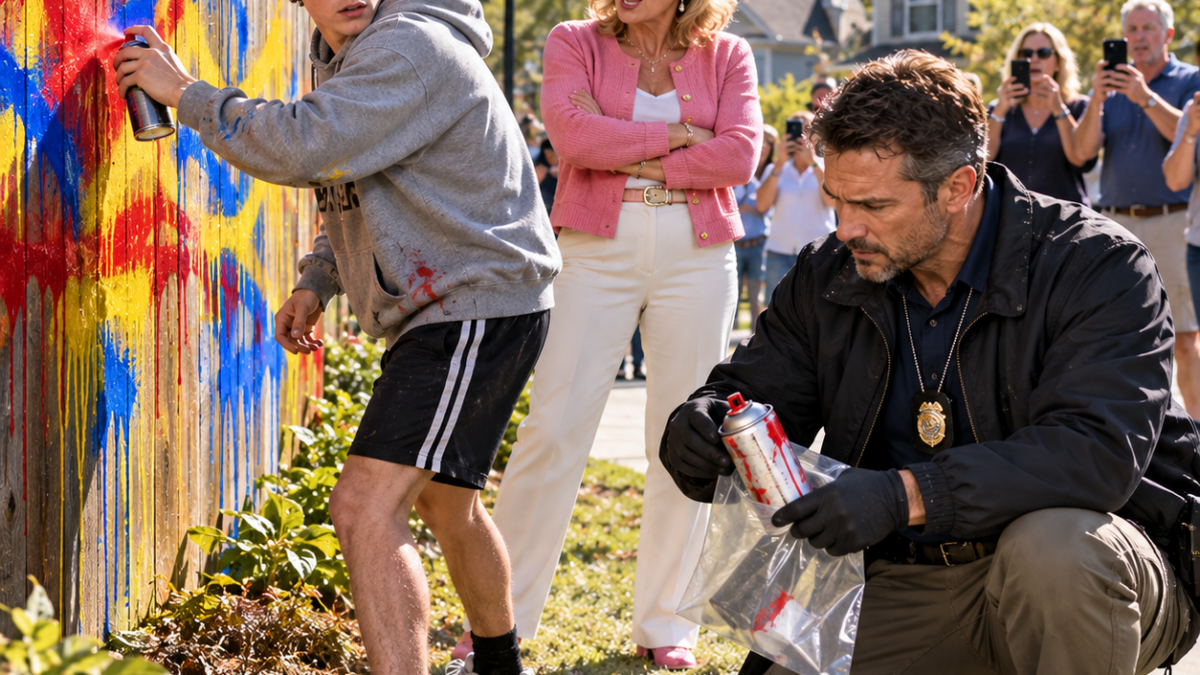
HOA Karen Sent Her Son to Spray-Paint My Fence—She Had No Idea I Was the Detective Hunting the Same Vandal Across Three Neighborhoods.
PART2:
My daughter Grace was twenty and away at college.
The divorce had been civilized, which is another way of saying expensive but not destructive.
My ex-wife and I remained on good terms.
Grace stayed with me when she came home.
The house was more space than one person needed, but I liked it.
I had bought it because of the backyard.
Large oak near the patio.
Small vegetable garden.
Room for a fire pit.
And along the rear and east boundary, a cedar privacy fence.
Six feet high.
Installed by the previous owner.
By the eighth year, the cedar had faded from warm honey brown to a silvery gray.
It wasn’t rotting.
No broken sections.
No leaning posts.
Nothing structurally wrong with it.
It just looked old.
I knew.
I had already bought stain.
Saturday was on my calendar.
Pressure wash Friday evening.
Let it dry overnight.
Stain Saturday afternoon.
My idea of a relaxing weekend had changed dramatically since my twenties.
Karen Whitmore had other ideas.
Karen lived directly across the street.
Early fifties.
PART3:
HOA president for three years.
She wore fitted cardigans, immaculate white sneakers, and carried a clipboard even when no meeting was occurring within a five-mile radius.
Some people carry authority naturally.
Karen carried office supplies.
She had been on the board almost from the moment she moved into Brookhaven.
Nobody could explain exactly why.
Maybe she enjoyed organizing things.
Maybe she liked rules.
Maybe she genuinely believed communities needed someone paying attention.
At first, I gave her the benefit of the doubt.
I’ve known good HOA presidents.
Unpopular job.
Neighbors want landscaping maintained but don’t want assessments increased.
They want rules enforced on the house next door but flexibility when the rule reaches their own driveway.
You’re never making everybody happy.
So when Karen reminded people about trash cans or parking, I didn’t automatically assume she was a tyrant.
Then I watched her long enough.
Patterns matter.
She had favorites.
The Dunlaps could leave their camper in the driveway for a week.
No problem.
Mrs. Rosales left hers overnight before a trip.
Violation letter.
Karen’s friend Diane repainted her front door without submitting a color request.
No issue.
A young couple at the corner used almost the same shade.
Formal notice.
She had a habit of turning personal preferences into phrases like:
“Community expectation.”
“Neighborhood standard.”
“Board direction.”
Those phrases sounded official until you asked where they were written.
Then the answer became complicated.
I rarely challenged her because she rarely bothered me.
My lawn was maintained.
Truck parked legally.
No illegal structures.
No barking dog.
No decorative stone frog large enough to trigger architectural review.
Then the fence faded.
Karen noticed.
Of course she did.
I came home one Thursday around five-thirty after ten hours at work.
Long day.
Two interviews.
One search-warrant return.
Forty minutes spent trying to explain to a prosecutor why “I just knew he did it” was not a substitute for probable cause.
I parked.
Grabbed my bag.
Had one foot on the porch when I heard:
“Daniel.”
I looked.
Karen crossing the street.
Clipboard under arm.
She stopped in my driveway.
“Evening.”
She didn’t waste time.
“Your fence.”
I glanced toward the backyard.
“What about it?”
“It has become unsightly.”
“It’s cedar.”
“It’s gray.”
“Cedar does that.”
She did not smile.
“We’ve received complaints.”
“From who?”
“I don’t disclose complainants.”
“Okay.”
“You need to repaint it.”
“It’s being stained Saturday.”
“What color?”
“Natural cedar.”
Her face tightened.
“Brookhaven’s approved exterior palette doesn’t include natural cedar.”
I almost laughed.
“It’s a wood fence.”
“Still visible from common areas.”
“Not a common area.”
“The side section is visible from sidewalk.”
“About twenty feet.”
“That is sufficient.”
I looked at clipboard.
“Show me the rule.”
“I don’t carry full declaration with me.”
Of course not.
“But architectural standards require exterior materials to remain consistent with neighborhood appearance.”
“Fence was here before I bought house.”
“That doesn’t exempt maintenance.”
“I agree.”
That caught her.
“I’m staining it.”
“You need color approval.”
“No.”
Her eyes narrowed.
“Excuse me?”
“Fence has always been natural cedar. I’m restoring existing finish.”
“You still need approval.”
“Send me section.”
She shifted.
“Daniel, this doesn’t have to become difficult.”
I looked at her.
“It isn’t difficult.”
“You submit request.”
“I stain fence.”
“If board denies?”
“Then board can explain what authority it thinks it has to make me paint natural wood a different color.”
Her mouth became line.
“You’re being combative.”
“No.”
“You know, cooperation is part of community living.”
“So is written rule.”
That ended conversation.
The next morning, a violation notice was taped to my front door.
Not mailed.
Taped.
DETERIORATED EXTERIOR BOUNDARY STRUCTURE.
Ten days to correct.
Possible fine:
$100 per day.
I took photograph before removing.
Then checked governing documents.
Fence maintenance requirement existed.
Reasonable.
Keep structures in good repair.
No requirement to paint cedar.
Architectural color approval applied to new installations and changes.
Restaining same natural wood wasn’t listed.
I sent email:
Fence scheduled for maintenance Saturday. Please identify specific written requirement for color approval on existing cedar fence.
No response.
Saturday I pressure washed.
Sunday morning I stained.
Natural cedar.
Looked good.
Karen walked by twice.
Did not speak.
I assumed conflict over.
It wasn’t.
Two weeks later came another letter.
NONAPPROVED EXTERIOR COLOR TREATMENT.
$250 fine.
I appealed.
At HOA meeting, board voted three to two to waive.
Karen voted against.
Her explanation:
“Mr. Mercer has shown pattern of resistance.”
I had challenged exactly one fence notice.
Patterns really are in eye of beholder.
The issue should have died.
Then vandalism started.
Not mine.
At first.
The first complaint reached my desk because county property-crime unit had an unusually slow Tuesday.
Ridgeview Estates.
About four miles east.
A homeowner woke to find red spray paint across newly installed white vinyl fence.
Not graffiti words.
No symbols.
Just broad fans of paint.
Red.
Yellow.
Blue.
Random-looking strokes.
But expensive.
Three fence panels ruined.
Then another home six days later.
Same neighborhood.
Wooden side gate.
Same colors.
Third attack in Laurel Pines.
A retaining wall and garage side door.
Same color combination.
Fourth in Cedar Hollow.
A freshly painted privacy fence.
Red, yellow, blue.
At first patrol reports treated them as unrelated vandalism.
Teenagers.
Prank.
Neighborhood dispute.
Then one patrol officer, Jessica Moore, noticed photographs.
She came to my desk.
“Does this look familiar?”
I spread reports.
Same fan shape.
Same colors.
Same height.
Same overspray pattern.
Maybe nothing.
Maybe something.
Property crimes are full of coincidences.
Most vandalism does not require detective.
But three neighborhoods.
Similar target types.
Similar paint.
Similar nighttime window.
Several victims recently involved in HOA disputes.
That caught my attention.
I started a working file.
Not major task force.
Just me and Jessica when time allowed.
First victim, Tom Alvarez, had argued with his HOA about replacing a dead tree.
Second, Nina Cho, refused to remove solar panels installed before board changed.
Third, retired Marine named Frank Dwyer challenged a special assessment.
Fourth family appealed a fine over children’s play structure.
Different HOAs.
Different boards.
Yet each said something similar.
Before vandalism, someone connected to HOA had warned:
“People who don’t cooperate create problems.”
Not enough.
Could be psychological pattern.
Victims see connection after bad event.
We pulled camera footage.
One doorbell camera captured person at 2:11 a.m.
Hood.
Mask.
Dark pants.
Backpack sprayer or handheld pressurized paint unit.
Not standard aerosol can.
Movement young.
Athletic.
Vehicle parked beyond view.
Another camera caught partial tire.
Nothing.
A grocery store camera near Ridgeview captured black crossover at relevant time.
Common model.
Plate obscured by glare.
We asked paint stores about bulk purchases.
No immediate lead.
We compared paint.
Preliminary lab said common exterior acrylic.
Red and yellow available widely.
Electric blue less common but not rare.
What interested me was application.
Pressure sprayer.
Broad fan nozzle.
Each attack began with test burst near ground.
Then sweeping diagonal motions.
Left to right.
Same hand likely.
I put photographs side by side.
Not proof.
Pattern.
Jessica said:
“Somebody has style.”
“Don’t flatter him.”
“Him?”
“Statistically.”
“Or woman.”
“Fine.”
She leaned over.
“Why HOA victims across different neighborhoods?”
That was question.
We checked management companies.
There.
All three HOAs used same property-management firm.
BrightLine Community Management.
Brookhaven did too.
Interesting.
BrightLine organized quarterly regional workshops for volunteer HOA boards.
Architectural enforcement.
Collections.
Vendor management.
Karen attended.
Not criminal.
Hundreds attended.
Still.
We asked BrightLine if anyone had complained about vandalism.
They were surprised.
Then defensive.
No known connection.
Fine.
I did not mention Karen.
No reason.
Not yet.
Then another attack.
Ridgeview homeowner who had sued HOA.
Same paint.
This time security camera captured vehicle more clearly.
Black Toyota RAV4.
2017 to 2021 generation.
Temporary-looking paper tag or covered plate area.
Driver wore white-soled shoes.
Passenger maybe.
We issued bulletin.
Nothing.
Two months.
Five confirmed attacks.
Possibly two others.
No one injured.
Property damage around $14,000.
Serious enough.
Not priority compared with violent crime.
Still mine.
Then Friday afternoon, I got stuck in court longer than expected.
Not my case originally.
Prosecutor needed testimony on recovered electronics from burglary case.
By time I left courthouse, phone had nineteen notifications.
Three missed calls from neighbor, Mark Ellis.
Two from Mrs. Rosales.
One text from Grace:
Dad are you seeing neighborhood group??
I was not.
Then Mark sent photo.
My fence.
Red.
Yellow.
Electric blue.
Across entire side section.
For maybe five seconds, I sat in courthouse parking lot staring at image.
Not angry first.
Recognition.
Same fan.
Same pattern.
Same blue.
Then another photo.
Tyler Whitmore.
Karen’s son.
Holding a pressurized paint sprayer.
Standing in my yard.
I called Mark.
“What happened?”
He answered immediately.
“You need to get home.”
“Is Tyler still there?”
“No. He left sprayer by your gate.”
“Karen?”
“Across street.”
“Anyone touch anything?”
“I told people not to.”
Good neighbor.
“Police called?”
“Mrs. Rosales called.”
“Good.”
“Daniel, Karen says HOA authorized it.”
“Don’t argue.”
“Too late.”
“Mark.”
“Fine.”
I called dispatch.
Identified myself.
Requested responding patrol treat as property crime and preserve scene until I arrived, but emphasized I was victim and would not investigate formally.
Important.
You cannot be investigator in your own case.
Conflict.
Department policy.
I could document what I personally observed, preserve immediate evidence, provide my prior case context, but another investigator would take lead.
I called my sergeant.
He answered:
“What now?”
“My house got hit.”
“Hit how?”
“Same paint vandalism.”
Silence.
Then:
“No.”
“Yes.”
“Are you sure?”
“Photos.”
“Suspect?”
“Neighbor’s nineteen-year-old son apparently seen doing it.”
Longer silence.
“Daniel.”
“I know.”
“You are not handling this case.”
“I know.”
“I’m assigning Benton.”
Detective Alicia Benton.
Good.
Calm.
Thorough.
Would not care whose feelings got hurt.
Perfect.
“Prior vandalism file?”
“I’ll transfer.”
“Do not interview anyone beyond spontaneous statements.”
“I know.”
“Do not search anything.”
“I know.”
“Do not be cop in driveway.”
That one harder.
“Fine.”
When I turned onto Brookhaven Court, half neighborhood was outside.
People love crime scene if crime isn’t theirs.
Three phones pointed at my driveway.
Karen stood across street.
Arms folded.
White sneakers.
Cardigan.
Tyler nowhere visible.
My cedar fence looked like circus accident.
Red across center.
Yellow angled.
Electric blue sweeping over top rails.
Paint dripped onto grass.
A pressurized garden sprayer lay near side gate.
Not typical paint gun.
Pump sprayer modified nozzle.
Exactly type we suspected.
My stomach went cold.
Not anger.
Case.
Officer Moore was there.
Jessica.
She saw me get out.
“Of course it’s you.”
“Good to see you too.”
“You’re victim today.”
“I know.”
“Hands out of pockets.”
I laughed despite.
“That’s not rule.”
“It’s my rule.”
Patrol officer already had yellow tape near side yard to keep neighbors out.
I stopped at curb.
Looked.
Footprints in damp soil.
White-soled athletic shoes pattern.
Sprayer.
Disposable gloves near shrub.
Small paint droplets along sidewalk leading toward street.
I took phone photographs from public point before anybody moved things.
Jessica said:
“You cannot help yourself.”
“I’m documenting personal property.”
“You sound like detective.”
“I am detective.”
“Not today.”
Fair.
Karen approached.
She did not wait to be asked.
“I want this documented correctly.”
Jessica turned body camera toward her.
“Ma’am, we’ll take statement.”
“This is an HOA maintenance matter.”
I said nothing.
She looked at me.
“Daniel knows.”
I still said nothing.
Jessica:
“Ms. Whitmore, who painted fence?”
“My son assisted with compliance.”
Assisted.
Great word.
“Did owner give permission?”
Karen looked at me.
“He received repeated notice.”
Jessica:
“That’s not what I asked.”
“HOA has right to cure unresolved exterior violations.”
I almost interrupted.
Didn’t.
Three neighbors’ phones were recording.
Jessica’s body camera too.
Karen continued.
“Tyler was improving property at association direction.”
“Who directed him?”
“I did.”
There.
Not enough for wider vandalism.
More than enough for mine.
Jessica:
“Did board vote?”
“The president has enforcement discretion.”
“Do you have document?”
Karen raised chin.
“I can provide.”
“Did Mr. Mercer authorize entry into yard?”
“No, but—”
“Did he authorize painting fence?”
“No.”
“Did he approve colors?”
Karen hesitated.
Then:
“The colors were intended to make point.”
That changed room.
Even she heard it.
Jessica:
“What point?”
“That allowing deteriorated property affects everyone.”
My fence was freshly stained.
Everyone could see.
Karen realized perhaps she had gone too far.
“The paint can be removed.”
No.
Likely not without sanding or panel replacement.
Jessica kept neutral.
“Where is Tyler?”
“At home.”
“Which home?”
“Mine.”
Across street.
Another patrol unit had already gone.
Karen looked at me.
“You could have avoided this.”
I felt anger then.
Not explosive.
Clean.
I said:
“Don’t talk to me.”
She smiled thinly.
“You’re the one who turned fence into neighborhood spectacle.”
Mark Ellis actually laughed.
Karen glared.
I walked toward my porch.
Waited for Benton.
Alicia arrived forty minutes later.
Unmarked sedan.
Dark suit despite heat.
She looked fence.
Then me.
“Congratulations.”
“For?”
“You finally got suspect with eyewitnesses.”
“Not funny.”
“A little.”
She turned serious.
“You touched anything?”
“No.”
“Photographs?”
“From curb.”
“Send.”
“Prior file transfer ready.”
“Good.”
She looked at sprayer.
“Same type?”
“Looks like.”
“Stop.”
I raised hands.
“Right. Sorry.”
She smiled.
“Go inside.”
“No.”
“Daniel.”
“It’s my house.”
“Porch.”
Fine.
Grace called.
I answered.
“Dad, are you okay?”
“It’s paint.”
“People online say Karen sent Tyler.”
“Looks that way.”
“Why would she do that?”
“Because some people confuse being in charge with being right.”
“Can I post?”
“No.”
“Dad.”
“No.”
“But—”
“Grace.”
She sighed.
“You’re no fun.”
“Correct.”
By evening Tyler was interviewed with mother present initially, then separately after consent and legal advice.
He was nineteen.
Adult.
Not child.
He admitted painting my fence.
Claimed Karen told him board had authority.
Claimed colors chosen because leftover from “community mural supplies.”
That sounded ridiculous.
Search? Not immediately.
Benton worked properly.
She requested consent to look at shoes.
Tyler refused.
Fine.
She documented.
Requested warrant later based on eyewitness accounts, video, Karen’s admission, sprayer, and links to open vandalism cases.
Because my prior investigation created conflict, another judge reviewed full affidavit through different detective.
Warrant approved.
The next morning, officers searched Whitmore garage and Tyler’s black Toyota RAV4.
They found paint.
Not surprising after known offense.
Three gallon cans.
Red.
Yellow.
Electric blue.
Pump sprayer nozzles.
Dark hoodie.
Disposable gloves.
White-soled shoes with tread pattern visually consistent with several scenes.
More important:
Receipts.
Dates.
A notebook.
And one external hard drive.
That part changed everything.
Tyler apparently filmed things.
Not every attack.
Enough.
GoPro clips.
Phone videos.
Quick recordings from vehicle.
Why?
At nineteen, bad decisions often want audience.
Some clips had been sent to private group chat.
He called vandalism “corrections.”
One video from Ridgeview showed him spraying white fence at 2:07 a.m.
Someone behind camera whispered:
“Karen says this lady’s been fighting board for months.”
Benton paused playback.
Everyone in conference room went still.
“Karen?”
Could be another Karen.
But context.
Voice?
Male.
Likely friend.
Another clip.
Tyler laughing:
“Mom’s gonna love this.”
That did not prove she ordered that specific attack.
But changed direction.
Then group chat.
Tyler and three friends.
One named Brayden.
One Cole.
One username unconfirmed.
Messages:
Any new problem houses?
Mom says Ridgeview has another one.
Do we get blue?
Always blue.
BrightLine list?
There.
BrightLine.
We subpoenaed records and devices properly.
Tyler had apparently gained access to documents through Karen.
Karen served on Brookhaven board and attended BrightLine regional leadership meetings.
BrightLine maintained lists of enforcement disputes for client boards.
Not publicly shared across communities normally.
But one employee, Melissa Grant, ran a regional volunteer-president group chat where board officers exchanged “problem owner” experiences.
Not official.
Sloppy.
Screenshots.
Names.
Addresses.
Complaints.
Karen participated heavily.
Messages from her:
Sometimes people need to see what noncompliance actually looks like.
Not a crime alone.
Then Tyler’s messages referenced addresses shortly after Karen discussed them.
Benton called me into office only as prior case investigator to identify which open cases matched.
I did.
Then left.
No involvement in interviews.
Hardest part of being detective is stepping back when case becomes yours.
You know exactly what question should come next.
You don’t ask.
Alicia did.
Better, maybe.
Karen obtained attorney by day two.
Stopped talking.
Smart.
Tyler’s attorney pursued plea discussions early.
Also smart.
But before silence, Karen had already given officers and three neighbors a beautiful recorded statement:
She ordered Tyler to paint my fence.
Colors intended to “make a point.”
She believed HOA could “cure” property.
That alone supported criminal mischief and trespass-related exposure.
The broader cases required more.
Forensics helped.
Paint batches.
Receipts.
Video timestamps.
Vehicle location data obtained by warrant.
Phone location history.
Toll records.
Camera footage.
Shoe impressions.
Group-chat messages.
No single magical clue.
Cases rarely hinge on one genius moment.
They are ropes.
Many fibers.
One fiber weak.
Together strong.
Tyler was placed at four of six confirmed scenes with digital and video evidence.
Another friend, Brayden, at two.
Cole drove once.
The seventh suspected attack turned out unrelated teenager.
Good reminder not to force pattern.
We removed it.
Another incident lacked evidence and remained open.
Karen’s involvement was harder.
She denied ordering any vandalism beyond my fence.
Her attorney claimed Tyler interpreted her complaints independently.
For Ridgeview, Laurel Pines, Cedar Hollow, she had attended regional HOA discussions but no proof she specifically told him:
Go vandalize.
Then investigators found voice notes.
Tyler had saved mother messages because apparently young people save everything.
One:
“I’m tired of these homeowners thinking they can ignore the board. If somebody wants ugly, maybe give them ugly.”
Ambiguous.
Another:
“Don’t do anything stupid.”
Helpful to defense.
Then a later one:
“Not the front where camera catches you. Side fencing.”
That wasn’t ambiguous.
Benton played it twice.
Her sergeant said:
“Well.”
There it was.
Not every attack.
At least one.
Then financial.
Karen purchased sprayers using HOA reimbursement once.
Description:
landscape maintenance equipment.
Brookhaven paid $86.41.
Small amount.
But public/community funds purchasing tool used in vandalism?
Bad.
She claimed sprayer originally used for weed treatment and Tyler borrowed.
Possible.
Then board records showed no approval for paint.
Fine.
Criminal case did not need HOA scandal, but HOA scandal came anyway.
News spread.
Local station:
COUNTY DETECTIVE’S HOME VANDALIZED; HOA PRESIDENT’S SON ARRESTED IN REGIONAL PROPERTY-DAMAGE CASE
I hated headline.
Made it sound personal operation.
I declined interview.
Department spokesperson handled.
Karen temporarily stepped down from board.
Her supporters insisted witch hunt because I was detective.
That was why Benton assignment mattered.
Why I didn’t interview.
Why independent prosecutor screened.
Why every warrant disclosed my status as victim and prior investigator.
Transparency is defense.
At emergency HOA meeting, clubhouse packed.
I went because homeowner, not cop.
Sat back.
No uniform.
No badge.
Board vice president, Linda Perez, chaired.
Karen absent.
Tyler absent.
Linda looked exhausted.
“We need address what association did or did not authorize.”
Residents yelled.
One:
“Did board send that kid onto Daniel’s property?”
“No.”
“Did Karen?”
“Apparently.”
“Using HOA authority?”
“Board did not vote.”
Another:
“Did HOA pay for paint?”
Linda:
“We are auditing expenditures.”
Karen’s friend Diane stood.
“This is being blown out of proportion. It’s paint.”
Mrs. Rosales turned.
“It was my house next?”
Diane frowned.
“What?”
“If board president can send son to damage property she dislikes, why am I safe?”
Exactly.
Power abuses spread when normalized.
Mark Ellis stood.
“I filmed Karen admitting it.”
A few people applauded.
Linda raised hand.
“Please, no.”
Good.
Not trial by clubhouse.
She announced outside counsel review.
Property manager BrightLine suspended Karen’s access pending board investigation.
Then something unexpected.
BrightLine fired Melissa Grant.
The employee who ran informal regional president group.
Not because she ordered vandalism.
No evidence.
Because she shared owner enforcement information across unrelated associations without clear need, creating privacy and governance problem.
Company audited.
Other HOAs freaked.
Residents in Ridgeview and Laurel Pines learned board officers had been discussing them casually across communities.
Civil complaints followed.
The criminal case became catalyst.
But I tried not to turn Karen into mastermind of statewide HOA conspiracy.
She wasn’t.
She was a woman who enjoyed authority and failed to distinguish:
Talking about a difficult homeowner.
From encouraging retaliation.
Tyler enjoyed vandalism.
Friends joined.
Karen’s comments gave moral permission.
In at least two instances, evidence suggested direct encouragement.
My fence was explicit.
Others varied.
Prosecutor charged carefully.
Tyler faced multiple criminal-mischief counts, trespass counts, conspiracy on incidents involving friends.
Karen faced solicitation/encouragement-related charges tied to two supported incidents, plus criminal mischief/trespass involvement at my house depending state statute.
I’m deliberately not pretending exact statutes mattered to me personally.
Prosecutors did.
I cared about proof.
Tyler was not some hardened criminal.
That’s important.
Nineteen.
Community college dropout.
Working part-time at tire shop.
Lived with mother.
No serious record.
One juvenile shoplifting incident.
He liked attention.
Liked spray rigs.
Liked feeling like he was enforcing something.
Benton told me after interview:
“He talks like your neighbor.”
“Karen?”
“Uses same phrases.”
Community standards.
Corrective action.
Problem owners.
Compliance.
Children learn language of authority before they understand responsibility.
Karen called people “problem homeowners.”
Tyler turned them into targets.
Doesn’t excuse.
Explains.
My daughter Grace came home that weekend.
She stood at fence.
“Wow.”
“Yep.”
“This looks terrible.”
“Thank you.”
“Can I paint something over it?”
“No.”
“You’re replacing?”
“Insurance.”
She turned.
“Are you mad?”
“Yes.”
“You don’t look.”
“Occupational disease.”
She studied.
“You knew it was him when you saw it?”
“I suspected.”
“From paint?”
“Pattern.”
“That’s creepy.”
“What?”
“That you can recognize vandalism style.”
“Useful creepy.”
She walked fence.
Then said:
“Do you feel stupid?”
I looked.
“Why?”
“You were investigating this guy and he lived across street.”
Good question.
“Yes.”
She smiled.
“Really?”
“Absolutely.”
Detectives miss things.
Real ones admit.
“I had no reason to focus on Tyler before.”
“But Karen?”
“Still no evidence.”
“You said suspects often hide in plain sight.”
“Sure.”
“So?”
“So hindsight is a liar.”
She thought.
“Meaning?”
“After you know answer, clues rearrange themselves and look obvious.”
I pointed fence.
“Before this, Tyler was one of thousands young men with black crossover and access to paint.”
“After?”
“He was neighbor.”
Exactly.
Grace nodded.
“Still creepy.”
Fair.
Insurance assessor said cedar could not be restored uniformly without aggressive sanding likely damaging boards.
Replacement of affected panels recommended.
I insisted preserve several sample sections until case concluded.
Then fence repaired.
Same natural cedar.
Karen’s supporters complained new wood color didn’t match old.
I laughed for full minute.
Nobody fined me.
Trial didn’t happen immediately.
Tyler negotiated plea.
He agreed responsibility for four incidents.
Restitution.
Probation.
Community service.
Counseling.
Restricted contact with victims.
No jail beyond brief pretrial custody.
Some victims wanted prison.
Frank Dwyer especially.
“He came on my property at night.”
“I know.”
“He should sit.”
I said:
“That’s your right to feel.”
“What do you think?”
I was careful.
“I think judge has more information than I do.”
Frank grunted.
“You’re a cop.”
“Today I’m victim.”
He didn’t like answer.
But later thanked.
Tyler’s plea required allocution.
He admitted he thought it was funny.
Then admitted mother sometimes described residents as people who “needed lesson.”
For my house, she directly told him to paint fence.
Why red, yellow, blue?
“Because she said if he insists on natural color, give him color.”
That sentence made Grace furious.
“She did all this over fence stain?”
“No.”
“Sounds like yes.”
“It was about control.”
Same in many conflicts.
Surface issue rarely issue.
Karen did not plead immediately.
She fought.
Claimed Tyler exaggerated to reduce sentence.
Claimed she meant chalk.
Claimed she thought HOA had “self-help maintenance authority.”
Her attorney found covenant provision allowing association to cure certain maintenance failures after notice and charge owner.
That was real.
But procedure required board authorization, written notice, licensed vendor, reasonable access, and actual maintenance.
Not spray-painting random colors as retaliation.
Her own recorded words killed good-faith argument:
“The colors were intended to make point.”
Self-help maintenance doesn’t usually use electric blue to make point.
Civil HOA consequences came first.
Forensic audit found Karen had submitted reimbursements without full receipts.
Nothing massive.
$3,800 questionable over three years.
Some legitimate event supplies.
Some not.
Board removed her.
Then special election.
She ran again.
I couldn’t believe.
Campaign flyer:
RESTORE ORDER TO BROOKHAVEN
Mark put one on my porch as joke.
Grace wrote:
ORDER = BLUE PAINT?
I threw away before drama.
Karen got nine votes.
Lost.
Linda Perez became president.
First thing she did:
“Daniel, can we discuss your fence?”
I stared.
She laughed.
“Kidding.”
Good leader.
Karen’s criminal case reached plea just before trial.
Prosecutor offered reduced counts if she admitted directing my fence vandalism and one Ridgeview incident, compensated victims, accepted probation, relinquished HOA office during term, performed community service.
She refused first.
Then Tyler was prepared to testify.
So was Brayden.
Video.
Voice note.
She accepted.
At plea hearing, judge asked:
“Ms. Whitmore, did you instruct your son to apply paint to Mr. Mercer’s fence without his consent?”
Long pause.
“Yes.”
“Why?”
Her attorney whispered.
Judge:
“You may answer if you wish, but not necessary beyond factual basis.”
Karen did answer.
“Because he refused to comply.”
There.
Still.
Not:
Because I made mistake.
Because I was angry.
Because I wanted embarrass him.
Because he refused to comply.
Judge asked:
“Comply with what?”
“Association standards.”
Prosecutor said:
“Your Honor, there was no valid violation outstanding at date.”
Karen turned.
“It had been waived on technicality.”
I almost admired persistence.
Judge did not.
“Ms. Whitmore, this court is not resolving your HOA disagreement. It is determining whether you intentionally caused property damage.”
“Yes.”
She accepted.
Sentence:
Probation.
Restitution.
Community service.
Fine.
No prison.
Anger online.
People wanted dramatic.
But nobody injured.
No serious prior record.
Property offenses.
Evidence.
Plea.
That is system.
I was okay.
Restitution covered deductible and repairs not insurance.
I donated my portion beyond actual costs to local youth diversion program.
Not because saint.
Because I didn’t want her money sitting in account.
Tyler completed community service partly with county parks, painting over graffiti.
Irony obvious.
Court chose it intentionally maybe.
He also enrolled trade program.
Two years later, I heard he moved to another state.
Worked commercial painting.
Life has humor.
Karen stayed across street another fourteen months.
That was awkward.
Imagine checking mail while woman who ordered your fence painted checks hers.
We did not speak.
Protective no-contact limited harassment, not ordinary presence.
She avoided.
I avoided.
Her house eventually listed.
Grace saw sign.
“Should we make offer?”
“No.”
“Turn it into evidence museum.”
“No.”
“You have no vision.”
She sold.
New family.
Two kids.
Golden retriever.
Normal returned.
That was victory.
Not conviction.
Normal.
My wider vandalism investigation closed with four solved attacks tied Tyler/group, one solved separate offender, one unsolved.
People expected every case linked.
Reality resists neatness.
We cleared what evidence supported.
Didn’t force rest.
Benton got commendation from department.
She hated.
I gave speech at briefing:
“Detective Benton demonstrated value of keeping conflicted investigator away from his own case.”
She flipped me off discreetly.
Professional friendship.
Jessica Moore got recognition too because she connected photos initially.
No lone-genius detective.
Again, real cases are teams.
One patrol officer noticed pattern.
One analyst pulled vehicle data.
Lab compared paint.
Warrants.
Neighbors recorded statements.
Victims kept receipts.
Tyler saved videos because he was nineteen and apparently allergic to discretion.
Karen talked too much.
Everyone contributed.
Months after case, I found old working board from before my fence.
Photos pinned.
Red.
Yellow.
Blue.
Ridgeview.
Laurel Pines.
Cedar Hollow.
In corner, one sticky note:
Possible HOA-related retaliation?
I stared.
Karen lived across street whole time.
Hindsight again.
Could I have caught sooner?
Maybe.
Would different move expose?
Unknown.
Detective ego wants believe every crime solvable if smart enough.
Not true.
Evidence arrives when it arrives.
Humility matters.
I brought board to shred.
Then stopped.
Kept one photo.
Not as trophy.
Training.
At academy in-service, I taught property-crime class later.
Showed image without names.
Asked detectives:
“What do you see?”
They said paint.
Fence.
Multiple colors.
Pattern.
Then gave five case photos.
Someone recognized same fan.
Lesson:
Consistency can identify behavior.
Then I showed my fence.
Class laughed when I told suspect was neighbor.
I said:
“Laugh. Then remember proximity isn’t evidence until it is.”
One rookie asked:
“Did you arrest him yourself?”
“No.”
“Why?”
“I was victim.”
“But you could.”
“Legally maybe under some circumstances. Professionally wrong.”
Another:
“Did you interrogate mom?”
“No.”
“Why not?”
“Same reason.”
I paused.
“Winning case isn’t about getting to be hero. It’s about making case survive scrutiny.”
That’s worth remembering.
Especially when personal.
Karen had spent years treating authority as personal possession.
I refused to do same with badge.
That’s distinction I cared about most.
One afternoon Linda Perez knocked.
New HOA president.
No clipboard.
Good sign.
She carried folder though.
I laughed.
“What?”
“Nothing.”
She said board reviewing self-help maintenance clause.
“We want remove.”
“Why?”
“Too easily abused.”
“Maybe don’t remove.”
She looked surprised.
“Why?”
“Association may need emergency lawn cut on abandoned property or repair common-facing hazard.”
“So?”
“Add safeguards.”
Board vote.
Notice.
Licensed vendor.
Photographic documentation.
No family members.
No punitive alterations.
Owner appeal.
She nodded.
“You want to help draft?”
“No.”
“Why not?”
“I want hobbies.”
“What hobby?”
“Fence staining.”
She laughed.
They revised rule.
Good.
Karen’s abuse did not require deleting all authority.
Requires controls.
Again.
Institutions can learn.
Brookhaven changed more subtly.
People challenged board without fear.
Meetings better attended.
Minutes clearer.
Enforcement matrix standardized.
Same violations same treatment.
Complaints anonymized but tracked.
Board members recused for friends.
Not perfect.
Better.
Diane, Karen’s friend, eventually apologized to Mrs. Rosales for double standard.
Human beings can change.
Not all.
Some.
My fence aged again.
Cedar always does.
Five years later gray returned.
Linda was no longer president.
New board sent generic maintenance reminder to all fence owners.
I got one.
I laughed.
Grace, now twenty-five, visiting.
“You gonna arrest them?”
“Very funny.”
“Paint it electric blue.”
“Leave my house.”
I restained.
Natural cedar.
No approval problem.
Progress.
My daughter became public defender.
I blame genetics.
At law school she said vandalism case influenced her.
I assumed toward prosecution.
Wrong.
She told me:
“Watching Tyler scared and stupid made me realize people can do bad thing without being permanently bad.”
That made me proud.
Complicated pride.
She represented young defendants later.
We argued constantly.
Healthy.
She once defended graffiti charge.
Called me for paint pattern science.
I said:
“I cannot consult on active case.”
“Dad.”
“Ethics.”
“You’re retired.”
“Still.”
She hung up.
Good.
I retired at fifty-eight.
Small ceremony.
Benton brought miniature pump sprayer painted red/yellow/blue.
I nearly killed her.
Plaque:
DANIEL MERCER — FINALLY SOLVED THE CASE ACROSS THE STREET
Everyone laughed.
I kept it.
In garage.
Not visible from street.
HOA might object.
On final day chief asked what case I remembered most.
People expected homicide.
Kidnapping.
Big burglary ring.
I thought.
“Fence vandalism.”
He laughed.
“Seriously?”
“Yes.”
“Why?”
“Because it reminded me badge doesn’t make you exempt from being human.”
He looked confused.
I explained.
“When crime hits you personally, you want certainty faster.”
“You want confrontation.”
“You want to use what you know.”
“The job is to slow down.”
“Document.”
“Hand off.”
“Let another investigator tell you what evidence says, even if you think you already know.”
Chief nodded.
“That all?”
“No.”
“It also proved old Ford stereotypes work both directions.”
Wrong story.
We laughed.
Karen never contacted after moving.
I occasionally heard through neighborhood gossip.
She moved near sister.
No HOA board.
Probably wise.
Tyler sent letter once.
Not required.
Two years after plea.
Addressed:
Mr. Mercer.
I almost threw away.
Opened.
He wrote simple.
No excuses.
Said he had been angry at everyone because mother made every disagreement feel like disrespect.
Said he liked making “problem homeowners” upset.
Said filming made him feel powerful.
Said after arrest he realized he had never met several people whose property he damaged.
They were names his mom complained about.
He apologized.
Then:
I know saying sorry doesn’t fix your fence. I just wanted you to know I understand now that it wasn’t ours to touch.
That sentence.
I kept letter.
Did not reply for weeks.
Then wrote:
Thank you for taking responsibility. Build something better with the skills you have.
No lecture.
He apparently did.
Commercial painting.
Maybe foreman now.
Who knows.
People aren’t frozen at nineteen.
Karen’s lesson different.
I don’t know if she learned.
Not required for my peace.
For a while neighborhood story portrayed me as detective who trapped HOA Karen.
Wrong.
I didn’t trap.
She came to my house in daylight.
Her son painted fence.
Witnesses filmed.
She confessed motive.
That is not trap.
That’s consequence.
She didn’t know I was detective hunting same vandal.
True.
But I didn’t “catch her” because secret identity.
The prior case made pattern recognizable.
Her own behavior made case.
If I had been accountant, electrician, teacher, retired guy, damage still wrong.
That’s another reason I disliked viral version.
It suggested she picked wrong target because I was cop.
No.
She picked wrong action.
Would have been wrong against anyone.
People deserve property rights without secretly being detective.
Same principle I taught Grace.
Respect cannot depend on hidden credentials.
My badge made evidence processing familiar.
It did not create right to fence.
The cedar fence still stands.
Well, replacement panels.
Oak grew.
Garden became bigger after retirement.
Fire pit.
Grace visits.
Granddaughter now runs through yard.
Yes, granddaughter.
Time is rude.
She once saw photograph of painted fence.
“Grandpa, rainbow!”
“Sort of.”
“Pretty.”
I looked.
Kids destroy narratives.
“It was vandalism.”
“What is vandalism?”
“When someone damages something that isn’t theirs.”
She considered.
“Why?”
“Sometimes because they’re angry.”
“Did you get mad?”
“Yes.”
“Did you yell?”
“No.”
“Why?”
Good question.
“Because yelling wouldn’t clean fence.”
She nodded.
Then:
“Did Grandma yell?”
Grace, from patio:
“I absolutely did.”
There you go.
The old neighborhood group archived hundreds posts from incident.
I never read most.
People argued:
Karen hero.
Karen tyrant.
Daniel abused police.
Daniel saved neighborhood.
Tyler victim.
Tyler criminal mastermind.
All exaggerated.
Real people don’t fit comment threads.
Karen abused authority.
Tyler committed crimes.
I was angry.
Department handled conflict correctly.
Some HOA rules legitimate.
Some not.
Victims suffered real property damage but nobody’s life destroyed permanently.
Accountability happened.
Life moved.
That’s enough.
If I had one lesson for Brookhaven, it wasn’t “don’t mess with detective.”
I hate that lesson.
It encourages power worship.
Better:
Don’t use community authority to settle personal grievances.
And if someone does, preserve facts before emotions.
The day I pulled into driveway, everyone expected me to explode because they knew fence was mine.
Some maybe wanted spectacle.
Cop versus Karen.
Instead I took photographs.
Names.
Waited.
That’s not because I’m unusually calm.
Training.
I have exploded before.
Badly.
Divorce taught some.
Police work taught rest.
Anger is information.
Not instruction.
It tells boundary crossed.
It doesn’t tell next move.
Evidence does.
Law does.
Process does.
Sometimes those fail.
Then you adapt.
But start there.
One of the neighbors filming that day, seventeen-year-old Emily Park, later became journalism student.
She interviewed me for class years after.
“Why didn’t you tell Karen you were detective?”
“She knew law enforcement.”
“No, why didn’t you say you were investigating similar vandalism?”
“Because then I’d contaminate statements.”
She blinked.
“You wanted her to keep talking?”
“I wanted not interrupt spontaneous statement.”
“So you tricked her.”
“No.”
“I stood silent.”
“Isn’t that trick?”
“People aren’t entitled to warning that their volunteered words have consequences.”
She liked quote.
I immediately regretted.
She asked:
“When did you know Tyler did other attacks?”
“I didn’t.”
“But suspected.”
“Yes.”
“When?”
“The paint fan.”
“Like signature?”
“Pattern.”
“Could another person copy?”
“Yes.”
“So?”
“Suspicion starts question. Evidence answers.”
She used that as article title.
SUSPICION STARTS THE QUESTION. EVIDENCE ANSWERS.
Not bad.
I stole later.
At department training.
Full circle.
Brookhaven eventually stopped being known as paint neighborhood.
New families moved.
Some didn’t know.
A house sold across from mine.
Karen’s old house got blue front door.
Approved.
Grace found hysterical.
“You should file complaint.”
“No.”
“Electric blue.”
“Different blue.”
“You know shades?”
“Unfortunately.”
We sat porch one evening.
She asked if I ever missed being detective.
“Sometimes.”
“What part?”
“Solving.”
“What not?”
“Everything before and after.”
She understood.
Then looked fence.
“Do you miss Karen?”
I laughed.
“No.”
“Tyler?”
“No.”
“The case?”
“Sometimes.”
“Why?”
I thought.
“Because it was clear.”
“Clear?”
“Most cases, victims don’t know why.”
“Suspects don’t admit.”
“Evidence incomplete.”
“This one eventually lined up.”
She nodded.
“But one unsolved.”
“Yes.”
“Does that bother?”
“Always.”
Detectives live with shelves.
Cases that don’t close.
People who deserve answers.
You learn closure is privilege.
Fence case had plenty.
So maybe that’s why it remains.
One more thing.
Karen’s claim that HOA had right to “cure” violation did create legal review statewide among management firms.
Not law change.
Training.
BrightLine added policy:
No board member or relative may perform enforcement work at individual property.
No self-help correction without documented authorization.
No punitive color/material changes.
Common sense written because common sense failed.
That happens often.
Every absurd rule you see somewhere probably has ancestor.
Someone did thing.
Now sentence exists.
Brookhaven’s policy became jokingly called Mercer Rule.
I hated.
Officially:
Third-Party Remediation and Access Policy.
Boring.
Good.
A few years after retirement, Linda sent holiday card.
Inside:
Fence still compliant.
I wrote back:
For now.
Normal neighbor humor.
That’s community.
Not absence of conflict.
Ability to survive conflict without becoming enemies forever.
Karen couldn’t.
She interpreted disagreement as disobedience.
That worldview infected Tyler.
When she said:
“He refused to comply,”
she revealed everything.
Not fence.
Hierarchy.
She believed I owed obedience because board president told.
When I asked for written rule, she heard challenge.
When board waived fine, she heard humiliation.
When I stained fence anyway, she heard defiance.
Then retaliation felt righteous.
That is how petty authority becomes dangerous.
Not because person wakes villain.
Because each escalation is framed as protecting standards.
My job had taught me same about bigger crimes.
People narrate themselves as justified.
Thief:
“I deserved it.”
Assault:
“He disrespected me.”
Fraud:
“They would’ve cheated me.”
Karen:
“He refused to comply.”
Tyler:
“We were correcting problem properties.”
Language matters.
It anesthetizes conscience.
Call vandalism correction.
Call revenge enforcement.
Call favoritism discretion.
Then harm feels administrative.
That may be darkest part of an otherwise ridiculous story about blue paint.
I tell HOA boards now, when asked:
“Never let enforcement language hide human choice.”
Somebody chooses warning.
Fine.
Lien.
Entry.
Contractor.
Own choice.
Write who authorized.
Vote.
Record.
Transparency makes people slower.
Slow can be good.
If Karen had needed board vote to paint fence, imagine meeting.
“Motion to spray Daniel’s cedar red, yellow, and electric blue because he won’t obey.”
Second?
None.
Abuse thrives where authority can be vague.
The board fixed that.
I give them credit.
At seventy? Not yet.
I’m getting there.
Fence still.
Truck changed twice.
Oak huge.
Granddaughter thinks electric blue is best color.
She wants fence painted blue.
I told her HOA might object.
She said:
“Tell them Grandpa’s detective.”
I laughed.
Then corrected:
“Grandpa’s retired.”
“Same.”
“No.”
“Can you still arrest people?”
“No.”
“Then why badge in box?”
“Memory.”
She accepted.
Children know identity shifts easier than adults.
I was cop.
Now not.
Karen was president.
Then not.
Tyler was vandal.
Then painter.
People change roles.
What matters is whether they understand role never equals person.
Karen didn’t.
For three years, HOA president became identity.
Questioning decision meant questioning her.
Dangerous.
My badge could have done same.
Maybe sometimes it did when younger.
I hope less later.
The day fence became evidence reminded me.
When Alicia told me:
“Go inside. You’re victim.”
Part of me resisted.
I was detective.
Except I wasn’t in that case.
I was Daniel.
Homeowner.
Victim.
Witness.
And letting somebody else take over wasn’t weakness.
It was integrity.
That’s my favorite part now.
Not catching Tyler.
Being told to step back and doing it.
Authority includes knowing when you do not have it.
Karen never learned that until court forced her.
If she had, there would be no story.
One last detail.
The abandoned sprayer from scene sat in evidence for years.
After appeals expired, property disposal.
Benton called.
“Want it?”
“No.”
“Sure?”
“Yes.”
“Could mount.”
“You and Tom would get along.”
“Who?”
“Different nightmare.”
She laughed.
Sprayer destroyed per policy.
Good.
Some things don’t need souvenirs.
The fence is enough.
Every few years I stain.
Natural cedar.
Slow brush around posts.
Roller on boards.
No pressure sprayer.
That would be tempting fate.
Sometimes a neighbor walks by.
Waves.
Nobody comments.
Nobody asks color approval.
Nobody says community expectation.
Just fence.
Normal.
That is what I wanted before any of it.
Quiet enough to be boring.
And after seventeen years dealing with crimes built from anger, fear, greed, addiction, and people convincing themselves they had right to what wasn’t theirs, I still think boring may be one of the best things a neighborhood can become.
Because the afternoon Karen stood across the street watching her son cover my property in paint, she thought she was demonstrating authority.
What she actually demonstrated was the opposite.
Authority without limits is not authority.
It is impulse wearing a clipboard.
Tyler thought bright paint would teach me lesson.
It did.
Just not one they intended.
It reminded me that evidence speaks longer than anger.
That process matters most when you would rather skip it.
That a uniform, title, board seat, badge, or family relationship does not make somebody else’s property yours to “correct.”
And that sometimes the suspect you’ve been looking for is not hiding in an alley, motel, or distant neighborhood.
Sometimes he’s across the street.
Sometimes his mother is giving him instructions.
Sometimes half the block has a phone pointed at them.
And sometimes the smartest thing the detective can do is stop being the detective, stand quietly beside his ruined fence, and let everybody else keep talking.