HOA Karen Sent Her Husband to Steal My Late Father’s $45,000 Tractor—He Was Still Smirking When I Pulled Out My Badge
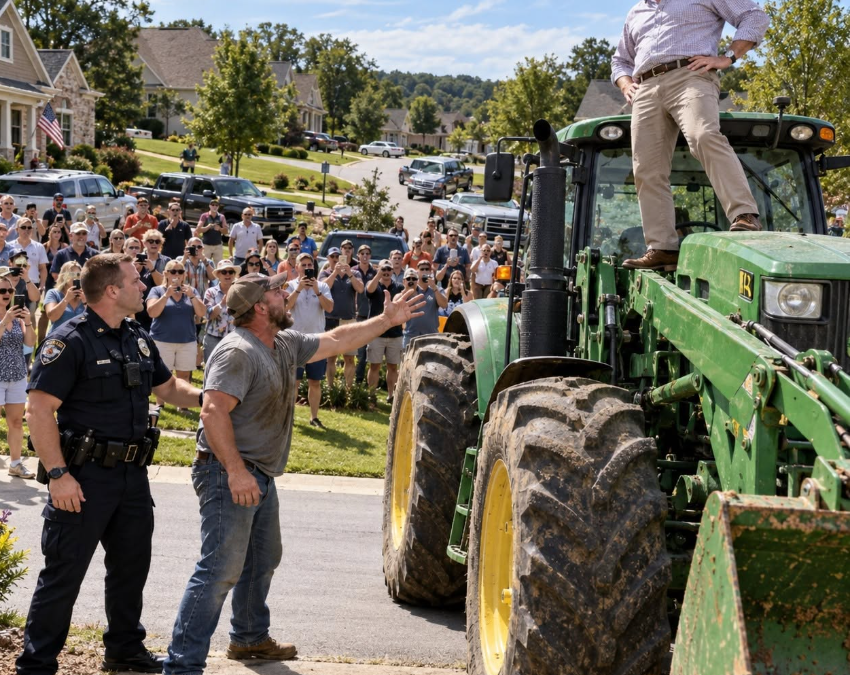
HOA Karen Sent Her Husband to Steal My Late Father’s $45,000 Tractor—He Was Still Smirking When I Pulled Out My Badge.
Sixty neighbors were filming when Wayne Aldridge climbed onto my late father’s restored tractor, looked down at me, and told the officer beside him I had no right to touch “HOA property.”
His wife was still screaming for my arrest when I reached behind my belt, pulled out my badge, and watched every smirk in Willow Ridge disappear.
But the tractor was never just a tractor—it was the last promise I made to my father before cancer took his voice.
Three hours earlier, I had been sitting behind a desk reading municipal budget reports and wondering whether the town needed to replace two aging patrol cruisers.
By noon, I was standing in the middle of a Harvest Festival surrounded by people who believed I was a trespasser trying to steal my own tractor.
And the strangest part was that the tractor itself was never really what the fight was about.
Not to me.
That machine carried the last good year I ever had with my father.
My father, Harold Brangan, had worked the same forty acres of Ohio ground for half a century.
He was not wealthy.
He never pretended to be.
He had rough hands, a bad knee, a toolbox that looked older than I was, and a habit of keeping things long after most people would have replaced them.
He patched fence posts instead of buying new ones.
He sharpened his own mower blades.
He repaired washing machines, pumps, engines, chainsaws, and anything else that could be persuaded to live another season.
If something broke, Dad did not ask what a new one cost.
He asked where the problem was.
When I was a kid, the center of his world was an old tractor that had once been red but had faded into a dull, scarred color somewhere between brown and rust.
I can still remember the first time he lifted me onto its seat.
I was maybe eight.
My boots did not reach the floorboards.
The steering wheel felt enormous in my hands.
Dad stood beside me with one arm resting on the fender.
“You know what people get wrong about work?” he asked.
I shook my head.
“They think the reward is money.”
I looked at him.
“What is it?”
“Knowing you can still stand on your own two feet when somebody else wants you on your knees.”
That was Dad.
He could make a lesson out of changing oil.
Years later, when I was already deep into my career with the state highway patrol, that old tractor finally reached the point where even he admitted it needed more than another patch.
The engine smoked.
The transmission slipped.
The seat was split.
The tires had dry rot.
I told him we ought to restore it.
He laughed.
“With what money?”
“Mine.”
“With what time?”
“Weekends.”
He studied me for a second.
Then he smiled.
“You always were stubborn.”
“I learned from you.”
That became our project.
Every weekend I could get away, I drove out to the farm.
Sometimes I arrived before sunrise.
Sometimes after a night shift.
Dad would already have the barn doors open, coffee in a steel thermos, tools spread across the workbench.
We stripped that tractor down almost to its bones.
We rebuilt the engine.
Replaced the tires.
Repaired the hydraulics.
Rewired the lights.
Cleaned corrosion from connections that looked like they had not been touched since the Reagan administration.
There were evenings when we worked until midnight with an old country station playing through a dusty radio in the corner.
Dad sang badly.
I told him so.
He sang louder.
Those were the best nights.
I did not know they were numbered.
Maybe nobody ever does.
PART2:
By the time the mechanical work was finished, Dad wanted to repaint the tractor.
I assumed he would choose the original red.
Instead, he came home one afternoon carrying paint samples.
Deep teal.
Almost black when the light hit it wrong.
And gold.
Actual metallic gold for the trim.
I stared at the samples.
“You serious?”
“Completely.”
“That thing is going to look like a parade float.”
He pointed a grease-stained finger at me.
“That machine worked harder than most men I’ve known.”
“So?”
“So if a machine works that hard, it ought to shine like it matters.”
That was the last summer before the diagnosis.
Not that we knew it then.
We painted the tractor in the old hay barn with the doors open and box fans blowing fumes toward the field. Dad insisted on doing the trim himself, even though his hands had started trembling in a way he pretended not to notice. He had me tape the edges twice because, as he said, “Sloppy gold is worse than no gold.”
When we rolled it out into the sunlight, I stopped breathing for a second.
It was beautiful.
Not pretty.
Beautiful.
The deep teal held the sky in it. The gold trim ran along the hood and fenders like sunlight caught on metal. The tires were new, the grille polished, the seat replaced with black leather Dad had found at an auction and refused to admit cost too much.
Dad stood beside it with his hands on his hips.
“Well,” he said, “she’ll do.”
That was high praise from Harold Brangan.
I took a picture of him that day.
He hated pictures, but he let me take it.
PART3:
He stood with one boot on the tractor step, one hand on the wheel, wearing his stained cap and that half-smile he only gave when he was proud and trying to hide it.
That picture was on my office shelf the morning Karen Aldridge stole his tractor.
Her name was not actually Karen.
It was Denise Aldridge.
But in Willow Ridge, everyone knew what she was.
The kind of woman who used “community standards” the way other people used weapons.
Denise had moved into the Willow Ridge Estates subdivision four years earlier, after a developer bought the old Miller orchard east of my father’s farm and turned it into seventy-four vinyl-sided homes with identical mailboxes, decorative ponds, and street names like Apple Blossom Lane and Orchard View Circle, though there was not a single apple tree left standing.
The subdivision did not include my land.
It did not include Dad’s barn.
It did not include the two-acre lane that connected the farm to County Road 11.
It did not include the equipment shed, the pond, the back pasture, or the old family cemetery behind the sycamores.
It bordered us.
That was all.
But Denise Aldridge believed borders were merely suggestions for people without enough confidence.
She was the HOA president by her second year.
By her third, she had formed committees for landscaping, holiday decorations, mailbox uniformity, guest parking, trash-bin visibility, exterior lighting tone, acceptable porch furniture, pet leash compliance, and what she called “visual harmony oversight.”
I learned that phrase when she sent me my first letter.
The letter claimed my father’s barn violated Willow Ridge’s visual harmony standards because it was “weathered, agriculturally obsolete, and visible from multiple community-facing lots.”
I wrote back:
Dear Mrs. Aldridge,
The barn was built in 1926.
Your subdivision was built in 2020.
The barn is not visible from your lots.
Your lots are visible from the barn.
We have decided to tolerate you.
Sincerely,
Claire Brangan.
My brother Daniel told me that was unnecessarily hostile.
I told him it was historically accurate.
The letters kept coming.
Dad was still alive for the first few.
He read one at the kitchen table, squinting through his glasses, then looked at me.
“What’s an aesthetic nuisance?”
“You, apparently.”
He grunted.
“Tell her I was here first.”
“I did.”
“Tell her louder.”
Denise did not only target us.
She sent notices to a widow whose backyard fence was half an inch too dark.
She fined a retired teacher for leaving a wheelchair ramp unpainted for three weeks after surgery.
She made a family remove a child’s handmade birdhouse because it was “nonconforming exterior ornamentation.”
But she reserved a special hatred for the Brangan farm.
Because the farm reminded Willow Ridge buyers that their “country living” package came with actual country.
Mud.
Machines.
Hay wagons.
Diesel smell.
Geese flying over decorative ponds and improving them in the way geese do.
And, most offensive of all, a family that did not answer to her.
After Dad died, Denise became bolder.
At first, she sent condolences.
A white envelope.
Embossed HOA seal.
Inside was a typed note that said the Willow Ridge Association was “sorry for the family’s loss” and hoped the transition of the agricultural parcel could occur “in a way consistent with surrounding community values.”
That was how she referred to my father’s death.
A transition.
Three weeks after the funeral, she sent a formal demand that I remove the tractor from the barn entrance because residents had complained it was “distracting from the premium rural aesthetic.”
Premium rural aesthetic.
I sat at Dad’s kitchen table with that letter in my hand and laughed until I cried.
The tractor sat beneath a canvas cover in the barn, exactly where Dad had parked it after our last ride together.
By then he was already thin from treatment, his cheeks hollow, his strength gone in ways he hated. He insisted on driving, but I kept my hand close to the ignition, terrified he would cough too hard and slip.
We drove the tractor slowly around the back field.
The sun was low.
Soybean stubble shone gold.
He did not say much.
He had reached the stage where words cost him.
Near the sycamores, he stopped the tractor and looked over the land.
Then he touched the steering wheel with both hands.
“Don’t let them make this place small,” he said.
I knew who he meant.
Not just Denise.
Not just the HOA.
All of them.
The people who measured land only in resale value. The people who saw barns as eyesores until a designer put fake barn wood above a fireplace. The people who wanted the feeling of a farm without the farmer, the view without the work, the history without the inconvenience.
“I won’t,” I said.
He nodded.
That was the last time he drove it.
He died nine days later.
So when Denise called that tractor a visual nuisance, she might as well have spit on his grave.
I filed every letter.
Not in a drawer.
In a case folder.
Because here is the thing nobody in Willow Ridge knew.
I was not just Harold Brangan’s daughter.
I was Lieutenant Claire Brangan of the Ohio State Highway Patrol’s Special Investigations Unit.
Most people in town knew I worked in government. They knew I had spent years in law enforcement. Some knew I had been highway patrol. But I did not wear the uniform anymore unless duty required it, and I had no interest in explaining my credentials at HOA meetings.
After Dad died, I took a temporary assignment assisting our small municipality with public safety budget review while the town administrator recovered from a stroke. It was paperwork, mostly. Fleet replacement plans, patrol scheduling, grant compliance, equipment purchases, interagency coordination.
That was why, on the morning of the Harvest Festival, I was behind a desk reading municipal budget reports.
The office was quiet.
Rain had fallen overnight, leaving the sidewalks damp and the air smelling like leaves.
A framed photo of Dad and the tractor sat beside my computer.
I had just reached a section about replacement costs for two aging patrol cruisers when my phone buzzed.
It was a text from my neighbor, Mrs. Kline.
Claire, are you at the farm?
I typed back:
No. Office. Why?
Three dots appeared.
Then disappeared.
Then appeared again.
That is never good.
A picture came through.
For a moment, my brain refused to understand it.
The photo showed my father’s barn doors standing open.
The canvas cover lay crumpled on the ground.
A flatbed trailer was backed up to the entrance.
My tractor—Dad’s tractor—was halfway up the ramps.
Two men were guiding it with chains.
And Wayne Aldridge was standing near the front tire, grinning like a man who had just won a prize.
Below the picture, Mrs. Kline wrote:
Denise says HOA is taking it for festival display. She told everyone you donated it.
The room narrowed.
Every sound in the office receded.
The fluorescent hum.
The printer.
The muffled voice of a clerk down the hall.
All gone.
I stared at that photo.
Then another text came.
Mrs. Kline again.
I told her I didn’t think that was true. She said you signed release papers.
A third text.
Claire, I think they cut the lock.
That was the moment anger became cold enough to be useful.
I did not throw the phone.
I did not curse.
I did not run out of the office shouting.
I stood, opened the bottom drawer of my desk, removed my sidearm lockbox, checked my badge and credentials, and called dispatch.
“This is Lieutenant Brangan,” I said. “I need a unit to respond to the Brangan farm for suspected theft in progress. Agricultural equipment. Possible forced entry. Suspects may be associated with Willow Ridge HOA.”
The dispatcher, Angie, paused.
“Your father’s place?”
“Yes.”
Her voice changed.
“We’ll send Officer Miller.”
“Also notify Sheriff’s Office. This may cross township jurisdiction depending on where they take it.”
“Copy.”
I hung up and called Daniel.
My brother answered on the third ring, sounding like he had been under a truck.
“What?”
“Where are you?”
“Shop. Why?”
“Denise Aldridge stole Dad’s tractor.”
Silence.
Then metal clanged.
“She what?”
“Flatbed at the barn. Wayne is there. They’re saying I donated it to the festival.”
Daniel’s voice went low.
“I’m on my way.”
“Do not touch anybody.”
“I’m not promising that.”
“Daniel.”
He breathed hard through the phone.
“I’ll behave if they do.”
“That is not the standard.”
“It is mine.”
I ended the call before I said something worse.
Then I grabbed my jacket and drove.
I should say I do not remember speeding.
That would be a lie.
I remember exactly how fast I drove, which roads I took, which stop sign I paused at longer than my patience wanted because I knew if I broke the law while going to enforce it, Dad’s ghost would call me a hypocrite.
As I drove toward the farm, the first memory hit.
Dad teaching me how to back the tractor with a wagon attached.
I was thirteen.
I kept jackknifing.
I got mad and climbed down, saying the steering was stupid.
Dad shut off the engine.
“The steering ain’t stupid,” he said. “It’s honest. It shows you what you did wrong.”
I hated that lesson.
I use it constantly.
The second memory hit near County Road 11.
Dad sitting in a lawn chair beside the barn during chemotherapy, too weak to hold a wrench but too stubborn to stay inside, giving instructions while I adjusted the carburetor.
“Half turn,” he rasped.
“I did a half turn.”
“That was three-quarters.”
“You can’t see from there.”
“I can hear foolishness.”
By the time I reached the farm, the trailer was gone.
The barn doors were still open.
The padlock lay in two pieces in the gravel.
Mrs. Kline stood near the fence in a pink cardigan, wringing her hands.
Her husband, Earl, stood beside her holding a rake like he might have fought the flatbed with it if needed.
“I’m sorry,” she said before I even got out of the truck. “I tried to stop them.”
“I know.”
“She had papers.”
“What papers?”
“Some kind of donation form. Your signature was on it.”
I looked at her.
“My signature?”
Mrs. Kline nodded.
“I told her it didn’t look right.”
Earl said, “Looked like a printer did it.”
I crouched beside the cut lock.
Clean slice.
Bolt cutters.
Not even subtle.
Inside the barn, the tractor’s tire tracks ran through dust Dad had never let me sweep properly because, as he said, “Barns are supposed to remember work.”
Now the tracks looked like a wound.
Officer Tyler Miller arrived five minutes later.
He was twenty-six, earnest, and new enough to still look startled when reality ignored the training manual. He stepped out of his cruiser, saw me, and straightened.
“Lieutenant Brangan.”
“Officer.”
His eyes moved to the lock.
“Dispatch said possible theft.”
“Confirmed theft.”
“Do you know where they took it?”
“Harvest Festival.”
Willow Ridge held an annual Harvest Festival on the green space near its clubhouse. It was the kind of event where people sold pumpkin candles, drank cider from mason jars they had not washed properly, and posed their children beside decorative hay bales.
This year, Denise had promised a “heritage farm display.”
I had ignored the flyer.
Apparently, I should not have.
Miller wrote quickly.
“Do you want to file—”
“Yes.”
He blinked.
I softened my voice.
“Sorry. Yes, I want to file a report. Forced entry, theft of agricultural equipment, forged document if they used my signature, and unlawful transport.”
“Value?”
“Forty-five thousand.”
Earl whistled.
Miller looked up.
“For a tractor?”
“It was appraised after restoration.”
“And sentimental value?”
I looked at the barn.
“Not measurable.”
He nodded, to his credit.
Daniel’s pickup came in hard and stopped crooked near the lane. He got out before the engine died.
My brother was forty-eight, built like Dad but with less patience and more tattoos. He ran a repair shop outside town and had inherited Dad’s talent for resurrecting machines and Mom’s talent for saying exactly the wrong thing at exactly the right volume.
He saw the lock.
His face changed.
“Where?”
“Festival.”
He turned back toward his truck.
I grabbed his arm.
“No.”
He looked down at my hand, then at me.
“Claire.”
“We do this right.”
“They cut Dad’s lock.”
“I know.”
“They stole his tractor.”
“I know.”
“They put a chain on what we built with him while he was dying.”
I let go of his arm.
The words had cut me too.
“That is why,” I said carefully, “we do this right.”
Daniel’s eyes were wet.
He hated that.
He looked away toward the barn.
Officer Miller cleared his throat.
“I can escort you to the festival.”
Daniel laughed once.
“Oh, good. An escort.”
I gave him a look.
He shut up.
Mostly.
We followed Miller’s cruiser to Willow Ridge.
As we drove, my phone kept buzzing.
Texts.
Pictures.
Videos.
People asking if it was true I had donated the tractor.
People saying Denise was giving speeches about “local agricultural heritage.”
One message from an unknown number said:
So nice of your family to finally contribute to the community.
I placed the phone face down on the passenger seat before I threw it out the window.
The Harvest Festival came into view just before noon.
Orange banners hung from lamp posts.
Children ran between booths with painted faces.
A bluegrass band played on a portable stage.
Food trucks lined the curb.
There were pumpkins stacked in decorative pyramids, scarecrows wearing designer flannel, and a chalkboard sign reading:
WILLOW RIDGE HARVEST FESTIVAL
Celebrating Community, Heritage, and Home.
And there, in the center of the green, under a white arch wrapped with fake autumn leaves, sat my father’s tractor.
Teal paint shining.
Gold trim catching the sun.
A sign in front of it read:
DONATED BY THE BRANGAN FAMILY
TO WILLOW RIDGE HISTORICAL HARVEST DISPLAY
My hands went numb.
For a moment, I did not see the crowd.
I did not hear the music.
I saw Dad standing in the barn holding paint samples.
If a machine works that hard, it ought to shine like it matters.
They had made it a decoration.
Not because they loved it.
Because stealing history looks better when you put a ribbon on it.
Denise Aldridge stood beside the tractor wearing a burnt-orange sweater dress, tall boots, and a wide-brimmed hat that had never seen a real harvest. Her hair was curled into a smooth blond helmet. She held a microphone in one hand and a clipboard in the other.
Wayne Aldridge stood near the rear tire, chest puffed out, accepting congratulations from men in quilted vests.
Wayne was one of those men who looked like he had been assembled from gym equipment and insecurity. He owned a chain of car washes, drove a lifted truck he never got dirty, and spoke to waitresses like the menu had personally offended him.
He saw me before Denise did.
And he smiled.
Not nervously.
Not guiltily.
Smugly.
That smile told me everything.
He knew.
He knew I had not donated the tractor.
He knew they had taken it.
He knew the papers were false.
And he believed the crowd would protect him.
Officer Miller parked near the curb.
I stepped out.
Daniel got out behind me.
The festival noise shifted as people recognized us.
Phones rose.
That was the age we lived in. Before anyone asked what was true, they made sure it was recorded.
Denise turned, saw me, and lifted the microphone with theatrical delight.
“Oh! Claire Brangan is here, everyone!”
A few people clapped.
Some awkwardly.
Some because they thought this was planned.
I walked straight toward the tractor.
Miller followed.
Daniel came behind us like a storm wearing boots.
Denise’s smile remained wide.
“Claire, we were just about to honor your family’s contribution.”
“You cut the lock off my barn.”
Her smile tightened.
The microphone was still near her mouth.
The crowd heard.
A murmur moved outward.
Denise lowered the microphone slightly.
“Let’s not do this here.”
“You brought my property here.”
“We have documentation.”
“No, you have a forgery.”
Wayne laughed from beside the tractor.
“You always this dramatic?”
I looked at him.
“Get off the tractor.”
He climbed onto the step instead.
Then onto the seat.
He actually sat in Dad’s seat.
Daniel moved.
I caught his sleeve without looking.
Wayne gripped the steering wheel and looked down at me.
“Careful, Claire. This is HOA property now.”
The crowd grew louder.
Officer Miller stepped forward.
“Sir, please step down.”
Wayne leaned back.
“Officer, she’s trespassing on community property and interfering with a festival display.”
Denise rushed to Miller’s side.
“Yes, exactly. Officer, I want her removed.”
Miller looked overwhelmed.
He knew me as a lieutenant. But he also had a crowd filming, an HOA president waving paperwork, and a stolen tractor sitting in public like a dare.
“Mrs. Aldridge,” he said, “I need to review—”
Denise shoved papers toward him.
“Here. Donation form. Transfer acknowledgment. Festival authorization. All signed.”
I glanced at the top page.
My signature was there.
Almost.
The forger had copied the shape from public records or an old letter, but they missed the pressure, the angle, the way I cross the t when I’m angry or rushed. I had testified in forgery cases. I had studied handwriting enough to know.
But the thing that made my stomach turn was Dad’s name near the bottom.
Harold Brangan Estate.
Authorized family release.
They had used my dead father’s name like a prop.
I looked at Denise.
“You forged documents involving my father’s estate.”
She lifted her chin.
“These documents were provided by the association’s legal committee.”
“You don’t have a legal committee. You have a retired insurance adjuster and a printer.”
Several people gasped.
Denise’s face flushed.
Wayne laughed again.
“Arrest her,” he called to Miller. “She’s causing a disturbance.”
Miller said, “Sir, step down from the tractor.”
Wayne’s smile widened.
“Make me.”
That was Wayne’s first major mistake.
Denise’s was thinking the crowd made her powerful.
Wayne’s was thinking the officer was the only badge on the green.
I looked around.
Sixty people, maybe more.
Phones up.
Children watching.
Neighbors whispering.
My father’s tractor beneath fake leaves.
Daniel breathing hard beside me.
Officer Miller caught between uncertainty and duty.
Denise said loudly, “Claire Brangan has harassed this community for years. She has refused to cooperate with beautification efforts, ignored repeated notices, and now she is attempting to ruin a family event because she regrets donating obsolete equipment.”
I felt something inside me go very still.
Not calm.
Beyond calm.
The place anger goes when it becomes evidence.
“Obsolete,” I repeated.
Denise smiled.
“Yes. Obsolete.”
Wayne patted the steering wheel.
“Don’t worry,” he said. “We’ll take better care of it than that rotting barn did.”
Daniel cursed under his breath.
I reached behind my belt.
Denise saw the movement and seized the moment.
“Officer! She’s reaching for something!”
Miller turned.
So did half the crowd.
I brought out my badge case and opened it.
The gold shield caught the noon sun.
Ohio State Highway Patrol.
Special Investigations Unit.
Lieutenant Claire Brangan.
The festival went silent so fast the bluegrass band stopped mid-song.
Wayne’s smile disappeared.
Denise stared at the badge as if I had produced a snake.
Officer Miller’s face changed from stressed to deeply relieved.
“Lieutenant,” he said.
I held his gaze.
“Officer Miller, you are standing at the scene of a reported felony theft involving forced entry, suspected forgery, unlawful transport of agricultural equipment valued at approximately forty-five thousand dollars, and possession of stolen property. I am the owner and reporting party. I am also a sworn officer. You need to secure the scene and call for a supervisor.”
Miller swallowed.
“Yes, ma’am.”
Wayne stood halfway from the seat.
“Now hold on—”
I pointed at him.
“Do not move.”
He froze.
It is amazing how quickly men stop smirking when consequences finally find their address.
Denise recovered enough to start shouting.
“This is abuse of power! She can’t do this! She’s using a badge for a personal dispute!”
I turned toward her.
“No, Denise. You made it criminal when you cut a lock, forged my signature, stole property from my father’s barn, transported it across town, and displayed it under a false donation sign.”
Her mouth opened.
Closed.
Opened again.
“I did not cut any lock.”
“No. You sent Wayne.”
Wayne shouted, “I didn’t cut anything!”
Daniel said, “You want to explain the bolt cutters in your truck?”
Everyone looked toward the curb.
Wayne’s lifted pickup sat parked behind a row of vendor tents.
In the bed, plainly visible beside a coil of chain, lay a pair of red-handled bolt cutters.
Wayne looked like a man who had forgotten gravity existed until it dropped him.
Officer Miller spoke into his radio.
“Dispatch, I need a supervisor at Willow Ridge green. Possible felony theft, forged documents, stolen equipment on scene. Also request additional units for crowd control.”
Denise lowered her voice, trying to regain control.
“Claire, this is getting out of hand.”
“It got out of hand when you entered my barn.”
“We were trying to honor your father.”
That was the wrong thing to say.
My voice dropped.
“You do not get to steal from a dead man and call it honor.”
Her face changed.
For a second, I saw fear.
Then anger covered it.
“Your father was unreasonable too,” she snapped. “He refused every attempt to modernize that property. He sat on valuable land while this community grew around him.”
There it was.
The truth.
Not buried anymore.
Not hidden under heritage displays or community values.
Valuable land.
That was what she wanted.
The tractor was bait, pressure, humiliation, and theater. But behind it was the farm.
It had always been the farm.
People began whispering.
Mrs. Kline, who had followed us to the festival with Earl, stepped forward.
“I heard her say last month the Brangan parcel should belong to Willow Ridge,” she said.
Denise turned on her.
“Margaret, this does not concern you.”
“It concerned me when I saw Wayne hauling that tractor away.”
Another voice spoke from the crowd.
A man named Rob Ellis, who lived on Orchard View Circle.
“She told us the family donated it.”
Denise said, “They did.”
I held up the forged paper.
“Then you won’t mind waiting while we verify that.”
A siren approached.
Then another.
Denise’s confidence began to fracture in visible pieces.
Supervisor Sergeant Hanley arrived with two additional officers. Hanley was fifty, bald, patient, and allergic to nonsense. He had worked with me on three joint investigations and knew exactly how much I disliked making scenes.
He looked at the tractor.
Then at me.
Then at Wayne sitting on it.
“Claire.”
“Mike.”
He sighed.
“I was hoping for a quiet Saturday.”
“So was I.”
He walked to Officer Miller, received the quick briefing, then turned to Denise.
“Mrs. Aldridge, I need you to step away from the tractor and provide the original documents.”
Denise clutched her clipboard.
“These are HOA records.”
“They’re evidence now.”
“I want an attorney.”
“That is your right. The documents are still evidence.”
Wayne climbed down at last, hands raised in performative innocence.
“I was just helping move something my wife said was donated.”
I looked at him.
“You told me it was HOA property.”
“I meant based on what I was told.”
“By your wife.”
He glanced at Denise.
The first crack between them appeared right there in public.
Denise saw it too.
Her eyes flashed.
“Wayne, do not say another word.”
Sergeant Hanley took the documents.
Officer Miller photographed the sign.
Another officer moved to Wayne’s truck and secured the bolt cutters and chains.
The festival had transformed into a courtroom with pumpkins.
Children were pulled away by embarrassed parents.
Vendors stopped pretending to sell candles.
The bluegrass band quietly packed up.
And through it all, my father’s tractor sat under fake autumn leaves, shining like it mattered.
I walked to it.
No one stopped me.
I placed my hand on the fender.
The metal was warm from the sun.
Daniel came up beside me.
His face was tight, his eyes red.
“I’m sorry,” he said.
I looked at him.
“For what?”
“I should’ve put cameras on the barn after the first letter.”
“We both should have.”
“I should’ve checked on it this morning.”
“Daniel.”
He looked away.
“They sat him under a fake arch.”
“I know.”
His jaw trembled.
“He would’ve hated that.”
“No,” I said.
Daniel looked at me.
“He would’ve hated them. He would’ve loved the tractor being admired.”
My brother let out a broken laugh.
“Yeah.”
Then his face hardened.
“But not by them.”
“No.”
Sergeant Hanley approached.
“We’re going to need to tow it as evidence temporarily.”
I closed my eyes.
“I know.”
“We’ll use a bonded heavy equipment hauler. Not Wayne’s friend with a flatbed.”
“Thank you.”
He lowered his voice.
“Do you want Wayne arrested here?”
I looked toward Wayne.
He was arguing quietly with an officer, still trying to control the narrative.
Denise stood apart from him now, phone in hand, probably texting half the HOA board and all of her self-importance.
Sixty neighbors watched.
Some still filming.
Dad once told me that humiliation was a tool best used carefully because it cuts the hand holding it.
“No,” I said. “Do it clean. Build the case. Don’t give them a performance to cry about later.”
Hanley nodded.
“That’s why you’re good at this.”
“I’m not feeling good at it.”
“That’s usually why.”
Wayne and Denise were not arrested immediately in front of the crowd.
That disappointed Daniel.
It disappointed a lot of people online too, once the videos spread.
But justice is not always a dramatic pair of handcuffs at the exact moment everyone wants them.
Sometimes justice is slower because it wants to be harder to escape.
The tractor was removed from the festival under police supervision.
The fake donation sign was bagged.
The forged documents were seized.
The bolt cutters, chains, flatbed rental agreement, text messages, HOA emails, and security footage from Willow Ridge were subpoenaed within forty-eight hours.
By Sunday night, the story had spread through the county.
By Monday morning, it had reached Columbus because nothing travels faster than a video of an HOA president screaming “arrest her” at a state highway patrol lieutenant whose dead father’s tractor is sitting behind her.
The comments were mostly supportive.
Mostly.
Some people said I should have announced my badge earlier.
Some said I abused authority.
Some said if the tractor was that valuable, I should have kept it locked better, as if a cut lock was an invitation.
Some said HOAs had to protect standards.
I stopped reading after one man wrote, “Sentiment doesn’t trump community aesthetics.”
I wanted to ask him what kind of childhood makes a person write that sentence.
Instead, I went to the evidence garage.
The tractor was stored in a secured bay, away from weather, behind a chain-link partition. Without the festival decorations, it looked like itself again.
Almost.
There was a scratch along the left fender where one of Wayne’s chains had rubbed through the clear coat.
Small.
Repairable.
But I stood there staring at it for a long time.
Sergeant Hanley found me.
“Claire.”
“I know,” I said.
“I didn’t say anything.”
“You were about to tell me not to stand in evidence storage mourning paint.”
He leaned on the partition.
“I was going to say we got something.”
I turned.
“What?”
“Security footage from Willow Ridge clubhouse parking lot. Wayne unloading the tractor. Denise directing him. Clear audio from one of the festival committee cameras.”
“What audio?”
Hanley’s mouth tightened.
“Denise telling Wayne to put the donation sign in front before too many people ask questions.”
I breathed out slowly.
“And?”
“And Wayne saying, ‘Once it’s here, she’ll look crazy trying to take it back.’”
There it was.
The plan in one sentence.
Make me look crazy.
That was Denise’s gift.
She did not just want control.
She wanted humiliation.
She wanted people to see me as unreasonable, emotional, unstable, selfish, hostile to community spirit.
A grieving daughter making a scene over a tractor she had supposedly donated.
It was not enough to take something from me.
She wanted to take the credibility I would need to demand it back.
I looked at Dad’s tractor through the fence.
“Anything else?”
Hanley hesitated.
“What?”
He opened a folder.
“We found emails between Denise and a developer.”
My stomach tightened.
“What developer?”
“NorthStar Residential Group.”
I knew the name.
Everyone did.
NorthStar had bought parcels outside three nearby towns and turned them into “lifestyle communities” with clubhouses, artificial lakes, and names stolen from whatever they destroyed.
“They wanted Dad’s land,” I said.
“Yes.”
“How long?”
“Looks like since before he died.”
The evidence showed what my gut had known.
NorthStar had approached Denise because Willow Ridge expansion required access to my father’s forty acres. The developer did not want to negotiate directly at first. They wanted local pressure. Community pressure. HOA pressure. They wanted the Brangan farm framed as a declining nuisance.
Denise was eager to help.
Not for free.
There were consulting fees.
Promised board positions.
A potential “community liaison” contract.
And one email from Denise to a NorthStar representative that made my hands shake with anger.
Harold is old and stubborn, but the daughter is law enforcement and may be more difficult. After his passing, pressure will be easier if the property appears neglected or out of step with community identity.
After his passing.
She had been waiting for my father to die.
I read the line three times.
Hanley said nothing.
Good officers know when silence is kinder.
I thought of Dad in the tractor seat, too weak to raise his voice but still strong enough to make me promise.
Don’t let them make this place small.
“They stole the tractor to make the farm look abandoned,” I said.
Hanley nodded.
“And to provoke you. If you reacted badly in public, it helped their narrative.”
I laughed once.
Cold.
“She almost got Daniel instead.”
“Your brother showed surprising restraint.”
“I’ll tell him you said that. He’ll be insufferable.”
Hanley closed the folder.
“We’re expanding the investigation.”
“Denise?”
“Denise. Wayne. The HOA legal committee. NorthStar. Whoever forged the documents.”
“Good.”
I looked back at the tractor.
“What about the scratch?”
Hanley blinked.
“The scratch?”
“Yes.”
He looked at the fender, then at me.
“I’ll make sure it’s photographed.”
“Thank you.”
He almost smiled.
“You Brangans really are something.”
“We’ve been called worse.”
The next weeks were brutal.
Not physically.
Emotionally.
Because once the truth started coming out, everyone wanted a piece of it.
Reporters came to the office.
Reporters came to the farm.
Reporters called Daniel’s shop.
People drove slowly past the barn.
Old friends messaged me to say they had always known Denise was trouble.
People who had served on her committees claimed they were shocked.
A few Willow Ridge residents apologized.
Others doubled down.
One woman posted that while theft was wrong, the Brangan farm did “create visual tension” with the neighborhood.
Daniel printed that comment and taped it to the shop refrigerator under the heading:
VISUAL TENSION OF THE WEEK.
Humor helped.
Some.
The hard part was the betrayal I had not expected.
My cousin Paul called three days after the festival.
Paul had not set foot on the farm in years except for Dad’s funeral, where he wore a suit too expensive for the occasion and checked his phone during the prayer.
He started with, “Claire, I’ve been thinking.”
That is never a safe sentence from relatives who only call when property is involved.
“About what?”
“Uncle Harold wouldn’t have wanted all this drama.”
I closed my eyes.
“Paul.”
“Hear me out. I know Denise handled things badly.”
“Badly?”
“But maybe this is a sign. The land is surrounded now. You and Daniel have careers. Neither of you farms full-time. NorthStar would pay real money.”
“Did they call you?”
Silence.
There it was.
“They reached out generally.”
“To you.”
“As family.”
“You have no ownership interest.”
“I know that.”
“Do you?”
He sighed.
“You’re being emotional.”
I almost laughed.
People love calling you emotional when they want you to ignore betrayal.
“Dad left the farm to Daniel and me.”
“And that was his right. But maybe he wasn’t thinking clearly near the end.”
The room went quiet.
My hand tightened around the phone.
“Say that again.”
Paul seemed to realize too late where he had stepped.
“I just mean illness can—”
“My father was clear-minded until the day before he died.”
“I didn’t mean—”
“You did. You meant to suggest a dead man’s will should bend because money finally noticed his land.”
“Claire, that’s not fair.”
“No, Paul. What Denise did was not fair. What Wayne did was not fair. What NorthStar did was not fair. Me refusing to reward it is not unfair. It is the first fair thing that’s happened.”
He huffed.
“You always were hard to talk to.”
“Goodbye.”
I hung up.
Then I sat in Dad’s kitchen and cried so hard I scared myself.
Not because Paul mattered.
Because grief has layers.
You think you have reached the bottom, then someone says one cruel thing and the floor opens again.
Daniel found me there an hour later.
He did not ask what happened.
He saw my face, took one look at the phone on the table, and said, “Paul?”
I nodded.
“I’ll kill him.”
“No.”
“Maul him?”
“No.”
“Light maiming?”
I laughed through tears.
He sat across from me.
For a while, we said nothing.
Then he looked around the kitchen.
Same yellowed wallpaper.
Same chipped mug tree.
Same clock shaped like Ohio that had not kept time since 2003.
“You ever feel like we’re guarding a house full of ghosts?” he asked.
“Yes.”
“Is that healthy?”
“No idea.”
Dad would have hated that answer.
He believed everything had a practical answer if you used the right tool, gave it enough light, and did not get dramatic.
But grief is not a carburetor.
Daniel rubbed his face.
“I don’t want to sell.”
“I know.”
“I also don’t know what to do with all of it.”
“The farm?”
“The farm. The barn. The tractor. Dad’s tools. Mom’s dishes. Every damn thing that feels like evidence we had parents.”
I stared at him.
That was the first honest thing either of us had said about the inheritance.
Not the legal part.
The weight.
After Mom died, Dad had held the family together by sheer routine. Sunday breakfast. Hay in July. Taxes in March. Oil changes before winter. When he died, the routines remained, but the center was gone.
I had filled the gap with responsibility.
Daniel filled it with anger.
Neither of us had filled it with a plan.
“We don’t have to decide everything right now,” I said.
“No. But we have to decide something before Denise or NorthStar or Paul or whoever else decides for us.”
He was right.
I hated that.
The criminal case moved forward in pieces.
Wayne was charged with breaking and entering, grand theft of a motor vehicle or agricultural equipment, criminal damaging for the lock and fender, and possession of criminal tools because of the bolt cutters and chain.
Denise was charged later.
That mattered.
People thought she might escape because she had not personally driven the flatbed.
But emails, texts, and videos built the path.
She had ordered the fake donation sign.
She had approved use of the forged release.
She had told the festival committee I had agreed.
She had directed Wayne where to position the tractor.
She had coordinated with NorthStar.
And perhaps most damning, she had texted Wayne that morning:
Do it early before Claire checks the farm. Once it’s public, she’ll have to look petty to fight it.
Petty.
My father’s tractor.
My father’s barn.
My father’s name.
Petty.
The forged signature led to the HOA’s so-called legal committee, which turned out to be a retired insurance adjuster named Frank Bell who had access to scanned copies of old complaints and correspondence. Frank claimed Denise told him I had authorized the donation verbally and only needed “form completion.”
He cooperated after prosecutors showed him the fraud charges he was facing.
NorthStar denied everything.
At first.
Then investigators found internal messages.
One from a regional acquisition manager read:
If Aldridge can get Brangan publicly discredited, approach brother/cousin separately. Family division may create leverage.
Family division.
They had not only studied our land.
They had studied us.
That was the part that made me feel dirty.
They knew Daniel had financial strain after expanding his shop.
They knew Paul resented being left out of the will.
They knew my career made me cautious about public conflict.
They knew Dad had died recently.
They knew grief makes doors easier to force.
When I told Daniel, he went very quiet.
Then he said, “They thought I’d sell out?”
“They thought they could pressure you.”
He nodded slowly.
“They were half right.”
I looked at him.
He met my eyes.
“I’m not saying I would’ve sold. But if you’d gotten arrested at that festival, if the videos made you look crazy, if the town turned on us, if they came to me with a check while I was mad at you for handling everything alone…”
He stopped.
I understood.
That was how manipulation worked.
Not by creating weakness from nothing.
By finding the cracks already there and pouring money into them.
“Thank you for telling me the truth,” I said.
He looked down.
“Don’t get used to it.”
But his voice was gentle.
The preliminary hearing for Denise and Wayne filled the courthouse.
People came because they wanted spectacle.
They got something quieter and worse.
The prosecutor played the festival video.
Wayne on the tractor.
Denise shouting.
Me pulling my badge.
The crowd gasped even though most had already seen it online.
Then they played the clubhouse footage.
Denise’s voice, clear as a bell:
“Put the donation sign in front before too many people ask questions.”
Wayne:
“Once it’s here, she’ll look crazy trying to take it back.”
Denise closed her eyes.
Wayne stared at the table.
Their attorney argued that it was a civil misunderstanding, a paperwork dispute, a community event gone wrong.
The judge looked unimpressed.
“Counsel,” she said, “most paperwork disputes do not require bolt cutters.”
That line made the local paper.
But the hardest part came when they displayed the forged release form.
My signature.
Dad’s estate.
The words “voluntary donation.”
I had prepared myself.
I still felt like I had been punched.
Then the prosecutor called me.
I walked to the stand, swore the oath, and sat facing a room full of people who had watched my grief become public property.
The prosecutor asked about the tractor.
I told the story simply.
Original condition.
Restoration.
Appraisal.
Storage location.
No donation.
No authorization.
No sale.
Then she asked what the tractor meant to me.
The defense objected.
Relevance.
The prosecutor argued that the defendants had used sentimental value strategically to provoke and humiliate the owner, making motive relevant.
The judge allowed limited testimony.
Limited.
How do you limit a father?
I took a breath.
“That tractor was the last project I completed with my father before he died,” I said. “He chose the color. He painted part of the trim. He drove it one final time nine days before his death. It was stored in his barn under a canvas cover. It was not abandoned. It was not donated. It was not community property.”
The prosecutor asked, “Did you give Denise or Wayne Aldridge permission to remove it?”
“No.”
“Did you sign the release form?”
“No.”
“Would you ever have donated it to Willow Ridge?”
I looked at Denise.
“No.”
Her face hardened.
For a moment, the mask returned.
Not guilt.
Resentment.
As if I had wronged her by refusing to play my part.
The defense attorney stood for cross-examination.
He was slick in a tired way, with a voice that tried to sound reasonable while asking unreasonable things.
“Lieutenant Brangan, you are trained in law enforcement, correct?”
“Yes.”
“You carry a badge.”
“Yes.”
“You displayed that badge publicly at the festival.”
“Yes.”
“After a personal dispute arose.”
“After I found my stolen property on public display.”
He shifted.
“Isn’t it true you and Mrs. Aldridge had a long history of hostility?”
“I had a long history of receiving invalid notices from her HOA.”
“Hostility,” he repeated.
“No. Documentation.”
A few people murmured.
The judge looked over her glasses.
Silence returned.
The attorney tried again.
“You disliked Mrs. Aldridge.”
“I disliked her conduct.”
“You mocked HOA notices.”
“Yes.”
That caught him off guard.
“You admit that?”
“I once mailed back a photocopy of a frog.”
The courtroom made a sound it tried to hide.
The judge’s mouth twitched.
The attorney frowned.
“So you did not take the HOA seriously.”
“They had no authority over my property. That was not a feeling. That was a fact.”
He paced.
“Lieutenant, when you arrived at the festival, you were angry.”
“Yes.”
“Emotional.”
“Yes.”
“Upset.”
“Yes.”
“Would you agree your judgment may have been compromised?”
“No.”
“Despite anger?”
“Anger does not automatically compromise judgment. Sometimes it clarifies what matters. My actions were controlled, lawful, and documented.”
He stared at me.
I stared back.
He moved on.
But the damage to his argument was done.
The judge found probable cause.
The case moved forward.
Denise’s supporters began to disappear after that.
Not all at once.
Quietly.
A resignation from the festival committee.
A deleted Facebook post.
A neighbor who had once praised her “leadership” now claiming he had always found her intense.
The Willow Ridge HOA board called an emergency meeting and suspended Denise from all duties pending the criminal case.
She refused to attend.
Wayne tried to blame her.
She tried to blame Wayne.
Frank Bell blamed both of them.
NorthStar blamed “overzealous local volunteers.”
By then, nobody believed anybody.
The farm became quieter once winter arrived.
The fields went brown.
The barn roof collected frost.
The investigation continued, but the daily storm of calls slowed.
Daniel and I started meeting every Saturday morning at Dad’s kitchen table to discuss the future of the property.
The first meetings were terrible.
We argued about everything.
Whether to lease the back acreage.
Whether to repair the barn roof first or the drainage tile.
Whether to sell Dad’s spare equipment.
Whether Mom’s dishes should stay in the cabinet nobody opened.
At one point, Daniel accused me of treating the farm like a museum.
I accused him of treating it like a junk drawer.
We did not speak for twenty minutes.
Then he made coffee.
That was our apology language.
Slowly, a plan formed.
We would keep the farm.
Not as a frozen shrine.
As a working place.
Smaller than Dad’s operation, yes. Different, yes. But alive.
Daniel would move part of his repair business into the old equipment shed, specializing in tractor restoration and farm equipment repair. He had more work than space at his current shop, and the farm had space that deserved work.
I would convert the front barn office into a community agricultural history room—not a museum exactly, because Dad would haunt us both for using that word, but a place where kids from the school could see tools, photos, maps, and the restored tractor when it was not being driven.
We would lease some ground to a young farmer named Luis Ramirez, who had been renting land wherever he could find it and losing parcels every time a developer appeared.
And the tractor?
The tractor would come home.
Not as a decoration.
As the centerpiece of what Dad believed.
Work matters.
Memory matters.
Standing matters.
The day the evidence hold was released, Daniel and I went together.
Sergeant Hanley met us at the garage.
“She’s all yours,” he said.
Daniel walked around the tractor slowly.
His hand hovered near the fender scratch.
“I can fix that,” he said.
“I know.”
He looked at me.
“Want me to?”
I thought about it.
A clean repair would erase Wayne’s chain mark.
That should have appealed to me.
But the scratch had become part of the story now.
Not the most important part.
But proof.
“No,” I said. “Seal it. Don’t hide it.”
Daniel nodded.
“Dad would say that’s stubborn.”
“Dad painted a tractor teal and gold.”
“Fair.”
We loaded the tractor carefully onto a hauler we trusted.
When it rolled back onto the farm, Mrs. Kline and Earl came out to watch from their fence.
Earl removed his cap.
Mrs. Kline cried.
Daniel drove the tractor down the ramps.
The engine rumbled deep and steady.
For the first time since the theft, I felt my chest loosen.
Daniel parked it in front of the barn.
Not inside.
Not yet.
We stood there in the pale winter sun.
Then, without planning it, I climbed onto the step and sat in the seat.
The same seat Wayne had used to mock me.
The same seat Dad had touched with trembling hands.
The steering wheel was cold.
I placed both hands on it.
Daniel leaned against the fender.
“You okay?”
“No.”
He nodded.
“Me neither.”
I looked across the farm.
The land was not impressive in winter. Bare trees. Muddy lane. Weathered barn. Stubble fields. A pond skimmed with ice. Nothing like the glossy renderings NorthStar sent investors.
But it was real.
That counted for more.
The trial never happened.
Denise and Wayne took plea deals in late spring.
Wayne pleaded guilty to grand theft, breaking and entering, and criminal damaging. He received probation, restitution, community service, and a suspended jail sentence that would activate if he violated terms.
Daniel was furious.
“He should’ve gone to jail.”
“Maybe.”
“Maybe?”
“I wanted a conviction that stuck.”
“I wanted him in orange.”
“So did I.”
Denise pleaded to forgery-related charges, complicity to theft, and falsification. Her deal required full cooperation in the NorthStar investigation, restitution, resignation from the HOA, a public apology, and a prohibition on serving in any HOA or nonprofit fiduciary role for years.
The apology was read at a Willow Ridge community meeting.
I did not want to go.
Daniel did.
So we went.
Denise stood at the front of the clubhouse she had once ruled like a queen. She looked smaller without the microphone confidence. Her hair was still perfect. Her clothes still expensive. But her eyes had the flat exhaustion of someone who had spent months discovering consequences do not care about presentation.
Wayne sat in the back, arms crossed, face red.
He did not look at me.
Denise unfolded a paper.
Her voice shook.
“I, Denise Aldridge, acknowledge that I knowingly participated in the unauthorized removal and display of the Brangan family tractor from private property. I acknowledge that documents used to justify that removal were not valid and that Claire Brangan did not donate the tractor to Willow Ridge. I apologize to Lieutenant Brangan, Daniel Brangan, and the memory of Harold Brangan for my actions.”
She paused.
The room was silent.
Then she continued.
“I also acknowledge that my conduct as HOA president exceeded the association’s legal authority and contributed to harm against neighboring property owners.”
That line had been negotiated.
I knew because the prosecutor told me.
It still mattered.
When she finished, she looked at me for the first time.
There was apology in her words.
Not in her eyes.
Her eyes still said she thought I had ruined her.
That was fine.
I did not need her transformed.
I needed her stopped.
After the meeting, a Willow Ridge resident approached me.
Rob Ellis.
He was the one who had said at the festival that Denise told everyone we donated it.
He held his baseball cap in both hands.
“I’m sorry,” he said.
I nodded.
“I believed her,” he continued. “I saw the tractor and thought it was nice you’d done that. I didn’t ask why nobody from your family was standing near it. I didn’t ask why Wayne looked so pleased with himself. I just accepted the sign.”
“That sign was designed to be accepted.”
“I know. But I still did.”
That was an honest apology.
The rare kind.
“Thank you,” I said.
He looked relieved but not absolved.
Good.
Some discomfort should remain long enough to teach.
The NorthStar case took longer.
Corporate wrongdoing always moves through fog machines.
No one person approved everything.
Everyone copied someone.
Everyone misunderstood.
Everyone relied on local volunteers.
Everyone regretted confusion.
But Denise’s cooperation, Frank Bell’s records, and NorthStar’s own internal communications eventually led to civil penalties, a state investigation, and the collapse of their expansion plan.
The phrase that made headlines came from one internal email:
Brangan asset emotionally vulnerable post-funeral; community pressure likely effective.
Asset.
Not farm.
Not family.
Not person.
Asset.
Emotionally vulnerable.
Post-funeral.
I read that line once and closed the folder.
I did not need to read it again.
Some evil is not dramatic.
Some evil wears business casual and says “likely effective.”
By summer, the forty acres were protected.
Not fully locked away from change, because land has to breathe, but protected from subdivision. We worked with a land trust to create an agricultural preservation agreement. Luis Ramirez leased fifteen acres and planted vegetables. Daniel’s restoration shop moved into the equipment shed. School groups began visiting on Fridays.
And Dad’s tractor became famous in a way he would have hated and secretly loved.
We displayed it under the barn lean-to, not roped off, not polished into uselessness, but cared for. Kids could sit on it if their boots were clean and their hands were gentle. Daniel put a small sign beside it.
HAROLD BRANGAN’S 1963 RESTORED TRACTOR
Rebuilt by Harold and Claire Brangan
Teal and gold because Harold said hard work ought to shine.
Below that, in smaller letters, I added:
Not donated to any HOA.
Daniel laughed for ten minutes when he saw it.
The first school group arrived in September.
Third graders.
Twenty-six of them.
Loud, sticky, fascinated by everything sharp, greasy, or forbidden.
Their teacher, Mrs. Alvarez, warned them not to climb anything unless invited.
Naturally, every child looked at the tractor.
I told them the story in a careful way.
Not the whole ugly legal version.
Just enough.
“This tractor belonged to my father,” I said. “He worked hard his whole life. When it got old, we fixed it together instead of throwing it away.”
A boy raised his hand.
“Why is it blue?”
“Because my father had unusual taste.”
Another child asked, “Is it expensive?”
“Yes.”
Another: “Can it go fast?”
“No.”
Disappointment spread.
Then a girl with red glasses asked, “Why did someone steal it?”
The adults went still.
Children have a gift for finding the center.
I thought before answering.
“Because they thought if something was old, and if the person who loved it was gone, maybe nobody would fight for it.”
The girl frowned.
“That’s mean.”
“Yes.”
“What happened?”
“We fought for it.”
“Did you win?”
I looked at the tractor.
Then at the barn.
Then at Daniel teaching another group how a wrench worked.
Then at Luis in the field beyond, bending over rows of green.
“Yes,” I said. “But winning meant more than getting it back. It meant remembering what it was for.”
The girl touched the fender gently.
“It’s shiny.”
“Yes,” I said.
“My grandpa is old.”
I smiled.
“Mine was too.”
“He has a truck.”
“Then take pictures.”
She looked confused.
I knelt slightly.
“Take pictures of him with the truck. Ask him stories. Even if he tells them too long.”
“My mom says he does.”
“Good. Let him.”
The girl nodded seriously, as if I had given her homework.
Maybe I had.
That evening, after the school bus left and the farm settled into quiet, Daniel and I sat on the barn steps drinking coffee from paper cups.
The tractor stood nearby in the low light.
The scratch on the fender had been sealed clear. You could only see it if you knew where to look.
Daniel looked at it.
“You still mad?”
“Yes.”
“Me too.”
“But less.”
“Yeah.”
He sipped his coffee.
“Dad would’ve liked today.”
“He would’ve pretended not to.”
“He would’ve said the kids asked too many questions.”
“Then answered every one.”
Daniel smiled.
The sun slipped behind the sycamores.
For once, the silence between us felt full instead of heavy.
A few weeks later, I received an envelope from the little girl with red glasses.
Inside was a drawing.
A teal tractor with gold wheels, though the real wheels were not gold. A smiling man stood beside it, labeled “Harold.” A woman with a badge stood on the other side, labeled “Claire.” Across the top, in careful pencil, she had written:
OLD THINGS STILL MATTER.
I framed it and hung it in the barn office.
Under Dad’s photo.
The final time I saw Denise Aldridge was at the courthouse.
Not during her case.
After.
I was there for a budget meeting with the county commissioners. She was leaving the clerk’s office with a stack of papers and a face stripped of all community-president polish.
She saw me near the metal detector.
For a moment, I thought she would look away.
She did not.
“Claire,” she said.
“Denise.”
Her mouth tightened at the absence of warmth.
“I suppose you’re satisfied.”
I studied her.
“No.”
That seemed to surprise her.
“You got everything you wanted.”
“No, Denise. I got back what you stole. That isn’t the same as satisfaction.”
She glanced around, perhaps checking who could hear.
“You have no idea what I lost.”
There it was.
Still about her.
“No,” I said. “I know exactly what you lost. Control. Position. Reputation. Access. Those things feel like identity when you build yourself out of other people’s fear.”
Her eyes hardened.
“You think you’re better than me because you have a badge.”
“No. I think I’m responsible for more because I have a badge.”
She laughed bitterly.
“You humiliated me.”
I stepped closer.
My voice stayed low.
“You humiliated yourself when you decided my father’s death was your opportunity.”
The color drained from her face.
For the first time, she had no answer.
I walked past her.
Not victorious.
Just finished.
That winter, on the anniversary of Dad’s death, Daniel and I started the tractor.
It was bitter cold.
Our breath smoked in the barn.
The engine protested, then caught.
Deep.
Steady.
Alive.
We drove it to the back field, taking turns at the wheel.
The ground was hard with frost. The sycamores stood bare against a pale sky. At the family cemetery, we stopped.
Dad’s grave sat beside Mom’s, beneath a simple stone.
Harold Brangan.
Father. Farmer. Fixer of what others gave up on.
Daniel had chosen that last line.
I had pretended to object.
I placed one hand on the tractor hood.
Daniel stood beside me.
For a while, neither of us spoke.
Then Daniel said, “You think he knows?”
I looked at the teal paint, the gold trim, the scratch, the repaired engine, the barn in the distance, the land still unbroken by NorthStar streets.
“I hope not everything,” I said.
Daniel laughed softly.
“Yeah. He’d be mad about a lot.”
“He’d be proud of the kids.”
“What kids?”
“The school kids. The ones visiting.”
“Oh.” He nodded. “Yeah.”
“And Luis.”
“And the shop.”
“And you.”
Daniel looked away.
I let him have that.
Then he said, “And you.”
I swallowed.
The winter wind moved through the dry grass.
I thought of Dad lifting me onto the tractor seat when I was eight.
Knowing you can still stand on your own two feet when somebody else wants you on your knees.
For most of my life, I thought he meant work made a person independent.
I still believed that.
But now I understood something else.
Standing does not always mean standing alone.
Sometimes it means standing with your brother in a frozen field.
Standing with a young officer who chooses evidence over confusion.
Standing with neighbors brave enough to admit they were fooled.
Standing with children learning that old things still matter.
Standing with the dead by refusing to let greedy people rewrite what they built.
When we drove back to the barn, I let Daniel take the wheel.
He sang badly.
Just like Dad.
I told him so.
He sang louder.
The tractor rolled home beneath a gray Ohio sky, teal and gold against the winter fields, no longer hidden under canvas, no longer trapped in evidence storage, no longer staged beneath fake leaves for people who wanted heritage without respect.
It was ours.
Not because of paperwork, though paperwork helped.
Not because of my badge, though the badge stopped a lie in public.
It was ours because my father had worked for it, because we had rebuilt it, because nobody gets to steal memory and rename it community property.
That was the lesson Willow Ridge learned the hard way.
A deed matters.
A signature matters.
A lock matters.
A badge matters.
But so does a promise made beside a dying man on an old tractor at sunset.
And when someone like Denise Aldridge mistakes grief for weakness, when someone like Wayne thinks a smirk can outrank the truth, when a developer looks at a family’s pain and sees an opening, they may discover too late that some people do not fold when pushed.
Some people reach behind their belt.
Some people pull out the truth.
And some old machines, if loved hard enough, keep running long after cruel people assume they should have been forgotten.