HOA Karen Sent 10 Bulldozers to Seal Off My Farm—She Had No Idea I’d Just Become the County Land Commissioner.
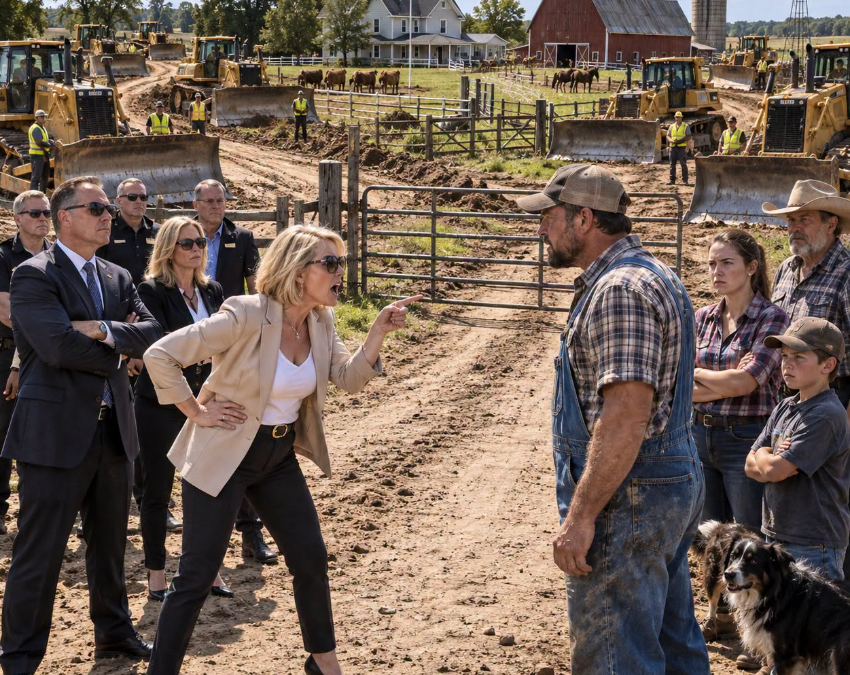
PART2:
She had dressed trespassing in a blazer and taught it to speak paperwork.
Emma pressed closer to me.
“Can she do that?”
“No,” I said.
This time, the word was not useless.
It was the first solid thing I had.
No.
Vivian Cross could not do this.
She could not block my driveway. She could not seal off my pasture gate. She could not interfere with livestock access to water. She could not stand on a private farm that had existed before her subdivision was a line on a developer’s map and declare herself queen of the dirt.
But there is a difference between what people cannot legally do and what they are willing to try before someone stops them.
Vivian raised the megaphone again.
“Any attempt to breach the restricted perimeter will be documented and referred for prosecution.”
I almost laughed.
Not because it was funny.
Because there is a special kind of arrogance required to trespass on someone else’s farm at dawn, surround it with bulldozers, terrify a child, frighten livestock, and then threaten to prosecute the people trapped inside.
It takes practice to become that ridiculous.
Vivian had practiced.
For three months, she had practiced on me.
PART3:
Three months earlier, I had believed this farm was the one place left in the world that could not betray me.
Forty-seven acres of rolling ground, old fence lines, weathered barns, a creek at the back, and soil so dark in spring it looked almost blue after rain. My grandfather used to say the land remembered who treated it right. When I was little, I thought he meant it like a fairy tale.
As an adult, after lawyers, court dates, divorce papers, and nights in an apartment where every wall felt temporary, I understood him differently.
Land remembers because people leave proof.
Fence posts.
Stone lines.
Seed records.
Burn scars.
Old wells.
Tree rows planted by hands that never lived long enough to sit in their shade.
My grandfather, Thomas Rourke, kept proof of everything. He had been a farmer, a veteran, a stubborn record keeper, and a man who did not trust offices to remember anything that did not benefit them. In the attic, he kept labeled boxes full of permits, tax receipts, crop records, water access documents, easement maps, letters from county clerks long dead, and handwritten notes explaining why each paper mattered.
When my marriage finally collapsed, I came home to those boxes with Emma and two suitcases.
The divorce had taken more from me than I liked admitting.
Not just money.
Direction.
Confidence.
The simple belief that if you worked hard and stayed reasonable, life would meet you halfway.
By the time I unlocked the farmhouse door again, I felt hollowed out.
The farm did not care.
That was its mercy.
It needed feeding, fixing, mowing, mending, hauling, cleaning, checking, planting, and planning. It did not ask whether I was heartbroken. It did not ask whether I was scared. It did not ask whether I had cried in a grocery store parking lot because I could not remember if Emma liked the red apples or the green ones.
The farm just waited.
So I worked.
Every morning before dawn, I walked the gravel drive with coffee in one hand and fence pliers in the other. Emma came with me when she could, wearing boots too clean at first, then properly muddy within a week. She named the chickens like they were classmates. She brushed Juniper until the mare’s coat shone. She taped drawings inside the feed room. She said the farm felt alive, like it was watching over us.
I told her that was because generations of our family had poured their lives into it.
I believed that.
Then the first letter arrived.
It came in the mailbox on a Tuesday, folded too neatly, with the county seal on the corner and language so polished it felt slippery.
Updated zoning boundaries.
Residential classification adjustments.
Community interface review.
Adjacent development impact.
I read it once at the kitchen table, then again standing by the window, then a third time with my grandfather’s old parcel maps spread out beside it.
Part of our western boundary now brushed against a newly expanded residential development called Silver Pines, a neighborhood of identical roofs, white fences, decorative ponds, and lawns green enough to look medicated. It had been built in phases over the last seven years, creeping closer to us each time the county approved another plat. Until then, we had coexisted mostly by ignoring each other.
They had their cul-de-sacs.
We had the farm.
That should have been enough.
A week after the letter, Vivian Cross came up my driveway.
I was repairing a water line near the barn when her white SUV rolled slowly over the gravel. She parked as if she expected valet service, stepped out in spotless shoes, and looked around with the expression of a woman smelling something she had already decided to dislike.
She was in her late fifties, maybe early sixties, polished in the way people get when presentation becomes armor. Pale blazer. Gold watch. Hair sprayed into obedience. Sunglasses big enough to hide compassion, if there had been any.
“Margaret Rourke?” she asked.
“Maggie,” I said.
She smiled.
It was not a smile of warmth.
It was a smile of correction.
“I’m Vivian Cross, president of the Silver Pines Homeowners Association.”
“I’m not in Silver Pines.”
“Not technically,” she said, as if technical truth was a minor inconvenience. “But with the updated boundary review, your property now falls within our community impact zone.”
“That sounds like something a committee made up to sound less nosy.”
Her smile tightened.
“We prefer to think of ourselves as stakeholders.”
“In my farm?”
“In the shared aesthetic and safety environment surrounding our homes.”
I wiped my hands on my jeans.
“Mrs. Cross, this farm has been here since before the road had a name. Your homes were built next to us, not the other way around.”
“Yes,” she said, glancing toward the barn. “And that history is part of the charm. But charm can become blight when not properly maintained.”
She looked at my grandfather’s barn when she said blight.
The barn had gray boards, a patched roof, and one door that hung slightly crooked because my grandfather had repaired it after a storm instead of replacing it. It had sheltered hay, horses, tools, barn cats, and generations of Rourkes. Vivian looked at it and saw depreciation.
Then she looked at the tractor.
“That equipment is visible from the road.”
“That equipment grows food.”
“It appears inoperable.”
“It runs better than your SUV.”
Her head tilted.
I should have known then that humor would not help me.
Vivian opened her folder and handed me a notice.
The top line read: COMMUNITY STANDARD CONCERN.
Below that were phrases like visual nuisance, agricultural odor, improper exterior storage, noise potential, livestock proximity, and negative impact on surrounding values.
There were dollar amounts at the bottom.
Not fines yet.
Threats wearing nice shoes.
“I’m sure we can resolve this cooperatively,” Vivian said.
“Resolve what?”
“The issues listed.”
“You listed a barn, a tractor, chickens, horses, and a compost pile.”
“Yes.”
“That’s called a farm.”
“In a developing residential corridor, it may be called a hazard.”
I stared at her.
She looked back, perfectly calm.
That was my first true glimpse of the problem. Vivian was not embarrassed by absurdity. She had learned that if she said something ridiculous in the right tone, many people would treat it as policy.
I tried reason.
I explained our permits. I explained the agricultural classification. I explained that our livestock numbers were within county allowances, our water access was documented, our structures were grandfathered, and our operations predated Silver Pines by decades.
Vivian nodded as if listening.
Then she said, “Progress doesn’t wait for nostalgia.”
That sentence stayed with me.
Not because it was clever.
Because it was a confession.
The notices came after that.
One for the barn.
One for the tractor.
One for the chickens.
One for “odor drift,” which is a bold complaint from people who moved next to a working farm and then discovered manure was not a decorative concept.
An inspector appeared one morning with Vivian behind him. He walked the property wearing polished boots and the bored look of a man who expected paperwork to support whatever conclusion was needed. Emma stood on the porch holding a mug of cocoa, watching strangers inspect the place she was just starting to feel safe in.
When I produced my grandfather’s permits, the inspector’s confidence faltered.
He took photos.
He asked for copies.
He left without issuing anything official.
Vivian did not like that.
The pressure changed after the failed inspection.
Cars idled near our gate. Men took pictures from the road. Customers who bought eggs and vegetables from us asked if it was still okay to come by. A Silver Pines security vehicle began parking near the entrance for long stretches, close enough to intimidate, far enough to deny blocking access.
Emma stopped waving at passing cars.
That was when I got angry in a way that frightened me.
Not hot anger.
Not the kind that makes you shout.
Cold anger.
The kind that organizes binders.
I pulled every document from the attic. Grandpa’s boxes covered the kitchen table for days. Emma helped sort them by decade. There were permits from 1968, water line approvals from 1979, agricultural tax classifications, soil conservation correspondence, livestock inspection records, old maps, newer maps, easements, letters, receipts, and one faded note in my grandfather’s handwriting that simply said:
Never let anyone redraw what they did not build.
I taped that note to the refrigerator.
My neighbor Ruth Bennett knocked on my door late one evening carrying a stack of copied records.
Ruth had lived beside our farm since before I was born. She was seventy-four, sharp-eyed, and built like a fence post: narrow, weathered, and impossible to move. She had worked in the county records office for thirty years and had retired with two hobbies: growing tomatoes and distrusting developers.
“You need to look at these,” she said.
She spread the copies across my table.
Shell companies.
Land transfers.
Planning applications.
Development maps.
Clearwater Development LLC appeared again and again, sometimes directly, sometimes through subsidiaries with names like CWD Holdings, Pine Corridor Partners, and Westline Residential Group. The maps circled our farm without touching it, like wolves testing a fence.
Ruth tapped one document with a crooked finger.
“They aren’t reacting to your farm,” she said. “They’re targeting it.”
“For what?”
“Access.”
She explained what I had not yet seen.
Our forty-seven acres sat between Silver Pines and a planned expansion corridor. Without our land, Clearwater would need an expensive bridge, drainage redesign, and a longer road connecting to the highway. With our land, they could run a clean access route straight through the old service lane by the creek.
The same service lane Vivian would block with bulldozers weeks later.
“How do you know Vivian is involved?” I asked.
Ruth gave me a look.
“Maggie, I spent thirty years watching people pretend not to know each other in public records. Vivian’s husband sits on two nonprofit advisory boards with Clearwater’s counsel. Her HOA attorney used to represent one of the shell companies. And three members of her so-called community safety committee bought investment shares in land adjacent to the expansion.”
I sat back.
The room felt suddenly smaller.
“So the notices…”
“Pressure,” Ruth said. “They make the farm look like a nuisance. Then they argue emergency review, safety mitigation, maybe even a forced easement if they can manufacture enough complaints.”
“That can’t be legal.”
“No,” Ruth said. “But illegal things happen all the time when people move fast and count on everyone else being too tired to stop them.”
After she left, I checked the locks twice.
Then I checked on Emma.
She was asleep with one arm around a stuffed horse she claimed she had outgrown. Her old phone, the one I had given her for emergencies, sat charging on the nightstand.
I stood in the doorway and felt something settle over me.
Vivian could insult my barn.
She could photograph my tractor.
She could send notices until her printer died from exhaustion.
But she had made one mistake that turned this from a land dispute into something personal.
She had made my daughter afraid of home.
The emergency HOA meeting notice arrived two weeks later.
Silver Pines Community Safety Session.
Attendance strongly encouraged.
I almost threw it in the trash.
Instead, I went.
The meeting was held at the Silver Pines clubhouse, a building so aggressively tasteful it looked assembled from a catalog titled Beige Authority. Inside, rows of chairs faced a long table where Vivian sat with her board, her attorney, and a few men I recognized from Ruth’s documents.
The room was full of Silver Pines residents with pressed shirts and concerned expressions, nodding along as Vivian spoke about public safety, rural hazards, pest risk, odor control, declining property values, road hazards, unsecured animals, and the need for decisive action.
She never said my name at first.
She did not need to.
Everyone knew whose “rural hazard” she meant.
Then she proposed a special assessment to fund emergency compliance measures and legal review of adjacent nuisance properties.
The amount was enormous.
A murmur moved through the room, but not resistance.
Approval.
Fear had already been planted, and fear is easy to invoice.
I raised my hand.
Vivian ignored me.
I raised it higher.
Finally, she smiled down the table.
“Yes, Ms. Rourke?”
“What authority does Silver Pines HOA have over land outside its recorded boundary?”
A few heads turned.
Vivian folded her hands.
“We are discussing community impact, not ownership.”
“That doesn’t answer the question.”
Her attorney leaned toward his microphone.
“Adjacent properties may fall within review when they materially affect the safety or value of association members.”
“According to what statute?”
His eyes narrowed.
“We can provide citations later.”
“I’d like them now.”
The room shifted.
Papers rustled.
Vivian’s smile sharpened.
“This is not a courtroom.”
“No,” I said. “It’s a meeting where you’re asking residents to fund action against land you don’t control. I’d also like to know whether you have quorum, whether the special assessment notice complied with your bylaws, and whether financial records supporting this proposal are available for homeowner inspection.”
That was when the energy changed.
Subtle, but real.
People stopped nodding.
Vivian’s attorney whispered to her.
One board member looked down at his folder as if hoping it might open and swallow him.
Within twenty minutes, the vote was postponed.
Vivian called it a procedural delay.
I called it blood in the water.
But on the drive home, I did not feel victorious.
I felt hunted.
Because I had not stopped anything.
I had only made them rush.
The bulldozers came eighteen days later.
Now, standing on my porch with Emma behind me and ten machines choking the morning air, I understood that Vivian had decided to stop pretending.
I forced myself to think.
Do not feed the fire.
Document the fire.
I stepped back into the house, keeping my body between Emma and the yard.
“Get my old phone,” I told her.
She looked up at me.
“Why?”
“Because we record everything.”
My hands wanted to shake.
I did not let them.
I grabbed my phone from the counter and began filming from the doorway. Slow pan. Machines. Blades. Gate. Service road. Operators. Vivian. Megaphone. License plates. The man in the gray suit. The orange tape two of her men were stretching across my entrance like a crime scene.
Emma returned with the old phone.
“I can film too,” she said.
I hesitated.
Every instinct in me wanted to send her to her room, shut the door, and preserve some imaginary wall between childhood and the ugliness outside.
But Vivian had already broken that wall.
Emma was watching whether fear made adults helpless.
I would not teach her that.
“Stand away from the windows,” I said. “Hold it steady. Say what you see. Do not guess what they mean. Just facts.”
She nodded with the seriousness of someone receiving a sacred duty.
I called the sheriff’s office first.
The dispatcher sounded tired before I finished my first sentence.
“There are ten bulldozers blocking access to my private farm,” I said. “A homeowners association is claiming emergency authority. They are restricting access to livestock and water.”
“Is anyone injured?”
“Not yet.”
The word tasted bitter.
Not yet.
As if injury were already in the room, waiting for permission.
“We’ll send a deputy.”
I almost asked how long.
I did not, because the answer would not matter.
Next, I called the state agricultural welfare hotline. Grandpa had taped the number inside a cabinet door years earlier after a sick horse incident. The woman who answered sounded alert in a way the dispatcher had not.
I explained the situation.
When I said “restricted access to livestock water,” her tone changed immediately.
“Can you safely confirm whether the animals have water access?”
“Not safely. Machines are positioned near the trough line and the service road.”
“Stay inside. Keep recording. Do not confront them. I’m dispatching an officer.”
“Can they do this?”
“If they are interfering with animal welfare, this is not merely a civil property dispute.”
That sentence steadied me.
Not merely a civil property dispute.
Vivian’s favorite hiding place had always been the fog between civil and criminal, between private and public, between authority and performance.
Someone had just turned on a light.
Outside, Vivian lifted the megaphone again.
“This property is subject to emergency compliance review due to documented hazards. Any interference will be treated as obstruction.”
Emma stood beside the front window, phone held in both hands.
“This is our farm,” she said softly into the camera. “They put machines in front of the gate. The horses are scared. My mom called the sheriff. We’re waiting.”
I turned toward her.
“Are you live?”
She winced.
“I’m sorry.”
“How many people?”
She looked at the screen.
“Forty-two.”
I almost told her to stop.
Then I looked outside and saw Vivian’s man pointing his phone toward our porch, recording us.
Sunlight is the one thing bullies hate more than rules.
“Keep your face out of it as much as you can,” I said. “Film the yard.”
She nodded.
Ruth arrived before the deputy.
Her old blue pickup rolled to a stop on the public road just short of the blockade. She climbed down slowly, lifted both hands, and walked toward the machines with the calm fury of a church lady approaching a bad casserole.
One of Vivian’s men stepped forward and pointed her back.
Ruth did not argue.
She pulled out her phone and began making calls.
I saw her eyes flick toward my porch.
Even from that distance, I could read the message.
Hold steady.
The deputy arrived twenty minutes later with lights flashing and siren off.
He was young. Maybe late twenties. He got out carefully, one hand resting near his belt, the other holding a notepad. Vivian intercepted him before he could reach the porch.
Of course she did.
I watched her perform.
Papers appeared. She gestured toward the barn. Toward the pasture. Toward the machines. Toward the sky, possibly because the sun had risen without HOA approval. Her attorney stood nearby, nodding gravely. The deputy listened with the expression of a man who had hoped law would be clearer than this.
Then he walked to my porch.
“Ms. Rourke?”
“Yes.”
“I need your side of what’s happening.”
I gave it to him in clean sentences.
Private property.
Farm predates development.
Agricultural classification.
No court order served.
No county emergency order.
Machines blocking access.
Animals distressed.
Possible interference with water and feed routes.
He wrote quickly.
Then came the phrase I had feared.
“This may be a civil matter.”
Behind him, Vivian watched like she was tasting victory.
I did not argue.
I had learned that arguing with uncertainty only makes uncertainty defensive.
So I asked him one question.
“Do they have legal authority to restrict my access to my own animals?”
He hesitated.
“I’d need to review the paperwork.”
“Do they have legal authority to block livestock from water while paperwork is reviewed?”
That landed differently.
His eyes moved toward the pasture, where Juniper was pacing hard enough to sweat.
I continued, quieter.
“If one of those horses injures itself because those machines are frightening them and blocking movement, who is responsible?”
The deputy looked back at Vivian.
For the first time, doubt showed on his face.
“Let me see what documentation they have.”
He walked back toward her.
Vivian’s smile tightened when he asked for something beyond HOA letterhead.
The state agricultural officer arrived twelve minutes later.
She came in a plain white vehicle with state plates and no drama. Her name was Officer Denise Alvarez, and she moved like a woman who had spent years walking into rural disputes where everyone claimed to be right and the animals paid first.
She did not start with Vivian.
She went straight to the animals.
One of the men near the tape stepped in front of her.
“Ma’am, this area is restricted.”
Officer Alvarez looked at him.
“Not by you.”
She stepped around him.
There are moments when real authority enters a space and fake authority suddenly looks overdressed.
This was one of them.
Alvarez inspected the trough line, the service path, and the gate. She watched the horses. She took photos. She asked me, from a distance, when they had last been watered, how many animals were on the property, where the feed was stored, and whether there was an alternate access route.
I answered clearly.
Then she turned to Vivian.
“I need to see the emergency order authorizing restriction of livestock access.”
Vivian held up a page.
“This is an internal emergency compliance notice issued by the Silver Pines Community Safety Committee.”
“I did not ask for an internal notice,” Alvarez said. “I asked for a county or state order.”
Vivian’s cheeks flushed.
“Our counsel can explain—”
“Internal HOA measures do not override state animal welfare requirements.”
That should have ended it.
It did not.
Vivian laughed.
A small, polished laugh, quiet enough to pretend innocence, confident enough to show contempt.
Then she snapped her fingers at the suited man.
He stepped forward, phone raised, recording Officer Alvarez.
“You are obstructing a lawful compliance action,” Vivian said. “We have counsel on standby.”
“Counsel is standing right there,” I said from the porch.
The suited man smiled at me.
It was the kind of smile lawyers use when they believe fear bills by the hour.
He walked toward the deputy and handed him a stack of papers with a flourish.
I could not hear everything, but I heard enough.
Emergency petition.
Hazard mitigation.
Pending injunction.
Liability.
The deputy’s posture softened again.
That was the tactic.
Confuse the law long enough for machines to do damage.
Once a gate is crushed, a fence line moved, a trough cut off, a road blocked, or a field torn open, the people who caused it can shrug and say the courts will sort it out later.
Land does not heal on court schedules.
Ruth waved from the road.
She was leaning out of her truck window, urgent now.
“Maggie!”
The deputy glanced over, then gave a tiny nod, as if granting me permission to approach the road so long as I did not cross the orange tape.
I walked down the drive, phone still recording.
Ruth shoved an envelope into my hand.
“This was delivered to my mailbox yesterday by mistake,” she said. “Same carrier, same route. It’s yours. I didn’t open it. But you need it now.”
The envelope was thick, cream-colored, and sealed with the county mark.
My name was typed across the front.
Margaret Rourke.
I stared at it while diesel smoke drifted around us and Vivian’s megaphone crackled behind me.
“What is it?” I asked.
Ruth’s eyes were fierce.
“Open it.”
I slit the envelope with my thumb against the hood of her truck.
Inside was an official letter on Crisp County stationery.
At the top, in bold:
INTERIM APPOINTMENT CONFIRMATION — COUNTY LAND COMMISSION.
For a moment, I simply stared.
My brain, overloaded by fear and engines and my daughter’s trembling voice, refused to process what I was seeing.
Then I read further.
Due to the sudden vacancy created by Commissioner Harold Benton’s resignation, and pursuant to county appointment procedures, Margaret Rourke was confirmed as interim land commissioner for the remainder of the term, effective immediately upon filing. Orientation required within ten days. Agenda materials enclosed. Pending land-use applications flagged for review.
I read the effective date.
Yesterday.
The letter had been misdelivered yesterday.
Which meant Vivian had surrounded the farm of a sitting county land commissioner.
I looked up.
Ruth mouthed, I told you.
Behind us, Vivian lifted her megaphone again.
“Any unauthorized breach will be prosecuted.”
I folded the letter once, then again, and slid it into my back pocket.
The world did not suddenly become safe.
The bulldozers did not vanish.
The horses did not calm.
Vivian did not shrink.
But something inside me shifted.
Until that moment, I had been defending my farm as a property owner, a mother, and a farmer.
Now I had a public duty.
And Vivian had just delivered a live demonstration of everything wrong with the system I had been appointed to help oversee.
I walked back toward the porch slowly.
Running would have shown nerves.
My daughter met me on the steps.
“What was it?”
“A county letter.”
“Bad?”
“Maybe the opposite.”
Her stream was still running. Comments rolled fast across the screen now. People were angry. People were tagging local pages. Someone claimed a reporter was watching. Someone else had posted the sheriff’s office number. I had never liked social media much, but at that moment, watching strangers react in real time to what Vivian wanted hidden, I understood its blunt usefulness.
I stepped toward Officer Alvarez and the deputy.
“I need both of you to see this.”
I handed them the appointment letter.
The deputy read it first, then looked up at me.
“You’re on the Land Commission?”
“Apparently as of yesterday.”
Officer Alvarez scanned the signature, then the effective date.
“This changes who needs to answer your questions,” she said quietly.
Vivian saw the paper.
For the first time that morning, her confidence flickered.
Not much.
But enough.
The suited man saw it too. He moved toward her and spoke into her ear. She nodded, then lifted her chin as if physically forcing superiority back into place.
A black sedan rolled up behind the bulldozers.
Another man got out, older than the first attorney, heavier, with silver hair and a briefcase that probably cost more than my first car. He walked straight to Vivian, whispered to her, then turned toward the deputy.
“Officer,” he said smoothly, “this is an active land-use compliance matter involving pending emergency relief. Any interference by county personnel at this stage may expose the county to significant liability.”
I lifted my phone.
“What is your name?”
He looked at me with mild irritation.
“Calvin Pike. Counsel for Silver Pines and associated applicants.”
Associated applicants.
That phrase mattered.
Not just the HOA.
Development.
Clearwater.
I felt Ruth move beside me. Somehow she had made her way closer, standing just outside the tape, arms folded.
“They brought the expensive one,” she muttered.
Calvin Pike handed papers to the deputy.
I watched the deputy read, watched confusion return, watched the machinery idle behind him like a threat waiting for a signature.
Officer Alvarez crossed her arms.
“Counselor, none of that authorizes obstruction of livestock care.”
“With respect, Officer, this property has been identified as a hazard site.”
“By whom?”
“Community review.”
“Not good enough.”
Vivian stepped forward.
“This farm presents a documented nuisance condition to hundreds of nearby residents.”
I looked around at the bulldozers.
“The nearest Silver Pines house is half a mile away.”
“Odor, runoff, unsecured animals, obsolete structures, and unpermitted commerce do not stop at your fence.”
“My permits say otherwise.”
“Your permits are under review.”
“By you?”
“By the proper authorities.”
I touched the folded appointment letter in my pocket.
“Interesting.”
Calvin’s eyes narrowed slightly.
He knew.
Maybe not before that second, but then.
He realized I was not standing there only as the farm owner anymore.
The engines rose.
Two operators climbed into their cabs. Blades lifted a few inches. Not enough to move forward with purpose. Just enough to threaten. The sound rolled over the yard, and Juniper panicked again, slamming into the fence hard enough that Emma cried out.
“Shut them down!” Officer Alvarez shouted.
The operators stared forward.
Blank.
That frightened me more than Vivian’s speeches.
A person making choices can be reasoned with. A person obeying instructions while pretending not to hear is a tool, and tools do damage.
I pulled out the appointment letter and called the number printed at the bottom.
The receptionist answered.
I said my name exactly as printed.
“Margaret Rourke, interim county land commissioner. I need the county attorney on an emergency line. Unauthorized heavy equipment is obstructing a working farm, interfering with livestock access, and claiming authority under a pending development matter.”
The word commissioner did what fear had not.
The receptionist transferred me in seconds.
A sharp female voice came on.
“This is County Attorney Elaine Porter.”
I put the phone on speaker.
“This is Margaret Rourke. I am at my farm on Rourke Road. Silver Pines HOA and their counsel have ten bulldozers blocking my entrances. State agriculture is on scene. A deputy is on scene. They are claiming emergency compliance authority, but no filed court order has been produced.”
“Names.”
I gave them.
Vivian Cross.
Calvin Pike.
Silver Pines HOA.
Clearwater Development.
A-Plus Grading and Earthwork, based on the logos painted on the machines.
Porter did not waste a syllable.
“Deputy, can you hear me?”
The deputy stepped closer.
“Yes, ma’am.”
“If private equipment is obstructing a property owner’s access without a signed order and interfering with livestock welfare, you treat it as unlawful obstruction and potential detention of property. Instruct them to clear access immediately. If they refuse, request additional units and prepare equipment impound.”
Calvin Pike stepped toward my phone.
“Counselor, this is Calvin Pike. We have an injunction petition being filed today. Any action taken now could—”
“You do not have an injunction until a judge signs one,” Porter cut in. “A petition is not an order. Clear the access.”
His jaw tightened.
Vivian lifted the megaphone.
The deputy raised his hand.
“Ma’am, put that down.”
She froze.
It was the first direct order anyone had given her all morning.
“Excuse me?”
“Put the megaphone down and tell your equipment operators to clear the entrance.”
Vivian stared at him as if he had spoken a foreign language.
“These machines are here for community safety.”
“These machines are obstructing access. Move them.”
For one second, I thought she might comply.
Then she made the mistake desperate people make.
She tried to prove she still had control.
“Proceed to position two,” she called.
The closest bulldozer lurched forward.
Only a foot.
Maybe two.
But its blade scraped gravel, the engine roared, and the horses exploded into motion.
Juniper hit the fence again.
Biscuit reared.
Emma screamed.
The sound snapped something loose in the morning.
Officer Alvarez ran toward the machine.
“Shut it down!”
The deputy grabbed his radio.
Ruth shouted a name from the road.
“Tommy! Don’t you dare!”
The operator flinched.
His head turned.
For one second, the blank obedience fell away, and I saw a man in a cab realizing half the county might know his mother.
Then Calvin Pike clapped once, sharp.
The operator faced forward again.
That was when another truck tore down the public road and stopped hard by the side gate.
A broad-shouldered man jumped out carrying bolt cutters. I had seen him twice at the feed store but did not know his name.
He did not ask permission.
He cut the chain on the side gate in one clean snap, threw it open, and shouted, “Animals first!”
The deputy yelled, “Sir!”
The man raised both hands.
“Charge me later. Water them now.”
More trucks arrived behind him.
Farmers.
Neighbors.
People from the co-op.
People I barely knew and a few I did not know at all. They came in work boots, barn coats, pajama pants, and one woman in a robe under a Carhartt jacket, carrying a bucket like she had been born ready for war.
Vivian shrieked into the megaphone.
“This is trespassing! Every one of you will be prosecuted!”
Nobody listened.
Not because they were lawless.
Because everyone there understood the hierarchy Vivian had ignored.
Animals first.
Property second.
Paperwork third.
Ego nowhere on the list.
The farmers moved with practiced calm. They opened interior gates, redirected the horses away from the machines, carried water, checked the trough line, and spoke in low voices that cut through panic better than shouting ever could. Emma stood on the porch, filming and crying at the same time.
“They’re helping,” she said into the phone. “People came to help.”
The livestream numbers climbed.
Hundreds now.
Then thousands.
Officer Alvarez documented everything. The open gate. The blocked access. The distressed animals. The machine movement after the deputy’s order. Vivian’s commands. Calvin’s presence. The operators. The tape.
The deputy called for backup.
Sirens came from the east first.
Then the south.
Patrol cars lined the public road. A county SUV pulled in behind them. Another vehicle with state markings arrived. Then Elaine Porter herself stepped out of a dark sedan, hair pinned back, face composed, shoes entirely wrong for mud but attitude perfectly suited to it.
She took in the scene with one sweep.
Vivian began walking toward her.
“Finally,” Vivian said. “Someone from the county who can understand the seriousness of—”
Porter walked past her.
Straight to me.
“Commissioner Rourke?”
I almost turned to see who she meant.
Then I remembered.
“Yes.”
She shook my hand.
Vivian’s face drained.
Porter looked at the bulldozers, then at Officer Alvarez.
“Animal welfare status?”
“Access restored through side gate. Animals stressed but stable. Obstruction documented. Equipment advanced after deputy’s instruction to clear.”
Porter’s eyes moved to the deputy.
“Order given?”
“Yes, ma’am.”
“Refused?”
“Yes, ma’am. One machine advanced.”
Porter turned to Calvin Pike.
“Authority letter.”
He handed her the stack.
She read fast.
I watched her expression flatten.
“This is not filed,” she said.
“It is pending.”
“This references an emergency agenda item that was pulled last month.”
“The issue remains active.”
“This cites a nuisance easement designation that does not exist in county records.”
“It is under application.”
“An application is not an easement.”
Vivian snapped, “The farm is a documented hazard.”
Porter looked at her.
“By whom?”
“Our community safety committee.”
“Your HOA committee does not designate county land hazards.”
Vivian’s mouth opened.
Porter kept going.
“Your equipment is blocking private agricultural property. Your personnel interfered with livestock access. Your counsel has presented unfiled and inaccurate documents to law enforcement. You have issued threats of prosecution without authority. You will cease operations immediately.”
Calvin’s voice lowered.
“Elaine, let’s be careful. There are major development interests here.”
Porter smiled without warmth.
“I am being careful. That is why I am saying this with witnesses.”
Then she turned to the deputy supervisor who had just arrived.
“Clear the equipment. Identify every operator. Document every company vehicle. If any machine refuses to move, impound it.”
This time, the operators listened.
Funny how quickly obedience changes direction when liability becomes personal.
Engines coughed. Blades lifted. Bulldozers backed away from the drive one by one, no longer an army, just expensive machines driven by men realizing they had been sent into a legal swamp wearing paper shoes.
A cheer moved through the gathered neighbors.
Not loud at first.
More like an exhale.
Then louder.
Emma grabbed my hand with fingers sticky from fear and sweat.
“Are we okay?”
I looked at the ruts, the tape, the frightened horses, the county vehicles, Vivian’s white face, Calvin’s clenched jaw, and the farmers still moving through my pasture like a rescue crew.
“We’re not done,” I said. “But we’re not alone.”
By midmorning, the siege had become an investigation.
Statements were taken.
Photos were cataloged.
Officer Alvarez wrote a preliminary animal welfare report. The sheriff’s deputy documented the refusal to clear access. County staff photographed every entrance. Porter issued a cease-and-desist order to Silver Pines HOA, Clearwater Development, and all associated contractors. She also issued a preservation demand for communications, contracts, invoices, internal notices, development filings, and any documents related to the emergency compliance action.
Vivian had arrived with a megaphone.
She left without it.
A county official took it from her during the investigation after she kept trying to address the gathered crowd.
“You’re done speaking,” he said.
Those three words may not have been legally necessary, but they were spiritually perfect.
Before Porter left, she met me on the porch.
Her folder was already thicker than when she arrived.
“Commissioner Rourke,” she said, “we need to talk about Clearwater Development.”
“I figured.”
“There are irregularities tied to filings that predate your appointment.”
“Ruth warned me.”
“Ruth Bennett?”
“Yes.”
Porter almost smiled.
“Ruth warned half this county about half this county.”
“That sounds right.”
Her expression turned serious.
“You are now in a public role connected to land-use review. They will claim conflict because your farm is affected.”
“I’ll recuse where required.”
“Good. But recusal does not mean silence. You can still provide evidence as a property owner. You can still ask procedural questions. You can still report misconduct. Just document everything.”
“I’ve been doing that.”
“I noticed.”
She glanced toward Emma, who sat on the porch steps now with a bottle of water someone had given her, still holding the phone.
“Your daughter’s stream may become evidence.”
Emma looked up.
“Am I in trouble?”
Porter’s face softened.
“No. You may have helped prevent people from lying about what happened.”
Emma absorbed that.
Then she looked at me.
“Grandpa said write things down.”
“He did.”
She lifted the phone a little.
“This is like writing, right?”
“Exactly like writing.”
The backlash came before lunch.
Emails.
Social posts.
Anonymous complaints.
A statement from Silver Pines claimed an “unfortunate misunderstanding” had occurred during a “lawful safety review” of an “adjacent nuisance operation.” It accused me of escalating tensions, abusing a newly received county appointment, and encouraging trespassers to breach a safety perimeter.
I read the statement twice.
Then I sent it to Porter, Sarah Whitcomb, my private attorney, and Ruth.
Sarah called first.
She had been my divorce lawyer originally, which meant she had already seen me at my most exhausted and least impressed. She had since become a friend in the way people do after surviving paperwork together.
“Maggie,” she said, “tell me you are not responding online.”
“I am not responding online.”
“Good. Because Vivian’s statement is a piñata full of defamation and admissions, and I would like to enjoy it professionally.”
“I was hoping you’d say that.”
“They claimed lawful authority?”
“Yes.”
“Excellent. Then they can produce it.”
“They can’t.”
“Even better.”
That afternoon, another letter appeared in my mailbox.
No postmark.
No return address.
Just a typed demand accusing me of unlawful interference with emergency development mitigation and claiming damages in the amount of $480,000 for equipment delays, contractor penalties, and reputational harm.
I stared at the number.
Four hundred eighty thousand dollars.
For making them stop trapping my farm.
At first, I laughed.
Then I stopped laughing, because the amount was not meant to make sense.
It was meant to exhaust me before we reached the truth.
Ruth read it at my kitchen table and snorted.
“They’re counting costs already.”
“What does that mean?”
“It means they expected the bulldozers to do more than block gates.”
The room went quiet.
Emma had gone upstairs to rest, but I still lowered my voice.
“You think they planned to damage something?”
Ruth looked toward the window, where the pasture was beginning to settle under afternoon light.
“I think they planned to create facts on the ground. Tear up the service lane. Block the water line. Force an emergency access claim. Maybe damage the old barn enough to call it unsafe. Once land is disrupted, developers call it mitigation.”
“That is insane.”
“No,” she said. “It’s expensive. Insane is usually cheaper.”
That night, after Emma fell asleep, I spread the county agenda materials from my appointment letter across the kitchen table.
Clearwater Development appeared on page after page.
Amended applications.
Variance requests.
Fast-track review petitions.
Environmental mitigation proposals.
Traffic access plans.
Drainage easement requests.
And then I saw it.
Nuisance easement.
The phrase appeared in a supporting document attached to an amended Clearwater application filed the night before the bulldozer siege. It identified my farm as a “rural nuisance impediment affecting residential safety and continuity.” It recommended emergency access authority across the service lane “pending full compliance review.”
I read the sentence again and felt cold all the way through.
They had been trying to turn my farm into an obstacle in the official record.
Not a home.
Not agricultural land.
Not a family property.
An impediment.
A nuisance.
A problem to be solved.
My phone buzzed at 11:42 p.m.
Unknown number.
The message contained coordinates and a time for the next morning.
Then one sentence:
You should see what they filed tonight.
I did not sleep much.
At dawn, I drove to a gravel pull-off by the river, the kind of place locals used for fishing, teenagers used for secrets, and county employees probably used when they wanted to avoid being seen doing the right thing too early.
Fog hung over the water.
My truck sounded too loud when I pulled in.
Ruth’s blue pickup arrived two minutes later.
She got out carrying a thick binder wrapped in a grocery bag.
“That was you?” I asked.
“No,” she said. “But I know who it was, and you don’t need to.”
She handed me the binder.
Inside were copies of amended development filings submitted after the bulldozer incident.
Backdated signatures.
Revised hazard claims.
Fast-track requests.
A draft emergency access order.
Maps showing a proposed temporary construction route across my service lane.
“They’re trying to rewrite yesterday before yesterday settles,” Ruth said.
We spread the pages across my tailgate.
The sloppiness was almost shocking.
Variance numbers repeated across parcels they did not match. Environmental reports referenced streams that did not exist. A traffic memo described a road connection that could not physically be built without crossing my land. One signature was dated before the document it approved. One hearing reference pointed to a meeting that had been canceled.
Ruth tapped the page.
“They’re rushing.”
“Why?”
“Because your appointment changes the board composition. Because Porter saw the bulldozers. Because the stream went public. Because once scrutiny starts, speed dies.”
I photographed everything.
Every page.
Every margin.
Every date.
Every sloppy mistake.
Then I drove straight to the county building.
The records office smelled like disinfectant, toner, and old paper, which might be my favorite government smell because it suggests at least one person somewhere still believes files matter.
I requested certified copies of every Clearwater filing from the past sixty days.
The clerk gave me a curious look.
“That’ll take a while.”
“I’ll wait.”
She looked at my muddy boots, then at my appointment letter.
“Yes, Commissioner.”
The word still felt strange.
Commissioner.
I had not campaigned for it. I had not sought it. Months earlier, before everything exploded, I had applied for an open advisory position after Ruth bullied me into it. She said the commission needed someone who understood land as more than future rooftops. I filled out the forms mostly to make her stop asking.
Then Commissioner Benton resigned suddenly.
Then my appointment letter was misdelivered.
Then Vivian arrived with ten bulldozers.
Life has terrible timing, except when it has perfect timing.
The emergency county session convened that afternoon.
The room was too small for the crowd. Farmers lined the back wall in work boots and pressed shirts. Silver Pines residents sat in clusters, some defensive, some embarrassed, some looking like they were reading the news about their own HOA for the first time. Reporters crowded near outlets. Cameras faced the dais.
Vivian arrived with Calvin Pike and two board members.
She wore red that day.
It was a mistake.
Red looks powerful when you are winning and theatrical when you are not.
The chair called the meeting to order.
The first item was Clearwater Development’s amended application.
Calvin Pike stood and spoke smoothly about housing demand, tax base expansion, responsible growth, community safety, and the need to harmonize rural transition zones with modern residential planning.
He did not mention bulldozers.
He did not mention livestock.
He did not mention Emma.
He described my farm without naming it, calling it “an outdated agricultural pocket creating access inefficiencies and safety friction.”
I wrote that phrase down because sometimes insults should be preserved in their natural habitat.
When he finished, the chair asked for commissioner questions.
I raised my hand.
Calvin’s eyes flicked toward me.
The room shifted.
“I have several,” I said.
My voice carried better than I expected.
“First, why does variance number CWD-17B appear on three separate parcel maps with different boundary descriptions?”
Calvin looked down.
“That may be a clerical duplication.”
“Second, why does the environmental impact section reference a stream crossing on parcel twelve when the county hydrology map shows no stream on that parcel?”
“I’d need our engineer to address that.”
“Third, why does the amended emergency access memo cite a public hearing dated August fourteenth when that hearing was canceled and no replacement notice was issued?”
The chair leaned forward.
Calvin’s collar darkened.
“I believe the applicant relied on preliminary scheduling.”
“Fourth,” I said, “why does the nuisance easement request identify Rourke Farm as a rural nuisance impediment when no county nuisance finding exists?”
Vivian whispered sharply to Calvin.
He ignored her.
“That language reflects community impact concerns raised by adjacent residents.”
“Not a county finding?”
“No.”
“Not an agricultural violation?”
“No formal finding at this time.”
“Not an animal welfare violation?”
He hesitated.
“No formal finding.”
“Then the application characterizes private agricultural land as a nuisance without an evidentiary finding, uses a hearing that did not occur, references mismatched parcel variances, and contains environmental descriptions inconsistent with county maps.”
The room was silent.
Calvin said, “Commissioner, with respect, these are correctable technical issues. Delaying this project causes real financial harm.”
I slid a folder across the table.
“These are certified copies from the clerk’s office. Some signatures appear dated before the supporting notices existed. I am asking that the amended application be tabled pending independent review.”
The chair looked at Porter.
Porter nodded once.
Vivian stood.
“This is outrageous. Commissioner Rourke has a personal vendetta. Her farm is directly implicated. She should be recused.”
“I will recuse myself from any final vote directly affecting my parcel,” I said. “I am not recused from identifying discrepancies in documents filed with this county.”
Porter added, “Conflict rules do not require a public official to ignore potentially false filings.”
The chair called a recess.
During the break, reporters rushed into the hallway. Vivian paced near the window, phone pressed to her ear, speaking so sharply people turned to stare. Calvin stood with two men I recognized from Ruth’s shell-company research.
Ruth appeared beside me with a paper cup of coffee.
“You’re doing fine.”
“I feel like I swallowed a hornet nest.”
“That’s government.”
When the session resumed, the chair’s tone had changed.
“Given the discrepancies identified, the Clearwater amended application is tabled pending independent review. Staff will audit related filings, notices, and supporting documents. No emergency access authority will be considered until that review is complete.”
Calvin objected.
The chair cut him off.
“We are not moving forward today.”
It was not a final victory.
But it killed momentum.
And for developers who rely on speed, delay is oxygen leaving the room.
The investigations began quietly.
That surprised Emma.
She expected consequences to look like the morning of the bulldozers, loud and immediate. I had to explain that real accountability usually arrives carrying a clipboard, asking boring questions, and requesting records in triplicate.
County staff reviewed Clearwater’s applications.
The state reviewed animal welfare interference.
The sheriff’s office reviewed obstruction complaints.
Sarah prepared civil claims.
Porter referred questionable filings for further investigation.
Silver Pines residents began requesting their own HOA records, and that was when Vivian’s kingdom started cracking from the inside.
It turned out many Silver Pines homeowners had no idea their dues were being used to fund legal pressure against our farm. They had been told we were dangerous. They had been told livestock waste threatened runoff. They had been told our service road was already subject to county emergency review. They had been told heavy equipment would simply “secure access points” until officials arrived.
They had not been told about Clearwater’s development route.
They had not been told Vivian’s husband held investment interests through a related company.
They had not been told their community safety committee had been feeding complaints into development filings.
They had not been told that the ten bulldozers were not about safety.
They were about leverage.
One evening, a Silver Pines resident named Daniel Price came to my farm with his teenage son.
He looked embarrassed before he spoke.
“I owe you an apology,” he said.
“For what?”
“I signed one of the complaint letters.”
I waited.
“They told us your animals were getting loose. That runoff was contaminating drainage. That your barn was unstable. That your farm was blocking emergency access. They showed pictures.”
“Pictures can be persuasive if you crop out the truth.”
He winced.
“I know that now.”
His son stared at the ground.
Daniel handed me a folder.
“These are the emails they sent residents. I thought your attorney should have them.”
I took the folder.
“Thank you.”
“I should have asked questions.”
“Yes,” I said. “You should have.”
He nodded.
No excuses.
That made forgiving him easier later, though not immediately.
The emails were worse than I expected.
Vivian had used fear like fertilizer. She sent residents selective photos of mud after rain, old barn boards, manure piles, and the tractor parked near the fence. She described the farm as declining, unstable, unsafe, and incompatible with residential life. She urged residents to support emergency action before “irreversible harm” affected home values.
Home values.
Always home values.
As if my family’s land existed only as scenery for someone else’s appraisal.
Then investigators found the vendor agreements.
A-Plus Grading and Earthwork, the company that sent the bulldozers, had a predevelopment services contract with Clearwater. Silver Pines HOA had signed a separate “community mitigation support agreement” authorizing the company to provide equipment for safety restrictions. Vivian had signed it without a full homeowner vote, using emergency powers that existed only in an HOA policy memo drafted by Calvin Pike’s office.
The memo had no force over my land.
None.
But it had created enough confusion to put machines at my gate.
That was Vivian’s method in miniature.
Not legal authority.
Legal fog.
Fog thick enough to scare residents, slow deputies, and let bulldozers move before the sun burned through.
The most damaging discovery came from a recovered email.
It was sent by Vivian to Calvin Pike two days before the siege.
Subject: Rourke Pressure Window.
The message read:
If we establish visible enforcement before commission review, the farm will look unstable and reactive. Need access issue documented before new appointment becomes active.
New appointment.
She had known.
Maybe not that the letter was misdelivered. Maybe not that I had not yet read it. But Vivian knew I was about to become interim land commissioner. She knew the review board would change. She knew Clearwater’s path would become harder.
So she tried to create a crisis before I could take the seat.
When Sarah read that email, she went very still.
“Maggie,” she said, “this is the spine of the case.”
“What case?”
“All of them.”
The civil complaint expanded.
Trespass.
Private nuisance.
Intentional interference with agricultural operations.
Emotional distress.
Civil conspiracy.
Defamation.
Abuse of process.
The state issued penalties related to livestock access interference. The county suspended Clearwater’s pending applications. The district attorney opened an inquiry into false filings and conspiracy to submit misleading public records.
Vivian resigned from the Silver Pines HOA “to focus on family.”
That was the phrase in her statement.
People always focus on family right after evidence focuses on them.
Calvin Pike’s firm withdrew from representing the HOA first, then from Clearwater’s county filings. His statement cited “evolving procedural complexities.” Sarah translated that for me as “the boat is on fire.”
The Silver Pines board collapsed within a month.
Homeowners voted to dissolve the aggressive community safety committee and commission an independent audit of HOA spending. Vivian’s emergency legal campaign had drained reserves, exposed conflicts, and tied the association to a development scheme many residents had never approved.
Clearwater fought longer.
Money does not apologize quickly.
They filed revised applications. They hired new counsel. They argued that the project would bring jobs, housing, tax revenue, and infrastructure. Some of that may even have been true. Growth is not evil by itself. New homes are not evil. Families need places to live. Counties change. Roads expand. Fields become neighborhoods.
I knew that.
What I objected to was theft wearing the language of progress.
At the formal review hearing three months later, I recused myself from the vote on any matter directly tied to Rourke Farm. I said it clearly into the microphone. Then I stepped away from the dais and sat in the front row as a property owner.
That mattered.
Vivian, who attended with her own lawyer, looked almost pleased at first, as if my recusal meant I had disappeared.
Then Ruth stood.
Ruth had brought maps older than most people in the room.
She spoke for twelve minutes and dismantled Clearwater’s access claims with the calm brutality of a retired records clerk who had been waiting years for someone to make the mistake of challenging her filing system.
Then Officer Alvarez testified about animal welfare interference.
Then Deputy Harris testified about the refusal to move equipment.
Then Daniel Price from Silver Pines testified that residents had been misled.
Then Sarah presented the email.
Rourke Pressure Window.
The room changed when that phrase appeared on the screen.
Even people who had tried to stay neutral understood what it meant.
This had not been a misunderstanding.
It had been a plan.
The commission voted to suspend Clearwater’s development review pending a full independent investigation. The county later revoked several preliminary approvals tied to defective filings. The proposed emergency access route across my farm was rejected entirely. Environmental review had to restart from scratch. Investors pulled back. Clearwater’s expansion timeline collapsed.
The civil case settled before trial.
I cannot share every term, but I can say this: the farm remained ours, the damaged land was restored at their expense, legal costs were covered, and a portion of the settlement funded agricultural preservation education in the county.
Silver Pines changed too.
Not magically.
Neighborhoods do not become wise overnight.
But their residents rewrote HOA procedures.
No emergency action without legal authority.
No outside counsel hired without board approval and homeowner notice.
No development-related advocacy disguised as safety enforcement.
No harassment of adjacent agricultural property.
Vendor disclosures required.
Financial reports itemized.
Boring reforms.
Beautiful reforms.
The kind of dull, sturdy rules that keep loud people from turning fear into policy.
As for Vivian Cross, she did not go to prison, though for a while Emma asked whether she would. The criminal investigation resulted in charges connected to false statements and obstruction-related conduct, but much of it ended in plea agreements, fines, probation, and professional consequences for the people around her. Her husband’s investment ties became public. Calvin Pike faced ethics complaints. A-Plus Grading lost county contract eligibility for a period that hurt more than any speech I could have given.
Vivian sold her house the following spring.
The listing described it as “peaceful living near rural charm.”
Ruth printed it out and brought it to me with a jar of tomato preserves.
“Rural charm,” she said. “That your barn they’re talking about?”
“Probably my odor drift.”
We laughed so hard Emma came in from the porch to ask what was wrong with us.
The farm healed slowly.
The ruts near the front drive filled in first. We brought in soil, reseeded, watered, waited. The service road took longer. Heavy machines leave memory in the ground. For weeks after, every time it rained, faint tracks appeared like ghosts under the mud.
The horses calmed faster than I did.
Juniper stopped flinching at distant engines after a month. Biscuit took longer. The chickens forgot almost immediately, because chickens live in a state of constant tiny crisis anyway.
Emma did not forget.
She kept the old phone charged.
At first, that broke my heart.
Then I realized it was not only fear.
It was readiness.
At school, she gave a presentation about farms, land use, and public records. She stood in front of her class with photos of our fields, Grandpa’s old maps, and a slide that said:
Power Hates Witnesses.
Her teacher called me afterward.
“She was remarkable,” he said.
“She gets that from the land,” I told him.
On the first cool Saturday of fall, we held an open farm day.
It started small in my mind. A few neighbors. Coffee. Maybe apples. It became something else. Farmers came. Silver Pines families came. County staff came out of uniform. Reporters came, though I made them eat pie before asking questions. Kids ran between hay bales. Someone played fiddle under the oak tree. Ruth sat in a lawn chair like a retired general surveying a battlefield she had always expected to win.
We set up tables about water rights, zoning notices, agricultural classifications, and how to read public agendas without falling asleep or being tricked.
That last table was mine.
Emma made the sign.
KNOW WHAT THEY FILE BEFORE THEY FILE OVER YOU.
It was a little aggressive.
I loved it.
A reporter asked me what I had learned.
I could have said a lot.
That land disputes are rarely just about land.
That people who talk endlessly about community often mean control.
That paperwork can be a weapon, but it can also be a shield.
That a misdelivered letter can change a morning.
That a child with a cracked phone can become a witness more powerful than a room full of polished lies.
Instead, I said, “Preparation matters. Community matters more. And nobody should be able to move faster than the truth.”
It sounded better than I expected.
That evening, after everyone left, Emma and I walked the fence line.
The air smelled like hay, cooling soil, and woodsmoke from somewhere beyond the creek. Juniper followed us on the other side of the fence, calm and curious. The repaired ground near the gate had begun to blend with the old grass.
Emma carried Grandpa’s old field notebook.
She had started using it for her own observations.
“Do you think they’ll try again?” she asked.
“Someone always tries something.”
“That’s not comforting.”
“No,” I said. “But it’s honest.”
She looked toward the road.
“I used to think rules were what kept people safe.”
“They can.”
“But not always.”
“Rules are tools,” I said. “Depends who’s holding them.”
She thought about that.
“Then people need to watch the people holding them.”
I smiled.
“Now you sound like Ruth.”
“Good.”
We stopped by the old barn.
The boards Vivian had called blight glowed silver in the evening light. Grandpa had repaired that barn after storms, drought years, bad markets, and one fire that took half the hayloft before the volunteer department got there. It was not pretty in the way developers liked things pretty. It was useful. Scarred. Honest.
Like most things worth keeping.
A week later, I attended my first regular commission meeting without cameras, without Vivian, without bulldozers, without drama. We reviewed drainage rules, notice requirements, and map corrections. We passed a policy requiring direct certified notice to agricultural landowners before any adjacent development application could proceed to emergency review. We required plain-language summaries for affected property owners. We added mandatory verification before nuisance language could appear in filings.
It was not exciting.
No one cheered.
No megaphones were confiscated.
But as the vote passed, I felt something deeper than triumph.
Maintenance.
That was what justice really was most of the time.
Not one dramatic moment.
Not one confrontation.
Not one villain humiliated under fluorescent lights.
Justice was maintenance.
Reading the agenda.
Checking the map.
Saving the receipt.
Showing up to the meeting when you would rather be home.
Teaching your daughter not to be afraid of official letterhead.
Making sure the next farmer got notice before the machines arrived.
I served the rest of the interim term.
When people urged me to run for the full seat, I considered it. Truly. But the farm needed me, and Emma needed our life to contain something other than conflict. So I did not run. I stayed involved. I attended meetings. I read filings. I helped form a county agricultural advisory network so small farms would not stand alone when development pressure came dressed as safety concern.
Ruth said that was better than holding office.
“Office makes people think you have power,” she said. “Networks make sure you actually do.”
She was right, annoyingly often.
Months after the siege, a Silver Pines family came by with their children to buy eggs. The youngest boy pointed at the old tractor.
“Is that the dangerous one?”
His mother went red.
“I’m so sorry.”
I crouched beside him.
“Very dangerous,” I said. “Once it refused to start for three days and nearly made me say words your mother would not approve of.”
He giggled.
Emma rolled her eyes.
The mother bought three dozen eggs and later joined the notice-watch group Ruth had started.
People can learn.
Not all of them.
Not quickly.
But some.
One morning nearly a year after the bulldozers came, I woke before sunrise to a low rumble.
For half a second, my whole body went rigid.
Then I recognized it.
Thunder.
A real storm rolling beyond the ridge.
I sat up in bed, heart pounding, listening until the difference became clear. Rain tapped the roof. Wind moved through the trees. Juniper snorted in the barn, annoyed but not afraid.
No engines.
No blades.
No megaphone.
I walked downstairs and found Emma already in the kitchen, pouring cereal.
“You heard it too?” she asked.
“Yeah.”
“Just thunder.”
“Just thunder.”
She looked out the window.
“Good.”
After breakfast, the storm passed. The sun rose clean over wet fields. The soil smelled rich and alive. Water beaded on the fence wire. Chickens complained about puddles. The horses stepped into the morning like nothing bad had ever happened there.
I stood on the porch with coffee in my hand and watched the farm breathe.
Grandpa’s words came back to me.
The land remembers who treats it right.
He was right.
But I had learned something else too.
The land also remembers who comes to take.
It remembers the tires, the ruts, the false maps, the men with papers, the woman with the megaphone, the machines lined up like soldiers at dawn. It remembers fear, but it does not surrender to it. Given time, care, and enough stubborn hands, it grows over the scars.
People are the same, I think.
Emma came out beside me.
“Mom?”
“Yeah?”
“Do you ever wish we’d stayed in the apartment?”
I looked at her, surprised.
She watched the pasture.
“No,” I said. “Not once.”
“Even with everything?”
“Especially with everything.”
She leaned against me.
“I don’t either.”
Across the road, where Vivian’s bulldozers had idled that morning, wildflowers had come up along the ditch.
Yellow.
White.
Purple.
Nobody planted them. Nobody approved them. Nobody filed a variance or held a hearing or checked whether they harmonized with residential expectations.
They just grew.
That felt right.
Vivian Cross had believed power was the ability to surround someone.
To block their exits.
To frighten their animals.
To make their child whisper on a porch before sunrise.
To call a farm a nuisance and hope the word became true if enough people repeated it.
But real power turned out to be quieter.
A neighbor saving a misdelivered letter.
A farmer cutting a chain and yelling “Animals first.”
A child holding a phone steady.
An officer refusing to be impressed by fake authority.
A county attorney saying a petition was not an order.
A room full of people learning that progress without honesty is just theft with better lighting.
Vivian sent ten bulldozers to trap my farm.
She thought she was bringing force.
What she actually brought was witnesses.