HOA Karen Screamed That I Blocked “Her” Private Access—Then the Police Opened My Survey and Proved the Entire Driveway Was Mine.
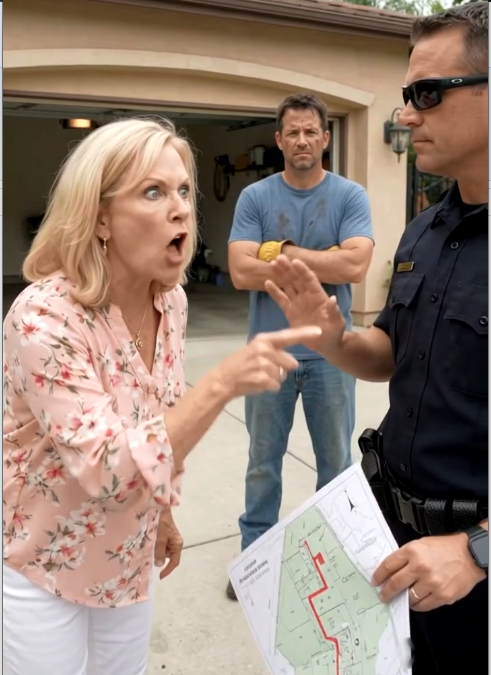
HOA Karen Screamed That I Blocked “Her” Private Access—Then the Police Opened My Survey and Proved the Entire Driveway Was Mine.
The first thing Karen did when the police arrived was point at my truck and scream that I had trapped her on her own property.
The second thing she did was demand that the officers arrest me.
The third thing she did was hand them a map that proved she had been lying for months.
I stood beside my garage wearing work gloves and a layer of sawdust, watching Officer Daniel Ruiz unfold the document across the hood of his patrol car.
Karen paced behind him in a white blazer and black heels.
Her face was bright red.
Her hands trembled with outrage.
“That vehicle has to be removed immediately,” she said. “It is blocking my access.”
Officer Ruiz looked toward my truck.
It was parked entirely inside my driveway.
The sidewalk remained clear.
The street remained clear.
My garage door stood open behind it.
Nothing touched Karen’s lot.
“Access to what?” he asked.
Karen jabbed one finger toward the narrow strip of pavement running along the side of my house.
“That lane.”
“It leads to the rear properties.”
“It has always been available to the neighborhood.”
I looked at her.
“No, it has not.”
Karen ignored me.
She pointed toward the back of my lot, where the pavement ended at a wooden fence and a locked gate.
“He installed that gate without authorization.”
“He blocks the lane with vehicles.”
“He keeps equipment there.”
“This is a private access corridor.”
Officer Ruiz studied the map.
The bold title at the top read:
MEADOW PARK EMERGENCY AND RESIDENT ACCESS PLAN.
A blue line ran from the public street, up my driveway, beside my garage, through my backyard, and into a green area behind the neighboring houses.
The line had been labeled:
COMMUNITY ACCESS LANE.
It looked official.
It contained the HOA logo.
It also showed a route that did not exist on any deed, plat, easement, county plan, fire map, or legal record.
Karen had drawn a road through my property and decided that made it hers.
Officer Ruiz pointed to the paper.
“Who prepared this?”
“The Meadow Park HOA.”
“Who approved it?”
“The board.”
“When?”
“Years ago.”
“Do you have a recorded easement?”
Karen folded her arms.
“This plan has been recognized through continuous use.”
PART2:
“What continuous use?” I asked. “You walking onto my driveway to photograph my garage?”
She spun toward me.
“This is not your private kingdom, Shane.”
“My deed says otherwise.”
“You moved here six months ago.”
“I have lived in this neighborhood for twelve years.”
“Your position is temporary.”
“My ownership is recorded.”
Officer Ruiz raised one hand.
“Let us keep this calm.”
Then he looked at me.
“Do you have your deed and survey?”
“Yes.”
“They are inside?”
“In the office.”
“Please get them.”
Karen scoffed.
“His personal paperwork does not override the HOA.”
Officer Ruiz’s expression changed slightly.
“A recorded deed generally carries more weight than an association illustration.”
Karen opened her mouth.
No sound came out at first.
Then she recovered.
PART3:
“This is not an illustration. It is an official access plan.”
The officer turned the paper over.
No county stamp.
No recorder’s number.
No surveyor’s seal.
No legal description.
Only the HOA logo and Karen’s signature.
I went inside.
My property records were stored in a fireproof cabinet in the home office. I retrieved the deed, the closing survey, the subdivision plat, and the title-insurance policy.
When I returned, a second patrol car had arrived.
Officer Melissa Grant stood near Karen.
Karen was speaking rapidly.
She claimed my truck created a dangerous obstruction.
She claimed emergency responders needed the driveway.
She claimed children used it to reach the greenbelt.
She claimed previous homeowners had granted access.
She claimed I knew about the arrangement before purchasing the house.
Every sentence added another layer to a story that had never existed.
Officer Ruiz opened my survey.
The boundary line ran along the outer edge of the pavement.
Every inch of the driveway belonged to Lot 22.
My lot.
The wooden fence also stood inside my boundary.
The greenbelt behind the houses belonged to the HOA, but no recorded route connected it to my driveway.
The legal entrance sat on Oak Hollow Road, two blocks east.
Officer Ruiz pointed to that road.
“Is this the recognized access?”
“Yes,” I said.
Karen shook her head.
“That gate is inconvenient.”
“It is still the legal entrance.”
“It does not accommodate service vehicles.”
“It was designed for service vehicles.”
“The angle is too narrow.”
“Then widen your own gate.”
“We should not have to spend community funds when an existing lane is available.”
“My driveway is not an existing lane.”
“It was used before you moved in.”
“By whom?”
“Residents.”
“Name one.”
Karen looked toward the houses.
“Many.”
“Name one person who had permission.”
She did not answer.
Officer Grant asked, “Did the previous owner grant access in writing?”
Karen’s eyes sharpened.
“The prior owner understood the neighborhood arrangement.”
“That wasn’t the question,” Officer Grant said.
Karen looked offended.
The kind of offended people get when a direct question threatens a useful lie.
Officer Ruiz compared the two maps again.
My recorded survey.
Karen’s HOA access plan.
One had bearings, distances, parcel markers, and a surveyor’s seal.
The other had a blue line drawn through my driveway and the word COMMUNITY printed in bold letters.
He looked at Karen.
“Mrs. Dempsey, this access plan appears to show a proposed or internal HOA route, but I do not see any legal instrument granting the association access across this property.”
Karen’s face flushed even darker.
“That is because you are looking at this too narrowly.”
Officer Ruiz blinked.
“I am looking at the property record.”
“Exactly,” she said, as if he had just proven her point. “This is about community use.”
I almost laughed.
That was Karen’s gift.
When the facts trapped her, she changed the category.
Private driveway became access lane.
Trespass became community use.
Convenience became emergency.
A blue line became law.
Six months earlier, I would not have believed someone could create that much chaos with a printer, a board vote, and enough confidence.
Then I bought Lot 22.
My name is Shane Porter.
For twelve years, I had lived in Meadow Park, just not in that house.
My first place was a rental on the other side of the subdivision, a two-bedroom townhouse with bad plumbing and a kitchen window that faced a brick wall.
I was single then.
Younger.
Still building my carpentry business.
Back then, Meadow Park was quiet in the normal way.
People mowed lawns, complained about leaf pickup, and occasionally argued over fence colors. The HOA existed, but mostly as a background annoyance. They sent newsletters, collected dues, hired landscapers, and occasionally reminded everyone that trash cans had to be hidden by eight p.m.
Annoying.
Not dangerous.
Karen Dempsey changed that.
Karen had lived on Briar Court for as long as I had been in the neighborhood. She had always been active in committees. Social committee. Landscaping committee. Welcome committee. Holiday décor committee. By the time she became HOA president, she had collected enough small responsibilities to convince herself she had been elected queen by popular demand.
She had a voice that could turn any sentence into a complaint.
She wore blazers to Saturday morning meetings.
She called neighbors “residents” even while standing in their kitchens.
And she loved the phrase community standard with the kind of affection other people reserve for grandchildren.
I tried to avoid her.
For years, that worked.
Then Lot 22 went up for sale.
The house sat near the western edge of Meadow Park. A 1970s brick ranch with a deep garage, a wide driveway, and a narrow strip of pavement along the side that ran toward a fenced backyard.
Most people did not notice the side pavement.
I did.
As a carpenter, storage mattered. Workshop access mattered. Being able to back my truck to the garage mattered.
Lot 22 was not flashy, but it was practical.
The previous owner, Mr. Harold Benton, had lived there for thirty-one years. He was a widower, quiet, and famous for yelling at squirrels like they owed him money. He kept his property clean, paid his dues, and attended exactly zero HOA social events.
When I toured the house, he met me in the driveway.
“You the carpenter?”
“Yes, sir.”
“You’ll like the garage.”
“I already do.”
He pointed toward the pavement running along the side.
“People may tell you that’s a lane.”
I looked at him.
“Is it?”
“No.”
He said it immediately.
No hesitation.
“No easement?”
“No easement.”
“Shared access?”
“No.”
“HOA right-of-way?”
He laughed.
“Hell no.”
Then he looked toward the row of houses beyond the back fence.
“Years ago, some folks cut through here because the HOA gate on Oak Hollow was stuck. I let it happen twice because I was trying to be neighborly. Third time, somebody left tire ruts in my yard. I locked the back gate. Karen never got over it.”
That was my first warning.
I took it seriously.
During closing, I reviewed the deed, the survey, the plat, and title commitments. I asked the title company specifically whether any recorded easement crossed the driveway or side pavement.
No.
I asked again.
Still no.
I paid for an updated boundary survey because I had learned in construction that assuming a line is where everybody says it is can become expensive fast.
The survey confirmed everything.
Lot 22 included the driveway.
The side pavement.
The rear fence.
The small wedge of grass beside the garage.
Everything.
The HOA greenbelt sat behind the property line, separated by my fence and gate.
The legal HOA entrance to the greenbelt was two blocks east on Oak Hollow Road.
That should have ended any question.
It did not.
The first week after I moved in, I was unloading lumber when Karen appeared at the end of my driveway.
White blazer.
Black heels.
Clipboard.
She looked at my truck, then at the open garage.
“You must be Shane.”
“That depends on what this is about.”
She smiled without warmth.
“Karen Dempsey. HOA president.”
“I know.”
That annoyed her.
“I wanted to welcome you properly and discuss the access issue.”
“What access issue?”
She pointed along the side pavement.
“That lane must remain clear.”
“My driveway?”
“The access lane.”
“It’s not an access lane.”
“It has historically functioned as one.”
“For whom?”
“The community.”
“No.”
Her smile thinned.
“I understand Mr. Benton may not have fully explained the arrangement.”
“He explained it very clearly.”
“Harold was difficult.”
“He was also the owner.”
Karen’s eyes moved to the garage.
“You cannot store materials there.”
“I can store materials in my garage.”
“Not if they obstruct emergency and resident access.”
I stepped closer.
“Karen, there is no access through here.”
She looked past me toward the rear fence.
“There was before.”
“Before what?”
“Before Harold installed that unauthorized gate.”
“It is inside the property line.”
“That is disputed.”
“No, it isn’t.”
“The board has records.”
“Send them.”
She lifted the clipboard slightly.
“I do not think you want to start your ownership here with conflict.”
“I don’t.”
“Good.”
“I want to start it with boundaries.”
That was the first time Karen’s face showed what she really thought of me.
Not anger exactly.
Entitlement interrupted.
She left without another word.
Three days later, I received my first notice.
OBSTRUCTION OF COMMUNITY ACCESS LANE.
Fine: $250.
The notice included a photograph of my truck parked in my own driveway.
I sent a copy of my survey and a polite letter requesting the recorded easement.
No reply.
The next week, a second notice arrived.
UNAUTHORIZED GATE.
Fine: $500.
The gate had been there before I bought the house.
I sent another letter.
No reply.
Then a third notice.
INTERFERENCE WITH EMERGENCY ACCESS.
Fine: $1,000.
That one made me angry.
Not because of the money.
Because Karen had discovered the one phrase that made people hesitate.
Emergency access.
Nobody wants to sound like they are against emergency access.
Nobody wants to be the person saying no if someone raises the specter of ambulances, fire trucks, or trapped children.
Karen knew that.
So she wrapped her convenience problem in red lights and sirens.
I called the fire marshal’s office.
A deputy fire marshal came out the following Tuesday. His name was Mark Leary. He wore a navy jacket, walked the property with me, looked at the side pavement, measured the driveway width, then checked the HOA greenbelt entrance on Oak Hollow Road.
“This is not listed as an emergency access route,” he said.
“Can you put that in writing?”
He gave me a look.
“You’re dealing with an HOA?”
“Yes.”
“I’ll email you.”
He did.
The email stated that the designated service and emergency access for the Meadow Park greenbelt was located on Oak Hollow Road and that Lot 22’s private driveway was not identified in fire department routing records as a required access point.
I forwarded it to Karen.
She replied within six minutes.
The HOA’s internal access plan predates current department routing.
That was the first time I heard about the plan.
I requested a copy.
She ignored me.
For two months, the harassment continued.
Residents I barely knew began walking up my driveway.
Some acted casual.
Some looked embarrassed.
Some pretended they were lost.
One man in running shorts tried to open the rear gate.
When I asked what he was doing, he said Karen told him residents still had pedestrian rights.
I told him Karen could walk him home.
A landscaping truck turned into my driveway one morning and tried to drive along the side pavement. I stopped it before it reached the garage.
The driver looked confused.
“Mrs. Dempsey said this was the service lane.”
“Mrs. Dempsey doesn’t own it.”
He reversed out, apologizing the entire time.
Then came the children.
That was the dirtiest part.
A flyer appeared on the HOA portal.
For safety, children should use the established community access lane beside Lot 22 when traveling to supervised greenbelt activities.
Established.
Community.
Access.
Lane.
Beside Lot 22.
Not through my private property.
Not across Shane Porter’s driveway.
Karen had learned to describe theft without naming the thing being taken.
Parents started sending kids down my driveway.
The first afternoon it happened, I was cutting trim in the garage. I heard voices and looked up to see four children walking along the side pavement, carrying soccer balls and water bottles.
“Hey,” I called gently. “Where are you going?”
One little boy pointed toward the rear gate.
“Mrs. Dempsey said this is the way.”
My anger disappeared for the moment because none of this was their fault.
I walked them back to the sidewalk and explained that the greenbelt entrance was on Oak Hollow.
Their mother appeared ten minutes later, furious.
Not at Karen.
At me.
“Why did you turn my kids away?”
“Because they were on private property.”
“This is the community lane.”
“Who told you that?”
“Karen.”
I showed her the survey.
She barely looked at it.
“Why would Karen lie?”
That question stayed with me.
Not because it was good.
Because it revealed how Karen’s power worked.
People assumed a person with an HOA title would not make up something that could be disproven.
They underestimated how effective confidence becomes when normal people are too busy to check paperwork.
So I began checking everything.
I saved every notice.
Screenshotted every portal post.
Downloaded every flyer.
Photographed every trespass.
Installed another camera near the side pavement.
Pulled county records.
Reviewed the plat.
Requested HOA minutes.
Most of the minutes were useless.
Landscaping complaints.
Pool budgets.
Mailbox colors.
But then I found one from four years earlier.
Greenbelt Access Improvement Discussion.
Karen was not president then, but she chaired the landscape committee.
A note said:
K. Dempsey proposed formalizing historic Lot 22 side access to reduce service traffic at Oak Hollow gate.
Another board member asked whether a recorded easement existed.
The minutes recorded:
No known easement located. Further review required.
Further review apparently never happened.
Instead, Karen kept repeating the words historic access until enough people forgot the question.
The next month, she became HOA president.
The access plan appeared later.
Not recorded.
Not surveyed.
Not approved by the county.
Adopted by board motion.
That was it.
Five people at a Thursday meeting voted to label my driveway a community access lane.
The previous owner had not consented.
The county had not accepted it.
No deed had changed.
But Karen treated it like law.
When I found that, I called a property attorney named Angela Morris.
Angela read everything in silence.
Then she said, “She has a problem.”
“She thinks I do.”
“She is relying on a board plan to claim access across land the board does not own.”
“Can they do that?”
“They can print anything they want.”
“That doesn’t answer my question.”
“It does. Printing is not ownership.”
Angela sent a cease-and-desist letter.
It demanded that Meadow Park stop representing Lot 22 as community access, withdraw the fines, remove portal references, and instruct residents and contractors not to enter my property.
Karen responded personally.
The HOA rejects Mr. Porter’s attempt to privatize historically shared access.
Angela smiled when she read it.
“Good.”
“Good?”
“She put the claim in writing.”
Two weeks later, Karen escalated.
She came to my property with two board members and a handyman carrying bolt cutters.
I saw them on the side camera and walked outside with my phone recording.
Karen stood by the rear gate.
“This obstruction must be removed.”
The handyman looked deeply uncomfortable.
“Do not touch that gate,” I said.
Karen turned.
“Shane, this is your final warning.”
“To stop you from cutting my lock?”
“To stop interfering with community access.”
I held up my phone.
“Say that again while standing on my side of the fence.”
One board member stepped backward.
The other looked at Karen.
“Maybe we should wait for counsel.”
Karen glared at him.
“We are counsel-approved.”
Angela later confirmed that was false.
The handyman left first.
The board members followed.
Karen remained just long enough to say, “You are making enemies in your own neighborhood.”
“No,” I said. “You are asking neighbors to trespass for your convenience.”
She walked away.
After that, I parked my truck in the driveway more often.
Not to block the sidewalk.
Not to antagonize anyone.
Inside my driveway.
In front of my garage.
Where vehicles belong.
Karen photographed it constantly.
I waved sometimes.
She hated that.
Then came the Saturday morning when everything broke.
I was building custom cabinets for a client. The garage door was open. Sawdust covered my shirt and gloves. My truck was parked in the driveway because I had just unloaded plywood.
Karen drove up and stopped halfway in the street.
Behind her was a small utility trailer loaded with mulch bags.
Apparently, the HOA planned to refresh the greenbelt beds that morning.
The Oak Hollow entrance was open.
I knew because I had checked it the day before.
But Karen had brought the trailer to my driveway.
She got out and marched toward me.
“Move your truck.”
“No.”
“I need access.”
“No, you don’t.”
“You are blocking HOA operations.”
“I am working in my garage.”
“That lane has to remain open.”
“It is my driveway.”
She pulled out her phone.
“I am calling the police.”
“Please do.”
Her eyes narrowed.
She expected fear.
She got relief.
For months, Karen had been creating her own record inside HOA systems.
Now someone outside the HOA would have to look at the documents.
That was how we ended up in the driveway with Officers Ruiz and Grant, Karen’s fake access plan spread across the hood of a patrol car, and my recorded survey lying beside it like a quiet answer to months of noise.
Officer Ruiz studied both documents for a long moment.
Then he asked Karen, “Do you have anything showing this access lane was granted by deed?”
Karen said, “Continuous use.”
“Do you have written permission from any owner of Lot 22?”
“This predates him.”
“From the prior owner?”
“The prior owner was difficult.”
“That does not answer the question.”
Karen’s mouth tightened.
Officer Grant asked, “Do you have a court order?”
“No.”
“Recorded easement?”
“I have the plan.”
“County approval?”
“The HOA approved it.”
Officer Grant looked at my survey again.
“HOA approval does not appear to change ownership.”
Karen’s voice rose.
“You are letting him steal community property.”
Officer Ruiz turned toward her.
“Mrs. Dempsey, based on the documents I’m looking at, this is not community property.”
Karen pointed at the blue line.
“Then why is it on the plan?”
“Because someone drew it there.”
The silence after that was beautiful.
For one full second, Karen had no words.
Then she tried a new angle.
“He is trapping residents.”
“Who is trapped?” Officer Ruiz asked.
“I am.”
“You are standing on the public street.”
“My trailer cannot reach the greenbelt.”
“The legal greenbelt entrance is on Oak Hollow Road.”
“That entrance is inconvenient.”
“Inconvenience is not false imprisonment.”
I had to look away.
If I laughed, Karen might actually explode.
Officer Grant walked to the rear fence with me. I showed her the gate, the survey pins, and the camera footage of Karen trying to bring bolt cutters two weeks earlier.
When we returned, Karen was telling Officer Ruiz that I had created a hostile environment.
Officer Grant said, “Mrs. Dempsey, did you direct residents or children to use Mr. Porter’s driveway?”
Karen hesitated.
“I informed residents of established access.”
“After he told you it was private property?”
“The matter was disputed.”
“By whom?”
“The HOA.”
Officer Grant’s tone sharpened.
“Mrs. Dempsey, a dispute does not authorize you to send people across private property.”
Karen looked toward the houses.
By then, neighbors had gathered.
Of course they had.
Meadow Park could ignore actual documentation for months, but a patrol car in front of a garage drew an audience instantly.
The mother whose kids had been turned away stood near the sidewalk.
The board member who had backed away from the bolt-cutter incident stood beside his mailbox.
Two teenagers watched from bicycles.
Mr. Benton’s old friend, George Haskins, leaned on a cane in his driveway.
Karen noticed the audience and tried to perform.
“This entire community has used that lane for years.”
George laughed.
Not politely.
Karen snapped, “Excuse me?”
George hobbled forward a few steps.
“Karen, that is nonsense.”
She stiffened.
“George, this does not concern you.”
“Sure it does. I lived across from Harold Benton for twenty-eight years. He never let people use that driveway as a lane.”
Karen’s face changed.
“That is not true.”
George lifted his cane and pointed toward my rear fence.
“You remember when the Oak Hollow gate broke and Harold let landscapers through twice?”
“That established use.”
“No. That established Harold being nice twice.”
A few neighbors murmured.
George continued.
“Then someone tore up his side grass, and he locked the gate. You yelled about it at the next meeting.”
Karen looked around.
“This is not a public forum.”
Officer Ruiz said, “Actually, ma’am, you called us here.”
George smiled.
I liked him more than ever.
Then Officer Ruiz asked the question that ended the scene.
“Mrs. Dempsey, did you tell dispatch that Mr. Porter was blocking your private access?”
Karen’s eyes flicked toward him.
“I said he was blocking access.”
“Dispatch notes say you reported being trapped from your private access lane.”
“That is what it is.”
Officer Ruiz tapped my survey.
“This shows the driveway belongs to him.”
Karen said nothing.
He tapped her plan.
“This shows an HOA-created line across his driveway but no recorded easement.”
Still nothing.
“Do you have any legal document establishing that the lane belongs to you, the HOA, or the community?”
Karen stared at the map.
Then at me.
Then at the gathered neighbors.
“No,” she said finally. “Not with me.”
Officer Ruiz folded her access plan carefully.
“Then there is no basis for ordering Mr. Porter to move a vehicle parked in his own driveway.”
Karen’s voice dropped.
“You are making a mistake.”
Officer Grant said, “No, ma’am. We are declining to enforce a private HOA document as if it were a property right.”
Karen reached for the map.
Officer Ruiz held it back for a moment.
“I’m going to photograph this for the call report.”
Her hand froze.
That was the first time she looked afraid.
Not embarrassed.
Afraid.
Because until then, Karen’s access plan had lived in HOA files, meetings, and resident emails. It had functioned as intimidation paper. It had never been tested by outsiders.
Now it would be attached to a police report beside my recorded survey.
Officer Ruiz photographed everything.
My truck.
The driveway.
The garage.
The survey.
Karen’s plan.
The rear fence.
The street.
The Oak Hollow access gate.
Then he handed Karen back her map.
“This is a civil matter. If the HOA believes it has access rights, you can pursue that through the appropriate legal process.”
Karen took the paper.
Her hands were shaking.
“And if he continues blocking?”
Officer Grant answered.
“Blocking his own driveway is not a police issue.”
Karen looked at me like I had personally rewritten reality.
But reality had been there the whole time.
On the deed.
On the survey.
On the plat.
In the absence of an easement.
Karen had just convinced people not to look.
After the police left, the neighbors did not scatter immediately.
That was when the second phase began.
People had questions now.
Not for me.
For Karen.
“Did we pay for that plan?” someone asked.
“Was there ever an easement?”
“Why did the newsletter say it was approved?”
“Why were children told to use it?”
“Did the board know?”
Karen tried to regain control.
“This is not the proper setting for association business.”
George said, “It became the setting when you called police on a man for parking in his own driveway.”
The mother whose children had been sent through my property looked sick.
“You told me he was illegally blocking access.”
Karen held the clipboard against her chest.
“The access issue remains unresolved.”
“No,” I said.
Everyone turned.
I had not planned to make a speech.
But months of being accused of stealing my own driveway had built up.
“The access issue is not unresolved. The HOA wants access it does not have. That is the issue.”
Karen opened her mouth.
I kept going.
“If you want an easement, make a lawful offer. If I say no, accept it. If you think one exists, file in court. But stop telling people my driveway is community property because five board members drew a blue line through it.”
That landed.
Not dramatically.
But enough.
Karen left first.
She abandoned the mulch trailer and drove away in her white SUV.
The board member who had watched the bolt-cutter incident walked up to me after everyone else drifted off.
His name was Peter Lang.
He looked exhausted.
“I owe you an apology.”
“Yes.”
He nodded.
“I know.”
“Did the board know there was no easement?”
Peter looked toward the rear fence.
“We knew we couldn’t find one.”
“That is not the same as having one.”
“I know that now.”
“No. You knew it then.”
He did not argue.
That mattered.
Three days later, Angela sent the HOA a formal demand letter attaching the police report, the fire marshal’s email, my deed, my survey, the subdivision plat, screenshots of portal posts, and photographs of Karen’s access plan.
The letter demanded immediate withdrawal of every fine, written correction to all residents, removal of every reference to Lot 22 as community access, and preservation of all board communications concerning the access plan.
Karen did not respond.
The HOA’s attorney did.
That was how I knew the board had finally understood the problem.
His letter was careful.
Very careful.
The association did not admit wrongdoing, but it agreed to suspend enforcement related to the alleged access lane pending review.
Then came the special meeting.
The clubhouse was packed.
I attended with Angela.
Karen sat at the front table, stiff-backed, lips pressed into a line, pretending the room had not turned against her.
The HOA attorney, a man named David Reilly, began with a statement.
“The association has reviewed the documents related to the alleged Lot 22 access lane. At this time, counsel has not located a recorded easement granting Meadow Park access across Lot 22.”
A ripple moved through the room.
Karen’s face hardened.
David continued.
“The map previously circulated as the Meadow Park Emergency and Resident Access Plan was an internal association document. It was not recorded with the county, does not bear a surveyor’s seal, and does not independently create property rights.”
The mother whose children had been directed through my driveway stood up.
“Then why were we told to use it?”
David looked toward Karen.
Karen did not move.
Peter answered.
“Because the board relied on an assumption.”
George called from the back, “You relied on Karen.”
That was not parliamentary.
It was accurate.
David cleared his throat.
“The board will address internal process after the legal review.”
Angela stood.
“My client is asking for three things tonight. First, written correction to all residents. Second, withdrawal of all fines. Third, confirmation that no resident, contractor, child, board member, or agent of the association is authorized to enter Lot 22 without Mr. Porter’s permission.”
Karen finally spoke.
“That is excessive.”
I turned toward her.
“No. Excessive was calling police because I parked in my driveway.”
A few people murmured agreement.
Karen lifted her chin.
“I was protecting community access.”
“Access you knew you could not prove.”
Her eyes flashed.
“I knew the history.”
“The history was Harold Benton letting landscapers through twice.”
“That is your interpretation.”
George raised his cane.
“It is also mine.”
Several people laughed.
Karen looked humiliated.
But humiliation is not accountability.
The board voted that night to withdraw all fines against me.
Then to issue written correction.
Then to remove the Lot 22 access lane from all HOA maps.
Then to prohibit board-created access plans from being circulated as legal documents without counsel review.
Karen voted no on every motion.
Every one passed anyway.
Two weeks later, she resigned as president.
The official statement said she wanted to spend more time with family.
Nobody believed that.
After her resignation, the board released more records.
That was when we learned the full story.
For years, Karen had wanted a more convenient route to the greenbelt because service vehicles disliked the Oak Hollow turn. Widening the actual entrance would cost money. Using Lot 22 would cost nothing if she could pressure the owner into accepting it.
Harold Benton refused.
So Karen waited.
When Harold sold the house, she saw opportunity.
New owner.
Busy contractor.
Maybe unfamiliar with documents.
Maybe intimidated by official letters.
Maybe eager to get along.
She miscalculated.
Badly.
She thought I was new.
I was not.
She thought I had not checked the title.
I had.
She thought a map with the HOA logo would scare me.
It annoyed me.
She thought calling police would make her claim stronger.
Instead, it preserved the exact moment her map failed.
The HOA eventually sent a correction to every resident.
It was dry, legal, and deeply satisfying.
Lot 22, including the driveway and side pavement, is privately owned property. Meadow Park HOA does not possess a recorded easement across Lot 22. Residents, contractors, and invitees are not authorized to use Lot 22 for greenbelt access without the owner’s permission.
I printed it.
Framed it.
Hung it in my garage.
Angela called that petty.
I told her I preferred the word decorative.
The Oak Hollow gate was widened six months later.
The cost was annoying but manageable.
Service vehicles began using the route they should have used all along.
No children were endangered.
No emergency access collapsed.
No community disaster occurred.
The world survived without my driveway becoming public infrastructure.
One Saturday, I was sanding cabinet doors when the mother from down the street stopped by.
Her name was Megan.
She stood at the end of the driveway and did not cross onto it.
That detail mattered.
“Can I talk to you?”
“Sure.”
She looked embarrassed.
“I’m sorry.”
“For what?”
“For believing her.”
I turned off the sander.
Megan looked toward the side pavement.
“She made it sound like you were taking something from all of us.”
“I know.”
“I should have checked.”
“Probably.”
She smiled weakly.
“You don’t soften things much.”
“No.”
“My kids still think you hate them.”
That one hurt a little.
“I don’t hate your kids. They were just sent somewhere they shouldn’t have been.”
“I told them that.”
“Tell them if they ever need help, they can knock on the front door. They just can’t use my driveway as a trail.”
She nodded.
“Fair.”
After she left, I stood there for a while.
That was the part Karen never understood.
Boundaries are not hostility.
Permission means something precisely because people can ask for it.
If a neighbor knocked and said, “My kid lost a ball over your fence,” I would help.
If the HOA asked for one-time access for a repair, I might say yes.
If there were a real emergency, I would open whatever gate needed opening.
But none of that means Karen gets to turn my land into a permanent convenience route because she dislikes the legal entrance.
Ownership is not anti-community.
Taking is.
Meadow Park quieted down after that.
The HOA still existed.
Still sent emails.
Still debated mulch color with alarming intensity.
But the board became more careful.
Maps had disclaimers.
Legal documents were actually reviewed by lawyers.
The phrase historic use disappeared almost entirely.
Karen remained in the neighborhood.
For a while, she avoided my street.
Then one morning, I saw her walking past with a small dog and no clipboard.
She slowed near my driveway.
I was loading cabinets into the truck.
For a second, I thought she might say something.
She did not.
I did not either.
Some conflicts do not require final speeches.
The survey markers remained where they had always been.
The driveway remained mine.
The gate remained locked.
That was enough.
A year after the police call, I found an envelope in my mailbox.
No return address.
Inside was a photocopy of an old HOA meeting note from years before I bought the house.
Karen’s handwriting was in the margin beside the words Lot 22 access.
If Benton won’t grant it, wait for next owner.
No signature.
No explanation.
I showed it to Angela.
“Useful?” I asked.
“Not legally necessary anymore,” she said. “But interesting.”
“Who sent it?”
“Someone with a conscience or a grudge.”
“Which is better?”
“In HOA matters, they often overlap.”
I kept the note.
Not because I needed it.
Because it confirmed what I had already understood.
Karen had never believed the access existed in the way she claimed.
She believed she could create it through pressure, repetition, and time.
That is how a lot of small property abuses happen.
Not with one dramatic theft.
With a neighbor calling something “shared” often enough that people stop asking who owns it.
With a board adopting a plan that labels private land as community space.
With residents repeating what they were told.
With one owner being polite too long.
With convenience slowly dressing itself up as entitlement.
I am not polite about that anymore.
I am civil.
There is a difference.
When new residents move into Meadow Park now, I introduce myself if I see them.
I say hello.
I help if they need a recommendation for a plumber or fence contractor.
I tell them where the good coffee is.
And if they mention the greenbelt, I point east.
“Oak Hollow gate,” I say. “That’s the access.”
Sometimes they glance toward my side driveway.
I smile.
“That’s mine.”
No one argues.
The framed HOA correction in my garage helps.
So does the small sign by the rear gate.
PRIVATE PROPERTY
NO GREENBELT ACCESS
I thought about making the sign more colorful.
Something like:
KAREN’S BLUE LINE ENDS HERE.
Angela advised against it.
“You enjoy being thirty percent petty,” she said.
“Only thirty?”
“On good days.”
She was right.
I kept the sign simple.
The best boundaries are clear, not clever.
Sometimes, when I park my truck in the driveway, I remember Karen standing beside Officer Ruiz’s patrol car, certain the police would force me to move it.
I remember her voice.
It is blocking my access.
Her access.
Those two words told the whole story.
Not community.
Not safety.
Not children.
Not emergency.
Her access.
She had used the HOA to convert personal convenience into institutional pressure.
Then she handed the police the map that proved it.
A blue line through my lot.
No seal.
No easement.
No recording number.
No legal description.
Just desire printed in color.
Officer Ruiz saw it.
Officer Grant saw it.
Eventually, the neighborhood saw it too.
That was all I wanted.
Not revenge.
Not a public humiliation.
Just for people to look at the actual line and understand whose side of it they were standing on.
The day after the Oak Hollow gate was widened, I walked over to look at it.
The new entrance worked fine.
Service trucks could turn in.
Children could access the greenbelt safely.
Residents had a clear path.
No one needed my driveway.
They never had.
George happened to be there with his cane.
He looked at the widened entrance and snorted.
“All this because Karen didn’t want to spend money.”
“All this because Karen wanted to spend my property instead.”
George laughed.
“That’s better.”
We stood there watching a landscaping truck drive easily through the proper gate.
Then he said, “Harold would’ve liked you.”
“Because I fought Karen?”
“Because you kept the gate locked.”
That felt like a compliment.
I went home and unlocked my garage.
The framed correction hung beside my workbench.
My survey was back in the cabinet.
My truck sat in the driveway.
The side pavement was empty.
Quiet.
Mine.
And that is how it has stayed.
Karen screamed that I blocked her private access.
The police proved the driveway was mine.
But the real proof had existed long before the cruiser arrived.
It was in the deed.
The survey.
The subdivision plat.
The title record.
The absence of any recorded easement.
The truth had not changed.
Only the audience had.
And once people outside Karen’s little circle finally looked at the paper, her entire access lane disappeared for what it had always been.
A blue line on a fake map.
Nothing more.