HOA Karen Sawed Down 12 Survey Posts on My Ranch to Push Through an $11.8 Million Summit Project—Then Her Bulldozers Reached the One Boundary She Should Never Have Touched.
PART3:
Silver Crest Estates had been growing on the other side of the ridge for years.
When the subdivision first appeared, I barely paid attention.
I had cattle to manage.
Drainage to maintain.
Equipment to repair.
The residents lived on their side.
I lived on mine.
That arrangement worked.
Then the Silver Crest HOA announced its summit project.
It was supposed to be their crown jewel.
A private hilltop pavilion.
Clubhouse.
Scenic overlook.
Member parking.
Landscaped terraces.
An exclusive access road climbing toward the ridge.
The figure floating around town was $11.8 million.
They mailed glossy brochures to residents. I saw one only because a feed store clerk showed it to me while shaking his head. The renderings showed glass walls catching sunsets, stone walkways, outdoor fireplaces, and a viewing platform overlooking the valley like the whole world had been arranged for the comfort of people with gate codes and quarterly dues.
It was the kind of project designed to make property values sound like an adventure.
I had heard about it.
I had never objected.
Why would I?
They could build whatever they legally wanted on land they legally controlled.
My concern started when their equipment began appearing close to boundaries that had existed long before Silver Crest Estates did.
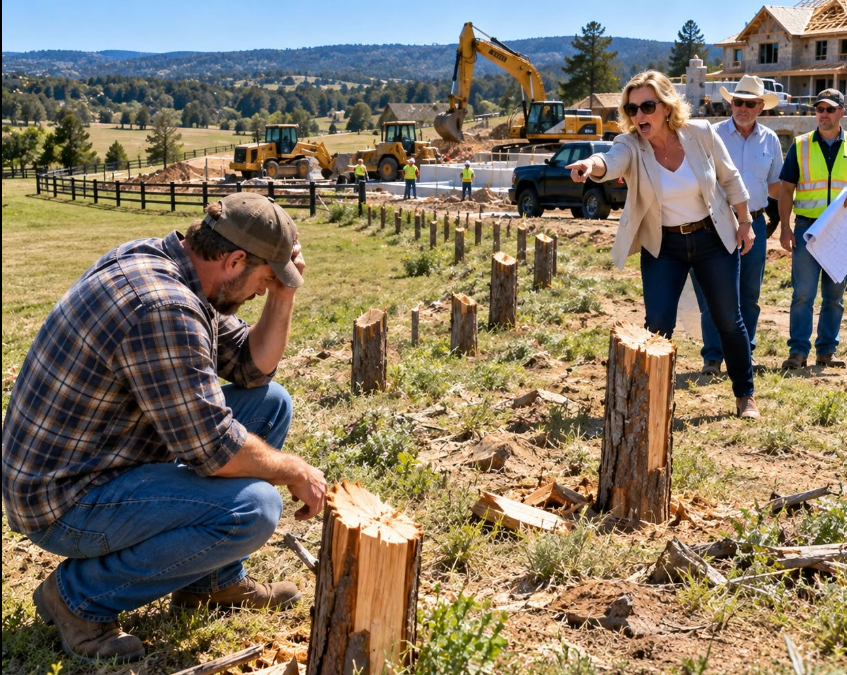
That morning, standing over twelve cut witness posts, concern became something else.
I walked back toward the fence.
Less than an hour later, a white pickup came climbing the access road.
I recognized Marlene Prescott before she stepped out.
Everyone around Silver Crest knew Marlene.
She had been HOA president long enough that people talked about her as though she personally owned the subdivision. She had sharp blond hair that never seemed moved by wind, sunglasses too expensive for dirt roads, and the kind of smile that made people feel managed instead of greeted.
She was energetic.
Aggressive.
Persuasive.
The kind of person who could make a board vote sound decided before anyone actually raised a hand.
Behind her, a second man climbed from the passenger side.
Rhett Callaway.
General contractor.
I knew Rhett by reputation.
He had been building commercial and high-end residential projects around the county for years. He was not reckless. He might push schedules, argue costs, and curse mud like any contractor, but men who worked for him said he did not like sloppy boundaries, bad permits, or undocumented change orders.
That mattered later.
Marlene came toward me with the brisk expression of someone arriving to correct an inconvenience.
“Silas.”
“Marlene.”
She looked down at the stump beside my boot.
I waited.
She did not bother pretending ignorance.
“If you’re wondering about those orange sticks,” she said, “we removed them.”
I let the words sit between us for a second.
“You removed all twelve?”
“They were abandoned survey junk.”
I stared at her.
“Abandoned?”
“They were sitting in the construction corridor.”
“On whose instructions were they cut?”
“Mine.”
Rhett shifted slightly behind her.
That was the first detail I noticed.
He did not look comfortable.
I asked Marlene, “Did you know what they marked?”
She laughed.
Actually laughed.
“Silas, surveyors leave stakes everywhere. Half of those things have probably been there since before Silver Crest was built.”
“They were witness posts.”
“For what?”
I looked toward the machinery.
“You should have asked that before you cut them.”
Her expression tightened.
“I don’t appreciate threats.”
“It wasn’t one.”
“Then what was it?”
“Advice.”
She crossed her arms.
“We have current plans. Current engineering. Current survey information. We are not holding up an eleven-million-dollar project because you like looking at old wooden sticks.”
“They’re reference points.”
“Your ranch does not control our construction site.”
“I didn’t say it did.”
“You have been complaining about the ridge for months.”
“That isn’t true.”
She waved toward the west.
“Our project is fully approved.”
“Then verifying twelve survey markers should not worry you.”
For the first time, she had no quick answer.
She turned to Rhett.
“Keep grading.”
He hesitated.
“Marlene—”
“I said keep grading.”
A bulldozer engine revved.
The blade lifted.
I felt every instinct in my body tell me to stand in front of it.
I didn’t.
If I physically blocked machinery, Marlene could turn me into the story.
Angry rancher obstructs permitted project.
Trespass dispute.
Work stoppage.
Damages.
I could already hear the words.
So I stepped backward.
Took out my phone.
And called Dean Weatherford.
He answered after two rings.
“Dean.”
“Silas?”
“All twelve are gone.”
Silence.
Not confusion.
Silence.
Then his voice changed.
“Gone how?”
“Sawed off.”
“Every one?”
“Every one.”
“Do not let them dig another foot.”
“They’re already moving.”
“I’m coming.”
He arrived within the hour.
Dean was in his late fifties, lean from a lifetime walking terrain nobody else wanted to walk. His truck bed was loaded with GPS equipment, tripods, survey rods, rolled maps, and a thick folder held shut by two rubber bands.
He got out without wasting time.
“Show me.”
I walked him to the first stump.
He crouched.
Looked at the cut.
Looked toward the equipment.
Then walked to the second marker.
By the third, his face had gone serious.
Back at his truck, he lowered the tailgate and spread out a laminated map.
“This,” he said, tapping the page, “is not just your fence line.”
“I know.”
“No, I mean the reference behind it.”
He pulled another sheet.
“The western side of Whitaker Ridge was retraced using federal cadastral monuments.”
I remembered that from the original survey but had never thought much about it.
“Meaning?”
“Meaning those twelve posts referenced a boundary connected directly into federal land records.”
He slid his finger across the map.
“This is your ranch.”
Then farther west.
“And this is federally managed land.”
I looked back at the machinery.
“So Silver Crest doesn’t own what’s beyond me.”
“Not even close.”
“The posts weren’t federal monuments themselves?”
“No. They were witness posts. Visible references. The actual boundary is established through the cadastral network.”
“So cutting them doesn’t change anything.”
Dean gave me a grim smile.
“You could burn every fence on this ridge and it wouldn’t change the coordinates by an inch.”
That sentence stayed with me.
Evidence can disappear.
The boundary does not.
Dean set up his equipment.
He began working.
I watched him establish points using records dating back decades.
He cross-checked field notes.
Coordinates.
A surviving federal brass monument farther from construction.
Within two hours, he had his first major concern.
Silver Crest’s new construction stakes did not line up with the historic boundary.
Not by inches.
Not by five feet.
By roughly 140 feet in one location.
“One hundred forty?” I asked.
“Approximately.”
“That can’t be measurement drift.”
“No.”
“Could their map be using another monument?”
“Not one that legally relocates federal land.”
He looked toward the summit.
“Whoever staked this needs to explain themselves.”
I drafted my first formal notice that afternoon.
No threats.
No accusations.
Just facts.
Twelve witness posts had been removed.
Their construction stakes appeared inconsistent with the recorded boundary.
Work should stop in the disputed area until a joint retracement could be completed.
I emailed it to Marlene.
Copied Rhett.
Copied the HOA administrative address.
I expected resistance.
I did not expect her answer within fifteen minutes.
She refused.
Her email said the Silver Crest survey was newer and therefore superseded what she called my “outdated ranch survey.”
Dean read that sentence twice.
Then handed me my phone.
“That isn’t how boundaries work.”
“I figured.”
“A new drawing doesn’t move federal cadastral monuments.”
Marlene sent another message.
If I continued interfering, Silver Crest would seek damages for delays.
That threat was meant to land hard.
Construction delays on an $11.8 million project could become enormous.
She wanted me thinking about legal bills instead of land.
I forwarded everything to Warren Tisdale.
Warren was a land-use attorney I had used once before over water-access paperwork. He was not flashy. He wore the same brown sport coat year-round, kept three pens in his shirt pocket, and had a face that looked permanently unimpressed by drama.
He called that evening.
“Don’t touch their equipment.”
“I haven’t.”
“Don’t block their road.”
“I won’t.”
“Don’t pull one of their stakes.”
“I won’t.”
“Photograph everything.”
“Already doing it.”
“Good. Let Marlene be the person making decisions.”
That sounded strange at first.
Then I understood.
Every new decision created a record.
Dean worked late.
He overlaid Silver Crest’s construction plans onto federal cadastral maps.
At around nine that night, he called me.
“You sitting down?”
“No.”
“Sit.”
I sat at my kitchen table.
“The access road crosses your parcel.”
“How far?”
“Enough to matter.”
“That isn’t what worries you.”
“No.”
He paused.
“One corner of the planned pavilion foundation appears to cross past your western boundary entirely.”
“Onto federal land?”
“Yes.”
I looked out the kitchen window toward darkness.
“You’re sure?”
“I am telling you what the overlay shows. I want to verify everything in the field before we make a formal accusation.”
“Fine.”
“But Silas?”
“Yes?”
“If this is correct, Marlene isn’t arguing with you anymore.”
“Who is she arguing with?”
“The United States government.”
I slept badly.
The next morning, I walked the ridge again.
The missing posts felt different now.
Before, they had represented someone trespassing on my ranch.
Now they looked like warning signs somebody had deliberately removed before driving toward something much bigger.
I could have gone public.
I could have posted photographs.
I could have called residents.
I could have driven to the Silver Crest clubhouse and demanded answers.
I did none of those things.
Warren told me to wait until Dean’s work was finished.
“If you accuse them publicly before verification, Marlene will say you’re trying to sabotage the project.”
“She already says that.”
“Let her. You don’t need to win the neighborhood. You need to establish the line.”
So I waited.
Marlene interpreted silence exactly the wrong way.
She thought I had backed down.
Within days, construction fencing appeared around the disputed area.
One section crossed ground Dean had already identified as part of my ranch.
Then banners went up.
SILVER CREST SUMMIT PAVILION.
PRIVATE MEMBER ACCESS.
COMING SOON.
I stood beside one banner and checked the coordinates.
It was planted in soil I had paid taxes on for years.
That was almost funny.
Almost.
Around Silver Crest, Marlene started telling residents I wanted money.
According to people who later spoke with me, she described me as a stubborn rancher trying to extort the HOA because property values were rising.
I did not respond.
At the next board meeting, however, someone else did.
Naomi Keading was the HOA treasurer.
I barely knew her at that point.
She had a reputation for numbers.
Budgets.
Reserve accounts.
Contracts.
Not politics.
When Marlene told residents my survey was outdated, Naomi asked a simple question.
“Has our attorney confirmed that in writing?”
People later described the pause.
Marlene did not answer directly.
She pivoted to engineering approvals.
Project timelines.
Construction costs.
Resident expectations.
Naomi noticed.
Meanwhile, Dean retraced the line again.
And again.
Different day.
Different equipment setup.
Same result.
The HOA boundary was wrong.
In several locations, the difference exceeded one hundred feet.
Then Dean found one of the details that disturbed me most.
A new Silver Crest construction stake had been hammered into the ground almost directly beside the stump of one of his old witness posts.
That meant somebody had stood there.
Looked at the original marker.
And placed a new stake beside the place where it had been cut.
Dean photographed it.
“Hard to say they never saw the old line now.”
I nodded.
The dispute started spreading.
Some Silver Crest residents thought I was being difficult.
I understood why.
They had been shown beautiful plans.
They had been promised a hilltop facility.
A private overlook.
Property appreciation.
Some had invested additional money for pavilion amenities.
From their perspective, one rancher seemed to be standing between them and something they had been promised for months.
Others remembered the land differently.
Older residents knew the western ridge had always bordered federal property.
A few started asking questions.
Marlene answered those questions confidently.
That was one of her strengths.
She could sound certain even when the documents underneath her were becoming unstable.
At a neighborhood gathering, she reportedly told residents the matter involved nothing more than an old rancher relying on an obsolete survey.
What she did not tell them was that I had already sent a formal boundary notice.
She also did not tell them something Warren uncovered a few days later.
The title company had warned Silver Crest months earlier.
Warren called me into his office.
He placed a letter on the table.
“Read paragraph three.”
I did.
The title company identified a federal boundary concern affecting the project area.
It recommended additional survey work before construction proceeded near the western ridge.
Date?
Three months before my posts were cut.
“Who received this?”
“The association.”
“Marlene?”
Warren tapped the distribution line.
Her name was there.
“So she knew.”
“She knew there was a documented concern.”
“That isn’t the same as knowing they crossed federal land.”
“No. Be precise.”
That was Warren.
Precise always.
“But she knew enough to get another survey before cutting markers.”
“Yes.”
The next discovery came from Naomi.
While reviewing internal emails, she found Marlene discussing the title warning with the project manager.
One sentence mattered more than the rest.
Marlene wrote that the association was not going to delay six months over “ancient government markers.”
When Warren read it, he leaned back.
“That phrase may become expensive.”
I stared at the email.
Ancient government markers.
That was how she saw them.
Old obstacles.
Technicalities.
Pieces of the past standing in front of a modern project.
But those old records were the only reason anyone knew exactly where the line was.
Warren told me again not to confront her.
“She’s giving us everything we need.”
It wasn’t easy.
Every morning, I could hear construction equipment.
Every afternoon, more dirt moved.
Every evening, I filed photographs by date.
June 8.
June 9.
June 10.
Coordinates.
Equipment positions.
Fence movement.
Stake placement.
Emails.
Phone calls.
Dean’s notes.
It was boring work.
Infuriatingly boring.
But I began to understand why Warren insisted on it.
Marlene had noise.
I had a record.
She had confidence.
I had coordinates.
Those were not the same thing.
Her biggest mistake came because she continued believing my restraint meant fear.
She accelerated construction.
The access road widened.
The hillside was graded more aggressively.
Crews prepared for a retaining wall.
Equipment moved deeper into the disputed corridor.
Dean came back and placed temporary survey stakes.
This time, each marker carried a formal survey notice.
I filmed the entire process.
We photographed every stake.
Logged every coordinate.
By the following morning, several were gone again.
This time, however, a camera caught a project pickup arriving at the location.
Rhett had reached his limit.
He confronted Marlene.
I was not present for that conversation, but his later records and testimony showed the substance of it.
He asked why survey stakes kept disappearing.
He warned that his company would not knowingly work across a disputed boundary.
Marlene told him anything inside the construction footprint would be removed.
He asked whether the federal concern had been resolved.
She told him he was being paid to build.
Not investigate.
That same day, the federal field office sent Silver Crest a written instruction.
Preserve the disputed area while the boundary concern was being verified.
That should have ended everything.
No more grading.
No more excavation.
No more machinery in the disputed zone.
Pause.
Verify.
Proceed correctly.
Instead, Marlene continued.
That was the moment the dispute changed.
Until then, she could still argue confusion.
Bad survey.
Bad advice.
Conflicting maps.
After the federal preservation notice, continuing required a conscious decision.
Naomi understood it.
Rhett understood it.
Warren understood it.
I understood it.
Marlene apparently believed momentum could still save her.
Warren came to the ranch that evening.
We sat at my kitchen table.
He had a copy of the federal letter.
“Yesterday,” he said, “this was mostly your boundary problem.”
“And today?”
“Today she made it theirs.”
I looked west.
Construction lights glowed faintly against the ridge.
“How fast does federal enforcement move?”
“Usually slower than angry landowners want.”
“Great.”
“But they are moving.”
I had contacted the federal field office with evidence.
Not demanding arrests.
Not demanding punishment.
I sent photographs.
Coordinates.
Dean’s survey overlay.
County records.
The twelve cut posts.
Construction activity.
The federal reference information.
The case eventually landed with Jocelyn Hartwell.
I did not meet her immediately.
What I later learned was that she did not simply trust my version.
Good.
I wouldn’t have trusted it either without verification.
She checked cadastral records.
Compared Dean’s work against federal documentation.
Reviewed historical imagery.
Examined project plans.
Contacted Dean.
Asked him to explain his methodology.
Then she coordinated with county planning officials.
That process took days.
While it happened, Marlene threw a major presentation.
Silver Crest residents gathered under banners showing the completed summit pavilion.
Renderings filled display boards.
Investors attended.
Marlene stood at the front talking about panoramic views and exclusive access.
She wore a white blazer and gold earrings. Behind her, on a screen, the future of Silver Crest glowed in artificial sunset colors. The pavilion looked like a private resort. Glass walls. Stone terraces. Fire pits. Native landscaping. A ribbon of road curling through the hillside as if the land had politely arranged itself to fit the architect’s drawing.
Meanwhile, federal specialists were quietly checking whether part of that pavilion was designed on land Silver Crest did not own.
The contrast would have been almost comical if the stakes had not been so high.
That same week, Marlene sent me a demand letter.
Twenty-four hours.
Accept the HOA’s boundary line.
Stop interfering.
Or face additional legal action.
I read it at my kitchen table.
Warren called.
“What do you want to do?”
“Respond.”
“With what?”
“No.”
He laughed.
“That’s the whole response?”
“Yes.”
“Works for me.”
Marlene called later.
“You received the letter?”
“I did.”
“And?”
“No.”
There was a pause.
“You’re making a very expensive mistake.”
“I don’t think I am.”
“You really believe you can stop this project?”
“I’ve never tried to stop your project.”
“You’ve done nothing but interfere.”
“I asked you to verify the boundary.”
“We did.”
“Then you shouldn’t be worried.”
Her voice sharpened.
“Watch us build around you.”
She hung up.
A few hours later, Jocelyn’s verification team confirmed something that changed everything.
It was not only the access road.
The planned pavilion foundation itself extended outside land Silver Crest had authority to build on.
Federal land.
At that point, the matter could no longer be resolved through Marlene pretending my ranch survey was old.
The government was now verifying its own boundary.
Jocelyn reviewed Dean’s work again before taking action.
That detail always mattered to me.
Nobody came charging onto the site because an angry rancher made a phone call.
The records were checked.
The coordinates were checked.
The monuments were checked.
The project plans were checked.
Only after the evidence lined up did enforcement move.
Inside Silver Crest, whispers reached the board.
Naomi requested a construction pause.
Marlene refused.
She was afraid a pause would create questions.
Lenders.
Residents.
Contractors.
Investors.
Everyone would want to know why the crown jewel of Silver Crest Estates had suddenly stopped.
So rather than reduce risk, she accelerated it.
Weekend crews.
Longer shifts.
More grading.
She wanted visible progress before anyone could intervene.
Rhett refused.
He told her he would no longer send his equipment into the disputed zone.
Marlene threatened to fire him.
He still refused.
Within days, she brought in another subcontractor.
When I saw unfamiliar machinery arrive, I called Warren.
“They changed crews.”
“I know.”
“Rhett is out.”
“That may help him later.”
“It doesn’t help the land.”
“No. But don’t interfere.”
So once again, I watched.
I photographed.
I logged.
Naomi was doing her own version of the same thing inside the HOA.
Emails.
Budgets.
Meeting minutes.
Insurance policies.
Contracts.
The deeper she looked, the more frightened she became.
Insurance might not protect Silver Crest if the association knowingly ignored boundary warnings and damaged land outside its control.
Residents thought they were building a clubhouse.
Naomi was beginning to see a financial disaster.
Dean returned to remark the boundary yet again.
I filmed him.
Coordinates appeared exactly where they had before.
That same day, another preservation request arrived from the federal field office.
Marlene read it.
Construction continued.
By then, even I could not understand what she thought would happen.
Maybe she believed the government would eventually negotiate.
Maybe she thought completed construction would be harder to remove than proposed construction.
Maybe she thought money already spent would make regulators hesitate.
Whatever the logic, the machines kept moving.
Then came the morning everything changed.
I was repairing a fence brace near the lower pasture when I heard vehicles climbing the county road.
Not dump trucks.
Not contractor pickups.
The sound was quieter.
Three vehicles appeared.
Federal markings.
They turned toward the summit site.
I stopped what I was doing.
For a moment, I just watched them climb.
Months of photographs.
Emails.
Coordinates.
Surveys.
Warnings.
Now three ordinary-looking vehicles were driving toward the ridge.
No sirens.
No dramatic convoy.
No television cameras.
That almost made it more serious.
I called Warren.
“They’re here.”
“Who?”
“Federal field office.”
“Stay where you are unless they ask for you.”
I did.
Jocelyn Hartwell arrived with a cadastral specialist and land management officer.
Marlene approached them before they had finished unloading equipment.
I could see the conversation from a distance.
Later I learned exactly what she said.
She informed Jocelyn that the construction site belonged to Silver Crest HOA and that federal employees needed permission to enter.
Jocelyn reportedly looked down at the map in her hands and answered calmly.
“Determining whose property this is is the reason we’re here.”
No shouting.
No argument.
Just work.
Dean joined them.
They checked the surviving cadastral monument.
Measured.
Recalculated.
Verified coordinates.
Walked the line.
Compared field results to archived records.
One by one, the positions lined up.
The construction did not.
A stretch of Silver Crest’s access road lay on the wrong side.
Excavation had crossed the line.
Parts of the graded area sat where Silver Crest had no legal authority.
And the places where my twelve witness posts had once stood aligned with the very boundary Dean had originally established.
Hours passed.
Marlene’s confidence slowly changed.
Jocelyn eventually asked the question.
“Who ordered the original survey posts removed?”
Nobody answered immediately.
Rhett was present by then.
He looked toward Marlene.
She finally spoke.
“I did.”
“Why?”
“They were interfering with construction.”
“Did you know what they represented?”
“They were old survey stakes.”
Jocelyn wrote something down.
“They were witness posts associated with this boundary.”
Marlene started arguing that the HOA’s plans showed a different line.
The cadastral specialist explained that local construction drawings did not relocate a federally recorded boundary.
Marlene shifted to permits.
Approvals.
Investment.
Delay costs.
None of those changed the coordinates.
Late that afternoon, Jocelyn issued the order.
Work in the affected area was halted.
Immediately.
The subcontractor shut equipment down.
Engines that had rumbled across the ridge for weeks went silent one after another.
Bulldozer.
Excavator.
Loader.
Truck.
The quiet spread strangely.
Workers stood waiting.
Rhett’s original crew had already removed much of its equipment, but the replacement contractor began preparing to leave as soon as the order became clear.
Then federal restriction signs went up.
Bright tape.
Controlled access.
No disturbance pending review.
That morning, Silver Crest’s pavilion banners had still promised residents a glamorous future.
By afternoon, machinery sat motionless behind federal warning tape.
Marlene stood staring at it.
I walked closer only when Jocelyn’s team asked me to identify several locations.
Marlene saw me.
Her face tightened.
“You called them.”
“I reported the boundary concern.”
“You did this.”
“No.”
“You knew exactly what would happen.”
“I knew somebody needed to check the line.”
“You shut down an eleven-million-dollar project.”
I looked at the excavators.
“I didn’t move the boundary.”
“You made the call.”
“And you crossed the line.”
For once, she had nothing ready.
I did not feel triumphant.
Mostly I felt tired.
Because the shutdown did not fix the land.
It did not restore my posts.
It did not repair whatever had been graded.
It simply stopped the damage from increasing.
Jocelyn explained that the disputed area would remain untouched while federal officials determined the extent of encroachment.
Restoration might be required.
Construction might have to be redesigned.
Responsibility would be reviewed.
The pavilion could not simply continue as planned.
That evening, Silver Crest exploded.
Residents who had heard Marlene dismiss the dispute now wanted answers.
Naomi called an emergency HOA meeting.
For the first time, the entire story came out in one room.
I did not attend the first portion.
Warren did.
Naomi presented the title company’s warning.
Three months before construction reached the ridge.
She displayed Marlene’s email.
“We are not delaying six months over ancient government markers.”
People reportedly went silent.
Then came the federal preservation letters.
The instructions to stop disturbing the area.
The continued construction.
The removed survey markers.
Rhett’s work records.
Marlene’s directives.
Residents learned the federal government had confirmed encroachment.
The lender suspended further disbursements.
That hurt immediately.
A project like Silver Crest Summit Pavilion survived on scheduled money.
Construction milestones.
Draws.
Vendor payments.
Financing.
Once the primary lender froze new funds pending boundary resolution, everything connected to the project became unstable.
Title insurance demanded another survey.
Vendors started calling.
Contractors asked whether invoices would be paid.
Residents who had personally contributed money for upgraded pavilion access and amenities demanded to know where those funds were.
The renderings that had once made everyone excited were replaced by spreadsheets.
Numbers.
Exposure.
Liability.
Potential restoration costs.
Marlene blamed me.
She said I was trying to destroy Silver Crest because I resented development near the ranch.
Naomi finally lost patience.
She put Marlene’s own email on the screen.
Ancient government markers.
Then she read the date.
Then she showed the title warning that arrived before it.
“You cannot blame Mr. Whitaker for a warning you received before he ever complained,” Naomi said.
That should have been enough.
It wasn’t.
Warren arrived with something else.
Another folder.
He placed survey overlays on the table.
The federal encroachment was only part of the problem.
During the grading, Silver Crest’s equipment had also crossed onto my private ranch.
Nearly two acres.
Not a narrow accidental strip.
Not a few tire tracks.
Almost two acres of land had been reshaped without authorization.
Topsoil moved.
Drainage altered.
Vegetation disturbed.
Ground graded for a project that had no right to be there.
When Warren told me the measurement, I felt anger in a way I hadn’t when the federal trucks arrived.
Federal land was serious.
But this was my father’s ranch.
Ground I had worked.
Ground I had maintained.
Ground somebody had treated as empty because it interfered with a drawing.
Warren kept our demands limited.
Restore what was damaged.
Pay survey costs.
Reimburse documented expenses.
Sign a binding agreement recognizing the boundary.
Nothing absurd.
Nothing designed to punish every resident for Marlene’s decisions.
Meanwhile, the federal process continued separately.
That distinction mattered.
My private claim did not control federal enforcement.
Federal officials were reviewing unauthorized activity on government-managed land under their own standards.
Jocelyn made clear that construction extending beyond Silver Crest’s legitimate boundary would have to be removed, redesigned, or otherwise resolved before anything could move forward.
Marlene was running out of room.
She tried one last strategy.
She asked the board for additional money to defend her original plan.
She framed retreat as surrender.
Silver Crest had invested too much.
Stopping now would waste residents’ money.
They needed to fight.
Naomi responded with the complete email chain.
No summaries.
No selective quotes.
Everything.
A board member asked Marlene one direct question.
“Did you tell us about the federal boundary warning before we approved this construction phase?”
Marlene started explaining that the warning was preliminary.
“That isn’t what I asked.”
She shifted to the project engineer.
“Marlene.”
Silence.
“Did you tell this board?”
No answer.
That silence changed the room.
The emergency vote happened that night.
First, Marlene lost control of the Summit Pavilion project.
Soon after, she lost the HOA presidency.
When she walked out of the clubhouse, workers were taking down one of the giant pavilion banners outside.
I did not see it myself.
Warren did.
He told me later.
“There was no cheering.”
“Good.”
“You expected some?”
“I hoped not.”
“Why?”
“Most of those people didn’t cut my posts.”
That was the truth.
Residents had trusted their president.
Some had been careless.
Some should have asked more questions.
But the majority did not know about the title warning.
They did not order the markers cut.
They did not ignore the federal preservation request.
They were going to pay enough for those decisions already.
Jocelyn later confirmed that the survey-marker destruction and unauthorized federal-land activity would be forwarded through the appropriate channels for further review.
There was no dramatic arrest.
No handcuffs.
No agent dragging Marlene away.
Reality was slower.
Paperwork.
Investigations.
Liability.
Financial consequences.
Project redesign.
Leadership collapse.
Sometimes that is worse for someone who has built their power on appearing untouchable.
Marlene largely disappeared from Silver Crest public life.
The woman who once greeted new homeowners and dominated meetings stopped showing up.
People had different reactions.
Some felt sorry for her.
They remembered the years she had worked for the association.
The improvements she had pushed.
The energy she brought.
Others could not get past the emails.
The warnings.
The decision to keep going.
I did not spend much time thinking about whether people should hate her.
That was not my business.
My business was restoring the land.
Naomi stepped into a larger leadership role.
She did it cautiously.
The new board reached out through Warren.
They wanted to settle the ranch portion.
I agreed to meet.
The first meeting was uncomfortable.
Not hostile.
Just uncomfortable.
Naomi sat across from me with two board members and their new attorney.
She started.
“Mr. Whitaker, before anything else, I want to acknowledge that the association crossed onto your property.”
I nodded.
“We also acknowledge the original survey markers should not have been removed.”
“Good.”
“We want to resolve the private-land issue without extending the conflict.”
“So do I.”
Their attorney asked what I wanted.
Warren slid our proposal across the table.
Restoration.
Survey reimbursement.
Verified boundary agreement.
Monitoring until disturbed land stabilized.
No HOA construction on the ranch without a future recorded agreement.
No private access road across my land.
The attorney looked surprised.
“That is all?”
“That is enough.”
Naomi studied me.
“You don’t want compensation beyond documented losses?”
“I want documented losses.”
“You could ask for more.”
“I could ask for anything. Doesn’t mean I’m entitled to it.”
That meeting became the beginning of the end.
The federal review took longer.
Nothing happened quickly.
Silver Crest could not simply redraw one line and restart.
Engineers had to revise plans.
Surveyors had to coordinate.
Government representatives needed to verify the new footprint.
County officials reviewed access.
The planned pavilion had to move.
The private road that had crossed into my ranch disappeared from the design.
The overlook shifted.
Parts of the foundation layout were abandoned entirely.
Restoration crews entered disturbed areas under strict conditions.
Ironically, the project Marlene tried to accelerate ended up delayed far longer because she refused the original pause.
Had she stopped when I first sent notice, Dean and Silver Crest’s surveyor could have compared records.
Maybe they would have discovered the problem before serious grading.
Maybe the road could have been moved.
Maybe the pavilion could have been redesigned before excavation.
Maybe twelve posts could have saved millions in disruption.
Instead, she cut them.
That thought stayed with me.
Twelve pieces of painted wood.
Probably worth almost nothing individually.
Yet they represented something priceless.
Warning.
Information.
History.
Location.
Cutting them did not remove the problem.
It removed the easiest way to see it.
Months after the shutdown, a formal coordinated survey began.
This time, nobody rushed.
Dean represented my side.
Silver Crest had its own licensed professionals.
Federal representatives participated where their boundary was involved.
Equipment was calibrated.
Records compared.
Monuments verified.
Coordinates logged.
Everybody saw the same line.
There was no argument left.
No “newer map.”
No “outdated ranch survey.”
No “ancient government markers.”
Just the boundary.
It stood where it had always stood.
New witness posts were installed.
Better ones.
More clearly documented.
Some locations received additional identification so nobody could honestly claim confusion again.
I walked the western fence with Dean after the work was completed.
It was almost the same time of morning as when I had discovered the originals gone.
Mist.
Wet grass.
Quiet.
We reached the first new post.
I stopped beside it.
“Funny.”
“What?”
“She thought removing these changed something.”
Dean smiled.
“A marker doesn’t create a boundary.”
“I remember.”
“It only tells you where the boundary already is.”
We continued.
One.
Two.
Three.
Twelve.
All standing.
Farther west, the original construction footprint looked different.
The giant equipment staging area was gone.
Federal restricted-access tape had eventually come down after restoration and verification.
Sections of grading had been repaired.
Where the original pavilion corner would have extended too far, the design had been pulled back.
The access road followed a different route.
Silver Crest eventually restarted construction.
Rhett returned under one condition.
Everything had to be inside verified boundaries.
In writing.
He refused to move a machine until the new board provided it.
I respected that.
He had made mistakes earlier by continuing as long as he did.
But once he realized how serious the boundary problem was, he stopped.
When Silver Crest eventually finished its redesigned pavilion, it was smaller than Marlene’s vision.
The structure sat farther back from the ridge.
The viewing area no longer reached across land the HOA did not own.
The road did not cross my ranch.
Residents could still use it.
They still got a clubhouse.
They still got their view.
They simply had to build it where they had the legal right to build.
That was all I had wanted from the beginning.
The financial fallout lasted longer.
The association paid a significant share of survey costs.
Restoration costs.
Professional fees.
Redesign costs.
Construction-delay costs.
Residents demanded stronger oversight.
Naomi helped create new procedures.
Major construction near external boundaries required independent verification.
Title exceptions had to be disclosed to the full board.
No single officer could bury warnings in private email chains.
Project changes involving disputed property required legal review.
Those rules sounded obvious after the disaster.
They had not existed before.
As for Marlene, her name gradually disappeared from project documents.
Meeting minutes no longer listed her at the top.
Her “Summit Vision” language vanished from presentations.
Silver Crest stopped referring to the project as her legacy.
That seemed fitting.
Because the most lasting thing she left behind was not the pavilion.
It was the lesson.
A project can have money.
Architects.
Contractors.
Investors.
Renderings.
Lenders.
Board votes.
Engineers.
Marketing.
Community support.
None of those things can move a boundary simply because the boundary is inconvenient.
One afternoon months later, I received a letter from a Silver Crest resident named Patrick.
I did not know him.
He wrote that he had originally believed Marlene.
He had been one of the residents who thought I was holding up the pavilion for money.
Then he saw the documents at the emergency meeting.
He apologized.
I read the letter twice.
Then put it in the same folder as the original photographs.
Not because I needed an apology.
Because it reminded me how easily a confident story can outrun facts when only one side is talking.
Marlene spoke early.
I documented early.
For weeks, speaking looked stronger.
Eventually, documentation was stronger.
That difference changed how I handled disputes after that.
Whenever someone tells me the loudest person in a room must know what they are doing, I think about those twelve stumps.
Marlene had contractors.
I had photographs.
She had an $11.8 million budget.
I had coordinates.
She had banners.
I had an old federal cadastral map.
She had confidence.
Dean had a brass monument in the ground.
The brass monument won.
Life on the ranch eventually became ordinary again.
Cattle broke fences.
Pumps failed.
Weather ruined plans.
Those were problems I understood.
Sometimes I would ride past the new Silver Crest pavilion visible through the trees.
It looked fine.
Honestly, it did.
Residents used the overlook.
Families held gatherings there.
Cars went up the redesigned access road.
Nothing crossed my property.
Nobody needed me to hate the finished building.
It was never the building I objected to.
It was the assumption that somebody could take land because the drawing looked better if they did.
One morning Naomi came to the ranch gate.
She called first.
That mattered.
I met her outside.
“We’re updating the association’s permanent land records,” she said.
“Okay.”
“I wanted to confirm you received the final boundary agreement.”
“I did.”
“And the restoration sign-off?”
“Yes.”
She looked toward the ridge.
“I don’t think Marlene ever understood why you didn’t yell at her.”
“I wanted to.”
“Why didn’t you?”
“Because yelling wouldn’t put a line on a map.”
Naomi laughed quietly.
“No.”
“She expected me to fight her in a way she knew how to fight.”
“What do you mean?”
“Marlene understood meetings. Arguments. Threats. Pressure.”
“And you?”
“I understood the ranch.”
I pointed toward the new posts.
“And Dean understood those.”
Naomi nodded.
Before leaving, she said something that stayed with me.
“We should have listened earlier.”
“Yes.”
No need to soften it.
She knew.
I knew.
Then she left.
A year after I found the posts cut, I rode the western line again at sunrise.
Same route.
Same ATV.
The grass was high.
Light moved over the ridge.
Every new witness post stood where it belonged.
I stopped near the location of the first stump.
You could barely see evidence of the old cut anymore.
Grass had grown over it.
The original post was gone.
Yet the boundary remained.
That was the perfect summary of everything.
Marlene had believed the visible thing created the reality.
Remove the post.
Remove the problem.
Move the stake.
Move the line.
Install a fence.
Create ownership.
Build a road.
Create permission.
Pour concrete.
Create permanence.
But reality worked the opposite way.
Permission had to come first.
Ownership had to come first.
The line existed before the project.
Records existed before Silver Crest Estates.
And no amount of construction could turn unauthorized ground into association property.
People sometimes ask what I would have done differently.
I always give the same answer.
Nothing important.
Maybe I would have installed better cameras earlier.
Maybe I would have had Dean mark additional reference points when Silver Crest first announced the pavilion.
Maybe I would have contacted federal officials the moment heavy equipment appeared near the western boundary.
But I would not have confronted the bulldozers physically.
I would not have cut their fencing.
I would not have blocked their trucks.
I would not have screamed at Marlene.
Those actions would have felt good for ten minutes and complicated the truth for months.
Restraint is difficult because it rarely looks powerful while you are practicing it.
Marlene saw me photographing stumps and assumed I was weak.
She saw me refuse to block equipment and assumed I had surrendered.
She received Warren’s letters and treated them like paperwork she could outlast.
She saw Dean restake the line and ordered the markers removed again.
She received a federal preservation notice and kept building.
Every time I refused to escalate emotionally, she escalated physically.
That created the record that eventually stopped her.
The federal order did not appear out of nowhere.
It was built one ignored warning at a time.
One removed post.
One inaccurate stake.
One title exception.
One email.
One preservation request.
One additional grading pass.
One more decision to continue.
By the time Jocelyn arrived, Marlene had already written most of the case against herself.
The agents simply verified the ground.
That is why the moment the machinery stopped felt so strange.
There was no dramatic battle.
No one seized a bulldozer.
Nobody shouted through a megaphone.
Jocelyn checked coordinates.
The machines were on the wrong side.
Work stopped.
Simple.
All of Marlene’s speeches about progress could not compete with a number on a survey instrument.
Later, Warren showed me the final file.
It was enormous.
Photographs.
Surveys.
Correspondence.
Federal records.
HOA records.
Title letters.
Construction drawings.
Emails.
Meeting minutes.
Contractor directives.
Invoices.
Restoration plans.
The story of twelve wooden posts had become boxes of paper.
I looked at him.
“Seems excessive.”
“That is land law.”
“All this because she cut twelve posts?”
“No.”
He shook his head.
“All this because she believed cutting twelve posts meant she didn’t have to ask what they represented.”
That was better.
He was right.
The posts themselves were not magic.
Cutting wood was not what destroyed Marlene’s project schedule.
Her refusal to verify before building did.
Her refusal to disclose warnings did.
Her decision to accelerate after receiving those warnings did.
The posts simply showed where the arrogance began.
The ranch healed.
The two acres damaged by grading took time.
Soil had to be restored.
Drainage corrected.
Vegetation reestablished.
I watched the first heavy rain afterward more carefully than any storm in years.
Water moved through the repaired area.
Not perfectly at first.
Crews adjusted it.
Another storm came.
Better.
Eventually the ground started acting like ranch land again instead of a construction corridor.
That mattered to me more than any meeting vote.
Land does not recover because somebody signs an agreement.
You have to actually repair it.
The new Silver Crest board understood that.
They paid for required restoration.
Monitored it.
Fixed problems.
When the final inspection closed the private restoration claim, Warren called.
“That’s it.”
“Everything?”
“For your ranch portion, yes.”
“And federal?”
“Separate process. But your restoration obligations are closed.”
I walked outside.
The sun was setting beyond the ridge.
For the first time since I discovered the stumps, there was no active dispute attached to that view.
No crews moving where they shouldn’t.
No unanswered notice.
No attorney deadline.
No new stake to photograph.
I stood there longer than usual.
My father used to say ownership was mostly responsibility.
As a kid, I thought that sounded unfair.
If you owned land, shouldn’t ownership mean freedom?
He meant something different.
You are responsible for knowing it.
Protecting it.
Maintaining it.
Understanding what belongs to you and what does not.
Marlene wanted the benefits of ownership without that responsibility.
She wanted the ridge because it improved the project.
She wanted the access because it improved the rendering.
She wanted the view because it increased value.
She never stopped long enough to respect what she actually had the right to use.
In the end, Silver Crest still had valuable land.
Plenty of it.
Enough for a pavilion.
Enough for parking.
Enough for landscaping.
Enough for an overlook.
They never needed my two acres.
They never needed federal land.
The tragedy was that Marlene turned a solvable design constraint into a community-wide crisis because she could not tolerate being told where the project had to stop.
That was the real boundary she hated.
Not the line in the soil.
The word no.
Some people hear no and ask why.
Some hear no and verify.
Some hear no and negotiate.
Marlene heard no and reached for a saw.
That choice followed her all the way to the federal tape.
Years later, I still have one photograph from that first morning framed in my office.
Not the federal trucks.
Not the stopped bulldozers.
Not Marlene at the meeting.
The stump.
Just a close photograph of one survey post cut flush with wet ground.
People who visit sometimes ask why I framed something so ordinary.
I tell them it reminds me to ask questions before removing obstacles.
They usually laugh.
I don’t.
Every obstacle is not meaningless.
Some are warnings.
Some are boundaries.
Some are there because people before you learned something expensive enough to put a marker in the ground.
The twelve posts were exactly that.
Warnings made visible.
Marlene thought she was clearing the way.
She was removing the final signs telling her to stop.
The new markers are harder to miss.
Silver Crest helped pay for them.
Each is properly documented.
Coordinates recorded.
Survey references filed.
The new board keeps copies.
I keep copies.
Federal records keep what they need.
Nobody will ever depend on one orange stick again.
Dean jokes that we created the most over-documented half-mile of boundary in the county.
He may be right.
One spring morning, he came out for unrelated survey work near my south pasture.
We finished early.
He asked if I wanted to ride the west line.
“Why?”
“Sentimental reasons.”
“You’re getting soft.”
“Don’t tell anybody.”
We took the ATV up.
The Silver Crest pavilion was visible in the distance.
Smaller than the original drawings.
Farther back.
Legal.
Dean pointed.
“Looks better there.”
“You’re biased.”
“I am.”
We reached the posts.
Everything was intact.
Dean checked one out of habit.
“Still where we left it.”
“I was worried it might walk away.”
“You joke, but apparently some people think boundaries move.”
I laughed.
We stood quietly.
After everything, the ridge looked almost boring.
That was exactly how I wanted it.
No yellow tape.
No excavators stopped mid-job.
No angry HOA president.
No federal officers.
Just grass.
Fence.
Posts.
A line nobody could see unless they knew where to look.
Dean kicked lightly at the dirt.
“You know what the strangest part is?”
“What?”
“If Marlene had called me before cutting the first post, this entire thing probably could have been avoided.”
“You would’ve told her the project crossed the line.”
“Yes.”
“She wouldn’t have liked it.”
“No.”
“But she would’ve known.”
Dean looked toward the pavilion.
“Knowing and listening are different problems.”
He was right.
Marlene had received warnings before she ever touched my posts.
The title company had warned her.
Records existed.
Her own contractor eventually warned her.
I warned her.
Dean warned her.
Federal officials warned her.
At every stage, she had an exit.
Pause.
Verify.
Redesign.
Each exit was cheaper than the next one.
She passed all of them.
By the time federal trucks drove up the access road, the cheap exits were gone.
Silver Crest paid the price.
So did residents.
So did contractors.
So did my ranch.
That is what reckless leadership really costs.
The person making the decision is rarely the only person paying for it.
I never became friends with Silver Crest.
We did not need to.
We became neighbors again.
That was enough.
Their maintenance crews knew the line.
Their landscapers stayed inside it.
Their board sent notices before any major work nearby.
My ranch operations stayed on my side.
When cattle occasionally pushed fencing near the border, I repaired it.
When Silver Crest had drainage questions, their manager called.
Normal neighbor problems.
Normal solutions.
No one needed federal intervention.
Sometimes I wondered whether Marlene ever drove past the finished pavilion.
Whether she looked at the smaller structure and thought about the original plans.
I never asked.
Her regrets were not my responsibility.
The only thing I knew was that she never held HOA office again.
Naomi remained involved.
Rhett kept working under stricter documentation.
Jocelyn moved on to whatever federal land dispute came next.
Dean still surveyed.
Warren still billed by the hour, unfortunately.
And I went back to ranching.
That was the ending I wanted.
Not destruction.
Normal life.
There is a moment from the federal inspection I remember more clearly than the shutdown itself.
Jocelyn was standing near one of the missing post locations with her equipment.
Marlene was talking behind her.
Fast.
Explaining.
Arguing about approvals.
Jocelyn barely reacted.
She adjusted the instrument.
Looked at the coordinates.
Moved several steps.
Checked again.
Marlene kept talking.
Finally, Jocelyn looked up.
The expression on her face said everything.
The line was where the line was.
That was it.
No amount of language could negotiate with the coordinate.
I think Marlene understood in that instant.
For months she had controlled rooms by controlling the conversation.
But the land did not care how persuasive she was.
Neither did the cadastral record.
Neither did the monument.
Facts can be stubborn that way.
People think power means making others agree.
Sometimes power is simply having something that remains true whether anyone agrees or not.
The western boundary was one of those things.
Marlene never moved it.
She only moved herself farther and farther onto the wrong side.
I learned something about myself too.
There were days I wanted revenge.
I would be lying if I claimed otherwise.
When I saw the second set of survey stakes removed, I wanted every machine on that site hauled away.
When I learned almost two acres of my ranch had been graded, I wanted Silver Crest to lose the entire pavilion.
When I saw Marlene blaming me in front of residents after she had ignored written warnings, I wanted to stand in that clubhouse and embarrass her with every email.
Warren stopped me more than once.
“Ask yourself what restores your land.”
That became the question.
Not what hurts Marlene.
What restores the land?
That kept us focused.
The eventual solution did restore it.
Silver Crest had consequences.
Marlene lost authority.
Federal enforcement addressed federal issues.
The project was redesigned.
My ranch was repaired.
The boundary was recorded beyond reasonable dispute.
That was better than revenge.
Revenge would have kept Marlene at the center of my life.
Restoration let me stop thinking about her.
The twelfth new post stands near a small rise where the valley opens below.
It is my favorite point on the western route now.
Not because of what happened there.
Because from that spot, you can see how little the conflict mattered to the landscape.
The valley continues.
Trees move in the wind.
Cattle graze.
The pavilion sits far away.
The federal land stretches beyond it.
Human beings spent months fighting over lines.
The ridge simply stayed where it was.
The morning I first saw the missing posts, I believed somebody had taken something from me.
In a way, they had.
Markers.
Land surface.
Time.
Trust.
But the most important thing was never taken.
The boundary.
Marlene could saw every post.
Pull every stake.
Hang every banner.
Order every bulldozer forward.
The line remained.
That is why, when people tell this story as though federal agents suddenly appeared and saved my ranch, I correct them.
The agents did their job.
Dean did his.
Warren did his.
Naomi eventually did hers.
Rhett eventually did his.
I did mine.
But none of us created the truth.
We documented it.
That’s different.
The truth existed long before any of us arrived.
The federal monuments were recorded decades before Silver Crest.
My ranch boundary existed before Marlene became president.
The title warning existed before the grading accelerated.
All anyone needed to do was respect what was already there.
Marlene’s mistake was believing reality began when she decided it did.
It didn’t.
The last time I saw her was months after the pavilion redesign.
I was filling my truck at a gas station outside town.
She pulled into the opposite pump.
For a second, we looked at each other.
Neither spoke.
She looked tired.
Not defeated.
Just older somehow.
I considered saying something.
There was nothing useful left.
The legal matters were settled or moving through their proper channels.
She no longer controlled the HOA.
The land was being restored.
Silence was enough.
She finished fueling.
Got in her vehicle.
Drove away.
I watched her disappear down the road.
Then I drove back to Whitaker Ridge.
At the ranch entrance, I turned west instead of going home.
Sunset was coming.
I rode the fence line.
All twelve new posts were still there.
At the final marker, I stopped the engine.
The Silver Crest pavilion lights were visible far across the ridge.
Beautiful, actually.
Built where it belonged.
I thought about that first conversation with Marlene.
Her laughing at surveyors leaving junk around.
Her dismissing the posts as obstacles.
Her ordering Rhett to keep grading.
My answer.
You should have asked what they marked before you cut them.
If I could return to that morning, I would say exactly the same thing.
Because in the end, that was the whole story.
The posts were never the boundary.
They were a warning about where the boundary already stood.
Marlene saw twelve pieces of wood blocking an $11.8 million dream and decided the easiest solution was to cut them down.
She never understood that every one of those posts was giving her one last chance to stop before the project crossed from ambition into trespass, from a private dispute into a federal one, and from a construction problem into a crisis that would cost her the authority she had spent years building.
I started the ATV.
Turned toward home.
Behind me, the new markers remained upright against the darkening sky.
No banners.
No warning tape.
No machines.
Just twelve quiet posts marking a line that had survived every attempt to ignore it.