HOA Karen Poured Concrete Into My Private Water Tank Without Warning—Then Her Shower Died Mid-Rinse and She Learned Exactly What She Had Destroyed.
PART2:
What he lacked in schooling, however, he made up for with a kind of mechanical patience that cannot be taught easily.
He could listen to a pump and tell you whether the sound came from cavitation, a worn bearing, or a bad connection.
He could walk a dry creek bed and point toward a patch of limestone where water would reappear after a storm.
He understood the country because he had spent most of his life depending on it.
The property was rough when he bought it.
Cedar.
Live oak.
Limestone.
Thin soil.
A narrow north-facing slope where a natural seep emerged from fractured rock and ran throughout the year.
It was not a large spring.
Nobody was going to bottle it and become rich.
But Dutch measured it.
Observed it through heat.
Observed it through dry months.
Returned after storms.
Then watched it again when everything else around it turned brown.
The seep never stopped.
That interested him.
In Central Texas, permanent water is rarely something a practical man ignores.
By 1976, Dutch had developed a plan.
He rented a backhoe.
My father, Raymond, was seventeen.
My uncle Hank was nineteen.
PART3:
For almost three weeks, the three of them excavated a cavity downslope from the spring and began constructing what eventually became a twenty-thousand-gallon underground cistern.
My grandmother later described that summer as the dirtiest period of her married life.
The men came into the house covered in limestone dust, clay, sweat, and concrete.
Dutch lined the cistern with reinforced concrete and sealed vulnerable joints with bentonite.
He installed a gravity-fed collection line from the spring.
The pipe traveled roughly two hundred yards through terrain where Dutch had to open portions of the limestone channel by hand because the equipment could not safely reach it.
He added an access shaft.
A pump.
Pressure storage.
Sediment filtration.
Valves.
A distribution manifold.
Over the following years, he improved the system whenever he could afford it.
Later upgrades eventually included modern filtration and UV treatment that my father and I added as technology improved.
The original system was not beautiful.
Nobody in my family claimed otherwise.
The pump house Dutch built in 1977 was twelve feet by six feet, concrete block with a corrugated metal roof.
The steel door was functional.
The ventilation louvers were functional.
The access hatches were heavy steel.
Everything existed for a reason.
Dutch did not build water infrastructure to look attractive in photographs.
He built it because he wanted to turn on a faucet in August and hear water.
It worked.
For decades.
When my father inherited the property, he maintained the system almost religiously.
Raymond was a quieter man than Dutch.
He wrote everything down.
Flow observations.
Pressure readings.
Filter changes.
Pump repairs.
Water quality results.
Dates.
Weather.
Anything unusual.
His records lived in a spiral-bound notebook written almost entirely in blue ballpoint ink.
The entries were short.
May 8. Pressure normal. Cleaned intake.
July 17. Spring lower but stable. No concern.
October 2. Replaced pressure switch.
March 14, 2019, was the final entry in his handwriting.
Spring flow steady. Pressure good. System clean.
My father died two weeks later.
Heart attack.
He had been seventy.
One morning, I still had a father.
By evening, I had a house full of relatives, a refrigerator full of food brought by neighbors, and a blue notebook sitting beside a pump system that suddenly belonged to me.
I continued the records.
Same notebook.
Same kind of blue pen.
Partly because it was useful.
Partly because grief makes people preserve strange rituals.
The property itself had changed dramatically around us by then.
In 2011, eight years before Raymond died, a developer named Paul Westbrook bought roughly 130 acres south of our land.
His company planned a gated development called Pinecrest Meadows.
One hundred forty-two lots.
Community pool.
Small fitness center.
Walking paths.
Landscaped entrance.
Guardhouse.
The usual promise that buyers could enjoy Hill Country living without surrendering suburban convenience.
Westbrook ran into a problem early.
Water.
His engineers calculated that extending adequate municipal capacity on the schedule he needed would be more expensive and slower than his construction financing allowed.
The municipal connection would eventually arrive.
But the first phases needed resilience, particularly during peak summer demand.
Someone in the engineering team learned about the Reigns spring system.
Westbrook came to my father personally.
Raymond did not trust developers automatically.
He especially did not trust people who described every inconvenience as an “opportunity.”
But the proposal itself was reasonable.
Thirty-eight homes in the first two phases would connect to our system as a supplemental source and pressure-equalizing backup.
Municipal water would remain part of their supply arrangement.
The Reigns system would help stabilize demand when pressure weakened, particularly during restrictions and high-use periods.
The HOA would pay an annual maintenance fee of $4,800 and share approved upgrade expenses associated with serving the subdivision.
My father hired an attorney before agreeing to anything.
That detail would become extremely important thirteen years later.
The arrangement was not a handshake.
It was not an informal favor.
It was not a grandfather promising a developer he could “borrow some water.”
A formal easement was drafted, recorded with the Hays County Clerk, referenced in the subdivision plat, and disclosed in closing documents for affected properties.
Access rights were defined.
Maintenance responsibilities were defined.
The system remained entirely on Reigns land.
Ownership remained with the Reigns family.
The subdivision received specified usage rights under the agreement.
Every buyer purchasing one of those thirty-eight homes had a paper trail somewhere in their closing package explaining the arrangement.
Most never read it.
That is not unusual.
People read the amount due at closing.
They read interest rates.
They study inspection reports if they are careful.
They often skim easements until the day an easement matters.
For more than a decade, the arrangement caused almost no trouble.
The system did exactly what good infrastructure is supposed to do.
It disappeared into normal life.
Someone turned on a shower.
Water came out.
Dishwasher ran.
Washing machine filled.
Pressure remained steady enough that homeowners rarely thought about why.
My father handled testing and maintenance.
After his death, I took over.
I made some technical upgrades.
Replaced aging components.
Improved monitoring.
Kept the county records current.
Kept quarterly testing.
Kept the old notebook.
There were occasional calls from the HOA about maintenance invoices or scheduling access, but nothing remarkable.
Then Brenda Kesler bought lot 47.
She moved into Pinecrest Meadows in February 2021.
Lot 47 sat high on a bend near the entrance road, with a wide front porch, expensive stonework, and three garage bays that faced the street like the house was proud of its own mortgage.
Brenda was fifty-six, recently divorced, and very clear that she had bought into Pinecrest Meadows because she wanted what she called “order.”
She had money from a commercial real estate settlement, too much free time, and the kind of personality that treated disagreement as evidence of moral decay.
Within six months, she was on the architectural review committee.
Within a year, she was HOA vice president.
By the following spring, she was president.
People voted for her because she seemed organized.
That is how a lot of trouble starts.
Brenda was organized.
She knew who parked trailers in driveways.
She knew whose yard lights were the wrong temperature.
She knew whose limestone border had shifted six inches outside approved landscaping limits.
She knew the color of everyone’s mailbox.
What she did not know was how water reached thirty-eight homes on the west side of Pinecrest Meadows.
That did not stop her from having opinions about the pump house.
The structure sat on my side of the property line but was visible from part of Pinecrest’s entrance road. Most people barely noticed it. A low concrete block building half-shaded by live oaks, tucked into the slope, with a service drive and a locked steel gate.
To Brenda, it was an insult.
Her first letter arrived in May.
Dear Mr. Reigns,
The Pinecrest Meadows Homeowners Association has received complaints concerning the unsightly utility structure visible from the entrance corridor. The structure appears inconsistent with the visual character and property-value expectations of Pinecrest Meadows. We request prompt removal, relocation, or aesthetic remediation.
I laughed when I read it.
Then I put it in a folder.
I sent a polite response explaining that the structure was a permitted private water facility located on Reigns property and operating under a recorded easement benefiting Pinecrest Meadows.
Brenda replied two days later.
Mr. Reigns,
The Association does not recognize your claim that a deteriorated utility shed may impose visual harm on this community simply because it predates current standards.
I read that sentence three times.
Visual harm.
I had heard people complain about rusty fences, busted culverts, and broken septic lids.
But visual harm from a functioning water system was new.
I called the HOA office and asked to speak with Brenda.
She answered personally.
“This is Brenda Kesler.”
“Ms. Kesler, Caleb Reigns.”
“Oh. Good. I assume you received our letter.”
“I received both.”
“Then you understand the concern.”
“I understand you don’t like looking at my pump house.”
“That is an oversimplification.”
“It is usually healthier to start with the truth.”
There was a pause.
“Mr. Reigns, Pinecrest Meadows is an upscale community. Our homeowners invested substantial money here. They have a right to expect that surrounding properties will not undermine the visual appeal of the development.”
“My property isn’t part of your development.”
“Your structure is visible from it.”
“So are the hills. Would you like me to move those too?”
She did not laugh.
Some people have no civic spirit.
“Let me be clear,” Brenda said. “We expect cooperation.”
“Let me be clear too. The pump house is not moving.”
“We have options.”
“You have stationery.”
That ended the call.
I probably should not have said it.
But I am my grandfather’s grandson.
Brenda escalated.
She sent certified letters.
She requested landscape screening.
She demanded paint colors.
She claimed the corrugated roof created glare, which was remarkable because the roof was dull gray and older than several board members.
She suggested I enclose the entire system in a “tasteful masonry surround.”
I responded with copies of the easement, permits, testing logs, and a summary of the system’s role in Pinecrest’s west-side pressure stability.
The HOA board ignored most of it.
Not because everyone supported Brenda.
Most people had no idea it was happening.
That is another lesson I learned.
HOAs often do not become unreasonable because every resident is unreasonable.
They become unreasonable because reasonable people are busy.
Busy with jobs.
Kids.
Sick parents.
Mortgages.
Life.
Meanwhile, someone with a clipboard and a grievance attends every meeting.
Brenda attended every meeting.
And she always brought folders.
She began referring to the pump house as “the Reigns nuisance structure” in HOA minutes.
Then “the external utility blight.”
Then “the derelict concrete box.”
That one almost offended me.
Derelict?
That little concrete box had survived flash floods, drought, freezes, deer strikes, one drunk teenager backing into the gate in 2004, and more Hill Country summers than Brenda had lived in Texas.
It was many things.
Derelict was not one of them.
In August, I received notice that Pinecrest intended to “seek remedies through all appropriate channels.”
I handed the notice to my attorney, Elise Morgan.
Elise was sixty-two, blunt, brilliant, and allergic to nonsense. She had represented my father during the original easement negotiation. When I sent her Brenda’s letters, she called me within ten minutes.
“Caleb,” she said, “is this woman literate?”
“She writes a lot of letters.”
“That’s not what I asked.”
“She may be selectively literate.”
Elise snorted.
“The easement is clear. The plat references it. Their own lots benefit from it. She can complain about aesthetics until the cows become lawyers. She cannot interfere with the system.”
“I know.”
“Does she know?”
“I’ve told her.”
“Then document everything, avoid direct confrontation, and do not assume stupidity is harmless.”
That last sentence stayed with me.
Do not assume stupidity is harmless.
By September, Brenda had become more than annoying.
She began bringing residents up to the edge of my driveway to point at the pump house.
I saw them through the kitchen window.
Small groups in golf carts or luxury SUVs.
Brenda gesturing toward my land like a tour guide explaining a battlefield.
Sometimes people looked embarrassed.
Sometimes they looked irritated.
Sometimes they looked confused, because a concrete pump house is not exactly thrilling drama unless someone works hard to make it one.
One Saturday morning, I was replacing a pressure sensor when Brenda arrived with three residents.
I heard tires crunch on gravel, then voices.
When I stepped outside, she was standing at my gate, pointing again.
“That thing on your property is a disgrace.”
That was the day she called it a hillbilly science project.
That was the day I told her it supplied supplemental water to thirty-eight homes.
And that was the day she smiled and said she would do those families a favor and get rid of it herself.
I wrote that sentence down after she left.
September 18. Brenda Kesler threatened removal of pump-house system. Witnesses: unknown residents, three individuals. Pressure normal. Sensor replaced.
The old notebook was never meant for drama.
But by then, it had become a record of more than water.
It had become a record of warning signs.
Two weeks passed.
Then came the violation notice.
Brenda claimed the pump house created a safety hazard because children could potentially access the structure. This was absurd. The pump house sat behind a locked gate, on private property, inside a fenced area, with a steel door and warning signs.
I responded through Elise.
Elise’s letter was short enough to sting.
Dear Ms. Kesler,
The Reigns water system is private infrastructure located on private land and protected by a recorded easement benefiting multiple Pinecrest Meadows properties. The Association has no right to remove, alter, obstruct, damage, conceal, access, or interfere with the system. Any such action may result in civil liability, regulatory reporting, and potential criminal referral.
Govern yourself accordingly.
I loved that phrase.
Govern yourself accordingly.
Brenda did not.
Her next mistake came on a Thursday morning in October.
I was in San Antonio inspecting a pump station for a consulting client when my phone buzzed.
Motion alert.
Then another.
Then another.
I had cameras around the pump house.
Not because I expected crime.
Because I worked in infrastructure, and infrastructure without monitoring is just hope with pipes.
I opened the feed while standing outside a chain-link fence beside a municipal lift station.
The image loaded slowly.
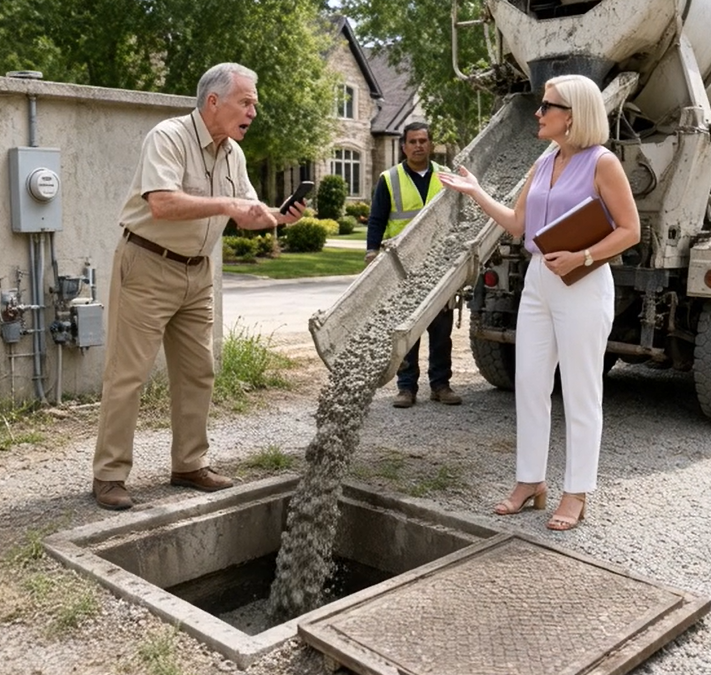
Then I saw the concrete truck.
For a moment, my brain refused to accept it.
A white ready-mix truck sat outside my locked service gate.
Two men in work vests were standing near the fence.
A third man was cutting my chain.
Brenda Kesler stood beside a black SUV holding a clipboard.
I called 911 first.
Then I called Elise.
Then I called my neighbor, Mateo Ruiz, who lived on the north side of my property and could reach the gate in five minutes.
“Mateo,” I said, already walking toward my truck, “someone’s at the pump house with a concrete truck.”
There was no pause.
“I’m going.”
“Do not confront them alone.”
“I’m bringing my sons.”
“That is exactly what I meant by alone.”
“I know what you meant. I’m still bringing them.”
I drove like a man trying to outrun consequences someone else had started.
The cameras kept recording.
Later, those recordings would be played in a conference room, then in a courtroom, then on the local news.
I can still see the footage clearly.
The contractor cutting the chain.
The gate swinging open.
Brenda pointing toward the pump house.
The concrete truck backing in.
The driver lowering the chute.
One of the workers hesitated at the access hatch.
He said something I could not hear through the camera microphone.
Brenda stepped close to him.
Whatever she said made him shrug.
Then they opened the hatch.
The access hatch led directly to the underground cistern.
It was not decorative.
It was not abandoned.
It was not empty.
It was twenty thousand gallons of water storage, collection flow, sediment management, and pressure stability built by my grandfather’s hands.
They poured concrete into it.
Wet gray slurry slid down the chute and disappeared into the dark.
I was still forty minutes away.
I remember making a sound in my truck that did not feel human.
Rage, fear, grief, disbelief, all forced through a throat that could not hold them.
I called 911 again and told the dispatcher people were actively destroying a permitted water system serving residential homes.
She told me deputies were en route.
I asked her to send fire and county environmental.
She paused.
Then I explained, as calmly as I could, what happens when unknown concrete enters an active potable water storage system.
She said, “Oh.”
That was when her voice changed.
Mateo reached the gate before I did.
His sons, Luis and Rafael, were with him.
Mateo was sixty, broad, and built like someone who had spent his life convincing fence posts to obey. Luis was a firefighter. Rafael ran heavy equipment.
They did not touch anyone.
They did not threaten anyone.
They parked their truck sideways across the service drive, and Mateo stepped out with his phone recording.
“What the hell are you doing?” he shouted.
Brenda turned.
“This is authorized HOA remediation.”
“You’re on Reigns land.”
“This structure affects Pinecrest Meadows.”
“That doesn’t answer my question.”
A worker said, “Ma’am, maybe we should stop.”
Brenda snapped, “Keep going.”
Mateo’s video caught that.
Keep going.
Two words.
Clear as a church bell.
Then the first deputy arrived.
The worker at the chute saw the cruiser and finally stopped.
By then, roughly three cubic yards of concrete had entered the cistern.
Three cubic yards does not sound like much until it is in the wrong place.
Three cubic yards inside an active underground water tank is catastrophe.
When I arrived, there were two sheriff’s vehicles, Mateo’s truck, the concrete truck, Brenda’s SUV, and four stunned workers standing around like men who had just realized they had been hired to commit evidence.
I got out before my truck fully settled.
A deputy moved toward me.
“Sir, stay back.”
“That is my water system.”
“I understand.”
“No, you don’t.”
My voice cracked so badly that he looked at me differently.
I walked to the open gate and stopped.
The chain lay cut in the dirt.
My grandfather’s gate.
My father’s lock.
My access hatch open.
Concrete splattered across the rim.
Brenda stood near the pump house, pale but defiant.
“Caleb,” she said, as if we were having a disagreement at a board meeting. “This has gotten out of hand.”
I stared at her.
That was all I could do.
Because if I spoke in that first moment, I do not know what would have come out.
Mateo came to my side.
His voice was low.
“Don’t give her anything she can use.”
I breathed once.
Then again.
The deputy asked Brenda who authorized the work.
“The Pinecrest Meadows HOA,” she said.
“Do you have documentation?”
She held up a folder.
Of course she did.
The folder contained a board resolution approving “aesthetic abatement and safety remediation of the nuisance utility structure adjacent to the entrance corridor.”
It had three signatures.
Brenda’s.
A board secretary named Alan Pritchard.
A treasurer named Bonnie Vale.
None of those signatures gave them authority to enter my land, cut my chain, open my access hatch, or pour concrete into a working cistern.
But arrogance often wears paperwork like armor.
The deputy read the resolution and looked confused.
Then he looked at the cut chain.
Then the hatch.
Then me.
“Mr. Reigns, did you authorize any of this?”
“No.”
“Did you receive notice?”
“No.”
“Is this system active?”
“Yes.”
“Does it serve homes?”
“Yes. Thirty-eight Pinecrest homes under recorded easement.”
The worker who had hesitated earlier muttered, “Oh, man.”
Brenda turned on him.
“Don’t say anything.”
That was another mistake.
Deputies dislike being told who may speak during an investigation.
The worker spoke anyway.
His name was Travis Lyle.
He owned a small concrete finishing company out of Kyle. Brenda had told him the structure was an abandoned cistern creating a safety hazard and that the HOA had legal authority to fill it. She had shown him photos, a plat map with highlighted lines he did not understand, and the board resolution.
Travis was not innocent exactly.
He cut a chain.
He entered property.
He opened an access hatch without verifying anything.
But he was not the mastermind.
He looked sick when I told him what he had filled.
“My god,” he said. “She told us it was abandoned.”
Brenda said, “It is functionally obsolete.”
I finally spoke to her.
“Water was flowing through it this morning.”
Her chin lifted.
“You refused reasonable remediation.”
“You poured concrete into drinking water storage.”
“You’re exaggerating.”
One of the deputies looked at her as if she had slapped a child.
“Ma’am,” he said, “stop talking.”
County environmental arrived next.
Then a representative from the local water authority.
Then Hays County development services.
Then Elise, my attorney, in black slacks and boots, moving across the gravel like judgment had decided to wear sunglasses.
She looked at the cut chain.
The concrete splatter.
The open hatch.
Then she looked at Brenda.
“Oh, you foolish woman,” Elise said softly.
Brenda’s attorney was not there yet.
That was unfortunate for Brenda.
By late afternoon, the system was isolated.
We shut down the supplemental line feeding Pinecrest’s thirty-eight homes to prevent contamination and equipment damage. Municipal supply still served them, but without the Reigns pressure support and storage buffer, the west side immediately began feeling the difference.
Pressure dropped first.
Not to zero.
Not immediately.
Just enough that people noticed.
Shower heads weakened.
Washing machines took longer to fill.
Irrigation zones failed to pop up fully.
Second-floor bathrooms sputtered.
The Pinecrest guardhouse called the HOA office.
The HOA office called Brenda.
Brenda was still standing on my property giving a statement to deputies when her phone started ringing.
She ignored the first call.
Then the second.
Then the third.
By the fourth, she answered sharply.
“What?”
I could not hear the other person clearly.
But I heard Brenda’s response.
“That’s impossible.”
Then, “No, it has nothing to do with that.”
Then, “Use less water until the city resolves it.”
She hung up and would not meet my eyes.
The first news did not spread publicly until evening.
Pinecrest Meadows West Side Water Pressure Advisory.
That was the email the HOA sent.
It did not mention concrete.
It did not mention trespass.
It did not mention Brenda.
It blamed “unexpected complications involving external infrastructure.”
External infrastructure.
That was one way to describe my grandfather’s cistern full of cement.
By 9 p.m., residents were texting one another screenshots, rumors, photographs of deputies, and half-understood explanations.
By midnight, someone posted a security-camera image of the concrete truck online.
By breakfast, everybody knew Brenda had done something.
They just did not know how bad it was.
I did.
The damage assessment began the next morning.
The cistern was not completely filled.
That was the only mercy.
But concrete had entered the active storage area, displaced water, contaminated surfaces, partially blocked the intake screen, and threatened the pump suction line. Some of it had begun settling around internal baffles Dutch had built by hand. The access shaft was coated. The water inside was unusable.
We had to drain, isolate, sample, ventilate, inspect, and plan removal without collapsing anything or contaminating the spring collection line.
Daryl Cates, a structural engineer who specialized in underground tanks, came out and whistled once when he saw the scope camera footage.
“Caleb,” he said, “this is ugly.”
“That seems to be the theme.”
He looked at me sideways.
“You all right?”
“No.”
He nodded.
“Fair.”
I appreciated that.
People kept asking if I was okay as if okay were a door I could walk through if someone pointed it out.
I was not okay.
I was furious.
But beneath the fury was something heavier.
I kept seeing my grandfather in my mind, shirtless in the heat, lowering concrete forms by hand because he could not afford better equipment. My father as a teenager, carrying sacks until his shoulders burned. Raymond in old age, handwriting neat entries into the blue notebook because systems survive only when someone cares after the building is done.
Brenda had not just damaged infrastructure.
She had violated a family memory.
There was no easy line item for that.
Three days after the concrete pour, Pinecrest held an emergency HOA meeting.
I was invited.
So was Elise.
So were representatives from the county.
So was Brenda, though by then several board members had begun pretending her decisions had occurred spontaneously without oxygen or witnesses.
The clubhouse was packed.
I stood at the back with Elise.
People were angry before the meeting even started.
Not at me.
Not mostly.
They were angry because their showers were weak, their irrigation systems were failing, and the email they received had been so vague it insulted even the people who had not yet learned the truth.
Brenda sat at the front table with Alan Pritchard and Bonnie Vale.
Alan looked like a man regretting every signature he had ever made.
Bonnie kept reading her notes without turning pages.
A homeowner named Denise Walden stood before the meeting was officially called.
“My pressure is half what it was last week,” she said. “My plumber says nothing is wrong in my house.”
Another man said, “My water softener alarm went off.”
A woman near the front said, “The HOA email said external complications. What external complications?”
Brenda adjusted the microphone.
“The association is addressing a complex issue involving infrastructure adjacent to the community.”
“Elaborate,” someone shouted.
Brenda’s mouth tightened.
“Legal counsel has advised caution.”
Elise leaned toward me and whispered, “That means she finally called one.”
The county water authority representative, a serious woman named Pilar Gomez, stood.
“With respect, homeowners need accurate information. A supplemental water system serving thirty-eight Pinecrest homes was taken offline after unauthorized concrete placement contaminated an active storage cistern.”
The room went silent.
Then exploded.
“Concrete?”
“Who poured concrete?”
“Active cistern?”
“Our drinking water?”
“Unauthorized by whom?”
Every voice rose at once.
Brenda lifted both hands.
“Please, everyone.”
Denise Walden shouted, “Did you do this?”
Brenda’s face reddened.
“The board authorized remediation of a nuisance structure based on available information.”
A man stood in the third row.
His name was Aaron Bell, father of three, lot 32.
“You poured concrete into our water system?”
Brenda said, “It is not your water system.”
That was the wrong answer.
Aaron stared at her.
“Then why did my shower die when you broke it?”
The room went dead quiet.
Brenda looked down at her folder.
Elise stepped forward.
“Mr. Reigns owns the system. Pinecrest has defined usage rights under a recorded easement. Those rights do not include trespass, cutting locks, damaging infrastructure, or pouring concrete into an active potable water cistern.”
Bonnie Vale whispered, “We didn’t know.”
I looked at her.
“You signed the resolution.”
“We thought it was abandoned.”
“You’re the treasurer of an HOA paying annual maintenance fees for it.”
Her face drained.
That was the moment many residents learned they had been paying for the very system Brenda called a disgrace.
An older man near the back said, “Wait. We pay for this?”
Pilar answered, “The HOA agreement includes maintenance contributions for the supplemental system.”
Another resident said, “Was that disclosed?”
Elise lifted a folder.
“In closing documents for affected properties and in the recorded plat.”
Groans moved through the room.
People hate discovering that the truth was available but buried under paperwork they never read.
Brenda tried again.
“The structure’s appearance has been a long-standing concern.”
Aaron Bell laughed.
Not because it was funny.
Because sometimes disbelief comes out sideways.
“My kids can’t take normal showers, and you’re talking about appearance?”
Brenda pointed toward me.
“Mr. Reigns refused reasonable aesthetic improvements.”
I finally walked to the front.
The room quieted in pieces.
“I refused to let the HOA dictate changes to private water infrastructure it does not own,” I said. “I sent records. Easements. Testing logs. Maintenance explanations. You ignored them. Then you entered my property without permission and damaged the system that helps stabilize pressure for your own residents.”
Brenda leaned toward her microphone.
“You were hostile from the beginning.”
“No,” I said. “I was accurate. You experienced that as hostility.”
A few people murmured.
Brenda’s eyes flashed.
“You expect this community to tolerate an eyesore forever because your family is sentimental about an old tank.”
There it was.
The room heard it.
Not just me.
Not just Elise.
Everybody.
Sentimental.
An old tank.
A woman in the front row slowly shook her head.
I looked at Brenda for a long moment.
“My grandfather built that tank because water matters here. My father maintained it because people depend on systems they never see. I maintain it because responsibility does not stop being responsibility just because the building is ugly.”
My voice did not rise.
It did not need to.
“You saw a concrete box. You did not see the spring, the storage, the pressure, the testing, the records, the easement, the families, the history, or the consequences. That is not my failure.”
Brenda looked away first.
That was when she lost the room.
The board voted that night to suspend Brenda’s authority pending investigation.
She objected.
Alan Pritchard resigned on the spot.
Bonnie Vale cried and claimed she never understood what she signed.
An interim committee formed to coordinate with county officials, Elise, and me.
Pinecrest residents were told the truth.
Repairs would be expensive.
Pressure might remain reduced for weeks.
The system could not simply be turned back on.
Concrete contamination was not something you flushed with a garden hose and optimism.
Over the next several days, my property became a job site.
Specialists installed temporary tanks.
A bypass line was designed.
Water testing began.
The cistern was drained slowly under supervision.
Interior access required ventilation and confined-space procedures.
The first time I saw inside after the water was lowered, I had to step away.
Gray concrete had spread across part of the floor and hardened around the old internal baffle like a disease.
Daryl Cates stood beside me.
“We can remove it,” he said.
“I know.”
But knowing something can be repaired does not make the damage easier to see.
Mateo came by that evening.
He brought beer and did not ask if I was okay.
We sat on my tailgate facing the pump house.
After a while, he said, “Dutch would have cussed for twenty minutes straight.”
I laughed despite myself.
“Thirty.”
“True. Then he would have fixed it.”
That was the comfort Mateo offered.
Not that it was fine.
Not that everything happened for a reason.
Just that the men who built the thing would have been furious too.
Then they would have picked up tools.
I slept badly for weeks.
Every time the phone rang, I expected worse news.
Collapsed wall.
Failed pump.
Contamination spread.
County order.
Lawsuit.
Something.
Brenda, meanwhile, shifted into self-preservation.
Her attorney sent a letter claiming she acted in good faith based on safety concerns and incomplete infrastructure information.
Elise’s response included the easement, the maintenance-fee records, Brenda’s prior letters, my written explanations, the 911 report, video footage of the chain being cut, footage of Brenda saying “keep going,” and the contractor’s statement that Brenda told him the cistern was abandoned.
The good-faith argument did not improve with evidence.
Then came the shower incident.
It happened three weeks after the concrete pour, on a Monday morning at 7:12.
I know the time because Brenda mentioned it in her own complaint.
The temporary bypass had been installed, but it did not provide the same pressure stabilization. Pinecrest’s west side was under water-use restrictions. Outdoor watering was prohibited. Residents were asked to avoid simultaneous high-demand use during peak hours.
Most complied.
Brenda did not.
Her house had a luxury primary bathroom with a rainfall shower system, body jets, and a freestanding tub large enough to baptize a horse. She also had a landscape crew that had apparently been watering before sunrise despite restrictions.
At 7:12, with irrigation running, a washing machine filling, and half the west side getting ready for work and school, pressure dropped.
Hard.
In several homes, showers weakened.
In Brenda’s house, the rainfall shower sputtered and nearly stopped.
She had shampoo in her hair.
According to the plumber she called in a rage, she came out wrapped in a towel, dripping water across marble tile, yelling that the municipal supply had failed.
Her plumber checked the house.
Nothing wrong.
He checked the pressure at the exterior bib.
Low.
He asked whether the neighborhood was under any special water conditions.
Brenda reportedly said, “Some temporary nonsense because of that Reigns man.”
The plumber knew enough to stop talking.
By 8:05, Brenda was on the phone with the interim HOA committee demanding immediate restoration of full pressure.
By 8:30, she had called Pilar Gomez at the county.
By 8:47, she called me.
I let it go to voicemail.
Her message was short.
“Mr. Reigns, this is Brenda Kesler. The water pressure situation is unacceptable. Whatever temporary arrangement you have made is inadequate. Residents cannot live this way. You need to restore the system immediately.”
I saved the voicemail.
Then I played it for Elise.
She laughed for a full ten seconds.
That was the first time I had heard Elise laugh like a normal person.
At the next HOA meeting, Aaron Bell stood and read Brenda’s voicemail aloud.
He had obtained it through the interim committee after I forwarded it to them.
People did not laugh at first.
They were too tired.
Then someone in the back said, “Didn’t she break the system?”
That was when laughter finally came.
Not joyful laughter.
Exhausted laughter.
The kind people release when hypocrisy becomes too large to hold politely.
Brenda sat near the front, no longer at the board table.
Her face was pale.
Aaron looked at her.
“You called this system a disgrace. Then you destroyed it. Then when your shower stopped working, you demanded Caleb fix it faster. Do I have that right?”
Brenda stood.
“I will not be publicly humiliated by people who do not understand what leadership requires.”
A woman named Nora Bell, Aaron’s wife, stood too.
“Leadership requires reading the easement before pouring concrete into it.”
The room went silent, then erupted.
Brenda grabbed her purse and walked out.
But this time, nobody followed.
The legal consequences moved slower than public anger.
Civil claims came first.
My claim against the HOA, Brenda personally, the contractor, and associated board members sought damages for repair costs, water testing, engineering, emergency bypass work, loss of system capacity, legal fees, and trespass-related damages.
The HOA’s insurance company tried to deny coverage because intentional acts were excluded.
The HOA tried to argue Brenda exceeded authority.
Brenda tried to argue she acted under board authorization.
The contractor tried to argue he relied on HOA representations.
Everyone pointed at everyone else.
Meanwhile, the water still had to work.
That is what people forget.
While attorneys debated liability, someone still had to pump, test, clean, repair, and monitor.
I spent mornings on calls with engineers and evenings at the pump house.
I wrote in the notebook every day.
October 11. Tank draining. Turbidity elevated. Bypass operating.
October 12. Contractor removed surface debris. Wall inspection pending.
October 14. Residents angry. Pressure complaints continue. Temporary restrictions necessary.
October 17. Dad would hate this.
I stared at that last entry after writing it.
It was the first time the notebook sounded like me instead of a maintenance log.
I almost tore the page out.
Then I left it.
Records should tell the truth.
Even when the truth is grief.
The breakthrough came when Elise subpoenaed HOA emails.
Brenda had not acted alone.
Not entirely.
Alan Pritchard had warned her twice that the easement needed review.
Bonnie Vale had asked whether the pump house might be “legally sensitive.”
Brenda had responded:
We have tolerated that structure long enough. The Reigns family has used historic sentimentality to bully Pinecrest for years. Once the cistern is filled, the issue becomes moot.
Moot.
That word did more damage than any insult.
It showed intent.
She did not misunderstand.
She wanted to make the system unusable first and deal with authority later.
There was another email too.
From Brenda to a landscaping consultant:
After removal/fill, I want visual screening and possibly a stone monument feature near entrance curve. The sooner the old utility eyesore is neutralized, the sooner home values stop being affected.
Neutralized.
A man’s grandfather builds a water system.
A father maintains it for decades.
A community relies on it.
And Brenda calls destroying it neutralization.
When that email came out, Pinecrest turned fully.
Not against me.
Against her.
Residents demanded Brenda pay personally.
They demanded board resignations.
They demanded a full audit of HOA governance.
They demanded infrastructure disclosures in plain language, not buried in packets no one read.
The new interim president, Denise Walden, came to my house one Saturday afternoon.
She brought no folder.
No clipboard.
No demands.
Just herself, looking embarrassed and tired.
“I owe you an apology,” she said.
“You didn’t pour the concrete.”
“No. But I ignored Brenda longer than I should have.”
I opened the gate.
We walked toward the pump house together.
The repair crew had set up temporary fencing. Hoses ran toward storage tanks. The old structure looked wounded, though I knew buildings do not feel. People attach feelings to concrete because concrete outlasts us.
Denise stopped near the door.
“I used to drive by this and think it looked ugly too,” she said.
“I know.”
She winced. “That obvious?”
“It is rarely difficult to tell when someone dislikes something.”
“I never knew what it did.”
“You could have.”
She nodded.
“That’s what I’m apologizing for.”
I respected that.
Real apologies do not try to erase fault.
They point at it.
Denise looked at the pump house again.
“My son asked me why the neighborhood’s water got weak. I told him grown-ups broke something important because they cared more about how it looked than what it did.”
“That’s not a bad explanation.”
“He asked if we were the bad guys.”
“What did you say?”
She looked at me.
“I said we were the careless guys. And careless can turn bad if nobody stops it.”
I thought about that for a long time after she left.
Careless can turn bad if nobody stops it.
That may have been the whole story of Pinecrest Meadows.
Brenda was cruel.
But Brenda had power because careless people gave it to her.
The repairs took four months.
Four long, expensive, exhausting months.
Specialists removed hardened concrete in sections using tools that would not compromise the tank walls. The cistern was cleaned, resurfaced in damaged areas, disinfected, refilled, tested, drained again, tested again, and finally certified for service.
We replaced the intake screen.
Rebuilt part of the manifold.
Installed additional monitoring.
Added tamper sensors, upgraded cameras, reinforced locks, and a remote alarm tied to my phone and the county contact list.
The total cost was sickening.
But the system survived.
Dutch’s cistern survived.
The first day we brought it back online, I stood in the pump house with Pilar Gomez, Daryl Cates, Mateo, Denise Walden, and three Pinecrest residents selected by the interim committee.
I turned the valve myself.
Slowly.
Water moved through the line.
The pump engaged.
Pressure climbed.
Forty-two.
Forty-eight.
Fifty-three.
Fifty-eight.
Stable.
For a few seconds, nobody spoke.
Then Mateo clapped a hand on my shoulder.
“Dutch would only cuss for ten minutes now.”
I laughed.
This time, it did not hurt.
That evening, my phone buzzed with a message from Aaron Bell.
Pressure is back. Kids cheered when upstairs shower worked. Thank you.
Then another from Nora.
I know this should have always been normal, but we are grateful.
Then Denise.
System restored notice sent. Plain language this time.
I walked to my father’s desk, opened the blue notebook, and wrote:
February 3. System restored. Pressure stable. Water clear. Dad would approve.
I sat there for a while with the pen in my hand.
Then I added:
Dutch too.
The civil settlement came in May.
The HOA’s insurance carrier paid part under reservation.
The contractor’s insurer paid part.
Brenda paid personally after Elise pursued a claim based on intentional trespass and property damage. She sold her house before summer.
No farewell party.
No dramatic goodbye.
A moving truck came on a Tuesday.
By noon, Brenda Kesler was gone from Pinecrest Meadows.
But before she left, she attended one final mediation session.
She had resisted apology for months.
Her attorney must have told her it would help.
Maybe it did.
Maybe it did not.
We sat across from each other in a conference room with beige walls, stale coffee, and too many lawyers.
Brenda looked smaller than she had at my gate.
Not humbled exactly.
Diminished.
There is a difference.
She folded her hands on the table.
“Mr. Reigns,” she said, “I regret what happened.”
Elise shifted beside me.
I stayed quiet.
Brenda continued.
“I believed I was acting in the best interest of Pinecrest Meadows.”
I looked at her.
“That isn’t an apology.”
Her jaw tightened.
For a moment, the old Brenda returned.
Then it faded.
She looked down at her hands.
“I was wrong,” she said.
The room went very still.
“I was wrong about the structure. I was wrong about your family’s system. I was wrong to dismiss the documents you provided. I was wrong to authorize work on your property. I caused damage.”
Her voice thinned.
“And I am sorry.”
I studied her face.
I wanted satisfaction.
I wanted the apology to restore something.
It did not.
Apologies are not time machines.
They do not pull concrete back out of water.
They do not erase months of stress.
They do not give a dead father the chance to see his system defended.
But they can mark the spot where denial finally ends.
So I nodded.
“Thank you for saying it clearly.”
Her eyes lifted.
“Do you forgive me?”
The room seemed to hold its breath.
That is a question people ask when they want release from consequences.
Sometimes they deserve an answer.
Sometimes they do not.
“I hope you become someone who understands why that question is not mine to make easy for you.”
Brenda’s eyes filled.
She looked away.
That was the last conversation we ever had.
After the settlement, Pinecrest Meadows changed.
Not overnight.
Neighborhoods do not become wiser just because one person leaves.
But changes came.
The HOA rewrote its infrastructure policies.
Every easement affecting the community was summarized in plain language and mailed to residents.
The annual budget identified maintenance fees by system, not vague categories.
Board members had to certify that they read legal documents before voting on property-related actions.
No work could be performed near private infrastructure without written owner authorization and legal review.
The pump house, ironically, became protected.
Denise asked if Pinecrest could pay for visual improvements that did not interfere with function.
This time, the request came respectfully.
No demands.
No insults.
No threats.
Just a proposal.
I agreed to limited work.
Not a stone monument.
Not a fake wall.
Nothing that hid access or pretended the system was something it was not.
We repaired the exterior block, replaced the old corrugated roof with a durable standing-seam metal roof in a muted color, added native screening plants at a safe distance, and installed a small plaque near the service gate.
I wrote the plaque text myself.
REIGNS SPRING SYSTEM
BUILT BY DUTCH REIGNS, 1976
MAINTAINED BY RAYMOND REIGNS AND CALEB REIGNS
WATER IS INFRASTRUCTURE, MEMORY, AND TRUST
Pinecrest paid for the plaque.
I paid for the bolts.
That felt right.
The dedication happened on a cloudy Saturday morning after a light rain.
Not formal.
No ribbon.
No speeches from politicians.
Just a handful of residents, Mateo, Elise, Pilar, Denise, Aaron and Nora Bell with their kids, and me standing near the pump house while water moved underground beneath our feet.
Denise said a few words.
She did not make Pinecrest sound heroic.
I appreciated that.
“We failed to understand what we depended on,” she said. “Then we failed to protect it. Today is not about pretending that failure did not happen. It is about remembering it correctly.”
Aaron’s youngest son raised his hand.
Denise smiled. “This isn’t school, but go ahead.”
He pointed at the pump house.
“Is that where the shower water lives?”
People laughed.
I crouched to his level.
“Some of it rests under there before it helps your house.”
He looked impressed.
“So it’s like a water battery?”
I blinked.
Then smiled.
“Actually, that’s not bad.”
He turned to his mother. “I told you pipes are cool.”
Nora said, “You did.”
After everyone left, I stayed by the gate.
Clouds moved low over the hills.
The live oaks dripped from the morning rain.
The pump house looked better than it had in years, but still honest.
Still concrete.
Still functional.
Still my grandfather’s idea at its core.
Mateo lingered beside me.
“You did good,” he said.
“I didn’t do it alone.”
“No. But you stood when standing was needed.”
That sounded like something my father would have said if he had been less quiet.
I looked at the plaque.
Water is infrastructure, memory, and trust.
That was the lesson Brenda had not understood.
Maybe most of Pinecrest had not understood it either.
People love the visible parts of a community.
The entrance signs.
The landscaping.
The clubhouse.
The pool.
The stonework.
The clean streets.
The matching mailboxes.
They take photographs of sunsets and kitchens and front porches.
They do not photograph pressure tanks.
They do not admire valves.
They do not brag about sediment filters.
They do not bring guests to look at easement maps.
But the invisible things decide whether the visible things can function.
Water.
Power.
Drainage.
Roadbeds.
Trust.
Maintenance.
Records.
The willingness to read what was signed before pretending it does not exist.
Brenda saw ugliness because she had trained herself to value appearance over service.
The pump house did not flatter Pinecrest.
It supported it.
And support is often plain-looking.
Support is a concrete block building with a steel door.
A blue notebook.
A grandfather’s rough hands.
A father’s careful handwriting.
A pressure gauge steady at fifty-eight.
A neighbor recording video because truth needs witnesses.
A community finally learning that the things they dismiss may be the things keeping them safe.
That night, I opened the old notebook and wrote one more entry.
June 12. Plaque installed. Pressure normal. System respected.
I paused.
Then added:
For now.
Because systems require maintenance.
All of them.
Water systems.
Communities.
Families.
Integrity.
You do not fix them once and walk away forever.
You check them.
You listen.
You keep records.
You question strange noises.
You do not ignore small leaks because they are inconvenient.
And when someone points at the structure keeping everyone alive and calls it a disgrace, you do not laugh it off for too long.
You show them the map.
You show them the easement.
You show them the pressure gauge.
And if they still pour concrete into the truth, you make sure the whole neighborhood understands why the shower stopped.
Brenda Kesler thought she was removing an eyesore.
What she exposed was a blindness.
A blindness to history.
To labor.
To legal duty.
To the quiet systems that hold up beautiful lives.
She wanted Pinecrest Meadows to look perfect from the road.
Instead, she taught everyone there that a perfect-looking community can be one bad decision away from running dry.
The pump house still stands on my land.
People still drive past it.
Some probably still think it is ugly.
That no longer bothers me.
Ugly things can be honest.
Beautiful things can hide rot.
And every time water moves from that old spring through Dutch’s cistern, through Raymond’s records, through my repaired valves, and into homes where families barely think about it, I remember the morning Brenda pointed at my grandfather’s work and called it a disgrace.
She was wrong.
The disgrace was never the pump house.
The disgrace was believing something had no value because she did not understand what it carried.
Now Pinecrest understands.
So do I.
The water beneath that hill does more than fill pipes.
It carries proof.
That old systems matter.
That private land is not public property just because someone wants it prettier.
That records matter.
That arrogance can break what patience built.
And that sometimes justice begins with the simplest sound in the world.
A faucet opening.
A pipe filling.
A shower running again because the truth, once repaired, is finally allowed to flow.