HOA Karen Pointed a Gun at Me Over Her Crushed $100,000 BMW—Then She Learned the Quiet Retiree Next Door Used to Run the FBI
PART3:
Families walking in the evening.
Children riding bicycles.
An HOA that appeared, from the documents, more annoying than dangerous.
I could handle annoying.
At least that was what I thought.
My name is James Hail.
Most people called me Jim.
I had served in the Bureau most of my adult life.
Eventually, I reached the Director’s office.
That title sounds grander from the outside than it feels from the chair.
Most days were responsibility layered over more responsibility. You learn quickly that power is mostly accountability with better stationery.
When I left, I didn’t advertise my résumé.
No plaque near the front door.
No security detail.
No framed magazine covers.
I wanted to be Jim from Maple Drive.
That lasted forty-eight hours.
The first HOA notice appeared on my door before I had even finished unpacking.
WELCOME TO HAWTHORNE RIDGE.
PLEASE ENSURE ALL TRASH BINS ARE COLOR COMPLIANT AND STORED OUT OF PUBLIC VIEW.
VIOLATIONS MAY RESULT IN FINES.
Signed:
Karen Hollingsworth
HOA President
I read it.
Looked at my two dark gray trash bins.
Looked at the association handbook.
Approved bins were dark gray.
Mine were dark gray.
I assumed it was a generic notice.
Then I met Karen.
She came walking up my driveway the next morning wearing a pastel tracksuit and white shoes clean enough to suggest they had never encountered real dirt.
Short woman.
Mid-fifties.
Sharp eyes.
Expensive haircut.
The posture of somebody who expected people to step aside before being asked.
She stopped near my hedge.
Didn’t shake my hand.
Didn’t introduce herself immediately.
She examined the shrub.
“You’ll need to trim that.”
I looked behind me.
“Morning.”
She pointed.
“That hedge is above regulation height.”
“Is it?”
“By approximately four inches.”
I studied it.
The hedge had been there long before I bought the house.
Probably before Karen moved into hers.
“I’m Karen Hollingsworth.”
“I guessed.”
That surprised her.
“Excuse me?”
“Your signature is on my trash can letter.”
Her face relaxed.
“Ah. Yes. HOA president.”
“Jim Hail.”
“I know.”
Of course she did.
Karen seemed like the kind of person who read closing records recreationally.
She looked at the hedge again.
“We maintain uniform aesthetics.”
“I appreciate the warning.”
“You’ll take care of it?”
“I’ll look at the rule.”
She frowned.
“The rule is clear.”
“Then reading it shouldn’t hurt.”
She stared at me.
That was the first tiny moment when I saw the problem.
Karen did not like questions when she already considered herself the answer.
She smiled again.
“We keep Hawthorne Ridge perfect.”
“That’s ambitious.”
“What do you mean?”
“Nothing is perfect.”
“Our property values are among the highest in the county.”
“Then you’re doing something right.”
She nodded as if I’d passed an exam.
“You’ll fit in.”
I watched her walk away.
I should have known better.
For the first couple of months, I played along.
Paid dues.
Followed legitimate requirements.
Trimmed the hedge.
Moved the trash bins.
Attended one HOA meeting because I wanted to see how the organization worked.
That meeting explained almost everything.
Karen sat at the head of a folding table as though Congress had convened to discuss national security.
Three board members sat beside her.
Phil.
Donna.
Rick.
All intelligent enough.
All nervous around her.
Agenda item three concerned a house on Cedar Lane whose shutters had been painted slate gray instead of stone gray.
I actually checked the color samples.
They were nearly identical.
Agenda item four involved a basketball hoop that allegedly disrupted “curb harmony.”
Karen said that phrase without irony.
Curb harmony.
I sat in the back and listened.
Some residents rolled their eyes.
Most remained quiet.
One man objected to a fine.
Karen corrected him so sharply he apologized for raising the question.
I recognized the pattern.
It wasn’t leadership through consensus.
It was control through exhaustion.
Make disagreement unpleasant enough and people stop disagreeing.
In federal service, I’d seen the same psychology in organizations far more dangerous than an HOA.
Scale changes.
Human nature doesn’t.
After that, the notices became more personal.
Mailbox paint faded.
Porch light too bright.
A shrub allegedly obstructing sight lines.
Driveway drainage angle.
My daughter visited with her children one weekend.
At 8:17 p.m., we were sitting on the back patio laughing.
No music.
No party.
Just family.
The next morning:
NOISE DISTURBANCE AFTER 8:00 P.M.
I held the paper up over breakfast.
My daughter looked at it.
“This is real?”
“Apparently.”
“Was it the kids?”
“Your children laughed without HOA approval.”
She laughed again.
I glanced toward the window.
“Careful. That’s another fifty dollars.”
The grandchildren thought Karen was hilarious.
I didn’t.
Not yet.
Mostly I found her tiring.
Then there was the BMW.
Karen’s pride.
Custom pink paint.
Imported wheels.
Tan leather.
Vanity plate:
KAREN1.
She polished it herself every Saturday.
The first time she caught me looking, she smiled.
“Beautiful, isn’t she?”
“Hard to miss.”
“It cost more than some people’s houses.”
“That’s unfortunate for those houses.”
She didn’t catch the joke.
Karen stroked the hood.
“Custom order.”
“Enjoy it.”
“I do.”
She looked toward my older SUV.
“You know, presentation matters in a neighborhood like this.”
I sipped coffee.
“My vehicle starts.”
That ended the conversation.
From then on, I noticed the BMW frequently parked near the edge of her driveway beneath the outer spread of my oak.
It was a magnificent tree.
Forty feet.
Healthy canopy.
Huge root system.
Older than Hawthorne Ridge.
The association had inspected it the year before.
An arborist documented it as healthy.
I kept the report because I keep reports.
Old occupational disease.
Spring brought storms.
The big one came after several days of humidity so heavy you could feel it in your lungs.
Weather alerts started in the afternoon.
High winds.
Severe thunderstorms.
Possible tornado activity farther west.
I moved outdoor furniture.
Checked gutters.
Charged flashlights.
Karen apparently reassured several neighbors that the trees were “HOA certified.”
I heard about that later.
As though certification negotiated with weather.
That night the sky turned greenish black.
Wind hammered the houses.
Rain moved sideways.
Thunder cracked hard enough to rattle windows.
I watched from my living room.
Then came the sound.
Not thunder.
Wood tearing.
Deep.
Violent.
Like the earth itself had snapped something.
I saw the oak move.
For half a heartbeat, I thought it was coming toward my house.
Then lightning lit the street.
The oak fell sideways.
Across the property line.
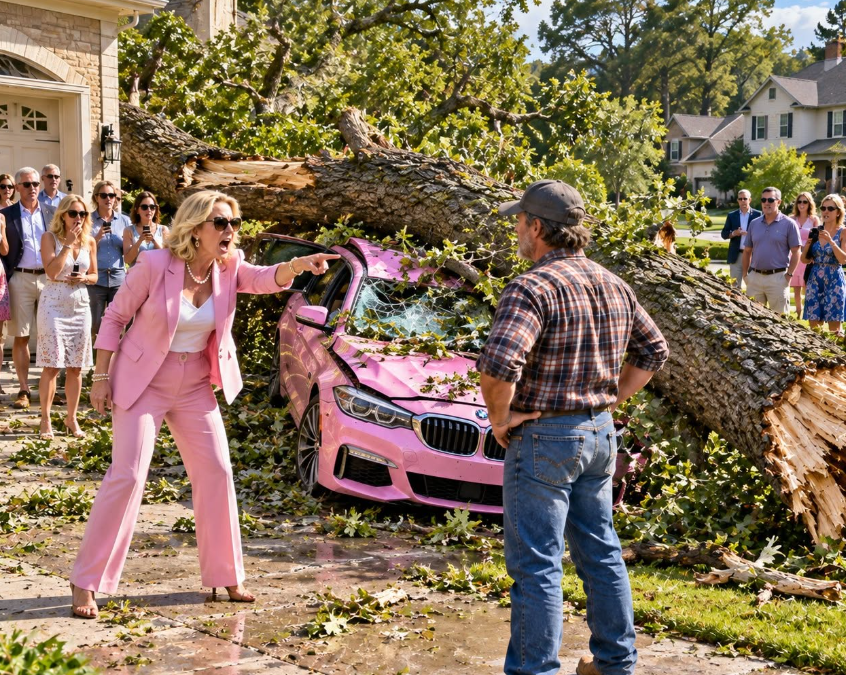
Across Karen’s driveway.
Directly onto the BMW.
The impact was spectacular.
Roof collapsed.
Windshield exploded.
Hood folded.
Tree branches covered almost the entire car.
The pink paint still visible underneath made the wreck look surreal.
I pulled on a raincoat and stepped outside.
Wind hit my face.
I checked for power lines.
None.
No one appeared injured.
Karen’s house was intact.
Her BMW wasn’t.
A reasonable person looks at that and thinks insurance.
Karen looked at it and thought enemy action.
At dawn, I made coffee.
Went outside.
The storm had passed.
Branches everywhere.
The air smelled like wet wood and ozone.
Karen’s front door opened.
She emerged in a robe.
Saw me.
Pointed.
“You!”
I looked behind me.
Nobody.
“This is YOUR fault!”
“Good morning, Karen.”
“Don’t you good morning me!”
She marched toward the wreck.
“My car!”
“I see it.”
“Your tree destroyed my car!”
“The storm dropped the tree.”
“You knew it was dangerous.”
“No.”
“It was on your property.”
“It was inspected last year.”
“You neglected it!”
“It was healthy.”
She stared at the crushed BMW.
“You’ll replace it.”
“No.”
Her head snapped toward me.
“What?”
“Call your insurance company.”
“Insurance?”
“Yes.”
“This is negligence.”
“Not according to the inspection.”
“I’m the HOA president.”
I waited.
That sentence was apparently supposed to change physics.
“You’ll pay for this.”
“Your insurer can contact mine if necessary.”
“I don’t want insurance.”
“That’s unfortunate.”
“I want a new car.”
“Then buy one.”
Karen looked like I had slapped her.
I turned toward my porch.
Behind me, she screamed.
Not words.
Just frustration.
The entire day became theater.
Photographs.
Phone calls.
Neighbors.
Karen standing beside the wreck explaining what my tree had “done to her.”
By evening, the first formal notice arrived.
PROPERTY NEGLIGENCE.
COMMUNITY HAZARD.
PENDING LIABILITY ASSESSMENT.
I created a folder.
EVIDENCE.
Not because I planned anything.
Because a lifetime in investigations teaches you that today’s ridiculous letter becomes tomorrow’s exhibit.
The next morning, the HOA board arrived in matching blue windbreakers.
Phil led them.
He photographed the tree.
“Morning, Jim.”
“Phil.”
“We’re conducting a community damage assessment.”
“Of Karen’s BMW?”
He looked uncomfortable.
“Of the incident.”
“What part is community property?”
“The tree originated on your parcel.”
“And the BMW is on hers.”
“Karen believes your negligence created a hazard.”
“Karen believes a lot of things.”
Phil lowered his camera.
“The board has to review it.”
“Review away.”
Karen came storming outside.
Sunglasses.
Floral robe.
Phone in hand.
“There he is!”
I closed my eyes briefly.
“The man who destroyed my car!”
“Storm.”
“Your tree!”
“Storm.”
“You will replace it.”
“No.”
“Exact model.”
“No.”
“Exact custom paint.”
“No.”
“I’ll send you the invoice.”
“Send it to your insurance company.”
Karen stepped closer.
“If you refuse, I will place a lien on your property.”
I smiled.
That made her angrier.
“What?”
“If you’re threatening me with property law, read some first.”
“Are you threatening me?”
“No.”
I looked at Phil.
“I’m advising your president not to make promises the HOA can’t legally keep.”
Phil looked down.
By afternoon, Karen sent a neighborhood-wide email.
URGENT COMMUNITY SAFETY NOTICE.
It described me as a resident with a history of refusing reasonable standards.
False.
Claimed the oak had been “visibly deteriorating.”
False.
Claimed I had ignored warnings.
False.
Claimed the HOA would review whether I remained eligible for residency.
That one was almost impressive.
I owned the house.
Karen apparently believed the board could vote me out like a contestant on television.
I saved the email.
Then another.
Then another.
Two days later, she arrived wearing a pink blazer and pearls.
Two board members stood behind her.
“Mr. Hail.”
“Karen.”
“This is your final opportunity to accept liability.”
“No.”
“You haven’t even read the notice.”
“I’ve read the law.”
Her jaw tightened.
“There was a severe weather warning.”
“That’s irrelevant.”
“It’s the entire cause.”
“You failed to maintain a safe environment.”
“The oak had a clean arborist inspection.”
“Those reports can be wrong.”
“Then your insurance company can litigate that.”
“The HOA has independent authority.”
“Not over weather.”
She glared.
“You think your little government career makes you untouchable?”
Interesting.
She knew something.
Probably a background search.
But not enough.
“I don’t think I’m untouchable.”
“Good.”
“I know your authority has limits.”
She stepped toward me.
“You’ll hear from our counsel.”
“I look forward to it.”
“Our lawyer is the best in the county.”
“I prefer mine in Washington.”
Karen paused.
“Washington?”
I smiled.
“Have a nice afternoon.”
That night, I sat in my office.
One wall held old commendations.
Photographs.
A framed plaque I’d never bothered to unpack completely.
Federal Bureau of Investigation
Director James Hail
I looked at it.
Then at Karen’s latest notice.
My old instincts had started waking up.
Not because of the BMW.
Not even because of the harassment.
Something about the HOA paperwork bothered me.
Numbers.
Fees.
Invoices.
Patterns.
When you spend enough years around investigations, inconsistencies become like off-key notes.
I pulled up meeting minutes.
Budgets.
Public filings.
Vendor records.
Three hours later, I found duplicate maintenance invoices.
Same work.
Different vendor names.
Payments that didn’t correspond to any visible projects.
Unusual emergency assessments.
One landscaping company receiving significantly more money than the work justified.
Nothing definitive.
But enough to make me curious.
Curiosity is dangerous in retired federal officials.
The next morning, Karen sent a $2,500 fine.
PROPERTY NEGLIGENCE AND FAILURE TO MAINTAIN SAFE CONDITIONS.
I laughed.
Actually laughed.
Then carried the notice to her house.
Karen stood beside the BMW wreck speaking to a local reporter.
She saw me.
“Oh, look who finally decided to face the consequences.”
I handed her the letter.
“Thank you.”
“For what?”
“My lawyer will enjoy it.”
Karen smirked.
“Your lawyer?”
“Yes.”
“The HOA counsel has never lost a property enforcement action.”
“Impressive.”
I turned.
“Mine works in D.C.”
Again, that pause.
“What are you implying?”
“Nothing yet.”
I walked home.
Two days later, chainsaws woke me.
Contractors.
On my property.
Preparing to cut the fallen oak.
I stepped outside.
“Stop.”
Engines slowed.
One contractor removed hearing protection.
“We have HOA authorization.”
“Do you have mine?”
“No.”
“Then leave the tree alone.”
Karen hurried over.
Phone already recording.
“He’s obstructing emergency cleanup.”
The contractor looked between us.
“Ma’am, he owns the property.”
“His property is inside the HOA.”
“Still his property.”
Karen pointed at the tree.
“Everything in Hawthorne Ridge falls under HOA jurisdiction.”
I looked at her.
“Karen.”
“What?”
“You just said that on camera.”
She stopped.
“What camera?”
I pointed toward the porch.
Black dome.
Red status light.
Her face paled.
The contractors left.
That night, a note appeared under my door.
Handwritten.
You’ve made a very dangerous mistake.
I’m not afraid of you.
I read it twice.
People who aren’t afraid don’t announce it.
I locked the doors.
Checked cameras.
For the first time, the situation stopped feeling silly.
Karen wasn’t fighting about a car anymore.
The BMW was just the trigger.
What she was really fighting was loss of control.
I had refused her authority.
Then questioned her money.
Then stopped her contractors.
Every refusal reduced her in front of other people.
Power-hungry personalities can tolerate losing money more easily than losing status.
The emergency HOA meeting came three days later.
Full clubhouse.
Karen had a projector.
Of course she did.
The screen displayed photographs of the crushed BMW from multiple angles.
One slide even included an arrow pointing toward my property.
I sat in the back.
Karen hit the gavel.
“Order.”
Nobody had been speaking.
“We are here to consider disciplinary action against the resident of 172 Maple Drive.”
I raised my hand.
“That’s me.”
She gave a thin smile.
“You may speak briefly.”
“Generous.”
Several neighbors chuckled.
Karen ignored them.
I stood.
“The oak was professionally inspected and considered healthy. A severe storm uprooted it. Insurance exists for exactly this kind of dispute.”
Karen interrupted.
“Stop hiding behind insurance.”
“I’m explaining liability.”
“You endangered my property.”
“The weather damaged your car.”
“Your tree.”
“Your car.”
Her face reddened.
“By extension, you endangered the entire community.”
“I wasn’t aware a BMW was community infrastructure.”
Laughter.
Karen slammed the gavel.
“Enough!”
I sat.
She began listing alleged violations.
Negligence.
Refusal to cooperate.
Obstruction of emergency maintenance.
Creating community disharmony.
Then she announced, “I move to assess a $5,000 emergency fine and suspend all community privileges.”
Phil leaned toward her.
“Karen.”
“What?”
“That motion hasn’t been seconded.”
“I second it.”
Phil looked miserable.
“You can’t second your own motion.”
I couldn’t help myself.
The room laughed again.
Karen’s jaw tightened.
“You think this is funny?”
“The procedure part is.”
She leaned forward.
“You think your government job protects you.”
“No.”
“I know people at city hall.”
“Then they’ll know where to send a financial misconduct report.”
Silence.
Real silence.
Karen stared at me.
Phil stopped moving.
I continued.
“Your maintenance budget is missing approximately twelve thousand dollars across the last three fiscal years.”
Her face changed.
“That’s a lie.”
“Duplicate invoices.”
“Accounting errors.”
“Payments to vendors that don’t appear to exist.”
“You’ve been accessing confidential information.”
“Public records.”
“You are stalking this board.”
“I read your own filings.”
Karen stood.
“You have no right.”
“Every homeowner paying dues has a right to know where the money goes.”
Nobody laughed now.
Several residents looked at each other.
I closed the folder.
“I’m giving you an opportunity.”
“For what?”
“Stop.”
Karen actually laughed.
“You think you can threaten me in my own meeting?”
“Withdraw the fabricated fines. Stop entering my property. Stop making false statements. Let insurance handle the tree.”
“And if I don’t?”
“I continue documenting.”
She sneered.
“That’s supposed to frighten me?”
“No.”
I walked toward the door.
“But people hiding accounting problems usually hate documentation.”
I left.
Retaliation started forty-eight hours later.
Mailbox gone.
Not knocked down.
Gone.
Someone dumped garbage bags across my driveway.
HOA inspectors sat outside for hours pretending to measure fence setbacks.
Then came the dead crow.
Placed on my front step.
Wings spread.
Note tied to one leg.
You should leave while you still can.
Karen’s handwriting.
That was no longer an HOA dispute.
I photographed everything.
Bagged the note.
Called Elliot Briggs.
Former colleague.
Assistant Director by then.
He answered on the third ring.
“James Hail.”
“Elliot.”
“I haven’t heard that name in months.”
“Enjoy it.”
“You miss the Bureau?”
“Not remotely.”
“Then why are you calling me?”
“Need a quiet background check.”
He laughed.
“On who?”
“My HOA president.”
Silence.
Then louder laughter.
“You’re joking.”
“She put a dead bird on my porch.”
He stopped.
“Send me everything.”
I did.
Before midnight, Briggs called back.
“Interesting woman.”
“What?”
“Karen Hollingsworth has history.”
“Financial?”
“Twice investigated in previous HOA roles.”
I sat straighter.
“Charges?”
“Settlements.”
“Details?”
“Fraudulent accounting allegations. Contractor relationships. Civil resolutions prevented deeper prosecution.”
“Same pattern.”
“Looks like.”
“Anything federal?”
“Not yet.”
“Keep it quiet.”
“Jim.”
“What?”
“You’re retired.”
“Apparently nobody told Karen.”
The next morning, I printed the public documentation.
Placed it in an envelope.
HOA BOARD CONFIDENTIAL.
Left it at the clubhouse.
By lunch, Hawthorne Ridge was buzzing.
Phil requested emergency financial records.
Donna demanded an independent audit.
Karen came to my driveway at four.
“You!”
I was watering newly planted shrubs.
“Afternoon.”
“You think you can smear me?”
“I didn’t write those records.”
“They’re irrelevant!”
“Two prior HOA investigations seem relevant to an HOA.”
“You have no idea who you’re dealing with.”
I turned off the hose.
“Oh, I think I’m finally getting one.”
“You want to destroy me.”
“No.”
“Liar.”
“I want you to leave me alone.”
“Never.”
There it was.
Clear.
Personal.
I stepped closer.
“Karen, listen carefully.”
She lifted her chin.
“Stop harassing me. Withdraw the illegal fines. Stop coming onto my property. Stop threatening my neighbors. Cooperate with the audit.”
“Or what?”
“Or consequences stop being theoretical.”
Her face twisted.
“You’re finished here.”
She turned.
Heels on pavement.
Hard, sharp clicks.
That night I slept badly.
11:30 p.m.
Motion light.
I looked through the blinds.
Karen.
At my mailbox post.
Metal tool in hand.
Prying.
I stepped outside.
“Evening.”
She jumped.
“What the hell are you doing?”
“Collecting evidence.”
“From my mailbox?”
“You’re hiding HOA notices.”
“You understand mailboxes involve federal law, right?”
That word again.
Federal.
She stiffened.
“You can’t scare me.”
“Not trying.”
“You think because you were some cop you can do anything.”
I walked closer.
“Not a cop.”
“What?”
“I was the one who used to brief them.”
She stared.
For the first time, real uncertainty.
Then pride returned.
“This isn’t over.”
She retreated.
The next day, a small box appeared on my porch.
No return address.
Inside:
One bullet.
Clean.
Polished.
Intentional.
I didn’t touch it with bare hands.
Photographed.
Bagged.
Called local police.
Called Briggs.
Now the threat was formal.
The morning Karen brought the gun began at 9:17.
I remember because the wall clock was visible when I heard tires.
Range Rover.
White.
Braked hard in front of my house.
Karen jumped out.
Manila folder.
Handbag.
Red face.
“GET OUT HERE, HAIL!”
I opened the door slowly.
“Morning.”
“You’ve been spreading lies!”
“No.”
“Those documents are forged!”
“They came from public records.”
“You’ve ruined my reputation.”
“You did that.”
“Don’t talk down to me!”
“I’m standing on my porch.”
She threw the folder.
Papers scattered across my grass.
Photographs.
HOA documents.
Copies of old complaints.
“I have proof you’ve been stalking me.”
“Proof of what?”
“You’ve been investigating me!”
“Yes.”
That stopped her.
Maybe she expected denial.
I continued.
“You threatened me.”
“I did not.”
“You tampered with my mailbox.”
“Liar.”
“Camera.”
“You planted it!”
“I planted my camera on my house?”
Karen shook.
“You think you’re so smart because you were some federal agent.”
I sipped coffee.
“You should lower your voice.”
“Don’t patronize me!”
“You’re shaking.”
She reached into the handbag.
Everything changed.
Silver metal.
Gun.
My body remembered before my thoughts finished forming.
Hands visible.
Feet balanced.
Voice low.
“Karen.”
“Stay back.”
“I’m not moving.”
She raised it.
“Put it down.”
“You destroyed my car.”
“Storm.”
“You destroyed my reputation.”
“Your records.”
“You destroyed the HOA.”
“Your finances.”
“I’ll make you pay.”
“Karen.”
“What?”
“Your finger is on the trigger.”
She looked.
Then glared back at me.
“I’m warning you.”
“You’ve warned me plenty.”
“Apologize.”
“For what?”
“For ruining my life!”
“I didn’t.”
She stepped closer.
Six feet.
Maybe seven.
Too close.
The gun bounced with every breath.
A neighbor shouted from across the street.
Karen turned slightly.
Bad.
Muzzle followed.
“Eyes on me,” I said.
She snapped back.
“Don’t order me!”
“I’m keeping you focused.”
“Shut up!”
“Put it down.”
Then she fired into the air.
For one second, nobody moved.
My ears rang.
A car alarm started.
Karen looked terrified by her own gun.
I said it.
“You just committed a felony.”
Her expression hardened again.
“I’m not going to prison because of you.”
“Then stop.”
“Stop what?”
“Digging.”
“Apologize.”
“No.”
“You think you’re untouchable.”
“No.”
“You think you’re powerful.”
“No.”
“I know who you were.”
I said nothing.
“Former FBI.”
Nothing.
“Big deal.”
Nothing.
“You think being some director means something here?”
There it was.
She knew.
Not all of it.
Enough.
“Karen, titles are irrelevant right now.”
“You ran the FBI and you come here acting like you’re better than everyone.”
“I’m asking you to lower a firearm.”
“You investigated me!”
“Because you threatened me.”
“You made me look like a criminal!”
“You’re holding a gun on me.”
Her finger moved.
I shifted my weight.
Then sirens.
Close.
Karen turned.
Two local cruisers hit the street.
Officers exited with weapons drawn.
“DROP THE GUN!”
Karen froze.
“This is private property!”
“DROP IT!”
“He threatened me!”
“MA’AM, DROP THE WEAPON!”
For half a second, I thought she might point toward them.
Instead her body seemed to collapse.
Gun fell.
One officer kicked it away.
Another cuffed her.
Karen screamed.
“You can’t arrest me!”
The officer didn’t answer.
“I’m the HOA president!”
Still nothing.
I looked at her.
“Not anymore.”
She glared.
The cruiser door closed.
Phil approached after they left.
Pale.
“Jim.”
I looked at the spent casing in the grass.
“We didn’t know.”
“Yes, you did.”
His face tightened.
“Not the gun.”
“No.”
I looked toward the clubhouse.
“But you knew what she was doing to people.”
Phil looked down.
“We thought she’d calm down.”
“People like Karen interpret silence as permission.”
He nodded slowly.
“I’m resigning.”
“Do what you think is right.”
That evening, Hawthorne Ridge turned into a rumor factory.
Stress.
Medication.
Marriage problems.
Hormones.
BMW trauma.
Every explanation except the obvious one.
Karen had spent years believing rules applied downward.
Not upward.
When she finally met resistance, she escalated until the law became impossible to ignore.
The next morning, the HOA emailed everyone.
UNFORTUNATE ALTERCATION.
MISUNDERSTANDING.
COOPERATING WITH AUTHORITIES.
I stared at the word misunderstanding.
A woman pointed a gun at me and discharged it.
Apparently the board thought punctuation could fix that.
Then the news vans arrived.
By noon, my street was on television.
HOA PRESIDENT ARRESTED AFTER FIREARM INCIDENT IN STORM DAMAGE DISPUTE.
The cameras blurred my face at first.
That lasted three hours.
Law enforcement circles work faster than television producers.
By afternoon, word leaked that I was former FBI Director James Hail.
Then the story exploded.
My phone became useless.
I turned it off.
At three, a black SUV stopped outside.
Two men in suits.
Real suits.
Not HOA windbreakers.
The taller agent showed credentials.
“Mr. Hail.”
“Depends who’s asking.”
He smiled.
“Assistant Director Briggs sent us.”
“Come in.”
They sat at my kitchen table.
One opened a file.
“We reviewed what you gave Briggs.”
“Financial?”
“More than we expected.”
Bank transfers.
Vendor payments.
Invoices.
Several names I recognized.
One I didn’t.
Silver Sycamore Property Services.
The agent pointed.
“Karen was receiving kickbacks.”
“How much?”
“Potentially several hundred thousand dollars across multiple associations.”
I leaned back.
“Multiple?”
“Three states.”
“Prior HOAs.”
“Yes.”
The earlier settlements had not changed the pattern.
They had taught her how to hide it better.
The agents had identified construction contracts where prices were inflated.
Ghost maintenance projects.
Consulting payments routed through shell entities.
Some of the Hawthorne Ridge landscaping fees had never reached landscapers.
A portion had gone elsewhere.
Karen’s BMW suddenly looked different in my memory.
Expensive.
Custom.
Maybe legitimately purchased.
Maybe not.
The Bureau opened a broader investigation with state authorities.
I did not run it.
Important distinction.
I was the victim and a source.
My old colleagues handled the work.
Still, having spent a lifetime reading investigations, I knew where it was going.
The HOA board resigned one by one.
Accounts froze.
Auditors arrived.
Residents who had defended Karen stopped talking.
Others came to my door.
Cookies.
Apologies.
Questions.
One woman said, “Thank you for not shooting back.”
I stared at her.
“That is an extremely low standard for neighborly behavior.”
She laughed nervously.
Then asked, “Is it true you ran the FBI?”
“Once.”
“Why didn’t you tell anyone?”
“Why would I?”
She didn’t have an answer.
Three days later, Briggs called.
“Karen’s lawyer says you emotionally manipulated her.”
I almost dropped my coffee.
“How?”
“Your calm behavior intimidated her.”
I laughed.
“Self-control is now intimidation?”
“Apparently.”
“Anything else?”
“She says your investigative background created an unfair power imbalance.”
“She pointed the gun.”
“I know.”
“She fired it.”
“I know.”
“She sent the bullet.”
“We’re testing that.”
“She’s creative.”
“Defense attorneys require material.”
The bail hearing came soon after.
Gray courthouse.
Fluorescent lights.
Karen wore orange.
No pink.
No pearls.
No gavel.
She looked at me through the partition.
Whispered to her lawyer.
He did this.
I could read it.
The judge reviewed the footage.
No argument.
No ambiguity.
Karen approaching.
Gun.
Threats.
Shot.
The judge looked over his glasses.
“Mrs. Hollingsworth, this was not self-defense.”
Karen’s lawyer stood.
“Your Honor—”
“You discharged a firearm in a residential area while aiming it at an unarmed neighbor.”
“Emotional distress—”
“Bail denied.”
Karen made a sound somewhere between a sob and a shout.
As deputies escorted her away, she twisted toward me.
“You’ll regret this!”
A deputy guided her through the door.
Outside, reporters asked, “Mr. Hail, were you afraid?”
I considered lying.
Then answered honestly.
“I wasn’t afraid.”
Another shouted, “How could you not be?”
“I’ve seen guns before.”
“What did you feel?”
I thought about Karen’s shaking hand.
“Disappointed.”
That became the headline.
I hated it.
But it was true.
The firearm case opened the door wider.
The financial investigation moved quickly.
Accounts.
Contracts.
Old HOA records.
Then something unexpected happened.
Karen wasn’t the center of the system.
She was part of it.
A loud part.
But not the architect.
After her indictment, Hawthorne Ridge had no functioning board.
For the first time in years, residents had to decide what they wanted instead of what Karen wanted.
A temporary meeting was scheduled.
I planned not to go.
At 6:45 that evening, I found myself walking toward the clubhouse.
Old instincts.
Power vacuums attract opportunists.
I wanted to see who entered.
The room was packed.
Evelyn, a retired nurse, stood at the front.
Calm.
Yellow legal pad.
No gavel.
“We need custodians.”
Not a permanent board.
Just people to pay legitimate bills.
Maintain common insurance.
Preserve records.
Schedule elections.
Hands went up.
Math teacher.
Plumber.
Young mother.
Retired accountant.
Teenager volunteering to organize digital files.
Then Evelyn looked at me.
“Jim.”
“No.”
People laughed.
“I haven’t asked yet.”
“Still no.”
“We need help auditing.”
I sighed.
“No title.”
“No title.”
“Fine.”
She handed me a folder.
Three years of documents.
My favorite retirement activity, apparently.
The audit exposed more.
Duplicate invoices.
Nonexistent contractors.
Security consulting fees for reports that said almost nothing.
Emergency assessments with no corresponding repair.
Then a vendor I hadn’t noticed before:
Silver Sycamore Property Services.
Small payments.
Regular.
Karen’s signature.
Treasurer’s signature.
I ran public corporate records.
Mailbox address.
Another HOA.
Same vendor.
Then another.
Pattern.
I called Briggs.
“This is bigger.”
“We know.”
“How much bigger?”
“We’re finding out.”
Silver Sycamore connected to Franklin Coyle.
Community compliance consultant.
He marketed enforcement programs to HOAs.
Streamlined violations.
Contractor management.
Risk assessments.
Everything boards wanted when they preferred outsourcing responsibility.
Coyle then moved payments through related LLCs.
Karen hadn’t invented the system.
She joined it.
Probably improved it with enthusiasm.
The deeper investigation found something almost comical.
Template violation letters.
Mailbox off by one inch.
Fence color inconsistent.
Lawn maintenance.
The language recycled across communities.
Fear packaged as a service.
One Sunday during an open audit session, a man named Gavin North entered.
Charcoal suit.
Glossy brochures.
Regional advocate for community associations.
He offered to stabilize Hawthorne Ridge.
“Freeze assessments and property values suffer.”
Evelyn smiled.
“We aren’t hiring anyone.”
“Residents panic without enforcement.”
“They seem calm.”
“Vendors may sue.”
“We’ll pay legitimate bills.”
He saw me at the back.
“Former lawman.”
“Former.”
“I’ve seen you on television.”
“Sorry.”
He smiled.
“We can help this neighborhood avoid further disruption.”
“Can you explain Silver Sycamore?”
His smile paused.
“What?”
“Franklin Coyle.”
“Don’t know the name.”
“Your firm represented three of his HOA clients.”
Gavin looked toward the door.
“You’re drawing connections that don’t exist.”
“Possible.”
I lifted a vendor report.
“But numbers are annoyingly stubborn.”
People began recording.
Not for social media.
For meeting minutes.
Gavin closed his brochures.
“I’ll be in touch.”
Evelyn answered, “Through counsel.”
He left.
That was the moment I knew Hawthorne Ridge had changed.
Six months earlier, Karen could silence a room.
Now a salesman offering outsourced authority couldn’t get through five minutes without residents asking for evidence.
Good.
Briggs called two days later.
“Coyle’s servers are a disaster.”
“For him?”
“For everyone involved.”
“Charges?”
“Coming.”
The association scheduled a proper election.
Before voting, Evelyn asked me to prepare a plain-language guide.
What boards can do.
What they cannot.
Appeal process.
Financial disclosure.
Contract rules.
Conflict-of-interest requirements.
No outside enforcement vendor without homeowner approval.
Term limits.
Transparent bids.
I wrote it like an investigative memo.
No drama.
No adjectives.
People read it.
Asked questions.
Election day was boring.
Perfect.
Coffee.
Ballots.
Parents.
Kids.
Neighbors arguing about reserve funds instead of personal enemies.
Evelyn won.
The math teacher won.
The plumber won.
The young mother won.
Mr. Dunn lost by two votes and looked relieved.
The teenager became technology coordinator and refused an official title.
My kind of teenager.
When I got home, an envelope sat on my porch.
No bullet.
No threat.
Inside was a nursery receipt.
And a note.
For the oak.
I was wrong about everything but the weather.
K.
I read it twice.
Then put it in the case file.
Karen had written from custody.
Not exactly an apology.
But closer than I expected.
The old oak stump still sat in my front yard.
Briggs called.
“Karen’s indicted.”
“Good.”
“You can rest.”
“I think I’ll plant something.”
He laughed.
“You always were sentimental.”
“Don’t spread that around.”
I bought a sapling.
Young oak.
Smaller than the one the storm took.
I dug the hole myself.
Soil still soft from months of rain and cleanup.
Neighbors passed.
Nobody stopped me.
Nobody measured the location.
Nobody asked whether the species was approved.
I planted it.
Packed the earth.
Watered it.
The symbolism was obvious enough that I tried not to think about it.
Didn’t work.
Old things fall.
New things grow.
But only if somebody does the work.
Hawthorne Ridge rebuilt slowly.
The first community project after the new board took office wasn’t enforcement.
Garden day.
People planted flowers near the clubhouse.
Trees along sidewalks.
Evelyn caught me helping an older couple with a magnolia.
“You planted yours?”
“Yes.”
“Taking?”
“So far.”
“Good.”
She pushed dirt around the roots.
“Maybe we all are.”
I liked that.
Briggs called again a week later.
“Coyle pleaded guilty.”
“What charges?”
“Wire fraud. Tax charges. Conspiracy.”
“Sentence?”
“Likely several years.”
“Karen?”
“Two years on the weapons case, plus financial restitution and cooperation on the fraud network.”
“Cooperation?”
“Yes.”
I almost smiled.
“Prison improved her civic spirit.”
“Maybe.”
“Anything else?”
“You’re off the case.”
“I was never on it.”
“You know what I mean.”
“I’m retired.”
“Keep repeating it.”
The new HOA became boring.
Monthly finances published.
Contracts listed.
Bids visible.
Meetings streamed.
Minutes accurate.
Appeals documented.
No board member allowed unlimited consecutive terms.
No external enforcement company without homeowner approval.
That was the greatest victory of the entire mess.
Boredom.
Good governance is boring.
People who want excitement should watch sports.
One evening, a moving truck appeared at Karen’s old house.
Young couple.
Two children.
Golden retriever.
No pink car.
No clipboard.
They waved.
I waved back.
The Hollingsworth house had been sold as part of the financial fallout.
The BMW wreck had been auctioned.
I never asked what anyone paid.
Probably less than Karen believed.
A few weeks later, another letter came.
Karen again.
Longer this time.
Mr. Hail,
You won’t believe me, but I am grateful now.
Prison is humbling.
The walls don’t care who chaired what committee.
My cellmate worked for the postal service. She lost everything over one falsified number in a shipping log.
She told me power isn’t worth your peace.
I thought that sounded stupid when she said it.
I don’t anymore.
I spent years believing control meant safety.
Then I destroyed both.
If the tree is still alive, water it once for me.
I want something I ruined to grow properly.
Karen.
I folded the letter.
Placed it beside the bullet note.
Threat.
Then reflection.
An arc I would never have predicted.
Did I forgive her?
That’s not the word.
I accepted that people sometimes understand themselves only after every excuse disappears.
Karen had lost the BMW.
Position.
Reputation.
Money.
Freedom.
The ability to command a room.
Without those things, she finally had to live inside herself.
Maybe she found something useful there.
Maybe not.
Not my responsibility.
The neighborhood held a dinner later that month.
Barbecue.
Lemonade.
Folding tables.
No speeches planned.
Naturally Evelyn gave one anyway.
“Short.”
Everyone laughed.
She looked around.
“We went through a storm.”
Someone shouted, “Which one?”
More laughter.
Evelyn smiled.
“Both.”
Then she said, “We rebuilt because people stopped waiting for one person to tell them what community meant.”
Applause.
She looked toward me.
“We also owe something to Jim.”
I raised a hand.
“No.”
“Too late.”
People turned.
“He reminded us that accountability doesn’t need to be loud.”
I stood.
“If anyone deserves credit, it’s Karen’s ego.”
The room erupted.
For the first time, laughter about Karen didn’t feel cruel.
It felt like release.
People ate.
Talked.
One man proposed T-shirts.
I SURVIVED HOA KAREN.
I told him black only.
Later, Evelyn joined me outside.
“Why did you stay?”
“What?”
“You could have sold.”
“I considered it.”
“After the gun?”
“Briefly.”
“So why stay?”
I looked toward my house.
Young oak visible beneath the streetlight.
“Leaving would’ve given the fight the last word.”
Evelyn nodded.
“And?”
“I like the house.”
She laughed.
“That’s less poetic.”
“It’s also true.”
We stood listening to crickets.
She pointed toward the sapling.
“Looks healthy.”
“It is.”
“Think it’ll outlive us?”
“That’s the plan.”
Six months after Karen’s arrest, Hawthorne Ridge sounded different.
Children.
Dogs.
Lawn mowers.
Neighbors.
No clipboard patrol.
No early morning enforcement emails.
No one filming hedges.
The HOA still existed.
That matters.
The lesson wasn’t that associations are inherently bad.
The lesson was that organizations become dangerous when nobody limits authority.
Karen didn’t start with guns.
She started with mailbox paint.
That’s what stayed with me.
People look at the ending and think:
Of course a woman pointing a firearm at a neighbor is dangerous.
Easy.
Obvious.
But nobody points a gun on day one.
The road there is paved with smaller moments everyone excuses.
A fine that isn’t legitimate.
A threat disguised as procedure.
A contractor sent onto property without permission.
A false public accusation.
A board too tired to challenge the president.
Residents deciding peace is easier than disagreement.
Power expands into every silence.
Karen learned that if she pushed, most people backed away.
So she kept pushing.
When I didn’t move, she didn’t know how to respond.
That’s why the BMW mattered so much.
Not because it cost $100,000.
Because the storm created a situation Karen couldn’t control.
The tree fell.
No one asked her.
Insurance law didn’t bend for her.
I said no.
The board hesitated.
Residents laughed at her motion.
Financial questions appeared.
Everything she relied on began failing at once.
Karen responded the only way she knew.
More control.
More threats.
More escalation.
Until eventually she reached for a gun.
People asked afterward why I stayed so calm.
Experience.
Yes.
Training.
Yes.
But mostly because panic wouldn’t have helped.
A firearm turns ego into physics.
One wrong movement can make every argument irrelevant.
My goal wasn’t to defeat Karen in that moment.
It was to survive the moment without anyone getting hurt.
That’s a different mindset.
She fired upward.
Nobody injured.
Police arrived.
That was enough.
I never felt brave.
Bravery is often the story people tell after fear has no job left.
I felt focused.
Focus is smaller.
More useful.
Years later, I still remember the exact sound of the shot.
Not because it frightened me.
Because it divided the story.
Before that sound, Karen believed consequences were negotiable.
After it, they weren’t.
The criminal system didn’t care about HOA politics.
Didn’t care about her BMW.
Didn’t care that I used to be FBI Director.
Evidence.
Statutes.
Witnesses.
Video.
That’s what mattered.
And that was appropriate.
People later treated my former position like the dramatic twist.
“She didn’t know who you were.”
True.
But my identity shouldn’t have mattered.
Karen shouldn’t have pointed a gun at anyone.
Retired FBI Director.
Plumber.
Teacher.
Teenager.
Nobody.
The law doesn’t become more serious because the victim once had a powerful title.
If anything, the situation showed how many ordinary residents had tolerated Karen before she reached me.
They didn’t have federal contacts.
Didn’t have investigative training.
Didn’t have the habit of saving every letter.
Some paid the fines.
Some apologized when they weren’t wrong.
Some stayed quiet.
That’s why I helped the new board.
Not to become powerful again.
To make sure the system didn’t require someone like me.
A healthy HOA should protect the resident who doesn’t know a federal agent.
The bylaws should do it.
The records should do it.
Transparency should do it.
Term limits should do it.
Appeals should do it.
Good systems assume someone worse will eventually sit in the chair.
That became the line I put in my memo:
Assume the next president will be worse than you.
Design accordingly.
Evelyn loved it.
Put it in the governance handbook.
Karen would’ve hated it.
One Saturday morning, the new family from her house walked over.
Golden retriever bouncing beside them.
The father pointed toward the oak.
“Is that the famous tree?”
“Replacement.”
“The original crushed the BMW?”
“Yes.”
His wife looked horrified.
“Did you feel terrible?”
“At first.”
“And later?”
I smiled.
“Complicated.”
Their daughter touched one leaf.
“My dad says trees are stronger after storms.”
Her father looked embarrassed.
“I said neighborhoods.”
“Same idea,” I told her.
She smiled.
The dog tried to eat mulch.
Normal family.
Normal problems.
Perfect.
I began to understand retirement differently.
I had believed retirement meant absence of conflict.
Impossible.
People carry conflict wherever they go.
Real retirement meant I no longer had to own every conflict.
Karen’s case ended.
Coyle’s case ended.
The HOA stabilized.
I could let it belong to history.
That took effort.
Old instincts like files.
I kept every document.
First fine.
Dead crow photograph.
Bullet evidence report.
Gun footage.
Karen’s letters.
Financial audit.
Election materials.
Eventually I moved them into one drawer.
Closed it.
Didn’t look again for months.
That was progress.
Briggs teased me.
“You still have the file?”
“Yes.”
“Why?”
“Records.”
“You’re a civilian now.”
“That’s a hurtful thing to say.”
He laughed.
“You’ll never stop.”
Maybe not entirely.
But one evening, sitting on the porch, I realized I had spent two hours reading a novel without checking the street.
No camera review.
No HOA email.
No thought of Karen.
The oak sapling moved gently in the wind.
That’s when peace finally returned.
Not after the arrest.
Not after indictment.
Not after Coyle’s plea.
Peace returns when vigilance stops feeling necessary.
People think justice brings instant relief.
Sometimes it doesn’t.
Sometimes justice ends the danger while your body keeps expecting it.
You have to relearn ordinary.
That’s why garden day mattered.
Why boring meetings mattered.
Why kids on bicycles mattered.
They gave the street its ordinary rhythm back.
The sapling grew.
First year, slowly.
Second year, stronger.
I watered it through a hot spell.
Once, while holding the hose, I remembered Karen’s letter.
Water it for me once.
I looked toward her old house.
Then at the tree.
“Fine.”
One extra minute.
That was all she got.
Not forgiveness.
Not absolution.
Just water.
Maybe growth doesn’t need perfect motives.
The new board eventually replaced the clubhouse gavel with nothing.
Meetings didn’t require it.
Evelyn joked they should auction the old one.
I told her to burn it.
She stared.
“After everything?”
“Fair point.”
They put it in a display case with a small card.
Old governance artifacts.
Nobody missed it.
At the annual meeting, residents debated whether holiday lights should have a removal date.
The discussion lasted fifteen minutes.
Nobody shouted.
They compromised.
January 31.
I voted against the rule.
Lost.
Went home.
Didn’t threaten anybody.
Amazing system.
That was another lesson.
Healthy communities do not require you to win every disagreement.
Karen could never accept losing a vote because she saw disagreement as disobedience.
The new board learned to lose small things.
That’s what kept small things small.
Phil stayed in the neighborhood.
He apologized eventually.
Not a dramatic conversation.
He stopped near my driveway.
“Jim.”
“Phil.”
“I should’ve challenged her earlier.”
“Probably.”
“I was scared.”
“I know.”
“That doesn’t excuse it.”
“No.”
He looked toward the oak.
“I kept telling myself she was difficult but effective.”
“Common mistake.”
“Then every time she crossed another line, the previous one made the new one seem less shocking.”
I nodded.
That’s exactly how normalization works.
He rubbed his hands.
“I’m sorry.”
“Accepted.”
“You mean that?”
“Yes.”
“That’s it?”
“What else do you want?”
Phil laughed.
“Nothing.”
Good.
Closure doesn’t need a courtroom every time.
Karen’s later cooperation helped federal investigators map more of Coyle’s network.
Other HOAs reviewed contracts.
Several boards terminated suspicious vendor relationships.
A couple of local officials publicly promised reform.
Politicians love discovering principles after indictments.
I stayed out of it.
My part was done.
One morning Briggs called purely to complain about retirement.
“You were right.”
“About?”
“Meetings.”
“What about them?”
“I hate them.”
“You’re still employed.”
“Exactly.”
“You can quit.”
“Then who saves the Republic?”
“Apparently whoever replaced me.”
He laughed.
“You gardening?”
“Unfortunately.”
“Rose interrogation going well?”
“One confessed to black spot.”
“Good work.”
We hung up.
I looked at my hands.
Dirt under fingernails.
For most of my career, my days ended with files.
Now they ended with soil.
Better.
The biggest surprise was that Karen’s story eventually became less important than the reforms after her.
People who visited Hawthorne Ridge sometimes knew about the gun incident.
Neighbors rarely discussed it.
They talked about budgets.
School.
Weather.
Dogs.
Life.
That’s how you know a community healed.
The trauma stopped being its main identity.
Karen became a cautionary story.
Not a ghost.
When I did think about her, I wondered which moment she regretted most.
The gun?
The shot?
The first fake invoice?
The first time she used an HOA rule to punish someone she disliked?
The BMW?
Maybe the answer changed depending on the day.
Her letter suggested she finally understood something deeper.
Power isn’t worth your peace.
I wish she’d learned it before the storm.
Could have saved everyone considerable trouble.
But people rarely learn lessons on schedule.
The oak sapling reached shoulder height.
Then above me.
One windy evening, I stood beside it while another storm approached.
Dark clouds.
Humidity.
Branches moving.
A neighbor walking past said, “Hope this one stays upright.”
I looked at the tree.
“Me too.”
“You nervous?”
“No.”
“After last time?”
“Trees fall.”
He laughed.
“That’s philosophical.”
“It’s insurance.”
We both looked toward Karen’s old driveway.
Silver SUV now.
Parked well away from the tree.
“Smart people.”
“Very.”
The storm passed without incident.
No trees down.
No gunfire.
No emergency HOA meeting.
The next morning, Karen’s old mailbox had a child’s drawing taped to it.
Rainbow.
Dog.
Tree.
That’s what occupied the house now.
Better use.
Years after the incident, someone asked me at a neighborhood dinner what the hardest part had been.
I could have said the gun.
It wasn’t.
The hardest part was understanding how ordinary everything looked until it wasn’t.
Hawthorne Ridge wasn’t a criminal neighborhood.
Karen wasn’t a gangster.
The board wasn’t a conspiracy of hardened offenders.
They were homeowners.
People with jobs.
Families.
Mortgages.
Calendars.
Yet ordinary structures can still produce extraordinary abuse if everyone assumes someone else will set the limit.
That scared me more than Karen’s gun.
The gun was obvious.
A governance culture built around fear is quieter.
People adapt.
That’s why the rebuild mattered.
Transparency wasn’t exciting.
Competitive bids weren’t exciting.
Audit rules weren’t exciting.
Term limits weren’t exciting.
Those things are roots.
No one applauds roots.
They keep the tree standing.
I started using that metaphor more than was probably healthy.
Evelyn noticed.
“Everything is trees now.”
“I’m retired. I’m allowed themes.”
She laughed.
At the next board meeting, someone proposed a memorial plaque for the old oak.
Absolutely not.
I stood.
“No.”
Evelyn smiled.
“Strong objection?”
“I refuse to live in a neighborhood with a plaque commemorating the tree that crushed Karen’s BMW.”
A teenager raised his hand.
“What if the plaque just says gravity?”
The room lost control.
Even I laughed.
Proposal died.
Thank God.
Karen eventually left prison.
I learned that from Briggs, not the neighborhood.
She complied with supervision.
Moved to another state.
No HOA leadership position.
Probably wise.
I didn’t contact her.
She didn’t contact me.
Good ending.
Not every relationship needs reconciliation.
Some need distance.
Her final letter remained in my drawer.
From threat to reflection.
That was enough.
The oak kept growing.
The neighborhood kept changing.
Kids who were small during the incident became teenagers.
Some didn’t remember Karen at all.
One asked me once, “Was there really a pink BMW?”
“Very.”
“Like bright pink?”
“Painfully.”
“That’s kind of cool.”
“You would’ve liked Karen’s car.”
“Was she really that bad?”
I thought about the question.
“She made bad choices.”
The teenager looked disappointed.
That’s not the dramatic answer young people want.
But it’s the true one.
People become monsters in stories because monsters are easier to understand.
Karen was a person.
That makes the lesson more useful.
People make choices.
Small ones.
Then bigger ones.
They build habits.
They create systems that reward those habits.
Then one day they’re standing on a lawn holding a gun wondering how everybody else became the enemy.
The danger isn’t that Karen was uniquely evil.
The danger is that ordinary arrogance can grow when nothing checks it.
I never called her evil.
I called her accountable.
That’s enough.
On the anniversary of the storm, rain came again.
Gentler.
I sat on my porch.
Coffee.
The oak leaves shimmered.
New family across the street loaded groceries.
Golden retriever barked at a squirrel.
Evelyn walked past.
“Thinking about it?”
“A little.”
“BMW?”
“Tree.”
“Gun?”
“Tree.”
She nodded.
Good neighbor.
Knew when not to push.
Rain tapped the porch roof.
I remembered the old oak.
Huge.
Strong.
Healthy.
Still fell.
There is humility in that.
Strong things fall.
Institutions.
Trees.
Careers.
People.
What matters is what grows after.
I retired thinking I had finished the part of my life where I dealt with power.
Karen proved power exists everywhere.
Federal buildings.
Corporate offices.
Homeowners associations.
Families.
Neighborhood clubs.
Anywhere humans organize, somebody eventually wants more authority than they should have.
The answer isn’t fear of organization.
It’s design.
Checks.
Transparency.
Limits.
A system strong enough to survive a Karen.
That became Hawthorne Ridge’s real legacy.
Not my FBI career.
Not the gun.
Not the viral news clip.
A boring governance manual.
I was proud of that.
Far more than the headlines.
One afternoon, while reorganizing my office, I found the original welcome notice.
TRASH BINS MUST BE COLOR COMPLIANT.
Karen’s signature.
I stared at it.
That ridiculous little sheet of paper was the first page of everything.
I almost threw it away.
Then decided to.
Not evidence anymore.
Not memory I needed.
Paper shredder.
Gone.
Next:
Mailbox violation.
Gone.
Porch light.
Gone.
Noise complaint about my grandchildren.
Gone.
Fake negligence fine.
That one I kept.
Historical comedy.
The dead crow note?
Kept because police documentation referenced it.
Bullet note?
Evidence archive.
Karen’s apology letters?
Kept.
By the end, the folder was thinner.
That felt right.
You don’t heal by carrying every document forever.
Some belong in history.
Some belong in the trash.
I looked outside.
The oak was tall enough to cast a small afternoon shadow.
Not much.
Enough.
Years earlier, Karen’s old BMW had cast a bigger shadow over the neighborhood than it deserved.
Money does that.
Status does that.
Objects become symbols.
Karen treated the BMW as proof of position.
When the tree crushed it, she experienced more than property damage.
Her symbol broke.
Then the HOA cracked.
Then her control.
Then everything.
I sometimes wondered whether a cheaper car would have changed the story.
Probably not.
The car wasn’t the cause.
It exposed the fault line.
If not the BMW, something else.
A hedge.
A mailbox.
A vote.
Someone saying no.
People like Karen eventually collide with a boundary they cannot command.
My role was mostly to remain standing when she did.
That’s all.
Not heroic.
Not revenge.
Stay calm.
Keep records.
Know the law.
Let evidence outlast emotion.
I had used those principles for decades.
Funny that the strangest test came after retirement.
No terrorists.
No organized crime.
No national security briefing.
Just an HOA president, a storm, an oak tree, and a pink BMW.
Life has a sense of humor.
One night Briggs visited.
Actually came to Hawthorne Ridge.
He stood beneath the oak.
“This is it?”
“The replacement.”
“Looks small.”
“It’s a tree, Elliot.”
“I expected something more dramatic.”
“You’ve seen too much television.”
He looked toward Karen’s old house.
“Hard to believe all that started here.”
“Started with a hedge.”
“What?”
“Never mind.”
We sat on the porch.
He brought bourbon.
I provided glasses.
For a while we talked about old Bureau stories.
Names I hadn’t thought about in years.
Cases.
Colleagues.
People gone now.
Then Briggs asked, “Did you ever seriously think she would shoot you?”
I looked at the street.
“Yes.”
“You didn’t look afraid.”
“That’s different.”
“So you were afraid?”
I thought.
“I respected the weapon.”
He nodded.
Best way to say it.
Fear is complicated.
Experience doesn’t remove it.
Experience gives it a job.
Notice.
Assess.
Act.
That’s what happened.
Karen’s gun was real.
Her emotional state was unstable.
The neighbors were close.
The safest thing I could do was remain predictable.
So I did.
People later mistook that for fearlessness.
Fine.
But I knew better.
“Why didn’t you move when she fired?” Briggs asked.
“Shot went up.”
“You trusted that?”
“No.”
“Then?”
“I didn’t want her tracking sudden movement with the muzzle.”
He took a sip.
“Still Director.”
“No.”
“Yes.”
“No.”
He laughed.
“You’re impossible.”
We changed subjects.
Gardening, ironically.
Briggs left the next morning.
The oak stayed.
A decade from now, it will probably be taller than the house.
Someone else may own my place eventually.
They might not know why the tree matters.
That’s okay.
Symbols don’t need permanent explanations.
Maybe some future child will climb it.
Maybe leaves will clog gutters.
Maybe another HOA will argue about trimming it.
Hopefully not.
If they do, the governance manual is still online.
I’ve checked.
Once.
Fine.
Several times.
Old instincts.
I eventually stopped attending every HOA meeting.
Then most meetings.
Evelyn noticed.
“Finally trusting us?”
“Mostly.”
“Mostly?”
“Assume the next president will be worse.”
She rolled her eyes.
“You wrote that.”
“Good line.”
“You quote yourself now?”
“Retirement.”
One year, Evelyn’s term ended.
She stepped down exactly as the rules required.
No drama.
New president elected.
Math teacher.
First thing she did was publish the budget.
I almost applauded.
That’s how systems prove they work.
Not when good people hold power.
When good people leave power voluntarily and the rules still hold.
Karen had believed Hawthorne Ridge needed her.
Evelyn proved leadership should be temporary.
I learned something from both.
The new president once disagreed with me over a landscaping proposal.
I voted against her.
She won.
Next morning, she waved.
I waved back.
No dead birds.
No bullets.
No BMW.
Progress.
The oak became the favorite shade spot for the golden retriever next door.
The dog would lie beneath it on hot afternoons.
Its owner apologized once.
“He’s technically on your lawn.”
“Call the HOA.”
We both laughed.
Normal jokes only work after abnormal things become safe enough to remember.
That was another sign of recovery.
When reporters occasionally contacted me for anniversary pieces, I declined.
The first year, several.
Second year, two.
Third year, none.
Perfect.
Stories should end.
Karen’s did.
Mine continued.
Morning coffee.
Reading.
Gardening.
Grandchildren visiting without noise citations.
They loved hearing the story.
Too much.
My grandson asked, “Grandpa, did you stare down the gun because you’re FBI?”
“No.”
“Mom says you didn’t move.”
“True.”
“Were you going to tackle her?”
“No.”
“Could you have?”
“Probably not.”
He looked disappointed.
“What would’ve happened if the police didn’t come?”
“I would have kept talking.”
“That’s boring.”
“Exactly.”
Children want action.
Adults should want boring.
Boring kept everyone alive.
I told him that.
He didn’t believe me yet.
Someday.
My daughter thanked me for not turning the whole incident into a family legend about toughness.
“Why would I?”
“You know men.”
“I am one.”
“Exactly.”
Fair.
The point was never that I was tougher than Karen.
I had better habits.
That matters more.
She escalated.
I documented.
She threatened.
I stayed calm.
She lied.
Records remained.
She waved authority.
I checked jurisdiction.
She pointed a gun.
I didn’t give her another reason to fire.
Habits win moments.
That’s what experience really is.
Not courage stored in a box.
Repeated habits ready when your conscious mind doesn’t have time.
The oak’s fifth spring, it flowered earlier than expected.
Tiny leaves.
Healthy trunk.
Deep roots.
I stood near it with coffee.
A delivery driver pulled up.
Looked at the tree.
Then at the street.
“Is this the place?”
“What place?”
“The BMW story.”
I sighed.
“Yes.”
He grinned.
“My wife loves that story.”
“I’m sorry.”
He handed me a package.
“She says you should write a book.”
“No.”
“Had to ask.”
He drove away.
I opened the package.
Gardening gloves.
From my daughter.
Of course.
I laughed.
Then went back to the tree.
The morning was quiet.
No reporters.
No sirens.
No Karen.
I thought about the first storm.
Old oak crashing.
Pink metal folding.
Karen screaming.
The gunshot months later.
The audits.
Coyle.
Election.
Garden day.
All of it felt far away.
That is what time does when you let it.
It reduces drama to context.
I touched the bark.
Still smooth.
Young.
Karen once wrote that she wanted something she ruined to grow right.
Maybe this did.
Not because she asked.
Because growing is what trees do when conditions improve.
People too, sometimes.
Communities certainly.
Hawthorne Ridge became less perfect after Karen.
That’s important.
Lawns varied.
Mailbox shades drifted.
Basketball hoops appeared.
Holiday lights sometimes stayed too long.
Property values survived.
Children laughed after eight.
Civilization somehow continued.
The neighborhood looked more human.
I preferred it.
Karen used to say the HOA kept chaos out.
She had the definition backward.
Chaos isn’t difference.
Chaos is unchecked power.
Different paint is harmless.
One person who believes they can punish disagreement is not.
That’s the final thing Hawthorne Ridge learned.
Order should create room for life.
Not squeeze life into uniformity.
My old Bureau career taught the same lesson at a much larger scale.
Laws exist to protect freedom as much as constrain behavior.
Authority without limits becomes the threat it claims to prevent.
Karen never understood until the limits closed around her.
Maybe prison taught her.
Maybe losing everything.
Maybe the letters were genuine.
I hope so.
Not for me.
For her.
Living angry is expensive.
She paid enough.
On a warm summer evening, the community held another garden day.
Nobody called it an anniversary.
Good.
I helped plant shrubs.
A teenager who had once labeled the audit boxes was now in college.
Came home for summer.
He pointed at me.
“Still no title?”
“Never.”
“Good.”
“You?”
“Computer science.”
“Of course.”
Evelyn brought lemonade.
The plumber argued about mulch.
The math teacher complained about reserve fund formulas.
Kids ran around.
Golden retriever slept beneath the oak.
I stood in the middle of it and felt something I had wanted from the beginning.
Not victory.
Peace.
There is a difference.
Victory requires someone else losing.
Peace doesn’t.
Karen lost plenty.
I didn’t need to keep winning after that.
The neighborhood simply needed to become normal.
It did.
When the sun went down, I walked home.
The oak cast a longer shadow now.
My porch light came on automatically.
Probably too bright by Karen’s old standard.
I never checked.
Inside, the case folder sat in a drawer.
Badge in another.
Both closed.
Coffee maker ready for morning.
I looked out the window.
Hawthorne Ridge.
Not perfect.
Better.
I thought of the gun one last time.
Silver.
Shaking.
Six feet away.
Karen saying:
“You ruined my life.”
She was wrong.
I didn’t ruin it.
Neither did the tree.
Neither did the BMW.
What ruined Karen was the belief that losing control meant being attacked.
That belief turned a storm into a feud.
A feud into harassment.
Harassment into threats.
Threats into violence.
Violence into investigation.
Investigation into exposure.
And exposure into consequence.
All because one woman couldn’t accept that sometimes bad things happen without someone else owing you submission.
The tree fell.
That’s all.
Insurance could have handled the rest.
One claim.
One deductible.
Maybe an argument between adjusters.
Instead, Karen built a criminal case out of wounded pride.
That’s the tragedy buried beneath the absurdity.
So when people tell the story now, they say:
“Karen pointed a gun at the wrong man.”
Maybe.
But I’d phrase it differently.
She pointed a gun because she spent too long believing every person was supposed to move when she pointed at them.
Eventually she met someone who didn’t.
Not because I was FBI.
Not because I had contacts.
Not because I was feared.
Because no healthy society can work if the loudest person gets to decide where everyone else stands.
The police arrived.
The courts worked.
The audit worked.
The residents changed the system.
That’s the ending.
Not revenge.
Consequences.
Not domination.
Limits.
Not fear.
Accountability.
I stepped onto the porch before bed.
Warm breeze.
Tree leaves whispering.
A sprinkler ticking somewhere down the block.
Same suburban sounds that had surrounded Karen’s gunshot years earlier.
Now harmless.
I looked toward the oak.
“Stay upright.”
The wind moved through its branches.
No promises.
Fair enough.
Trees don’t answer to HOAs.
Neither does weather.