HOA Karen Ordered Security to Smash My Wife’s 1967 Mustang, Then Called 911 on Me—But the Moment Police Checked Her Story, Everything Started Unraveling.
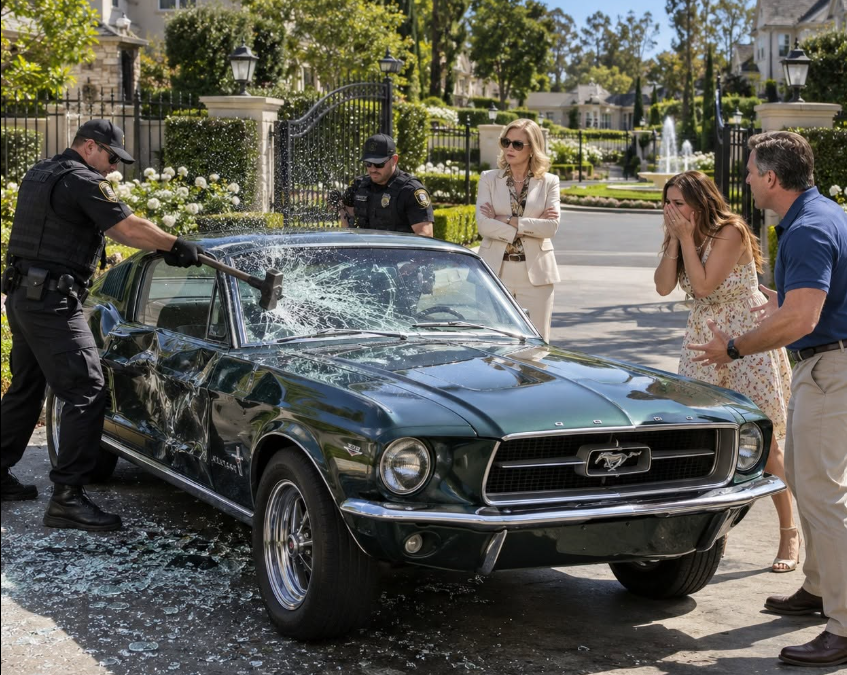
HOA Karen Ordered Security to Smash My Wife’s 1967 Mustang, Then Called 911 on Me—But the Moment Police Checked Her Story, Everything Started Unraveling.
The sound of a crowbar tearing into my wife’s 1967 Mustang dragged me outside before I even understood that someone was destroying the last moving piece of her father’s life.
The woman supervising the damage looked me straight in the eye, called 911, and calmly told the dispatcher that I was the dangerous one.
But when my wife walked onto the porch and saw what they had done, Patricia Henderson had no idea she had just created the evidence that would finally destroy the system she had spent years building.
My name is Daniel Crawford.
I was thirty-eight years old when Rachel and I moved into Ridgewood Estates, and until that Saturday morning, I had never been the kind of person who imagined himself getting into a war with a homeowners association.
I was a software engineer.
I worked from home.
I liked quiet mornings, predictable schedules, strong coffee, and problems that could usually be solved by figuring out which line of code was wrong.
Rachel used to joke that I approached life the same way I approached software.
Find the bug.
Isolate it.
Fix it.
Move on.
What happened at Ridgewood Estates taught me that some people are not bugs.
They are systems.
And if the system protects them long enough, they start believing they are untouchable.
We had lived in the neighborhood for only three months.
The house itself was not extraordinary.
Three bedrooms.
Two stories.
A covered porch.
A little backyard that Rachel immediately started planning to fill with herbs she would probably forget to water.
What sold us was the garage.
It was deep enough for the Mustang.
Not just any Mustang.
Rachel’s Mustang.
A 1967 Ford Mustang Fastback that had belonged to her father, Master Sergeant William Torres.
Calling it a classic car never felt right.
A classic car is something somebody buys because they want polished chrome and attention at a Sunday show.
That Mustang was family history made out of steel.
Rachel’s father had served two tours in Vietnam and spent twenty-five years in the Army. He came home carrying silence in his chest, stories he rarely told, and a kind of discipline that made ordinary life feel sacred to him.
He did not bring the Mustang home from Vietnam, of course.
But in Rachel’s mind, the car and that part of his life had always been tied together.
He bought it after coming back stateside.
Worked on it in rented garages.
Rebuilt parts of it with his own hands.
Tuned the engine himself.
Cussed at the carburetor.
Polished the chrome until Rachel’s mother said he looked at that hood more lovingly than he looked at the wedding china.
He taught Rachel how to change the oil before she had a driver’s license.
When she was sixteen, he would take her out on Sunday afternoons, windows down, old music playing low enough that they could still hear the engine.
He was not a man who talked constantly.
Rachel said that was what she loved about those drives.
They could go twenty miles without saying much.
They did not need to.
After he died in 2019, the Mustang went to Rachel.
His request was simple.
Take care of it.
That was all.
She did.
Religiously.
The car was registered.
Insured.
Maintained.
Driven.
The engine ran beautifully.
Rachel took it to work whenever the weather was good and she wanted to feel close to him.
Three days before Patricia Henderson showed up in our driveway, Rachel had driven that Mustang across Phoenix without a single mechanical issue.
That fact would matter.
But not yet.
That Saturday morning began quietly.
PART2:
I was standing in the kitchen with a mug of coffee when I heard metal scrape against metal.
It was not loud at first.
Just a harsh, ugly sound from outside.
I froze.
Then it happened again.
Scrape.
Pressure.
A metallic pop.
My first thought was that somebody had hit a trash can.
Then came a crack.
I set my coffee down and walked toward the front door.
The second I opened it, my stomach tightened.
Two men in dark uniforms were standing beside Rachel’s Mustang.
One had a pry bar wedged into the top of the driver’s side door.
The other was working near the lock.
The door frame was already bent.
Paint had been scraped down to bare metal.
The driver’s side mirror hung crooked.
Behind them stood Patricia Henderson.
Clipboard tucked under one arm.
White polo shirt embroidered with RIDGEWOOD ESTATES.
Silver hair cut short.
Perfect posture.
Not a trace of uncertainty in her face.
I had met her once.
Briefly.
She had introduced herself during our first week in the neighborhood.
“Patricia Henderson,” she had said.
“HOA president.”
Not “I’m Patricia.”
Not “Welcome to Ridgewood.”
Her title came first.
That should have told me something.
PART3:
Now she was standing in my driveway while two men damaged my wife’s car.
I stepped off the porch.
“What are you doing?”
One of the men paused.
Patricia did not.
“Mr. Crawford.”
She said my name like we were beginning a scheduled meeting.
“That vehicle is in violation of section 4.7 of the community standards.”
I looked at the Mustang.
Then at the pry bar.
“What?”
“Inoperable classic vehicles may not be stored on residential driveways.”
“It isn’t inoperable.”
Patricia’s expression did not change.
“It has been identified as a nuisance vehicle.”
“My wife drove it three days ago.”
“We have received complaints.”
“From who?”
“Residents.”
“Which residents?”
“Complaints are confidential.”
I took another step toward the Mustang.
The guard with the pry bar glanced at me.
I pointed at his hand.
“Stop touching the car.”
Patricia answered for him.
“The board has authorized removal.”
“This is my driveway.”
“That does not exempt you from association rules.”
“The car runs.”
“You may appeal the determination.”
“You’re damaging it.”
“You can address any concerns through the appropriate process.”
The words were so polished that for a second I did not know how to respond.
I had walked into a conversation she had apparently practiced before I ever knew it was happening.
I looked at the man with the pry bar.
“You cracked the door frame.”
He looked at Patricia.
Not me.
She nodded slightly.
He pushed again.
The metal groaned.
Something inside me changed.
Not rage exactly.
Fear mixed with disbelief.
That car was the last physical thing Rachel had from her father that still moved, sounded, smelled, and felt the way it had when he was alive.
And these people were treating it like an abandoned refrigerator.
I stepped forward.
“Stop.”
Patricia immediately stepped backward.
Her hand came up.
“Do not come any closer.”
I stopped.
“What?”
“You are behaving aggressively.”
“I’m telling them to stop destroying my wife’s car.”
“You need to back away.”
“I’m standing in my own driveway.”
The guard holding the pry bar finally spoke.
“Sir, we’re just doing our job.”
“Your job is breaking into privately owned cars?”
Patricia raised her voice.
“Back away from my staff.”
Neighbors were looking now.
Curtains moving.
A door opening across the street.
A man walking his dog had stopped on the sidewalk.
I lowered my voice deliberately.
“Show me the authorization.”
“You can request it from the board.”
“Show me the rule.”
“Section 4.7.”
“Show me where section 4.7 says you can physically break into my wife’s car.”
Her eyes narrowed.
That was the first sign I had said something she did not like.
Then she reached into her pocket.
“I’m calling 911.”
I almost laughed because the statement was so absurd.
“Why?”
“You are threatening HOA personnel.”
“I haven’t touched anyone.”
She was already dialing.
The first guard looked uncomfortable.
The second one looked at the ground.
Patricia raised the phone to her ear.
When the dispatcher answered, her entire voice changed.
Not louder.
Softer.
Controlled.
Concerned.
The voice of a frightened citizen trying desperately to remain composed.
“Yes, hello. I need police assistance at Ridgewood Estates.”
She looked directly at me.
“There is an aggressive male threatening HOA staff.”
I stared at her.
She continued.
“He is approaching us in a threatening manner. We are attempting lawful enforcement, and he is becoming increasingly hostile.”
I felt something cold move through my chest.
I had not touched her.
I had not threatened her.
I had not even raised my voice.
But the second those words left her mouth, they existed.
Aggressive male.
Threatening.
Hostile.
I suddenly understood this was no longer about the Mustang.
She was building a version of events.
And she had started before I realized there was a story to fight over.
The men kept working on the car.
Metal scraped again.
I wanted to pull the pry bar out of the man’s hands.
I wanted to physically put myself between them and the Mustang.
But now Patricia was on the phone with 911 telling someone I was dangerous.
Any movement I made could become evidence for the version she had already created.
So I stood there.
That may have been the hardest part.
Standing still while somebody damaged something precious because I knew defending it physically could be turned against me.
I heard the back door open.
Rachel stepped onto the porch.
She was still wearing the clothes she had fallen asleep in after working late. Her hair was pulled back loosely. A laptop was tucked under one arm.
She stopped at the top step.
Her eyes went directly to the Mustang.
The cracked frame.
The gouged paint.
The mirror hanging by its wiring.
The man holding the pry bar.
Patricia.
Me.
She said nothing.
The guards stopped working.
That silence changed the atmosphere more than shouting would have.
Rachel walked slowly down the steps.
I knew that expression.
I had seen it when she was preparing for court.
Not anger.
Not panic.
Concentration.
Patricia turned toward her.
“And who are you?”
Rachel stopped beside me.
“I own that vehicle.”
Patricia looked her over.
“Well, your husband needs to learn how to behave.”
I felt my jaw tighten.
Rachel did not react.
Patricia continued.
“I have already contacted law enforcement. I’ll also be filing a formal complaint with the HOA board regarding his threatening behavior.”
Rachel looked at the car.
Then at Patricia.
“You ordered this?”
“The vehicle is in violation.”
“You ordered them to force entry?”
Patricia’s eyes flicked toward the guards.
“The removal process is being handled by authorized personnel.”
“That wasn’t my question.”
Patricia folded her arms.
“I suggest you speak with the board if you have concerns.”
Rachel nodded once.
That was all.
No argument.
No threat.
She just stood there.
For reasons I did not understand yet, that seemed to make Patricia more uncomfortable than anything I had said.
Sirens approached.
Patricia straightened.
The guards stepped away from the Mustang.
Rachel shifted the laptop under her arm.
I leaned toward her.
“Why aren’t you saying anything?”
She barely moved her lips.
“Not yet.”
A patrol cruiser pulled into our driveway four minutes after Patricia called.
Two officers got out.
Both looked young.
Late twenties, maybe.
Their hands rested near their duty belts as they looked over the scene.
Patricia moved toward them before they reached us.
“Officers, thank you.”
She sounded relieved.
“This man became aggressive while we were carrying out a community enforcement action.”
She pointed at me.
“He approached my staff in a threatening manner. We were concerned for our safety.”
One officer raised his hand toward me.
“Sir, stay back for a moment.”
I did.
Patricia kept talking.
She explained the HOA rules.
Section 4.7.
Nuisance vehicle.
Community standards.
Authority.
Safety.
Aggression.
Threats.
Every sentence made her sound more official.
The guards stood behind her in dark uniforms.
To anyone driving by, they could have looked like law enforcement.
They were not.
They were private contractors.
But uniforms do something to people.
So does a clipboard.
So does someone speaking with absolute confidence.
The first officer looked at me.
“Sir, did you approach these individuals?”
“I walked toward my wife’s car because they were damaging it.”
Patricia shook her head immediately.
“That isn’t what happened.”
“I never touched anybody.”
“He was aggressive.”
“What exactly did I do?”
Patricia pointed at the guards.
“I have two witnesses.”
Both men nodded.
The officer glanced toward the Mustang.
The door frame was visibly damaged.
I thought that should have ended the question immediately.
Instead, he said, “Everybody needs to remain calm.”
Calm.
That word landed differently than he intended.
I was already calm.
At least externally.
But saying it made me feel like I had been assigned a role.
The emotional homeowner.
Patricia was the reasonable authority figure.
I was the problem being managed.
More neighbors had come outside.
An older couple from across the street stood together near their mailbox.
A jogger had stopped.
Someone was filming.
Patricia noticed the growing audience.
“This is exactly why we have standards,” she said loudly. “The board has a responsibility to maintain safety and property values.”
The older woman across the street whispered something to her husband.
He nodded.
I looked around.
Nobody asked what the guards had been doing to the Mustang.
Nobody asked why the door was cracked.
Nobody asked why the mirror was hanging.
They were watching a story form, and Patricia had started telling hers first.
I was becoming the new neighbor who caused trouble.
Rachel still had not moved.
One officer glanced toward her.
His expression changed for half a second.
Recognition maybe.
He looked again.
Then away.
Rachel noticed.
So did I.
The second officer asked Patricia whether she wanted to make a formal complaint.
“Yes.”
She answered immediately.
“I also intend to report the incident to our board and consult association counsel.”
The officers spoke with me again briefly.
They gave me a case number.
One handed me a card.
“If you wish to dispute any part of the report, contact the department.”
Then they left.
That was it.
No dramatic revelation.
No handcuffs.
No sudden reversal.
Not yet.
Patricia watched their cruiser disappear down the street.
Then she turned toward Rachel.
“I don’t believe we’ve been properly introduced. Patricia Henderson. HOA president.”
Rachel’s voice was flat.
“I know who you are.”
Patricia paused.
Just slightly.
“Then you understand we take violations seriously.”
“I understand.”
“I’ll be recommending a formal board hearing.”
Rachel said nothing.
“I suggest you consult an attorney.”
For the first time that morning, something almost like amusement moved behind Rachel’s eyes.
“Thank you for the suggestion.”
Patricia stared at her.
Then turned and walked toward the HOA golf cart.
The guards followed.
The neighbors began drifting back into their houses.
No one came over.
No one asked if we were okay.
Within a few minutes, the street looked normal.
Except for the Mustang.
The door frame was cracked.
Paint was gouged along the side.
The mirror hung at an angle.
Eighteen years of careful maintenance had been damaged in roughly fifteen minutes.
I looked at Rachel.
“Say something.”
She stepped closer to the car.
Ran her eyes over every mark.
Then pulled out her phone.
“What are you doing?”
“Documenting.”
“That’s it?”
“For now.”
She took photographs from every angle.
Wide shots.
Closeups.
Door.
Mirror.
Scratches.
Pry marks.
Then she turned to me.
“Don’t touch anything.”
“Rachel.”
“Daniel. Don’t clean it. Don’t close the door. Don’t move the car.”
Her voice was still calm.
“What is happening?”
She looked toward the street where Patricia had disappeared.
“Inside.”
We went into the kitchen.
Rachel sat at the table and opened her laptop.
For ten minutes she barely spoke.
Her fingers moved quickly.
Folders.
Files.
Dates.
I stood by the window staring at the Mustang.
Finally, I could not take it anymore.
“What are you doing?”
“Building a record.”
She turned the laptop toward me.
A folder had been created with that day’s date.
Inside were three files.
She opened the first.
Doorbell camera footage.
It started before I came outside.
There were the guards.
There was Patricia.
There was the Mustang untouched.
Then the tools came out.
I watched one guard insert the pry bar.
I watched Patricia standing behind him.
I watched the door frame bend.
Then I watched myself appear.
The sequence was undeniable.
Rachel closed it.
Opened another file.
Her laptop recording.
She had been on a video call with a colleague when she heard the noise outside. She muted the call and repositioned the laptop.
Different angle.
Clearer view of Patricia.
Then the third file.
Audio from Rachel’s phone.
“What is this?”
“I started recording before I came outside.”
“Why?”
“Because I heard you arguing with someone.”
“You didn’t know what was happening.”
“No.”
“So why record?”
Rachel looked at me for several seconds.
“Because people remember conversations differently when consequences appear.”
There was something in her tone.
Something I had missed.
“You knew this might happen.”
“No.”
“You knew something.”
She closed the folder.
Then opened another one.
RIDGEWOOD.
Inside were documents.
Lots of them.
Complaint letters.
County filings.
Emails.
Photos.
Fine notices.
Towing receipts.
“What am I looking at?”
Rachel leaned back.
“My office has received complaints involving Ridgewood Estates.”
I stared at her.
“What kind of complaints?”
“Unauthorized towing. Fines residents say were fabricated. Enforcement actions without proper notice. Harassment.”
I looked through the files.
Six households.
Six different stories.
A family forced to pay more than two thousand dollars in storage fees after their vehicle was towed.
Another homeowner fined repeatedly over supposed landscaping violations.
Residents claiming they had been threatened with escalating penalties if they questioned the board.
One name appeared over and over.
Patricia Henderson.
I looked at Rachel.
“You knew about her before we bought the house?”
“I knew the name.”
“And you didn’t tell me?”
Her face tightened.
“We didn’t move here because of her.”
“But you knew.”
“Yes.”
I pushed away from the table.
“That matters.”
“I know.”
“You let us buy a house in a neighborhood where you already had files on the HOA president.”
“We bought this house because it fit us. Because of the garage. Because we liked the area.”
“And then you found her name?”
“I recognized it when I reviewed the HOA documents.”
I stared at the screen.
“Were you investigating her?”
“No.”
The answer came immediately.
“I had complaints. That is not the same thing as a prosecutable case.”
“But you were watching.”
“I was paying attention.”
“Rachel.”
She finally showed emotion.
Not anger.
Frustration.
“At what? Suspicion? Angry emails? People saying they were treated unfairly? I cannot build a case because six people believe an HOA president abused her authority. I need evidence. Direct evidence. Documents. Recordings. A pattern I can prove.”
She pointed toward the front window.
“Today, she gave us that.”
I sat down.
The meaning of the morning shifted.
Patricia had not simply damaged our car.
She had apparently reenacted the same kind of conduct Rachel had been hearing about for months.
Only this time, there were cameras.
Audio.
Police involvement.
Physical damage.
And witnesses.
“She lied to police,” I said.
“On camera.”
“And those guards broke into the car.”
“On camera.”
“And she knew it runs.”
Rachel shook her head.
“We need to prove what she knew.”
“It drove three days ago.”
“That proves the car was operational.”
“She called it inoperable.”
“Yes.”
Rachel opened another document.
“But this has to be done correctly.”
I leaned back.
“You sound like this is already a case.”
“It might become one.”
“Might?”
“Daniel, evidence does not become stronger because we are angry.”
I looked outside at the Mustang.
“You’re not angry?”
Her eyes followed mine.
For the first time, her voice softened.
“That was my father’s car.”
She paused.
“I am furious.”
Then she looked back at the screen.
“That is exactly why I am not going to be careless.”
She spent the rest of the day moving with a precision that made me feel like I was watching her at work rather than at home.
Photographs.
A restoration estimate.
Formal complaint.
Request for police body camera footage.
Documentation of the HOA action.
She told me not to speak to Patricia.
Not to post online.
Not to confront the guards.
“If somebody comes back?”
“Record.”
“If they touch the car?”
“Record.”
“That’s it?”
“Call police if necessary. But do not give Patricia another story.”
Before leaving to obtain a professional damage estimate, Rachel stopped at the door.
“And don’t tell anyone what we’re doing.”
“Why?”
“Because people behave differently once they know they’re being documented.”
That evening she returned with paperwork.
The restoration estimate was just over eighteen thousand dollars.
I read the number twice.
“Eighteen thousand?”
“The door frame is worse than it looks.”
The shop owner had written a detailed assessment.
He was a veteran himself.
According to Rachel, he had gone quiet when she explained who the Mustang had belonged to.
“He asked whether my father served.”
“What did you say?”
“Twenty-five years.”
“And?”
“He said he’d document everything.”
Rachel placed the estimate beside the other papers.
The county had accepted her complaint.
The request for body camera footage had been acknowledged.
Nothing had exploded yet.
No one had been arrested.
No official had declared Patricia wrong.
But the record was growing.
Rachel looked exhausted.
I poured her coffee.
She took one sip.
Then her phone buzzed.
She read the screen.
Her expression hardened.
“What?”
She turned the phone toward me.
A new post on the Ridgewood neighborhood board.
COMMUNITY SAFETY ALERT INVOLVING NEW RESIDENT.
Patricia had posted it.
The language was careful.
Dangerously careful.
She described a confrontation involving HOA personnel.
Aggressive behavior.
Verbal threats.
Staff members who had feared for their safety.
She did not use my name.
She did not need to.
Our address was included.
Then I saw the photo.
The Mustang.
Captioned as a vehicle that had been lowering neighborhood property values.
I felt my face heat.
“She’s posting our address?”
Rachel kept reading.
“She wants witnesses after the fact.”
“What?”
“Social consensus.”
Comments were already appearing.
By morning there were more than eighty.
By noon, more than two hundred.
People I had never met called me unstable.
Dangerous.
Hostile.
One woman wrote that she had “always felt something strange” about our house.
We had been there three months.
She had never spoken to me.
A man suggested the HOA should pursue legal action.
Another told residents to report suspicious behavior near our property.
A few people wrote that everyone should wait for the full story.
Those comments disappeared beneath the louder ones.
Patricia responded personally to supporters.
Thank you for your concern.
The board takes safety seriously.
We will not be intimidated.
I wanted to post the doorbell footage immediately.
I had my finger over the button.
Rachel stopped me.
“No.”
“They’re calling me dangerous.”
“I know.”
“We have proof.”
“I know.”
“Then why are we letting her do this?”
“Because right now it becomes your video against her statement.”
“The video shows everything.”
“To you.”
“To anyone with eyes.”
Rachel shook her head.
“She will say it is edited. She will say there is missing context. She will say the security footage shows something else.”
“So we just take this?”
“For now.”
The next morning, a courier delivered a cease and desist letter from the HOA’s attorney.
I stood in the kitchen reading it three times.
Harassment.
Intimidation.
Improper interference with HOA personnel.
No further contact with Patricia Henderson.
No contact with security staff.
No communication with individual board members outside formal channels.
I looked at Rachel.
“I haven’t contacted anybody.”
“I know.”
“I haven’t even left the house.”
“I know.”
“Then what is this?”
“A record.”
“Of something I didn’t do.”
“Exactly.”
That answer chilled me.
Patricia was not trying to respond to events anymore.
She was creating documents that could later be pointed to as though their existence proved their contents.
A security golf cart started circling our block.
Every half hour.
Sometimes slower when it passed our house.
Never stopping.
Just visible.
Watching.
A coworker of mine lived two streets away.
He messaged me that evening.
Everything okay?
I replied that there had been a misunderstanding with the HOA.
He wrote back:
Hope it gets worked out.
Then silence.
During a virtual meeting the next day, two colleagues who lived in Ridgewood barely acknowledged me.
That hurt more than I expected.
It is one thing to know strangers are gossiping about you.
It is another to watch people who know you become cautious because somebody else gave them permission to doubt you.
Patricia had figured out how to isolate us without saying my name directly.
Then she learned Rachel was an attorney.
Her next neighborhood post appeared that night.
“It has come to my attention,” it began, “that the wife of the individual involved in last week’s incident is an attorney.”
I felt sick before I finished reading.
Patricia framed Rachel’s profession as a threat.
Some people believe legal credentials permit them to intimidate volunteers.
The board will not be bullied.
Community standards apply equally to everyone.
The comments turned on Rachel immediately.
Typical lawyer.
Thinks she is above the rules.
Probably planning a lawsuit.
Trying to scare volunteers.
I looked at my wife across the kitchen.
She was reading every comment.
Not responding.
Just taking screenshots.
“You knew she would do this?”
“I knew she might.”
“How are you this calm?”
“I’m not.”
“You look calm.”
“That’s different.”
I pushed my phone toward her.
“Post the footage.”
“Not yet.”
“Rachel.”
“We have the police body camera request pending.”
“So?”
“Patricia called police. Their footage is independent.”
“The doorbell camera is independent.”
“It belongs to us. Her supporters will call it selective.”
“They already think we’re criminals.”
“Then one more day won’t change that.”
I stood up.
“I hate this.”
“So do I.”
“You’re asking me to sit here while she destroys our reputation.”
“I’m asking you to let her keep committing to a version of events.”
That stopped me.
Rachel continued.
“Every public statement makes it harder for her to later claim she misunderstood.”
I sat back down.
“How long?”
“Until she believes she has won.”
That answer stayed with me.
Two nights later, Rachel received the email.
The responding officers’ body camera footage was available.
At almost the same time, my phone buzzed.
Another Ridgewood post.
This time Patricia had uploaded video.
Fifteen seconds.
No sound.
It showed me walking from the porch toward the Mustang.
Nothing before.
Nothing after.
No crowbar.
No damage.
No context.
Just me moving quickly.
Caption:
SEE FOR YOURSELF. THIS IS WHO WE ARE DEALING WITH.
I watched it twice.
Then a third time.
Without context, I looked angry.
Of course I looked angry.
Two men were breaking my wife’s car.
But people watching Patricia’s clip did not see that.
They saw exactly what she wanted them to see.
Rachel watched over my shoulder.
Her face remained neutral.
Then something shifted.
A tiny movement at the corner of her mouth.
“What?”
“She edited it.”
“Obviously.”
“No. She publicly represented an edited fragment as evidence of a threat.”
“Is that good?”
Rachel picked up her phone.
“It is useful.”
She added the post to her file.
“She thinks she is strengthening her story.”
“Isn’t she?”
“Not if the full footage shows what came before.”
The emergency HOA meeting was announced shortly afterward.
Thursday.
Seven p.m.
Community center.
Rachel and I arrived ten minutes early.
One hundred forty-seven residents signed in.
I counted because I needed something to do with my hands.
We sat in the back row.
Nobody sat next to us.
Patricia stood at the front with the two security guards.
Four other board members sat behind a long table.
Coffee brewed near the wall.
Fluorescent lights buzzed.
It felt less like a neighborhood meeting than a courtroom assembled by people who had never been required to follow courtroom rules.
At seven exactly, Patricia called the meeting to order.
She thanked everybody for coming.
Then she told the story.
Her story.
A routine enforcement action.
An inoperable nuisance vehicle.
A hostile homeowner.
A sudden aggressive advance.
Fear.
Safety.
The difficult decision to involve police.
She spoke without notes.
Slowly.
Confidently.
The two guards testified next.
One said I had “advanced rapidly.”
The other said he had prepared to defend himself.
Neither mentioned the crowbar.
Neither mentioned the door frame.
Neither mentioned the mirror.
Neither explained what authority allowed them to force entry into the Mustang.
A board member named Harold Crenshaw proposed the punishment.
Five-thousand-dollar fine.
The Mustang officially classified as an inoperable nuisance vehicle.
Mandatory removal within thirty days.
Failure to comply would result in towing and storage at our expense.
Five thousand dollars.
Plus they wanted the car gone.
Patricia nodded.
“I believe this is measured and appropriate.”
Measured.
She asked for discussion.
Silence.
Then a man in the front row turned around.
“What about them?”
He pointed at us.
“Do they get to say anything?”
For a moment Patricia looked annoyed.
Then the public smile returned.
“Of course.”
She looked directly at me.
“The Crawfords may address the board.”
Every head turned.
Rachel leaned toward me.
“Remember.”
I knew.
Do not argue.
Do not explain.
I stood.
Walked to the front.
Handed one sheet of paper to the board secretary.
“This is a formal objection to the proceeding. It identifies due process violations under the association’s own governing documents. I request that it be entered into the official record.”
Patricia stared at me.
“That’s all?”
I turned around.
Behind me, people murmured.
Patricia raised her voice.
“You have nothing else to say?”
I sat down.
Rachel did not move.
Someone behind us whispered, “If they had evidence, they’d show it.”
Another answered, “Exactly.”
Patricia let the whispers spread.
Then smiled.
“Very well. If the Crawfords have no defense to present, I suggest we proceed.”
She looked at Rachel.
“I would also like the record to reflect that Mrs. Crawford is an attorney.”
Rachel stared straight ahead.
“One might expect a legal professional to understand the importance of community standards.”
Patricia paused.
“Instead she has chosen to remain silent while her husband’s conduct speaks for itself.”
My hands tightened beneath the chair.
Then Patricia added the line that changed the room for Rachel.
“I will also be filing a formal complaint with the Arizona State Bar concerning her conduct.”
I turned toward my wife.
Rachel’s face did not move.
Seven votes to two.
Fine approved.
Removal order approved.
Patricia thanked the board.
Meeting over.
We had been judged in less than an hour.
No evidence review.
No meaningful defense.
No questioning of the guards.
Just the appearance of process.
We were almost outside when somebody touched my arm.
I turned.
An older man stood beside me.
Gray hair.
Weathered face.
Probably early seventies.
He spoke quietly.
“I know what they did.”
I looked toward Rachel.
The man continued.
“They did it to my wife too.”
“What?”
“Not the car. Her garden.”
He glanced toward Patricia.
“Three years ago. Tore everything out. Said it attracted pests.”
“I’m sorry.”
“We didn’t fight.”
His expression tightened.
“We were tired.”
He placed something in my hand.
A USB drive.
“I kept everything.”
“What’s on this?”
“Photos. Letters. Fine notices. Emails.”
I looked at him.
“What’s your name?”
“Walter Morrison.”
He lowered his voice further.
“I’ve lived here twenty years. I’ve watched her do this to good people.”
Patricia was shaking hands with residents near the board table.
Walter looked at her.
“Somebody needs to stop her.”
Then he walked away.
Outside, I showed Rachel the drive.
She looked back toward the community center.
“How many now?” I asked.
“Seven households if his records match the others.”
“She thinks she won.”
Rachel put the USB into her bag.
“Yes.”
“Does that bother you?”
“No.”
“Why?”
“Because tomorrow I pick up the body camera footage.”
Three weeks later, I sat in the back of a room at the Maricopa County District Attorney’s Office.
Rachel had recused herself from the matter to avoid even the appearance that she was using her position for personal revenge.
That detail mattered to her more than I initially understood.
She did not want Patricia punished by Rachel Crawford.
She wanted the evidence evaluated by people who owed us nothing.
An independent prosecutor named David Brennan reviewed the case.
Additional records were collected.
Walter’s files were examined.
The earlier complaints were compared.
Then a press conference was scheduled.
Patricia attended with her attorney.
She was not entering the room as a convicted person.
The investigation was still moving through the process.
But she looked confident.
Almost amused.
She sat near the front and whispered something to her lawyer.
At ten o’clock, David Brennan stepped behind the podium.
Reporters filled the room.
Television cameras were positioned at the back.
Brennan began calmly.
“We are here today to discuss the results of an investigation involving allegations of civil rights violations, fraud, and abuse of authority connected to the Ridgewood Estates Homeowners Association.”
The room quieted.
Patricia’s expression barely changed.
Brennan continued.
Multiple residents had reported unauthorized property seizures.
Questionable fines.
Intimidation.
For months, the information had not been sufficient to support action.
Then he said:
“That changed four weeks ago.”
A screen behind him came alive.
Body camera footage.
I saw my own driveway.
Patricia walking quickly toward the officers.
I heard her voice.
“This man became aggressive.”
I watched myself standing near the Mustang.
I watched the officer tell me to step back.
I watched Patricia describe me as threatening.
The footage continued.
Six minutes.
It did not prove everything by itself.
But it preserved exactly what she had told police.
Then Brennan played our doorbell footage.
Earlier timestamp.
The guards arriving.
Patricia with her clipboard.
The tools.
The pry bar.
The Mustang untouched.
Then the damage beginning.
One guard pushing into the door frame.
Metal bending.
Paint breaking.
Patricia watching.
My appearance came afterward.
For the first time, people saw the sequence without Patricia controlling it.
A reporter leaned forward.
Someone else began typing rapidly.
Then audio played.
Patricia’s voice.
“Hurry up. He’s going to come out soon.”
I felt my stomach tighten even though I had heard the recording before.
The words sounded worse in that room.
More deliberate.
Then came Rachel’s laptop footage.
Different angle.
Clear audio.
Patricia seeing me emerge.
Patricia reaching for her phone.
The 911 call.
“A man is threatening us.”
On screen, I stood several feet away.
No attack.
No physical contact.
No threat.
Just a homeowner asking why strangers were forcing their way into his wife’s car.
Brennan paused the footage.
Then he displayed a photograph of the Mustang.
“The vehicle involved is a 1967 Ford Mustang Fastback.”
Next slide.
A photograph of a younger William Torres standing beside the car in uniform.
“It previously belonged to Master Sergeant William Torres, a decorated United States Army veteran who served two tours in Vietnam and twenty-five years on active duty.”
I looked toward Rachel.
She was sitting near the side wall.
Her eyes were fixed on the photograph.
Brennan continued.
“Mr. Torres died in 2019. The vehicle passed to his daughter, Rachel Crawford, who maintained it in operating condition.”
He stated that the assertion that the Mustang was an inoperable nuisance vehicle could be disproved.
Registration.
Maintenance.
Use.
Documentation.
Then Walter Morrison’s USB became part of the presentation.
Photos.
Letters.
Notices.
Correspondence.
Seven households.
Seven stories.
Unauthorized towing.
Questionable fines.
Intimidation.
Different people.
Different years.
Similar methods.
Patricia was no longer smiling.
Brennan did not need dramatic language.
The documents were dramatic enough.
Then he announced the charges.
Patricia Henderson faced allegations including filing a false police report, conspiracy to commit fraud, harassment, and abuse of authority.
The two private security guards faced allegations connected to destruction of property, trespassing, and impersonating peace officers.
Additional board members remained under investigation.
Patricia’s attorney leaned toward her.
I saw him whisper.
She shook her head.
Then she stood.
“This is a setup.”
Every camera turned.
Her lawyer reached for her arm.
Patricia pulled away.
“That woman is using her position to destroy me.”
She pointed toward Rachel.
“This is personal.”
Rachel did not react.
Brennan spoke calmly.
“For the record, Assistant District Attorney Crawford recused herself from this case three weeks ago. The investigation and charging review were conducted independently.”
Patricia barely listened.
“She moved into my neighborhood to entrap me.”
Her attorney whispered urgently.
Patricia continued.
“This is corruption. I will sue every person involved.”
The room exploded with reporters trying to ask questions.
Brennan waited.
Patricia was still talking.
Still insisting she was the victim.
Still pointing.
Still trying to take control of a room that no longer belonged to her.
When she finally stopped, Brennan gave the arraignment information and ended the press conference.
Outside, I found Rachel near the parking lot.
Patricia was being guided toward a waiting vehicle by her attorney.
I stood beside my wife.
“You okay?”
Rachel watched the car leave.
“It isn’t over.”
“She looked finished to me.”
“She’ll fight.”
“Wouldn’t you?”
Rachel looked at me.
“If I believed I was right? Yes.”
“She still thinks she’s right?”
“I don’t know.”
“What happens now?”
“The system works.”
“That simple?”
“No.”
She looked toward the courthouse buildings.
“That slow.”
Three months passed.
Rachel had been right.
Legal processes do not move like television.
There was no single day when Patricia’s entire life changed at once.
There were filings.
Negotiations.
Hearings.
Attorneys.
Evidence.
Offers.
Eventually Patricia pleaded no contest to filing a false police report and harassment.
The fraud-related allegations were reduced as part of the resolution.
She received two years of probation.
Two hundred hours of community service.
A twenty-five-thousand-dollar fine.
During the probationary period, she was prohibited from serving in a leadership or advisory position in a homeowners association.
The court record became public.
The two security guards received six months of suspended jail time and ten thousand dollars in restitution.
They lost their jobs.
Three Ridgewood board members resigned before the investigation fully reached them.
Others cooperated with an independent audit.
Then came the civil settlement.
Seven families.
One hundred eighty thousand dollars.
Our portion was thirty-two thousand.
Enough to restore the Mustang.
People assumed the money must have felt like victory.
It did not.
The first time I saw the settlement number on paper, my reaction was almost nothing.
A check cannot reverse watching Rachel stand beside her father’s damaged car.
It cannot erase weeks of neighbors treating you like a threat.
It cannot remove the moment when colleagues decide maybe they should keep their distance because somebody with a title said you were dangerous.
What mattered more were the changes attached to the settlement.
The HOA had to reform enforcement procedures.
Private security could no longer function under deliberately vague authority.
Punitive action required proper notice.
Anonymous complaints could not automatically become justification for punishment.
A compliance monitor would oversee operations for two years.
Records had to be maintained.
Decisions documented.
The system that had allowed Patricia to turn personal certainty into neighborhood law was being forced to become transparent.
Six weeks after the press conference, Ridgewood held a special election.
Turnout broke every previous neighborhood record.
Every incumbent board member was removed.
Walter Morrison became president.
Nearly three votes to one.
He looked uncomfortable standing at the front of the community center.
That made me trust him more.
His speech was short.
“I stayed quiet too long.”
The room went still.
“A lot of us did.”
He looked around at residents who had known each other for years.
“We told ourselves what happened to somebody else was not our problem.”
His voice caught slightly.
“We thought somebody would eventually deal with it.”
He paused.
“Silence has a cost. Our neighbors paid it.”
Nobody moved.
“I cannot undo what happened. But I can make sure we don’t build another system where one person gets to decide what the truth is.”
People applauded.
Some cried.
I looked around the room.
Several of the faces were familiar from that earlier meeting.
People who had stared at us.
People who had believed Patricia.
People who had approved the five-thousand-dollar fine.
I expected to feel vindicated.
Instead, I mostly felt tired.
The apologies came slowly.
The couple across the street arrived one evening with a bottle of wine.
The husband held it awkwardly in both hands.
“We should have asked questions.”
His wife looked at Rachel.
“We saw the damage to the car.”
Rachel waited.
The woman continued.
“And we still listened to Patricia.”
Rachel nodded.
“I’m sorry.”
“Thank you.”
No dramatic forgiveness.
No speech.
Just acknowledgement.
A man who had called me dangerous online knocked on the door a week later.
“I believed what I was told.”
“Why?”
He looked embarrassed.
“Because it came from the board.”
“That’s it?”
“That was enough then.”
I said nothing.
He looked toward the garage.
“Not anymore.”
Rachel had a standard response when people apologized.
“Now you know. Don’t let it happen again.”
Some residents never apologized.
A small group continued insisting Patricia had been targeted.
They posted theories online.
Said prosecutors had overreached.
Said Rachel’s job made the process unfair despite her recusal.
There was nothing we could do about that.
Evidence does not force everyone to accept reality.
It only makes denial more expensive.
Months later, Patricia’s attorney reached out through an intermediary.
She was considering a public statement expressing remorse.
In return, she wanted Rachel to support early termination of her probation.
I read the request.
Then I read it again.
“She wants you to help her?”
Rachel nodded.
“Apparently.”
“What are you going to do?”
“I don’t know yet.”
That surprised me.
“You’re considering it?”
“I’m considering my response.”
I thought about the Mustang.
The crowbar.
The neighborhood posts.
The cease and desist letter.
The board meeting.
The way Patricia had threatened to report Rachel to the State Bar.
Part of me wanted Rachel to write a letter asking the court to extend everything.
I wanted Patricia to feel trapped inside consequences the way we had felt trapped inside her narrative.
Then I remembered something Rachel’s father used to say.
She had repeated it to me several times over the years.
The measure of a person is not what they do when they are winning.
It is what they choose not to do.
“What do you think?” Rachel asked.
“It’s your call.”
“That isn’t an answer.”
“I know.”
She waited.
“I don’t think you owe her anything.”
Rachel looked down at the request.
“I agree.”
Two days later, she wrote back.
She did not demand harsher treatment.
She did not attack Patricia.
She did not advocate leniency.
She simply stated that the court had imposed consequences based on the evidence and that it would be inappropriate for her to influence the probation terms.
If Patricia completed her obligations, that was between Patricia and the legal system.
Rachel wished her no further harm.
But she would not advocate for relief Patricia had not yet earned.
The attorney never responded.
The Mustang took longer.
The restoration shop in Phoenix treated the car like something more important than a repair ticket.
The owner understood.
Veteran.
Military family.
He worked carefully.
Door frame straightened.
Mirror replaced.
Paint matched.
Chrome restored.
Every damaged section repaired.
Months after the press conference, the Mustang finally came home.
Rachel insisted on parking it in the driveway.
Exactly where it had been that Saturday morning.
I stood near the garage as she turned onto our street.
I heard the engine before I saw the car.
Low.
Steady.
That old mechanical sound modern cars never reproduce properly.
The Mustang came around the corner.
Sunlight caught the chrome.
For half a second, I understood what Rachel had been telling me all those years.
The car did not look alive.
It sounded alive.
She pulled into the driveway slowly.
Turned off the engine.
I walked around it.
From several feet away, it looked perfect.
Up close, I could see faint evidence of the repair.
Subtle lines in the metal.
Scars where the door frame had been bent and restored.
I ran my fingers near one.
“They could probably make this disappear completely.”
Rachel looked at it.
“I asked them not to.”
I turned toward her.
“Why?”
She rested her hand on the roof.
“Because repaired isn’t the same as never damaged.”
She looked at me.
“And that’s okay.”
The neighborhood had changed too.
Not physically.
Lawns were still trimmed.
Golf carts still moved through the streets.
People still complained about things that did not matter very much.
But meetings were recorded now.
Complaints required documentation.
Enforcement letters cited actual rules.
Board decisions appeared in minutes that residents could read.
Walter did not carry himself like a sheriff.
He carried a folder.
A normal folder.
Without theatrical importance.
Rachel eventually suggested putting a memorial bench near the lake.
For her father.
The new board approved it unanimously.
The plaque read:
IN MEMORY OF MASTER SERGEANT WILLIAM TORRES
SERVICE. SACRIFICE. HOME.
The dedication was small.
Walter came.
Several neighbors.
A representative from the local VFW.
Rachel did not give a speech.
She stood beside the bench with her fingers resting on her father’s name.
Then she sat.
Looked over the water.
I joined her.
Later, I asked what she had been thinking.
“Sunday drives.”
“With your dad?”
She nodded.
“Windows down. Radio on.”
“What did you talk about?”
“Usually nothing.”
She smiled.
“He wasn’t much of a talker.”
“I know somebody like that.”
She bumped my shoulder.
“The Mustang was different when he drove it.”
“How?”
“I don’t know.”
She watched sunlight move across the lake.
“It felt like proof.”
“Proof of what?”
“That he made it home.”
That sentence stayed with me.
The Mustang had never just been a car.
It was evidence.
Evidence that William Torres had survived enough to come back, raise a daughter, teach her how to drive, complain about her braking, rebuild an engine, and spend ordinary Sundays going nowhere important.
Patricia saw an old vehicle.
Rachel saw home.
That Sunday, we took the Mustang out.
No destination.
No schedule.
Rachel drove.
We passed the community center.
Passed the stretch where the security golf cart used to circle.
Passed houses belonging to people who had believed Patricia.
Some waved.
Rachel waved back.
We drove toward the lake.
She pulled over.
Killed the engine.
For a while neither of us spoke.
Then I asked the question I had been thinking about since the case ended.
“Do you ever wish you pushed harder?”
Rachel looked at me.
“Against Patricia.”
“What do you mean?”
“More charges. Bigger settlement. Oppose every request. Make sure she loses everything she can lose.”
Rachel looked back toward the lake.
“No.”
“You never wanted that?”
“Of course I wanted it.”
That surprised me.
She continued.
“The morning I saw what they did to Dad’s car, I wanted to destroy her.”
She said it quietly.
“Not legally. Emotionally.”
I waited.
“I wanted her humiliated. I wanted everyone who listened to her to watch it happen.”
“Why didn’t you?”
“Because wanting something is not the same as being entitled to do it.”
She rested her hands on the steering wheel.
“Winning isn’t about how much you can take from somebody.”
I said nothing.
“It’s about what you protect.”
She looked toward her father’s memorial bench.
“What you build afterward.”
Then back at me.
“Patricia wanted a war. I gave her consequences.”
I thought about that.
“Difference?”
“Wars destroy everything.”
She turned the key.
The Mustang came alive.
“Consequences end.”
We drove home as the sun dropped behind the houses.
Near Walter Morrison’s place, we saw him watering his lawn.
Rachel hit the horn twice.
Walter looked up.
Smiled.
Waved.
The horn echoed down the street.
Small sound.
Ordinary moment.
After months of attorneys, police footage, investigations, court records, and meetings, there was something almost perfect about how unimportant it seemed.
Rachel pulled into our driveway.
The same driveway where Patricia had stood with her clipboard.
The same place two men had forced a crowbar into the Mustang.
The same place where I had been called aggressive for trying to protect property that belonged to us.
Rachel shut off the engine.
Neither of us got out immediately.
She looked over the dashboard.
Then at the house.
Then toward the quiet street.
“My father would’ve liked this ending.”
I smiled.
“The part where his car got attacked by an HOA?”
She gave me a look.
“No.”
“The criminal investigation?”
“No.”
“Walter becoming president?”
“Daniel.”
I laughed.
“Okay. Why?”
She put one hand on the steering wheel.
“Because the car is still here.”
I looked at her.
“So are we.”
She nodded.
“And we didn’t have to become them to make it happen.”
That was the part I finally understood.
Patricia had believed power was the ability to make other people afraid of consequences.
A fine.
A tow truck.
A lawyer.
A board vote.
A police call.
A public accusation.
She believed that if she spoke first, spoke loudly enough, and wrapped herself in enough official-looking authority, most people would never bother checking whether she was telling the truth.
For years, she had often been right.
People paid.
People apologized.
People stayed quiet.
People moved away.
Then she came into our driveway and found a car she decided did not belong there.
She saw an old Mustang.
She saw new residents.
She saw another easy enforcement action.
She ordered two men to break into it.
When I objected, she called 911.
When police arrived, she controlled the first version of the story.
When neighbors watched, she controlled the second.
When the HOA met, she controlled the third.
Each time she thought silence meant defeat.
She did not understand that Rachel was never silent because she had nothing to say.
Rachel was silent because she was preserving everything Patricia said.
The doorbell camera remembered.
The laptop remembered.
The phone remembered.
The officers’ body cameras remembered.
Walter Morrison remembered.
Six other families remembered.
The damaged metal remembered.
By the time Patricia realized the story had stopped belonging to her, she had already told too many versions of it on too many permanent records.
And in the end, the moment that mattered most was not the press conference.
It was not the charges.
It was not the settlement.
It was not even the election that removed the old board.
For me, it was a Sunday evening months later.
Rachel was sitting behind the wheel of her father’s Mustang.
The engine was running perfectly.
Walter was waving from his lawn.
A memorial bearing Master Sergeant William Torres’s name stood near the lake.
And Patricia Henderson no longer had the power to make any of those things disappear.
That morning she had called 911 because she thought the police would make me afraid.
Instead, she created the first official record of what she had done.
She thought the uniformed men beside her made her version stronger.
Instead, cameras showed exactly who was damaging the car.
She thought learning my wife was an attorney gave her another weapon.
Instead, Rachel stepped away from the investigation so nobody could honestly claim the final consequences belonged to her.
Patricia spent weeks trying to turn us into the villains of Ridgewood Estates.
All Rachel ever did was make sure the truth had timestamps.
And that turned out to be enough.