HOA Karen Laughed at My Sinkhole Warning and Parked 34 Cars Over the Cracking Pavement— Then the Ground Swallowed Her Gala Lot
PART2:
Then one morning after a hard overnight storm, I drove along my fence line and saw something that made me stop.
A section of chain-link fence leaned toward the HOA lot.
Not much.
Maybe a few degrees.
But it had been straight.
I got out.
Walked the line.
Then I saw the pavement.
A shallow depression had formed near the back of Blue Cedar’s overflow lot.
Maybe five inches lower than the surrounding grade.
Not a pothole.
The asphalt itself had settled.
The depression was broad.
Smooth.
Unnatural.
Then I saw the crack.
Curved.
Crescent-shaped.
Running near the edge of the pavement.
One side slightly lower than the other.
Dark soil visible beneath.
I crouched beside it.
Touched the edge.
Still damp from the storm.
I did not think:
Sinkhole.
That would have been irresponsible.
There are many reasons ground settles.
Poor compaction.
Water erosion.
Failed base material.
Leaking utilities.
Old fill.
Drainage migration.
Tree roots.
Not every depression means a hidden cavern is about to swallow a building.
So I did what years in construction taught me.
Photographs.
Wide shot.
Close shot.
Fence alignment.
Drainage direction.
Crack.
Depression.
Date and time.
Then I walked my own property.
Checked the drains.
No washout.
No obvious leak.
No excavation.
No failed pipe.
Nothing on my side explained what I was seeing.
Three days later, I checked again.
The depression was wider.
That mattered.
There was also standing water sitting inside it.
Not flowing.
Not draining.
A thin stagnant sheen.
I stood there longer than I intended.
Then I called Lauren Beckett.
Dr. Lauren Beckett was a geotechnical engineer I knew from my grading days.
We had worked on three commercial projects together.
She was cautious in exactly the way you want an engineer to be cautious.
Lauren did not use dramatic language.
If she said something concerned her, I paid attention.
I explained what I saw.
“Can you take a look?”
“Your property?”
“Technically theirs. But it’s along the shared drainage edge.”
“Any movement on your structures?”
“Not yet.”
“I’ll come.”
Two days later, her truck pulled up.
Field boots.
Survey case.
Clipboard.
No wasted motion.
She walked the depression.
Measured the crack.
Checked slope.
Looked at drainage.
Then crouched beside the crescent-shaped fracture.
Stayed there for a while.
I stood behind her.
Finally, she got up.
“What?”
“I don’t know yet.”
“What do you think?”
“I think nobody should put heavy loads here until we understand what’s happening underneath.”
That sentence ended up mattering more than anything else we said that morning.
I asked, “Can it be normal settlement?”
“Yes.”
“Could it be something worse?”
“Yes.”
“Can you tell from the surface?”
“No.”
“What would you do?”
“Close this section temporarily.”
“Then?”
“Redirect storm water away from the depression. Do preliminary subsurface work. If the readings justify it, exploratory drilling.”
I looked across the lot.
Yellow paint marks were already visible.
Temporary parking numbers.
“What are those?”
Lauren followed my eyes.
“Looks like event striping.”
Blue Cedar held one major social event every year.
Their gala.
Residents dressed up.
Outside guests.
Sponsors.
Auction items.
Wine.
Music.
Priscilla treated it like the social center of the county.
That year, attendance was supposed to be bigger.
I went home and wrote the first warning.
Not:
YOUR PARKING LOT IS ABOUT TO COLLAPSE.
Nothing like that.
I summarized what we had observed.
Attached photographs.
Named Lauren.
Explained she was a licensed geotechnical engineer.
Recommended no additional loading until assessment.
Requested written acknowledgment.
Sent it to the HOA management office.
Copied the board.
Then waited.
Nothing.
Three days.
Five.
A week.
No technical response.
Then Priscilla came to me.
I was outside near the storage building when she walked up to the fence.
Sunglasses on top of her head.
Arms crossed.
“You’re Caleb?”
“Yes.”
“I’ve been meaning to speak with you.”
“About the rear lot?”
She smiled.
“About your report.”
“It’s not really my report.”
“You sent it.”
“Lauren Beckett raised the concern.”
“Of course.”
I waited.
Priscilla looked toward the clubhouse.
Then back at me.
“You weren’t invited to the gala, were you?”
For a second, I thought I had misunderstood.
“What?”
“The gala.”
“What about it?”
“I’m trying to understand motivation.”
“My motivation is that your pavement is moving.”
She laughed.
“Caleb.”
That laugh.
Not loud.
Just dismissive.
“Are you seriously suggesting the ground is going to open up?”
“I’m suggesting a licensed engineer said not to load the area until it’s evaluated.”
“That land belongs to the association.”
“Yes.”
“That parking lot belongs to the association.”
“Yes.”
“So I think you should worry about your side of the fence.”
I looked down.
The depression was visible behind her.
Larger than when Lauren first came.
Priscilla never glanced at it.
She turned.
Walked away.
Heels clicking against pavement that was already telling her something was wrong.
Lauren returned within the week.
This time with proper field instruments.
We stayed on my side wherever possible.
The HOA had not granted formal access beyond the shared edge.
Her preliminary readings were concerning.
Not definitive.
But concerning.
There appeared to be a possible subsurface void or loose zone.
She could not determine depth or geometry without drilling.
So Lauren wrote the first formal hazard notice.
Professional letterhead.
Stamped.
Calm language.
No speculation.
No sensationalism.
Close the affected portion to vehicle traffic.
Do not apply heavy loads.
Redirect water.
Conduct further investigation.
I forwarded it to the full board.
HOA management.
County building and safety division.
I wanted more than one set of eyes.
That afternoon, Naomi Fletcher called me.
Naomi was Blue Cedar’s treasurer.
We knew each other slightly.
Mostly waves.
Occasional conversation.
Her voice was low.
“Caleb?”
“Yes.”
“I probably shouldn’t be calling you directly.”
“You just did.”
She exhaled.
“Priscilla got the report.”
“I know.”
“She read it.”
“Good.”
“No.”
Something in her tone changed mine.
“What happened?”
“She told the board the engineer was protecting herself.”
“Meaning?”
“That engineers exaggerate everything so nobody can blame them later.”
I rubbed my forehead.
“Lauren recommended temporary closure.”
“I know.”
“Did the board vote?”
“Not yet.”
“Then close it.”
Pause.
“There’s another problem.”
“What?”
“The gala.”
I leaned against my truck.
“What about it?”
“Priscilla oversold parking.”
“How?”
“She created premium spots.”
“Where?”
Silence.
I already knew.
“Back lot.”
“How many?”
“Thirty-four.”
I looked across the fence.
The flagged section nearly matched the depressed area.
“You’re serious.”
“Yes.”
“Has she collected money?”
“Yes.”
“How much?”
“I don’t know exactly.”
Later we learned the number.
Two hundred fifty dollars per space.
Thirty-four cars.
Eight thousand five hundred dollars.
At the time, I only knew she had sold parking on ground a licensed engineer told her not to load.
I suggested a solution.
There was a shopping center less than two miles away.
Half its rear lot sat empty on weekends.
“Use shuttles.”
Naomi said, “I mentioned that.”
“And?”
“Priscilla said it’s too expensive.”
“How expensive?”
“Not eight thousand five hundred dollars.”
That told me everything.
Closing the lot was no longer simply a safety decision.
It meant refunds.
Admitting a problem.
Admitting I might have been right.
Possibly delaying part of the gala.
Priscilla had turned the ground into a reputation problem.
That is dangerous.
Physical risk does not care about reputation.
The next thing I saw made me realize she was not just ignoring the warning.
She was hiding it.
A paving crew arrived.
I watched from my side.
They filled visible cracks.
Applied fresh black sealant.
Covered the crescent fracture.
I walked over near the property line.
One worker was cleaning a tool.
“Are you guys doing any base investigation?”
He shook his head.
“No.”
“Drilling?”
“No.”
“Compaction test?”
“Nope.”
“What’s the scope?”
He wiped sweat from his forehead.
“Make it look good before Saturday.”
I looked at the black patch.
“You were told about subsurface movement?”
He shrugged.
“I just get a work order.”
I went back to my office.
Called Lauren.
She was quiet for several seconds.
Then said, “I’m issuing another letter.”
The second warning was sharper.
Immediate closure.
No loading.
Fresh surface treatment did not address subsurface failure.
Continued infiltration and loading could accelerate collapse.
Lauren sent it directly.
Priscilla.
Naomi.
Management.
Me.
Digital delivery.
Later investigators confirmed Priscilla opened it.
Read it.
Then deleted the notification.
A warning does not become less real because you delete an email.
Naomi started looking through older records.
She told me she felt sick.
“I should have looked earlier.”
“At what?”
“The original clubhouse files.”
“You’re treasurer.”
“Financials, mostly. Not engineering archives.”
“Did you find something?”
“One note.”
She sent me a photograph.
Old file.
Construction era.
A short line referencing restricted structural loading pending subsurface evaluation near the rear section.
Not enough to prove current danger.
But enough to show concern was not new.
I called Lauren.
She read it.
“That increases the need for investigation.”
“Does it prove a void?”
“No.”
“Anything definitive?”
“No.”
That discipline mattered.
We did not know exactly what sat underground.
We only knew nobody should be parking thirty-four cars there.
Priscilla called an emergency board meeting.
She invited me.
Not because she wanted my opinion.
Because she wanted to dismiss me publicly.
I went.
Community room.
Fluorescent lights.
Board at the long table.
Priscilla in the center.
Naomi near the end.
About thirty residents.
Priscilla opened with something about misinformation.
Then said, “Certain neighboring property owners have circulated unnecessarily alarming claims.”
She looked directly at me.
I waited.
“Mr. Whitmore has apparently seen several surface cracks and convinced himself half the county is about to collapse into the Earth.”
A few people laughed.
Not many.
I did not.
Priscilla smiled.
“Would you like to explain your sinkhole theory?”
“I don’t have a sinkhole theory.”
That threw her slightly.
“You’ve been warning everyone.”
“I’ve been forwarding a licensed engineer’s recommendations.”
I placed Lauren’s letter on the table.
“You don’t have to trust me.”
I slid it toward the board.
“Trust the engineer who signed her name to that.”
One director read the first page.
Another looked uncomfortable.
Priscilla barely glanced at it.
“We have operated that parking area for years.”
Lauren’s warning was specific.
“The affected section should be closed.”
“Nothing has happened.”
“That isn’t proof nothing will.”
“We cannot manage community property based on hypotheticals.”
“We manage risk based on evidence.”
She leaned back.
“The gala proceeds.”
Naomi spoke.
“I disagree.”
The room changed slightly.
Priscilla looked at her.
Naomi continued.
“I want my dissent recorded.”
One vote against.
The others did not challenge Priscilla.
Some later admitted they were uncomfortable.
They still voted to continue.
After the meeting, I submitted a final written objection.
Not emotional.
Date.
Location.
Professional report.
Specific recommendation.
My objection to vehicle loading.
Then saved everything.
Email.
PDF.
Photographs.
Video.
Time.
That was when Naomi sent me the invoice.
Twenty-plus tons of fill.
Delivered to Blue Cedar.
Rear lot.
Two weeks earlier.
No engineering report attached.
No testing.
No compaction certification.
They had filled the depression.
Covered it.
Then paved over the top.
I stared at the invoice.
Priscilla had not mistaken a crack for harmless settlement.
She had seen a depression.
Received warnings.
Then buried the visual evidence.
Lauren came to my property that evening.
I handed her the invoice.
She read.
“Oh, no.”
“That bad?”
“Fill over a possible void does not fix a void.”
“I know.”
“If anything, it adds load.”
“How much load?”
“Depends on material and spread.”
“Twenty tons.”
She looked toward the lot.
“Then I want no one near it during the gala.”
The morning of the event, rain had been falling on and off for days.
Not catastrophic.
Enough to saturate ground.
I drove behind my storage buildings around seven.
That was when I saw the new crack.
It ran through the fresh black patch.
Nearly along the same path as the original crescent fracture.
That alone was bad.
Then rainwater reached it.
And disappeared.
Not flowed away.
Not pooled.
Vanished downward.
I filmed.
Close shot.
Wide shot.
Water.
Crack.
Timestamp.
Sent it to Lauren.
She called almost immediately.
“No vehicles.”
“I know.”
“I mean it, Caleb.”
“I know.”
“Call emergency management.”
“I already sent it.”
“Call again.”
I did.
Then went toward the fence.
Priscilla stepped out of the clubhouse with members of her event committee.
She saw my phone.
Raised her voice deliberately.
“Caleb!”
I looked over.
She smiled for the people around her.
“How is the imaginary sinkhole this morning?”
I pointed at the crack.
She barely looked.
“Still waiting to swallow us?”
“Stop parking.”
She turned to the valet supervisor.
“Continue.”
One word.
The first car rolled in.
Dark sedan.
Attendant guided it.
Parked.
Driver got out.
Walked toward the clubhouse.
Second car.
Third.
I started counting.
Five.
Eleven.
Eighteen.
Every vehicle added thousands of pounds.
Lauren was driving toward us.
Naomi came out of the clubhouse.
She saw the cars.
“What are you doing?”
Priscilla did not answer.
Naomi approached the valet.
“Stop.”
The attendant looked toward Priscilla.
Priscilla shook her head.
“Continue.”
Twenty-six.
I called the county emergency line again.
Explained.
Potential subsurface failure.
Engineer warning.
Vehicles loading.
Weekend.
No visible collapse yet.
They could not get a structural response team there immediately.
That is the frustrating thing about prevention.
The system often needs the thing you are trying to prevent to become more visible before urgency rises.
Thirty.
Thirty-one.
Thirty-two.
Lauren arrived.
Parked on my gravel.
Not Blue Cedar pavement.
Came toward the fence.
Thirty-three.
Then the final car.
Thirty-four.
All spaces filled.
The guests had already gone inside.
This detail mattered later.
No people remained sitting in the cars.
The parking attendants stood near the outer area.
Lauren stared at the pavement.
“Caleb.”
“I see it.”
A separation line was opening.
Slow.
Maybe half an inch.
Then more.
Priscilla walked over.
She looked pleased.
Not at the ground.
At us.
“Thirty-four vehicles.”
She spread her hands.
“Nothing happened.”
Lauren did not respond.
“Are you satisfied now?”
Then we heard it.
Deep.
Low.
Long.
Not a bang.
Not a crash.
A groan from underground.
The kind of sound that feels like vibration before your brain identifies it as sound.
My stomach tightened.
Lauren spun around.
“Everybody off the pavement!”
The attendants looked confused.
“Move!”
They ran.
A light pole in the far corner leaned.
Not dramatically.
Just enough.
Then leaned more.
People near the clubhouse steps saw it.
Everyone backed away.
Twenty seconds passed.
Maybe thirty.
Nothing.
Priscilla laughed.
Again.
I still remember it.
“How dramatic was that supposed to be?”
Then the first car moved.
Not forward.
Down.
The asphalt under the front tires disappeared.
The sedan dropped nose first.
Rear end rose.
The driver was not inside.
Thank God.
The car tilted almost vertical.
Someone screamed.
An SUV beside it slid sideways.
Its tires crossed broken pavement.
Then the entire slab beneath it folded.
The SUV disappeared after the sedan.
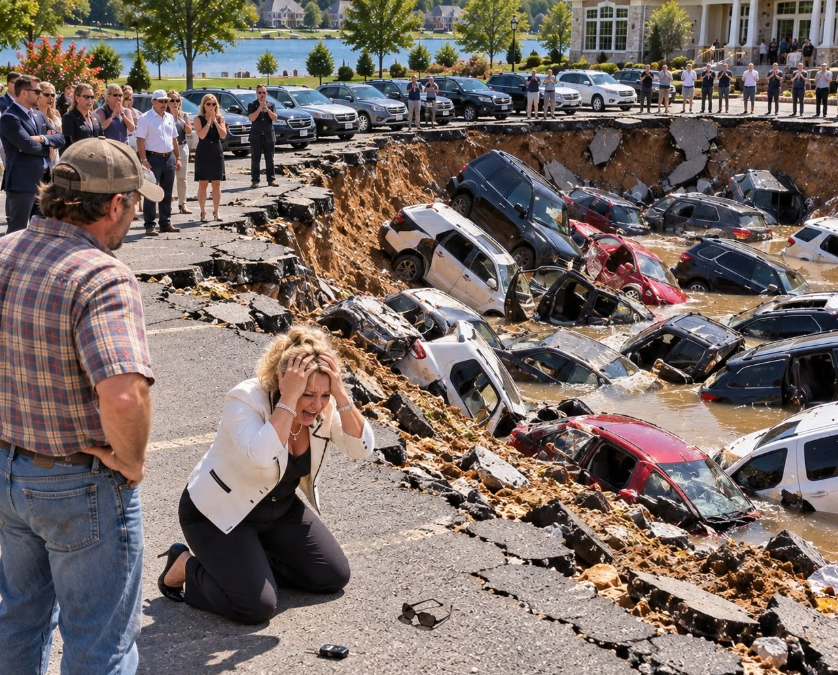
That was when the lot came apart.
Cracks ran outward.
Fast.
One line.
Then three.
Pavement split into jagged plates.
The ground beneath seemed to empty.
Three spaces vanished.
Then six.
Cars rolled.
Tilted.
Struck each other.
Metal screamed against metal.
Windshields shattered.
Alarms began going off.
One after another.
The sound became unbelievable.
Car horns.
Alarms.
Cracking pavement.
People yelling.
Somebody inside the clubhouse shouted.
Guests crowded toward windows.
I screamed, “Stay back!”
Lauren joined me.
“Get everyone out the front!”
A widening cavity opened where the center parking row had been.
Dark.
Several yards deep.
I could not see the bottom clearly.
More asphalt dropped.
One luxury SUV hung briefly at an angle.
Then the edge broke under it.
Gone.
Another car slid rear first.
Hit the side of a sedan already below.
Crumpled.
The collapse was not cinematic.
No explosion.
No fireball.
Physics.
Weight.
Saturated material.
Unsupported crust.
Once failure started, each collapsing section shifted load onto the next.
The hole widened.
Priscilla stood frozen.
Her mouth open.
No laugh.
No instructions.
No speech.
The eight thousand five hundred dollars she collected for premium parking disappeared into irrelevance.
Vehicle damage was already going to be in the millions.
Then Lauren saw another crack.
It was moving toward the clubhouse.
“Evacuate the building!”
Priscilla looked at her.
“What?”
“Everyone out!”
This time, nobody argued.
The gala emptied through the front.
Women in dresses.
Men in jackets.
Catering staff.
Residents.
Guests.
People staring back at their cars.
Nobody injured.
That remains the single best fact in this entire story.
Thirty-four vehicles.
Major collapse.
No human injury.
I will take that outcome every time.
Priscilla finally turned toward me.
Her shock became anger.
“What did you do?”
I almost could not believe it.
“What?”
“What did you do to the ground?”
I raised my phone.
Played the video from that morning.
Rainwater disappearing into the crack.
Timestamp.
“I did nothing.”
“You’ve been working right across the fence!”
“I warned you.”
“This is because of your drainage.”
“No.”
“You altered something.”
“No.”
Lauren stepped between us verbally before I could say more.
“Stop.”
Priscilla looked at her.
Lauren pointed toward the crater.
A section of old concrete had become visible.
Not modern pavement.
Older.
Buried.
Weathered.
Lauren’s expression changed.
“That’s not natural.”
“What?”
“There’s old construction under there.”
That was when the story got bigger.
Emergency crews arrived within the hour.
Police.
Fire.
County safety.
Barricades.
Red tape.
Nobody near the crater.
The clubhouse itself was closed after new cracking appeared near the rear foundation.
Owen Prescott arrived.
County structural safety engineer.
Veteran.
Calm.
Unimpressed by personalities.
He stood at the edge from a safe distance.
Asked basic questions.
Priscilla immediately told him my property had likely caused the collapse.
Owen looked at her.
“What excavation?”
She paused.
“Mr. Whitmore operates commercial property next door.”
“That wasn’t my question.”
He pointed toward my land.
“What excavation occurred there that you believe affected this site?”
She had no answer.
I did.
“None.”
Then I handed Owen the folder.
Not physically all at once.
Copies.
Timeline.
Initial photos.
Lauren’s first letter.
Second warning.
Emails.
Fill invoice.
Morning video.
My written objection.
Owen read quietly.
Then asked, “When did you first notify the HOA?”
I gave him the date.
“When did Dr. Beckett first recommend closure?”
Date.
“When was the fill placed?”
Date.
“When was the surface patched?”
Date.
“When were the cars parked?”
He looked toward the crater.
“Today.”
Exactly.
The timeline was terrible for Priscilla.
Three months earlier, initial depression.
Ten weeks earlier, professional concern.
Seven weeks earlier, formal hazard report.
Two weeks earlier, untested fill.
One week earlier, surface patch.
Morning of gala, new crack and active water loss.
Then thirty-four vehicles.
Owen requested development records.
That was when the old quarry appeared.
The rear property sat near the edge of an abandoned limestone quarry.
Decades old.
Backfilled.
Graded.
Then later incorporated into development land.
That did not mean collapse had been inevitable.
Lauren was clear about that.
Plenty of old quarry areas can be stabilized and developed responsibly.
But the original documents included warnings.
Restricted loading.
Subsurface investigation required before expansion.
The overflow parking area had apparently grown over time.
Priscilla called it restriping.
Satellite imagery disagreed.
The paved footprint had moved outward into what had once been landscaped buffer.
No formal permit for that expansion could be found.
Then Owen found something worse.
A previous geotechnical report.
Two years old.
Connected to a proposed clubhouse expansion.
Receipt signature:
Priscilla Hargrove.
I remember Naomi calling me.
Her voice sounded empty.
“She knew.”
“What?”
“There was another report.”
“How old?”
“Two years.”
“What did it say?”
“Mild subsidence.”
I sat down.
Naomi continued.
“It recommended no increased loading.”
“Parking?”
“Specifically warned against expanded parking without additional subsurface evaluation.”
That was the moment Priscilla’s claim of ignorance died.
My warning had not introduced her to the risk.
Lauren’s warning had not introduced her.
She had already received a professional report years earlier.
That earlier warning had stopped a proposed expansion.
Then the paper copy disappeared.
Priscilla said she did not remember it.
Naomi searched the physical archives.
Nothing.
Then remembered an old cloud storage account used by the former bookkeeper.
Scanned backup.
There it was.
Full report.
Signed receipt.
Recommendation.
Priscilla’s name.
Then emails surfaced.
Two weeks before gala.
Priscilla to paving contractor:
Fill depression.
Compact.
Patch.
Make sure the finished surface appears invisible before Saturday.
The contractor had written back:
Should an engineer inspect first?
Priscilla’s reply was almost unbelievable.
She was not paying another engineer to tell her dirt settles.
There it was.
Not misunderstanding.
Not lack of notice.
Not a missed email.
A conscious decision to dismiss professional review because the answer might interfere with the gala.
That email became central.
Vehicle owners wanted answers.
Some cars were ordinary sedans.
Some were not.
Luxury SUVs.
High-end sports cars.
New imports.
Combined vehicle damage estimates passed two million dollars.
Insurance carriers entered.
Then more carriers.
HOA general liability carrier.
Vehicle insurers.
Contractor insurers.
Management company.
Lawyers multiplied quickly.
Everybody asked the same thing.
Who knew?
When?
What did they do after knowing?
Priscilla tried to say the full board approved the lot.
Naomi produced minutes.
Her dissent was there in the original.
The version later circulated to residents was different.
Her written objection had vanished.
Metadata showed the file had been edited from an administrator account tied to Priscilla.
That changed the story again.
Now it was not simply:
President ignored warning.
It became:
President received warnings, concealed the hazard physically, and apparently altered records connected to board objections.
Priscilla still blamed me publicly.
Emails to residents.
Messages.
She suggested my commercial operation affected groundwater.
Lauren issued a technical analysis.
No.
Nothing on my property contributed meaningfully to the collapse.
Owen’s independent county investigation reached the same conclusion.
That door closed.
Then came the clubhouse problem.
The crater had expanded close enough to the rear foundation that the building could not reopen.
Engineering remediation estimates reached millions.
Stabilization.
Excavation.
Grouting.
Drainage redesign.
Foundation work.
Monitoring.
The polished clubhouse sign remained near the entrance.
For weeks, it sat behind red safety fencing with a crater full of destroyed cars in the background.
One resident sent me a photograph.
I did not save it.
I already had enough reminders.
Blue Cedar held a special meeting at a rented hall.
The clubhouse was unsafe.
That detail alone said everything.
Priscilla arrived early.
Sat at the head of the table.
As if nothing had changed.
Naomi had already distributed the documents.
The old report.
Lauren’s warnings.
Email records.
Fill invoice.
Original minutes.
Edited minutes.
Parking payments.
Thirty-four transactions.
Thirty-four vehicles.
Naomi stood before Priscilla could call the meeting.
“I move to remove Priscilla Hargrove as president.”
Another director seconded.
Priscilla started talking.
“This is procedurally improper.”
They checked.
It was proper.
She tried again.
“This entire board approved the event.”
Naomi answered, “No.”
Priscilla pointed toward her.
“You are trying to save yourself.”
Naomi’s voice stayed calm.
“I voted no.”
The minutes showed it.
Vote.
Almost unanimous.
Priscilla was removed.
No applause.
No shouting.
Just numbers.
The title disappeared.
That was only the beginning.
Civil claims came next.
Vehicle damage.
Parking refunds.
Property remediation.
Clubhouse repairs.
Unauthorized work.
Insurance disputes.
Association counsel explained something residents needed to hear.
Some liabilities belonged to the HOA.
The association owned property.
The association had obligations.
Insurance existed for legitimate covered risks.
But deliberate concealment or actions beyond authorized board power might create separate personal exposure.
Priscilla had to hire her own lawyer.
The HOA lawyer no longer represented every interest she had.
That mattered.
I requested reimbursement for the engineering and survey costs I had paid because the shared drainage issue threatened my property.
Nothing dramatic.
Documented cost.
Reasonable request.
The case did not resolve overnight.
That would have been unrealistic.
Instead, Priscilla’s position weakened slowly.
First, presidency.
Gone.
Control over HOA files.
Gone.
Ability to blame my property.
Gone.
Credibility.
Gone.
Assumption that association insurance would simply absorb everything.
Uncertain.
Then the deposition.
I was not in the room for all of it.
I later saw portions through the legal process.
Priscilla was shown my original photographs.
Date.
Then Lauren’s first report.
Date.
Then Lauren’s second warning.
Date.
Then the two-year-old geotechnical report.
Her signed receipt.
Then her email to the contractor.
Make it invisible before Saturday.
Her attorney eventually asked, “Do you still maintain no one warned you?”
Silence.
That silence mattered more than her laugh had.
Months passed.
Cars were removed.
Some had to be dismantled in place.
The ground was too unstable for ordinary recovery at first.
Engineers designed safe extraction procedures.
One vehicle came up almost unrecognizable.
Another had its roof crushed.
Owners received insurance settlements through their carriers.
Then carriers pursued responsible parties.
The destroyed lot was not rebuilt.
Not then.
Maybe never as parking.
The remediation plan designated the zone restricted.
No heavy loading.
No casual expansion.
No “premium parking.”
The clubhouse needed major repair.
The new board refunded every dollar Priscilla had collected.
Eight thousand five hundred dollars.
All thirty-four parking payments.
Naomi pushed a new policy.
Any engineering warning involving common property had to go automatically to the entire board.
Not through the president.
Not through management discretion.
Entire board.
Simultaneously.
Priscilla eventually sold her home.
Moved away.
She never gave the dramatic apology people expected.
Some residents wanted one.
I did not.
An apology would not rebuild the lot.
Would not repair the cars.
Would not erase the risk.
The documents already said enough.
Months later, I stood beside Owen near the stabilized area.
The crater itself had been filled and engineered under strict controls.
But the site no longer looked like a parking lot.
Flat.
Empty.
Restricted.
No white lines.
No cars.
Owen asked, “You satisfied?”
I thought about it.
“No.”
He looked surprised.
“You were right.”
“That doesn’t make thirty-four cars less destroyed.”
“Nobody got hurt.”
“That part I’m grateful for.”
Lauren was there for the final inspection.
She looked across the repaired ground.
Then said, “The soil never cared who the HOA president was.”
That was the simplest truth in the entire mess.
Ground does not respect titles.
It does not care who won a board vote.
It does not care how much someone charged for parking.
It does not care whether a gala has sponsors.
It does not care whether fresh asphalt looks beautiful.
Water follows gravity.
Soil follows mechanics.
Voids respond to load.
That is all.
Priscilla spent three months trying to turn a physical problem into a political argument.
Physics declined.
Years later, Blue Cedar still has a sign beside that zone.
SUBSURFACE HAZARD
NO PARKING
NO HEAVY LOADING
ENGINEERING AUTHORIZATION REQUIRED
Plain.
Boring.
Useful.
Almost exactly where Priscilla once stood laughing at me.
Naomi eventually became president.
Not immediately.
She served quietly first.
When new directors joined, she had a habit.
Before their first meeting, she walked them behind the clubhouse.
Stopped at the sign.
Let them read it.
No speech.
She did not need one.
People in Blue Cedar called it the thirty-four-car lot.
Some called it the gala crater.
I hated both names.
But stories name things.
I kept one photograph.
Not the collapse.
Not Priscilla.
The original crescent crack.
My first photo.
Three months before everything happened.
A small curved fracture.
Easy to dismiss.
That is why I framed it.
It sits in my office.
People ask, “What’s that?”
I usually say, “A warning.”
Sometimes they want the full story.
I tell them.
Not because I enjoy it.
Because the dangerous part was never really the sinkhole.
The dangerous part was the decision to treat evidence like an inconvenience.
That first morning, nothing had collapsed.
No car.
No building.
No disaster.
Just a leaning fence.
Five inches of settlement.
A curved crack.
That was when the problem was cheapest.
Close a section.
Bring in an engineer.
Drill.
Understand the ground.
Maybe stabilize.
Maybe change parking.
Maybe nothing serious.
Each day Priscilla delayed, the price rose.
Then she added fill.
More load.
Then asphalt.
More concealment.
Then thirty-four cars.
More load.
The lesson was not subtle.
Problems are often cheapest when they look smallest.
That is why good operators pay attention early.
A drip.
A crack.
A smell.
A vibration.
A number that changes.
The first signal is rarely dramatic.
It is easy to postpone.
Then one day, drama arrives.
People asked whether I felt vindicated.
A little.
I am human.
I remember Priscilla mocking Lauren’s report.
I remember the laugh.
I remember “imaginary sinkhole.”
So yes, there was a moment after the collapse when part of me thought:
You were warned.
Then I looked at the cars.
And the guests.
And the clubhouse.
And Naomi crying behind the emergency vehicle because she believed she should have pushed harder.
Vindication gets small quickly when consequences become real.
I told Naomi that.
She kept apologizing.
“I should have stopped it.”
“You voted no.”
“I should have done more.”
“Maybe.”
Not the comforting answer.
But honest.
Then I added, “So should the others.”
Responsibility is not binary.
Priscilla drove the decision.
Other directors had opportunities.
Some were intimidated.
Some lazy.
Some trusted her.
Some did not understand engineering.
All human.
But governance exists specifically so one personality does not become the entire safety system.
That was Blue Cedar’s deeper failure.
Too much went through Priscilla.
Records.
Warnings.
Contractor instructions.
Meeting minutes.
Event planning.
She became the choke point.
And if the choke point decides inconvenient information should disappear, the system becomes blind.
The new board corrected that.
Engineering warnings go to everyone.
Large contractor work requires documented approval.
Safety reports cannot be edited out of distributed minutes.
Records are archived.
Outside engineers communicate directly with more than one board officer.
Boring again.
Boring is good.
My own property survived without major damage.
That was lucky.
The drainage corridor shifted, but the storage buildings remained stable.
Lauren recommended monitoring.
We installed markers.
Later, when I expanded the storage facility, I overinvested in geotechnical review.
People joked.
“Sinkhole trauma?”
“Call it experience.”
We drilled.
Tested.
Adjusted foundation design.
Spent more money upfront.
Slept better afterward.
That is what experience should do.
Not make you fearful of everything.
Make you precise.
One contractor on my new building pointed toward Blue Cedar.
“That really where the cars went down?”
“Yes.”
“All thirty-four?”
“Some were swallowed deeper than others.”
“No injuries?”
“No.”
He whistled.
“Lucky.”
“Very.”
I think about the timing often.
If collapse happened twenty minutes earlier, attendants might still have been between cars.
If it happened while guests were arriving, people could have been standing beside vehicles.
If a car dropped with someone inside?
Different story.
Lauren arriving before failure mattered.
Her order to clear the pavement mattered.
Those twenty seconds mattered.
People love to focus on what went wrong.
I remember what barely went right.
No one physically hurt.
That is why I never accepted the version of the story where the collapse was somehow satisfying.
A disaster that misses people by minutes is not a punchline.
It is a warning inside a warning.
The county investigation eventually reconstructed the ground conditions.
Old quarry.
Historic fill.
Water infiltration.
Loading.
Incomplete investigation decades earlier.
Later development.
Expanded pavement.
Recent saturation.
Then unauthorized fill.
Vehicle loading.
Not one magical cause.
Systems fail through combinations.
That is another lesson people miss.
They ask, “What caused the sinkhole?”
As if there is one switch.
The better question is:
“What conditions allowed failure?”
Old geology.
Historic quarry.
Drainage.
Fill.
Time.
Water.
Load.
Decision-making.
All interacting.
Priscilla did not create the ancient void.
Important.
She did not build the quarry decades ago.
Important.
But she received evidence of the risk and made decisions that increased exposure.
Also important.
Accuracy matters.
I never wanted to claim more than documents supported.
Lauren was the same.
Reporters called.
Some asked, “Did Priscilla cause the sinkhole?”
Lauren said, “No.”
That disappointed them.
Then she explained, “She did not create the geological condition. The question is whether documented warnings were ignored and whether later loading contributed to failure.”
Less dramatic.
More correct.
I respected that.
One reporter tried to get me angry on camera.
“How do you feel knowing she laughed at you?”
“I feel glad no one died.”
“Do you think she should be personally responsible?”
“That is for the legal process.”
“Do you forgive her?”
“I’m not discussing that.”
“Would you warn her again?”
“Yes.”
That question surprised me.
Would I warn her again?
Of course.
If I knew what happened and could go back, I would still send every warning.
Even knowing she would mock them.
Because the warning was not about winning.
It was about safety.
That is the part I want to keep.
If someone reacts badly to correct information, do not let their reaction convince you the information was a mistake.
You still warn.
You document.
You escalate appropriately.
You do not sabotage.
You do not create the outcome to prove yourself.
You let professionals do their jobs.
People accused me online of knowing the lot would collapse and simply watching.
That bothered me.
I did more than watch.
Initial notice.
Engineer.
Formal warning.
County notification.
Second warning.
Board appearance.
Final objection.
Emergency call.
Morning video.
Final warning.
Lauren physically arrived.
We tried.
There is a difference between failing to stop another person and wanting them to fail.
I wanted the cars moved.
I wanted shuttles.
I suggested them.
The shopping center owner later told me he would have rented overflow space for less than fifteen hundred dollars.
Fifteen hundred dollars.
Priscilla chose risk over a solution costing less than one fifth of what she collected in parking fees.
That number made people angry.
It made me sad.
Because it showed how unnecessary everything was.
Refund the spaces.
Hire shuttles.
Lose face.
That is all.
Sometimes the most expensive disasters happen because somebody is unwilling to endure a small embarrassment.
Priscilla had oversold.
Fine.
Admit it.
“Safety concern. Premium parking relocated.”
People complain.
Maybe refund.
Gala continues.
Nothing swallowed.
Instead, she protected the appearance of competence until reality made her look far less competent than a parking change ever could.
Pride has a terrible cost curve.
One of the vehicle owners, a man named Reggie, visited me months later.
His Mercedes had been one of the first cars to go.
He had been angry at everybody.
HOA.
Priscilla.
County.
Me.
At first he thought I should have physically blocked the lot.
He told me that.
“You knew.”
“Yes.”
“Why didn’t you put your truck across the entrance?”
“Not my property.”
“You could have.”
“I could also have been arrested for trespass or obstruction.”
He did not like that.
Neither did I.
Later, after seeing the timeline, he came back.
“I was wrong.”
“About what?”
“You tried.”
“Yes.”
He looked embarrassed.
“I needed somebody to blame.”
“I understand.”
“My car was six months old.”
“I know.”
He laughed without humor.
“My wife told me I loved the car more than her.”
“Was she right?”
He smiled.
“Not anymore.”
We shook hands.
That conversation helped more than I expected.
People in loss look for agency.
Who could have stopped this?
Sometimes the answer is several people.
Sometimes the one person who tried still gets blamed because he was visible.
I learned not to take every early reaction personally.
Insurance made everyone tense.
Thirty-four vehicle claims alone were messy.
Different coverage.
Values.
Deductibles.
Total losses.
Partial damage.
Recovery costs.
Then liability allocation.
HOA.
Contractors.
Possibly individual decision-makers.
The process lasted.
I stayed mostly outside it except when asked for records.
That was healthy.
I had given the evidence.
My job was not to become the claims adjuster.
Priscilla’s personal litigation continued after she moved.
I do not know every outcome.
I intentionally stopped following.
Some people found that strange.
“You don’t want to know?”
“Not really.”
“How can you not?”
Because at some point, knowing becomes another attachment.
I wanted my property safe.
It was.
I wanted the drainage corrected.
It was.
I wanted the hazard recognized.
It was.
I wanted my engineering costs reimbursed.
They were.
The rest belonged to people whose job it was to decide.
I had spent enough life thinking about Priscilla.
One evening, about a year after the collapse, Naomi invited me to a Blue Cedar meeting.
I almost declined.
Then she explained.
They were adopting the permanent engineering notice policy.
She wanted Lauren to speak.
Lauren said she would only do it if I came too.
So I went.
Different room.
The clubhouse still under repair.
Community hall.
Naomi at the front.
No grand speeches.
She displayed the new policy.
Any written safety warning from a licensed professional concerning common property would be automatically distributed to all board members, management, and retained counsel.
Receipt logged.
No deletion.
No filtering.
Independent review required before reopening.
Then Lauren spoke.
Not about Priscilla.
About uncertainty.
That surprised residents.
“Engineering is not certainty,” she told them.
“When we say investigate, it does not mean catastrophe is guaranteed.”
One resident asked, “So why close something if you’re not sure?”
Lauren answered, “Because uncertainty and safety interact. We close temporarily to learn enough to make a responsible decision.”
That was exactly what Priscilla never understood.
She believed if Lauren could not prove collapse would happen, then closure was unnecessary.
But safety decisions often happen before proof.
You do not need to know a bridge will collapse before restricting traffic after discovering a structural defect.
You investigate because you do not yet know.
Uncertainty is not permission.
It is the reason to look.
I wish that sentence had been in the first report in letters ten feet high.
Maybe it would not have mattered.
Priscilla wanted certainty in the direction that supported her plan.
“No proof of collapse” became “proof of no danger.”
Those are not the same.
That logical mistake destroyed millions of dollars.
After Lauren spoke, Naomi asked me if I wanted to say anything.
“No.”
People laughed.
She smiled.
“Nothing?”
“I sent enough emails.”
More laughter.
Then I said one thing.
“When someone brings you bad information, don’t punish them for ruining your schedule.”
That was it.
I sat down.
The old quarry zone eventually received long-term stabilization.
Not cheap.
Engineered fill.
Drainage modification.
Monitoring.
Restricted loading.
No return to the old parking configuration.
The land looked boring afterward.
I liked that.
Grass.
Markers.
Warning sign.
No luxury cars.
No premium spots.
Just ground allowed to be ground.
The new clubhouse parking plan used shuttle overflow during large events.
Exactly what I suggested before the collapse.
Funny how ideas become reasonable after the expensive alternative fails.
First gala after repairs, Naomi sent me an invitation.
I declined.
She called.
“You have to come.”
“No.”
“Why?”
“I hate galas.”
“You could at least enjoy the shuttle.”
“I’m enjoying it from here.”
She laughed.
Event went fine.
Guests parked at the shopping center.
Shuttle buses ran.
Cost less than the legal bill for one hour of the old disaster.
Nobody complained much.
People adapt quickly when a solution works.
Priscilla had treated shuttles like humiliation.
Nobody else cared.
That is another thing leaders forget.
Their personal embarrassment often matters less to everyone else than they imagine.
Residents did not need Priscilla to be perfect.
They needed her to be responsible.
She chose perfect appearance.
Lost trust.
Naomi chose open imperfection.
“Here’s the problem.”
“Here’s what we know.”
“Here’s what we don’t.”
“Here’s the plan.”
Residents liked her more.
Not because she never made mistakes.
Because they could see the process.
Trust grows differently than authority.
Authority can be printed on a letterhead.
Trust takes repetition.
One honest meeting.
Then another.
One complete set of minutes.
Then another.
One warning distributed without being buried.
Then another.
Blue Cedar became less dramatic.
Good.
Drama is expensive.
I still walked my fence line after storms.
Habit.
Heavy rain.
I check drains.
Look at markers.
Watch water.
The new construction on my side included monitoring points.
Everything stable.
One morning, I saw a small crack near my gravel apron.
My stomach tightened immediately.
Old reaction.
I crouched.
Looked.
Called the contractor.
They inspected.
Minor surface shrinkage.
Nothing structural.
I laughed afterward.
Maybe I had become paranoid.
Then I thought:
Fine.
Better one unnecessary inspection than one invisible void under thirty-four cars.
Experience changes your threshold.
That is not always fear.
Sometimes it is wisdom.
People still ask, “How did you know it was a sinkhole?”
I did not.
Important.
I knew the ground was behaving abnormally.
Lauren knew loading should stop.
Then investigation revealed the underlying condition.
That sequence matters.
If I had walked around telling everyone, “There is definitely a sinkhole!” before evidence, Priscilla would have had more room to dismiss me.
Instead:
There is movement.
Here are photos.
Engineer says close.
Here is the report.
Water is disappearing.
Here is video.
Professional caution wins credibility.
Dramatic certainty feels satisfying but creates weaknesses.
I learned that long before Blue Cedar.
Construction disputes are full of people overstating.
“This wall is unsafe.”
“This foundation is failing.”
“This contractor ruined everything.”
Maybe.
Measure first.
Document first.
Then speak as precisely as evidence allows.
That is why Lauren’s reports became so important.
She never promised disaster.
She identified risk.
Priscilla mocked her for that caution.
Later, the caution made Lauren credible.
The deposition transcript of Priscilla’s silence circulated more than it should have.
Residents talked.
I never read the entire thing.
I knew the key sequence.
Photo.
Warning.
Old report.
Email.
Question.
Silence.
People described that as the moment she lost.
Maybe.
For me, she lost much earlier.
She lost when she decided making the crack invisible was equivalent to making the problem disappear.
That is a fundamental failure of thinking.
Appearance versus condition.
Fresh asphalt looks stable.
Ground can still be hollow.
An edited meeting record looks unanimous.
Naomi still voted no.
A deleted email looks absent.
Server logs still show it opened.
A missing paper report looks forgotten.
Cloud backup still exists.
A gala looks successful.
Cars can still be sitting over a void.
Reality keeps copies.
Not always literal copies.
But consequences.
Priscilla managed surfaces.
The problem lived underneath.
That theme followed everything.
Surface:
Smooth black asphalt.
Underneath:
Unstable ground.
Surface:
Approved gala.
Underneath:
Known warning.
Surface:
Board support.
Underneath:
Dissent.
Surface:
No old report.
Underneath:
Digital backup.
Surface:
Premium parking.
Underneath:
Risk.
You cannot manage only surfaces forever.
Eventually something underneath asserts itself.
That is probably why the story spread so widely inside the county.
People recognized more than a sinkhole.
Every organization has some version of the crack everyone sees and nobody wants to deal with.
A failing roof.
A bad contract.
A toxic employee.
A financial irregularity.
A safety warning.
Something inconvenient.
Then a person in authority says:
“Patch it.”
Maybe sometimes patching is correct.
Sometimes the patch is the problem.
The question is whether you understand what you are covering.
My father was not in construction.
He was a mechanic.
He used to say, “Fresh paint is how people sell trouble.”
Not always true.
But I heard him in my head every time I looked at that black asphalt patch.
Fresh paint.
Fresh sealcoat.
Trouble underneath.
When the crater was finally empty, investigators found layers.
Pavement.
Recent fill.
Older fill.
Old concrete.
Quarry material.
Water pathways.
History stacked underground.
You could almost read the property’s mistakes in cross section.
One engineer showed me photographs.
“Look.”
Different material zones.
Compaction.
Void.
I found it fascinating.
Sad.
But fascinating.
Ground keeps records too.
Not in folders.
In layers.
That thought made me smile.
Priscilla spent months hiding paper.
The earth had its own archive.
One rainy afternoon, I ran into the paving contractor who had patched the lot.
He recognized me.
Looked uncomfortable.
“I told her.”
“I know.”
“Not enough.”
“What did you say?”
“Should have an engineer.”
“I saw the email.”
He nodded.
“I should’ve walked.”
“Maybe.”
He looked down.
“I had a work order.”
“That phrase can get expensive.”
He gave a tired laugh.
“Yeah.”
His company faced questions too.
He had not created the original hazard.
But professionals have obligations when scope intersects obvious risk.
I did not know how his case resolved.
Again, not mine.
But his comment stayed.
I had a work order.
People use instructions to transfer responsibility upward.
Sometimes legitimate.
Sometimes not.
If the ground is visibly failing, an order to make it pretty deserves another question.
Authority does not erase professional judgment.
The valet supervisor had a similar reaction.
He had no idea.
Nobody told him.
His staff parked thirty-four cars because that was the assignment.
Afterward, he was furious.
Not at me.
At Priscilla.
“If she told us there was an engineer’s warning, we never go back there.”
I believed him.
Information had been compartmentalized.
Another governance failure.
The people physically putting vehicles at risk did not receive the risk report.
That new Blue Cedar policy changed too.
Event contractors now receive relevant safety restrictions.
Obvious.
Again.
Only obvious after failure.
One of the gala guests sent Lauren a thank-you note.
She showed it to me.
“Thank you for yelling.”
That was the entire note.
Lauren laughed.
“I’ve never been thanked for yelling before.”
“Enjoy it.”
She kept the card.
There were a lot of near misses that day.
No people in cars.
Attendants cleared.
Guests evacuated before foundation area worsened.
No fire.
No fuel rupture creating bigger hazard.
Emergency access remained open.
We were lucky in many directions.
I think responsible storytelling should include that.
Because if somebody hears this and thinks, “I can wait until the ground actually moves before acting,” they learned the wrong lesson.
We got lucky.
Warnings exist so you do not have to rely on luck.
The first full year after the collapse passed quietly.
Anniversary articles.
A few social posts.
Then attention faded.
Good.
Blue Cedar wanted normal life.
I wanted normal life.
Priscilla’s name slowly stopped appearing.
Naomi became president after two terms in lower leadership.
She was almost annoyingly cautious.
Every contractor loved her or hated her depending on the paperwork.
She asked questions.
Requested certificates.
Wanted reports.
Some residents teased her.
“Naomi, it’s just a light pole.”
She would point toward the hazard sign.
Nobody argued.
The sign became institutional memory.
That may be why I came to like it.
Signs are simple.
No personality.
No persuasive speech.
Just:
NO PARKING.
SUBSURFACE HAZARD.
People obey.
Not because Naomi says so.
Because the reason is known.
That is healthier authority.
Clear.
Evidence-based.
Limited.
One new board member apparently asked why the sign was still needed after stabilization.
Naomi walked him to it.
Then showed photographs.
Thirty-four cars.
He never asked again.
My framed photograph is less dramatic.
One crack.
If you did not know the story, you would walk past it.
That is why I prefer it.
Big disasters are easy to respect.
Small warnings require judgment.
I want to remember the small warning.
The crescent crack.
Before anybody knew what it meant.
Before lawyers.
Before insurers.
Before the crater.
The moment when curiosity could still have been enough.
That is where prevention lives.
Not at the collapse.
Before.
People occasionally ask what I would say if Priscilla called me today.
I have no idea.
She has not.
If she apologized?
I would probably accept it.
If she defended herself?
I would not argue.
The facts have been argued enough.
I do not need to win again.
That is another lesson.
At some point, continuing to replay victory is just another way of staying trapped.
Thousands of pounds each.
Luxury SUVs heavier.
Combined with pavement and fill.
Weight where weight had been specifically discouraged.
I still feel a coldness thinking about it.
The ground gave us one final warning that morning.
A visible crack through fresh asphalt.
Water disappearing.
Even then, there was time.
Priscilla could have stopped at car number one.
Five.
Eleven.
Eighteen.
Twenty-six.
Thirty-three.
At every number, she had another chance.
She chose thirty-four.
That is why the count matters.
Not for drama.
Because every vehicle was another decision.
People talk about “the decision” to use the lot.
There were dozens of decisions.
Sell space.
Ignore report.
Refuse shuttle.
Patch cracks.
Place fill.
Skip engineering.
Proceed with gala.
Continue parking.
Continue after Naomi objects.
Continue after morning crack.
Continue after Lauren arrives.
Then laugh.
Disasters often look sudden at the end.
Decision chains are slow.
That is what my framed crack reminds me.
The asphalt collapse took minutes.
The failure took months.
There is a difference.
A couple years later, a local college asked Lauren to speak about engineering ethics.
She invited me.
I declined the first time.
She called again.
“Students need the owner perspective.”
“I wasn’t the owner.”
“Neighbor perspective.”
“Why?”
“Because engineers can issue perfect reports. Somebody still has to act.”
I went.
Small lecture hall.
No dramatic video.
We used photographs.
Lauren spoke about uncertainty.
Hazard communication.
Load restrictions.
I spoke about documentation and decision-making.
A student asked, “Why didn’t the engineer have legal authority to close the lot?”
Good question.
Lauren answered, “Private property governance and public enforcement have specific channels. A consulting engineer can recommend closure. Depending on jurisdiction and circumstances, enforcement may require owner action or public authority.”
The student looked frustrated.
“So a person can ignore you?”
“Yes.”
“That seems broken.”
I answered.
“Systems cannot remove every bad decision. They can make bad decisions harder and consequences clearer.”
That is reality.
No process guarantees wisdom.
Blue Cedar changed its system to reduce the chance one person could suppress warnings.
That is probably as good as institutions get.
Another student asked me, “Would you trespass to block the lot if you could redo it?”
I thought.
“No.”
“Even knowing?”
“I would escalate harder to public safety channels earlier.”
That is the change I would make.
More formal escalation.
More attempts.
But physically seizing control of another property creates its own risks.
You should not solve one overreach with another unless emergency law clearly authorizes it.
That answer disappointed him.
People prefer heroic intervention.
Real life often gives you paperwork and imperfect jurisdiction.
I understand the frustration.
I felt it.
Watching the first cars park was one of the most helpless experiences of my life.
I knew enough to be afraid.
Not enough to physically stop them.
Lauren knew more.
She still could not magically close private property without appropriate authority.
That is why Priscilla’s responsibility was so heavy.
She had the operational control.
And the information.
Leadership matters most when the person with power has knowledge others lack.
Use it well.
She did not.
The real estate value of Blue Cedar dropped briefly after the collapse.
News coverage.
Clubhouse closed.
Lawsuits.
Then recovered.
Neighborhoods survive.
The crater did not destroy the community.
Poor governance almost damaged trust more deeply than geology damaged land.
Naomi worked on that.
Open meetings.
Public records.
Insurance briefings.
She did not hide costs.
Residents hated some numbers.
Millions in remediation are ugly.
But hiding costs would have repeated the same mistake.
So she showed them.
I respected that.
One meeting became tense over assessments.
A resident yelled, “Why should we pay for Priscilla’s mistake?”
Fair question.
Association counsel explained covered and uncovered liabilities.
Insurance.
Common property responsibilities.
Potential recovery from responsible parties.
No easy answer.
Communities share some consequences of leaders they elect.
That truth is uncomfortable.
But the board worked to separate legitimate HOA obligations from potentially personal misconduct.
Again, process.
Not vengeance.
Priscilla’s personal finances were not my concern.
The source of money to fix shared drainage was.
That work needed to happen regardless of who felt guilty.
So residents faced reality.
Another lesson.
Accountability does not always mean innocent people feel zero impact.
Sometimes bad leadership creates costs no legal system can perfectly isolate.
That is why selecting leaders matters.
So do controls.
Blue Cedar residents learned both.
I do not know if Priscilla ever drove past the old lot after moving.
I imagine not.
Maybe she avoided that road.
Maybe she still believed engineers overreacted.
Source records suggested she privately continued to say the whole episode had been exaggerated.
That used to irritate me.
Now it does not.
People protect their self-image.
Sometimes to the end.
I do not need her private agreement.
The parking lot is gone.
The sign exists.
The reports exist.
The emails exist.
The policy changed.
That is enough.
One afternoon, I stood with Lauren and Owen at the final stabilization inspection.
Equipment gone.
Ground compacted under engineered plan.
Monitoring points installed.
Lauren checked readings.
Owen signed the final phase.
Then he asked me, “What are you going to do now?”
“Go back to work.”
“You’re retired.”
“Semi-retired.”
“Same thing.”
“No.”
He laughed.
We stood quietly.
I looked at the place where the first sedan dropped.
Nothing there now.
Just treated ground.
Grass beginning.
I expected some feeling.
Triumph.
Relief.
Anger.
Nothing dramatic.
Just tiredness.
Then Lauren said, “Good.”
“What?”
“Nothing happening.”
I understood.
In engineering, nothing happening can be success.
No movement.
No crack.
No collapse.
Boring ground.
Excellent.
That is what everyone should have wanted from the beginning.
Not a perfect gala.
Not premium parking.
Boring ground.
The most expensive lesson in Blue Cedar history came from someone refusing to value boring.
Inspection.
Closure.
Shuttle.
Engineer.
Refund.
All boring.
Instead, she chose appearance.
Fresh asphalt.
Premium spaces.
Event.
Confidence.
The dramatic option looked better until it became catastrophic.
I think about that anytime a client tells me, “We don’t have time to check.”
You always have time.
You may not like when you spend it.
Before failure.
Or after.
But time will be spent.
Priscilla saved a few days before the gala.
Blue Cedar spent months repairing.
That exchange rate is terrible.
The original crack photograph hangs above my desk now.
Small.
Almost elegant.
Crescent moon.
Visitors sometimes guess.
“Foundation failure?”
“No.”
“Drainage?”
“Partly.”
“Sinkhole?”
“Eventually.”
Then I tell them, “The crack wasn’t the most dangerous part.”
“What was?”
“The person standing over it insisting it meant nothing.”
That line came naturally one day.
It became my summary.
Because hazards do not need arrogance to become dangerous.
But arrogance makes prevention much harder.
The crack was honest.
It showed movement.
The standing water was honest.
The leaning fence was honest.
The engineer was honest.
Even the quarry records were honest.
Everything around Priscilla was telling her the same thing.
Slow down.
Investigate.
She kept demanding a different answer.
The ground never gave it.
That is the image I keep.
Not cars falling.
Not Priscilla’s face.
A small crack.
Early.
Quiet.
Still cheap.
The moment when listening could have changed everything.
Years later, whenever rain hits hard, I sometimes walk behind the storage buildings.
Old habit.
Check drainage.
Look across at Blue Cedar’s restricted zone.
The warning sign stands there.
Naomi had it mounted on steel.
Probably overkill.
I approve.
Water moves through the redesigned channel.
No pooling.
No parking.
No gala attendants.
Nothing interesting.
One rainy evening, I stood there while water ran.
A new Blue Cedar resident passed on the walking path.
He stopped.
“Are you Caleb?”
“Yes.”
He pointed at the sign.
“That’s the sinkhole lot?”
“Was.”
“I heard the HOA president parked like fifty cars there.”
“Thirty-four.”
“Whole clubhouse fell in?”
“No.”
He looked disappointed.
“Just the lot?”
“Lot collapse damaged cars and threatened the clubhouse. Building was evacuated and later repaired.”
“Oh.”
He smiled.
“Story got bigger.”
“Stories do.”
He looked at the drainage.
“You were the guy who warned them?”
“I was one.”
“Engineer too?”
“Yes.”
He nodded.
Then:
“They should have listened.”
Simple.
“Yes.”
He walked away.
That is probably how the story will survive.
Details fade.
Core remains.
Someone warned.
Someone laughed.
Someone hid the signs.
The ground failed.
Records proved the warning existed.
A system changed.
That is enough.
I went back inside.
Rain on the roof.
Office light.
Framed photograph.
The crescent crack.
I looked at it once.
Then returned to paperwork for my storage expansion.
Soil report.
Drainage plan.
Foundation inspection.
Boring documents.
I read every page.
Every one.
Because I have seen what happens when somebody decides inconvenient evidence can be buried under fresh asphalt.
And I have learned that the ground is very patient.
It does not argue.
It does not defend itself in meetings.
It does not care whether you laugh.
It waits.