HOA Karen Invited 1,000 People to Camp on My Ranch—Then She Opened the Wrong Gate and Led Them Straight Toward Three 1,800-Pound Bulls.
PART2:
I know people use phrases like that too easily.
Saved me.
Changed my life.
Gave me purpose.
For me it was literal enough.
I was drinking too much when I first came home.
Not falling-down drunk every day.
The quieter kind.
Two beers became four.
Four became whiskey.
Sleep became something I chased instead of something that arrived naturally.
The ranch forced structure back into my life.
Cattle do not care if you slept badly.
Water still has to be checked.
Fence still has to be repaired.
Hay still has to move.
Animals still need you.
I started waking before sunrise.
Coffee on the porch.
PART3:
Then feed.
Then work.
The smells became familiar again.
Hay.
Dust.
Leather.
Diesel.
Manure.
Rain when we were lucky enough to get it.
By the end of the first year, I had stopped thinking of the ranch as something I inherited.
It was home.
That was when developers arrived.
The land north and east of mine had belonged to an old family partnership.
They sold.
Within eighteen months, roads appeared.
Then sewer lines.
Then stone entry monuments.
Then model homes advertised as:
RURAL LUXURY WITHOUT THE RURAL INCONVENIENCE.
I remember reading that sign.
I actually laughed.
They had moved into cattle country and immediately marketed the absence of cattle-country inconvenience.
The development became Milfield Ranch Estates.
The word ranch appeared on every brochure.
No ranches were included.
Just large houses with decorative timber beams, fake barn doors, and mailboxes shaped like miniature ranch gates.
The HOA formed after the first phase sold.
That was how Karen Rutherford became my neighbor.
Not next-door neighbor.
Her house sat nearly half a mile from my eastern fence.
Still close enough.
Karen was fifty-seven.
Former corporate event planner.
That detail eventually explained almost everything.
She had silver-blonde hair, immaculate nails, a white SUV, and the unusual ability to turn every conversation into a committee meeting whether anybody else had agreed to attend.
Our first encounter came two weeks after she became HOA president.
I was fixing a fence near County Road 14.
She pulled onto the shoulder.
Got out wearing loafers unsuitable for dirt.
“Hank Morrison?”
“Depends.”
She smiled.
“I’m Karen Rutherford, president of Milfield Ranch Estates.”
I waited.
People who introduce themselves with titles usually have more coming.
“We’re reviewing visual compatibility along our perimeter.”
I looked at my fence.
Then her.
“My cows complain?”
She laughed like I had made a joke she intended to forgive.
“Several residents have mentioned the barbed wire.”
“What about it?”
“It presents a harsh appearance.”
“To cattle?”
“To the community.”
I rested one arm on the post.
“The community bought houses beside a cattle ranch.”
“We understand that.”
“Good.”
“But there are more modern fencing alternatives.”
“Then use them.”
Her smile slipped.
“I meant along this boundary.”
“This is my fence.”
“Yes.”
“So I’ll use mine.”
She changed approach.
“Would you consider black rail?”
“No.”
“Vinyl?”
“No.”
“Decorative field fencing?”
“No.”
“Why?”
“Because cows weigh more than decorations.”
That conversation established the pattern.
Karen would request.
I would explain.
She would reinterpret explanation as negotiation.
Then appear surprised when the answer remained no.
Over the next year I received:
A request to paint my barn “a more neutral earth tone.”
No.
A request to stop operating my tractor before eight on weekends.
No.
A suggestion that manure storage be screened with landscaping.
I did move one pile farther from their fence because it made sense.
Karen treated that as evidence I had accepted HOA authority.
I corrected her immediately.
Then came the cattle complaints.
Residents bought homes marketed beside “authentic working ranchland.”
Then complained the authentic working ranchland contained cattle.
One homeowner emailed asking whether I could relocate bulls because his children found them “intimidating.”
I did not respond.
Another complained about flies.
Another about mooing before sunrise.
One woman demanded reimbursement after her golden retriever rolled in something near my fence.
Not on my property.
Near it.
I started keeping a folder labeled:
RURAL INCONVENIENCE.
Mostly for entertainment.
Karen stopped being entertaining the second summer.
Milfield Ranch Estates had expanded to almost two hundred homes.
The developer transferred full control to the resident board.
Karen won another term.
Then announced a new annual event.
THE MILFIELD HERITAGE WEEKEND.
Heritage.
Food trucks.
Live country music.
Craft vendors.
Family games.
A “historic ranching experience.”
The first year it took place inside the HOA park.
Maybe three hundred people.
Fine.
I heard music from my porch.
Didn’t care.
Second year they used a vacant developer lot.
Six hundred people.
Parking became a mess.
Two cars blocked one of my gates for several hours.
I called the non-emergency line.
Deputy had them moved.
Karen sent me an email afterward.
Hank,
In the future, please contact the Association before involving law enforcement in community-event parking issues.
I replied:
Karen,
In the future, please keep vehicles out of gates marked LIVESTOCK ACCESS — KEEP CLEAR.
Hank.
No response.
The following spring, she came to my ranch carrying a folder.
That was the first time she mentioned using my land.
“We’re growing.”
“Congratulations.”
“The Heritage Weekend has become one of the county’s strongest neighborhood events.”
“Good.”
“We need more space.”
“No.”
She blinked.
“I haven’t asked yet.”
“You brought an event folder to a cattle ranch.”
“Hank.”
“No.”
She sighed.
“We would like to lease the south pasture for one weekend.”
“No.”
“You haven’t heard compensation.”
“Don’t need to.”
“Ten thousand dollars.”
“No.”
“Fifteen.”
“No.”
“One weekend.”
“No.”
“No livestock contact.”
“No.”
“Why are you being difficult?”
There it was.
I looked toward the pasture.
About twenty cow-calf pairs grazing.
“Because that’s agricultural land.”
“It’s grass.”
“It is grazing land.”
“Your herd doesn’t use all forty acres at once.”
“Correct.”
“So portions are available.”
“No.”
She stared at me.
“You’re refusing fifteen thousand dollars because cows might want to stand somewhere else?”
“I’m refusing because nearly a thousand strangers, vehicles, generators, food waste, dogs, children, temporary toilets, music equipment, and alcohol do not belong inside active livestock pasture.”
“We have insurance.”
“Good.”
“Security.”
“Good.”
“Portable fencing.”
“No.”
She closed the folder harder than necessary.
“This ranch is surrounded by our community now.”
I looked at her.
“That sentence doesn’t change the deed.”
Her face went tight.
“Nobody is questioning ownership.”
“Then we’re done.”
She drove away.
I thought that was it.
Three weeks later, I received an email from an event company.
Subject:
Morrison Ranch Heritage Weekend Vendor Layout Confirmation.
I almost deleted it as spam.
Then opened the attachment.
Site map.
My property.
Not a similar property.
Mine.
RVs in south pasture.
Vendor rows along hay field.
Music stage near equipment barn.
Parking in east grazing area.
“Farm animal experience” marked near my working pens.
And something called:
BULL TOUR — VIP ONLY.
I stared.
Then called the event company.
A young man named Trevor answered.
“Lone Star Community Events.”
“This is Hank Morrison.”
Pause.
“Mr. Morrison.”
“You have an event mapped on my property.”
Another pause.
“We were told site approval was finalized.”
“By who?”
“Milfield Ranch Estates.”
“Name.”
“Karen Rutherford.”
“Did anyone receive a lease signed by me?”
“I’m not on legal.”
“Find someone who is.”
Ten minutes later a woman named Alicia came on.
I asked the same questions.
She sounded increasingly worried.
Their file contained:
An event authorization letter from Milfield Ranch Estates HOA.
A site-use agreement.
A county event permit application.
An insurance certificate.
No signature from me.
No lease.
No deed.
The HOA had represented itself as authorized property manager.
Not owner exactly.
Authorized manager.
“Who told you that?”
“Ms. Rutherford.”
“What document supports it?”
“Her board certification.”
“Send it.”
She hesitated.
I gave my email.
Five minutes later:
BOARD CERTIFICATION OF COMMUNITY USE RIGHTS.
Signed Karen Rutherford.
It stated:
Morrison Ranch constitutes preserved open-space acreage functionally integrated into Milfield Ranch Estates and historically maintained in cooperation with the Association.
Almost every meaningful word was false.
Preserved open space?
No.
Functionally integrated?
No.
Maintained by HOA?
Absolutely not.
Then:
Association has continuing community-use rights for heritage, recreational, and emergency purposes.
I called my attorney.
His name was Mark Ellison.
Country lawyer.
Boots.
No tie unless court required it.
He read the certification and said:
“Well.”
“What?”
“She has imagination.”
“What do I do?”
“First, we send notices.”
To HOA.
Event company.
County permitting.
Sheriff.
Insurer listed on certificate.
Certified mail.
Email.
Personal service to registered HOA agent.
NO AUTHORIZATION EXISTS.
PRIVATE AGRICULTURAL PROPERTY.
NO EVENT ACCESS.
NO LIVESTOCK INTERACTION.
NO GATE MAY BE OPENED.
Mark emphasized the last sentence because I asked him to.
The east breeding pasture contained Thunder, Diesel, and Maverick during that month.
Three bulls separated from cows while I rotated breeding groups.
The gate to that pasture had:
A red livestock sign.
A padlock.
A secondary chain.
And a warning plate:
BREEDING BULLS
DO NOT ENTER
AUTHORIZED RANCH PERSONNEL ONLY
I photographed all of it.
Sent photographs with notice.
Karen replied personally.
Hank,
Your threat-laden correspondence is unnecessary. The Association disputes your characterization of the historical community-use arrangement. We intend to proceed with Heritage Weekend while our counsel resolves the property question.
I read it twice.
Called Mark.
“What historical arrangement?”
“None that I can find.”
“Can she do that?”
“She can drive onto your land.”
“Legally?”
“No.”
“But physically.”
“Yes.”
Good distinction.
We sent another notice.
This one less polite.
Any entry after receipt constitutes unauthorized entry.
No implied permission.
No license.
No public invitation.
No festival.
No camping.
No livestock tours.
Karen’s attorney finally responded.
Their theory was astonishing.
When the developer built Milfield Ranch Estates, an old sixty-foot “agricultural access strip” appeared on a 1963 plat along part of my eastern boundary.
It had been used historically to move farm equipment between parcels.
The HOA attorney argued the strip created a broader right of ingress and egress benefiting surrounding land and potentially permitted “community access.”
Mark laughed.
“That’s not what ingress and egress means.”
More importantly, the strip ended at an old gate and did not burden the entire ranch.
Even if valid, it did not turn forty acres into festival grounds.
The county title records showed no recreational easement.
No HOA rights.
No lease.
No common ownership.
Karen had taken one old access notation and inflated it into:
community property.
We believed a judge would stop the event.
The problem was timing.
Event scheduled for Saturday.
We filed for temporary restraining order Monday.
Hearing set Friday afternoon.
Then Karen’s counsel requested continuance claiming inadequate service on one board member.
Judge pushed argument to Monday.
After event.
Mark tried emergency reconsideration.
Denied.
Not because judge thought HOA was right.
Because the court had not yet developed enough record to issue broad injunctive relief without hearing both sides.
Mark told me:
“Call sheriff if they enter.”
“I already did.”
“Call again.”
Sheriff’s office was aware.
They said civil property dispute unless trespass occurred.
Fair.
I hired two off-duty deputies through an approved private detail for Saturday.
Not to arrest people.
Traffic and safety.
I locked every gate Friday night.
Moved cows away from eastern boundary.
Moved bulls into strongest interior pasture.
Double-checked water.
Cameras active.
Three fixed cameras.
Two trail cameras.
One camera over equipment barn.
Drone batteries charged though I had no intention of using it unless needed.
At 10:30 Friday night, I went to bed.
At 5:58 Saturday morning, bass shook my bedroom window.
For one confused second, I thought a truck was idling beside the house.
Then another beat hit.
Then cheering.
I sat up.
Looked through curtains.
Lights.
Lots.
I pulled on jeans.
Boots.
Walked outside.
And stopped.
The south pasture looked like a county fair.
RVs.
Tents.
Pickup trucks.
Food trailers.
Canopies.
String lights.
Portable toilets.
A temporary stage.
Cars parked in rows.
People carrying coolers.
Children riding bicycles.
Dogs.
So many dogs.
I could not understand how they had entered.
Then I saw the southeast service gate.
Chain cut.
Again.
Temporary gravel ramps laid over drainage ditch.
Festival workers directing vehicles.
Someone had installed signs overnight.
HERITAGE CAMPING.
VENDOR CHECK-IN.
VIP RANCH EXPERIENCE.
My ranch.
My stomach went cold.
The first emotion was not anger.
Fear.
Because livestock were still on property.
A thousand inexperienced people around cattle creates risk even when everyone behaves perfectly.
This was not perfect.
Two teenagers were already standing at a fence taking selfies with heifers behind them.
A man was filling a fifty-gallon portable tank from my hydrant.
An RV generator ran beside hay.
Hay.
Dry Texas hay.
I walked fast.
Not running.
Running attracts attention.
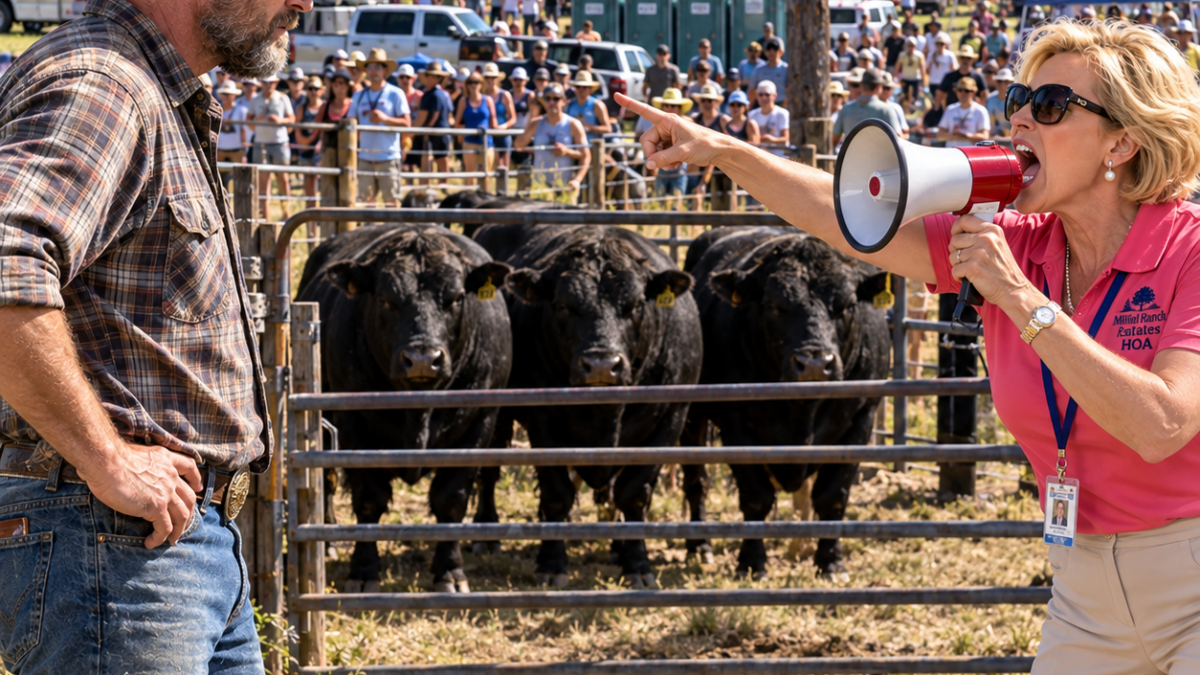
Near my driveway stood Karen Rutherford with a bullhorn.
She wore boots.
Brand-new western boots.
White blouse.
Denim vest embroidered:
MILFIELD HERITAGE WEEKEND
EVENT DIRECTOR.
I still remember thinking:
She bought a costume.
She saw me.
Raised the bullhorn.
“Morning, Hank.”
I walked straight to her.
“Shut it down.”
She lowered the bullhorn.
“Good morning to you too.”
“You cut my gate.”
“Our contractor opened the access.”
“Cut.”
“I didn’t personally see what they did.”
“Shut it down.”
She looked toward hundreds of people.
“That’s not practical.”
“This is trespass.”
“Our legal position—”
“Karen.”
I stepped closer.
“Listen carefully.”
She did.
“Your legal position will not stop a bull.”
Her eyes moved toward the interior pasture.
“I told you cattle would be isolated.”
“They are.”
“Then we’re safe.”
“No.”
“We have temporary fencing.”
“Temporary fencing is not livestock infrastructure.”
“You’re being dramatic.”
I looked toward her event crew.
“Who authorized the Bull Tour?”
She smiled.
“It’s educational.”
“No.”
“Nobody enters the enclosure.”
“There is no bull tour.”
“Hank, guests will view them from the outer lane.”
“No.”
“From behind fencing.”
“No.”
“We’re promoting agricultural literacy.”
“No.”
She rolled her eyes.
“That word cannot be your entire management style.”
“It works.”
I pointed toward the red pasture gate visible farther west.
“No one touches that gate.”
Her expression changed.
Only slightly.
“You don’t control every walkway on forty acres.”
“Yes.”
“I do.”
“That is what ownership means.”
Then the sheriff arrived.
Not one unit.
Three.
I had called while walking down.
So had event staff apparently.
Captain Luis Ramirez stepped out.
He had worked cattle growing up.
That helped.
He looked at the field.
Then me.
“Mr. Morrison?”
“Yes.”
“You authorized any of this?”
“No.”
He looked at Karen.
She stepped forward.
“We have an active legal dispute over community-use rights.”
Ramirez said:
“Do you have a court order permitting an event?”
“Our counsel—”
“Court order?”
“No.”
“Lease?”
“Our right is not based on lease.”
He looked back at me.
“Deed?”
“In my truck.”
Mark arrived twenty minutes later.
He had driven faster than I would recommend.
He brought title copies.
Survey.
Notices.
Proof of delivery.
County permit file.
The event permit turned out to be conditional.
It required:
Property-owner authorization.
Fire review.
Sanitation plan.
Traffic plan.
Insurance.
The county had accepted Karen’s certification that she was authorized manager.
Once I stated otherwise and showed deed, the permit officer on call suspended the authorization pending review.
That should have ended the festival.
In a rational world.
But by 7:30, almost nine hundred guests were already there.
Some paid as much as $85 for family admission.
RV packages.
Vendor fees.
VIP passes.
People had driven hours.
You cannot simply yell “leave” at a thousand people without creating another safety problem.
Captain Ramirez made the right call.
Orderly evacuation.
Vendors stop serving.
Music off.
No new entries.
Event crew direct vehicles.
Sheriff’s deputies manage gates.
Fire marshal inspect immediate hazards.
I agreed.
Karen did not.
She grabbed the bullhorn.
“Attention, everyone.”
Ramirez said:
“Ma’am, don’t.”
She did anyway.
“There has been a temporary misunderstanding regarding site administration.”
Misunderstanding.
People booed.
Vendors shouted about refunds.
She continued:
“Activities will proceed in limited form while legal representatives clarify access.”
Ramirez took the bullhorn from her hand.
Not dramatically.
Just took it.
“No.”
She stared.
“You cannot take my equipment.”
He handed it to another deputy.
“I can stop you from interfering with an active safety evacuation.”
That was the moment most sensible people began leaving.
Unfortunately, Karen had spent months telling residents one thing:
Morrison Ranch belongs to the community.
Not legally maybe.
But morally.
Historically.
Culturally.
She had built expectation.
So when law enforcement said leave, a group of residents believed I had weaponized police to cancel “their” event.
A man shouted at me:
“You can’t take everything from us because your name is on a deed!”
That sentence fascinated Mark later.
At the moment it terrified me.
Because adults were getting angry around livestock.
I climbed onto my flatbed trailer.
Raised both hands.
“Listen.”
Some did.
“I’m not arguing ownership right now.”
That surprised them.
“I need everyone away from fences.”
“Keep dogs leashed.”
“Do not feed cattle.”
“Do not enter pens.”
“Do not open any gate.”
I pointed toward the bull pasture.
“Especially the red gate.”
A woman yelled:
“They’re just cows!”
“No.”
I looked directly at her.
“They are bulls.”
That quieted nearby parents.
“Three mature breeding bulls.”
“Stay out.”
I spoke slowly.
“If you’re angry at me, be angry at me from the parking area.”
A few laughed nervously.
Good.
Tension down.
“Do not climb fences.”
“Do not let children near livestock.”
“Please follow deputies out.”
That helped.
By 9:00, maybe half the crowd had left.
RVs took longer.
Vendor vehicles blocked lanes.
One portable toilet truck got stuck in soft ground.
A family had pitched tents directly across my western livestock lane.
We moved them.
Not angrily.
Efficiently.
Marine mechanic brain.
Problem.
Sequence.
Clear lane.
Move obstacle.
Next.
Karen disappeared for about an hour.
That worried me.
At 10:15, one camera alert came through.
Motion at equipment barn.
Two event employees removing cases.
Fine.
Then motion near east paddock.
Five guests walking with a woman in a denim vest.
Karen.
I zoomed.
She was leading maybe twenty people.
Then more joined.
VIP wristbands.
I called Ramirez.
“She’s moving people toward bulls.”
His head snapped.
“Where?”
“East lane.”
He ran toward his unit.
I drove my side-by-side.
Karen was giving a tour.
Actually giving a tour.
Despite the event being shut down.
Maybe forty people now.
Phones out.
Children.
One elderly couple.
A man carrying beer though alcohol sales had been stopped.
Karen stood outside the outer livestock lane.
“These are authentic Black Angus breeding animals.”
Thunder lifted his head from nearly two hundred yards away.
Diesel stood near shade.
Maverick closer to water.
Karen pointed.
“The bulls remain behind a double barrier.”
False.
There was one primary bull fence plus an alley fence in sections.
Not designed as spectator containment.
I stopped the side-by-side hard.
“Karen.”
She ignored me.
“Karen!”
Guests turned.
She smiled.
“Hank has joined us.”
“This tour is over.”
A few people started backing away.
Good.
Karen addressed them.
“This is exactly the kind of intimidation residents have dealt with.”
I stared.
“You are standing beside breeding bulls after law enforcement shut down your event.”
“We’re on the access lane.”
“My access lane.”
“That is disputed.”
“Fine.”
I pointed at people.
“Everyone please walk back.”
One father immediately took his daughter’s hand.
Smart.
Karen said:
“Nobody is in danger.”
Thunder began walking toward us.
Not charging.
Walking.
Head level.
Interested.
Maybe because people were unusual.
Maybe because somebody had food.
Maybe because bulls investigate movement.
Karen smiled.
“See? Completely calm.”
I felt cold.
“Back up.”
She did not.
Thunder reached inner fence.
Stopped.
Sniffed.
A teenager raised his phone above the rail.
“Don’t do that.”
He lowered it.
Then Karen walked toward the red gate.
I couldn’t believe it.
“What are you doing?”
“Showing them the working lane.”
“No.”
She touched the chain.
“Karen.”
My voice changed.
People heard.
She looked at me.
“That gate stays closed.”
“There is another fence.”
“Not enough.”
“It’s chained.”
“Yes.”
“Because it stays closed.”
She smiled the way she always did when she believed I was performing for effect.
“We are not entering the pasture.”
She unhooked the secondary chain.
I moved toward her.
Captain Ramirez shouted from behind us:
“Ma’am! Step away from the gate!”
Too late.
Karen lifted the latch.
The gate opened maybe eighteen inches.
Not wide.
Enough.
Thunder stepped forward.
Not through immediately.
Karen froze.
Then someone behind her screamed.
That scream changed the animals.
Diesel raised his head.
Maverick moved.
Thunder pushed the opening with his shoulder.
A steel gate designed to swing freely once unlatched did exactly that.
It opened.
Fully.
Karen jumped backward.
The crowd scattered.
That was the worst possible reaction.
Not because people were foolish.
Because fear is automatic.
Phones dropped.
Someone knocked over a child-sized folding wagon.
A dog started barking.
Thunder came into the lane.
Then Diesel followed.
Maverick stayed inside for three seconds.
Then moved after them.
Three mature bulls.
Dozens of panicked civilians.
I yelled:
“DO NOT RUN TOWARD THE PARKING FIELD!”
Why?
Because the parking field contained hundreds more people and bottlenecked vehicles.
Ramirez and two deputies began moving people behind solid equipment barriers.
I jumped into the side-by-side.
Not to chase the bulls.
Never turn a panic event into a pursuit if you can avoid it.
I drove ahead toward the cross-gate connecting the lane to the open hay pasture.
Opened that gate remotely from the mechanical release I had installed years earlier.
That gave the bulls a wide, familiar pasture route away from people.
Thunder stopped.
Looked.
Diesel angled toward the open grass.
Good.
Cattle prefer open space when pressure releases.
I moved the side-by-side slowly along the outside line.
Not toward them.
Enough to make one direction less attractive.
My neighbor José Alvarez—another cattleman who had come after seeing the commotion—grabbed a sorting flag from my truck.
We gave the animals room.
No shouting.
No hero nonsense.
Thunder turned first.
Walked into hay pasture.
Diesel followed.
Maverick, who had never fully entered the lane, turned behind them.
Three bulls moved away.
Nobody was gored.
Nobody was trampled by the bulls.
That is important.
There were injuries from people fleeing.
One woman sprained an ankle.
A man cut his forearm climbing a fence.
Two children had scraped knees.
One vendor employee had a panic attack.
An older man fell and bruised his hip.
Serious enough for evaluation.
Not catastrophic.
But the potential had been.
Everyone understood that afterward.
Karen sat on the ground beside the red gate.
Her face had gone white.
Ramirez stood over her.
“Ma’am.”
She looked up.
“I didn’t think—”
“No.”
He said it quietly.
“No, you didn’t.”
Body cameras recorded that sentence.
So did mine.
The red gate camera captured everything.
The warning sign.
Me telling her not to touch it.
Captain Ramirez telling her to step away.
Her removing the chain.
Her lifting the latch.
The gate opening.
Thunder stepping through.
No ambiguity.
That video ended her story before lawyers even began.
Within twenty minutes, the remaining festival evacuation accelerated.
Nobody argued anymore.
Parents pulled children away from fences.
Vendors packed.
RVs moved.
The bass finally stopped.
By 1:30 p.m., my ranch looked like a battlefield fought entirely with folding chairs and food wrappers.
Trash everywhere.
Ruts.
Broken tent stakes.
Coolers.
One abandoned canopy tangled in mesquite.
Portable toilets still stood in rows.
Hay flattened.
Two water hydrants leaking because somebody damaged hose fittings.
And Karen’s white SUV remained in my driveway.
She had been taken to the sheriff’s office for an interview.
Not arrested at first.
Interview.
Trespass.
Property damage.
Public safety conduct.
Permit misrepresentation.
Potential reckless conduct.
Investigators had questions.
So did I.
The county fire marshal had more.
Event permit required property-owner authorization.
Where had Karen obtained it?
She submitted:
BOARD CERTIFICATION OF COMMUNITY USE RIGHTS.
No deed.
No lease.
No owner signature.
Permit technician had accepted certification because HOA listed itself as site manager.
That was a process failure.
The county acknowledged it.
Then insurance company called.
Their policy covered the event based on application statements.
One:
SITE CONTROL CONFIRMED.
Two:
LIVESTOCK SEGREGATED AND INACCESSIBLE TO GUESTS.
Three:
PROPERTY OWNER AUTHORIZATION ON FILE.
Their lawyer asked for copies.
I said:
“Talk to mine.”
Mark smiled when I told him.
“Good.”
“What?”
“You’re learning.”
“I have spent three years with HOAs.”
“Same thing.”
Then came vendors.
Forty-three by final count.
Food trucks.
Craft sellers.
Rental companies.
Band.
Portable sanitation.
Tent company.
Several had paid booth fees directly to HOA.
The “bull tour” VIP tickets cost an additional $40 per person.
That part surprised even board members.
Karen had created a special-ticket revenue stream without full board approval.
According to finance records recovered later:
186 VIP Bull Tour tickets sold.
$7,440 gross.
Marketing copy read:
GET UP CLOSE WITH MORRISON RANCH’S LEGENDARY BREEDING BULLS.
Legendary.
Thunder had never left Milfield County.
Apparently reputation travels.
The advertisement included a photo of my bulls taken from outside my fence.
No permission.
Another line:
Exclusive access normally unavailable to the public.
At least that part was true.
Two days later the HOA board held an emergency meeting.
I attended with Mark.
Not because they had authority over me.
Because they had invited me and I wanted to hear Karen explain herself.
She arrived with counsel.
No denim vest.
No bullhorn.
Board vice president Tom Ledbetter opened.
“Before we begin, I want the record to reflect that the Association does not admit ownership of Morrison Ranch.”
Interesting opening.
Karen’s attorney whispered to her.
She looked furious.
Tom continued:
“Nor does the Association admit any permanent recreational right over Morrison Ranch beyond such rights as may be determined by a court.”
Translation:
Everyone’s insurer had arrived.
Residents packed the clubhouse.
Some had attended the festival.
One woman carried a brace on her ankle.
She was the sprain.
Karen read a statement.
“I regret the confusion surrounding Heritage Weekend.”
Someone shouted:
“Confusion?”
Tom called order.
Karen continued.
“For years, Morrison Ranch has functioned as agricultural open space integrated visually and historically with our community.”
Mark leaned toward me.
“Integrated visually.”
I whispered:
“That’s a new one.”
Karen went on.
“The Board relied on legal advice regarding historic access.”
One board member interrupted.
“What legal advice?”
Room shifted.
Karen looked toward him.
Board member:
“Because I never saw a legal opinion saying we could hold a festival there.”
Another:
“Neither did I.”
Karen’s attorney looked uncomfortable.
She said:
“The Association’s counsel had discussed—”
Tom cut in.
“Discussed or issued an opinion?”
Silence.
Then finance chair spoke.
“I voted for Heritage Weekend funding at the developer lot.”
Heads turned.
“What?”
She held up minutes.
“The site in the budget packet was Parcel 8C.”
Vacant developer parcel.
Not mine.
Karen said:
“8C was withdrawn by the developer six weeks before the event.”
Finance chair:
“And when did the board vote to relocate?”
Karen did not answer.
That was the first big collapse.
She had moved the event to my ranch administratively after losing the approved site.
No new board vote.
She told vendors HOA possessed community-use rights.
She told county HOA managed the property.
She told residents the ranch had become “community property for the day.”
None had been formally authorized.
Tom asked:
“Who approved the Bull Tour?”
Karen said:
“It was part of programming.”
“Who approved it?”
“Event committee.”
A woman in the back stood.
Chair of event committee.
“No.”
Everything stopped.
She walked forward.
“We approved a ranch-history walking tour along the outside perimeter.”
Karen looked at her.
“You were in the planning meeting.”
“Yes.”
“And I said absolutely no livestock contact.”
Mark wrote something.
Event chair continued.
“When you added VIP Bull Tour to ticket sales, I emailed that we had no owner permission.”
She pulled out printed email.
Karen answered:
“We discussed this.”
“No.”
Another email.
Karen’s reply:
Hank is using livestock concerns as leverage in a broader land dispute. Guests will remain protected.
There it was.
Written.
A resident yelled:
“You knew he said no?”
Karen looked toward the crowd.
She had no good answer.
Then Mark stood.
Not dramatic.
“Mr. Ledbetter, may I clarify one point for the record?”
Tom nodded.
Mark held up certified receipts.
“Mr. Morrison’s counsel provided written notice to the HOA, its registered agent, county permitting, event contractor, and insurer fourteen days before the festival.”
He read:
NO GUEST ACCESS.
NO CAMPING.
NO LIVESTOCK TOUR.
NO GATE OPENING.
“Receipt signed by HOA management.”
He placed it down.
Then:
“Three days later Ms. Rutherford wrote that the Association intended to proceed.”
A woman shouted:
“Why weren’t residents told?”
Exactly.
Karen had never told ticket buyers the owner objected.
Instead newsletter said:
Final site coordination complete.
That phrase would cost her.
The board voted that night.
Emergency suspension of Karen from president duties.
Four to one.
Karen voted against her own suspension.
Of course.
Recall scheduled.
But the legal consequences moved faster.
The sheriff referred reports to county attorney.
Possible criminal trespass-related conduct.
Criminal mischief for gates.
Permit misrepresentation.
Reckless conduct connected with opening livestock enclosure.
The prosecutors did not charge every possible theory.
Real cases rarely become the buffet angry neighbors want.
But there were charges.
Some against an event contractor employee for cutting locks.
More serious scrutiny centered on Karen’s instruction and representations.
Her attorney negotiated.
Meanwhile civil claims exploded.
Injured guests.
Vendors.
Rental companies.
Me.
HOA.
Insurance carriers.
Everyone had counsel.
My damages were straightforward at first.
Cut chains.
Damaged gates.
Rutted pasture.
Water use.
Hay contamination.
Trash removal.
Fence repair.
Lost grazing.
Veterinary checks because idiots had fed cattle things through fences.
Yes.
One guest gave a cow tortilla chips.
Another fed an apple whole.
Livestock survived.
My patience did not.
Then we discovered one heifer had consumed enough unfamiliar feed from festival trash to require monitoring.
She recovered.
That bill went into the claim.
RVs compacted part of irrigated pasture.
Two underground water lines were damaged by stakes.
The temporary stage had been placed over a shallow drainage swale.
Ruts worsened.
Total property restoration exceeded what most residents expected.
Not millions.
Enough.
The big money came from event liability.
Insurer investigated whether coverage had been procured through material misrepresentation.
That frightened the HOA.
If insurer denied portions, association reserves could be exposed.
Then Karen’s personal exposure became a board issue.
Had she acted within authority?
If not, indemnification could be limited.
That meeting was apparently ugly.
I did not attend.
Carlos—not from the lake story, different Carlos; this was Carlos Bennett, retired airline mechanic from Milfield—called me.
“You should sell tickets.”
“To what?”
“Our meetings.”
“No thanks.”
He laughed.
“Karen says you’re destroying the HOA.”
“I haven’t sent them one fine.”
“Good line.”
“Free.”
The recall vote was held six weeks after the festival.
Eighty-one percent removed her.
Even some longtime supporters voted yes.
Not because they suddenly loved me.
Because she’d exposed homeowners to risk without telling them.
That changes loyalty quickly.
A new board formed.
First act:
Formal acknowledgment that Morrison Ranch was not HOA property and not subject to association recreational rights.
Second:
Rescind every prior letter claiming community-use rights.
Third:
Cooperate with county title review.
Fourth:
Prohibit future HOA event use of non-HOA property without recorded lease or owner authorization.
I suggested they add:
Ask owner.
They actually did.
Karen’s “historical access” claim went to court anyway because her attorney had filed before removal.
The old agricultural access strip existed.
But its purpose was narrow.
Ingress and egress for farm use between historical parcels.
Not festival camping.
Not recreation.
Not bull tours.
Not parking one thousand people.
Judge’s preliminary ruling said essentially:
Even assuming some access right survives, nothing presently shown converts that access corridor into a general possessory or recreational right over the Morrison Ranch.
Mark translated:
“You can drive through a road if you have a road right.”
“You cannot build Coachella next to the road.”
Good translation.
The HOA settled its claim.
Released any assertion of recreational access.
The old agricultural strip remained whatever the old deeds legally made it.
I did not challenge legitimate access rights.
I challenged fiction.
That distinction mattered.
Karen eventually pleaded to a reduced set of charges tied to unauthorized entry and permit-related false representation, with other allegations resolved or dismissed.
She paid fines.
Community supervision.
Restitution obligations.
The exact outcome disappointed people who wanted television justice.
No orange jumpsuit.
No dramatic prison bus.
I did not care.
The ranch was mine before sentencing.
It remained mine after.
That was enough.
Then came the question nobody expected.
What about the residents?
The festival had been stupid.
Dangerous.
Illegal.
But not every person camping on my pasture knew.
Most bought tickets in good faith.
Families believed HOA had permission.
Vendors believed permits were valid.
Some residents later apologized.
A few didn’t.
One man told me:
“Whether legal or not, the ranch is part of our community.”
I answered:
“Visually.”
He did not appreciate it.
But others surprised me.
The woman who sprained her ankle came to the ranch after healing.
Her name was Denise Harper.
Forty-one.
Mother of two.
She brought a pie.
“I don’t know if ranchers still accept apology pie.”
“We do now.”
She sat on porch.
“I was on the bull tour.”
“I know.”
“I heard you tell us to leave.”
“Yes.”
“I thought you were being controlling.”
“Okay.”
“Karen told us the bulls were gentle.”
I looked toward pasture.
“They are.”
“That doesn’t mean safe.”
“No.”
She stared at her hands.
“When everybody ran…”
She stopped.
“I thought my daughter was behind me.”
Her daughter had actually been pulled behind a tractor by a deputy.
Safe.
But for thirty seconds Denise did not know.
“That was the longest thirty seconds of my life.”
“I believe you.”
“I was angry at you before that.”
“I know.”
“Now I feel stupid.”
“Don’t.”
She looked up.
“You warned us.”
“Yes.”
“We chose her story.”
“You bought tickets from your HOA.”
“That seemed reasonable.”
She nodded.
Then:
“Why didn’t the bulls attack anyone?”
Interesting question.
“They weren’t hunting people.”
She looked surprised.
“Bulls don’t wake up wanting lawsuits.”
She laughed.
“They reacted to an open gate, noise, movement, dogs, crowd pressure.”
“Could they have hurt someone?”
“Absolutely.”
“Did you save us?”
“No.”
She frowned.
“I opened a route they preferred.”
“José helped.”
“Deputies moved people.”
“The bulls chose grass over chaos.”
“That is what happened.”
She looked toward the field.
“Karen keeps saying it wasn’t really dangerous because no one got hurt by the bulls.”
I felt anger return.
“That is like saying drunk driving is safe because you reached home.”
Denise nodded.
“I thought so.”
She finished pie with me.
Apple.
Good.
Months passed.
Grass recovered.
Festival signs came down.
Trash stopped appearing.
One portable toilet company left a unit for eleven days because payment got disputed.
I considered decorating it for Christmas.
Didn’t.
Thunder, Diesel, and Maverick returned to normal breeding rotation.
Maverick became difficult the following season and I sold him to another breeder with better facilities for his temperament.
Thunder stayed.
Diesel stayed.
Every time I passed the red gate, I saw Karen’s hand lifting the latch.
So I changed the system.
Not because she might return.
Because one failure taught me something.
The gate had been secure against cattle.
It was not secure enough against confident idiots.
I installed a keyed livestock latch inside a locked protective box.
Secondary pin.
Clearer signs.
Camera lower.
Not beautiful.
Good.
The new HOA president, Tom Ledbetter, visited one afternoon.
He stood outside the fence.
Correct side.
“That gate looks military now.”
“Marine mechanic.”
“Right.”
He handed me an envelope.
“What?”
“Reimbursement check.”
“For?”
“Water.”
The HOA had agreed to compensate me for unauthorized water use and cleanup costs not covered elsewhere.
I opened it.
Then handed it back.
“Put it toward the residents’ legal deductible.”
He stared.
“Why?”
“Because they didn’t open the gate.”
“Some trespassed.”
“Yes.”
“Some called you names.”
“Yes.”
“You still want them protected?”
“No.”
I smiled.
“I want less reason for everyone to hate each other for ten years.”
He looked at the check.
“You’re sure?”
“Property damages are already covered in settlement.”
He nodded.
Then:
“Karen would say you’re trying to look noble.”
“Karen says many things.”
He laughed.
The HOA’s next Heritage Weekend happened the following year.
Inside their own park.
Attendance:
four hundred.
No camping.
No bulls.
They invited me to bring an educational cattle trailer.
I declined.
Then reconsidered.
Not live bulls.
I brought a stock trailer.
Equipment.
Old saddles.
Fence tools.
Photos of ranch history.
A calm steer behind proper panels for supervised viewing.
One steer.
Not Thunder.
I stood beside a sign:
WORKING LIVESTOCK ARE NOT PETTING-ZOO ANIMALS.
Children asked good questions.
One boy asked:
“Do bulls hate red?”
“No.”
“Why do cartoons say that?”
“Cartoons hate facts.”
His father laughed.
Another asked:
“Is Thunder mean?”
“No.”
“Can I pet him?”
“No.”
“Why?”
“Because respecting an animal means not requiring it to prove whether it’s dangerous.”
The boy thought about that.
“Okay.”
Best response I had received in years.
Karen’s house went on the market eighteen months after the festival.
She moved out of Milfield.
I did not ask where.
People told me anyway.
Arizona.
Maybe.
I never verified.
I had no interest in turning her life into my hobby.
The divorce taught me resentment can become a second job if you let it.
I already had cattle.
Grace—my daughter, not the same Grace from another story, mine was named Rachel; I suppose I should explain that because stories tend to repeat names—my daughter Rachel came home two years after the festival.
She was twenty-eight then.
Physical therapist in San Antonio.
She had grown up mostly with her mother after our divorce.
That was one of the quiet costs of my last Marine years.
We loved each other.
But for a long time we knew each other in scheduled weekends.
Ranch helped repair that too.
Rachel stood on porch and looked toward Milfield Ranch Estates.
“You really had a thousand people out there?”
“Close.”
“And bulls got loose?”
“Entered a lane.”
“That is your technical version?”
“Yes.”
“Mom said you almost died.”
“Your mother enjoys precision when insulting me and exaggeration when worrying.”
Rachel smiled.
“Sounds right.”
She walked to red gate.
Read signs.
“This the one?”
“Yes.”
“Karen opened it?”
“Yes.”
“After you told her not to?”
“Yes.”
Rachel turned.
“Why?”
That question took me months to answer properly.
At first:
Arrogance.
Entitlement.
Stupidity.
All partly true.
But not enough.
“Because she needed me to be wrong.”
Rachel frowned.
“What?”
“She had sold a story.”
“That the ranch belonged to the community.”
“That the event was safe.”
“That I was difficult.”
“That livestock concerns were excuses.”
“If she admitted the gate was dangerous, she had to admit maybe I wasn’t trying to ruin the event.”
“She had already invested herself in one version.”
Rachel nodded slowly.
“So she opened it to prove you were exaggerating.”
“Yes.”
“And then…”
“Thunder disagreed.”
She laughed.
That became family shorthand.
Whenever someone made an overconfident statement:
Thunder disagreed.
The civil cases wrapped over almost three years.
Some guest injury claims settled.
Vendors recovered portions of fees.
Event contractor sued HOA and Karen.
Insurers negotiated endlessly.
My ranch restoration was fully paid.
The county changed permit procedures.
For events on land not owned by applicant:
Deed owner authorization required.
Not management certification alone.
Simple fix.
Should have existed already.
Sheriff’s office added large-event property verification guidance.
Again:
Boring changes.
Best kind.
One morning Captain Ramirez came by.
Off duty.
Jeans.
He brought coffee.
“Peace offering.”
“For what?”
“County coffee is terrible.”
“This is not county coffee.”
“Exactly.”
We sat on porch.
He looked at pasture.
“Thunder?”
I pointed.
Far field.
Black shape beneath oak.
“That’s him.”
“He looks small from here.”
“Distance is useful.”
Ramirez nodded.
Then:
“I rewatch that body-cam clip sometimes.”
“Why?”
“Training.”
“What part?”
“Gate.”
He looked toward me.
“I told her to step away.”
“Yes.”
“She opened it anyway.”
“Yes.”
“I used to think commands fail because people don’t hear.”
He took a sip.
“Sometimes they hear perfectly.”
“They just trust themselves more.”
That was Karen.
Warnings had become obstacles to overcome.
Not information.
Ramirez said:
“We use the clip in event-safety training now.”
“Do you blur my face?”
“No.”
I looked at him.
He laughed.
“Yes.”
“Good.”
Thunder lived to twelve.
Old for a working bull.
By then he had become slower.
Heavier.
Still respected.
I retired him from breeding before his legs failed.
He spent his final year in a small pasture with shade and no expectations.
People online had turned him into a local legend.
Someone made T-shirts.
THUNDER SAID NO.
I hated them.
Rachel bought one.
Of course.
When Thunder died, naturally—not dramatically, just old age and body wearing out—I buried him on the west rise.
Not because bulls are pets.
Some become something else.
Working animals mark time.
He had been there when I returned from Marines.
There during drinking years.
There when subdivision arrived.
There when Karen opened the gate.
There long enough to become part of ranch’s memory.
I put no tourist sign.
Just stone.
T.
That was enough.
A few years later, Milfield Ranch Estates celebrated its twentieth anniversary.
New HOA asked whether they could include Morrison Ranch in a historical exhibit.
Photographs only.
No claim of ownership.
They sent draft first.
One panel read:
MORRISON RANCH — ADJACENT WORKING CATTLE RANCH, ESTABLISHED BY HAROLD MORRISON FAMILY, 1962. PRIVATELY OWNED. NOT PART OF MILFIELD RANCH ESTATES.
I approved.
That sentence would have prevented everything.
Privately owned.
Not part.
Clear language.
The exhibit included a photograph of Grandpa Harold leaning on the old fence.
I had never seen it.
Developer’s archive.
Maybe taken during early survey.
He looked young.
Stronger than I remembered.
Cigarette in one hand.
Hat low.
Behind him, open land where hundred homes now stood.
Rachel looked at photo.
“He’d hate the subdivision.”
“Probably.”
“Would he hate people?”
“No.”
That distinction mattered.
Land changes.
Neighbors change.
You do not have to like development to acknowledge the people inside it are just people.
Families.
Kids.
Retirees.
Veterans.
Nurses.
Teachers.
Idiots.
Good neighbors.
Bad neighbors.
Same mix as anywhere.
Karen was not two hundred families.
That took me a while to remember.
So I opened one thing.
Not ranch.
Not access.
One afternoon every November:
Ranch Safety Day.
Free.
Registration.
Twenty-five families at a time.
Outside working pastures.
We teach children and new residents:
Why gates stay shut.
Why dogs should not chase cattle.
Why cattle on roads are emergencies.
Why you do not feed livestock through fences.
Why tractors need room.
Why a bull standing still is not an invitation.
No HOA authority.
No permanent access.
Just neighbor education.
The first year Denise helped organize.
Her daughter, the one she thought she lost during panic, was eleven.
She asked:
“Is this because of us?”
I said:
“Partly.”
“Because we were dumb?”
“No.”
“Because nobody taught you.”
She considered.
“Karen did.”
I looked at her.
“What did she teach?”
“That bulls are calm.”
I nodded.
“They often are.”
She frowned.
“That sounds like her.”
“Difference is the next sentence.”
“What next sentence?”
“Calm is not harmless.”
She smiled.
“Okay.”
We taught that.
Over and over.
Calm is not harmless.
Permission is not ownership.
Tradition is not title.
Confidence is not expertise.
A crowd is not safety.
A bullhorn is not authority.
Those all came from one Saturday.
I am sixty-two now.
Back worse.
Hair thinner.
Herd smaller.
Usually twenty-five cows.
Diesel is long gone.
Maverick too.
Thunder under west rise.
Milfield Ranch Estates has matured.
Trees finally look like trees instead of landscaping sticks.
Homes resold.
Kids grew.
HOA presidents changed.
The stone entrance still says RANCH ESTATES.
Still no ranch inside.
I find that funny now instead of irritating.
Some mornings I sit on porch with coffee before sunrise.
Exactly like grandfather.
Maybe Dad.
Cattle silhouettes beyond fence.
Traffic hum distant where coyotes used to be louder.
Progress, depending whom you ask.
The red gate is still there.
Same steel frame.
New latch.
New paint.
Warning sign.
I do not think of Karen every time I see it anymore.
Good.
For a long time I did.
Memory attaches to objects.
Then life adds new memories.
Rachel’s kids helping me paint it.
A calf escaping near it.
José leaning on it telling a bad joke.
Rain dripping from it.
Ordinary replaces disaster slowly.
That is healing too.
People still ask:
“Did a thousand people really camp on your ranch?”
“Yes.”
“Did three bulls really get loose?”
Not exactly.
“They entered a lane after someone opened a gate.”
“Did everyone run?”
Yes.
That part is accurate.
“Did Karen know?”
She had been warned in writing.
By me.
My lawyer.
Sheriff.
Event committee.
The sign.
Eventually, yes.
She knew enough.
“Why didn’t you stop her?”
I tried.
That’s another thing people misunderstand about obvious disasters.
We imagine somebody could simply step forward.
Grab wrist.
Close gate.
End story.
Real life includes law.
Crowds.
Distance.
Timing.
Human reaction.
One second.
An open gate.
An eighteen-hundred-pound animal does not wait while adults litigate.
That is why prevention matters more than heroism.
The hero version says:
Hank handled three bulls.
No.
I didn’t “handle” them.
I had decades of livestock experience and used familiar space to give them a safer direction.
José helped.
Deputies created barriers.
Guests moved.
Animals chose open pasture.
Luck mattered.
Never write luck out of a safety story.
The better version says:
The gate should never have opened.
That is the lesson.
By the time a skilled person has to recover a dangerous situation, several earlier safeguards have already failed.
The title deed.
Notice.
Permit verification.
Board oversight.
Event contractor diligence.
Law-enforcement warning.
Chain.
Sign.
All existed.
One person still lifted the latch.
Systems are not perfect because signs exist.
They are good when people respect why signs exist.
Grandpa Harold used to say:
“A gate only works if the last fool shuts it.”
I thought that was cattle advice.
Turns out it applies widely.
I kept Karen’s bullhorn.
Sheriff returned event property after cases ended.
Nobody wanted it.
It sits on a shelf in workshop.
Bright red.
MILFIELD HERITAGE WEEKEND sticker peeling.
Rachel wants it.
Why?
“Family history.”
“No.”
“Dad.”
“No.”
“Thunder disagreed.”
She will probably get it when I die.
I also kept the broken padlock from southeast gate.
That one matters more.
Metal jaw cut clean.
It reminds me how quickly somebody can turn:
No.
into:
We’re doing it anyway.
But I don’t display it.
Workshop drawer.
Because ranch is not a museum of conflict.
It’s a place where cattle need feeding.
Today.
Where fences need mending.
Today.
Where grandson wants to drive tractor.
Today.
Where rain forecast matters more than old lawsuits.
Today.
That is how you know conflict stopped owning you.
When weather becomes interesting again.
The last time I saw Karen was six years after event.
Gas station outside San Antonio.
Maybe her.
Same hair, shorter.
Older.
I recognized her.
She recognized me.
We stood across two pumps.
Neither spoke initially.
Then she said:
“Hank.”
“Karen.”
Long silence.
Finally:
“I heard Thunder died.”
I was surprised she knew.
“Yes.”
“He was beautiful.”
That sentence annoyed me and softened me at same time.
“Yes.”
She looked down.
“I was afraid of him after.”
“You should have respected him before.”
She nodded.
No argument.
Then:
“I ruined my life over one weekend.”
I thought of board actions.
Lies.
Permit.
Gate.
“It was more than one weekend.”
She looked at me.
“I know.”
That was probably closest thing to accountability I would ever get.
She did not ask forgiveness.
I did not offer it.
She drove away.
I stood beside diesel pump thinking about how stories want villains frozen forever.
People do not freeze.
Sometimes they improve.
Sometimes not enough.
Sometimes too late.
Consequences still matter.
So does change.
I have no idea who Karen is now.
Not my job.
My job is Morrison Ranch.
Forty acres.
Cattle.
Fence.
Water.
Family.
A place developers called inconvenient until they discovered “ranch” looked good on brochures.
A place an HOA president called community property because enough people believed her.
A place nearly a thousand strangers camped for one impossible morning.
A place where three bulls walked through an open gate and made a legal fiction suddenly feel physical.
That is what changed everything.
Before Thunder moved, ownership was paper.
My warnings were emails.
Karen’s claim was rhetoric.
Residents had two stories.
Then eighteen hundred pounds of Black Angus stepped into an alley full of screaming people.
Suddenly boundaries were not abstract.
The fence had a purpose.
The gate had a purpose.
The warning had a purpose.
Ownership carried responsibility.
If I say nobody opens that gate, it is not because I enjoy power.
It is because I know what stands behind it.
Karen thought rules were tools used by people in charge.
Ranching taught me something else.
Good rules usually come from someone getting hurt before you.
Don’t stand behind a horse.
Don’t wrap rope around your hand.
Don’t turn your back on a bull.
Don’t park in a livestock gate.
Don’t leave hay near open flame.
Don’t open red gate.
Each sounds controlling until consequence arrives.
Then it sounds like memory.
I still have Karen’s first email.
The one where she said my livestock concerns were leverage in a land dispute.
I have thought about deleting it.
I don’t.
Not out of anger.
Because it reminds me to listen when somebody says:
This is dangerous.
Especially if that person has spent years doing the thing I’m about to pretend I understand.
Expertise often sounds inconvenient.
That does not make it wrong.
The ranch still hosts no festivals.
No RV camping.
No HOA events.
But every November twenty-five families come for Ranch Safety Day.
Children sit on hay bales outside working pens.
I stand in front wearing old Marine cap.
Not because military service gives me cattle authority.
It doesn’t.
Experience does.
I ask:
“What’s the most dangerous animal on this ranch?”
Kids yell:
“Bull!”
“Snake!”
“Horse!”
One kid always says:
“Human!”
They laugh.
I tell them:
“Correct.”
Because humans open gates.
Then I point toward red gate.
“What’s that for?”
“To keep bulls in!”
“Partly.”
“To keep us out!”
“Better.”
The answer is both.
Boundaries protect both sides.
That may be the lesson I needed more than anyone.
My marriage failed partly because I treated emotional boundaries like obstacles.
Marines teach fixing.
Mission.
Action.
Marriage sometimes requires listening instead.
Rachel once told me:
“You tried to repair Mom when she wanted you to hear her.”
She was right.
Ranch rebuilt me because cattle are clear.
Fence means fence.
Gate means gate.
Water empty means refill.
Human relationships are harder.
But the ranch taught me to stop pretending every boundary is rejection.
Sometimes it is care.
Karen ignored mine and nearly got people hurt.
I ignored some in my life and did get people hurt differently.
Not everything needs a villain to teach you.
Sometimes you can learn from the part you recognize in yourself.
That is why I don’t tell the story with joy.
Funny parts?
Sure.
Karen in brand-new boots.
The inflatable photo booth shaped like a barn.
The portable toilet left eleven days.
Thunder Said No shirts.
I laugh.
But underneath is a serious fact.
A thousand people trusted an institution.
That institution trusted one president.
That president trusted her own interpretation over documents, warnings, experts, and finally common sense.
That chain nearly ended badly.
The sheriff’s final after-action summary used bland language.
Unauthorized mass gathering.
Property-access dispute.
Livestock containment compromise.
Crowd movement injuries.
No direct livestock-contact injuries.
That bureaucratic last line mattered most.
No direct livestock-contact injuries.
We got lucky.
I have said it before.
I will say it again.
Luck was in the pasture that day.
People gave me credit.
No.
Luck deserves some.
I knew what to do.
So did José.
Deputies responded.
But there are versions of that same open gate where a child stands in the wrong place.
Where a barking dog runs forward.
Where Thunder turns toward the crowd instead of grass.
Where panic crushes someone.
We do not tell ourselves those versions to scare people.
We remember them so we respect the gate.
The last time my grandson asked about Thunder, we stood on west rise.
He is seven.
Saw the T stone.
“That’s him?”
“Some of him.”
“Was he mean?”
“No.”
“Did he chase Karen?”
“No.”
“But Mom said—”
“Your mother likes shirts.”
He laughed.
“What happened?”
I knelt.
Back complained.
“Somebody opened a gate.”
“Why?”
“They thought warning was not important.”
“Was it?”
“Yes.”
He considered.
Then asked:
“Did Thunder know?”
“Know what?”
“That he was scary.”
I smiled.
“No.”
He was just a bull.
That may be the cleanest ending.
Thunder never knew he ended an HOA president’s career.
Never knew about permits.
Lawsuits.
Insurance.
Recall elections.
Videos.
Never knew his name became a joke.
He saw open gate.
Noise.
People.
Then open grass.
And moved.
Humans built everything else around it.
Karen’s lies did not collapse because Thunder attacked anybody.
He didn’t.
They collapsed because the moment that gate opened, everyone finally understood what Hank Morrison had been saying from the beginning.
This was not a decorative “ranch amenity.”
Not community open space.
Not a festival backdrop.
Not property available because somebody else thought it was underused.
It was a working cattle ranch.
My ranch.
With real fences.
Real gates.
Real animals.
Real consequences.
And after that day, nobody in Milfield Ranch Estates ever confused the word ranch on their entrance monument with ownership of mine again.