HOA Karen Dumped Used Motor Oil Into My Rainwater Tanks—Then Environmental Investigators Followed the Contamination Beyond My Property and Found Something Much Bigger.
PART2:
That was why I built my own rainwater system.
Oak Haven Estates was supposed to be suburban.
Safe.
Quiet.
Very ordinary.
Rows of houses.
Two-car garages.
Maple trees planted at mathematically identical distances from the sidewalks.
Mailboxes that looked as if they had all been ordered from the same catalog.
Lawns cut to almost the same height.
Most people liked that.
I did too, at first.
I just wanted to live a little differently inside it.
My property sat slightly lower than the others, with good roof collection area and enough backyard space to build a serious system.
I started small.
Two barrels.
A basic overflow line.
Then I expanded.
Underground storage.
A fifty-foot main cistern.
Solar-powered pumps.
Sediment separation.
Multi-stage filtration.
UV treatment.
PART3:
Chemical sensors.
Custom piping into the house for non-potable uses and, through the properly treated side, household water.
Overflow to a drought-resistant garden.
Redundancy.
Bypass.
Isolation valves.
The kind of setup only an engineer could call beautiful.
I called it beautiful constantly.
My neighbors called it “Marcus’s spaceship.”
Fine.
It worked.
During dry months, my water use dropped dramatically.
During the last drought, I let neighbors fill buckets for gardens.
Mrs. Petrov used water for her roses.
Mr. Chang used some for his turtles and landscaping.
People respected the system even if they did not fully understand it.
Apollo loved it.
Apollo was my golden retriever.
Eighty pounds of optimism.
No sense of personal space.
Would follow me everywhere unless food existed somewhere else.
He drank from the filtered outdoor station connected to the rain system.
Always had.
Never a problem.
Until the morning he started coughing.
I was in the kitchen making coffee when I heard him gag.
Not a normal dog gag.
Deep.
Wet.
I ran outside.
Apollo stood beside the patio.
Head low.
Then he coughed again.
Something dark hit the concrete.
Black.
Shiny.
Rainbow film along the edge.
My stomach tightened.
“Apollo.”
He looked up.
Tail tried to wag.
Then another cough.
I knelt.
Touched nothing with bare hands.
Training took over before emotion.
The sludge smelled faintly chemical.
Not enough yet to identify.
I got Apollo away from the water station immediately.
Called the veterinarian.
Told them possible petroleum exposure.
Then went to the collection system.
At first, I thought algae.
We had been getting unusual warmth.
A bloom could foul a poorly maintained tank.
Mine was not poorly maintained.
Still, systems fail.
I opened the prefilter.
Dark residue.
Wrong.
Checked the secondary line.
Same.
Then climbed to the inspection point for the main cistern.
Wrench.
Bolts.
Seal.
The second the port opened, I knew.
Burned motor oil has a smell you never confuse once you have worked industrial cleanup.
Metallic.
Heavy.
Old heat.
A hydrocarbon stink that seems to coat the inside of your nose.
I recoiled.
“No.”
The surface inside shimmered.
Black film.
Thick patches.
Oil.
Used oil.
My system.
The water Apollo drank.
The water feeding my vegetables.
The water cycling through lines I had designed myself.
Contaminated.
For a few seconds, anger disappeared.
Fear came first.
How much had moved?
How long?
Had any reached household treatment?
Garden?
Overflow?
Storm drain?
Creek?
Then anger arrived.
Because used motor oil does not climb into a sealed rainwater system by accident.
Somebody put it there.
I shut isolation valves.
Disabled every downstream pump.
Marked every tap connected to the system.
Called the veterinarian again with confirmation.
Apollo went in immediately for evaluation.
Then I did what training taught me.
I did not clean.
Did not drain.
Did not destroy evidence.
I went inside.
Opened the security system archive.
The cameras around my property were mostly boring.
Delivery drivers.
Rabbits.
Neighbors walking dogs.
Wind moving branches.
I scrubbed backward.
One hour.
Two.
Night.
Previous afternoon.
Then I saw her.
Eleanor Vance.
HOA president.
Ellie the Enforcer.
That was what people called her privately.
Never to her face.
Not because she was physically frightening.
Because she could turn a mailbox complaint into six certified letters and an emergency hearing.
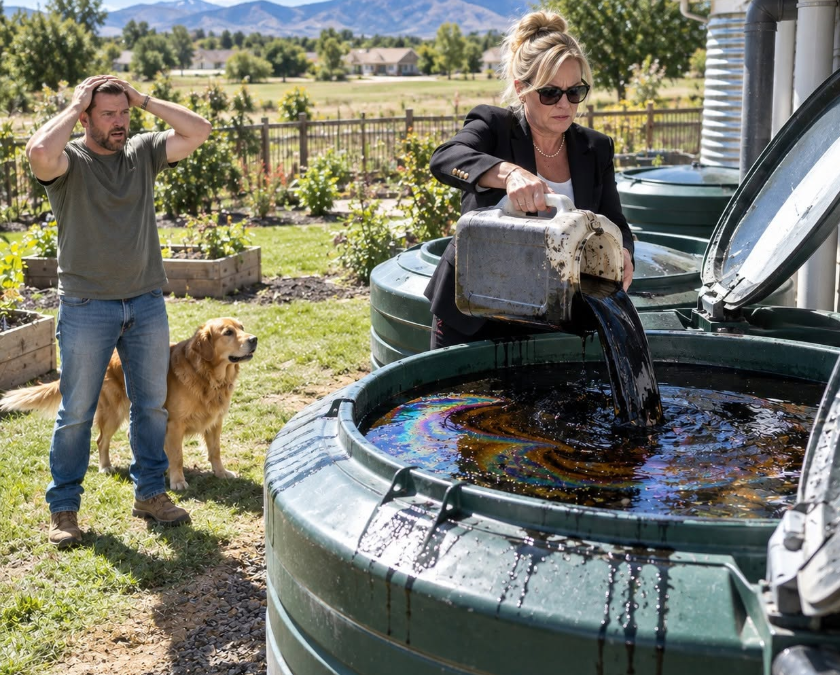
The video showed Ellie entering through the side gate.
No permission.
Two large plastic containers.
Five gallons each.
She struggled with them.
Paused.
Looked around.
Then walked directly toward the primary collection access.
My hands went cold.
She unscrewed the top.
Lifted one container.
Poured.
Slow.
Thick.
Dark liquid.
Then the second.
Every drop.
Into my water system.
I paused the video.
Rewound.
Watched again.
There was no ambiguity.
Not spilled nearby.
Not a mistaken container.
Not dumping waste on the ground.
She deliberately opened my system and poured oil inside.
Then she closed the lid.
Turned.
Looked toward the street.
Walked two steps.
Stopped.
Looked directly toward the camera.
She had spotted it.
I zoomed.
Ellie smiled.
Not nervous.
Satisfied.
Then lifted one hand and gave the camera her middle finger.
That was the moment everything changed.
Before that, I had considered Ellie obnoxious.
Controlling.
Petty.
Maybe even vindictive.
But still inside the world of neighborhood politics.
Fines.
Notices.
Arguments.
Now I was looking at intentional contamination of a private water supply.
Apollo had consumed it.
My property had been exposed.
A potential runoff pathway existed.
This was not a disagreement about landscape aesthetics anymore.
It was criminal destruction.
I copied the footage immediately.
Three locations.
External drive.
Cloud.
Encrypted archive.
Then exported still frames with timestamps.
Engineers document.
People make fun of us until they need proof.
I needed proof.
Because Ellie had always had a problem with me.
Not personally at first.
Philosophically.
Oak Haven had a culture of conformity.
White trim.
Tidy shrubs.
Approved exterior colors.
No obvious alternative systems.
My rain tanks bothered her.
Solar panels bothered her.
Native landscaping really bothered her.
I had replaced a section of ornamental turf with drought-resistant grasses.
She called it “unstructured vegetation.”
I called it plants.
She once fined Mrs. Petrov because her rose supports were visible from the sidewalk.
Another resident received a notice over a bird feeder because fallen seeds supposedly disrupted “aesthetic continuity.”
A young couple was ordered to remove a small St. Francis statue because it was not on the approved ornament list.
No one knew such a list existed until Ellie produced it.
I was different because I challenged her.
Every notice received a response.
Every fine request received the relevant bylaw.
Every invented rule got questioned.
That irritated her.
Rainwater harvesting became our main fight.
She called the tanks unsightly.
I showed city permits.
She called them mosquito hazards.
I showed sealed system design.
She called the solar panels industrial.
I showed approval.
She called my native landscaping neglected.
I showed a maintenance plan.
She hated losing on documentation.
I think that mattered.
But even then, I never imagined oil.
I stood in my yard with the footage playing on my phone.
Ellie walking in.
Pouring.
Smiling.
Finger to camera.
Something inside me settled.
Calm.
Not forgiveness.
Focus.
I had spent years responding to industrial contamination.
You do not help anyone by screaming at a spill.
You isolate.
Sample.
Trace.
Document.
Report.
So I started.
Protective gloves.
Sterile lab containers.
Chain-of-custody labels.
Time.
Date.
Sample point.
Depth.
Temperature.
Container ID.
I siphoned top-layer samples without disturbing the bulk contents.
Collected multiple duplicates.
Sealed.
Labeled.
Placed them inside a temperature-controlled lock box.
Then sampled prefilter residue.
Secondary filter.
Outlet line.
Garden branch.
Overflow trap.
Every point.
I wanted a contamination profile.
Apollo returned from the veterinarian later that day.
He was lucky.
Exposure limited enough for treatment and monitoring.
They kept him under observation.
He came home tired.
I sat on the floor with him that evening.
He put his head on my leg.
I looked toward the backyard.
That was when anger hit hardest.
Property damage is one thing.
A dog does not understand revenge.
Apollo drank because water had always been safe.
Ellie weaponized that trust.
I promised myself something.
No confrontation.
No stupid threats.
No giving her an argument she could twist.
I was going to build the cleanest case I had ever built.
The next morning, I sent samples to an accredited lab through professional contacts.
Requested hydrocarbon profile.
Heavy metals.
Additive compounds.
Viscosity characterization.
Markers.
Used motor oil is chemically messy.
Combustion byproducts.
Metal wear residues.
Additives.
Contaminants.
That mess can become a fingerprint.
If I could match contamination to a source, the video would become even stronger.
While waiting, I started asking questions.
Carefully.
I did not go door to door saying, “Did our HOA president poison your water?”
That contaminates witness memory almost as badly as oil contaminates tanks.
Instead, I framed it as a neighborhood water quality check.
Any unusual odors?
Films?
Discoloration?
Dead fish?
Sick animals?
Mrs. Petrov answered first.
Her fountain had developed a black film.
Her koi died overnight.
She assumed pump failure.
“When?”
She gave a date.
Two weeks before my incident.
I wrote it down.
“Did you save water?”
“No.”
“Any photos?”
“Yes.”
She showed me.
Rainbow sheen.
Oil.
I felt cold.
Next:
Mr. Chang.
Decorative rain barrel.
Mechanic shop smell.
Two turtles became sick after garden runoff reached their enclosure.
Date:
Three weeks earlier.
Then another house.
Garden hose outlet with oily residue.
Another.
Small buried rain collection tank.
Discoloration.
By the end of two days, the possibility of a pattern had become very real.
All the affected properties had something else in common.
Alternative water systems.
Rain barrels.
Fountains.
Nonstandard garden features.
Things Ellie had complained about.
I went to the next HOA meeting.
Normally I argued.
Not this time.
Ellie wore a cream suit.
Perfect hair.
She stood at the front handing out bulletins.
Approved mailbox fonts.
She saw me.
Held eye contact.
Tiny smile.
Cold.
I sat.
Said nothing.
She probably thought I was beaten.
Good.
I wanted her comfortable.
During the meeting she introduced a new “public health advisory.”
Unauthorized rainwater collection may breed mosquitoes and create sanitary hazards.
People looked toward me.
I almost laughed.
The hypocrisy was spectacular.
She had dumped toxic oil into my water and was publicly warning residents that rain barrels were dangerous.
I took the bulletin.
Saved it.
Evidence of hostility.
Not proof of crime by itself.
Context.
Afterward, Mrs. Petrov whispered, “You okay?”
“No.”
She looked concerned.
“Is Apollo okay?”
“He will be.”
That answer spread quietly.
People knew something happened.
I asked them not to speculate.
“Why?”
“Because if this becomes official, I want facts clean.”
Mrs. Petrov nodded.
She understood.
The next issue was pathway.
My system overflowed toward a drainage ditch.
That ditch crossed southward and ultimately joined a Cedar Creek tributary.
Cedar Creek fed toward a federally protected wetland area about three miles away.
That changed scale.
Oil in one private tank is serious.
Oil migrating into public drainage and protected waters becomes much more serious.
I mapped every line.
Roof collection.
Main cistern.
Overflow.
Ditch.
Curb.
Drainage grate.
Tributary.
Topography.
Then sampled legally accessible drainage points.
I found black streaking near the curb.
Thin.
Easy to miss.
Collected samples.
Marked GPS coordinates in my project notes.
Photographed.
No assumptions.
The lab would decide.
I upgraded cameras too.
Higher definition.
Motion alerts.
Different angles.
I had already caught Ellie once.
If she returned, I wanted everything.
Then I visited an automotive supply shop called The Pit Stop.
Large regional store.
Oil.
Parts.
Bulk fluids.
Waste handling.
I knew buying used oil in bulk would be unusual.
So I asked.
Young clerk named Kevin.
Maybe twenty-three.
Friendly.
I showed a still image of Ellie from public HOA material.
“Seen her?”
He looked.
“Maybe.”
“What did she buy?”
He hesitated.
“Are you police?”
“No.”
“Lawyer?”
“No.”
“Then why are you asking?”
“Water contamination issue.”
I gave him my professional background.
Environmental quality systems.
Former state department project work.
Not enforcement.
He relaxed slightly.
Then laughed.
“She bought oil.”
“What kind?”
“Bulk synthetic.”
“How much?”
“Two five-gallon containers.”
My pulse rose.
“When?”
He checked the system.
Three days before my contamination.
Cash purchase.
Specific product.
I asked if the store had surveillance.
“Yes.”
“Keep it.”
“What?”
“Preserve the footage.”
“Why?”
“Because environmental investigators may request it.”
Kevin stared.
“Are you with DEP?”
“I used to work with them.”
His expression changed.
“What did she do?”
“I’m not discussing that.”
Professional discipline.
Harder than gossip.
I asked for the receipt record if legally releasable.
He could not give everything immediately.
Fine.
Preservation mattered.
I documented clerk name.
Time.
Store.
Then left.
By the end of the week, laboratory results arrived.
Hydrocarbon concentrations extreme.
Heavy zinc markers.
Used motor oil profile.
Synthetic additive package.
Exactly consistent with the product category Kevin described.
Not absolute brand-level certainty yet.
But strong.
The drainage ditch sample showed the same general signature.
That scared me.
Now contamination had left my property.
I called David Stone.
Former supervisor at the Department of Environmental Protection.
David sounded permanently irritated even when happy.
“Marcus.”
“David.”
“You finally bored in retirement?”
“I need an official response.”
Silence.
His tone changed.
“What kind?”
“Unauthorized hazardous material dumping.”
“How much?”
“At least ten gallons confirmed at my property.”
“Substance?”
“Used synthetic motor oil.”
“Water source?”
“Rainwater cistern.”
Another silence.
“Household use?”
“Yes.”
“Surface pathway?”
“Likely.”
“Public tributary?”
“Yes.”
“Which?”
“Cedar Creek feeder.”
He exhaled.
“That goes to protected wetland.”
“Yes.”
“How good is your documentation?”
I almost felt insulted.
“David.”
He laughed once.
“Right.”
I summarized.
Security video.
Samples.
Lab reports.
Witnesses.
Store purchase timeline.
Multiple neighboring incidents.
Drainage signatures.
He stopped me.
“We’re sending a field investigation team.”
“When?”
“Friday.”
“That soon?”
“You said Cedar Creek.”
Fair.
“Do not clean.”
“I haven’t.”
“Do not confront.”
“I won’t.”
“Secure samples.”
“Done.”
“Send me chain logs.”
“Already prepared.”
He paused.
“I missed working with you.”
“No, you didn’t.”
“No. I didn’t.”
Friday gave me three days.
I used them to strengthen facts.
Not manufacture.
Verify.
I requested updated drainage maps.
Reviewed HOA maintenance sheds.
Not entered.
Public observation only.
Mapped affected properties.
There were more.
Four additional residents reported oil-like contamination.
One had photographs.
One still had contaminated water in a barrel.
I helped them collect preliminary field samples but told them official investigators would resample.
One buried tank produced unmistakable rainbow sheen.
Same odor.
Every affected location sat near routes accessible from either Ellie’s property or central HOA maintenance areas.
Pattern.
But I still did not know the source beyond my own purchased-oil clue.
Maybe Ellie bought only the oil used on me.
Where did the other contamination come from?
Storage.
Waste collection.
Maintenance stock.
Something.
Thursday afternoon, I watched Ellie leave her house.
Large containers loaded in the trunk.
Heavy.
She drove away.
I followed at a distance.
Before anyone turns that into spy fantasy, I did not run red lights or trespass.
I stayed on public roads.
She drove across town.
Industrial edge.
Self-storage facility.
She entered with a keypad.
Specific unit.
Backed her sedan close.
Went inside.
Twenty minutes.
Returned.
Trunk appeared empty.
I noted the unit number from a distance.
Did not enter.
Did not touch.
That was for investigators.
Friday morning, the DEP team arrived.
Unmarked vehicles.
Protective equipment in cases.
Field meters.
Sample kits.
David got out.
Older now.
More gray.
Same expression.
He shook my hand.
“Show me.”
We started at the cistern.
I handed over the file.
Video.
Timeline.
My samples.
Lab report.
Property map.
Drainage diagram.
Neighbor summary.
Store lead.
Self-storage note.
David flipped through.
“You built a prosecution binder.”
“I built an investigation binder.”
“Same tabs.”
He smiled faintly.
Then official sampling began.
My tank.
Filter system.
Soil near overflow.
Drainage grate.
Curb.
Ditch.
Tributary.
Cedar Creek feeder.
They did their own chain of custody.
That distinction mattered.
My evidence could initiate.
Government evidence would support enforcement.
By afternoon, field readings were ugly.
Hydrocarbon contamination confirmed.
Creek sample elevated.
David stood near the water looking at the meter.
“She’s going to need a miracle.”
I said nothing.
He looked at me.
“And good counsel.”
The official team moved toward HOA property.
Search authority had been prepared based on preliminary evidence and records.
Ellie, meanwhile, was decorating the entrance to the HOA office for Oak Haven’s neighborhood pride weekend.
Flowers.
Flags.
Brochures.
Prospective buyers scheduled.
Perfect timing.
We watched from a distance as David approached.
Ellie turned with a smile.
“Oh.”
She clearly expected some municipal landscaping inspection.
“Can I help you?”
David showed credentials.
“Department of Environmental Protection.”
Her smile changed.
Barely.
Then reset.
“Of course.”
He explained the contamination investigation.
Need for access.
Maintenance sheds.
Records.
Ellie’s expression sharpened.
“I would know if there had been hazardous dumping.”
“Why?”
“I am HOA president.”
I almost laughed from where I stood.
David did not.
He asked, “Who controls maintenance storage?”
“The board.”
“Who has access?”
“Several people.”
“Names?”
She hesitated.
Then began talking.
Too much.
People under pressure often do.
Two investigators entered the maintenance area under lawful authority.
Within thirty minutes, they found containers.
Five-gallon drums.
Several empty.
Several containing oil.
Same category.
One had handwriting.
COLLECT AND SAVE.
Another word beneath looked like initials.
Ellie saw the containers brought out.
Her face changed completely.
“That’s not mine.”
David asked, “Whose handwriting?”
“Not mine.”
One neighbor whispered, “That’s her handwriting.”
Ellie heard.
“Be quiet!”
Bad move.
She started saying frame-up.
Conspiracy.
Someone planted material.
Then she pointed toward me.
“He did this!”
Everyone turned.
“Marcus is obsessed with me.”
I felt genuinely embarrassed for her.
David calmly asked, “Did Mr. Reed place containers inside HOA maintenance storage?”
“Yes.”
“You saw him?”
“No.”
“Camera?”
“No.”
“Witness?”
“No.”
“Then let’s stay with facts.”
Beautiful.
That was exactly why I called professionals.
DEP did not arrest her that day.
That surprised neighbors.
Some expected handcuffs.
Real environmental cases do not work like television.
Samples.
Warrants.
Records.
Chain of custody.
Laboratory confirmation.
Financial tracing.
Interviews.
Then charges.
Ellie received formal notice of investigation.
She left trembling.
Still muttering about government overreach.
Neighbors gathered.
One said, “Can we remove her now?”
That became the HOA’s immediate question.
But the state investigation expanded.
The storage unit mattered.
I gave David my observations.
Unit number.
Time.
Vehicle.
He did not raid based on my story alone.
Investigators obtained appropriate authority.
Meanwhile, cameras near public-facing areas captured Ellie returning to the facility Sunday.
Oversized sunglasses.
Hoodie.
Almost comical disguise.
She entered.
Moved containers.
Used a clipboard.
Checked items.
Not random.
Logistics.
When David viewed the footage, he went quiet.
“That’s inventory management.”
“Exactly.”
“Could be legitimate waste handling.”
“Could.”
“Need money.”
“Yes.”
Follow money.
Always.
DEP investigators obtained financial records through proper process.
HOA discretionary funds.
Maintenance payments.
Waste disposal contracts.
One name appeared:
Greenway Disposal.
Sounds environmentally responsible.
It was not.
Greenway had been flagged in multiple states for improper waste handling.
The HOA had paid it through vague maintenance line items.
Records suggested Ellie authorized payments.
Then oil pickups.
Then containers moving.
Then contaminated properties.
Now this was no longer a single revenge act.
Potential systematic waste disposal.
Misappropriation.
Fraud.
Illegal dumping.
The more investigators dug, the worse it became.
Several neighborhoods connected through Greenway showed questionable waste incidents.
Not all tied to Ellie.
But enough to expand review.
Then Robert came forward.
Ellie’s ex-husband.
Nobody expected him.
He contacted investigators after local news mentioned DEP activity at Oak Haven.
Robert had documentation from their divorce.
Messages.
Notes.
Photographs.
He described a pattern.
When angry, Ellie used environmental destruction as revenge.
Years earlier, during their divorce, she allegedly poured used oil over a backyard garden because he retained the house.
At first, investigators treated it cautiously.
Ex-spouses can have motives.
Good investigators verify.
Robert had photos.
Messages.
A note Ellie sent afterward.
Language matched current behavior.
Then clipboard records.
Target lists.
Properties.
Dates.
Water features.
Rain systems.
Mrs. Petrov.
Mr. Chang.
Me.
My name abbreviated:
M. Reed barrel system.
That froze me.
I stared at the copy.
Not impulse.
Not one angry afternoon.
List.
Plan.
That was harder to process than the video.
The video showed cruelty.
The list showed system.
Ellie had cataloged people.
Infrastructure.
Targets.
Why?
Control.
Retaliation.
Maybe both.
Investigators searched her home under warrant.
Garage.
Storage.
Records.
They recovered funnels.
Gloves.
Labeled containers.
Oil types.
Notes.
More evidence.
The image of a suburban HOA president running an organized used-oil stockpile out of a garage sounds absurd.
Reality did not care.
When police and environmental investigators carried out bins, half the neighborhood watched.
I stayed inside.
Did not want spectacle.
Apollo lay beside me.
Healthy again.
That mattered more.
Ellie was later located two counties away and served.
Charges included illegal dumping.
Environmental damage.
Misappropriation of association funds.
Conspiracy connected to hazardous disposal.
Endangering a protected waterway.
Specific legal counts evolved as prosecutors reviewed evidence.
That is normal.
The source of truth became charging documents, not neighborhood gossip.
I gave statements.
Turned over originals.
Maintained chain logs.
Provided engineering explanation.
Then waited.
Oak Haven removed Ellie from HOA leadership almost immediately.
Emergency election later.
Interim board.
Financial audit.
People discovered how much power she had centralized.
Vendor approval.
Enforcement.
Maintenance spending.
Almost no independent review.
That explained Greenway payments.
She had built a system where she could authorize “maintenance” expenditures with minimal scrutiny.
Residents were furious.
Some because of environmental harm.
Some because their dues funded it.
Money turns abstract outrage into personal outrage quickly.
I understood both.
Cleanup began.
My system was a loss.
Not every component.
But enough.
Oil penetrates surfaces.
Filters.
Seals.
Piping.
Certain materials can be cleaned.
Others should be replaced.
I could have rebuilt immediately.
I waited until official sampling completed.
Then isolated contaminated parts.
Professional disposal.
Soil remediation.
Apollo stayed on municipal water.
Garden watering stopped.
Vegetables potentially exposed were discarded.
That hurt.
Months of work.
Gone.
Mrs. Petrov’s fountain had to be drained and cleaned.
Her fish were already gone.
Mr. Chang replaced his barrel and treated his turtle enclosure.
Affected residents received guidance.
Creek cleanup was larger.
Containment.
Absorbent boom where appropriate.
Sediment monitoring.
Testing.
Wetland surveillance.
Environmental harm does not vanish because the perpetrator is caught.
That is the part revenge stories usually skip.
Cleanup.
The boring, expensive, slow part.
Oil leaves a legacy.
The irony almost made me angry all over again.
Ellie claimed she cared about neighborhood appearance.
Her actions created environmental cleanup trucks, warning tape, sampling stations, and weeks of remediation.
All because she disliked rain barrels.
The trial came later.
Packed courtroom.
Environmental cases rarely draw crowds.
This one did because everyone knew Ellie.
Neighbors wanted to see.
Reporters too.
She sat beside expensive counsel.
Looked smaller.
No cream suit.
Dark.
Conservative.
No clipboard.
The prosecution built a timeline.
Not emotion.
Purchase.
Access.
Video.
Chemical match.
Multiple sites.
Storage unit.
HOA payments.
Greenway.
Garage stockpile.
Robert’s evidence.
Environmental pathway.
Cedar Creek.
Wetland risk.
The defense tried alternatives.
Frame-up.
Contaminated municipal system.
Improper private tank maintenance.
Environmental activists targeting her.
Each theory ran into evidence.
Municipal system unaffected.
My tank video clear.
Store purchase.
Chemical profile.
Physical access.
Her face.
Her hand.
Oil entering.
Hard to argue with recorded reality.
When the video played, the courtroom changed.
Ellie carrying containers.
Opening hatch.
Pouring.
Then looking at the camera.
Smiling.
Middle finger.
Silence.
I had watched it dozens of times.
Still hated it.
Not because of the insult.
Because I remembered Apollo coughing.
The prosecutor paused the video.
Zoomed.
Timestamp.
Then store record.
Three days earlier.
Product category.
Chemical report.
Additive signature consistent.
Then my tank.
Then another contaminated property.
Then HOA storage.
Then her home.
Pattern.
Robert testified.
I was skeptical how the jury would receive him.
Ex-husband.
History.
But he was calm.
No theatrical hatred.
He described prior retaliatory dumping.
Messages.
Notes.
Explained target-list language.
His testimony strengthened premeditation.
Then I testified.
I had testified as an expert before in professional contexts.
Different when victim.
I reminded myself:
Facts.
No adjectives.
No Ellie the Enforcer.
No rage.
My name.
Qualifications.
System design.
Normal operation.
Detection.
Isolation.
Sampling protocol.
Lab results.
Flow path.
Chemical signature.
Potential migration.
Protected wetland connection.
The defense attorney tried to make my system look unsafe.
“Mr. Reed, isn’t harvested rainwater inherently vulnerable to contamination?”
“Any water source can be contaminated.”
“But private systems lack municipal oversight.”
“Mine was permitted, sealed, monitored, and maintained.”
“You designed it yourself.”
“Yes.”
“So you had total control.”
“Over design and maintenance.”
“Could you have introduced oil accidentally?”
“No.”
“Why not?”
“Because there is no motor oil stored near the collection inlet, and security video records the defendant pouring it in.”
Several jurors looked down.
The defense changed direction.
“Could chemical signatures overlap?”
“Yes.”
“So you cannot say one molecule came from one exact container.”
“Correct.”
He looked pleased.
I continued.
“But the contaminant profile, additive package, timing, source purchase, video, storage samples, and distribution pattern are mutually consistent.”
The pleasure faded.
Science does not need magic certainty.
Evidence converges.
That is what I explained.
No one test.
Many independent points.
Same conclusion.
The jury deliberated less than an hour.
Guilty.
Environmental damage.
Illegal dumping.
Misuse of community funds.
Other related counts.
Ellie sat still.
No dramatic collapse.
No screaming.
Just blinking.
I expected to feel triumphant.
I did not.
Relief.
That was all.
Sentencing came two days later.
Full restitution.
Environmental cleanup costs.
Financial penalties.
Permanent exclusion from HOA activity.
Eighteen months supervised probation.
Mandatory community service cleaning hazardous roadside waste under county supervision.
Bright orange vest became the detail neighbors loved.
I found it less funny.
Appropriate, maybe.
But environmental cleanup is serious work.
If she learned respect for contamination while doing it, good.
She was also barred from handling or storing regulated materials.
That mattered.
Some people wanted prison.
Others thought probation too light.
I did not decide the sentence.
Not my job.
The court weighed charges, circumstances, and law.
My priority was repair.
Apollo healthy.
Water safe.
Creek recovering.
That was enough.
The neighborhood changed rapidly after conviction.
People who had been quiet spoke.
Old fines reviewed.
Rules reconsidered.
Ellie’s aesthetic obsession lost authority overnight.
Bird feeder restrictions?
Gone.
Overly broad ornament rules?
Gone.
Native landscaping prohibitions?
Gone.
Rainwater hostility?
Gone.
Solar restrictions reviewed.
A special election was called.
Neighbors asked me to run for president.
I laughed.
Then realized they were serious.
“No.”
Mrs. Petrov asked.
“No.”
Mr. Chang.
“No.”
David, not even a resident, said, “You should.”
“Absolutely not.”
Then I looked at the board documents.
There was no transparency.
Vendor selection was weak.
Environmental policy backward.
Enforcement concentrated.
I changed my answer.
“One condition.”
Residents listened.
“Actually several.”
First:
Published budgets.
Second:
Conflict disclosures.
Third:
Independent approval for vendor contracts.
Fourth:
Clear appeal process.
Fifth:
Permanent recognition of lawful sustainable systems.
Rain barrels.
Solar panels.
Native landscaping.
Sixth:
Environmental safety policy.
No president with unilateral control.
They agreed.
I ran.
Won.
Not because people thought I was charismatic.
I am not.
Because I had folders.
Apparently after Ellie, folders became reassuring.
My first meeting felt strange.
Her chair.
Same room.
I moved the chair.
Small gesture.
People noticed.
I started, “This association exists to manage shared obligations.”
Pause.
“Not individual taste.”
Applause.
I hated applause.
“We’re going to make this boring.”
More applause.
People really had suffered.
We removed nonsense rules.
Not everything.
Some standards matter.
Drainage.
Safety.
Common spaces.
Parking.
Reasonable maintenance.
But rules had to have purpose.
Rain collection became encouraged if properly designed and maintained.
Solar welcomed.
Native landscaping recognized.
Bird feeders allowed within sanitation rules.
Garden ornaments regulated only where actual shared visibility or safety issues existed.
Mrs. Petrov put St. Francis back for the young couple.
They cried.
That showed how much pressure Ellie had created over tiny things.
The rebuild of my rainwater system became a community project.
I initially wanted professionals only.
Then neighbors asked to help.
Not technical contamination work.
Cleanup after clearance.
Trenching.
Moving materials.
Garden restoration.
Painting enclosures.
Mrs. Petrov brought food.
Mr. Chang handled the expense spreadsheet.
Kids painted small water-drop signs.
Even residents who disliked rain barrels came.
That changed how I saw Oak Haven.
For years, Ellie made community feel like enforcement.
Now community looked like people carrying pipe.
Apollo supervised.
Poorly.
He stole a sandwich.
Fully recovered.
The new system was stronger.
Tamper-resistant hatches.
Locking access.
Smart chemical monitoring.
Hydrocarbon sensor.
Remote alerts.
Flow isolation.
Redundant bypass.
If unusual readings occurred, automatic shutdown.
Overkill?
Maybe.
Engineers respond to trauma with sensors.
David approved.
“You built Fort Knox.”
“For water.”
“Normal people just buy bottled water.”
“Normal people disappoint me.”
He laughed.
When the system went live, I tested for days before Apollo got access.
He stared at his old drinking station.
Confused.
Finally, I opened it.
He drank.
I watched like a paranoid father.
Water clear.
Sensors normal.
Lab normal.
Good.
That moment meant more than the courtroom.
Trust restored.
The contaminated garden required replanting.
We replaced vegetables.
Added native pollinator beds.
Neighbors contributed seedlings.
Spring came.
Everything grew.
Oil had killed a season.
It did not kill the soil forever after proper remediation.
Nature can recover.
Slowly.
That gave me hope.
Cedar Creek monitoring improved.
No long-term catastrophic wetland damage was documented in our area beyond the contamination response levels we had observed, but ongoing testing remained important.
I never exaggerated.
Environmental harm needs accuracy.
People love dramatic words.
Poisoned forever.
Destroyed ecosystem.
Sometimes true.
Sometimes not.
In our case:
Serious contamination.
Real risk.
Cleanup.
Monitoring.
Recovery.
That truth was enough.
The HOA audit revealed how Greenway money moved.
Fake or inflated maintenance contracts.
Waste pickup line items.
Discretionary spending.
Ellie had used association money to support illegal oil handling.
Residents were furious.
We referred all appropriate financial matters to authorities.
No neighborhood vigilante accounting.
Real forensic review.
Some funds recovered.
Some not.
The experience changed how we approved vendors forever.
Three bids.
License verification.
Insurance.
Environmental compliance.
Conflict check.
Board vote.
Published summary.
Boring.
Beautiful.
One member complained, “This takes too long.”
I answered, “Used oil.”
The meeting moved on.
That became shorthand.
Want to skip review?
Used oil.
Want a verbal contract?
Used oil.
Want one officer to approve spending?
Used oil.
Institutional memory can be efficient.
I also refused to turn the HOA into an anti-Ellie club.
Important.
Some residents wanted a permanent ban on everything she liked.
White trim?
Keep it if people want.
Traditional lawns?
Fine.
Neat hedges?
Fine.
Freedom works both directions.
Sustainable living should be allowed.
Not mandatory.
Native garden or lawn.
Solar or no solar.
Rain barrel or municipal water.
Within law and reasonable community impact.
Choice.
Ellie’s problem was not preferring uniformity.
It was enforcing preference through abuse.
We corrected abuse, not taste.
That nuance mattered.
Mrs. Henderson, one of Ellie’s old supporters, kept a perfect lawn and white trim.
I liked her.
She apologized once.
“I thought your tanks were ugly.”
“They are.”
She blinked.
I laughed.
“They’re functional ugly.”
She smiled.
“I still don’t want one.”
“You don’t need one.”
That was progress.
We could disagree without fines.
The wooden sign came later.
That was my indulgence.
Local artist.
Cedar plank.
Hand-carved.
Mounted near the rebuilt system.
It read:
THIS SYSTEM WAS NEARLY DESTROYED BY IGNORANCE AND MALICE.
IT NOW STANDS AS A MONUMENT TO RESILIENCE, TRUTH, AND CLEAN WATER.
MAY WE NEVER FORGET THE MESS ONE PERSON CAN MAKE OR HOW MUCH STRONGER WE ARE WHEN WE CLEAN IT UP.
Below, smaller:
THANKS FOR THE INSPIRATION, ELLIE VANCE.
Colleen from the next street laughed when she saw it.
“Petty.”
“Educational.”
“Petty educational.”
Fair.
I eventually considered removing her name.
Not because she deserved protection from truth.
Because I no longer wanted the system defined by her.
Years later, I replaced the bottom line.
Now:
BUILT BY MARCUS REED. REBUILT BY OAK HAVEN.
Better.
Community over enemy.
That felt mature.
The original sign piece sits in my garage.
History.
Apollo aged.
Slower.
Still loved the water station.
Every time he drank, I checked the sensor without meaning to.
Habit.
He had no idea.
Dogs live forward.
We should learn.
His coughing had started everything for me emotionally.
Without Apollo, I might still have discovered contamination through smell or sensors.
But seeing him sick transformed the case.
I had to guard against anger during the investigation.
That was hardest.
Professional Marcus knew protocol.
Dog-owner Marcus wanted to walk across the street and demand a confession.
I did not.
That restraint protected the case.
Had I confronted Ellie immediately, she might have removed storage.
Destroyed records.
Warned Greenway.
Changed behavior.
Instead, she stayed confident.
That arrogance preserved evidence.
The video itself probably convinced her I would be too shocked to act intelligently.
Middle finger.
Smirk.
She wanted me to know.
That psychological choice doomed her.
If you intentionally harm someone and then signal ownership of the act, you reduce ambiguity.
Not smart.
People who crave domination sometimes need recognition more than secrecy.
Ellie wanted credit.
She got it.
In court.
When neighbors later called me a hero, I rejected that too.
I had advantages.
Training.
Knowledge.
Contacts.
Resources.
Security cameras.
Many residents did not.
Mrs. Petrov noticed an oily fountain and thought equipment failure.
Mr. Chang thought barrel problem.
They did not know to collect chain samples.
That does not make them careless.
It means systems should protect ordinary people.
The DEP investigation did.
Eventually.
Our new HOA tried too.
Environmental complaint process.
Anonymous reporting.
No retaliation.
Independent testing when credible.
That was the institutional lesson.
Do not rely on every resident being an environmental engineer.
Build safeguards.
One year after the trial, we held community water day.
Sounds terrible.
Kids loved it.
Demonstrations.
Rain collection.
Watershed maps.
Pollution prevention.
City utility staff.
David came reluctantly.
I introduced him as a grumpy expert.
He threatened to leave.
Stayed.
Children learned that one quart of oil can contaminate huge quantities of water.
That statistic frightened them.
Good.
Environmental education should.
Mrs. Petrov brought roses for the table.
Mr. Chang brought turtle photos.
Apollo became mascot.
Someone made him a bandana:
CLEAN WATER CREW.
He wore it proudly.
That day healed something.
The system that had been a target became an educational resource.
Not a monument to crime.
A resource.
Future.
I preferred that.
Water monitoring data became public.
Monthly dashboard.
Quality.
Usage.
Rainfall.
Neighborhood runoff.
Not required.
People liked it.
Children checked after storms.
Mr. Chang built the spreadsheet.
Retired accountants also respond to trauma with data.
We bonded.
Rain barrels multiplied.
Irony.
Before Ellie:
Four systems.
Three years after:
Twenty-seven.
All permitted.
Proper screens.
Overflow.
Maintenance.
The exact thing she tried to destroy became normalized.
Solar too.
Native gardens spread.
Oak Haven became known locally for sustainable retrofits.
Property values did not collapse.
Some increased.
Real estate listings mentioned community sustainability features.
Ellie would have hated that.
Or maybe eventually accepted it.
Unknown.
I did not care.
Progress rarely asks permission from people committed to stasis.
But progress should ask permission from property owners.
Difference.
We encouraged.
Never forced.
That mattered.
My own system evolved.
Added a second cistern.
Not because I needed revenge capacity.
Because climate variability increased.
Storage is useful.
David teased me.
“You building a municipal utility?”
“No.”
“Yet.”
Apollo inspected the excavation.
Almost fell in.
Retired from mascot duty.
The new cistern included a sampling port designed for easier chain collection.
Habit again.
Hopefully never used for crime.
But engineering remembers failure.
Aircraft improve after accidents.
Water systems after contamination.
Institutions after corruption.
If they learn.
That is the choice.
Oak Haven learned.
I learned.
Even DEP adjusted outreach after the case.
They developed guidance for private rainwater contamination.
David sent me the draft.
“Your fault.”
“Good.”
Systemic value.
One incident creates better response.
That is how painful events become useful without being justified.
No silver lining makes crime good.
But aftermath can produce improvement.
Important distinction.
I would undo Apollo’s exposure instantly if possible.
Even if reforms disappeared.
Do not romanticize suffering.
Use what happened.
That is all.
The Greenway angle continued beyond Ellie.
Other jurisdictions investigated.
I did not follow details.
Not my case.
It reminded me criminal systems are often larger than one person.
Ellie used a vendor already willing to mishandle waste.
Supply meets demand.
Weak oversight enables it.
That is why vendor regulation matters.
If we only focused on Ellie, another president could hire another Greenway.
Fix market access.
Checks.
Documentation.
The board instituted environmental vendor standards.
Waste haulers licensed.
Manifest records.
No cash.
No vague “maintenance disposal.”
Invoices itemized.
Unsexy.
Preventive.
I loved it.
Budget meetings became longer.
Residents complained.
I told them, “You voted for an engineer.”
They groaned.
Next election, nobody opposed me.
Apparently trauma had made spreadsheets attractive.
I served two terms.
Then stepped down.
Important.
Power should rotate.
I had seen what happens when title becomes identity.
I did not want President Marcus.
I wanted Marcus.
Engineer.
Dog owner.
Gardener.
Neighbor.
The new president was Mrs. Petrov.
Prize-winning roses.
Gentle voice.
Steel backbone.
Perfect.
Her first act was not banning anything.
She planted a community pollinator strip.
Second:
Financial transparency report.
Good.
I returned to the advisory environmental committee only.
No title that mattered.
Peace.
Years passed.
Apollo’s muzzle turned white.
Mine too.
We walked the creek together.
Testing stations still existed.
Water clear.
Wetland healthy enough.
Birds.
Frogs.
Life.
I would stop by one sampling point.
Remember black streak.
Gone.
That gave satisfaction no courtroom could.
Cleanup works.
Nature responds.
But prevention is cheaper.
Always.
Apollo died years later.
Old age.
At home.
Not oil.
That mattered irrationally.
I had carried fear that contamination shortened him.
The veterinarian believed there was no lasting effect.
Still.
When he died, I buried his collar under the oak near the rain system.
Not his body.
Cremated.
Collar.
The system he trusted almost harmed him.
Then became safer because of him.
I installed a small brass tag:
APOLLO
QUALITY CONTROL SUPERVISOR
Neighbors loved it.
That memorial means more than the Ellie sign ever did.
Again, define by what you love.
Not the enemy.
The story became local legend.
New residents heard it.
Some exaggerated.
“President poisoned the entire neighborhood.”
No.
Multiple properties contaminated.
Creek affected.
Not the whole neighborhood drinking water.
“Dog nearly died.”
Apollo got sick, recovered.
“FBI raided her house.”
No.
Environmental investigators and law enforcement executed warrants.
“Ellie got prison.”
No.
Probation, restitution, community service, restrictions.
Truth.
Why insist?
Because environmental cases already struggle with credibility when people dramatize.
Facts matter.
If you want law respected, tell it accurately.
I corrected even when less exciting.
Some content creators hated me.
Fine.
One asked, “Can I call it felony poisoning?”
“No.”
“Why?”
“Because the legal charge wasn’t attempted poisoning.”
“But she put oil in drinking water.”
“Describe that.”
Less sensational.
More powerful.
Language precision protects everyone.
Including the accused.
Including victims.
Expert habit.
The creek runs south.
I walk it occasionally.
Protected wetland farther.
Birds.
Reeds.
Water insects.
No rainbow sheen.
When sun hits the surface, natural reflection can look rainbow for a split second.
My heart still jumps.
Then I look.
No oil.
Trauma in optics.
I carry field strips sometimes.
Overkill.
Maybe.
Peace does not require forgetting.
Just living anyway.
Apollo’s collar tag jingles in my memory when I walk.
He would have jumped in the creek if allowed.
Never learned caution.
Dogs trust the world.
Humans complicate it.
Our responsibility is to make water safe for creatures that cannot inspect it.
That thought guided advocacy.
Environmental protection is often described abstractly.
Wetlands.
Watersheds.
Compliance.
But at the beginning, it was a dog drinking from a bowl.
Environmental law protects intimate things.
Pets.
Gardens.
Children.
Neighbors.
That makes it real.
Ellie saw a barrel.
I saw a drinking system.
Regulators saw a tributary.
Scientists saw hydrocarbon loading.
All layers matter.
The crime crossed all of them.
Property.
Animal health.
Public water.
Protected habitat.
Finance.
That is why the response became serious.
Not because I had friends.
Because pathways connected.
Systems.
Always systems.
I taught residents the drainage map after the case.
Where street water goes.
People were shocked.
They thought storm drain meant treatment plant.
Not always.
Often directly toward waterways.
Oil poured in a yard does not disappear.
It travels.
That education reduced dumping of household chemicals.
Positive.
People started proper disposal days.
Greenway was replaced by a licensed provider.
Manifest.
Accountability.
We created a hazardous household waste event twice yearly.
Participation was high.
Irony again.
Crime increased proper disposal awareness.
No thanks to Ellie.
Thanks to the response.
Environmental governance should make correct behavior easy.
Ellie used disposal as a weapon and money channel.
We made disposal a legitimate service.
Structural solution.
That is how you beat a pattern.
Not just punish a person.
Change incentives.
Long stories matter because the short version can make revenge seem simple.
Find evidence.
Call agency.
Bad person convicted.
Real life:
Samples.
Waiting.
Fear.
Dog vet.
Neighbors confused.
Chain forms.
Lab delays.
Legal paperwork.
Cleanup.
Board meetings.
Restitution.
Rebuild.
Years.
Justice is slow.
Not always satisfying moment to moment.
But durable.
That is why I prefer slow justice to fast revenge.
Fast revenge destroys evidence.
Creates new harm.
Slow process can feel unbearable.
But when built well, it sticks.
Ellie’s own smirk on video could not be argued away.
Every step after made it stronger.
If I had confronted her at her door, she might have denied it.
If I had dumped oil back, I would have become criminal too.
If I had posted online first, witnesses would have been contaminated.
Instead:
Sample.
Document.
Report.
Let the system work.
That is the lesson I would give anyone facing serious sabotage.
Safety first.
Preserve.
Professional help.
Do not retaliate physically.
You want clean hands and clean evidence.
Especially environmental crime.
Contamination is already messy enough.
Mrs. Petrov still has roses.
Mr. Chang’s turtles recovered.
One died later unrelated.
He clarifies every time.
Affected households received remediation.
No one’s system remained contaminated.
Cedar Creek recovered within monitored parameters.
That is what matters.
Ellie served probation.
Completed community service as far as records indicated.
After that, she disappeared from my life.
No need to update.
Boundary.
I do not search her name.
People send occasional articles.
I ignore them.
Memory should not become surveillance.
She once watched and targeted us.
I refuse to mirror that.
That is perhaps the biggest victory over control culture.
Let go.
One morning years later, I woke to Apollo’s successor, Luna, drinking from the station.
Black lab.
Bad manners.
I froze instinctively.
Then the sensor stayed green.
Water clear.
She looked at me like I was strange.
I laughed.
“Drink.”
She did.
No fear.
A new dog does not inherit old trauma unless I teach it.
Important.
I scratched her ears.
Rain had filled the tank overnight.
Garden wet.
Sun rising.
Quiet.
That scene replaced the original.
Same system.
Different morning.
No sludge.
No video.
No crime.
Just life.
Maybe every story needs that.
Not villain punished.
Victim normal again.
That is closure.
So yes, Eleanor Vance dumped used motor oil into my rainwater system.
Yes, she was caught.
Yes, environmental investigators uncovered a wider operation.
Yes, financial misconduct.
Yes, trial.
Guilty.
Restitution.
Cleanup.
Probation.
Community service.
Restrictions.
Yes, I became HOA president and changed the rules.
All true.
But the detail I care about now is simpler.
The water is clean.
The neighborhood is healthier.
The creek runs clear.
People ask permission.
Contracts get reviewed.
Rain barrels sit openly beside houses.
Solar panels shine.
Native grasses move in the wind.
No one gets fined because a garden has personality.
And when storms roll across Oak Haven, gutters fill, cisterns rise, and people hear rain hitting roofs instead of worrying about what someone might have poured into their tanks.
Ellie tried to use contamination as punishment.
Instead, she exposed every weak point in our neighborhood.
Environmental.
Financial.
Governance.
Social.
We fixed them.
That is why I stopped thinking of her as the ending.
She was the failure event.
The rebuild was the ending.
Engineers understand that distinction.
A failure tells you where design is weak.
If you learn, the next version is stronger.
My water system became stronger.
The HOA became stronger.
The community became stronger.
I became less obsessed with independence and more committed to resilience.
Apollo recovered.
Then lived out his life loved.
Nothing she did could take that.
Sometimes visitors read the wooden sign.
They ask, “What happened here?”
I tell the shorter version.
“Someone contaminated the system.”
“What did you do?”
“Documented.”
They expect dramatic.
“That’s it?”
“Then called professionals.”
“What happened to her?”
“Court handled it.”
They look disappointed.
People want a revenge story.
I give them process.
Because process saved us.
Not rage.
Not fists.
Not a clever trap.
Evidence.
Science.
Law.
Community.
That combination is slower than revenge.
Less cinematic.
Far more powerful.
And every time rain hits the roof and the sensors stay green, I am reminded that the thing Ellie tried hardest to destroy is still working exactly as designed.
Only now it is not just mine.
It is part of what changed Oak Haven.
A reminder that clean water matters more than clean curb appeal.
That rules should protect people, not punish difference.
That a title does not give anyone the right to contaminate another person’s home.
And that if you pour ten gallons of used motor oil into an environmental engineer’s carefully monitored rainwater system, smile into his camera, leave a chemical trail through a protected watershed, pay for your disposal operation with HOA money, and keep records of the entire thing on a clipboard, you should probably expect someone to follow the evidence.
I did.
The investigators did.
The jury did.
And once all of us followed it to the end, Ellie’s power disappeared.
The rain did not.
It kept falling.
We cleaned up.
We rebuilt.