HOA Karen Cut Power to My Ridge Beacon—Then the Airport Called Asking Why Their Approach Light Vanished in the Clouds
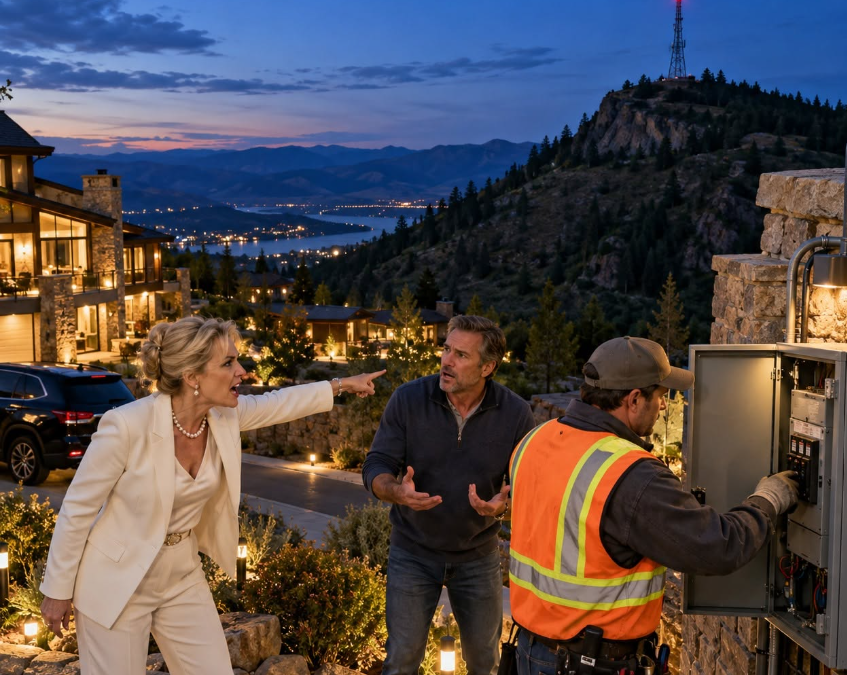
HOA Karen Cut Power to My Ridge Beacon—Then the Airport Called Asking Why Their Approach Light Vanished in the Clouds
Sabrina Wexler thought the blinking red light above my ridge was ruining the view from her million-dollar terrace.
She ordered a contractor to kill the power at sunset, then smiled as the mountain finally went dark.
Twenty-three minutes later, the airport called me because a small aircraft was descending through low clouds—and one of its approach reference lights had just disappeared.
At 8:17 that Friday night, the HOA president ordered a contractor to kill the power to the red beacon above my ridge because she wanted her expensive mountain view back.
Twenty-three minutes later, the airport called me asking why one of their approach lights had suddenly disappeared while an aircraft was descending through low clouds.
My name is Reed Callaway, and for years Blackstone Ridge was exactly what I wanted it to be.
Quiet.
Remote.
Predictable.
Eighty-six acres of pine, rock, brush, old access roads, and enough distance between my front porch and everybody else’s opinions that I could drink coffee in the morning without hearing a lawn mower, a leaf blower, or somebody arguing about whether a mailbox was the wrong shade of gray.
The property sat east of Redwood Regional Airport.
From the county road below, Blackstone Ridge looked like a long dark spine rising above the valley. Most people passed it without thinking much about it.
I liked that.
My house sat well below the summit.
Above the house, near the highest usable ground on the ridge, stood a steel pole about forty feet tall.
Mounted at the top was a beacon.
During daylight, it barely registered.
At night, it pulsed red and white on a fixed cycle.
Slow.
Steady.
Reliable.
I had lived with that light for so long that I hardly noticed it anymore.
If I stepped onto my porch after dark, my eyes registered the flash somewhere above the trees the same way they registered stars or the distant lights of Redwood Regional.
It was simply there.
It had been there long before Stonehaven Ridge Association existed.
That distinction would eventually matter more than anything else.
Stonehaven was a gated residential development built along the lower slope on the opposite side of the ridge.
The first phase had gone in years earlier.
Then came another.
Then bigger houses.
Then larger lots.
Then glass terraces and infinity pools and marketing brochures promising panoramic mountain living.
By the time Sabrina Wexler moved into Stonehaven, some of those homes were worth more than anything I had ever imagined paying for a house.
Her villa was one of the newer ones.
White stone.
Dark roof.
Floor-to-ceiling windows.
Wide terrace facing directly toward Blackstone Ridge.
And when she stood on that terrace at night, she could see my beacon.
Or, more accurately, the airport’s beacon.
Sabrina never cared much about that distinction.
The first letter arrived about four months after she became president of the Stonehaven Ridge Association.
I remember opening the mailbox and seeing the HOA logo.
At first, I thought it had been delivered to me by mistake.
My property wasn’t inside Stonehaven.
It had never been inside Stonehaven.
There was no shared road agreement.
No annexation.
No covenant.
No dues.
No architectural committee.
No legal relationship at all.
I opened it anyway.
The header read:
PART2:
NOTICE OF UNAUTHORIZED COMMERCIAL LIGHTING.
I laughed before I finished the first paragraph.
According to Sabrina, the beacon constituted a visual nuisance visible from Stonehaven property and violated the association’s dark-sky standards.
I read the sentence twice.
Then I looked up toward the ridge.
The beacon blinked calmly against the evening sky.
Red.
Dark.
White.
Dark.
Red again.
I went inside and pulled the county plat.
Not because I had forgotten where my property ended.
Because sometimes the fastest way to deal with nonsense is to make sure it really is nonsense.
Stonehaven’s legal boundary ended more than a thousand feet from the electrical cabinet below that beacon.
There was no overlap.
No shared parcel.
Nothing.
I wrote one sentence.
Stonehaven HOA has no jurisdiction over Blackstone Ridge.
Then I mailed it.
That should have ended things.
Instead, it irritated Sabrina.
I learned later that Sabrina had built most of her reputation inside Stonehaven on the ability to make people respond.
If she sent a warning, homeowners wrote back.
If she announced a fine, they argued.
If she summoned someone to a board hearing, they appeared.
Even when people hated her, they acknowledged her authority simply by participating in her process.
I didn’t.
That was the part she couldn’t tolerate.
The second letter arrived nine days later.
This one was longer.
It mentioned “regional nuisance impacts,” “view corridor interference,” “nighttime quality-of-life degradation,” and “potential violation of Stonehaven’s exterior illumination policy.”
I taped it to the refrigerator because it was funnier than most things I received in the mail.
My sister, Mara, saw it when she came by that Sunday with groceries I had not asked for and did not need.
She read the letter while standing in my kitchen, one hand on her hip.
“Reed.”
“What?”
“You cannot keep attracting insane women with clipboards.”
“I don’t attract them. I ignore them. That’s different.”
She pointed toward the ridge through the kitchen window.
“Does Sabrina know what that beacon is?”
“She knows it blinks. That appears to be her main area of expertise.”
Mara gave me the look she had used since we were children whenever I pretended something serious was not serious.
Mara was five years younger than me, a high school counselor in Redwood Valley, and the only person on earth who could walk into my house, criticize my entire life, refill my pantry, and make me grateful all in the same hour.
She had our mother’s patience and our father’s ability to hear trouble before it spoke.
“You should call the airport,” she said.
“I already spoke with them last year when I replaced the lens housing.”
“And?”
“And they have the maintenance file.”
“Call again.”
“Mara.”
“Reed.”
I sighed.
There was no arguing with Mara when she used my name like a court order.
So I called Redwood Regional’s operations office the next morning.
The airport manager, Tom Reilly, answered on the third ring.
“Reed Callaway,” he said. “Please tell me the beacon hasn’t fallen down.”
“Still standing.”
“I love calls that start with good news.”
“I’m getting HOA letters.”
There was a pause.
“What HOA?”
“Stonehaven Ridge.”
“About the beacon?”
“Yes.”
Another pause.
Then Tom laughed.
Not a polite laugh.
A full, open laugh from a man who had dealt with county committees, pilots, weather, construction grants, runway lights, bird strikes, and enough bureaucracy to know absurdity when it arrived in formal stationery.
“They can’t be serious,” he said.
“They seem committed.”
“That light predates their subdivision.”
“I know.”
“It’s on your land under a recorded aviation easement.”
“I know.”
“It’s part of the eastern visual reference chain for runway approach in marginal conditions.”
“I know.”
“It’s on the FAA chart supplement.”
“I know.”
“Then why am I explaining this to you?”
“Because my sister told me to call.”
“Smart woman.”
“She tells me that often.”
Tom’s laughter faded.
“Send me copies of the letters.”
“Why?”
“Because if an HOA president is harassing the owner of a private approach beacon tied into airport safety infrastructure, I’d like a paper trail before she gets creative.”
That sentence stuck with me.
Before she gets creative.
I had spent twenty-nine years working in aviation safety systems before retiring early after a back injury and a bad winter that taught me I was no longer interested in airport politics. I had seen people get creative around regulations. They almost always did it because some rule, light, fence, marker, or warning sign was standing between them and something they wanted.
Sometimes it was money.
Sometimes convenience.
Sometimes pride.
Sabrina wanted a clean dark mountain behind her glass wall.
That sounded trivial until you understood people like Sabrina did not experience wanting as a private feeling.
They experienced it as evidence of entitlement.
The beacon had been installed in 1978 by Redwood Regional’s predecessor authority, back when the airport was smaller, the runway shorter, and the eastern approach less developed. The ridge created a visual challenge in low cloud and night operations. The airport did not own the ridge, but my father did.
My father, Elias Callaway, had been a lineman, a volunteer firefighter, and the kind of man who believed public safety was not a slogan but a habit. When the airport approached him about placing a beacon near the summit, he agreed with one condition.
“If that light helps one pilot get home,” he told them, “you keep it working.”
So they recorded an easement.
The airport provided the equipment.
My father provided access and routine eyes-on monitoring because he already checked the ridge roads and water tanks.
After my father died, I inherited both the land and the responsibility. The airport handled official maintenance, but I kept the access clear, checked the cabinet, reported outages, and made sure ice, vandals, animals, lightning, and human stupidity did not take the beacon offline.
Mostly lightning and animals.
Until Sabrina.
The third letter was not mailed.
It was delivered by hand.
I was splitting firewood near the lower shed when a black electric SUV rolled up my drive.
A woman stepped out wearing cream slacks, dark sunglasses, and a blouse so white it looked like it had never encountered dust.
Sabrina Wexler was in her late forties, though she presented herself like a brand category. Everything matched. Everything was deliberate. Hair cut sharp at her jaw. Nails pale. Gold bracelet. Perfume arriving ten seconds before she did.
Two men got out behind her.
One was older, thin, and anxious, holding a binder.
The other wore a Stonehaven security polo and tried to look bored.
Sabrina stopped ten feet from me and looked around my property as if it had personally disappointed her.
“Mr. Callaway.”
“Sabrina.”
Her lips tightened slightly.
“It’s Mrs. Wexler.”
“You came to my house uninvited. I’m feeling informal.”
The security guard shifted.
The thin man looked down at his binder.
Sabrina removed a folded envelope from under her arm.
“You have ignored two formal notices.”
“I answered the first.”
“With one sentence.”
“It was a complete sentence.”
Her smile had no warmth.
“Stonehaven is prepared to escalate.”
I set the splitting maul against the woodpile.
“That must feel exciting.”
The thin man cleared his throat.
“I’m Leonard Price, compliance secretary for the association.”
“I’m sorry.”
He blinked.
“For what?”
“For that job title.”
The security guard looked away quickly, but not before I saw his mouth twitch.
Sabrina did not smile.
“Mr. Callaway, the lighting fixture on your ridge creates a severe nuisance.”
“It’s not a lighting fixture. It’s an approach beacon.”
“That phrase does not change its impact.”
“It changes everything.”
“It shines directly into private residences.”
“No, it doesn’t.”
“It interrupts the natural darkness.”
“It prevents unnatural darkness from confusing pilots.”
She held up the envelope.
“Our residents pay a premium for mountain views.”
“They should have bought mountains.”
Her jaw tightened.
“Let me explain something. Stonehaven is a community of standards.”
“So I’ve heard.”
“We have spent years cultivating a certain environment.”
“My father spent years keeping aircraft from hitting a ridge.”
The thin man shifted again.
Sabrina’s eyes flicked toward him, warning him not to speak.
“The beacon,” she said, “is not on airport property.”
“It doesn’t need to be.”
“It is on your property.”
“Yes.”
“Then you control it.”
“No.”
“You own the land.”
“I own the land subject to an aviation easement.”
“A private agreement.”
“A recorded easement.”
“Recorded documents can be modified.”
“Not by an HOA that isn’t party to them.”
Sabrina’s smile returned.
“You are very fond of technicalities.”
“I’ve found they help keep people alive.”
Her eyes hardened.
“Stonehaven is offering to resolve this amicably.”
“By demanding I turn off an airport beacon.”
“By requesting responsible shielding, relocation, dimming, or removal.”
“It already complies with its aviation function.”
“Not with modern community expectations.”
I looked at the ridge.
The beacon was invisible in daylight, just a small steel shape above the trees.
“My land is not part of your community.”
Sabrina stepped closer.
“That is an outdated way of thinking.”
“No,” I said. “It’s a boundary.”
She held out the envelope.
Inside was a packet.
Photographs taken from Stonehaven terraces.
A glare analysis by someone calling himself a visual environment consultant.
An HOA resolution declaring the beacon a “regional external nuisance.”
A proposed agreement for me to disconnect it within thirty days and allow Stonehaven to install a “dark-sky compatible decorative ridge marker” at their expense.
A decorative ridge marker.
I nearly laughed.
But then I saw the last page.
A warning that failure to comply could result in legal action, fines, contractor intervention, and “abatement of nuisance conditions.”
Contractor intervention.
That was the first time I understood Sabrina was not merely writing letters.
She was building permission in her own mind.
I looked at her.
“If anyone from Stonehaven touches that beacon, its wiring, its cabinet, or the access road, I will consider it interference with aviation safety infrastructure.”
Her smile thinned.
“Is that a threat?”
“It’s a description.”
“You know, people around here have tolerated your stubbornness for a long time because your father was well liked.”
The words landed quietly.
The security guard looked uncomfortable.
Leonard Price stared at the gravel.
I felt something in me go still.
“You didn’t know my father.”
“No,” Sabrina said. “But I know men like him. They install something decades ago and expect everyone else to live around it forever.”
“My father installed that beacon after a medevac pilot nearly hit the ridge in fog.”
Her expression did not change.
“Progress requires adaptation.”
“Safety requires memory.”
She put her sunglasses back on.
“We’ll be in touch.”
“I hope not.”
She turned and walked back to the SUV.
Leonard lingered for a second.
Then he said softly, “My brother flies.”
Sabrina stopped.
Leonard swallowed.
“Just saying.”
She stared at him until he hurried to the vehicle.
After they left, I called Tom Reilly.
“She mentioned contractor intervention,” I said.
Tom stopped joking.
“Send me the packet.”
“I will.”
“I’m notifying airport counsel.”
“Good.”
“Reed?”
“Yeah.”
“Put a camera on the cabinet.”
“I already ordered two.”
“Order four.”
That night, I climbed the access road in my old pickup with my dog, Ranger, in the passenger seat.
Ranger was a black shepherd mix, eleven years old, mostly retired from chasing anything except shadows and sandwich crusts. He had belonged to Mara’s oldest son before the boy went into the Navy, then somehow became mine because I was “better suited to a dog with suspicious opinions.”
Ranger loved the ridge.
He sat beside me while I checked the electrical cabinet at the base of the beacon pole.
The cabinet was housed in a locked weatherproof metal enclosure about fifty yards below the summit, fed by a dedicated utility line and backed up by battery failover that could keep the light cycling for a limited period if power dropped.
The airport inspected it quarterly.
I checked it weekly.
I unlocked the cabinet and examined the breakers, relays, battery indicators, and logging module. Everything was normal.
Red flash.
White flash.
Red flash.
The valley opened below us.
Redwood Regional’s runway lights glowed in the distance, a bright stitched line beneath low evening haze. Beyond that, the town spread out in pockets of yellow and white. Stonehaven lay below the opposite slope, its houses gleaming behind walls and ornamental landscaping.
Sabrina’s villa was easy to spot.
Too much glass.
Too much terrace.
Too much confidence.
The beacon flashed above me, and for a moment I remembered my father standing at that same cabinet thirty years earlier with a flashlight in his teeth, cursing a bad relay while rain came sideways.
I had been seventeen.
I wanted to leave the ridge then.
Leave the town.
Leave the endless chores, brush clearing, generator checks, winter road washouts, and my father’s belief that responsibility was something you inherited even when you didn’t ask for it.
“Why do we have to fix it?” I had shouted over the rain. “It’s not even ours.”
My father removed the flashlight from his mouth and looked at me like I had failed a test he had not known he was giving.
“Something doesn’t have to belong to you for you to be responsible for it.”
I hated that answer at seventeen.
I lived by it at fifty-six.
Ranger leaned against my leg.
The beacon flashed.
I said to the dog, “She’s going to do something stupid.”
Ranger sneezed.
That was his legal opinion.
For two months, Sabrina escalated without crossing the line.
She sent more notices.
The airport sent responses.
She demanded a mediation.
Airport counsel declined.
She threatened county code complaints.
The county planner told her the beacon was exempt under aviation infrastructure filings.
She organized a Stonehaven “dark sky listening session,” where residents sat in the clubhouse under recessed LED lighting and described the emotional toll of seeing a distant blink while drinking wine on terraces.
Someone sent me the recording.
I watched ten minutes before shutting it off.
One woman said the beacon made her feel “surveilled by outdated infrastructure.”
A man said it interrupted his “mountain mindfulness practice.”
Sabrina ended the meeting by announcing that Stonehaven would pursue “all available remedies.”
Tom Reilly called me the next morning.
“You see the video?”
“Part of it.”
“Mountain mindfulness?”
“Please don’t make me defend that phrase.”
“Airport counsel is drafting a cease-and-desist.”
“Good.”
“We’re also logging the beacon status more aggressively.”
“What does that mean?”
“Remote monitoring every fifteen minutes. If the light drops, operations gets an alert.”
“That wasn’t already happening?”
“It was, but the system is old. We’re upgrading.”
“Because of Sabrina?”
“Because Sabrina reminds me why redundancy exists.”
I installed the cameras the same week.
One faced the electrical cabinet.
One faced the access road.
One watched the gate.
One mounted higher on a tree near the pole.
I put up signs too.
AVIATION SAFETY EQUIPMENT
AUTHORIZED ACCESS ONLY
24-HOUR VIDEO RECORDING
Mara helped me attach them.
She stood with a drill in one hand and looked toward Stonehaven.
“You think signs stop people like her?”
“No.”
“Then why put them up?”
“So later nobody can say they didn’t know.”
She nodded.
“You always did think like a report.”
“You always did talk like a guidance counselor.”
“That is literally my job.”
“I know. It’s exhausting.”
She smiled, but it faded quickly.
“Reed, be careful.”
“I’m always careful.”
“No. You’re quiet. People confuse that with careful, including you.”
I looked at her.
She softened.
“Dad used to go still right before he got angry. You do the same thing.”
“I’m not angry.”
She raised one eyebrow.
“I’m irritated.”
“You’re furious.”
I looked toward the beacon.
It flashed in daylight, faint but visible if you knew where to look.
“I keep thinking about him,” I said.
“I know.”
“He trusted people to understand why it mattered.”
“Dad trusted systems more than people.”
“That’s fair.”
Mara tightened the last screw on the sign.
“Then use the systems. Don’t stand alone on the ridge waiting for Sabrina Wexler to become reasonable.”
She was right.
Again.
I hated how often that happened.
The Friday everything happened started with fog.
Not ordinary valley mist.
A low, stubborn marine layer that rolled in before dawn and stayed pressed against the hills all day. By afternoon, the ridge was half swallowed. The beacon flashed into gray, disappearing and reappearing like a heartbeat behind gauze.
At 4:30 p.m., Tom Reilly called.
“We may get messy tonight.”
“I figured.”
“Ceilings are dropping. Nothing severe, but we’ve got low visibility on the eastern approach. Beacon matters tonight.”
“I’ll check it before dark.”
“Appreciate it.”
I drove up at 5:15 with Ranger.
Everything looked normal.
The cabinet was locked.
Battery backup green.
Main power steady.
Cameras active.
No fresh tire tracks beyond mine.
The fog made the ridge feel smaller.
Sound carried strangely. The hum of the beacon transformer, the drip of moisture from pines, Ranger’s paws on gravel. Down below, Stonehaven’s lights were fuzzy halos.
I stood under the beacon longer than usual.
Red flash.
White flash.
Red flash.
My father’s light.
The airport’s light.
The ridge’s warning to anyone descending through weather with too much trust in instruments and not enough visibility.
At 6:40, I was back home heating leftover chili when my phone buzzed.
Camera alert.
Motion at lower gate.
I opened the feed.
A white utility truck was stopped at the locked access gate.
Two men got out.
One wore a reflective vest.
The other held bolt cutters.
Behind them, headlights appeared.
A dark SUV.
I knew that SUV.
Sabrina.
I grabbed my jacket.
Ranger stood immediately.
“No,” I told him.
He ignored me.
I called 911 as I ran to the truck.
“This is Reed Callaway, Blackstone Ridge. I have unauthorized persons at the aviation beacon access gate with tools. Possible interference with airport approach light equipment.”
The dispatcher’s voice sharpened.
“Are they on your property now?”
“They’re cutting the access lock.”
“Do not confront if unsafe.”
“They are heading toward critical equipment.”
“Deputies are being dispatched.”
I hung up and called Tom.
“People at the gate,” I said. “Sabrina’s there.”
Tom swore.
“I’m notifying operations and airport police.”
“Beacon still up?”
“For now. Remote feed normal.”
“I’m heading up.”
“Reed—”
“I’m not letting them reach the cabinet alone.”
The access road from my house climbed the west side of the ridge. The gate they were cutting was on the Stonehaven side, where an old service road intersected the utility corridor. If I drove fast, I could reach the cabinet before they did.
The fog thickened as I climbed.
My headlights carved tunnels through gray.
Ranger braced himself in the passenger seat, ears forward.
At 7:02, I reached the cabinet.
The beacon flashed above.
Still working.
I parked across the service track, headlights on, engine running.
Then I stepped out.
The fog swallowed the lower road, but I could hear voices before I saw lights.
A utility cart engine.
Tires over gravel.
Sabrina emerged from the fog first, riding in an electric service cart beside a man in a contractor jacket.
Behind them came the utility truck.
Two workers rode in the cab.
Sabrina looked startled to see me.
Then annoyed.
Like I had arrived early to my own burglary.
“Mr. Callaway,” she said. “You need to move your vehicle.”
“No.”
“This is a scheduled abatement.”
“No.”
The contractor stepped out of the cart.
He was a thick man in his forties with a shaved head and a clipboard tucked under one arm.
“Sir, we’re here under authorization to perform nuisance lighting control.”
“Name.”
He hesitated.
“Derek Madsen. Madsen Electrical Services.”
“Derek, you’re standing on private property beside airport safety equipment under recorded aviation easement. If you touch that cabinet, you may be interfering with navigational lighting.”
Sabrina laughed.
“Don’t be dramatic.”
I looked at her.
The fog made her face look pale and sharp.
“You cut my gate lock.”
“We accessed a nuisance source after repeated noncompliance.”
“You cut a lock to reach an airport beacon.”
“You keep calling it that as if words grant immunity.”
From above, the beacon flashed red.
Derek looked up.
For the first time, uncertainty crossed his face.
“Mrs. Wexler,” he said quietly, “you told us this was a decorative private light.”
“It is.”
“No,” I said. “It’s on the airport facility list. Call Redwood Regional if you have questions.”
Sabrina stepped closer.
“I’m done letting you hide behind bureaucratic exaggeration. Stonehaven has the right to peaceful enjoyment of its property. This light has tortured residents long enough.”
“Tortured.”
“Yes.”
A low aircraft engine sounded faintly beyond the fog.
Distant.
Then gone.
I looked toward the valley.
Weather was worsening.
“Sabrina,” I said, “leave now. Deputies are coming.”
Her eyes narrowed.
“You called the police?”
“You cut a lock and brought contractors to disable aviation equipment.”
“I called the county this afternoon.”
“For what?”
“To document nuisance abatement.”
“That’s not authorization.”
She smiled.
“It will be once the light is off.”
There it was.
The same logic every arrogant person used before consequences arrived.
Do the thing first.
Force everyone else to chase the paperwork afterward.
Derek Madsen shifted.
“I’m not comfortable with this.”
Sabrina turned on him.
“You were paid for emergency service.”
“You said it was a landscape beacon.”
“It is a nuisance light.”
“She lied to you,” I said.
Sabrina pointed at me.
“Do not speak to my contractor.”
“He’s on my land.”
She stepped toward the cabinet.
I moved between her and the door.
She stopped inches from me.
“Move.”
“No.”
“Do you really want to be arrested over a light?”
“Do you?”
She looked past me at Derek.
“Open it.”
Derek did not move.
Sabrina’s voice sharpened.
“Derek.”
He held up his hands.
“Ma’am, if this is tied to the airport, I need documentation.”
“I gave you documentation.”
“No, you gave me an HOA resolution.”
“That is documentation.”
“That is a committee opinion with a logo.”
I almost liked him.
Almost.
The two workers in the utility truck stayed inside, wisely pretending not to exist.
Sabrina looked at the cabinet.
Then at me.
Then at the beacon.
The light flashed white above us, briefly illuminating the fog.
Her face changed.
Not to fear.
To decision.
She walked to the utility truck.
Before I understood what she was doing, she opened the passenger door and grabbed a long insulated hook from behind the seat.
Derek shouted, “Mrs. Wexler, no!”
She moved toward the external disconnect mounted on the service pole feeding the cabinet.
I reached her before she touched it.
I did not grab her.
I stepped in front of the disconnect.
She raised the hook anyway.
The tip hit my shoulder.
Not hard enough to injure.
Hard enough to be stupid.
Ranger exploded from the truck.
He barked once.
Deep.
Old, but not uncertain.
Sabrina screamed.
The workers finally got out.
“Lady, stop!” one of them shouted.
Derek grabbed the hook from Sabrina’s hands.
“What the hell are you doing?”
Sabrina staggered back, breathing hard.
“He threatened me with a dog!”
“The dog was in the truck,” I said.
Ranger stood beside me, hackles up, teeth not bared but opinion clear.
A siren sounded below.
Sabrina heard it.
So did everyone.
For a second, I thought she would stop.
Then she did something I still replay in my head.
She looked at the contractor, the workers, my truck, the fog, the cabinet, the incoming siren, and calculated that she had maybe ninety seconds left.
She ran around the other side of the service pole and slapped the emergency disconnect lever down.
The beacon went dark.
At first, the darkness did not make sense.
The ridge had always pulsed.
My eyes expected the red flash.
Then the white.
Then red.
But there was only fog.
The silence after the relay cut was worse than sound.
Derek shouted, “No, no, no!”
I shoved past him, unlocked the cabinet, and checked the backup.
No automatic transfer.
The disconnect had killed the feed ahead of the failover relay.
The system was dead.
At 8:17 p.m., Blackstone Ridge disappeared from the sky.
Sabrina stood near the pole, chest rising and falling.
For one second, she looked victorious.
Not frightened.
Not ashamed.
Victorious.
“You’ll thank me when the valley realizes the world didn’t end,” she said.
Then my phone rang.
Tom Reilly.
I answered with one hand still inside the cabinet.
“Reed,” he said, voice tight. “We lost the ridge beacon.”
“I know. Sabrina cut the disconnect.”
“Get it back now.”
“I’m trying.”
“We have inbound traffic on instrument approach, breaking through low cloud east of the field. Pilot just reported no visual on Ridge Three.”
Ridge Three.
That was what operations called my beacon in the approach reference chain.
My mouth went dry.
“How far out?”
“Eight minutes.”
I looked at the dead cabinet.
Derek was already beside me.
“I can restore feed if the disconnect isn’t damaged,” he said.
“Do it.”
Tom was still talking.
“Airport police en route. Tower is advising pilot. But Reed, that light needs to come back.”
“I’m on it.”
I hung up.
Sabrina had gone quiet.
Maybe the phrase inbound traffic reached her.
Maybe not.
Derek grabbed tools from his truck, hands moving fast now. Whatever he had believed when he arrived, he understood the stakes.
Deputies arrived as he worked.
Two sheriff’s SUVs pulled up hard, lights turning the fog red and blue.
Deputy Lena Ortiz got out first, followed by Deputy Grant Hale.
Lena had grown up in Redwood Valley. Her father had flown crop survey planes out of Redwood Regional. She looked at the dark pole, then at me, then at Sabrina.
“What happened?”
“She cut the disconnect,” I said.
Sabrina snapped, “That is not accurate.”
Every person on that ridge looked at her.
Even the workers.
Derek said, “It’s accurate.”
Lena’s face hardened.
“Ma’am, step away from the equipment.”
Sabrina lifted her chin.
“I am president of Stonehaven Ridge Association. We are conducting lawful nuisance abatement.”
Deputy Hale looked up at the dark beacon.
“Isn’t that an airport light?”
“Yes,” I said.
Derek, working at the disconnect, shouted, “Power feed intact. Resetting now.”
He pulled the lever up.
Nothing.
He swore.
“Breaker tripped inside.”
I moved back to the cabinet.
The breaker had kicked.
I reset it.
The relay hummed.
The beacon flashed red.
Then white.
Then red again.
It was 8:24.
Seven minutes of darkness.
Seven minutes is not long unless an airplane needs something you made disappear.
My phone rang again.
Tom.
“It’s back,” I said.
“I see it. Pilot reports visual reference restored.”
I closed my eyes.
The fog, the deputies, Sabrina’s voice, Ranger’s growl, everything receded for one breath.
“Did they land?”
“Still inbound. But stabilized.”
“Tom—”
“Don’t talk. Let me work.”
He hung up.
I leaned against the cabinet.
My legs felt weaker than I liked.
Deputy Ortiz was speaking to Sabrina.
“Ma’am, you are being detained while we investigate interference with aviation safety infrastructure, trespass, criminal mischief, and possible reckless endangerment.”
Sabrina laughed.
A short, disbelieving sound.
“You cannot be serious.”
Lena stepped closer.
“Hands where I can see them.”
“This is absurd.”
“You cut power to an approach beacon in low visibility while an aircraft was inbound.”
“I had no knowledge of any aircraft.”
“You had knowledge of a beacon.”
“I had knowledge of a nuisance.”
Derek said, “She knew after we told her.”
Sabrina spun toward him.
“You work for me.”
“No, ma’am,” Derek said. “I’m pretty sure I quit when you almost got somebody killed.”
Deputy Hale looked at him.
“We’ll need a statement.”
“You’ll get one.”
Sabrina’s mouth tightened.
“You will never work in this county again.”
Derek looked at the dark fog beyond the beacon, then back at her.
“Better than not sleeping again.”
Deputy Ortiz cuffed Sabrina.
That was when Sabrina finally looked afraid.
Not because of the beacon.
Not because of the airplane.
Because handcuffs were a public loss of control.
Stonehaven residents had followed the sirens up the lower road and gathered beyond the gate. Their phone lights glowed through the fog. Someone was filming. Of course they were.
Sabrina saw them.
Her face changed.
“Lena,” she said, suddenly using the deputy’s first name though she had no right to it. “Let’s not make this theatrical.”
Deputy Ortiz did not blink.
“You handled that when you cut a lock and killed airport equipment.”
The airport called me again at 8:43.
Tom’s voice was quieter.
“Aircraft landed.”
I sat on the tailgate of my truck with Ranger pressed against my knee.
“Everyone okay?”
“Everyone okay.”
I looked up at the beacon.
Red.
White.
Red.
“Good.”
Tom exhaled.
“Pilot was a medical transport repositioning from a rural pickup. Two crew on board. No patient yet, thank God. They had instruments, tower guidance, all of it. They weren’t seconds from disaster. But they lost an expected visual cue in low cloud, and that is exactly how chains of risk start.”
“I know.”
“I know you know.”
I watched Sabrina being placed in the back of a deputy SUV.
“She’s in custody.”
“Good.”
Derek was sitting on a rock with his head in his hands.
The workers stood near their truck, looking like men who had discovered a paycheck could ruin a life.
The fog pulsed red-white-red around all of us.
Tom said, “Reed.”
“Yeah?”
“Your dad would’ve been proud.”
I swallowed.
“Don’t do that right now.”
“Okay.”
But he had already done it.
The next morning, Stonehaven woke up to a scandal.
The first video online showed Sabrina in handcuffs under the flashing beacon, shouting that Deputy Ortiz was violating HOA authority.
The second showed Derek Madsen telling deputies, “She said it was decorative. She lied to us.”
The third showed the beacon going dark and then coming back, filmed by a resident from Stonehaven’s lower road.
By noon, local news had the headline:
HOA PRESIDENT ARRESTED AFTER AIRPORT APPROACH BEACON POWER CUT DURING LOW VISIBILITY.
By evening, state aviation officials had announced a review.
The FAA wanted reports.
The county wanted reports.
The airport wanted reports.
Stonehaven wanted silence.
They did not get it.
Sabrina was charged first with trespass and criminal mischief.
Then additional counts followed after airport authorities filed their findings: interference with aviation facility operations, reckless endangerment, and conspiracy depending on what investigators could prove about planning.
Her lawyer immediately claimed she had believed the beacon was private decorative lighting.
That defense lasted until investigators seized Stonehaven emails.
Sabrina had been warned repeatedly.
By me.
By the airport.
By county planning.
By the airport’s attorney.
By Leonard Price, the compliance secretary whose brother flew.
Leonard became important.
He turned over emails the same day Sabrina was arrested.
Not because he suddenly became brave.
Because his brother called him at 2:00 a.m. and asked whether he had helped shut down a light pilots used.
Some questions do not leave room for excuses.
Leonard’s emails showed that Stonehaven’s board had discussed “direct action” weeks before the incident.
One message from Sabrina read:
If the county won’t enforce modern standards, we need to remove the nuisance ourselves and let them litigate after the fact.
Another read:
Reed Callaway hides behind airport language. Once the light is off and residents experience the restored dark ridge, political pressure will shift.
Restored dark ridge.
That phrase made Tom Reilly furious.
“She almost restored a medevac crew into a hillside,” he said.
Mara was less poetic.
“She’s a dangerous idiot.”
“She’s not an idiot,” I said.
Mara sat across from me at my kitchen table, rubbing Ranger’s ears while he accepted sympathy he had not earned.
“Fine,” she said. “She’s dangerous with vocabulary.”
That was closer.
The investigation widened fast.
Stonehaven had hired Madsen Electrical through a shell maintenance budget labeled “external nuisance mitigation.” Sabrina had approved the payment personally. She had told the contractor that the light was “private decorative illumination” and that the HOA had legal authority to disable it.
She also arranged for Stonehaven security to cut the gate lock, though the guard refused at the last minute and called out sick after realizing what was planned.
The two workers in the utility truck admitted they thought they were doing a legal lighting disconnect on private landscape equipment. One said he got nervous when I mentioned aviation. Derek Madsen admitted he should have stopped everything then and there.
He was right.
But he was also the reason the beacon came back in seven minutes instead of longer.
That mattered.
The airport filed a civil claim against Stonehaven for interference, emergency response costs, safety system disruption, and required upgrades. The county opened its own code and trespass investigation. My attorney, Sylvia Chen, filed suit for trespass, damage to property, lock cutting, emotional distress, and attempted interference with an easement.
Sylvia was calm in a way that frightened people.
She was in her sixties, wore simple black suits, and had once told me, “The most dangerous document in any dispute is the email the arrogant person thought sounded clever.”
Sabrina had provided several.
Stonehaven residents began taking sides.
Some supported Sabrina at first.
They said she had gone too far but was “trying to protect community standards.”
They said the beacon really was annoying.
They said airport infrastructure should not be placed near residential luxury homes.
Tom responded publicly to that one with a map showing the beacon had existed forty years before Stonehaven’s luxury homes.
Others were furious at Sabrina.
Not because they loved the beacon.
Because they realized their HOA dues had funded criminal stupidity.
One resident, a retired pilot named James Akers, became her loudest critic.
He stood at an emergency HOA meeting and said, “If you buy next to an airport approach corridor and complain about aviation safety lights, you did not buy a home. You bought a misunderstanding.”
That sentence got applause.
Then someone yelled, “Why didn’t you say that before?”
James answered, “Because I foolishly assumed no one would cut the damn thing off.”
Fair.
The emergency HOA meeting happened six days after the arrest.
I did not plan to attend.
Sylvia advised against it.
Mara told me to go.
“You can’t keep letting them talk about you like you’re a crank on a hill,” she said.
“I am a crank on a hill.”
“You are a responsible crank on a hill.”
“That’s going on my headstone.”
“Go, Reed.”
So I went.
The Stonehaven clubhouse looked like a resort lobby pretending to be civic space. Timber beams. Stone fireplace. Wine bar. Neutral furniture designed to feel expensive without inviting anyone to sit comfortably.
More than a hundred residents packed the room.
Sabrina was not there.
Her attorney had advised silence.
For once, she listened.
The remaining board members sat at the front looking like people who had discovered leadership was heavier when cameras were present.
Leonard Price sat near the aisle, pale and sweating.
The acting HOA vice president, a man named Connor Vale, opened the meeting.
“We are here to address the regrettable events of last Friday and to discuss a path forward for Stonehaven.”
I stood in the back.
Mara stood beside me.
Connor continued.
“We recognize that certain actions were taken without full board understanding of the technical nature of the ridge light.”
James Akers stood.
“Don’t start with that.”
Connor blinked.
“Excuse me?”
“Don’t say technical nature like this was confusing. We were told repeatedly it was an airport beacon.”
Applause rippled.
Connor raised a hand.
“We are still gathering facts.”
I said, “You had enough facts before you cut the lock.”
The room turned.
Connor’s face tightened.
“Mr. Callaway.”
“That’s my name.”
A woman near the front whispered, “That’s him.”
As if I were a rumor that had walked inside.
Connor adjusted his papers.
“We appreciate your presence, though this is a private association meeting.”
“My property was invaded by your association. My gate was cut by your association. Your president killed power to an aviation beacon on my land. I appreciate your privacy concerns about as much as you appreciated mine.”
The room went quiet.
Mara’s elbow brushed mine.
A warning or encouragement.
Hard to tell.
Connor said, “No one on this board intended to endanger aircraft.”
“Intent is not the only measure of responsibility.”
Leonard Price stood slowly.
His hands shook.
“I need to say something.”
Connor looked alarmed.
“Leonard, perhaps—”
“No,” Leonard said. “I need to say it here.”
The room settled.
Leonard faced the residents.
“I knew the beacon was tied to airport operations. I told Sabrina. I told the board we needed independent legal review before any action. I objected to direct abatement. I did not object loudly enough. I did not inform the airport. I did not warn Mr. Callaway. I thought internal objection was enough. It wasn’t.”
He turned toward me.
“I’m sorry.”
That was the first real apology I had heard from anyone at Stonehaven.
Not polished.
Not defensive.
Not “mistakes were made.”
I nodded.
“Thank you.”
Connor looked furious.
But the room had shifted.
Once one person told the truth, everyone else’s careful language sounded smaller.
Residents began speaking.
A nurse said her husband flew in medical transports and she was ashamed she had complained about the light without understanding it.
A young father said Sabrina had told the neighborhood that I was illegally operating a commercial tower.
A retired engineer said the board had refused to show residents the airport’s letters.
James Akers said Stonehaven needed to resign the entire board, cooperate with all investigations, and pay for whatever upgrades the airport demanded.
Then Sabrina’s closest ally, a woman named Patricia Lowe, stood.
“I think we need to remember Sabrina served this community tirelessly,” she said.
Someone muttered, “She got arrested tirelessly.”
Patricia glared.
“She made a mistake, but Mr. Callaway has also been hostile and unwilling to compromise.”
Mara stepped forward before I could stop her.
“My brother was asked to compromise with an aircraft safety beacon,” she said. “What would you have preferred? Dim it until pilots felt emotionally supported?”
The room broke into laughter.
Patricia sat down.
I looked at Mara.
She smiled sweetly.
“Guidance counselor,” she whispered.
By the end of the meeting, Stonehaven voted to suspend the entire board pending investigation, appoint an interim committee, turn over all records, and formally acknowledge that the association had no jurisdiction over Blackstone Ridge.
It was a start.
Not redemption.
A start.
The criminal case against Sabrina moved slowly.
She fought every charge.
Her attorney argued she relied on contractor expertise.
Derek Madsen’s attorney nearly injured himself objecting to that in the press.
She argued she did not understand the beacon’s aviation role.
The emails destroyed that.
She argued the aircraft was never in actual danger.
Tom Reilly testified that aviation safety does not wait for crashes before taking risk seriously.
That sentence mattered.
People often think danger only counts when disaster completes itself.
But every crash investigation I had ever read began with a chain of ignored warnings, small decisions, assumptions, shortcuts, delays, pride, and one final moment when physics stopped caring about explanations.
Sabrina had tried to become one link in such a chain.
The fact that the chain broke before tragedy did not make her innocent.
During the preliminary hearing, the pilot testified.
His name was Captain Aaron Bell.
He was forty-two, calm, and had been flying medical transports for over a decade. He described descending through low cloud on an instrument approach, expecting the ridge beacon as part of his transition to visual reference, and not seeing it.
“We had instruments,” he said. “We had tower. We were not blind. But when an expected reference disappears in marginal conditions, workload increases. You verify. You cross-check. You manage uncertainty. That is not when you want surprises.”
The prosecutor asked, “How did you feel when the light returned?”
Captain Bell paused.
“Relieved. And angry.”
“Why angry?”
“Because lights like that don’t vanish by accident when people are maintaining them. Somebody either failed badly or interfered. Either way, my crew was forced to absorb risk we didn’t create.”
I sat in the back row and felt every word.
Sabrina sat at the defense table, expression controlled.
But when Captain Bell looked directly at her and said, “A view is not worth my crew,” she looked down.
Good.
The civil side moved faster.
Stonehaven’s insurer tried to deny coverage for intentional acts.
Stonehaven residents panicked.
Special assessments became likely.
Property values trembled.
Luxury communities love rules until the rules send invoices.
The interim board eventually came to my house.
Not with security.
Not with letters.
With an appointment, a lawyer, and visible discomfort.
James Akers was now interim president.
Leonard Price came too.
So did a woman named Alina Shah, an accountant who had apparently volunteered because someone had to find out how much money Sabrina had spent pretending authority extended uphill.
We sat on my porch.
The beacon flashed above us in the afternoon haze.
James spoke first.
“Mr. Callaway, Stonehaven owes you an apology.”
“Yes.”
He blinked.
Then nodded.
“Yes, we do.”
Alina opened a folder.
“We also owe damages. Gate repair, road damage, equipment inspection, legal fees, and any costs not already covered by the airport claim.”
“Yes.”
Leonard stared at his hands.
James continued.
“We want to propose a settlement framework.”
Sylvia, sitting beside me, said, “We’re listening.”
The framework was surprisingly reasonable.
Stonehaven would pay all repair costs, legal fees, and additional damages.
Stonehaven would fund upgraded beacon redundancy, including a protected disconnect housing, remote alarm integration, and backup power improvements.
Stonehaven would permanently waive and renounce any claim of authority over Blackstone Ridge.
Stonehaven would adopt a rule requiring aviation, utility, environmental, or emergency-related complaints about neighboring properties to be reviewed by qualified independent professionals before any action.
Stonehaven would issue a public apology.
And, most interestingly, Stonehaven would fund an aviation safety scholarship in my father’s name at Redwood Valley High School.
That last part had Mara written all over it.
I looked at her.
She sat beside the porch rail, innocent as a cat near a broken vase.
“When did you get involved?”
She shrugged.
“People talk to counselors.”
I looked at James.
“Why a scholarship?”
He cleared his throat.
“Because your father allowed that beacon to be installed for public safety. Because we forgot that safety systems often depend on private citizens doing the right thing. And because some of our residents’ children attend that school. They should know the story correctly.”
That answer surprised me.
It also made me look away for a moment.
My father had not been a man who wanted recognition.
But he had believed young people should understand responsibility before life forced it on them.
Sylvia leaned toward me.
“Your call.”
I looked at the ridge.
Red flash.
White flash.
Red.
“If the scholarship happens,” I said, “it isn’t a branding exercise. No Stonehaven logo. No speeches about community healing by people who paid only because lawyers got involved.”
Alina nodded immediately.
“Agreed.”
“And the public apology names what happened.”
James said, “It will.”
“No passive voice.”
Leonard smiled faintly for the first time.
“I’ll help draft it.”
I looked at him.
“You should.”
The settlement took weeks.
The apology took longer because lawyers have a disease that makes them allergic to plain language.
The first draft said:
Stonehaven regrets the incident involving the Blackstone Ridge light.
I sent it back with one note.
No.
The final version read:
Stonehaven Ridge Association acknowledges that its representatives trespassed on Reed Callaway’s property, cut a locked gate, and interfered with an aviation approach beacon serving Redwood Regional Airport. These actions were wrong, unauthorized, and dangerous. Stonehaven apologizes to Mr. Callaway, Redwood Regional Airport, Captain Aaron Bell and his crew, and the broader community placed at risk by this conduct.
That was better.
Not perfect.
But better.
Sabrina’s trial ended before the civil settlement became public.
She took a plea.
They often do when emails become witnesses.
She pleaded guilty to criminal trespass, criminal mischief, and reckless interference with safety equipment under a state statute prosecutors used creatively and effectively. The more serious charges were reduced in exchange for restitution, probation, community service, and a ban from serving on any HOA board or community association leadership role for five years.
People online wanted prison.
I understood.
But I also understood what the judge did at sentencing.
He made her stand and listen while Tom Reilly described the airport’s emergency response. He made her listen while Captain Bell explained workload under low visibility. He made her listen while Derek Madsen described realizing he had been used. He made her listen while I spoke about my father.
I did not plan to speak.
Mara told me I should.
So I did.
I stood in the courtroom with my statement folded in my hand and looked at Sabrina.
She looked smaller than she had on my ridge.
Not humble.
Just reduced by process.
“My father installed that beacon because he believed responsibility did not stop at property lines,” I said. “He did not own the airport. He did not fly planes. He did not profit from that light. But he understood that people he would never meet might need it.”
The room was quiet.
I continued.
“For years, I maintained access to that beacon because I made the same promise. Not to the airport. To him. To the idea that public safety depends on private people refusing to be careless.”
Sabrina looked at the table.
“You treated that light as an inconvenience. You treated warnings as obstacles. You treated my property line as a suggestion and an aircraft safety system as a decoration you could switch off because it bothered your view.”
My voice tightened.
“No plane crashed. No one died. I am grateful for that. But gratitude does not erase what you risked. The absence of a funeral is not proof that no harm was done.”
The judge watched me carefully.
I finished.
“You wanted the mountain dark. I hope you understand now that darkness is not always peace. Sometimes it is danger you created.”
I sat down.
Mara took my hand.
Sabrina read her own statement next.
It was better than I expected.
Not good.
Better.
“I convinced myself the beacon was a nuisance because I wanted it to be one,” she said. “I ignored information that contradicted what I wanted. I misled contractors. I exceeded my authority. I endangered people. I apologize.”
Her voice broke once.
Maybe from shame.
Maybe from consequence.
I was no longer interested in telling the difference.
The judge sentenced her.
Restitution.
Probation.
Community service with an aviation safety education program, which I found almost poetic enough to be suspicious.
A written apology.
No HOA leadership.
Mandatory safety training.
And a warning that any violation would reopen jail exposure.
Outside the courthouse, reporters asked if I forgave her.
I hated that question.
Forgiveness is too often demanded from the person harmed because everyone else wants a clean ending.
I looked at the cameras.
“I hope she learns,” I said. “That’s all I owe the public.”
Then I left.
The ridge changed after that.
Physically, not much.
The gate was repaired.
Then reinforced.
The cabinet got a new locked protective housing, tamper alarms, improved backup power, and a direct digital monitor tied to airport operations. Tom called it the Sabrina upgrade until airport counsel told him not to put that in writing.
The beacon continued flashing.
Red.
White.
Red.
Stonehaven changed more.
The new board published all external complaints.
Residents had to attend an aviation safety briefing if they wanted to serve on any committee related to lighting, views, or infrastructure. James Akers made sure of that.
Leonard Price resigned from the board but helped create the Elias Callaway Aviation Safety Scholarship with Mara’s school.
At the first scholarship ceremony, a senior named Priya Raman received the award. She wanted to study aerospace engineering and had written an essay about how safety systems are built from trust, maintenance, and humility.
I did not cry.
Mara claims otherwise.
Mara lies.
After the ceremony, Priya approached me with her parents.
“Mr. Callaway,” she said, “I read about what happened. I’m sorry.”
“Thank you.”
“Your father sounds like he was a good man.”
“He was.”
“I liked what he said in the article.”
“What did he say?”
She pulled out a folded clipping.
Something doesn’t have to belong to you for you to be responsible for it.
I had forgotten I told the reporter that.
Seeing it in print beneath my father’s name nearly knocked the breath from me.
Priya smiled.
“I’m going to remember that.”
I nodded because speaking was out of reach.
That night, I drove up to the beacon alone.
Ranger had passed away the previous winter, old and opinionated to the end. Mara helped me bury him near the lower pine bend where he used to stop and sniff the air like he was reading legal filings from coyotes.
Without him, the truck felt too quiet.
At the summit, I parked near the cabinet and walked to the pole.
The upgraded housing gleamed under moonlight.
The beacon flashed above.
The valley stretched below, dark in some places, glittering in others. Redwood Regional’s runway lights lined the distance. Stonehaven glowed on the slope, less arrogant somehow, though maybe that was my imagination.
A plane approached from the east.
I heard it before I saw it.
The engine hummed through the night.
The beacon flashed.
The plane passed beyond the ridge and descended toward the airport, lights steady, path clean.
I stood there until it landed.
Then I said, “Still working, Dad.”
The wind moved through the pines.
No answer came.
No answer needed to.
Years went by.
The story became local legend, then cautionary tale, then something people brought up at county meetings when an HOA got too ambitious.
“Remember the beacon,” someone would say.
That usually helped.
Not always.
People forget.
Systems help them remember.
Stonehaven eventually sold the Wexler villa after Sabrina and her husband moved away. The new owners were a retired couple from Oregon. The husband flew small planes. The wife brought me banana bread the week they moved in and said, “We love the beacon. Makes us feel like someone is watching out.”
That felt like justice of a small, strange kind.
They invited me to dinner once.
I went because Mara said I was becoming feral.
The view from their terrace was impressive, even with the beacon pulsing above the ridge.
Especially with it, maybe.
The red flash caught the edge of their wine glasses.
The wife, Anne, looked toward it and said, “I don’t understand how anyone could hate that.”
I thought of Sabrina standing in fog with the disconnect hook.
“She didn’t hate the light,” I said.
“What did she hate?”
“Being told no.”
Anne nodded slowly.
Her husband lifted his glass toward the ridge.
“To no,” he said.
I laughed.
We drank to that.
Ten years after the incident, Redwood Regional replaced the beacon with a modern LED unit.
The old lamp assembly came down on a clear October morning.
Tom had retired by then, but he came anyway with coffee and donuts.
Mara came.
Priya Raman came too, now an aerospace systems engineer visiting from Seattle. She brought her young daughter, who kept asking if the beacon was a lighthouse for airplanes.
“That’s not wrong,” Priya told her.
The airport crew lowered the old assembly carefully.
For a moment, seeing the top of the pole bare made my chest hurt.
I had lived with that rhythm most of my life.
Red.
White.
Red.
Memory becomes physical when it repeats long enough.
The new unit was smaller, brighter, more efficient, with better diagnostics and redundant control.
Progress, the real kind.
Not Sabrina’s version.
When the work was done, the airport technician asked if I wanted the old lens.
I looked at Tom.
He grinned.
“Your dad would haunt us if we threw it away.”
So I kept it.
I mounted it in my workshop near the old photograph of my father standing beside the beacon cabinet in 1983, sleeves rolled, hair dark, expression annoyed because my mother had made him pose.
Under it, I placed a small plaque Mara had made.
ELIAS CALLAWAY RIDGE BEACON
1978–2034
Something doesn’t have to belong to you for you to be responsible for it.
The new beacon flashed above Blackstone Ridge that night.
Different light.
Same duty.
I stood on the porch and watched it through the pines.
For the first time after the replacement, the rhythm felt unfamiliar.
Sharper.
Cleaner.
Less warm somehow.
Mara stood beside me.
“You okay?”
“I’m deciding.”
She smiled.
“You know what Dad would say?”
“That the old one worked fine.”
“Definitely.”
“And then he’d admit the new one was better.”
“Never out loud.”
We stood in silence.
The beacon flashed.
Far beyond it, an aircraft lined up for approach.
Mara touched my arm.
“I’m glad you stayed on this ridge.”
I looked at her.
“You used to tell me to leave.”
“I used to be seventeen and dramatic.”
“You were twenty-eight.”
“Still dramatic.”
I laughed.
The plane descended safely.
The light pulsed again.
There are moments in life when you realize the thing you thought you were protecting has also been protecting you.
For years, I believed I maintained the beacon because of my father.
Because of the airport.
Because of aircraft I would never fly, pilots I would never meet, passengers who would never know my name.
All true.
But the beacon had also kept me tied to the ridge after loss, after retirement, after my world got smaller than I wanted to admit. It gave me a reason to climb the road, check the cabinet, clear brush, answer calls, stay useful.
Sabrina had looked at it and seen an irritation.
My father had looked at it and seen a promise.
I had looked at it and, for too long, seen an obligation.
Now I saw it more clearly.
A light is not important because it shines.
It is important because someone depends on it shining when the world disappears into fog.
That was the lesson Stonehaven learned the hard way.
Property lines matter.
So do easements.
So do warnings.
So do old systems maintained by quiet people nobody thinks about until something goes dark.
Sabrina Wexler wanted the mountain black because she thought darkness would make her view more beautiful.
Instead, darkness exposed her.
It exposed the arrogance of a woman who believed a title gave her reach beyond the law.
It exposed a community too willing to confuse luxury with authority.
It exposed how fast inconvenience can become danger when pride is allowed near a switch.
But it also exposed better things.
A contractor willing to tell the truth.
A deputy who understood the difference between HOA drama and public safety.
A pilot who explained risk without exaggerating it.
A board that eventually learned plain language.
A student who carried my father’s words into a future he would never see.
And an old ridge beacon that kept blinking because, in the end, enough people remembered what it was for.
Every night, when the fog rolls in from the coast and the valley lights blur soft beneath Blackstone Ridge, that beacon still pulses above the trees.
Red.
White.
Red.
Slow.
Steady.
Reliable.
Somewhere below, a pilot may glance through cloud and see it.
Somewhere on the ridge, I may step onto my porch with coffee or whiskey or just the ache of another long day and see it too.
And every time it flashes, I think of my father’s hands on that old cabinet, of Sabrina’s face when the airport call came, of the seven minutes when the mountain went dark, and of the simple truth powerful people always seem to learn last.
A view is a privilege.
A light can be a lifeline.
And nobody’s comfort is worth more than somebody else’s safe way home.