HOA Karen Cut My Power Lines to “Teach Me a Lesson”—Then I Shut Down the Private Substation Feeding Her Entire Neighborhood and Watched Every House Go Dark.
PART2:
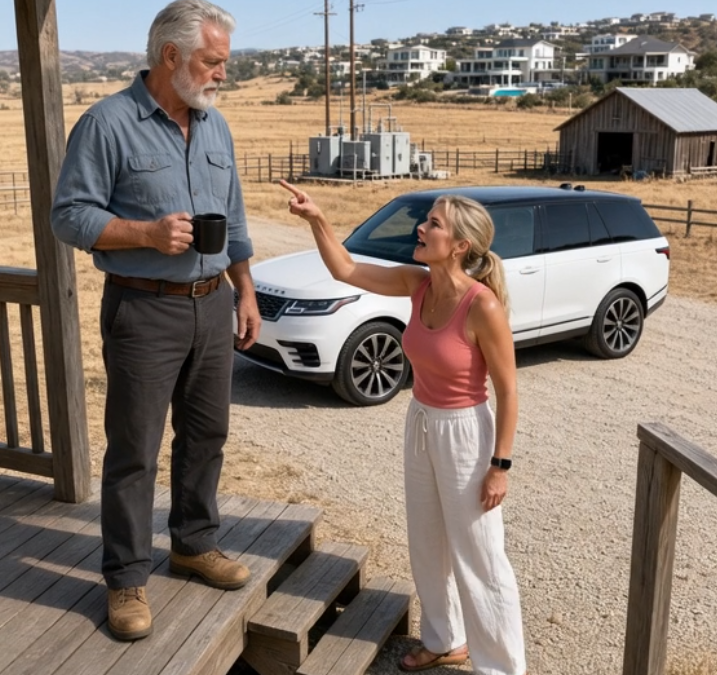
I was on a creeper beneath my truck when she arrived. The first thing she saw of me was a pair of boots and a stained sleeve.
I think that settled the whole matter for her before I ever stood up.
Celeste looked past me at the workshop, the utility trailer, the old service van, and the coveralls hanging from a nail beside the door. Then she asked in a bright, helpful voice whether I was the maintenance contractor working out there.
I told her I was not.
I told her I lived there.
She tilted her head toward the cedar siding, low roofline, and porch I had rebuilt myself two summers earlier.
“In Cedar Hollow?” she asked.
The way she said it made clear she was reciting a conclusion rather than asking a question.
“Not exactly.”
I let the answer sit because the accurate explanation takes about four minutes, a plat map, and a person willing to listen.
I have learned that people who introduce themselves with folders are not usually listening yet.
Celeste smiled the smile I would come to know very well over the following months. It arrived before her sentences and generally outlasted them.
“We’re all neighbors here,” she said. “Neighbors help each other maintain standards.”
Then she looked over my shoulder toward the utility poles and the fenced electrical yard behind the arborvitae.
Her smile remained.
Her eyes began doing arithmetic.
I could have told her the whole truth right then.
I want to be honest about that because it mattered later, and because I have replayed that afternoon more times than is probably good for me.
Instead, I told her my parcel predated the subdivision and was not governed by Cedar Hollow’s architectural covenants.
That was true.
Provable.
And completely useless as a conversational tool.
Celeste heard it as an excuse.
She explained slowly that Cedar Hollow had spent years creating a cohesive community identity, that appraisals were sensitive to visual clutter along the southern sightlines, and that she was sure a reasonable man would want to become part of the solution.
“What does the solution look like?” I asked.
“Screening. Relocation. Ideally removal.”
“Of what?”
She lifted one manicured finger toward the poles.
“Those.”
“The power lines?”
“The apparatus.”
I looked at her.
She liked that word. Apparatus. It made a utility pole sound like a circus contraption.
“That apparatus serves my property,” I said.
“And it impacts ours.”
“You don’t own mine.”
“Visual impact doesn’t respect survey lines.”
That was Celeste’s gift. She could say something ridiculous with the confidence of a county judge.
I told her the electrical equipment was permitted, inspected, and subject to recorded utility agreements.
She said the word permitted the way another person might say supposedly.
That was the first time she looked down on me.
It was not the last that week.
Two days later, I passed Celeste at the mailbox cluster where I collect my parcels. She was standing beside Tessa Monroe, one of the board members, a tall bookkeeper who usually kept reading glasses pushed into her hair.
Celeste greeted me warmly enough.
Then she turned to Tessa.
“I was just telling her that Mr. Avery was going to help us with the power-line situation.”
Tessa politely asked whether I could simply build a fence around the view.
Celeste answered before I could.
“A fence would only draw attention to it.”
I stood there holding my own mail while two people planned the rearrangement of my property.
On the walk back down my driveway, I did what I usually do when I get angry.
Nothing.
I have wondered since whether that silence was patience or cowardice.
A week later, an envelope arrived with the association’s return address printed in an ornate font that must have cost somebody a vote.
Inside was a single page of letterhead addressed to the owner of record.
Across the top, in bold capital letters, was the heading:
UNAUTHORIZED OVERHEAD ELECTRICAL APPARATUS.
Below that were four numbered findings, each citing a section of the Cedar Hollow Declaration of Covenants, Conditions, and Restrictions.
At the bottom was an instruction ordering me to bring my property into compliance within fourteen days.
I read the letter standing in my driveway with my keys still in my hand.
Then I read it again inside the kitchen with the lights on.
The letter was procedurally flawless.
It was also addressed to a parcel over which the association had no authority whatsoever.
More importantly, it demanded the removal of equipment Cedar Hollow itself was drawing power through at that very moment.
The fine schedule was on the second page. I had missed it the first time because it was stapled behind the compliance instructions.
There was an initial $500 assessment under the utility-nuisance provision. Then $100 per day for every day the alleged violation continued beyond the cure period, accruing until the equipment was removed or approved by the architectural review committee.
At the bottom was a checkbox offering me the opportunity to submit an application for retroactive approval along with a nonrefundable $75 filing fee.
I sat at my kitchen table with a pencil and calculated the daily accrual.
The number became large quickly enough to sting even a man with no mortgage.
Then I put the pencil down.
Paying attention to the number was exactly what the number had been designed to make me do.
That night, I wrote three sentences from my shop computer.
My property is not subject to Cedar Hollow HOA covenants. The electrical equipment referenced in your notice is legally permitted and maintained under the recorded Shared Utility Easement dated May 14, 2001. Please confirm in writing whether Cedar Hollow HOA is ordering disconnection, removal, or shutdown of any equipment serving association-connected facilities or homes.
I attached the easement.
I attached the inspection record.
I attached the utility-cooperative service map.
Then I sent it to the association office, Celeste, and every board member whose email address appeared on the HOA website.
The next morning, Celeste replied with one sentence.
Your refusal to comply has been noted.
That was the moment I should have hired a lawyer.
Instead, I went back to work.
The problem with being self-employed is that a crisis has to stand in line behind every service call already booked by people who will still be cold, dark, or flooded if your personal life gets complicated. I had a heat pump to diagnose in Little Fork, a well control box to replace near Mill Road, and an elderly widow named Mrs. Duncan who insisted her hallway lights flickered every time the wind blew from the west.
Mrs. Duncan did have a wiring problem.
She also had four cats, all of whom treated my tool bag like an invading army.
That was still easier to solve than Celeste Whitaker.
By Friday, the HOA had sent a second notice. This one accused me of operating a commercial utility installation without architectural approval. It included photos of my utility poles taken from the Cedar Hollow side of the fence. One image had a red circle around the transformer cabinet. Another had an arrow pointing to my workshop. Someone had added the words INDUSTRIAL POWER FACILITY in red.
I recognized the angle.
Celeste had stood on a neighbor’s retaining wall to get the shot.
I called the association office and asked to speak with her.
“She’s in a compliance meeting,” the receptionist said.
“I’ll hold.”
“She may be a while.”
“I work in utilities,” I said. “Waiting in uncomfortable silence is half my profession.”
Celeste came on twelve minutes later.
“Nolan,” she said, as though we were old friends who had disappointed each other over brunch.
“I received your second notice.”
“Good. Then we’re communicating.”
“No,” I said. “You’re mailing things. Communication involves listening.”
There was a pause.
“I understand this may feel personal,” she said.
“It became personal when you photographed my property and accused me of violations that don’t apply.”
“We are protecting our community.”
“From electricity?”
“From visual nuisance. From unapproved commercial use. From dangerous equipment stored near homes.”
“The system you’re calling dangerous serves those homes.”
She laughed softly.
Not because I had made a joke.
Because she thought I had.
“Nolan, please don’t exaggerate.”
“I’m not exaggerating.”
“Cedar Hollow homes do not depend on your little power yard.”
“Twelve homes do. So does your gate, clubhouse, irrigation, cameras, and the stormwater pump station.”
“That is absurd.”
“It’s recorded.”
“That old document is not what you think it is.”
I closed my eyes.
That sentence told me Celeste had finally read the easement and decided the facts were inconvenient.
“What do you think it is?”
“A temporary construction arrangement,” she said. “Outdated. Possibly invalid. Certainly not permission for you to keep those ugly poles forever.”
“The agreement stays in force until Cedar Hollow builds its own approved utility service or reroutes the lower loop through the cooperative.”
“We’re exploring modernization options.”
“Modernization is fine. Trespassing is not. Cutting lines is not. Fining me is not.”
Her voice cooled. “You may want to be careful how you speak to the president of the association.”
“And you may want to be careful how you speak to the man whose equipment powers your front gate.”
Another pause.
This one was different.
Then she said, “Is that a threat?”
“No. It’s a warning label.”
“I don’t appreciate intimidation.”
“I don’t either,” I said. “So I’ll ask plainly. Are you certain you want that system shut down?”
She laughed.
I remember that laugh better than I remember some birthdays.
It was small and sharp and careless.
“Mr. Avery,” she said, “you are not as important as you think you are.”
Then she hung up.
That weekend, a third notice arrived.
This one was hand-delivered.
It came Saturday morning in a white envelope tucked under my shop door with blue painter’s tape. Across the top was stamped FINAL OPPORTUNITY TO CURE.
The HOA gave me seventy-two hours to remove, relocate, or fully screen the overhead electrical apparatus. If I failed, Cedar Hollow reserved the right to pursue “self-help remedies, including contractor access for abatement of visible nuisance equipment.”
They were not just threatening fines anymore.
They were threatening to come onto my land.
I spent Saturday afternoon doing what I should have done two weeks earlier.
I called my attorney, Lydia Crane.
Lydia had handled my purchase of the property years before. She was seventy, wore red-framed glasses, and had the unnerving habit of letting people talk themselves into traps while she watched with a pleasant expression.
When I emailed her the notices, she called me back in less than ten minutes.
“Nolan,” she said, “tell me you did not ignore the old utility easement all these years.”
“I maintained everything.”
“Do you have logs?”
“Yes.”
“Inspection records?”
“Yes.”
“Repair invoices?”
“Yes.”
“Correspondence?”
“Yes.”
“Good. Then we have a paper trail and an idiot.”
“Which idiot?”
“Let’s be optimistic and assume only one for now.”
She sent a formal letter that afternoon. It was seven pages long and had the kind of calm language that sounds almost gentle until you realize every paragraph is a door locking from the other side.
She informed Cedar Hollow HOA that my property was not subject to its covenants, that any attempt to fine me was void, that any attempt to access my property without consent would be trespass, and that interference with the shared electrical distribution equipment could create public safety, regulatory, civil, and criminal exposure.
She also wrote one sentence I underlined after printing it:
If the association maintains that the electrical equipment is unauthorized, unsafe, or subject to removal, Mr. Avery will have no choice but to initiate a safety review and suspend service to all association-fed circuits pending inspection and written clarification of responsibility.
Celeste responded Monday at 6:02 a.m.
Your threat to disrupt community power has been forwarded to counsel. The apparatus remains unauthorized. Proceed accordingly.
So I did not touch a thing.
That is important.
I did not cut power lines.
I did not sabotage Cedar Hollow.
I did not march to the utility yard with bolt cutters like a fool looking to die young.
At 7:40 that morning, I called the electric cooperative. At 8:05, I spoke with County Electrical Inspector Martin Shaw, a man with a dry voice, a white mustache, and the spiritual energy of a locked toolbox.
I explained the notices.
I sent him the photos Celeste’s people had taken.
I sent him the threat of self-help abatement.
He asked one question.
“Has anyone physically touched the equipment?”
“Not yet.”
“Call me the second they do.”
I asked him what I should do about the HOA claiming the equipment was unauthorized.
He said, “Document everything, keep the gate locked, and don’t let anyone near energized lines who learned electricity from a board meeting.”
I slept badly that night.
At 2:26 a.m., my driveway camera lit up.
I sat up before the phone finished buzzing.
Headlights moved along the old service lane at the southern fence line.
Not my main drive.
The lane behind the arborvitae.
I opened the camera feed.
A white work truck had stopped near my utility poles. Behind it was Celeste’s white crossover. Two men climbed out wearing reflective jackets. One carried a ladder. The other carried a long-handled cutter.
My stomach turned cold.
Celeste stepped out of her vehicle with a flashlight and pointed toward the line feeding my workshop.
Not the main utility feeder.
Not the buried Cedar Hollow branch.
The overhead service line to my workshop.
A man set the ladder against the pole.
I was already calling 911 when the first line dropped.
It snapped down in a shower of sparks bright enough to light the trees.
The camera shook from the flash.
The men jumped back.
One of them shouted.
Celeste stumbled away from the pole, her flashlight beam jerking wildly across the ground.
The second man yelled something I could not hear through the feed.
Then the workshop went dark.
My chest tightened.
Not from fear.
From the kind of anger that arrives so clean it almost feels peaceful.
The operator asked if anyone was injured.
“I don’t know,” I said. “But someone just cut energized power lines on my property.”
She told me to stay inside.
For once, I listened.
The sheriff’s deputies arrived first. Then the fire department. Then the electric cooperative. Then Inspector Shaw, still wearing what looked like yesterday’s shirt under a heavy coat.
By the time I walked down with Deputy Harper, the two men were sitting on the grass under firefighter supervision, pale and shaking. One had a burn mark across his glove and kept staring at his hand like he could not believe it was still attached.
Celeste stood near her SUV, wrapped in a blanket someone had put around her shoulders.
She saw me and straightened.
“This happened because you refused to comply,” she said.
Deputy Harper looked at her like she had started speaking another language.
Inspector Shaw stood beneath the pole and looked up at the severed service line.
Then he looked at the cutter lying in the grass.
Then he looked at me.
“Mr. Avery,” he said, “is this your workshop service?”
“Yes.”
“Did you authorize disconnection?”
“No.”
He turned to Celeste.
“Did you direct these men to cut that line?”
Celeste lifted her chin. “The HOA authorized removal of nuisance wiring after repeated noncompliance.”
Inspector Shaw stared at her.
There are silences that feel empty.
This one felt loaded.
“Ma’am,” he said, “you authorized unlicensed personnel to cut an energized service line on private property at two in the morning?”
“They told me they could handle it.”
One of the men on the grass looked up. “You said it was dead.”
Celeste snapped, “I said it should be dead.”
The firefighter nearest them muttered something I will not repeat.
Inspector Shaw pointed toward the fenced utility yard.
“Deputy, nobody touches anything else. I need the cooperative to de-energize the shared distribution until we assess damage.”
Celeste’s face changed.
“What does that mean?”
“It means,” Shaw said, “the circuits running through this property are now under safety shutdown.”
“You can’t do that.”
“I can, and I am.”
“But Cedar Hollow depends on that service.”
I looked at her.
She heard herself then.
Too late.
Within forty minutes, Cedar Hollow went dark.
The front gate froze half open. The clubhouse lights died. The irrigation pump controls dropped offline. The stormwater station alarms began screaming on backup battery. Streetlights along the lower road blinked out. Twelve homes lost power completely because their lower-loop service still depended on the old feeder they had never paid to reroute.
Residents came out in bathrobes and coats, confused and angry.
They gathered near the gate, phones glowing in their hands.
Celeste tried to leave before they understood.
Deputy Harper stopped her.
“Ma’am, we still need your statement.”
“My neighborhood is without power.”
“Yes,” he said. “We noticed.”
By sunrise, every phone in the association office was ringing.
By eight, Lydia Crane was in my kitchen drinking coffee from my father’s old mug and reading the sheriff’s preliminary report with the expression of a woman watching a legal gift unwrap itself.
“She did what?” Lydia asked.
“She sent two men to cut my workshop line.”
“Were they licensed?”
“No.”
“Was there a permit?”
“No.”
“Was there utility coordination?”
“No.”
“Was the line energized?”
“Yes.”
Lydia removed her glasses and rubbed the bridge of her nose.
“I have practiced law for forty-three years. I still wake up every morning hoping people will surprise me by being less stupid. They rarely do.”
At 9:15, Celeste returned to my gate with Ron Vale, Tessa Monroe, and about twenty Cedar Hollow residents behind her.
Dana Pierce was there too, holding her toddler in a winter coat. Arthur Bell stood with a cane near the ditch. Mason Bell, a teenager who mowed lawns in the neighborhood, held a phone up, recording everything.
Celeste gripped the gate bars.
“Turn it back on.”
I stood on my side with Lydia beside me.
“I can’t.”
“Don’t play games with me.”
“I’m not. The inspector shut it down.”
“You caused this.”
“No,” Lydia said. “Your unauthorized contractors cut an energized private service line, created a safety hazard, and compromised a shared distribution point. That caused this.”
Ron Vale pointed at me. “You knew the neighborhood depended on that system.”
“Yes,” I said. “So did Celeste.”
Tessa turned sharply. “Celeste?”
Celeste did not look at her.
Tessa’s voice changed. “Did you know?”
“This is not the time.”
“That sounds like yes.”
Celeste pointed at the utility yard behind my trees. “We are not going to be held hostage by one man’s ugly equipment.”
Inspector Shaw arrived before I could answer.
He stepped out of his truck carrying a hard case and a clipboard. Two cooperative linemen followed him.
Celeste walked toward him immediately.
“Inspector Shaw, this community needs power restored.”
He looked past her at me.
“Mr. Avery, nobody has accessed the equipment since last night?”
“No.”
“Good.”
Celeste stepped into his line of sight. “How long will this take?”
“As long as it takes to verify that no unauthorized work damaged the shared equipment.”
“That is unacceptable.”
Inspector Shaw looked at her over the top of his glasses.
“Ma’am, unacceptable was sending people with cutters to energized lines in the dark.”
People behind her murmured.
Dana said, “You cut his lines?”
Celeste spun. “He is framing this as retaliation. The board authorized nuisance abatement.”
Arthur Bell’s face went pale. “My wife’s medical bed lost power.”
Celeste blinked.
For the first time that morning, she looked less certain.
“Backup generators should—”
“We don’t have one,” Arthur said.
Fire Marshal Elise Baird arrived then, and the conversation ended.
She had the kind of presence that made people stop talking even before she asked them to. She walked to Arthur first.
“Sir, is your wife safe now?”
“My son brought a generator.”
“Good. I’ll have emergency services check on any medically vulnerable residents on the lower loop.”
Then she turned toward Celeste.
“Who authorized cutting the line?”
Celeste’s attorney was not there yet.
That was unfortunate for Celeste.
She said, “The association voted to cure a violation.”
Fire Marshal Baird stared at her.
“Aesthetic enforcement does not authorize electrical work.”
“It was not aesthetic. It was safety.”
“Then why did you send landscapers?”
The two men who cut the line owned a landscape and handyman company called Clean Edge Property Solutions. They trimmed hedges, repaired fences, painted decks, and apparently accepted midnight work orders from HOA presidents with poor judgment.
Their owner, a man named Travis Locke, arrived in a panic around ten.
He brought the work order.
That became the turning point.
The work order said:
Remove visible nuisance wiring from noncompliant parcel. Target service line to metal outbuilding only. Do not disturb main HOA utility equipment. Work to be completed before resident interference.
Authorized by: Celeste Whitaker, HOA President.
Attached was a map.
On that map, my property was labeled Cedar Hollow Utility Easement Area.
My workshop was labeled Abandoned Service Structure.
Lydia read it once.
Then she looked at Celeste.
“Abandoned?”
Celeste’s mouth tightened.
Travis Locke pointed at her. “She told us nobody lived on that part.”
I looked at him.
“My truck was parked by the shop.”
“She said you were trespassing on HOA-controlled utility land.”
Tessa covered her mouth.
Residents began shouting.
Celeste raised both hands. “This is being twisted.”
Inspector Shaw opened the hard case and removed testing equipment.
“While you untwist it,” he said, “I’m going to inspect the damage your contractors caused.”
For four hours, Cedar Hollow remained without power.
The cooperative crews isolated circuits and tested equipment. Inspector Shaw examined the severed service, the pole, the transformer cabinet, and the old distribution point. Fire Marshal Baird coordinated resident checks. Lydia took photographs of everything. Deputy Harper took statements. Celeste made three phone calls and grew paler after each one.
By noon, the truth was no longer something only I knew.
Cedar Hollow’s lower-loop service did run through my property.
The HOA had known about the easement, or at least had enough records to know if anyone had looked.
The board had approved nuisance-abatement language without understanding what Celeste intended.
Celeste had signed the work order and provided a false map.
Two unlicensed men had cut an energized line to my workshop.
The safety shutdown was not revenge.
It was required.
At 1:30, Inspector Shaw stood at my gate and addressed the residents.
“I’ll keep this simple,” he said. “The electrical equipment on Mr. Avery’s property is permitted. It is part of a recorded utility arrangement. The HOA does not own this parcel. The HOA did not have authority to cut or remove any lines. Because unauthorized work occurred, power cannot be restored to the shared circuits until repairs, testing, and clearance are complete.”
Dana asked, “How long?”
“Best case, later today for common systems. Lower-loop homes may take longer if service rerouting or repairs are needed.”
Arthur Bell looked at Celeste. “You did this over how it looked?”
Celeste snapped, “I did this because he refused to cooperate.”
“No,” Tessa said quietly. “You did this because you refused to read.”
That line spread through Cedar Hollow faster than any legal notice.
By evening, the gate and clubhouse power had been restored through a temporary cooperative bypass. The twelve lower-loop homes were moved to emergency service arrangements one by one. My workshop remained dark until repairs were completed, inspected, and signed off.
The next day, Lydia filed for an emergency injunction.
The judge barred Cedar Hollow HOA, its officers, contractors, agents, and vendors from entering my property or touching utility equipment without written permission, utility coordination, and county inspection approval.
The sheriff opened a criminal investigation into trespass, reckless endangerment, property damage, and falsification of documents.
The electric cooperative issued a violation notice.
The county building department opened an enforcement case.
Clean Edge Property Solutions lost more than pride.
Travis Locke cooperated immediately. He turned over emails, texts, and a voicemail from Celeste.
In that voicemail, she said, “Cut the workshop feed only. Once Avery loses power, he’ll understand we’re serious. He can’t keep hiding behind old paperwork.”
That sentence became the center of everything.
Once Avery loses power.
Teach him a lesson.
She did not know the lesson would be hers.
The emergency HOA meeting was held three nights later at the Cedar Hollow clubhouse, running on temporary power from a generator parked outside like a mechanical witness.
I did not want to attend.
Lydia told me not to.
“You are the property owner, the victim, the service provider, and likely the plaintiff,” she said. “You do not need to walk into a room full of people looking for someone to blame.”
She was right.
Then Arthur Bell called me.
“My wife wants you to come,” he said.
“Arthur, I don’t know if that’s smart.”
“She says smart didn’t get us into this mess. Silence did.”
I went.
The clubhouse was packed beyond reason. Residents lined the walls, crowded the hallway, and stood outside near open windows. The generator hummed behind the building. Every light overhead seemed to flicker just enough to remind people why they were there.
Celeste sat at the front table with Ron Vale and two other board members. Tessa sat at the far end, separate enough to make a point. The HOA attorney sat beside Celeste, whispering urgently.
Celeste ignored him.
She opened the meeting by striking the table with a little wooden gavel.
“This emergency session has been called,” she said, “to address the deliberate disruption of community power by a hostile adjacent property owner.”
The room erupted.
Some people shouted at me.
Some shouted at her.
Some shouted questions no one could answer.
Celeste let it go on just long enough to make fear bloom, then raised her hand.
“I understand your anger,” she said. “I share it. For months, this board has attempted to resolve a hazardous nuisance condition involving Mr. Avery’s unauthorized electrical apparatus. Unfortunately, rather than cooperate, he chose to weaponize infrastructure against Cedar Hollow families.”
Dana stood. “You cut his line.”
Celeste’s smile tightened. “Dana, please let the board present the full picture.”
“You hid the full picture.”
A murmur rolled through the room.
Tessa leaned toward her microphone. “I move that Mr. Avery be allowed to speak.”
Ron Vale said, “Absolutely not.”
Tessa looked at him. “Then I move you explain why the board authorized electrical work on land we do not own.”
Ron’s mouth opened.
Nothing useful came out.
People turned toward Celeste.
She said, “There are legal complexities.”
That was when Inspector Shaw walked in.
I had not known he was coming.
Neither had Celeste.
He entered with Fire Marshal Baird and Deputy Harper behind him. The room quieted in waves, like wind dying down.
Celeste stood. “This is a private association meeting.”
Shaw looked around. “Not when you are discussing an active electrical safety event affecting occupied homes.”
Fire Marshal Baird added, “And not when residents’ safety depends on accurate information.”
Celeste’s attorney put both hands over his face.
Inspector Shaw walked to the front of the room and placed a folder on the table.
“I’ll keep this simple,” he said. “The equipment on Mr. Avery’s property is permitted. The shared utility easement is recorded. Cedar Hollow has used that equipment for years. Mr. Avery did not unlawfully shut down your power. The shutdown occurred because unauthorized contractors cut an energized line on his property, creating a safety hazard.”
Someone in the back said, “So why didn’t we know?”
Tessa answered before anyone else could.
“Because we didn’t read our own records.”
Celeste shot her a look.
Tessa did not look away.
Inspector Shaw continued. “The work order used by the contractors falsely labeled Mr. Avery’s land as HOA-controlled utility area. That is not accurate. Any claim that the workshop was abandoned is also not accurate.”
Arthur Bell stood slowly.
“My wife was in a powerless house because you wanted to scare him?”
Celeste said, “Arthur, I would never endanger residents.”
“You did.”
“No. He did.”
Fire Marshal Baird leaned toward the microphone.
“No, Mrs. Whitaker. The safety event began when your contractors cut the line.”
There are moments when a room changes allegiance.
Not dramatically.
Not with music.
Just face by face.
People who had arrived angry at me began turning toward the woman at the front table.
A mother with a baby on her hip.
A retired man gripping a cane.
A teenager recording with shaking hands.
A board member reading the easement for the first time.
Celeste felt it and did what arrogant people do when control slips.
She attacked harder.
“This neighborhood has standards,” she said. “We cannot allow one man’s junkyard infrastructure to dictate community safety and property values.”
I finally stood.
“Nobody asked you to depend on my infrastructure,” I said.
The room went silent.
I walked to the front slowly.
“I didn’t build Cedar Hollow. I didn’t design your lower loop. I didn’t keep your power arrangement hidden from residents. I didn’t send fines to myself. I didn’t create a fake map. I didn’t send men with cutters into the dark.”
Celeste stared at me.
I looked at the residents.
“For years, that ugly equipment powered things you used without thinking. Gates. lights. pumps. cameras. homes. You didn’t have to like how it looked. You didn’t even have to thank me. But the least your board could have done was ask what it served before trying to erase it.”
No one spoke.
Then Arthur Bell’s wife, a frail woman in a wheelchair near the front row, lifted her hand.
Her voice was thin but steady.
“Thank you for keeping it running all these years.”
That did more than any argument.
Because gratitude, spoken at the right moment, can expose cruelty better than anger.
Celeste resigned two weeks later.
Not voluntarily.
The recall petition forced it.
The meeting was held in the middle school gym because the clubhouse could not hold the crowd. Celeste arrived with two attorneys, three binders, and the same polished smile she had worn in my driveway.
She called herself a defender of standards.
Tessa read the recorded utility easement aloud.
She called herself a victim of misinformation.
Travis Locke’s voicemail played over the gym speakers.
She called the shutdown retaliation.
Inspector Shaw stood and explained, in plain English, that the shutdown was mandatory after unauthorized damage.
Then Lydia stood.
I had not expected that.
She faced the residents, not Celeste.
“Your neighborhood has a problem,” she said. “Not because Mr. Avery owns equipment near your boundary. Not because old agreements are complicated. Your problem is that the board treated appearance as authority. They saw something they disliked, assumed it had no value, and punished the person who understood it.”
She turned toward Celeste.
“That is not leadership. That is vandalism with letterhead.”
The recall passed by a margin so large even Ron Vale stopped defending her.
Celeste left before the meeting ended.
No one followed.
That, more than anything, told me her power was gone.
The settlement took months.
They always do.
Cedar Hollow’s insurance carrier tried to deny coverage because intentional cutting of electrical lines was somehow not part of “ordinary HOA governance.” The HOA tried to argue Celeste acted beyond authority. Celeste tried to argue the board had approved enforcement. The board tried to argue it had not approved that kind of enforcement.
Everyone pointed at everyone else until Lydia said in mediation, “Excellent. Now that we agree there is plenty of blame, let’s discuss who is paying.”
I received compensation for property damage, lost work, emergency repairs, legal fees, security upgrades, and interference with my business.
But the more important agreement was not money.
It was clarity.
Cedar Hollow had twelve months to reroute every remaining lower-loop home and common system through its own properly permitted service. Until then, the shared circuits would operate under transparent resident notices, maintenance schedules, and emergency protocols. No HOA officer could access my property, photograph equipment from beyond the fence for enforcement purposes, or send contractors anywhere near the utility yard without written approval and county coordination.
The association also had to record a corrective document against every Cedar Hollow deed, explaining the utility easement in plain language.
That was Lydia’s idea.
“Never underestimate the public value of forcing future idiots to read,” she said.
By spring, Cedar Hollow had changed.
Not perfectly.
Neighborhoods do not become humble overnight. People still argued about mulch color. Someone still complained about a basketball hoop. Civilization remained fragile.
But people waved when I drove by.
Some apologized.
Some did not.
A few pretended they had always been on my side, which was annoying but mostly harmless.
Dana’s toddler began calling me “Mr. Lights,” which I accepted as better than several alternatives. Arthur Bell brought me jars of honey from his son’s farm. Tessa, who became interim president despite insisting she hated the word president, came down my driveway one Saturday with a folder.
I looked at it.
She looked at me.
Then she held it up.
“Too soon?”
“Depends what’s in it.”
“Utility reroute proposals.”
“That folder may live.”
She laughed.
We stood near the fenced utility yard. The transformer cabinet hummed softly behind the gate. The repaired line to my workshop ran overhead, neat and inspected. The arborvitae moved in the wind.
Tessa looked up at the poles.
“You know,” she said, “I used to hate seeing those.”
“A lot of people did.”
“I didn’t know what they were doing.”
“That’s true of most useful things.”
She nodded. “The new board wants to plant a proper screen on the Cedar Hollow side. Not to hide evidence. Just to make the boundary nicer. We’ll pay for it. You choose the plants.”
I looked at her carefully.
“No blocking access. No decorative boulders over conduit. No locked gate. No committee theme.”
She smiled. “No theme.”
“Native shrubs only.”
“Fine.”
“And a plaque.”
Her smile faded a little. “A plaque?”
“Small one. On your side. It says: Before you cut what you do not understand, ask what it powers.”
Tessa stared at me.
Then she started laughing.
“You’re serious?”
“Completely.”
“I’ll put it to a vote.”
The plaque was approved, thirty-four to nine.
I still wonder about the nine.
The permanent reroute finished before the next winter.
On the day Cedar Hollow disconnected from my utility yard for good, Inspector Shaw came out with the cooperative crew. Tessa stood on the road with a clipboard. Arthur Bell sat in his son’s truck because the cold bothered his knees. Dana brought coffee.
The final common feeder was transferred to Cedar Hollow’s new service cabinet on land the HOA actually owned.
Inspector Shaw signed the clearance.
Then he looked at me.
“Well,” he said, “you are no longer accidentally powering civilization.”
“Feels like a demotion.”
“Feels like fewer idiots near your fence.”
“That too.”
When it was done, my old utility yard served only my house, my workshop, my well, and my own equipment.
I expected to feel only relief.
I did.
But I also felt something stranger.
For years, those lines had made me part of a neighborhood that did not claim me. They had connected my old cedar house to polished homes above it in a way most people never saw. They had judged the poles, the workshop, the service van, the mud, and the man under the truck without realizing their comfort depended on the very things they dismissed.
When the lower loop disconnected, that hidden relationship ended.
What replaced it was better.
Not dependence.
Respect.
One evening that summer, I walked out to the fence as the sun went down.
The new shrubs had taken root on the Cedar Hollow side. Small green leaves trembled in the warm wind. Behind them stood the plaque, mounted low on a cedar post.
Before you cut what you do not understand, ask what it powers.
I stood there longer than I meant to.
Maybe because the whole ugly mess had started in that exact spot.
Maybe because for months I had felt like I was defending more than poles, wires, and a metal cabinet.
I had been defending the right to exist without being polished into someone else’s idea of acceptable.
My old cedar house was not ugly.
My workshop was not a nuisance.
My utility yard was not an embarrassment.
My work was not beneath anyone.
And my silence had never been permission.
That is what Celeste never understood.
Quiet men still know where the power comes from.
I went back inside, washed my hands, poured coffee into the chipped mug my father used to keep by the stove, and opened the next day’s schedule.
A heat-pump tune-up at nine.
A panel inspection at eleven.
A no-power call near Mill Road after lunch.
Ordinary work.
Honest work.
The kind that keeps people warm, lit, and safe whether or not they ever think to ask who made it possible.
Outside, the last light settled on the poles, the shrubs, the repaired line, and the sign that would outlast every HOA board member who voted against it.
And for the first time since Celeste Whitaker walked down my driveway with her burgundy folder and her polished little smile, my land felt quiet again.
Not because nobody could see it.
Because now they finally understood what they were looking at.