HOA Karen Cut Down 12 Thirty-Year-Old Pines on My Property to “Restore” Six Million-Dollar Lake Views—Then She Saw What Those Trees Had Been Hiding.
HOA Karen Cut Down 12 Thirty-Year-Old Pines on My Property to “Restore” Six Million-Dollar Lake Views—Then She Saw What Those Trees Had Been Hiding.
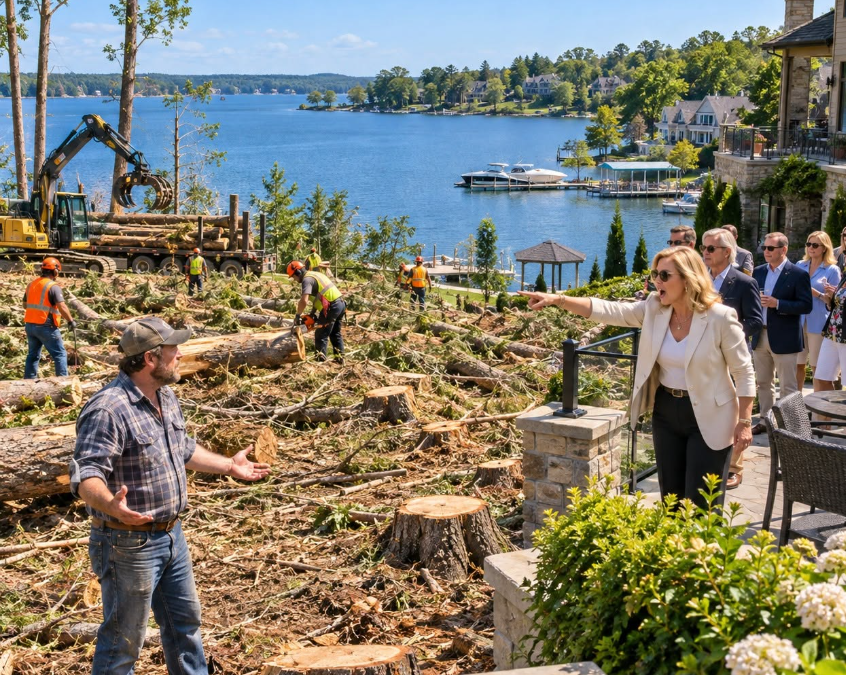
When I pulled into my yard and saw twelve mature pines reduced to fresh stumps, I knew Silver Ridge had not just crossed a property line—they had cut down thirty years of my father’s work.
The HOA president smiled in her red blazer and called it “restoring the shoreline view corridor,” but she had no idea what those trees had been hiding from her million-dollar homes.
Because six months before she ever touched a chainsaw, the county had already approved my 120-foot-long, 20-foot-high dark steel fabrication building for that exact spot.
My name is Jack Mercer.
I was fifty-one years old when Silver Ridge decided my trees were standing between them and happiness.
Not illegal trees.
Not dying trees.
Not diseased, leaning, storm-damaged, beetle-eaten, power-line-threatening trees.
Just trees.
Twelve mature pines my father planted more than thirty years earlier, back when the hillside west of my property was still scrub, clay, and pasture instead of million-dollar houses with outdoor kitchens large enough to make a restaurant feel insecure.
My father’s name was Daniel Mercer.
He ran Mercer Marine Works before I did.
Docks, boat lifts, shoreline repairs, retaining walls, storm-damaged piers, aluminum framing, steel posts, floating platforms, cracked gangways, bent hardware, desperate lakefront owners who waited until something half-collapsed before admitting water had opinions.
That was our business.
Not glamorous.
Not cute.
Not the sort of place people write brochures about unless the brochure includes tetanus warnings and a photo of a man holding a welding mask with the expression of someone who has not had a full weekend off since 2008.
Our yard sat along the northern shore of Lake Hartwell on twenty-seven acres my father bought when I was fourteen.
Back then, there was almost nothing around us.
A gravel road.
Three fishing cabins.
An old marina a few miles east.
Trees everywhere.
Pine, cedar, oak, sweetgum, and enough brush that every summer somebody in my family declared war on vines and lost by August.
Dad planted the pines along the western boundary for practical reasons.
He used to stand in the work yard, look at our stacks of dock frames, lift motors, bent pontoons, trailer axles, fuel drums, welding tables, scrap bins, and half-repaired equipment, then say, “If people can’t see the mess, they can’t complain about the mess.”
He was right for thirty years.
That tree line was not decorative to us.
It was a shield.
It softened sound.
Blocked dust.
Caught wind.
Hid the yard from the road.
And, maybe most importantly, kept people with lakefront fantasies from discovering that a real marine construction company does not look like the brochure image of a man in clean khakis shaking hands beside a finished dock at sunset.
A real marine construction yard looks like metal, mud, fuel, labor, machinery, bad coffee, and several things that are not broken but are waiting for the right invoice to prove it.
By twenty-five, I could build a dock from a sketch.
By thirty-five, I was running crews.
By forty-two, Dad handed me the business.
He died four years before Vanessa cut down his trees.
I still heard his voice every morning I opened the shop.
Check the weld twice.
Don’t trust a lake that looks calm.
Grease the trailer hubs before they complain.
Never store hardware where a man has to swear to find it.
And, most of all, don’t invite people to have opinions about what they don’t need to see.
Silver Ridge appeared west of us in phases.
At first, it was just survey tape and bulldozers.
Then roads.
Then water lines.
Then streetlights.
Then the first wave of homes, all stone facades and decorative gables, each one advertised as “lake-adjacent luxury living,” which is a phrase that means you can see water if nobody inconvenient owns the land in between.
The latest section was built on higher ground, looking east over my property toward Lake Hartwell.
Six large homes were marketed as premium lake-view residences.
Three-car garages.
Outdoor kitchens.
Glass walls.
Decks.
Landscaping with names.
PART2:
The cheapest one sold for just under a million dollars.
From every one of those houses, you could see the lake.
You could also see the tops of my father’s pines.
Most owners did not care.
They had bought nice houses.
They had water in the distance.
They had sunsets, if the weather cooperated.
And they had the comforting illusion that everything visible from their patios existed, somehow, for their enjoyment.
Then Vanessa Caldwell became president of the Silver Ridge HOA.
Vanessa was fifty-three, sharp-featured, always polished, and wore a red blazer to meetings as if she were permanently auditioning to be the villain in a zoning dispute.
She carried a leather folder thick enough to make everything inside it look official, which is the oldest trick in small-government theater.
Paper intimidates people.
Especially paper in folders.
Especially paper held by someone who speaks in the tone of a woman explaining rules to a child she has already decided to punish.
Vanessa rarely raised her voice at first.
That was her style.
Quiet superiority.
Controlled pace.
Chin lifted just enough to make disagreement feel like bad manners.
But the louder she got, the more likely it was that someone had just told her no.
The first time she came to my yard, she did not call my trees trees.
She called them vegetation.
That should have told me everything.
“Mr. Mercer?”
“Jack.”
“I’m Vanessa Caldwell, president of Silver Ridge.”
“I know.”
“We have received several homeowner concerns regarding the vegetation along your western boundary.”
I looked behind me.
“You mean the trees?”
“Yes.”
“What about them?”
PART3:
“They’re interfering with protected view corridors.”
“Protected by what?”
“Our architectural standards.”
I stared at her.
“Your architectural standards control my trees?”
“They protect community sightlines inside Silver Ridge.”
“The trees are not inside Silver Ridge.”
“The views extend beyond Silver Ridge.”
“I imagine they do.”
She opened her folder and pulled out a photograph.
It had been taken from one of the six houses across the road. A pine canopy filled the lower half of the frame. Lake Hartwell was still visible above it, blue and wide and very much not hidden from anyone with functioning eyes.
“See?” Vanessa said.
“Yes.”
“Residents purchased those homes with lake-view expectations.”
“Then they should speak to whoever made the promise.”
“The trees have grown substantially.”
“They tend to do that.”
Her jaw tightened.
“We are asking you to top them.”
“No.”
“Not remove them. Reduce the canopy.”
“No.”
“The association would pay.”
“No.”
She closed the folder.
“Why are you being difficult?”
“You came onto my property to tell me your HOA controls trees on land outside your HOA.”
“That is an oversimplification.”
“It is exactly what happened.”
She stared at me for a few seconds.
Then she left.
Two days later, I received an email.
Subject line: Request for Vegetation Cooperation.
I replied with three sentences.
The trees are on my property.
My property is not part of Silver Ridge.
I do not consent to trimming, topping, or removal.
The HOA treasurer, Martin Cole, responded first.
Understood. We’ll confirm the boundary and recorded rights before further discussion.
That was a reasonable answer.
Vanessa responded twenty minutes later.
The association reserves all rights associated with historic maintenance and view preservation.
That sentence smelled expensive.
It also meant almost nothing.
People in HOA politics love phrases that sound legal but collapse if asked to produce a document.
Historic maintenance.
View preservation.
Community expectations.
Architectural harmony.
Those phrases can decorate a newsletter.
They cannot cross a survey pin with a chainsaw.
I forwarded everything to my attorney, Paul Hensley.
Paul handled property issues for people like me: farmers, lakefront owners, contractors, heirs, families with old deeds and newer neighbors who believed owning a large window entitled them to landscape control.
He checked my deed.
No scenic easement.
No vegetation easement.
No maintenance easement.
No HOA covenant.
No view corridor.
No shared landscape obligation.
Nothing.
Paul sent Silver Ridge a letter saying exactly that.
Clear.
Dry.
Professional.
The kind of letter designed to end foolishness before foolishness orders equipment.
That should have ended it.
Instead, Vanessa changed the story.
The trees were suddenly a fire hazard.
Then a storm hazard.
Then a drainage problem.
Then she claimed roots were threatening a retaining wall on HOA property.
A county arborist came after someone filed a complaint.
He walked the tree line with me, inspected every trunk, checked stability, looked for disease, reviewed distance from the retaining wall, and found exactly what I already knew.
Healthy.
Stable.
No immediate hazard.
I asked, “Can I get that in writing?”
He smiled.
“Already doing it.”
I sent the report to Silver Ridge.
Martin replied, Thank you.
Vanessa said nothing.
For almost a month, the issue went quiet.
Quiet from people like Vanessa is not peace.
It is preparation.
One afternoon, Carol Bennett stopped me near the mailbox.
Carol owned one of the six lake-view homes.
She was not a bad person.
A little nervous, maybe, and prone to saying “I don’t want to get involved” immediately before getting involved, but fundamentally decent.
“Jack, can I ask you something?”
“Sure.”
“Did you agree to selective tree removal?”
I looked at her.
“No.”
She frowned.
“Vanessa told us the HOA was negotiating a view restoration plan with you.”
“She told you wrong.”
Carol hesitated.
“We approved twelve thousand dollars for it.”
“For what?”
“The view corridor.”
“On my land?”
“She said the association had maintenance rights.”
“It doesn’t.”
Carol looked back toward Silver Ridge.
“Then why did we vote on it?”
“That is a good question.”
That night, I checked every camera on my property.
Then I photographed the tree line.
Every trunk.
Every survey marker.
Every boundary pin.
Every visible reference point.
I measured distances from recorded stakes.
I saved the arborist report in three locations.
Then I pulled the latest survey from my safe.
It felt excessive.
Twelve days later, it did not.
Martin invited me to the next Silver Ridge HOA meeting.
Vanessa had clearly not expected that.
The moment I walked into the clubhouse, she stopped speaking.
“This is a members-only meeting,” she said.
Martin pointed toward an empty chair.
“I invited Jack for the boundary discussion.”
“Invited him?”
“Yes.”
“Without asking me?”
“I’m treasurer, Vanessa, not your assistant.”
A few residents laughed.
Vanessa did not.
The tree issue came up fifteen minutes later.
Vanessa put a map on the projector.
A shaded strip ran along the edge of my parcel.
At the top were the words:
Historic View and Maintenance Area.
I raised my hand.
“Where did that map come from?”
“Our management files.”
“Is it recorded?”
“It reflects long-standing use.”
“That was not my question.”
Martin looked toward Vanessa.
“I asked management the same thing.”
“And?”
“They could not identify a recorded easement.”
Vanessa shifted.
“That does not eliminate prescriptive rights.”
I said, “Who maintained my trees? The HOA?”
“We have landscaping records.”
“For landscaping on your side of the property line.”
She pointed to the map.
“Residents remember contractors trimming this area.”
“Branches crossing the fence, maybe.”
“Exactly.”
“No. Not exactly.”
I placed my survey on the table.
“My property line is here.”
I pointed to the boundary.
“If branches cross onto your side, you deal with whatever the law allows on your side. You do not cross this line and remove my trees.”
Vanessa smiled.
“No one is proposing that.”
I looked at her.
“Good.”
That sentence mattered because twelve days later, she did exactly that.
I left home at 6:30 on a Monday morning for a dock installation on the south end of the lake.
Routine job.
Two-section floating dock, aluminum frame, composite decking, lift alignment, client who had strong feelings about cleat placement.
We finished early.
I drove back a little after two.
The first thing I noticed was sunlight.
Too much of it.
The western edge of my yard had always been shaded in the afternoon.
Now light poured across the gravel so harshly the whole place looked exposed.
I slowed the truck.
Then I saw the stumps.
One.
Three.
Six.
Nine.
Twelve.
Twelve mature pines gone.
The tree service truck was still parked near the fence.
Branches were being loaded.
The air smelled like sap and fresh violence.
Vanessa stood beside the foreman.
Red blazer.
Leather folder.
Expression composed.
Like she had not just taken a saw to thirty years of someone else’s history.
I got out.
“What happened?”
The foreman turned.
Vanessa did not.
I walked closer.
“Who authorized this?”
The foreman pointed at Vanessa.
“She did.”
Vanessa folded her arms.
“The HOA approved view corridor restoration.”
“On my land?”
“This is the historic maintenance strip.”
“No, it isn’t.”
“The board approved the work.”
“Did the board approve removing trees outside the Silver Ridge boundary?”
Her expression changed slightly.
“The boundary is disputed.”
“No, Vanessa. A disagreement does not move a survey pin.”
The foreman looked uncomfortable.
Good.
Comfort at that moment would have been a moral failing.
I turned to him.
“Did she tell you the trees belong to me?”
He glanced at Vanessa.
“She gave us the work area.”
“Did you verify ownership?”
“The customer marked the site.”
Vanessa stepped toward us.
“Do not harass the contractor.”
I looked at her.
“You had twelve trees cut down on my property.”
“They were obstructing the community view corridor.”
“They were mine.”
“That remains disputed.”
“No. It remains inconvenient.”
The foreman started gathering paperwork.
I said, “Before you leave, I need your company information and the work order.”
Vanessa interrupted.
“You do not.”
The foreman looked at her.
Then at me.
Then at the stumps.
He handed me a business card.
“Call the office. They’ll send it.”
“Thank you.”
Vanessa glared at him.
“The HOA is your client.”
He looked toward the stumps.
“And those were apparently his trees.”
Nobody said anything for a moment.
Vanessa stayed after the crew began packing.
“You are not turning this into some ridiculous lawsuit.”
“I haven’t decided what I’m doing.”
“The association acted in good faith.”
“You were sitting ten feet from me when your treasurer said there was no recorded easement.”
“We have legal arguments.”
“You also told everyone nobody was proposing to remove trees from my property.”
“That is not what I meant.”
“I know exactly what you meant.”
Then Vanessa looked through the opening she had created.
For the first time, she saw my entire equipment yard.
Stacks of aluminum dock frames.
Steel posts.
Pontoons.
A flatbed loaded with rail sections.
Welding tanks.
Fuel tank.
Lift arms.
The compact excavator.
Scrap bins.
Half-finished hardware racks.
A work truck with one fender the color of primer because paint had never risen high enough on the priority list.
Her expression changed.
“What is all that?”
“My business.”
“It is visible from Silver Ridge.”
“Now it is.”
“You need screening.”
I laughed.
I could not help it.
“I had screening.”
She did not laugh.
She pointed toward a row of dock frames.
“That cannot remain exposed.”
“Why?”
“It damages the visual character of Silver Ridge.”
“Then maybe you shouldn’t have removed the thing hiding it.”
Vanessa left.
I stood there long after she was gone.
Those trees mattered to me.
My father had planted every one.
He had spaced them badly at first, then replanted three after a storm, then argued with my mother over whether pines were too plain for the boundary.
She told him plain trees were good for plain men.
He took that as a compliment because he knew better than to do otherwise.
Those trees had watched the business grow.
They had watched me become the man running it.
They had watched Dad age.
They had hidden our mess and softened our noise and marked the boundary better than any sign.
Now they were twelve stumps and a smell of cut sap.
For a moment, I wanted to do something stupid.
Floodlights.
Ugly equipment stacked along the boundary.
The biggest legal fence I could order.
A mural of Vanessa’s face staring back at her own subdivision, though I admit that was more emotional than practical.
But anger is expensive when you let it make decisions.
So I did not touch Silver Ridge property.
I did not yell.
I did not threaten Vanessa.
I made three phone calls.
My attorney.
A certified arborist.
The county planning office.
The third call changed everything.
Six months before Vanessa ever started talking about lake views, the county had approved my expansion.
Mercer Marine Works had been growing.
We were fabricating larger dock sections, building more custom aluminum assemblies, and taking on work that needed indoor space.
The existing shop was cramped.
Rain delayed jobs.
Wind made welding miserable.
Materials sat outside too long.
We needed a covered assembly building.
The engineer designed a steel-sided fabrication building.
One hundred twenty feet long.
Forty feet deep.
Twenty feet high along the western elevation.
Two welding bays.
Material storage.
Overhead lighting.
Overhead crane capacity.
Truck access.
Drainage plan.
Setbacks.
Stamped drawings.
Approved permit.
The original site plan placed it near the western property line.
Perfect for truck movement.
Perfect for drainage.
Perfect for the business.
Terrible for the trees.
The building itself met setback requirements, but excavation and foundation work would threaten several root systems.
I did not want that.
Those trees were not landscaping to me.
They were my father’s work.
So I asked the engineer to study moving the building farther east.
He did.
The alternate site worked, barely.
More grading.
Longer electrical run.
Less efficient truck access.
More cost.
More inconvenience.
But it would save most of the tree line.
I had not finalized the change.
Then Vanessa removed the trees.
Suddenly, the original approved footprint was open.
I called county planning.
“My site conditions changed,” I said.
The planner pulled the file.
“If I build exactly according to the approved plan, do I need an amendment?”
“Dimensions changing?”
“No.”
“Use changing?”
“No.”
“Drainage?”
“No.”
“Setbacks?”
“No.”
“Then no amendment.”
“What about the western elevation?”
“What about it?”
“Twenty feet.”
“That is what the stamped plan shows.”
“Correct.”
“So build the stamped plan.”
I thanked him.
Then called my contractor.
“How soon can you mobilize?”
“Three weeks.”
“Can you make it two?”
He laughed.
“I’ll start calling people.”
Meanwhile, the arborist documented the damage.
Species.
Health.
Age.
Trunk diameter.
Condition.
Function as visual and noise screening.
Replacement estimates.
Restoration requirements.
Paul sent Silver Ridge a preservation notice.
Do not destroy records.
Do not alter maps.
Do not delete emails.
Do not contact contractors for the purpose of changing invoices, scope descriptions, or authorization documents.
That last line became important.
The tree company sent me the work order.
Authorized by Vanessa Caldwell, HOA president.
Scope:
Remove 12 pine trees to restore lake view.
Not fire mitigation.
Not storm safety.
Not drainage.
Lake view.
She had written the motive down for us.
Martin called me that evening.
“Jack, I owe you an apology.”
“Were you part of the removal?”
“No.”
“Did the board vote to remove my trees?”
There was a pause.
“The board approved money for view corridor maintenance.”
“That is different.”
“Yes.”
“Did you authorize Vanessa to cross the property line?”
“No.”
“Did the board know twelve trees were being removed?”
“No.”
“Then preserve the meeting minutes.”
“Already done.”
For the first time since I saw the stumps, I felt something other than grief and fury.
Not relief.
Not satisfaction.
A kind of cold alignment.
The pieces were beginning to arrange themselves.
Two weeks later, construction began.
The first day was excavation.
Silver Ridge barely noticed.
A machine digging on a marine construction yard does not attract much attention when people already believe the yard is an eyesore.
The second day was forms and utility prep.
Still little interest.
On day three, steel columns arrived.
That got attention.
Carol Bennett walked over first.
She stood near the edge of the road, looking at the columns on the flatbed.
“What are you building?”
“Fabrication shop.”
“How tall?”
“Twenty feet.”
She stared at me.
“Twenty?”
“That is the approved elevation.”
She looked toward her house.
“Vanessa is going to lose her mind.”
“She can call the county.”
By the end of the week, the frame was visible from every lake-view house.
Then the wall panels arrived.
Dark charcoal steel.
Matte finish.
Not reflective.
Not decorative.
Not ugly by industrial standards.
But definitely not Lake Hartwell.
The panels went up section by section.
Eight feet.
Twelve.
Sixteen.
Twenty.
One hundred twenty feet long.
From my side, it looked like a building.
From Silver Ridge, it looked like somebody had lowered a steel curtain across the horizon.
Vanessa showed up before lunch.
Fast.
Red blazer.
Phone in one hand.
Stack of papers in the other.
“You can’t put that there.”
My contractor looked at me.
I climbed down from the forklift.
“Morning, Vanessa.”
“This violates Silver Ridge architectural standards.”
“I am not in Silver Ridge.”
“It blocks a protected lake view.”
“You have no recorded view easement.”
“This is clearly retaliatory.”
I walked to my truck and pulled out the stamped county permit.
“What is that?” she asked.
“Building permit.”
“I don’t care.”
“You should.”
“You cannot construct a twenty-foot barrier just to punish residents.”
“It is not a barrier.”
She pointed at the panels.
“That is a wall.”
“It is the western exterior wall of my permitted fabrication building.”
“You’re playing games.”
I handed her the first page.
She looked at the issue date.
Then looked again.
Six months earlier.
Before the tree removal.
Before the HOA vote.
Before her first conversation about vegetation.
Her voice dropped.
“You already had this permit?”
“Yes.”
“You were going to build this?”
“Yes.”
“And you never told us?”
“Why would I?”
“Because it affects our homes.”
“So did my trees.”
She looked toward the stumps.
Then back at the building.
“You could move it.”
“I considered moving it.”
Her eyes narrowed.
“Why?”
“To save the trees.”
That stopped her.
I pointed toward the original footprint.
“The engineer already drew an alternate location. More expensive. Less efficient. More grading. Longer electrical run. I was considering it because I did not want to kill the root systems.”
She looked at the steel.
Then at the stumps.
“You’re saying—”
“I am saying you solved the problem for me.”
Her face turned red.
“We’ll stop this.”
“Call planning.”
“I intend to.”
“Good.”
She spun around and walked away.
I called after her.
She stopped.
“You wanted the trees gone, Vanessa.”
I looked up at the dark steel wall.
“Enjoy the view.”
For a few minutes, I thought that might be the end of it.
I should have known better.
Vanessa called planning.
Then zoning.
Then code enforcement.
Then the fire marshal.
Then, for all I know, a priest specializing in setback disputes.
She filed complaints about height, setback, drainage, commercial use, visual impact, emergency access, possible permit modifications, screening requirements, industrial incompatibility, and neighborhood character.
Every complaint generated a response.
That was fine.
I had permits.
What I did not expect was a county vehicle arriving while my crew was installing the final wall sections.
A code officer named Reynolds stepped out.
He walked to the contractor.
“Who’s responsible for the site?”
“I am,” I said.
He handed me a notice.
“Construction needs to pause while we verify a complaint regarding deviation from approved height and setback.”
Behind him on the public road, Vanessa stood beside her SUV watching.
For the first time since the trees were cut, she smiled.
My contractor looked at me.
“What do you want to do?”
“Stop.”
The drills went silent.
One worker climbed down.
Another set a panel back onto the trailer.
Across the road, Vanessa folded her arms.
For about forty-five minutes, the steel wall stopped rising.
If you had looked at her face, you would have thought the county had ordered the entire building torn down, the trees regrown, and the lake moved closer to her kitchen window.
Reynolds took measurements.
Setback.
Foundation location.
Column height.
Top elevation.
He pulled up the stamped plans.
Measured again.
Vanessa walked closer.
“Officer, the approved structure was never supposed to be twenty feet along this boundary.”
Reynolds looked at the plan.
“It says twenty.”
“The owner changed the design after the vegetation was removed.”
I said nothing.
Reynolds turned a page.
“Permit issue date was six months ago.”
“That does not mean this elevation was approved.”
He pointed to the stamped sheet.
“Western elevation, twenty feet.”
She stared.
“What about setback?”
He checked his measurement.
“Compliant.”
“Buffer?”
“Compliant.”
“Commercial structure next to residential homes?”
“This parcel has an established lawful use.”
Vanessa looked at me.
“This is retaliation.”
Reynolds shrugged.
“That is not a code category.”
Then he looked at my contractor.
“You can continue.”
The drill started again.
The next panel rose.
Vanessa stood there as the wall climbed past her line of sight.
I did not smile.
I did not need to.
Reynolds handed me a copy of his inspection notes.
No violation.
No work stoppage.
No setback deviation.
Approved height confirmed.
I placed it in the same folder as everything else.
Vanessa tried to stop the wall.
Instead, she gave me another government document proving it was legal.
And she was not done helping.
Over the next two weeks, every complaint produced the same result.
Height legal.
Setback legal.
Drainage compliant.
Fire access compliant.
Use permitted.
No permit deviation.
No enforceable visual-impact claim from Silver Ridge.
No HOA architectural authority over my parcel.
Each answer arrived dry, official, and useful.
Then Vanessa emailed Silver Ridge residents.
The owner has exploited recent vegetation changes to construct an industrial barrier inconsistent with the historic character of the lakefront.
Carol forwarded it to me.
Paul responded with two words.
Keep it.
By then, our tree claim had entered formal mediation.
Once attorneys began requesting records, Vanessa’s real problem surfaced.
Not the steel wall.
The emails.
Discovery produced a chain beginning three weeks before the trees were removed.
The first email came from Martin.
We do not have confirmation that the view corridor extends onto Mercer property.
Vanessa replied:
The trees have been maintained as part of the community view for years.
Martin answered:
That does not establish ownership. Wait for counsel.
Two days later, HOA counsel responded.
Do not authorize tree removal outside the confirmed Silver Ridge boundary without written owner consent.
That should have ended everything.
Five days later, Vanessa emailed the tree company.
Proceed with the 12 marked pines. HOA authorization attached.
The tree company asked:
Please confirm Silver Ridge owns or controls the work area.
Vanessa replied with one word.
Confirmed.
One word.
That one word destroyed almost every version of the story she told afterward.
She could no longer claim nobody asked about ownership.
They did.
She could no longer claim she relied on counsel.
Counsel told her not to proceed.
She could no longer claim twelve trees were removed by accident.
The work order said twelve.
She could no longer claim the motive was safety.
The work order said lake view.
Martin called an emergency meeting.
About forty residents showed up.
I sat in the second row.
Vanessa opened the meeting.
“This is about the retaliatory industrial structure Mr. Mercer has erected.”
Martin interrupted.
“No. This meeting is about unauthorized tree removal and association liability.”
“They are directly connected.”
“Yes,” Martin said, “they are.”
Vanessa looked almost relieved.
Then Martin continued.
“Because if the trees were still standing, most residents would barely see the structure.”
The room went quiet.
Carol raised her hand.
“I live directly across from Jack.”
Vanessa sighed.
“Carol, no.”
“I want this on the record.”
Martin nodded.
Carol stood.
“Before the trees came down, I could not see Jack’s equipment yard from my patio.”
Another homeowner spoke.
“Same.”
Another nodded.
“Us too.”
Vanessa turned toward them.
“The trees interfered with the lake view residents purchased.”
Carol said, “We already had a lake view.”
“Not the view represented in sales materials.”
A man near the back said, “Then that is a developer problem.”
Exactly.
Martin turned on the projector.
The first email appeared.
Wait for counsel.
Then the attorney warning.
Do not authorize tree removal.
Then Vanessa’s message to the contractor.
Then the contractor’s question:
Does Silver Ridge own or control the work area?
Then Vanessa’s answer:
Confirmed.
Nobody spoke.
The HOA attorney, Susan Blake, sat at the end of the table.
She looked at Vanessa.
“Mrs. Caldwell, I need to ask you a direct question.”
Vanessa crossed her arms.
“Fine.”
“After receiving written instruction from counsel not to authorize removal outside the confirmed HOA boundary without owner consent, why did you tell the contractor Silver Ridge controlled Mr. Mercer’s land?”
Vanessa looked at the screen.
Then at Martin.
Then at me.
“The maintenance history supported our position.”
Susan asked, “Did you have written owner consent?”
“No.”
“Did you have a recorded scenic or vegetation easement?”
“We believe—”
“That was not my question.”
Vanessa’s jaw tightened.
“No.”
“Did the board authorize you to represent to the contractor that Silver Ridge owned or controlled the work area?”
Vanessa looked at Martin.
Martin said nothing.
“No.”
Susan nodded.
“Thank you.”
Vanessa immediately turned toward the steel building.
“And what about what he did?”
Susan rubbed her forehead.
“The building permit predates the tree removal.”
“He didn’t have to build it.”
I finally stood.
“No.”
Everyone looked at me.
“I didn’t.”
Vanessa turned.
I continued.
“I was planning to move it.”
A few people looked confused.
I handed Martin a copy of the alternate engineering sketch.
He put it on the projector.
Dated seven months earlier.
The building had been shifted east.
More grading.
Longer utility run.
Less efficient truck access.
But the tree line remained.
“I asked my engineer for this because I wanted to preserve the trees my father planted.”
Carol looked at Vanessa.
“So if the trees had stayed—”
I answered carefully.
“I might have built the alternate plan.”
Vanessa seized on the word.
“Might.”
“Yes,” I said. “I am not going to exaggerate just because the truth is inconvenient.”
Then I pointed at the original site plan.
“But once twelve mature trees were removed, there was no reason for me to spend extra money relocating an already permitted building.”
Martin stared at the screen for several seconds.
“So the association spent twelve thousand dollars to remove the screening that hid the business next door.”
Nobody answered.
He looked toward Vanessa.
“And by doing that, we made the original permitted building easier to construct.”
Still silence.
Carol said quietly, “We traded trees for steel.”
That was the sentence that ended Vanessa.
Not legally.
Not yet.
But politically.
Everyone in the room understood the story at once.
Vanessa wanted a cleaner lake view.
She ignored the property line.
Ignored counsel.
Authorized the cutting.
Exposed the equipment yard.
Removed the only natural screen between luxury homes and a permitted fabrication building.
And then complained when I used the very footprint the trees had previously made me reluctant to disturb.
The board finally did the math.
The vote happened that night.
Vanessa was removed as HOA president, four to one.
She voted for herself.
Martin became interim president.
His first motion suspended discretionary landscaping work along all external property boundaries until every easement, survey, and ownership line had been verified.
His second authorized the association’s insurer and attorney to negotiate the tree claim.
Vanessa called it surrender.
Martin called it math.
The settlement took another two months.
I did not receive some fantasy hundred-million-dollar check.
Real disputes are usually less dramatic than angry people on the internet want them to be.
The tree company’s insurer paid part.
The HOA insurer covered part within policy limits.
Silver Ridge absorbed legal and professional expenses that were not covered.
The settlement included documented tree loss, restoration costs, survey expenses, arborist fees, related damages, and other costs tied to the removal.
But the most important sentence was not about money.
Silver Ridge signed a written acknowledgment that it had no vegetation easement, scenic view easement, or maintenance easement over that section of my property.
No historic corridor.
No internal map.
No view preservation right.
No future board president could reinterpret it.
Permanent boundary markers were installed.
Then I asked for one more thing.
Trees.
Martin looked surprised.
“You want us to replace them?”
“Where they can grow.”
I showed him open ground north of the fabrication shop.
“I want screening restored.”
Silver Ridge agreed.
We planted native evergreens.
They were small.
Painfully small.
You cannot replace thirty years in one afternoon.
But they were a start.
The fabrication building was completed on schedule.
Twenty feet high on the western elevation.
One hundred twenty feet long.
Dark charcoal steel.
Inside, it was exactly what Mercer Marine Works needed.
Two welding bays.
Material storage.
Overhead crane.
Covered assembly space.
Better lighting.
Better workflow.
Less weather delay.
My employees loved it.
Silver Ridge did not.
At first.
Then something predictable happened.
People adapted.
Curtains went up.
A few owners planted landscaping.
Carol installed three trees near her patio.
Another family added a pergola.
Someone else bought tall ornamental grasses, which I considered a brave but doomed gesture against industrial geometry.
The lake was still there.
The houses were still standing.
Nobody’s life had ended.
They simply could not see as much water from a few windows.
Vanessa stayed on the board until the next election.
She ran again.
Her campaign email said she had been punished for defending community standards.
Carol forwarded it to me.
I wrote back:
Which community standard covers cutting trees you don’t own?
Carol sent a laughing emoji.
That was the closest I came to celebrating.
I never wanted to destroy Silver Ridge.
I wanted them to understand where their authority ended.
At my property line.
That sounds simple.
It often is not.
People with expensive windows develop strange theories about the land in front of them.
They begin with language.
View corridor.
Historic maintenance.
Community expectation.
Preserved character.
Then they add maps.
Then budgets.
Then contractors.
Then suddenly somebody is standing beside twelve stumps telling you that trees planted by your dead father were actually part of a neighborhood aesthetic program.
Vanessa came back one last time about six months after the building was finished.
I was loading aluminum rail sections when a white SUV stopped near the road.
No red blazer.
No folder.
No board members.
Just Vanessa.
She got out and stopped near the new boundary marker.
I walked over.
“What do you need?”
She looked past me at the steel building.
“You really are leaving that there.”
“It’s a building.”
“You know what I mean.”
“Yes.”
She looked toward the newly planted evergreens.
“They’ll take years to grow.”
“Yes.”
“The old trees were taller than the houses.”
“Yes.”
For once, she did not argue.
Then she said, “I didn’t think the contractor would remove all twelve.”
I looked at her.
“The work order says twelve.”
“Well, I know what it says.”
“So what did you think twelve meant?”
She looked away.
There was no answer.
After a while, she said, “The homeowners were pressuring me.”
“That does not make the trees theirs.”
“I thought the HOA had maintenance rights.”
“Your attorney told you not to proceed.”
She looked back at me.
“You saw those emails.”
“Yes.”
“Of course you did.”
We stood there quietly.
Then she looked at the building again.
“Would you ever paint it?”
“It is painted.”
“You know what I mean. Something lighter.”
“No.”
“Green?”
“No.”
“Why?”
I looked at the dark steel wall.
“Because I like it.”
For half a second, she almost smiled.
Then she said, “You enjoy this.”
“No.”
I meant it.
“If I could choose between that building and the old trees, I’d still have the trees.”
She looked surprised.
“My father planted them.”
I pointed toward the shallow depressions where the last stumps had been ground away.
“They were here before Silver Ridge.”
Nothing.
“Before the million-dollar houses.”
Nothing.
“Before anyone decided the view across my land belonged to them.”
She looked toward the lake.
I continued.
“You thought those trees were blocking something valuable. But they were also hiding something you did not want to see.”
For the first time, I think Vanessa understood the whole thing.
Not the legal issue.
Not the settlement.
Not the board vote.
The irony.
She wanted to see what was behind my trees.
Now she could.
Every day.
She left without another word.
The new trees are taller now.
Still nowhere close to the old pines.
Maybe someday.
My father never saw the fabrication building.
He died four years before I built it.
But I know exactly what he would have said if he had stood beside me the day the first steel panel went up.
He would have looked at the wall.
Then at Silver Ridge.
Then at me.
And he would have asked, “Why didn’t you leave the trees?”
I would have answered, “I tried.”
That is the part people usually miss when they hear this story.
They think I built a twenty-foot steel wall because I wanted revenge.
I did not.
The building existed on paper before Vanessa ever touched those trees.
Stamped plans.
Engineering approval.
Legal setbacks.
A real business purpose.
The only reason I considered moving it was because those trees mattered to me.
Vanessa made that decision for me.
She wanted a better lake view.
For about two weeks, she got one.
Blue water.
Open sky.
No pine canopy.
Then the first steel column went up.
Then another.
Then another.
Then dark steel panels climbed where branches had once softened the edge of my yard, until the thing my father’s trees had hidden for thirty years became the only thing Silver Ridge could see.
That was not revenge.
It was consequence.
There is a difference.
Revenge would have been asking, What can I build to make Vanessa miserable?
I never asked that.
I asked a much simpler question.
What am I already legally allowed to build on my own property?
The county had answered six months earlier.
Twenty feet high.
One hundred twenty feet long.
Dark steel siding.
Approved.
Sometimes the thing blocking your view is doing you a favor.
Vanessa learned that too late.
She wanted to know what was behind my trees.
Now she knows.
Every single day.
The weeks after the settlement were quieter than I expected.
I had imagined more outrage from Silver Ridge.
More letters.
More complaints.
More committees with names like Visual Harmony Recovery Task Force.
But the board under Martin became painfully practical, which is the best personality an HOA can develop after nearly paying to vandalize a neighbor’s property.
External boundary work required survey review.
Tree trimming near property lines required written owner consent.
Any claim involving scenic views required legal documentation, not photographs from someone’s breakfast nook.
Contractors had to verify work limits.
Board members could not authorize off-site work alone.
It was dull.
Beautifully dull.
The kind of governance that produces fewer lawsuits because everyone is too busy checking boxes to commit one.
Carol stopped by one afternoon with a small evergreen sapling.
Not part of the settlement.
Just hers.
“I wanted to add one,” she said.
“To your yard?”
“To the restoration area, if you’ll allow it.”
I looked at the sapling.
Then at her.
“You understand it will grow into the view.”
She smiled sadly.
“I understand better now.”
So we planted it.
No ceremony.
No speech.
Just a hole in the ground, water from a hose, and Carol tamping soil around a tree that would one day block the very sightline she had paid a premium to enjoy.
People are capable of learning.
Not always.
Not quickly.
But sometimes.
That sapling became my favorite of the new trees.
Not because it was bigger.
It was not.
Because it represented a resident choosing shade over entitlement after learning what sunlight had cost.
The steel building changed my business.
That is the part Vanessa never considered.
She saw a wall.
I saw indoor workflow.
Fewer weather delays.
Cleaner welds.
Better storage.
Safer material handling.
No more stacking aluminum frames under tarps and praying a storm did not turn them into expensive kites.
No more welding in side wind that made every job feel like negotiating with invisible hands.
No more rushing assemblies before rain.
My crew worked better.
Morale improved.
We took larger jobs.
We hired two more welders and a young apprentice named Luis, who learned faster than anyone I had trained in years and asked one day why the building faced the rich houses instead of the other direction.
“Because trees used to be there,” I said.
He looked at the wall.
“What happened?”
“Someone wanted a view.”
He thought about that.
“Bad trade.”
“Very.”
The wall became part of the landscape.
At first, Silver Ridge residents treated it like an injury.
Then like weather.
Then like background.
That happens with most things people declare unbearable.
Life continues.
Curtains help.
Landscaping grows.
People stop staring.
Children probably grew up thinking the dark building had always been there, which is how history disappears if nobody tells the story.
So I told it when asked.
Carefully.
Not every time.
Not at length, unless trapped at a barbecue by someone who said, “Is it true you built that wall to get back at Vanessa?”
Then I would say, “No. She removed the trees that made me consider moving it.”
That sentence usually did the work.
If they asked more, I explained.
Twelve pines.
No easement.
Attorney warning.
Contractor confirmation.
County permit.
Twenty feet.
One hundred twenty feet.
Consequence.
Most people understood by the end.
Some still preferred the revenge version.
It is cleaner.
More satisfying.
Less uncomfortable.
The revenge version lets people enjoy the wall without thinking too hard about the trees.
But the truth matters.
The trees were not props in a feud.
They were living things with history.
They deserved more than becoming setup for a punchline.
The arborist’s report stayed in my office.
I read it more than I needed to.
Pinus taeda and Pinus echinata, mixed stand.
Estimated age twenty-eight to thirty-six years.
Healthy crown density prior to removal based on available photographs.
No visible disease.
No immediate hazard.
Functional visual and acoustic buffer.
Replacement of equivalent size impracticable.
That last phrase annoyed me every time.
Impracticable.
A cold word for something everyone already knew.
You cannot replace thirty years.
You can pay.
You can plant.
You can acknowledge.
You can prevent future harm.
But you cannot hand a man twelve new mature pines and say there, all better.
The law measures damage.
It does not resurrect shade.
I learned to accept the settlement without pretending it fixed everything.
That is harder than anger.
Anger gives you energy.
Acceptance asks you to keep working after the audience leaves.
So I worked.
The building needed systems.
Electrical.
Ventilation.
Tool placement.
Storage racks.
Safety markings.
Crane inspection.
Workflow layout.
The new evergreens needed watering.
Mulch.
Protection from deer.
The boundary markers needed to stay visible.
The yard needed organizing because, thanks to the missing trees, my father’s old theory had finally failed.
People could see the mess.
At first, I resented that.
Then I cleaned some of it.
Not for Silver Ridge.
For us.
Stacks were moved.
Scrap sorted.
Old hardware recycled.
Trailers parked straighter.
The fuel tank got new containment barriers.
The yard became more efficient because spite had exposed inefficiency.
Dad would have enjoyed that.
He loved improvements born from irritation.
“Nothing like being annoyed into competence,” he used to say while fixing something he had ignored for six months.
Still, I refused to make the yard pretty.
It was a working yard.
Not a resort backdrop.
There is dignity in honest function.
A dock frame does not need to apologize for being visible.
A welding shop does not need to wear flowers to soothe a balcony.
Silver Ridge had bought homes beside a marine construction property.
Their sales materials may have edited reality.
That was not my responsibility.
The developer had promised lake views filtered conveniently through someone else’s tree line.
Vanessa tried to make me responsible for fulfilling that promise.
That was the heart of it.
A promise made by one party, paid for by another, enforced against a third.
That is where many neighborhood conflicts begin.
Someone sells an expectation the land does not owe.
Then the buyer demands the nearest quiet person make it true.
No.
That word deserves more respect.
No saved more trouble than any compromise could have, had Vanessa listened.
No, you may not top my trees.
No, you do not have an easement.
No, your standards do not apply here.
No, a view expectation is not a property right.
No, I will not move a permitted building because you regret what your contractor cut.
People call no negative.
Sometimes no is the most constructive word available.
The new boundary markers helped.
They were not dramatic.
Steel posts with caps.
Recorded.
Surveyed.
Visible.
Placed where the line had always been.
Not where Silver Ridge wished it were.
Not where Vanessa’s map shaded it.
Where it was.
I walked the line with Martin after installation.
He was quiet for most of it.
Finally, he said, “I should have pushed harder before the vote.”
“Yes.”
“I thought getting counsel’s letter would stop her.”
“So did counsel, apparently.”
He sighed.
“We all knew she was aggressive.”
“Aggressive is not the same as authorized.”
“No.”
He stopped near one of the markers.
“This association needed the lawsuit.”
“That is an expensive way to learn property law.”
“It seems to be the only way some people learn.”
Maybe.
I wished it were not true.
Martin became a good interim president because he was embarrassed enough to be careful.
Embarrassment can become useful if converted into procedure.
Silver Ridge’s new external-boundary policy was his monument.
Not flashy.
No plaque.
No ribbon cutting.
Just a rule that said no board member could make assumptions about land outside the association ever again.
I liked that.
Vanessa would have hated it.
Even better.
During the next election, Vanessa’s campaign email tried to turn her removal into martyrdom.
She had defended community standards.
She had fought for homeowners.
She had been punished for protecting lakefront value.
She had been silenced by fear of litigation.
She did not mention the word confirmed.
She did not mention the attorney’s warning.
She did not mention the work order.
She did not mention the twelve stumps.
Carol forwarded the email.
“Can you believe this?”
“Yes.”
“You can?”
“Of course. The truth is hard to campaign on when it’s shaped like a chainsaw.”
Carol replied with another laughing emoji.
Vanessa lost badly.
Not narrowly.
Badly.
There are losses where a person can claim misunderstanding.
There are losses where the numbers politely ask you to go sit somewhere quieter.
This was the second kind.
After that, she lost her remaining influence.
Not immediately.
Influence fades like a stain.
But residents stopped treating her certainty as proof.
When she spoke at meetings, people asked for documents.
When she referenced maintenance history, someone asked whether it was recorded.
When she said community expectations, Martin asked whether expectations had been surveyed.
The room changed.
That was the true defeat.
Not losing the presidency.
Not losing the election.
Losing the ability to make vague phrases walk past evidence.
The replacement trees grew slowly.
The first summer was brutal.
Heat.
Dry weeks.
A storm that leaned two saplings hard enough that Luis and I had to stake them again.
One died.
We replaced it.
Another got chewed by deer despite the protection cage because deer are vandals with eyelashes.
We replaced that too.
Every small tree required more care than the old pines had needed in years.
That was fitting.
New trust is like that.
So is new governance.
So is rebuilding after someone confuses authority with appetite.
Carol came by twice to help water.
The first time, she apologized again.
“You don’t have to keep doing that,” I said.
“I know.”
“Then why?”
“Because I still look out my window and see what happened.”
I looked toward the steel wall.
“What do you see?”
“At first, just the building. Now, the absence.”
That was honest.
I appreciated it.
We watered in silence.
The building did not move.
The lake did not become more visible.
The saplings took what water they were given and got on with surviving.
Vanessa’s final visit near the boundary stayed with me longer than I expected.
Not because she apologized.
She did not.
Not really.
Because for one moment, she seemed close to understanding loss as something other than inconvenience.
She looked at the new trees and knew they would take years.
She looked at the wall and knew it would not.
She tried to soften her own intent by saying she did not think all twelve would be removed.
But the work order said twelve.
The email said proceed.
The confirmation said controlled.
At some point, a person runs out of fog.
What did you think twelve meant?
There was no answer because the answer was obvious.
She thought twelve meant the view would improve before anyone could stop her.
She was right for two weeks.
Then the steel went up.
I do not know whether Vanessa regretted cutting the trees because of the trees, the settlement, the wall, or the loss of power.
Probably the wall.
People tend to regret consequences before harm.
But maybe, standing near the boundary marker without her folder, she felt some smaller discomfort she did not have language for.
Maybe not.
I stopped needing to know.
The facts were enough.
Dad used to say, “Never chase a man into his own excuses. You’ll both get lost.”
Vanessa’s excuses were a swamp.
Maintenance history.
View corridors.
Pressure from homeowners.
Good faith.
Unclear boundaries.
Contractor misunderstanding.
Architectural character.
Retaliatory building.
None changed the stump count.
Twelve.
That number stayed clean.
People sometimes ask why I did not sue for more.
Why not push until Silver Ridge felt real pain?
Why not demand the building be celebrated as protected expression, paint the wall brighter, stack ugly scrap against it, install lights?
Because vengeance is another way to let the other person manage your property.
If every decision I made after Vanessa revolved around hurting Silver Ridge, then she would still be designing my yard.
No.
I built what my business needed.
I restored what could be restored.
I documented what had happened.
I accepted settlement language strong enough to prevent repetition.
I planted trees.
That was enough.
The wall stayed dark charcoal because dark charcoal is practical.
It hides dirt.
It does not glare.
It matches the rest of the shop.
And yes, I like it.
That part also matters.
Owning property means you do not have to choose colors based on the emotional digestion of people who cut down your trees.
One winter morning, fog rolled in so thick the wall disappeared from Silver Ridge entirely.
Carol sent me a photo from her patio.
Caption:
Best lake view since 2025.
I laughed harder than I expected.
Humor returned slowly.
That was a good sign.
For a long time after the cutting, any joke felt like it reduced the loss.
Eventually, jokes became proof the loss no longer owned every room.
Marty, an old contractor friend of mine, called the wall “Vanessa’s View Improvement Project.”
Luis called it “the scenic steel corridor.”
My lead welder, Reggie, suggested painting a small sign on our side:
You’re Welcome.
I said no.
Professionalism, unfortunately, must appear occasionally.
But we all understood the joke.
Silver Ridge wanted a view.
They got one.
Just not of the lake.
The county planning office, tired of calls from residents, eventually posted a clarification for established commercial and industrial uses near residential subdivisions.
Permitted use.
Setback compliance.
Existing business rights.
No guarantee of private views absent recorded easement.
That last line should be carved over the entrance to every lakefront development sales office.
No guarantee of private views absent recorded easement.
Simple.
Unromantic.
Necessary.
Developers sell expectations.
Deeds sell rights.
Confuse those two and eventually someone calls a tree service they should not call.
The old pines still appear in older photos.
Dad beside a work truck.
Me at thirty holding a dock bracket.
My nephew running through shade with a dog long gone.
Snow once, rare enough to make the whole yard look staged.
In every photo, the trees stand in the background.
Tall.
Ordinary.
Doing their job without credit.
I keep those photos in the office.
Not to torture myself.
To remember the property as it was.
The wall belongs to the story now, but it is not the whole story.
The trees came first.
That order matters.
The first real test of the fabrication building came during spring storm season.
We had three large dock sections under assembly when weather rolled in hard.
In the old yard, we would have scrambled with tarps and straps, cursed wind, delayed welding, and lost a day drying materials.
Inside the new building, we kept working.
Rain hammered the roof.
Wind pushed against the western wall.
The wall held.
The crew finished the sections ahead of schedule.
Reggie looked around and said, “Your dad would’ve liked this place.”
I swallowed before answering.
“He would’ve asked why I didn’t leave the trees.”
Reggie nodded.
“He’d have liked it after that.”
Maybe.
I hope so.
There is no version of this where every choice feels clean.
That is another truth people skip.
I needed the building.
I loved the trees.
Vanessa destroyed the trees.
The building benefited.
That does not make the benefit dirty, exactly, but it makes it complicated.
Life often hands you practical good wrapped in grief and then expects you to invoice it correctly.
The alternate site plan stayed in my file.
Sometimes I looked at it.
The building shifted east.
The trees preserved.
More money.
Less efficient.
A compromise with memory.
I might have built it.
I might not.
I told the meeting that honestly.
Might.
I refused to turn uncertainty into certainty just because certainty would sound better.
The truth was strong enough without polishing.
Once the trees were gone, the original plan made business sense.
That was not revenge.
It was not mercy either.
It was decision-making after someone else removed the constraint.
The settlement’s restoration fund included monitoring for the new trees.
Three years.
Survival checks.
Replacement requirements.
Soil amendments.
I insisted on native species.
No decorative fast-growing nonsense that would look good for five years and then collapse under weather or disease.
Longleaf pine where appropriate.
Virginia pine.
Eastern red cedar.
A few oaks farther north.
A new mixed buffer, not identical but resilient.
The arborist said diversity would protect the line better over decades.
Dad had planted mostly pines because he had a truck, a weekend, and more confidence than ecological strategy.
He would have pretended to be offended by the mixed plan, then admitted it made sense.
Maybe the new line will outlast the old.
That thought comforts and hurts at the same time.
Silver Ridge’s relationship with me settled into formal politeness.
No more surprise visits.
No more maintenance claims.
No more view requests.
If they needed to discuss boundary work, Martin emailed Paul.
If I needed to notify them about construction noise, I emailed Martin.
Everyone wrote things down.
Blessed paperwork.
The sort that prevents people from remembering themselves into trouble.
Carol and I became friendly in the way neighbors can be friendly across a history neither fully controls.
She invited me once to a small gathering at her house.
I went, mostly because she had planted the sapling and because Paul said community goodwill could be useful.
Lawyers ruin even dinner.
From her patio, the wall filled much of the lower view.
Above it, Lake Hartwell still showed blue in sections.
The sunset still happened.
People still drank wine.
Nobody turned to stone.
One guest who did not know the story said, “That building is unfortunate.”
Carol said, “The trees were better.”
I looked at her.
She did not look away.
Good.
That sentence was enough.
A year after Vanessa lost the election, Silver Ridge installed new disclosure language for home sales.
Views may include adjacent private commercial property not controlled by the association.
I framed that too, mentally if not physically.
Somewhere, a realtor wept.
Good.
Buyers deserve the truth before the mortgage.
If the six lake-view homeowners had been told clearly that the trees stood on private commercial land and no view easement existed, maybe pressure would never have built the way it did.
Maybe Vanessa would have had less fuel.
Maybe not.
But expectations are easier to manage before someone spends a million dollars.
The steel wall became weathered in small ways.
Rain streaks.
Dust.
A dent from a forklift incident Luis swears was “wind-assisted,” which it was not.
Birds perched on the roof edge.
In summer, heat shimmered above it.
In winter, it stood dark against pale sky.
From Silver Ridge, it remained blunt.
A hard horizontal fact.
I grew fond of that.
Not because it blocked their view.
Because it did not pretend.
It was exactly what it was.
A permitted fabrication building for a working marine construction company.
No architectural charm.
No fake rustic trim.
No cosmetic apology.
Function, sided in steel.
A few residents eventually admitted it was not as bad as they first thought.
One said, “At least it’s clean.”
I said, “That is the nicest thing anyone has said about industrial siding.”
Another asked whether I would consider adding vines.
I looked at him until he realized what he had said.
“To the wall,” he clarified.
“No.”
“Right.”
Sometimes life writes jokes too sharp to improve.
The phrase “We traded trees for steel” stuck around.
Carol regretted saying it at first because people repeated it.
I told her it was the clearest sentence in the whole mess.
She said that did not make her feel better.
I said clarity often arrives late and without snacks.
She said I sounded like Paul.
I took offense.
But she was right.
Paul’s letter after the settlement closed was only four lines.
Boundary acknowledged.
Settlement funded.
Replacement schedule active.
Do not speak to Vanessa without me.
Concise.
Helpful.
Slightly insulting.
I followed it until Vanessa’s final visit, and even then I kept the conversation short.
The new trees reached shoulder height faster than I expected.
Then taller.
Still nothing like the old pines, but enough to soften the lower edge of the building from some angles.
Not hide it.
Soften.
There is a difference.
Maybe in twenty years, the buffer will screen much of the wall.
Maybe Silver Ridge will get filtered water views again.
Maybe some future resident will complain that the trees are too tall.
If that happens, the documents are ready.
Recorded acknowledgment.
Boundary markers.
Settlement terms.
No easement.
No scenic rights.
No maintenance corridor.
No internal map.
No future Vanessa.
At least, not with the same tools.
Every generation creates its own Vanessa if records get lazy.
That is why I keep copies.
In my office, beside old photos of Dad and the tree line, I keep the file.
Original survey.
Paul’s letter.
Arborist report.
Tree company work order.
Vanessa’s confirmed email.
County permit.
Reynolds inspection note.
Settlement agreement.
Boundary acknowledgment.
Replacement plan.
External-boundary policy from Silver Ridge.
Some people keep trophies.
I keep paper that prevents amnesia.
One afternoon, Luis saw the file open and said, “That’s a lot for twelve trees.”
I said, “No. That is a lot because someone thought twelve trees were easier to remove than one assumption.”
He looked at me.
“You always talk like that?”
“Only when tired.”
“You’re tired a lot.”
He was not wrong.
The work continued.
Mercer Marine Works grew into the building.
Jobs that once cramped the yard now moved smoothly under roof.
Clients appreciated shorter timelines.
Employees appreciated fewer weather disasters.
Insurance appreciated safer storage.
I appreciated not having to move half a dock frame because a thunderstorm decided aluminum needed adventure.
The building earned its place.
That helped.
A structure built only out of spite eventually becomes a burden.
A structure built for use becomes part of life.
The wall that angered Silver Ridge protected welders from wind, materials from weather, and payroll from delay.
That mattered more than Vanessa’s view.
On the third anniversary of the tree cutting, I walked the boundary early.
The replacement trees were taller than me by then, some of them.
Carol’s sapling was doing well.
I touched one branch lightly.
Not sentimental.
Maybe a little.
The steel wall rose behind them.
Dark.
Practical.
Patient.
Beyond it, Lake Hartwell caught morning light.
From some angles, I could see water above the wall.
From others, only steel.
That felt honest.
Views depend on where you stand.
Vanessa had stood on my property line and assumed the only view that mattered was hers.
Dad had stood in the same yard and planted trees so people would not complain.
I stood there years later between the new growth and the building and understood both had been looking at different things.
Dad saw privacy.
Vanessa saw obstruction.
I saw memory after it was gone.
Now I saw work.
That is what remained.
Work and record.
Record and growth.
Growth and steel.
Not a perfect ending.
Perfect would be twelve old pines still standing.
Perfect would be Vanessa listening when I said no.
Perfect would be homeowners understanding that a view over private land is not the same as a right.
Perfect would be my father never needing to ask, even in imagination, why I did not leave the trees.
But perfect is not what property disputes offer.
They offer lines.
They offer facts.
They offer consequences.
And sometimes, if you are lucky and stubborn and have a county permit issued six months before anyone touches a chainsaw, they offer a 20-foot steel wall exactly where the law already allowed it to stand.
By the end of that year, Silver Ridge had stopped calling it the wall.
At least officially.
Their meeting minutes referred to it as the adjacent commercial structure.
That was accurate enough.
Carol still called it the lesson.
Martin called it the consequence.
Reggie called it the big shed, which annoyed me because it was a fabrication building and words matter.
Vanessa, I imagine, called it something else.
Privately.
Daily.
Maybe while looking through curtains she had to buy because the lake view she fought for now came with one hundred twenty feet of charcoal steel.
I did not need to know.
My life was on my side of the boundary.
That was the whole point from the beginning.
One spring morning, I opened the shop early.
Fog lay low over the lake.
The building lights flickered on overhead.
The welders would arrive soon.
A truck would pick up two dock sections by nine.
The new evergreens moved slightly in the wind.
The stumps were gone, ground out and covered, but I still knew where each tree had stood.
Memory is its own survey.
I stepped outside and looked west.
Silver Ridge windows reflected the pale morning.
Some curtains closed.
Some open.
The steel wall stood between us, not angry, not apologizing, not performing.
Just there.
Approved.
Useful.
Mine.
I thought of Vanessa’s first sentence.
The vegetation is interfering with protected view corridors.
No.
The trees had been protecting everyone from a view they were not ready to understand.
They protected Silver Ridge from my yard.
They protected my business from their opinions.
They protected Vanessa from discovering what happens when you remove someone else’s screen without asking what stands behind it.
She called them obstruction.
I called them my father’s trees.
Now the new trees grow north of the shop, and the wall holds the line where the old ones fell.
That is not revenge.
That is the land remembering what people tried to make it forget.
And every time someone across the road opens their curtains and sees steel instead of the lake they thought they were owed, I hope they remember one simple thing.
Sometimes the tree blocking your view is the only thing saving you from the truth behind it.