HOA Karen Called Wildlife Officers to Arrest Me for Hunting on My Own 186 Acres—Then One Survey Marker Turned the Investigation Back on Her.
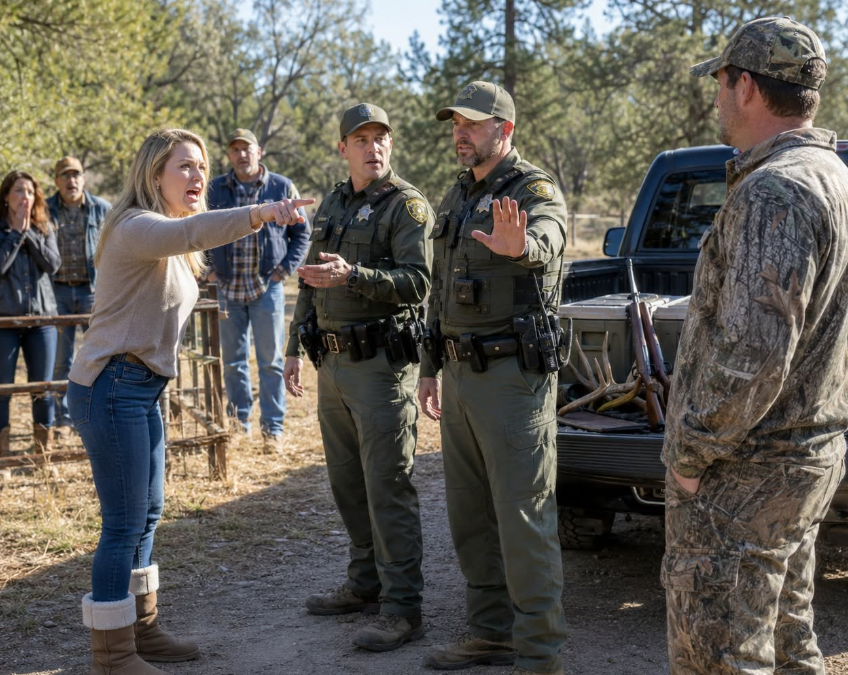
HOA Karen Called Wildlife Officers to Arrest Me for Hunting on My Own 186 Acres—Then One Survey Marker Turned the Investigation Back on Her.
Vivian Roark called wildlife officers because she thought one official complaint would finally force me off the 186 acres I legally owned.
She told them I was armed, trespassing, hunting illegally, and endangering families inside what she confidently called “HOA conservation property.”
What she did not understand was that once those officers checked the first survey marker, the hunting complaint would become the smallest problem she had.
My name is Nolan Beckett.
I’m forty-seven years old, and for most of my life, I have preferred property lines to people.
Property lines are simple.
They don’t flatter you.
They don’t threaten you.
They don’t care how impressive your title sounds.
They exist where the deed says they exist, and if somebody doesn’t like that, they can argue with the county recorder.
That attitude served me well because I owned 186 acres of mixed oak and pine woodland on the eastern side of Pine Hollow Estates.
Not inside Pine Hollow.
Not governed by Pine Hollow.
Not partially annexed into Pine Hollow.
Not functionally integrated with Pine Hollow, which was a phrase their HOA president would eventually invent when plain English stopped helping her.
My land had its own parcel number, its own chain of title, its own access road, and survey records older than the first house in that subdivision.
The woods had been there when Pine Hollow was still pasture.
The gravel track cutting through them had been there before the clubhouse, before the pool, before the ornamental entrance wall, before somebody decided that every mailbox within half a mile needed to be the same shade of dark bronze.
I never had a problem with most residents.
A lot of them were decent people.
Some waved when they saw me driving along the county road.
A retired couple named Dennis and Laura would sometimes ask if they could walk the southern tree line with their Labrador.
They asked.
That mattered.
I always said yes.
One family had two adult daughters who came home from college and liked birdwatching. They asked whether they could sit near a little pond on my eastern acreage during migration season.
I said yes to them too.
I wasn’t interested in treating 186 acres like a prison yard.
I liked the idea that private land could still be neighborly land.
But neighborly meant permission.
It did not mean ownership.
That distinction became important when Vivian Roark was elected president of the Pine Hollow Homeowners Association.
Vivian was forty-nine, sharp-featured, always polished, and one of those people who could turn asking someone to move a trash bin into a performance of executive authority.
She loved meetings.
She loved binders.
She loved phrases like community standards, collective value, environmental stewardship, and shared responsibility.
Above all, she loved being the person at the front of the room deciding what everyone else was allowed to do.
I had no reason to care at first.
I wasn’t a member.
Then the letters began.
The first came in March.
Mr. Beckett,
Several homeowners have expressed concern regarding unmaintained vegetation visible along the eastern Pine Hollow boundary. Please mow and trim the affected area within fourteen days to preserve neighborhood appearance standards.
I read it at my kitchen table.
Then I wrote back.
My parcel is not part of Pine Hollow Estates and is not subject to Pine Hollow HOA appearance standards.
Regards,
Nolan Beckett
PART2:
I assumed that would settle it.
Instead, Vivian replied.
Mr. Beckett,
While your parcel may technically sit outside the recorded subdivision, it directly impacts the appearance and market value of Pine Hollow. We expect adjacent property owners to cooperate with reasonable neighborhood maintenance expectations.
That word stood out.
Adjacent.
I smiled.
She had just admitted the most important fact in the whole dispute.
Adjacent.
Not included.
Not governed.
Adjacent.
I saved the letter.
A month later, another came.
This one asked me not to park my truck near my eastern tree line on municipal trash days because the vehicle was visible from a cul-de-sac.
I wrote back:
My truck is parked on my property.
The third letter was almost funny.
It said any additional NO TRESPASSING signs visible from Pine Hollow would require design review because “unauthorized signage may create an inconsistent visual environment.”
I had placed several signs after catching teenagers riding dirt bikes across the lower section of my property.
Nothing dramatic.
Standard signs.
PRIVATE PROPERTY.
NO TRESPASSING.
HUNTING BY PERMISSION ONLY.
Vivian wanted me to seek HOA approval before posting signs on land the HOA did not own.
I answered:
Pine Hollow has no authority over signage located on my parcel.
She called me that afternoon.
I answered because curiosity sometimes defeats good judgment.
“Nolan,” she said, as though we were colleagues sorting out a minor scheduling conflict, “this is getting unnecessarily adversarial.”
“I agree.”
“Good. Then you understand why we need cooperation.”
“No. I understand why you need a survey.”
There was a pause.
“I beg your pardon?”
“You keep writing letters as if you control land east of your subdivision. You don’t.”
“That is a very narrow view of community impact.”
“It is a very accurate view of ownership.”
Vivian exhaled through her nose.
“Nolan, Pine Hollow has invested considerable resources in maintaining a desirable environment. Your property borders our homes. What you do affects us.”
“What I do affects you visually. That is not the same as giving you authority.”
“You can’t simply hide behind technical ownership.”
I looked out my kitchen window toward the woods.
The phrase was so absurd that it took me a second to answer.
“Vivian, ownership is not technical.”
“It can be when land use affects a broader community.”
“No. It really can’t.”
That was the first time she raised the conservation argument.
She said Pine Hollow had long treated the eastern woodland as part of its natural buffer. She said residents believed it formed a conservation corridor. She said children learned about nature there. She said homebuyers had been told the woods would remain protected.
I let her talk.
Then I asked one question.
“Who told them that?”
She did not answer directly.
That became a pattern.
Vivian never lied in the simple way.
She surrounded lies with language until they seemed like civic planning.
She did not say Pine Hollow owned my land.
She said Pine Hollow had always maintained a conservation interest.
She did not say residents had legal access.
She said residents had relied on traditional use.
She did not say I had no right to hunt.
She said hunting conflicted with community expectations.
Community expectations became her favorite phrase.
I preferred county records.
That spring, Vivian started rewriting reality one newsletter at a time.
The first Pine Hollow bulletin referred to the woodland east of the subdivision as the “adjacent natural buffer.”
The next called it the “Pine Hollow conservation zone.”
By summer, it had become the “community conservation woodland.”
My name never appeared.
My ownership never appeared.
The parcel number never appeared.
Just soft language, repeated often enough to make residents believe what they were reading.
Then signs appeared.
Not on my side at first.
Along Pine Hollow trails.
COMMUNITY CONSERVATION AREA.
NO MOTORIZED VEHICLES.
DOGS ON LEASH.
REPORT SUSPICIOUS ACTIVITY.
I took photographs.
Then one morning, I found a matching sign nailed to a pine tree seventy yards inside my land.
That changed things.
I removed it.
Two days later, another appeared.
I removed that too.
The third time, I mounted a trail camera.
It caught Vivian herself walking through my woods at 7:14 in the morning with a hammer in one hand and a printed sign under her arm.
She wore spotless hiking boots and a bright green vest that said PINE HOLLOW ENVIRONMENTAL COMMITTEE.
I watched the video twice.
Then I saved it in three places.
The next time she called, I answered immediately.
“Stop putting signs on my property.”
She did not deny it.
“We are clarifying community boundaries.”
“You are trespassing.”
“That is a serious accusation.”
“It is an accurate one.”
“These woods have been used by Pine Hollow residents for years.”
“Some residents had permission.”
“Permission is implied through longstanding recreational use.”
“No, Vivian. Permission is granted by the owner.”
“You are being unreasonable.”
“I am being clear.”
She changed tone.
That was another thing Vivian did.
When polished authority failed, she became wounded.
“Our families are scared, Nolan.”
“Of my signs?”
“Of the idea that someone may be hunting near their homes.”
“I hunt during legal seasons, on my land, away from houses, following state rules.”
“You can understand how alarming that sounds.”
“No. I can understand how you are trying to make it sound alarming.”
“I am asking you to be a responsible neighbor.”
“I am asking you to stop trespassing.”
The call ended badly.
After that, the neighborhood shifted.
People stopped waving as much.
A woman near the cul-de-sac glared at me when I drove past.
Someone left an anonymous note on my truck windshield at the feed store.
STOP THREATENING CHILDREN.
I had threatened no children.
I had posted no hunting near homes.
I had never fired toward Pine Hollow.
I had never even carried a rifle near the subdivision boundary during daylight hours when residents might see me.
But Vivian understood fear better than facts.
The word hunting did work for her that appearance standards had not.
Mowing requests sounded petty.
Conservation language sounded noble.
But hunting made people emotional.
It made residents picture bullets through windows and children in danger, even though my hunting stand sat deep in the interior woods, far from any house, facing a hollow where deer crossed between ridges.
That stand had been there fifteen years.
Long before Vivian decided my property was a community amenity.
In September, she sent a cease-and-desist letter through the HOA’s management company.
It accused me of discharging firearms inside the Pine Hollow conservation area.
I forwarded it to my attorney, Leah Moreno.
Leah was a property lawyer with the calmest voice of any person I knew.
She had the kind of patience that made other people nervous.
When she read Vivian’s letter, she said, “They are escalating from aesthetics to public safety.”
“Is that better or worse?”
“Worse if ignored. Better if documented.”
She sent a response demanding that Pine Hollow stop representing my parcel as HOA land, remove signage, correct all resident communications, and provide any recorded document supporting access, conservation control, or regulatory authority over the Beckett parcel.
Vivian replied herself.
The HOA has a duty to protect residents from dangerous activity occurring in and around shared conservation assets.
Leah read it and smiled.
“Shared conservation assets?”
“That’s my woods.”
“I know.”
“Can she say that?”
“She can say almost anything. The problem is what happens when someone official asks her to prove it.”
I should have known that sentence would become prophecy.
October arrived wet and cold.
Leaves turned brown early.
Deer began moving more predictably near the low hollows.
I hunt because my father hunted, because managing deer pressure mattered on that acreage, and because I preferred knowing where my food came from when I could.
I also followed rules.
Licenses current.
Tags current.
Season dates checked.
Stand location marked.
Safe shooting lanes maintained.
No bait piles.
No trespass across neighboring land.
No drama.
Opening morning, I parked at the old gravel pull-off on my own access road before sunrise. I carried a rifle in a case, a thermos of coffee, and a folded copy of my hunting license because Vivian had made me more careful than usual.
Fog sat low between the pines.
The air smelled like wet leaves and cold soil.
I walked quietly to the stand and climbed before first light.
For two hours, nothing happened.
A squirrel yelled at me from a white oak.
A pair of crows argued somewhere east of the pond.
Then, around 8:30, my phone vibrated.
That annoyed me.
Only three people had that number for emergencies.
Leah.
My sister.
And Walter Haines, my retired neighbor who watched the access road when I was out.
It was Walter.
Text:
HOA lady at east trailhead with two trucks. Wearing orange vest. Looks mad.
I closed my eyes.
Then another message.
Now wildlife officers here.
I climbed down.
Slowly.
Carefully.
I unloaded the rifle before walking.
By the time I reached the lower trail, I could hear voices.
Vivian’s carried through the trees like a sawblade.
“He is armed right now. He has been warned repeatedly. Families walk these trails.”
A man’s voice answered.
“Ma’am, let us speak with him.”
“He should be detained before he hurts someone.”
I stepped into the opening with both hands visible and the unloaded rifle slung safely.
Two wildlife officers stood beside a green department truck.
One was older, maybe mid-fifties, broad shoulders, gray mustache, name tag reading HARRIS.
The other was younger, late twenties or early thirties, named CALDWELL.
Vivian stood behind them in an orange safety vest over a cream sweater, holding a folder thick enough to imply authority without proving anything.
Behind her were three Pine Hollow residents.
And two children.
That made my jaw tighten.
She had brought an audience.
Including kids.
Officer Harris turned toward me.
“Nolan Beckett?”
“Yes.”
“Are you armed?”
“I have an unloaded rifle slung. I can set it down if you want.”
“Slowly, please.”
I did.
Careful movements.
No attitude.
No sudden gestures.
Officer Caldwell retrieved the rifle, checked it, confirmed it was clear, and held it safely pointed downward.
Harris said, “We received a complaint that you were hunting illegally on HOA conservation property.”
I looked at Vivian.
She lifted her chin.
I looked back at Harris.
“This is my property.”
Vivian snapped, “That is disputed.”
“No,” I said. “It is disliked.”
Harris raised one hand.
“Let’s keep this calm.”
I nodded.
“Happy to.”
Vivian stepped forward.
“He has posted threatening signs, harassed residents, removed HOA conservation notices, and now he is hunting inside a shared recreation area.”
Harris looked at me.
“Do you have identification and hunting license?”
“Yes.”
I handed both over.
License valid.
Tags valid.
State ID valid.
Then Harris asked, “Do you have proof of property ownership?”
“In my truck and on my phone. Deed, survey, tax map.”
Vivian made an impatient sound.
“This is not just about his paperwork.”
Officer Harris glanced at her.
“Actually, property ownership is fairly relevant to a trespass hunting complaint.”
That was the first moment the morning tilted.
Not dramatically.
Just enough for Vivian to notice that official attention did not automatically belong to her.
I opened the county parcel map on my phone.
Then pulled the folded survey from my truck.
Harris examined it on the hood of his vehicle.
Vivian immediately placed her own document beside it.
PINE HOLLOW CONSERVATION AND RECREATION MAP.
There it was.
A glossy, color-coded map showing my woods shaded pale green, labeled:
HOA CONSERVATION PROPERTY.
Walking trails were drawn through the oaks.
The little pond was marked BIRDING AREA.
My old logging track was marked MAINTENANCE ACCESS.
My hunting stand location was labeled PROHIBITED WEAPONS ZONE.
I stared at it.
For a moment, I was not angry.
I was impressed.
Not by the honesty.
By the nerve.
Vivian had not merely implied ownership.
She had printed it.
Officer Caldwell leaned closer.
“Who prepared this?”
Vivian said, “The HOA environmental committee.”
“Is it recorded?”
“It is an internal planning map.”
“Does Pine Hollow own this shaded area?”
“It is recognized as conservation property.”
“That wasn’t my question.”
Vivian’s mouth tightened.
Harris looked from her map to my survey.
“Mr. Beckett, can you show us the nearest property marker?”
“Yes.”
Vivian said quickly, “The old markers are unreliable.”
Harris looked at her.
“Why?”
“Because this area has been used by Pine Hollow for years.”
“That does not make a survey marker unreliable.”
She did not like that.
We walked toward the southern boundary first.
The ground dipped into a shallow wash, then rose near a line of old stones and iron pins. I knew the markers well. My father had shown them to me when I was young, the same way his father had shown him.
The nearest pin sat beside a double-trunk oak.
I brushed leaves away with my boot.
There it was.
Iron.
Orange cap from my newer survey.
Stamped with the surveyor’s license number.
Officer Caldwell photographed it.
Then compared it to my survey.
Harris checked coordinates on his handheld GPS.
The first marker matched.
We moved to the next.
It matched too.
Then the next.
By the third marker, Vivian’s confidence began to fray.
“These are private survey points,” she said.
Harris answered, “They appear consistent with recorded boundary documents.”
“Our HOA map uses community conservation boundaries.”
Caldwell looked at her.
“Who established those boundaries?”
“The board.”
“Based on what survey?”
Vivian hesitated.
“The historical use pattern.”
I nearly laughed.
Harris did not.
He asked, “Do you have a deed?”
Vivian blinked.
“For what?”
“For the land you say belongs to the HOA.”
She looked at the map.
“The conservation property has always been understood as part of Pine Hollow’s environmental buffer.”
“Do you have a deed?”
“No, not with me.”
“Recorded easement?”
“It is not an easement issue.”
“Then what is it?”
“Shared stewardship.”
Harris looked tired suddenly.
The kind of tired officers get when a complaint starts becoming paperwork.
He turned to Caldwell.
“Call county GIS and records. Confirm parcel line.”
Vivian said, “That won’t be necessary.”
Harris looked at her.
“It became necessary when you called us to arrest an armed man for hunting on land he says he owns.”
That sentence finally shut her up.
For ten minutes, we stood in wet leaves while Caldwell spoke on the radio and then by phone.
The residents Vivian had brought looked increasingly uncomfortable.
The two kids whispered to each other.
One of them asked, “Mom, are we allowed to be here?”
Nobody answered him.
That question did more to expose Vivian than anything I could have said.
Were they allowed to be here?
No.
Not without permission.
Caldwell returned.
“County records show this parcel belongs to Nolan Beckett. Pine Hollow common property ends west of the marked boundary. No recorded conservation easement found in the quick search. No public hunting restriction specific to this parcel beyond standard state rules.”
Vivian immediately said, “That is incomplete.”
Harris folded my survey.
“Maybe. But right now, the records we have do not support your complaint.”
“He is hunting near homes.”
I pointed west.
“My stand is over nine hundred yards from the nearest Pine Hollow house and faces east into the hollow.”
Caldwell asked, “Can you show us?”
“Yes.”
We walked.
Vivian followed even though nobody invited her.
At the stand, Harris examined the shooting lane.
The direction.
The backstop.
The distance.
He asked questions.
I answered.
He checked my tags again.
He checked the season.
Checked weapon condition.
Checked whether bait was present.
There was none.
Finally he said, “I don’t see a hunting violation.”
Vivian’s face tightened.
“He has created a dangerous environment for residents.”
Harris turned slowly.
“Mrs. Roark, the residents appear to be on his property because you brought them here.”
That was the second moment the morning tilted.
Harder this time.
One of the mothers looked at Vivian.
“You said this was HOA land.”
“It is treated as HOA conservation land.”
“That’s not what you said.”
Vivian ignored her.
Harris looked at the three residents.
“Did Mr. Beckett give any of you permission to be here today?”
No one spoke.
The mother shook her head.
“Vivian said we should come because he was hunting illegally.”
Harris looked back at Vivian.
“You led residents, including minors, onto private hunting property during hunting season to confront an armed landowner?”
Vivian’s mouth opened.
Closed.
“This is not a hunting property. This is a conservation area.”
“No,” Harris said. “Based on what we’ve checked, this is private woodland owned by Mr. Beckett.”
The word private seemed to irritate her more than anything else.
She had spent months sanding it down with prettier language.
Conservation.
Community.
Shared.
Buffer.
Stewardship.
Harris put the hard word back.
Private.
The investigation did not end there.
It expanded.
That was the part Vivian had not expected.
Wildlife officers are not just referees for neighbor arguments. They deal with land access, hunting permissions, illegal posting, interference, and safety. When Vivian handed them a map claiming HOA ownership over my land, she gave them something to verify.
And when the first survey marker matched my deed, the next question became obvious.
How many people had she sent onto my property under a false claim?
Harris asked for the HOA map.
Vivian clutched it.
“This is an internal document.”
“You used it to support a law-enforcement complaint.”
“It belongs to the association.”
“Then we’ll photograph it.”
He did.
Every page.
Every label.
Every trail.
Every shaded section.
Every place where my land was described as HOA conservation property.
Then he asked Vivian whether signs had been placed in the woods.
She said yes.
“By whom?”
“The environmental committee.”
“On whose authority?”
“The board’s.”
“On whose land?”
She said, “The conservation area.”
Harris said nothing.
He just wrote that down.
I recognized the tactic.
Let the person keep choosing the wrong words.
A little later, we walked to the place where Vivian had nailed the sign to my pine tree.
The holes were still there.
I had kept the removed signs in my barn.
I told Harris that.
He asked to see them.
Vivian’s face changed.
“You kept HOA property?”
“You nailed it to my tree.”
“It was improperly removed.”
“It was improperly installed.”
At the barn, I showed the officers the signs.
Three of them.
All bearing Pine Hollow’s logo.
All identifying my woods as community conservation land.
I also showed them the trail-camera video of Vivian installing one.
Harris watched it without expression.
Caldwell watched it twice.
Then he looked at Vivian.
“Is that you?”
Vivian lifted her chin.
“I was acting in my capacity as HOA president.”
“Were you aware this was Mr. Beckett’s property?”
“I was aware he claimed ownership.”
“Did you have documentation showing the HOA owned it?”
“Our map—”
“No. A deed.”
Vivian’s answer was quiet.
“No.”
That was the first honest thing she had said all morning.
The officers separated everyone for statements.
The residents admitted Vivian had repeatedly told them the woodland was HOA conservation property.
One produced an email.
I could see the subject line from where I stood.
COMMUNITY CONSERVATION TRAIL SAFETY.
Another had a screenshot of the HOA portal showing recommended family nature walks through the eastern woods.
My woods.
A third had paid a $25 “conservation access fee” for a guided birdwatching event the previous spring.
I had never heard of that fee.
Vivian had charged residents to access my land.
That was when the hunting complaint stopped being the center of the day.
Harris asked Vivian about the fee.
She said it supported environmental programming.
“On Mr. Beckett’s property?”
“In the conservation area.”
“Owned by whom?”
She did not answer.
Harris closed his notebook.
“Mrs. Roark, we’re going to need additional documentation from the HOA.”
“What kind?”
“Maps, communications, sign installation records, event notices, fees collected, and any documents you believe give Pine Hollow authority over this land.”
Vivian looked at me.
“This is harassment.”
I almost admired the audacity.
She had called wildlife officers to have me arrested on my land, brought residents into my woods during hunting season, handed officers a fake ownership map, and now she was calling the consequences harassment.
Harris said, “No, ma’am. This is follow-up.”
The officers did not arrest Vivian that morning.
That disappointed some people when the story spread later.
Real life is not always immediate handcuffs and dramatic speeches.
They gave instructions.
Residents were escorted back to Pine Hollow.
Vivian was told not to return to my property.
My rifle was returned.
My license was returned.
No hunting citation was issued.
No trespass complaint against me survived contact with the survey.
Before Harris left, he looked at me.
“Mr. Beckett, I would recommend you contact your attorney.”
“I already have one.”
“Good.”
Then he looked toward the woods.
“And document every sign, map, and event you can.”
“I have been.”
For the first time that morning, he smiled.
“Figured.”
Leah was delighted in the quiet way lawyers get delighted when an opponent puts nonsense in writing.
She read Harris’s preliminary report twice.
Then she said, “Vivian may have just done more for your case than we could have done in six months.”
The report documented the complaint.
The survey markers.
The lack of recorded HOA ownership.
The signs.
The map.
The resident statements.
The conservation access fee.
And the fact that Vivian had escorted minors onto private hunting property while alleging I was the danger.
Leah sent a formal demand letter to Pine Hollow.
It was not short.
It demanded immediate removal of all references to my land as HOA conservation property. It demanded accounting for all fees collected for events or access involving my parcel. It demanded preservation of all communications regarding the eastern woodland, trail maps, environmental programming, signage, resident access, hunting complaints, and Vivian’s communications with wildlife authorities.
Then it demanded that Pine Hollow notify all residents in writing that my land was private property and that no one had HOA permission to enter it.
The HOA’s attorney responded in four days.
That told me something.
Before the wildlife officers came, Vivian answered everything herself.
After they checked the survey, lawyers started speaking for her.
The first legal response was careful.
The association denied intentional wrongdoing but agreed to suspend conservation programming in the eastern woodland pending review.
Leah smiled when she read it.
“Suspending programming on land they don’t own. Generous.”
Then the board called a special meeting.
I attended with Leah.
The clubhouse was packed.
Vivian sat at the front table wearing a dark green blazer and the expression of someone preparing to survive a hostile takeover by sheer posture.
Three board members sat beside her.
The HOA attorney, Martin Kell, stood at the podium.
He began with the kind of legal language people use when admitting as little as possible.
“Following a recent interaction involving state wildlife officers and adjacent landowner Mr. Nolan Beckett, the board has undertaken a review of documents concerning the eastern conservation boundary.”
Adjacent.
There was that word again.
Honest by accident.
Martin continued.
“At this time, the association has not located any deed, easement, or recorded instrument establishing Pine Hollow ownership or control over Mr. Beckett’s parcel.”
The room shifted.
A resident raised her hand.
“Then why were we told it was our conservation land?”
Martin looked toward Vivian.
Vivian did not move.
Another resident stood.
“I paid for the spring birdwatching event.”
“So did I.”
“My kids went on that trail.”
“Were we trespassing?”
The questions multiplied.
Vivian finally stood.
“Everyone needs to understand context.”
No one looked comforted.
“For many years, Pine Hollow residents have enjoyed access to the eastern woods as part of our community’s natural environment. The association acted in good faith to preserve that area.”
I stood.
Leah touched my sleeve lightly, warning me not to interrupt too aggressively.
I ignored that halfway.
“You preserved it by charging people to walk on land you didn’t own?”
Vivian looked at me.
“You allowed residents before.”
“With permission.”
“That created expectations.”
“No. It created gratitude. You turned it into entitlement.”
A murmur moved through the room.
Vivian’s face tightened.
“You cannot invite some residents and exclude others arbitrarily.”
“It’s my land. Yes, I can.”
That simple sentence seemed to offend the entire philosophy she had built.
Vivian believed community need diluted ownership.
I believed ownership defined who got to say yes.
Martin stepped in quickly.
“The board is not prepared tonight to debate broader access rights.”
Leah stood.
“Then let’s keep it narrow. Your president represented private land as HOA conservation property. The association posted signs, organized events, collected fees, and directed residents onto Mr. Beckett’s property. Then Mrs. Roark called wildlife officers alleging he was armed and trespassing on land the association cannot prove it owns.”
That summary landed hard.
Vivian said, “I acted to protect families.”
Leah turned toward her.
“By bringing families onto private hunting land during hunting season?”
Silence.
That was the line no one could soften.
Even residents who disliked hunting understood that Vivian had created the very risk she claimed to be preventing.
A father near the back stood.
“My son was there that morning.”
Vivian said, “You chose to accompany me.”
“You told us he was illegally hunting on HOA land.”
“I believed that.”
“Based on what?”
“The map.”
“Who made the map?”
No answer.
Martin stepped back from the podium and whispered to another board member.
Then the treasurer, a tired-looking man named Paul Renner, opened a folder.
“There is also the matter of conservation access fees.”
Vivian turned sharply.
“Paul.”
He continued.
“Over the past eighteen months, the association collected approximately $11,400 in fees for guided nature walks, birdwatching weekends, trail maintenance donations, and conservation programming connected to the eastern woodland.”
The room erupted.
“That was for his land?”
“Did he get the money?”
“Did we trespass?”
“Who approved this?”
Paul looked miserable.
“The programming was approved under the environmental committee budget.”
Vivian lifted her chin.
“Those funds supported conservation awareness.”
I asked, “On whose property?”
She looked at me with real hate then.
Not dislike.
Hate.
Because I had reduced her noble language to the question she could not answer.
The board voted that night to suspend Vivian from all duties pending investigation.
Not remove.
Not yet.
Suspend.
But it was enough.
For the first time since she had become president, someone else took the gavel from her hand.
The aftermath took months.
Wildlife officers completed their report. They did not find any hunting violation by me. They did document improper representation of land status, unauthorized signage, resident access under false premises, and potential interference with lawful hunting activities.
The county recorder confirmed Pine Hollow owned no part of my parcel.
The title search confirmed no conservation easement.
The fire marshal confirmed no emergency access route through my woods.
The planning department confirmed the HOA’s environmental map had never been filed as an official land-use document.
Everything Vivian had built collapsed into one fact.
Pine Hollow did not own the land.
After that, all the elegant language fell away.
Shared stewardship.
Conservation boundary.
Traditional access.
Natural buffer.
Community asset.
None of it survived the deed.
The HOA had to send a letter to every resident.
Eastern Woodland Ownership Clarification.
I still have a copy.
It said:
The wooded parcel east of Pine Hollow Estates is privately owned by Nolan Beckett. Pine Hollow HOA does not own, manage, or control the parcel. Residents do not have association permission to enter the property. Prior maps or communications suggesting otherwise should be disregarded.
I framed that one.
Not in my house.
In my barn.
Above the shelf where I store trail-camera batteries.
Leah said it was petty.
I told her barns need decoration.
Pine Hollow refunded conservation fees.
Some residents were embarrassed.
Some were angry.
A few apologized.
Dennis and Laura came by with their Labrador and stood outside the posted line.
Dennis took off his hat.
“We’re sorry, Nolan.”
“You asked before walking. You’re fine.”
Laura looked upset.
“We believed the newsletters.”
“I know.”
“We should have checked.”
“Most people don’t.”
“Can we still walk the southern tree line sometimes?”
I looked at their dog.
The dog looked at me like he personally had never printed a fake conservation map.
“Call first,” I said.
Laura smiled.
“We will.”
I still let them walk.
Permission was never the problem.
Vivian was.
Eventually, the board removed her as president.
Officially, the reason was failure to verify land ownership before authorizing communications, signage, programming, and enforcement activity involving adjacent property.
Unofficially, residents were furious she had charged them fees to trespass and then dragged their kids into a hunting complaint that backfired.
She did not resign gracefully.
People like Vivian rarely do.
She sent one final letter to the board accusing them of abandoning environmental values under pressure from an aggressive landowner.
Someone leaked it.
The neighborhood chat exploded.
For once, most residents did not rally behind her language.
They had learned to ask a better question.
Do we own it?
The answer was no.
That question changed everything.
The HOA amended its rules.
No map could label land outside Pine Hollow boundaries without identifying the owner.
No committee could install signs outside HOA common areas.
No resident event could use adjacent private property without written permission.
No fee could be collected for access to land the HOA did not own.
No officer or committee chair could contact law enforcement alleging trespass or illegal activity on adjacent land without board review and documentation.
The rules sounded obvious.
Most necessary rules do after someone proves why they are necessary.
The relationship between Pine Hollow and me became better afterward.
Not perfect.
Better.
People stopped assuming my woods were theirs.
A few still disliked the hunting.
That was fine.
They were allowed to dislike it from their side of the line.
I added more signs.
Not ugly ones.
Clear ones.
PRIVATE PROPERTY.
NO TRESPASSING WITHOUT WRITTEN PERMISSION.
HUNTING AREA.
CONTACT OWNER FOR ACCESS.
I also painted the boundary trees with lawful purple markings where appropriate.
Vivian complained about the color in a private message to someone who sent me a screenshot.
Apparently, purple created an “aggressive visual tone.”
I laughed for ten minutes.
The next hunting season came quietly.
No wildlife officers.
No residents standing in orange vests.
No children brought into the woods as props.
I sat in the stand before dawn and listened to the world wake up.
A barred owl called once from the creek bottom.
Fog lifted between the oaks.
The subdivision remained hidden behind trees.
For the first time in nearly a year, the woods felt like woods again instead of evidence.
That mattered more to me than the framed HOA letter.
More than Vivian’s removal.
More than being right.
Land changes when people argue over it.
Even if nothing physical moves, the feeling shifts.
Every trail becomes a claim.
Every sign becomes a warning.
Every boundary marker becomes a witness.
It took time for my woods to stop feeling like a courtroom.
But they did.
One afternoon, Officer Harris stopped by.
Not officially.
He was off duty, driving his personal truck, wearing jeans and a worn jacket.
He parked by the barn and asked if I had a minute.
I did.
We walked toward the southern marker.
He looked around.
“Quiet out here.”
“That’s why I bought it.”
He nodded.
“Mrs. Roark still giving you trouble?”
“Not directly.”
“Good.”
At the marker, he crouched and brushed leaves away with two fingers.
“I’ve seen a lot of neighbor disputes,” he said. “Most start because somebody wants what’s convenient and works backward toward a reason.”
“That’s exactly her.”
“She picked the wrong complaint.”
“Because of the hunting?”
“Because hunting forced us to check land status before we did anything else.”
He stood.
“If she’d kept it to newsletters and signs, this might’ve dragged on for years.”
“I know.”
“She put a badge on the problem.”
That was a good way to say it.
Vivian thought calling wildlife officers would put state authority behind her story.
Instead, it put state authority in front of the survey markers.
And survey markers, unlike newsletters, do not care who speaks more confidently.
Months later, I saw Vivian at the grocery store.
She was standing near the produce section, inspecting tomatoes like they had disappointed her personally.
She saw me.
I saw her.
For a second, I thought she would walk away.
Instead, she pushed her cart toward me.
“Nolan.”
“Vivian.”
Her posture remained perfect.
She had lost the presidency, the conservation program, the map, and most of her influence, but she had not lost her talent for looking offended.
“I hope you are satisfied.”
“With what?”
“You turned an environmental concern into a legal attack on the community.”
“No. You turned my property into your environmental program.”
“You could have cooperated.”
“I did. With people who asked.”
Her eyes narrowed.
“That is not community-minded.”
“Permission is community-minded. Taking is not.”
She looked away first.
That felt like the closest thing to an apology I would ever get.
I did not need more.
As the months passed, the woods became neighborly again in the right way.
Birdwatchers emailed.
I approved specific dates.
Dennis and Laura texted before walking.
One scout troop requested permission for a tree-identification lesson. I allowed it with adult supervision, route limits, and no fees.
The event went beautifully.
Kids learned the difference between white oak and red oak.
They saw deer tracks near the mud.
They asked better questions than most adults.
One boy pointed at a boundary marker and asked, “What’s that?”
I said, “That tells people where one property stops and another begins.”
He asked, “What happens if people ignore it?”
I thought about Vivian.
Then I said, “Then grown-ups waste a lot of time relearning what the marker already knew.”
The scout leader laughed.
The boy nodded seriously, as if that made perfect sense.
Maybe it did.
Children understand ownership better than committees sometimes.
This is yours.
That is mine.
May I use it?
Yes.
No.
Thank you.
Adults create phrases like functionally integrated conservation asset because they dislike the simplicity of asking.
The funny thing is that I became more generous after Vivian was removed.
Not less.
Once people stopped pretending they had rights, I became more willing to grant permission.
I let the birdwatchers use the pond twice a year.
I allowed Dennis and Laura their walks.
I gave the scout troop annual access.
I even worked with the new HOA president, Paul Renner, to create a written permission process for occasional educational use.
The document was two pages.
Clear dates.
Clear routes.
No fees.
No implied future access.
No signage.
No public claims.
Revocable at any time.
Paul read it and said, “Vivian would hate this.”
“Why?”
“Because it gives us less power than she claimed.”
“No,” I said. “It gives you exactly the power I grant.”
He smiled.
“That’s what I meant.”
That agreement did more for neighbor relations than every one of Vivian’s newsletters combined.
Because people respect what is clearly offered.
They resent what is falsely seized.
Looking back, the part that still bothers me most is not that Vivian called wildlife officers.
It is that she brought residents and children with her.
She wanted witnesses to my humiliation.
She wanted families to see me confronted by state officers, rifle in hand, standing in woods she had taught them to think were theirs.
She wanted the scene to prove her story.
Instead, the scene revealed the danger of her story.
She had led them into a place she did not own, during hunting season, to confront the legal owner, then blamed me for the risk her own lie created.
That is what finally changed people’s minds.
Not the deed alone.
Not the survey alone.
The hypocrisy.
Vivian had claimed to protect families.
The first unsafe thing those families experienced was following Vivian.
I still hunt that land.
Carefully.
Legally.
Quietly.
I still prefer property lines to people, though I admit some people are improving.
I still keep every document.
Deed.
Survey.
Tax record.
Hunting license.
Wildlife report.
HOA correction letter.
Photos of every marker.
Trail-camera clips.
Screenshots of old portal posts.
Leah says I overdocument.
I tell her Vivian cured me of underdocumenting forever.
One evening, I took a walk along the eastern ridge at sunset.
The oaks were bare.
Pine needles softened the trail.
The pond reflected a pale sky.
Far off, behind trees, I could see the rooftops of Pine Hollow Estates.
The houses looked peaceful from a distance.
Most things do.
I stopped at the survey marker where Harris had first crouched and brushed away leaves.
It looked unimpressive.
A small cap.
A pin.
A point on a line.
Yet that little marker had done what months of letters could not.
It had forced everyone to stop talking in concepts and start dealing with reality.
Vivian had community expectations.
I had a boundary.
Vivian had a conservation map.
I had a deed.
Vivian had angry residents.
I had survey markers.
Vivian had called wildlife officers to remove me.
Those officers checked the ground.
And the ground told the truth.
That is the thing about land.
People rename it.
Market it.
Map it badly.
Describe it as underused, shared, adjacent, integrated, or community-serving.
They write newsletters about it.
They print brochures.
They collect fees.
They stand at meetings and speak as if confidence can substitute for title.
But the land stays where it is.
Waiting.
Patient.
Exact.
The day Vivian called wildlife officers, she believed official uniforms would finally make her version of the woods real.
Instead, those uniforms walked to the first marker, then the second, then the third.
And with every matching point, her story lost another piece of ground.
By noon, the hunting complaint was gone.
By evening, the conservation map was evidence.
By the next board meeting, residents were asking for refunds.
And by the end of it all, Vivian Roark learned the one lesson every HOA tyrant eventually meets if they push far enough.
You can call private land a community asset as many times as you want.
You can shade it green on a map.
You can nail signs to trees.
You can charge fees, send emails, and frighten families.
But when the officers bend down, clear the leaves, and read the survey marker, all your language has to stand in the same place as everyone else.
On the correct side of the line.