HOA Karen Called 911 on Me in My Own Driveway—Then the Patrol Officers Saw the Police Chief Badge I’d Kept Hidden for Weeks.
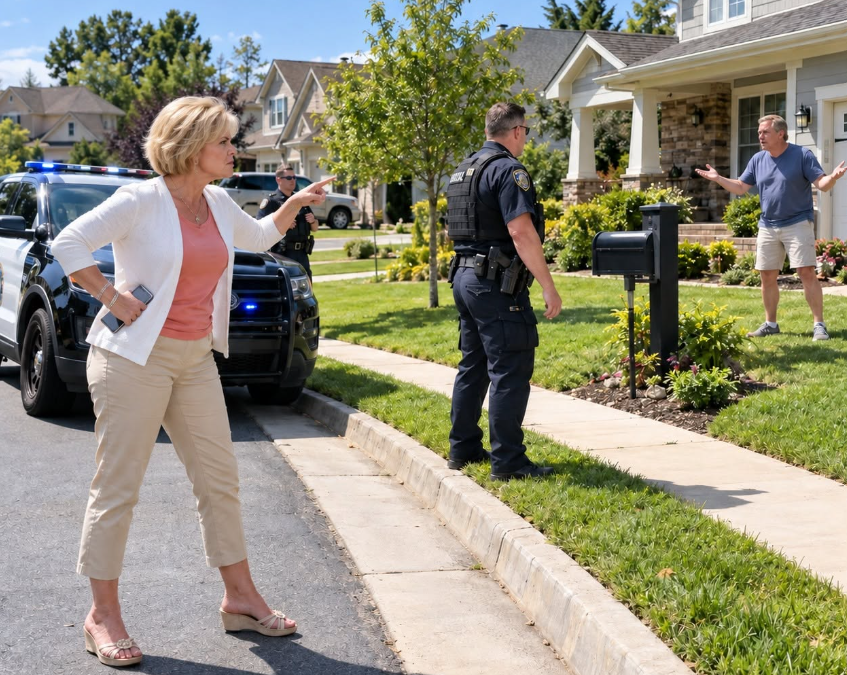
PART2:
She moved with the confidence of somebody who had never considered the possibility that another person might tell her no.
I was carrying a box toward the garage when she walked straight past me.
No introduction.
No hello.
No welcome to the neighborhood.
She circled the moving truck once, then stopped at my Ford F-150.
My truck wasn’t new.
It was a 2009.
A little faded around the edges.
A few scratches in the bed.
Nothing dramatic.
It ran perfectly.
I maintained it obsessively.
Most importantly, it was mine.
Pamela looked at it like someone had dumped garbage on the front lawn.
“Commercial vehicles aren’t permitted on this street past six p.m.”
Her eyes remained on the moving truck.
I checked my watch.
It was just after two.
“We’ll be finished long before then, ma’am.”
She made a small sound through her nose.
Then she walked around the F-150.
“And this truck?”
“This one?”
I put the box down.
“Yes.”
She tapped the tailgate with one finger.
“Is it staying?”
“That’s my daily driver.”
For the first time, she looked directly at me.
Then she lowered her eyes to the clipboard and began writing.
Slowly.
Deliberately.
Scratch.
Scratch.
Scratch.
The sound of the pen seemed almost theatrical.
“What are you writing?”
She didn’t answer.
She finished, snapped the pen against the metal clip, and turned away.
No goodbye.
No explanation.
She climbed into the Cadillac.
The tinted window rose.
The Escalade glided away.
Shelby emerged from the house carrying a cardboard box marked KITCHEN.
She watched Pamela disappear around the curve.
“Did that woman just inspect our truck?”
“Apparently.”
“Like a health inspector?”
“Apparently.”
Shelby squinted after the Cadillac.
“She seems pleasant.”
I laughed.
That was the first mistake I made with Pamela Thornton.
I thought she was funny.
Not intentionally funny.
The kind of funny that comes from watching an adult take something absurdly seriously.
I had dealt with armed suspects.
Domestic barricades.
Drunk drivers.
People screaming in emergency rooms.
People lying straight to my face while evidence sat on the table between us.
A neighborhood woman with a clipboard didn’t register as a threat.
That evening, I learned that everyone else in Ridgewood knew better.
Around seven, while I was stacking flattened moving boxes in the garage, a man walked over from two houses down carrying a six-pack of SweetWater.
He was in his early sixties.
Weathered face.
Gray hair.
Hands that looked like they had spent a lifetime around tools.
“Hank Sellers.”
He held out one hand.
I shook it.
“Garrett Callaway.”
“Welcome to Ridgewood.”
He lifted the beer.
“And condolences.”
I smiled.
“For what?”
He nodded toward the direction Pamela’s Escalade had gone earlier.
“You met the queen.”
I laughed.
“That obvious?”
“Pamela Thornton?”
He handed me a beer.
“She’s been HOA president for nine years.”
We sat on the edge of my front porch while the last of the daylight faded behind the trees.
Hank told me Pamela had built her identity around Ridgewood Estates.
Not literally.
She hadn’t developed the neighborhood.
She hadn’t designed the houses.
She hadn’t laid the roads.
But in Pamela’s mind, Ridgewood existed because she protected it from everybody else.
“She likes rules,” I said.
Hank shook his head.
“No.”
He took a drink.
“She likes being the person who decides what the rules mean.”
That sentence stayed with me.
“The family who owned your house before you lasted eight months,” he said.
“What happened?”
“Violations.”
“What kind?”
“All kinds.”
“Anything serious?”
Hank laughed without humor.
“Trash can visible from the street on pickup day. Basketball hoop two inches too high. Grass supposedly half an inch over the maximum height. Their kids had friends over and she complained there were too many cars.”
“They moved over that?”
“She called the police three times in their first month.”
I looked through the front window.
Colton was sitting on the floor of his new bedroom arranging baseball cards into rows.
The sight made something in my chest settle.
This house was supposed to be our reset.
The quiet place.
The normal place.
Then the doorbell rang.
I looked at Hank.
He stared toward the front door.
“You have got to be kidding me.”
I opened it.
A uniformed Gwinnett County officer stood under the porch light.
He was probably in his late thirties.
Professional posture.
Hat in his hands.
Embarrassed expression.
“Mr. Callaway?”
“Yes.”
“I’m Officer Wade Pruitt, Gwinnett County Patrol.”
I nodded.
“What can I do for you?”
“We received a complaint about a suspicious commercial vehicle at this address.”
I looked over his shoulder.
The moving truck sat legally at the curb.
Empty.
The rear door was already closed.
The crew had left.
“This vehicle?”
“Yes, sir.”
“This is my moving truck.”
“I understand.”
“I moved here today.”
“I understand that too.”
The officer sighed quietly.
“It’s not in violation of anything. I just have to document the response.”
I looked down the street.
No sign of Pamela.
But I knew.
“Who called?”
Officer Pruitt hesitated.
“I think you probably already know.”
I nodded.
He checked my name, documented the situation, apologized, and left.
I stood in the doorway after his patrol car disappeared.
Our first night in Ridgewood Estates.
Our first police call.
Somewhere farther down Sycamore Trail, a garage door opened.
The white Cadillac disappeared inside.
Then the door lowered again.
That should have been my warning.
Six days later, the first violation letter arrived.
Cream-colored envelope.
HOA logo.
My last name misspelled.
CALLAWAY became CALLOWAY.
Inside was a single page.
VEHICLE AESTHETIC STANDARDS VIOLATION.
According to the letter, my 2009 Ford F-150 was “aged, visibly deteriorated, and inconsistent with the visual standards established for Ridgewood Estates.”
I read that sentence three times.
Then I reached the fine.
Two hundred dollars.
Per day.
Until I removed the truck or “brought the vehicle into aesthetic compliance.”
I sat at the kitchen table with coffee cooling beside me.
Shelby walked in wearing her scrubs.
“What?”
I slid the letter toward her.
She read it.
Then looked at me.
“Can they actually do that?”
“That’s what I’m about to find out.”
Before buying the house, I had read the entire forty-seven-page covenant package.
Most homeowners probably skimmed it.
I didn’t.
Twenty years in policing had taught me that the sentence nobody reads is often the sentence everybody argues about later.
I pulled out the CC&Rs.
Parking restrictions.
No blocking sidewalks.
No parking near fire hydrants.
No abandoned vehicles.
No commercial logos.
No long-term storage of nonoperational vehicles.
Nothing about age.
Nothing about cosmetic appearance.
Nothing banning pickup trucks.
Nothing giving Pamela Thornton authority to decide whether a vehicle was attractive enough for her neighborhood.
I read it twice anyway.
Nothing.
The fine was fabricated.
I wrote a formal response.
No anger.
No insults.
I cited the relevant sections.
Asked Pamela to identify the specific recorded covenant I had allegedly violated.
Then I mailed it certified.
Return receipt requested.
Paper trails matter.
Three days after she signed for it, another violation arrived.
DRIVEWAY MAINTENANCE.
Alleged oil stains.
Fine: one hundred fifty dollars.
I walked outside.
The driveway was spotless.
Colton and I had pressure washed it two days earlier.
He had spent more time spraying me than the concrete.
There wasn’t a single oil stain.
I took photographs.
Wide shots.
Close shots.
Date stamped.
Then added them to a folder on my laptop.
THORNTON.
At that point, I still thought I was documenting a neighborhood dispute.
I didn’t know I was beginning a criminal case.
That evening, I showed the letters to Hank.
He studied the first one.
Then the second.
He didn’t look surprised.
“Wait here.”
He disappeared into his garage.
A few minutes later, he returned carrying a Nike shoe box held shut with an old rubber band.
He placed it on the patio table.
“What is that?”
“Four years.”
He removed the lid.
Violation letters.
Dozens of them.
He pulled out the first.
“Garden hose visible from street.”
Another.
“Garbage can lid open on collection day.”
Another.
“Satellite dish angle.”
Another.
“Porch light color not consistent with neighborhood aesthetic.”
He held up another piece of paper.
“My favorite.”
I read it.
WELCOME MAT NOT CONSISTENT WITH COMMUNITY AESTHETIC GUIDELINES.
I looked at him.
“A welcome mat?”
“A welcome mat.”
“Did you challenge these?”
“The first five.”
“What happened?”
“She doubled the fines.”
“That’s not how this is supposed to work.”
“I know.”
“Why did you pay?”
Hank stared at the box.
“Because eventually peace becomes worth more than being right.”
That answer bothered me.
Not because I blamed him.
Because I understood it.
People like Pamela depended on exhaustion.
They didn’t have to win legally.
They just had to make resisting expensive enough, irritating enough, embarrassing enough that people eventually surrendered.
The next morning, I walked toward the mailbox and heard the Escalade behind me.
Pamela stopped beside the curb.
The window lowered.
“I see you received my letters, Mr. Calloway.”
“I did.”
“This is not negotiable.”
“What isn’t?”
“Compliance.”
“With which covenant?”
Her smile tightened.
“The board has spoken.”
“The board?”
“Yes.”
“Or you?”
The smile disappeared.
She removed her sunglasses.
Her eyes moved past me toward my truck.
“Maybe if you could afford a real vehicle, you wouldn’t have to park that junkyard reject in front of decent people’s homes.”
There it was.
Not safety.
Not covenants.
Not maintenance.
Contempt.
I let the silence stretch.
Twenty years of police work had taught me not to fill every silence.
People reveal themselves when you don’t rescue them from their own words.
Pamela waited.
I smiled faintly.
“Have a good morning, ma’am.”
Then I walked away.
That night, Shelby and I sat on the back porch after Colton went to sleep.
Cicadas screamed from the trees.
The air smelled like honeysuckle.
Shelby held a glass of iced tea against her knee.
“She’s making things up.”
“Yes.”
“So what are you going to do?”
I opened my laptop.
“What I always do.”
“What’s that?”
“Build a case.”
I created subfolders.
Violation letters.
CC&Rs.
Certified mail receipts.
Photographs.
Police response.
Correspondence.
Shelby watched me organize everything.
“Are you going to tell her what you do?”
“No.”
“Why?”
“Because right now she thinks I’m just another homeowner.”
“And?”
“I want to know what she does when she thinks nobody with authority is watching.”
Shelby considered that.
“Garrett.”
“Yes?”
“Don’t turn our house into one of your investigations.”
I looked toward Colton’s upstairs window.
“I won’t.”
At the time, I meant it.
Three weeks after we moved in, Shelby called me while I was sitting in a budget meeting at the station.
Her voice was controlled.
That scared me more than panic would have.
“Garrett.”
“What happened?”
“There’s a tow truck in our driveway.”
I stood immediately.
“What?”
“A flatbed.”
“What is it doing?”
“The driver is hooking up your F-150.”
My chair rolled backward.
“Where’s Pamela?”
“Standing on our lawn telling him what to do.”
I grabbed my keys.
“I’m coming.”
The twenty-two-minute drive home felt like an hour.
I kept myself below the speed limit.
Barely.
When I turned onto Sycamore Trail, I saw the flatbed.
Diesel engine idling.
Heavy chain running toward the front axle of my truck.
Pamela stood near the walkway holding a piece of paper.
Shelby was between her and the tow operator.
I parked farther down the street.
For a moment, I didn’t approach.
I watched.
The tow driver was a heavyset man wearing gray coveralls.
His patch read EARL’S TOWING.
“Ma’am,” he said, “this is private property.”
Pamela thrust the paper toward him.
“You have authorization.”
“From who?”
“Me.”
“That’s not enough.”
“I am the president of the homeowners association.”
The driver examined the page.
“This is HOA letterhead.”
“Correct.”
“It’s not a court order.”
“It’s a vehicle removal order.”
“Signed by you.”
“I am authorized to enforce community regulations.”
The tow driver shook his head.
“I need the property owner’s written consent or a legal order.”
Pamela’s face reddened.
“The owner is in violation.”
“That doesn’t change what I need.”
Shelby crossed her arms.
“You need to leave my driveway.”
Pamela turned toward her.
“Your husband’s truck is dragging down every property value on this street.”
Shelby didn’t move.
“Get off my property.”
“If you can’t control him, I will.”
That sentence nearly pulled me out of the shadows.
Nearly.
Then Pamela made the mistake of continuing.
“You people think you can move into a community like this and ignore standards because nobody will stop you.”
Shelby stepped forward.
“What exactly do you mean by ‘you people’?”
Pamela’s mouth opened.
Then closed.
The tow driver had already begun unhooking the chain.
Metal scraped over concrete.
“I’m not touching this,” he said.
Pamela turned on him.
“You were hired to remove a vehicle.”
“I was told there was legal authorization.”
“There is.”
“No, ma’am.”
He climbed into the truck.
Pamela stood in my driveway watching him leave.
Then she spun toward Shelby.
“I have been here nine years.”
Shelby stared at her.
“I don’t care.”
“I built this neighborhood.”
“You bought a house in it.”
“I am the rules.”
That sentence hung in the July heat.
I am the rules.
Then Pamela marched back to her Escalade.
She accelerated hard enough to squeal the tires.
When she disappeared, I walked up.
Shelby saw me.
Her hands started shaking.
“She tried to take our truck.”
“I know.”
“She tried to tow it while Colton was home.”
I looked upstairs.
Colton’s face was behind the curtain.
Watching.
Something changed in me.
This wasn’t funny anymore.
That weekend, I installed four security cameras.
Front entrance.
Backyard.
Mailbox and street.
Driveway.
Hardwired.
Cloud backup.
Continuous storage.
No blind spots.
Then I filed a formal complaint with Gwinnett County documenting the unauthorized towing attempt.
I contacted Earl’s Towing.
The driver confirmed Pamela had represented the HOA removal letter as authority to take the truck.
He agreed to provide a statement.
I saved everything.
That night, the Thornton folder became two folders.
Then three.
Shelby walked into the kitchen and saw documents spread across the table.
“You said you weren’t turning this into an investigation.”
“I said I wasn’t planning to.”
“Is it one now?”
I looked at the tow company statement.
The fake removal order.
The violation notices.
“Yes.”
She exhaled.
“What are you looking for?”
“A pattern.”
“And if you find one?”
“We’ll see.”
Six weeks after we moved into Ridgewood, Pamela called 911 on me for sitting in my own driveway.
It was Tuesday.
A little after nine at night.
I had worked a twelve-hour day.
Budget meetings.
Personnel problems.
Phone calls.
One complaint about overtime.
Another about scheduling.
One city council member demanding numbers I had already sent twice.
When I got home, I parked my F-150 in the driveway and stayed there.
Engine off.
Windows down.
Phone in my hand.
I did that sometimes after long shifts.
Fifteen minutes.
Maybe twenty.
A quiet transition between being Chief Callaway and being Dad.
Shelby knew.
She never rushed me.
That night, she left the porch light on and went inside.
I was reading the news when a flashlight beam hit the passenger window.
“Mr. Callaway?”
I looked up.
Officer Wade Pruitt.
Again.
I almost laughed.
“Evening, Wade.”
His expression told me everything.
“We received a call.”
“Of course you did.”
“Male subject sitting in a vehicle in the dark. Possible surveillance of neighborhood residents.”
I looked around my driveway.
Then at my house.
Then back at him.
“I live here.”
“I know.”
“This is my truck.”
“I know.”
“I’m sitting in my own driveway.”
“I know.”
He lowered the flashlight.
“The caller described you as an unfamiliar male in an older-model truck behaving erratically.”
I stared at him.
“Unfamiliar?”
He nodded uncomfortably.
“I’ve lived here six weeks.”
“I know.”
“Erratically?”
“That’s what dispatch recorded.”
“What exactly am I doing that qualifies as erratic?”
Pruitt looked at my phone.
“Apparently reading.”
I almost smiled.
Almost.
Then something about the wording bothered me.
Unfamiliar male.
Surveillance.
Watching residents.
I handed over my driver’s license because I wanted the documentation complete.
Pruitt wrote the report.
Unfounded.
Resident sitting in own vehicle.
No criminal activity.
He apologized.
Then left.
I stayed in my truck another five minutes.
Purely on principle.
Three days later, Hank walked across the lawn.
His expression was different.
No beer.
No smile.
“I need to tell you something.”
“What happened?”
“Pamela’s going door to door.”
I felt my jaw tighten.
“What is she saying?”
He hesitated.
“Hank.”
“She’s talking about you.”
“What about me?”
“She says she’s concerned about your behavior.”
I waited.
He looked away.
“She told people she’s seen men like you before.”
I felt something cold move through my chest.
“What does that mean?”
Hank swallowed.
“She said sitting alone in a truck at night isn’t normal.”
He paused.
“Then she told parents she was doing it to protect their children.”
For several seconds, I couldn’t speak.
My truck didn’t matter anymore.
The fines didn’t matter.
Even the tow attempt seemed smaller.
This woman was telling parents that I was a danger to children.
Me.
The father of a nine-year-old boy who played with those same children.
That afternoon, one of the neighborhood mothers texted Shelby.
She showed me when I got home.
Hey. I just wanted you to know Pamela has been saying things about Garrett at the pool. I don’t believe any of it, but I thought you should hear it from someone you know.
Shelby’s face was pale.
“She’s telling people you’re a threat to children.”
“I know.”
“Our son goes to school with their kids.”
“I know.”
“What happens when somebody says it at school?”
I didn’t answer.
“What happens when another parent calls the principal?”
“Shelby—”
“No.”
Her voice cracked.
“This isn’t a stupid HOA letter anymore.”
“I know.”
She pressed both palms against the kitchen counter.
“I spend twelve hours a day treating people who are terrified because something is wrong with their body. I come home and now I’m supposed to wonder whether some woman with a clipboard is going to convince our neighbors my husband is some kind of predator?”
Her eyes were wet.
That hurt more than Pamela’s accusation.
I walked around the counter and held her.
Her hands were cold despite the heat.
“I’m going to handle it.”
“When?”
“When I can prove everything.”
“You already know she’s lying.”
“I do.”
“That isn’t what I asked.”
I looked toward the stairs.
Colton was upstairs.
“Soon.”
The next week, I knocked on doors.
No uniform.
No badge.
No title.
Just Garrett from Sycamore Trail.
The Pelletiers.
The Stanfords.
The Winfields.
Every conversation revealed another piece.
Pamela had done this before.
Many times.
The Delgado family.
Ernesto and Maria.
Young couple.
Two children.
Pamela had called the police four times in three months.
Noise complaint.
Suspicious gathering.
Illegal business.
The business was Maria giving piano lessons in her living room.
They sold their home at a loss and moved.
Then Lyle Crawford.
Single father.
Twelve-year-old daughter.
Pamela reported him to child protective services.
Unsafe living conditions.
Possible neglect.
The investigation found nothing.
But “nothing” doesn’t erase the experience of strangers questioning a child about whether her father feeds her.
Lyle moved within three months.
His daughter started therapy.
Mrs. Pelletier handed me a photocopy of one of Pamela’s letters to Lyle.
If you continue to disregard community standards, I will be forced to escalate my concerns regarding the welfare of the minor child in your household.
I stared at the page.
Same phrasing.
Same threat.
Comply or I escalate.
Truck.
Driveway.
Police.
Children.
Different weapon.
Same strategy.
That night, the Thornton folder became something else.
I stopped thinking like a homeowner.
I started thinking like an investigator.
I filed an open-records request for 911 calls associated with Pamela Thornton’s phone number and address over the previous six years.
I paid the fee.
Used the public portal.
No special access.
No favor.
Eleven days later, forty-three pages arrived.
I spread them across the kitchen table.
Forty-seven calls.
Forty-seven.
Over six years.
I highlighted every outcome.
Unfounded.
No action.
Cleared on scene.
No violation.
Not one arrest.
Not one citation.
Not one substantiated emergency.
Then I highlighted the people targeted.
New homeowners.
Renters.
Families who had challenged Pamela publicly.
Residents she had fined.
The pattern was so clear it stopped looking accidental almost immediately.
Four calls against the Delgados.
Three against Lyle Crawford plus the CPS report.
Two against a couple on Birchfield Lane, followed by an HOA lien.
Others.
Different streets.
Different complaints.
Same outcome.
Five households had eventually left Ridgewood.
I sat at the kitchen table long after midnight.
Forty-seven dispatch records surrounding me.
Shelby came downstairs in her robe.
She stopped when she saw the paperwork.
“How bad?”
“Worse than I thought.”
She pulled out a chair.
I showed her.
Call after call.
Complaint after complaint.
“Why didn’t anyone stop her?”
“Because each incident looks small when you examine it alone.”
“And together?”
I looked at the pages.
“Together, they tell a different story.”
Then I requested the HOA financial records.
That was when everything changed.
The books came through Doug Thornton.
Pamela’s husband.
Retired county tax assessor.
HOA treasurer.
At first glance, nothing looked dramatic.
Dues.
Maintenance.
Insurance.
Landscaping.
Pool expenses.
Repairs.
But I had spent twenty years around fraud investigations.
Clean books can be dirtier than messy ones.
You just need to know what doesn’t belong.
One name appeared repeatedly.
THORNTON LANDSCAPE SERVICES.
I stared at it.
Doug’s company.
Registered to Pamela and Doug’s home address.
Over four years, the HOA had paid it $38,400.
The invoices listed work at the entrance median.
Community pool.
Clubhouse landscaping.
Shrub replacement.
Patio work.
Planters.
Outdoor furniture.
I called Hank.
“When was the pool landscaping redone?”
He laughed.
“It wasn’t.”
“Last three years?”
“No.”
“Entrance median?”
“Same ugly boxwoods since at least 2019.”
I called another homeowner.
Same answer.
Another.
Same.
Then I started matching invoices against visible work.
One Thursday evening, I drove past Pamela’s property.
Her backyard could be seen partially from the cross street.
Flagstone patio.
Cedar pergola.
Custom planters.
Professional hardscape.
Built-in bar.
Fresh landscaping.
Then I noticed outdoor furniture near a structure associated with the community pool property.
I remembered a receipt.
Four thousand two hundred dollars.
I went home.
Pulled it.
Same furniture.
That was the moment this stopped being solely about harassment.
I called District Attorney Lorraine Beckett.
“Lorraine, it’s Garrett Callaway.”
“Garrett.”
“I need to walk you through something.”
“Personal or professional?”
“Yes.”
She was quiet.
“Go ahead.”
I spoke for forty-five minutes.
The fake violations.
The towing attempt.
The 911 calls.
The harassment.
The families who had moved.
The financial records.
Thornton Landscape Services.
When I finished, Lorraine asked one question.
“How soon can you bring me the file?”
The next three weeks were methodical.
No shortcuts.
No emotional charges.
No improvisation.
The evidence package grew into two binders and a digital archive.
911 transcripts.
Officer narratives.
Dispatch logs.
Security footage.
Violation letters.
The tow order.
Certified receipts.
Homeowner statements.
Financial records.
Bank transfers.
Invoices.
Photographs.
But paperwork only shows structure.
People show damage.
I tracked down the Delgados.
Ernesto and Maria drove from Covington.
They sat across from us in Lorraine’s conference room.
Maria held Ernesto’s hand.
Pamela had reported them every time several cars appeared at their home.
One report claimed an illegal restaurant was operating there.
Ernesto stared at the table when he told us what had actually happened.
“My wife made tamales for her sister’s birthday.”
Maria gave a small, painful laugh.
“We had cousins over.”
“That was the restaurant?”
“That was the restaurant.”
Then Lyle Crawford.
He had moved to Macon.
New phone number.
Harder to locate.
When I finally reached him and explained what we were doing, there was silence on the line.
Then his voice changed.
“She reported me to CPS.”
“I know.”
“You know?”
“I have documentation.”
Another long pause.
“I had to borrow money from my brother for an attorney.”
His voice cracked.
“My daughter was twelve.”
I closed my eyes.
“She had to sit in our living room while a stranger asked whether I fed her breakfast. Whether I yelled at her. Whether she felt safe sleeping in her own bedroom.”
He stopped.
“She thought she had done something wrong.”
I heard him breathing.
“She’s fourteen now. Honor roll. Wants to be a veterinarian.”
“That’s good.”
“Yeah.”
Another pause.
“She still doesn’t talk about that investigation.”
I looked at Lorraine.
Her expression had hardened.
“Would you be willing to give a sworn statement?”
“Yes.”
No hesitation.
“Yes.”
By then, we had enough evidence to move.
But there was another complication.
I was the target of part of the conduct.
I was also a police chief.
Every procedural step had to be clean.
Lorraine reviewed jurisdiction.
Warrants.
Evidence handling.
Outside agency involvement.
Nothing could look like personal retaliation.
Pamela’s best defense would be to claim I used my badge against a neighborhood opponent.
So we made sure the badge had almost nothing to do with building the evidence.
Public records.
Civilian complaints.
Neighbor statements.
Financial audits.
Independent officers.
Documents.
Pamela created the case.
We simply organized it.
A warrant was prepared.
Her name appeared across the top.
PAMELA THORNTON.
I brought a copy home in a sealed envelope.
Locked it in my desk.
Then we waited.
Not because the evidence was weak.
Because Pamela was still escalating.
I wanted the pattern undeniable.
That Saturday, I sat on Hank’s back porch.
Storm clouds were forming beyond the trees.
“You’re going to need to come to the next HOA meeting.”
His beer stopped halfway to his mouth.
“Why?”
“I can’t explain everything yet.”
He studied me.
“Is something happening?”
“Yes.”
“Good something?”
“For the neighborhood?”
I looked toward Pamela’s house.
“Eventually.”
Hank set the bottle down.
“What do you need?”
“You. The Pelletiers. Stanfords. Anyone willing to state exactly what happened to them.”
He leaned back.
“I’ve been waiting nine years for somebody to say that.”
That night, Shelby found me sitting on the edge of the bed.
The drawer containing the warrant was slightly open.
“Is this personal?”
I looked at her.
I thought about Colton watching a tow truck hook onto our vehicle.
I thought about Pamela telling neighbors I was dangerous to children.
I thought about Lyle Crawford’s daughter.
“It became personal when she involved our son.”
Shelby said nothing.
“But this part isn’t personal anymore.”
“What is it?”
“Professional.”
Then Pamela made the mistake that nearly broke my family.
The flyers appeared Thursday morning.
Cream-colored paper.
Folded once.
Placed throughout the subdivision.
COMMUNITY SAFETY ALERT.
I opened ours.
The Callaway family at 1247 Sycamore Trail is currently under investigation by local authorities. Residents are advised to exercise extreme caution and report any unusual activity to the HOA board immediately.
I stared at the words.
There was no investigation.
No agency.
No case number.
No official source.
Nothing.
Pamela had invented it.
I photographed the flyer.
Then drove through Ridgewood.
Mailbox after mailbox.
Same paper.
Same typeface.
Same lie.
I documented six separate copies.
Different streets.
Different locations.
Then went to work.
I could document paper.
I couldn’t document what it did to my son until he came home.
Colton usually burst through the front door like a storm.
Backpack dropped somewhere inappropriate.
Shoes kicked off.
A running report about school.
Baseball.
Lunch.
His teacher.
Something funny another kid said.
That afternoon, he came in silently.
Dropped his backpack.
Walked upstairs.
Shelby noticed immediately.
She followed him.
A few minutes later, I heard her call my name.
I went up.
Colton was sitting on the edge of his bed.
Shoes still on.
Looking at the carpet.
“What happened, buddy?”
He didn’t look up.
“Tyler asked if we’re going to jail.”
I felt something inside me stop.
“What?”
“He said his mom got a paper.”
Shelby sat beside him.
“What paper?”
“He said it says our family is being investigated.”
His lower lip trembled.
“He asked if you did something bad.”
I sat on the other side of him.
“Look at me.”
He did.
“You know me.”
He nodded.
“Have I done anything bad?”
“No.”
“Our family isn’t going to jail.”
“Then why did the paper say that?”
There was no answer a nine-year-old deserved to hear.
Because an adult woman wanted to hurt your father.
Because she knew attacking my reputation was easier than proving her rules existed.
Because some adults weaponize fear when ordinary control stops working.
Instead, I said, “Someone wrote something that isn’t true.”
“Why?”
“I don’t know.”
That was a lie.
I knew exactly why.
Shelby held him after I left the room.
I went downstairs.
Placed the flyer on the kitchen counter.
Waited.
Twenty minutes later, Shelby came down.
Her face had changed.
Not crying.
Not angry in the loud way.
Her voice was flat.
“Garrett.”
“Yes.”
“You need to stop her.”
“I’m working on it.”
“No.”
She pointed upstairs.
“I cannot watch that happen again.”
“I know.”
“She can fine the grass. She can complain about the truck. She can hate us. I don’t care.”
Her eyes filled.
“But she does not get to destroy our son because you’re waiting for the perfect case.”
That hurt because she was right.
“I’m not waiting for perfect.”
“What are you waiting for?”
“One more clean incident.”
“Why?”
“So there is absolutely nowhere for her to hide.”
Shelby stared at me.
Then nodded slowly.
“One.”
“One.”
Pamela escalated again the next day.
She called Colton’s school.
Identified herself as a concerned community leader.
Claimed our family was involved in an ongoing legal matter.
Suggested school officials might need to consider whether children required protection.
The school called Shelby while she was working in the emergency department.
She had to step into a hallway during a twelve-hour shift and explain that her husband was not under investigation.
That their family was not involved in criminal activity.
That their child was safe.
Then she hung up.
Went into the break room.
Cried.
Ten minutes later, she returned to caring for patients.
When she told me that night, whatever anger I had been carrying changed.
It became cold.
Precise.
I called Lorraine.
“She contacted my son’s school.”
Silence.
“What did she say?”
I told her.
“That matters.”
“I know.”
“Document every detail.”
“I will.”
The school call became another exhibit.
Date.
Time.
Administrative assistant.
Phone records.
Shelby’s signed account.
Everything.
That night, I opened the drawer.
Looked at Pamela’s arrest warrant.
Then closed it again.
One more.
The emergency HOA meeting came Monday.
Forty-eight hours notice.
Agenda:
PROPOSED RESTRICTED VEHICLE ORDINANCE.
I knew what it would say before I opened the attachment.
No vehicle more than ten years old could remain visible from the street.
Three hundred dollars per day.
Enforcement authority delegated exclusively to the HOA president.
My F-150 was fourteen years old.
It was a rule written for one driveway.
Wednesday night, eighty-three residents crowded into the Ridgewood clubhouse.
The room was designed for maybe sixty.
Folding chairs lined the walls.
People stood in the back.
The air-conditioning unit rattled overhead.
The building smelled like chlorine and floor cleaner.
Pamela stood at the podium.
Doug sat behind her with a laptop.
Shelby held my hand.
Hank sat nearby.
Pamela tapped the microphone.
“Thank you for coming.”
The room quieted.
“This community was built on standards.”
I watched her perform.
“Property values have increased twelve percent over the past five years. That did not happen accidentally.”
She looked around.
“It happened because Ridgewood enforces standards.”
Then her eyes stopped near me.
“Unfortunately, some people move into established communities believing rules do not apply to them.”
Murmuring.
“We have to decide whether we are willing to allow those attitudes to undermine what generations of homeowners have built.”
Hank stood.
Pamela stopped.
“Yes, Mr. Sellers?”
His voice was low.
“I’ve lived here eleven years.”
“I’m aware.”
“You fined me for a garden hose.”
Somebody laughed.
Pamela stiffened.
“This meeting concerns—”
“You fined me for a garden hose that was behind my fence.”
“Hank.”
“You fined the Crawfords for a basketball hoop.”
“That matter is irrelevant.”
“You threatened Lyle with CPS over his shutters.”
The room changed.
A few heads turned.
Pamela gripped the podium.
“That is not an accurate characterization.”
Mrs. Pelletier stood.
“You fined us for a wreath.”
Pamela blinked.
Mrs. Pelletier continued.
“You said it wasn’t seasonally appropriate.”
Someone farther back said, “She did.”
Carl Stanford stood next.
“You reported our dog as dangerous.”
Laughter rippled through the room.
Carl raised one hand.
“He weighs eleven pounds.”
More laughter.
Pamela’s cheeks reddened.
One after another, homeowners stood.
Fines.
Warnings.
Police calls.
Threats.
Rules nobody could find in the covenants.
Nine years of people believing they were isolated suddenly became nine years of witnesses discovering they had all been experiencing the same thing.
Pamela slammed her clipboard against the podium.
“Enough.”
Silence.
“We are here to vote.”
Hank nodded.
“Then vote.”
They did.
Sixty-seven against.
Fourteen in favor.
The ordinance died.
Pamela stared at the result.
For several seconds, she didn’t move.
Then she leaned toward the microphone.
“Fine.”
Her voice was different.
No polish.
No practiced cadence.
“If you people won’t protect this neighborhood, I will.”
She walked out.
Doug followed.
Shelby and I waited before leaving.
The summer night outside felt heavy.
Mimosa blossoms sweetened the air.
We had almost reached the truck when Pamela’s voice came from behind us.
“You think you won something tonight?”
I turned.
She stood beside her Escalade.
No clipboard now.
No audience except a few people lingering near the door.
“You think this is over?”
I said nothing.
She walked closer.
“I will make your life so miserable you will beg to leave this neighborhood.”
There was no ambiguity.
No policy language.
No concern about property values.
A direct threat.
“Just like the others did.”
There it was.
Confirmation.
I held her gaze.
Then smiled slightly.
“Good night, Mrs. Thornton.”
Her expression twisted.
I got into the truck.
Shelby climbed into the passenger seat.
We drove away.
At the first red light, I sent Lorraine a text.
She’s going to call again.
Three dots appeared.
Then:
Ready.
The forty-eighth 911 call came Saturday morning.
Colton and I were washing the F-150.
The Georgia sun was brutal.
Water steamed from the hood almost as quickly as we sprayed it.
Colton had been assigned tire duty.
He was doing a terrible job.
Mostly he sprayed his own shorts.
Shelby sat on the porch with a book and lemonade.
For ten minutes, life felt normal.
Then I saw the white Escalade.
It appeared at the end of Sycamore Trail.
Slow.
Too slow.
Pamela passed our house once.
Her head turned toward the driveway.
She reached the cul-de-sac.
Circled.
Came back.
Then parked four houses away.
I watched through the water running over the truck.
She lifted her phone.
I knew.
Before she pressed the screen.
Before dispatch answered.
Before the call was made.
I knew.
Colton sprayed the chrome bumper.
Soap bubbles rolled down.
“Dad, look.”
“What?”
“That one looks like a jellyfish.”
I looked.
He laughed.
For one second, I wished I could freeze that sound.
Then I heard distant engines.
Twelve minutes later, two patrol cars turned onto Sycamore Trail.
No lights.
No sirens.
Officer Wade Pruitt stepped out of the first.
A younger officer exited the second.
Dunlap.
Pamela remained in her Cadillac.
Watching.
Pruitt walked toward me.
His expression was almost apologetic before he opened his mouth.
“Mr. Callaway.”
“Wade.”
“We received another call.”
“I assumed.”
“Complainant reported threatening behavior involving a motor vehicle.”
I looked at my truck.
Covered in soap.
Engine cold.
“What kind of threatening behavior?”
“She claims you were aggressively revving the engine toward pedestrians.”
I stared at him.
Then slowly raised the garden hose.
“The truck hasn’t been running since nine.”
“I know.”
Colton sat on the front step eating a red Popsicle.
His shorts were soaked.
The driveway was covered in water.
The engine was visibly off.
Pruitt lowered his voice.
“I know.”
Around us, doors began opening.
Hank stepped onto his porch carrying coffee.
The Pelletiers came outside.
Carl Stanford appeared with his supposedly dangerous eleven-pound dog.
More neighbors followed.
Twenty.
Maybe twenty-five.
Pamela had spent years using police appearances to isolate people.
This time, she had created an audience.
I put down the hose.
Set the sponge on the bucket.
Dried my hands against my jeans.
Then reached into my back pocket.
Pamela was watching from four houses away.
I opened the badge wallet.
Wade Pruitt looked down.
His eyes widened.
Dunlap stopped moving.
“My name is Garrett Callaway.”
I let the words settle.
“I’m the Chief of Police for the City of Briarfield.”
Pruitt stared at me.
“Chief?”
“Yes.”
Hank slowly lowered his coffee cup.
I reached into the F-150.
Opened the center console.
Removed a sealed document.
“And I have a warrant for Pamela Thornton.”
The street went silent.
I handed the warrant to Pruitt.
He read the first page.
Then looked toward the Escalade.
“You’ve got to be kidding.”
“No.”
Pamela must have sensed something.
She sat straighter.
I walked down the sidewalk.
Pruitt and Dunlap followed.
Pamela’s window lowered as we approached.
“What is going on?”
I stopped beside the driver’s door.
“Mrs. Thornton, step out of the vehicle.”
She stared at me.
“What?”
“Step out.”
Her eyes moved toward Pruitt.
“Officer, this is the man I called about.”
Pruitt said nothing.
“He has been threatening residents.”
Silence.
“He is dangerous.”
I watched realization begin arriving in pieces.
My posture.
The officers.
The document in Pruitt’s hand.
The badge wallet.
Pamela looked at it.
Her face changed.
“What is that?”
“Please step out of the vehicle.”
“You’re not a police officer.”
“Yes, ma’am.”
“No.”
She looked at Pruitt.
“Tell him.”
Pruitt’s face remained neutral.
Pamela turned back to me.
“You’re the truck man.”
For some reason, those words almost made Hank laugh from down the street.
I opened the door.
“Mrs. Thornton, step out.”
She did.
Slowly.
The clipboard resting on her passenger seat slipped.
Hit the pavement.
Papers scattered across the curb.
Nobody moved to pick them up.
I looked directly at her.
“Pamela Thornton, you are under arrest pursuant to a duly issued warrant related to repeated false police reports, harassment, misuse of homeowners association funds, and other documented conduct contained in the warrant.”
Her face went pale.
Then red.
Then pale again.
“This is insane.”
I took out the handcuffs.
“I am the president of this homeowners association.”
“I’m aware.”
“You cannot arrest me.”
I moved one wrist behind her back.
“This is my neighborhood.”
“Other hand.”
“I protect these people.”
“Other hand, Mrs. Thornton.”
Her breathing became shallow.
“You tricked me.”
“No.”
The first cuff closed.
Metallic click.
“You lied about who you were.”
“I never told you anything false.”
The second cuff closed.
“You never asked.”
She twisted enough to look over her shoulder.
“This is retaliation.”
“No.”
“You’re doing this because I enforced the rules.”
“The warrant was signed because of evidence.”
“You cannot do this.”
Pruitt stepped closer.
“Ma’am, stop moving.”
Pamela looked toward the neighborhood.
The people she had fined.
Threatened.
Reported.
Intimidated.
For nine years.
No one looked away.
Doug Thornton appeared running from their house.
Bathrobe.
Tube socks.
Face almost colorless.
“Pamela!”
He stopped when he saw the handcuffs.
“What happened?”
Pamela shouted, “Call our attorney!”
Dunlap stepped toward Doug.
“Mr. Thornton, that would be a good idea.”
Pruitt opened the rear door of his patrol car.
Pamela turned toward me one final time.
“I will destroy you for this.”
I didn’t react.
“Careful with your head.”
She ducked into the car.
The door closed.
Thunk.
The sound traveled down the street.
I watched the patrol vehicle pull away.
The Cadillac remained at the curb.
Driver’s door open.
Papers fluttering across the asphalt.
For several seconds, nobody said anything.
Then someone clapped.
Once.
Another person joined.
Hank.
Then the Stanfords.
Then others.
It spread down Sycamore Trail.
I didn’t feel triumphant.
Not exactly.
Mostly, I felt tired.
Months of pressure released all at once.
I walked back toward my house.
Colton still sat on the front step.
Popsicle melting down his fingers.
He watched me approach.
“Dad?”
“Yeah?”
“Are you a policeman?”
I sat beside him.
“Yeah, buddy.”
“Like Officer Wade?”
“Something like that.”
He thought about it.
Then nodded.
“Cool.”
That was all.
Cool.
Shelby stood behind us with one hand over her mouth.
I looked up.
Her eyes were wet.
I reached for her hand.
Pamela was processed that afternoon.
Bail was set.
Two days later, Doug Thornton was brought into the investigation over the HOA financial scheme.
The forensic audit confirmed what the documents had suggested.
Thornton Landscape Services had billed the homeowners association for work that had never been performed.
Thirty-eight thousand four hundred dollars.
Fake invoices.
Fake landscaping.
Fake maintenance.
Real money.
Money that had paid for improvements connected to Pamela and Doug’s own property.
The flagstone.
The pergola.
The furniture.
The board held an emergency meeting the following week.
Without Pamela dominating the room, something strange happened.
People talked.
Actually talked.
Not speeches.
Not threats.
Not selective enforcement.
The two remaining board members admitted they had spent years being afraid to challenge Pamela.
That confession made some homeowners angry.
It made me angry too.
But I understood it.
Pamela’s greatest power had never been the HOA bylaws.
It was making every individual believe they would stand alone if they resisted.
The board appointed Hank Sellers interim president.
His first motion was simple.
Cancel every outstanding violation Pamela had issued during the previous twelve months pending review.
Forty-three violations disappeared in one vote.
Garden hoses.
Wreaths.
Vehicles.
Trash cans.
Lights.
Rules that did not exist.
People actually laughed when the final count was read.
Then came the families who had already left.
Ernesto Delgado called from Covington.
“I saw what happened.”
His voice was heavy.
“Someone posted about it.”
“How’s Maria?”
“She cried.”
I didn’t know what to say.
“Not because she’s sad.”
He paused.
“She said she wants to drive back through Ridgewood.”
“Why?”
“Just once.”
Another pause.
“To see the street without being afraid.”
That sentence stayed with me.
Lyle Crawford called from Macon.
“You did what I couldn’t.”
“No.”
“Yes.”
“Lyle, you survived what you had to survive.”
“I ran.”
“You protected your daughter.”
Silence.
Then he exhaled.
“She’s doing better.”
“I’m glad.”
“She asked if we could get a dog.”
I smiled.
“That sounds like progress.”
“She wants to be a veterinarian.”
“I remember.”
He laughed quietly.
“Of course you do.”
Ridgewood didn’t simply replace Pamela.
The community changed.
Residents established a legal assistance fund for homeowners facing abusive HOA enforcement.
Recovered funds helped seed it.
Several local attorneys volunteered time.
Within six months, families in other subdivisions were using the program to challenge fraudulent fines and demand access to financial records.
The most important change for me came the Saturday after Pamela’s arrest.
The doorbell rang at eight in the morning.
Colton opened it.
Tyler Patterson stood outside.
Baseball glove in hand.
I heard his voice from the kitchen.
“My mom says your dad is a hero.”
I stopped washing my coffee mug.
Colton shrugged.
“He’s just my dad.”
Then the two of them ran outside.
I stood at the sink looking through the window.
Something inside me finally loosened.
A few weeks later, Shelby and I sat on our porch after dinner.
Georgia twilight settled slowly.
Orange.
Lavender.
Blue.
Fireflies flashed across the lawn.
Colton and Tyler threw a baseball beneath the fading light.
Shelby rested against my shoulder.
“You could have told Pamela who you were the first day.”
“I know.”
“She probably would have left us alone.”
“Probably.”
Shelby watched Colton catch a throw.
“Why didn’t you?”
I thought about it.
Because the answer had changed over time.
At first, I had simply wanted privacy.
Later, I wanted to see whether Pamela’s behavior was as bad as people claimed.
Then, eventually, hiding my title became part of understanding the entire pattern.
“If she knew I was police chief, she would have behaved around me.”
Shelby nodded.
“And kept doing it to everyone else.”
“Yes.”
We sat quietly.
Down the street, Pamela’s old driveway was empty.
The white Cadillac was gone.
Someone had planted marigolds near the front walkway.
Bright yellow flowers.
Exactly the sort of harmless decoration Pamela probably would have found some reason to regulate.
I smiled.
The strangest thing about everything that happened was how small it had started.
A truck.
A clipboard.
A woman writing something down.
If you had told me that afternoon that the confrontation would eventually involve forty-eight police calls, families forced from their homes, false allegations involving children, fabricated HOA fines, embezzled money, an arrest warrant, and handcuffs closing on the HOA president in front of half the neighborhood, I would have laughed.
But abuse rarely introduces itself honestly.
It doesn’t arrive saying, I intend to control your life.
It arrives as a letter.
A warning.
A fine.
A little inconvenience.
Something easier to pay than challenge.
Then another.
Then another.
Pamela had understood something about people.
Most of us want peace.
We have jobs.
Children.
Bills.
Responsibilities.
We don’t want a war over a garden hose.
We don’t want to hire a lawyer because our welcome mat offended someone.
We don’t want patrol cars showing up while our neighbors stare through curtains.
So we compromise.
Then we compromise again.
Eventually, the person pushing us starts believing our exhaustion is obedience.
Pamela made that mistake.
She believed every family that left Ridgewood proved she was powerful.
The Delgados.
The Crawfords.
Others whose names had become lines in dispatch logs.
She never considered that those people had not been defeated.
They had simply decided their families mattered more than winning a fight against a woman who had unlimited time to make them miserable.
The day she called 911 on me for sitting in my own truck, she thought she had found another person she could exhaust.
The difference was that documentation was already part of my life.
I saved the letter.
Then the next letter.
Then the tow order.
Then the footage.
Then the police report.
Then the dispatch logs.
Then the statements.
Then the financials.
No single piece looked dramatic.
Together, they told the truth.
That became the lesson I carried away from Ridgewood.
It wasn’t the badge.
People later focused on that moment.
The police chief reveal.
Pamela’s face when she realized who I was.
The handcuffs.
Yes, it was dramatic.
But the badge didn’t build the case.
Paper did.
Patience did.
Hank keeping four years of ridiculous violation letters did.
The Delgados agreeing to relive what happened did.
Lyle Crawford telling us what a false CPS report had done to his daughter did.
Shelby documenting the call from Colton’s school did.
Officer Pruitt writing accurate reports every time he responded did.
Even Pamela helped.
Every time she put a lie on paper, she created another piece of evidence.
Every time she called 911, she created another record.
Every time she invented a fine, she revealed the pattern.
Every time she escalated after somebody refused to obey, she showed intent more clearly.
By the time she sat in that Cadillac watching two patrol cars approach my driveway, she thought she was looking at the result of her power.
She believed she had finally convinced law enforcement to deal with the stubborn man in the old pickup truck.
She had no idea the officers were arriving at the exact moment her own pattern had become impossible to deny.
Sometimes I still remember her expression when I opened the badge wallet.
Disbelief first.
Then calculation.
Then fear.
For weeks she had reduced me to one thing in her mind.
The truck man.
The person with the vehicle she disliked.
The homeowner who would not pay fake fines.
The neighbor who refused to leave.
She never bothered learning anything else because people like Pamela don’t need to understand you.
They only need a category.
Compliant.
Difficult.
Useful.
Problem.
Threat.
Once she labeled someone a problem, everything she did afterward became justified in her own mind.
That was how she could tell herself forty-seven false calls were “community protection.”
How she could threaten families.
How she could use children.
How she could spend HOA money on her own property while preaching about standards.
She had stopped distinguishing between Ridgewood Estates and herself.
Whatever helped Pamela helped Ridgewood.
Whatever challenged Pamela threatened Ridgewood.
Once someone reaches that point, rules become decoration.
The only real rule is obedience.
She had said it herself that afternoon when the tow company refused to take my truck.
I am the rules.
No sentence described Pamela Thornton more accurately.
And no sentence explained better why everything eventually collapsed.
Because she wasn’t the rules.
The covenants were rules.
State law was law.
Court orders carried authority.
Warrants carried authority.
Badges carried responsibility.
Pamela had confused being loud with being lawful.
For nine years, people had allowed that confusion to survive.
Until they didn’t.
The new Ridgewood board was boring.
I mean that as the highest compliment possible.
Meetings had agendas.
Minutes were recorded.
Rules came from actual covenants.
Fines required citations to specific provisions.
Financial records were available.
Nobody patrolled the streets.
Nobody photographed guests.
Nobody called police because someone had more cars than usual during a birthday party.
Hank hated being interim president.
Which was probably why he was good at it.
“I don’t want this job,” he told me once.
“Perfect qualification.”
He laughed.
“You know what my first priority is?”
“What?”
“Never hearing the phrase community aesthetic again.”
I raised my beer.
“I’ll vote for that.”
Months passed.
The Thornton house eventually changed hands.
The marigolds remained.
Every summer, they returned.
Yellow against the walkway.
Small.
Bright.
Unapproved.
Nobody cared.
Colton stopped asking whether people thought our family was going to jail.
Tyler kept coming over.
Baseballs continued disappearing into bushes.
Shelby stopped checking her phone every time an unfamiliar Ridgewood number appeared.
The tension slowly drained out of our house.
That mattered more than anything that happened in court.
Because I had spent years around criminal cases.
Arrests feel final from the outside.
They aren’t.
People still have to wake up the next morning.
Children still go to school.
Families still carry whatever happened through ordinary days.
Justice doesn’t magically erase damage.
The Delgados never got back the money they lost selling their house early.
Lyle’s daughter didn’t suddenly forget the CPS investigator sitting in her home.
Shelby couldn’t erase the afternoon she cried in a hospital break room because someone had called our son’s school.
Colton would always remember his best friend asking if his father was a criminal.
That was why I never celebrated Pamela’s arrest the way some neighbors did.
I was relieved.
I was satisfied that the system had finally responded.
But I also understood how much had already been lost before that day.
Pamela had spent years turning ordinary suburban life into a battlefield because nobody had forced her to stop.
That was the failure.
Not that she was eventually arrested.
That it took nine years.
I often thought about Officer Wade Pruitt.
The first night we met, he stood under my porch light apologizing for bothering me about a moving truck.
Weeks later, he illuminated my face with a flashlight because Pamela claimed I was surveilling children.
Then he responded again when she said I had weaponized an engine that hadn’t been running for hours.
Every time, he documented exactly what he saw.
No drama.
No assumptions.
That mattered.
I thanked him later.
He looked embarrassed.
“I was just doing my job.”
“That’s why I’m thanking you.”
He understood.
Good policing often looks boring.
Write what happened.
Record what didn’t happen.
Don’t make facts fit the caller’s narrative.
Pamela treated 911 like a weapon.
Wade treated it like a system that required documentation.
The difference became part of the evidence.
One evening, nearly a year later, I parked the F-150 in the driveway after work.
Same truck.
Still old.
Still scratched.
Still apparently capable of destroying Ridgewood property values by existing.
I turned off the engine.
Lowered the window.
And sat there reading the news.
Exactly what I had been doing the night Pamela called me suspicious.
The street was quiet.
A few kids rode bicycles.
Someone watered flowers.
Hank waved from his porch.
Nobody called 911.
After about ten minutes, Shelby opened the front door.
“You coming inside?”
“In a minute.”
She smiled.
“You’re being very suspicious.”
I laughed.
“Extremely.”
She disappeared back inside.
I looked toward the spot where Pamela used to park her Escalade while watching people.
Empty.
Then I looked at my house.
Porch light on.
Colton moving past the upstairs window.
Normal.
Finally.
I had spent my career learning that power reveals people.
Some become more careful when they receive authority.
Others become addicted to the feeling.
Pamela never had the legal authority she imagined, but she had been given enough social power to build the illusion.
HOA president.
Clipboard.
Official letterhead.
A board unwilling to confront her.
Neighbors too tired to fight.
Police willing to respond because they had to.
That was enough.
For a while.
Then the illusion met documentation.
That was the real reason Pamela lost.
Not because she happened to harass a police chief.
I never liked that interpretation.
It made it sound as though what she did would have been acceptable if I were an accountant or plumber or teacher.
It wouldn’t have been.
Pamela didn’t lose because she finally picked the wrong victim.
She lost because every previous victim mattered too.
The Delgados mattered.
The Crawfords mattered.
Hank mattered.
The Pelletiers mattered.
The Stanfords mattered.
Shelby mattered.
Colton mattered.
Forty-eight false reports didn’t become wrong because call number forty-eight involved me.
They created a history.
One family’s story gave context to another.
One old letter supported another new one.
One unfounded dispatch record became part of a pattern.
That is why I kept everything.
Because bullies depend on isolation.
Documentation connects the dots they want everyone to see separately.
Pamela wanted each homeowner to think the problem belonged only to them.
Your truck.
Your dog.
Your wreath.
Your children.
Your driveway.
Your fault.
Once everyone began comparing notes, the structure collapsed.
That Wednesday night in the clubhouse had proven it before the arrest ever happened.
Pamela stood at the podium believing eighty-three people were listening to her.
Then Hank stood.
Then Mrs. Pelletier.
Then Carl.
One voice became another.
Suddenly Pamela wasn’t addressing isolated homeowners.
She was standing in front of nine years of memory.
That frightened her more than she admitted.
It was why she followed me into the parking lot afterward.
Why she threatened to make my life miserable.
Why the forty-eighth call came only days later.
Her control was slipping.
Escalation was the only tool she knew.
The difference was that this time, the escalation landed exactly where the evidence needed it.
Fresh call.
False allegation.
Independent responding officers.
Public setting.
Witnesses.
Video coverage.
A valid warrant already waiting.
Pamela thought she was tightening the trap around me.
She stepped directly into her own.
Years later, I can still hear the handcuffs closing.
Not because the sound gave me pleasure.
It did, in that moment.
I won’t pretend otherwise.
After watching what she did to my family and hearing what she had done to others, that small metallic click carried years of consequences.
But what I remember more clearly is the silence before it.
Pamela looking around.
Seeing the neighbors.
Realizing nobody was rushing forward to defend her.
For nine years she had claimed to protect Ridgewood.
Yet when the moment came, Ridgewood watched her leave.
That was the verdict that mattered most.
The community did not need Pamela Thornton.
It had simply forgotten that.
Once people remembered they had voices of their own, her title became what it should always have been.
A temporary position.
Nothing more.
The last conversation I had with Hank about Pamela happened on a warm evening the following spring.
We were sitting on his porch.
Same place where he had first shown me the shoe box.
He brought it outside again.
“What are you doing with that?”
He opened it.
Empty.
“You threw the letters away?”
“Shredded them.”
“All of them?”
“Every stupid one.”
“Even the welcome mat?”
He looked almost emotional.
“Especially the welcome mat.”
We laughed.
Then he became quiet.
“You know what bothers me?”
“What?”
“I had all that evidence for four years.”
I looked at the empty box.
“So?”
“I never did anything with it.”
“You survived.”
“I paid her.”
“You chose peace.”
“I let her get stronger.”
I shook my head.
“No.”
He looked at me.
“Pamela made her choices.”
“I could’ve fought.”
“And maybe you would’ve spent thousands of dollars and lost sleep for another four years.”
He rubbed his hands together.
“Still feels like I should’ve done something.”
“You did.”
“When?”
“When I asked you to stand up at that meeting.”
He smiled faintly.
“That was one speech.”
“That speech changed the room.”
He considered that.
Then nodded.
“Guess it did.”
People underestimate how much courage is hidden inside ordinary moments.
Hank standing up.
Maria Delgado agreeing to return and tell her story.
Lyle answering the phone.
Shelby signing her statement.
The school administrator preserving the record.
A tow driver refusing an invalid order.
None of them involved a badge.
All of them mattered.
That is what I eventually told Colton when he got old enough to understand the whole story.
For years, he remembered only fragments.
Pamela.
Police cars.
Dad’s badge.
The cuffs.
As he got older, he asked more questions.
One evening, when he was twelve, he asked me why I hadn’t arrested Pamela earlier.
“We didn’t have enough.”
“You knew she was lying.”
“Knowing isn’t the same as proving.”
“But you were police chief.”
“That doesn’t change the standard.”
He frowned.
“So you had to wait?”
“We had to investigate.”
“What if she did something worse while you waited?”
That question hit harder than he knew.
“She did.”
“The school?”
“Yes.”
He looked down.
“Mom was mad.”
“She had every right to be.”
“Were you?”
“Very.”
“Then how did you wait?”
I thought about my answer.
“Because being angry doesn’t give you permission to skip the rules.”
He nodded slowly.
I hoped he remembered that part longer than the handcuffs.
Authority without restraint had been Pamela’s disease.
I never wanted the story to teach my son the opposite version of the same lesson.
A badge isn’t a shortcut.
It is a burden.
You need more discipline when you have power, not less.
That had always been the difference between what Pamela thought authority was and what it actually meant.
She believed authority allowed you to force other people to obey.
I had learned authority means your own behavior is held to a higher standard.
The day I revealed my badge, I wasn’t finally becoming powerful.
I was finally revealing the responsibility I had been carrying the entire time.
The evidence had already done the hard work.
Pamela’s own decisions had done the rest.
Today, Ridgewood Estates looks almost exactly the way it did the first afternoon I drove through the gate.
Pine trees.
Clean sidewalks.
Kids riding bicycles.
Lawns in varying stages of perfection.
Pickup trucks.
SUVs.
Minivans.
A few expensive cars.
My old F-150 still sits in the driveway.
The paint has a few more scratches now.
Colton put one of them there himself when he was learning how to load his bicycle into the bed.
I never fixed it.
Pamela would hate that.
Sometimes that thought still makes me smile.
But the neighborhood feels different.
Not because the houses changed.
Because fear left.
No white Cadillac rolling slowly past driveways.
No clipboard appearing at the mailbox.
No cream-colored envelopes filled with invented violations.
No whispers that someone might call police if you challenge a board decision.
People disagree now.
That is healthy.
Meetings occasionally get heated.
That is normal.
Rules still exist.
They should.
An HOA without rules eventually becomes chaos.
But rules are written down.
They apply to everyone.
Nobody gets to invent them because they dislike a neighbor’s truck.
And when somebody asks where a rule comes from, the answer is a section and a paragraph.
Not “because I said so.”
That sounds obvious.
It wasn’t obvious under Pamela.
The biggest lie abusive authority tells is that questioning it causes instability.
Pamela repeated that constantly.
Standards.
Property values.
Safety.
Community protection.
She used serious words around petty behavior because serious words made people hesitate.
Nobody wants to be the person accused of threatening property values.
Nobody wants to sound anti-safety.
Nobody wants to be blamed for harming community standards.
So people complied.
Until the language stopped working.
By the time Pamela made the forty-eighth call, her words meant almost nothing.
Threatening behavior.
Aggressive vehicle.
Danger to pedestrians.
Yet there I stood.
Garden hose in one hand.
Soap on the truck.
Nine-year-old son eating a Popsicle.
Twenty-five neighbors watching.
Reality finally overwhelmed the narrative.
Then I opened the badge wallet.
Not because the badge made me right.
Because for the first time, Pamela realized the man she had spent months trying to intimidate understood exactly how much evidence she had created.
That was the moment her confidence disappeared.
I sometimes wonder what would have happened if I had shown her the badge on moving day.
She probably would have smiled.
Welcomed us personally.
Maybe sent a fruit basket.
The F-150 would suddenly have met every community standard.
No violation letters.
No tow truck.
No 911 calls.
No rumors.
No flyers.
Colton’s school never would have heard my name.
My family would have enjoyed a peaceful first summer in Ridgewood.
It is tempting to wish I had done exactly that.
Then I think about Ernesto Delgado.
Maria.
Lyle Crawford.
His daughter.
Hank’s shoe box.
Forty-seven calls before mine became forty-eight.
If Pamela had known who I was, she might have behaved perfectly whenever I could see her.
Then kept doing everything else to people she believed could not fight back.
That thought settles the question.
I would not choose what my family went through.
I would never deliberately expose Shelby or Colton to harm for the sake of catching someone.
But once Pamela chose us, once the pattern became visible, revealing my title too early would only have protected me.
I had enough protection.
Other people had not.
The case needed more than my anger.
It needed their voices.
When all of those voices came together, Pamela’s little kingdom disappeared almost overnight.
Not because one police chief rode in and saved everyone.
Because everyone finally realized they had been fighting the same person alone.
That was why the applause on Sycamore Trail felt complicated.
They weren’t really applauding me.
They were releasing something.
Nine years of anger.
Humiliation.
Fear.
Bills paid simply to avoid another confrontation.
Police visits they had been embarrassed to explain.
Children who had heard adults arguing.
Families who had left.
Every clap belonged to something Pamela had forced somebody to swallow quietly.
Then, suddenly, nobody had to swallow it anymore.
I sat beside Colton while that applause rolled down the street.
He asked whether I was a policeman.
I said yes.
He said cool.
That simple reaction pulled me back to what mattered.
I was still Dad.
Still Garrett.
Still the guy who needed to finish washing the truck.
Still the husband whose wife had spent months holding our family together while I built binders.
That afternoon, after everything settled, I went outside.
The bucket was still beside the F-150.
Water had dried into spots across the hood.
The sponge lay on the driveway.
I picked it up.
Colton came out behind me.
“Are we still washing it?”
I looked at the truck.
Then at him.
“Absolutely.”
He grabbed the hose.
Within thirty seconds, I was soaked.
He laughed.
And for the first time in months, I laughed without thinking about Pamela Thornton.
That is the memory I prefer.
Not the cuffs.
Not the warrant.
Not her face.
My son laughing while spraying me with a garden hose in the same driveway Pamela had tried to turn into evidence that our family did not belong.
We belonged.
We had always belonged.
The driveway was ours.
The truck was ours.
The house was ours.
The life inside it was ours.
No clipboard could change that.
No fake violation could change it.
No 911 call could change it.
No rumor could change it.
Pamela had spent years making people feel like trespassers in homes they owned.
That was her real cruelty.
Not the fines themselves.
The constant message beneath them.
You are here because I allow it.
You can stay if I approve.
Your home is conditional.
Your peace depends on me.
For nine years, that lie worked.
Then one Saturday afternoon, with soap dripping off an old Ford and two patrol cars standing at the curb, Pamela learned something she should have understood from the beginning.
She was never the law.
She was never Ridgewood.
She was never the final authority over the families who lived there.
She was simply one homeowner who had been allowed to believe her title made her untouchable.
And when the badge came out of my pocket, the most important thing it exposed wasn’t who I was.
It exposed who she wasn’t.
The papers scattered from her clipboard remained near the curb after the patrol car left.
One landed facedown in the gutter.
Another blew beneath the Cadillac.
One stopped near my shoe.
I bent down and picked it up.
A draft violation notice.
Blank homeowner name.
Blank address.
The fine amount was already printed.
Three hundred dollars.
I looked at it for several seconds.
Then folded it once.
Not because I needed more evidence.
We already had enough.
I kept it as a reminder.
Pamela had spent years carrying blank punishment around, waiting to decide who deserved it.
The system worked backward.
The violation came first.
The justification came later.
That was Ridgewood under Pamela Thornton.
It is not Ridgewood anymore.
And every time I pull into my driveway after a long day, shut off the F-150, lower the window, and sit quietly for a few minutes before walking inside, nobody thinks twice.
Sometimes a neighbor waves.
Sometimes Hank shouts something from his porch.
Sometimes Colton, older now, opens the front door and asks whether I plan to sleep in the truck.
I usually tell him I’m conducting surveillance.
He rolls his eyes.
Then I go inside.
Home.