HOA Karen Called 911 on Me for Open Carry in a Grocery Store—Then My Own Deputies Walked In and Called Me “Sheriff.”
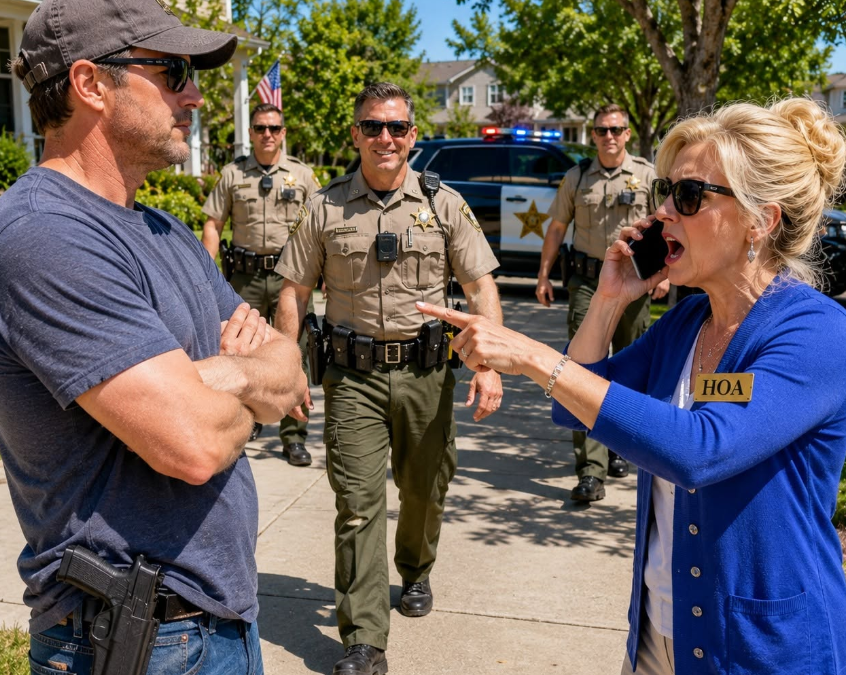
HOA Karen Called 911 on Me for Open Carry in a Grocery Store—Then My Own Deputies Walked In and Called Me “Sheriff.”
She screamed “gun” in the grocery store loud enough to freeze every cart in the aisle, thinking she had just exposed a dangerous stranger. What she did not know was that the man she was accusing had sworn in half the officers now racing toward that call. By the time my own deputies walked through those sliding doors, her perfect HOA smile had turned into the kind of silence people remember for years.
My name is Tom Mitchell, and I came to Pine Valley because I was tired of sirens.
For twenty years, I worked law enforcement in a big city where peace came in short bursts between radio calls. I had chased armed robbers through alleys at midnight, negotiated with men who had nothing left to lose, testified in courtrooms where victims’ families watched every word like it might bring someone back, and stood over more yellow tape than any man should remember.
By forty-five, my knees hurt when it rained, my patience for politics was gone, and sleep had become something I negotiated with instead of enjoyed.
So when Pine Valley County needed a new sheriff, and the old one, Albert “Bert” Harrelson, decided he was finally done fighting with drunks, thieves, loose cattle, and budget committees, I applied.
Pine Valley was tucked between pine forests and a slow brown river that curled along the edge of town. It had a grocery store where the manager knew who bought decaf but pretended not to judge them. It had a diner where the waitress called every man under seventy “honey” and every man over seventy “trouble.” It had church bells, pickup trucks, fishing permits, and gossip that traveled faster than patrol cars.
It looked, from a distance, like a place where a man could breathe.
Bert shook my hand after the county board voted me in and said, “Tom, Pine Valley ain’t complicated until someone decides to make it.”
I should have written that down.
I bought a modest house on Juniper Lane because I wanted a porch, not a palace. Cedar siding. Sloped roof. A patch of front lawn, two oak trees, a detached garage, and enough quiet to drink coffee before the sun came over the ridge.
The subdivision was called Pine Hollow, and it had an HOA.
That did not worry me much at first.
I had dealt with gangs, narcotics crews, political fixers, domestic abusers, corrupt contractors, armed robbery suspects, and a mayor who once asked me if an arrest report could be “softened for community stability.” I did not think a homeowners association could be much more than a nuisance.
That was before I met Vanessa Caldwell.
Vanessa was president of the Pine Hollow Homeowners Association, though she introduced herself like the title belonged on a courtroom seal. She was in her early fifties, tall, blonde, polished, and always dressed in crisp clothes that looked too expensive for ordinary errands. She wore perfume strong enough to enter a room before she did and carried a leather binder filled with color-coded tabs.
People in Pine Hollow called her Vanessa when she was present.
They called her “the queen” when she was not.
My first conversation with her happened three days after I moved in.
I was carrying a box of books from my truck to the porch when she crossed the street, smiled brightly, and said, “You must be the new owner.”
“Tom Mitchell.”
“Vanessa Caldwell. HOA president.”
She extended her hand.
I shook it.
“Nice to meet you.”
“We’re very proud of Pine Hollow,” she said. “We work hard to maintain a certain standard.”
“I noticed.”
That was polite.
What I noticed was that every mailbox looked identical, every driveway was spotless, and every house seemed slightly afraid of being individual.
Vanessa looked at my truck.
It was a black county-issued SUV with discreet markings and emergency lights mounted inside the windshield. I was not on duty that morning, but the sheriff’s office vehicle was assigned to me. Rural sheriffs are never completely off duty. That is one of the lies people tell themselves when they take the job.
“You’re in law enforcement?” she asked.
“Sheriff.”
Her smile flickered.
“Sheriff of Pine Valley County?”
“That’s right.”
“Oh.”
It was one syllable, but I heard three thoughts behind it.
That could be useful.
That could be inconvenient.
That could be difficult.
She recovered quickly.
“How wonderful. Pine Hollow values safety.”
“So do I.”
Her eyes moved to my hip.
I was wearing jeans, a plain gray T-shirt, and my duty sidearm in an outside-the-waistband holster. Not flashy. Not careless. Just part of my normal life. I had carried a weapon long enough that it felt less like an object and more like a responsibility with weight.
Vanessa’s smile cooled.
PART2:
“I hope that won’t become a regular feature.”
“What won’t?”
She tilted her head slightly toward the holster.
“Open firearms make some residents uncomfortable.”
“I’m the sheriff.”
“I understand, but Pine Hollow has community standards regarding visible weapons.”
“No, it doesn’t.”
She blinked.
I had already read the covenants before closing. Old habit. I read documents the way other people check weather forecasts.
Her smile tightened.
“The board has discussed maintaining a family-friendly atmosphere.”
“Discussing something does not make it a rule.”
“That depends.”
“No,” I said. “It really doesn’t.”
She studied me for a second.
Then she gave the kind of laugh people use when they want to pretend they have not been corrected.
“Well, I’m sure we’ll get along fine.”
“I hope so.”
She looked at the sidearm again.
“I do hope you’ll be considerate.”
“I always am.”
That should have ended it.
It did not.
Over the next month, I received three HOA notices.
The first said my county vehicle could not be parked in the driveway overnight because it was “commercial or official-use equipment.”
I sent back a copy of the covenant showing law enforcement vehicles were not prohibited, along with a polite note explaining that a sheriff’s emergency response vehicle was not a landscaping trailer.
The second notice said my porch flag was mounted at an improper angle.
I measured it.
It was fine.
The third notice said “visible defensive equipment” had been observed on my person while outside and that the board encouraged residents to “store such items discreetly.”
That one made me sit at my kitchen table for a full minute staring at the paper.
Visible defensive equipment.
I had been called many things in twenty years.
A walking covenant violation was new.
I put the notices in a folder labeled Pine Hollow.
Experience teaches you that one unreasonable letter is annoying.
Two is a pattern.
Three is a file.
At the sheriff’s office, I tried not to bring neighborhood problems to work. My deputies had enough to do without hearing their boss complain about mailbox angles and HOA language.
Still, Deputy Maria Torres noticed the folder on my desk one afternoon.
“You look irritated,” she said.
“I’m reading community standards.”
“That sounds worse than booking paperwork.”
“It is.”
She leaned against the doorframe.
“HOA?”
“HOA.”
She laughed.
“Sheriff, with respect, I’d rather clear a bar fight than attend one of those meetings.”
“So would I.”
Deputy Evan Price walked past my office and said, “If they cite you for your patrol vehicle, can we cite them for impersonating government?”
“Keep walking, Price.”
He grinned and kept walking.
I thought the whole thing would stay petty.
Then came the grocery store.
It was a Friday afternoon in late June, hot enough that heat shimmered over the parking lot. I stopped at Miller’s Market on my way home because I needed coffee, eggs, dog food for a dog I did not yet own but kept feeding because a stray mutt had decided my porch was his seasonal residence, and a jar of peanut butter.
I was off duty in the sense that I was not wearing a uniform. But again, rural sheriff. I carried.
Jeans.
Blue button-down shirt.
Boots.
Holstered sidearm.
Badge clipped beside it.
Not hidden.
Not waved around.
Not touched.
Just there.
I had made it to aisle four when Vanessa Caldwell saw me.
She was near the endcap with a cart full of sparkling water, salad greens, and the kind of crackers that cost too much because the box used the word artisan. She froze when she spotted my hip.
I saw the calculation in her face before she spoke.
That was the thing about police work. You learn to read the half-second before people decide who they want to be.
Vanessa chose victim.
Her hand flew to her chest.
Then she screamed.
“Gun!”
The whole grocery store stopped.
Every shopper turned toward me.
Every cart froze.
A jar slipped from somebody’s hand and thudded onto the floor without breaking.
A child near the cereal shelves went silent mid-sentence.
Vanessa backed away from me, one hand still pressed to her chest, the other pointing.
“He has a gun!”
I did not move.
That mattered.
In a situation like that, the safest thing a lawful, trained person can do is become boring.
Hands visible.
Voice calm.
No sudden movement.
The store manager, Carl Miller, came rushing from the front.
“Vanessa, what are you doing?”
She ignored him.
“Call 911!”
Several people already had phones out.
I kept my hands relaxed at my sides.
“Vanessa,” I said evenly, “you need to stop shouting.”
“He’s armed!”
Carl looked at me, then at Vanessa.
“Tom is the sheriff.”
She spun toward him.
“That does not mean he can terrorize shoppers!”
I almost sighed.
Nobody in that store looked terrorized until she screamed.
“Vanessa,” I said, “I am not threatening anyone.”
“You brought a gun into a grocery store!”
“I carry a sidearm.”
“Not in Pine Hollow community spaces!”
Carl frowned.
“This isn’t Pine Hollow. This is my store.”
“It serves Pine Hollow residents.”
That was Vanessa’s gift.
She could say absurd things with the posture of someone presenting evidence.
I heard sirens in the distance.
For the first time, anger moved through me.
Not because deputies were coming.
Because she had created risk out of nothing.
A false panic in a public place can get people hurt. A child can run. An armed citizen can misunderstand. A nervous responding officer can enter a situation flooded with bad information. I had spent too much of my career watching unnecessary fear become real danger.
Vanessa lowered her voice, but only slightly.
“You should be ashamed of yourself.”
I looked at her.
“For what?”
“For intimidating this community.”
“I’m buying peanut butter.”
“You knew this would frighten people.”
“No. You decided it would.”
Sirens stopped outside.
Through the front windows, I saw two Pine Valley County patrol vehicles pull up.
Deputy Maria Torres entered first.
Deputy Evan Price came in behind her.
Both were alert, professional, and moving like they had been dispatched to a possible armed threat in a grocery store.
Then they saw me.
Torres slowed.
Price blinked.
For one strange second, the store held its breath.
Then Torres said, “Sheriff?”
The word landed like a hammer.
Vanessa’s face changed.
Not completely.
People like Vanessa rarely collapse all at once.
But her expression cracked.
Price looked from me to her.
Then back to me.
“Everything okay, Sheriff?”
I kept my voice calm.
“Deputy Torres, Deputy Price. This is a false alarm. I am lawfully carrying. I have not threatened anyone. Ms. Caldwell screamed ‘gun’ after seeing my sidearm.”
Torres looked at Vanessa.
“Ma’am, did he point the firearm?”
Vanessa’s lips parted.
“No, but—”
“Did he touch it?”
“No, but he—”
“Did he threaten anyone?”
“He brought it in here.”
“That wasn’t my question.”
Vanessa’s cheeks flushed.
“No.”
Deputy Price glanced at Carl.
“Mr. Miller?”
Carl crossed his arms.
“Tom walked in like he always does. Vanessa started yelling.”
Several shoppers nodded.
One older man near the bread said, “She scared my granddaughter half to death.”
Vanessa turned on him.
“I was protecting people.”
Torres’s face remained neutral.
“Ma’am, calling 911 because you see a holstered firearm on a known law enforcement officer is not the same as reporting a threat.”
“I did not know he was the sheriff.”
That was a lie.
She had met me.
She had sent me notices addressed to Sheriff Thomas Mitchell.
She had objected to my county vehicle.
She had written about my “visible defensive equipment.”
Torres looked at me.
I gave the smallest shake of my head.
Not here.
Not in the store.
There is a time to prove someone is lying, and a grocery aisle full of civilians is not always the best courtroom.
Torres took statements.
Price spoke with dispatch and canceled additional response.
The whole thing lasted fifteen minutes.
But fifteen minutes is a long time when an entire town is watching.
Vanessa tried to leave before Torres finished.
“Ma’am,” Torres said, “we still need your statement.”
“I have nothing further to say.”
“You called 911?”
“I was concerned.”
“Then you can explain the concern.”
Vanessa looked at me.
For the first time since I had moved to Pine Hollow, she did not look in control.
That should have been the end of it.
It was not.
The next morning, I received an emergency HOA notice by email.
Subject: Immediate Community Safety Concern.
Sheriff Mitchell,
Following yesterday’s alarming incident at Miller’s Market, the Pine Hollow HOA Board has called an emergency meeting to address resident concerns regarding visible firearms, intimidation, and the use of law enforcement status to bypass community standards.
Pending board review, you are instructed not to openly carry firearms in common view within Pine Hollow, including streets, sidewalks, driveways, lawns, and any commercial areas frequented by Pine Hollow residents.
Regards,
Vanessa Caldwell
President, Pine Hollow HOA
I read it twice.
Then I printed it.
Then I laughed once.
Not because it was funny.
Because sometimes a document is so stupid it becomes useful.
I called County Attorney Rebecca Sloan.
Rebecca had represented the county for nine years and had the voice of a woman who could remove nonsense from a room with a single eyebrow.
“Rebecca, I need you to look at something.”
“Is it budget-related?”
“No.”
“Then my day just improved.”
I sent her the HOA email.
She called back six minutes later.
“Tom.”
“Yes.”
“Is this real?”
“Unfortunately.”
“She is instructing the elected county sheriff not to carry a firearm in public view?”
“That appears to be the theme.”
“Based on a grocery store incident she caused?”
“Yes.”
Rebecca was quiet for a moment.
Then she said, “Do not respond directly.”
“I wasn’t planning to.”
“I will send a letter.”
“How sharp?”
“Educational.”
Rebecca’s educational letters had made grown men apologize to zoning maps.
By Monday afternoon, Vanessa and the Pine Hollow board received a letter from the county attorney explaining that the HOA had no authority to regulate the sheriff’s official duties, law enforcement equipment, county vehicles, or lawful public carry by any individual where otherwise permitted. It also advised them that false or reckless emergency calls could create legal consequences and that any attempt to interfere with law enforcement duties would be treated seriously.
The letter was polite.
It was also a legal slap across the room.
Vanessa did not take it well.
Two days later, she appeared at the sheriff’s office.
My dispatcher, Nancy, called back to my office.
“Sheriff, Vanessa Caldwell is here to see you.”
“Did she say why?”
“She said she wants to file a formal complaint.”
“Against whom?”
Nancy paused.
“You.”
Of course.
I stepped into the lobby.
Vanessa stood near the front counter wearing a cream blazer, heels, and the expression of a woman who had mistaken persistence for strategy.
“Sheriff Mitchell,” she said.
“Ms. Caldwell.”
“I’m here to file a complaint regarding your conduct.”
“Nancy can provide the form.”
Vanessa blinked.
“I expected to speak with you.”
“You’re filing against me. The complaint process does not run through the subject of the complaint.”
That annoyed her.
Good.
Nancy handed her the form.
Vanessa looked at it like it had personally offended her.
“This is not adequate for the seriousness of the issue.”
“It’s the same form everyone uses,” Nancy said.
Vanessa’s mouth tightened.
“I want it noted that I believe Sheriff Mitchell is using his office to intimidate the Pine Hollow community.”
Nancy looked at me.
I said nothing.
Nancy looked back at Vanessa.
“You can write that in the narrative section.”
Vanessa gripped the pen.
It took her twenty-two minutes to complete the form.
I know because Nancy told me later.
The complaint went to the county board and the state law enforcement standards office, as required. I did not interfere with it. I did not call anyone. I did not ask for favors.
I sent the grocery store footage, 911 recording, deputy reports, and HOA emails through proper channels.
Then I waited.
Waiting is harder when you know you are right.
That is one of the things nobody tells you.
Truth does not make patience easy.
While the complaint process moved, Vanessa escalated inside Pine Hollow.
She called a community safety meeting.
I did not attend.
But three neighbors later told me what happened.
Vanessa stood at the front of the clubhouse and told residents that “militarized behavior” had entered Pine Hollow. She said visible firearms reduced property values. She said families felt unsafe. She said the HOA had a duty to protect the emotional atmosphere of the neighborhood.
Then Mr. Dillard, a retired mechanic who lived across from the pond, raised his hand.
“Vanessa, are you talking about the sheriff?”
She said, “I’m talking about conduct.”
“Was he waving the gun around?”
“No.”
“Threatening folks?”
“No.”
“Touching it?”
“No.”
“So he was just shopping?”
Vanessa reportedly said, “That is not the point.”
That sentence tends to appear when someone’s point has died.
Another resident, Linda Carver, asked whether the HOA had authority to regulate law enforcement equipment.
Vanessa said the board was “exploring its options.”
By the end of the meeting, even people who disliked guns were uncomfortable. There is a difference between personal discomfort and giving an HOA president authority over the sheriff’s duty belt.
Vanessa did not understand that difference.
Or she did, and hated it.
The state dismissed her complaint three weeks later.
The letter was short.
No misconduct found.
The county board accepted the finding.
That should have ended things.
Instead, Vanessa made her worst mistake.
She called 911 again.
This time, it was not at the grocery store.
It was in Pine Hollow.
I was outside on a Saturday morning repairing a loose board on my porch steps. I wore jeans, a work shirt, and my sidearm because I had already taken one call that morning about a domestic disturbance outside town and had not fully changed.
My county vehicle was parked in the driveway.
The stray mutt was asleep under the oak tree.
I heard Vanessa before I saw her.
She was on the sidewalk with her phone pressed to her ear, speaking loudly enough for the entire cul-de-sac to hear.
“Yes, I need officers at 18 Juniper Lane. The sheriff is outside with a firearm again. Residents are afraid to leave their homes.”
I set down my hammer.
Across the street, Mr. Dillard was watering his roses.
He looked at me.
Then at Vanessa.
Then back at me.
Nobody else was outside.
No one was afraid to leave their homes.
The dog did not even wake up.
I walked to the edge of my porch.
“Vanessa, hang up the phone.”
She held up one finger as if I were interrupting her at a restaurant.
“He is approaching me now,” she told the dispatcher. “I feel threatened.”
I stopped.
That sentence changed everything.
Not because it was true.
Because it was recorded.
I lifted both hands slightly, palms visible, and took one step back.
Mr. Dillard turned off his hose.
“Vanessa,” he called, “he ain’t approaching you. He’s on his porch.”
She ignored him.
Within seven minutes, two deputies arrived.
Not Torres and Price this time.
Deputy Graham and Deputy Ellis.
Both looked deeply unhappy to be there.
Graham approached me first.
“Sheriff.”
“Deputy.”
He lowered his voice.
“We have to handle it like any other call.”
“That’s exactly what you’ll do.”
He nodded.
Ellis spoke with Vanessa.
I could hear pieces of it.
“He walked toward me.”
“No, ma’am, he appears to be on his porch.”
“He was armed.”
“He is the sheriff.”
“That doesn’t make him above community rules.”
Graham asked me what happened.
I told him.
Mr. Dillard gave a statement.
So did Linda Carver, who had watched from her front window.
My porch camera recorded everything.
Again.
Vanessa had not learned about cameras.
The deputies cleared the call as unfounded.
But this time, I did not let it stay informal.
“Deputy Graham,” I said, “complete the report. Include statements. Include the 911 audio request. Include that I am requesting review for misuse of emergency services.”
Vanessa heard that.
Her face changed.
“You can’t retaliate against me for calling police.”
“No,” I said. “But you also can’t fabricate danger because you lost an argument.”
She stepped back.
The whole cul-de-sac was watching now.
Curtains.
Porches.
Driveways.
The quiet theater of suburban accountability.
The report went to the county attorney.
Then to a judge for review.
Vanessa was charged with making a false emergency report.
Not because she disliked seeing a firearm.
Not because she was uncomfortable.
Because she stated facts that were not true, after prior warning, in a situation that pulled deputies away from actual calls.
The court date drew half of Pine Valley.
Small counties do not need newspapers when the courthouse has benches.
Vanessa arrived with an attorney, wearing navy blue and no smile.
I sat in the back, not as sheriff, but as the complainant witness.
Deputy Graham testified.
Deputy Ellis testified.
Mr. Dillard testified.
Then the 911 recording played.
The courtroom heard Vanessa say:
“He is approaching me now. I feel threatened.”
Then my porch camera video played.
It showed me standing on my porch.
Not approaching.
Not threatening.
Not speaking.
Then Mr. Dillard’s voice from across the street:
“Vanessa, he ain’t approaching you. He’s on his porch.”
A few people in the courtroom shifted.
Vanessa stared straight ahead.
Her attorney argued that she was afraid and had misinterpreted the situation.
The prosecutor argued that fear does not give a person permission to invent facts.
The judge agreed.
Vanessa was not sent to jail.
I did not want that.
She received a fine, community service, and a stern warning that future misuse of emergency services would be treated more severely.
But the real consequence came later.
Pine Hollow held a special HOA meeting.
This time, I attended.
Not in uniform.
Not to intimidate.
I wore jeans, a button-down shirt, and my badge clipped at my belt because by then I had stopped pretending Vanessa’s discomfort could dictate my life.
The clubhouse was packed.
Vanessa sat at the board table, pale and rigid.
The vice president, a quiet accountant named Henry Shaw, opened the meeting.
“We’re here to discuss board conduct and proposed restrictions exceeding HOA authority.”
That was a polite way of saying everyone knew why they were there.
Residents spoke one by one.
Mr. Dillard stood first.
“I don’t care how folks feel about guns. That’s not the issue. The issue is Vanessa used 911 like a complaint box.”
Linda Carver spoke next.
“I have children. I care about safety. But making false reports makes us less safe.”
Carl Miller, the grocery store manager, was not a Pine Hollow resident, but someone had invited him.
He stood near the back and said, “Your HOA president turned my store into a panic because she wanted to win a neighborhood argument. That can’t happen again.”
Vanessa tried to defend herself.
“I acted out of concern.”
Henry Shaw looked at her.
“You acted after county counsel told us not to interfere.”
She looked stunned that he had said it publicly.
Then he opened a folder.
“The board received written legal guidance. We did not have authority to regulate the sheriff’s firearm, patrol vehicle, or official equipment. We also had no authority to issue notices based on visible defensive equipment. Those notices were improper.”
For the first time, I learned there had been more.
Vanessa had drafted a proposed amendment titled Community Weapons Visibility Policy.
It would have prohibited visible firearms in yards, driveways, sidewalks, porches, and “community-facing residential areas,” with fines starting at $250 per violation.
It was never valid.
It had never been adopted.
But she had circulated it as if it were inevitable.
Henry continued.
“I move that Vanessa Caldwell be removed as president and from all enforcement roles pending the next election.”
The second came immediately.
The vote was not close.
Vanessa sat perfectly still while her authority disappeared.
No sirens.
No handcuffs.
No dramatic speech.
Just raised hands in a clubhouse she once controlled.
When it was over, she stood, gathered her purse, and walked out without looking at anyone.
I almost felt sorry for her.
Almost.
A month later, Pine Hollow’s new board sent me a letter rescinding all notices related to my patrol vehicle and sidearm. They apologized for the improper language, acknowledged the HOA had no authority over my law enforcement duties, and adopted a policy requiring legal review before any rule affecting public safety, emergency response, or residents’ lawful conduct outside HOA authority.
It was a good letter.
I put it in the folder.
Not because I wanted to remember the fight.
Because records matter.
By fall, Pine Hollow settled down.
The stray mutt became less stray and more mine. I named him Bert after the old sheriff, mostly because he had the same suspicious eyes and habit of ignoring instructions unless food was involved.
I still shopped at Miller’s Market.
The first time I walked back into aisle four after everything ended, the store got quiet for half a second.
Then Carl called from the register, “Sheriff, peanut butter’s on sale.”
That broke the tension.
People laughed.
I bought two jars.
Life moved on, which is what life does in small towns after the gossip finds a new porch.
Vanessa eventually sold her house and moved closer to her daughter two counties over.
At least that was the official story.
Mr. Dillard said she moved because Pine Hollow had become “unmanageable,” which was old-man language for people stopped obeying her.
I never celebrated her leaving.
I had seen too many people destroy themselves trying to control things that were never theirs to control.
But I did feel lighter.
Not because I needed everyone to like seeing a sheriff with a sidearm.
People are allowed to feel uncomfortable.
They are allowed to ask questions.
They are allowed to advocate for rules through lawful channels.
What they are not allowed to do is create danger where none exists, weaponize 911, and pretend personal discomfort is an emergency.
That distinction matters.
It matters in grocery stores.
It matters in neighborhoods.
It matters in counties where deputies might be pulled from a real crisis because someone wants to win an HOA argument.
The day after Vanessa moved, I sat on my porch before sunrise with coffee in one hand and Bert asleep near my boots.
The county was quiet.
No sirens.
No shouting.
No HOA emails.
Just cicadas, wind through the oaks, and the faint hum of a truck somewhere beyond the ridge.
I thought about old Bert Harrelson’s warning.
“Pine Valley ain’t complicated until someone decides to make it.”
Vanessa had decided to make it complicated.
She looked at a holstered sidearm and saw not a threat, but an opportunity. An opportunity to control. To embarrass. To force the world to bend around her discomfort and call that safety.
But safety is not panic.
Authority is not volume.
And a 911 call is not a weapon for neighborhood politics.
When my deputies walked into that grocery store, Vanessa expected them to see what she wanted them to see.
A dangerous man.
A public threat.
A resident who needed to be humbled.
Instead, they saw their sheriff standing still in aisle four with a jar of peanut butter on the shelf beside him, waiting for the truth to catch up.
And the truth did.
It came through witness statements.
Through dispatch logs.
Through body cameras.
Through porch footage.
Through a courtroom video where her own voice said the thing that never happened.
That is the thing about false alarms.
They make noise quickly.
But the record answers slowly.
And when it does, it does not scream.
It simply shows who was standing where.
Who said what.
Who touched nothing.
Who threatened no one.
And who thought fear could be manufactured on command.
I came to Pine Valley because I was tired of sirens.
I still hear them sometimes.
That is the job.
But now, when one fades into the distance and the porch returns to quiet, I remind myself that peace is not the absence of conflict.
Peace is when the right things are stronger than the loud things.
A badge is not a shield from accountability.
A sidearm is not a symbol to wave around.
An HOA title is not a license to command the county.
And a sheriff standing calmly in a grocery aisle is not a threat just because one woman needs him to be.
Vanessa screamed “gun” because she thought panic would do what her rules could not.
She thought the deputies would come in and drag me out.
Instead, they walked through the sliding doors, saw me, and said one word.
“Sheriff?”
That one word did more than embarrass her.
It reminded Pine Valley of something simple.
Real authority does not need to scream.
And the people who scream the loudest about rules are often the first ones who need to read them.