HOA Karen Buried the Only Fire Road Under 250 Tons of Granite—Then the Ridge Caught Fire and No Fire Truck Could Get Through.
PART2:
Dry pine needles lay thick over the ground, brittle under my boots, and everything smelled the way the high country smells when it has not seen rain in too long.
Resin.
Dust.
Bark.
Waiting fire.
My cabin sat on forty acres of family land at the shoulder of Croft Ridge.
The place was not fancy.
It was honest.
Stone chimney.
Weathered cedar siding.
Tin roof.
A barn that leaned slightly south because my grandfather had built it by eye and pride in 1911.
Every nail, fence post, water ditch, and trail had a history attached to it.
That was something Blackwood Glen never understood.
Blackwood Glen was the new gated development below my ridge, a glittering arrangement of steel, glass, and imported landscaping that had appeared over the last four years like a rash on the mountainside.
Seventy-two luxury homes.
Each pretending to be eco-conscious while using enough water to irrigate a municipal park.
Solar panels on the roofs.
Heated stone driveways.
Koi ponds.
Smart sprinklers.
Electric gates.
Residents who came up from Denver on weekends to discuss sustainability over steaks flown in from Argentina.
At the center of that shiny little kingdom stood Priscilla Davenport, president of the Blackwood Glen Homeowners Association.
And that morning, she was standing on the bank above Pine Needle Trail, directing dump trucks with the confidence of a woman who had confused a design board with divine authority.
Pine Needle Trail ran along the eastern boundary of my land.
On old forestry maps, county maps, and federal emergency-access plans, it had another name:
Fire Lane 7.
It was not much to look at if your soul required landscaping.
Just hard-packed red dirt, pine needles, native grass, and deep tire ruts from decades of forestry rigs, county trucks, and my own equipment.
But it was wide, solid, and shallow enough for a loaded structural engine to climb from the state highway to the back side of Blackwood Glen and the upper ridge.
In mountain country, that is not an ugly road.
That is a lifeline.
Priscilla saw it differently.
“Back it up!” she shouted, waving one manicured hand toward the lead dump truck. “Yes, right there. Perfect. Dump it.”
The truck was a big corporate-blue Kenworth, freshly washed, absurdly polished, and already looking offended by the dirt road beneath it.
Its air brakes screamed.
The tailgate clanged open.
Then granite came roaring out of the steel bed.
The sound hit the ridge like a train wreck.
Stone slammed into earth.
Ferns disappeared.
Roots tore.
Dust exploded upward in a choking gray cloud that swallowed the morning sun and coated the pine needles like ash from a fire that had not started yet.
Priscilla clapped.
“Gorgeous!” she called. “Absolutely gorgeous. It looks so organic.”
I raised the Nikon and took three photographs.
One of the truck.
One of the license plate.
One of Priscilla Davenport smiling like a proud general after conquering a dirt road.
Then I walked down to the boundary marker and stopped on my side of it.
“Good morning, Priscilla,” I said. “I see you brought rocks.”
She turned slowly, and the smile on her face tightened into the expression wealthy people use when reality steps into the room without an appointment.
“Oh,” she said. “Caleb. I didn’t see you there.”
“That would explain a great deal.”
She gave me a thin little laugh.
“No need for hostility. The Blackwood Glen Board has officially commenced our winter scenic harmony initiative.”
I looked at the granite pile, then at the second truck already backing up.
“Your what?”
“Our winter scenic harmony initiative,” she repeated, louder, as though the problem was my hearing and not the words themselves. “We are converting this unattractive dirt cut into a Japanese-inspired dry riverbed. It will provide visual continuity between the lower residences and the natural ridge environment.”
“Priscilla,” I said, “that unattractive dirt cut is Fire Lane 7.”
Her eyes flickered with annoyance.
“We have been over this.”
“No,” I said. “You have talked over this. That is different.”
Her mouth hardened.
I pointed down the trail.
“Fire Lane 7 is a designated emergency corridor. It is the only access road within five miles with the grade, width, and turning radius to carry a twenty-five-ton Type 1 structural engine up from the highway to the rear of your development.”
She adjusted the cream-colored cashmere wrap around her shoulders.
I still remember that wrap.
It had no business existing within fifty feet of diesel exhaust.
“Caleb, please,” she said. “Blackwood Glen has invested three hundred thousand dollars in a smart-connected high-pressure fire suppression system. We have automated copper sprinklers, thermal sensors, remote alerts, and perimeter misting. We do not need dirty fire trucks rumbling past bedroom windows and damaging the aesthetic profile of the community.”
“The aesthetic profile of the community will be difficult to admire if it is on fire.”
Her smile sharpened.
“That sort of rustic fatalism may have worked when people around here measured progress by how many rusted tractors they had behind a barn, but we live in a modern world.”
“That modern world still burns at about the same temperature.”
She ignored that, which was a talent she had cultivated into an art form.
“This is a private easement,” she said. “The HOA has every right to improve it.”
“The easement was granted in 1924,” I said. “To the county and adjacent landowners, with one condition written plain enough for a mule to understand. It must remain open and passable for emergency services.”
She lifted her iPad, tapped at it, and frowned as if she expected the law to update itself.
“Our counsel has reviewed the matter.”
“No. Your counsel reviewed whatever version you paid them to read.”
The second truck began lifting its bed.
I raised my voice.
“If you block this trail, you are cutting off your only viable escape route, your only rear fire access, and the only route a crew can use to get water to the upper side of your subdivision when the forest burns.”
“When,” she repeated, laughing. “Not if?”
“Correct.”
“Dramatic.”
“Accurate.”
“Caleb, we have an app that monitors soil moisture.”
I stared at her.
I have faced crown fires in August, lightning storms above timberline, flash floods that tore culverts out like toothpicks, and federal budget meetings that made a man envy the dead.
But I had never heard anyone put so much faith in an app while standing in a forest full of dry fuel.
“An app,” I said.
“Yes,” she replied. “A very expensive one.”
“That must comfort the trees.”
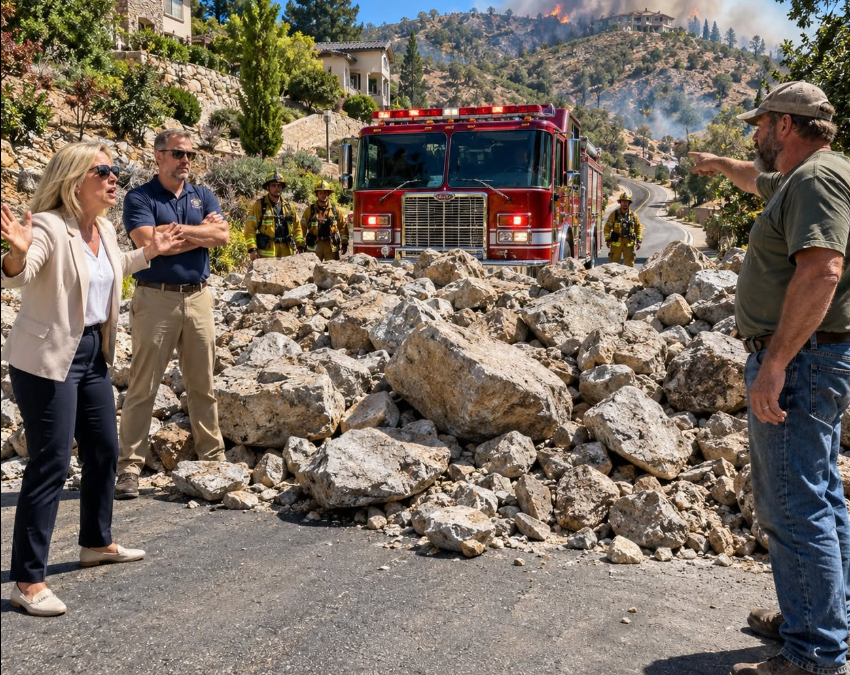
The second load of granite came crashing down, bigger stones this time, some the size of old steamer trunks.
They tumbled and locked together, forming a rough gray wall over the trail.
Dust rolled across the boundary line and settled on my jacket.
Priscilla waved it away from her face.
“Also,” she said, as though remembering a fun little errand, “the board has issued a citation against your property.”
“My property.”
“Yes. Your tool shed is visible from the eighth-hole tee box.”
“There is no eighth hole. You have a putting green with delusions.”
“It creates visual pollution,” she said. “The shed is unpainted. The roof is dented. The board has assessed a five-hundred-dollar daily fine until it is painted in an approved exterior tone. Blackwood Beige is preferred.”
I looked past her at the granite wall rising across Fire Lane 7.
Then at the trucks.
Then back at her.
At that moment, anger would have been easy.
I could have shouted.
I could have threatened an injunction.
I could have called the sheriff, the county engineer, the Forest Service, or every old rancher in a twenty-mile radius who still remembered when Pine Needle Trail had saved three families during the Morrison Creek Fire.
But rage is wasted on people like Priscilla Davenport.
They feed on it.
They record it.
They edit it into evidence that you are unstable.
So I let the mountain do what the mountain had taught me to do.
I went still.
“I’ll put my warning in writing,” I said.
She smiled.
“Write whatever you want, old man. The rocks are staying.”
Then she turned her back on me and lifted one glittering hand.
“Next truck!”
The third truck backed into place.
I walked home through granite dust while the roar of falling stone shook dry pine needles loose from the trees.
By the time I reached my porch, Fire Lane 7 was no longer a road.
It was a monument to expensive stupidity.
To understand why Priscilla’s mistake was even worse than it looked, you need to understand the plumbing of Croft Ridge.
My family had managed water in that valley for four generations.
We were not rich in the way Blackwood Glen measured richness.
We did not have heated bathroom floors, imported stone counters, or garages that opened with facial recognition.
What we had was older, quieter, and far more useful.
We had water rights.
In 1924, my grandfather Silas Croft signed a mutual-use water agreement with the original ranching families in the lower basin.
In those days, men understood water the way modern people understand Wi-Fi passwords.
Without it, nothing worked, nobody stayed, and everything eventually failed.
Under Pine Needle Trail, buried four feet deep in rocky soil, ran a twelve-inch clay-sealed, low-pressure steel water main.
It carried gravity-fed spring water from Croft Lake, a deep cold tarn on my property, down into the lower valley.
For decades, it supplied stock tanks, irrigation, and emergency draw points.
When Blackwood Glen was built, the developers did not want to spend money drilling reliable deep wells through granite.
They preferred the kind of environmentalism that begins with speeches and ends with somebody else’s infrastructure.
So they negotiated with my late father for a limited tap into the old gravity line.
That agreement allowed them to draw water for ornamental features and emergency fire suppression, provided the line remained accessible, protected, and undisturbed.
It was all written down.
Blackwood Glen had received copies.
Their developers had signed acknowledgments.
Their board had inherited the obligations along with the benefits.
Naturally, they remembered the benefits.
The obligations had slipped their minds with the delicacy of a silk scarf falling into a shredder.
The line they depended on ran directly beneath the same trail Priscilla had just buried under hundreds of tons of granite.
A pipe built to survive passing vehicle loads is not built to endure a permanent rock fortress.
Static load is different from traffic.
Soil shifts.
Pressure concentrates.
Old metal fatigues.
Clay seals crack.
Water finds weakness with the patience of a tax auditor and the persistence of God.
That afternoon, I sat in my study with Arthur Vance.
Arthur was a retired land-use attorney, my lifelong friend, and one of the few men I knew who could read an easement and experience actual joy.
He had silver hair, sharp blue eyes, and a dry smile that usually meant someone arrogant was about to learn that paperwork has a revenge cycle.
My study smelled of old maps, woodsmoke, and coffee.
Forestry certificates hung beside survey plats and hand-drawn deeds.
Outside the window, I could still hear trucks shifting gears on the ridge.
Arthur sat across from me in my father’s leather chair, reading the HOA citation over the top of his glasses.
“Visual pollution,” he murmured.
“They want the shed painted Blackwood Beige.”
Arthur looked personally wounded.
“Blackwood Beige sounds like a disease found in model homes.”
“I warned her about the fire road.”
“Of course you did.”
“She laughed.”
“Of course she did.”
“She’s dumping more tomorrow.”
Arthur set the citation down.
“How much rock total?”
“By my count? Two hundred fifty tons when they finish.”
He leaned back and folded his hands over his vest.
Arthur still wore vests.
Not because he was fashionable, but because he had apparently declared war on casual modern clothing in 1978 and never surrendered.
“That pipe under the trail,” he said. “Still the 1954 section?”
“Yes.”
“Clay-sealed?”
“Yes.”
“Any reinforcement?”
“No.”
“Then they’re crushing their own water supply.”
“Most likely.”
He smiled.
It was not a kind smile.
It was the expression of a man watching a trap assemble itself.
“I know that look,” I said.
“Good.”
“I don’t like it.”
“You never like it. Then later you admit I was right.”
“That has happened less often than you suggest.”
“It has happened enough.”
I poured him coffee.
He accepted it with the disappointment of a man hoping for whiskey.
“Caleb,” he said, “you could file for an injunction.”
“I know.”
“They would fight it.”
“I know that too.”
“They would call you an obstructionist. A bitter old holdout. A man standing in the way of progress because he dislikes people with clean windows and disposable income.”
“Likely.”
“Their Denver lawyers would bury you in motions. They would delay. They would demand studies. They would accuse you of exaggerating fire risk. By the time anything useful happened, the rocks would still be there, your savings would be thinner, and Priscilla would be giving interviews about community harmony.”
I stared out the window at the dust hanging over the trail.
“So what are you suggesting?”
Arthur lifted the HOA citation.
“I am suggesting we give her exactly what she thinks she wants.”
“That sounds immoral.”
“No,” he said. “It sounds contractual.”
For the next four hours, we drafted what Arthur called a legal surrender and what I privately considered bait in business attire.
The document was titled the Croft–Blackwood Joint Agreement of Aesthetic Compliance and Infrastructure Liability Waiver.
Arthur wrote it in a tone so meek I nearly refused to sign my own name under it.
It stated that I, Caleb Croft, wishing to avoid conflict and preserve neighborly harmony, agreed to waive my objections to the HOA’s beautification of Pine Needle Trail and Fire Lane 7.
It acknowledged that the HOA desired to install a decorative granite dry riverbed and that I would not interfere with their chosen surface modifications.
Priscilla would love those sentences.
They were polished little candies designed for the administrative ego.
Then came the teeth.
In exchange, Blackwood Glen HOA would permanently rescind the five-hundred-dollar daily fine against my tool shed.
More importantly, the HOA would formally accept one hundred percent ownership, maintenance responsibility, structural responsibility, and civil liability for the surface and subsurface condition of the modified easement area.
That included any blockage, failure, water-flow disruption, emergency-access limitation, slope instability, environmental damage, or infrastructure failure resulting directly or indirectly from its landscaping modifications.
Arthur slid the final draft across the desk.
“It reads like surrender,” he said. “But it transfers the liability to the party creating the hazard.”
“She won’t read it.”
“No,” Arthur said. “She will skim the first page, smell victory, and sign before anyone competent can stop her.”
“That seems cynical.”
“That seems accurate.”
I looked at the signature lines.
“And if she does read it?”
“Then she stops dumping rocks and you win by prevention.”
“And if she doesn’t?”
Arthur’s eyes brightened.
“Then she buys every consequence she creates.”
On Friday afternoon, I drove down to the Blackwood Glen clubhouse.
The building looked like a luxury ski lodge had married an airport lounge and raised its children badly.
Exposed beams.
Glass walls.
Heated stone floors.
A sculpture in the lobby made from twisted metal and driftwood, priced high enough to suggest the artist had suffered greatly while invoicing.
Priscilla was in the main conference room presiding over a committee discussion about approved seasonal mailbox wreaths.
I stood at the doorway until she noticed me.
Her face brightened with the unmistakable glow of someone preparing to enjoy another person’s humiliation.
“Caleb,” she said. “Have you come about the citation?”
“I’ve come about the road.”
The board members turned toward me.
There were six of them around the table, all dressed in different shades of expensive outdoor leisure, as though they might climb a mountain after lunch if the mountain had valet parking.
I walked to the table and placed the agreement in front of Priscilla.
“I don’t want to fight anymore,” I said. “You can keep your rocks. Sign this, rescind the shed fine, and we’ll call it settled.”
There are few pleasures more dangerous than watching an arrogant person believe they have broken you.
Priscilla’s eyes lit up.
“Well,” she said slowly, savoring the word, “I’m glad you’ve finally seen reason.”
“I’ve seen several things.”
She missed that.
She picked up the document and read the first page.
Her smile grew wider with every line.
Around her, the board members exchanged satisfied glances, the way people do when a small local resistance has been crushed beneath a well-funded committee.
“This is very mature of you,” Priscilla said.
“Trying my best.”
“Community standards exist for a reason.”
“They certainly reveal character.”
Again, she missed it.
She flipped to the signature page without reading the liability section in full.
Arthur had predicted this with such precision I almost felt embarrassed for her.
“Do you want counsel to review it?” I asked.
Priscilla laughed.
“Caleb, this is a simple neighbor agreement. We don’t need to run to lawyers over every little thing.”
“No,” I said. “I suppose not.”
She uncapped a heavy gold pen.
Then Priscilla Davenport signed.
She did not initial the clauses because she had read them carefully.
She initialed them because I pointed and said, “There too.”
She stamped the agreement with the official Blackwood Glen HOA seal, a gold embossed thing that looked impressive right up until the moment it became a brand on a live cow.
“There,” she said, sliding a copy back to me. “The trucks will finish tomorrow morning. Have a pleasant weekend, Caleb.”
I folded the agreement and placed it inside my jacket pocket.
“You too, Priscilla.”
I meant it.
Not kindly.
The next morning, the final loads came.
The remaining granite slammed onto Fire Lane 7 with a deep, punishing vibration.
I stood on my porch and felt the earth absorb what the HOA had done.
Two hundred fifty tons of stone settled into the trail bed like a fist pressing into an old wound.
At 10:14 a.m., the pressure gauge in my pump house twitched.
At 10:16, it dropped sharply.
At 10:19, it fell to zero.
I was already standing beside it.
The pump house was a small stone building on the high ridge above my cabin.
My grandfather built the first version.
My father rebuilt the second after the winter of 1962 cracked the roof beam.
I had replaced the gauges myself after a hard freeze ten years before.
The brass fittings were polished by use, not decoration.
I watched the needle settle.
No drama.
No explosion.
No alarm screaming like in a television show.
Just a small black needle telling the truth.
The gravity line was broken.
I stepped to the main gate valve, an old cast-iron wheel connected to the reservoir feed.
Opening that valve with a crushed downstream main would not restore Blackwood Glen’s water.
It would send spring water into fractured soil beneath the trail, eroding the subsurface until the eastern slope began to move.
A mountain does not need much encouragement to become a landslide.
I turned the wheel clockwise until it stopped.
Then I padlocked it shut.
After that, I walked back to the cabin and made another pot of coffee.
People sometimes mistake calm for indifference.
They assume that if a man is not yelling, he is not angry.
That is because many people have never seen the kind of anger that wears boots, documents evidence, and waits for physics to finish speaking.
The first call came Tuesday morning.
It was not from Priscilla.
It was from Victor Harlan, the grounds manager at Blackwood Glen, a decent enough man trapped in employment under people who treated maintenance workers like appliances with opinions.
“Caleb,” he said, voice low, “we got a pressure issue.”
“So I’ve heard.”
“Our irrigation is down.”
“That will happen when water stops moving.”
“You shut the valve?”
“I isolated a broken line.”
He was quiet for a second.
“The board is saying you sabotaged the system.”
“The board says many things.”
“Between you and me,” Victor said, “the trail looks bad. Those rocks are right where the old main runs.”
“Yes.”
“Priscilla won’t let me touch them.”
“No?”
“She says moving them would compromise the design intent.”
“The design intent is doing very well.”
Victor exhaled.
“This is going to get ugly.”
“It already is. Now it just has paperwork.”
By Thursday, the golf greens had yellowed.
The decorative waterfalls at the Blackwood Glen entrance had become muddy trickles.
The koi pond near the clubhouse smelled like a science project losing funding.
Most importantly, the digital sensors in the so-called smart fire suppression system began flashing amber warnings.
Loss of primary pressure.
Insufficient emergency flow.
System compromised.
Priscilla responded to these alerts with the same strategy she used for every fact that displeased her.
She blamed me.
Her lawyers filed an emergency lawsuit the following Monday.
The hearing took place in the Blackwood County courthouse, a stone building constructed in 1892 when men still believed public buildings should look capable of surviving an avalanche and judging your soul.
The courtroom smelled like old paper, floor wax, and restrained irritation.
Judge Walter Vance presided.
He was not related to Arthur closely enough for anyone to care, though in a county that old, everyone was related to everyone by either blood, land dispute, or bad marriage.
Judge Vance had a face like weathered granite and a voice that made people sit straighter before they knew why.
He did not enjoy theatrical lawyering.
He believed the law existed to keep neighbors from solving property disputes with rifles.
Blackwood Glen hired a Denver attorney named Harrison Cole.
Cole wore a three-thousand-dollar suit, shoes that had never met gravel, and the expression of a man who believed vocabulary could overpower topography.
He stood before the bench and pointed at me like he had discovered the villain in a children’s play.
“Your Honor, this is a clear case of malicious sabotage,” he declared. “Mr. Croft has intentionally cut off the water supply to Blackwood Glen, a residential community of seventy-two premium homes. Their irrigation is gone. Their water features are stagnant. Their fire suppression system is inoperable. He is holding an entire community hostage over a petty dispute about landscaping.”
I sat at the defense table in clean jeans and a pressed flannel shirt.
Arthur sat beside me, calm as a spider in a library.
Judge Vance looked over his glasses.
“Mr. Croft,” he said. “Did you turn off the water feeding the plaintiff’s system?”
I stood.
“Yes, Your Honor.”
Harrison Cole smiled.
I continued.
“I turned off the main gate valve at my reservoir after the downstream gravity line lost pressure due to structural collapse. I did it to prevent uncontrolled underground discharge, erosion, slope failure, and possible landslide damage on my property and below it.”
Cole’s smile faded.
“Your Honor,” he said quickly, “that explanation is speculative.”
Arthur rose with a manila folder in one hand.
“May it please the court, we have three documents to enter into the record.”
Judge Vance nodded.
Arthur passed them to the bailiff.
“The first,” Arthur said, “is a certified geotechnical and engineering report from the State Department of Natural Resources, conducted yesterday afternoon. It confirms that the plaintiff dumped approximately two hundred fifty tons of granite directly over the 1954 clay-sealed steel gravity main beneath Pine Needle Trail.”
Cole shifted.
Arthur went on.
“The report further concludes that the static load exceeded the pipe and soil-bearing capacity, causing a complete collapse of the line. When the pipe failed, spring water began discharging underground at an estimated rate of four hundred gallons per minute before Mr. Croft isolated the valve. Had he not done so, the eastern slope would likely have suffered significant saturation failure.”
Judge Vance read silently.
Courtrooms have different silences.
There is bored silence.
There is confused silence.
Then there is the silence that arrives when a document walks in and starts beating someone with its own facts.
This was the third kind.
Cole cleared his throat.
“Even accepting that report for argument’s sake, Your Honor, Mr. Croft has an obligation to maintain this shared utility. We ask the court to order him to reopen the valve immediately and permit our engineers to address any repairs afterward.”
Judge Vance looked up.
“Mr. Cole, if Mr. Croft opens that valve while the line remains crushed, where does the water go?”
Cole hesitated.
“Into the system, Your Honor.”
“No,” said the judge. “According to this report, it goes into fractured soil beneath an obstructed emergency corridor at four hundred gallons per minute.”
Cole’s jaw tightened.
“Our engineers would monitor—”
“Would they monitor from uphill or downhill of the landslide?”
A sound almost like a cough came from Arthur.
I did not look at him.
Judge Vance turned another page.
“Proceed, Mr. Vance.”
Arthur inclined his head.
“The second document is the Croft–Blackwood Joint Agreement of Aesthetic Compliance and Infrastructure Liability Waiver, signed and sealed by HOA president Priscilla Davenport.”
Priscilla sat in the front row behind her lawyer, wearing a pale gray suit, pearls, and the brittle expression of someone waiting for the law to remember who she was.
Judge Vance read the agreement.
A tiny movement appeared at one corner of his mouth.
It was not quite a smile.
That made it worse.
He read aloud:
“Blackwood Glen Homeowners Association hereby assumes one hundred percent ownership, maintenance responsibility, structural responsibility, and civil liability for the surface and subsurface conditions of the modified Pine Needle Trail easement area, including but not limited to infrastructure failure, water-flow disruption, blockage, emergency-access limitation, slope instability, and all consequences arising from landscape modifications.”
The courtroom remained very still.
Cole turned toward Priscilla.
Priscilla stared at the floor.
“Your Honor,” Cole said, his polished voice cracking slightly, “that was an administrative agreement signed without full understanding of the engineering implications.”
Judge Vance lowered the paper.
“Then your client should have hired an engineer before placing two hundred fifty tons of rock on a fire corridor with a water main under it.”
Cole opened his mouth.
The judge lifted one finger.
“Careful, Mr. Cole. This is a courtroom, not a brochure.”
That finger closed Cole’s mouth as effectively as a door.
Judge Vance continued.
“The agreement is clear. It was signed under seal by the HOA president. It transfers responsibility for the modified easement area to the HOA. Mr. Croft was under no obligation to flood his own hillside through a crushed line your client now owns and controls.”
Cole’s face had gone pale.
“But Your Honor,” he said, “the community is unprotected from fire.”
“Yes,” said Judge Vance. “That appears to be a condition your client created.”
Priscilla made a small noise in the front row.
The judge looked at her.
“Mrs. Davenport, the court is not a device for reversing consequences you declined to investigate.”
Her face flushed.
Judge Vance turned back to Cole.
“If Blackwood Glen wants water restored, Blackwood Glen must remove the obstruction, repair the line at its own expense, and provide certified engineering assurance that reopening the valve will not create a slope hazard. Until then, this court will not order Mr. Croft to do something reckless merely because your client finds dry waterfalls embarrassing.”
He struck the gavel once.
“Emergency injunction denied.”
Cole stood frozen.
Judge Vance gathered the papers.
“And Mr. Cole?”
“Yes, Your Honor?”
“In this county, we respect two old laws. Contract and gravity. Your client has offended both.”
Case dismissed.
Priscilla did not look at me as she left.
That was fine.
A person does not need to watch a rock fall to know it has started downhill.
The responsible thing for Blackwood Glen to do after that hearing would have been obvious.
Remove the granite.
Repair the line.
Reopen Fire Lane 7.
Apologize loudly and publicly enough that even the trees heard it.
Instead, they formed a subcommittee.
There are disasters caused by sudden accidents.
There are disasters caused by ignorance.
And then there are disasters that pause halfway through, look around, receive written instructions for avoiding further damage, and choose a subcommittee.
Blackwood Glen’s board called theirs the Emergency Aesthetic and Infrastructure Response Working Group.
Victor Harlan told me about it over the phone.
“They’re debating whether removing the rocks would signal liability,” he said.
“They already accepted liability.”
“I mentioned that.”
“How did it go?”
“I’m looking for work.”
The board hired a landscape consultant, two public-relations specialists, and an attorney to review whether the phrase “temporary ornamental hardscape” sounded less negligent than “rock wall.”
They did not hire excavation crews.
They did not repair the pipe.
They did not clear Fire Lane 7.
For three weeks, the granite stayed.
For three weeks, the pressure gauge stayed at zero.
For three weeks, August tightened its hand around the mountains.
People who do not live with fire tend to think of it as an event.
Something that happens suddenly, announced by sirens and news alerts.
But in the high country, fire begins long before ignition.
It begins with winter snowpack that melts too early.
It begins with spring wind that strips moisture from soil.
It begins with July heat and no rain.
It begins with pine needles turning from flexible green to brittle brown.
It begins with the smell of resin thickening in the air until every breath feels like standing beside an open can of turpentine.
By late August, Croft Ridge was a loaded chamber.
The valley had gone seventy-eight days without measurable rain.
Relative humidity dropped to four percent.
The afternoon winds came up hard from the southwest, hot and dry, crossing the desert before climbing into the timber.
Every blade of grass along the ridge snapped underfoot.
Pine cones opened wide.
The oaks in my grove curled their leaves at the edges.
I walked the property every morning before sunrise and every evening before dark.
I checked fuel breaks.
I cleared needles from the cabin roof.
I cleaned the gutters twice a week though nothing but dust had fallen into them.
I sharpened tools I hoped not to use.
My barn held a seventy-ton Caterpillar D8 bulldozer, older than most Blackwood Glen residents’ marriages and considerably more reliable.
I had used it for road maintenance, firebreak work, and snow clearing.
It was yellow, scarred, loud, and ugly in the exact way useful machines are allowed to be ugly.
Behind my cabin stood the Sedge Oak Grove.
That grove was the heart of my land.
My grandfather Silas planted the first white oaks there in 1895 to celebrate his marriage to my grandmother Ruth.
Later generations added trees when children were born, when wars ended, when droughts broke, when family members died and the living needed somewhere to put grief into the ground.
My father planted three saplings the week I came home from the Forest Service academy.
I planted one for my wife Ellen after we lost her.
She had loved that grove.
In summer, the canopy held cool shade even when the ridge baked.
Wild herbs grew under it.
Deer bedded near the lower stones.
As a boy, I built forts there.
As a husband, I walked there with Ellen.
As a widower, I sat under those trees because grief is less sharp when old roots hold the soil beneath you.
Priscilla once called the grove “visually dense.”
I once called her a woman who could look at a cathedral and complain about leaf litter.
Neither of us apologized.
On August 25, the wind shifted before noon.
I was on the porch with my handheld weather monitor.
Gusts were hitting forty-five miles per hour from the southwest.
The sky over the western peaks had turned a bruised purple-gray, but there was no moisture in those clouds.
Dry lightning weather.
Every fire warden knows that feeling.
The air goes electric.
Birds vanish into low cover.
The forest seems to inhale and refuse to exhale.
At 1:37 p.m., I heard the first strike.
The thunder cracked over the ridge like the sky splitting open.
Ten seconds later, my radio came alive.
“Dispatch to all units, reported strike near West Line transformer, possible ignition, smoke visible from Highway 14.”
I grabbed the binoculars from the hook beside the door and climbed to the upper lookout rock behind the cabin.
Two miles upwind, a column of white-gray smoke rose from the national forest.
Then it darkened.
Then it widened.
My stomach dropped.
A lightning strike is bad.
A lightning strike into dry timber is worse.
A lightning strike into an old oil-cooled transformer above a slope of drought-stressed ponderosa with forty-five-mile-per-hour wind behind it is not a fire.
It is a verdict.
I keyed my radio.
“This is Croft. I have visual. West Ridge ignition, rapid growth, wind-driven. Recommend immediate structure protection for Blackwood Glen and evacuation of lower basin.”
Dispatch answered through static.
“Copy, Croft. Engine 3 responding. Main access Blackwood Boulevard.”
I looked down toward the development.
Blackwood Boulevard was their paved, gated entrance from the highway.
It curled through a lower draw lined with power poles and ornamental fencing before climbing to the houses.
Then a second transmission broke through.
“Dispatch, be advised, transmission tower down across Blackwood Boulevard. Live wires on pavement. Utility crew delayed. Primary access blocked.”
I closed my eyes for one second.
Only one.
Then I opened them and looked toward Pine Needle Trail.
Fire Lane 7.
The only remaining route.
Buried under Priscilla Davenport’s dry riverbed of consequences.
The first evacuation sirens began wailing inside Blackwood Glen at 1:52 p.m.
From the ridge, I could see garage doors opening, people running to cars, confusion spreading the way confusion always spreads among people who have outsourced preparedness to technology.
Some vehicles headed toward Blackwood Boulevard and stopped at the police blockade near the downed wires.
Others turned in circles inside the development, trapped behind their own gates, their own roads, their own landscaping, their own confidence.
Smoke rolled over the western ridge.
The fire crowned at 2:03 p.m.
A crown fire is not ordinary flame.
It does not politely burn along the ground.
It climbs into treetops, feeds on resin, and leaps ahead on wind like a living engine.
The sound is something between freight trains, jet turbines, and mountains breaking.
It throws embers miles ahead of itself.
It makes its own weather.
It does not negotiate with property values.
At 2:06 p.m., Priscilla called me.
I let it ring twice.
Then I answered.
“Caleb!”
Her voice was shrill with panic.
“The sprinklers aren’t working.”
“No.”
“What do you mean no?”
“I mean there is no pressure.”
“You have to turn the water on.”
“The line is crushed.”
“Turn it on anyway!”
“That would flood the slope and help nobody.”
“The fire is coming!”
“Yes.”
“Do something!”
I looked through binoculars as smoke swallowed the upper ridge.
“I did,” I said. “I warned you.”
She began crying then, or maybe screaming.
It was hard to tell over the wind.
“The fire department is coming,” she said. “They’ll use the emergency road.”
I said nothing.
A second passed.
Then she understood.
“No,” she whispered.
“Yes.”
“No, Caleb. No. They can move the rocks.”
“They cannot.”
“You can move them.”
“With the D8? Not fast enough.”
“How long?”
“Three hours if everything goes well.”
“How long do we have?”
I looked at the flame front bending over the ridge, orange through the smoke.
“Less than fifteen minutes.”
She made a sound I had heard only a few times in my life.
It was the sound of a human being discovering that denial has reached the end of the road and found it blocked by its own signature.
“Please,” she said.
I did not answer immediately.
Not because I enjoyed her fear.
I did not.
Fear strips people down to the bone, and most of what is beneath the costume is simply human.
Priscilla had been arrogant, reckless, vain, cruel, and foolish.
But terror is not elegant.
It made her sound small.
“I’ll meet Engine 3 at the trail,” I said.
Then I hung up.
I pulled on my old yellow Nomex wildland jacket, leather gloves, goggles, and hard hat.
The gear smelled of smoke embedded from fires long past.
I grabbed the radio, jumped into my truck, and drove hard toward the lower bend of Fire Lane 7.
The sky had gone orange-black.
Ash was falling.
Not snowlike, as people say when they want to make disaster pretty.
It fell like burnt paper from a world being erased.
Engine 3 came grinding up the lower trail at 2:11 p.m., a massive red structural engine built for mountain roads and worst days.
Chief Harris was behind the wheel.
Beside him sat his captain.
In the rear cab were four young firefighters, faces pale beneath soot, helmets on, eyes wide.
The engine rounded the bend.
Then its brakes screamed.
It stopped fifty feet from the granite wall.
Chief Harris leaned out the window.
“What the hell is this, Croft?”
“The HOA’s scenic harmony initiative.”
He stared at me.
Even through smoke, fear, heat, and urgency, I saw his expression move through disbelief and land in fury.
“This is Fire Lane 7.”
“Yes.”
“They blocked Fire Lane 7?”
“Yes.”
“With a rock wall?”
“They prefer dry riverbed.”
“Don’t make me laugh right now, Caleb.”
“I wasn’t trying to.”
He climbed halfway out of the cab and looked over the barrier.
The granite was piled high and deep, locked together in uneven slabs and boulders.
No engine could climb it.
No crew could clear it.
No miracle was hiding inside it.
Harris looked over his shoulder.
The fire roared closer.
“We can’t back down,” he said. “The wind shifted. Fire’s wrapping behind us.”
“I know.”
“If we stay here, we get overrun.”
“I know.”
“If we dump water and shelter in place, maybe we buy minutes, but not enough.”
The four young firefighters in the back cab watched us.
One of them had freckles visible through the soot.
Another had a picture of a baby taped to the inside of his helmet brim.
I noticed details like that in disasters.
A man’s mind grabs them because the alternative is to stare directly at death.
Priscilla came stumbling through the brush from the development side.
Her suit jacket was torn.
Her cashmere wrap was gone.
Soot streaked her face.
She no longer looked like the president of anything.
She looked like a woman who had run out of power words.
“Caleb!” she cried. “Please. Please move the rocks.”
“No time.”
“Use your bulldozer!”
“No time.”
“My house is up there!”
Harris snapped, “Lady, my crew is down here.”
That finally shut her mouth.
Only for a second.
Then she turned back to me, grabbing my sleeve with both hands.
“Please,” she whispered. “Those boys are going to die.”
I looked at the granite.
I looked at the engine.
I looked at the fire.
Then I looked toward my land.
Toward the Sedge Oak Grove.
There are moments when a lifetime collapses into one decision.
No committee.
No hearing.
No appeal.
No one coming to save you from the cost.
Just the thing you love, the thing that must happen, and the ugly space between them.
The oak grove stood east of the blocked trail, thick and old, running from my lower meadow to the clearing behind Blackwood Glen.
If I cut through it with the D8, I could create a bypass around the granite wall.
Maybe.
The path would be rough.
The soil might hold.
The engine might make it.
The firefighters might live.
But the grove would be gone.
My grandfather’s trees.
My father’s saplings.
Ellen’s oak.
Gone.
I keyed my radio.
“Harris, back your engine down fifty yards. Do not try the rocks. You’ll roll.”
His eyes locked on mine.
“What are you doing?”
“What I should have prepared myself to do the day she dumped them.”
His face changed.
He knew.
“No, Caleb.”
“Yes.”
“That grove—”
“Back down fifty yards.”
He hesitated.
“Now, Chief.”
He nodded once.
Engine 3 began reversing down the trail.
I ran for my barn.
The heat was building fast enough that breathing hurt.
Smoke crawled low across the ground.
Embers landed on my jacket and died in tiny orange sparks.
My boots slipped in dry needles as I sprinted past the cabin, past the shed Blackwood Glen had fined me over, past the woodpile Ellen used to say I stacked too neatly.
The barn doors groaned when I shoved them open.
The Caterpillar D8 sat in the dimness like an old warhorse waiting for a command it had always known would come.
I climbed into the cab.
My hands moved without thought.
Battery.
Glow plug.
Throttle.
Ignition.
The diesel engine coughed once, twice, then roared awake with a deep mechanical bellow that shook the barn walls.
I slammed it into gear and rolled out into the smoke.
For one second, at the edge of the grove, I stopped.
The white oaks stood in front of me, leaves flashing silver-green in the hot wind.
Through the smoke, I could see the broad trunk of Ellen’s tree near the center, the one with the iron bench beneath it.
The bench where I had sat the first night after her funeral because the cabin felt too full of absence.
“I’m sorry,” I said.
Then I lowered the blade.
The D8 hit the first oak with a force that traveled through the steel frame and up into my bones.
The tree screamed.
People think trees fall silently unless chopped.
They do not.
Old wood tears like a living thing.
Fibers split.
Roots pop underground.
Branches snap against one another.
The trunk groaned once, deep and final, then crashed forward beneath the blade.
I did not look back.
If I looked back, I might stop.
I pushed forward.
The bulldozer tore into the grove, blade low, tracks grinding, diesel roaring above the growing thunder of the fire.
I drove with the precision of every firebreak I had ever cut and the grief of every funeral I had ever attended.
Oaks fell.
Saplings vanished.
Wild herbs disappeared beneath the tracks.
Soil rolled in dark waves.
The grove that had held my family’s shade for more than a century became a raw wound of mineral earth.
Sweat ran into my eyes.
Or tears.
It did not matter.
I aimed for the low saddle behind Blackwood Glen where the clearing opened near the upper houses.
The D8 bucked over roots and stone.
Once, a branch shattered against the cab glass hard enough to crack the corner.
I shoved the throttle higher.
Behind me, Engine 3 waited.
Ahead of me, the fire came.
The air inside the cab grew hot enough that every breath felt scraped from a stove pipe.
Embers bounced off the windshield.
Smoke turned the world into red-black shapes.
I could no longer see the full grove, only the next tree, the next stump, the next line I had to cut.
A big oak blocked the final turn.
Ellen’s oak.
I recognized it even through smoke.
It leaned slightly west, shaped by decades of prevailing wind.
Its bark was deeply ridged.
At its base, half-buried in leaves, was the flat stone I had placed there with her name carved small on the underside, where only I knew to look.
My hands froze on the levers.
The radio crackled.
“Harris to Croft! Fire is cresting! We need that route!”
The oak stood in front of me.
Ellen had once told me trees do not belong to us.
We belong briefly to their shade.
“Forgive me,” I whispered.
Then I pushed the blade forward.
The oak resisted longer than the others.
For a moment, absurdly, I thought it might hold.
Then the roots tore loose, and the trunk fell with a sound that seemed to pull something out of my chest with it.
The way opened.
I drove through.
At 2:18 p.m., seven minutes after Engine 3 stopped at the rocks, I broke through the far side of the grove into the clearing behind Blackwood Glen.
The bypass was ugly.
It was raw dirt, crushed roots, splintered wood, and churned mud.
But it was twelve feet wide, mostly level, and passable if the driver trusted momentum and God in equal measure.
I grabbed the radio.
“Harris, take the bypass. Through my grove. Stay left of the big stump at the entrance. Don’t slow down.”
His voice came back instantly.
“Copy.”
Seconds later, Engine 3 roared into view, charging through the scar I had cut.
Its tires bounced hard over roots.
The rear fishtailed once.
One firefighter in the back slapped a hand against the window as the truck lurched, but Harris held it steady.
The engine passed within ten feet of my dozer.
The young firefighter with the baby picture looked out at me.
He did not smile.
He looked too scared for smiling.
But he pressed one gloved hand flat to the glass.
That was enough.
Engine 3 reached the clearing behind the villas and deployed.
The crew stretched hoses, set a defensive line around the engine and escape route, and used the water in their tank with brutal economy.
They did not have pressure from Blackwood Glen’s system.
They did not have time to save landscaping.
They had one job now:
Keep themselves alive and prevent the fire from wrapping around the bypass.
The houses were already in trouble.
Blackwood Glen had been designed by people who loved the look of nature but did not respect its behavior.
They had replaced native fire-resistant spacing with ornamental plantings, wooden privacy screens, decorative cedar fencing, and imported Japanese maples that had no business standing in that climate without a river beside them.
Their homes had vast glass walls facing the view, broad decks, outdoor furniture, and enough flammable luxury to make a fire marshal develop a facial twitch.
The flame front hit the western edge at 2:23 p.m.
First came embers.
Then radiant heat.
Then the crown fire dropped into the decorative trees and exploded sideways.
The copper sprinkler heads across Priscilla’s lawn popped up exactly as designed.
They hissed dry air.
Then nothing.
No water.
No mist.
No miracle from the app.
The first mansion to go belonged to a venture capitalist named Sterling Pierce, who had once told me at a county meeting that “legacy landholders should think more collaboratively.”
His cedar fence caught, ran fire like a fuse to his deck, and within minutes his outdoor kitchen was throwing flames against the glass.
The second house belonged to a surgeon from Boulder who had planted imported bamboo for “privacy texture.”
It burned with enthusiasm.
Then Priscilla’s house caught.
Her mansion sat highest, proudest, and most exposed, all glass angles and steel beams, perched to gather the view.
Fire likes pride when pride is made of heat-trapping glass and dry landscaping.
The radiant heat shattered the lower panels.
Embers drove inside on the wind.
Curtains flashed.
Furniture caught.
The interior glowed orange, then white.
Priscilla stood beside the bypass, wrapped in smoke, watching her beautiful house become a lantern.
“No,” she said over and over. “No, no, no.”
Nobody answered.
There are some arguments nature wins without speaking.
Harris and his crew held the clearing.
Barely.
The bypass I cut became both their access and their escape line.
They used the dozer-cleared mineral soil to stop a flank from jumping east toward my cabin.
At one point, the wind shifted hard enough that I thought we had lost them.
Flames bent over the clearing.
The rookies dropped low behind Engine 3 while Harris screamed commands through the smoke.
But the line held.
Not because of Blackwood Glen’s smart system.
Not because of the HOA’s planning.
Not because of Priscilla’s confidence.
Because four young firefighters worked like demons, because a chief refused to panic, and because my family’s oak grove lay dead beneath a bulldozer blade, turned into a firebreak at the exact moment one was needed.
By dusk, aircraft arrived.
By night, the worst of the front had moved east.
By dawn, the ridge was black.
The morning after a wildfire is the quietest sound I know.
It is not peace.
Peace has softness.
This is absence.
The world is stripped down to ash, stone, smoke, and the occasional pop of something still burning inside itself.
Colors disappear.
Green becomes memory.
Brown becomes charcoal.
Gray settles on every surface like the mountain has aged a thousand years overnight.
I stood on my porch with no coffee in my hand.
My cabin survived.
The barn survived.
The old shed survived, still unpainted and visually polluting the moral universe of nobody important.
But the Sedge Oak Grove was gone.
Where shade had stood, there was now a blackened scar cut wide through the land.
Splintered trunks lay pushed into berms.
Stumps smoked.
Ellen’s oak was a charred length of broken wood half-buried in dirt, its roots exposed to the sky.
I walked to it after sunrise.
For a long time, I stood there without moving.
A man can know he made the right decision and still hate the cost.
Anyone who tells you otherwise has never paid one.
Chief Harris found me there around seven.
His face was black with soot.
His eyes were red.
He looked twenty years older than he had the day before.
He stopped beside me.
Neither of us spoke for a while.
Finally, he said, “All four made it.”
I nodded.
“One minor burn. Smoke inhalation. Nothing life-threatening.”
I nodded again.
Harris looked at the destroyed grove.
“I’m sorry, Caleb.”
“So am I.”
“You saved them.”
“I know.”
“That doesn’t make this easier, does it?”
“No.”
He removed his helmet and held it against his side.
“I’ll make sure the report says exactly what happened.”
“Good.”
“And I’ll make sure it says why it had to happen.”
I looked toward the granite wall still blocking Fire Lane 7.
Blackened now.
Ugly in a way even Priscilla could not rebrand.
“Reports matter,” I said. “But consequences matter more.”
He followed my gaze.
“They’re coming.”
He was right.
By midmorning, the investigators arrived.
Not news reporters first.
Not politicians.
Not influencers taking tragedy selfies beside the ash.
The serious people came first.
County fire investigators.
State forestry officials.
Insurance auditors.
Utility engineers.
Two men from Lloyds of New York, the underwriter behind Blackwood Glen’s master policy.
The lead insurance investigator was named Miller.
He was thin, gray-haired, sharp-eyed, and wore a dark field jacket that looked too clean for the landscape until you realized he had dressed for evidence, not sympathy.
Miller had the calm manner of a surgeon and the emotional warmth of a locked filing cabinet.
I liked him immediately.
He spent the first day saying very little.
He photographed the granite.
He photographed the crushed pipe after excavation crews exposed it.
He photographed the bypass through my grove.
He photographed the dry sprinkler heads, the burned houses, the melted control panels, the blocked boulevard, the downed transmission tower, and the court order denying the injunction.
He requested copies of every agreement.
I gave him mine.
Arthur gave him certified duplicates.
The county gave him maps showing Fire Lane 7 as a designated emergency corridor.
Chief Harris gave him his incident report.
Victor Harlan, recently unemployed and therefore miraculously liberated into honesty, gave him maintenance records proving he had warned the board that the system had no pressure.
Priscilla gave him tears.
Miller seemed least impressed by those.
Three mansions had burned completely.
Priscilla’s.
Sterling Pierce’s.
The surgeon’s.
Several others suffered smoke and heat damage.
Blackwood Glen’s ornamental landscaping was destroyed.
Their waterfalls were mud.
Their putting green looked like a burned carpet sample.
The granite dry riverbed remained intact, which was about the only thing it had ever done successfully.
On the second afternoon, Miller called everyone to the boundary near Fire Lane 7.
Priscilla arrived wrapped in a cheap gray Red Cross blanket, her hair still smelling of smoke.
Without makeup, jewelry, and command posture, she looked smaller, older, and far less certain.
Sterling Pierce arrived with his wife.
The surgeon came too.
Several other residents followed, faces tight with exhaustion and anger.
They were still in shock, but beneath the shock something else had begun to glow.
Not grief.
Blame.
Miller stood beside the blackened granite with a tablet in one hand and a folder under his arm.
“Mrs. Davenport,” he said, “we have completed our preliminary document and physical audit.”
Priscilla lifted her chin with visible effort.
“This was a natural disaster,” she said. “A catastrophic wildfire. We expect the claims process to be expedited. Our community has suffered unimaginable loss.”
Miller looked at her for a second.
Then he opened the folder.
“Your master policy contains a standard exclusion under Section 9, Clause 4. The insurer is absolved of liability for property damage when the insured party engages in willful negligence or unauthorized modification that obstructs emergency services or compromises safety infrastructure.”
Priscilla blinked.
“I beg your pardon?”
“You dumped approximately two hundred fifty tons of granite onto a designated Class One fire corridor.”
Her mouth opened.
Miller continued.
“That same modification crushed the primary gravity water main feeding your emergency fire suppression system. You were notified of the access issue prior to completion. You signed an agreement assuming full liability for surface and subsurface infrastructure consequences. After the line failed, a court advised that the obstruction must be removed and the pipe repaired before water could safely be restored. Your HOA did not remove the obstruction.”
The residents had gone silent.
Miller lifted a laminated copy of the agreement.
“This document bears your signature and the official HOA seal.”
“That agreement was misunderstood,” Priscilla said quickly.
Miller’s expression did not change.
“Insurance exclusions do not require emotional comprehension.”
Sterling Pierce stepped forward.
“Are you saying the policy won’t pay?”
“I am saying Lloyds is issuing a formal denial of the HOA master claim pending final report, and based on current findings, that denial is expected to stand.”
Priscilla swayed.
Sterling’s wife made a small choking sound.
The surgeon stared at Priscilla with an expression I would not have wanted directed at me in a room full of scalpels.
“Our homes,” Sterling said. “Our homes are gone.”
Miller nodded once.
“Yes.”
“And insurance will not cover them?”
“Not under the HOA master policy.”
“Our personal policies?”
“That will be determined by each carrier. However, several have already requested the HOA liability documents. The fact that the association formally assumed responsibility for the infrastructure failure may materially affect individual claims.”
Sterling turned slowly toward Priscilla.
“You signed what?”
Priscilla clutched the blanket tighter.
“I acted in the community’s best interest.”
“My house is a foundation.”
“The fire—”
“The fire trucks couldn’t get through!”
Her face crumpled.
“The main boulevard was blocked. That wasn’t my fault.”
Chief Harris stepped forward then.
“No. But Fire Lane 7 was. If that road had been clear, Engine 3 would have reached the upper clearing ten minutes sooner with access to a functioning water supply. We likely save all three primary structures.”
Sterling pointed toward me.
“And he had to destroy his own land to save your crew?”
Harris’s jaw tightened.
“Yes.”
The residents looked at the ruined grove.
For the first time since Blackwood Glen had been built, those people saw my land not as scenery, not as rustic backdrop, not as undeveloped potential, but as something that had paid a price for their survival.
Priscilla whispered, “I didn’t know.”
I spoke for the first time.
“Yes, you did.”
Everyone turned.
My voice was quiet, but it carried in the burned air.
“You were told before the first truck dumped. You were told the trail was Fire Lane 7. You were told it was the only emergency access route with the proper grade. You were told the easement had to remain unobstructed. You were told the water line ran under it. You were told in court to move the rocks and repair the pipe.”
Priscilla shook her head.
“I didn’t understand.”
“No,” I said. “You didn’t care.”
Her eyes filled again.
I felt no pleasure in it.
Only the tired satisfaction of truth arriving late but intact.
The lawsuits began within a week.
Blackwood Glen had always presented itself as a community of refined cooperation, but remove insurance coverage from wealthy people and cooperation dies like a houseplant in a furnace.
The residents turned on the board first.
Then on Priscilla.
Then on one another.
Their governing documents, drafted by developers to protect the association’s authority, contained a joint-and-several liability clause that now became a loaded gun lying on the conference table.
Because Priscilla had signed the liability waiver under the HOA seal, and because the board had allowed the obstruction to remain after notice, the entire association was exposed.
The residents alleged breach of fiduciary duty, gross negligence, unauthorized execution of legal agreements, reckless endangerment, and failure to maintain emergency infrastructure.
The county filed civil claims for emergency response costs and damage to protected access infrastructure.
The state opened an investigation into obstruction of a designated fire corridor.
The district attorney began reviewing whether criminal reckless endangerment charges were appropriate.
Priscilla hired a lawyer.
Then another.
Then a third when the first two apparently developed survival instincts.
Her defense shifted by the week.
First, she had not known.
Then she had relied on experts.
Then the board had approved.
Then the board had not approved but had implied support.
Then the rocks were temporary.
Then they were permanent but decorative.
Then they were not rocks but landscape elements.
Arthur enjoyed that one so much he wrote it down.
“Landscape elements,” he said in my kitchen one evening, holding a copy of her deposition transcript like scripture. “Caleb, I have waited forty years for someone to argue that two hundred fifty tons of granite blocking a federal fire corridor were not rocks.”
“Did it work?”
“No.”
“Shocking.”
By November, Priscilla’s assets were frozen.
Her personal residence was gone, but that did not stop the court from finding other things to liquidate.
Investment accounts.
Jewelry.
A condo in Denver.
A vacation interest in Aspen.
Vehicles.
Art.
Furniture.
A collection of antique French mirrors that, according to Arthur, reflected poor judgment beautifully.
Blackwood Glen HOA collapsed under the weight of its own liability.
The county court dissolved the association and placed the development under temporary receivership for safety compliance.
The receiver’s first act was to hire an excavation crew to remove every piece of granite from Fire Lane 7.
I watched from my porch as they worked.
For three weeks, machines hauled away Priscilla’s masterpiece one truckload at a time.
The stones had been blackened by fire, cracked by heat, and settled into the soil like shame.
Beneath them, crews uncovered the crushed section of water main.
The pipe looked as if a giant hand had squeezed it shut.
Victor Harlan came by one afternoon while the work was underway.
He had found a job with the county.
He looked happier.
“Never thought I’d enjoy watching rocks leave,” he said.
“You develop refined tastes with age.”
He nodded toward the ruined grove.
“They paying you for that?”
“Eventually.”
“Enough?”
“No.”
He understood.
Some losses fit on forms.
Some do not.
The county repaired Fire Lane 7 wider than before.
They reinforced the shoulder, improved drainage, installed visible emergency access signs, and placed steel bollards at the entrance designed to fold down for authorized vehicles but discourage decorative ambition.
The water line was replaced with modern pipe and armored under the crossing.
Blackwood Glen, or what remained of it, paid through court-ordered assessments and liquidated HOA reserves.
When the main valve reopened in December, I stood in the pump house and watched the pressure gauge climb.
Twenty.
Forty.
Sixty.
Steady.
A simple needle returning to where it belonged.
Outside, snow had begun to fall.
Winter arrived early that year, thick and clean, laying white silence over the black scars of the ridge.
Snow softened the burned foundations of the mansions until they looked like ruins from a civilization that had vanished after worshiping the wrong gods.
It covered the torn ground of my oak grove too, though not enough to hide what was gone.
Three months after the fire, Priscilla left the valley.
I did not go to watch.
I heard about it from Arthur, who heard it from the courthouse clerk, who heard everything because courthouse clerks are the last surviving intelligence network in rural America.
Priscilla drove away in a rented U-Haul on a rainy Tuesday, with no diamonds on her hands and no cashmere around her shoulders.
She was living in a small Denver apartment, fighting civil judgments, class-action claims, and a criminal investigation.
The woman who once fined my shed five hundred dollars a day for being the wrong color had been reduced to arguing over which personal belongings were exempt from liquidation.
I did not celebrate.
That surprised some people.
They expected me to smile when her name came up.
They expected me to enjoy the symmetry.
A vain HOA president buried a fire road, crushed her own water line, lost her mansion, destroyed her association, and ended up swallowed by the same rule system she had weaponized against others.
There was justice in it.
No question.
But justice and joy are not the same thing.
Every morning that winter, I walked to the edge of the Sedge Oak Grove and stood among the stumps.
The first few times, I felt only loss.
Then anger.
Then a heavy tiredness that seemed to settle into my bones.
The grove had saved lives because I killed it.
That is a hard sentence to live beside, even when every word is true.
Chief Harris came by often.
Sometimes he brought coffee.
Sometimes he brought one of the firefighters from Engine 3.
The young man with the baby picture was named Luis Romero.
He had a wife, a six-month-old daughter, and a habit of staring at the ground before saying anything sincere.
The first time he visited, he stood at the edge of the burned grove twisting his helmet in his hands.
“Mr. Croft,” he said, “I don’t know how to thank you.”
“You don’t have to.”
“Yes, sir. I do.”
I looked at him then.
He was barely twenty-four.
Younger than the boots I wore on some fires.
“My wife wanted me to give you this.”
He handed me a small photograph.
It showed him holding his daughter.
She had round cheeks, dark eyes, and one tiny fist gripping his shirt like she had no intention of letting the world take him easily.
I stared at the picture longer than I meant to.
“What’s her name?”
“Marisol.”
I nodded.
“That’s a good name.”
“She’s going to know yours.”
I had to look away.
Some payments arrive in envelopes.
Some arrive as lawsuits.
Some arrive as a photograph of a child who still has a father because an old man cut down trees he loved.
I kept the photograph on the mantel.
Next to Ellen’s.
In spring, the county held a formal hearing on the future of Fire Lane 7.
The room was full.
Former Blackwood Glen residents sat on one side, county officials on the other, and I sat in the back beside Arthur, who had worn his best vest because he suspected bureaucracy might bleed if properly cornered.
The receiver presented the final safety plan.
Fire Lane 7 would remain permanently designated, maintained, and protected.
No HOA, private board, landscape committee, developer, or adjacent owner would be permitted to obstruct, narrow, decorate, alter, gate, berm, trench, plant, pave, beautify, conceptualize, reinterpret, or otherwise improve it without county fire approval.
Arthur whispered, “They added conceptualize because of Priscilla.”
“I hope so.”
The county also approved restoration support for my land.
Not enough to replace the grove.
Nothing could.
But enough to begin.
That April, volunteers arrived at my property.
Firefighters.
County workers.
A few old ranchers.
Victor.
Chief Harris.
Luis with his wife and baby.
Even some Blackwood Glen residents who had survived the financial wreckage with enough humility to show up wearing work gloves.
We planted new oaks.
White oak.
Bur oak.
Fire-adapted native species recommended by the forestry office.
We spaced them properly.
We cleared defensible zones.
We seeded native grass.
We laid erosion blankets over the raw scar and set stones by hand along the drainage.
At the center of the old grove, where Ellen’s oak had stood, I planted one new sapling myself.
Luis helped dig the hole.
His daughter sat nearby in a carrier, chewing on a mitten and supervising with great seriousness.
I placed the sapling in the ground and held it straight while Luis filled around the roots.
“You okay?” he asked.
“No.”
He nodded.
“Still worth doing?”
“Yes.”
“That’s what Chief says about most things.”
“Chief is occasionally right.”
Harris, standing twenty feet away, said without turning, “I heard that.”
“You were meant to.”
By summer, green returned in small ways.
Not dramatic ways.
The mountain does not perform recovery for cameras.
It sends up grass first.
Then weeds.
Then tiny leaves on stems so fragile you could crush them with careless fingers.
Fireweed bloomed along the edges of the scar in purple streaks.
Aspen suckers rose near the drainage.
The new oaks held their leaves through the heat, stubborn and small.
Fire Lane 7 stayed clear.
Every month, the county drove an engine up it as part of inspection.
The first time Engine 3 passed my cabin after repairs, Harris tapped the horn twice.
I raised my coffee mug.
It became a ritual.
Two taps.
One raised mug.
No speeches.
That was the kind of ceremony I trusted.
As for Blackwood Glen, it never fully recovered.
Some homes remained, rebuilt under stricter codes and without the HOA’s old power structure.
The receiver sold common assets to pay claims.
The putting green became a staging area for fire equipment.
The ornamental waterfalls were removed and replaced with a practical cistern that no one described as organic.
The entrance sign, once lit from below like it was announcing a spa for angels, came down after vandals painted FIRE LANE 7 REMEMBERS across it in red.
I did not approve of vandalism.
I also did not rush to condemn that particular sentence.
Sterling Pierce came to see me one afternoon in July.
He looked older.
Less polished.
The fire had taken his house, and the lawsuits had taken much of what the fire left behind.
He stood awkwardly near my porch, holding his hat in both hands though he was not a hat-wearing man by nature.
“Mr. Croft,” he said. “I owe you an apology.”
“That so?”
“Yes.”
“For what specifically? I like a thorough apology.”
He actually smiled a little.
“For dismissing your warnings. For supporting the board when they treated you like an obstacle. For assuming people like us understood this land because we could afford views of it.”
“That’s a start.”
He looked toward the trail.
“I lost my house.”
“I know.”
“I keep thinking about how angry I was at you before the hearing. I thought you were just being stubborn.”
“I was.”
He blinked.
I took a sip of coffee.
“Stubborn is not always wrong.”
“No,” he said quietly. “It wasn’t.”
He shifted his weight.
“I’m helping fund the restoration work.”
“I heard.”
“It doesn’t make up for the grove.”
“No.”
“But it’s something.”
“Yes,” I said. “It is.”
We stood in silence for a while.
Then he said, “What happens now?”
I looked out over the ridge, at the new green rising through black earth, at Fire Lane 7 lying open and plain and useful below.
“Now,” I said, “you learn the difference between owning a house in the mountains and living with the mountains.”
He nodded like a man who had finally found the first page of a book he should have read before moving in.
The final court orders came down the following fall.
Priscilla Davenport pleaded no contest to a reduced reckless endangerment charge tied to emergency access obstruction.
The civil judgments against her remained severe.
She was barred from serving on any residential association board in the state for ten years, which struck Arthur as both satisfying and insufficient.
“Ten years?” he said over coffee. “That woman should not be allowed to chair a dinner reservation.”
The Blackwood Glen HOA was permanently dissolved.
Its replacement structure, if you could call it that, was a limited maintenance district under county oversight with no authority over private aesthetics, shed color, mailbox wreaths, or philosophical interpretations of dirt roads.
My shed remained unpainted.
One board remnant suggested, during a public meeting, that the community might benefit from voluntary exterior harmony guidelines.
The entire room turned to look at him.
He withdrew the suggestion.
Quietly.
Winter came again.
This time, snow fell heavy and early, covering Croft Ridge in white.
The new oaks were only thin black lines against the drifts, each marked with a stake and protective wrap.
They looked fragile.
Maybe they were.
So are most beginnings.
On the first anniversary of the fire, Engine 3 came up Fire Lane 7 at sunrise.
Harris was driving.
Luis rode beside him.
The other three firefighters from that day came too.
They parked near the edge of the new grove and climbed out carrying a small wooden sign.
I walked down from the porch.
“What’s this?” I asked.
Harris held it out.
The sign was simple.
No polished brass.
No official nonsense.
Just carved cedar, sealed against weather.
SEDGE OAK FIREBREAK
CUT AUGUST 25
FOUR LIVES SAVED
FIRE LANE 7 STAYS OPEN
I stared at it.
For once in his life, Arthur, who had come along for the ceremony uninvited and overdressed, said nothing.
The firefighters installed the sign near the first new oak.
Luis’s daughter, now old enough to toddle through the grass, patted the post with one hand and looked proud of herself.
I cleared my throat.
“Sign’s crooked.”
Harris squinted at it.
“It is not.”
“It leans east.”
“It does not.”
“Mountain will notice.”
Luis laughed.
We adjusted it half an inch.
Then it was right.
As the firefighters left, Engine 3 rolled slowly down Fire Lane 7.
At the bend below my cabin, Harris tapped the horn twice.
I raised my copper mug.
The sound echoed through the pines.
Not loud.
Not dramatic.
Just enough.
That evening, I walked to the new sapling planted where Ellen’s oak had stood.
The sun had dropped behind the western ridge, and the sky held that clean gold light that comes only after fire season breaks and autumn returns to the high country.
The air smelled of pine, snow far off, and damp soil.
I knelt beside the sapling and brushed a few needles away from its base.
“You would have liked Luis,” I said quietly.
The leaves trembled in the wind.
Behind me, Fire Lane 7 lay open.
Not beautiful in the way Priscilla Davenport had understood beauty.
It had no imported stone pattern.
No curated dry riverbed.
No committee-approved visual continuity.
It was dirt, gravel, pine needles, drainage cuts, tire tracks, and purpose.
It was ugly enough to save lives.
Useful things often are.
My cabin stood behind me, old and stubborn.
The shed leaned in its place, still the wrong color.
The mountains rose black and green and gold around the valley.
Down below, the remains of Blackwood Glen reflected the last light in fewer windows than before.
The laws of vanity had burned away.
The laws of the land remained.
So did the law of gravity.
So did the contract Priscilla never read.
And so did Fire Lane 7, open from the highway to the ridge, waiting quietly for the next day someone might need it.
Because the mountain does not care what a committee calls a road.