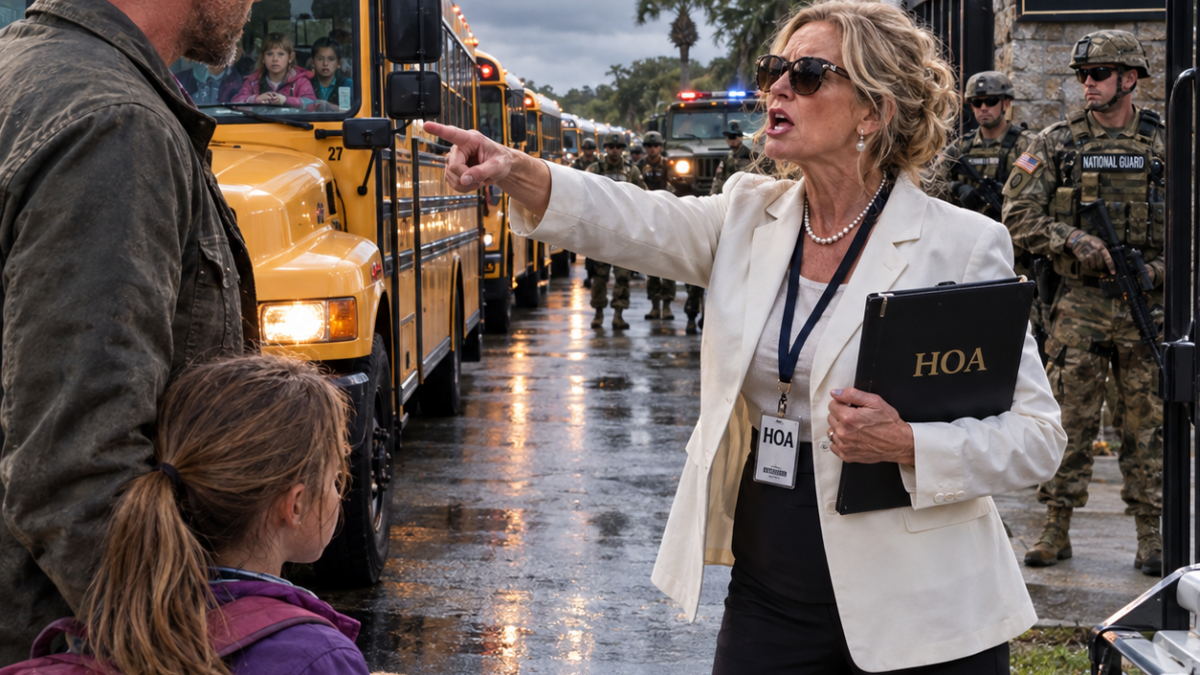
HOA Karen Blocked Four Evacuation Buses Carrying 43 Kids as a Category 3 Hurricane Closed In—My 9-Year-Old Daughter Was on One of Them, and Marlene Had No Idea What I’d Been Documenting for 18 Months.
PART2:
The first time she fined me, I paid.
That was my mistake.
I was resurfacing part of our driveway and placed two orange traffic cones near the curb so nobody would drive over the fresh coating.
Two cones.
Temporary.
Visible for one afternoon.
A violation notice arrived the next morning.
AESTHETICALLY DISRUPTIVE VISUAL CORRIDOR.
Forty-dollar fine.
I read the phrase twice.
Then I read it to Renata.
She was chopping vegetables in the kitchen.
“An aesthetically disruptive visual corridor?”
“Apparently.”
“They’re traffic cones.”
“Apparently they are ugly traffic cones.”
Renata didn’t look up.
“Pay it.”
I stared at her.
“That’s your legal opinion?”
“That’s my marriage-preservation opinion.”
“We’ve lived here eleven days.”
“Exactly.”
I paid the forty dollars.
PART3:
Marlene learned the wrong lesson.
She learned that if she printed something on HOA letterhead and attached a deadline, Dex Calloway would comply.
For a while, she was right.
Then she went after the school buses.
The shared entrance between Coastal Pines Elementary and Pelican Cove had existed long before we bought our house.
A recorded easement dated back to 2008.
Buses entered through the east side in the morning.
Children from Pelican Cove walked to designated pickup points.
The bus came in, collected them, and left.
Simple.
Safe.
Efficient.
Then one August morning Lily came downstairs and told me the bus stop had moved.
“Moved where?”
“The big road.”
“What big road?”
“The county road.”
I looked at Renata.
She shrugged.
“School sent an email.”
I opened it.
Due to access concerns raised by the Pelican Cove Homeowners Association, school bus service would no longer enter the east access route.
Students would be picked up approximately six-tenths of a mile away.
I drove the route.
No sidewalk.
A drainage ditch.
One narrow shoulder.
Heavy morning traffic.
Children walking in rain.
Children walking in darkness during winter mornings.
Children crossing a section where drivers routinely exceeded the posted speed.
I called the school district.
The transportation office told me the HOA had disputed the bus access rights.
I asked what changed.
“HOA counsel sent a letter.”
“What does the easement say?”
“I’d have to check.”
“Did anybody check before rerouting forty-three kids?”
Silence.
That silence was how I met Marlene properly.
I went to the next board meeting.
Renata came with me because she had learned that when I carried a binder, somebody was about to have a bad evening.
Marlene sat at the center table.
White blazer.
HOA vest draped over chair.
Clipboard.
Of course.
I waited through thirty minutes of discussion about mailbox paint and whether basketball hoops lowered property values.
Then homeowner comments opened.
I stood.
“My name’s Dex Calloway, Cypress Lane.”
Marlene smiled.
“Mr. Calloway. Three minutes.”
“Why did Pelican Cove tell the school district buses can no longer use the east entrance?”
Her smile weakened by maybe five percent.
“The board reviewed the matter with counsel.”
“What matter?”
“Commercial vehicle access.”
“A school bus isn’t commercial traffic.”
“It exceeds our vehicle-length standards.”
“Where are those standards?”
“In the governing documents.”
“Which section?”
She looked at her property manager.
The property manager looked at a laptop.
Marlene answered:
“Article Eight.”
I had read Article Eight.
“Article Eight regulates homeowner parking.”
“It also establishes the board’s authority over road use.”
“Inside HOA-owned roads.”
“The east entrance is HOA-controlled.”
“Not completely.”
Her eyes sharpened.
“What do you mean?”
“There is a recorded access easement.”
That got the room quieter.
I continued.
“Book 2281, page 417. Recorded June 12, 2008.”
Marlene leaned back.
“You’ve done your homework.”
“I used to work with infrastructure.”
“This is not an Army base, Mr. Calloway.”
“I didn’t say it was.”
A few people turned.
She had obviously researched me enough to know my background.
I asked:
“Did the board review the easement before sending the letter?”
Marlene said:
“Our attorney reviewed all relevant documents.”
“Does the attorney’s opinion say buses are prohibited?”
“That communication is privileged.”
“That’s not what I asked.”
“You have thirty seconds.”
I opened binder.
“The easement grants ingress and egress to the school district, county personnel, emergency vehicles, utility contractors, authorized school transportation, and—”
Marlene interrupted.
“That is your interpretation.”
“No.”
I held up copy.
“That’s the sentence.”
The property manager looked uncomfortable.
One board member, a retired accountant named Henry Webb, leaned toward Marlene.
“Can I see that?”
She ignored him.
“Mr. Calloway, your time is up.”
“Forty-three children are walking along a county road because you sent a letter contradicting a recorded easement.”
“Your time is up.”
“Is the board willing to reopen bus access?”
“No.”
That was answer.
Not because she had reviewed.
Because I had challenged.
You learn people quickly when their authority is questioned.
I sat.
Renata whispered:
“You’re doing the jaw thing.”
“What jaw thing?”
“The one that costs us weekends.”
She was right.
The next morning I ordered certified copy of easement, original subdivision plat, school access agreement, and maintenance exhibits.
Then I started documenting.
Not because I planned lawsuit.
Because documentation is cheaper before conflict than after.
The 2008 easement was clearer than I expected.
The developer had needed county approval for Pelican Cove’s east phase.
The school district owned property immediately adjacent.
The county wanted secondary emergency access.
So developer granted perpetual nonexclusive easement across east entrance.
Allowed uses included:
School buses serving residents.
Emergency vehicles.
County evacuation operations.
Public utility access.
School personnel.
Pedestrian emergency movement.
Then came a clause I underlined twice.
During a declared local, state, or federal emergency, operational control of the easement area may be exercised by the county emergency management authority, sheriff’s office, fire-rescue command, school district emergency coordinator, or other governmental entity designated by law, and no private gate, barrier, association rule, or owner regulation shall unreasonably impede such use.
There it was.
Not secret.
Not obscure.
Recorded deed book.
Marlene either had not read it or hoped no one else would.
I sent copy to school transportation director.
He called the next day.
“We’re reviewing.”
“How long?”
“Legal counsel needs—”
“The children are still walking.”
“I understand.”
“Do you?”
Pause.
“We’ll get back to you.”
Government moves slower when nothing is on fire.
For the moment, nothing was.
So I kept documenting.
The buses did not return.
Then Marlene installed a new gate.
The old east entrance had a simple swing arm that remained open during school transportation windows.
The replacement was black steel.
Decorative.
Expensive.
Automatic.
RFID access.
Camera.
Keypad.
Two masonry columns.
Pelican Cove newsletter called it:
East Gateway Security Enhancement Project.
Cost:
$94,000.
I emailed board:
Does project interfere with recorded easement?
No response.
I sent certified letter.
No response.
I sent it again to property manager.
He replied:
“Board has been advised.”
That phrase would matter later.
One morning I drove over and measured clear width from public side.
Twenty feet, four inches with gate fully open.
Adequate for bus.
With Marlene’s newly installed decorative bollards near curb?
Seventeen feet, nine.
Still passable but tight for larger emergency vehicles.
Drainage swale reduced turning radius.
Not illegal necessarily.
Poor design.
I took photographs.
Renata watched from passenger seat.
“You’re enjoying this.”
“No.”
“You brought a laser rangefinder.”
“I already owned it.”
“That wasn’t denial.”
Fair.
Marlene began fining me again soon after.
Trailer visible for two hours.
Trash can out twelve minutes early.
Sergeant barked after ten p.m.
A garden hose allegedly crossed sidewalk.
One notice claimed my American flag bracket was nonconforming because screws were black instead of silver.
I appealed each.
Not because money.
Because pattern.
Every appeal denied.
Then I requested hearing recordings.
Funny thing.
State property association law and our bylaws gave members access to certain records.
Meeting minutes showed something interesting.
The vote to block school buses never happened.
There was no board resolution.
No motion.
No recorded vote.
Marlene sent letter herself using HOA letterhead.
Henry Webb called me privately.
“I didn’t authorize it.”
“Who did?”
“Marlene said counsel recommended temporary restriction.”
“Did counsel?”
“I never saw letter.”
“Why haven’t you challenged her?”
Silence.
Then:
“You don’t understand politics in this neighborhood.”
I almost laughed.
“Henry, this is an HOA.”
“Exactly.”
He wasn’t joking.
Marlene controlled committees.
Architectural approvals.
Landscaping contracts.
Vendor recommendations.
Real estate referrals.
She had helped half the neighborhood buy or sell something.
People didn’t want problems.
That is how small power grows.
Not because power huge.
Because cost of opposing feels annoying.
So everyone decides:
Not worth it.
Until enough people decide that, and suddenly one person behaves like nobody can stop them.
Over eighteen months, I documented twenty-three incidents involving access, records, selective enforcement, and board procedure.
Not all illegal.
Some merely petty.
I separated categories.
Always.
If you exaggerate, you weaken good evidence.
I had a spreadsheet.
Date.
Event.
Rule cited.
Actual governing section.
Witness.
Photo.
Board response.
Renata saw it.
“You made a spreadsheet about Marlene?”
“I made a record.”
“With conditional formatting.”
“It helps.”
“You need a hobby.”
“This is my hobby.”
“That is concerning.”
Then hurricane season changed everything.
The storm started as tropical depression east of Bahamas.
Nobody panicked.
Then tropical storm.
Then hurricane.
Forecast cone shifted west.
Coastal Georgia began watching.
Marlene posted message:
PELICAN COVE PREPAREDNESS COMMITTEE IS MONITORING CONDITIONS.
I almost respected it.
Then:
Residents should not contact county agencies independently, as board will coordinate official information.
There we go.
You cannot tell people not to contact government.
I sent Renata screenshot.
She replied:
Don’t start.
I didn’t.
Not yet.
Storm became Category 2.
Schools announced early closure.
County emergency management prepared shelters inland.
Coastal Pines Elementary was designated temporary child staging site because summer enrichment program was still in session.
Lily attended three mornings a week.
The storm strengthened faster than predicted.
Category 3 forecast at landfall.
Mandatory evacuation ordered for designated coastal zones including Pelican Cove.
At 2:14 p.m. every phone in our kitchen screamed simultaneously.
Emergency alert.
Renata jumped despite knowing.
Sergeant barked like air raid siren.
Lily covered ears.
MANDATORY EVACUATION.
LEAVE ZONE BY 6:00 P.M.
Use designated routes.
Do not delay.
I looked toward east.
School.
County emergency plan used buses to relocate remaining children and staff from Coastal Pines to inland reunification center because main western highway already congested.
Parents could pick up children if safe.
Others would be bused.
Renata said:
“We’re getting Lily.”
I called school.
Lines overloaded.
Automated message:
Do not approach campus unless directed.
Children secure.
Transportation underway.
Four buses.
Forty-three children.
Lily included.
I knew eastern access was fastest way from school to county collector road.
The recorded easement was designed exactly for this.
Then my phone rang.
Mark Ellison.
Neighbor.
Not related to school.
“Dex.”
“What?”
“Marlene closed east gate.”
My stomach changed.
“What do you mean closed?”
“She has golf cart across it.”
“Why?”
“She’s saying evacuation traffic has to use main entrance.”
I walked toward window.
Wind already moving pines.
“School buses?”
“That’s what I’m calling about.”
I didn’t remember grabbing keys.
Renata stopped me.
“Where are you going?”
“East gate.”
“Lily?”
“On buses.”
She went pale.
“Dex.”
“I know.”
“We should call sheriff.”
“I am.”
I called 911.
Dispatch overloaded.
Transferred to nonemergency incident queue.
I gave exact address.
“Four school buses may be obstructed at emergency easement.”
Operator’s tone changed.
“Children onboard?”
“Yes.”
“Mandatory evacuation zone?”
“Yes.”
“Units are extremely limited. Do not confront anyone.”
“Understood.”
I left.
Renata followed in her SUV despite my objection.
“I’m not staying home.”
Fine.
East entrance was four blocks away.
People were loading cars.
Generators.
Suitcases.
Dogs.
Boats.
Wind gusting.
Rain beginning sideways.
Phones chirping alerts.
Then I saw buses.
Four yellow school buses lined along school-side access road.
First stopped thirty yards before gate.
Children visible through windows.
The gate itself was open.
But Marlene’s golf cart sat sideways across pavement.
Two orange cones.
Her white HOA vest snapped in wind.
Three HOA volunteers stood nearby.
One carried radio.
The absurdity almost made me laugh.
Instead I felt cold.
I parked.
Marlene saw me.
“Dex, stay back.”
“What are you doing?”
She held clipboard.
“Directing neighborhood evacuation.”
“No. You’re blocking it.”
“These buses are not entering Pelican Cove.”
“They don’t need to enter neighborhood. They’re using east easement to exit school.”
“The easement is suspended during emergency.”
I actually stared.
“What?”
“For resident safety.”
“Show me.”
“Emergency board authority.”
“Show me.”
Her mouth tightened.
“Move your vehicle.”
“This is not your concern.”
“My daughter is on that bus.”
That landed.
One volunteer looked toward windows.
Marlene did not.
“Then she will be evacuated using school-approved route.”
“This is the school-approved route.”
“Not through Pelican Cove.”
I walked toward first driver.
Marlene stepped in front.
“You cannot interfere with official HOA operations.”
There are sentences so ridiculous your brain rejects them.
I ignored her.
Driver lowered window.
Woman named Patricia Green.
I knew her from school.
“Mr. Calloway.”
“Patricia, did district direct you through here?”
“Yes.”
She showed printed route packet.
East access.
County evacuation corridor.
She looked furious.
“She says buses violate weight and commercial vehicle rule.”
“How long have you been stopped?”
“Fourteen minutes.”
Fourteen.
During hurricane evacuation.
I looked through bus windows.
Kids scared but orderly.
Lily spotted me.
Her face changed.
“Dad!”
I raised hand.
Smile.
Everything okay.
Lie parents tell to keep fear from spreading.
Marlene said:
“You are escalating children.”
I turned.
“No. You are holding them.”
Her chin lifted.
“I’m protecting community infrastructure.”
“From school buses?”
“Our private roads aren’t rated for repeated heavy vehicle loads.”
“This route is an easement.”
“Private easement.”
“No.”
“Your interpretation.”
“No, Marlene. Recorded language.”
She pointed at decorative gate.
“HOA owns this structure.”
“Maybe.”
That made her pause.
“What does that mean?”
“You should have read easement.”
“I have.”
“No.”
“I know every governing document.”
“Then read emergency-control clause.”
Silence.
For first time.
Tiny.
She recovered.
“That clause does not give school district authority to override HOA gate regulations.”
“It gives county emergency management operational control during declared emergency.”
“County is not here.”
“Yet.”
Her eyes flashed.
“You threatened me?”
“No.”
I looked toward approaching rain.
“I called them.”
Marlene turned to volunteers.
“No vehicle passes until board counsel confirms.”
Patricia, bus driver, said:
“We were told to proceed.”
Marlene:
“You proceed through main school exit.”
Patricia:
“That route is backed up three miles.”
“Not our issue.”
It was then I knew this wasn’t misunderstanding.
A reasonable person, confronted with forty-three children and hurricane, errs toward letting them leave.
Marlene’s priority was winning.
I called county emergency management directly.
Old habit kept numbers.
I had attended preparedness meetings after moving.
Duty officer answered after two tries.
“Chatham Coastal EMA.”
“My name is Dex Calloway, Pelican Cove Estates. Four school evacuation buses are being blocked at east school easement by HOA president.”
“Blocked how?”
“Golf cart and gate control.”
“Police notified?”
“Yes.”
“Do buses have children?”
“Forty-three.”
“Storm zone?”
“Mandatory.”
“Hold.”
Not words you like.
Thirty seconds.
Then a different voice.
“Mr. Calloway, this is Deputy Director Carla Jennings.”
I knew Carla from county infrastructure workshop.
“Carla.”
“Dex?”
“Yes.”
“What the hell?”
“I wish I knew.”
“Is east easement still recorded emergency access?”
“Yes. I have deed.”
“Can you send?”
“Already on phone.”
I emailed PDF.
“Page?”
“Six, paragraph eleven.”
She read.
Then silence.
“Okay.”
The okay sounded different.
“Do not confront. Do not move gate yourself.”
“I won’t.”
“We are issuing direction.”
“How long?”
“We have sheriff unit en route. Also Guard traffic-control team moving through sector.”
National Guard had been activated by governor for hurricane response earlier that day.
Not for Marlene.
For storm.
High-water vehicles.
Traffic points.
Shelter logistics.
Engineering support.
Carla continued:
“If necessary we’ll reroute buses, but I want east corridor opened.”
“Understood.”
“Dex.”
“Yes?”
“Stay out of roadway.”
Renata, beside me, heard speakerphone.
She said:
“He won’t.”
Carla:
“Renata?”
“Hi.”
“Make him.”
“I’ve been trying twenty years.”
I hung up.
Marlene looked suspicious.
“Who was that?”
“County EMA.”
She laughed.
Actually laughed.
“Dex, you cannot just call somebody you know and commandeer HOA property.”
“I didn’t.”
“You’ve been trying to undermine board since you moved here.”
“This isn’t about board.”
“It is always about board with you.”
Forty-three children were behind her.
Wind now gusting hard enough to move cones.
I said:
“Move the golf cart.”
“No.”
“Please.”
“No.”
“Then we wait.”
That confused her.
She expected fight.
People like Marlene often rely on confrontation.
If you won’t give it, they lose rhythm.
Ten minutes later sheriff deputy arrived.
One unit.
Deputy Miles Carter.
Marlene approached before he parked fully.
“Officer, this homeowner is interfering with HOA emergency operations.”
Miles stepped out slowly.
“Ma’am, where are buses?”
She pointed.
“I’ve stopped unauthorized entry.”
Miles looked at children.
Then at her.
“You stopped evacuation buses?”
“They cannot use private road.”
He touched shoulder mic.
“Dispatch, confirm county direction on Pelican Cove east.”
Static.
Then:
“County EMA directs immediate opening of east evacuation easement for school transport. Emergency control provision invoked under declaration.”
Miles looked at Marlene.
“Move the golf cart.”
Her face changed.
“No.”
Simple.
Everybody heard.
Deputy:
“Ma’am?”
“My attorney has not confirmed that.”
“County direction is clear.”
“HOA counsel controls association property.”
“Not during declared emergency if easement says otherwise.”
“You haven’t read our covenants.”
“I don’t need your covenants right now.”
That offended her deeply.
Marlene pulled phone.
“I’m calling counsel.”
Miles:
“Call from sidewalk after moving vehicle.”
“No.”
He stepped closer.
“Ms. Duckett, you are obstructing an evacuation route.”
“I am protecting private property.”
“You can challenge the order later.”
“No.”
That was second refusal.
Miles looked toward first bus.
Rain intensified.
He spoke into radio.
“Need supervisor and traffic assistance.”
Marlene turned to me.
“This is your doing.”
“No.”
“Yes. You’ve been waiting.”
That sentence stayed.
Because she was partly right.
I had documented eighteen months.
I knew emergency clause.
I had told county months earlier gate design might create conflict.
But I had never imagined this.
“No,” I said. “I was hoping you’d stop before something mattered.”
Headlights appeared from school side.
Olive-drab vehicles.
Not tanks.
Not dramatic convoy.
Two Georgia National Guard high-water trucks assigned to county emergency traffic support and one smaller utility vehicle.
Behind them a county public works truck.
They had been redirected while moving toward another sector.
People later online claimed I “brought the National Guard.”
No.
The hurricane did.
Marlene simply gave them another problem.
Captain Aaron Briggs got out.
Georgia Army National Guard.
Rain jacket over uniform.
Carla from EMA had apparently briefed him.
He approached Deputy Miles first.
Professional.
Quiet.
Looked at map.
Looked at easement.
Then looked at gate.
I stayed back.
Good.
This was no longer homeowner argument.
Briggs asked:
“Who controls gate electronics?”
Marlene immediately:
“I do.”
He nodded.
“Open access.”
“You don’t have authority over our HOA.”
He glanced at deputy.
Then county public works supervisor.
Then back.
“Ma’am, county emergency management has activated this corridor under declared evacuation authority. School buses need through.”
“Your vehicles exceed our weight restriction too.”
One Guardsman looked away.
Probably hiding expression.
Briggs stayed neutral.
“This isn’t optional.”
“I want written order.”
County public works supervisor held tablet.
“You have it.”
Marlene didn’t look.
“I want my attorney.”
Briggs:
“You may contact attorney. Open gate and clear roadway.”
“The gate is open.”
“Clear golf cart.”
“No.”
Deputy Miles sighed.
Last chance.
“Ms. Duckett, move cart or we move it.”
“You touch HOA property and there will be consequences.”
Briggs looked toward me for first time.
“You Calloway?”
“Yes.”
“EMA says you have survey.”
I held folder.
“Certified copy.”
He reviewed.
Not long.
Clause.
Then site exhibit.
Easement width forty feet.
Interesting.
The HOA’s new gate columns and bollards sat partly inside dedicated emergency easement.
That was something I’d suspected.
Survey confirmed.
Briggs pointed.
“This structure is inside easement?”
“Parts.”
County engineer checked GIS.
Then actual recorded dimensions.
“Yes.”
Marlene interrupted.
“This is ridiculous.”
County supervisor said:
“No, ma’am. It means during emergency we control functional use of this strip.”
Marlene’s face went white.
There it was.
The clause nobody read.
Not ownership transfer.
Important.
County did not become owner.
HOA did not lose title.
But operational control of easement area during declared emergency shifted to public emergency authorities.
Marlene had built a private gate across corridor whose emergency-use rights were superior to her HOA traffic rules.
And now she was standing inside it.
Deputy Miles said:
“Move.”
She didn’t.
He stepped toward golf cart.
Marlene grabbed steering wheel.
“Do not touch this vehicle.”
“Ma’am.”
“This is private property.”
“You are obstructing.”
“Arrest me then.”
Everyone froze.
Maybe she thought nobody would.
Miles gave one final clear instruction.
“Step away from cart.”
“No.”
He arrested her.
No tackle.
No dramatic fight.
He took her wrist.
She pulled once.
Then stopped.
Cuffs.
Read warning.
Placed her under temporary custody for obstruction and failure to comply with emergency traffic direction.
One HOA volunteer immediately stepped away.
Another said:
“I told her we should move it.”
Of course.
County workers rolled golf cart out.
Then Briggs looked at gate controls.
“Keep gate open.”
HOA volunteer said:
“It auto-closes after sixty seconds.”
“Disable auto-close.”
“I don’t know code.”
Marlene, beside deputy vehicle, shouted:
“Do not give them codes!”
Briggs looked at county supervisor.
Supervisor:
“Manual release?”
I knew.
Not code.
A mechanical emergency release inside west column.
Required under installation manual.
I had downloaded manufacturer specs months earlier.
I said:
“Lower access panel, keyed latch.”
County worker opened panel using maintenance key from HOA volunteer.
Manual disengagement.
Gate stayed open.
Briggs said:
“County controls this point until evacuation order ends.”
Not me.
County.
That distinction matters.
But because I had copy, surveys, manufacturer specs, and eighteen months of records, I became the annoying retired engineer standing in rain telling people where buried control conduit ran.
Honestly?
Best use of retirement so far.
First bus moved.
Patricia rolled forward slowly.
Children erupted cheering.
Lily pressed both palms to window.
I smiled.
Renata cried.
I did not.
That came later.
Second bus.
Third.
Fourth.
Forty-three children.
No one hurt.
Sixteen minutes after Guard arrived, buses were on county evacuation route.
Thirty-eight minutes after Marlene first blocked them, the east corridor was clear.
Thirty-eight minutes does not sound long until your child is sitting on bus with hurricane warning screaming.
Then it is a lifetime.
Renata and I did not follow buses.
That surprised people.
School directed parents to inland reunification point after evacuation.
We returned home to collect Sergeant and bags, then left through main exit.
Marlene’s golf cart sat parked beside clubhouse.
Empty.
National Guard traffic team remained at east gate for school and emergency traffic.
As we drove out, I saw the white HOA vest soaked on ground.
I almost felt sorry for her.
Almost.
We reached inland shelter center at 7:40 p.m.
Lily ran to Renata first.
Then me.
She wrapped arms around waist.
“Dad, that lady is crazy.”
Children have clarity adults lose.
I said:
“She made a bad decision.”
“Really bad.”
“Yes.”
“Is she going to jail?”
“I don’t know.”
“Did Army arrest her?”
“No.”
“The policeman did.”
“Good.”
Renata gave me look.
“What?”
“Do not discuss criminal justice with nine-year-old tonight.”
Fair.
Hurricane made landfall farther south than worst forecast for us.
Still severe.
Pelican Cove lost power eighteen hours.
Several trees down.
Roofs damaged.
Clubhouse windows broken.
East gate lost electrical controller when surge hit.
Because manual mode already engaged, it remained open for emergency vehicles.
That irony was not lost on me.
Fire rescue used it twice overnight.
Once for elderly resident with breathing problem.
Once for diabetic emergency.
Marlene’s “security risk” became fastest responder route.
By sunrise, story had spread.
Phones.
Facebook.
Neighborhood groups.
Someone uploaded video of Marlene arguing with National Guard captain.
Headline grew instantly:
HOA KAREN TRIES TO STOP NATIONAL GUARD DURING HURRICANE
Not exactly.
She blocked school buses and then refused emergency-control direction.
Internet prefers shorter.
Another:
HOA PRESIDENT ARRESTED AFTER BLOCKING 43 KIDS FROM HURRICANE EVACUATION
Closer.
Then:
RETIRED ARMY ENGINEER TAKES OVER HOA GATE WITH NATIONAL GUARD
That annoyed me.
I didn’t take over anything.
County did.
I happened to know why they could.
Accuracy loses to drama.
What happened after hurricane was less viral and far more important.
County reviewed east gate.
Surveyors came.
Engineers.
School district counsel.
HOA counsel.
County attorney.
The gate columns had indeed been built partially within recorded emergency-access easement.
Not necessarily illegal by existence because gates can coexist with easements if access isn’t unreasonably impeded.
But design and control policy were defective.
The RFID-only configuration did not guarantee government access.
Automatic close timer could obstruct.
Decorative bollards narrowed turning envelope.
Marlene had directed installers not to give school district permanent access credentials.
We learned that through email.
Why?
She wrote:
If the school has permanent code, they’ll treat route like public property and we’ll never regain control.
There it was.
Regain control.
Of an easement never exclusively theirs.
Another email to property manager:
Do not reference emergency override language in homeowner communications. It creates confusion about ownership.
That one interested county lawyer.
Translation:
She knew clause existed.
She didn’t misunderstand.
She wanted people not to know.
My eighteen months of documentation suddenly stopped looking obsessive.
Renata still called spreadsheet deranged, but respectfully.
HOA board held emergency meeting two weeks after storm.
Marlene was out on bond and barred from interfering with east access pending hearing.
Clubhouse packed.
I sat back.
No binder this time.
Board vice president Henry Webb chaired.
His hands shook.
“I want to begin by apologizing.”
Residents quiet.
“For the first time in years, I am going to say what I should have said earlier.”
He looked toward us.
“The board allowed one officer to exercise authority without sufficient oversight.”
Marlene’s supporters stirred.
Henry continued.
“That includes me.”
Good.
Not:
We were misled.
Not:
Mistakes happened.
Me.
Accountability starts pronoun.
He described easement.
Read emergency clause aloud.
People murmured.
Many had never heard.
Then property manager admitted no formal board vote had authorized permanent school-bus restriction.
That got louder.
Resident stood.
“My daughter walked on county road for a year because of letter nobody voted on?”
“Yes.”
“Who wrote it?”
Everyone knew.
Henry said:
“President Duckett.”
“Did lawyer approve?”
HOA counsel stood.
This was new lawyer.
Firm had reviewed old correspondence.
“Our predecessor counsel advised board that recorded school and emergency easement likely remained enforceable.”
Room erupted.
Henry banged gavel.
Marlene wasn’t there.
Lucky.
Then came gate.
$94,000.
Special reserve fund.
Who approved?
Board vote existed.
But members had been told upgrade necessary because county warned about unauthorized traffic.
County never did.
Marlene’s presentation to board included slide:
COUNTY SECURITY RECOMMENDATION
No supporting document.
County denied issuing it.
The board had relied on her statement.
Then vendor.
Gate contractor was owned by Marlene’s nephew’s business partner.
Not prohibited automatically.
Not disclosed adequately.
Residents got angrier.
Mark Ellison stood.
“Are you telling us she spent ninety-four grand on gate across somebody else’s emergency easement using contractor connected to her family?”
Henry said:
“Investigation ongoing.”
Mark:
“That’s a yes with necktie.”
I liked Mark.
Vote scheduled to recall Marlene.
She resigned before vote.
Letter:
Due to relentless harassment and politically motivated attacks following unprecedented weather emergency, I am stepping aside to protect my family and preserve community unity.
No mention children.
No mention buses.
No mention easement.
People who cannot admit mistake often rewrite ending.
Criminal charges?
Less dramatic than internet hoped.
County prosecutor reviewed.
Marlene faced misdemeanor obstruction-related charge and local emergency-order violation.
She pled no contest to one count under agreement.
Fine.
Probation.
Community service.
No prison.
Some neighbors thought too little.
I didn’t care much.
Goal was access.
Not punishment.
Civil consequences hit harder.
School district demanded permanent operational access.
County required gate modifications.
HOA insurer questioned coverage.
Residents demanded forensic accounting.
Real estate board received ethics complaints.
Marlene’s reputation collapsed in community where reputation had been her power.
Enough.
Then school buses returned.
The first morning was almost anticlimactic.
7:08.
Gate open.
Bus entered.
Children boarded.
Left.
Nobody applauded.
That’s how infrastructure should work.
Boring.
Safe.
Routine.
Lily sat window.
Waved.
I waved.
Renata stood beside me.
“You won.”
“No.”
“You absolutely did.”
“The bus is back.”
“That is winning.”
Maybe.
But I still disliked framing.
If a school bus using recorded easement becomes personal victory, system failed too long.
County later installed separate emergency access cabinet near east gate.
Standardized responder lock.
School district credential.
Manual override.
Camera logs.
HOA retained normal gate control outside authorized uses.
Balanced.
Not:
National Guard permanently takes HOA gate.
No.
Emergency ended.
Operational control returned according to documents.
But now everyone knew clause.
Harder to pretend.
Marlene moved from Pelican Cove seven months later.
House sold.
I saw moving truck.
No satisfaction.
Just closure.
Sergeant barked at truck.
He barked at everything.
Renata said:
“He’s saying goodbye.”
“He hated her golf cart.”
“We all did.”
I kept documenting for another year.
Habit.
Then stopped.
Spreadsheet archived.
Renata celebrated by opening wine.
“To retirement.”
“I am retired.”
“No, Dex. Now you’re retired.”
She had point.
I joined neighborhood emergency-preparedness committee.
She laughed so hard she almost spilled glass.
“You replaced HOA war with committee?”
“Useful committee.”
“That is what every retired engineer says before buying laminator.”
I did buy laminator.
Unrelated.
We mapped elderly residents needing assistance.
Generator locations.
Drainage trouble spots.
Pet evacuation.
Emergency contacts.
East gate protocol.
No one objected.
Funny what happens when preparedness isn’t used as personal authority.
We held hurricane drill next year.
County participated.
School buses tested east route.
Gate override timed.
Four minutes from notification to fully open.
Marlene’s old system once required president approval.
New system required no personality.
That’s good engineering.
Remove unnecessary human bottleneck.
Especially if human is Marlene.
Lily grew.
At twelve, she barely remembered fear of bus incident.
She remembered National Guard trucks.
Kids love trucks.
At fourteen she asked:
“Did you really bring soldiers because Mrs. Duckett wouldn’t move?”
“No.”
“That’s what everybody says.”
“Everybody is wrong.”
“You called them?”
“I called county.”
“County sent them.”
“Yes.”
“Because you called.”
“Partly.”
“So you brought them.”
I sighed.
“That’s not how emergency management works.”
She smiled.
“Dad, normal people don’t care.”
True.
But I did.
Words matter when telling power stories.
I did not command Guard.
I did not seize gate.
I did not arrest Marlene.
I did not secretly outrank anyone.
I was homeowner who read easement.
County had authority.
Sheriff enforced.
Guard supported evacuation.
That version teaches something useful.
Fantasy version teaches:
Be secretly powerful.
Real version teaches:
Read documents and call right authority.
Better.
One evening Henry came by.
Former vice president.
He had resigned board after transition.
He brought folder.
Old minutes.
“Found something.”
“What?”
“2008 developer meeting.”
Original.
Handwritten note from first board:
East access must never be obstructed during school transport or emergency operations. County approval contingent.
We laughed.
Not because funny.
Because sixteen years before Marlene, someone had already written common sense.
He said:
“We all failed.”
“You tried eventually.”
“Too late.”
“Still tried.”
Henry looked toward east.
“I was afraid she’d turn neighborhood against me.”
I said nothing.
“She controlled committees, vendors, realtors. My wife wanted peace.”
“Understandable.”
“No.”
He shook head.
“That’s how it got worse.”
Again.
Small power grows through avoided inconvenience.
He asked:
“Would you do anything differently?”
“Yes.”
“What?”
“Not pay first forty-dollar fine.”
Henry laughed.
“Traffic cones.”
“Ugly traffic cones.”
He left.
I kept original citation copy framed in office?
No.
That would be weird even for me.
But I kept easement.
Of course.
My years connected to Army infrastructure had taught me something that residential communities rarely think about:
Access is invisible until needed.
Gate is decoration on sunny day.
During fire, flood, hurricane?
Gate is life-safety device.
Road width.
Turning radius.
Load capacity.
Drainage.
Clearance.
Override.
Keys.
Who can open.
Who cannot.
These details feel boring.
Until forty-three children wait behind them.
Marlene viewed gate as symbol of control.
I viewed it as a mechanical choke point.
County viewed it as emergency corridor.
Only one view mattered during hurricane.
Not hers.
Years later Pelican Cove replaced decorative monument near east entrance after storm damage.
Design committee asked me input.
I made mistake of agreeing.
They wanted arch.
Stone columns.
Swing gate.
Landscaping.
I asked:
“What is fire apparatus turning radius?”
Silence.
Architect sighed.
Renata whispered:
“This is your Super Bowl.”
She wasn’t wrong.
We designed something beautiful and functional.
Wide.
Clear.
Breakaway landscaping.
Emergency override.
No center island.
No decorative obstacle.
Residents complained looked less grand.
Then fire chief brought engine through in one smooth turn.
Complaints ended.
Marlene’s white golf cart?
Nobody knew.
Rumor Mark bought it at HOA asset auction.
He denied.
Then one Halloween he decorated a white golf cart with sign:
AESTHETICALLY DISRUPTIVE VISUAL CORRIDOR
Forty-dollar fake ticket.
I laughed more than I should.
Renata took picture.
Maybe healing.
The hurricane itself left scars.
Roof repairs.
Trees.
One family lost garage.
No deaths in Pelican Cove.
That mattered.
County-wide casualties were limited compared with worst fears.
Forty-three children reached inland center.
That mattered.
Nobody injured because thirty-eight-minute delay.
We were lucky.
Luck should never be defense of bad decision.
Marlene later said in one written statement:
“No child was harmed.”
True.
Irrelevant.
Safety rules exist to prevent us from having to discover whether harm occurs.
You don’t block evacuation and then claim success because storm didn’t kill anyone during delay.
That’s like driving drunk and defending yourself because you missed pedestrians.
Outcome matters.
Risk matters too.
I testified at county emergency-access review.
No courtroom drama.
Fluorescent conference room.
Engineers.
Fire chiefs.
School transportation.
Developers.
HOA management firms.
I presented timeline.
Not Marlene character study.
6:02 buses staged.
6:07 first bus reached gate.
6:08 blocked.
6:12 driver contacted transportation.
6:16 I arrived.
6:19 county notified.
6:28 deputy arrived.
6:36 Guard support arrived.
6:45 first bus cleared.
Numbers.
People understand timeline.
A property manager asked:
“What if HOA genuinely believes easement use exceeds scope?”
“Litigate later.”
That surprised him.
I explained:
“During declared emergency, if competent public authority directs evacuation under recorded rights, gate isn’t place to try property case.”
County attorney nodded.
“You preserve objection in writing and let people out.”
Exactly.
That line became guidance.
PRESERVE THE OBJECTION. DO NOT BLOCK THE EVACUATION.
Could have saved everything.
Marlene wanted her objection physically enforced.
Because paper didn’t feel like power.
Barrier did.
That’s dangerous personality type in any system.
The National Guard captain, Aaron Briggs, contacted me once afterward.
Not because friendship.
He needed gate contractor specs for after-action report.
I sent.
Then wrote:
“Sorry you got dragged into HOA nonsense.”
He replied:
We were there for hurricane. HOA brought itself to us.
Perfect.
I saved that email.
Not framed.
Yet.
Briggs later told reporter:
“Our role was supporting civil authorities. County established access. We assisted.”
Exactly.
He refused hero narrative.
Professionals usually do.
Internet hated nuance.
Years later I still get messages when story resurfaces.
“Why didn’t you ram gate?”
Because that’s stupid.
“Why didn’t National Guard arrest entire HOA?”
Because that’s not their role.
“Why didn’t you sue Marlene for millions?”
Because I wanted buses, not TV finale.
“Why didn’t you reveal you were general?”
Because I wasn’t.
I was engineer.
Civilian contractor and project manager for Army-connected infrastructure programs over years.
Retired.
No secret rank.
Reality is enough.
The strongest moment remains one I almost never tell.
After first bus cleared gate, before it turned onto county road, Lily looked down at me through glass.
She put hand against window.
I put hand up.
No sound.
Bus moved.
I realized how close anger had been to taking me somewhere unhelpful.
If I had shoved Marlene.
Moved golf cart myself.
Cut gate.
Argued physically.
Maybe I get detained.
Maybe buses delayed longer.
Instead I called.
Waited.
Produced paper.
Let authority function.
Harder than it sounds when your child is there.
My old work had trained me to solve physical problems.
Bridge overloaded?
Reduce load.
Road blocked?
Clear obstacle.
Gate locked?
Find mechanism.
But civilian systems require restraint too.
Sometimes solution isn’t touching obstacle.
It is proving who legally can.
That was lesson for me.
Renata later said:
“I was afraid you were going to become old Dex.”
“What is old Dex?”
“The one who thinks every problem needs immediate engineering solution.”
“Most do.”
She stared.
“Thank you for making my point.”
Then smiled.
“You did good.”
Coming from Renata, that’s medal.
I eventually learned why Marlene hated buses so much.
Not just control.
Two years before we moved in, a school bus clipped decorative stone cap at east entrance.
Minor damage.
HOA paid $1,700 because insurance dispute.
Marlene became convinced buses caused wear, dirt, noise, and security risk.
Then she wanted entrance “residential only.”
Reasonable concerns existed.
Could negotiate maintenance contribution with school district.
Could redesign.
Could schedule.
Instead she chose absolute control.
Again.
Common theme.
People become dangerous not because concern imaginary, but because concern becomes permission to ignore everyone else’s rights.
She wasn’t wrong that buses were large.
She was wrong that HOA could erase easement.
She wasn’t wrong that gate was HOA property.
She was wrong that ownership eliminated superior access rights.
She wasn’t wrong to care about neighborhood security.
She was wrong to treat forty-three children as leverage during hurricane.
Nuance does not excuse.
It explains.
I prefer explanations that make future prevention possible.
“She’s evil” prevents nothing.
“System allowed one officer to make unilateral access decisions without emergency override” can be fixed.
We fixed.
Pelican Cove changed bylaws.
No single officer controls emergency infrastructure.
Recorded easements indexed.
Any access restriction reviewed by counsel and affected public agency.
Emergency gates standardized.
Board votes recorded.
Conflict disclosures.
Homeowners access minutes online.
Not revolutionary.
Boring governance.
Beautiful.
New HOA president after Henry interim was Tasha Monroe.
Former school principal.
First meeting she said:
“I have no interest in becoming famous.”
Residents applauded.
She added:
“If you see me buy embroidered vest, remove me immediately.”
Even I laughed.
Tasha restored relationship with Coastal Pines.
HOA funded covered waiting shelter near bus stop.
Not required.
Good.
School held safety fair at clubhouse.
Fire truck.
Deputies.
National Guard recruiters, coincidentally.
Kids climbed vehicles.
Lily whispered:
“Are these same guys?”
“No.”
“Close enough.”
No.
But I let it go.
Our dog Sergeant died when Lily was thirteen.
That hurt more than gate ever did.
We buried his ashes under pine behind house.
Marlene had once fined us because Sergeant barked.
I considered adding plaque:
NONCOMPLIANT CANINE
Renata said absolutely not.
Marriage preservation.
I complied.
Mostly.
Tiny engraving underside.
Nobody sees.
I am not perfect.
At sixty, I finally considered Pelican Cove home.
Not battlefield.
That’s important.
For first few years after conflict, every golf cart annoyed me.
Every HOA email raised pulse.
Then time.
New people.
Better leadership.
Normal life.
Neighbors brought food when Renata’s mother died.
Mark helped after roof leak.
Tasha watched Lily once during emergency.
Community redeemed itself by being community rather than board.
That’s why I resist calling entire HOA evil.
Institution failed.
People corrected.
Marlene was not Pelican Cove.
Neither was I.
Forty-three children now teenagers.
Some don’t remember.
One became lifeguard.
One moved.
Lily starts college soon.
She wants civil engineering.
I pretend not proud because it’ll make her insufferable.
She says hurricane gate made her interested in infrastructure.
I said:
“Please choose something with less permitting.”
She said:
“No.”
Genetics.
For college essay she wrote about easement.
Not Marlene.
Title:
THE ROAD THAT EXISTED ON PAPER BEFORE IT EXISTED TO US.
That nearly got me.
She wrote:
“Safety systems are invisible until someone refuses to honor them.”
Better sentence than anything I had.
I asked permission to steal.
She said $40.
Traffic-cone fine.
I paid.
Some circles deserve closing.
The original certified easement now sits in fireproof file cabinet.
Not because Marlene.
Because documents matter.
Occasionally neighbor asks:
“Can HOA ever close east gate again?”
“Yes.”
Outside school transport and emergency access, they can control normal operation consistent with easement.
People expect dramatic:
Never again!
Law isn’t dramatic.
Rights overlap.
HOA owns structures.
School has access rights.
County has emergency control when activated.
All can coexist.
Problem starts when one pretends other rights disappear.
That is what Marlene did.
During hurricane, clause didn’t “steal” gate.
It did exactly what developers, county, and school planned in 2008.
Someone back then imagined:
What if main road blocked?
What if evacuation?
What if emergency vehicles need access?
Then they wrote answer.
Fifteen years later woman with clipboard tried ignoring answer.
Paper won.
That might be most satisfying part.
Not Guard trucks.
Not arrest.
A paragraph.
People laugh when engineers love documentation.
Until weather arrives.
At retirement ceremony from my old work, supervisor once said:
“Dex believes no problem is real until it has drawing number.”
Probably insult.
I took compliment.
Pelican Cove Drawing E-04 now has emergency gate details so clear even Marlene couldn’t misunderstand.
I checked.
Twice.
Renata made me stop.
On anniversary of hurricane, local reporter asked follow-up.
“Do you forgive Marlene?”
I hate that question.
It assumes story needs emotional transaction between two people.
I said:
“I don’t think about her much.”
Reporter pushed.
“Would you speak to her?”
“If necessary.”
“Are you angry?”
“Not daily.”
“How did incident change you?”
Better.
“It reminded me emergency planning fails at weakest human-controlled point.”
Reporter looked disappointed.
Engineers ruin television.
Then asked:
“What was weakest point?”
I said:
“A golf cart.”
They used quote.
Fine.
The title online became:
RETIRED ENGINEER SAYS HOA GOLF CART NEARLY BROKE HURRICANE EVACUATION
Accurate enough.
I still drink coffee on porch.
Pines taller.
Lily gone most mornings.
Renata tends herbs.
No Sergeant fur.
Quieter.
School buses audible from east road.
At 7:12 each weekday, one yellow bus passes entrance.
Gate opens.
Bus enters.
Children board.
Gate remains open long enough.
Then closes.
Simple sequence.
Every time I notice.
Maybe always will.
Sometimes Tasha drives golf cart by and raises clipboard jokingly.
I point.
She laughs.
Normal.
If you asked me what Marlene’s biggest mistake was, people expect:
Blocking buses.
Ignoring National Guard.
Refusing deputy.
Hiding easement.
All bad.
But those came later.
Her biggest mistake happened years before hurricane, probably slowly.
She began believing responsibility meant ownership.
People elected her to manage HOA.
She decided that meant community belonged to her.
Once that idea settles, every disagreement becomes insubordination.
Every rule becomes weapon.
Every boundary becomes insult.
Every emergency becomes chance to prove control.
Then children sit on buses while hurricane approaches because one person cannot tolerate gate opening without permission.
That’s why checks matter.
Not because leaders always bad.
Because everybody is capable of becoming too sure.
Including me.
Especially me.
My documentation could have become obsession.
My knowledge could become arrogance.
Renata reminded.
County reminded.
Good systems remind us:
You do not get everything because you’re right about one thing.
I didn’t get gate ownership.
Didn’t need.
County didn’t keep control forever.
Didn’t need.
HOA didn’t lose all authority.
Didn’t need.
School got access.
Kids got out.
That’s enough.
On morning after storm, while power still out, I returned briefly with county permission to inspect our house.
Branches everywhere.
Wet leaves.
East gate open.
National Guard truck parked nearby.
A young Guardsman stood watch.
Maybe nineteen.
He didn’t know story.
“Resident?”
“Yes.”
“ID please.”
I showed.
He checked.
“Okay, sir.”
Then I noticed Marlene’s soaked clipboard lying in ditch.
County cleanup missed.
I picked up.
Paper ruined.
HOA forms blurred.
For half second I considered keeping.
Symbol.
Trophy.
Then threw it in debris pile.
That surprised me.
A year earlier I would have saved.
Evidence.
But evidence had done job.
You can’t live forever among exhibits.
I drove home.
Our house had one broken window.
Roof okay.
Sergeant had vomited in Renata’s SUV during evacuation.
Honestly largest household disaster.
We cleaned.
Neighbors returned.
Power crews.
Chainsaws.
Insurance.
Normal recovery.
The gate controversy eventually became anecdote.
That’s healthy.
Communities should not organize identity around worst officer.
They should fix and move.
Pelican Cove did.
One afternoon years later I found Lily at kitchen table with old copy easement.
“What are you doing?”
“College project.”
“Why is original out?”
“Mom gave it.”
I looked toward Renata.
She shrugged.
“Your legacy.”
Lily asked:
“Why did you already have all this documented before hurricane?”
I told her truth.
“Because I didn’t trust Marlene.”
“That’s it?”
“And because systems fail at interfaces.”
She rolled eyes.
“Engineer answer.”
“You asked.”
“No, seriously.”
I sat.
“Because I worried one day dispute would stop being about traffic cones.”
That was it.
Petty power rarely stays petty if rewarded.
First cone.
Then bus.
Then gate.
Then evacuation.
Escalation doesn’t feel dramatic while occurring.
Each step seems small enough to ignore.
That is why boundaries matter early.
But also proportion.
I wouldn’t advise turning every $40 HOA ticket into federal case.
Sometimes pay.
Sometimes appeal.
Know difference.
My mistake wasn’t paying cone fine.
My mistake was thinking compliance would teach Marlene reasonableness.
It taught her compliance.
If rule illegitimate, calm challenge early may prevent bigger assumption later.
Maybe.
No guarantee.
Lily asked:
“What would you tell nine-year-old me on bus?”
I thought.
“That adults were handling it.”
“They weren’t.”
“Some were.”
She smiled.
“Would you tell me not to be scared?”
“No.”
That surprised her.
“Why?”
“Because you were allowed to be scared.”
Then:
“I’d tell you bus would move as soon as it could.”
She nodded.
“That is very dad.”
Good.
The forty-three children became a number in headlines.
But numbers hide faces.
Lily.
Noah Patel.
Madison Clark.
Twins Ava and Emma Reyes.
Caleb Morrison who threw up when anxious.
Little Jun Park clutching dinosaur backpack.
Teachers trying keep calm.
Drivers following orders.
Each child had family watching radar.
Marlene reduced them to vehicle classification.
School buses violate HOA rule.
That’s danger of bureaucracy when separated from purpose.
Rules exist for people.
Not people for rules.
The original vehicle-length provision had purpose:
Keep residents from parking commercial tractor trailers on narrow streets overnight.
Marlene applied it to evacuation buses because words “vehicles exceeding thirty feet” could be pulled from context.
Technically clever.
Functionally insane.
Good governance asks why rule exists.
Bad governance asks how rule can be used.
That’s another lesson I teach whenever asked.
Context.
Purpose.
Hierarchy.
HOA rule beneath easement.
Easement beneath emergency authority in specified conditions.
Documents interact.
You cannot read one sentence and declare kingdom.
Marlene tried.
The hurricane did not care.
By sunrise after evacuation, her gate had effectively become county-controlled emergency access point.
Not forever.
Not stolen.
Temporarily subordinated to purpose for which corridor had been recorded.
Exactly as designed.
That’s why title “I took control of her gate” always makes me laugh.
I didn’t.
The clause did.
I just knew where to point.
Maybe that’s best ending.
Not retired engineer defeats Karen.
Not National Guard revenge.
A community wrote an emergency clause in 2008.
Nobody thought about it for years.
Then one afternoon, with wind rising and forty-three children trapped behind a golf cart, the sentence woke up.
It did what good infrastructure language is supposed to do.
It took personality out of decision.
No longer:
Does Marlene approve?
No longer:
Does Dex win?
No longer:
Who shouts louder?
Instead:
Emergency declared.
Authorized authority activated.
Barrier cannot unreasonably impede.
Open gate.
Bus moves.
Child goes home.
That is what systems are for.
And every weekday morning when I hear a school bus roll through Pelican Cove’s east entrance, I remember the moment Marlene stood in rain insisting that because she controlled a keypad, she controlled the road.
She didn’t.
None of us control as much as we think.
Sometimes we’re just temporary people standing beside permanent obligations.
The gate belongs to HOA.
The road serves more than HOA.
The easement protects school.
Emergency clause protects everyone.
Marlene forgot.
Forty-three children nearly paid for it.
We didn’t.
And after eighteen months of fines, letters, meetings, fake authority, selective enforcement, and one hurricane afternoon that finally exposed what mattered, Pelican Cove learned a rule more important than anything Marlene ever printed on HOA letterhead:
When evacuation begins, the gate is not a symbol.
It is a way out.
And nobody gets to stand in front of a way out just because their name is on the clipboard.