HOA Crews Invaded My 400-Acre Forest to Cut My Trees—By Noon Every Machine Was Stuck, and None of Them Knew the Way Out.
PART2:
The property sat well outside any subdivision. The nearest full-time neighbor lived almost two miles away. There was no clubhouse. No decorative entrance. No pool. No community mailbox. No neighborhood committee.
No HOA.
When my niece once asked whether I had an association telling me what I could build, I laughed so hard she thought I was making fun of her.
“Out here?”
I had pointed at the trees.
“The deer haven’t formed a board yet.”
Apparently, somebody disagreed.
I followed the engine noise downhill, then around a bend in an old maintenance trail.
And stopped.
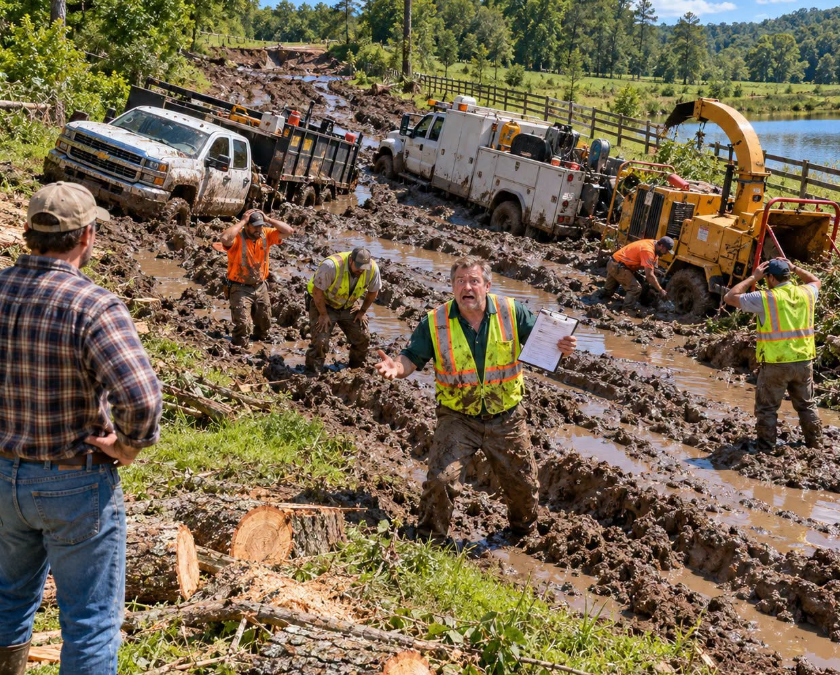
Six people.
Matching polo shirts.
Two trucks.
One mobile tree-cutting rig.
Clipboards.
Safety vests.
Orange marking paint.
They were standing inside my forest like they had every right in the world to be there.
One man had a tablet in one hand.
Another held a measuring pole.
A woman was photographing tree trunks.
And a guy wearing sunglasses was pointing at an oak that had probably been standing there since before his grandparents were born.
“This one’s definitely a violation.”
The woman beside him nodded.
“What category?”
“Overgrowth and hazard obstruction.”
She wrote something down.
I looked at the oak.
Then at him.
Then back at the oak.
The tree stood at least seventy feet tall. Its trunk was thick enough that two people couldn’t have reached around it. It was not leaning. It was not dead. It was not near a house.
It was not blocking anything except sunlight.
I took another sip of coffee.
“Morning.”
The man turned.
He gave me the kind of automatic smile employees use when they assume you are another customer.
“Morning.”
He lifted his clipboard slightly.
“Hollow Pines Community Association. Tree maintenance compliance walkthrough.”
I waited.
He waited.
I looked around.
Then back at him.
“I don’t know what Hollow Pines is.”
His smile weakened.
“We’re handling the Section Four east boundary.”
“You’re handling what?”
“Tree maintenance.”
He gestured toward the oak.
“Several properties received notices.”
“I didn’t.”
“That’s probably handled through the office.”
“Where exactly do you think you are?”
That question made him glance down at the tablet.
“Hollow Pines Section Four.”
“No.”
He frowned.
I pointed around us.
“This is private forest.”
“Yes, sir, I understand these lots back into woodland.”
“No.”
Now I laughed.
“This isn’t woodland behind a lot.”
He looked at me.
“This is four hundred acres.”
That got his attention.
He looked past me.
Then behind himself.
For the first time, he actually looked.
Not just at the tree in front of him.
At the forest.
At how far it continued.
At the lack of houses.
The lack of fences.
The lack of streets.
The lack of anything resembling a planned community.
Something flickered across his face.
He looked back at the tablet.
“It’s pretty big.”
“Good observation.”
“But we only need the east tree line.”
“What east tree line?”
“Section Four boundary.”
“There is no Section Four.”
He opened his mouth.
Then a loud mechanical whine interrupted us.
The cutting rig started forward.
I turned.
The machine was large enough to do serious work. Industrial tires. Articulating cutting arm. Heavy cab. The kind of machine that could turn a mistake into permanent damage before anyone in an office finished saying “clerical error.”
The operator eased it off what he apparently thought was solid ground.
The front tires rolled maybe six feet.
Then sank.
Not gradually.
One second, the machine was moving.
The next, the front end dropped hard enough that the operator bounced in his seat.
Mud shot backward.
The rear tires spun.
The machine moved about three inches.
Then stopped.
Everyone froze.
The guy with the clipboard looked at it.
The operator tried again.
Engine revved.
Tires spun faster.
Mud sprayed across two tree trunks.
The machine sank another inch.
I leaned against the oak they had been planning to cut.
Twenty minutes.
They had been on my land maybe twenty minutes, and the first machine was already stuck.
Nobody spoke.
The operator climbed out.
He looked at the ground.
Then at the machine.
Then back at the ground.
“That wasn’t soft a second ago.”
I raised my coffee.
“It was.”
He ignored me.
Clipboard guy walked over.
His name tag said GARY.
“Can you reverse?”
“I tried.”
“Try again.”
The operator climbed back in.
The engine revved.
Nothing.
The front tires turned inside holes they had just dug for themselves.
Gary put both hands on his hips.
“That’s not supposed to do that.”
He said it mostly to himself.
I smiled.
“Ground can be unpredictable.”
He glanced at me.
I could tell he was starting to dislike how calm I was.
Then one of the trucks started backing up.
The driver was probably trying to find firmer ground. He turned the wheel, moved ten feet, and then the rear of the truck dropped.
Hard.
The driver hit the brake.
Too late.
The right rear wheel disappeared into a drainage ditch hidden under leaves and grass.
The truck tilted at an angle that made everybody instinctively take one step back.
Gary spun around.
The driver leaned out his window.
“Little help?”
Gary stared.
“What did you do?”
“I backed up.”
“I can see that.”
“I didn’t see the ditch.”
“That’s because it’s covered.”
“Helpful.”
The driver tried forward.
The tire spun.
Mud flew.
The truck stayed crooked.
Gary looked from the truck to the cutting rig.
Then toward me.
I took another sip.
“Big place, huh?”
He did not answer.
That was mistake number one.
They still thought they had a simple equipment problem.
One stuck rig.
One truck in a shallow ditch.
They could pull one with the other.
Recover.
Finish the job.
Go home.
So they brought the second truck forward.
The driver approached carefully. He saw where the first truck had dropped. Saw the mud around the cutting rig. Decided to take a wider route.
To him, the area looked open.
Mostly flat.
Grass.
Leaf litter.
A few low shrubs.
He drove fifteen feet.
Then his left front wheel sank nearly to the axle.
The truck lurched forward.
Stopped.
He reversed.
Nothing.
He tried turning.
The tire dug deeper.
The engine noise echoed through the trees.
Then he shut it off.
Silence.
Three vehicles.
Stuck.
In less than an hour.
Even Gary stopped talking.
The six crew members stood in different places, looking at the equipment as if waiting for one of the machines to apologize.
Nobody did.
I checked my watch.
Gary looked at the forest.
Same trees in every direction.
Then at his tablet.
He pinched the screen.
Zoomed.
Turned.
Zoomed again.
His face tightened.
“Does anyone know which direction we came from?”
Nobody answered.
The younger guy near the second truck pointed.
“That way.”
One of the women shook her head.
“No. That’s north.”
“How do you know?”
“The sun.”
“The sun is behind clouds.”
She looked up.
“Oh.”
Gary turned slowly.
There was a trail behind them.
Sort of.
But after three vehicles had churned mud, reversed, turned around, crossed tracks, and tried alternative routes, it no longer looked like one trail.
It looked like several.
“Okay.”
Gary forced a calm tone.
“No problem.”
He pointed.
“We walk back the way we drove in.”
I almost stopped him.
Almost.
But I wanted to understand what they thought they were doing there. I still had not seen the work order. I still didn’t know why Hollow Pines believed my property belonged to them.
And, if I’m being completely truthful, I was also curious.
So I stayed beside the oak.
Gary picked a direction.
Two people followed.
Three others looked at each other.
Then one of them quietly pointed the opposite way.
They split.
I watched one group disappear between trees.
Then the other.
I checked my coffee.
Half left.
I sat on a fallen trunk.
Fifteen minutes passed.
Birds returned.
Then I heard branches moving.
Gary’s group came back.
From the left.
Two minutes later, the other group appeared from the right.
Both groups looked annoyed.
“There’s nothing that way,” one worker said.
The other group’s woman replied, “There’s nothing our way either.”
Gary rubbed his forehead.
“There has to be.”
Nobody answered.
“We drove trucks in here.”
“Two trucks,” I said.
He looked at me.
“And the cutting rig.”
“Right.”
He sounded exhausted already.
“Two trucks and the cutting rig.”
One younger worker lifted his phone high.
“I’ve got one bar.”
Everybody moved toward him.
Gary pointed.
“Call the office.”
The young guy nodded.
“What’s your name?” I asked.
“Tommy.”
He dialed.
“Speaker,” Gary said.
The phone rang.
A woman answered.
“Hollow Pines Community Association, Denise speaking.”
“Denise, hey. It’s Tommy.”
“Oh, hey. You guys done already?”
Tommy stared at Gary.
Gary stared at the ground.
Tommy said, “Define done.”
I turned away.
I genuinely did.
Because I knew if I looked at Gary, I was going to laugh.
Denise paused.
“What happened?”
“We have a situation.”
“What kind of situation?”
“Nothing major.”
Gary closed his eyes.
Tommy continued.
“The cutting rig is stuck.”
Another pause.
“How?”
“Ground’s soft.”
“Okay.”
“And one truck is in a ditch.”
“What?”
“And the other one’s stuck too.”
“What?”
Gary took the phone.
“Denise.”
“Gary, where are you?”
“On site.”
“What site?”
“Section Four east line.”
“Okay.”
“We may need recovery equipment.”
“How many vehicles?”
Gary looked around.
“Three.”
“Three?”
“And the cutting rig.”
“That makes four.”
“I understand that.”
“You said three.”
“I meant three vehicles plus the rig.”
There was silence on the phone.
Then Denise said, “I’ll call a tow company.”
Gary looked at the forest.
“That may not work.”
“Why?”
“A tow truck can’t reach us.”
“Why not?”
He rubbed his forehead again.
“Because we’re in the forest.”
More silence.
“How far?”
Gary looked at me.
I shrugged.
“Maybe half a mile from a usable access point.”
He repeated it.
Denise’s voice changed.
“Gary, why are you half a mile into a forest?”
Excellent question.
Gary ignored it.
“We followed the coordinates.”
“Are you at the property?”
“We’re at a property.”
Everyone looked at me.
I smiled.
Denise said, “What does that mean?”
Gary walked a few steps away.
“We’ll call back.”
He hung up.
Then sat on the fallen log, clipboard on his knees.
“This was supposed to be two hours.”
I checked my watch.
“You’ve been here about two.”
He looked up.
“Seriously?”
“Give or take.”
He put his face in his hands.
I felt a little bad then.
These people were not acting like vandals.
They were acting like workers who had been handed bad information.
I knew that feeling.
I had done contract work earlier in my life. Wrong address. Wrong materials. Wrong instruction. Somebody in an office makes a mistake, and the crew in the field absorbs the consequences.
The difference here was scale.
A wrong address in town might send you to the house next door.
A wrong coordinate in four hundred acres of forest can swallow an entire day.
Still, I wanted to see the paperwork before I helped.
Then the cutting rig sank another four inches.
The woman nearest it noticed first.
“Gary.”
He did not move.
“Gary.”
“What?”
“The machine.”
He looked.
The front end sat lower than before.
Not dramatically.
But clearly.
“What happened?”
“It’s sinking.”
Gary stood.
I walked closer.
The ground around the front tires had become shiny with water. That section of forest sat near an old seep feeding the creek. It looked solid most of the year. After wet weather, heavy weight compressed the top layer and found mud underneath.
I knew not to drive tractors there.
They didn’t.
“How much has it moved?” Gary asked.
I looked at the wheel well.
“Maybe four inches.”
“Since when?”
“Since you parked it.”
“Is it going to keep sinking?”
“Probably.”
He stared at me.
“Probably?”
“It depends.”
“On what?”
“How much it weighs.”
He looked at the machine.
Then at me.
“It weighs a lot.”
“There you go.”
The operator climbed up.
“We need to get it out now.”
“With what?” someone asked.
Silence.
“The chains,” Gary said.
He pointed toward the second truck.
“There are chains in the rear compartment.”
A worker named Brad looked toward the creek.
“The truck with the chains is the one that’s stuck.”
“I know.”
“It’s also the lowest one.”
“I know, Brad.”
“We’ll have to walk through mud.”
“Yes, Brad.”
Brad raised both hands.
“Just clarifying.”
Two workers headed toward the truck.
They disappeared behind brush.
A minute later, one shouted.
Not words.
A sharp sound.
Gary straightened.
“What?”
Brad yelled back.
“The chains aren’t the problem anymore.”
“What does that mean?”
“The truck’s in the water.”
Gary closed his eyes.
“How much water?”
Pause.
“A lot.”
We walked over.
The truck had shifted. The ground beneath the rear wheels had collapsed farther. The vehicle now sat with its rear axle lower in the drainage channel. Creek water moved around the tires.
Not raging.
But flowing steadily.
The rear compartment was close enough to the water that anything on the floor was getting wet.
Gary stared.
“Anything important back there?”
Brad opened the doors.
“Generator.”
Gary winced.
“Two chainsaws.”
More wincing.
“Recovery chains.”
Gary closed his eyes.
“And the cooler.”
“The lunch?”
“Yes.”
Brad reached inside.
“The lunch is wet.”
Gary looked like he might resign from employment on the spot.
“The lunch is not the priority.”
“I’m aware.”
“I’m just saying it’s wet.”
I had finally seen enough.
Funny difficult had become expensive difficult.
Expensive difficult could turn into dangerous difficult if they kept improvising.
So I walked over to Gary.
“All right.”
He looked up.
“Let’s sort this out.”
His expression said he had completely forgotten I existed.
“You work here?”
“Something like that.”
“For the owner?”
“Closer.”
He waited.
I pointed to his clipboard.
“Can I see the work order?”
He handed it over.
Hollow Pines Community Association.
Section Four.
Lot Seventeen.
Tree maintenance compliance.
East boundary.
There was a tiny map.
A neat grid of lots.
Cul-de-sac.
Common greenbelt.
Nothing on that page resembled my property.
Then I saw the GPS coordinate.
Wrong.
Not wildly wrong numerically.
One digit had been entered incorrectly.
But one digit in coordinates can move you a long distance.
I looked at Gary.
“You’ve got the wrong location.”
He sighed.
“We’re starting to suspect that.”
“This isn’t Hollow Pines.”
“Okay.”
“It’s never been Hollow Pines.”
“Okay.”
“I’ve owned it almost twenty years.”
He blinked.
“You own this property?”
“Yes.”
He pointed around us.
“All this?”
“Yes.”
“All the forest?”
“Yes.”
“How much?”
“About four hundred acres.”
He stared.
Then looked at his map.
The map showed half-acre residential lots.
Then he looked at the endless trees.
Back to map.
Back to trees.
He said, slowly, “I think our system may have the wrong coordinates.”
“I think your system may have the wrong county.”
Gary put the clipboard down on the log.
Just placed it there.
Like the clipboard had betrayed him.
“I am so sorry.”
And he meant it.
The sarcasm drained out of me immediately.
I believed him.
He looked at the oak.
“We were about to cut that.”
“I noticed.”
“Oh God.”
“It would have been inconvenient.”
He stared at the trunk.
“How old is it?”
“Older than both of us.”
He nodded.
“I believe that.”
The crew had gathered around.
Tommy looked embarrassed.
The woman with the camera put it away.
Brad said, “So none of this is HOA property?”
“No.”
“Not even the edge?”
“No.”
“The road?”
“County road outside the gate.”
“The trail?”
“Mine.”
“The creek?”
“Mine, until it leaves the southern boundary.”
Brad looked toward the truck sitting in it.
“Great.”
Gary exhaled.
“What happens now?”
I could have been angry.
I had the right.
They trespassed.
They nearly started cutting trees.
They damaged the ground.
They buried equipment.
They drove into a creek.
But nobody had actually cut anything yet. Nobody was injured. And these people did not seem malicious.
The mistake came from somewhere above them.
A coordinate.
A work order.
A map.
So I said, “Give me an hour.”
Gary stared.
“For what?”
“I may be able to get you out.”
“You’d help?”
“Yes.”
“After all this?”
“You’re stuck in my creek.”
“I know.”
“That means your problem is now physically sitting on my property.”
That made him laugh.
Small laugh.
First one all day.
I pulled out my phone.
No signal.
Of course.
So I walked uphill to a ridge where I usually got two bars.
Called Hank.
Hank lived two miles south.
Farmer.
Mechanic.
Collector of machines that most reasonable people would have scrapped decades earlier.
He owned a winch truck powerful enough to relocate small buildings if he felt like it.
He answered, “Yeah?”
“You busy?”
“Depends.”
“I’ve got three trucks and a cutting rig stuck in the woods.”
Long pause.
“You buy a landscaping company?”
“No.”
“Logging?”
“No.”
“Friends?”
“Not exactly.”
Another pause.
“How many did you say?”
“Four pieces of equipment.”
He started laughing.
“Hank.”
“I’m coming.”
“Bring the big winch.”
“I was already planning to.”
Twenty minutes later, I heard his truck on the county road.
I walked out to meet him.
He leaned out the window.
“You weren’t kidding.”
“No.”
“Where are they?”
“In there.”
“How far?”
“Half mile.”
His grin widened.
“This is the best thing that’s happened all week.”
“You’re going to enjoy this too much.”
“I already am.”
He parked where the ground was solid.
We walked in.
Gary stood when he saw Hank.
“Hollow Pines?” Hank asked.
Gary nodded.
Hank looked at me.
Then at the trucks.
Then at the cutting rig.
Then toward the creek.
“You put one in the creek?”
Brad said, “Technically the creek came to the truck.”
Hank stared.
“I like him.”
Recovery took the rest of the afternoon.
The creek truck came first.
We used heavy recovery straps, a pulley block, and planks beneath the rear tires. Hank positioned his winch on solid ground. Gary’s crew dug mud from around the axle.
Everyone worked.
No more arguments.
No more clipboards.
No more compliance language.
Just people trying to move a truck without making the situation worse.
The first pull failed.
Cable tightened.
Truck moved six inches.
Stopped.
Hank repositioned.
“Again.”
Second pull.
The truck climbed.
Mud suction made a deep ripping sound.
Water poured from the rear compartment.
Brad opened the cooler.
He stared inside.
Tommy looked over his shoulder.
“How bad?”
Brad held up a sandwich bag full of brown water.
“Lunch is officially deceased.”
Even Gary laughed.
The second truck came easier.
The ditch truck needed boards. We built a temporary ramp. Hank winched. The rear wheels climbed. The vehicle leveled.
The driver stepped out and kissed the hood.
“I love you.”
Gary said, “Please don’t encourage it.”
Then we went for the cutting rig.
That machine had sunk nearly a foot. The front tires were almost swallowed. Mud reached the lower chassis. The operator looked sick.
“How much does this thing cost?” I asked.
He told me.
I whistled.
Hank smiled.
“Now I’m nervous.”
“You weren’t before?”
“No.”
We spent an hour digging.
Branches.
Planks.
Stone.
Anything to distribute weight.
Two winch lines.
One from Hank’s truck.
One auxiliary pull.
Gary watched every connection.
I liked him more by then.
He had stopped pretending.
No more corporate confidence.
He asked questions.
Listened.
Followed instructions.
When we finally pulled, the machine resisted.
Hank increased tension.
Nothing.
Again.
The rig moved maybe an inch.
Then another.
The mud released with a deep sucking sound.
The front wheels rose.
Everybody shouted.
Not cheering exactly.
Relief.
The rig came free.
Mud dripped from the tires. The operator drove slowly onto firmer ground, shut it off, climbed down, and hugged Gary.
Gary tolerated it for about two seconds.
“Okay.”
The operator stepped back.
“Sorry.”
“No. Fair.”
By early evening, all equipment sat near the access road.
Muddy.
One truck dented.
One generator possibly ruined.
Lunch destroyed.
Pride severely damaged.
But functional.
Nobody had been hurt.
No tree had been cut.
That mattered.
We stood beside the trucks.
Sun had broken through the clouds. Steam rose from mud on the tires. A deer stepped out thirty yards away, looked at us, then disappeared again.
Gary held his clipboard.
The same clipboard that had started the morning with a list of violations.
I nodded toward it.
“I have to ask.”
He sighed.
“Go ahead.”
“How exactly did your office mistake four hundred acres of forest for a half-acre subdivision lot?”
He looked at the map.
“Honestly?”
“Please.”
“I think somebody entered the coordinate wrong.”
“That’s it?”
“That and nobody checked.”
He shook his head.
“We do eight or ten of these jobs a day.”
“Tree jobs?”
“Compliance jobs. Trimming. Dead limbs. Sightline issues. Greenbelt maintenance.”
“And nobody looked at the satellite image?”
“Apparently not.”
“You drove in here and still didn’t notice?”
That embarrassed him.
“We noticed it looked strange.”
“How strange?”
He laughed.
“About four hundred acres strange.”
“Yet you kept going.”
“We thought the section backed into unmanaged woodland.”
“You were half a mile in.”
“I know.”
“Trees everywhere.”
“I know.”
“No houses.”
“I know.”
“No roads.”
“I know.”
“No mailboxes.”
He held up a hand.
“I understand how bad this sounds.”
“It sounds worse when you summarize it.”
He laughed again.
“Fair.”
Then his expression became serious.
“I am sorry.”
“I know.”
“We damaged the trail.”
“Yes.”
“And the creek edge.”
“Yes.”
“We’ll cover restoration.”
“That would be appropriate.”
“And I’m going to get the property corrected in the system.”
“Permanently.”
“Absolutely.”
I pointed toward the clipboard.
“Write it down.”
He looked at me.
“Now?”
“Yes.”
He turned the clipboard over.
On the back, he wrote by hand that Hollow Pines Community Association had entered the wrong property due to mapping error, that my parcel was not part of the association, and that the office would remove it permanently from maintenance routing and compliance records.
Then he signed.
Dated it.
Handed it to me.
I read it.
“Good.”
“Keep that.”
“I intend to.”
Before leaving, Gary looked back toward the forest.
“I’m never complaining about suburban lots again.”
“You probably will.”
“Tomorrow.”
The trucks left slowly.
Very slowly.
I stood at the gate until the last one disappeared.
Then I walked back.
The forest was quiet again.
Almost.
The ground looked terrible.
Ruts.
Mud.
Tracks.
The creek bank torn up.
One drainage area churned into a mess.
But the oak still stood.
That was what I looked at first.
The massive tree they had marked as a violation.
The orange paint was still on its bark.
I walked over.
Touched it.
Then laughed.
“Hazard obstruction.”
The oak didn’t care.
A few weeks later, an envelope arrived.
Hollow Pines Community Association.
Official letterhead.
I opened it at the kitchen table.
Formal apology.
Mapping error.
Incorrect maintenance routing.
Confirmation that my property was not and had never been part of Hollow Pines.
Then a sentence near the bottom:
PER YOUR REQUEST, THE PROPERTY HAS BEEN PERMANENTLY REMOVED FROM ALL HOLLOW PINES MAINTENANCE ROUTE MAPS AND COMPLIANCE DATABASES.
I read that sentence twice.
Then smiled.
The letter also addressed ground damage. They paid for repair work near the creek. Hank helped regrade the worst section. Gary personally called once to confirm everything had been handled.
I told him it had.
That could have been the end.
But the whole thing stayed with me.
Not because I was angry.
Because it showed how easily ordinary systems can produce extraordinary mistakes when everyone assumes someone else checked.
The worker thinks the office checked.
The office thinks software checked.
The software assumes the coordinates are right.
The manager sees a work order and approves it.
The crew follows GPS.
Then suddenly six people with industrial equipment are standing in the middle of a four-hundred-acre forest discussing whether a century-old oak violates neighborhood standards.
Nobody wakes up planning that.
The mistake builds quietly.
One unchecked field at a time.
For the first few days afterward, I kept replaying the moment Gary looked around and realized there were no houses.
It happened slowly.
He had been looking at tasks.
Tree one.
Tree two.
Boundary.
Work order.
Finish time.
Then I asked where he thought he was.
Suddenly, he saw the landscape.
Four hundred acres.
That distinction interested me.
People can miss enormous things when they are focused on small instructions.
I knew that from my own life.
Maybe everyone does.
A routine becomes so familiar that you stop checking whether the situation still matches the routine.
Gary did not wake up thinking, I’m going to trespass on private land today.
He woke up thinking, Eight jobs. Tree maintenance. Get home before dinner.
That didn’t excuse the mistake.
But it explained why anger would have accomplished very little.
I could have called the sheriff.
Maybe I should have earlier.
I could have demanded they leave immediately.
I could have refused to help recover their equipment.
All defensible.
But by the time I understood they were workers following a bad work order, the question changed.
Do I punish the people standing in front of me?
Or do I fix the error and make sure the system doesn’t send them back?
I chose the second.
That did not mean I let Hollow Pines walk away.
They repaired the damage.
They corrected the records.
They put it in writing.
That mattered.
Goodwill without paperwork is memory.
Paperwork survives personnel changes.
A year later, I still had Gary’s handwritten statement.
I kept the formal letter too.
Both went into a file marked:
HOLLOW PINES.
Only two pages.
Not dramatic.
But if another truck ever arrived, I wouldn’t need to explain from the beginning.
I would hand them the letter.
Thankfully, no truck came.
The forest returned to normal.
Spring rain filled the creek. The damaged bank stabilized. Grass returned to the ruts. The orange mark on the oak faded.
Hank kept asking whether I needed any more “HOA forestry services.”
I told him to stop.
He didn’t.
One afternoon, he showed up with a homemade sign.
HOA APPROVED TREE.
He wanted to nail it to the oak.
I refused.
“That tree has suffered enough.”
“You’re no fun.”
“So I’ve heard.”
We drank coffee instead.
Months later, my niece visited.
We walked the eastern trail. She noticed repaired ground.
“What happened here?”
I told her.
Not the whole story.
Just enough.
She stopped.
“An HOA crew came here?”
“Yes.”
“Your property?”
“Yes.”
“They thought you were in an HOA?”
“Yes.”
She laughed.
Then kept laughing.
I waited.
Eventually, she said, “You remember when I asked whether you had an HOA?”
“Yes.”
“And you laughed at me.”
“I remember.”
“You owe me an apology.”
“For what?”
“Apparently I was asking a reasonable question.”
“No.”
“They literally sent inspectors.”
“Still no.”
She shook her head.
Then we reached the big oak.
I pointed.
“They marked that one as a violation.”
She looked up.
“Why?”
“Hazard obstruction.”
“Hazard to what?”
“No idea.”
She walked around it.
“This tree is huge.”
“Yes.”
“How old?”
“Probably more than a hundred years.”
“And they were going to cut it?”
“Trim it, supposedly.”
She stared at me.
“You were way too nice.”
Maybe.
Maybe not.
I thought about that for a long time.
There is a version of this story where I stop them the second I see them.
Perfectly reasonable.
Get off my land.
Call the sheriff.
No recovery help.
Let Hollow Pines figure it out.
That version would be shorter.
Probably more satisfying to some people.
But it would miss what made the day strange.
The forest solved half the problem before I did.
Bad ground stopped the cutter.
A ditch stopped one truck.
The creek edge stopped another.
The trees erased orientation.
No speech I could have given would have made Gary understand the scale of his mistake as quickly as the land itself did.
At eight that morning, he believed he was handling a routine tree compliance job.
At noon, he was sitting on a log with mud on his shirt while a cutting machine slowly sank into the earth.
There was no argument left.
Reality had already won.
That lesson stayed with me too.
Some disputes do not need more force.
Sometimes they need time.
Let the claim meet the facts.
Let the map meet the land.
Let the clipboard meet four hundred acres.
Then talk.
A few years earlier, I probably would have been angrier.
Age changes things.
Or land does.
Living far from people teaches you that urgency is often artificial. A tree can stand in the same place for one hundred years while humans invent three different rules about it. The creek runs whether anybody approves its route. Mud does not recognize logos.
Forests do not care about work orders.
That sounds philosophical.
It isn’t.
Ask Gary.
His cutting rig found out.
The strangest part happened almost six months later.
I got a phone call from a number I didn’t recognize.
“Hello?”
“Is this Mr. Harper?”
“Yes.”
“This is Gary.”
I smiled immediately.
“Hollow Pines Gary?”
He laughed.
“I was hoping you wouldn’t call me that forever.”
“You drove a cutting rig into my forest.”
“Fair.”
“What can I do for you?”
“Actually, I wanted to ask you something.”
“Go ahead.”
“We changed our field verification procedure.”
I leaned back.
“Because of me?”
“Because of several things.”
“Mostly me?”
“Mostly you.”
I laughed.
He explained that Hollow Pines now required field crews to verify parcel maps against county records before performing invasive work. The office added a second check for GPS coordinates. Crews were instructed to stop immediately when physical conditions materially differed from work order descriptions.
“That sounds obvious,” I said.
“It is obvious.”
“Those are usually the rules written after something goes wrong.”
“Exactly.”
He paused.
“I also wanted to thank you.”
“For what?”
“Helping us get out.”
“You already thanked me.”
“I know.”
“But?”
He hesitated.
“My company wanted us to call commercial recovery.”
“That would’ve been expensive.”
“They quoted a lot.”
“I believe it.”
“And honestly, the creek truck might have gotten worse before they reached us.”
“Yes.”
“So thank you.”
I looked out the window toward the trees.
“You’re welcome.”
“One more thing.”
“What?”
“The guys still talk about that day.”
“I’m sure they do.”
“Brad says the lunch cooler was the biggest casualty.”
“Brad has strange priorities.”
“He still complains about the sandwich.”
That made me laugh.
We hung up.
I never heard from Gary again.
But knowing the procedure changed mattered.
That was better than a dramatic lawsuit would have been.
The point wasn’t to destroy Hollow Pines.
It was to make sure a mapping error did not send another crew onto somebody else’s land with cutting equipment.
People love stories where somebody gets revenge.
I understand why.
Revenge has structure.
Wrong happens.
Victim gets angry.
Victim flips the situation.
Wrongdoer gets punished.
Very satisfying.
Real life is messier.
Sometimes the person standing in front of you is not the person who created the problem.
Gary wasn’t the person who entered the coordinate. Tommy didn’t design the map. Brad didn’t claim ownership. The operators didn’t invent the compliance notice.
They were six workers who followed an instruction until the instruction became obviously absurd.
Once they understood, they stopped.
That matters.
If Gary had argued after learning the land was mine, the story would have changed. If they had cut the oak anyway, everything would have changed. If Hollow Pines had refused to repair damage, changed the letter, or continued sending notices, I would have responded differently.
But they corrected it.
The mistake remained serious.
The response after discovery was responsible.
Both things can be true.
That nuance doesn’t fit as neatly into an angry headline.
But it matters when you are the person actually living the story.
Still, I kept the clipboard statement.
I’m not stupid.
The following spring, I walked the property after a storm.
The creek was high. The section where the truck had slipped looked normal again. Hank’s repair held. The wet ground around the cutting rig had recovered too. You could still see slight depressions if you knew where to look.
Otherwise, nothing.
The forest absorbs disturbance.
Slowly.
Branches fall.
Tracks disappear.
Leaves cover ruts.
Roots stabilize soil.
What looked catastrophic on the day eventually becomes difficult to find.
Human memory works differently.
I could stand at the exact spot where Gary sat on the log and still hear him say, “This was supposed to be a two-hour job.”
Sometimes I repeat that when a project goes wrong around the house.
Pipe leak?
“This was supposed to be a two-hour job.”
Tractor battery dies?
“This was supposed to be a two-hour job.”
Hank calls because his barn door fell off?
“This was supposed to be a two-hour job.”
He hates it.
Which makes it better.
The oak became a kind of landmark after that.
Not formally.
Just in my mind.
Whenever I walked past, I remembered the orange mark. For a while, you could still see it. Rain faded it. Sun bleached it. Bark shifted. Eventually only a faint streak remained.
One morning, I considered scrubbing it off.
Then decided not to.
The tree didn’t care.
Neither did I anymore.
It became part of the story.
Years from now, the mark will be gone.
Maybe the tree will still be standing.
Maybe not.
That is another thing four hundred acres teaches you.
Ownership is temporary.
I say my forest.
Legally, yes.
I pay taxes.
I maintain roads.
I control access.
But the oldest trees were here before me.
Many will outlive me.
The creek certainly will.
The idea that a homeowners association could look at a map, assign a compliance category to that landscape, and send a machine to correct it was almost funny because the scale of human certainty was so small compared with what they were trying to regulate.
Almost funny.
Until the machine turned on.
That morning, had the ground been dry, the operator might have reached the oak.
Maybe cut branches.
Maybe more.
The paperwork error could have caused real damage before anyone stopped to ask a basic question.
Where are we?
That is why the procedure change mattered.
Look up from the task.
Verify the world matches the form.
Sounds simple.
But organizations fail there constantly.
A database says something.
People believe it.
A map highlights a parcel.
People assume it is right.
A letter gets generated.
A work order follows.
A crew arrives.
The system looks authoritative because every piece agrees with every other piece.
But all of those pieces may come from the same wrong input.
One wrong coordinate.
Repeated six times.
Still wrong.
That morning, I became the external check.
The forest became another.
Neither existed inside Hollow Pines’ workflow.
That should make anybody uneasy.
Not just people dealing with HOAs.
Banks.
Insurance.
Government.
Contractors.
Property managers.
Utilities.
Any system can repeat an error faster than a human being can correct it.
Confidence scales beautifully.
Accuracy doesn’t unless someone designs for it.
Gary learned that.
So did Hollow Pines.
So did I.
Before that day, I assumed isolation protected me from bureaucratic nonsense.
Four hundred acres.
Nearest neighbor two miles.
No association.
No development.
No shared facilities.
What could possibly happen?
Turns out someone can misplace a digital pin.
That is all it takes.
I became more careful with county records after that.
Not paranoid.
Just attentive.
Once a year, I check parcel mapping.
Tax records.
Boundary references.
Easements.
Nothing dramatic.
It takes twenty minutes.
Hank calls it my annual HOA prevention ritual.
I tell him there is no HOA.
He says, “That’s what you said last time.”
Annoying man.
He is correct enough to be irritating.
About two years after the incident, I saw a Hollow Pines service truck in town.
Same logo.
Different crew.
I was parked outside a hardware store. The truck pulled into the next row. Two workers got out. One glanced at my truck.
Then looked at me.
“Wait.”
I knew immediately.
He walked closer.
“Are you the forest guy?”
I sighed.
“I’m going to regret asking how you know that.”
He laughed.
“Training video.”
“What?”
“They use your incident in field orientation.”
I stared.
“They made a video?”
“Not of you.”
“Good.”
“Photos of the equipment.”
“Of course.”
“The creek truck.”
“Of course.”
“The cutting rig.”
“Of course.”
He grinned.
“The slide says VERIFY BEFORE ENTRY.”
I covered my face.
“This is my legacy.”
“Could be worse.”
“How?”
“You could be the guy who put the truck in the creek.”
Fair.
He introduced himself. We talked for a minute. Then he said something that made the entire embarrassing history worth it.
“We’ve stopped two wrong-property jobs since then.”
I looked at him.
“Seriously?”
“Yeah. One map mismatch. One outdated parcel file.”
“And nobody entered?”
“Nope.”
“Good.”
He nodded.
“Your day sucked.”
“It was entertaining.”
“Gary tells it differently.”
“You know Gary?”
“Everyone knows Gary.”
Poor Gary.
I went inside the hardware store smiling.
That was the outcome I liked most.
Not that Hollow Pines apologized to me.
Not that they paid for repairs.
Not even that no tree was cut.
Two future mistakes had been stopped.
Somebody else avoided waking up to machinery on their property because Hollow Pines had written a rule after mine.
That is how systems improve.
Embarrassingly.
A failure becomes a lesson.
A lesson becomes a procedure.
Hopefully before somebody gets hurt.
I still think Tommy’s phone call was the funniest part.
Not because they were in trouble.
Because language collapsed.
Are you done already?
Define done.
There was no good way to summarize the situation.
How do you tell your office:
We found the tree violation.
Except it isn’t in your development.
Also, the property is eight hundred times larger than expected.
Also, the cutting machine is sinking.
One truck is in a ditch.
Another is in a creek.
We are lost.
We have one bar of phone signal.
And the property owner has been standing ten feet away drinking coffee the whole time.
Any single item sounds bad.
Together, they sound fictional.
Yet I watched all of them happen before lunch.
Sometimes people ask why I didn’t tell them immediately that I owned the property.
Fair question.
Partly, I tried.
My first conversation was clear enough to me.
This is my forest.
Gary did not really process it.
He was still inside the assumptions created by the work order. The map said Section Four. His task said tree maintenance. So “my forest” became, in his mind, resident backing onto association woodland.
That is how strong context can be.
He heard my words.
But interpreted them inside the wrong model.
By the time I explicitly said, “I own all four hundred acres,” the physical reality had forced him to abandon that model.
Then he understood instantly.
Could I have been even more direct in the first thirty seconds?
Absolutely.
Stop. You are trespassing. This entire property is privately owned and has no connection to Hollow Pines.
That would have been clearer.
If industrial cutting had actually begun, I would have said exactly that.
But because they were still measuring and talking, I allowed the absurdity to unfold longer than necessary.
I can admit that.
I was curious.
And amused.
There are worse sins.
Nobody was hurt.
No tree was damaged.
The people whose equipment suffered had entered property without verification.
I lost very little sleep over the mud.
Still, if I encountered the same situation today, I would probably stop the cutting rig immediately.
Not because I regret the story.
Because I understand how close we came to irreversible damage.
Mud can be repaired.
A hundred-year-old oak cannot be uncut.
That is the line.
The morning after the crew left, I walked to the oak.
The forest smelled like wet dirt and diesel.
Their tracks were everywhere.
I found Gary’s first orange mark.
Then another nearby.
They had identified three trees.
I photographed the marks.
Not for a lawsuit.
Documentation.
Always documentation.
Then I called Hollow Pines.
Denise answered.
“Hollow Pines Community Association.”
“This is the owner of the four hundred acres your crew visited yesterday.”
Silence.
“Oh.”
That oh contained a lot.
“Is Gary there?”
“He’s in a meeting.”
“I bet.”
She cleared her throat.
“Sir, I want to apologize.”
“I appreciate that.”
“We are reviewing what happened.”
“Good.”
“The work order has been canceled.”
“It should never have existed.”
“I understand.”
“And remove my parcel from whatever database generated it.”
“We’re doing that.”
“Send confirmation in writing.”
Pause.
“Yes.”
“And someone needs to inspect the ground damage.”
“Yes.”
“And if I ever receive another maintenance notice?”
“You won’t.”
“Put that in writing too.”
“Yes.”
Her tone was professional.
No defensiveness.
That helped.
A week later, someone from their insurer visited. We walked the damage. He took photographs. Asked how the crew entered. I showed him. Asked about the creek. I showed him. Asked whether trees were damaged.
“No.”
“That’s fortunate.”
“Yes.”
He looked at the massive oak.
“That one?”
“They marked it.”
He whistled.
“That would have been expensive.”
I looked at him.
“More than expensive.”
He understood.
The insurer covered restoration.
No fight.
No delay.
Another reason I never felt the need to escalate further.
Sometimes accountability works exactly the way people claim systems are supposed to work.
Mistake.
Report.
Investigation.
Repair.
Correction.
Done.
Rare enough to be memorable.
I wish every property dispute ended that way.
Most don’t.
Maybe this one did because the facts were too ridiculous to dispute.
Nobody could look at four hundred acres and convincingly argue it was Section Four Lot Seventeen.
Not once they physically saw it.
The difference between paperwork and reality was too enormous.
There was nowhere to hide.
Years later, the Hollow Pines letter remains in my desk.
I rarely look at it.
But every time I do, the phrase any inconvenience caused makes me smile.
Inconvenience.
Three stuck vehicles.
One slowly sinking cutting rig.
Six lost employees.
A submerged lunch cooler.
Creek recovery.
Ground repair.
Half a day of winching.
A century-old oak nearly marked for trimming.
Inconvenience was doing heroic work in that sentence.
I considered framing it.
Decided that was too much.
Hank disagreed.
Of course.
He thought the letter belonged beside a photo of the creek truck.
I told him I had no photo.
He said Brad probably did.
I refused to find out.
Some dignity deserves preservation.
A few summers later, a storm took down a large maple near the eastern trail.
Natural failure.
Split trunk.
No HOA required.
Hank came over with a chainsaw. We cut it safely. While we worked, he pointed at the oak.
“Violation still standing.”
“Apparently.”
“Should report it.”
“To whom?”
“Hollow Pines.”
“They’d block my number.”
“Worth a try.”
“You need hobbies.”
“This is my hobby.”
We finished the maple, stacked usable wood, and left some downed material for habitat.
Normal forest management.
The kind of work people outside wooded property often misunderstand.
Not every dead tree needs removal.
Not every limb is a hazard.
Not every rough edge is neglect.
A forest is supposed to look like a forest.
That was another reason the original work order bothered me.
The phrase tree maintenance compliance makes sense inside a landscaped subdivision.
Sight lines.
Street trees.
Branches over sidewalks.
Dead limbs near houses.
Those are reasonable things to manage.
But transplant that same checklist into a four-hundred-acre natural forest and the logic collapses.
A dead snag can be habitat.
A fallen tree can stabilize soil.
Dense brush can protect young growth.
Mature trees do not need to satisfy neighborhood aesthetics.
Context matters.
Hollow Pines had taken a rule built for one environment and applied it blindly to another because a map said the environments were the same.
That is the deeper failure.
Rules without context become absurd.
The oak was not violating anything.
The checklist was simply in the wrong place.
I have thought about Gary often.
Not because I blame him.
Because I remember the moment he changed.
Early morning Gary was cheerful.
Confident.
East line.
One hour.
Tree maintenance.
He trusted the process.
By noon, he was muddy and exhausted.
By evening, he was listening.
Humility arrived through physical evidence.
That is often how it works.
People rarely abandon a confident assumption because someone says, “You’re wrong.”
They abandon it when reality becomes impossible to fit inside the assumption.
Four hundred acres was too large to pretend.
Three stuck vehicles were too many.
No subdivision was visible.
No road could be found.
The creek definitely wasn’t on the work order.
Eventually, the model broke.
Once it did, Gary became reasonable immediately.
That is why I never saw him as the villain.
A stubborn man would have doubled down.
Gary apologized.
Helped fix it.
Wrote the correction.
Followed through.
I respect that.
Being wrong is unavoidable.
Refusing to update after discovering you are wrong is a choice.
Hollow Pines made the first mistake.
At least they avoided the second.
The forest, meanwhile, did not care.
It swallowed tire tracks.
Repaired itself.
The oak kept growing.
Every spring, buds returned.
Every fall, leaves dropped.
No paperwork required.
That may be why I stayed there.
Four hundred acres is a lot to maintain.
Taxes.
Storm damage.
Road repair.
Boundary work.
Invasive plants.
Equipment.
There are easier ways to live.
But there is something comforting about land that operates outside human urgency.
A tree does not care about email.
The creek does not understand deadlines.
Mud does not respect authority.
If four tons of machinery drives onto saturated ground, physics makes the ruling.
No appeal.
Gary learned that at approximately 8:27 that morning.
Hank still claims the forest intentionally trapped them.
I tell him forests do not have intentions.
He says mine does.
I tell him he watches too many movies.
He points toward the oak.
“That tree looked smug.”
Ridiculous.
Though, if any tree can look smug, that one does.
Last fall, I took my niece walking again.
We stopped at the oak.
No orange mark remained.
She asked, “Which branch were they going to cut?”
“I don’t know.”
“Whole tree?”
“They said trimming.”
“Would you have sued them?”
“If they seriously damaged it?”
“Yes.”
“How much is a tree like this worth?”
“Depends how you value it.”
“Money.”
“Still depends.”
I looked up.
Branches spread across the sky.
“But money wouldn’t have replaced it.”
She nodded.
That answer seemed to satisfy her.
Then she said, “You really should put up a sign.”
“What sign?”
“PRIVATE PROPERTY. NOT AN HOA.”
I laughed.
Then stopped.
“You know.”
She smiled.
“I’m serious.”
There is now a sign.
Not because I believe it should be necessary.
Because sometimes clarity is cheaper than recovery.
PRIVATE PROPERTY.
NO ASSOCIATION ACCESS.
NO MAINTENANCE ENTRY WITHOUT OWNER AUTHORIZATION.
Simple.
No joke.
Hank wanted the bottom to say:
YES, ALL 400 ACRES.
I refused.
My niece added it in marker once.
I removed it.
She added it again.
Family is exhausting.
But the sign works.
Delivery drivers stop at the gate.
Contractors call.
Hunters know the boundary.
And if Hollow Pines ever updates their maps badly again, maybe somebody will read before continuing.
That is the lesson I would keep from the entire mess.
Not revenge.
Not “HOA gets what it deserves.”
Verification.
People underestimate how much damage can start from an unchecked assumption.
Before entering land, verify ownership.
Before cutting trees, verify authorization.
Before sending fines, verify jurisdiction.
Before following a GPS pin into a forest, look out the windshield and ask whether the world around you resembles the map.
If the map shows half-acre lots and you are surrounded by wilderness, stop.
It sounds obvious because mistakes always sound obvious afterward.
Beforehand, they hide inside routine.
That morning, everybody trusted routine.
Then routine drove into mud.
The story became funny because the consequences were mostly recoverable.
It could easily have been different.
A worker could have been injured.
Equipment could have rolled.
Fuel could have leaked into the creek.
A tree could have fallen.
Someone could have panicked.
That is why I don’t tell the story as proof that trespassers should be allowed to fail.
I tell it because systems need checks before failure.
Hollow Pines eventually installed one.
Good.
I installed a sign.
Also good.
Gary learned to look around.
Probably the best improvement of all.
Sometimes I wonder what Denise heard after the speakerphone call ended.
Gary told me later the office thought they had parked near the road.
Then Denise opened the field map.
Realized the pin was far from Hollow Pines.
Then somebody checked county GIS.
Apparently, the room went quiet.
The same kind of quiet I had witnessed in the forest when the third vehicle sank.
There is a specific silence that happens when several people discover the same bad fact simultaneously.
No argument.
No blame yet.
Just:
Oh.
We made a very large mistake.
That silence may be one of the healthiest moments any organization can have, if people use it correctly.
Stop.
Verify.
Correct.
Instead of defending the mistake because admitting it feels embarrassing.
Hollow Pines, to its credit, corrected.
I know plenty of organizations that would have spent six months arguing that my forest somehow had an obligation to cooperate with their map.
Thankfully, they didn’t.
The last time I heard anything related to Hollow Pines was through a local contractor. He was repairing a fence on a property near mine. We talked over coffee. He asked where I lived.
I told him.
His eyebrows rose.
“The four hundred acres?”
“Yes.”
“You’re that guy.”
Again.
Apparently, I had become regional folklore.
“What have you heard?”
“That an HOA tried to cut your forest and lost four trucks.”
“Three vehicles and a cutting rig.”
“So four.”
“Technically.”
“And they were lost for two days.”
“No.”
“A week?”
“No.”
He frowned.
“How long?”
“One day.”
“That’s less interesting.”
“Reality often is.”
“Did you keep their equipment?”
“No.”
“I heard you did.”
“Why would I keep a tree-cutting rig?”
“Revenge?”
“That would be theft.”
He looked disappointed.
So I told him the actual story.
By the end, he laughed.
“Honestly, the real version is better.”
“Why?”
“Because the forest beat them before you had to.”
I considered correcting him.
Then decided not to.
Let the forest have that one.
On the anniversary of the incident—not that I deliberately remember the date—I was on the porch again.
Coffee.
Fog.
Quiet.
For a second, I heard an engine.
My body reacted before my mind did.
I stood.
Listened.
Then saw Hank’s truck on the county road.
He honked.
I sat back down.
Old reflex.
Maybe that is the only damage that lasted.
The morning no longer feels completely ordinary when I hear machinery unexpectedly.
I check.
Not fear.
Awareness.
That seems reasonable.
Four hundred acres creates enough legitimate surprises.
Fallen trees.
Poachers.
Stray livestock.
Storm damage.
The occasional lost hiker.
I do not need surprise arborists.
The forest still feels peaceful.
Maybe more because of that day.
After hours of engines, shouting, chains, winches, radios, mud, and confusion, the silence when everyone left felt enormous.
I remember walking from the gate toward the house.
Sunset between trunks.
Tire tracks behind me.
Birds beginning to move again.
I stopped where Gary’s crew had first marked the oak.
Looked back.
No vehicles.
No people.
Just trees.
That was when I realized how much noise six people can bring into a place built around quiet.
The next morning, I went out at the same time.
Coffee.
Same porch.
Fog again.
No engines.
Perfect.
That was the ending I wanted.
Not ruined equipment.
Not humiliation.
Normal.
My land returned to being my land.
Their company returned to its actual development.
Maps were corrected.
Damage was repaired.
The oak remained.
No one needed to lose a job.
No courtroom.
No screaming match.
No years of litigation.
Just a large mistake corrected after one exceptionally muddy day.
I think people underestimate how satisfying a clean correction can be.
Drama gets attention.
Resolution gives you your life back.
I prefer resolution.
Still, when somebody asks for the story, I always start the same way.
I woke up to engines.
Because that is the part that never stops sounding impossible.
Not trucks on the road.
Not neighbors.
Engines inside four hundred acres of private forest.
Then six matching polo shirts.
Then a man pointing at an oak and calling it a violation.
I have lived long enough to know life rarely warns you before becoming absurd.
Sometimes you are drinking coffee.
Sometimes a homeowners association accidentally invades your woods.
The important thing is what you do next.
That day, I watched.
I asked questions.
I verified the work order.
I let the facts become obvious.
Then, when the people involved understood the mistake, I helped get them home.
Not because they were entitled to my help.
Because by then I could see the difference between incompetence and malice.
That distinction matters.
It would have been easy to lump everyone together.
HOA.
Crew.
Office.
Contractor.
Enemy.
But Gary was not Denise.
Denise was not the person who entered the coordinate.
The equipment operators were not the board.
And none of them, once confronted with the truth, tried to take my forest.
They wanted out.
Very badly.
Especially Brad.
His socks were wet.
I still laugh thinking about him opening the truck doors and announcing that lunch was in danger while Gary was mentally calculating the cost of a submerged generator.
Priorities reveal character.
Brad liked sandwiches.
If I ever meet him again, I owe him one.
Maybe not from the cooler.
A dry one.
I sometimes imagine the story from Gary’s perspective.
He wakes up.
Routine job.
Checks schedule.
Section Four east tree line.
Crew loads trucks.
Drives.
GPS says turn.
Road gets narrower.
Maybe someone says, “This seems far.”
Gary says, “Map says keep going.”
They cross the gate.
Forest.
Maybe the pin says another half mile.
They continue.
No houses.
Maybe he assumes new development.
Then the owner appears.
Says four hundred acres.
Gary thinks the guy is exaggerating.
Cutting rig moves.
Stuck.
Truck backs.
Ditch.
Second truck detours.
Mud.
Then no signal.
No road.
No orientation.
At some point, Gary probably remembered every moment when he could have stopped.
That is the cruel thing about hindsight.
It turns warning signs fluorescent.
Beforehand, each one seems explainable.
Afterward, they form a giant arrow.
NO HOUSES.
NO STREET.
NO LOT MARKERS.
NO ASSOCIATION SIGN.
FOREST FOREVER.
And still they drove.
I doubt Gary has ignored environmental context since.
He told me procedures changed.
I believe him.
Embarrassment is a powerful training tool.
Not humiliation.
Embarrassment.
The private recognition that you should have noticed.
Humiliation makes people defensive.
Embarrassment can make them careful.
I never posted Gary’s name publicly.
Never shared crew photographs.
Never tried to turn workers into villains.
The company handled the problem.
That was enough.
I’m glad.
Because years later, the story can be funny without needing somebody to remain ashamed forever.
That is probably why I still enjoy telling it.
Nobody died.
Nobody lost a home.
Nobody spent years in court.
Nobody’s life was destroyed.
A wrong map met a very large forest.
The forest won.
And everyone learned something.
Even me.
Especially me.
I learned never to assume isolation means immunity from paperwork.
I learned four hundred acres can still be reduced to a bad digital pin.
I learned a crew with clipboards can be both completely confident and completely lost at the same time.
I learned heavy equipment sinks faster when everybody argues beside it.
I learned Hank owns more recovery cable than any civilian should.
I learned Brad values lunch above generators.
I learned Gary can apologize properly once he stops trusting his tablet.
And I learned the oak was apparently violating something for about forty-five minutes.
Then its record was cleared.
Good for the oak.
The formal Hollow Pines letter eventually yellowed slightly at the edges. I found it while cleaning the desk last winter. I read it again.
POLICY CORRECTION.
PROPERTY REMOVED.
NO FUTURE COMPLIANCE ACTION.
APOLOGY FOR INCONVENIENCE.
I put it back.
Then walked outside.
Snow covered the forest. The eastern trail was barely visible. The wet area that trapped the cutting rig was frozen solid. The creek moved dark beneath ice.
I reached the oak.
Put a hand against the bark.
Cold.
Rough.
No orange paint.
No damage.
I looked through the trees toward the ridge.
Four hundred acres.
Still mine on paper.
Still mostly belonging to itself in every meaningful sense.
No association signs.
No crews.
No violation notices.
Nothing needed fixing.
That was the part Hollow Pines had failed to understand from the beginning.
The forest was not a neglected version of their landscaping.
It was not an oversized backyard.
It was not waiting for a committee to improve it.
It was exactly what it was supposed to be.