He Kidnapped a Terrified Woman and Hijacked the Wrong SUV—Because the Driver He Put at Gunpoint Was a Navy SEAL, and the Dog Beside Him Was Trained for Exactly This Kind of Threat.
PART3:
The change in him was instantaneous.
Not panic.
Awareness.
Rearview mirror.
Silver sedan.
Fast.
Too fast.
The car fishtailed onto the shoulder about thirty yards back.
Dust exploded.
One front tire was shredded.
The bumper hung crooked.
The passenger door opened before the sedan fully stopped.
A woman stumbled out.
Blue dress.
Brown hair.
Bare left foot.
She made it two steps.
Then a man came from the driver’s side and grabbed her.
Ames’s hand moved automatically toward the center console.
Stopped.
Too late.
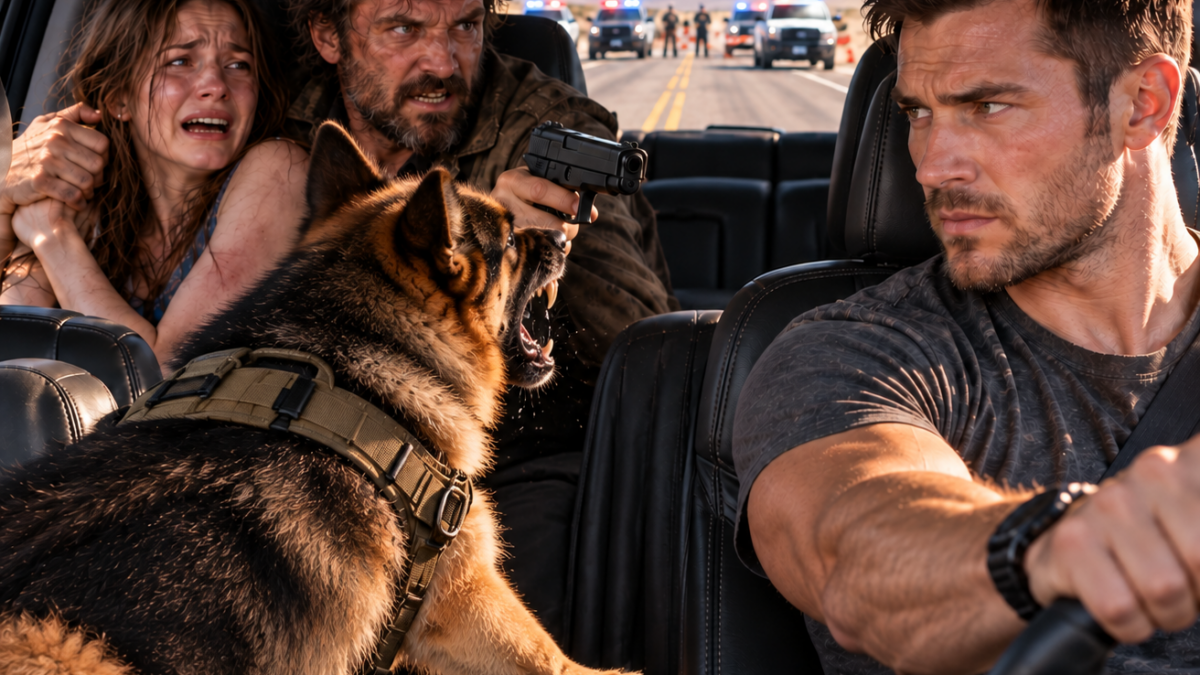
The man had a pistol.
Mid-thirties.
Scruffy beard.
Dirty tan jacket.
Sweat soaked through his shirt.
His eyes moved too fast.
Not tactical.
Panicked.
That was worse.
The woman screamed once.
The gunman struck her shoulder with the barrel.
“Move!”
Rex rose.
His entire body changed.
Ears forward.
Mouth closed.
No barking.
Working posture.
Ames whispered:
“Hold.”
Rex remained still.
Outside, the woman twisted.
“Please!”
The gunman dragged her toward the Land Cruiser.
Ames unlocked nothing.
The rear door was already unlocked because he had used it at the last fuel stop.
A mistake.
Small mistakes have large consequences under the right conditions.
The back door opened.
The woman was thrown inside.
She hit the seat.
Gasps.
Tears.
The gunman climbed in after her.
Door slammed.
Pistol came up.
The barrel touched the back of Ames’s headrest.
“Don’t move.”
Ames looked at him through the mirror.
“I’m not.”
The gunman saw broad shoulders.
Gray T-shirt.
Jeans.
Travel mug.
Dog.
Nothing more.
Good.
Rex turned slowly.
His lips pulled back.
The growl that came from him was so low Ames felt it through the seat.
The gunman flinched.
“Call that thing off!”
“Rex.”
The dog remained fixed on him.
“Down.”
Rex lowered himself.
Still watching.
The gunman pressed the weapon harder against the seat.
“I swear to God, I’ll shoot the dog first.”
Ames kept his voice level.
“He’s down.”
“Start the car.”
Ames looked once more into the mirror.
The woman had pushed herself against the passenger-side rear door.
Twenty-five, maybe twenty-six.
Blood near one elbow.
Torn dress.
Terrified.
Her eyes met his.
He could see the question.
Are you going to help me?
Ames did not answer with words.
Not yet.
He started the engine.
The gunman said:
“Drive west.”
“Where?”
“Just drive.”
Ames shifted into gear.
“What’s your name?”
“Shut up.”
“Fine.”
He pulled onto Route 66.
Rex stayed down.
The woman breathed too quickly.
Hyperventilation approaching.
The gunman held his pistol in his right hand and controlled her with his left.
Finger on trigger.
Bad.
Very bad.
People in movies imagine highly trained soldiers welcome situations like that.
They don’t.
Training does not make danger fun.
It makes danger detailed.
Ames saw every way the next ten seconds could kill Sarah before he even knew her name.
Gun discharges inside vehicle.
Rex reacts.
SUV veers.
Woman shot.
Secondary collision.
He saw them like branches on a diagram.
And almost every branch ended badly if he moved too early.
So he drove.
The gunman watched behind them.
“Faster.”
“I’m doing sixty.”
“Seventy.”
Ames increased speed carefully.
The woman made a small sound.
The gunman snapped:
“Shut up.”
“Please,” she whispered. “I don’t even know you.”
He grabbed her hair.
“Then stop giving me reasons to remember you.”
Ames’s jaw tightened.
Still he did nothing.
The woman started breathing faster.
Ames spoke.
“Ma’am.”
The gunman aimed toward him.
“I said shut up.”
“She passes out, she becomes harder for you to move.”
That made him pause.
Ames addressed the mirror.
“Look at the back of my seat.”
The woman stared.
“Pick one point.”
Her eyes found the headrest.
“Breathe in slowly.”
The gunman said:
“What the hell are you doing?”
“Keeping your hostage conscious.”
Silence.
Ames continued.
“Four seconds in.”
The woman inhaled.
“Hold.”
She held.
“Slow out.”
Her breath trembled but came.
Again.
Within a minute the panic did not disappear, but it loosened enough for her to think.
Good.
Thinking mattered.
The gunman muttered:
“You some kind of doctor?”
“No.”
“What are you?”
“Driver right now.”
The answer seemed to satisfy him.
For another mile.
Then:
“Name.”
Ames looked into the mirror.
The gunman had asked him now.
“Ames.”
“What kind of name is Ames?”
“The one my parents picked.”
The woman made the smallest sound.
Almost a laugh.
The gunman glared at her.
Ames noticed.
Humor could interrupt fear.
Useful.
“What’s hers?”
“Don’t worry about her.”
“I need something to call her if she has a medical problem.”
“She doesn’t.”
“She’s bleeding.”
The gunman looked.
Her elbow.
Small laceration.
Not serious.
He swore.
“Sarah.”
The woman closed her eyes.
So that was her name.
Sarah.
“Okay, Sarah.”
Her eyes reopened.
“You’re going to keep breathing.”
Cole hit the back of Ames’s seat with the pistol.
“Stop talking like you’re in charge.”
Ames met his eyes in the mirror.
“I’m driving.”
For one second, anger flashed.
Then the man laughed.
Ugly laugh.
“You’ve got nerve.”
Ames kept driving.
Ten minutes later, he learned the gunman’s name accidentally.
A two-way radio clipped inside the man’s jacket crackled.
“Cole.”
Static.
“Cole, answer.”
The man grabbed it.
“Yeah.”
“You clear?”
“Not yet.”
“Where are you?”
“Westbound.”
“Highway?”
“Yes.”
“Don’t stay there. They know the sedan.”
Cole glanced at Ames.
“I got another ride.”
Pause.
“You got the package?”
Cole looked toward Sarah.
“Yeah.”
Sarah went pale.
Package.
Ames filed the word away.
“What happened at the store?” the radio voice asked.
“Went bad.”
“Bad how?”
“Just get Briggs ready.”
The transmission ended.
Ames’s mind sharpened.
This wasn’t one panicked robber anymore.
There were others.
Organized enough for radios.
A plan.
Briggs.
Ames looked at Sarah.
She heard it too.
Her eyes changed.
The gunman noticed.
“Don’t.”
She whispered:
“What package?”
“Nothing.”
“You called me—”
Cole shoved the gun against her ribs.
“Stop talking.”
Ames spoke immediately.
“Cole.”
The name made him look forward.
“What?”
“The road.”
“What about it?”
“Police.”
About a mile ahead, heat haze flashed blue and red.
State patrol vehicles.
Hard checkpoint.
Several cruisers angled across Route 66.
Officers behind doors.
Spike strips staged near the shoulder.
Cole leaned forward.
His entire body changed.
“No.”
Ames kept speed steady.
“No, no, no.”
Cole grabbed Sarah.
Dragged her tight against him.
Gun pressed beneath her ribs.
“You’re not stopping.”
“There are rifles.”
“Drive through.”
“We won’t make it.”
“Drive through!”
Ames’s voice remained flat.
“They’ll spike the tires first.”
“I said—”
“If the SUV loses control at seventy, you die before prison becomes your problem.”
Cole stopped.
Panic.
Logic.
Panic again.
Ames continued.
“They don’t know you’re in here.”
Cole looked ahead.
Then Sarah.
Then Ames.
“You talk us through.”
“That’s the only option.”
“If you signal them—”
“I understand.”
Cole pushed the pistol harder against Sarah.
“If anything goes wrong, she dies first.”
Sarah’s face drained white.
Ames met her eyes.
No heroics.
Not yet.
He gave the smallest nod.
She understood enough.
The roadblock approached.
A trooper raised one hand.
Ames slowed.
Forty.
Twenty.
Five.
Stop.
He lowered the driver’s window.
Hot air flooded in.
A state trooper approached.
Late forties.
Thick mustache.
Dark uniform.
Nameplate: MILLER.
“Afternoon.”
“Afternoon, Officer.”
“License and registration.”
“My wallet’s in my right rear pocket. Okay if I reach?”
Miller nodded.
Ames moved slowly.
Handed him license.
Registration.
Military identification remained behind another card.
He intentionally allowed the corner to show.
Miller saw it.
“Military?”
“Just separated.”
“What branch?”
“Navy.”
Miller’s light entered the vehicle.
Rex.
“That your dog?”
“Yes.”
Rex sat perfectly still.
Miller smiled faintly.
“Better behaved than mine.”
His flashlight moved to the back.
Cole wrapped his arm around Sarah in a posture designed to look intimate.
The gun stayed hidden against her side.
Sarah looked sick.
Miller noticed.
“You folks all right?”
Ames had only seconds.
The truth would likely kill her.
A lie might save them long enough to create a better opening.
“My sister gets motion sick.”
Cole stared at Ames.
Different story than expected.
Good.
Confusion forced him to follow.
Miller addressed Sarah.
“Ma’am?”
Sarah opened her mouth.
Cole pressed the gun.
She swallowed.
“I’m okay.”
Miller’s expression tightened.
Ames added:
“She threw up about ten minutes ago. We’re trying to get her to Needles.”
Miller looked into the back again.
Sarah caught Ames’s eyes.
Ames gave nothing visible.
Miller asked:
“Need medical help?”
Cole’s breathing stopped.
Sarah whispered:
“No.”
One word.
Correct.
Not because she didn’t need help.
Because she was staying alive.
Miller nodded slowly.
“We’re looking for an armed robbery suspect. White male, mid-thirties. Bearded.”
Cole’s reflection looked directly at Ames.
Miller’s flashlight drifted toward him.
“What’s your name, sir?”
Ames answered before Cole could.
“David Carter.”
Cole stared.
Miller looked at Ames.
“Brother?”
“Yes.”
Ames smiled.
“Unfortunately.”
Miller almost smiled too.
Cole forced one.
For a terrible second, Ames thought the trooper would ask for Cole’s identification.
Instead Miller looked toward the line of vehicles forming behind them.
Then returned Ames’s papers.
“All right. Keep your eyes open.”
“Yes, sir.”
“Drive safe.”
Ames shifted.
Pulled away.
Normal pace.
No sudden acceleration.
No sign.
In the mirror, Miller watched them longer than Ames liked.
Then disappeared.
Cole began laughing.
Hard.
Relief bordering on hysteria.
“You son of a—”
He slapped the seat.
“You lied to a cop without blinking.”
Ames said nothing.
Sarah did.
Very softly:
“He was trying to help us.”
Cole’s smile vanished.
“I told you not to talk.”
He raised the pistol.
Rex’s ears moved.
Ames whispered:
“Easy.”
It could have been for anyone in the vehicle.
Cole leaned forward.
“What did you do in the Navy?”
“Maintenance.”
“You expect me to believe that?”
“You asked.”
Cole studied him.
Suspicion arrived.
Late.
But arrived.
The checkpoint faded behind them.
Then Cole’s radio crackled.
“Roadblock?”
“Yes.”
“You make it?”
“Yes.”
“How?”
Cole looked at Ames.
“Driver talked.”
Pause.
“Who is he?”
“Nobody.”
Ames saw Cole’s eyes in the mirror.
He no longer believed that.
“Take the utility road at mile marker seventy-one,” the voice ordered. “Briggs will meet you at Harlow Station.”
“ETA?”
“Thirty.”
The radio clicked off.
Ames knew something important now.
Destination.
Harlow Station.
The name sounded familiar.
He had passed an old sign earlier.
Abandoned mining supply settlement.
No population.
No services.
No witnesses.
That was bad.
Sarah seemed to understand too.
Cole told Ames:
“Next right.”
Ames saw the dirt road.
He turned.
The Land Cruiser left asphalt.
Everything became darkness and dust.
Sarah bounced against the seat.
Rex braced his paws.
Cole cursed.
“Slow down.”
“You told me to move.”
“Don’t be smart.”
The road degraded quickly.
Ruts.
Rock.
Sand.
Old mining debris.
Ames drove carefully.
He could feel Rex’s breathing beside him.
The dog wanted direction.
Ames rested his fingers briefly behind Rex’s shoulder.
Hold.
The signal was old.
Rex recognized it.
Sarah saw the movement.
Her eyes moved from Ames to the dog.
Understanding dawned.
Rex wasn’t a pet in the ordinary sense.
Neither was Ames an ordinary driver.
Hope appeared on Sarah’s face.
Dangerous thing, hope.
It makes frightened people move before the moment is right.
Ames looked at her firmly.
Not yet.
Her expression steadied.
Twenty minutes deeper into the desert, the front-right tire struck metal.
The explosion was violent.
The Land Cruiser jerked.
Cole shouted.
Sarah screamed.
Ames controlled the wheel.
Brake.
Correct.
Slow.
The SUV ground to a stop.
Blown tire.
Bent rim.
Partially buried in soft sand.
Cole shoved the gun toward Ames.
“What did you do?”
“Hit scrap metal.”
“Drive.”
“Can’t.”
“Drive!”
Ames turned slightly.
“If I spin the wheel, it digs deeper.”
“Then fix it.”
“Rim may be damaged.”
“Fix it.”
Ames looked outside.
Night had fully arrived.
The desert temperature was falling fast.
Sarah wore a thin torn dress.
Not enough.
Cole was sweating despite cold.
Adrenaline.
Maybe stimulants.
Ames said:
“We stay here, your people can find us.”
Cole considered.
Then checked his radio.
Static.
“Station’s less than a mile.”
He pointed the pistol.
“Everybody out.”
They walked.
Ames took his field jacket from the SUV.
Cole nearly objected.
“She’s going hypothermic.”
“Fine.”
Ames draped it around Sarah.
She whispered:
“Thank you.”
Cole heard.
“Stop acting like he’s your friend.”
Sarah looked at him.
Something had changed in her.
Still afraid.
But anger had entered alongside fear.
Good.
Anger sometimes returns control.
They reached Harlow Station thirty-five minutes later.
An abandoned cinder-block building.
Former mining supply stop.
Broken windows.
Rusted gas pumps.
Collapsed awning.
Moonlight spilled through the empty frames.
Inside smelled like dust, rodent droppings, motor oil, and old weather.
Cole forced them into the main room.
“Sit.”
Sarah sat.
Ames remained standing.
“I said sit.”
Ames lowered himself slowly.
Rex lay beside him.
Cole paced.
Radio in hand.
“Briggs.”
Static.
“Briggs, answer.”
Finally:
“Go.”
“I’m at Harlow.”
“You have her?”
“Yes.”
“And driver.”
Pause.
“Driver saw you?”
“Yes.”
Longer pause.
“What about checkpoint?”
“They saw all of us.”
Briggs’s voice changed.
Cold.
Controlled.
“That’s a problem.”
Cole wiped his mouth.
“What do you want me to do?”
“How long until we arrive?”
“Twenty?”
“Closer to fifteen.”
Then Briggs said:
“No loose ends.”
Sarah stopped breathing.
Ames did too, inwardly.
Cole stared at the radio.
“What?”
“You heard me.”
“The woman was the package.”
“She became a witness the moment you grabbed her.”
“What about—”
“All of them.”
Cole looked at Ames.
Rex.
Sarah.
Briggs continued:
“We clean the site. Vehicles disappear. Nobody connects us to the robbery.”
The transmission ended.
For several seconds, only wind moved.
Cole lowered the radio.
He looked sick.
That interested Ames.
Not every violent man is prepared for murder until somebody says the word plainly.
Sarah whispered:
“You were never going to let me go.”
Cole said nothing.
“You said if I cooperated—”
“Shut up.”
“You lied.”
“Sarah.”
Ames spoke her name softly.
She looked at him.
He needed her alive.
Not morally satisfied.
Cole began pacing faster.
“Fifteen minutes.”
Ames said:
“You don’t have to do what he says.”
Cole pointed the weapon at him.
“Don’t.”
“Briggs plans to clean up.”
“What do you think that means for you?”
Cole froze.
Good.
Ames continued.
“You failed the first vehicle.”
“Police saw your face.”
“You brought witnesses.”
“He already called you a problem without saying the word.”
Cole’s jaw moved.
“You’re lying.”
“Maybe.”
Ames shrugged.
“Ask him whether you leave with them.”
Cole’s gun lowered half an inch.
Sarah saw it.
Ames did not move.
Cole raised the radio.
Stopped.
Fear.
He knew the answer.
That told Ames plenty about Briggs.
Cole whispered:
“Who are you?”
Ames looked at him.
“Right now?”
“Yeah.”
“The person telling you that the men coming here don’t need you anymore.”
Cole’s eyes hardened.
“You think you’re smart.”
“No.”
Ames looked toward Rex.
“I think I want the woman alive.”
Something about the sentence unsettled Cole.
Sarah’s eyes moved between them.
Cole said:
“You military?”
“Yes.”
“What?”
Ames did not answer.
Cole looked at the dog.
Then Ames.
Then the posture.
The calm.
Understanding hit.
“Special forces?”
Ames almost smiled.
“Wrong branch.”
Cole stepped backward.
“Jesus.”
The advantage changed without anyone moving.
Cole still had the gun.
Still lethal.
But now he knew.
Ames watched him do the math too late.
He had kidnapped a civilian.
Hijacked a vehicle.
Forced the driver through a police checkpoint.
And selected the one driver in miles of empty desert who had built an entire career around functioning while armed men made bad decisions.
Still, Ames could not simply attack.
Sarah remained too close.
Gun remained live.
Rex remained waiting.
Ames needed one clean opening.
Headlights appeared through the broken windows.
Early.
Briggs.
Cole spun toward them.
Three vehicles.
Not two.
Ames counted at least five silhouettes.
Maybe six.
Sarah whispered:
“Oh God.”
Cole grabbed her.
Ames stood.
“Don’t.”
Cole aimed at him.
“Back!”
Ames stopped.
Outside, doors slammed.
Voices.
Weapons.
Cole looked through the window.
Then toward Ames.
Fear swallowed whatever confidence remained.
“What do I do?”
Ames almost laughed at the absurdity.
The kidnapper was asking his hostage for help.
“Put the gun down.”
“They’ll kill me.”
“Maybe not if police get here first.”
“There are no police!”
Ames thought of Trooper Miller.
The checkpoint.
The way Miller had watched them leave.
A trained cop would have noticed inconsistencies.
Sarah pale.
Bearded male matching description.
Military driver.
Ames hoped Miller had run Cole’s description again after they left.
Hope was not a plan.
He needed time.
A voice outside called:
“Cole.”
Briggs.
“Bring her out.”
Cole said nothing.
“Cole!”
Ames watched the pistol.
Sarah’s eyes.
Rex.
He whispered:
“Sarah.”
Cole snapped:
“What?”
Ames kept his gaze on Sarah.
“Remember breathing?”
She understood.
Not the words.
The tone.
Four in.
Hold.
Out.
Her shoulders loosened.
Cole looked toward the entrance.
Ames moved one hand slightly.
Rex saw.
Wait.
Outside Briggs called:
“We don’t have time for this.”
Cole shouted:
“What’s the plan?”
Silence.
Then:
“Bring the woman.”
“And the driver?”
Another pause.
“We handle him.”
“What about me?”
Nothing.
There.
Cole’s face collapsed.
“You hear that?”
Ames said quietly.
Cole raised his voice:
“Briggs!”
A shot cracked through the front window.
Concrete exploded near Cole’s head.
Sarah screamed.
Cole ducked.
That was the opening.
Not planned.
Not elegant.
Enough.
Ames moved.
Rex moved with him.
Cole’s pistol swung toward Sarah.
Rex hit his arm before the barrel finished turning.
Cole screamed.
The gun fell.
Ames kicked it away.
Grabbed Sarah.
Pulled her behind a thick interior wall.
Rex held Cole pinned without continuing to maul him.
“Out!”
Rex released and returned.
Bullets struck the front wall.
Ames shoved Sarah low.
“Stay behind this.”
“What about you?”
“Stay.”
He pulled Cole by the collar into cover too.
Cole stared.
“You’re helping me?”
“I said I want everyone alive.”
Another burst hit the building.
Briggs shouted:
“Carter!”
Ames froze.
He knew the name.
How?
Then understood.
Cole’s radio.
Maybe they had run the SUV plate from somewhere.
Maybe checkpoint communications.
Didn’t matter.
Briggs continued:
“We know who you are.”
Ames kept Sarah low.
“Congratulations.”
“Send Cole out.”
Cole whispered:
“He’ll kill me.”
“Yes.”
Sarah looked at Ames.
“What do we do?”
Ames looked around.
Back office.
Storage pit visible beneath damaged flooring.
Thick concrete walls.
Old service corridor.
He remembered the building layout from entering.
“We make this building last longer than their patience.”
He moved Sarah toward the rear.
Found a low maintenance pit beneath a wooden cover.
Not ideal.
Better than the main room.
“Get down.”
She stopped.
“What about you?”
“Sarah.”
“I’m not leaving you.”
“You’re not leaving.”
He looked into her eyes.
“You’re staying alive.”
That worked.
She climbed down.
Ames gave her Rex’s leash.
Then changed his mind.
Rex needed mobility.
He handed her his phone instead.
No service.
But emergency satellite function occasionally appeared.
“Keep trying 911.”
She nodded.
“If you get a signal, tell them Harlow Station off utility road seventy-one.”
“What if—”
“I come back.”
“Promise?”
Ames stopped.
Promises in combat were dangerous.
He had learned not to make them.
Then he looked at her.
Terrified.
Cold.
Still fighting.
“I’ll do everything I can.”
She accepted that.
More honest than a promise.
Ames covered the opening loosely.
Returned to Cole.
The man sat against the wall clutching his injured arm.
“You should’ve let the dog kill me.”
“No.”
“They will.”
“Not if you start helping.”
Cole laughed weakly.
“You think that fixes what I did?”
“No.”
Good answer.
Cole stared.
Ames continued:
“But prison is better than a grave.”
Outside, Briggs repositioned his people.
Ames heard boots.
One left.
Two right.
Professionals?
Competent criminals, maybe.
Not military to Ames’s ear.
Still dangerous.
He had no weapon except Cole’s pistol, which he had recovered.
He checked it quickly.
Limited rounds.
He did not want a gunfight.
Sarah was inside.
Rex.
Cole.
Unknown number of attackers.
Every exchange increased probability of catastrophe.
Instead Ames used the thing combat had taught him most:
Information mattered more than aggression.
He listened.
Tracked voices.
Tracked footsteps.
Used darkness.
Moved only when needed.
Rex stayed close.
Briggs sent one man through a side entrance.
Ames avoided him until the attacker moved too far from support.
Rex’s growl came from the darkness.
The man froze.
Ames spoke quietly behind him.
“Drop it.”
The man turned.
Bad choice.
Rex lunged just enough to force his rifle down.
Ames took control of the weapon.
Pinned the man.
No theatrical fight.
Fast.
Ugly.
Over.
He secured him using his own restraints.
Now Briggs knew Ames had one of his men.
That bought hesitation.
Then Sarah’s phone connected.
A tiny vibration sounded from the pit.
Ames almost missed it.
She whispered:
“911 answered.”
Relief.
“Stay with them.”
She did.
The dispatcher had triangulated enough of the emergency signal to notify state patrol.
Miller was among the officers searching the utility roads.
Ames did not know any of that yet.
He only knew help might be moving.
Outside Briggs shouted:
“We burn the place if you don’t come out.”
Cole whispered:
“He will.”
Ames believed him.
Briggs had already crossed too many lines to value restraint.
A smell reached Ames.
Gasoline.
He swore.
Sarah heard.
“What?”
“They’re trying to force us out.”
Smoke appeared near the front.
Not much.
Then more.
Ames had seen fire used to flush compounds.
Smoke kills before flame reaches you.
The building could not become their shelter anymore.
Plan changed.
“Sarah.”
She looked up.
“When I open this, stay behind me.”
Rex moved beside him.
Cole struggled upright.
“What about me?”
“You can walk?”
“Barely.”
“You walk.”
“You’re taking me?”
“I’m not leaving you for Briggs.”
Cole looked stunned.
They moved through the rear service corridor.
Broken exterior door.
Dark desert.
Vehicle headlights washed the front side.
Back side remained shadowed.
Ames led.
Sarah behind him.
Cole next.
Rex rear then flank.
They crossed fifty yards of rock toward an old equipment berm.
A shot cracked.
Dust near Ames’s boot.
Briggs had seen movement.
They ran.
Sarah fell.
Ames turned.
Cole reached her before he did.
Pulled her up with his uninjured hand.
That moment stayed with Sarah for years.
The man who kidnapped her helping her stand while another man tried to kill them.
Human beings rarely remain simple once the worst moment expands.
They reached the berm.
Ames shoved Sarah down.
Rex crouched.
Cole gasped.
Headlights moved.
Briggs’s men were flanking.
Then another sound entered the night.
Sirens.
Far.
Growing.
Sarah began crying.
Not quietly.
Relief broke something open.
Cole looked toward the sound.
“They came.”
Ames nodded.
Briggs heard too.
His people panicked.
One truck started.
Another reversed too quickly.
State patrol vehicles appeared along the utility road.
Red and blue light bounced across the desert.
Loudspeaker:
“STATE POLICE! DROP YOUR WEAPONS!”
Gunfire erupted near the station.
Not from Ames.
Briggs’s men firing toward approaching units.
Officers returned controlled fire from cover.
Ames pulled Sarah lower.
Cole covered his head.
Rex stayed pressed against Ames’s leg.
Within minutes, everything fractured.
One attacker surrendered.
Another ran into open desert and was caught later by a K9 team.
The man Ames restrained remained inside.
Briggs tried to escape in a pickup.
Two patrol SUVs boxed him near the utility track.
He abandoned the vehicle.
Ran.
Made it seventy yards.
Then dropped his rifle after troopers surrounded him.
Nobody needed a final cinematic duel.
Ames was grateful.
Real bullets are not choreography.
When Miller reached the berm, he recognized Ames immediately.
His expression went from relief to disbelief.
“You.”
Ames raised both hands.
“Me.”
Miller saw Sarah.
Cole.
Rex.
“What in God’s name happened?”
Cole laughed once.
Possibly shock.
Ames said:
“Long story.”
Miller looked at Rex.
“Dog okay?”
Rex panted.
Ames nodded.
“Dog’s fine.”
Sarah suddenly stood.
Then crossed the small distance between them and wrapped both arms around Ames.
He froze.
Physical contact after combat always surprised him.
Then slowly he held her.
She shook.
Not dramatically.
Deep body tremors.
“I thought we were going to die.”
“I know.”
“You knew what to do.”
“No.”
She pulled back.
“What?”
“I knew what to do next.”
“That isn’t the same thing.”
She stared.
Then began laughing and crying simultaneously.
Miller looked at Cole.
“You the suspect?”
Cole lifted his hands as much as his injury allowed.
“Yes.”
No argument.
No run.
No lie.
Troopers arrested him.
As they led him away, Cole looked back at Ames.
“You were right.”
“About what?”
“Prison’s better.”
Ames said nothing.
Paramedics examined Sarah.
Bruising along ribs.
Cut elbow.
Mild hypothermia.
Dehydration.
No gunshot wounds.
No broken bones.
Lucky.
Ames hated the word lucky after nights like that.
Too much suffering gets hidden inside it.
Rex received water and a full examination from a county K9 medic who treated him like royalty.
Ames had a bruised jaw, torn knuckles, smoke irritation, and enough adrenaline in his blood to keep him awake for hours.
At 5:17 in the morning, Sarah sat on the rear bumper of an ambulance wrapped in an orange thermal blanket.
Ames sat six feet away.
He intentionally gave her space.
Rex lay between them.
The eastern sky had begun to turn violet.
Sarah looked over.
“Why are you sitting so far away?”
Ames looked around.
“Thought you might want room.”
“After spending twelve hours with a gun pointed at me, six feet feels excessive.”
He moved closer.
Not touching.
She stared at Rex.
“He really was military?”
“Yes.”
“And you?”
“Yes.”
“Navy SEAL?”
Ames hesitated.
Former identities felt strange after leaving.
“Yeah.”
Sarah laughed softly.
“Of all the cars.”
“That’s what I was thinking.”
She looked at him.
“You could have attacked Cole when he first got in.”
“Yes.”
“But you didn’t.”
“No.”
“Why?”
“Because he would’ve shot you.”
The answer came too quickly.
Matter-of-fact.
Sarah looked down.
Ames continued:
“People think training means always fighting.”
“What does it mean?”
“Knowing when not to.”
She thought about that.
Then:
“You lied at the checkpoint.”
“Yes.”
“Miller could have saved us.”
“Or Cole could have shot you before Miller cleared his holster.”
Sarah nodded slowly.
“I hated you for about ten seconds.”
“That’s fair.”
“When you told him I was your sister.”
“Also fair.”
“Then I realized you were trying to keep me alive.”
Ames looked east.
Sunlight touched the mountains.
“You kept yourself alive too.”
“I sat there.”
“You controlled panic at the roadblock.”
“I lied to a police officer.”
“Yes.”
“I threw a bottle.”
“Good arm.”
“I hid in a hole.”
“You called 911 from the hole.”
She stared at him.
Ames finally looked back.
“You helped save us.”
Sarah’s face changed.
People had been calling her victim all night.
Accurately.
But not completely.
She had also participated.
Acted.
Thought.
Survived.
“I’m a third-grade teacher.”
“So?”
“I yell at children for throwing erasers.”
Ames almost smiled.
“Context matters.”
She laughed.
Rex raised his head.
Sarah reached toward him.
Stopped.
“Can I?”
Ames nodded.
Rex sniffed her hand.
Then placed his chin on her knee.
That destroyed her.
She cried into the dog’s neck.
Rex accepted this as his due.
The investigation lasted more than a year.
What police uncovered was larger than Ames had understood during the kidnapping.
Cole Mercer—no relation to anyone important, despite the surname—had participated in a string of armed robberies targeting rural pharmacies and cash-transfer businesses across California, Nevada, and Arizona.
Briggs Harlan ran the crew.
Former private security contractor.
Smart enough to plan routes.
Cruel enough to remove people he considered liabilities.
Sarah Jensen had become involved by accident.
She taught third grade in Barstow.
That afternoon, she stopped at a convenience store for water and witnessed Cole abandoning a getaway vehicle after a robbery several blocks away.
He tried stealing her car.
She fought.
He dragged her with him because a police cruiser appeared before he could leave cleanly.
Then the sedan failed in the desert.
Ames’s SUV happened to be there.
Wrong place.
Or right one.
Depending on which life you were measuring.
Briggs eventually received decades in federal prison for robbery conspiracy, kidnapping-related offenses, weapons crimes, and other charges tied to the crew.
Several members cooperated.
Cole did too.
That surprised Sarah.
He pleaded guilty.
Testified against Briggs.
His cooperation reduced his sentence but did not erase it.
When prosecutors asked Sarah how she felt, she said:
“I want him held responsible.”
Then:
“But I don’t need him destroyed to prove what happened to me mattered.”
That line made headlines after sentencing.
People tried to turn her into a saint.
She hated that.
“I didn’t forgive him.”
She told Ames afterward.
“I just don’t want revenge to be the only proof I survived.”
Ames understood.
For his part, Ames became briefly famous.
FORMER NAVY SEAL AND WAR DOG SAVE KIDNAPPED TEACHER.
Television producers called.
News networks.
Podcasts.
Military pages.
Dog magazines.
A company offered Rex free food for life if Ames posed with the bag.
He declined almost everything.
Sarah did one interview.
So did Ames.
Together.
The interviewer asked:
“Mr. Carter, when did you decide you were going to save Sarah?”
Ames looked uncomfortable.
Sarah smiled because she knew that face.
He answered:
“I didn’t.”
The interviewer blinked.
“You didn’t?”
“I decided to keep her alive for the next minute.”
Pause.
“Then the next.”
“That’s all?”
“That was enough.”
The interviewer turned to Sarah.
“And what did you think when you learned who he was?”
She looked at Ames.
“That the worst criminal in three states had terrible luck choosing cars.”
Ames laughed on camera.
The clip went everywhere.
But fame faded.
That was good.
Sarah went back to teaching after four months.
The first day terrified her.
Not because children were dangerous.
Because ordinary life felt insulting.
How could fluorescent lights still buzz?
How could the copy machine jam?
How could a child complain that Ava had taken the purple marker after the world had nearly ended in the desert?
Her therapist told her something she eventually repeated to Ames:
“Ordinary life isn’t disrespecting what happened. Ordinary life is what survival was trying to get back to.”
She wrote that on a card.
Kept it in her desk.
Ames struggled differently.
The desert incident brought things back.
He had left military service hoping the vigilance would fade.
Instead the hijacking proved vigilance useful.
That frightened him.
Part of him began believing relaxation itself had been the mistake.
If he had kept the rear door locked—
If he had parked somewhere else—
If he had noticed the sedan ten seconds earlier—
He started checking doors three times.
Then five.
Rex noticed.
Dogs always do.
One night, Ames woke at 2:13 standing in the hallway holding an unloaded pistol he did not remember retrieving.
Rex pressed against his leg.
That scared him more than Briggs.
Ames called the VA the next morning.
Not because Sarah asked.
Not because somebody rescued him.
Because twelve years of being competent under danger did not make him competent alone afterward.
He began therapy.
He hated it.
Went again.
Hated it less.
Went again.
Sarah learned about that months later.
“You never told me.”
“It wasn’t relevant.”
“It is to me.”
“Why?”
“Because people think you walked away fine.”
Ames stared.
“No one walks away fine.”
“Exactly.”
That became another thing they shared publicly once, much later.
Courage during the emergency.
Help afterward.
Both mattered.
Sarah and Ames did not immediately fall in love at sunrise.
That would have made a better movie.
It would also have been dishonest.
For weeks, Sarah could not hear tires skid without freezing.
For months, Ames could not let anyone sit behind him in a car.
They had phone numbers because investigators coordinated statements.
Sarah texted first.
Rex okay?
Ames answered:
Rex believes he deserves steak because of media attention.
She wrote:
He does.
Three days later:
How are you?
Ames stared at the message for six minutes.
Fine would have been easy.
He wrote:
Not sleeping much.
Sarah answered:
Me neither.
That was how it started.
Not romance.
Truth.
They spoke every few days.
Then every day.
Sometimes about the kidnapping.
Usually not.
Sarah sent photographs of ridiculous drawings her students made of Rex.
One portrayed him with wings and laser eyes.
Ames framed it.
He sent Sarah pictures from his hikes.
Rex asleep in strange positions.
Terrible motel coffee.
One day Sarah texted:
I passed Harlow exit today.
Had to pull over.
Ames called.
She answered crying.
He did not tell her to calm down.
He sat on the phone.
Fifteen minutes.
Then she said:
“I hate that road.”
“I know.”
“I want to drive it again.”
“Why?”
“Because I don’t want Cole owning a road.”
That sounded like Sarah.
Two months later, they drove it together.
In daylight.
Rex in back.
Doors locked.
No weapons visible.
They stopped at the old station.
The building was fenced as evidence and scheduled for demolition.
Sarah stood outside.
Hands shaking.
Ames stayed beside her.
She looked toward the place she had hidden.
“It looks smaller.”
“Most bad places do later.”
She turned.
“You have many bad places?”
“Enough.”
They did not stay long.
Sarah picked up one small desert stone from outside the evidence perimeter.
Kept it.
Not as trauma worship.
Proof of scale.
The place was a building.
The night had been huge.
She had survived both.
Their first actual date happened nearly six months after the kidnapping.
Mexican restaurant.
Public.
Bright.
Sarah chose a booth against the wall without thinking.
Ames chose the opposite seat where he could see the door.
They noticed simultaneously.
Then laughed.
“This is romantic,” Sarah said.
“Extremely.”
Rex waited at home.
Ames wore a button-down shirt Sarah accused of being older than some of her students.
He asked:
“Do you always insult people on dates?”
“Only Navy SEALs.”
“Former.”
“Still counts.”
He looked at her.
“Why did you agree to this?”
She became quiet.
Then:
“Because I wanted to know who you are when nobody has a gun.”
That answer stayed with him.
He had spent most of adulthood defined by what he could do during violence.
Very few people asked who remained afterward.
Sarah discovered:
He cooked badly.
Loved old western movies.
Hated olives.
Could repair nearly anything mechanical but once ruined a washing machine because he refused to read instructions.
He read history books slowly and deeply.
He called his mother every Sunday.
He never raised his voice when angry.
Sometimes he disappeared emotionally when overwhelmed.
That last part was harder.
Ames discovered:
Sarah sang badly in the car.
Loved astronomy.
Cried at animal-rescue videos.
Could control twenty-eight third graders with one raised eyebrow.
Had been engaged once at twenty-three and ended it because the man kept deciding what she should want.
She was kind.
Not passive.
There is a difference.
The night of the kidnapping had taught Ames that before he knew anything else.
They dated.
Slowly.
Two adults with therapists and scars.
Less cinematic.
More durable.
Rex adored Sarah.
That became inconvenient because Rex had previously pretended Ames was the center of civilization.
Within a year, if both stood in separate rooms and called him, Rex chose Sarah approximately seventy percent of the time.
“Traitor.”
Sarah scratched the dog’s chest.
“He recognizes emotional intelligence.”
“He detects explosives.”
“Same skill.”
Two years after Harlow Station, Ames asked Sarah to marry him.
No dramatic restaurant.
No desert road.
He asked in her backyard while Rex dug a hole he had been told not to dig.
Sarah stared.
“You planned this?”
“Yes.”
“You’re kneeling next to dog dirt.”
Ames looked down.
Rex had indeed compromised the operational environment.
“Do you want me to relocate?”
Sarah started laughing.
Then crying.
Then said yes.
Rex barked because both humans were behaving strangely.
They married at a small outdoor ceremony.
Trooper Miller attended.
So did two paramedics from the desert.
Several members of Ames’s old team.
Sarah’s students had become fifth graders by then.
Three were invited.
One asked during the reception:
“Is Rex the reason you guys met?”
Sarah answered:
“Technically, a criminal is.”
The child’s mother nearly dropped her drink.
Ames laughed.
Years later, Sarah became a school counselor.
Not because kidnapping suddenly gave her a calling.
She had considered graduate school before.
But the experience changed the way she understood fear.
Children who froze.
Children who lied when adults asked direct questions.
Children who behaved badly after frightening events.
She recognized something.
Fear rarely introduces itself.
It shows up as anger.
Silence.
Stomachaches.
Control.
Avoidance.
Ames eventually began working with a nonprofit helping military veterans transition into civilian emergency-response and search-and-rescue careers.
He refused jobs that wanted him as a motivational mascot.
He wanted useful work.
Rex came with him.
Until age finally caught the dog.
At eleven, Rex slowed dramatically.
Arthritis.
Hearing loss.
The German Shepherd who had once tracked every movement in a room began sleeping through doorbells.
Sarah teased him:
“Retirement.”
Rex snored.
Ames did not handle it well.
He knew dogs aged.
Knowledge is not preparation.
One winter morning Rex could not stand.
Ames carried him to the veterinary hospital.
Sarah drove.
The diagnosis was bad.
Spinal degeneration.
Pain.
Neurological decline.
Options narrowed.
Ames sat on the clinic floor with Rex’s head in his lap.
The dog’s muzzle had gone almost completely gray.
“You’re a good boy.”
Rex looked at him.
Maybe heard.
Maybe did not.
Sarah sat beside them.
No one said:
He saved your life.
No one said:
He had a good run.
Those things were true.
Truth can still be useless at the wrong moment.
Ames whispered:
“Hold.”
The command from the desert.
From deployments.
From years together.
Rex’s ear moved.
Ames broke.
“No.”
He stroked the dog’s head.
“You don’t have to hold anymore.”
Rex died peacefully with both of them beside him.
For months, Ames still looked toward the passenger seat.
Sarah still opened the back door expecting him to jump in.
Grief occupied space physically.
They scattered none of his ashes at Harlow Station.
People assumed they would.
Ames refused.
“That place doesn’t get him.”
Instead they scattered part near a mountain trail where Rex loved snow.
Part remained at home.
Years after the kidnapping, somebody uploaded old news footage again.
It went viral.
Millions of views.
Comments.
People called Ames a superhero.
Called Rex a warrior angel.
Called Sarah lucky.
That last word irritated her.
She wrote a short public post.
I was fortunate that Ames and Rex were there.
But please don’t erase what survival required from me by calling me lucky.
I followed instructions while terrified.
I lied with a gun against my ribs.
I chose when to stay still.
I chose when to act.
Victims can be rescued and still participate in their own survival.
Both things can be true.
Thousands shared it.
Ames read it twice.
Then told her:
“Best thing anyone wrote about that night.”
She kissed his cheek.
“You’re biased.”
“Very.”
Cole eventually wrote Sarah from prison.
One letter.
She almost threw it away.
Instead she read it with her therapist.
He apologized.
Not beautifully.
Not perfectly.
He admitted he had been using methamphetamine heavily.
Admitted Briggs controlled him through debt and threats.
Admitted he chose to kidnap Sarah anyway.
That line mattered.
No excuses.
I chose it.
Cole wrote:
I know helping you stand when we ran from Briggs does not erase putting you in that car.
Sarah cried when she read that.
Because it was true.
Human beings want acts to cancel each other.
They rarely do.
Cole had endangered her.
Later helped her.
Both remained.
Sarah answered once.
Three sentences.
I remember what you did.
I also remember that you helped me stand.
I hope accountability becomes something useful in your life.
She never wrote again.
Ames asked whether sending the letter helped.
“I don’t know.”
“Do you regret it?”
“No.”
“Then maybe that’s enough.”
As they got older, the story became smaller inside their lives.
That surprised both of them.
For years, Harlow Station seemed like the axis around which everything turned.
Then came marriage.
Jobs.
A house.
Sarah’s mother becoming ill.
Ames losing a friend to cancer.
Rex dying.
Nephews.
Holidays.
Roof repairs.
Taxes.
Arguments about dishes.
A terrifying medical test that turned out benign.
Birthdays.
Ordinary time slowly surrounded extraordinary trauma until it no longer touched every wall.
That was healing.
Not forgetting.
Proportion.
One summer, almost fifteen years after the kidnapping, Ames and Sarah drove through the Mojave again.
Different SUV.
Older faces.
No Rex.
They stopped near the same stretch where Ames had parked that first afternoon.
Sarah stepped out.
Heat hit.
Road empty.
She looked at him.
“You still come here for peace?”
“Not often.”
“Why?”
He considered.
“Learned peace isn’t a place.”
Sarah smiled.
“That sounds annoyingly therapeutic.”
“I’ve paid enough for therapy. I’m allowed one sentence.”
They stood beside the highway.
A truck passed.
Wind.
Then silence.
Sarah looked at the passenger seat.
“I still miss him.”
“Me too.”
They had adopted another dog years after Rex.
A mutt named Charlie who possessed no military training and was afraid of vacuum cleaners.
Ames loved him precisely because Charlie had never needed to be brave.
Sarah walked toward the roadside.
Not too far.
“Do you ever think about what would have happened if Cole chose another car?”
“Yes.”
“Me too.”
She looked back.
“Does it scare you?”
“Yes.”
He never lied to make fear prettier.
She appreciated that.
Then Ames said:
“But that’s true of everything.”
“What?”
“One different red light.”
“One different turn.”
“One phone call answered.”
“One missed.”
“Life changes.”
Sarah nodded.
“That sounds worse, actually.”
He laughed.
“Sorry.”
She came closer.
“I prefer thinking Rex chose me.”
“Rex was asleep.”
“Details.”
They got back into the SUV.
Before Ames started the engine, Sarah touched his hand.
“When Miller stopped us…”
“Yeah?”
“I thought you were abandoning me.”
Ames looked at her.
“You never told me that.”
“For maybe five seconds.”
“I’m sorry.”
“You don’t need to be.”
She looked out the windshield.
“I saw a police officer and thought: finally.”
Then she looked back.
“And you lied.”
Ames remembered.
The flashlight.
Gun against her body.
Cole’s shaking hand.
“What changed?”
“You looked at me.”
Ames said nothing.
“I realized you weren’t asking me to trust that everything would be okay.”
Her fingers tightened around his.
“You were asking me to trust the next decision.”
That was exactly what he had been doing.
Sarah smiled faintly.
“I think that’s why I survived the whole night.”
“What do you mean?”
“You never promised the ending.”
“You gave me the next thing.”
Breathe.
Stay still.
Wait.
Move.
Hide.
Call.
Run.
Small instructions.
Manageable pieces.
Ames stared at the road.
“That’s how teams survive bad situations.”
Sarah leaned her head against the seat.
“Maybe that’s how people survive most bad things.”
He thought about it.
Grief.
Trauma.
Retirement.
Rex.
Marriage.
Life.
The next thing.
Not the whole future.
Just enough.
Ames started the engine.
Before pulling away, he looked at the empty passenger space beside him.
For a second, he could almost see black-and-tan fur.
Alert ears.
Steady eyes.
Hold.
Then release.
He drove west.
People still sometimes asked Ames whether being a Navy SEAL had saved Sarah Jensen.
He always answered carefully.
Training helped.
Rex helped.
Sarah helped.
Trooper Miller helped by noticing enough to remember the vehicle.
The dispatcher helped.
The officers following tire tracks helped.
Even Cole, at the end, helped Sarah stand when Briggs began shooting.
No single person owned the rescue.
That mattered to Ames.
Hero stories are cleaner than real survival.
Real survival is collaborative.
Messy.
Dependent on timing.
Dependent on people doing one useful thing before fear convinces them to do nothing.
Cole had looked into that SUV and thought he saw easy targets.
One man traveling alone.
One dog.
One terrified woman.
He saw control.
What he did not see was twelve years of discipline behind Ames’s stillness.
Thousands of hours of training behind Rex’s restraint.
Or the courage waiting underneath Sarah’s fear.
He mistook calm for weakness.
Terror for helplessness.
Obedience for surrender.
That mistake ruined him.
But Ames never remembered the night as a victory over Cole.
The images that stayed were different.
Sarah forcing herself to breathe at the roadblock.
Rex waiting when every instinct told him to attack.
Miller’s flashlight crossing the back seat.
Sarah whispering to the dispatcher from darkness.
Cole pulling Sarah to her feet when Briggs fired.
Sunrise hitting the ambulance.
Rex drinking from a plastic bowl as if nothing unusual had happened.
Those were the moments.
The rest was noise.
Years later, when Sarah asked him what courage actually meant after everything they had seen, Ames thought for a long time before answering.
Not fearlessness.
He knew too many brave people who had been terrified.
Not fighting.
Sometimes fighting was the worst choice available.
Not victory.
Good people lose.
Then he said:
“Courage is staying useful while you’re afraid.”
Sarah smiled.
“That sounds like you.”
Ames shook his head.
“Sounds like you.”
She looked toward the framed photograph of Rex on their mantel.
The German Shepherd sat beside their old black SUV.
Ears high.
Tongue out.
Completely unaware that strangers would someday call him a hero.
“He too?”
“Definitely him.”
Sarah laughed.
The story had begun with a criminal believing everyone inside that vehicle belonged to him because he had the gun.
It ended years later with three survivors refusing to let the worst night of their lives decide everything that followed.
Cole went to prison.
Briggs never walked free again.
Rex grew old in a warm house.
Sarah returned to children who needed a teacher who understood fear.
Ames learned that leaving war did not require pretending war had never changed him.
And somewhere along the way, two strangers who first met through a rearview mirror built an ordinary life neither expected to find.
That was the part Ames treasured most.
Not the roadblock.
Not the abandoned station.
Not being called a hero.
Ordinary.
Coffee in the morning.
Sarah correcting papers at the kitchen table.
A dog asleep on the floor.
Doors locked once instead of checked five times.
Silence that no longer felt like something terrible waiting to happen.
He had driven into the Mojave looking for that kind of peace.
He just misunderstood where peace came from.
It was never the empty highway.
Never the absence of danger.
Peace was knowing that when danger ended, there was somewhere—and someone—to come home to.
And Sarah?
Whenever someone asked what she remembered most from the kidnapping, they expected the pistol.
Or the roadblock.
Or Briggs.
Sometimes Rex.
She always gave the same answer.
“The mirror.”
Because throughout the worst hours of her life, every time panic threatened to swallow her, she looked into the rearview mirror and found Ames looking back.
He never mouthed:
Don’t worry.
Never promised:
You’re safe.
They both knew she wasn’t.
His expression said something far more useful.
I see you.
Stay with me.
One more minute.
Then another.
And sometimes, when the world has become a dark desert road and you cannot imagine surviving all the way to sunrise, one more minute is exactly enough.