He Crawled Under a Collapsed Building for Nine Hours to Save Six Kittens—On the Last Trip, His Lung Collapsed, but He Went Back Anyway
PART3:
A folded towel beneath the broken dock after a rain.
A few quiet words.
“Morning.”
“Eat up.”
“Storm coming.”
She never came close enough to touch.
He never tried.
About five days before the storm, she disappeared.
Not gone.
Changed.
Ray saw her once, slipping out from beneath the dock thinner than before, moving fast, grabbing food, and returning to the darkness. Her belly was smaller. Her sides hollowed. Her eyes sharper.
Ray stood near the porch rail and understood.
“So you had them,” he said.
The cat vanished beneath the warehouse.
He did not hear the kittens then.
Not yet.
But he thought about them every time the wind rattled the old metal walls.
On the last Friday of August, the weather turned wrong before noon.
Farmers know the difference between a hot day and a dangerous one. The air went still, then heavy. Clouds stacked high and greenish to the west. Birds disappeared from the fence lines. The soybeans in the fields seemed to hold their breath.
Ray watched the sky from his porch.
His back hurt.
That happened when storms came.
Deep, metallic pain along the old injury, as if the rods in his spine could feel pressure before the barometer did. He swallowed two pills, checked the local weather on his phone, and saw the warning.
Severe thunderstorm.
Straight-line winds possible.
Seek shelter.
He looked toward the warehouse.
The calico cat was not visible.
By late afternoon, the sky had turned the color of old bruises.
Wind hit first.
Not rain.
Wind.
It came across the fields in a flat, roaring wall, bending trees, ripping loose dust from the gravel road, sending plastic barrels skittering behind the old feed mill. Ray stepped into the doorway of his trailer and watched the warehouse shudder.
The metal siding flexed inward.
Then outward.
The roof lifted slightly at one corner.
“Don’t,” Ray whispered.
The wind did not listen.
A strip of corrugated metal peeled from the roof and flew into the field like a giant dull blade. The east wall buckled. The loading dock awning folded downward. Something inside the structure snapped with a sound like a rifle shot.
Then the building screamed.
Ray would tell people later that the worst sound was not the wind.
It was the metal.
The long, tortured howl of beams twisting, panels tearing loose, old bolts shearing from frames that had held for eight decades and then, in one terrible moment, decided they were done.
The warehouse collapsed in less than four seconds.
It did not fall neatly.
Old buildings rarely do.
The walls folded inward. The roof dropped. The frame twisted sideways and sank. Dust burst from every seam. The loading dock disappeared behind a curtain of rust-colored debris.
Then everything stopped.
Wind still blew.
Rain still came.
But the building, the thing that had filled the edge of Ray’s world for years, was suddenly flat.
Ray stood in his doorway, one hand gripping the frame.
For several seconds, he could not move.
The place where the cat had made her nest was gone.
No.
Not gone.
Buried.
The storm continued for another twenty minutes.
Ray waited because he had to. The wind was still violent enough to throw debris across the lot. Rain slashed sideways against the trailer. A piece of metal struck the side wall so hard the whole structure shook.
He stood there the entire time.
His mind moved in circles.
Maybe she moved them.
Maybe she wasn’t inside.
Maybe they were deeper under the dock and safe.
Maybe there were no kittens after all.
Maybe he was an old fool standing in a doorway worrying about cats while half the county was losing roofs.
When the worst of the wind passed, the world outside looked stunned.
Branches down.
Power lines sagging.
The road littered with siding, leaves, trash cans, shingles, and pieces of things Ray could not identify.
The warehouse had collapsed almost completely onto its concrete slab. The metal roof lay folded into itself, leaving only narrow pockets of space where the walls had crumpled unevenly. Near the loading dock, the gap between the warped metal and the concrete looked no higher than eighteen inches.
Ray put on his boots and stepped outside.
The air smelled like wet dirt, torn weeds, ozone, and old rust.
He crossed the lot slowly, using a walking stick he hated needing.
The closer he got, the worse the damage looked.
There was no door anymore. No wall. No safe opening. Just folded metal, splintered support beams, dangling insulation, and dust turning to gray paste in the rain.
He stood near the loading dock gap and listened.
At first, he heard only dripping.
Metal ticking as it settled.
Wind.
Distant sirens.
Then, faintly, from somewhere deep beneath the flattened warehouse, came a sound so small he almost missed it.
A kitten crying.
Ray froze.
It came again.
Thin.
Muffled.
Desperate.
Then another.
More than one.
The sound came from the back half of the collapsed structure, far from the loading dock opening.
Ray lowered himself carefully to one knee, ignoring the sharp protest in his back, and peered into the dark gap beneath the crumpled metal.
“Hey,” he called softly.
The crying stopped.
Then resumed.
He could not see them.
But he heard them.
Alive.
Ray pulled out his phone and called 911.
The dispatcher answered on the sixth ring.
“Waverly County emergency.”
“There’s a building collapsed behind the old Hartwell feed warehouse,” Ray said. “I can hear kittens trapped inside.”
The dispatcher paused.
“Sir, are there people trapped?”
“No people. Kittens. Maybe the mother cat too.”
Another pause.
In the background, Ray could hear voices, radios, phones ringing.
“Sir, all available crews are responding to a residential area east of town. We have three homes destroyed and reports of people trapped. I can enter the location, but it may be tomorrow before anyone can assess an animal rescue.”
Ray looked at the flattened warehouse.
Rain dripped from a twisted sheet of roof metal and fell into the gap like a clock ticking.
“They’re alive now,” he said.
“I understand.”
“I don’t think they’ll be alive tomorrow.”
The dispatcher’s voice softened, but only slightly. Emergency workers learn to survive by separating compassion from triage.
“Sir, we have people trapped. I’m sorry.”
Ray closed his eyes.
For a moment, he hated the dispatcher.
Then he didn’t.
Because the man was right.
Somewhere across town, human beings were under broken houses. Families. Children maybe. Elderly people. The living priorities of disaster had already been decided, and six newborn kittens did not outrank people.
Ray understood that.
Understanding did not make the crying stop.
“Okay,” he said.
“Sir, please do not enter the structure. It is unstable.”
Ray looked at the gap.
“I heard you.”
He ended the call.
For a minute, he stood in the rain with the dead phone in his hand.
Then he walked back to the trailer.
Inside, the power was out.
The trailer was dim and humid. Rain tapped against the windows. His recliner sat beside the little table where he kept his medications, reading glasses, and a stack of unpaid bills held down by a coffee mug.
Ray moved slowly but without hesitation.
He took his thick canvas work jacket from the hook by the door. The one he used for winter fence repairs. Heavy. Stiff. Hard to move in. Better than bare arms against torn metal.
He pulled on leather gloves.
He found his headlamp in a drawer with fishing hooks and batteries.
He checked the batteries.
Half charge.
He took a crowbar from the tool rack.
A bottle of water.
A towel.
He paused at the inhaler on the table.
For a second, he stared at it.
Then he put it in his jacket pocket.
He also took a cardboard box from beside the stove, lined it with an old bath towel, and set it near the couch.
The trailer felt too quiet.
Ray looked around as if expecting someone to tell him he was crazy.
There was no one.
Just rain.
A kitten cried again in the distance, so faint he might have imagined it.
Ray put on the headlamp and stepped back outside.
His neighbor, Carl Dobbs, appeared at the edge of the gravel road just as Ray returned to the loading dock.
Carl was sixty-eight, retired from the post office, and lived in a small house beyond the tree line. He had come out to check storm damage and now stood holding a flashlight, staring at Ray’s jacket, gloves, and crowbar.
“What are you doing?” Carl called.
“Cats are under there.”
Carl looked at the warehouse.
His face changed.
“Ray, no.”
“I can hear them.”
“That building’s done. It’ll shift again.”
“Maybe.”
“Not maybe. Definitely.”
Ray lowered himself near the gap.
Carl hurried closer.
“Emergency crews coming?”
“Tomorrow maybe.”
“Then wait.”
Ray looked into the dark.
One of the kittens cried again.
Carl heard it.
His expression tightened.
Ray said, “They don’t have tomorrow.”
Carl swallowed.
“They’re cats.”
Ray did not look at him.
“I know what they are.”
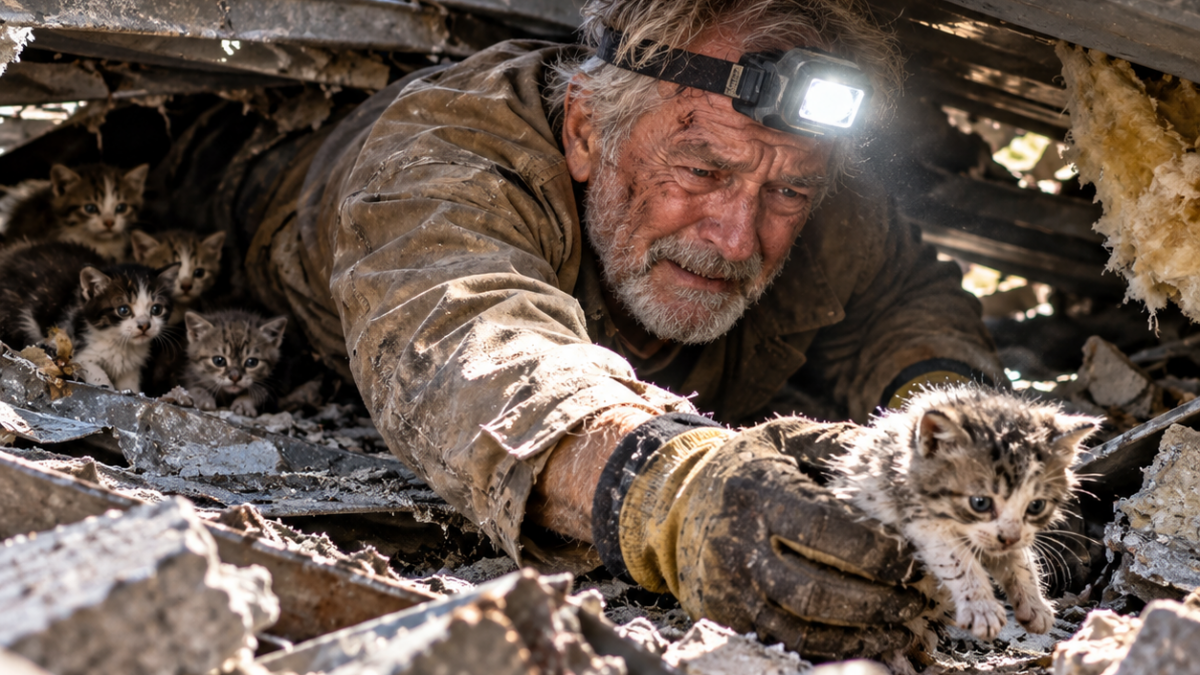
At 7:40 p.m., Ray Garrison crawled under the collapsed building.
The entrance was worse than it had looked from outside.
A warped sheet of wall metal had bent upward just enough to form an opening about seventeen inches high and three feet wide. Beyond it, the space narrowed almost immediately. The collapsed roof pressed down unevenly, creating a low metal cave filled with jagged edges, broken shelving, fiberglass insulation, splinters of wood, rust flakes, and gray dust.
Ray lay flat on his stomach and pulled himself forward with his elbows.
Pain flared in his lower back before his boots even cleared the entrance.
The headlamp beam shook across the debris.
The air inside was thick.
Not just dusty.
Alive with particles.
Concrete dust from the slab.
Fiberglass from torn insulation.
Rust from old panels.
Mold.
Dry feed residue that had been trapped in cracks for years.
Ray tried putting the towel over his mouth, but the space was too tight. The towel caught on his headlamp. His breath fogged the inside of it. He needed both hands to move debris. He shoved it down around his neck and kept going.
The first ten feet took eight minutes.
The metal above him groaned constantly.
Sometimes from the wind.
Sometimes from his movement.
Sometimes for no reason he could understand.
Every groan traveled through his body.
He had worked maintenance long enough to know unstable structures speak before they kill you. The trouble is they do not always tell you how much time you have.
The kittens cried ahead of him.
That sound became his map.
He moved toward it.
At first, the space beneath the roof was high enough for him to drag his body forward without turning his head sideways. Then it narrowed. A bent support shelf forced him to angle one shoulder down and push through a gap that scraped his jacket. A shard of metal caught his sleeve and tore it. Something sharp sliced his forearm beneath the canvas.
Ray hissed.
Kept moving.
His breathing worsened quickly.
The dust hit his lungs like ground glass.
He coughed once, then clamped his mouth shut because coughing under a collapsed metal roof made the whole space vibrate around him. He pulled the towel up when he could, breathed through it twice, then dropped it again to push aside a broken board.
Eleven yards inside, his headlamp caught a small movement beneath a collapsed shelf bracket.
A kitten.
Gray with dust, no bigger than his palm, wedged in a shallow pocket where a piece of shelving had pinned the towel-like nest material beneath it. Its mouth opened in a silent cry before sound came out.
Ray stopped.
For a moment, the whole wreckage seemed to hold its breath with him.
“Hey there,” he whispered.
His voice sounded strange in the low metal space.
He slid the crowbar forward, wedged it carefully beneath the shelf support, and lifted just enough to free the fabric. The kitten squirmed weakly. Its fur was coated gray. Its eyes were sealed shut. Newborn. Five days old, maybe less.
Ray tucked the crowbar beneath his chest, reached with both hands, and worked the kitten free.
It fit in one palm.
Warm.
Alive.
He slipped it inside his canvas jacket against his chest, zipped the jacket halfway, and began crawling backward.
Backward was worse.
Forward, at least, he could see.
Backward, he had to trust memory.
His boots kicked debris. His shoulder hit metal. The kitten moved against his chest, tiny and fragile. He kept one hand over it through the jacket and pulled himself with the other elbow, inch by inch.
It took twenty-two minutes to get out.
When Ray emerged, Carl was waiting near the dock with his flashlight.
“Oh my God,” Carl said.
Ray rolled onto his side and carefully opened his jacket.
The kitten made a weak sound.
Carl’s face changed.
That was the moment cats stopped being an idea.
It is easy to say “just cats” when they are invisible under wreckage.
It is harder when one fits in a man’s shaking hand.
Ray stood too quickly and nearly fell. Carl caught his arm.
“Easy.”
Ray shook him off gently.
“Box.”
He carried the kitten into the trailer, placed it inside the cardboard box, and wrapped the towel around it. He heated a small towel on the gas stove because the power was out. His hands trembled so badly he almost dropped it.
Carl stood in the doorway, rain dripping from his cap.
“One’s enough,” he said quietly.
Ray looked at him.
“They’re still crying.”
“Ray.”
“They’re still crying.”
He went back.
The second kitten was farther in.
Twelve yards.
Maybe more.
Time became difficult underground. Minutes stretched and folded. Ray could not check his watch because he could barely move his arm. He followed the sound, dragging himself through the same narrow passage, past the shelf bracket, deeper toward the back wall.
The second kitten lay near a piece of torn insulation, its tiny body pressed against a crushed feed sack. Ray had to clear rusted metal fragments from around it one by one. Twice, the roof settled above him with a low metallic moan.
He froze each time.
Waited.
Listened.
Moved again.
By the time he brought the second kitten out, his throat burned.
Carl had found another towel.
“Don’t go again,” he said.
Ray put the kitten in the box beside the first.
The first one moved toward the second instinctively, two dust-covered bodies searching for warmth.
Ray watched them for half a second.
Then he turned.
The third kitten was close to where the second had been.
That made Ray reckless for a moment.
He thought maybe he could get in, get it, and get out faster.
The wreckage punished him for thinking that.
On the way in, his left glove snagged on torn metal. When he pulled, the metal sliced through the glove and into the base of his thumb. Blood slicked the leather. He wrapped the towel around his hand and kept moving.
The third kitten was wedged under a piece of broken crate.
Ray freed it with his fingers because there was not enough room to maneuver the crowbar. Splinters dug under his nails. His back spasmed so violently he had to press his forehead against the concrete and breathe through his teeth until it passed.
He thought of his doctor.
Avoid dust.
Avoid heavy exertion.
Avoid confined spaces.
He almost laughed.
It came out as a cough.
The cough triggered another.
Then another.
The metal above him vibrated.
“Stop,” he whispered to himself.
Stop coughing or stop crawling?
He did not know.
He tucked the third kitten inside his jacket and crawled backward again.
Outside, the rain had become mist.
Night settled over the wreckage.
Carl had brought a lantern from his house and set it near the trailer steps. Its glow made the wet concrete shine.
Ray put the third kitten in the box.
Three.
The cardboard box had become the warmest place in the trailer.
Carl stood beside it, staring down at them.
“They’re so small,” he said.
“Newborn.”
Ray grabbed the water bottle and drank too fast. He coughed, choked, swallowed, and wiped his mouth with the back of his glove.
There was blood on the glove.
He told himself it came from his hand.
Maybe it did.
The fourth kitten was deeper.
Fifteen yards in.
Past the collapsed shelf.
Past a place where the roof sagged so low Ray had to turn his head sideways and exhale fully to squeeze under it.
Past a section where fiberglass insulation hung down in strips that brushed his face like wet cobwebs.
The kitten’s cries came from behind a fallen metal wall panel.
Ray could see movement through a gap, but the opening was too small for his hand. He wedged the crowbar against the panel and pushed.
Nothing.
He shifted position, planted one elbow against the concrete, and pushed again.
Pain shot through his lower back.
The panel moved one inch.
Then two.
The sound it made was horrible.
Metal scraping metal.
The roof above answered with a groan.
Ray froze.
Dust sifted down onto the back of his neck.
“Easy,” he whispered.
To himself.
To the building.
To God, maybe.
He pushed again.
The gap widened enough for his arm.
The fourth kitten was lying on its side, mouth open, barely crying now. Ray slid his hand behind it and pulled it through.
For a terrifying second, it did not move.
Then it gasped.
Ray tucked it inside his jacket.
On the way out, his headlamp flickered.
Once.
Twice.
Stayed on.
He knew what that meant.
Battery.
Outside, Carl was waiting with another man now.
Ray recognized him as Earl Benson from down the road. Earl had followed the lantern light. He stared at Ray crawling out from under the flattened warehouse like a man watching someone rise from a grave.
“Jesus,” Earl said.
Ray did not answer.
He placed the fourth kitten in the box.
Then he sat down on the concrete.
Not by choice.
His legs simply stopped cooperating.
For fifteen minutes, he sat with his back against a broken slab, arms resting on his knees, head bowed. His forearms were bleeding through his torn jacket. His thumb throbbed. His chest made a wet, heavy sound every time he breathed.
Carl crouched beside him.
“You’re done.”
Ray closed his eyes.
“No.”
“Ray, listen to yourself.”
Ray listened.
His own breathing was loud enough to be heard six feet away.
Ragged.
Wet.
Wrong.
The headlamp on his forehead dimmed slightly, then brightened.
Carl pointed toward the wreckage.
“That roof shifts every time you move. You got four. That’s more than anyone could expect.”
Ray looked toward the trailer.
Through the open door, he could see the cardboard box on the floor near the stove. Four kittens moved weakly beneath the towel.
Then, from under the warehouse, came another cry.
Carl heard it.
Earl heard it.
Everyone heard it.
Carl’s face tightened.
“Ray.”
“There are two more.”
“Those are cats.”
Ray looked at him then.
No anger.
No speech.
Just a tired man with blood on his sleeves and dust in the lines of his face.
“They’re alive,” Ray said.
Carl looked away first.
Ray went back in.
The fifth trip felt different from the beginning.
His body had begun negotiating against him.
Every movement cost more.
His elbows slipped. His back screamed. His lungs pulled less air than they needed. The dust seemed thicker now, or maybe he was weaker.
The headlamp beam had narrowed to a dim cone.
He reached the place where he had found the fourth kitten, then moved beyond it.
The cries came from farther back, near the rear corner of the building, where the floor had buckled slightly and created a shallow pocket beneath a fallen crossbeam.
That was where he found the mother.
She was alive.
Barely.
The calico cat lay on her side beneath a metal beam that had fallen across her hindquarters. Her back legs were pinned. Her body curved around two kittens pressed against her belly, shielding them from the debris above. Her eyes caught the faint headlamp and flashed dull gold.
She hissed when Ray came close.
Not strong.
Still a warning.
“Easy, girl,” he whispered.
The fifth kitten was closest to him, partly under her front leg. Ray reached slowly. The mother cat tried to move, but the beam held her fast. Her claws scraped weakly against concrete.
“I know,” Ray said. “I know.”
He freed the fifth kitten gently.
It cried once, louder than the others, as if offended by rescue.
Ray tucked it inside his jacket.
He looked at the sixth kitten.
Then at the mother.
The beam.
The darkness.
The fading light.
His lungs.
He could not free them both now.
He knew that.
He hated knowing it.
“I’ll come back,” he whispered.
To the cat.
To himself.
Maybe to the kitten.
The mother stared at him.
There are people who will tell you animals do not understand promises.
Ray would never argue with them.
But he would remember that stare for the rest of his life.
The trip back took thirty-one minutes.
Halfway out, the headlamp died.
Not flickered.
Died.
The darkness under the wreckage became total.
Ray stopped moving.
For one moment, panic climbed onto his back heavier than the collapsed roof.
He could not see the path.
He could not see the metal.
He could not see the opening.
He could not see his own hands.
He had one kitten under his jacket, one bleeding hand, a bad back, lungs full of dust, and fifteen yards of wreckage between him and air.
He forced himself to breathe slowly.
That failed.
His lungs seized.
He coughed.
Once.
Twice.
The kitten moved against his chest.
Ray pressed one hand over it through the jacket and closed his eyes, though open or closed made no difference.
“Back,” he whispered.
He had crawled in.
He could crawl back.
He used touch.
The scrape of concrete beneath his elbows.
The angle of the fallen shelf against his right shoulder.
The fiberglass strip brushing his left ear.
The sharp metal edge near his boot.
Memory became sight.
He pulled himself backward with one arm while holding the kitten against his chest with the other.
Inch by inch.
He counted breaths.
Lost count.
Started again.
When he finally emerged, the lantern light outside looked impossibly bright.
He rolled onto the concrete, clutching the kitten.
Carl and Earl pulled him clear.
Ray could not stand.
He crawled to the cardboard box on his knees and placed the fifth kitten beside the others.
Then he coughed for four minutes without stopping.
Carl later said there was blood in it.
Ray did not remember seeing blood.
He remembered the sound of his breath.
He remembered the box.
Five kittens.
Five tiny bodies against the towel.
One left.
And the mother.
Carl grabbed his shoulders.
“No more.”
Ray shook his head.
“You can’t breathe.”
Ray swallowed.
The air would not go deep enough.
“Still one.”
“I’m calling an ambulance.”
“Call.”
“You need to stop.”
Ray looked toward the collapsed warehouse.
“She can’t breathe either.”
Carl stared at him.
“What?”
“The mother. Beam on her.”
Earl whispered, “Good Lord.”
Ray pushed himself up using the trailer step.
He nearly fell.
Carl caught him.
This time Ray did not shake him off.
He leaned there for a second, letting another man hold part of his weight.
“Ray,” Carl said, softer now, “you don’t owe the world your life over this.”
Ray looked at the box.
Five kittens.
No mother.
One sibling still in the dark.
He thought about how many times in his life he had walked away because walking away was easier.
From his marriage when the silence got too large.
From friendships after work ended.
From his own pain because naming it seemed useless.
He had become good at leaving things alone.
This was not going to be one of them.
“Ambulance,” he said.
Carl nodded.
“And flashlight.”
Earl ran to his truck and brought a flashlight with a taped handle. Ray tried to hold it, but there was no room to crawl with it in one hand. He tied it to his wrist with a strip torn from the towel.
It was 4:15 in the morning when Ray went back under the collapsed warehouse for the last time.
Nearly nine hours had passed since he first entered.
The storm had moved east, but the air remained wet and heavy. Sirens still sounded in the distance. A generator ran somewhere down the road. The town was awake in pieces—people clearing branches, checking neighbors, tarping roofs, calling insurance, finding what had survived.
Ray moved beneath the warehouse like a man entering a mine that hated him.
Every muscle shook.
His back burned.
His arms were slick inside the torn sleeves.
His breath came shallow and loud.
Five yards in, something changed in his chest.
He would later describe it as a sound.
A small pop.
Not loud.
Not outside him.
Inside.
Then pressure.
A crushing weight against the left side of his ribs, as if someone had placed a concrete block on his chest and told him to breathe around it.
He stopped.
Tried to inhale.
The breath went halfway and hit a wall.
He tried again.
Half.
Pain sharpened beneath his left shoulder blade.
His mouth opened, but no real air came.
For a moment, he thought:
This is where I die.
Not dramatically.
Not heroically.
Just wedged beneath old metal, too far in for Carl to reach, with one lung failing and a cat still crying in the dark.
He thought of the doctor.
He thought of Patricia, his ex-wife, leaving with two suitcases and tears she was too proud to wipe.
He thought of the grain elevator, the accident, waking up in the hospital and being told his back would never be the same.
He thought of all the quiet years that followed.
Then the sixth kitten cried.
Ray moved.
Not because he was brave.
Bravery sounds too clean.
He moved because the sound gave him a direction and stopping meant the darkness won everything.
He dragged himself forward.
Five yards.
Ten.
Fifteen.
Each breath half a breath.
Each movement smaller.
The flashlight tied to his wrist threw wild arcs across the wreckage. Twice he dropped his head to the concrete and rested, not from choice but because his body shut him down for several seconds.
Then he reached the mother cat.
She was still alive.
Her breathing was fast, short, terrified.
The sixth kitten pressed against her chest, crying weakly. The beam still trapped her hind legs. Her eyes watched Ray in the flashlight glow.
He whispered, “Told you.”
The beam was heavier than anything he should have tried to move in that position.
Ray knew leverage.
Maintenance work teaches a man what muscle cannot do and angles can.
He wedged the crowbar against a concrete footing and positioned the curved end beneath the beam. There was barely enough room to work. He could not get his shoulder under it. Could not kneel. Could not brace properly.
He had one arm, bad air, and a piece of steel.
He pushed down on the crowbar.
Nothing.
He adjusted.
Pushed again.
Pain exploded in his back.
The beam shifted maybe an inch.
The cat screamed.
Ray froze.
“Sorry,” he whispered. “Sorry.”
He pushed again.
More.
More.
The beam lifted.
Not much.
Maybe three inches.
Enough to change the pressure.
He held the crowbar with his left arm, which felt like it belonged to someone else.
With his right hand, he grabbed the loose skin at the back of the cat’s neck and pulled gently.
She did not move.
Her back legs were still caught.
Ray pushed harder on the crowbar.
His left lung gave him nothing.
His right lung burned.
The beam lifted another fraction.
The mother cat dragged herself forward with her front claws.
Ray pulled.
She came free.
He nearly dropped the crowbar.
The beam slammed down behind her with a metallic crash that echoed through the collapsed building.
Everything shifted.
Dust fell.
A panel groaned overhead.
Ray curled around the sixth kitten instinctively.
For a moment, he waited for the roof to finish falling.
It did not.
The mother cat lay beside him, panting. Her back legs did not move.
Ray tucked the sixth kitten under his jacket.
Then he faced the next problem.
How to carry the mother.
He could not hold her in his arms and crawl.
He could not drag her by the scruff all the way out.
He had no carrier.
No rope.
No strength.
The space above his back, near the center of the collapsed roof, was slightly higher than the rest. Just enough.
Ray slid the mother cat onto his back, between his shoulder blades.
She reacted with panic at first, claws digging into the canvas jacket. One claw went through into his skin. He grunted but did not stop.
“Hold on,” he whispered.
She held on.
He began crawling backward.
The last trip took forty-four minutes.
Ray remembered almost none of it clearly.
He remembered the cat’s breath against his neck.
Fast.
Short.
Terrified.
He remembered the kitten moving under his jacket.
He remembered the flashlight dimming.
He remembered metal scraping his back.
He remembered telling himself, “One more foot,” and then, after one foot, “One more.”
He remembered getting stuck near the sagging section and having to turn slightly while the mother cat clung to him and his chest refused air.
He remembered thinking of Carl outside.
He remembered thinking he should have named the mother cat.
He remembered deciding she probably did not need him to.
At 5:02 a.m., Ray came out.
He did not crawl so much as spill from the opening.
Carl and Earl pulled him clear.
The mother cat tumbled off his back and tried to drag herself forward with her front legs. Carl caught her gently in his jacket. Ray opened his own jacket with fingers that barely worked and removed the sixth kitten.
Alive.
He placed it in the cardboard box.
Then he collapsed.
The ambulance arrived three minutes later.
By then, Ray’s lips were blue.
His face was gray with concrete dust.
His jacket hung in ribbons.
His forearms were cut from wrist to elbow, more than a dozen wounds crossing old scars with new ones.
He could not stand.
He could barely speak.
When the paramedic asked his name, he whispered, “Ray.”
When she asked what happened, Carl answered for him.
“He went in six times.”
The paramedic looked toward the collapsed warehouse.
“In there?”
Carl nodded.
“For kittens.”
Ray used what little breath he had left to correct him.
“And the mother.”
Then he passed out.
He woke in the hospital with a tube in his chest.
That was the first thing he understood.
Not the room.
Not the machines.
The tube.
It ran from his left side to a drainage device beside the bed, and every time he shifted, pain reminded him that his body had finally collected payment.
A nurse noticed his eyes open.
“Mr. Garrison?”
He blinked.
“You’re in Waverly County Medical. You had a partial pneumothorax. Your left lung collapsed partway. We placed a chest tube. You’re stable.”
He tried to speak.
His throat scraped.
The nurse held a cup of water with a straw.
He took a small sip.
“Cats,” he whispered.
The nurse’s face softened.
“They’re alive.”
He closed his eyes.
“Mother?”
“Alive too. Injured, but alive.”
Only then did he let himself sink back into the pillow.
Ray stayed in the hospital six days.
The doctors treated the pneumothorax, chemical irritation in both lungs from fiberglass and concrete dust, dehydration, exhaustion, and lacerations across both arms that required thirty-one stitches. His oxygen saturation stayed low for two days. His chest tube hurt worse than the cuts. Coughing felt like being split open. Nurses kept telling him not to move so much. He kept asking about the cats.
Carl visited on the second day.
He came in carrying a paper grocery bag and looking guilty enough to confess to crimes he had not committed.
Ray’s voice was rough.
“They alive?”
Carl nodded.
“All seven.”
“Where?”
“My place first. Then Dr. Price took the mother.”
Dr. Elena Price ran the small veterinary clinic outside town. She had heard about the rescue from Carl, met him at sunrise, and taken the mother cat and kittens immediately. The mother’s pelvis was fractured. Her back legs were weak but not paralyzed. She was dehydrated, bruised, and covered in dust. The kittens were cold, hungry, and irritated but otherwise uninjured.
“She said the mother might heal,” Carl said.
“Might?”
“Needs time.”
Ray closed his eyes.
Carl shifted.
“I told you to stop.”
Ray opened one eye.
“You were right.”
Carl gave a sad laugh.
“That doesn’t make me feel better.”
“Shouldn’t.”
They sat in silence for a while.
Then Carl said, “News folks came by.”
Ray groaned.
“I didn’t talk.”
“Good.”
“Denise at the grocery did.”
Ray groaned louder.
“Small town,” Carl said.
By the fourth day, people knew.
Not everyone.
But enough.
The story moved from the veterinarian’s office to the grocery store, from the grocery store to church prayer lists, from prayer lists to Facebook, from Facebook to a local reporter named Megan Lane who had spent the storm covering damaged roofs and emergency shelters before hearing about “the man who nearly died for kittens.”
She called the hospital.
Ray refused.
She came anyway after his discharge.
But that was later.
First, Ray had to go home.
The day he left the hospital, Carl drove him back to the trailer.
Ray had lost more than ten pounds in six days. His clothes hung loose. His arms were bandaged. He moved like every joint had filed a complaint. The doctor had given him instructions and a look that said instructions would probably be ignored.
No dust.
No heavy lifting.
Use the inhaler.
Follow up.
Rest.
Ray nodded the way he had nodded before crawling under a collapsed warehouse.
Carl pulled into the gravel drive.
The old warehouse had been taped off by the county. Yellow caution tape snapped in the wind around the wreckage. From the trailer, Ray could see the entrance where he had crawled in. It looked impossibly small.
He stared at it.
Carl turned off the truck.
“You okay?”
“No.”
Carl nodded.
“Fair.”
Then Ray heard a sound from inside the trailer.
A kitten.
He turned toward Carl.
Carl smiled a little.
“Dr. Price said they could come home if somebody watched them close. I told her I’d help.”
Ray opened the trailer door.
The cardboard box had been replaced by a larger crate lined with clean blankets. Six kittens slept in a pile beneath a heating pad set on low. The mother cat lay beside them, her hindquarters wrapped and supported, eyes open, watching.
When Ray stepped inside, she lifted her head.
For several seconds, neither moved.
Then she made a sound.
Not a meow.
Not a hiss.
Something quieter.
Recognition, maybe.
Ray lowered himself painfully onto the floor.
The mother cat dragged herself forward with her front legs, slow and awkward, and pressed her forehead against his knee.
Carl looked away.
Ray rested one bandaged hand near her, not quite touching.
“Hey, girl,” he whispered.
She closed her eyes.
He kept all seven.
People argued with him.
Carl argued first.
“You can’t keep seven cats in a trailer.”
Ray said, “Looks like I can.”
Dr. Price argued gently.
“At least let me find homes for the kittens once they’re old enough.”
Ray said, “They’ve had enough moving.”
Denise at the grocery said, “You’ll need names.”
Ray said, “No.”
That surprised people more than the keeping.
No names?
None?
Not even for the mother?
Ray never explained at first.
He simply did not name them.
The mother cat recovered slowly.
For two weeks, she barely moved beyond the crate. Dr. Price came by every other day, refusing payment in a way that made Ray uncomfortable. He tried to leave cash on the clinic desk. She mailed it back.
“Don’t insult me,” she wrote on a sticky note.
The kittens grew.
Their eyes opened.
One gray, two orange, one calico like the mother, one black with white socks, one cream-colored with a crooked tail.
They spread through the trailer like spilled water.
At first, they wobbled.
Then climbed.
Then destroyed.
They attacked shoelaces, curtains, oxygen tubing, unpaid bills, and each other. One slept in Ray’s work boot. One learned to climb the recliner before learning how to get down and screamed until rescued. The mother cat, healing but still weak in the back legs, watched them with a tired expression Ray understood deeply.
His lungs never fully recovered.
Before the rescue, COPD had been a diagnosis he could sometimes pretend was theoretical. Afterward, it became part of every day. He used an inhaler twice daily. Cold air hurt. Dust hurt. Laughing too hard made him cough. He could no longer walk to the mailbox without noticing the distance.
His arms healed into thin white scars that ran from wrist to elbow.
Too many to count.
At night, when the trailer finally quieted and the kittens slept wherever they fell, the mother cat climbed onto Ray’s bed with effort and settled against his side. She had a limp now. So did he. They made room for each other.
Three weeks after the storm, Megan Lane knocked on his trailer door.
Ray saw the news van at the road and considered pretending not to be home. But the kittens betrayed him by knocking over a metal bowl, and Megan heard it.
“Mr. Garrison?” she called.
Ray opened the door halfway.
She was young, maybe twenty-six, rain jacket over a blouse, hair pulled back, notebook in hand. She looked nervous, which helped. Ray distrusted reporters less when they looked like people.
“I’m Megan Lane with Channel 6. I was hoping to ask you a few questions about the rescue.”
“No.”
“I understand. It would only take—”
“No.”
She glanced past him and saw movement in the trailer.
A kitten climbed onto Ray’s boot.
Her face softened.
“I heard you saved all six.”
“And their mother.”
“And their mother,” she repeated.
He started to close the door.
“Mr. Garrison?”
He stopped.
“People are calling you a hero.”
He looked tired when he answered.
“People need better hobbies.”
She almost smiled.
“Can I ask one thing? Not on camera.”
“No camera.”
“No camera.”
He waited.
“Why did you do it?”
He looked behind him.
The mother cat lay on the bed, eyes half-closed, six kittens scattered around her like punctuation.
Why.
Everyone wanted why.
As if reasons had to be large to justify risk.
As if kindness needed a philosophy.
As if something alive crying in the dark presented a complicated moral problem.
Ray stood in the doorway of his trailer, chest still aching, arms scarred, breath shallow, and said the only answer he had.
“Something living was trapped in the dark and couldn’t get out by itself. That’s all.”
Megan’s pen stopped moving.
“That’s all?”
“That’s all.”
She looked like she wanted to ask more.
She did not.
“Thank you,” she said.
Ray closed the door.
The story still got out.
Not because Ray told it.
Because stories like that do not stay buried in small towns.
Carl talked, though he claimed he didn’t.
Dr. Price’s receptionist told her sister.
Denise posted a vague status about “the kindest stubborn man in Waverly County,” which everyone understood within thirty minutes.
Megan ran a short segment without an interview, using footage of the collapsed warehouse and a distant shot of Ray’s trailer. She repeated his quote, voice soft over images of storm damage.
Something living was trapped in the dark and couldn’t get out by itself.
That’s all.
Donations came.
Cat food.
Blankets.
A new cat tree from a church group Ray had never attended.
A prepaid veterinary account someone set up anonymously.
An oxygen concentrator offer from a medical supply company.
Ray accepted the cat food.
Returned the cat tree twice before Denise drove it over herself and said, “Don’t be hateful.”
He kept it.
The kittens loved it.
Winter came.
The warehouse was eventually demolished. The county hauled away the metal, beams, insulation, and broken history in dumpsters. The concrete slab remained, swept clean and empty, a pale rectangle beside Ray’s trailer.
Sometimes he stood at the edge of it and listened.
There was nothing to hear anymore.
No metal groan.
No crying.
Only wind.
Carl told him once, “You ought not come out here so much.”
Ray said, “Probably.”
But he kept coming.
Not because he wanted to remember the fear.
Because he needed to remember the moment before.
The moment he could have walked away.
The whole story lived there.
Not in the hospital.
Not in the news.
Not in the scars.
There, at the edge of the collapsed building, when he had called for help and been told help would not come, when he had stood with a choice nobody else would judge him for refusing.
He could have gone inside.
Closed the door.
Sat in his recliner.
Listened to the rain.
Told himself he had done what he could.
No one would have blamed him.
That was what haunted him.
Not that he nearly died.
That walking away would have been so easy to justify.
One evening, Carl found him there near sunset.
The slab glowed pink in the fading light.
“You still thinking about it?” Carl asked.
Ray nodded.
“You regret it?”
Ray considered.
His left lung ached in cold weather.
His back had worsened.
Medical bills had arrived, though the town had quietly helped with some.
He could not work odd repair jobs anymore. Not many. Not the way he used to.
Inside the trailer, seven cats had turned his quiet life into chaos.
“No,” he said.
Carl nodded.
“Didn’t think so.”
They stood together until the light faded.
A year later, Ray was sixty-four.
His hair had gone almost completely white. His breathing was never the same. He carried an inhaler in his shirt pocket. The scars on his forearms had faded to pale lines, but they remained visible, thin and numerous, running beneath the skin like a map of the wreckage.
The mother cat slept on his bed every night.
Not at the foot.
Beside his chest.
Sometimes, when his breathing grew rough in sleep, she woke and placed one paw against his shoulder. He did not know if she did it because she remembered the sound of his breath under the building or because cats simply choose strange habits and keep them.
The six kittens became cats.
They filled the trailer.
The gray one claimed the kitchen window.
The orange pair fought over the recliner.
The black-and-white one slept in the bathroom sink.
The calico followed her mother.
The cream-colored one with the crooked tail learned to open the lower cabinet where Ray kept cans of food and became, in Denise’s words, “a criminal.”
Ray still gave none of them names.
People tried.
Denise suggested names every week.
“Dusty.”
“No.”
“Lucky.”
“No.”
“Miracle.”
“Absolutely not.”
Carl called the black-and-white one “Socks” until Ray glared at him enough times that he stopped.
Dr. Price wrote “Mother Cat” and “Kitten 1” through “Kitten 6” on their files.
When asked why he refused names, Ray only shrugged.
Then, one afternoon, Megan Lane came back.
Not with a camera crew this time.
She came alone, older by a year, more confident, carrying a paper bag of cat food.
Ray opened the door and sighed.
“You again.”
“I brought tribute.”
“Bribery.”
“That too.”
He let her in because refusing cat food seemed petty even for him.
The trailer was cleaner than people expected. Worn, yes. Small. Crowded. But clean. Blankets folded. Dishes washed. Cat toys in a basket. The mother cat on the bed. Six grown cats pretending they had not been on the counter five seconds earlier.
Megan sat at the kitchen table.
“I’m not here for a story,” she said.
“Good.”
“I’m doing a follow-up on storm recovery. The warehouse demolition, rebuilding, that kind of thing. I wanted to check how you were.”
“Alive.”
“I can see that.”
“Then you’re done.”
She smiled.
“I also wanted to tell you something. The quote you gave me last year… people still write to the station about it.”
Ray frowned.
“Why?”
“Because it helped them.”
“Helped them do what?”
“All kinds of things. Foster animals. Check on neighbors. Volunteer after storms. One woman wrote that she started visiting her father in assisted living again because she said he’d been trapped in the dark in his own way.”
Ray looked uncomfortable.
“I was talking about cats.”
“I know.”
“People stretch things.”
“Sometimes things stretch because they’re true.”
He said nothing.
One of the orange cats jumped onto the table and sniffed Megan’s sleeve.
She laughed softly.
“Still no names?”
“No.”
“Can I ask why?”
Ray looked toward the bed.
The mother cat had lifted her head.
For once, he answered.
“Because names are for telling other people who something is.”
Megan waited.
Ray scratched the orange cat behind one ear.
“They know who they are.”
He looked at the six cats, then at the mother.
“They’re the ones somebody came for.”
Megan did not write that down right away.
Her eyes filled first.
Ray pretended not to notice.
After she left, the quote spread farther than the first one.
They know who they are. They’re the ones somebody came for.
People made it into posts.
Printed it under photos.
Said it about pets, children, veterans, lonely neighbors, foster kids, elderly parents, themselves.
Ray hated most of that.
Then quietly stopped hating all of it.
Because maybe people did stretch things.
Maybe they stretched them toward where they needed to go.
On the second anniversary of the storm, the town placed a small bench near the empty warehouse slab.
Ray had opposed it.
No one listened.
The bench was simple, wooden, with a small metal plaque.
For all living things waiting in the dark.
Ray said it was too much.
Denise said he could complain after helping install it.
So he helped install it.
Carl held the bolts.
Dr. Price brought coffee.
Megan took one photograph from far away, with permission this time.
Ray stood beside the bench after everyone left.
The slab was empty.
Grass had begun to grow through cracks at the edges.
The sky was blue.
A breeze moved across the lot, carrying the smell of cut hay from fields beyond town.
For a moment, Ray could almost hear the metal again.
The groan.
The shift.
The crying.
Then he heard something else.
A meow.
He turned.
The mother cat stood in the trailer doorway, watching him.
She was not supposed to be outside. Not because she couldn’t manage, but because Ray worried. She stepped carefully down the cinder-block stairs, back legs still uneven, and crossed the yard toward him.
Slow.
Determined.
He waited.
She reached the edge of the slab and sat beside his boot.
Ray lowered himself onto the bench.
His chest hurt a little.
It always did.
The cat leaned against his leg.
He rested one scarred hand on her back.
They stayed that way until the sun dropped lower.
A man and a cat who had both come out of the dark breathing differently than before.
People would keep asking why.
Ray knew that.
Why risk your life?
Why go back?
Why save animals when people were suffering too?
Why keep all seven?
Why no names?
Why not let the story become bigger, cleaner, easier to package?
He never found a better answer than the first one.
Something living was trapped.
It could not get out by itself.
He could hear it.
He was there.
That was all.
And maybe that was the part people had trouble with.
They wanted heroism to arrive with music.
With speeches.
With certainty.
With a man standing tall and fearless before entering danger.
But Ray had not felt fearless.
He had been afraid every time.
Afraid of the roof dropping.
Afraid of getting stuck.
Afraid of dying alone beneath a building nobody cared about.
Afraid of taking one more breath and finding no air left.
He went anyway.
Not because fear disappeared.
Because the crying did not.
That was the truth.
A year after the bench went in, Ray still lived in the trailer.
He still used the inhaler twice a day.
He still hated interviews.
He still bought cat food at Miller’s Grocery, though now Denise automatically ordered the large bags and wrote “for the unnamed royalty” on the receipt.
The mother cat still slept beside him.
The six grown cats still occupied every room as if the trailer had been built for them and Ray was a tolerated tenant.
Sometimes, late at night, when the weather turned and his back ached and his lungs tightened, Ray would wake in the dark.
For a second, he would be under the warehouse again.
Dust.
Metal.
No light.
Half a breath.
Then he would feel weight beside him.
The mother cat.
Warm.
Alive.
Breathing.
And somewhere in the small trailer, six more breaths answered.
That was how he knew he had made it out too.
Not all rescues are clean.
Some leave scars.
Some take pieces of your body you never get back.
Some cost more than anyone would have asked you to pay.
But sometimes the living proof curls up beside you afterward, purring against the ruined part of your chest, and the question of whether it was worth it becomes too small to matter.
Ray never called himself a hero.
If you said it to his face, he would wave you off.
If you pushed, he might get irritated.
If you asked the cats, they would not answer because cats are wise enough to ignore human categories.
But every night, the mother cat climbed onto his bed.
Every night, the six grown kittens settled throughout the trailer.
Every night, the old man who had crawled nine hours through dust and twisted metal listened to them breathing.
And in that little trailer beside an empty concrete slab, beneath a sky that still turned dangerous every summer, seven animals slept because someone had come for them.
No names.
No speeches.
No grand explanation.
Just the truth Ray understood better than anyone:
When something living is trapped in the dark, and you are the one who hears it, the world has already asked you a question.