For Four Months, a German Shepherd Waited Beside an Old Suitcase—Then I Opened It and Found the Letter That Changed My Life
PART3:
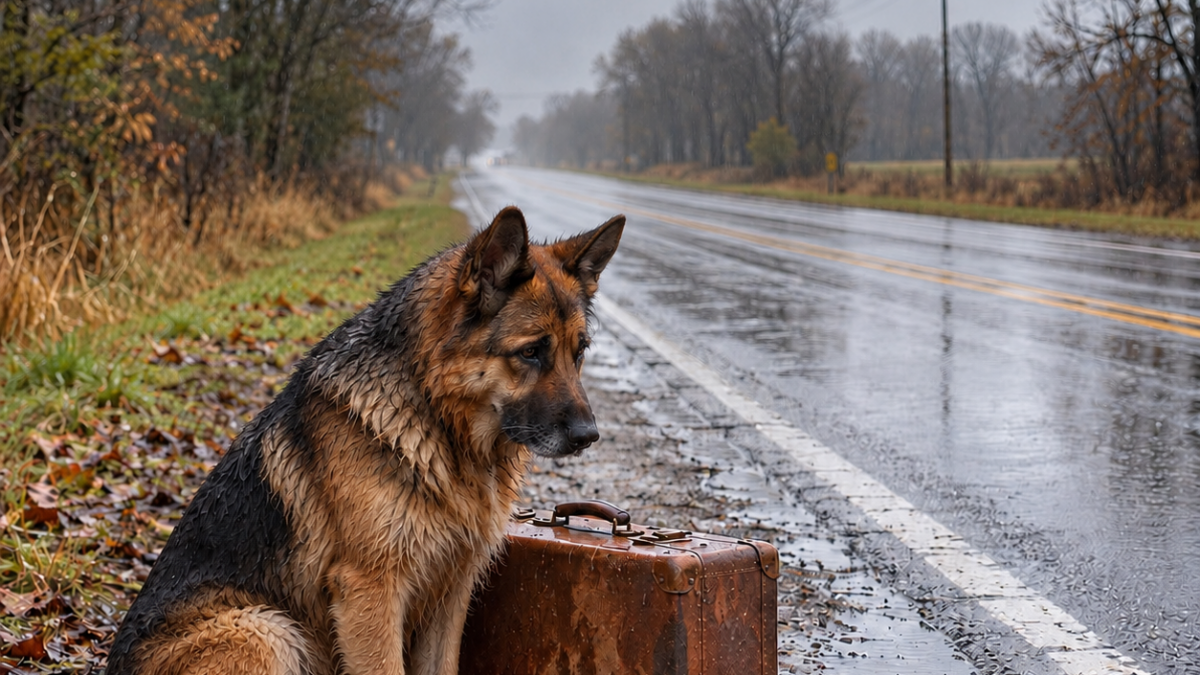
The German Shepherd was still there.
Soaked.
Shivering.
Pressed against the suitcase as though leaving it would be worse than freezing beside it.
Something inside me finally broke.
I slowed.
For the first time in four months, I pulled onto the shoulder.
I killed the engine.
Rain hammered the roof.
For several seconds, I just sat there looking through the windshield.
“Enough, Daniel,” I said aloud. “You’ve passed him enough.”
I stepped out.
Cold rain soaked through my jacket almost instantly.
The dog watched me approach but did not run.
“Hey, buddy.”
His ears lifted.
I crouched several feet away.
Up close, I could see how tired he was.
Mud clung to his paws.
His black-and-tan coat was plastered against his body.
His ribs were not sharp enough to say he had been starving, but he was thinner than a dog his size should have been.
Yet his eyes were clear.
Alert.
Waiting.
That was the word that kept coming to me.
Waiting.
Not lost.
Not wandering.
Not guarding for the sake of guarding.
Waiting.
I slowly reached toward the suitcase.
That was when he stood.
I froze.
“It’s okay.”
He stared directly into my eyes.
There was no aggression there.
Only a kind of desperate attention.
Almost as if he had spent four months waiting for someone to do exactly what I was about to do.
I placed my fingers around the metal latch.
It opened with a rusty click.
Inside was a folded wool blanket.
Several postcards.
A small wooden box.
And a faded photograph in a cracked frame.
An elderly woman smiled at the camera while holding a German Shepherd puppy.
He was mostly ears and paws in the picture, his face still soft with puppyhood but already marked with the same black mask, the same tan eyebrows, the same serious eyes.
I looked from the photograph to the wet old Shepherd beside me.
Same ears.
Same dark saddle.
Same eyes.
My hands began shaking.
Beneath the picture lay an envelope.
The handwriting across the front was unsteady.
It said:
FOR THE PERSON WHO FINDS MAX.
The dog stepped closer.
“Max?”
His tail moved.
Once.
I swallowed.
Then I opened the letter.
The first sentence made me sit down in the rain.
“If someone is reading this, please take care of my best friend.”
The rain had already begun to soften the paper between my fingers.
I pulled my jacket over the suitcase as best I could and leaned forward, shielding the letter with my body.
Max stood beside me.
Not behind me.
Not nervously circling.
Beside me.
Watching.
As if the words belonged to both of us.
The handwriting was shaky enough that some letters drifted above the lines, but I could still read it.
“My name is Margaret Thompson. I live in the little blue house not far from this road. This dog’s name is Max. He has been my only companion for twelve years.”
I stopped.
Twelve years.
I looked at him.
“You’re an old man.”
Max blinked rain from his eyes.
The letter continued.
“My health is getting worse, and I do not know how much longer I will be able to care for him. I have tried to make arrangements, but most people have their own lives, their own responsibilities, and I understand that. Max deserves someone who will love him, not simply tolerate him.”
A knot formed in my throat.
“He likes chicken. He is afraid of thunder. He will pretend he does not understand the word bath, but I assure you that he does. He has slept beside my bed every night since my husband died.”
Thunder rumbled somewhere over the hills.
Max moved closer.
His side pressed against my arm.
I stared at him.
“You really are afraid of storms.”
He lowered his head.
I read on.
“If the day comes when I cannot return to him, please do not let him believe he was abandoned because he was unwanted. There has never been a day in his life when he was unwanted.”
I stopped again.
That sentence did something to me.
There has never been a day in his life when he was unwanted.
How many mornings had I passed him?
Eighty?
A hundred?
How many times had Max raised his head when my car appeared?
How many times had he watched me disappear down the road?
I had always told myself he was somebody else’s responsibility.
Now I knew somebody had once been terrified that he would think he belonged to no one.
I kept reading.
“In the suitcase, there is a small box containing what little money I could set aside. It is not much. Please use it for food or a veterinarian if he needs one.”
I looked at the wooden box.
I did not open it.
I did not care what was inside.
Then came the final paragraph.
“Max is a good dog. Better than I deserve. After my husband died, there were mornings when I stayed in bed because getting up seemed pointless. Max would sit beside me and place one paw on the mattress until I finally stood. I suppose he thought he was asking for breakfast. Maybe he was. But I like to believe he was reminding me that the day had started and that I was still part of it.”
The words blurred.
Rain.
Or my eyes.
I was not sure.
“If someone has found him, please be patient. He waits for people. It is what he does. When my husband was alive, Max waited by the window for him every afternoon. After he died, Max kept doing it for almost a year.”
My chest tightened.
“He does not understand why people fail to come home.”
I looked up at Max.
He was staring down the highway.
Cars moved through the rain in the distance.
Every time headlights appeared, his ears lifted.
Every time they passed us, they lowered.
I suddenly understood what I had been seeing for four months.
Not a stray dog.
Not a dog guarding luggage.
A dog waiting.
The letter ended with one final line.
“Please don’t make him wait forever.”
I sat there in the mud for a long time.
Max did too.
Finally, I folded the letter carefully and put it back inside the envelope.
The date in the upper corner caught my eye.
Four months earlier.
Almost exactly the same week I had first noticed Max beside the road.
“My God.”
He looked at me.
“Four months?”
His tail touched the gravel once.
I reached toward him slowly.
This time, I touched the top of his head.
His fur was cold.
“You’ve been here four months?”
He leaned into my palm.
A feeling I still have trouble describing came over me.
It was not simply pity.
It was shame.
I had driven past a living creature almost every day while telling myself that because he was not screaming, bleeding, or lying in the road, his situation probably was not urgent.
Max had not demanded attention.
He had simply waited.
And somehow that had made him easier to ignore.
“I’m sorry.”
He licked my wrist.
That made it worse.
“I don’t deserve that.”
He licked me again.
I laughed weakly.
“Okay.”
I stood.
My knees were soaked.
“So here’s what we’re going to do.”
Max watched me.
“You’re coming with me tonight.”
His ears moved.
“Tomorrow we’re going to find Margaret.”
At her name, something changed.
Max stood straighter.
I froze.
“You know that name.”
His tail started moving.
“Margaret?”
Faster.
“Oh, buddy.”
I closed the suitcase.
When I lifted it, Max became anxious.
He stepped in front of me.
“It’s okay.”
He nosed the leather.
“I’m not taking it away.”
He watched me carry it toward my car.
Then came the moment I still think about.
For four months, according to what I had seen, Max had barely left that suitcase.
Now he looked at the open passenger door.
Then at the suitcase in my hand.
Then at me.
I patted the seat.
“Come on.”
He took one step.
Stopped.
Looked back at the patch of gravel where he had waited.
I could almost see the decision happening inside him.
If he left, what if she came back?
What if the car he had been waiting for arrived five minutes later?
What if walking away meant missing the person he had refused to stop believing in?
I set the suitcase inside the back seat.
“Max.”
He looked at me.
“I promise we’ll come back if we have to.”
Of course, promises mean very little to dogs when they come from strangers.
Still, something in my voice must have been enough.
Max walked to the car.
I helped him inside.
The second I shut the door, he put both front paws on the seat and stared through the window toward the roadside.
I climbed behind the wheel.
The car smelled immediately like wet dog.
Normally that would have annoyed me.
That night it made the car feel less empty.
I turned on the heat.
Max stood trembling.
“Lie down.”
Nothing.
“I guess we haven’t reached the obedience stage.”
His eyes stayed on the road behind us.
I pulled back onto the highway.
For the first mile, Max kept staring through the rear window.
At two miles, he finally sat.
At five, he turned around.
At ten, he rested his head on the center console.
At fifteen, he put his chin on my thigh.
I drove one-handed the rest of the way.
Every few minutes, thunder rolled in the distance.
Every time it did, his body tensed.
So I talked.
I told him useless things.
“My house is nothing special.”
His ear moved.
“I don’t have a yard as big as whatever you’re used to.”
No reaction.
“I probably don’t have chicken.”
That got a look.
“Okay, apparently we care about that.”
His tail moved.
“I do have eggs.”
Nothing.
“Cheese?”
He stared.
“Cheese it is.”
By the time we reached my town, the storm had weakened.
I pulled into a convenience store and bought dog food, two bowls, a cheap leash, towels, and a bag of chicken strips that probably contained enough salt to preserve a small mammal for a decade.
Max waited in the car.
The cashier looked at my soaked clothes.
“Bad night?”
“You could say that.”
When I came back, Max was standing with both paws against the passenger window.
For one irrational second, seeing him waiting for me made something warm move through my chest.
“I came back.”
I opened the door.
He immediately touched his nose to my hand.
“I said I would.”
My house was small.
Two bedrooms.
A garage filled with tools I rarely used.
A kitchen that looked more like a place coffee passed through than somewhere meals were made.
I had lived there for seven years.
I had always described it as peaceful.
That night, when Max walked inside and his nails clicked against the hardwood floor, I realized peaceful might have been the polite word for empty.
He moved slowly through each room.
Sniffing.
Inspecting.
Looking toward doors.
That German Shepherd mind of his did not seem to know how to enter a new place without making a full report.
Finally, he returned to the suitcase, which I had placed near the couch.
He lay beside it.
Not on the towel.
Not on the blanket I had unfolded for him.
Beside the suitcase.
“You really won’t let that thing out of your sight.”
He rested his chin on his paws.
I warmed a little chicken.
The moment the smell reached the living room, Max raised his head.
“Well, Margaret definitely told the truth about that.”
I placed the bowl down.
He ate carefully.
Not desperately.
Someone had been feeding him during those months.
That comforted me.
Maybe people who lived nearby left food.
Maybe truck drivers stopped.
Maybe someone at the small gas station two miles away knew about him.
But feeding a dog is not the same as giving him an answer.
After dinner, I tried to get him to sleep in the kitchen.
He refused.
I moved the blanket into the living room.
He ignored it.
Finally, I picked up the suitcase and carried it beside the couch.
Max followed instantly.
“Okay.”
I opened it.
Inside, beneath the letter and photograph, was Margaret’s wool blanket.
I spread it on the floor.
Max sniffed it.
Then his entire body softened.
He turned around twice and lay down.
I sat on the couch.
For several minutes, I watched him.
He watched me too.
“What happened to her?”
His eyes remained open.
“Was she taken somewhere?”
Nothing.
“Hospital?”
At the word, his ears moved.
That could have meant anything.
Or nothing.
I leaned back.
“We’ll find out tomorrow.”
Thunder shook the windows.
Max rose immediately.
Before I could say anything, he crossed the room and pressed himself against my leg.
I put my hand on his neck.
“It’s okay.”
Another rumble.
He trembled.
I remembered the letter.
He is afraid of thunder.
“Come here.”
I sat on the floor beside the couch.
Max squeezed himself between me and the furniture.
For the rest of the storm, I remained there with one hand on his back.
At some point, I fell asleep.
When I woke at 5:40 the next morning, my neck hurt, my left foot was numb, and Max was still beside me.
His eyes opened.
“Morning.”
His tail tapped the floor.
That simple sound made me smile.
I had not owned a dog since childhood.
I had forgotten how nice it felt to be greeted as though waking up were an achievement.
I made coffee.
Max followed me into the kitchen.
“Margaret said you remind people to get out of bed.”
He sat.
“Well, congratulations. It worked.”
After breakfast, I searched the suitcase.
A postcard had an address.
Margaret Thompson.
12 Catlett Road.
The address was only eleven miles from where I had found Max.
I checked the map.
The little blue house was on a narrow road hidden behind a stand of trees.
I had driven within a mile of it hundreds of times.
I texted my supervisor.
Running late. Family emergency.
I stared at the words.
Family emergency.
I almost deleted “family.”
Then Max nudged my knee.
I sent it.
At seven-fifteen, we left.
The closer we got to Catlett Road, the more restless Max became.
He stood in the passenger seat.
His ears were forward.
His nose worked constantly.
Then I turned onto the gravel lane.
Max whined.
“You know this road.”
He began pacing.
“Easy.”
The blue house appeared at the end.
Small.
Weathered.
The paint had faded almost gray in places.
A narrow porch sagged slightly on one side.
A bird feeder hung from a hook.
Max barked.
Once.
Then again.
It was the first time I had heard him bark.
I stopped the car.
Before I even reached for the leash, he was pressing against the door.
“Wait.”
He whined.
“Max.”
He stared at the house.
I clipped the leash onto his collar.
Then opened the door.
He nearly pulled me off balance.
“Slow down!”
For a twelve-year-old German Shepherd, he suddenly had the strength of a sled team.
He dragged me up the path.
At the porch, he stopped.
His entire body began trembling.
He sniffed the air.
Then he scratched the front door.
Once.
Twice.
“Margaret?”
No answer.
Max whined.
I knocked.
Nothing.
I waited.
Knocked again.
The silence inside frightened me.
The letter had been written four months ago.
What if Margaret had died?
What if Max had understood before I did?
I tried not to think about it.
“Hello?”
I knocked harder.
“Mrs. Thompson?”
Something moved inside.
Very slowly.
A chair scraping.
Then footsteps.
A lock clicked.
The door opened.
An elderly woman stood there.
White hair.
Thin shoulders.
One hand gripping a cane.
For half a second, I thought I had the wrong house.
Then I remembered the photograph.
Older now.
More fragile.
But the same eyes.
“You’re Margaret?”
She looked confused.
“Yes.”
I almost laughed with relief.
“My name is Daniel.”
She waited.
“I found Max.”
Everything in her face changed.
Her fingers tightened around the cane.
“What?”
“Max.”
Her mouth opened.
No sound came.
Behind me, Max made a small cry.
Margaret looked past my shoulder.
Her cane slipped.
I caught her arm.
“Oh my God.”
Max lunged forward.
I dropped the leash.
“Max!”
He crossed the porch in three steps.
Then something extraordinary happened.
The dog who had dragged me through the yard suddenly slowed.
Margaret was fragile.
He knew.
Instead of jumping, Max lowered himself.
He moved the last few feet almost crawling.
Margaret sank against the doorframe.
“My baby.”
Max pressed his head into her lap.
The sound Margaret made will stay with me for the rest of my life.
Not quite a sob.
Not quite a laugh.
Something between grief and relief.
“My Max.”
Her hands moved over his ears.
His face.
His shoulders.
“You came back.”
Max whimpered.
“No, no, I’m sorry.”
She bent over him.
“I didn’t leave you.”
His tail struck the porch.
“I didn’t leave you, sweetheart.”
Max began licking her hands.
Margaret cried harder.
I stepped away.
That moment belonged to them.
But I could not stop watching.
Four months of roadside waiting disappeared in seconds.
The dog I had seen sitting motionless through heat, wind, and rain was suddenly alive in every part of his body.
His tail.
His ears.
His paws.
His voice.
He kept touching Margaret as though he needed physical proof that she was real.
She kept repeating his name.
Eventually Margaret looked at me.
“He was by the road?”
“Yes.”
“How long?”
I hesitated.
“Tell me.”
“Four months.”
Her face crumpled.
“No.”
“I saw him almost every day.”
“He waited four months?”
I nodded.
She covered her mouth.
“My poor boy.”
“I’m sorry.”
“For what?”
“I passed him.”
Margaret looked confused.
“Every day.”
I stared at the porch boards.
“I kept thinking someone else would stop.”
Max leaned against her.
“I should have stopped the first morning.”
Margaret reached out and touched my sleeve.
“But you stopped.”
“Four months late.”
“No.”
Her voice was surprisingly firm.
“You stopped when you were ready to see him.”
“That doesn’t make it better.”
“It makes today possible.”
I looked at her.
She gave me a tired smile.
“Young man, if I spent my remaining years counting everything people should have done sooner, I’d have no time left for gratitude.”
I did not know what to say.
So I asked the question that mattered.
“What happened?”
Margaret looked down at Max.
“I got sick.”
She stroked his ears.
“Very suddenly.”
“What kind of sick?”
“Heart trouble. Then pneumonia.”
Her voice was weak.
“One morning I couldn’t breathe. My neighbor called an ambulance.”
She looked toward the road.
“I expected to be gone three days.”
She laughed sadly.
“It became three months.”
“And Max?”
“My neighbor, Carl, was supposed to feed him.”
She frowned.
“Carl is kind, but his wife became ill too. Their daughter came to take them out of state.”
“So what happened to Max?”
“I don’t know exactly.”
She looked devastated.
“When I got out of the hospital, he was gone.”
“Did you search?”
“I tried.”
She gestured toward the cane.
“I could barely walk from the bedroom to the kitchen.”
“I asked people. I called the county shelter. I put a notice at the grocery store.”
“Why didn’t anyone tell you he was beside the highway?”
“I don’t know.”
Then she looked toward my car.
“The suitcase.”
I nodded.
“You found it with him?”
“Yes.”
Margaret closed her eyes.
“That suitcase was by the front door when the ambulance came.”
“How did it get all the way out there?”
She shook her head.
“I prepared it before I got sick.”
“For Max.”
“Yes.”
She looked embarrassed.
“I knew my health wasn’t good. I thought if something happened, at least whoever took him would have his things.”
“The letter.”
“You read it?”
“Yes.”
“Then you know.”
“I do.”
Margaret stroked Max again.
“Carl told me afterward that Max escaped the house several days after I went into the hospital. Apparently someone had moved the suitcase outside when they were trying to decide what to do with my things. How Max ended up beside the highway with it…”
She looked at him.
“I may never know.”
I imagined Max finding Margaret’s scent in the blanket.
Following people.
Following a vehicle.
Dragging or staying beside the last piece of her he could find.
The exact mechanics did not matter.
What mattered was that he had decided the suitcase was where hope lived.
And then he guarded that hope for four months.
“Come inside,” Margaret said.
I followed them.
The house was small but warm.
Family photographs covered the walls.
A younger Margaret.
A man I assumed was her husband.
Children.
Grandchildren.
Max appeared in nearly every photograph from the previous decade.
Max as a German Shepherd puppy, ears too large for his head.
Max wearing a red Christmas sweater and looking humiliated.
Max beside Margaret’s husband in a fishing boat.
Max asleep on Margaret’s lap even though he was clearly too large to fit there.
Max sitting beside a birthday cake.
“He’s your whole life.”
Margaret smiled.
“A big part of it.”
She eased herself into an armchair.
Max immediately settled beside her feet.
“I had children.”
“Had?”
“Have.”
She corrected herself.
“They live far away.”
“Do they know you’ve been sick?”
“Yes.”
“They couldn’t take Max?”
Margaret looked away.
“They have jobs. Children. One has an apartment that doesn’t allow dogs.”
There was no bitterness in her voice.
That somehow made it sadder.
“People have their own lives.”
I remembered the letter.
Those exact words.
“Do you have help?”
“A nurse comes twice a week.”
“What about groceries?”
“I manage.”
“That is not an answer.”
Margaret raised an eyebrow.
“You’ve known me twenty minutes and you’re already lecturing me?”
“I’ve been accused of worse.”
She smiled.
Max stood, walked over to me, and placed his head on my knee.
Margaret watched him.
“Well.”
“What?”
“You’ve passed inspection.”
I scratched his neck.
“He spent the night with me.”
“I gathered that.”
“He hates thunder.”
“He always has.”
“He likes chicken.”
Margaret laughed.
“Too much.”
“He likes cheese too.”
“That part wasn’t in the letter.”
“I conducted independent research.”
Her laugh became a cough.
Immediately Max went to her.
So did I.
“You okay?”
She waved me off.
“I’m fine.”
I stared.
“Are you?”
She looked at me.
Then smiled faintly.
“Mostly.”
I sat across from her.
“I should probably go to work.”
“Yes.”
Neither of us moved.
Max lay between us.
I looked at Margaret.
“You’re able to care for him?”
Her eyes went to the dog.
The answer was obvious before she spoke.
“I don’t know.”
That honesty caught me off guard.
“I want him here more than anything.”
She looked at her hands.
“But some mornings my legs are so weak I can’t take him outside. And he deserves walks.”
Max lifted his head at the word.
“See?”
She smiled.
“I used to walk him every morning.”
I looked through the window toward the yard.
“What if I helped?”
Margaret blinked.
“With what?”
“Max.”
“You’ve already helped.”
“I drive past here every day.”
“That doesn’t mean—”
“Actually, it does.”
She looked skeptical.
“My commute is seventy-five miles.”
“That is terrible.”
“It is.”
“And you want to add dog walking?”
“I’m already awake.”
Margaret studied me.
“Why?”
The question was simple.
The answer was not.
I looked at Max.
“Because I drove past him for four months.”
“That sounds like guilt.”
“It is.”
“Guilt is unreliable.”
“So?”
“So it makes people promise things they resent later.”
“I’m not promising forever.”
“Good.”
“I’m saying I can stop tomorrow morning.”
Margaret’s eyes filled again.
“You don’t owe us anything.”
“I know.”
That sentence surprised both of us.
Maybe that was the first moment the decision became real.
Not because I owed them.
Because I wanted to.
The next morning, I left home forty minutes earlier.
I arrived at Margaret’s house at 6:20.
Max was waiting behind the door.
Before I even knocked, I heard his tail hitting the wall.
Margaret opened it wearing a robe.
“You really came.”
“You sound surprised.”
“I’m old enough to know people mean many things at nine in the morning that they no longer mean at six.”
“Fair.”
Max pushed past her.
I clipped on his leash.
“Ready?”
He nearly dragged me down the steps.
Margaret laughed.
“Careful. He thinks he’s still three.”
We walked half a mile.
Max sniffed everything.
Mailbox.
Fence post.
Dead leaf.
Another dead leaf.
A particularly fascinating patch of gravel.
“You spent four months sitting still, and now we have to investigate every molecule in the county?”
His tail wagged.
When we returned, Margaret had made coffee.
“I can’t stay.”
“Five minutes.”
“I’m already late.”
“You said your boss knows you’re unreliable.”
“I said no such thing.”
“Five minutes.”
I stayed twenty.
That was how it began.
One morning became three.
Three became every weekday.
I adjusted my alarm.
Changed my route slightly.
Stopped buying breakfast because Margaret insisted on feeding me toast.
“Too skinny,” she would say.
“I am not skinny.”
“You’re thinner than my curtains.”
“That doesn’t even make sense.”
“It doesn’t have to. Eat.”
Max sat between us waiting for crumbs.
The first week, my supervisor noticed.
“You’re getting here six minutes later every day.”
“I’m still early.”
“You used to be twenty minutes early.”
“I’ve grown.”
He narrowed his eyes.
“Who is she?”
“What?”
“You’re seeing someone.”
“No.”
“Then why are you smiling?”
“I’m not.”
“You absolutely are.”
I did not explain.
How do you explain that your mornings have become better because an eighty-year-old woman insults your breakfast habits while her German Shepherd tries to steal toast from your knee?
At first, I told myself I was helping Margaret.
Then I began noticing how often she helped me without trying.
I had spent years organizing my life around efficiency.
Leave at six.
Work.
Lunch at desk.
Drive home.
Microwave dinner.
Emails.
Sleep.
Repeat.
Weekends were for laundry, repairs, and recovering enough to do it again.
I was not unhappy.
That was what I always told people.
But happiness and absence of crisis are not the same thing.
Margaret told stories.
Long ones.
The kind I used to find inefficient.
One morning, she told me how she met her husband, Frank, at a county fair in 1963 because he spilled lemonade on her dress.
Another morning, she spent fifteen minutes explaining why store-bought tomatoes were “an insult to summer.”
Max lay beneath the table while she talked.
I checked the clock less and less.
About three weeks after I found Max, Margaret asked me to bring the suitcase.
I had kept it at my house.
“Why?”
“I want to see it.”
“You wrote the letter.”
“That doesn’t mean I want the thing haunting your living room forever.”
So I brought it.
Max recognized it instantly.
For one second, his body went still.
His tail stopped.
He stared.
I regretted bringing it.
Margaret saw his reaction.
“Oh, sweetheart.”
She knelt as far as her knees allowed.
Max approached the suitcase.
Sniffed it.
Then looked toward Margaret.
She touched his face.
“I’m here.”
He leaned into her.
“I’m here.”
Something changed then.
Max sniffed the suitcase once more.
Then walked away from it.
Just walked away.
For four months, he had treated that object as if his life depended on staying beside it.
Now Margaret was in the room.
The suitcase was only leather.
I felt my throat tighten.
Margaret looked at me.
“You see?”
“What?”
“He doesn’t need it anymore.”
We opened the small wooden box.
There were forty-three dollars inside.
Mostly ones and fives.
A few coins.
Margaret looked embarrassed.
“I told you it wasn’t much.”
“It’s more than enough.”
“For what?”
I thought.
“Chicken.”
She laughed.
“Forty-three dollars of chicken might finally kill him.”
Max wagged at the word.
I kept the money in the box.
Never spent a dollar.
It felt wrong.
Instead, I added something.
The gas-station receipt from the night I found him.
On the back, I wrote the date.
Margaret saw me.
“What are you doing?”
“Documenting history.”
“You’re very dramatic for a man who claims to be practical.”
“Your influence.”
Winter came early that year.
The mountain roads iced over.
My commute became slower.
But I still stopped.
Some mornings, I could not walk Max far, so we stayed in Margaret’s kitchen.
I shoveled her steps.
Replaced a loose handrail.
Fixed the porch light.
She complained through every repair.
“You don’t have to do that.”
“I know.”
“You have your own house.”
“I know.”
“You work too much.”
“I know.”
“You should find a nice woman.”
“Margaret.”
“What?”
“Stay focused.”
“I am focused.”
“On my personal life?”
“Somebody has to be.”
Max would watch us argue as though this were normal.
Eventually, it became normal.
One Saturday, I took Margaret and Max to the park.
It was the first time she had been anywhere besides doctors’ appointments and the grocery store since leaving the hospital.
I drove slowly.
Margaret sat in the passenger seat.
Max sat behind us, his big Shepherd head between the seats, nose working against the cracked window.
“This is strange,” she said.
“What?”
“Someone else driving.”
“You’ve been in cars.”
“Ambulances don’t count.”
At the park, Max walked between us.
He kept looking back.
Exactly as Margaret had described.
Checking.
Counting.
Making sure nobody disappeared.
We sat on a bench.
Children played nearby.
A man threw a ball for a Labrador.
Margaret watched him.
“Frank used to bring Max here.”
“Your husband?”
“Yes.”
“How long has he been gone?”
“Nine years.”
“I’m sorry.”
She nodded.
“For the first year, Max waited at the living-room window every afternoon.”
“The letter said that.”
“I kept telling him Frank wasn’t coming.”
She smiled sadly.
“As though words could explain death to a dog.”
“Maybe not.”
“No.”
She watched Max sniffing near a tree.
“But routine explains things.”
“What do you mean?”
“At first, Max waited at four o’clock because that was when Frank came home.”
Her voice became soft.
“Eventually he stopped waiting for Frank.”
“That sounds sad.”
“It was.”
She looked at me.
“But then he started waiting for me to make tea at four instead.”
I thought about that.
“Life gives you new things to wait for.”
“If you let it.”
Max returned and placed his head on her knee.
Margaret stroked his muzzle.
“He saved me after Frank died.”
“The letter said that too.”
“You read everything.”
“You wrote everything.”
“I thought no one would ever read it.”
“I’m glad I did.”
“So am I.”
January brought another storm.
Not rain.
Snow.
The office closed early.
I called Margaret.
No answer.
I called again.
Nothing.
My stomach tightened.
I told myself she might be sleeping.
Then I called a third time.
Still nothing.
I drove to her house.
The road was bad.
Every sensible part of me said I should turn around.
I did not.
When I reached the blue house, Max was barking inside.
Not his greeting bark.
Sharp.
Repeated.
Panicked.
I ran to the porch.
“Margaret?”
No answer.
I tried the door.
Locked.
“Margaret!”
Max scratched from inside.
I remembered the spare key she had once shown me beneath the planter.
I used it.
The house was cold.
“Margaret?”
Max ran toward the hallway, then back to me.
“Show me.”
He turned.
I followed.
Margaret was on the bathroom floor.
Conscious.
Barely.
“Daniel?”
I dropped beside her.
“Oh God.”
“I’m fine.”
“No, you are absolutely not.”
“I slipped.”
“You’re bleeding.”
“It’s a small cut.”
There was blood near her temple.
Max pressed himself against my back.
I called 911.
While we waited, I wrapped a towel around Margaret’s shoulders.
She shivered.
“What happened?”
“I got dizzy.”
“How long have you been down?”
“I don’t know.”
“Why didn’t you have your phone?”
“I forgot it in the kitchen.”
I closed my eyes.
“What?”
“You’re impossible.”
She smiled weakly.
“Now you know how I feel about you.”
The paramedics arrived.
They wanted to take her to the hospital.
Margaret immediately looked at Max.
“No.”
“Margaret.”
“I’m not leaving him.”
“I’ll take him.”
She stared at me.
“He’ll stay with me.”
“Daniel—”
“I mean it.”
Max looked between us.
Margaret’s face broke.
“What if I don’t come back?”
The words hung in the room.
Not again.
That was what she meant.
Not Max waiting again.
Not another road.
Not another suitcase.
I took her hand.
“Then he won’t wait alone.”
Her eyes filled.
“You promise?”
“Yes.”
“Don’t promise lightly.”
“I don’t.”
She looked at Max.
Then at me.
“Okay.”
The paramedics lifted her.
Max tried to follow.
I held his collar.
Margaret touched his head from the stretcher.
“I’m coming back.”
Max whined.
She looked at me.
I nodded.
“I’ve got him.”
The ambulance left.
Max stood at the window.
For ten minutes, he did not move.
I understood exactly what was happening.
The old pattern.
Vehicle.
Person leaves.
Door closes.
Wait.
I knelt beside him.
“No.”
He looked at me.
“We’re not doing this again.”
He returned his gaze to the window.
I clipped on his leash.
“Come on.”
He resisted.
“Max.”
Nothing.
“Margaret is coming back.”
His body remained rigid.
I sat on the floor.
For nearly half an hour, we stayed there.
Then I did something that felt ridiculous.
I took out my phone.
I called the hospital.
Once Margaret was settled, a nurse eventually let me speak to her.
“Put me on speaker,” Margaret said.
“What?”
“Put me on speaker for Max.”
I laughed.
“You think—”
“Do it.”
I held the phone near him.
“Max?”
Margaret’s voice filled the room.
Max’s head snapped around.
“Max, sweetheart, I’m okay.”
His ears went forward.
“I’m coming home.”
Max stood.
He searched behind the phone.
I almost cried.
Margaret laughed from the speaker.
“That’s my boy.”
Max licked the phone.
“Okay, that’s disgusting,” I said.
Margaret laughed harder.
Max looked at me.
Then finally stepped away from the window.
That night he came home with me.
I expected him to pace.
Instead, he followed me from room to room.
When I went to bed, he lay beside the bedroom door.
At two in the morning, I woke and found him staring at me.
“You checking?”
His tail tapped once.
“She’s coming back.”
He lowered his head.
For the first time since I met him, Max slept somewhere without the suitcase.
Margaret had fractured her wrist but nothing worse.
She stayed in the hospital four nights because doctors wanted to monitor her heart.
Every evening, I called.
Every evening, she spoke to Max.
By the third night, he no longer panicked when the call ended.
He would listen.
Wag.
Then follow me into the kitchen.
That might sound like a small thing.
It was not.
He was learning that someone could leave and still return.
Maybe I was too.
When Margaret came home, Max heard my car before I parked.
The moment I opened the passenger door, he jumped out.
Margaret was waiting on the porch, wrist in a cast.
“Don’t run!”
Max ignored me.
He reached her.
This time he did jump.
Not high.
But enough.
Margaret laughed and cried.
“I told you.”
She held his face.
“I came back.”
Max licked her chin.
I stood by the car watching.
A strange thought came to me.
Four months earlier, if you had asked me who depended on whom, I would have said Max depended on Margaret.
Then I would have said Margaret depended on Max.
Now I understood they both depended on the same thing.
Trust.
The belief that love returns.
After the fall, things changed.
Not dramatically.
Practically.
I started keeping a spare key.
A home health aide came more often.
I put grab bars in Margaret’s bathroom.
She fought me.
“They’re ugly.”
“They’re bars.”
“They ruin the wall.”
“Your skull ruined my evening.”
“That is rude.”
“You’re welcome.”
She used them.
Her children called more often after the hospital scare.
One daughter flew in from Arizona.
I worried she might think I had inserted myself into Margaret’s life.
Instead, she hugged me on the porch.
“You’re Daniel?”
“Yes.”
“Mom talks about you constantly.”
“That’s concerning.”
“She says you’re stubborn.”
“She’s correct.”
Then she looked at Max.
“We thought he was dead.”
I shook my head.
“No.”
“Mom stopped sleeping when he disappeared.”
I looked toward the kitchen where Margaret was pretending not to listen.
Her daughter lowered her voice.
“Thank you.”
“I only stopped.”
“That’s sometimes the whole thing.”
Margaret had said almost the same words.
But you stopped.
I began to understand why they mattered.
We spend so much of our lives waiting to feel perfectly ready to help.
Perfectly qualified.
Perfectly certain.
Sometimes all another person needs is for someone to interrupt their routine.
Stop the car.
Knock on the door.
Make the call.
Stay five minutes.
Those five minutes can become everything.
Spring came.
The dead grass around the roadside turned green again.
One morning, I drove past the place where I had first seen Max.
For the first time since finding him, I pulled over.
No rain.
No suitcase.
No dog.
Just gravel.
Traffic.
Birds.
I got out.
I stood where he had waited.
It looked smaller than I remembered.
Unremarkable.
Hundreds of people probably passed it every day without noticing anything.
I imagined Max sitting there.
Morning.
Night.
Sun.
Rain.
Head rising every time an engine approached.
I felt the old shame return.
Then I heard Margaret’s voice in my memory.
But you stopped.
I took a photograph of the empty roadside.
Later, I printed it.
I put it in the suitcase beside the old photograph of Margaret and Max.
On the back I wrote:
THE LAST PLACE HE HAD TO WAIT ALONE.
That summer, my company offered me a promotion.
More money.
Better title.
Different office.
The catch was simple.
I would move.
Two hundred miles away.
A year earlier, I would have accepted before the meeting ended.
Career progress had always been easy for me to understand.
There were numbers.
Steps.
Targets.
You moved forward.
You did not look backward.
I took the paperwork home.
For three nights, it stayed on my kitchen counter.
Margaret noticed something was wrong before I said anything.
“You’ve stirred that coffee for three minutes.”
“I like it mixed.”
“You take it black.”
I looked at her.
“You are irritatingly observant.”
“Age.”
Max was asleep under the table.
I told her.
Margaret listened.
When I finished, she said, “You should take it.”
That was not what I expected.
“What?”
“It’s a promotion.”
“Yes.”
“You worked for it.”
“Yes.”
“So take it.”
“You and Max—”
“We are not your obligation.”
“I didn’t say that.”
“You thought it.”
“I’m allowed to think.”
“You think too much.”
I leaned back.
“You really want me to go?”
Margaret’s face softened.
“No.”
That answer hurt.
“But I want you to choose your life because you want it, not because an old woman and an old dog accidentally became part of your commute.”
“Accidentally?”
“You know what I mean.”
I looked at Max.
Margaret followed my gaze.
“He taught you to stop.”
She reached across the table and touched my hand.
“Don’t misunderstand the lesson and stop living.”
I went home angry.
Not at Margaret.
At the decision.
For years, choices had been easy because everything important in my life fit inside my schedule.
Now people complicated things.
Connection complicated things.
Love, though I still hesitated to call it that, made clean decisions messy.
I drove to the new office the following Saturday.
Looked at apartments.
Saw the city.
Everything was efficient.
Closer commute.
Good restaurants.
A gym in the building.
Nothing was wrong.
That was the problem.
Nothing felt wrong.
Nothing felt right either.
On the drive home, I passed Catlett Road.
Max was in Margaret’s yard.
He saw my car.
Even from the road, I watched his head rise.
His tail started moving.
He ran toward the fence, old body and all, still carrying that Shepherd loyalty like it was a job he refused to retire from.
I pulled over without thinking.
Max barked.
Margaret appeared on the porch.
“You’re home early.”
Home.
She meant the county.
The town.
Maybe the road.
Maybe something else.
I went inside.
The promotion paperwork remained unsigned.
On Monday, I turned it down.
My supervisor stared.
“You understand what you’re refusing?”
“Yes.”
“Because of the commute?”
“No.”
“Money?”
“No.”
“Then why?”
I thought about explaining Max.
The suitcase.
Margaret.
The hospital.
The morning coffee.
Instead I said, “My life is here.”
He studied me.
Then nodded.
“Fair enough.”
I expected regret.
It never came.
That does not mean I think people should sacrifice careers for every emotional connection.
That is not the lesson.
The lesson was simpler.
For the first time in years, I had something outside work worth considering.
That mattered.
Autumn returned.
It had been almost a year since I first stopped.
Margaret wanted to mark the date.
“You celebrate strange anniversaries.”
“So do people.”
“What exactly are we celebrating?”
“You becoming less self-centered.”
“That sounds fun.”
“Bring cake.”
I brought chicken instead.
For Max.
And cake.
For us.
Margaret had placed the old suitcase on the table.
“What’s that doing here?”
“I want to add something.”
She handed me an envelope.
“For whom?”
“You.”
I immediately disliked it.
“No.”
“You haven’t opened it.”
“I don’t like letters from you.”
“Why?”
“The first one emotionally manipulated me into adopting a highway dog.”
“You did not adopt him.”
“Tell my car upholstery that.”
She smiled.
“Open it later.”
“What is it?”
“Daniel.”
I recognized the tone.
“Fine.”
I put it in the suitcase.
We ate.
Max got too much chicken.
Margaret told me I looked healthier.
I told her that was because she had stopped feeding me toast every morning.
“That is not why.”
“What is why?”
“You’re less lonely.”
The words landed harder than I expected.
“I wasn’t lonely.”
“Of course not.”
“I wasn’t.”
“Then why do you spend every morning with an old woman?”
“Free coffee.”
“And every Sunday?”
“Max.”
“And why did you refuse a promotion?”
I stared at her.
“You know about that?”
“Your supervisor called.”
“What?”
She laughed.
“No, you idiot. You told my daughter.”
“I did not.”
“She guessed.”
I shook my head.
“You people are terrifying.”
Margaret became serious.
“You were lonely, Daniel.”
Maybe I had been.
Loneliness is not always sitting in a dark room wishing someone would call.
Sometimes it is being so busy you never notice nobody would know if you got home late.
Sometimes it is mistaking independence for completeness.
Sometimes it is driving seventy-five miles through the same towns for five years and not knowing a single person in any of them.
Before Max, the road had been something to get through.
After Max, it contained a home where the porch light sometimes waited for me.
A woman who saved coffee.
A German Shepherd who recognized my engine.
That was different.
That evening, after Margaret went to bed, I opened her new letter.
The handwriting was steadier than the first.
“Dear Daniel,
The first letter in this suitcase was written because I was afraid Max would be alone.
This one is written because I think you were alone too, though you were much better at hiding it.
I used to believe Max needed someone after I was gone.
What I did not expect was that he would find someone before I was gone and bring that person into my life too.
You once told me you felt ashamed that you drove past him for four months.
Please stop carrying that shame.
Max does not count the days you passed.
He only knows the day you stopped.
I suspect life is kinder if we learn to measure people that way.
Not only by how long they failed to see us, but by what they did once they finally did.
You gave Max back to me.
You gave me mornings I thought I had lost forever.
You gave an old woman something to complain about besides her knees.
That alone is a miracle.
But you should know something else.
You have become family.
Not because you owe me.
Not because you rescued Max.
Because you kept coming back.
Love,
Margaret.”
I read it twice.
Then once more.
Max was asleep at my feet.
I reached down.
“You two planned this.”
He opened one eye.
“Emotional ambush.”
His tail moved.
The next morning, I hugged Margaret.
She froze.
We were not a hugging family.
At least we had not been.
Then she hugged me back.
“Took you long enough,” she whispered.
“You ruin everything.”
“I know.”
Two years passed.
My route remained the same.
Seventy-five miles.
Mountain curves.
Farms.
Villages.
But the commute was no longer monotonous.
At 6:15, I stopped at the blue house.
Some mornings Margaret was awake.
Some mornings she slept.
If she slept, Max and I walked alone.
I knew every road around Catlett by then.
The old barn.
The creek.
The field where deer gathered.
The hill where Max always stopped halfway up and pretended he was smelling something instead of catching his breath.
“You’re not fooling anyone.”
He would look offended.
“You’re old.”
Tail wag.
“So am I becoming.”
Another wag.
Max slowed with age.
The walks shortened.
A mile became half a mile.
Half became around the yard.
His black-and-tan coat whitened around the face.
His hearing faded slightly.
His eyes clouded.
But one thing never changed.
He watched for people.
If Margaret went into another room too long, Max checked.
If I left after coffee, he walked me to the door.
If I returned, he greeted me as though months had passed.
Then one winter, Margaret’s heart worsened.
We all knew before the doctor said it.
She tired more easily.
Her ankles swelled.
She stopped finishing meals.
One Sunday afternoon, I found her sitting beside the suitcase.
Max’s head rested on her knee.
“You okay?”
“No.”
The honesty scared me.
I sat.
“What did the doctor say?”
“That I need another procedure.”
“When?”
“Next week.”
“Okay.”
“It isn’t nothing.”
“I know.”
“It might not work.”
“Margaret.”
“I need you to listen.”
I hated that sentence.
Still, I listened.
“If something happens—”
“No.”
“Daniel.”
“No.”
“You said you’d listen.”
“I lied.”
She smiled.
“Sit down.”
I sat.
Max looked between us.
“If something happens, Max goes with you.”
My throat closed.
“Nothing is happening.”
“That is not a plan.”
“You’re going to the hospital. You’re coming home.”
“I hope so.”
“You are.”
She touched my hand.
“This is the difference between hope and denial.”
I looked away.
“I don’t want this conversation.”
“I didn’t want to write the first letter.”
“That worked out terribly.”
“It worked out beautifully.”
I could not argue.
Margaret stroked Max.
“He’s sixteen.”
“I know.”
“He may not have many years either.”
“Stop.”
“He needs familiarity.”
“He has it.”
“With you.”
I pressed my palms against my eyes.
“Margaret.”
“I know you love him.”
I lowered my hands.
“You know I love you too.”
She smiled.
“That’s why I’m asking.”
I wanted to be angry.
Instead, I cried.
Not dramatically.
Quietly.
Margaret gave me a tissue.
“You keep these ready?”
“I’m old. People cry around me.”
“That’s morbid.”
“That’s practical.”
Max placed his head on my knee.
I rubbed his ears.
“I hate both of you.”
Margaret smiled.
“No, you don’t.”
The morning of her procedure, Max stayed with me.
We drove to the hospital first.
Margaret sat in the passenger seat.
Max in back.
At the entrance, she turned around.
“Be good.”
Max leaned forward.
She kissed his nose.
“I’ll come back.”
His tail moved.
She looked at me.
“You heard me.”
“I heard you.”
“Make sure he does.”
“I will.”
I walked Margaret inside.
At the surgical entrance, she hugged me.
“If I don’t—”
“You will.”
She sighed.
“You are exhausting.”
“You raised me badly.”
“I didn’t raise you.”
“Debatable.”
She smiled.
Then her expression became serious.
“Thank you for stopping.”
I swallowed.
“Thank you for writing the letter.”
They took her through the doors.
I sat in the waiting room for six hours.
Max was at home.
For the first time, I understood him completely.
Waiting is physical.
It sits in your chest.
It makes every opening door feel like a possible answer.
A nurse appeared.
Every head lifted.
Not mine.
Another nurse.
Not mine.
A doctor.
Not mine.
For six hours, I became the dog beside the suitcase.
The doctor finally called my name.
The procedure had gone well.
Margaret was stable.
I bent forward until my forehead almost touched my knees.
Relief can hurt.
When I got home, Max stood at the front window.
The second he saw me, his tail moved.
“She’s okay.”
He barked.
I laughed.
“She’s okay.”
I put the hospital on speaker later.
Margaret’s voice was weak.
“Max?”
He walked toward the phone.
“I told you I’d come back.”
His tail thumped.
Then she said, “Daniel?”
“Yeah?”
“I told you too.”
“I know.”
That night, Max slept beside my bed.
Not the suitcase.
Not the door.
Beside me.
Margaret came home eight days later.
The reunion was quieter than the first.
Max was older.
Margaret was weaker.
But he still pressed his face into her hands.
She still cried.
And I understood something I had missed the first time.
The miracle was not that Max waited.
Dogs wait.
People wait.
We all build our lives around expected returns.
The miracle was that eventually, someone returned.
After her surgery, Margaret recovered slowly.
I reduced my hours for a few weeks.
My supervisor did not complain.
By then, everyone at work knew the story.
One coworker started calling Max “Suitcase Dog.”
I hated it.
Max seemed indifferent.
A local newspaper eventually heard about him.
They wanted to run a story.
Margaret refused at first.
“I look terrible in photographs.”
“That’s your concern?”
“Yes.”
The reporter came anyway after convincing her.
The article was titled:
DOG WAITS MONTHS BESIDE OWNER’S SUITCASE—COMMUTER FINALLY STOPS.
I hated “finally.”
It felt accusatory.
Accurate, but accusatory.
The article spread farther than expected.
People sent letters.
Dog food.
Blankets.
One woman mailed a note that said she had started carrying extra water in her car for stray animals because of Max.
A truck driver wrote that he had begun stopping when he saw older people struggling with groceries at a roadside market.
A teacher read the story to her class and had students write about times they wished they had noticed someone sooner.
Margaret kept every letter.
“See?” she said.
“What?”
“You thought you stopped for one dog.”
“I did.”
“No.”
She tapped the stack of envelopes.
“You stopped the road.”
“That makes no sense.”
“It does to me.”
I smiled.
“That’s your defense for everything.”
“It works.”
The little wooden box with forty-three dollars stayed in the suitcase.
Over time, we added things.
The original letter.
Margaret’s second letter to me.
The photograph of the empty roadside.
The article.
A picture of Max asleep on my couch.
A picture of Margaret drinking coffee on the porch.
A photograph of the three of us in the park.
The suitcase stopped being a symbol of abandonment.
It became an archive.
Years passed.
Not many.
Enough.
Max eventually turned seventeen.
The veterinarian said he was one of the oldest German Shepherds in the practice.
His hips hurt.
His hearing was poor.
His eyes clouded.
But his nose still found chicken from three rooms away.
Margaret would say, “His priorities remain sound.”
One summer evening, I sat on her porch.
Max was asleep between our chairs.
Margaret looked older too.
So did I.
“You know,” she said, “you’re going gray.”
“Thank you.”
“Right here.”
She pointed.
“I know where.”
“It looks distinguished.”
“Stop.”
“I’m helping.”
“You have never helped in this way.”
She smiled.
Then we sat quietly.
A car passed on the county road.
Max’s ears barely moved.
He did not lift his head.
He did not need to.
Nobody he loved was missing.
That thought struck me so deeply I had to look away.
Margaret noticed.
“What?”
“Nothing.”
“Daniel.”
I pointed toward Max.
“He doesn’t watch cars anymore.”
Margaret looked down.
Her eyes filled.
“No.”
“He used to watch every one.”
“I know.”
“He’s done waiting.”
She reached down and placed her hand on his back.
“Yes.”
We sat there until the light faded.
Several months later, Max stopped eating.
Not completely.
Just less.
Then one morning he refused chicken.
I called the veterinarian.
Margaret knew before I finished the call.
“No.”
I sat beside her.
“Let’s hear what she says.”
The veterinarian examined him at the house.
His heart was weak.
His kidneys were failing.
Pain medication could keep him comfortable for a little while.
But not long.
“How long?” I asked.
“Days. Maybe weeks.”
Margaret nodded slowly.
Max lay on his blanket.
The same wool blanket from the suitcase.
After the veterinarian left, Margaret went to her bedroom.
I heard her crying.
I remained with Max.
I put my hand on his back.
“Hey, old man.”
His tail moved slightly.
“You caused a lot of trouble.”
Another small movement.
“You know that?”
I swallowed.
“I used to drive past you.”
His eyes opened.
“I’m sorry.”
He placed one paw against my shoe.
That nearly destroyed me.
That evening, Margaret sat on the floor beside him despite her knees.
“I’m not making him wait,” she said.
I knew what she meant.
When the time came, we would not cling to him because we were afraid.
We would let him leave surrounded by the people he had waited for.
We got five more days.
We made them gentle.
Chicken.
Sunshine.
Short drives.
The park.
One last visit to the roadside.
That was my idea.
Margaret hesitated.
“Will it upset him?”
“I don’t know.”
We drove there.
I parked on the gravel.
The place had changed.
A new road sign.
Fresh fencing.
But the shoulder was the same.
I opened the door.
Max did not get out immediately.
Then he did.
Slowly.
I supported him with a harness.
Margaret stood beside us.
Max sniffed.
He looked down the road.
For one second, my heart stopped.
Would he remember?
Would the old waiting return?
Then Max turned away from the highway.
He looked at Margaret.
Then me.
And walked toward the car.
Margaret began crying.
I understood.
He remembered enough to know he did not belong there anymore.
We took a photograph.
Max between us.
The empty road behind.
That photo went into the suitcase.
On the back, Margaret wrote:
HE LEFT THIS PLACE TWICE.
THE SECOND TIME, HE KNEW WE WERE GOING WITH HIM.
Two days later, Max could no longer stand comfortably.
The veterinarian came to Margaret’s house.
We placed his blanket in the living room.
Margaret sat on one side.
I sat on the other.
The suitcase stood nearby.
Open.
Not because Max needed it.
Because we did.
His whole story was inside.
Margaret held his face.
“You were my best friend.”
Max breathed slowly.
“You stayed when Frank left.”
Her voice broke.
“You stayed when I was sick.”
She kissed his head.
“And when you thought I left you, you waited anyway.”
Max’s eyes remained on her.
“I’m sorry you had to wait.”
I reached for his paw.
“But you found me.”
My throat closed.
“No.”
I corrected myself.
“I found you.”
The veterinarian prepared the medication.
I leaned close.
“You know what you did to me?”
Max’s tail moved once.
“You made me stop.”
I smiled through tears.
“That sounds small.”
My voice shook.
“It wasn’t.”
I thought about the man I had been.
Coffee.
Work.
Road.
Home.
Repeat.
Never cruel.
Never intentionally selfish.
Just perpetually passing.
Passing towns.
Passing people.
Passing chances to become part of something.
“You made me notice things.”
Margaret took my hand.
“You made me notice her.”
I squeezed Margaret’s fingers.
“You gave me a family.”
Max exhaled.
The veterinarian gave the first injection.
His body relaxed.
Margaret whispered, “You don’t have to wait anymore.”
My breath caught.
The same words that had hovered over his entire life.
Wait by the window.
Wait beside the suitcase.
Wait for Margaret.
Wait for someone to stop.
Now there was nothing left to wait for.
Everyone was there.
I put my forehead against his.
“You can rest.”
Max took one slow breath.
Then another.
His final breath was so soft I almost missed it.
Margaret did not.
She bent over him.
I held her.
For a long time, neither of us moved.
The house became quiet.
But it did not feel empty.
Not yet.
Too much of Max remained in it.
His bowls.
His leash.
The worn patch near the back door.
Black-and-tan fur woven permanently into the couch.
The suitcase.
Especially the suitcase.
We buried Max’s ashes beneath a maple tree in Margaret’s yard.
No elaborate stone.
Just a small marker.
MAX
A GOOD DOG WHO NEVER STOPPED WAITING.
I disliked it.
“What?” Margaret asked.
“He did stop waiting.”
She looked at me.
“You’re right.”
We changed it.
MAX
HE WAITED UNTIL WE FOUND EACH OTHER.
That was better.
I thought the morning stops would end after Max died.
They did not.
The first Monday afterward, I drove toward work.
At Catlett Road, I automatically slowed.
I almost kept going.
Then I imagined Margaret sitting alone in the kitchen.
No Max.
No reason to wake before sunrise.
I turned.
Her porch light was on.
When I knocked, she opened the door.
“You came.”
“Coffee?”
Her eyes filled.
“Terrible coffee.”
“Of course.”
We sat in the kitchen.
There was no German Shepherd head beneath the table.
That absence was enormous.
But we stayed.
The next morning, I came again.
Then the next.
The walks were gone.
The coffee remained.
Sometimes grief changes routine.
Sometimes routine carries grief.
Margaret and I learned the second.
A year later, her health made living alone difficult.
Her children asked her to move closer to them.
She refused.
Then they suggested assisted living.
She refused more loudly.
Finally, she looked at me.
“What?” I asked.
“You have a spare room.”
I stared.
“No.”
“Why not?”
“Because you criticize everything.”
“I would improve the property.”
“You would ruin my life.”
“You don’t have much of one.”
“Margaret.”
“What?”
Two months later, she moved into my spare room.
The blue house stayed in the family.
I told everyone the arrangement was temporary.
It lasted four years.
They were some of the loudest, strangest, best years of my life.
Margaret complained about my food.
I complained about her television volume.
She planted tomatoes in my yard.
I built her a ramp.
She told every woman over forty at the grocery store that I was single.
I threatened eviction.
She laughed.
The suitcase moved into my study.
Every year on the anniversary of the night I stopped, we added one photograph.
Sometimes a picture of the roadside.
Sometimes Margaret.
Sometimes us.
Always Max somewhere, even after he was gone.
Then one spring morning, Margaret did not come to breakfast.
I knew.
Before I opened her bedroom door, I knew.
She had died peacefully in her sleep.
Eighty-eight years old.
One hand resting on the photograph beside her bed.
Frank.
Margaret.
Max as a puppy.
I sat beside her for a long time.
Grief was different that time.
No panic.
No unfinished waiting.
We had said everything.
The week before, she had made me sit beside her.
“You know I love you, right?”
“Yes.”
“Say it properly.”
“I know you love me.”
“And?”
I had rolled my eyes.
“I love you too.”
“Good.”
“Are we done?”
“No. You still need to clean the gutters.”
Even at the end, she was Margaret.
Her children came.
We held a small funeral.
Afterward, her daughter handed me an envelope.
“She left this for you.”
I recognized the handwriting.
Another letter.
Of course.
I waited until everyone left.
Then I opened the suitcase.
I sat on the floor.
Max’s blanket was still inside.
The old photograph.
Both earlier letters.
The forty-three dollars.
Every picture.
I opened Margaret’s final note.
“Dear Daniel,
If you are reading this, I have finally gone somewhere you cannot insist on driving me back from.
Do not argue. I know you are arguing.
There is something I need you to remember.
When I met you, you kept apologizing because you had driven past Max for four months.
I told you that what mattered was that you stopped.
I hope by now you understand I meant more than the dog.
People drive past one another all the time.
We pass loneliness because it is quiet.
We pass grief because it is inconvenient.
We pass old people because we assume someone else is visiting them.
We pass frightened people because they say they are fine.
We pass opportunities to love because we believe there will be a better moment later.
Sometimes there is.
Sometimes there isn’t.
You gave me years I did not expect to have.
You gave Max his home back.
He gave you something too.
He taught you that stopping is not the end of the journey.
It is where the real journey begins.
There is one more thing.
That suitcase belongs to you.
Keep filling it.
Love,
Margaret.”
I cried harder than I had at the funeral.
Then I laughed.
Because at the bottom she had added:
“And please throw away those awful frozen dinners. I spent years teaching you better.”
I kept the letter.
I kept the suitcase.
And I kept filling it.
Years have passed since then.
I still drive the same route.
Not every day anymore.
My job changed.
Eventually, I moved into a role that let me work closer to home.
But sometimes, when I have an excuse, I take the old road.
I pass the gravel shoulder.
There is no dog there.
No suitcase.
Just weeds and traffic.
Still, I always slow.
Once, a few years after Margaret died, I saw an elderly man standing beside a broken-down truck.
I almost kept driving.
Almost.
Then I laughed out loud.
“Okay, Max.”
I pulled over.
Another time, I saw a frightened teenager sitting alone outside a closed gas station after dark.
I stopped.
Her phone had died.
She needed to call her father.
Another time, I saw a woman trying to carry grocery bags while pushing a wheelchair up a curb.
I stopped.
None of these things were heroic.
That is important.
I did not become a saint because of a dog.
I still get impatient.
I still complain.
I still rush.
I still miss things I should notice.
But now there is a question that sometimes interrupts me.
Are you passing something that matters?
That question has changed my life more than any promotion or goal ever did.
The suitcase still sits in my study.
The leather is cracked.
One latch barely works.
Inside are decades of lives intersecting because an old German Shepherd refused to leave it.
Margaret’s first letter.
The old photograph of her holding Max as a puppy.
The postcards.
The forty-three dollars.
My gas receipt.
The newspaper story.
Photos from our walks.
The hospital wristband Margaret insisted I keep because, according to her, “You paid enough in parking fees to deserve a souvenir.”
Max’s collar.
His final photograph beside the road.
Margaret’s last letter.
And one more note.
Mine.
I wrote it years after both of them were gone.
It says:
“My name is Daniel.
For four months, I drove past a German Shepherd because I was waiting for someone else to stop.
Nobody did.
Then one rainy night, I finally pulled over.
I thought I was rescuing him.
I was wrong.
Max already knew what mattered.
He knew loyalty.
He knew patience.
He knew that people are worth waiting for.
I was the one who had forgotten.
That dog led me to an old woman in a blue house.
She became family.
They taught me that a life does not become meaningful because we move through it quickly.
It becomes meaningful because, every once in a while, we notice who is standing beside the road.
Max waited four months.
I passed him more times than I can count.
But one night I stopped.
That stop gave Max back to Margaret.
It gave Margaret back a reason to laugh.
And it gave me years of a life I never knew I was missing.
So if you are reading this because somehow this suitcase has outlived me too, I ask only one thing.
Pay attention.
Someone around you may be waiting quietly.
Maybe it is a dog.
Maybe it is a neighbor.
Maybe it is someone in your own house.
You do not have to fix their whole life.
Sometimes you only have to stop long enough to see them.”
I keep that note on top.
Every now and then, I open the suitcase.
Not because I need reminding that Max existed.
I could never forget him.
I open it because I need reminding of the man who almost did not stop.
That version of me still exists somewhere.
The man who said tomorrow.
The man who believed somebody else would handle it.
The man who confused being busy with having a full life.
I do not hate him.
Margaret taught me not to measure people only by how long it takes them to notice.
I just try not to become him again.
Sometimes I dream about that rainy night.
The headlights.
The dog.
The suitcase shining beneath the water.
But the dream changes.
Instead of staying in the car, I stop immediately.
I walk toward Max before months pass.
He stands.
His tail moves.
And somehow Margaret is already there on the other side of the road, younger and strong, calling him home.
Max looks at me.
Then at her.
Then he runs.
I wake up smiling.
Because in the end, that was all he had ever wanted.
Not food.
Not a suitcase.
Not a stranger to rescue him.
He wanted the person he loved to come back.
And for a while, because life can be unexpectedly merciful, she did.
People sometimes hear this story and tell me, “You saved that dog.”
I always correct them.
“No.”
I stopped the car.
That was my part.
Max did the rest.
He led me to Margaret.
Margaret taught me how to stay.
And together, they saved me from living a life where every destination mattered more than the people I passed on the way.
So when I think about Max now, I do not picture him soaked in rain beside that suitcase.
I picture him years later on Margaret’s porch.
Sun on his black-and-tan coat.
Her hand resting on his head.
Me holding a cup of terrible coffee.
A car passing on the distant road.
Max hearing it.
And not even bothering to look up.
Because everyone he loved was already there.
He had nothing left to wait for.