Fake HOA Cops Ambushed My Wife and Tried to Drag Her From Her Car—Then She Flashed Her State Police Badge and Put Them in Handcuffs.
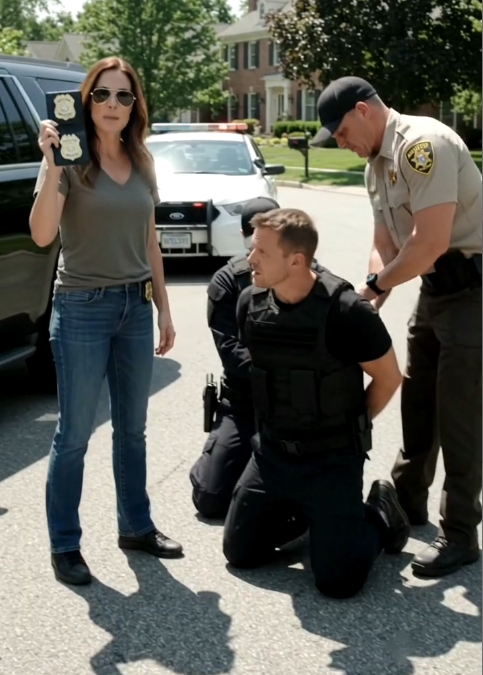
Fake HOA Cops Ambushed My Wife and Tried to Drag Her From Her Car—Then She Flashed Her State Police Badge and Put Them in Handcuffs.
Two men in tactical uniforms trapped my wife’s unmarked car on a rain-soaked street, flashed illegal red-and-blue lights, and threatened to drag her through the window.
They believed a surplus police cruiser, plastic badges, and four months of harassing terrified homeowners had turned them into the law.
What they did not know was that the exhausted woman behind the tinted glass had spent twelve years hunting violent criminals—and she had just quietly called real officers to surround them.
My name is Ben Miller, and I learned that the most dangerous thing in suburbia is not a burglar, a loose dog, or even a teenager with a leaf blower before eight in the morning.
It is a bored middle manager with a clipboard and a small amount of unchallenged authority.
My wife, Nora, and I moved into Meadowlark Crossing three years earlier.
The place was expensive, gated, quiet, and designed to make adults feel they had finally purchased immunity from inconvenience.
The streets curved between large brick homes and perfectly trimmed lawns. The clubhouse had a pool, two tennis courts, and a meeting room where the coffee tasted like somebody had filtered warm regret through cardboard. Every house had tasteful uplighting. Every mailbox matched. Every entrance bed contained the same three shrubs, placed as if by committee vote, which they probably were.
I worked from home as a data analyst.
Most days, I sat in sweatpants staring at spreadsheets and searching for errors created by people who believed commas were optional.
Nora worked for the state police as a violent-crimes detective.
She spent her days looking at the worst decisions human beings could make.
Her hours were ugly.
Her cases were uglier.
When she came home, she wanted a shower, hot food, and silence.
For our first two years, Meadowlark Crossing gave her that.
Then Warren Pike became HOA president.
Warren was fifty-four, retired from regional management at a paper-supply company, and carried himself like civilization had spent decades waiting for him to organize it.
He wore wraparound sunglasses beneath cloudy skies.
He walked with his chest pushed forward.
He referred to ordinary board decisions as operations.
Within his first month, he created the Meadowlark Safety and Security Committee.
He appointed Dennis Pruitt as deputy coordinator.
Dennis was thirty-seven, lived with his mother on Elm Court, and walked a golden retriever while wearing combat boots, cargo pants, and tactical gloves.
Rumor said Dennis had failed the county sheriff’s psychological evaluation twice.
Warren considered that previous law-enforcement experience.
The first change was paperwork.
Yellow slips appeared beneath windshield wipers.
Improper driveway alignment.
Failure to stop for three complete seconds.
Trash container visible after approved hours.
Holiday wreath displayed nine days beyond approved seasonal window.
Dog off leash while retrieving mail.
Unauthorized basketball hoop angle.
The second change cost money.
Warren pushed a special assessment through a Tuesday-night meeting attended by eleven homeowners.
The HOA bought a decommissioned 2011 Ford Crown Victoria.
It was painted white.
Aggressive black lettering appeared on both doors:
MEADOWLARK CROSSING PATROL.
At the annual block party, Warren stood beside it holding a plastic cup of beer.
“It’s a deterrent,” he announced.
“Crime is spreading from the city. We’re securing the perimeter.”
“We live twenty miles from downtown behind an electronic gate,” I said. “The biggest crime here is what the landscaping company charges.”
Warren adjusted his sunglasses.
PART2:
“Complacency is the enemy of security, Ben.”
I told Nora about the car that night.
She had just finished a twelve-hour shift.
She sat on the couch rubbing her temples.
“He bought a police cruiser?”
“Surplus Crown Vic. Spotlight, push bumper, everything.”
“As long as he doesn’t install red-and-blue lights, impersonate an officer, or detain people, it’s probably legal.”
“Stupid, but legal?”
“Very stupid.”
She closed her eyes.
“Please stay away from him. I deal with fragile egos wearing real badges. I don’t want one living down the street with a fake one.”
I promised.
Then Warren started pulling people over.
The first time he stopped me, I was returning from the grocery store.
Amber-and-white lights exploded in my mirror.
A siren gave two sharp blasts.
Warren approached slowly, placed one hand on my trunk like a real patrol officer, and demanded my license.
He wore a navy tactical shirt, duty belt, body camera, pepper spray, handcuffs, and a gold plastic badge.
“You’re not a police officer,” I said.
“This is a private community,” he replied. “Section Four authorizes traffic enforcement.”
He gave me a $150 HOA ticket for rolling through a stop sign and driving twenty-two miles per hour in a fifteen zone.
That night, Nora dropped the ticket into the trash.
“Don’t pay it,” she said.
“But do not provoke him.”
“What he did was illegal.”
“He’s standing on a very thin line.”
“Then arrest him.”
She looked at me with exhausted eyes.
PART3:
“I have three homicide files open. Unless Warren does something spectacularly stupid, I do not have the time to build an impersonation case against a retired paper salesman.”
Five weeks later, on a freezing November night, Warren did something spectacularly stupid.
He stopped Nora.
Not me.
Not a nervous retiree.
Not a teenager with tinted windows.
Nora.
It had been raining since dinner.
Not soft rain.
Cold, slanted, November rain that seemed personally offended by skin.
I was home alone, reheating soup and watching the driveway camera because Nora had texted that she was finally leaving headquarters.
Her shift had run fourteen hours. She had been working a case involving a violent home invasion two counties over. She sounded tired even through text.
Leaving now.
That was all she sent.
I replied:
Soup’s hot. Don’t murder anyone on the way home.
She sent back:
No promises.
Twenty-six minutes later, my phone rang.
Nora.
I answered with, “You okay?”
Her voice was low.
Too calm.
That was never good.
“Ben, listen carefully. I’m on Wrenford Lane near the south pond. Meadowlark Patrol just boxed me in.”
I stood so fast my chair hit the wall.
“What?”
“Warren’s Crown Vic is behind me. Dennis has another vehicle angled in front. They’re using red-and-blue lights.”
My stomach dropped.
“Red and blue?”
“Yes.”
“Are you safe?”
“For now.”
I could hear rain hitting her windshield.
I could hear a muffled male voice outside the car.
“Ma’am, step out of the vehicle.”
Nora did not answer him.
Instead, she said quietly, “I’m on speaker. Don’t say my job title.”
I understood immediately.
“Okay.”
“I already called county dispatch. State Police notified. Stay in the house unless I tell you otherwise.”
“I’m coming.”
“No.”
“Nora—”
“Ben.”
One word.
Sharp.
Command voice.
I stopped.
“Stay home. Record any incoming calls. Save everything.”
Outside her car, Warren’s voice got louder.
“This is a community safety stop. You are required to comply.”
Nora said, “I need to go.”
The call ended.
For three seconds, I just stood in the kitchen holding the phone.
Then I opened the neighborhood camera app.
Our HOA had installed cameras at entrances, the clubhouse, the pond, and several intersections after Warren’s safety initiative. Ironically, the same surveillance system he used to scare teenagers out of riding bikes after dusk gave me a perfect view of Wrenford Lane.
The south pond camera showed it all.
Nora’s dark gray unmarked sedan sat near the curb with its headlights on. Warren’s white Crown Vic was behind her, angled close enough that she could not back up. A black pickup with an amber light bar sat in front, blocking her forward exit. Dennis stood near the driver’s side with a flashlight. Warren stood several feet behind him, one hand on his belt, the other holding what looked like a citation clipboard.
Red-and-blue lights flashed from the Crown Vic’s windshield.
Not amber.
Not white.
Red and blue.
Nora had not exaggerated.
My phone buzzed.
Linda Alvarez, our neighbor across the street.
Did Warren just stop Nora?
I typed:
Yes. Stay inside. Record from window if you can.
Another message came from Charles Whitman, retired accountant, professional worrier, owner of the smallest dog in the neighborhood.
Is something happening near pond? I see lights.
I wrote:
Stay back.
Then I downloaded the camera feed.
Outside, rain ran down the glass of my kitchen window. The blue flashes from the distant patrol lights pulsed faintly through the trees.
I wanted to get in my truck and drive there.
Every instinct in my body told me to go.
But Nora had told me not to.
And Nora did not give instructions casually.
On Wrenford Lane, Dennis knocked on her driver’s window with his flashlight.
The camera had no audio from that distance, but I could imagine his voice.
Step out.
Ma’am.
Step out now.
Nora lowered her window two inches.
Dennis leaned in.
Warren moved closer.
The rain made his tactical shirt cling to him. He wore a black vest now, with a patch across the front that said SAFETY ENFORCEMENT. Dennis wore one too. Both had duty belts with flashlights, pepper spray, handcuffs, radios, and cheap metal badges reflecting the flashing lights.
They looked like police to anyone scared enough not to look carefully.
That was the point.
Nora later told me the conversation word for word because, of course, she had recorded it.
“License and registration,” Dennis said.
Nora looked at him through the narrow opening.
“Who are you?”
“Meadowlark Crossing Patrol.”
“That’s not a law-enforcement agency.”
“You were speeding and failed to obey community traffic control.”
“Move your vehicle.”
Dennis leaned closer.
“Ma’am, your attitude is escalating this stop.”
From behind him, Warren said, “You are required to comply with community patrol personnel inside Meadowlark Crossing.”
Nora stared at him.
“No, I am not.”
Warren smiled.
It was the kind of smile used by men who had never met real consequences.
“Then we’ll detain you until county arrives.”
Nora tilted her head slightly.
“On what authority?”
“HOA covenant enforcement.”
“Covenants don’t authorize detention.”
“You signed them when you bought here.”
“No. My husband and I agreed to civil restrictive covenants. We did not waive constitutional rights to two civilians with a used Crown Vic.”
Dennis’s jaw tightened.
“You need to step out of the car.”
“No.”
“Step out.”
“No.”
Warren moved closer to the window.
“If you refuse, we can remove you.”
Nora looked at him.
“Try.”
That was the moment I knew things were about to get worse.
Not because Nora was bluffing.
Because she wasn’t.
Dennis looked back at Warren.
Warren gave one short nod.
Dennis reached through the window gap.
His hand went toward the lock.
Nora moved faster than the camera could show.
Her left hand caught his wrist and pinned it against the door frame hard enough that he bent forward with a grunt.
Inside the car, her right hand stayed low.
Not visible.
Probably near her weapon.
Her voice came through the recording later, completely flat.
“Remove your hand from my vehicle.”
Dennis yanked backward.
“Assault!”
Warren shouted, “She assaulted patrol!”
Nora said, “Your man inserted his hand into my car.”
Dennis shook his wrist.
“You’re under detention.”
“No, Dennis. I’m not.”
He froze.
“How do you know my name?”
Nora did not answer.
Because she knew everyone’s name.
Once Warren’s patrol started harassing people, Nora had done what Nora did.
Quietly.
Privately.
Completely.
She had pulled meeting minutes, security invoices, patrol schedules, vehicle registration, HOA insurance certificates, incident reports, and resident complaints. She had screenshotted social-media posts where Warren bragged about “restoring order.” She had saved video of Dennis activating amber lights behind a delivery driver. She had kept copies of every ticket. She had asked me to forward every resident message I received.
She had not been building a neighborhood complaint.
She had been building a file.
The rain intensified.
On the camera feed, Warren moved toward the passenger side of Nora’s car.
The Crown Vic’s lights painted the wet pavement red, then blue, then red again.
A few residents had begun watching from porches.
Nobody approached.
People were scared of Warren now.
That was the thing outsiders might not understand.
It sounded ridiculous.
Fake HOA cops.
Plastic badges.
A retired paper manager playing sheriff.
But fear does not require legitimate authority.
It only requires enough people believing resistance will cost them.
Warren and Dennis had spent four months teaching Meadowlark Crossing that lesson.
A teenager had been fined for “evading patrol” after riding his bike away from Dennis.
A single mother named Priya had been pulled over while taking her sick child to urgent care because her visitor tag was expired.
An elderly man had been threatened with towing because he parked a contractor van near his garage.
A delivery driver had been handcuffed for six minutes after refusing to let Warren search his truck.
Nobody called it criminal.
They called it overzealous.
A misunderstanding.
A private community issue.
Warren used that space well.
He lived in the gray area between annoying and unlawful.
Until he chose Nora’s car.
On the camera, Dennis stepped back and pulled something from his belt.
Pepper spray.
My hands went cold.
Then Nora’s headlights flashed twice.
Not random.
A signal.
Seconds later, headlights appeared at the far end of Wrenford Lane.
One car.
Then another.
Then a third.
Dark vehicles moving without lights flashing.
They stopped just beyond the curve.
Warren did not see them at first.
Dennis did.
He turned.
County deputies exited the first vehicle.
Two marked cruisers rolled in behind them with lights off until they were close enough to block both exits.
Then red and blue filled the street for real.
Everything changed.
Warren’s fake lights looked suddenly pathetic beside actual law enforcement.
Dennis lowered the pepper spray.
Nora’s driver’s door opened.
She stepped out slowly.
Rain hit her dark jacket and ran down her face. She looked exhausted, furious, and absolutely steady.
Her badge was in her left hand.
Not raised dramatically.
Just visible.
State Police.
Detective Nora Miller.
Dennis stared.
Warren stopped moving.
The county sergeant on scene, a broad-shouldered man named Sergeant Paul Reardon, approached with one hand resting near his holster.
“Everybody keep your hands where I can see them.”
Warren immediately said, “Sergeant, thank goodness. This woman assaulted one of our patrol officers.”
Reardon looked at him.
“Your what?”
“Our patrol officer.”
Reardon’s eyes moved to Dennis’s vest.
Then to the Crown Vic.
Then to Nora.
“Detective Miller, you all right?”
Warren’s mouth opened.
Nora nodded.
“I’m fine.”
“Did either of them identify as law enforcement?”
“They stated I was required to comply with community patrol personnel. They used red-and-blue emergency lights. They blocked my vehicle front and rear. They attempted entry through my driver’s window. They threatened detention.”
Warren said, “That is not an accurate characterization.”
Nora looked at him.
“Warren, my recorder has been running since you activated the lights.”
The rain seemed louder after that.
Dennis turned pale.
Reardon looked toward the Crown Vic.
“Who owns that vehicle?”
“The association,” Warren said quickly.
“Who installed the red-and-blue lights?”
Warren hesitated.
“They’re safety lights.”
“They’re emergency colors.”
“We’re a gated community.”
“That’s not an answer.”
Dennis tried to speak.
“Sergeant, we were just enforcing HOA traffic—”
Reardon cut him off.
“Stop talking.”
Another deputy moved to the Crown Vic.
He photographed the dashboard light system.
The windshield strobes.
The siren box.
The fake citation pad on the passenger seat.
The duty belts.
The plastic badges.
The body cameras.
Everything.
Then Reardon looked at Nora.
“You want to handle this?”
Nora wiped rain from her face.
“No. I’m the victim and witness. County can make the arrests.”
Warren made a strangled sound.
“Arrests?”
Nora looked at him.
For the first time that night, she smiled.
Not kindly.
“Yes, Warren. That’s what happens when fake cops detain a real one.”
Dennis stepped backward.
A deputy caught his arm.
“Hands behind your back.”
Dennis looked at Warren.
Warren looked at Reardon.
“This is absurd. I am the HOA president.”
Reardon nodded.
“Congratulations.”
Another deputy took Warren’s arm.
“You can explain that downtown.”
“You cannot arrest me for enforcing community rules.”
Reardon said, “We’re not arresting you for enforcing community rules.”
He looked toward the Crown Vic.
“We’re arresting you because you used a vehicle equipped with illegal emergency lights to stop a motorist, blocked her movement, threatened detention, and attempted to remove her from her car without lawful authority.”
Warren’s face went slack.
Nora added, “And because you did it after months of documented prior conduct.”
Warren looked at her.
“What?”
Nora tilted her head toward meadows, windows, porches, cameras, and residents watching from the dark.
“You thought people were just scared. You didn’t realize scared people save things.”
By the time Warren and Dennis were cuffed, half of Meadowlark Crossing was watching from behind blinds.
I watched from my kitchen, shaking.
Not from fear anymore.
From relief.
Nora called me nine minutes later.
“I’m okay.”
I closed my eyes.
“Do I get to come now?”
“No.”
“Nora.”
“I need to give a statement. Stay home.”
“I hate this.”
“I know.”
Pause.
Then softer:
“Soup still hot?”
“No.”
“Can you reheat it?”
I laughed because if I didn’t, I was going to cry.
“Yes.”
“Good. I’ll be home eventually.”
Eventually turned into nearly three hours.
By the time she walked through the front door, her hair was damp, her boots were muddy, and her face had the drained look she got after terrible cases.
I wanted to hug her.
She lifted one hand.
“Let me take off the wet jacket first.”
I waited.
She removed the jacket, badge case, sidearm, spare magazine, and radio she had been carrying from work. She placed everything carefully where it belonged.
Then she came into my arms.
For a while, neither of us spoke.
Finally I said, “Are you actually okay?”
She nodded against my shoulder.
“Angry.”
“Yeah.”
“Tired.”
“Yeah.”
“Hungry.”
“Soup.”
“Good.”
We ate at the kitchen island while rain tapped the windows and my phone vibrated nonstop with neighborhood messages.
Did Nora arrest Warren?
Is Dennis really in jail?
Were the lights illegal?
Can we get our fines back?
Are we allowed to talk about this?
Nora watched the messages appear and said, “Now everyone wants to be brave.”
I looked at her.
“That sounds harsh.”
“It is harsh.”
She took a spoonful of soup.
“But it’s also human.”
The next morning, Meadowlark Crossing looked different.
Nothing physical had changed.
The lawns were still trimmed.
The mailboxes still matched.
The clubhouse still smelled like bad coffee.
But the illusion was broken.
Warren’s Crown Vic was gone.
Dennis’s pickup was gone.
The fake tickets were suddenly less terrifying.
At 8:12, the HOA portal went offline.
At 9:30, the board sent a statement.
Meadowlark Crossing Homeowners Association is aware of an incident involving volunteer safety personnel. The association is cooperating fully with authorities. Patrol operations are temporarily suspended pending review.
Nora read it over my shoulder.
“Volunteer safety personnel.”
“That’s generous.”
“That’s fiction.”
By noon, residents began gathering in small clusters near mailboxes.
Nobody used the word scared at first.
They used HOA language.
Concerned.
Confused.
Uncomfortable.
Seeking clarification.
Then Priya stood outside the clubhouse with her son beside her and said, “He blocked my car when I was taking Arjun to urgent care.”
That opened it.
An older couple said Warren had threatened to fine them $800 for refusing to let Dennis inspect their garage after a “suspicious odor” complaint that turned out to be paint thinner.
A teenage girl admitted Dennis had followed her home at night because she was “walking after approved quiet hours.”
A delivery driver submitted video of Warren standing with one hand on his fake badge demanding to search a van.
A contractor produced footage of Dennis saying, “In this community, we are the law.”
That clip spread fast.
Not publicly at first.
Inside resident chats.
Then outside.
By evening, local news vans were parked beyond the gate.
Nora hated that part.
She hated being named.
She hated that people praised her as if she had staged some cinematic takedown rather than called dispatch, stayed calm, and waited for the real officers to arrive.
She especially hated Warren’s lawyer’s statement.
Mr. Pike believed he was acting under authority granted by the HOA governing documents and denies any intent to impersonate law enforcement.
Nora read it aloud at the kitchen table.
Then she looked at me.
“Intent is going to have a hard time explaining the red-and-blue lights.”
The investigation widened.
The county sheriff’s office handled the stop itself.
State Police internal affairs confirmed Nora’s role as victim and witness, not primary investigator.
The county attorney requested HOA records.
Security committee minutes.
Invoices.
Training materials.
Vehicle modifications.
Ticket logs.
Body-camera footage.
Resident complaints.
Insurance communications.
That was when the paper trail became worse than the video.
Warren had created written “patrol procedures.”
The first page warned committee members not to use the word police.
The second page instructed them to approach vehicles “consistent with law-enforcement safety protocol.”
The third page described “temporary detention pending county response.”
The fourth page contained a chart titled:
ESCALATION MATRIX.
Level One: Verbal warning.
Level Two: HOA citation.
Level Three: Vehicle block.
Level Four: Compliance hold.
Compliance hold.
That was Warren’s phrase for handcuffing people.
Dennis had signed the training acknowledgment.
So had three other volunteers.
One of them resigned immediately and gave a statement saying he had quit after Warren told him, “People obey uniforms before they obey documents.”
That sentence became important.
Nora had been saying something similar for weeks.
Warren did not merely want safety.
He wanted submission.
The HOA board tried to distance itself.
They claimed the security committee had exceeded its authority.
That might have worked if the invoices had not existed.
The board had approved the Crown Vic purchase.
Approved the light installation.
Approved the patrol uniforms.
Approved body cameras.
Approved citation pads.
Approved a contract with a private training consultant who had once been fired from a bail-enforcement company.
Most board members insisted they did not know about the red-and-blue lights.
Maybe that was true.
Maybe they had simply not wanted to know.
Nora had a name for that.
“Administrative blindness.”
It sounded polite.
It was not.
The emergency homeowners meeting happened nine days later.
The clubhouse had never been so full.
People stood along the walls.
Others watched through the windows.
Warren was not there.
Dennis was not there.
Their chairs at the front table sat empty in a way that felt almost satisfying.
Acting board secretary Elaine Porter opened with a prepared statement about transparency, community trust, and moving forward together.
Priya stood before Elaine finished.
“My child was in pain when they stopped me.”
Elaine blinked.
“I understand emotions are high.”
“No,” Priya said. “You do not understand. My son was crying in the back seat, and Dennis stood in front of my car with his hand on his pepper spray because my visitor tag was expired.”
Nobody interrupted.
Priya’s voice shook.
“I paid the fine because I was afraid he would follow me again.”
An older man named Mr. Han stood next.
“They blocked my contractor from leaving because Warren said the van smelled like chemicals. It was cabinet stain. They made him open the doors.”
Another woman stood.
“My daughter stopped walking the dog at night because Dennis followed her with that spotlight.”
More people spoke.
A retired firefighter said the patrol vehicle’s lighting setup was illegal and dangerous.
A nurse said Warren had delayed her leaving for a night shift because he wanted to “verify medical credentials.”
A college student said Dennis had told him he could be banned from the community roads if he continued to “evade patrol observation.”
For nearly an hour, the room emptied itself of fear.
Then someone asked the question everyone had been avoiding.
“How much money did they take in fines?”
Elaine looked down.
Treasurer Martin Choi opened a folder.
“Over the last four months, the association collected approximately forty-eight thousand dollars in security-related citations.”
The room erupted.
“Forty-eight thousand?”
“For fake tickets?”
“Where did it go?”
Martin lifted both hands.
“Some remains in the operating account. Some offset patrol expenses.”
“Patrol expenses?” Priya said.
“You mean we paid for the people harassing us?”
Martin looked sick.
“Yes.”
That was the moment the board lost the room.
Nora stood near the back with her arms folded.
She did not speak.
People kept looking at her, waiting.
She hated that too.
Finally, Linda Alvarez—different Linda from other stories, every neighborhood has at least one—called from the second row, “Detective Miller, can they keep our money?”
Nora’s face did not change.
“I’m not your attorney.”
A few people chuckled nervously.
She continued, “But I would suggest you request a full accounting, preserve every ticket, payment receipt, video, email, and message, and consult counsel as a group.”
Warren would have turned that into a speech.
Nora turned it into homework.
That was why people listened.
A motion was made to suspend all security enforcement permanently.
Passed.
A motion to refund all security-related citations pending legal review.
Passed.
A motion to remove Warren as HOA president.
Passed unanimously, including by board members who had once praised him for “restoring order.”
A motion to dissolve the Meadowlark Safety and Security Committee.
Passed with applause.
Nora leaned toward me.
“HOA meetings should not have applause.”
“They should when fake cops lose.”
She almost smiled.
The legal process took longer.
It always does.
Warren’s case did not become the theatrical headline people wanted. He was not dragged off to prison for life because he bought a used Crown Vic and developed a fantasy. The charges were serious, but specific: impersonation-related offenses, unlawful detention, misuse of emergency lighting, and other counts connected to the stop and prior incidents.
Dennis faced similar charges, along with additional issues tied to the delivery driver handcuffing incident.
Their lawyers argued they believed the HOA gave them authority.
The recordings made that argument complicated.
Especially Nora’s.
The audio from her stop was clear.
“Step out of the vehicle.”
“No.”
“You are required to comply.”
“No, I am not.”
“We can remove you.”
“Try.”
Dennis reaching through the window.
Nora pinning his wrist.
Warren shouting “She assaulted patrol!”
Then actual officers arriving.
Actual law arriving.
The difference was brutal.
The Crown Vic became evidence.
The red-and-blue light system came out.
The siren came out.
The fake badges came out.
The HOA later sold the car, after repainting it, to a man who planned to use it in low-budget films.
That felt appropriate.
Refunds took two months.
Not everyone got everything back immediately. Some fines had been combined with legitimate HOA dues. Some payments were disputed. Some records were messy. But eventually, every security citation was voided.
Meadowlark’s insurance carrier was not amused.
The HOA’s premium went up.
The board looked older by Christmas.
Nora did not care.
“You know what bothers me most?” she asked one night.
We were sitting on the couch, the way we used to before Warren turned our neighborhood into a community-theater police state.
“What?”
“He could have hurt somebody.”
“He did hurt people.”
“I mean physically.”
She stared at the dark television screen.
“If Dennis had reached into the wrong person’s car, if somebody had panicked, if a resident had been armed, if a real officer responding fast had misunderstood the scene…”
She shook her head.
“All because Warren wanted to feel important.”
That was the core of it.
People thought the danger came from the fake lights.
The badge.
The handcuffs.
The Crown Vic.
But those were tools.
The real danger was a man who wanted authority more than responsibility.
Warren liked the feeling of being obeyed.
He liked people rolling down windows.
Handing over licenses.
Lowering their eyes.
Apologizing.
Paying fines.
That feeling was addictive.
The HOA had given him a taste.
Then residents gave him silence.
Then he escalated.
Nora knew escalation.
It was her job to recognize it.
That was why she had saved everything long before the night at Wrenford Lane.
She had known Warren would eventually do something spectacularly stupid.
She just had not known he would do it to her.
Months later, Meadowlark Crossing changed its rules.
The new board amended the covenants to prohibit any private patrol from using vehicles resembling law-enforcement cars, emergency-colored lights, duty belts, badges, detention language, traffic stops, or citation forms designed to mimic government tickets.
The wording was painfully specific.
That specificity was Warren’s legacy.
There were no more patrol stops.
No more “compliance holds.”
No more private traffic enforcement.
The speed signs remained.
The stop signs remained.
The gate remained.
The neighborhood somehow survived.
People still forgot trash cans.
Teenagers still rolled through stop signs on bicycles.
Dogs still barked.
Civilization did not collapse.
One afternoon in spring, I saw Nora standing near the south pond.
The same spot.
Wrenford Lane looked peaceful in daylight.
Water moving slightly in the wind.
Ducks near the reeds.
No flashing lights.
No Crown Vic.
No Warren.
I walked up beside her.
“You okay?”
She nodded.
“Just thinking.”
“About that night?”
“About how many people watched before anyone called.”
I did not answer.
She was not accusing them exactly.
Not excusing them either.
“Fear teaches people to wait for someone else,” she said.
“Then what teaches them to stop waiting?”
She looked toward the clubhouse.
“Usually consequences.”
A few days later, Priya left a casserole on our porch with a note.
Thank you for not letting them make fear normal.
Nora read it and got quiet.
I asked if she was okay.
She nodded.
“That’s a good sentence.”
We kept the note.
Not because Nora needed thanks.
She hated public praise.
But because it named the thing Warren had tried to do.
Make fear normal.
Make fake authority feel inevitable.
Make neighbors believe that if a man had a uniform, a light bar, and the confidence to shout, they should comply first and question later.
That is how small tyrannies grow.
Not all at once.
Not with a coup.
With tickets under windshield wipers.
With harmless-looking committees.
With phrases like community safety.
With residents too busy, tired, polite, or frightened to ask, “Who gave you this power?”
Nora asked that question in a rainstorm with two vehicles blocking her car.
Warren had no answer.
He had paperwork.
He had a badge.
He had lights.
He had a vest.
He had Dennis.
He had months of practice intimidating people who did not know how far he could go.
But when real officers arrived, none of that became law.
It became evidence.
That was the lesson Meadowlark Crossing needed.
Authority is not a costume.
A badge is not decoration.
A siren is not a toy.
A uniform does not make a person lawful.
Power without limits is not safety.
It is danger with better branding.
Nora still works violent crimes.
She still comes home tired.
She still wants a shower, hot food, and silence.
Most nights, Meadowlark gives her that again.
Sometimes we walk after dinner.
Past the clubhouse.
Past the tennis courts.
Past the south pond.
When we reach Wrenford Lane, I still see the flashing lights in my memory.
Red.
Blue.
Rain.
Dennis leaning into the window.
Warren smiling.
Nora’s calm voice through the phone.
Stay home.
Record everything.
Then I remember what happened next.
Real headlights at the curve.
Real officers stepping out.
Warren’s confidence breaking.
Dennis lowering the pepper spray.
Nora standing in the rain with her badge in her hand.
Not because she needed to prove she mattered.
Because Warren needed to learn that authority is not something you can print, purchase, or vote into existence during a poorly attended HOA meeting.
A year after the incident, the new HOA president asked Nora if she would consider joining the safety committee.
She stared at him until he looked physically uncomfortable.
“We don’t have one anymore,” he added quickly.
“Good,” she said.
Then kept walking.
I laughed for two blocks.
Meadowlark Crossing is still gated.
Still expensive.
Still full of people who complain too much about mulch color and dog waste stations.
But it is quieter now.
Not perfect.
Just quieter.
The way we hoped it would be when we moved there.
The fake tickets are gone.
The fake badges are gone.
The Crown Vic is gone.
Warren’s name still comes up occasionally, usually in embarrassed tones.
Dennis moved out of his mother’s house after the case resolved. Nobody knows where he went. I hope somewhere with fewer tactical catalogues.
As for Warren, the last time I saw him was outside the county courthouse after a hearing. He looked smaller without the sunglasses. Without the vest. Without the car. Without Dennis at his side.
He saw Nora and looked away.
She did not.
She watched him walk past, then turned to me.
“He still thinks he was misunderstood.”
“How can you tell?”
“He looked angry, not ashamed.”
I thought about that.
Then I looked toward the courthouse steps.
“Do you think people like that ever understand?”
“Some do.”
“And the others?”
She shrugged.
“The rest become examples.”
That was what Warren became.
An example.
At the next homeowner orientation, the new board included a slide titled:
Private Security Limitations.
It explained, in plain language, that HOA personnel could not pull vehicles over, demand identification, detain residents, search vehicles, use emergency lights, or present themselves as police.
Someone had added a final line at the bottom.
When in doubt, call actual law enforcement.
I appreciated the word actual.
Nora did too.
She took a picture.
“Sentimental?” I asked.
“Evidence that the species can learn.”
“That’s almost optimistic.”
“Don’t get used to it.”
We walked home under streetlights that looked much less dramatic without red-and-blue reflections bouncing off wet pavement.
Our house was warm.
The neighborhood was still.
And for once, nobody was pretending to patrol anything.
That night, as Nora hung her jacket by the door, I noticed the faint bruise on her wrist from where Dennis had tried to reach through the window.
It had nearly faded.
She saw me looking.
“It’s fine.”
“I know.”
“It could have been worse.”
“I know that too.”
She touched my arm.
“But it wasn’t.”
No.
It wasn’t.
Because she had stayed calm.
Because she had documented everything.
Because she had called real officers.
Because a man who believed costume authority was enough finally tried it on someone who understood the difference between theater and law.
The story people tell now is simple.
Fake HOA cops ambushed my wife.
She showed her State Police badge.
They ended up in cuffs.
That version is satisfying.
It is also incomplete.
The real story began months earlier, when a neighborhood mistook irritation for safety and let a bored man build a uniform around his ego.
It grew every time someone paid a fake fine just to avoid trouble.
It sharpened every time Warren learned that fear worked faster than rules.
It nearly became violence on a rain-soaked street where two men believed flashing lights could turn private arrogance into public authority.
And it ended because Nora knew something Warren never did.
Real power does not need to pretend.
It arrives quietly.
It asks clear questions.
It records facts.
It waits for lawful authority.
Then, when the moment comes, it takes the fake badge, the fake lights, the fake patrol, and the fake courage—and lays them all on the hood of a real cruiser as evidence.
That is how Meadowlark Crossing got its silence back.
Not because Warren protected us.
Because Nora stopped him.