Fake HOA Cop Dragged My 15-Year-Old Daughter by Her Hair—Then I Stepped Out With My Pistol and His Entire “Authority” Collapsed in Minutes.
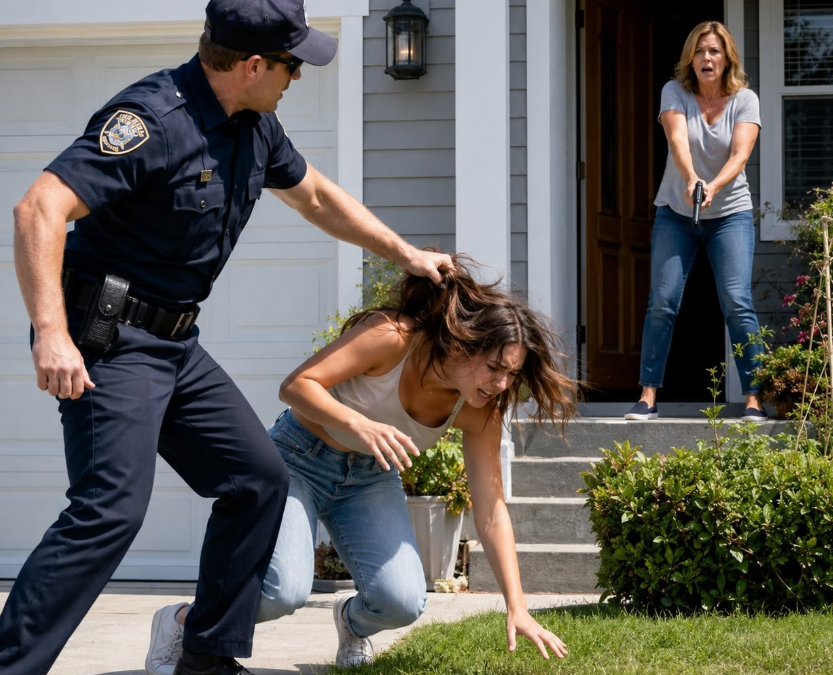
Fake HOA Cop Dragged My 15-Year-Old Daughter by Her Hair—Then I Stepped Out With My Pistol and His Entire “Authority” Collapsed in Minutes.
The man in the black “HOA Enforcement” vest had a fistful of my fifteen-year-old daughter’s hair and was dragging her across our living-room floor when I stepped out of the hallway.
My wife was on the floor behind him, Mia was screaming for me, and the stranger kept pulling her toward our front door while insisting that some made-up “HOA protocol” gave him the authority to take a minor from her own home.
I had been trying to stay patient with the neighborhood for three weeks, but when I raised the loaded pistol and told him to let go of my daughter, the entire lie Barbara Kellerman had built around her fake authority was about to collapse in less than ten minutes.
We had lived in the neighborhood for twenty-two days.
That was it.
Twenty-two days.
Not enough time to learn which neighbors left for work before sunrise.
Not enough time to remember every street name without looking at the GPS.
Not enough time to decide whether the grocery store on the north side of town was worth the extra seven-minute drive.
But apparently it was more than enough time for Barbara Kellerman, president of the homeowners association, to decide my fifteen-year-old daughter represented a threat to civilization.
Her name is Mia.
If you met her for five minutes, you would understand how ridiculous that was.
Mia reads.
Draws.
Listens to music through one earbud because her mother has spent years telling her she needs to hear if someone calls her name.
She can sit cross-legged on the same couch for four hours sketching faces from photographs.
She does not throw parties.
She does not sneak out.
She does not scream at neighbors.
She does not blast music.
She barely talks to strangers unless they speak first.
When we moved in, she spent the first weekend organizing her bookshelves by color.
That was the rebellion level we were dealing with.
Barbara saw something else.
The first time she met Mia, my daughter was sitting on our own porch railing with a sketchbook balanced on her knees.
Barbara was walking past with another woman.
She stopped.
Looked at Mia.
Then said, not quite quietly enough, “Another loud teenager ruining the neighborhood aesthetic.”
Mia looked up.
She was wearing headphones.
One ear uncovered.
She heard every word.
She said nothing.
That was Mia.
She told us at dinner.
My wife, Sarah, frowned.
“Did you say anything?”
“No.”
“Why not?”
Mia shrugged.
“She’s old.”
I almost choked on my drink.
Sarah gave me the look.
The one that means:
Do not encourage this.
I looked down at my plate.
“Very mature response.”
Mia smiled.
“Thank you.”
Sarah pointed her fork at both of us.
“I live with children.”
That should have been the whole incident.
An unpleasant HOA president said something rude.
Teenager ignored her.
Life continued.
PART2″
Instead, Barbara began documenting Mia.
That was the word she used.
Documenting.
Three days later, an HOA warning appeared taped to our front door.
PORCH USE — IMPROPER SEATING / SAFETY CONCERN
I read it twice.
“Sarah?”
She came over.
“What?”
I handed it to her.
She read.
Then looked toward the porch railing.
“They’re serious?”
“Apparently.”
Mia came downstairs.
“What happened?”
I held up the paper.
“You have been convicted of sitting.”
She stared.
“On the porch?”
“Very serious offense.”
“Do I get a lawyer?”
“Not at these rates.”
Sarah sighed.
“Stop.”
I looked at the HOA covenants.
There was a general rule about keeping common areas unobstructed.
Our porch was private.
Nothing about railings.
Nothing about teenagers.
I put the notice into a folder.
I had learned a long time ago that throwing paperwork away because it is stupid only makes it harder to prove later that someone was being stupid.
Four days after that came another warning.
DRIVEWAY CLUTTER — BICYCLE PLACEMENT.
Mia’s bike had been leaning against the side of our garage.
Not on the sidewalk.
Not in the roadway.
Our driveway.
I checked the covenants again.
No violation.
Folder.
Then came the one that made Sarah march across the neighborhood to Barbara’s house.
IMPROPER PUBLIC DECORUM.
Sarah stood in the kitchen holding the paper.
“What is this?”
I read it.
Apparently Mia had been observed “engaging in disruptive vocal behavior in an exterior residential zone.”
I looked at my daughter.
“What did you do?”
She stared.
“Nothing.”
“You sure?”
She thought.
Then her eyes changed.
“Oh.”
“What?”
“I laughed.”
Sarah closed her eyes.
I said, “You laughed.”
“My friend sent me something.”
“Outside?”
“On the sidewalk.”
“How long?”
“I don’t know. Two seconds?”
I looked back at the notice.
“Disruptive vocal behavior.”
Mia sank onto a stool.
“Am I allowed to breathe here?”
That one landed harder than she probably meant it to.
Because I could hear the hurt under the joke.
We had moved because I got a better job.
Because Sarah wanted a quieter school district.
Because Mia had been bullied in eighth grade by girls who found out she liked drawing fantasy portraits and decided that meant she was weird enough to target.
We told her this place would be a fresh start.
A safer neighborhood.
A bigger room.
A better school.
A place where she could breathe.
Then, within three weeks, an adult woman with a clipboard had turned my shy daughter into a neighborhood problem.
Sarah went to Barbara’s house that evening.
I wanted to go.
Sarah told me not to.
“You will make it worse.”
“I will be calm.”
“You think you will be calm.”
“That is almost the same thing.”
“It is not.”
So Sarah went.
She returned nineteen minutes later with a face I had seen only twice in our marriage.
Once when a drunk driver clipped her car with Mia in the back seat.
Once when a school administrator tried to explain bullying as “social conflict.”
This was the third.
“What happened?” I asked.
Sarah put her purse on the counter with surgical precision.
“Barbara says Mia has been identified as a pattern concern.”
“A what?”
“A pattern concern.”
Mia was halfway down the stairs.
She stopped.
Sarah noticed and softened immediately.
“Honey, go back upstairs.”
“No,” Mia said.
“Mia.”
“She said that about me?”
Sarah did not answer fast enough.
That was answer enough.
My daughter walked back upstairs quietly.
The door closed.
I looked at Sarah.
“What else did Barbara say?”
Sarah folded her arms tight against herself.
“She said teenagers create liability. She said our home is on a visible corner. She said the HOA has a duty to monitor behavior that may affect community comfort.”
“Community comfort.”
“That is exactly what she said.”
I laughed once.
Not because it was funny.
Because rage sometimes looks for the wrong exit.
Sarah’s voice lowered.
“She also said if Mia continued to ignore guidance, the HOA could escalate to youth intervention.”
I stared at her.
“What does that mean?”
“I asked.”
“And?”
“She said the board has safety protocols.”
“Safety protocols for what?”
“For minors behaving disruptively in common-view areas.”
“Our daughter was sitting and laughing.”
Sarah nodded.
“I know.”
That night, after Mia went to bed, I opened my laptop.
I searched the HOA portal.
Barbara Kellerman had been president of Maple Ridge Commons for five years.
Retired school administrator.
Chair of the Safety and Conduct Committee.
Founder of something called the Community Standards Response Team.
That name made me stop.
Community Standards Response Team.
I clicked.
The page described volunteers trained to “observe, document, and de-escalate resident misconduct affecting shared neighborhood harmony.”
There were photos.
Mostly older residents in matching navy polos.
Then one man who did not fit.
Large.
Late thirties.
Black wraparound sunglasses.
Tactical boots.
Black vest.
Arms folded.
Name: Troy Haskett.
Role: Enforcement Liaison.
Sarah leaned over my shoulder.
“He looks like a mall cop who failed a background check.”
“He might be worse.”
I clicked his profile.
Former private security contractor.
Current HOA compliance consultant.
Available for after-hours incident response.
A chill went through me.
Not fear exactly.
Recognition.
Some people spend their whole lives looking for a uniform that will let them be cruel without calling it cruelty.
Troy looked like one of them.
The next morning, I installed two more cameras.
One facing the porch.
One covering the driveway.
Sarah asked if that was necessary.
I said, “Probably not.”
That was a lie.
It felt necessary.
Two days later, Troy appeared at our door.
Not Barbara.
Troy.
He stood on the porch wearing black cargo pants, black boots, black shirt, and the black vest from the website.
Across the front, white block letters read:
HOA ENFORCEMENT.
I opened the door but left the screen locked.
“Can I help you?”
“Mr. Whitaker?”
“Yes.”
“My name is Troy Haskett. I’m here on behalf of Maple Ridge Commons.”
“I’m aware.”
He looked past my shoulder into the house.
That alone made me dislike him permanently.
“Is your daughter home?”
“No.”
She was.
Upstairs.
Drawing.
But Troy did not need that information.
He smiled.
It was not friendly.
“We need to discuss minor conduct compliance.”
“No, we don’t.”
“Sir, this can be resolved cooperatively.”
“Then send a letter.”
“We’ve sent several.”
“And I’ve saved them.”
His smile thinned.
“Barbara asked me to make contact personally.”
“Barbara can personally read the covenants before sending another fake violation.”
His eyes shifted.
That hit something.
I continued.
“My daughter has done nothing wrong. Do not speak to her. Do not approach her. Do not photograph her. Do not come onto this porch again unless invited.”
Troy straightened.
“Are you refusing HOA compliance contact?”
“I am refusing harassment.”
“That’s a strong word.”
“It was chosen carefully.”
For a second, he dropped the polite act.
Just a flicker.
Enough.
Then he stepped back.
“We’ll document this interaction.”
I pointed to the camera above the porch.
“So will I.”
He looked up.
His jaw tightened.
Then he left.
That evening, the portal updated.
RESIDENT NONCOOPERATION — FAMILY CONDUCT REVIEW PENDING.
Sarah read it and whispered, “They’re making us sound like criminals.”
I said, “That’s the point.”
Mia pretended not to care.
She cared.
She stopped sitting on the porch.
Stopped walking around the block.
Stopped riding her bike.
She began asking if she was allowed to do things no kid should have to ask.
“Can I get the mail?”
“Can I sit outside?”
“Can I wear headphones on the sidewalk?”
“Can I laugh in the driveway?”
Every question was a cut.
Barbara had not fined us into compliance.
She had frightened a child into shrinking.
That was when I stopped treating the HOA as annoying.
I called an attorney named Rachel Meyers.
She reviewed the notices and said, “This is harassment.”
“Can we stop it?”
“Yes. But document first.”
“I have cameras.”
“Good.”
“I have every notice.”
“Good.”
“I have Troy on video asking if my daughter was home.”
Silence.
Then Rachel said, “Save that twice.”
She sent the HOA a cease-and-desist letter.
It demanded they stop targeting Mia, withdraw all youth-related notices, preserve all communications mentioning our family, and provide the legal authority for any “minor conduct” or “youth intervention” protocols.
Barbara replied personally.
The Association takes seriously its obligation to protect community safety, decorum, and resident well-being.
Rachel read it over the phone.
Then said, “That is a non-answer wearing lipstick.”
I liked Rachel immediately.
Two days passed.
Quiet.
Then three.
Then four.
Mia relaxed a little.
She sat at the kitchen table drawing again.
Sarah slept better.
I began to think maybe the attorney letter had done its job.
That was my mistake.
People like Barbara do not retreat when challenged.
They wait until they can reframe themselves as victims.
The incident happened on a Saturday afternoon.
I was in the back hallway repairing the linen-closet door. The hinge had pulled loose during the move, and I had finally gotten around to fixing it.
Sarah was in the living room folding laundry.
Mia was on the couch, sketchbook open, headphones in one ear.
It was raining lightly outside.
Quiet house.
Normal day.
Then the doorbell rang.
Sarah called, “I’ve got it.”
I heard the front door open.
Muffled voices.
Sarah’s tone changed.
“I’m sorry, what?”
A man answered.
Troy.
“This is an HOA welfare and compliance check.”
“You need to leave.”
“Ma’am, we have authority to verify minor safety.”
“No, you do not.”
I put down the screwdriver.
Started toward the hallway.
Then I heard Barbara’s voice outside.
“Sarah, this will go easier if you cooperate.”
Everything in me went cold.
I moved faster.
Before I reached the living room, the front door hit the wall.
Sarah shouted.
Mia screamed.
Then something crashed.
I came around the corner just enough to see.
Troy was inside my house.
Inside.
One hand had Sarah by the upper arm.
She shoved him away.
He pushed her.
She fell backward against the coffee table and hit the floor.
Mia jumped up from the couch.
“Mom!”
Troy grabbed Mia by the wrist.
She twisted away.
He caught her hair.
A fistful of it.
My daughter screamed.
Not a movie scream.
Not dramatic.
A raw, terrified sound that rewired my body in one second.
Troy pulled her toward the door.
“Minor extraction protocol,” he shouted. “You are interfering with HOA safety authority.”
Barbara stood on the porch behind him, holding a folder.
“Troy, remove her from the residence until police arrive.”
Remove her.
From our home.
My fifteen-year-old daughter.
By her hair.
I stepped back into the hallway.
Not away.
Toward the bedroom.
My pistol was in the quick-access safe mounted inside the closet.
I had owned it for years.
Trained with it.
Kept it locked.
Never imagined I would need it in my own living room.
My hands did not shake when I opened the safe.
That scared me later.
In the moment, I felt nothing but a clean, narrow line of purpose.
I returned to the hallway.
Troy had dragged Mia three more feet.
Sarah was on the floor trying to grab his leg.
Mia was crying, “Dad! Dad!”
I stepped out.
Both hands on the pistol.
Muzzle down at first.
Then up.
“Troy.”
He turned.
The room stopped.
Barbara stopped smiling.
Troy’s eyes went to the gun.
His grip tightened in Mia’s hair.
Wrong choice.
I raised the pistol.
“Let go of my daughter.”
My voice did not sound like mine.
It sounded distant.
Flat.
Older.
Troy swallowed.
“Sir, put the weapon down.”
“Let go of my daughter.”
“We are acting under HOA—”
“Let go.”
Mia was sobbing.
Sarah was frozen on the floor.
Barbara said from the porch, “Mr. Whitaker, you are threatening an authorized enforcement officer.”
I did not look at her.
“If he takes one more step with my child, this ends badly.”
Troy’s face shifted.
The fake authority drained out first.
Then the anger.
Then the calculation.
Slowly, he opened his hand.
Mia stumbled backward and fell against the couch.
Sarah crawled to her and pulled her close.
I kept the pistol on Troy.
“Hands up.”
He lifted them.
“Turn around.”
He did.
“On your knees.”
He hesitated.
“Now.”
He dropped to his knees.
Barbara found her voice again.
“You are committing a felony.”
I looked at her for the first time.
She stood outside my threshold, rain behind her, folder clutched to her chest like paper could protect her.
“You sent a man into my house to drag my child out by her hair.”
“She was subject to youth intervention.”
I could barely process the insanity of that sentence.
“Sarah,” I said without taking my eyes off Troy. “Call 911.”
“She already is,” Mia whispered through sobs.
I glanced.
My daughter had her phone in one trembling hand.
Good girl.
Brave girl.
The dispatcher’s voice came faintly through the speaker.
Mia was crying but speaking.
“He came inside. He grabbed me. My dad has him on the floor. Please come.”
I wanted to go to her.
I could not.
Not yet.
Troy was still between me and the door.
Barbara was still on the porch.
And I did not know if anyone else was outside.
I backed toward the wall so I could see more of the entryway.
“Troy, do not move.”
“This is a misunderstanding,” he said.
His voice had changed completely.
No command tone now.
No enforcement posture.
Just fear wrapped in negotiation.
“No,” I said. “This is burglary, assault, and attempted kidnapping.”
Barbara snapped, “That is outrageous.”
Sarah looked up from the floor.
Her cheek was already swelling.
“You pushed me down.”
Barbara looked at her.
“You interfered with enforcement.”
Sarah’s eyes changed.
If I had not been holding the pistol, I think my wife would have gone through Barbara like weather through paper.
The first sirens arrived in less than four minutes.
Longest four minutes of my life.
When the officers came through the front yard, I called out before they reached the door.
“Homeowner inside. I am armed. Suspect is on his knees. My wife and daughter are injured.”
A voice answered.
“Set the firearm down and step back.”
I did exactly that.
Slowly.
The pistol went onto the floor.
I stepped back.
Hands visible.
Two officers entered.
One covered Troy.
One moved toward me.
I did not argue when he guided me away from the weapon.
I did not argue when he placed me near the hallway wall.
I did not argue when he asked if I had touched the suspect after he got on his knees.
No.
No.
No.
Because this was the difference between real authority and Barbara’s fantasy.
Real authority asked questions.
Real authority secured the weapon.
Real authority checked injuries.
Real authority separated witnesses.
Real authority did not kick in a door and call it protocol.
Officer James Lin handcuffed Troy.
Not me.
Troy kept saying, “I was acting under HOA authority.”
Officer Lin said, “Stop talking.”
Another officer, Carla Ruiz, helped Sarah onto the couch.
A third officer escorted Barbara away from the porch.
Barbara protested loudly.
“This is a civil HOA matter.”
Officer Ruiz looked at Mia’s shaking hands, Sarah’s bruised cheek, the broken lamp, the door dented into the wall, and Troy kneeling in our living room in an HOA Enforcement vest.
“No, ma’am,” she said. “It isn’t.”
Paramedics came.
They checked Mia’s scalp.
A small patch of hair had been ripped loose near her temple.
Her wrist was red where Troy had grabbed her.
Sarah’s hip was bruised.
Her cheek swollen.
The coffee table had cracked where she hit it.
I signed my statement with hands that finally started shaking.
That was when the adrenaline left.
Rachel Meyers arrived before the officers finished.
She walked in wearing jeans, a raincoat, and an expression that made everyone except my family slightly nervous.
She looked at Mia first.
Then Sarah.
Then me.
Then Troy’s vest lying on the floor as evidence.
Finally, she said, “I assume this is the youth intervention protocol.”
I almost laughed.
Almost.
Officer Lin asked Barbara what authority she believed allowed Troy to enter our home.
Barbara produced the folder.
Of course she did.
People like Barbara always believe paper will save them.
Inside were printed screenshots from the HOA portal, copies of our violation notices, minutes from a Safety and Conduct Committee meeting, and a document titled:
MAPLE RIDGE MINOR WELFARE RESPONSE PROTOCOL.
Officer Ruiz read it.
Then read it again.
“Who drafted this?”
Barbara lifted her chin.
“The board approved it.”
“That’s not what I asked.”
“I prepared it with committee input.”
“Are you a judge?”
“No.”
“Police officer?”
“No.”
“Child protective services worker?”
“No.”
“Licensed social worker?”
“No.”
“School official?”
“I am a retired administrator.”
“Currently authorized by any agency to remove minors from private homes?”
Barbara’s mouth tightened.
“This was not a removal. It was a protective extraction.”
Officer Ruiz stared at her.
A beautiful, silent stare.
Then she said, “You are describing a removal.”
Rachel stepped in.
“Officer, my clients previously sent a cease-and-desist regarding harassment of this minor. The HOA was on notice.”
Barbara snapped, “That letter was baseless.”
Rachel looked at her.
“Your enforcement contractor just dragged a fifteen-year-old across her living room by the hair.”
Barbara went pale.
Not from guilt.
From the way the sentence sounded when said plainly in front of police.
Troy and Barbara were both taken into custody that afternoon.
Troy first.
Barbara later, after enough statements were taken and enough video was reviewed.
Yes.
Video.
The porch camera captured Troy arriving.
The living-room camera captured the entryway and part of the assault.
I had installed it to monitor the front hall after the notices started.
I never imagined it would record a grown man dragging my daughter by her hair.
But it did.
Barbara had spent three weeks documenting Mia.
She forgot we were documenting her.
The footage became the end of her power.
There was no spinning it.
No community standards language strong enough.
No safety committee title polished enough.
No HOA covenant broad enough.
The video showed Troy forcing his way in after Sarah told him to leave.
It showed him shoving my wife.
It showed him grabbing Mia.
It showed him pulling her toward the door.
It showed Barbara standing outside with the folder.
It showed me entering with the pistol.
It showed me giving commands.
It showed Troy releasing Mia.
It showed me not firing.
It showed the whole lie.
The neighborhood learned within an hour.
Not from us.
From people who saw police cars.
From Barbara’s friend who had come along and recorded the front yard until an officer told her to back up.
From the HOA portal going dark.
By evening, every resident knew something had happened.
By the next morning, they knew enough.
At first, some tried to defend Barbara.
There are always people who need authority to stay pure because they trusted it too long.
“She must have had a reason.”
“Troy probably overstepped.”
“The family seemed difficult.”
“Teenagers can be manipulative.”
Then the charges became public.
Burglary.
Assault.
Child endangerment.
Unlawful restraint.
Conspiracy allegations under review.
Impersonation-related issues tied to the enforcement vest and claims of authority.
Barbara’s supporters went quiet.
The HOA board called an emergency meeting four days later.
We did not attend in person.
Mia could not even walk past the front door without freezing.
Sarah stayed with her.
I attended by video from our kitchen with Rachel beside me.
The meeting room was packed.
Barbara’s chair at the front was empty.
Troy’s name had already been removed from the HOA website.
The acting president, a nervous man named Alan Cho, began with a statement about “recent unfortunate events.”
Rachel leaned toward my microphone.
“Say assault.”
Alan blinked.
“I’m sorry?”
“Say assault.”
The room shifted.
Alan swallowed.
“Recent events involving alleged assault.”
Rachel said, “Better.”
Then parents started asking questions.
Who approved the protocol?
Who hired Troy?
Who authorized him to approach minors?
Who allowed him to wear enforcement gear?
Who gave Barbara access to resident family information?
Who decided Mia was a “pattern concern”?
Who else had been documented?
That last question changed the meeting.
Because Mia was not the only one.
A twelve-year-old boy had been reported for riding a scooter “aggressively.”
A seventeen-year-old had been photographed sitting in her parked car too long.
Two brothers had been written up for “unsupervised loitering” while waiting for the school bus.
A girl with autism had been labeled “nonresponsive during compliance contact.”
Parents began standing.
One after another.
Fear became anger.
Anger became testimony.
Barbara’s system had not been about safety.
It had been about control.
Children were easy targets because they could be made to feel wrong for existing in public.
Troy was the muscle.
Barbara was the mind.
The board had been the rubber stamp.
Alan looked like he might faint.
Rachel requested all records involving minors.
The board’s attorney said they would need time.
Rachel said, “You have forty-eight hours before I file.”
They produced them in thirty-six.
The files were disgusting.
Not graphic.
Worse in a quieter way.
Spreadsheets.
Photos.
Time stamps.
Behavior notes.
Teenage girl walking alone, dark clothing.
Minor male laughing loudly near mail kiosk.
Unidentified youth making hand gestures near pond.
Mia appeared eighteen times.
Eighteen.
Sitting on porch railing.
Laughing on sidewalk.
Bike near garage.
Sketching in driveway.
Wearing headphones.
Ignoring verbal greeting from committee member.
That one made me shake with anger.
Ignoring verbal greeting.
My shy daughter had been documented because she did not respond to some adult who had already made her afraid.
The HOA had built a file around normal childhood.
Then used that file to justify sending Troy into our home.
The civil lawsuit was filed two weeks later.
Rachel handled it with the same cold precision Barbara had once tried to imitate.
Claims against Troy.
Barbara.
The HOA.
Certain board members.
Negligent hiring.
Harassment.
Trespass.
Assault.
Emotional distress.
Civil rights-related claims under state law.
Privacy violations involving minors.
The criminal case moved separately.
We moved too.
Not permanently at first.
Mia could not sleep in the house.
Every sound near the front door made her flinch.
For the first week, she slept between us like she was six years old again.
Then she asked if we could stay with my brother for a while.
We did.
I felt like the house had failed her.
Sarah told me that was not fair.
“The house didn’t fail her.”
“I opened the door.”
“She opened the door. Troy forced his way in.”
“I should have been faster.”
Sarah took my face in both hands.
“No. You were there.”
That helped.
Not enough.
But some.
Mia started therapy.
So did Sarah.
Eventually, so did I.
I did not want to.
I said I was fine.
Sarah said, “You pointed a loaded pistol at a man holding our daughter by the hair. You are not fine.”
That was difficult to argue with.
The therapist asked what I remembered most.
I expected to say Mia screaming.
Or Sarah on the floor.
Or Troy’s hand in my daughter’s hair.
Instead, I said, “How calm I sounded.”
That bothered me.
The therapist said calm in a crisis is not the same as coldness.
I am still working on believing that.
Three months later, Barbara accepted a plea.
Not for everything.
Legal outcomes are rarely as complete as anger wants them to be.
But enough.
Troy’s case went harder.
The video left him little room.
His lawyer argued he believed he was acting under authorized HOA protocol.
The prosecutor answered with the simplest sentence in the case:
“No homeowners association can authorize a private citizen to enter a home and drag a child outside by her hair.”
Sometimes the truth does not need decoration.
The HOA collapsed financially.
Insurance fought coverage because intentional acts were involved.
Residents faced special assessments.
The board resigned.
A court-appointed receiver took over.
The Community Standards Response Team was dissolved.
The portal disappeared.
The navy polos vanished.
The enforcement vest became evidence in a storage room somewhere.
Maple Ridge Commons rewrote its rules so thoroughly that the new handbook began with a disclaimer:
The Association has no law-enforcement authority.
I asked Rachel if we could make them print that on the entrance sign.
She said no.
I said I was just asking.
She said no again.
Mia returned to the house before we did.
Not alone.
With us.
She walked through the front door slowly.
Stopped in the living room.
Looked at the floor where Troy had dragged her.
For a long time, nobody spoke.
Then she said, “Can we move the couch?”
So we did.
That same day.
We rearranged the entire room.
New rug.
New lamp.
Different couch angle.
Sarah painted the entryway a warm yellow.
I replaced the front door.
Not because it was broken beyond repair.
Because none of us wanted to hear that same hinge sound again.
Mia chose the new door color.
Deep blue.
Barbara would have hated it.
That helped.
One evening, months later, Mia sat on the porch again.
Not the railing.
The chair.
Sketchbook on her knees.
One earbud in.
One ear uncovered.
I watched from inside for a minute before joining her.
“You okay?”
She nodded.
“Drawing?”
“Barbara as a goblin.”
I sat beside her.
“Accurate.”
“She has a clipboard.”
“Very accurate.”
Mia smiled.
Small.
Real.
I looked toward the street.
A woman walking her dog slowed near our house, then kept going.
No staring.
No clipboard.
No comments.
Mia said, “Do you think people still think I caused trouble?”
“No.”
“Some do.”
“Then they’re idiots.”
She gave me Sarah’s look.
The inherited version.
I raised both hands.
“Sorry. Some are misinformed.”
“Better.”
We sat quietly.
Then she said, “I was really scared.”
“I know.”
“I thought he was going to put me in a car.”
My throat tightened.
“He didn’t.”
“Because you had the gun.”
I breathed slowly.
“Because you called 911. Because your mom fought him. Because I came out. Because the police came. It wasn’t just one thing.”
She looked at me.
“Were you going to shoot him?”
I did not answer right away.
She deserved honesty.
“If he kept dragging you out, I was prepared to stop him.”
She looked down at her sketchbook.
“I’m glad you didn’t have to.”
“Me too.”
That was the truest thing I had said all year.
A lot of people online later turned the story into a fantasy.
Father with pistol saves daughter from fake HOA cop.
They wanted it simple.
Hero.
Villain.
Gun.
Justice.
But nothing about that day felt heroic.
It felt like failure stacked on failure until violence stood in the doorway.
The neighborhood failed when it let Barbara turn children into compliance files.
The board failed when it approved protocols it did not understand.
Troy failed when he mistook a vest for authority.
Barbara failed when she decided control mattered more than a child’s fear.
And I nearly became part of the worst ending because the only thing between my daughter and that door was a loaded weapon and a decision I pray no parent ever has to make.
So no.
I do not tell the story as a celebration.
I tell it as a warning.
Fake authority does not become dangerous all at once.
It starts with a rude comment.
A warning notice.
A folder.
A committee.
A volunteer with a title.
A parent being told not to overreact.
A child being documented for laughing.
Every step seems too small to justify a war.
That is how people like Barbara win.
They count on reasonable people staying reasonable while unreasonable people keep advancing.
I am still reasonable.
But not passive.
There is a difference.
We still live in the house.
People ask why.
Because leaving would have made Mia feel like Troy took it from her.
Because the house was not the villain.
Because our daughter deserved to sit on her porch without feeling exiled from her own life.
Because Barbara does not get to be the final memory attached to our front door.
The blue door helps.
So do the cameras.
So does the new board’s official apology, framed in my office beside the first absurd warning notice.
PORCH USE — IMPROPER SEATING / SAFETY CONCERN.
I kept that one.
Of course I did.
It sits next to the settlement document and the criminal case summary.
Beginning and end.
A teenager sat on a porch railing.
An HOA president decided that was a threat.
A fake enforcement officer crossed a threshold he had no right to cross.
And a neighborhood learned, too late, that no amount of letterhead can turn obsession into law.
Sometimes Mia still startles when the doorbell rings.
Sometimes Sarah checks the window before opening the door.
Sometimes I wake up hearing my daughter scream.
Healing is not a straight line.
But last week, Mia laughed on the sidewalk.
Loudly.
With a friend.
For longer than two seconds.
I was in the garage when I heard it.
I stepped outside.
She froze for half a heartbeat, like some part of her still expected a warning notice to fall from the sky.
Then she saw me.
I smiled.
“Disruptive vocal behavior,” I called.
She rolled her eyes.
Then laughed again.
That sound was worth every legal bill, every meeting, every statement, every sleepless night.
Barbara had tried to make my daughter afraid of being seen.
Troy had tried to drag her out of her own home.
The HOA had tried to dress harassment in official language and call it safety.
But Mia was still there.
On our sidewalk.
In front of our blue door.
Laughing.
Not quietly.
Not apologetically.
Not with permission.
Just laughing.
And nobody came to document it.