Animal Control Wanted to Put Down This German Shepherd—Until a Navy SEAL Left Everyone Speechless
PART3:
A convenience store with dusty windows and shelves that looked half empty from the road.
Grant pulled up to the nearest pump, and the truck’s engine sputtered once before he killed it.
He stepped out into the heat.
The soles of his boots crunched over gravel. He stretched his back, felt a satisfying pop, then swiped his card at the pump and shoved the nozzle into the tank.
The numbers ticked upward slowly.
Too slowly.
He walked toward the store, hoping for cold water.
The front windows were coated in yellow dust. Inside, a small refrigerator hummed beneath a flickering light. A few bags of chips hung from metal racks like props left behind after everyone abandoned the set.
He reached for the door.
Then heard it.
A sharp, desperate sound from behind the building.
Grant froze.
Not because he was afraid.
Because every part of him had been trained to recognize distress before thought could interfere.
At first, it was a whimper.
Low.
Broken.
Then a frantic bark.
Then a metallic clang, followed by a yelp so raw it made the hair on the back of Grant’s neck rise.
Human voices followed.
Harsh.
Angry.
“Hold the pole steady!”
Another crash.
Another yelp.
Grant stepped away from the door.
His thirst vanished.
His body changed instantly.
Shoulders squared.
Breath slowed.
Eyes sharpened.
He moved toward the side of the building with silent, controlled steps, the way he had moved through places where one bad sound could cost lives.
The shouting grew louder.
“Pin it against the wall!”
A dog screamed.
Grant’s jaw clenched.
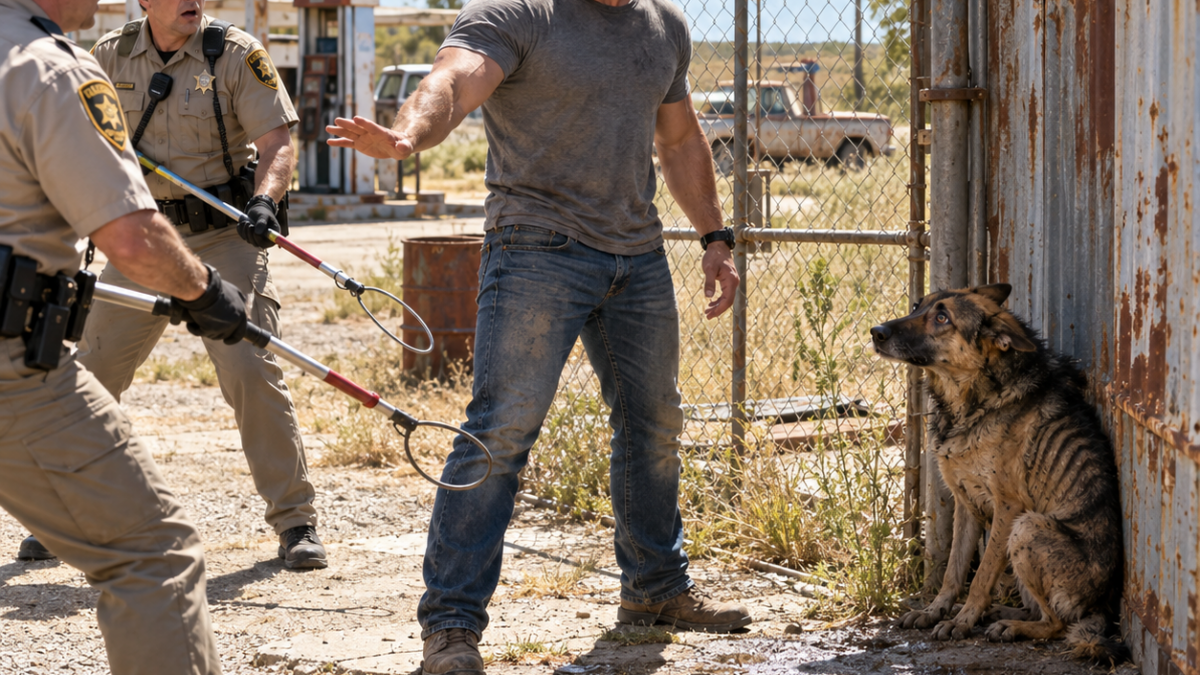
He came around the corner of the crumbling brick building into the back lot.
Two men stood inside a fenced enclosure.
Khaki uniforms.
County patches.
Long aluminum catchpoles gripped in both hands.
The wire loops at the ends swung like tools designed by people who had never been cornered themselves.
Against the rusted corrugated wall crouched a German Shepherd.
Or what was left of one.
The dog was starved down to angles.
Ribs sharp beneath a matted black-and-tan coat.
Hips jutting.
Paws raw.
One ear torn.
Dried mud and grease clung to his fur in thick patches. His tail was tucked so tightly beneath him it nearly disappeared. His lips curled back, showing teeth, but Grant read the body in half a second.
Not aggression.
Terror.
The dog’s amber eyes darted between the men, the poles, the fence, the wall.
No exit.
No mercy.
Only panic forced into a corner.
The taller officer lunged forward with the catchpole.
“Get the loop around its neck!”
The metal pole slammed against the wall.
The Shepherd snapped at the wire and missed. He stumbled sideways, trapping himself deeper in the corner. The shorter officer cursed and raised his pole like he meant to strike.
Grant pushed through the chain-link gate.
The hinges shrieked.
“Stop right there.”
He did not shout.
He did not need to.
His voice carried the kind of authority men either obeyed quickly or regretted testing.
Both officers turned.
They saw a tall, broad-shouldered man with a military haircut, combat boots, and eyes that did not blink enough.
“Back off, buddy,” the shorter officer said, wiping sweat from his forehead. “This is official county business.”
Grant moved closer.
The German Shepherd pressed harder into the wall behind him.
Grant did not look at the dog yet.
He kept his attention on the men with the poles.
“What are you doing?”
“Impounding a dangerous stray,” the taller officer said. “We have orders to secure and destroy it.”
“Destroy it.”
“That’s right.”
Grant’s eyes hardened.
“He’s not dangerous.”
The shorter officer laughed once.
“You some kind of dog expert?”
“I know panic when I see it.”
The taller officer scoffed. “This animal has been menacing the area for weeks. Bit a farmer two days ago. Carries disease, probably. It’s a liability.”
“He’s starving.”
“He’s feral.”
“He’s cornered.”
The taller officer raised the pole again.
Grant took two long steps and placed himself directly between the catchpoles and the German Shepherd.
He turned his back on the dog.
Completely.
The officers noticed.
So did the dog.
Grant stood there like a wall.
“You are interfering with a county operation,” the shorter officer warned. He reached toward the radio clipped to his belt. “I’ll call the sheriff.”
“Call him.”
Grant’s voice stayed flat.
“Tell him a Navy SEAL is standing here ready to pay every fine attached to this animal right now. Tell him I’m adopting the dog.”
Both men stared at him.
The taller one frowned.
“You can’t just adopt a condemned stray in a gas-station lot.”
“Watch me.”
“There’s paperwork. Fees. Quarantine costs.”
“How much?”
The officers exchanged a glance.
Grant saw the calculation move across their faces.
The shorter officer’s eyes flicked to Grant’s wallet pocket.
“Capture fee’s two hundred. Unregistered stray penalty’s another hundred. Transport and processing. Quarantine hold. You’re looking at five hundred cash.”
It was nonsense.
Grant knew it.
They were inventing numbers because men like that often trusted greed more than procedure.
He did not care.
He pulled his wallet from his jeans and took out five crisp hundred-dollar bills. He had withdrawn the cash to help his mother with repairs.
He held it out.
“Take it. Give me the release form.”
The taller officer hesitated.
The German Shepherd panted behind Grant, breath fast and ragged.
Finally, the shorter officer snatched the money.
The taller man pulled a wrinkled clipboard from the truck, scribbled on a yellow form, and shoved it toward Grant.
“Sign at the bottom. Animal’s your legal responsibility now. If it attacks somebody, county holds you liable.”
Grant signed his name with hard, precise strokes.
Grant Calloway.
He handed the clipboard back.
“Now leave.”
The officers lowered their poles.
They backed out of the enclosure, muttering, climbed into their white county truck, and drove away in a cloud of dust.
The lot fell silent.
Grant stood still.
He listened to the dog behind him.
Panting.
Shaking.
Alive.
He did not turn around immediately.
He knew better than to rush a frightened animal simply because the visible threat had left. Fear did not disappear when danger walked away. Sometimes that was when fear finally had room to show its teeth.
Slowly, Grant lowered himself into a crouch.
He kept his back slightly angled.
Eyes down.
Hands open.
“Their truck’s gone,” he said quietly.
His voice had changed.
No command now.
No edge.
Just low, steady sound.
“You’re safe.”
The Shepherd’s panting continued.
Grant waited.
The Texas heat pressed down on his shoulders.
A drop of sweat slid along his temple.
He did not wipe it away.
Behind him, gravel shifted.
One step.
Pause.
Another.
The dog sniffed the air.
Grant remained motionless.
A cold, wet nose brushed the back of his elbow.
He turned his head slowly.
Up close, the dog looked worse.
Every rib showed. His paws were cracked and bleeding. His coat smelled of oil, heat, old rain, and hunger. But the eyes that looked at Grant no longer held blind terror.
There was something else there now.
A question.
Maybe hope, though the dog seemed too exhausted to trust it.
Grant raised his hand slowly and let the dog sniff his knuckles.
For several tense seconds, nothing happened.
Then the Shepherd lowered his head and pressed one muddy cheek into Grant’s palm.
A soft whine escaped him.
Grant swallowed.
“Okay,” he whispered, stroking the coarse fur behind the dog’s ear. “Let’s get you out of here.”
The ride to the farmhouse was quiet.
The German Shepherd curled tightly on the passenger-side floorboard, making himself smaller than his body should have allowed. He did not look out the window. He did not bark. Now and then, he made a soft noise in his throat, as if expecting the truck to stop and the poles to come back.
Grant left the radio off.
He drove one-handed and kept the other resting near the seat, not touching, just there.
The barren roadside gave way to scattered oaks, wire fences, and green patches that survived wherever the land found water. By late afternoon, he turned onto the familiar dirt driveway leading to the Calloway farmhouse.
The white two-story house stood in warm sunlight, paint peeling around the porch columns, screen door patched at one corner, the roofline sagging slightly with age and memory.
Martha stood on the porch before he even parked.
She had been watching the road.
She always watched when Grant was expected home.
She wiped her hands on a faded floral apron and started down the steps, smiling.
Then she saw what was curled on the floorboard.
“Oh, Grant.”
He opened the passenger door.
The dog did not move.
Grant reached in carefully, slid one arm beneath the bony chest and another under the hindquarters, and lifted him out.
The Shepherd stiffened but did not fight.
Grant carried him up the steps.
Martha came close, eyes widening.
“What happened to this poor soul?”
“Rough day,” Grant said.
“That’s not a rough day. That’s a hard life.”
He set the dog gently on the porch floorboards.
Martha knelt without hesitation, not caring that mud smeared her apron.
The dog flinched backward at the movement.
Martha stopped instantly.
She did not speak at first.
She began to hum.
Low.
Soft.
An old church melody Grant remembered from childhood Sunday mornings and kitchen evenings.
The dog trembled.
Martha waited.
When he stopped leaning away, she extended one hand slowly.
He sniffed.
Then allowed her fingers to brush the top of his head.
“You’re safe here, sweet boy,” Martha whispered. “Nobody’s going to hurt you on my porch.”
Grant looked away.
Something in his chest tightened.
Martha glanced up at him.
“Wash tub,” she said.
“Yes, ma’am.”
For the next hour, mother and son worked together in the backyard.
Grant dragged the large metal tub from the shed and filled it with warm water from the hose. Martha brought mild soap, clean towels, and a bowl of plain chicken broth to tempt the dog.
The Shepherd stiffened when Grant lifted him into the tub.
Grant held him securely.
“Easy,” he said. “Not a trap. Just water.”
Martha poured warm water over the matted fur with a plastic cup.
Brown water ran into the grass.
Then black.
Dirt, grease, blood, and old fear washed loose in layers.
The dog shook at first, then gradually went still. His eyes half closed when Martha scrubbed behind his ears.
“That’s it,” she murmured. “There you are.”
Beneath the dirt, the dog’s coat emerged black and tan. Thin. Patchy. Scarred. But beautiful.
Martha wrapped him in towels and dried him briskly while he stood trembling on unsteady legs.
“He needs a name,” she said.
Grant looked at the dog.
The Shepherd sat taller now, amber eyes fixed on him, intelligent and watchful.
Not defeated.
Not anymore.
“Ranger,” Grant said.
Martha smiled.
“That suits him.”
The dog’s ear flicked at the sound.
Grant said it again.
“Ranger.”
The dog looked at him.
And just like that, a condemned stray had a name.
Martha cooked chicken and rice.
She placed the bowl on the kitchen floor.
Ranger approached, then stopped and looked up at Grant.
Waiting.
Grant’s throat tightened.
He understood permission.
He understood the damage done by people who made survival depend on approval.
“Go ahead, Ranger,” he said softly. “Eat.”
The dog lowered his head.
At first, he ate carefully.
Then hunger overcame caution, and he finished the bowl, licking it clean before lying down with a long, exhausted sigh.
Over the next two weeks, the farmhouse changed.
Not loudly.
Not all at once.
But the way a room changes when someone lonely starts leaving a lamp on for someone else.
Grant repaired the porch steps.
Ranger watched from the shade.
Grant patched the barn roof.
Ranger lay in the grass below, eyes tracking the road, ears moving at every sound.
Martha weeded the vegetable garden.
Ranger settled beneath the oak tree, close enough to see her, far enough not to crowd.
He gained weight.
His coat began to shine.
The fear in his eyes did not vanish, but it stopped ruling every movement.
He learned the sound of Martha’s spoon against a mixing bowl.
The creak of Grant’s boots on the porch.
The low rumble of the old washing machine.
The mail carrier’s truck.
He barked at strangers.
Never attacked.
Never lunged without cause.
He simply took the job seriously.
This was his home now.
These were his people.
And Ranger, like many wounded creatures, loved with the intensity of someone who understood exactly what it meant to almost lose the chance.
On a quiet Tuesday evening, the secure military phone on the kitchen counter rang.
Sharp.
Jarring.
Grant stopped washing dishes.
Martha looked up from wiping the table.
Ranger rose from beside her chair.
Grant dried his hands, picked up the phone, and answered.
“Yes, sir.”
He listened.
His posture changed as the voice on the other end spoke.
The ease went out of his shoulders. The son disappeared. The operator returned.
“Understood, sir. I’ll be at the transport base by 0600.”
He ended the call.
The kitchen seemed to hold its breath.
“They need you back,” Martha said.
It was not a question.
Grant nodded.
“Emergency extraction overseas.”
“How long?”
“I don’t know.”
She looked at the dish towel in her hands.
Then folded it carefully because grief, for Martha, often became neatness.
“When do you leave?”
“Now.”
Grant packed upstairs with practiced speed.
Uniforms.
Gear.
Documents.
A duffel bag filled by muscle memory.
When he came down, Martha waited by the front door with tears she was trying not to spend yet.
He hugged her tightly.
She felt smaller than the last time.
“Come back to me,” she whispered.
“I always do.”
Ranger sat beside the door, watching.
He sensed the change.
The heaviness.
The goodbye.
Grant dropped his bag and knelt in front of the dog.
He took Ranger’s head in both hands and looked into those amber eyes.
“Listen to me.”
Ranger stilled.
“I have to leave for a while. You have an important job now.”
Martha covered her mouth with one hand.
Grant’s voice lowered into command.
“You protect this house. You protect my mother. Do not let anything happen to her. Do you understand?”
Ranger leaned forward and licked Grant’s chin once.
Then he sat straighter.
Chest lifted.
As if accepting an assignment.
Grant stood, grabbed his bag, and walked out.
He drove away with one final look in the rearview mirror.
Martha stood on the porch, waving slowly.
Ranger sat pressed against her leg like a stone guardian.
Then dust swallowed them.
Autumn came.
Then winter.
The farmhouse stayed quiet but no longer felt empty.
Ranger transformed fully into the dog Grant had seen buried beneath the fear.
Strong.
Watchful.
Loyal to the bone.
Every morning, he patrolled the fence line at sunrise. He checked each gate, sniffed every corner, and returned to the porch only when satisfied. When Martha worked in the garden, he lay nearby. When she napped in the rocking chair, he slept with his head across her feet. When the secure military phone rang, he stood immediately, ears forward, because he knew that sound meant news from the man who saved him.
Martha talked to him constantly.
About tomatoes.
About church.
About the way Grant used to hide biscuits in his pockets as a boy.
About how hard it was to be proud and terrified at the same time.
Ranger listened.
Dogs are better at listening than people give them credit for.
Thousands of miles away, Grant crouched in a freezing mountain pass under a sky with no mercy.
His team moved like shadows across rock.
Cold bit through his gloves. His rifle felt heavy in his hands. Beside him, a young sniper named Miller watched the ridge through his scope, calm as stone.
The extraction target was hidden in a fortified compound below.
The mission should have been clean.
Missions rarely cared what they should have been.
The first shot cracked from above.
Stone splintered inches from Grant’s face.
“Contact right!”
The valley erupted.
Tracer fire cut the dark.
Grant threw himself behind a boulder and returned fire, barking orders through comms.
They were outnumbered.
Ambushed from high ground.
“Miller, find that sniper!”
Miller shifted, scope lifting.
Then came the sound every operator knows before thought.
The sharp whistle of a rocket-propelled grenade.
“Incoming!”
Grant lunged toward Miller, trying to shove him behind cover.
The world turned white.
The blast lifted Grant off the ground and threw him into rock.
Pain detonated through his lower back.
Sound vanished, replaced by a high, endless ring.
Then darkness took him.
He woke six days later in a military hospital.
Fluorescent light.
Antiseptic.
Machines beeping.
Tubes in his arms.
His throat raw.
“My team,” he rasped.
A surgeon named Dr. Evans stood beside the bed, face heavy.
“They survived. They pulled you out.”
Grant exhaled.
Then tried to shift his legs.
Nothing happened.
He tried again.
His brain sent the order.
His body did not obey.
Cold panic spread through him.
“Doctor.”
Evans lowered his clipboard.
“I can’t move my legs.”
The room went too quiet.
A man can hear his whole life changing in a silence like that.
“You took shrapnel from the blast,” Evans said gently. “We stabilized your spine, stopped the bleeding, but the neurological damage is severe.”
Grant stared at him.
“Permanent.”
Evans did not look away.
“You will not walk again, Grant. I am deeply sorry.”
Outside the window, somewhere beyond the sterile walls, the world kept moving.
Grant’s did not.
Six weeks later, a specialized transport van pulled into the dirt driveway of the Calloway farmhouse.
Martha stood on the porch in a thick sweater, both hands clasped at her chest.
A wheelchair ramp now covered half the old steps.
Ranger sat beside her, eyes fixed on the van.
The back doors opened.
A mechanical lift lowered Grant to the gravel in a heavy black wheelchair.
He looked like a different man.
Pale.
Thinner.
Face hollowed by pain and medication.
Shoulders curved inward as if his own body had become a place he did not want to live.
Martha hurried down the ramp and wrapped her arms around his neck.
“Welcome home, my brave boy.”
Grant did not hug her back.
His hands remained locked on the wheels of the chair.
“Just get me inside, Mom.”
Ranger moved cautiously down the ramp.
He recognized the man.
Of course he did.
The shape had changed.
The smell had changed under hospital chemicals, pain, and despair.
But beneath it all was Grant.
Ranger whined softly and nudged Grant’s hand.
Grant pulled away.
He would not look at the dog.
He pushed himself up the ramp with angry, jerky movements.
The weeks that followed turned the farmhouse into a dark place.
Grant refused to leave the ground-floor bedroom Martha had prepared for him.
He kept the curtains closed.
He sent back food half eaten.
He snapped when Martha tried to help too gently and snapped worse when she tried not to help at all.
“Leave me alone,” he shouted one afternoon when she opened a window.
Martha froze with one hand on the curtain.
“Grant, you need sunlight.”
“I need my legs back. Can you do that?”
Her face changed.
He saw it.
Hated himself.
Could not stop.
“Just stop trying to fix what can’t be fixed.”
She left quietly.
That was worse than if she had yelled.
Ranger sat outside Grant’s closed door every day.
Every night.
When Grant dropped a book, Ranger whined.
When Grant’s breathing changed in sleep, Ranger pressed his nose to the gap beneath the door.
When Martha opened the door to bring water, Ranger tried to slip inside.
“Out,” Grant barked.
The first time, Ranger backed away immediately, tail low.
But he did not leave the hallway.
He lay down again outside the door.
Guarding the man who no longer believed he was worth guarding.
Spring brought storms.
One night, black clouds rolled across the plains and swallowed the moon.
Wind shoved against the farmhouse.
Rain battered the windows.
Grant lay awake in the dark, staring at the ceiling.
The rhythmic pounding began to sound like distant automatic fire.
Then thunder cracked overhead.
Massive.
Violent.
Too close.
Grant was not in Texas anymore.
He was in the mountain pass.
Cold rock beneath him.
Blood in his mouth.
Miller beside him.
The white flash coming.
“Take cover!”
He threw his upper body sideways, trying to roll behind a boulder that did not exist.
He tumbled out of bed and hit the floor hard.
Pain shot up his spine.
He dragged himself across the floor using his arms, breath coming in ragged bursts. His useless legs trailed behind him like punishment.
The nightstand went over.
A lamp shattered.
Glass scattered across the floor.
“Miller, get down!” Grant sobbed.
He curled into the corner, hands over his ears, shaking too hard to breathe.
Outside the room, Ranger heard the crash.
He did not wait.
He rose on his hind legs, pressed both front paws to the door handle, and pushed.
The latch clicked.
The door swung open.
Ranger rushed inside.
He ignored the broken glass.
He saw Grant on the floor, shaking, trapped inside a battlefield nobody else could see.
Ranger understood that kind of terror.
He had known it at the gas station.
He had known it in the corner, with poles coming for his neck.
He went straight to Grant.
“Get away!” Grant cried.
Ranger ignored him.
He forced his head beneath Grant’s arms and pushed into his chest.
Grant tried to shove him off.
Ranger did not move.
He lay down against Grant’s torso, using his full weight to pin him gently against the wall.
Warm.
Solid.
Unarguable.
He licked the sweat from Grant’s face with slow, deliberate strokes and made a deep rumbling sound in his chest.
Not a growl.
A grounding sound.
Grant fought him for several minutes.
Then the pressure reached the part of him that words could not reach.
The dog’s heartbeat thudded steadily against him.
The warmth seeped through his shirt.
Grant stopped fighting.
His hands closed around Ranger’s neck.
He buried his face in the dog’s fur and wept.
For his legs.
His team.
His mother.
His house that had become a prison.
His body that had become foreign.
His life that seemed to have ended while he was still breathing.
Ranger stayed perfectly still.
The storm raged outside.
Inside the dark bedroom, the German Shepherd held the broken SEAL together one breath at a time.
After that night, something shifted.
Not healed.
Shifted.
Grant still hurt.
He still hated the wheelchair.
Still hated needing help.
Still woke angry some mornings and ashamed most nights.
But he stopped ordering Ranger out.
The dog slept beside his bed.
When nightmares came, Grant reached down and found fur before the memories took him all the way under.
Martha noticed first.
She did not say anything.
She simply placed an extra bowl of water in Grant’s room and began leaving the door slightly open.
Months passed.
Texas summer arrived hard and dry.
The fields turned brittle.
The farmhouse showed its age more with every week.
Martha worked herself thin trying to care for the house, the land, and her son. She gardened, cooked, cleaned, hauled laundry, paid bills, and smiled through exhaustion because mothers often convince themselves love can replace rest.
Grant saw it.
That made him feel worse.
Ranger saw it too.
That made him stay closer to Martha whenever Grant slept.
The old house had problems nobody could see from the porch.
Wiring inside the living room walls.
Decades old.
Rubber cracked.
Copper exposed.
Dust and dry newspaper insulation packed in places no one had opened since Grant was a child.
On a quiet Tuesday night, just after two in the morning, two exposed wires touched behind the wall near the old television.
A blue spark jumped.
It landed in dry debris.
A small flame appeared.
Then grew.
It climbed inside the wall, feeding on dust and old wood until it broke through the paneling and reached the back of the floral sofa.
The fabric ignited with a soft whoosh.
Black smoke rolled upward.
The curtains caught next.
The front window cracked from heat and shattered inward, feeding the fire oxygen.
Flames spread into the main hallway.
Smoke moved faster.
It slid beneath doors.
Filled rooms.
Reached Martha first.
She woke coughing.
Her eyes burned.
The room was black.
Hot.
Confusing.
“Grant,” she rasped.
She tried to stand.
The lack of oxygen hit her hard.
Her knees buckled.
She collapsed beside the bed.
Down the hall, Ranger woke.
His nose caught burning wood, melting plastic, old wiring, and danger.
He sprang to his feet and ran to Grant’s bedroom door.
Smoke poured beneath it.
Heat radiated through the wood.
Ranger barked.
Once.
Twice.
Frantic.
Grant jolted awake coughing.
His eyes stung.
Orange light flickered under the doorframe.
The roar outside sounded like a jet engine.
“Mom!”
No answer.
He threw off the blanket and dragged himself toward the wheelchair parked beside the bed.
At that exact second, a section of burning hallway ceiling collapsed outside his door.
The blast of heat and smoke blew the door open.
Grant flinched backward.
His hand knocked the wheelchair off balance.
It tipped and crashed to the floor, sliding several feet away.
Out of reach.
Grant fell from the bed.
He hit the floor and clawed toward the chair with his arms.
His fingertips brushed the rim.
Missed.
The fire entered the room.
Heat rolled over him.
Paint bubbled.
Smoke swallowed the air.
Grant pressed his face to the floor, searching for the last thin layer of oxygen.
He could not stand.
Could not crawl fast enough.
Could not reach the chair.
Could not reach his mother.
A man trained to run into impossible danger was trapped on his own bedroom floor.
The helplessness was worse than the smoke.
Worse than the heat.
Worse than pain.
He thought of Martha.
Thought of her lying somewhere in the house.
Thought of every time she had waited on that porch for him to come home.
He closed his eyes.
Death had entered his room, and Grant had no weapon left.
Then a dark shape burst through the smoke.
Ranger.
The German Shepherd bounded across the burning floorboards, fur already singed along his back and tail.
“Get out!” Grant choked. “Run!”
Ranger did not obey.
He stood over Grant, lowered his head, and clamped his teeth into the thick collar of Grant’s hoodie.
Not skin.
Fabric.
He planted all four paws.
Pulled.
Grant’s upper body lifted.
Then slid.
Ranger dragged him inch by inch across the floor.
Grant weighed over two hundred pounds, dead legs trailing behind him, but the dog pulled with a strength born from loyalty and terror.
Smoke forced them low.
Ranger’s jaws tightened.
His paws slipped on heated wood.
He recovered.
Pulled again.
They reached the doorway.
The hall was a tunnel of fire.
Wallpaper burned on both sides.
The ceiling sagged.
A beam snapped overhead.
Ranger jerked left, dragging Grant sideways just before the burning wood crashed where they had been.
Sparks showered over them.
Grant shielded his face.
The dog kept pulling.
Past the living room.
Past the burning sofa.
Over broken glass.
Through blistering heat.
The front door had blown open from pressure.
Night air waited beyond it.
Ranger gave one final heave and dragged Grant across the threshold onto the porch.
But the porch roof was burning too.
Ranger did not stop.
He backed down the wheelchair ramp, pulling Grant with him, step by step, then across gravel and into the wet grass of the front lawn.
Only then did he release the collar.
Ranger collapsed beside him, chest heaving.
Patches of fur were burned away. His paws bled. Red blisters rose beneath singed hair.
Grant rolled onto his back and sucked in clean air.
He was alive.
He turned his head.
“You did it,” he rasped. “You saved me.”
Ranger lifted his head.
His ears twitched.
Then he looked back at the burning house.
Grant’s blood went cold.
“No.”
Ranger stood unsteadily.
He remembered.
The woman who washed mud from his coat.
The woman who fed him chicken and rice.
The woman who hummed on the porch.
Grant’s old command lived somewhere inside him like law.
Protect this house.
Protect my mother.
Do not let anything happen to her.
“Ranger, no!”
The dog sprinted toward the burning porch.
Grant pushed himself onto his elbows, screaming.
“Ranger! Stop!”
But Ranger did not stop.
He leaped through the doorway and vanished into the wall of fire.
Grant clawed at the grass.
Helpless.
Again.
He screamed his mother’s name.
He screamed the dog’s name.
The fire swallowed both.
Far down the road, sirens wailed.
Too far.
Too late.
The roof groaned.
Support beams snapped one by one.
The farmhouse shuddered like it was preparing to collapse.
Grant stared at the doorway through smoke and tears, praying for something he did not have the right to ask.
Then a shape emerged.
Ranger stumbled through the smoke.
Barely walking.
Dragging something heavy behind him.
Martha.
The dog’s teeth were locked in the thick fabric of her nightgown.
Her body was limp, smoke-blackened, unconscious.
Ranger pulled her over the threshold.
“Keep going!” Grant screamed. “Bring her to me!”
Ranger dragged Martha down the ramp.
The second they cleared the porch, the roof collapsed behind them with a deafening crack, sending sparks into the night sky.
Ranger pulled Martha another twenty feet into the grass.
Then his legs gave out.
He collapsed beside her and did not move.
Grant dragged himself across the lawn with his arms until he reached them.
Fire trucks roared into the driveway.
Men shouted.
Lights flashed red and blue against the burning house.
Paramedics dropped beside Martha.
“She’s got a pulse!” one shouted. “Smoke inhalation, but she’s breathing!”
Grant sobbed once.
Then turned to Ranger.
A young paramedic knelt beside the dog.
He had kind eyes and steady hands.
“This dog needs an emergency vet now,” he said, wrapping Ranger in a thermal burn blanket. “He saved your lives. We’re going to do everything we can to save his.”
Grant could only nod.
As they loaded him into one ambulance and Ranger into another, Grant looked at the ruins of the farmhouse.
The house was gone.
His childhood.
His father’s porch.
His mother’s kitchen.
His room.
All of it burning into the dark.
But Martha was breathing.
Ranger was alive.
And for the first time since the explosion overseas, Grant understood something simple and absolute.
He had not lost everything.
Three days later, morning sun filled a private room at the county hospital.
Martha sat upright in bed, pale but clear-eyed, oxygen tube beneath her nose.
Grant sat beside her in his wheelchair wearing donated clothes.
His hands rested in his lap.
He looked different.
Not healed.
Not suddenly whole.
But awake.
The dead dullness had left his eyes.
The door opened.
The young paramedic stepped in holding a thick leather leash.
At the end of it walked Ranger.
The German Shepherd was bandaged around his torso and all four paws. Patches of his beautiful coat had been shaved for burn treatment. He limped badly, but his amber eyes were bright.
He saw Grant and barked once.
The sound broke something open in the room.
Grant rolled forward.
Ranger came to him and pressed his head into Grant’s lap.
Grant wrapped both arms around the dog’s neck and buried his face against the clean bandages.
He did not try to hide the tears.
Not from his mother.
Not from the paramedic.
Not from himself.
Ranger licked the tears from his cheek and rested his chin across Grant’s paralyzed legs.
Martha reached out and placed her hand over Grant’s.
“We’re still here,” she whispered.
Grant looked at his mother.
Then at Ranger.
The fire had taken the farmhouse.
The war had taken his legs.
But the dog he had saved from a rusted wall behind an abandoned gas station had pulled him back from more than flames.
Ranger had pulled him from the belief that his life was over.
Grant squeezed Martha’s hand.
“We’re going to rebuild,” he said.
His voice was rough.
But steady.
“We’re going to figure this out.”
Martha smiled through tears.
“I know we are.”
Grant looked down at Ranger.
The dog’s eyes were half closed now, exhausted but peaceful.
“You hear that?” Grant whispered. “We’ve got work to do.”
Ranger’s tail moved once.
Not much.
Enough.
Months passed.
They did rebuild.
Not the old house.
That was gone.
A community fundraiser helped Martha and Grant move into a small one-story home built farther back from the road, with wide doorways, ramps, reinforced floors, and a porch large enough for a wheelchair, a rocking chair, and a German Shepherd who had earned the right to sleep wherever he pleased.
Grant hated the fundraiser at first.
He hated needing help.
But Martha told him pride was useful only when it helped a man stand tall, not when it made him slap away hands trying to lift him.
So he learned.
Slowly.
He learned how to accept help without feeling erased by it.
He learned how to move through the world in a chair without apologizing for taking up space.
He learned how to cook from a seated position while Ranger watched for dropped chicken.
He learned that his mother was tougher than anyone who had ever worn body armor.
And he learned that Ranger still took his assignment seriously.
Every morning, even with scarred paws and patches of fur growing back unevenly, Ranger patrolled the new fence line.
Every evening, he lay between Martha’s rocking chair and Grant’s wheelchair.
If a truck turned down the driveway, he lifted his head.
If Martha coughed, he stood.
If Grant’s breathing changed in the night, Ranger nudged open the bedroom door and pressed his body against the chair until Grant touched his fur and remembered where he was.
The story spread.
First through town.
Then the county.
Then beyond.
Reporters came.
Grant refused most interviews.
Martha accepted exactly one because she wanted people to know Ranger’s name.
Not “hero dog.”
Not “burned German Shepherd.”
Not “the stray.”
Ranger.
The dog animal control had called dangerous.
The dog Grant had bought with five hundred dollars and a signature.
The dog who had dragged a paralyzed man and an unconscious woman out of a burning house.
When asked why she thought Ranger had done it, Martha looked at the camera like the question itself was strange.
“Because my son told him to protect me,” she said. “And because some creatures understand love better than people do.”
Grant watched the interview later from the porch.
He pretended dust had gotten in his eyes.
Martha pretended to believe him.
The two animal-control officers were investigated after the story became public.
Improper field procedure.
Cash payments not recorded.
Failure to document live release.
Allegations from other residents surfaced quickly, as they often do once one truth gives people courage to speak.
Grant followed the news only enough to know they would not be cornering animals with poles behind abandoned buildings anymore.
That was enough.
One afternoon, the county director himself came to apologize.
He stood on the new porch with his hat in both hands while Ranger watched him from beside Grant’s chair.
“I’m sorry,” the director said. “That dog should never have been handled that way.”
Grant looked at him for a long moment.
“No dog should.”
The director nodded.
“No, sir. No dog should.”
Ranger stood and walked forward.
The director froze.
Ranger sniffed his pant leg once, then returned to Grant.
The man exhaled shakily.
Grant almost smiled.
“You’re fine,” he said. “If he didn’t like you, you’d know.”
The county later changed its field policies.
Mandatory body cameras.
No cash collection on scene.
Veterinary assessment before euthanasia decisions.
De-escalation training for fearful animals.
Grant did not call that justice.
Justice would have meant Ranger never being starved, cornered, or nearly killed in the first place.
But change was still change.
And change, like healing, rarely arrived clean.
One year after the fire, Martha insisted on visiting the old property.
Grant did not want to.
The land had been cleared by then. The burned foundation remained, low and black against the grass. Wildflowers had started growing where the living room used to be.
Martha stood beside the van.
Grant rolled slowly along the packed dirt path.
Ranger walked beside him, moving a little stiffly now but still proud.
They stopped near the place where the porch had been.
For a long time, none of them spoke.
Martha looked at the foundation.
“I thought I’d cry more.”
Grant looked up at her.
“Do you want to?”
“Maybe later.”
“That’s allowed.”
She laughed softly.
“So I’ve heard.”
Ranger sniffed the ground near a patch of new grass, then lay down.
Right where the old porch steps had once been.
Grant watched him.
“I gave him one job,” he said.
Martha rested a hand on his shoulder.
“He did it.”
“He almost died doing it.”
“So did you, saving him.”
Grant looked at her.
She smiled.
“Kindness is risky, son. That doesn’t make it foolish.”
He looked out over the land.
The place where he had grown up.
The place that had burned.
The place where Ranger had run into flames because love had become stronger than fear.
For a long time after losing his legs, Grant had believed strength meant standing.
Running.
Carrying weight.
Fighting through pain without asking anyone to help.
Ranger had taught him a better definition.
Strength was crawling through smoke when your body was already burned.
Strength was staying beside someone having a nightmare.
Strength was letting your mother see you cry.
Strength was accepting that needing help did not make you helpless.
And sometimes strength was a starving dog, shaking in a corner, still willing to press his face into the hand of a stranger.
Grant reached down and rested his palm on Ranger’s head.
“You saved us,” he said.
Ranger sighed.
The kind of sigh dogs give when humans say obvious things.
Martha laughed.
The sound moved across the empty foundation and made it feel less haunted.
Years later, people in the county still told the story.
They told it at church suppers.
At the feed store.
At the diner.
They said a Navy SEAL stopped animal control from putting down a German Shepherd.
They said the dog later saved him from a fire.
They said the whole thing proved dogs knew when you saved them.
Grant never corrected them.
But he knew the truth was deeper than that.
Ranger had not saved him because of debt.
Love was not bookkeeping.
Ranger saved him because Grant had become his person, and Martha had become his person too, and some bonds, once formed, become stronger than fear, stronger than injury, stronger than smoke.
The world had looked at Ranger and seen a problem to remove.
Grant had looked once and seen a life worth protecting.
That one choice returned to him on the worst night of his life with teeth locked in his collar and paws bleeding against burning wood.
No act of mercy is ever small.
Not really.
Mercy leaves tracks.
Sometimes it comes back years later.
Sometimes it comes back through fire.
Sometimes it comes back on four burned paws, dragging everything you love out of the dark.
On quiet evenings, Grant and Martha still sat together on the porch.
Martha in her rocking chair.
Grant in his wheelchair.
Ranger between them, gray now around the muzzle, ears still alert, body relaxed but ready.
The sun would set over the fields.
The air would cool.
Crickets would begin in the grass.
Martha would hum the old melody she had hummed the first day she touched him.
And Ranger would close his eyes, safe at last.
Grant would look at the dog and remember the rusted gas station.
The catchpoles.
The money.
The signature.
The moment a condemned stray pressed his muddy cheek into Grant’s hand.
He had thought he was rescuing Ranger.
He understood now that rescue rarely moves in one direction.
Sometimes you pull one life back from the edge.
Then later, when your own life burns down around you, that same soul comes back through the smoke and pulls you out too.
Grant was still a Navy SEAL.
Still a survivor.
Still a son.
Still a man learning how to live in a body the war had changed.
But he was no longer trapped inside the belief that his worth had ended when his legs stopped moving.
Ranger had shown him that.
Not with words.
With presence.
With loyalty.
With fire.
And whenever someone asked Grant what made Ranger so special, he never mentioned heroism first.
He never mentioned the flames, the rescue, or the news stories.
He always went back to the beginning.
“He was scared,” Grant would say. “And everybody mistook that for dangerous.”
Then he would rest his hand on the old dog’s head.
“Good thing I knew the difference.”