An Old Man Sat Ignored for 43 Minutes With His Late Son’s Sick Military K9 Across His Lap—Then One Nurse Stopped and Asked the Question Nobody Else Had.
PART3:
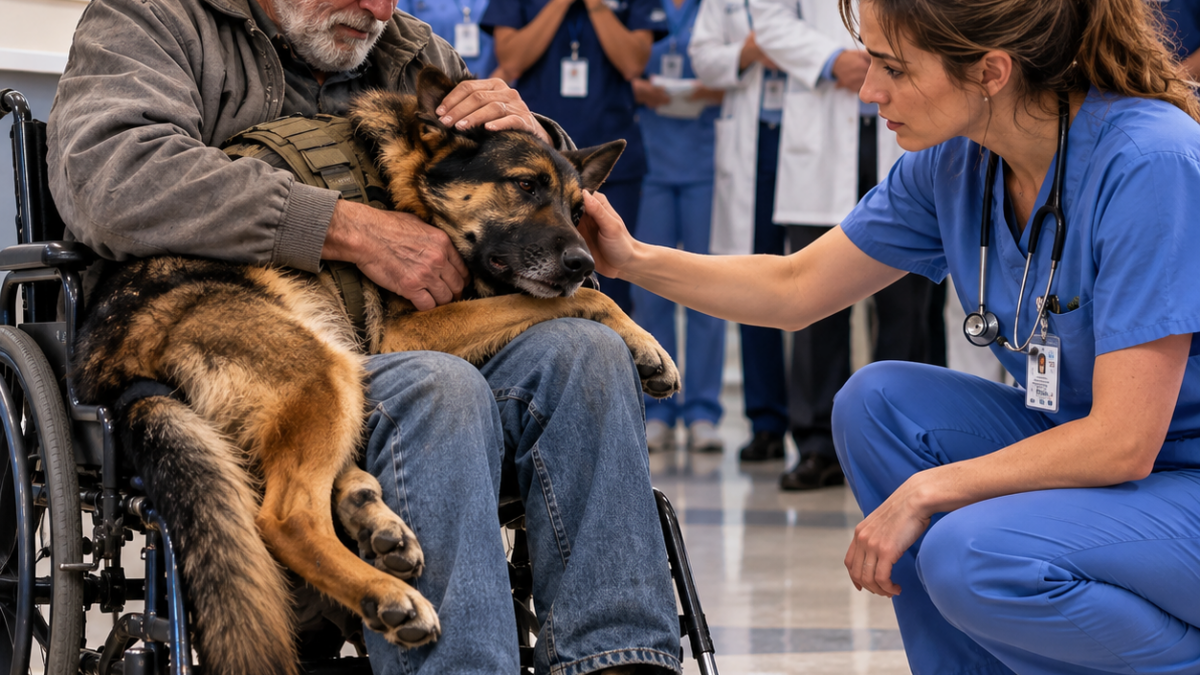
I placed the back of my hand gently near his ear.
Heat.
Too much heat.
Not the mild warmth of a nervous animal. Fever heat. Deep, heavy, radiating through his fur.
“How long has he been sick?”
“Since last night.”
“What happened?”
“He wouldn’t eat breakfast. Then he wouldn’t get up.”
“Vomiting?”
“No.”
“Diarrhea?”
“No.”
“Any injury?”
“Not that I saw.”
“Can he stand?”
Walter looked away.
That was answer enough.
“Not this morning,” he said. “He tried.”
His voice cracked on the last word.
“He couldn’t.”
I looked at Kodiak again.
His gums looked a little dry. His breathing was steady but subdued. His body felt too warm. There was no obvious trauma, no blood, no visible wound, but he was clearly unwell.
“We’re going to get him evaluated.”
Walter glanced toward the corridor.
“Will someone come?”
“I’ll take you.”
His eyes widened.
“You?”
“Yes.”
“But the dog…”
“I’ll make sure he stays with you.”
Relief moved across his face so quickly it hurt.
“Thank you.”
I stepped behind the wheelchair and began guiding him toward the elevator.
I did not take Kodiak away from him.
That was the first thing Walter noticed.
The second was that I did not treat him like an inconvenience.
The third was that every time we stopped, I checked on the dog.
By the time we reached veterinary intake, Walter was still anxious, but he had stopped looking like he was preparing to be dismissed again.
The intake room was quieter than the main lobby.
A technician was setting up an examination table.
Walter immediately stiffened.
“Can he stay with me?”
“Of course,” I said.
The technician looked uncertain. “He’s big.”
“Then we’ll adapt.”
That was another thing I had learned in nursing.
People remember whether you protect what matters to them.
Walter wheeled closer.
Kodiak shifted his head slightly.
I crouched beside him.
“Hey, Kodiak. I’m going to check you again, okay?”
His eyes opened.
Then closed.
“Good boy.”
Walter watched my hand.
“He likes you.”
I smiled.
“I haven’t earned that yet.”
A faint laugh escaped him.
“He doesn’t trust many people.”
“He’s tired.”
The veterinarian arrived a few minutes later.
Dr. Emily Barrett.
Calm voice.
Sharp eyes.
The kind of clinician who could read a room before anyone explained why it mattered.
She examined Kodiak carefully.
Temperature elevated.
Mild dehydration.
Generalized weakness.
No obvious injury.
She listened to his heart and lungs.
Checked his abdomen.
Watched his responses.
Kodiak remained unusually still.
Dr. Barrett frowned.
“Has he eaten anything unusual?”
Walter thought.
“No.”
“New medication?”
“No.”
“Recent travel?”
“No.”
“Ticks?”
“Not that I know of.”
“Recent vaccinations?”
“Several months ago.”
Dr. Barrett glanced at me, then at Walter.
“We’ll need blood work.”
Walter nodded immediately.
“Do whatever you need.”
Then he hesitated.
His hand found Kodiak’s fur again.
“Just…”
He could not finish.
I understood.
“Don’t let him be alone?”
He looked at me.
“Yes.”
“He won’t be.”
The blood results would take time.
Walter remained beside Kodiak.
I noticed then how exhausted he was. Not only worried. Not only old. Exhausted in the way people become when grief has been living inside them so long it starts using their bones for shelter.
His hands shook.
“Have you eaten today?” I asked.
He looked embarrassed.
“No.”
“You should.”
“I couldn’t leave him.”
“I know.”
I brought him water.
Then a small snack from the staff room.
He accepted both with the kind of gratitude that made me angry at everyone who had made him wait so long.
“Thank you.”
“You’re welcome.”
He stared at Kodiak.
“He’s all I have.”
I pulled up a chair beside him.
“Tell me about him.”
Walter looked surprised.
“Why?”
“So I know who I’m taking care of.”
He studied me for a moment.
Then reached into his pocket and pulled out a worn leather wallet.
Inside was a photograph.
A young Navy SEAL stood beside Kodiak. Daniel Hayes, though I did not know his name yet. His arm rested across the German Shepherd’s shoulders. Both of them looked toward the camera with that strange stillness military people and military dogs sometimes share — alert, contained, alive with purpose.
Walter touched the photograph.
“My son never went anywhere without him.”
“What was your son’s name?”
“Daniel.”
His voice changed when he said it.
Not louder.
Not softer.
Older.
“He was Chief Petty Officer Daniel Hayes. Navy SEAL.”
I looked at the photo again.
“He looks happy.”
Walter nodded.
“He was.”
Pause.
“Very.”
His thumb moved over the edge of the picture.
“He used to call me every Sunday.”
“And?”
“One Sunday he stopped.”
I did not interrupt.
That is one of the hardest things for nurses to learn.
Silence is care sometimes.
Walter continued.
“He didn’t call. I thought maybe the schedule changed. Maybe there was no signal. Maybe there was some mission he couldn’t talk about.”
He stared at the photo.
“Then the officers came.”
His lips pressed together.
“They said Daniel had died during deployment.”
“I’m sorry.”
He nodded like he had heard those words so many times they had worn smooth.
“After the funeral, Kodiak came home.”
His eyes moved to the dog.
“Daniel didn’t.”
For a moment, the room disappeared around us.
There was only the old man, the sick dog, and the photograph of someone whose absence had filled every corner of their lives.
Walter told me about the first time he saw Kodiak after the funeral.
The dog had stood near the back of the room during the service, still and watchful, staring at the door as if Daniel might arrive late and apologize for worrying everyone.
After the service, Walter had knelt beside him.
He had not known what to say to the dog.
So he simply whispered, “Come home with me.”
Kodiak had placed his head against Walter’s chest.
Somehow, that had been enough.
For three years, they had lived together.
Walter never called Kodiak a replacement.
He never said the dog was Daniel.
He understood the difference.
But Kodiak was the last living creature that had shared Daniel’s life in a way no one else could.
He had known Daniel’s voice in the field.
His hand signals.
His stress.
His sleep.
His danger.
His courage.
His routines.
His jokes.
His silence.
That made the dog priceless.
Not because Kodiak was an object left behind.
Because he was a witness.
A breathing witness.
To the person Daniel had been.
Walter touched Kodiak’s head.
“He sleeps by the front door.”
“Why?”
“Daniel used to come through it.”
My chest tightened.
“He still waits.”
Walter gave a small, painful smile.
“He doesn’t understand.”
I looked at Kodiak.
“I’m not sure that’s true.”
Walter looked at me.
“You think he understands?”
“I think he understands more than people give him credit for.”
He looked down.
“That sounds like something Daniel would say.”
The first blood results came back that afternoon.
Signs of inflammation.
Dehydration.
Nothing immediately catastrophic.
Likely infection or inflammatory illness, but the source was not yet clear.
Kodiak needed fluids.
Medication.
Monitoring.
Further testing.
Dr. Barrett explained all of it carefully.
Walter nodded at every sentence.
“How long?” he asked.
“Hard to say.”
“Will he walk again?”
“We’ll know more once his fever comes down.”
“I brought him because he couldn’t stand.”
“I know,” Dr. Barrett said. “Then we focus on getting him comfortable first.”
Walter nodded.
But his face had gone pale.
I stayed beside him.
He had finally been heard.
That mattered.
But being heard did not remove the fear.
That evening, the hospital quieted.
Walter remained with Kodiak.
I finished my shift.
Clocked out.
Walked halfway toward the exit.
Then stopped.
I do not know why some patients stay with us immediately.
Maybe because we see our own past in them.
Maybe because we see our future.
Maybe because every exhausted professional still has one place inside that refuses to become efficient.
I turned back.
I found Walter asleep in his wheelchair, his head resting against the wall.
One hand remained on Kodiak’s neck.
The dog lay on a padded bed beside him.
I stood there for several seconds.
I could have gone home.
Instead, I adjusted Walter’s blanket.
Then checked Kodiak’s temperature.
Still high.
But slightly lower.
“That’s better,” I whispered.
Kodiak’s eyes opened.
He looked at me.
Then toward Walter.
I quietly said, “You’re both staying tonight.”
The dog closed his eyes.
And for the first time since arriving at the hospital, Walter slept without jolting awake every time Kodiak moved.
Around midnight, everything changed.
The monitor alarmed.
Kodiak’s breathing quickened.
His temperature rose again.
I rushed into the room, and Dr. Barrett came in behind me.
Walter woke instantly.
“What happened?”
I knelt beside him.
“Stay with me.”
“What is it?”
“We’re checking him.”
Kodiak tried to lift his head.
Walter reached for him.
“I’ve got you.”
I watched the dog’s eyes.
That was when I noticed something strange.
Kodiak was not looking at the veterinarian.
Not the monitor.
Not me.
He was looking toward the corridor.
Toward the main entrance.
There was nothing there.
But Kodiak kept watching.
Walter saw it too.
His face crumpled slightly.
“Daniel used to come through that door.”
Kodiak lowered his head.
And I understood something I could not chart in any medical record.
The illness was not the only thing making Kodiak weak.
He was old enough to remember his handler.
And every time his body became sick, some part of him seemed to look for the person who used to come back.
Walter touched his head.
“I know, Cody.”
His voice broke.
“I’m still here.”
I looked at the old man.
Then at the dog.
“Then we make sure he knows that.”
Walter stared at me.
“How?”
“Talk to him.”
“What?”
“Just talk.”
“About what?”
“Anything.”
He looked at Kodiak.
Then he began telling him about a Sunday afternoon three years earlier.
Daniel had called from somewhere overseas.
He had been tired.
Complained about the food.
Laughed because Kodiak had stolen part of his blanket.
Walter talked slowly at first.
Then steadier.
He told Kodiak about Daniel’s laugh.
About the truck Daniel had wanted to restore.
About the time Daniel came home and fixed Walter’s porch light without being asked.
About how he used to say a good handler never forgot the dog.
While Walter spoke, Kodiak’s breathing slowed.
Not dramatically.
Not magically.
But enough.
Enough that I noticed.
At 1:15 a.m., Dr. Barrett returned with updated results.
Walter looked at her face.
He knew immediately that something had changed.
“What?”
Dr. Barrett sat down.
“We found significant inflammation.”
“From what?”
“We don’t know yet.”
“Is it infection?”
“It could be.”
“Can you treat it?”
“We’re starting treatment now.”
Walter nodded.
Then asked the question he had been trying not to ask.
“Is he going to die?”
The room went quiet.
Dr. Barrett answered carefully.
“We don’t know.”
Walter closed his eyes.
“I’m sorry.”
Dr. Barrett shook her head.
“Don’t apologize.”
“He’s all I have.”
“I know.”
Walter looked at me.
“You don’t.”
I sat beside him.
“Maybe not exactly.”
I paused.
“But I know what it’s like when an animal becomes part of a person’s identity.”
Walter looked at me for a long moment.
I did not explain.
I did not need to.
The next six hours were slow.
Fluids.
Medication.
Repeat temperature checks.
Blood pressure.
Monitoring.
Kodiak remained weak but stable.
Walter refused to leave.
At 4:30 a.m., I brought him another blanket.
At 5:15, I brought him coffee.
At 6:00, toast.
He finally ate.
“Thank you.”
“You’re welcome.”
He looked at Kodiak.
“He used to eat before me.”
“Who?”
“Daniel.”
Walter smiled sadly.
“He’d make a bowl for Kodiak first, then himself. Said a good handler never forgets the dog.”
“Sounds like he meant it.”
“He did.”
Morning light entered the lobby.
The hospital became busy again.
Doctors changed shifts.
Visitors filled the waiting area.
Phones rang.
Doors opened and closed.
But Walter remained in the same chair.
Kodiak’s bed had been moved closer to him.
Around 8:00 a.m., Dr. Barrett approached.
“We have an update.”
Walter straightened.
“Kodiak’s temperature is coming down.”
Walter closed his eyes.
“Oh, thank God.”
“But there’s something else.”
His expression tightened.
“What?”
“We found evidence this may not be a simple temporary illness.”
“What does that mean?”
“There may be an underlying condition. We need more tests.”
“What kind?”
“Imaging, repeat blood work, possibly an ultrasound.”
Walter nodded.
“Do it.”
“We will.”
After Dr. Barrett left, Walter stared at the floor.
“Can I tell you something?”
“Of course.”
“I almost didn’t bring him.”
That surprised me.
“Why?”
“I thought maybe he was just old.”
“He’s seven.”
“I know.”
His fingers tightened.
“I started thinking maybe I was keeping him alive because I couldn’t let go of Daniel.”
I stayed quiet.
“People keep telling me I need to move on,” he said.
“What do they mean by that?”
He gave a tired smile.
“Stop talking about my son. Stop looking at his photograph. Stop keeping Daniel’s things. Stop treating Kodiak like he’s family.”
I frowned.
“Who told you that?”
“Everyone.”
I looked at Kodiak.
“And what do you think?”
Walter swallowed.
“I think if I lose him…”
His voice broke.
“I lose the last part of Daniel’s world that still walks.”
I sat closer.
“He isn’t Daniel.”
“I know.”
“He doesn’t have to replace him.”
“I know.”
“Then what is he?”
Walter looked at the dog.
“A witness.”
“To what?”
“To the person my son was.”
That answer went through me.
Not because it was dramatic.
Because it was exact.
Grief is often most painful when no one else can confirm what we remember.
Kodiak could not speak Daniel’s name.
But he had lived beside him.
Served beside him.
Come home because Daniel could not.
“That makes sense,” I said.
Walter looked at me.
“You don’t think that’s unhealthy?”
“No.”
I shook my head.
“I think grief changes shape.”
He looked down.
“And what if the shape is this dog?”
“Then maybe caring for him isn’t refusing to let go.”
I looked toward Kodiak.
“Maybe it’s remembering without pretending the past has to disappear.”
Walter said nothing.
But his shoulders loosened.
Late that morning, Kodiak had enough strength to stand briefly.
Dr. Barrett lowered a support harness around him.
“Don’t encourage him yet.”
Walter nodded, though every muscle in his face wanted to call the dog forward.
Kodiak placed his front paws beneath himself.
His back legs trembled.
Walter leaned forward.
“Easy.”
The dog stood for three seconds.
Four.
Then his knees weakened.
Dr. Barrett and I caught the harness and lowered him safely.
Walter’s eyes filled.
“He stood.”
Dr. Barrett smiled.
“Briefly, yes.”
I looked at him.
“He stood.”
Walter laughed through tears.
“Daniel would have been proud.”
Kodiak’s ears moved at the name.
Walter noticed.
He touched the dog’s head.
“You remember him.”
Kodiak looked at him.
Walter whispered, “Of course you do.”
The imaging results arrived that afternoon.
Dr. Barrett called Walter into a small consultation room, and I joined them because by then Walter had started looking for me whenever medical words came too quickly.
Dr. Barrett placed the images on the monitor.
“We’ve identified the likely source of the fever.”
Walter leaned forward.
“What is it?”
“There is inflammation in the abdominal area consistent with a significant internal infection.”
His face tightened.
“Can you treat it?”
“Yes.”
“How?”
“Hospitalization, antibiotics, fluids, and close monitoring.”
“No surgery?”
“Not right now.”
“Then let’s do it.”
“We already started.”
Walter covered his face briefly.
Then whispered, “Thank you.”
I touched his shoulder.
“You don’t have to thank everyone every time they help.”
He smiled.
“I know.”
He looked at me.
“But I’m going to.”
That evening, Kodiak’s temperature finally dropped into a safer range.
He drank water.
Ate a little.
Stood twice with support.
And when Walter spoke to him, his tail moved.
I watched from the doorway.
Walter looked up.
“It’s working.”
“Yes.”
He looked at Kodiak.
“You’re staying.”
The dog closed his eyes.
Walter laughed softly.
“That means yes.”
Later that night, Walter took out Daniel’s photograph again.
I sat beside him.
“This was taken two weeks before he died,” he said.
Daniel stood beside Kodiak in the photo.
Both looked young.
Untouched by what was coming.
Walter smiled faintly.
“He told me he’d bring the dog home.”
“He did.”
Walter nodded.
“That’s what I keep forgetting.”
“What?”
“He kept his promise.”
I looked at him.
“Daniel brought Kodiak home.”
Walter stared at the photograph.
“He did.”
“And you kept Kodiak safe.”
“Yes.”
“So the promise didn’t end that day.”
Walter’s eyes filled.
“It continued.”
“Exactly.”
Near midnight, Walter fell asleep.
Kodiak rested beside him.
I checked the dog’s temperature.
Normal.
For the first time, normal.
I smiled.
Then something unexpected happened.
Kodiak opened his eyes.
He looked at Walter.
Then at me.
Then at the photograph on the bedside table.
His nose moved slightly toward it.
I picked up the photo and lowered it toward him.
Kodiak sniffed.
Then rested his head against Walter’s arm.
“You remember,” I whispered.
The dog closed his eyes.
And I understood something important.
Kodiak was not simply carrying Daniel’s memory.
He was carrying a history that included Walter too.
Maybe that was why he had fought so hard to stay.
Not because he was afraid of dying.
Because he still had someone to stay beside.
The next morning, Dr. Barrett delivered better news.
“His fever is significantly lower.”
Walter smiled.
“Walk?”
“Not yet.”
“Okay.”
“But he’s responding.”
Walter nodded.
“That’s enough.”
I came in with fresh coffee.
“Morning.”
Walter looked at me.
“He made it through the night.”
“He did.”
Walter reached for my hand.
This time, he did not hesitate.
“Thank you.”
I squeezed gently.
“You’re welcome.”
He looked toward Kodiak.
“Do you know what Daniel used to tell me?”
“What?”
Walter smiled.
“He said a good military dog isn’t just trained to protect his handler.”
I waited.
“He’s trained to keep going when the handler can’t.”
I looked at Kodiak.
“Sounds like he learned that lesson well.”
Walter laughed softly.
Then Kodiak lifted his head.
He tried to stand.
I froze.
Walter straightened.
“Wait.”
The dog pushed upward.
His front legs locked.
His rear legs trembled.
He stood not for three seconds.
Not for four.
Almost ten.
Then he took one small step toward Walter.
The room went silent.
Walter’s eyes filled.
“Cody.”
Kodiak took another step.
I smiled.
“Let him come.”
The dog moved slowly, weakly, but willingly.
And when he finally reached Walter’s wheelchair, he lowered his head onto the old man’s lap.
Walter wrapped both arms around him.
“Daniel would be so proud.”
I stood beside them.
And I realized Walter’s greatest fear had never really been losing his son’s dog.
It had been losing the last proof that his son had existed in a world outside his own memories.
Kodiak had just reminded him that memories can be carried forward.
Not by pretending Daniel was still alive.
But by caring for the life Daniel had once trusted him to protect.
The hardest part came after the crisis passed.
People think good news ends a story.
It does not.
Sometimes good news is when grief finally has enough quiet to ask harder questions.
Walter remained beside Kodiak’s bed, one hand resting gently on the dog’s head.
The question stayed in the air between us.
Was Kodiak really the last thing Daniel had left behind?
Or was he something else?
Something still alive.
Something still capable of forming a future.
Kodiak’s eyes were open now.
The fever had dropped.
His breathing was easier.
He had eaten a little.
For the first time since arriving, he could stand for short periods without collapsing.
Walter smiled faintly.
“You’re stubborn.”
Kodiak’s tail moved.
“You got that from him.”
“Daniel?” I asked.
Walter nodded.
“He was stubborn too.”
I sat near the doorway.
“He once drove three hours because he didn’t like the way a mechanic had tightened the brakes.”
“Sounds reasonable.”
“It wasn’t.”
Walter looked at Kodiak.
“He said if he was trusting his life to something, he wanted it done right.”
“That sounds like Daniel.”
“That was Daniel.”
“And Kodiak?”
Walter looked down.
“Same.”
That afternoon, Dr. Barrett came in with the latest results.
“The treatment is working. His inflammation is coming down.”
Walter looked relieved.
“He still needs another few days.”
“I’ll stay.”
Dr. Barrett smiled.
“You know you can’t sleep in the treatment room forever.”
“I’ve slept in worse places.”
“I believe you.”
She looked at Kodiak.
“He’s lucky.”
Walter frowned.
“Because he has you.”
Dr. Barrett shook her head.
“Because he has you.”
Walter did not answer.
But I watched his face change.
For three years, he had believed he was the lucky one because Kodiak had remained beside him.
He had never considered that Kodiak might have survived because Walter remained beside him too.
The following morning, Kodiak took six steps.
We cleared a small area.
Walter sat at one end.
I stood several feet away.
Dr. Barrett watched Kodiak’s gait.
“Don’t call him,” she told Walter.
He nodded.
Kodiak lifted his head.
Looked at Walter.
Then slowly stepped forward.
One.
Two.
Three.
His hind legs trembled.
Walter leaned forward.
“Easy.”
Kodiak continued.
Four.
Five.
Six.
Then stopped.
Exhausted.
But standing.
Walter laughed through tears.
“I knew you could.”
I smiled.
“He knew too.”
Walter looked at me.
“What?”
“He just needed time.”
Later that day, Walter asked me something unexpected.
“Do you think Daniel knew?”
“Knew what?”
“That he wasn’t coming home.”
I did not answer quickly.
“I don’t know.”
Walter nodded.
“I think he did.”
He pulled Daniel’s photograph from his wallet.
He turned it over.
There was handwriting on the back.
Dad, take care of Kodiak if I don’t make it back. He’s too loyal to understand when someone isn’t coming home.
I looked at the words.
Walter had read them hundreds of times.
I could tell by the way the paper had softened along the fold.
“What does it mean to you now?” I asked.
Walter’s voice became quiet.
“I think I always read the first half.”
“Take care of Kodiak?”
He nodded.
“But I never really read the second part.”
“What second part?”
“He said Cody was too loyal to understand when someone wasn’t coming home.”
He touched the photograph.
“Daniel knew Cody would wait.”
I nodded.
“And you made sure he didn’t wait alone.”
Walter’s eyes filled.
“Yes.”
On the fourth day, Kodiak was strong enough to walk down the short rehabilitation hallway.
Walter waited at one end.
I walked beside the dog.
Dr. Barrett followed behind.
Kodiak took a step.
Then another.
His gait was stiff.
His body still needed time.
But he did not stop.
Walter’s eyes followed every movement.
When Kodiak reached him, Walter rested both hands on his head.
“You came back.”
The dog licked his wrist.
That was his answer.
That evening, the hospital became quiet again.
Walter and Kodiak sat in a small recovery room near the lobby.
I brought Walter tea.
He looked at the cup.
“You remember what I told you?”
“What?”
“You asked me about Daniel.”
“Yes.”
“I’ve been thinking.”
He paused.
“I thought taking care of Kodiak was how I kept Daniel alive.”
I waited.
“But I think I had it backwards.”
“What changed?”
Walter looked at the dog.
“Daniel didn’t ask me to preserve him.”
“No?”
“He asked me to care for Cody.”
He smiled faintly.
“That’s different.”
“How?”
“Because caring for Cody isn’t about staying in the past.”
He touched the dog’s head.
“It’s about taking responsibility for something Daniel loved.”
“That sounds healthier.”
Walter smiled.
“Maybe I’m finally learning.”
The next morning, Kodiak was cleared for discharge.
Dr. Barrett gave Walter a detailed medication schedule.
Restricted activity.
Hydration instructions.
Follow-up appointments.
Diet changes.
Warning signs.
Walter listened carefully and wrote everything down.
Before leaving, I crouched beside Kodiak.
“You’ve given everybody enough trouble.”
His tail moved.
Walter laughed.
“He likes you.”
“I think I like him too.”
Walter looked toward the lobby.
“When I came here, nobody even noticed us.”
I knew what he meant.
“I saw you.”
“Yes.”
He looked at Kodiak.
“You saw him too.”
“That mattered.”
Walter shook his head.
“No.”
He paused.
“It mattered that you saw us together.”
My throat tightened.
“Everyone else saw an old man in a wheelchair carrying a sick dog.”
He looked at Kodiak.
“You saw a team.”
I smiled.
“I did.”
Before they left, Walter returned to the lobby.
The same blue pillar was there.
Same reception desk.
Same waiting chairs.
He stopped and looked around.
Kodiak stood beside his wheelchair, steady, tired, alive.
Walter smiled.
“This is where everything changed.”
“You don’t have to stay here,” I said.
“I know.”
He looked at the nurses’ station.
“I just wanted to remember it differently.”
I understood.
The first time he had sat beneath that pillar, he had felt invisible.
Now people smiled at him.
The receptionist recognized Kodiak.
A nurse came over to ask how he was doing.
Someone brought Walter water without being asked.
The hospital had changed for him.
But more importantly, he had changed.
A week later, Walter returned for Kodiak’s follow-up.
He entered through the same doors.
Kodiak walked beside him.
Not perfectly.
But steadily.
I saw them from the corridor.
Kodiak recognized me and wagged his tail.
Walter laughed.
“He’s been looking for you.”
I crouched.
“Hi, Cody.”
The dog rested his head against my shoulder.
I stroked his ears.
Walter watched.
Then said, “Daniel would have liked you.”
I looked up.
“Why?”
“He trusted people who listened.”
I smiled.
“I guess I got lucky.”
Walter shook his head.
“No.”
He looked at Kodiak.
“We did.”
Months passed.
Kodiak recovered fully from the illness.
His energy returned.
His appetite returned.
His walking became normal again.
Walter continued his own physical therapy.
He began leaving the house more often.
He started attending a veterans support group.
He even accepted invitations from neighbors he had previously avoided.
But every Sunday remained theirs.
Walter and Kodiak sat together on the porch.
Sometimes Walter talked.
Sometimes he did not.
Sometimes he looked at Daniel’s photograph.
Sometimes he put it away.
He did not need to choose between remembering and moving forward anymore.
Both could exist.
One Sunday afternoon, Walter placed the photograph beside Kodiak.
Daniel stood smiling in uniform.
Kodiak was younger then.
Walter looked at the picture.
Then at the dog.
“You’ve changed.”
Kodiak looked at him.
“Not just your fur.”
The dog’s tail moved.
“You’ve gotten older.”
Walter smiled.
“So have I.”
He paused.
“But we’re still here.”
Kodiak leaned against him.
Walter touched his head.
“Your boy kept his promise.”
The dog closed his eyes.
“He brought you home.”
Later that evening, Walter called me.
“I wanted to tell you something.”
“How is Cody?”
“Sleeping.”
“Good.”
“He walked three times today.”
“That’s great.”
Walter paused.
“I’ve been thinking about the day we met.”
I listened.
“I kept waiting for someone to notice me.”
My voice softened.
“And then you did.”
“Yes.”
He took a breath.
“I don’t think I’ll ever forget that.”
“You don’t have to.”
“Thank you.”
“You’re welcome, Walter.”
Then he said something that made me quiet.
“You didn’t just treat my son’s dog.”
I waited.
“You gave me a reason to stop sitting there waiting for my son to come back.”
My eyes filled.
“You were allowed to love him,” I said.
“I know.”
“And you’re allowed to keep loving him.”
Walter smiled.
“I know that now.”
Later that year, Walter returned to the hospital for a veterans community event.
Kodiak walked beside him.
The two entered the lobby together.
Nobody overlooked them.
A receptionist greeted Walter by name.
A nurse asked Kodiak how he was doing.
A veteran in the waiting area recognized the dog.
Walter smiled.
The same place that had once made him feel invisible now felt familiar.
He stopped beside the blue pillar.
I was waiting near the nurses’ station.
When I saw them, I smiled.
Walter rolled toward me.
Kodiak walked beside him.
“He’s doing well,” Walter said.
“I can see that.”
Walter looked down at the dog.
“Daniel would be happy.”
“I think so too.”
Then he took out an old photograph and handed it to me.
Daniel stood beside Kodiak.
Walter stood on the other side.
Three people.
One dog.
One family.
“He looked proud,” I said.
Walter nodded.
“He was.”
Pause.
“He still is.”
Before leaving, Walter touched my hand.
“Thank you for noticing us.”
I smiled.
“You were hard to miss.”
He laughed.
“Apparently not that hard.”
Kodiak gently nudged Walter’s wheelchair.
Walter looked down.
“Ready?”
The dog stood.
Walter smiled.
“Yeah.”
They moved toward the automatic doors slowly, together.
The sunlight outside was warm.
Kodiak stepped onto the walkway.
Walter followed.
And I watched the old man and the military canine disappear into the afternoon.
The dog was no longer the last thing Daniel had left behind.
Walter had finally understood the difference.
Kodiak was not a piece of the past he needed to keep alive.
He was a living creature his son had trusted him to protect.
And by caring for Kodiak, Walter had not refused to let Daniel go.
He had honored him.
The memory remained.
The photograph remained.
The stories remained.
But now there was something else too.
Tomorrow.
And the day after.
And all the ordinary mornings that still belonged to them.
Walter looked down at Kodiak.
“Come on, boy.”
The German Shepherd glanced up.
Walter smiled.
“Let’s go home.”
And for the first time since his son had died, those words did not feel like an ending.
They felt like a beginning.