An 8-Year-Old Navy SEAL K9 Refused Every Handler for Three Hours—Then a Quiet Trauma Nurse Walked Past, Whispered His Name, and He Suddenly Lay Down. Văn bản đã dán (1)
PART2:
He had stepped into rooms before I did because that was what we asked of him, and somehow he had done it with a courage most people only pretend to understand.
He was eight years old now.
Older in the muzzle.
A little slower getting up.
Still strong.
Still proud.
Still Rex.
His official retirement had gone through six weeks earlier, and I had promised him that the hardest parts of his life were behind him.
No more helicopters.
No more desert compounds.
No more midnight entries.
No more engines screaming over our heads.
No more dust in his teeth.
No more waiting for my command before walking into danger.
Just long mornings in Virginia, a soft bed near my back door, too many tennis balls, and quiet.
I thought I could give him that.
I thought quiet was enough.
I was wrong.
That morning was supposed to be routine.
Annual evaluation.
Blood work.
Mobility check.
Hearing test.
Behavioral assessment.
A few signatures.
Maybe a lecture from a veterinarian about his joints.
Then home before dinner.
He had been calm during the drive from Virginia.
Three hours in the truck, lying beside me with his chin on his paws, occasionally lifting his head when I stopped for gas or adjusted the radio. His ears would move at every passing siren, every motorcycle, every truck that growled too loudly beside us.
Old habits.
But nothing serious.
When we pulled into the medical center parking lot, I looked over at him.
“You ready, partner?”
He looked back at me.
His tail thumped once.
Just once.
That was Rex.
A whole speech compressed into a single tail tap.
Inside, the hospital staff greeted us warmly.
They knew him.
Not personally, most of them, but by reputation.
Military hospitals have long memories. Names travel through hallways. Stories attach themselves to men, women, and sometimes dogs. Rex had been part of enough missions, enough recoveries, enough whispered briefings, that people recognized his harness before they recognized me.
“That’s him?” a young corpsman whispered when we passed the main desk.
Another nodded.
“That’s Rex.”
He walked beside me then.
Close.
Disciplined.
Not relaxed exactly, but under control.
I noticed the first change when we reached the military veterinary wing.
His paws touched the polished marble floor, and he stopped.
Not slowed.
Stopped.
His ears moved forward.
His nose lifted.
His breathing changed.
Fast.
Shallow.
I felt it through the leash before I fully saw it in his body.
“It’s okay,” I said softly. “We’ve done this before.”
Rex did not move.
The automatic doors closed behind us with a quiet hiss.
His head snapped toward the sound.
I stepped closer.
“Hey.”
He looked at me.
For half a second, he was there.
My dog.
My partner.
Then his eyes shifted past my shoulder toward the hallway.
He was searching again.
I had seen him do that in combat zones.
Scanning.
Tracking.
Listening.
But this was not a battlefield.
This was a hospital.
Clean floors.
Soft lights.
White walls.
People speaking in gentle voices because they knew the animals who came through that wing had given more than anyone could reasonably ask of them.
Still, Rex looked like he had walked into a memory.
Dr. Hannah Foster met us outside the exam room. She was experienced, calm, and careful in the way good veterinarians are careful around working dogs. She did not reach for Rex immediately. She did not bend over him. She smiled, greeted me first, and let him process her presence.
“Good morning, Commander Brooks.”
“Morning.”
“Routine annual evaluation?”
“That’s the plan.”
She looked at Rex.
“And how’s our hero today?”
Rex stared past her.
Dr. Foster’s smile softened.
“Long drive?”
“Three hours.”
“Any issues?”
“No. He was fine in the truck.”
She nodded and opened the exam room door.
The room had been prepared for dogs like him.
Soft lighting.
Comfort mats.
Fresh water.
No loud equipment running.
No unnecessary movement.
No sudden approach.
Walter Reed understood military working dogs.
Or at least we thought it did.
Rex stepped into the room, paused, walked one slow circle, then sat directly beside the exit door.
Facing out.
Watching the hallway.
Never blinking.
Dr. Foster lowered herself onto a stool several feet away.
“No rush,” she said. “Let’s give him a minute.”
Five minutes passed.
Then ten.
Rex did not move.
I tried familiar commands.
“Sit.”
He was already sitting.
“Stay.”
He had not moved.
“Come.”
Nothing.
I gave a small, embarrassed laugh.
“Usually he’s more cooperative.”
Dr. Foster was kind enough not to make that worse.
“Sometimes dogs need extra time.”
She reached for her stethoscope.
The moment she took one step closer, Rex stood.
Not aggressive.
Not threatening.
Ready to leave.
There is a difference, and anyone who has worked beside a dog like Rex knows it.
He was not trying to hurt anyone.
He was trying not to fall apart.
A second veterinarian approached from the side.
Same result.
A behavioral specialist entered and sat quietly on the floor. She waited, spoke softly, and offered no pressure.
Nothing changed.
Rex’s breathing became heavier.
His eyes never stopped searching the room.
Outside the examination suite, more hospital staff quietly gathered.
Military K9 cases always attracted attention.
Not because people wanted drama.
Because they respected them.
A nurse whispered, “Is that Rex?”
Another answered, “The SEAL dog?”
A veteran waiting for his appointment smiled sadly from his chair.
“Beautiful shepherd,” he said. “He looks worried.”
Worried.
That word got under my armor faster than any medical term would have.
Inside the room, I removed my gloves and sat on the floor several feet from Rex.
No commands.
No expectations.
Only silence.
For nearly fifteen minutes, neither of us moved.
He watched the hallway.
I watched him.
Dr. Foster finally asked, “Has anything changed recently?”
I thought for a moment.
“He officially retired six weeks ago.”
The room became quiet.
Retirement.
It sounds peaceful when humans say it.
For military dogs, it can be a cliff.
The missions stop.
The routine disappears.
The structure vanishes.
The people they protected scatter into different assignments, different bases, different lives.
Suddenly a dog trained to live by purpose wakes up in a world that keeps telling him to rest.
I looked at Rex.
“I promised him retirement would be peaceful.”
He briefly looked back at me.
Then turned toward the hallway again.
Waiting.
That was the word I did not say out loud.
He looked like he was waiting for someone.
By late morning, the story had spread through the military working dog wing.
The famous Navy SEAL K9 who had stayed calm through helicopters, explosions, overseas deployments, and rooms full of men with rifles could not complete a routine hospital examination.
Director Richard Coleman arrived personally.
He was sixty-two, silver-haired, controlled, a man who had run military medical facilities long enough to appear calm even when a building lost power or a senator showed up without warning.
He observed through the glass.
“Has he shown any aggression?”
Dr. Foster answered, “None.”
“Biting?”
“No.”
“Growling?”
“Never.”
Coleman frowned.
“Then what’s the problem?”
I answered before anyone else could.
“He’s scared.”
The director looked surprised.
“Scared?”
I nodded.
“And he’s trying very hard not to let anyone see it.”
The room went silent.
That was Rex in one sentence.
He would rather tremble standing up than collapse where someone could notice.
Another hour passed.
Three experienced Navy SEAL handlers volunteered to help.
Each had worked alongside military working dogs.
Each knew exactly how to approach one.
The first walked forward calmly.
“Hey, partner.”
Nothing.
The second used familiar military phrases.
No response.
The third gently tossed Rex’s favorite tennis ball across the room.
Usually, that ball was a weakness.
A flaw in his otherwise disciplined soul.
Today, he did not even look.
I lowered my head.
“I’ve never seen him like this.”
At exactly 12:23, the examination room doors opened.
Not dramatically.
Not because anyone had planned it.
Someone was simply passing through the hallway.
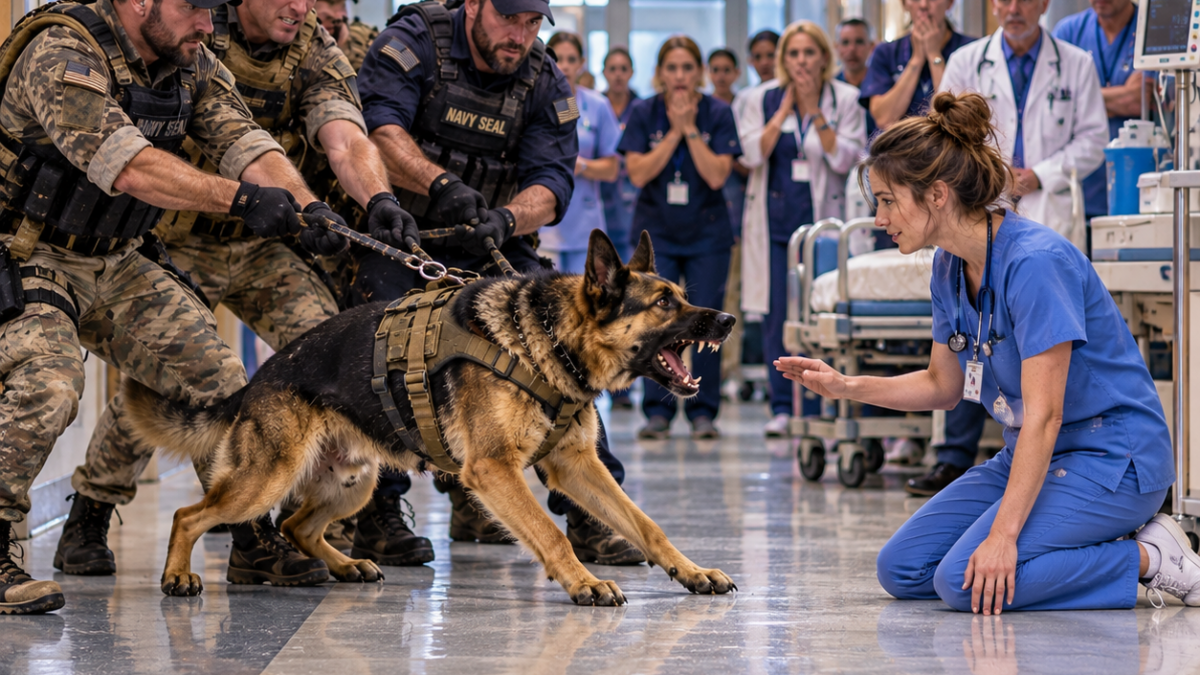
A nurse carrying a patient chart walked by without realizing everyone inside had turned toward the sound. She wore neatly pressed royal blue scrubs, a white hospital ID badge, and a black stethoscope looped around her neck. Her dark chestnut hair was twisted into a loose low bun.
Her badge read:
Olivia Bennett.
Trauma Nurse.
She was not looking at us.
She was reading notes on her clipboard, walking with the quiet efficiency of someone already late to something important.
Rex slowly stood.
I noticed first.
“Wait.”
The room froze.
Rex walked toward the glass.
His breathing slowed.
His ears lifted.
His tail, still for hours, moved once.
Then again.
Olivia finally looked up.
She noticed the crowd.
Then she noticed Rex.
For a long moment, neither moved.
She did not look afraid.
She did not look impressed.
She smiled softly, almost as if she were recognizing an old photograph.
Then, in a voice so quiet that only those nearest the door could hear, she whispered one word.
“Rex.”
The German Shepherd froze.
His ears slowly lifted.
His eyes changed first.
That was what I remember most.
The panic did not vanish all at once.
It loosened.
Like someone had unclenched a fist inside him.
His breathing evened.
His body softened.
Then, for the first time since arriving at the hospital, Rex quietly laid down on the floor.
The room fell completely silent.
Dr. Foster covered her mouth.
Director Coleman stared at Olivia.
I could not speak.
I had commanded Rex in dust storms, under fire, through chaos, through confusion, through explosions that rattled teeth.
That quiet nurse had done what none of us could do.
She had said his name like it was a safe place.
Director Coleman finally broke the silence.
“Nurse,” he said, stepping toward the door. “Could you come inside for a moment?”
Olivia blinked, embarrassed by the attention.
“I’m actually on my way back to trauma.”
“It’ll only take a minute.”
She glanced through the glass at Rex.
He was watching only her.
Nothing else.
No doors.
No windows.
No people.
Her.
She nodded politely.
“Of course.”
As soon as Olivia entered the room, Rex stood.
His posture had completely changed.
The tension that had tightened every muscle in his body was gone. His ears remained forward, but not sharply. His breathing had returned to normal. His eyes stayed on Olivia with a kind of recognition I could not explain.
“I don’t believe this,” I whispered.
Neither did anyone else.
Olivia stopped several feet away.
She did not kneel.
She did not stretch out her hand.
She did not coo at him.
She simply smiled.
“Hello, handsome.”
Rex’s tail moved once.
Then again.
Dr. Foster whispered, “That’s the first time he’s wagged his tail all morning.”
Olivia looked at me.
“May I?”
I handed her the leash immediately.
“Please.”
The moment Olivia gently took hold of it, Rex walked beside her without hesitation.
Not because she pulled.
Because he chose to.
She slowly guided him toward the examination mat.
No commands.
No treats.
No force.
Just calm footsteps.
Rex followed every one.
The veterinarians looked at one another in disbelief.
Three hours.
All it had taken was thirty seconds.
Dr. Foster carefully approached again.
This time, Rex did not move away.
Olivia rested one gentle hand against the side of his neck.
“Good boy.”
The stethoscope touched his chest.
Nothing.
No anxiety.
No pulling.
No attempt to leave.
I smiled for the first time that day.
“There you are.”
I had not seen that peaceful expression on Rex’s face since retirement.
The examination finally began.
Heart.
Perfect.
Temperature.
Normal.
Mobility.
Excellent.
Hearing.
Strong.
Everything about his physical health looked outstanding.
Only one question remained.
Why had he refused everyone except Olivia?
Director Coleman folded his arms.
“Nurse Bennett.”
She looked up.
“Yes, sir?”
“How did you know his name?”
She seemed genuinely surprised.
“It was on his harness.”
Everyone turned toward Rex.
Sure enough, a small engraved brass nameplate sat beneath the American flag patch.
REX DAUGHTRY.
Dr. Foster blinked.
“We’ve all been calling him Rex.”
Olivia nodded.
“I know.”
Director Coleman frowned.
“Then why did he respond only to you?”
Olivia smiled softly.
“I don’t know. I just said hello.”
I shook my head.
“No.”
She looked at me.
“There was something different.”
“I don’t understand.”
“When you said his name, he looked at you like he already trusted you.”
The room quieted again.
Olivia looked down at Rex.
He calmly rested against her leg now, as if he had decided she had always belonged there.
She scratched behind one ear.
“I wish I had an answer.”
But during the next twenty minutes, the answer kept showing itself even if none of us knew how to name it.
Every procedure that had been impossible earlier became effortless.
Blood sample.
Simple.
Weight check.
No problem.
Mobility assessment.
Perfect.
Even the hearing evaluation, which required Rex to move across the room, went smoothly. Olivia simply walked. Rex quietly followed.
I could not stop watching them.
“I’ve spent seven years working beside this dog,” I said. “I’ve never seen anyone earn his trust that quickly.”
Outside the examination room, news spread through the wing.
Doctors gathered near the observation window.
Nurses whispered to one another.
Veterans paused in the hallway.
One elderly Army medic smiled.
“I’ve seen this before.”
A young resident looked confused.
“What?”
“The right person,” the medic said. “Animals know.”
Director Coleman watched Olivia carefully.
She was not trying to impress anyone.
She was not giving instructions.
She was not acting like an expert.
In fact, she kept trying to step away.
Every time she did, Rex calmly stood and followed.
The third time it happened, everyone laughed.
Olivia looked down at him.
“Oh, no. You have your own commander.”
Rex looked toward me.
Then immediately back at Olivia.
I laughed.
“I think he’s temporarily reassigned himself.”
Even Coleman smiled.
That afternoon, Olivia and I sat outside the treatment wing while Rex slept peacefully beside us.
For the first time all day, he had fallen into a deep, steady sleep.
Not alert sleep.
Not working sleep.
Not one-ear-open sleep.
Real sleep.
The kind soldiers envy.
I looked at Olivia.
“Can I ask you something?”
“Of course.”
“Have we met before?”
She thought carefully.
“I don’t think so. I would have remembered.”
“So would I.”
I looked down at Rex.
“Because he certainly thinks he knows you.”
Olivia smiled.
“I’ve always loved military working dogs. My father trained service dogs when I was growing up.”
“Really?”
She nodded.
“I spent most weekends around German Shepherds and Belgian Malinois.”
“What did they teach you?”
She rested her hands around the paper cup of coffee someone had brought her but she had barely touched.
“They notice how people feel long before people notice how dogs feel.”
I looked at Rex.
“I believe that.”
She glanced at me.
“And he was trying very hard to protect you from seeing how afraid he was.”
That hit me quietly.
I wanted to deny it.
I could not.
“He’s been struggling since retirement,” I admitted.
“With hospitals?”
“With everything.”
Olivia waited.
That was one of the first things I noticed about her.
Most people wait because they are preparing to respond.
Olivia waited because she was giving you room to arrive at the truth yourself.
I continued.
“In the field, he always had a job. A mission. A team. A reason to move. Since retirement, he has me, a bed, a yard, toys, food, quiet.”
“That sounds kind.”
“It is supposed to be.”
“But?”
I swallowed.
“But sometimes I think quiet feels like being forgotten.”
Olivia looked down at Rex.
“He doesn’t need the war back.”
“I know.”
“He needs to know who he is without it.”
I turned toward her.
I had heard therapists say versions of that about men.
Never about dogs.
Maybe because too many people forget that working dogs lose purpose too.
Rex shifted in his sleep.
His paw twitched once.
Olivia lowered her voice.
“My father used to say the hardest part of helping a military dog wasn’t teaching them to trust people again.”
“What was it?”
“Teaching them they didn’t have to earn rest.”
I looked away.
The afternoon light hit the hospital windows and scattered across the courtyard.
For reasons I did not want to examine too closely, I felt my throat tighten.
“Your father sounds like a good man.”
“He was.”
Was.
I heard it.
So did she.
But she did not explain further.
Back inside, Director Coleman requested Olivia’s personnel file.
He expected an ordinary nursing record.
Good evaluations.
Trauma certifications.
Shift notes.
Maybe a few commendations.
Instead, he found a life she had apparently never advertised.
Thirteen years of outstanding service.
Letters of appreciation from military families.
Commendations from veteran support organizations.
Recommendations from military K9 rehabilitation programs.
Volunteer.
Military K9 Recovery Center.
Volunteer.
Veteran therapy events.
Volunteer.
Retired military dog adoption programs.
One sentence caught his attention and refused to let go.
Frequently requested by military K9 handlers for emotional support during rehabilitation visits.
Coleman leaned back in his chair.
“How did I never know this?”
His assistant smiled.
“Because she never talks about it.”
Late that afternoon, Rex’s examination was officially complete.
I gathered the paperwork.
“Looks like we’re all done, buddy.”
Rex remained lying beside Olivia.
I laughed.
“I guess we’re not done.”
Olivia patted his shoulder.
“You should probably go home.”
Rex did not move.
The room laughed again.
Dr. Foster smiled.
“I’ve never seen him this relaxed.”
Neither had I.
Not since retirement.
As Olivia finally stood to leave, Rex quietly stood too.
She walked toward the hallway.
He followed.
I called softly, “Rex.”
The German Shepherd paused.
He looked back at me.
Then looked at Olivia again, almost asking permission.
Olivia smiled.
“You should stay with your commander.”
Rex immediately turned and walked back to my side.
I stared at her.
“He listened.”
Olivia shrugged.
“He knows where he belongs.”
Director Coleman watched the exchange carefully.
One question still refused to leave his mind.
How could someone who had never met Rex understand him so effortlessly?
As Olivia disappeared down the hallway, Coleman turned toward me.
“I want to know everything.”
“About what?”
“About Nurse Olivia Bennett.”
I looked down at Rex.
He was peacefully watching the hallway where Olivia had disappeared.
Then I said something that made Coleman stop walking.
“This isn’t the first military canine she’s changed.”
He looked back.
“What do you mean?”
I smiled faintly.
“Not the first.”
Coleman waited.
“There’s a story almost nobody in this hospital knows,” I said. “And I think it’s time someone told it.”
Twenty years earlier, Olivia Bennett was thirteen years old.
Most children spent weekends watching cartoons, playing sports, or arguing about homework.
Olivia spent hers at a military K9 rehabilitation center outside Quantico.
Her father, David Bennett, volunteered there every Saturday.
He was not a Navy SEAL.
He was not a veterinarian.
He was not a famous trainer with a wall full of certificates.
He was a quiet man with patient hands who believed military dogs deserved the same grace they had given the soldiers they protected.
Young Olivia rarely spoke.
She preferred sitting quietly on the grass while retired military dogs rested nearby. She did not rush them. She did not call them. She did not perform affection for adults watching from benches.
She just sat.
One afternoon, she asked her father, “Dad, why don’t you make them come to you?”
David Bennett smiled.
“Because they’ve spent their whole lives following commands. They deserve a place where nobody asks anything from them.”
She looked toward an older German Shepherd lying beneath a tree.
“So how do you help them?”
David’s answer stayed with her for the rest of her life.
“You don’t make them trust you,” he said. “You become someone who never gives them a reason not to.”
That was Olivia.
Not magic.
Not a trick.
Not some dramatic hidden power.
Patience.
The kind that does not need witnesses.
The following morning, I returned to Walter Reed.
Not because Rex needed another examination.
Because Rex refused to leave the parking lot.
Every time I opened the truck door at home, he climbed in.
Every time I tried to guide him back inside, he looked at the road.
Finally, I gave up.
“You want to say goodbye, don’t you?”
His tail tapped once.
Just once.
I drove him back.
Inside the hospital, Olivia had just finished helping another patient when she heard familiar footsteps.
She turned.
Rex stood at the end of the hallway.
The moment he saw her, his tail began wagging.
Not wildly.
Just enough to say, There you are.
Several nurses smiled.
“I think he came back for you,” one said.
Olivia knelt.
“Good morning, Rex.”
The German Shepherd walked calmly over and rested his head against her shoulder.
I watched quietly.
“I’ve never seen him greet anyone like that.”
Director Coleman happened to witness the reunion.
He smiled.
“Yesterday, I thought the story was about a frightened military dog.”
He looked at me.
“I was wrong.”
“What is it about then?”
He watched Olivia press her forehead lightly against Rex’s.
“Trust.”
Later that morning, Dr. Hannah Foster invited a group of newly hired veterinary residents into the military working dog wing.
She wanted them to observe Rex before he returned home.
One resident whispered, “I heard he wouldn’t let anyone near him yesterday.”
Another nodded.
“But now he looks completely different.”
Dr. Foster smiled.
“Watch carefully.”
Olivia entered the room carrying nothing except a water bowl.
No treats.
No toys.
No leash.
Rex calmly walked beside her.
Every movement relaxed.
Every step confident.
Dr. Foster turned toward the residents.
“You’ll spend years learning medicine. You’ll learn surgeries, diagnostics, behavior, and protocols. But never forget that the greatest tool you will ever have is making someone feel safe.”
The residents nodded quietly.
Not one of them looked away from Olivia and Rex.
That afternoon, Director Coleman made another unexpected decision.
He gathered doctors, nurses, military handlers, veterinarians, therapists, maintenance workers, and reception staff in the hospital auditorium.
Nobody knew why.
Olivia quietly chose a seat near the back.
Exactly where she always sat.
Director Coleman stepped onto the stage.
“When I became hospital director,” he began, “I believed the best caregivers were the loudest leaders.”
He smiled.
“I’ve changed my mind.”
The room became silent.
“Yesterday, I watched some of the most experienced Navy SEALs in the country struggle to calm one extraordinary military K9.”
He looked toward me.
“They never stopped caring. They never stopped trying. They simply weren’t the person Rex needed in that moment.”
Then he looked toward Olivia.
“And one quiet nurse reminded all of us that compassion is sometimes stronger than command.”
He stepped off the stage, walked through the audience, and stopped beside Olivia.
She looked surprised.
So was everyone else.
He extended his hand.
“Olivia Bennett, thank you for reminding this hospital what healing really looks like.”
The room erupted.
Doctors stood.
Nurses stood.
Veterans stood.
Even maintenance staff near the back applauded with smiles.
Rex watched Olivia almost proudly.
When the applause finally softened, Olivia stood.
She looked nervous.
“I don’t think I deserve this.”
Coleman gently asked, “Why not?”
She looked around the room.
“Because I didn’t calm Rex.”
Everyone looked confused.
She continued softly.
“Commander Brooks did.”
I blinked.
“I did?”
Olivia nodded.
“For seven years.”
The auditorium became still.
“You gave him courage. You gave him purpose. You gave him a family. I simply reminded him he was safe enough to rest.”
I felt my eyes burn.
Not because I was embarrassed.
Because I knew she was right.
Rex gently leaned against my leg.
I looked down at him.
“Thank you, partner.”
He looked up with the same loyal eyes that had followed me through countless missions.
A month later, Walter Reed hosted a military working dog appreciation day.
Veterans came.
Families came.
Children came.
Retired handlers came wearing old ball caps and carrying stories they had not told in years.
Military K9s from every branch walked through the hospital garden with their handlers, some still alert, some limping, some gray-muzzled and spoiled in the way old heroes deserve to be spoiled.
Rex walked proudly beside me.
Nearby, Olivia greeted visitors with her usual quiet smile.
She was not standing on a stage.
She was not giving interviews.
She was helping a little boy overcome his fear of a retired Belgian Malinois by teaching him how to calmly offer his hand.
I watched from across the garden.
Director Coleman walked beside me.
“You know,” he said, “I’ve been thinking.”
“About what?”
“The first thing Rex did when Olivia whispered his name.”
I smiled.
“He stopped feeling alone.”
Coleman nodded slowly.
“I think that’s what healing really is.”
As the afternoon drew to a close, I prepared to leave.
I opened the truck door.
Rex climbed inside.
Then he paused.
He turned around one last time and looked toward Olivia.
She smiled and raised her hand in a small wave.
“Take care of yourself, Rex.”
The German Shepherd wagged his tail.
Then he settled into his seat.
I closed the door.
As we drove away, I glanced into the rearview mirror.
Rex was not watching the road.
He was watching the hospital disappear behind us.
“You found another friend, didn’t you?”
He finally looked forward.
His eyes were peaceful.
For the first time since retiring, he truly looked at home.
Several weeks later, visitors walking through Walter Reed often noticed a framed quote hanging in the military working dog wing.
It was not about courage.
Not medals.
Not heroic missions.
It simply read:
Sometimes the kindest voice isn’t the loudest one. It’s the one that quietly reminds us we’re safe.
Beneath the quote was a photograph.
Me kneeling beside Rex.
Olivia Bennett smiling quietly nearby.
No ceremony.
No trophies.
No headlines.
Just a Navy SEAL, a loyal military K9, and the quiet nurse who reminded everyone that the strongest bond is never built through fear.
It is built through trust.
And Rex, who had once charged through smoke, dust, and danger without hesitation, taught all of us one final lesson inside that hospital corridor.
Even heroes need someone gentle enough to whisper their name.
Even warriors need permission to rest.
And sometimes, the voice that saves you is not the loudest command in the room.
Sometimes it is a quiet nurse at the end of a hallway saying one word like she has been waiting her whole life to make you feel safe.
“Rex.”