An 8-Year-Old Girl Ran From the Rain and Hid Behind My Motorcycle—Then a Federal Agent Revealed Why Dangerous People Had Been Searching for Her for Six Years.
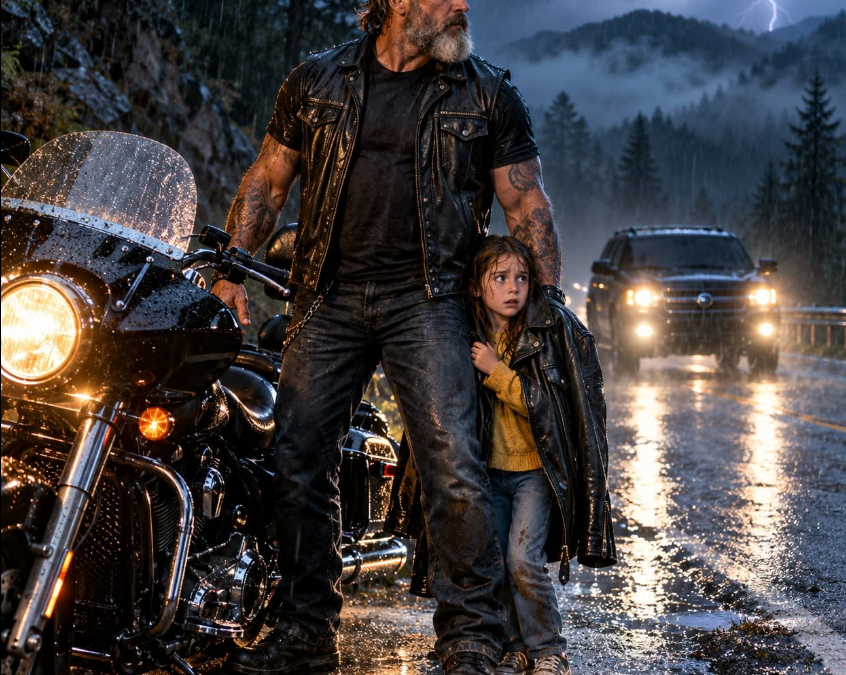
PART3:
Later, when federal agents spread files across a metal table and showed me how long people had searched, how many tips had died in county offices, how many photographs had been printed and faded, I would hate myself for not knowing that name.
But in that moment, she was just a child in the rain.
And that was enough.
“Who’s in the SUV, Sophie?”
“I don’t know all their names.”
That answer bothered me more than if she had said none.
“Do they know you?”
“Yes.”
“Where did you come from?”
She turned her head toward the trees on the north side of the road.
“A house.”
“Your house?”
She shook her head.
I looked at the woods.
Eastern Tennessee mountains are beautiful in daylight and merciless after dark. The trees grow close and thick. Slopes drop where you don’t expect them. Old logging roads split and vanish. Creeks rise fast in storms. A grown man can get turned around in those woods if he’s proud enough to pretend he can’t.
An eight-year-old girl had come out of them alone.
“How long were you walking?”
“I don’t know.”
“Were you hurt?”
She shook her head too fast.
That meant yes, but not in a place she wanted to name.
I kept my voice even. “Can you show me your hands?”
She held them out.
Small fingers. Mud under the nails. A scrape across one palm. No fresh blood. Her wrists were too thin. The skin under the cuffs of her sweater had old bruises fading yellow.
I felt something inside me go still.
There is anger that burns hot and makes a man stupid.
Then there is anger that goes cold and sharp.
The second kind keeps you alive.
I opened the saddlebag on my bike and pulled out a bottle of water. I twisted the cap loose before handing it to her so she wouldn’t have to struggle with shaking hands.
“Small sips,” I said.
She took three careful drinks, like water was something that had rules.
Then she looked at my jacket and frowned.
“I got it dirty.”
I blinked.
Rain was running down my neck. A black SUV had just crept past us. A child had come out of the woods with bruises on her wrists.
And she was worried about mud on my jacket.
“That jacket has been through three states, two marriages, and one bar fire,” I said.
Her eyes widened. “You were in a fire?”
“Long story.”
She started wiping the sleeve with her wet hand.
I almost laughed.
“There are more important things right now, Sophie.”
“It looks important.”
It was.
But not because of the leather.
Inside the inner pocket was the last photograph I had of my daughter.
Lena.
She had died nineteen years earlier, nine years old, missing one front tooth, madly in love with pancakes, stray cats, and my motorcycle. A drunk driver ran a red light outside Bowling Green while I was away on a recovery contract in Kentucky. My wife at the time, Carol, survived with a broken collarbone and a wound in her soul that never closed right. Our marriage followed Lena into the ground slower, piece by piece.
I didn’t talk about Lena.
Not to the club.
Not to family.
Almost never to myself.
Some names turn into locked rooms. You can walk past them every day and still pretend you don’t know what’s inside.
I took my phone out.
Still no service.
Naturally.
“All right,” I said. “We’re not staying here.”
Sophie went rigid. “Where are we going?”
“Somewhere dry. Somewhere with a door.”
“No police.”
I paused.
Most scared kids ask for police.
Sophie had said it like a warning.
“Why no police?”
Her eyes filled. “They know some of them.”
The rain got louder.
Or maybe the world got quieter.
“Who knows some of them?”
She pressed her lips together.
I didn’t push.
The wrong question can shut a child like a slammed door.
I had spent eight years in Army aviation rescue pulling people out of mountains, floodwaters, wrecks, and places no one should have survived. After that, I spent twenty-three years around bikers, mechanics, veterans, recovering addicts, men who lied for sport, and men who lied because the truth hurt too much. I knew the difference between a kid making up trouble and a kid who had learned that adults with badges could still be dangerous.
Real fear has a rhythm.
You can hear it.
Sophie wasn’t acting.
I looked down the road again. The SUV was gone, but that didn’t mean it had left.
I rolled my Harley backward beneath a stand of hemlocks off the shoulder, killed the remaining light, and covered the chrome with a dark rain tarp I kept for long rides. Then I took my helmet, my saddlebag, and Sophie’s small hand.
“There’s an old Forest Service maintenance cabin about half a mile in,” I said. “Can you walk?”
She nodded.
“You tell me if you need to stop.”
“I won’t.”
“That wasn’t the question.”
She looked up at me, confused.
I softened my voice. “You don’t have to prove anything to me.”
For a second, her face changed. Not relief. Not trust. Something smaller and sadder.
Like she didn’t know what to do with permission.
We left the road and followed an old trail I knew from years of riding these mountains with the Iron Ridge crew. The trail was half washed out, slick with red clay and pine needles. Sophie stumbled twice but refused to let go of my hand. Every few steps, she looked behind us.
I did too.
The cabin sat tucked between rhododendron and rock, an ugly square structure with a tin roof and boarded side window. I had found it years ago during a charity ride when one of our guys blew a tire and we spent two hours waiting out hail. It wasn’t much, but it had a roof, an old bolt on the door, and a woodstove that might or might not smoke us blind.
I checked every room before letting Sophie inside.
One main room.
One storage closet.
No basement.
No second door except the rear exit, which was swollen from damp but still opened with a hard pull.
I locked the front door and dragged an old workbench in front of it.
Sophie stood in the middle of the room wrapped in my jacket, water dripping from the hem.
“There’s nobody here?” she asked.
“Nobody but us.”
“How do you know?”
“I looked.”
“Sometimes they hide.”
The way she said it made my hand tighten on the flashlight.
I checked again.
Not because I thought I had missed someone.
Because she needed to see an adult believe her fear enough to act.
When I came back, she was sitting on the floor with her knees to her chest.
I dug through my saddlebag and found two granola bars, a half pack of jerky, a first-aid kit, an emergency blanket, a flashlight, a battery lantern, and an old satellite communicator I carried from my rescue days because habit is just fear with better organization.
The communicator had no signal inside.
I set it near the broken window where the roof overhang kept most of the rain out.
Nothing.
I gave Sophie a granola bar.
She held it without opening it.
“You can eat it,” I said.
“I know.”
But she didn’t.
So I opened one for myself and took a bite.
“See?” I said. “Terrible. But not poison.”
Her mouth twitched.
Then she ate.
Tiny bites. Careful. Like someone had taught her not to finish too fast.
I turned my back while she changed into my spare thermal shirt from the saddlebag. It hung to her knees. I wrung out her sweater and draped it over a chair near the stove, though I didn’t light a fire yet. Smoke could be seen. Warmth was good. Being found was not.
The rain softened after an hour.
Not stopped.
Just softened.
Enough that the cabin seemed less like a drum and more like a secret.
Sophie sat in the corner wrapped in my leather jacket and the emergency blanket. Her eyes moved around the room, measuring exits, shadows, distance.
I knew that look.
I had seen it on men fresh home from war.
I had seen it in mirrors.
“You from around here?” I asked.
She shook her head.
“Do you know where your family is?”
Her face closed.
I backed away from that question.
“Do you know how old you are?”
“Eight.”
“When’s your birthday?”
“March.”
“What day?”
She looked embarrassed.
“I don’t know anymore.”
An eight-year-old should know her birthday. She should be counting down to cake, arguing over candles, asking whether eight sounded much older than seven.
My anger went colder.
After a while, she reached into the inner pocket of my jacket.
I moved fast without meaning to.
“Careful.”
She froze, one hand inside.
I forced myself to breathe. “Sorry. There’s something in there.”
She pulled it out slowly.
The photograph.
Lena sat on my old motorcycle in the picture, wearing a pink helmet too big for her head, laughing so hard her missing tooth showed. I had taken that photo two months before she died. She had begged me to let her sit on the bike and “look dangerous.” She looked like sunshine pretending to be thunder.
Sophie studied the picture.
“That your daughter?”
I took it carefully.
“Yes.”
“She looks nice.”
“She was.”
Sophie heard the past tense.
Kids always do.
“What happened?”
I could have told her it was private. I could have put the picture away and locked the room again.
But she had handed me her fear on a mountain road. The least I could do was hand her one honest thing back.
“Car accident.”
“I’m sorry.”
I nodded.
People say I’m sorry when they don’t know what else to do with your pain. Most of the time, I hated it.
From Sophie, it felt different.
She touched the edge of the photograph.
“She looks like she laughed a lot.”
That almost broke me.
Because when I thought of Lena, I didn’t think first of laughter.
I thought of the phone ringing.
I thought of the hospital hallway.
I thought of the doctor’s mouth moving before I understood the words.
I thought of Carol screaming without sound.
I thought of a small bedroom filled with toys that suddenly looked like evidence.
“She did,” I said.
Sophie looked around the dark little cabin, then back at the photograph.
“Maybe you should remember that part more.”
I stared at her.
A child I had known less than two hours had found a wound grown men had spent twenty years politely walking around.
Before I could answer, headlights moved through the trees.
Sophie went white.
Not pale.
White.
All the blood seemed to leave her face at once.
I killed the lantern.
The cabin plunged into darkness, except for thin gray rain-light leaking around the boards. I moved Sophie behind me and guided her into the shadow beside the old stove.
“Quiet,” I breathed.
Footsteps reached the porch.
Slow.
Measured.
Not lost hikers.
Not kids.
Someone tried the door handle.
Once.
Twice.
The workbench held.
Sophie’s fingers dug into my arm so hard it hurt.
Then a man’s voice came through the wood.
“Sophie?”
She stopped breathing.
The voice was gentle. Warm. Almost amused.
“We’re here to take you home.”
I looked down at her.
She shook her head hard.
I whispered against her hair, “Family?”
“No.”
“Sophie, sweetheart,” the voice continued. “Everybody’s worried. You scared Miss Ruth half to death running off like that.”
Miss Ruth.
I stored the name.
The man waited.
I did not answer.
Rain ticked off the roof. Somewhere in the woods, water rushed down a ditch. The man outside shifted his weight, and the porch board creaked.
“We know you’re frightened,” he said. “But the man with you doesn’t understand. He could get in trouble. You don’t want that, do you?”
Sophie’s whole body shook.
There it was.
Not anger.
Not threats.
Guilt.
The leash adults use when children are too kind for their own safety.
I kept my hand over her shoulder.
The man tried the handle once more.
Then silence.
Nearly a minute passed before footsteps moved away.
An engine started somewhere down the trail.
Another vehicle answered farther off.
Then nothing.
I waited ten full minutes.
Sophie finally whispered, “They always sound nice when other people can hear them.”
Every hair on my neck lifted.
I turned toward her.
“What happens at that house?”
She stared at the floor.
“There are other kids.”
I kept my face still.
That mattered.
“How many?”
“I don’t know.”
“Do you go to school?”
“No.”
“Doctors?”
She shook her head.
“What do they tell people?”
“That they’re helping us.”
The storm outside suddenly felt very far away.
Sophie’s voice grew smaller.
“When visitors come, we stay downstairs.”
I wanted to ask a hundred questions.
What visitors?
How many kids?
Who brought you there?
Were you hurt?
Who was Miss Ruth?
Where exactly was the house?
But children who crawl out of cages do not owe adults a complete report before they are allowed to be safe.
So I asked only one.
“How did you leave?”
“A back door.”
“Anyone come with you?”
Her eyes filled.
“I tried.”
That was enough.
I didn’t ask another question.
I made her a place to sleep in the driest corner of the cabin with the emergency blanket, my jacket, and an old canvas tarp folded under her like a mattress. She lay down but didn’t close her eyes.
“You should sleep,” I said.
“So should you.”
“I’m old. We practice not sleeping.”
“That’s not healthy.”
“No, ma’am.”
She looked at the door.
“What if they come back?”
“They’ll have to make noise moving that workbench.”
“What if they have a key?”
“It’s a Forest Service lock from 1978. I’m not sure the Forest Service has a key.”
That earned me half a smile.
It vanished quickly.
“Please don’t let them take me.”
I sat against the door with my knees up and the flashlight across my lap.
“They won’t.”
“You don’t know that.”
She was right.
So I corrected myself.
“I won’t give you to anybody until you know you’re safe.”
That was a promise I could keep.
She watched me for another long minute.
Then exhaustion finally dragged her under.
I sat against the door until almost dawn.
A man thinks strange things in darkness with a sleeping child behind him and unknown vehicles in the woods.
I thought about Lena.
Not the hospital this time.
Pancakes.
I hadn’t let myself think about pancakes in years.
Lena used to press chocolate chips into the batter in smiley faces and get furious when I flipped them too early and melted the mouth crooked. She called my Harley the dinosaur because she said it growled before it moved. She hated matching socks and named every squirrel in our yard Jeremy, even though I explained that statistically not all squirrels could be Jeremy.
Maybe you should remember that part more.
Sophie murmured in her sleep around three in the morning and began crying without waking.
“No,” she whispered. “I tried. I tried.”
I moved close enough for her to hear me but not close enough to trap her.
“You’re safe right now,” I said. “You’re in the cabin. My name is Mason. Nobody is taking you.”
She woke with a gasp and grabbed my wrist.
“Did they come?”
“No.”
“I left Noah.”
Her voice cracked on the name.
I lowered myself onto the floor across from her.
“Who’s Noah?”
“He’s little. He cries too loud. They don’t like it.”
Cold anger.
Sharper now.
“You tried to bring him?”
She nodded, tears spilling silently.
“The door made noise. Miss Ruth came. I ran because Noah said run, but he didn’t come.”
She covered her mouth like the words were trying to climb back in.
I wanted to promise her we would get Noah before breakfast.
I wanted to promise her every child in that house would be safe by noon.
I wanted to promise things only God and liars can promise.
Instead, I said, “You got out. That means you can help people find him.”
She stared at me.
“Help?”
“Yes.”
“I didn’t leave him forever?”
“No.” I made my voice hard enough for both of us. “You survived long enough to tell.”
She wiped her face with the sleeve of my thermal shirt.
“Miss Ruth says running is selfish.”
“Miss Ruth is a damn liar.”
Sophie’s eyes widened.
I cleared my throat. “Sorry.”
“No,” she said softly. “I think that was accurate.”
Just before sunrise, my old satellite emergency communicator caught a signal.
It beeped once.
I almost jumped out of my skin.
Sophie sat up.
“What is it?”
“Message.”
“From who?”
“I don’t know yet.”
The screen glowed blue in the dim cabin.
Unknown sender.
One sentence.
IF THE CHILD WITH YOU IS SOPHIE BENNETT, DO NOT CONTACT THE COUNTY SHERIFF. SOMEONE INSIDE IS COMPROMISED.
I read it twice.
Then a third time.
Sophie watched my face.
“What does compromised mean?”
“It means we’re going to be careful who we trust.”
“More careful than now?”
“Unfortunately.”
I removed the battery from the communicator.
Old habit.
Then I woke my body the rest of the way. Stiff knees. Cold back. Shoulder aching from leaning against the door. None of it mattered.
“We’re moving.”
Sophie stood immediately, too quickly, like children in that house had learned hesitation cost something.
“Did they find us?”
“Not yet.”
That word frightened her.
I handed her another granola bar.
“Eat.”
She stared at it.
“That’s breakfast?”
“You want restaurant service, complain to management.”
She smiled despite herself.
It was the first real smile I saw.
Small, cautious, gone quickly.
But real.
We left the cabin through the back door and climbed toward an old logging ridge before the sun fully cleared the trees. I kept us off obvious paths. Sophie moved quietly, better than any child should have been able to move in the woods. She avoided branches. Tested mud before stepping. Froze when birds scattered too sharply.
Someone had taught her fear as a survival skill.
That made me want to tear the world apart with my hands.
By midmorning, the rain had stopped, leaving the mountains steaming and bright. Fog clung low between the trees. We reached an abandoned fire lookout near noon, a wooden structure with half the railing missing and graffiti carved into the posts.
Inside, Sophie found half an old checker set in a metal box.
“We can use bottle caps for missing pieces,” she said.
“We’re hiding from people in SUVs, and you want to play checkers?”
“You said we had to wait until it was safe to move.”
“I said we had to watch.”
“I can watch and win.”
“You’re making rules up.”
“Yes.”
“That’s cheating.”
“No,” she said solemnly. “Cheating is when you lose.”
She destroyed me in nine minutes.
For a little while, she was simply eight.
She frowned at bottle caps, accused me of suspicious strategy, and informed me that bears should not be allowed to play checkers because their paws were too big for precision.
Then I heard buzzing.
Soft at first.
A mosquito sound where no mosquito should be.
I stepped to the doorway.
A drone passed above the trees.
Small.
Commercial.
Gone quickly.
Sophie saw my face and stood.
“What?”
“We leave now.”
She didn’t question me.
That broke my heart in a fresh way.
Children should ask why. They should complain. They should need convincing.
Sophie moved like a soldier under orders.
We were halfway down the ridge when my communicator vibrated again.
I had put the battery back in only long enough to check signal from the lookout. The new message came through in fragments, then completed.
Coordinates.
Then:
COME ALONE WITH THE CHILD IF SAFE. ASK FOR AGENT CLAIRE MORGAN. FBI.
I almost ignored it.
Could have been bait.
Could have been someone using three letters because desperate people run toward authority the way drowning people reach for anything floating.
But the first message had known her full name.
It had known not to trust the county sheriff.
And whoever sent it had not told me to hand Sophie over. They had told me not to trust too fast.
That sounded less like a trap than most official instructions.
Still, I chose the safest option I knew.
I sent one coded message to my riding club.
Not details.
Not names.
Just coordinates and one word.
WATCH.
Iron Ridge understood.
The Iron Ridge Riders were not saints.
I won’t pretend otherwise.
We had men with records. Men with divorces stacked like unpaid bills. Men who had crawled out of addiction and men still white-knuckling it day by day. We had veterans who woke swinging, mechanics who trusted engines more than people, widowers who drank too much coffee because sleep was a room full of ghosts.
But if one of us sent coordinates and the word WATCH, nobody asked whether the trouble was convenient.
They came.
Three hours later, Sophie and I reached an old covered bridge crossing a mountain creek.
The bridge had faded red boards, a sagging roof, and enough holes in the floor to see water flashing beneath it. On the opposite side stood a woman in hiking clothes, early forties maybe, dark hair tied back, hands visible.
She had no visible weapon.
That did not mean she was unarmed.
She placed credentials on the railing and stepped back.
“Claire Morgan,” she called. “FBI.”
I stopped inside the mouth of the bridge with Sophie behind me.
“How do I know those are real?”
“You don’t,” she said.
Good answer.
She stepped farther back.
“Don’t trust me yet.”
I liked her more for that.
Sophie peeked around my side.
Claire’s face changed when she saw her.
Not pity.
Not victory.
Relief so sudden it almost looked painful.
“Hi, Sophie.”
Sophie stiffened. “How do you know me?”
Claire swallowed.
“Because people have been looking for you since you were two years old.”
Silence filled the bridge.
Even the creek seemed quieter.
Sophie grabbed my hand.
“I’m not two.”
“No,” Claire said gently. “You’re not.”
She opened a folder on the railing and turned it toward us without stepping closer.
Missing-child reports.
Fake charity registrations.
Properties across Tennessee, North Carolina, Kentucky, and Virginia.
Photographs.
Names.
Some crossed out.
Some circled.
Six years of investigation spread across damp wood in the mountain air.
The first photo showed Sophie younger, with round cheeks and a red bow clipped crookedly in her hair.
I looked down at the child beside me.
Her face had changed, thinned and sharpened by fear and time, but the eyes were the same.
Sophie stared at the photograph like she was looking at a ghost who had stolen her face.
“That’s me?”
Claire nodded.
“You were taken from a park outside Asheville. Your mother had died the year before. Your father was struggling. Your aunt Rebecca had temporary custody that weekend. She turned away for less than a minute.”
Sophie’s lips parted.
“I have an aunt?”
“Yes,” Claire said. “Rebecca Bennett. She has never stopped looking for you.”
Sophie looked at me.
As if I could confirm whether family was real.
I had no answer.
Claire continued carefully. “The people who took you moved children through organizations that looked legitimate. Temporary homes. Religious retreats. Crisis shelters. Youth programs. By the time authorities understood what was happening, the houses were empty.”
“Why hasn’t anyone stopped them?” I asked.
Claire’s eyes moved from Sophie to me.
“Because someone kept warning them.”
“The sheriff?”
“I don’t know how far it goes. We know prior searches failed after information leaked. We know local agencies were used when they should not have been. We know at least one person with access to child welfare and law enforcement information helped them stay ahead.”
Sophie’s hand tightened around mine.
Claire looked at her again.
“We found other children over the years, but most were too young or frightened to identify locations. Some remembered pieces. A porch. A song. A smell. A woman named Ruth. A man who drove a black SUV. But never enough to connect the current houses.”
Sophie stared at the papers.
Then she pointed at one photograph.
An old farmhouse.
White siding.
Green roof.
A red barn behind it.
“That one.”
Claire went still.
“What about it?”
“The blue room is there.”
Claire’s face changed.
“Blue room?”
Sophie nodded. “They paint the walls blue because they say blue makes kids calm.”
Claire closed her eyes briefly.
“No report has ever mentioned that.”
“There’s a cellar door behind the pantry,” Sophie said.
Claire crouched, still keeping distance. “Do you remember anything else?”
Sophie looked at me first.
Not Claire.
Me.
I said, “Only if you want to.”
That mattered.
Her shoulders loosened one inch.
Then she began talking.
Not in order. Not like adults do when they’re trying to sound convincing. She spoke the way frightened children remember things: road sounds, smells, colors, phrases, little details adults never realize they’re leaving behind.
A church sign with a missing letter.
A red barn with a painted rooster.
A water tower shaped like a peach.
A woman called Miss Ruth who smelled like peppermint and bleach.
A man named Owen who wore shiny shoes in the mud.
A boy named Noah who cried too loud.
A baby everyone called Cricket because she made squeaking sounds when she slept.
A room downstairs with mattresses lined against a wall.
A pantry shelf that swung out if you pressed the knot in the wood.
A white van with Helping Hands Youth Ministry on the side.
The more Sophie spoke, the paler Claire became.
Finally Sophie asked, “If I help, can you get the others?”
Claire answered carefully.
“We can try.”
“Promise?”
Claire hesitated.
Then she said the right thing.
“I promise we won’t stop trying.”
Sophie nodded.
I liked Claire more after that.
No impossible promises.
Just truth.
We agreed to move toward a federal rendezvous point eighteen miles away. Claire had an unmarked pickup hidden beyond the bridge, but Sophie did not want to get inside any vehicle with doors she couldn’t control. I understood that.
So Sophie rode behind me on the Harley.
My jacket was still around her, the sleeves tied carefully so they wouldn’t flap. Claire followed in the pickup. I gave Sophie my spare helmet, tightened the strap, and told her twice that if she wanted to stop, she tapped my shoulder.
She climbed on behind me like she had been brave all her life and was tired of it.
For the first time since I found her, she wasn’t holding on like she expected to fall.
We rode slowly.
The road twisted down the mountain, wet leaves plastered along the edges. Clouds dragged shadows over the ridges. Every black vehicle made her hands tighten, but she stayed with me.
Then we rounded a curve and saw three SUVs blocking the road.
Black.
Tinted windows.
The same kind Sophie had been running from.
She pressed against my back.
“That’s them.”
Claire’s voice crackled through the helmet radio she had given me.
“Reverse. Now.”
I looked behind us.
Narrow road.
Steep slope.
Bad angle.
Claire’s pickup was thirty yards back, boxed by the curve.
Then I heard motorcycles.
A lot of them.
From the western ridge.
My club.
Twelve Iron Ridge Riders appeared around the bend behind Claire’s pickup, engines low and steady. They stopped in formation, not close enough to crowd her, not far enough to be useless.
Nobody charged.
Nobody threatened anyone.
They simply formed a wall between Sophie and the road behind us.
The SUVs remained ahead.
I cut my engine.
Sophie whispered, “Bear?”
“I know.”
Claire got out of her pickup, one hand near her jacket but not reaching. “Mason, stay with the child.”
The lead SUV door opened.
A man stepped out.
Clean shirt. Expensive rain jacket. Dark hair silvering at the temples. The kind of face you could imagine smiling at donors, shaking hands at fundraisers, standing beside oversized checks.
My body recognized him before my mind did.
Not his name.
His type.
Men who know how to sound reasonable while doing unreasonable things.
“Sophie,” he called.
She shrank against me.
I dismounted slowly and helped her down behind the bike. One of my riders, Boone, a retired paramedic with a beard bigger than most house pets, stepped near enough that Sophie could move behind him if she needed to.
I walked forward alone.
Empty hands.
My heart pounded.
I wasn’t fearless.
People misunderstand that word.
Fearless men are dangerous because they don’t understand consequences.
I was terrified.
I just knew where I wanted the fear focused.
On me.
Not Sophie.
Claire grabbed my arm as I passed.
“Mason.”
“They’re watching me.”
“That’s not a plan.”
“It doesn’t need to be.”
I stopped twenty yards from the man in the rain jacket.
“That child belongs with us,” he said.
“She’s a child,” I answered.
“We are her guardians.”
“Then federal agents can sort it out.”
His face tightened. “This doesn’t concern you.”
Behind me, Sophie’s voice shook but carried.
“Yes, it does.”
The man’s eyes moved past me to her, and I saw the mask slip.
Just for a second.
It was not rage.
It was ownership.
Like she had spoken out of turn at his table.
“Sophie,” he said softly. “You’re confused. You’ve been through a frightening night. Miss Ruth is worried sick.”
At the name, Sophie flinched.
I took one step sideways, blocking his view.
“You don’t say another word to her.”
His smile returned.
“You have no idea what you’re interfering with.”
“Funny,” I said. “I was about to tell you the same thing.”
A distant thump rolled over the mountain.
At first it sounded like thunder.
Then it came again.
Steady.
Mechanical.
Helicopter blades.
The man looked up.
That was when he realized Claire had not been waiting alone.
Federal vehicles appeared from the east, emerging around the lower bend with lights hidden until the last second. Two SUVs. Then a third. Not local cruisers. Not county markings. Federal plates, hard faces, doors opening before the vehicles fully stopped.
The man in the rain jacket stepped backward.
For the first time, he looked uncertain.
He returned to his SUV fast.
All three black vehicles reversed, then turned onto a narrow forest road with tires spitting gravel.
Nobody fired a shot.
Nobody needed to.
Federal agents moved after them.
Claire’s radio exploded with voices.
Sophie ran toward me.
I barely had time to bend before she wrapped both arms around my waist.
“You said nobody gets me without going through you.”
I rested a hand on her wet hair.
“They didn’t.”
She cried then.
Not quietly.
Not politely.
She cried like a child whose body had finally realized it did not have to keep running that second.
Boone turned away and wiped his face with the heel of his hand.
The Iron Ridge Riders, men who looked like every parent’s warning, stood in a wet mountain road and gave a little girl the dignity of not staring while she fell apart.
By that evening, federal and state teams had recovered nine children from two properties.
One of them was Noah.
He was six years old, thin as a rake handle, with a voice so hoarse he could barely speak. When Sophie heard he was alive, she folded to the floor in the federal safe house and sobbed into my jacket until Claire had to kneel beside her and say, “You helped bring him out. You did that.”
More children were found over the following weeks.
Not all at once.
Not all easily.
Some houses were empty by the time teams arrived. Some records had been burned. Some adults disappeared into states where they thought old names would protect them. But the machine had been cracked open, and light was moving through it.
Miss Ruth was arrested in North Carolina.
The man in the rain jacket was named Owen Vale, director of a fake charity called Grace Harbor Family Outreach. He had spent years collecting donations, smiling in brochures, and speaking at churches about vulnerable children needing “structured love.” People had written him checks with tears in their eyes.
He had used their kindness as camouflage.
A local sheriff’s captain in Tennessee was later charged with leaking information from prior investigations. A county child welfare contractor was charged too. Others followed. The case became bigger than even Claire expected, crossing state lines, agencies, churches, nonprofits, foster networks, and private homes where paperwork had been made to look just official enough that busy people stopped asking questions.
I wish I could tell you everything became easy for Sophie after that.
It didn’t.
Rescue is not recovery.
People clap for rescue because it has a visible ending. Doors kicked open. Children carried out. Bad people in handcuffs. News vans outside courthouses.
Recovery is quieter.
It happens at three in the morning when a child wakes up screaming because a heater clicked like a lock.
It happens when she hides crackers under a mattress because some part of her body still believes meals can vanish.
It happens when a black SUV turns into a grocery store parking lot and she stops breathing.
It happens when someone says “sweetheart” in the wrong tone and she disappears inside herself for twenty minutes.
It happens when adults learn that good intentions do not erase terror.
For the first week, Sophie stayed in a federal protective placement while they confirmed Rebecca Bennett’s identity and checked every possible connection. She was not handed over quickly, and that was right. Children who have been moved through fake systems deserve adults who take real systems seriously.
Rebecca arrived on the fourth day.
I was at the federal building because Claire had asked me to give another statement. I saw Rebecca in the hallway before Sophie did.
She looked like a woman who had been holding her breath for six years.
Forty maybe, though grief had made her older around the eyes. Brown hair pulled into a messy knot. Hands shaking around a folder so thick it barely closed. She wore a gray sweater with a small embroidered sunflower near the collar.
Claire spoke with her first.
Then she asked me to wait outside the family room.
“That moment isn’t mine,” I said.
“No,” Claire agreed. “But Sophie asked if you were still in the building.”
So I stayed in the hallway.
Not near the door.
Not listening.
Just there.
When Sophie saw Rebecca, there was no movie moment. She did not run into her aunt’s arms. She did not remember everything. She stood in the doorway, one hand holding my jacket sleeve, staring at a woman who loved her more than memory could prove.
Rebecca sank to her knees.
“Hi, Sophie,” she said, and her voice broke on the name.
Sophie looked at Claire.
Claire nodded.
Then Sophie looked at me through the open doorway.
I said, “You don’t have to do anything fast.”
That was all.
Sophie took one step.
Then another.
Rebecca did not grab her. Did not overwhelm her. She held out both hands, palms up, and let Sophie decide.
When Sophie finally touched her fingers, Rebecca closed her eyes like someone had placed a miracle in her hands.
They cried together quietly.
I walked away before my own grief made me intrude on theirs.
The months after that were complicated.
Rebecca became Sophie’s legal guardian after hearings, evaluations, background checks, and more paperwork than any human being should have to survive. She moved temporarily closer to Knoxville for Sophie’s therapy and the ongoing case. Sophie started school part-time, then full-time. She hated math, loved science, drew stars on everything, and had strong opinions about cafeteria mashed potatoes.
She came to my motorcycle shop three months after the mountain road.
Rebecca brought her.
I was under a lifted truck when Boone shouted, “Bear, you got visitors.”
I rolled out on the creeper, grease on my forehead, and saw Sophie standing in the open bay holding my leather jacket.
Clean.
Conditioned.
Every torn seam repaired.
The Iron Ridge patch polished like it had been blessed.
“I think this belongs to you,” she said.
I sat up slowly.
“You didn’t have to fix it.”
“It kept me warm.”
Rebecca smiled. “She insisted.”
Sophie held it out.
I took it with both hands.
The leather felt different. Softer somehow. Or maybe I was.
Then Sophie reached into the inner pocket and pulled out Lena’s photograph.
My throat closed.
“You kept it safe,” I said.
“She kept me company.”
Beside the photograph was Lena’s old hospital bracelet, sealed in the small plastic sleeve where I had kept it for nineteen years. I had forgotten it was still there.
That was a lie.
I had not forgotten.
I had simply trained myself not to feel it every time my hand brushed the pocket.
Sophie held it toward me.
“I think you should keep remembering her.”
“I do.”
“No.” She shook her head. “Remember the good stuff.”
There was that eight-year-old wisdom again.
Small body.
Ancient eyes.
I looked at the photograph.
For years, whenever I thought about Lena, I saw the end.
The phone call.
The hospital room.
The empty bedroom.
The white coffin.
That day, standing in my shop with oil on the floor and sunlight cutting through dust in the air, I remembered pancakes.
Lena making chocolate-chip faces.
Lena naming squirrels.
Lena wearing mismatched socks to school because “feet need different personalities.”
Lena on my motorcycle laughing, missing tooth and all, yelling, “I look dangerous, Daddy!”
A laugh came out of me before I could stop it.
It sounded rusty.
Sophie narrowed her eyes.
“What?”
“Nothing.”
“Adults say nothing when it’s definitely something.”
“You sound like Lena.”
She smiled.
“I’ll take that as a compliment.”
“It is.”
The club loved her immediately, though they tried to pretend they were being normal about it.
Boone built her a step stool so she could see over the workbench.
Rico taught her how to check tire pressure and then got offended when she corrected his handwriting on the chart.
Preacher, who had not been a preacher for thirty years but still somehow made people confess things near him, brought her a telescope he found at a yard sale because he heard she liked astronomy.
Sophie accepted the telescope with great seriousness and said, “I will use this for scientific purposes and possibly spying on birds.”
Rebecca laughed.
I nearly did too.
The first time Sophie came to an Iron Ridge cookout, some people in town stared.
They still saw leather first.
Patches.
Tattoos.
Motorcycles lined up like a warning.
Then they saw Sophie sitting between Boone and Rico, explaining constellations with a paper plate in one hand and a hot dog in the other, and the story got harder to keep simple.
That’s the thing about truth.
It complicates hate.
One Saturday almost a year after I found her, Sophie and Rebecca came by the garage with a paper bag full of muffins and a school project about planets. Sophie had grown an inch. Maybe two. Her hair was longer. Her cheeks were fuller. She still startled too easily when a door slammed, but she recovered faster now.
Healing, I learned, was not the absence of fear.
It was the speed at which safety could return.
We played checkers in the office while Rebecca talked to Claire on the phone outside.
Sophie cheated.
She claims I’m lying about that.
She moved a bottle cap diagonally backward even though we had clearly established bottle caps were standard pieces unless crowned with a washer.
“That is illegal,” I said.
“That is innovation.”
“That is theft with vocabulary.”
“You’re just upset because I’m young and brilliant.”
“You’re eight.”
“Nine next month.”
“You know the day now?”
She looked up.
“March seventh.”
The room went soft around that answer.
She noticed.
“Don’t get weird.”
“I’m not weird.”
“You’re absolutely weird.”
I let her win because she was right.
After checkers, we went for pancakes at a diner outside town. Not June’s. Another place with green booths, sticky syrup bottles, and a waitress who called everyone honey whether they deserved it or not.
When the waitress asked why we were eating breakfast at three in the afternoon, Sophie answered, “Because breakfast foods deserve freedom.”
I almost fell out of the booth.
Lena used to say almost exactly the same thing.
Sophie looked alarmed. “What?”
I shook my head.
This time, I told the truth.
“My daughter used to say that.”
Sophie grew quiet.
“Does that make you sad?”
“Yes.”
“Should I not say it?”
“No.” I looked at the plate in front of me, at the pancakes melting butter into their edges. “It makes me remember the good stuff.”
Sophie nodded like a teacher whose student had finally understood the lesson.
“Good.”
Later, outside the diner, she handed me my leather jacket.
I put it on.
For nineteen years, that jacket had carried my daughter’s photograph like a weight.
Now it carried something else too.
Proof that grief can change shape.
Proof that protecting someone does not mean owning their future.
Proof that sometimes the safest person on a lonely road is not the one wearing a uniform.
And proof that a child who has been failed by adults can still recognize one who is finally telling the truth.
The federal case continued for years.
Claire called when she could. Not with details she wasn’t allowed to share, but with enough for me to understand that Sophie’s courage had mattered. Her memory of the blue room connected properties. Her mention of the pantry door helped recover evidence. Her description of Miss Ruth’s peppermint-and-bleach smell sounded childish until agents found cleaning supplies and candy wrappers in the same locked storage room. Her memory of the water tower led them to a house that had been missed twice.
Adults had overlooked a thousand things.
A child had carried them all.
Owen Vale went to prison.
Miss Ruth went too.
So did the sheriff’s captain who had warned them.
So did others who had smiled in public and harmed children in private.
Not everyone got the sentence I thought they deserved. Some never do. Justice in courtrooms is made of statutes, evidence, procedure, and human limits. It does not always match the size of the wound.
But Sophie got to grow.
That mattered more than any headline.
She joined art club.
Then astronomy club.
She learned to ride a bicycle, badly at first, then with terrifying confidence. She got braces. She developed a habit of correcting adults who used the word literally wrong. She became fiercely protective of smaller kids and once got sent to the principal for telling a boy twice her size that “intimidation is a weak person’s strategy.”
Rebecca called me afterward.
“I know I’m supposed to discourage school conflict,” she said, “but honestly, I’m proud.”
“Did she win?”
“Mason.”
“What? I need context.”
“She used words.”
“Even better.”
Sophie never became a public symbol.
That was intentional.
Claire fought hard for that. Rebecca fought harder. Sophie had already spent enough of her childhood being treated like something adults could control, display, hide, move, and use.
Now she got to be a kid.
Not a headline.
Not a miracle.
Not a tragedy people could share online to feel something for five minutes before scrolling away.
A kid.
A living, stubborn, brilliant kid who believed stars were maps and pancakes should be available at all hours.
Two years after the night on the mountain, Sophie stood in my garage holding a small wrapped box.
She was ten by then, taller, with a denim jacket covered in astronomy pins. Rebecca stood behind her with tears already in her eyes, which made me suspicious.
“What’s this?” I asked.
“A present,” Sophie said.
“Why?”
“Because adults are bad at accepting kindness without a reason, so I made one up.”
“What reason?”
“It’s Tuesday.”
“Strong reason.”
She handed me the box.
Inside was a framed copy of Lena’s motorcycle photograph, restored and enlarged. Beside it, in a smaller frame, was a drawing Sophie had made of the night we met. Not the SUV. Not the fear. Not the cabin.
Just my leather jacket wrapped around her shoulders beneath a sky full of stars.
At the bottom, she had written:
Scary and safe can be the same person.
I had to sit down.
Boone, who happened to be pretending not to watch from the garage bay, suddenly found something very important to inspect behind the air compressor.
Sophie sat beside me.
“Do you like it?”
I looked at Lena laughing from one frame and Sophie standing under stars in the other.
“I don’t have words for how much.”
“That’s okay,” she said. “You’re more of a motorcycle-noise person.”
I laughed.
A real laugh.
The kind I hadn’t trusted in years.
That evening, after Rebecca and Sophie left, I hung both frames in the office above the old desk where we kept invoices, parts catalogs, and a coffee maker that violated several health codes.
For a long time, I stood there looking at them.
Lena’s smile.
Sophie’s stars.
Past and future in cheap wooden frames.
The wound did not close.
That’s not how grief works.
But for the first time in nineteen years, it had windows.
The next spring, the Iron Ridge Riders organized a charity ride for missing and recovered children. We did it carefully, with Rebecca’s guidance and Claire’s boundaries. No exploiting faces. No dramatic posters. No turning pain into spectacle.
Just money raised for trauma therapy, legal assistance, and safe family reunification.
Sophie designed the patch.
A small compass under a star.
When I asked why, she said, “Because lost isn’t the same as gone.”
I had to walk away for a minute after that.
The ride ended at a park near Asheville.
The same park where Sophie had disappeared when she was two.
Rebecca had avoided it for years. Understandably. Some places become haunted not because ghosts live there, but because the living leave pieces of themselves behind.
Sophie wanted to go.
Not for the crowd. Not for the ceremony.
For herself.
We arrived near sunset. Families spread across the grass. Kids chased each other near the playground. The Iron Ridge Riders parked in a long line along the curb, engines cooling, leather creaking, men trying to look tough while carrying juice boxes and folding chairs.
Sophie stood beside Rebecca at the edge of the playground.
I stayed back.
Again, that moment wasn’t mine.
After a while, Sophie walked to the swings. She sat on one, feet dragging in the dirt, looking smaller than ten and older than anyone should.
Rebecca sat on the swing beside her.
They didn’t talk for a long time.
Then Sophie looked over and waved me closer.
I walked across the grass.
She held out my leather jacket.
“Can you hold this?”
“You cold?”
“No. I just don’t need it right now.”
That sentence almost took me down.
I held the jacket.
Sophie gripped the swing chains and pushed off. Once. Twice. Higher. Her hair lifted in the evening air. Rebecca laughed through tears.
For a second, I saw Lena on a swing years before, yelling for me to watch, always watch, Daddy, watch this.
This time, I did.
I watched Sophie fly forward into sunlight, then back toward shadow, then forward again.
Not gone.
Not lost.
Moving.
When she slowed, she dragged her sneakers through the dirt and looked at me.
“Bear?”
“Yeah?”
“You know why I ran toward you that night?”
“I’ve wondered.”
“You looked scary.”
I stared at her. “That was comforting?”
She nodded seriously.
“I figured if I was scared of you, maybe they would be too.”
Rebecca covered her mouth, laughing.
I shook my head. “That is the strangest compliment I’ve ever received.”
“I’m not done.”
“Go on, then.”
Sophie’s expression softened.
“But then you gave me your jacket.”
The park noise seemed to fade.
Kids laughing.
Motorcycles cooling.
Rebecca breathing beside us.
All of it moved gently to the edges.
“And that’s when I knew,” Sophie said.
“Knew what?”
“That scary and safe can be the same person.”
I looked down at the jacket in my hands.
Rain had nearly ruined it. Mud had stained it. Sophie had repaired it. Lena’s photograph still lived in the inner pocket, but it no longer felt like a stone against my ribs.
It felt like a hand.
Small.
Warm.
Still there.
Sophie slipped her hand into mine.
Her fingers were bigger than they had been on the mountain road, but they still fit.
We walked back toward the motorcycles as the sun slid behind the trees.
For the first time in nineteen years, I didn’t look at an empty passenger seat and think only about who was gone.
I thought about who had been saved.
I thought about who had come home.
I thought about a terrified little girl running through rain toward the scariest man she could find because some part of her still believed a stranger might choose to be good.
And I thought about the promise I made on that mountain road.
Nobody takes you anywhere until we know who they are.
Years later, Sophie would tell me that was the first honest promise she remembered hearing from an adult.
Not “everything will be okay.”
Not “you’re safe now.”
Not “no one will ever hurt you again.”
Just the truth.
We would find out.
We would be careful.
We would not hand her back to darkness simply because darkness came wearing a soft voice and clean shoes.
That is what saved her.
Not my size.
Not my motorcycle.
Not the leather vest people crossed streets to avoid.
A child told the truth, and for once, an adult believed her before asking the world for permission.
Sometimes that is where rescue begins.
Not with sirens.
Not with badges.
Not with a headline.
Just rain on a mountain road, a black SUV moving too slowly, and a frightened little girl whispering, “They’re coming back.”
And one old biker finally understanding that the worst thing a man can do with grief is let it make him too tired to protect the living.
So I wear the jacket still.
The photograph stays in the pocket.
The repaired seams hold.
And every time thunder rolls over the mountains, I remember the night Sophie Bennett ran out of the rain and hid behind my motorcycle.
I remember the way she shook.
I remember the way she still worried about getting mud on my jacket.
I remember the way she said they always sounded nice when other people could hear them.
And I remember the truth she taught me before any federal agent said her name.
Evil does not always look like evil.
Safety does not always look safe.
And sometimes, when a child runs toward you in the dark, God is not asking whether you are ready.
He is asking whether you will stand still long enough for her to reach you.