An 8-Year-Old Girl Asked a Biker if He Could Make Bad People Disappear—Then She Showed Him a Drawing With Three Words in the Corner: “PLEASE HELP US.
PART2:
That is why the girl beside my booth surprised me.
Most children crossed the diner to avoid our table.
This one had apparently come looking for us.
I lowered my coffee.
“What’s your name?”
“Mia.”
Her voice was small but steady.
Behind me, three of my friends had gone completely silent.
Hank.
Luis.
Boone.
Men who could argue through a thunderstorm about nothing had suddenly remembered how to breathe quietly.
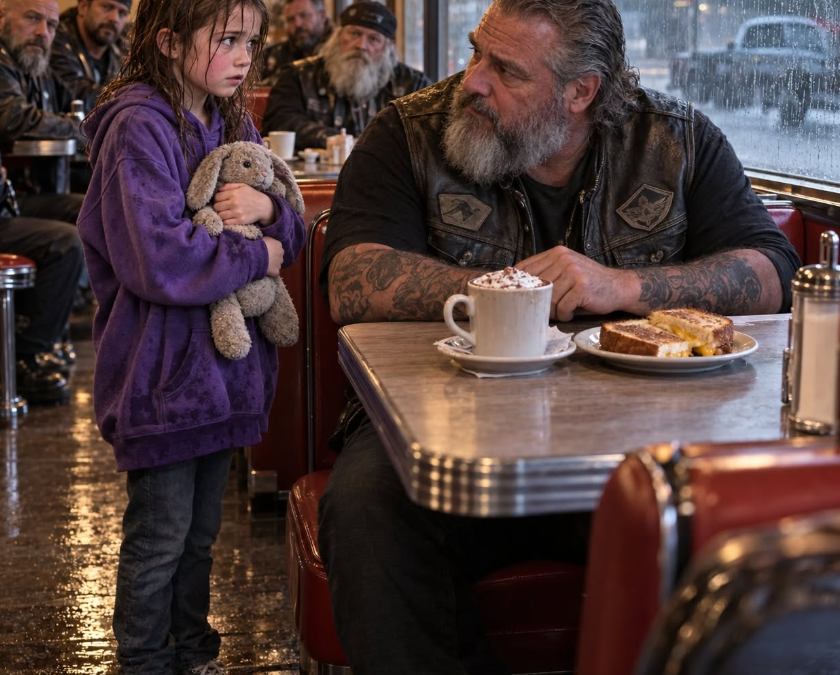
Mia’s wet hair stuck to her forehead. Her sneakers were soaked through. Mud dotted her white socks. Her purple hoodie looked one size too big, as if someone had bought it hoping she would grow into a better season.
She looked exhausted.
Not tired.
Children get tired after playgrounds, birthday parties, and long car rides.
This was different.
This was the kind of exhausted children should not understand.
“Sit down, Mia,” I said gently.
She hesitated only once.
Then she climbed into the booth across from me, sliding carefully onto the cracked red vinyl seat. She placed the stuffed rabbit beside her, then pulled it back into her lap like she regretted letting go.
“Now,” I said, keeping my voice low, “why would you ask me something like that?”
Her arms tightened around the rabbit.
“People say bikers aren’t scared.”
I almost laughed.
“That’s definitely not true.”
Her eyes widened.
“You get scared?”
PART3:
“All the time.”
“Of what?”
That question caught me.
I looked down at my hands.
Scarred knuckles.
A crooked finger that had never healed right.
Grease that never completely came out of the lines around my nails.
There were plenty of answers I could have given.
Hospitals.
Phone calls after midnight.
Bad weather on mountain roads.
Memories that waited until sleep to open the door.
But children deserve honest answers, especially the ones brave enough to ask hard questions.
“Failing somebody who needs help,” I said.
Mia stared at me for a long time.
Rain ticked against the window.
The fryer hissed behind the counter.
Then she whispered, “Then maybe you’re the right one.”
A weight settled in my chest.
Not fear exactly.
Recognition.
Marlene came over with a plate of grilled cheese and a mug of hot chocolate topped with whipped cream that had already begun to melt.
Mia looked at the food.
“I didn’t order.”
“Neither did I, technically,” I said.
Behind me, Hank cleared his throat and looked suddenly fascinated by the salt shaker.
Mia turned in his direction.
“Thank you.”
Hank, a man who had once dragged a refrigerator up three flights of stairs without blinking, looked like he might cry over two words from an eight-year-old.
“You’re welcome, kid.”
Mia did not eat.
She kept glancing at the front door.
Once.
Twice.
Four times.
“You expecting somebody?” I asked.
“My mom’s working.”
“Where?”
“Grocery store on Cedar Street.”
Three blocks away.
“Does she know you’re here?”
Mia nodded.
Then shook her head.
That answer told me enough not to push.
Adults like to think children speak in contradictions because they do not understand the question.
Most of the time, they understand too much.
We talked about easier things.
School.
Books.
Dogs.
She liked dogs but had never had one because her apartment did not allow pets.
She liked drawing houses, but only houses with yellow lights in every window.
She wanted to see the Pacific Ocean because she had only seen pictures of it on her teacher’s computer.
She thought whales were “too big to be real.”
For a few minutes, she almost looked like any other eight-year-old.
Almost.
Then thunder cracked outside.
Mia flinched so hard hot chocolate spilled over the edge of her mug.
Her shoulders shot up.
Her breathing changed.
I knew that reaction.
It was not surprise.
It was expectation.
There is a difference between being startled by a loud sound and being trained to brace for what comes after one.
“You okay?” I asked.
“I don’t like loud noises.”
I let that answer stand.
A child gives you a door.
You do not kick it open.
You wait.
Marlene brought napkins and wiped the table without making a fuss.
“Storm’s loud today,” she said, as if all of us had not seen the little girl’s face go white.
Mia nodded.
Then her sleeve slipped up.
There was a faint mark near her wrist.
Nothing dramatic.
Nothing anyone across the diner would have noticed.
But I saw it.
More importantly, Mia saw me see it.
Her hand disappeared beneath the table.
And every bit of trust I had spent twenty minutes building nearly vanished with it.
So I looked away.
Not because it did not matter.
Because it mattered too much to grab at.
“Hot chocolate better than coffee?” I asked.
She studied me like she was deciding whether I had missed the mark on purpose.
Then she gave me the smallest smile.
“Way better.”
“Correct answer.”
Slowly, she relaxed again.
She took a bite of grilled cheese.
Then another.
After the third bite, she said, “My mom used to sing.”
I waited.
“At night,” Mia continued. “When she cooked. When she cleaned. Sometimes in the car.”
“Doesn’t anymore?”
Mia shook her head.
“She cries when she thinks I’m asleep.”
My stomach tightened.
“She says everything’s okay. But sometimes she calls my aunt and says she doesn’t know what to do.”
Mia looked toward the door again.
“I sleep in my closet sometimes.”
I kept my voice steady.
“Why?”
“It feels safer.”
There are sentences you hear once and carry forever.
That was one of them.
I had heard men twice my size confess things in parking lots at midnight. I had listened to veterans talk about memories that would not let them go. I had watched mothers cry outside courtrooms and fathers stare at hospital floors like they might find a way to trade places with their children.
But that sentence from an eight-year-old girl landed differently.
I sleep in my closet sometimes.
It feels safer.
“Does your mom know?” I asked.
“She checks on me.”
The love in Mia’s voice came immediately.
No hesitation.
No doubt.
Whatever else was happening, she trusted her mother completely.
That mattered.
“Then why are you scared for her?”
Mia’s eyes filled.
“Because she’s scared too.”
The diner seemed to shrink around us.
Not physically.
Emotionally.
The booths, the counter, the old jukebox that had not worked since 2016, the pie case, the rain-blurred windows—all of it pulled closer until there was only a little girl with a rabbit and the truth she had carried farther than any child should have to walk.
She reached into her hoodie pocket and pulled out a folded sheet of paper.
“I brought this because I didn’t know how to explain.”
She slid it toward me.
I opened it carefully.
It was a child’s drawing.
A little yellow house.
Blue sky.
Two small figures holding hands.
One labeled MOM.
The other labeled MIA.
Off to one side stood a much larger figure colored in gray.
No name.
No face.
Just a dark shape towering over them.
Then I noticed the corner of the page.
Three tiny words written in pencil.
PLEASE HELP US.
I stared at those words.
And suddenly, I was thirteen again.
Back in my childhood home in Missouri, standing in a narrow hallway with peeling wallpaper, listening to my own mother cry behind a bedroom door.
Knowing something was wrong.
Being too young to understand what.
Too frightened to ask.
Believing adults would somehow fix everything without anyone saying the problem out loud.
They did not.
My father had not been a monster all the time.
That was part of what made it confusing.
People like clean villains.
Men who are cruel from sunrise to sundown.
Men with no charm, no apologies, no good days.
But real fear often lives in between good moments.
A laugh at breakfast.
A slammed door at night.
Flowers the next morning.
A broken dish the week after.
My mother spent years calling it stress.
Money.
Bad moods.
Hard times.
She said he did not mean it.
She said it would settle.
She said families had private problems.
I believed her because children believe the adults they love, even when their bodies already know the truth.
No biker ever walked into our house.
No neighbor knocked.
No teacher asked the right question.
No one helped my mother make a plan.
By the time she finally left, my younger brother had stopped trusting silence, and I had already decided I would become the kind of man nobody could frighten.
It took me decades to understand looking frightening is not the same as being strong.
Mia reached across the table.
Her small fingers rested on my hand.
“You okay?”
I swallowed.
“Yeah.”
Then she said something I will never forget.
“You’re helping now.”
My throat tightened.
I folded her drawing carefully.
“Mia, I need you to understand something.”
She watched me.
“I’m not going to make anybody disappear.”
Her face fell.
That hurt.
More than I expected.
“But,” I said, “I can help you and your mom find people who know how to keep families safe.”
“Really?”
“Yes.”
“Even if Mom says she doesn’t need help?”
“That part has to be her choice.”
Mia looked down at the rabbit.
For a moment, I thought I had disappointed her.
Maybe I had.
Children want simple rescue.
A bad person gone.
A door locked.
A mother singing again.
A closet turned back into a closet instead of a hiding place.
Adults know safety is usually built with paperwork, phone calls, planning, money, timing, documents, witnesses, and courage that has to wake up tired every morning and try again.
Then the front door opened.
Cold air swept through the diner.
Mia looked up.
Every trace of color disappeared from her face.
“That’s my mom.”
A woman in a damp grocery-store uniform stepped inside.
Early thirties.
Blond hair stuck to her cheeks.
Dark circles beneath exhausted eyes.
She scanned the diner too quickly, the way people do when fear has trained them to count exits before faces.
Then she saw Mia.
Relief flooded her face so fast it almost knocked me backward.
Then she saw me.
Her whole body stiffened.
Mia slid from the booth and ran toward her.
“Mom.”
The woman dropped to her knees and wrapped both arms around her daughter.
“I’ve been looking everywhere.”
That hug told me one thing immediately.
Whatever was happening in their life, Mia’s mother loved her.
Not politely.
Not conveniently.
Fiercely.
The kind of love that can be exhausted, terrified, imperfect, and still real enough to shake.
Then the woman stood.
She took Mia’s hand.
“We need to go.”
Mia did not move.
“Mom…”
“Not now.”
“Please.”
The woman’s eyes moved to the folded drawing sitting beside my coffee.
She recognized it.
Her face changed.
“Mia,” she whispered.
Then the little girl finally said the thing she had apparently been too afraid to say at home.
“Mom, I told him we’re scared.”
Her mother closed her eyes.
For one terrible second, I thought she was going to grab Mia and run.
Instead, she sat down.
Slowly.
Like her legs had finally decided they could no longer carry everything.
“My name is Sarah Bennett,” she said.
“Ray.”
“I know who you are.”
That surprised me.
She glanced at my vest.
“People in town talk.”
“Usually not accurately.”
A weak smile almost appeared.
Then disappeared.
“I’m sorry Mia bothered you.”
“She didn’t.”
“She shouldn’t be talking about our private life with strangers.”
Mia shrank beside her.
I leaned back, keeping my hands where Sarah could see them.
“She came here because she’s worried about you.”
Sarah’s jaw tightened.
“Kids worry.”
“Usually for a reason.”
“Everything is fine.”
Too quick.
Too practiced.
I had heard those words from men who had lost homes, jobs, marriages, sobriety, and faith.
Everything is fine usually means exactly the opposite.
Mia looked up at her mother.
“No, it isn’t.”
Sarah froze.
“You cry every night.”
“Mia—”
“You tell Aunt Laura you don’t know what to do.”
“Honey, stop.”
“You keep saying things will get better.”
Mia’s voice cracked.
“But you don’t believe it.”
Sarah covered her mouth.
The wall finally broke.
Not dramatically.
No screaming.
No collapse.
Just a tired woman beginning to cry in a diner because her eight-year-old daughter had finally said aloud what both of them had been pretending not to know.
“You have no idea how hard I’m trying,” Sarah whispered.
“I believe you,” I said.
She looked at me.
Maybe she expected judgment.
There was none.
Trying hard and needing help are not opposites.
That was something I had learned too late.
Marlene came by quietly and set down a fresh napkin, then walked away without asking questions. Hank and the others stayed turned in their booth, giving us as much privacy as a public diner could offer.
I took a business card from my wallet.
On the front was the garage number.
Mercer Custom & Repair.
On the back, I wrote another number.
“This belongs to a family advocate named Denise Porter.”
Sarah did not take it.
“She works with people dealing with unsafe home situations,” I continued. “Legal resources. Counseling. Emergency planning. Housing if it ever comes to that.”
“I’m not going to a shelter.”
“I didn’t say you had to.”
“I’m not helpless.”
“I didn’t say that either.”
Her eyes flashed, but underneath the anger was fear.
People think fear always looks soft.
It does not.
Sometimes fear looks like a woman ready to fight the first person who suggests she cannot handle her own life.
I pushed the card slightly closer.
“You call. You listen. You decide what happens next.”
Sarah looked down.
Mia reached for the card.
Her mother stopped her.
Then, after several seconds, Sarah picked it up herself.
That mattered.
Not because everything was solved.
Because help taken by force rarely becomes help.
She needed to choose that card.
Even if her hand shook when she did it.
Sarah and Mia left ten minutes later.
Mia took the stuffed rabbit, the untouched half of her grilled cheese, and one last look at me before the door closed behind them.
I watched them cross the wet parking lot.
Sarah held Mia close under her grocery-store jacket.
The rain swallowed them.
Hank slid into the booth across from me.
“You think she’ll call?”
“I don’t know.”
He looked at the drawing.
“What do we do?”
“Nothing.”
Hank frowned.
“Nothing?”
“She has the number.”
“And if she doesn’t call?”
I stared through the diner window at the rain streaking down the glass.
“We can’t choose for her.”
That was the hardest part.
Men like us want to act.
Lift.
Move.
Fix.
Stand in a doorway.
Block a road.
Make a phone call.
Make a threat.
Make something happen.
But there are kinds of help that become harm the minute you grab the steering wheel.
Sarah was not a motorcycle on a lift.
She was a woman with a child, a life, risks I did not know, and consequences that would fall on her long after everyone else drove home.
She needed support.
Not control.
Three nights later, I was in my garage rebuilding an old Harley transmission when my phone rang.
Unknown number.
I almost let it go.
Then I answered.
“Ray Mercer.”
Silence.
Then a woman’s voice.
“I almost didn’t call.”
I shut off the radio.
The garage settled around me, all metal, oil, rain, and quiet.
“I’m listening,” I said.
Sarah.
For the first time, she told me pieces of the truth.
She and Mia had moved to Oregon hoping for a fresh start after Sarah’s divorce. Her sister Laura lived two towns over. Sarah had found work at the grocery store and a small apartment she could afford if nothing went wrong.
Then something went wrong.
A man named Daniel entered their life.
At first, he was helpful.
That is how these stories often begin.
He fixed Sarah’s car.
Picked Mia up from school once when Sarah’s shift ran late.
Brought soup when they were sick.
He made Sarah laugh when she had forgotten how.
He did not start with slammed doors.
People rarely do.
First came suggestions.
Then criticism.
Then rules disguised as concern.
Why are you wearing that?
Why do you need to talk to your sister so much?
I’m just trying to protect you.
Then apologies.
Then gifts.
Then anger.
Then the careful shrinking of Sarah’s world until she found herself explaining every minute of her day to a man who did not technically live with them but somehow controlled the air inside their apartment.
“It sounds stupid when I say it out loud,” Sarah whispered.
“No, it doesn’t.”
“I kept thinking I could manage it.”
Most people do.
They believe if they stay calm enough, speak softly enough, avoid the right triggers, explain the right way, love hard enough, everything will stabilize.
It does not.
Not when control is the point.
“I protected Mia from the worst of it,” Sarah said.
I closed my eyes.
Because I knew she believed that.
And I knew Mia slept in a closet.
“Sarah,” I said carefully, “kids feel weather adults don’t think they can see.”
She did not answer.
Then, quietly, she said, “She sleeps in the closet.”
“I know.”
“She told you?”
“Yes.”
A sound came through the phone.
Not a sob.
Worse.
The sound of a mother realizing her child had been carrying proof she was not okay.
“I thought if he never touched her, I was keeping her safe.”
I let silence hold that for a moment.
Then I said, “Safety is bigger than that.”
Sarah cried then.
For a while, I just listened.
That matters more than people think.
Listening is not nothing.
Listening is often the first safe room somebody enters.
When she could speak again, she said, “Now my eight-year-old thinks she has to find a biker to save us.”
“She found someone to give you Denise’s number,” I said. “That’s different.”
“I’m scared.”
“I know.”
“What if I make everything worse?”
“That’s why you make a plan with people who understand this before you make big moves.”
Sarah breathed slowly.
“You really trust Denise?”
“With my life.”
That was not entirely true.
I trusted Denise with other people’s lives.
Which was more important.
Sarah called Denise the next morning.
That one phone call did not solve everything.
I wish stories worked that way.
I wish there was a number you could dial and fear packed its bags by sunset.
Instead, the call created work.
Meetings.
Paperwork.
Safety planning.
Legal consultation.
Counseling.
A teacher who became part of Mia’s support system.
A neighbor who quietly kept an extra house key.
A sister who stopped hearing half the story and finally heard all of it.
There were days Sarah wanted to quit.
Days she wondered if asking for help made her weak.
Days she almost convinced herself things had not been that bad.
People do that.
Pain fades at the edges when the immediate danger is not in the room.
Fear begins bargaining.
Maybe I overreacted.
Maybe I made him angry.
Maybe I can handle it.
Maybe the plan is too much.
Maybe staying is easier.
I told her the same thing each time she called.
“Fear isn’t weakness.”
Sometimes she believed me.
Sometimes she did not.
I said it anyway.
Two weeks later, Mia called me from Sarah’s phone.
“Ray?”
“Hey, kid.”
“Mom’s crying again.”
My heart dropped.
“Is she safe?”
“Yes.”
“Are you safe?”
“Yes.”
“Then why is she crying?”
“She says everything is changing.”
I understood.
Change is frightening even when it leads somewhere better.
“What if she changes her mind?” Mia asked.
There it was.
The fear beneath all the other fears.
I looked at an old photograph above my workbench.
Me at twenty-seven.
My younger brother beside me.
My mother still alive.
A family none of us had known how to save from itself.
“Listen to me,” I said.
“I’m listening.”
“Being brave doesn’t mean you stop being scared.”
“It doesn’t?”
“No.”
“What does it mean?”
“It means you keep taking the next safe step while you’re scared.”
Mia was quiet.
“Like Mom?”
I smiled.
“Exactly like your mom.”
A month later, Sarah called again.
Her voice sounded exhausted.
But different.
Not happy exactly.
Not free in the way movies like to show it.
Different.
Like someone who had been holding her breath underwater and had finally found a place to stand.
“They helped me make a plan,” she said.
“A real one?”
“A real one.”
“And Mia?”
Sarah laughed softly.
“She slept through the night.”
I could not answer for a second.
“Ray?”
“I’m here.”
“She slept from nine until seven.”
That sentence hit me harder than anything else.
No closet.
No flashlight.
No listening through walls.
Just sleep.
People do not understand how holy ordinary sleep can become after fear has stolen it.
Months passed.
Sarah found a new apartment.
Nothing fancy.
Two bedrooms.
A little balcony.
Locks she trusted.
Mia started raising her hand in class again.
Her teacher said she talked about the ocean constantly.
So the North Ridge Riders did something ridiculous.
We organized a Saturday ride to the coast.
Sarah and Mia came by car.
We met them near Cannon Beach on a morning bright enough to make the previous winter feel like somebody else’s nightmare.
The first time Mia saw the Pacific, she stood completely still.
The ocean rolled in gray and blue under a wide sky.
Wind whipped her hair around her face.
She clutched the same stuffed rabbit, though by then one ear had been stitched twice.
Then she ran toward the water screaming.
Not scared.
Happy.
There is a difference in the sound.
I will never forget it.
Sarah stood beside me with her arms wrapped around herself, watching Mia jump back from the foam.
“She looks like a kid,” Sarah said.
“She is a kid.”
“I know.”
But I understood what she meant.
For a while, fear had made Mia older than eight.
That day, the ocean gave some of that back.
Hank bought saltwater taffy.
Boone taught Mia how to skip rocks badly.
Luis let her sit on his parked motorcycle for a photo, after making her put on a helmet so large it nearly swallowed her head.
Mia declared motorcycles “kind of loud but emotionally supportive.”
None of us knew what to do with that.
So we agreed.
A year after we met, I received strict instructions from Mia that I had to attend her school assembly.
Not an invitation.
Instructions.
She was presenting a project on bravery.
I arrived wearing clean jeans, a black shirt without oil stains, and the least intimidating version of my leather vest.
Still got plenty of looks.
Sarah saved me a seat.
She looked different too.
Not untouched by what had happened.
That is not how recovery works.
People love before-and-after stories.
Before fear.
After freedom.
Before darkness.
After sunlight.
Real healing does not draw the line that neatly.
Sarah still looked tired sometimes.
She still checked locks twice.
She still startled when someone knocked too hard.
But she also laughed more easily.
Stood straighter.
Looked people in the eye without apologizing for taking up space.
Steadier.
Present.
When Mia’s name was called, she walked onto the stage holding a sheet of paper.
She spotted her mother.
Then me.
Her shoulders relaxed.
“My project is about bravery,” she began.
The gym grew quiet.
“When people hear brave, they think about superheroes or soldiers or people who do giant things.”
She looked down at her paper.
“But I learned brave can be smaller.”
Sarah reached for my hand.
Her fingers were cold.
Mia continued.
“Sometimes brave means telling somebody you’re scared.”
My throat tightened.
“Sometimes it means asking for help even when you’re embarrassed.”
She looked directly at her mother.
“And sometimes it means being scared and taking the next safe step anyway.”
Sarah cried.
I pretended I had something in my eye.
Then Mia reached her final sentence.
“The strongest people aren’t the people everybody is afraid of.”
Her eyes found me.
“They’re the people who make other people feel safe.”
The whole gym applauded.
I could not.
Not immediately.
Because suddenly I was back in Harper’s Diner.
Rain against the windows.
A tiny girl hugging a worn stuffed rabbit.
Asking a tattooed stranger if he could make bad people disappear.
After the assembly, she ran across the gym and hugged me.
“You remember my first question?”
“Every word.”
She grinned.
“So do you?”
“Do I what?”
“Make bad people disappear?”
I laughed.
“No, kid.”
She waited.
“I help good people remember they don’t have to face bad things alone.”
Mia thought about that.
Then nodded.
“I like that better.”
“So do I.”
She ran back to Sarah.
I watched them leave together.
Holding hands.
Not running.
Not looking behind them.
Just going home.
For most of my life, I thought helping meant fixing.
Fighting.
Standing between somebody and danger.
Sometimes it does.
There are moments when someone has to step forward, plant their boots, and say, No farther.
But that little girl taught me something better.
Sometimes helping means listening long enough for someone to tell the truth.
Sometimes it means giving a phone number instead of an order.
Sometimes it means staying close without taking control.
Sometimes it means admitting you cannot erase every bad person from the world, but you can help build enough light around a family that darkness no longer gets to own every room.
I still have Mia’s drawing.
Sarah gave it to me months later.
She said Mia wanted me to keep it because “Ray needed proof he did a good job.”
It hangs in my garage now, framed behind the front desk where customers can see it if they look closely.
A little yellow house.
Blue sky.
Two small figures holding hands.
One labeled MOM.
One labeled MIA.
Off to the side, the gray shape still stands.
I did not ask Mia to remove it.
Some truths do not need to be erased to lose their power.
But the corner is what people notice.
Three tiny pencil words.
PLEASE HELP US.
When customers ask about it, I tell them the truth.
I tell them a child once walked into a rainy diner and asked the scariest-looking man in the room for help.
I tell them she was braver than most adults I know.
I tell them her mother was brave too, because asking for help when you are exhausted and ashamed can take more courage than standing in front of a crowd.
And I tell them this:
Bad people do not always disappear.
But silence can.
Fear can loosen its grip.
Doors can open.
Safe people can gather.
A child can sleep through the night.
A mother can sing again.
A biker can learn that strength is not about being feared.
It is about becoming the kind of person a frightened child can walk toward in the rain.
That was what Mia taught me.
And sometimes, when a storm hits Oregon hard enough to rattle the garage windows, I still think about that afternoon.
The diner.
The hot chocolate.
The stuffed rabbit.
The little girl watching the door.
And those three words in the corner of a drawing that changed all our lives.
PLEASE HELP US.
I have seen a lot of things in fifty-eight years.
Some I wish I could forget.
Some I pray I never do.
But I will carry that drawing until the day I die.
Because sometimes hope does not arrive looking bright.
Sometimes it walks into a diner soaked to the bone, scared out of its mind, and brave enough to ask the first honest question.
Do you make bad people disappear?
No.
I do not.
But I know how to listen.
I know how to stay.
And sometimes, for someone who has been afraid too long, that is where disappearing begins.
Not the person.
The fear.
The silence.
The lie that they are alone.