After 14 Months Undercover, I Came Home to Find HOA Karen Handcuffing My Dad—Then Her Fake Court Order Linked Her Entire HOA to My Federal Case.
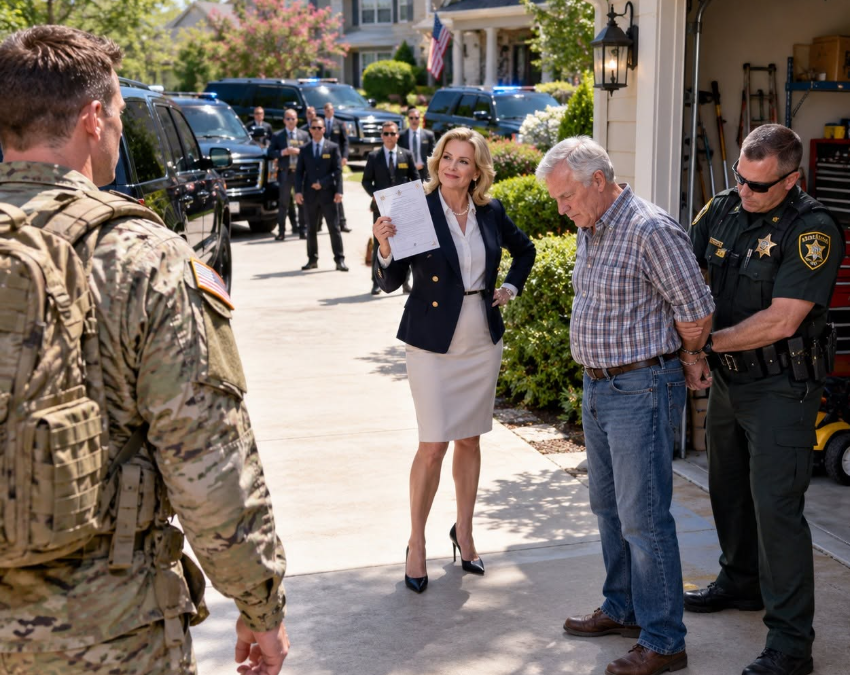
After 14 Months Undercover, I Came Home to Find HOA Karen Handcuffing My Dad—Then Her Fake Court Order Linked Her Entire HOA to My Federal Case.
After fourteen months undercover, I came home in a convoy of black federal vehicles expecting to see my father waiting on the porch, not standing in his own driveway with a deputy tightening handcuffs around his wrists.
Marjorie Vance, president of the Westbridge Estates HOA, stood beside him holding a fake court order, smiling like she had finally turned my family home into one more property on her private hunting list.
She had no idea that the evidence crates riding behind me had already cracked open a real estate laundering network across three counties—and that the forged paper in her hand was about to connect her entire HOA empire to the case I had spent more than a year bleeding my life into.
My name is Gideon Mercer, and for fourteen months I lived inside a lie.
That is the easiest way to explain undercover work to people who have never done it. You do not simply pretend for a few hours, wear a wire, get a confession, and return home in time to mow the lawn. You become a version of yourself built for survival. You answer to a name that is not yours until it starts coming faster than your own. You memorize fake histories, fake friends, fake failures, fake habits, fake grudges, fake debts, fake dreams. You sleep in apartments that never feel safe. You eat with people you would rather arrest. You laugh when dangerous men make jokes, because not laughing might make them curious. You learn to breathe slowly while someone with a gun at his waist asks you a question that has only one correct answer, and the wrong answer might put you in a shallow hole before sunrise.
I had been chasing a laundering network that moved dirty money through real estate firms, construction contractors, fake consulting companies, and homeowners associations scattered across three counties.
That last part was what made people outside the case laugh at first.
Homeowners associations.
It sounded petty.
Lawn fines.
Paint disputes.
Mailbox colors.
Grass height.
People did not imagine an HOA as a financial weapon.
I had learned better.
A homeowners association, in the wrong hands, is a beautiful disguise for theft. It has fees, liens, enforcement letters, lawyers, community funds, maintenance accounts, reserve budgets, board minutes, and residents who often trust documents simply because they arrive on official-looking letterhead. It can pressure elderly homeowners with fines they do not understand. It can bury expenses in categories no one reads. It can claim authority over property lines, roads, gates, drainage access, architectural violations, and unpaid assessments.
And if corrupt people control enough of the local machinery around it—security companies, attorneys, lenders, county staff, maybe even a deputy who does not ask enough questions—it can start acting like law.
That was the monster I had been following for over a year.
The final weeks of the operation had turned dangerous. We had seized drives, raided shell offices, flipped a bookkeeper, and tied millions of dollars to construction entities that seemed to exist mostly to move stolen equity from one account to another. My partner, Tamson Doyle, insisted on a full escort when I came out. She said it was for evidence transport, agent safety, and operational control.
I told her it was overkill.
Tamson looked at me across the command table with the expression she used when I was being brave in the stupid way.
“Gideon, you have three hard drives, two evidence crates, a live target list, and people who know what face you used for fourteen months.”
“I can drive myself.”
“You can also shut up and get in the convoy.”
Tamson had a gift for clarity.
So I got in the convoy.
Six black SUVs, two evidence transports, and a mobile command vehicle rolled through the outskirts of town behind me. More than twenty agents moved with us. No sirens. No lights. Nothing theatrical. Just controlled, quiet federal weight traveling under a sky that looked too clean for the kind of year I had just lived.
I did not want attention.
I wanted one stop.
My father’s house.
Hollis Mercer was seventy years old, though he moved like a man determined not to admit that number applied to him. He had worked with his hands his whole life—electrical systems, maintenance lines, pumps, old service tunnels, substation repairs, whatever needed fixing before younger men with newer certifications showed up and charged twice as much to learn what he already knew.
He had raised me in that house after my mother died, and no matter where I went afterward, no matter what name I used or what lie I lived under, that place stayed fixed in my mind.
Three acres at the edge of Westbridge Estates.
A low house with a deep porch.
A detached garage.
Old maples.
A gravel drive.
Tools in the basement.
My mother’s rose bushes along the side fence, still stubbornly alive because Dad refused to let them die on his watch.
PART2:
The house had been there long before Westbridge Estates wrapped itself around the neighborhood. My grandfather bought the land in 1987. Westbridge came later with gates, landscaping, retention ponds, cul-de-sacs, and people who paid a premium to pretend they had moved far away from problems while bringing most of them in through the front gate.
Dad’s property was never part of the HOA.
Never.
Not in the original development filings.
Not in later amendments.
Not in any recorded covenant.
Not through easement.
Not through annexation.
Not through assessment.
Not by accident.
The house predated the community by nearly two decades, and my father had refused every attempt to pull him under HOA control.
That refusal became a personal insult to Marjorie Vance.
I knew Marjorie’s name before that day, but only in the distant way you know local nuisances while your real work is somewhere else. Dad mentioned her in calls sometimes. An HOA president who liked sending letters. A woman who had opinions about his fence, his work truck, his garage door, his antenna, his driveway, his refusal to let inspectors into a house she had no authority over.
During the first few months of the undercover operation, Dad would call and say, “That Westbridge woman was here again.”
I would be sitting in a borrowed apartment under a fake name with a burner phone in one hand and a pistol inside a kitchen drawer, and I would force myself to sound normal.
“What did she want this time?”
“Claims my south fence is a visual obstruction.”
“Your fence has been there since I was twelve.”
“She says it affects community harmony.”
“Dad, tell her you’re not in the community.”
“I did.”
“And?”
“She said technically adjacent properties share responsibilities.”
That word had made me pause.
Adjacent.
People who want control love soft words.
Adjacent.
Integrated.
Affected.
Benefited.
Shared.
They are the words people use when ownership will not help them.
I told Dad to keep every letter.
He did.
My father kept paperwork the way other men kept fishing lures. Deeds, tax records, permit receipts, old plats, repair invoices, utility maps, photographs of fence lines, insurance papers, everything in labeled folders inside a metal cabinet in his office.
I inherited my paranoia from him.
Or maybe he inherited his from the land.
The letters escalated while I was away.
First, Marjorie claimed Dad owed “impact maintenance contributions” because his property supposedly benefited from Westbridge roads.
Dad’s driveway connected directly to the county road.
He did not use Westbridge roads.
Then came a notice demanding removal of his service van because it was visible from the eastern cul-de-sac.
Then another claiming his garage antenna interfered with neighborhood aesthetics.
Then one about unauthorized exterior lighting.
Then one about “noncompliant heritage fencing.”
That one made him laugh.
“Heritage fencing,” he said over the phone. “Gideon, that fence is older than her hair color.”
I laughed because he did.
But guilt sat in my chest.
I was three counties away using a fake name, sitting across from a shell-company accountant who kept a pistol on his desk and thought I was helping move clean invoices through dirty books.
I could not come home.
I could not attend HOA meetings.
I could not walk into Westbridge and explain to Marjorie Vance that she was leaning on the wrong family.
I could only tell Dad to document everything.
He did.
Then, eight months into the operation, Dad told me Marjorie had changed tone.
No more fence complaints.
No more antenna jokes.
Now she wanted land.
Specifically, the gravel strip along the south side of his property that connected to an old utility access path behind Westbridge.
To Dad, it was just a side lane.
To Marjorie, it was the missing key to something bigger.
Westbridge Estates had a planned expansion called Westbridge North. New villas. A wellness center. A private walking trail. A maintenance corridor. A second gated entrance that would increase resale values on the far side of the development.
There was one problem.
The easiest route crossed my father’s land.
Not the only route.
Just the cheapest.
The alternative required drainage work, retaining walls, and county permits.
Dad’s side lane required pressure.
Marjorie preferred pressure.
She offered to buy a narrow easement.
Dad refused.
She offered more.
Dad refused again.
Then the letters turned legal.
Westbridge claimed a “historic service corridor.”
Dad requested the recorded easement.
No answer.
Westbridge claimed “emergency maintenance necessity.”
Dad asked which county agency had designated it.
No answer.
Westbridge claimed “community dependency.”
Dad wrote one sentence back:
My property is not a community asset.
I was proud of him.
I was also worried.
The network I was investigating used pressure exactly that way.
A soft request.
An inflated fee.
A fake violation.
A lien.
A court-looking document.
A foreclosure threat.
A quick sale to a friendly entity.
Then the property moved through three companies and came out clean enough for development.
Most victims were elderly.
Widows.
People with medical bills.
People without lawyers.
People who got scared when a letter used words like judgment, receiver, lien enforcement, or sheriff’s execution.
My father was not easily scared.
That made him harder to move.
Not safer.
The week before I came home, everything broke open.
We raided a consulting office operating under the name Harbor Civic Solutions. It looked boring from outside. Beige building. Glass door. Potted plants dying by the entrance. Inside were servers, closing files, fake contractor invoices, stamped HOA notices, and binders organized by community.
Westbridge Estates had its own binder.
I did not see it at first.
Tamson did.
She called from across the records room.
“Gideon.”
Her voice had changed.
I looked up.
She stood beside a metal shelving unit, holding a blue binder with white spine tape.
WESTBRIDGE — VANCE.
Something cold moved through me.
Tamson opened it.
Inside were board resolutions, assessment schedules, contractor bids, draft lien letters, property diagrams, and correspondence between Marjorie Vance and companies already under investigation.
One page showed my father’s property.
Outlined in red.
South access strip highlighted.
Potential acquisition strategy written beside it.
I remember those three words.
Potential acquisition strategy.
Under them:
Nonmember parcel. Owner elderly. Resistant. Possible compliance route unavailable. Consider judicial documentation path.
Judicial documentation path.
That was not legal language.
That was criminal language trying on a suit.
I wanted to leave immediately.
Tamson put one hand on my arm.
“No.”
“That’s my father.”
“I know.”
“I need to call him.”
“You can call from a secure line after we finish securing the room.”
“Tamson—”
“Gideon, listen to me.”
Her voice lowered.
“If his property is in this file, then your father may be part of the case now. You cannot contaminate it by running half-cocked into the middle.”
I hated her for being right.
We finished the seizure.
I called Dad from the command office that night.
He answered on the third ring.
“Hey, son.”
His voice sounded normal.
Too normal.
“Dad, has Marjorie come by again?”
“Yesterday.”
“What did she want?”
“She says there’s a court hearing I failed to attend.”
My grip tightened around the phone.
“What hearing?”
“No idea.”
“Did you get served?”
“No.”
“Any paper?”
“She left something in the mailbox. Looked like nonsense.”
“What did it say?”
“Temporary possession order. Enforcement of community access rights. Some judge’s name I’ve never heard of.”
The room around me went quiet.
Or maybe my blood did.
“Dad, listen carefully. Do not open the gate for anyone. Do not sign anything. Do not let anyone in the house. I’m coming home tomorrow.”
He paused.
“You all right?”
“No.”
That was all I could say.
He understood enough not to ask more.
But tomorrow became forty-eight hours because the operation had one final seizure scheduled. Two warrants. One warehouse. One attorney’s office. Evidence transport coordination. Target debrief. Chain of custody. I kept moving because stopping would make me think about Dad standing alone with a fake order on his kitchen table.
By the time the convoy rolled toward Westbridge Estates, I had been awake thirty-one hours.
I smelled like stale coffee, vehicle upholstery, and stress.
Tamson sat in the passenger seat beside me.
She said nothing for the last fifteen minutes.
That was kindness.
We turned off the county road and onto the lane leading toward my father’s property.
The first thing I saw was the white HOA SUV.
Then a county cruiser.
Then another.
Then a tow truck.
Then two men in work vests near the south gate.
Then my father.
He stood in his own driveway wearing jeans, a flannel shirt, and the brown work boots he had owned longer than some marriages last. His shoulders were squared. His chin was raised. One deputy held his left arm behind his back. Another was locking a cuff around his right wrist.
For a moment, undercover discipline vanished.
There was no case.
No convoy.
No evidence.
No controlled approach.
Only my father in handcuffs.
I hit the brakes hard enough that Tamson braced against the dashboard.
“Gideon,” she snapped.
But I was already out.
The convoy stopped behind me in a rolling wave of black SUVs and federal plates.
Doors opened.
Agents stepped out.
The air changed.
Everyone in the driveway turned.
Marjorie Vance stood beside the cruiser holding a folder.
She was in her late fifties, silver-blonde hair cut sharply at her jaw, wearing a cream coat and red scarf. Her face had the composed satisfaction of a woman who believed the hard part was finished.
Then she saw the vehicles.
The satisfaction cracked.
The deputy tightening Dad’s cuffs looked over his shoulder.
“Sir, stay back.”
I did not slow.
Tamson caught up on my left.
Three agents fanned out behind us.
My father saw me.
For half a second, his face did something I had not seen since I was a child.
Relief.
Then he straightened again.
“Gideon,” he said calmly. “This woman is trying to steal your mother’s roses.”
That was my father.
Handcuffed in his driveway, and still choosing the most emotionally accurate description of the crime.
I looked at the deputy.
“Take those off him.”
The deputy’s eyes narrowed.
“Who are you?”
I took out my credentials.
“Federal agent Gideon Mercer.”
His face changed.
Not enough.
“We are executing a county court order.”
“No, you’re executing paper someone handed you.”
Marjorie stepped forward.
“This is a local civil enforcement matter. Federal involvement is inappropriate.”
Tamson looked at her.
“And you are?”
“Marjorie Vance. President of Westbridge Estates Homeowners Association.”
Tamson’s expression did not move.
“Of course you are.”
The deputy holding Dad’s arm looked uncertain now.
His name tag read Lawson.
I knew that name.
Deputy Eric Lawson.
Not corrupt, according to anything I had seen.
Young.
Ambitious.
Not experienced enough to distrust paper that looked official.
He said, “The order authorizes removal of obstructions and temporary detention for interference.”
I held out my hand.
“Show me.”
Marjorie pulled the folder back slightly.
“This is a court-certified document.”
“Then you won’t mind showing it.”
Deputy Lawson took it from her before she could decide.
He handed it to me.
The first page looked real to someone who wanted it to look real.
County header.
Case number.
Court seal.
Judge’s signature.
Caption:
Westbridge Estates Homeowners Association v. Hollis Mercer.
Temporary Enforcement and Possession Order.
I read the first paragraph.
Then the second.
By the third, I knew.
Not suspected.
Knew.
The language was wrong.
Too broad.
Too eager.
The order purported to grant Westbridge immediate access over Dad’s south lane, authority to remove gates, authority to exclude the property owner from interference, authority to place the property under “temporary compliance supervision,” and authority to recover costs through emergency assessment liens.
That phrase hit like a flare.
Emergency assessment liens.
I had seen it three days earlier in the Harbor Civic Solutions file.
Same phrase.
Same capitalization.
Same weird punctuation.
I looked at the signature line.
Judge Alton Pierce.
Wrong.
Pierce had retired two years earlier.
I looked at the case number.
The format was close.
Not correct.
Then I looked at the footer.
Document prepared by:
Vance Community Compliance Services, LLC.
I lifted my eyes to Marjorie.
She had gone very still.
Behind me, Tamson leaned close enough to read the footer.
She whispered one word.
“Got her.”
I handed the order to Tamson.
Then looked at Deputy Lawson.
“Did you verify this with the court clerk before putting cuffs on my father?”
Lawson swallowed.
“We received it through civil processing.”
“From whom?”
He glanced at Marjorie.
She answered for him.
“Through established channels.”
Tamson said, “That wasn’t the question.”
The second deputy shifted uncomfortably.
Dad stood between them, wrists cuffed, watching me with the kind of calm that made me more furious.
I turned back to Lawson.
“Remove the cuffs.”
Lawson hesitated.
“Sir—”
“Now.”
Tamson stepped forward, showing her own credentials.
“Deputy, you are standing in the middle of an active federal investigation involving forged real estate enforcement instruments. Remove the cuffs from Mr. Mercer and preserve that document.”
That did it.
Lawson unlocked my father’s cuffs.
The metal came away from Dad’s wrists.
I saw the red marks.
Something dark and old moved through me.
Dad rubbed one wrist, then the other.
“I’m all right,” he said.
I did not answer.
Because I was not.
Marjorie tried to recover.
“This is outrageous. Deputy Lawson, the court order is valid until challenged through proper procedure.”
Tamson looked at the evidence transport behind us.
“Funny thing about proper procedure.”
She turned and signaled.
Two agents opened the rear of the transport.
Inside were sealed evidence crates.
One was marked:
HARBOR CIVIC SOLUTIONS — COMMUNITY ENFORCEMENT DOCUMENTS.
Marjorie’s eyes locked on the label.
She knew that name.
I saw it.
So did Tamson.
Tamson smiled without warmth.
“You recognize that?”
Marjorie’s lips parted.
“No.”
Too fast.
Too clean.
Wrong answer.
One of the agents, Malik Reyes, carried over a tablet. He pulled up a scanned document from the seized files.
Tamson held it beside Marjorie’s fake court order.
Same formatting.
Same footer style.
Same phrase.
Temporary compliance supervision.
Same misspelling in the second paragraph.
“Possessory” spelled with one s.
Twice.
Tamson looked at Marjorie.
“You really should have hired someone who could spell.”
Marjorie’s face drained.
Deputy Lawson stared at the tablet.
“What is this?”
I said, “Evidence from a federal money-laundering investigation.”
The tow truck driver, who had been trying very hard to become invisible, slowly stepped away from his controls.
Good decision.
The two work-vest men near the south gate exchanged a look.
One of them started backing toward his truck.
Malik said, “Don’t leave.”
He stopped.
Marjorie lifted her chin.
“I want my attorney.”
Tamson said, “You’ll need one.”
Then she looked at Lawson.
“Who authorized you to assist this civil action?”
“My sergeant approved service support.”
“Call him.”
Lawson did.
While he spoke, I turned to Dad.
“Are you hurt?”
“No.”
“Did they come inside?”
“No.”
“Did they touch the garage?”
“Not yet.”
“Mom’s roses?”
He looked toward the side fence.
“Still standing.”
I breathed for the first time since I saw the cuffs.
Marjorie had not been targeting the roses, not really.
She wanted the south lane.
She wanted the old utility corridor.
She wanted the easiest route for Westbridge North.
But Dad had understood the emotional truth.
The roses were where my mother had spent mornings after chemo, sitting on a low stool, trimming stems with shaking hands because she refused to let illness decide what remained beautiful. Dad had kept them alive for sixteen years after she died.
Marjorie saw a strip of land.
Dad saw my mother.
That alone told me everything I needed to know about both of them.
Lawson’s sergeant arrived twelve minutes later.
Sergeant Dana Holt.
Older.
Sharper.
She stepped out of her cruiser, assessed the federal vehicles, the evidence crates, my father, Marjorie, the tow truck, the work crew, and the fake order without speaking for several seconds.
Then she looked at Lawson.
“Tell me you verified the order.”
Lawson’s face said enough.
Holt closed her eyes for half a second.
When she opened them, she said, “Nobody moves. Nobody enters the property. Nobody touches a vehicle, gate, fence, flower bed, mailbox, or blade of grass until I know what the hell this is.”
I liked her immediately.
Tamson handed her the order.
Holt read it.
Her mouth tightened.
“This judge is retired.”
“Yes,” I said.
She looked at Lawson.
“You didn’t notice that?”
Lawson looked miserable.
Marjorie interrupted.
“Sergeant, with respect, your office accepted the filing.”
Holt looked up.
“My office does not validate court orders by wishful thinking.”
Marjorie stiffened.
“The HOA relied in good faith.”
“No,” Tamson said. “You relied on a forged instrument connected to an active federal case.”
Holt looked at Tamson.
“Explain.”
Tamson did.
Briefly.
Harbor Civic Solutions.
Fake compliance documents.
Real estate laundering.
HOA lien manipulation.
Construction contracts.
Forced acquisition strategies.
Westbridge file.
My father’s parcel.
Marjorie’s name.
The same document template.
The same language.
The same footer company.
The same network.
As Tamson spoke, Marjorie became smaller.
Not physically.
Socially.
Her power had always depended on people treating her as the center of the room.
Now she stood between real officers and federal agents while every paper she had brought became evidence against her.
The convoy had drawn neighbors.
Of course it had.
Westbridge residents stood along sidewalks and behind hedges, pretending not to watch while watching with every part of themselves.
Some had phones out.
Some looked frightened.
Some looked like they had been waiting years to see Marjorie Vance face a room she could not control.
Sergeant Holt took the order from Tamson and placed it in an evidence sleeve.
Marjorie reached for it.
“That is association property.”
Holt turned slowly.
“It is evidence.”
The same phrase had destroyed many powerful people.
Evidence.
A document stops being a weapon when someone with authority labels it evidence.
Then it becomes a witness.
Marjorie lowered her hand.
The work-vest men identified themselves as employees of Northline Site Services. They had been hired to remove the south gate and begin grading the lane for emergency community access.
The tow truck had been hired to remove Dad’s old service van if it blocked equipment.
The deputy had been told Dad was subject to a temporary court order and had refused compliance.
Everything was scheduled.
Everything was timed.
Marjorie had planned to enter, clear, cut, tow, grade, and establish a physical access route before anyone could stop her.
Build first.
Litigate later.
I had seen that strategy in the seized files too.
Create irreversible facts.
Then force settlement.
Tamson asked one of the Northline workers who signed the contract.
He looked toward Marjorie.
“She did.”
“In her HOA capacity?”
“And through Vance Community Compliance Services.”
Marjorie closed her eyes.
Just briefly.
But I saw it.
So did Tamson.
Tamson looked at me.
There it was.
The bridge.
Westbridge HOA was one piece.
Vance Community Compliance Services was another.
Harbor Civic Solutions had prepared documents.
Northline Site Services had contracts in multiple seized files.
The fake order connected the network directly to my father’s driveway.
For fourteen months, I had been chasing shell entities through financial records and whispered meetings.
Marjorie had just brought one to my family home and handed it to us.
People sometimes imagine criminals make mistakes because they panic.
Often, they make mistakes because they are used to winning.
Marjorie had bullied residents for years.
Fines.
Letters.
Committees.
Enforcement notices.
Threats.
Most people paid.
Most people apologized.
Most people did not have the money or stamina to fight.
She had come to believe paper worked because paper had worked.
She did not know my father had kept every page.
She did not know my convoy was carrying the missing half of her story.
And she definitely did not know I had spent fourteen months learning the smell of fake authority.
Holt separated Marjorie from the others.
Tamson ordered the evidence team to photograph the scene.
Agents documented the driveway.
The south lane.
The gate.
The tow truck.
The work crew vehicles.
The order.
The folder.
Dad’s wrists.
That part made him uncomfortable.
“Really necessary?” he asked.
“Yes,” I said.
He looked at me.
I looked back.
He let them photograph the marks.
I hated it.
Then Tamson pulled me aside.
“You can’t interview her.”
“I know.”
“You can’t handle the local arrest decision.”
“I know.”
“You’re family.”
“I know.”
She studied me.
“Do you?”
I looked toward my father, who stood by the porch now, arms folded, pretending this was just another inconvenient service call.
“I know.”
Tamson softened slightly.
“Go sit with him.”
“I’m fine.”
“No. You’re not.”
She was right again.
I walked to the porch.
Dad sat in his old wooden chair.
The same chair he used to occupy when I came home late as a teenager, pretending not to wait up.
I sat on the step below him.
For a while, neither of us spoke.
Finally he said, “You look awful.”
“I missed you too.”
“You eating?”
“Sometimes.”
“Sleeping?”
“Less.”
“Still stubborn?”
“Genetic.”
He snorted.
Then he looked toward Marjorie.
“She really in trouble?”
“Yes.”
“How much?”
“A lot.”
“Good.”
That was all he said.
Then his hand settled on my shoulder.
I had spent fourteen months living under another name, surrounded by people who would have killed me if they knew what I was. I had held steady through threats, weapons, dirty money, and long nights waiting for extraction that might not come.
That hand almost broke me.
I looked down.
Dad pretended not to notice.
That was kindness too.
The immediate scene resolved with less drama than people later claimed.
Marjorie was not tackled.
No one read a speech.
No one dramatically shouted that the HOA empire had fallen.
Sergeant Holt asked clear questions.
Tamson coordinated with the federal prosecutor.
The fake order was secured.
The Northline contract was copied.
The tow operator gave a statement.
Deputy Lawson gave a statement that sounded like shame trying to become useful.
Marjorie was detained for questioning after refusing to explain the source of the document beyond saying, “Our compliance consultant prepared it.”
That phrase became important.
Our compliance consultant.
Not attorney.
Not court clerk.
Not judge.
Consultant.
By sunset, the south gate remained standing.
Dad’s service van remained parked.
My mother’s roses remained untouched.
Marjorie’s SUV did not.
It was impounded after agents obtained consent from local authorities to preserve documents visible inside.
One folder on the passenger seat contained a list of noncompliant properties across four communities.
Dad’s address was marked:
Phase Priority — Immediate Possession.
I stood in the driveway reading the photocopy later.
Immediate possession.
Of my father’s land.
Of my mother’s roses.
Of the gravel where I had learned to ride a bike.
Of the garage where Dad taught me to solder wire and respect voltage.
That was what people like Marjorie never understood.
Property is not just value.
It is memory with a legal description.
The next morning, the case expanded fast.
Once federal analysts connected Vance Community Compliance Services to Harbor Civic Solutions, a whole new map opened.
Marjorie’s company had billed HOAs for enforcement strategy, compliance audits, emergency access planning, lien recovery assistance, and special assessment structuring. Those services sounded dull enough to pass through board minutes without attention.
The invoices were anything but dull.
Thousands here.
Tens of thousands there.
Consulting fees flowing into accounts tied to shell contractors already under investigation.
A property marked distressed would receive violations.
The violations would become fines.
Fines would become liens.
Liens would become pressure.
Pressure would become sale.
Sale would become transfer to an investor entity.
The investor entity would hire a friendly contractor.
The contractor would inflate improvement costs.
Dirty money would move.
The property would reenter the market clean.
Simple.
Elegant.
Cruel.
My father’s house was supposed to be one more pressure point.
Except Marjorie needed something more direct because Dad had no HOA dues, no covenant obligation, and no membership hook.
So she invented a court order.
That was her arrogance.
Or desperation.
Probably both.
Three days after the driveway incident, agents searched Marjorie’s HOA office.
The residents watched from sidewalks while boxes came out.
Board minutes.
Contracts.
Access plans.
Lien files.
Violation logs.
Private emails.
A shred bin.
Two laptops.
One external drive taped beneath a drawer.
Tamson called me when they found it.
“You sitting down?”
“No.”
“Do that.”
“I hate when you say that.”
“The drive has draft orders.”
“How many?”
“Twenty-three.”
I closed my eyes.
“Against who?”
“Multiple property owners. Three counties. Some executed. Some planned. Hollis is in the active folder.”
I looked across Dad’s kitchen.
He was at the sink washing a coffee mug, acting casual while listening to every word.
Tamson continued.
“Gideon, your father wasn’t the first.”
“I know.”
“But he may be the cleanest connection.”
Cleanest.
Investigators love that word.
Clean link.
Clean chain.
Clean evidence.
To normal people, there was nothing clean about it.
But she meant provable.
The fake order.
The seized template.
The company footer.
The contract.
The deputy response.
The access plan.
The evidence crates arriving before destruction began.
My father’s case gave prosecutors a story jurors could understand.
That mattered.
Complex laundering cases can drown people in numbers.
But everyone understands a seventy-year-old man handcuffed in his own driveway because an HOA president wanted his land.
Over the following weeks, more victims surfaced.
A widow in Briar County who paid $18,000 in fake drainage assessments before selling her house at a loss.
A disabled veteran whose condo association placed liens for impossible violations while steering him toward a “friendly buyer.”
An elderly couple who gave up a strip of land for an access road after receiving what they believed was a court-endorsed enforcement notice.
A small church that nearly lost its parking easement to a developer connected through three shell companies to Harbor Civic Solutions.
Every story sounded different.
Every mechanism rhymed.
Fake authority.
Financial pressure.
Official-looking paper.
People too frightened or tired to fight.
Marjorie’s name did not appear everywhere.
But her language did.
Temporary compliance supervision.
Emergency assessment lien.
Historic access right.
Nonmember impact obligation.
Potential acquisition strategy.
Once you learn someone’s phrasing, you can see their fingerprints even where they forgot to sign.
Dad became famous in the worst possible way.
Local reporters camped outside Westbridge for two days.
He hated it.
One reporter shouted, “Mr. Mercer, how did it feel to be handcuffed on your own property?”
Dad looked at her and said, “Uncomfortable.”
That clip went everywhere.
I told him he could have said more.
He said, “You know I charge by the hour for more.”
He was fine, mostly.
Fine in the way older men are when they decide being shaken would be inconvenient.
But I noticed things.
He checked the driveway more.
He locked the side gate twice.
He stood longer near my mother’s roses.
One night, I found him in the basement sorting old property folders.
“You already gave copies to Tamson,” I said.
“Copies aren’t originals.”
“Dad.”
He did not look up.
“Your mother told me once that paperwork was boring until somebody tried to take something.”
I sat on the bottom step.
“She said that?”
“No. I made that up. But she would’ve liked it.”
I laughed.
He smiled faintly.
Then he pulled out a folder marked:
WESTBRIDGE — REFUSALS.
Inside were every letter Marjorie had sent.
Every answer Dad wrote.
Every certified receipt.
Every photograph.
Every envelope.
Every date.
My father had built a timeline without knowing he was building evidence.
I looked at him.
“You kept all this.”
He looked offended.
“I raised a federal agent. You think I throw away letters from criminals?”
“You didn’t know they were criminals.”
“I knew they were annoying.”
“Apparently close enough.”
The legal consequences came in layers.
Marjorie was charged first at the state level for the forged order and attempted unlawful property action. Then federal charges followed as the broader case connected her companies to the laundering network. Her attorney tried to frame her as a local HOA president misled by consultants.
That argument did not last long.
Emails surfaced.
Marjorie questioning whether Judge Pierce being retired would matter.
Marjorie asking Harbor Civic whether “civil deputies verify docket status in real time.”
Marjorie writing:
Once Hollis is physically displaced from the lane, practical control becomes ours.
That sentence ended any claim that she misunderstood.
Practical control becomes ours.
Not legal control.
Practical.
That was the whole philosophy of the network.
Take enough practical control, and legal control becomes negotiable.
Take the road.
Cut the fence.
File the lien.
Cloud the title.
Pressure the sale.
Move fast.
Make the victim catch up.
My father had been chosen because Marjorie thought he was alone.
Old.
Stubborn.
Technically outside the HOA but surrounded by it.
She believed no one powerful would arrive for him before the lane was cut open.
She was wrong.
But sometimes I wonder what would have happened if the convoy had been one day later.
One hour later.
If I had come home to tire tracks through the roses.
If the gate had been removed.
If the gravel lane had already been graded and labeled emergency access.
If Dad had been taken away long enough for Marjorie to create the physical fact she wanted.
That thought still wakes me some nights.
Undercover work teaches you to accept risk when you are the one carrying it.
It does not teach you how to accept risk carried by people you love without their consent.
Marjorie accepted a plea eventually.
Not immediately.
People like her rarely admit defeat until the math becomes impossible.
The evidence became impossible.
The fake order tied her to Vance Community Compliance.
Vance tied to Harbor.
Harbor tied to shell contractors.
Shell contractors tied to property flips.
Property flips tied to laundering proceeds.
Her attorney could attack one link.
Not all of them.
Several county officials faced discipline or charges depending on what they had done and what they had merely failed to notice. Deputy Lawson kept his job after cooperating fully, but not before a brutal internal review. He came to the house months later in plain clothes.
Dad opened the door.
Lawson stood on the porch holding his hat.
“Mr. Mercer, I wanted to apologize.”
Dad looked at him for a long moment.
Then stepped outside and closed the door behind him.
I watched from the kitchen window.
I could not hear everything.
But I saw Lawson speak.
I saw Dad listen.
I saw Dad hold up one hand when Lawson tried to say more.
Later, I asked what happened.
“He apologized,” Dad said.
“And?”
“I accepted.”
“That easily?”
“He was a fool. Not the architect.”
“That’s generous.”
Dad shrugged.
“Being old teaches you to save your hate for people who earned it.”
Marjorie had earned his.
He never said so.
He did not need to.
Westbridge Estates changed after that.
The HOA board collapsed.
The management company resigned.
A court-appointed monitor reviewed finances.
Residents discovered special assessments they never should have paid, consulting contracts they never approved, and enforcement actions built on authority the HOA did not possess.
Some were embarrassed.
Some were furious.
Some insisted they had suspected Marjorie all along.
That was probably not true.
People often become prophets after the storm passes.
Still, several residents came to Dad’s porch with apologies.
A woman from the cul-de-sac brought banana bread.
Dad accepted the bread.
Did not accept the excuse.
“I thought Marjorie had legal documents,” she said.
Dad answered, “Then next time, read them.”
Another neighbor admitted he had voted for the Westbridge North access plan because Marjorie said Dad was blocking progress.
Dad said, “Progress is easier when you steal the route.”
The man had no answer.
Good.
One month after Marjorie’s plea, Dad and I repaired the south gate.
It did not really need repair.
A hinge was stiff.
A latch plate had loosened.
But working on it gave us something to do with our hands.
The morning was cool.
My mother’s roses had been trimmed back for winter.
The gravel still bore faint tire marks from the tow truck.
I held the gate steady while Dad tightened bolts.
“You going back under?” he asked.
I looked at him.
“No.”
He kept working.
“You sure?”
“Yes.”
“Because you always say things like that with room for exceptions.”
“I’m sure.”
He nodded.
“You done enough lying?”
“For a while.”
“For good?”
I watched him turn the wrench.
“For good if I can help it.”
He nodded again.
That was all.
My father did not make speeches about trauma.
He tightened bolts.
That was his love language.
Tamson visited the next week.
She brought a box of files, a bottle of bourbon for Dad, and a plant for my mother’s rose bed because she had heard enough about the roses to understand they were part of the evidence in a way no court would ever record.
Dad liked her immediately.
“She the one who told you to shut up and get in the convoy?”
“Yes.”
“Smart woman.”
Tamson smiled.
“I keep telling him that.”
We sat on the porch while the sun went down behind Westbridge’s neat rooftops.
For the first time in months, I could look at those houses without seeing target charts and shell-company arrows.
Tamson said, “You know the Mercer incident changed the case.”
Dad looked at me.
“Mercer incident?”
“That’s what prosecutors call it,” she said.
“I prefer Tuesday.”
“It was not Tuesday,” I said.
Dad shrugged.
“Felt like one.”
Tamson laughed.
Then became serious.
“People understand what happened here. That matters. The financial structure is complicated. Your driveway isn’t.”
Dad looked toward the south lane.
“No. It isn’t.”
That was true.
Marjorie’s scheme had been complex because money laundering requires fog.
But greed is usually simple.
She wanted something that was not hers.
She found paper to make taking it look official.
The rest was decoration.
Months later, I testified.
Not about my father’s arrest.
Other agents handled that piece where possible.
I testified about the laundering network, the undercover meetings, the shell invoices, the real estate transfers, the HOA enforcement strategies, and the way fake civil authority became a tool for moving property.
I described how official-looking documents were created to pressure targets before any real court reviewed anything.
I described how elderly owners were selected.
I described how fines and liens created panic.
I described how construction companies were used to turn disputed land into “improvements,” making reversal more expensive than surrender.
I described Harbor Civic Solutions.
Vance Community Compliance.
Northline Site Services.
Westbridge Estates.
And yes, eventually, my father’s lane.
Marjorie sat at the defense table.
She did not look at me often.
When she did, I saw no remorse.
Only calculation that had run out of numbers.
That bothered me less than I expected.
Some people confess with tears.
Some with documents.
Marjorie’s documents confessed loudly enough.
When the sentencing phase finally came, several victims spoke.
The widow.
The veteran.
The church trustee.
My father declined.
The prosecutor asked if he was sure.
Dad said, “The paper speaks.”
He meant the fake order.
The letters.
The photos.
The red marks on his wrists.
My mother’s roses still standing because the convoy arrived before the cutters.
The paper spoke.
So did the land.
After everything ended, I stayed at Dad’s house for a while.
Officially, I was on leave.
Unofficially, I was remembering how to be myself.
That sounds easier than it is.
Undercover work teaches you to become useful in false rooms. Coming home asks you to become unnecessary again.
No one needed me to lie.
No one needed me to perform.
No one asked me to laugh at dangerous men.
Dad needed help cleaning gutters.
That felt holy.
We fixed the porch rail.
Replaced two basement lights.
Repaired the garage door track Marjorie had once complained about.
Pruned the roses.
Cooked bad chili.
Watched old westerns.
Sat in silence.
One evening, I asked him if he had been scared when Lawson cuffed him.
He looked offended.
“Of course.”
“You didn’t look scared.”
“You think courage is looking scared?”
“No.”
“Then why ask?”
“I don’t know.”
He looked toward the driveway.
“I was scared they’d get past the gate before you came.”
That answer stayed with me.
Not scared of jail.
Not scared of embarrassment.
Scared they would change the property before truth arrived.
That was what Marjorie had counted on.
Speed.
Force.
Confusion.
Paper.
By the time truth arrived, she wanted the land altered enough that undoing it would feel unreasonable.
That is why the convoy mattered.
Not because it looked dramatic.
Because it arrived before the first cut.
Before the tow hook.
Before the gate came down.
Before practical control became theirs.
Some endings happen quietly.
This one happened with engines idling, evidence crates open, my father rubbing red marks from his wrists, and Marjorie Vance staring at a label on a federal box like it had been written specifically for her.
In a way, it had.
WESTBRIDGE — VANCE.
That label had traveled through a case built from bank records, shell companies, false liens, frightened homeowners, hidden drives, and fourteen months of my life.
But its clearest meaning appeared in my father’s driveway.
Westbridge was not just a development.
Vance was not just an HOA president.
And my father’s house was not just another stubborn old parcel on the edge of progress.
It was the place where her fake authority ran into the real investigation waiting behind it.
Today, the south lane is still gravel.
The gate still opens with a hard pull because Dad refuses to replace a latch that “has character.”
My mother’s roses still bloom along the fence.
Westbridge North never got built the way Marjorie planned.
The HOA has new leadership, new rules, court oversight, and a permanent legal acknowledgment that Hollis Mercer’s property is not, never was, and will not become part of Westbridge Estates without a voluntary recorded transfer.
Dad framed that acknowledgment in the hallway.
I asked why.
He said, “Decoration.”
That is where I get it from.
Sometimes I stand on the porch and look toward the place where the cruiser stopped that day.
I can still see it.
Deputy Lawson’s hand on the cuffs.
Marjorie’s red scarf.
The fake order.
Dad’s face when he saw me.
The convoy rolling in behind me like the truth finally arriving with enough witnesses.
People later told the story like it was a perfect reversal.
HOA president tries to steal house.
Undercover federal agent comes home.
Fake court order connects her to laundering network.
Bad woman gets caught.
That version is satisfying.
It is also too clean.
The real story was fourteen months of lies.
Years of small abuses.
Dozens of victims before my father.
A network that understood paperwork better than the people it hurt.
A father who kept his records.
A partner who insisted on a convoy.
A fake order prepared by people so used to being believed that they forgot the most dangerous thing you can do with a forged document is hand it to someone who has already seen the template.
Marjorie thought she was bringing law to my father’s driveway.
She brought evidence.
She thought the handcuffs meant power.
They became proof.
She thought my family home was isolated.
It was connected to everything.
And when I came home after fourteen months undercover, I did not find peace waiting on the porch.
I found my father in cuffs.
I found my mother’s roses under threat.
I found a fake court order in the hands of a woman who had built an empire out of making lies look official.
Then the black vehicles stopped behind me.
The evidence crates opened.
And for the first time in a very long year, the lie in front of me was not mine to live inside.
It was hers to explain.