A Tiny Kitten Lay Beside His Dead Mother After She Went Searching for Food—He Couldn’t Understand Why She Wouldn’t Wake Up.
PART3:
“I saw her carrying food under there last week. She has babies somewhere.”
Harold had looked toward the bushes with annoyance.
“That’s exactly the problem. One stray becomes seven.”
Elena’s expression changed.
“Then call a rescue.”
“I’m not spending my week chasing cats.”
“I’ll help.”
“I don’t need help.”
That was Harold’s most common lie.
He said it when Miriam was sick.
He said it when his daughter asked him to move closer to her.
He said it when Elena offered to bring groceries after his knee surgery.
I don’t need help.
The words had become a fence around his heart.
The gray cat kept coming.
Elena began leaving food near her own back porch, hoping to draw the cat away from Harold’s yard. But the mother cat still crossed the fence. She was not trying to ruin Harold’s life. She was trying to live hers. She had kittens hidden somewhere between the hedges and the shed, and hunger made her brave.
Harold watched her from the kitchen window one evening, his jaw tight.
She moved carefully beneath the bird feeder, sniffing the grass. Her belly was thin now, no longer round with pregnancy but hollow with nursing. Her coat looked dull. Her ribs showed when she turned.
A memory came uninvited.
Miriam kneeling on the kitchen floor years ago, holding a wet orange kitten wrapped in a towel.
“Look what I found behind the church,” she had said.
“No,” Harold had replied immediately.
Miriam had smiled.
“You don’t even know what I’m asking.”
“I know that face.”
“He was crying.”
“So are babies in grocery stores. We don’t bring them home.”
She had ignored him, of course.
The kitten stayed.
They named him Butters because Miriam said every creature deserved one ridiculous thing in its life. Butters lived eighteen years, slept on Harold’s newspaper every morning, and climbed into Miriam’s lap the night before she went to the hospital for the last time.
After Miriam died, Butters lasted seven months.
Then one morning, he did not wake up.
Harold buried him beneath the hibiscus.
He told himself he was done with animals.
Done with loving things that left.
Done with soft bodies becoming memories.
So when the gray cat appeared hungry in his yard, she did not awaken compassion in him.
She awakened fear.
Fear that something would need him.
Fear that he might care.
Fear that caring would break him open again.
So Harold chose anger because anger felt safer.
The poison had been in his garage for years, a leftover container of rodent bait from when squirrels got into the attic. The label was faded. He read it twice. He told himself he was not setting it out for the cat, not exactly. He told himself he was dealing with pests. He told himself hungry animals would learn to stay away.
He placed the blue dish near the fence after sunset.
Then he went inside, locked the door, and turned the television loud enough to drown out the sound of his own conscience.
Now, in the morning light, the gray cat lay dead beside the shed.
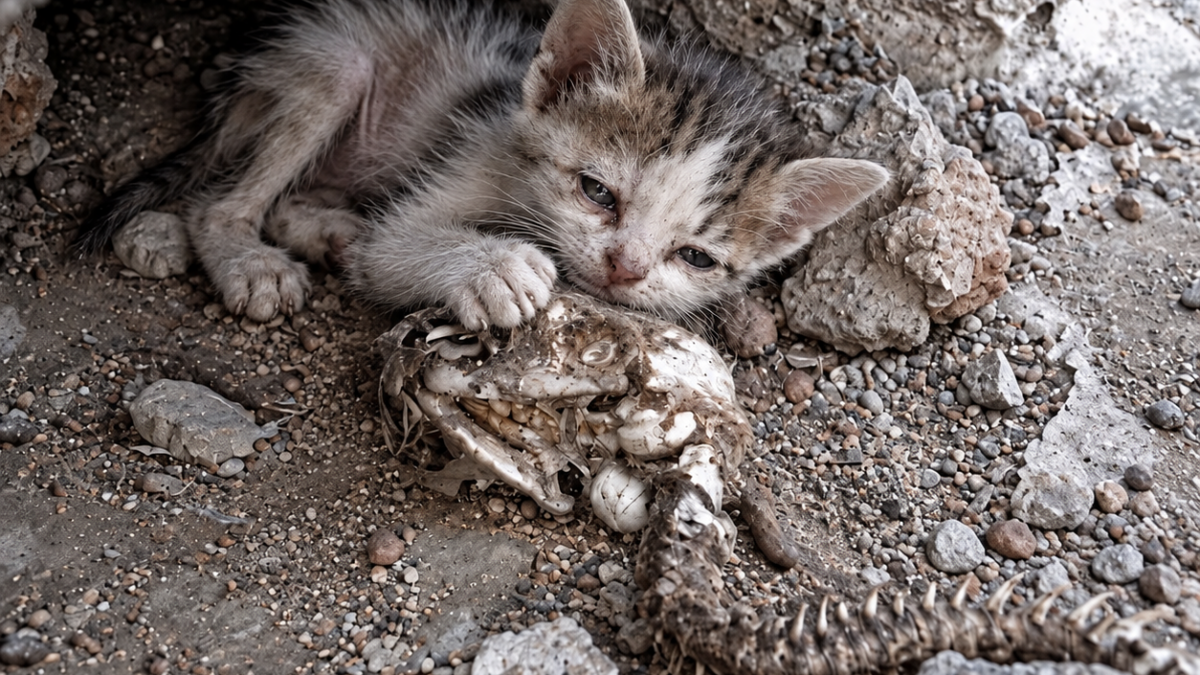
And her kitten was trying to nurse from a body that could no longer feed him.
Harold dropped the coffee cup.
It hit the grass without breaking, spilling dark liquid into the soil.
The kitten startled and lifted his head.
His eyes were barely open, cloudy blue and confused. His fur was gray like his mother’s, but with a white patch on his chest shaped almost like a tear.
He wobbled against her side.
Then he squeaked again.
That sound did something terrible to Harold.
It went straight through the wall he had built around himself.
Not loudly.
Not dramatically.
Just enough to let the truth in.
He had not removed a nuisance.
He had killed a mother.
He took another step forward.
The kitten tried to crawl under his mother’s front leg, seeking shelter that was no longer there.
Harold’s knees weakened.
“Miriam,” he whispered.
He did not know why he said her name.
Maybe because she would have known what to do.
Maybe because she would have looked at him with those disappointed eyes and said nothing, which would have been worse than shouting.
Maybe because the best part of him had always sounded like her.
Across the fence, Elena’s back door opened.
She carried a watering can in one hand and stopped when she saw Harold standing frozen in the yard.
“Harold?”
He did not answer.
She followed his gaze.
The watering can slipped from her hand.
“Oh my God.”
She ran to the fence gate between their yards, the one Miriam and Elena had insisted on installing years earlier because “neighbors should not have to walk around the block to share tomatoes.”
Elena pushed through it and crossed the grass.
When she reached the cat, she stopped.
Her hand flew to her mouth.
“No,” she whispered.
The kitten squeaked.
Elena knelt immediately.
“Oh, baby.”
She looked at Harold.
“What happened?”
Harold opened his mouth.
Nothing came out.
Elena saw the blue dish.
Then the container near the trash can by the garage.
Her face changed.
“Harold.”
He stepped back.
“I didn’t—”
His voice broke.
“I thought—”
“What did you do?”
The question was not shouted.
That made it worse.
Harold looked at the kitten.
“I wanted her gone.”
Elena stared at him as if she had never seen him before.
Then she turned away, scooped the kitten gently into both hands, and tucked him against her chest.
The kitten cried, thin and desperate.
Elena’s eyes filled with tears.
“She had babies somewhere.”
Harold’s head snapped toward the shed.
The mother cat had not died in the open because she was wandering.
She had died trying to return.
Elena understood at the same moment he did.
“Help me,” she said.
Her voice shook.
Harold stood still.
“Elena—”
“Help me find them.”
That broke whatever paralysis had held him.
He moved toward the shed.
They searched beneath it first. Harold got down on his stomach in the dirt, ignoring the pain in his knees, and shone a flashlight under the wooden frame. Spiderwebs clung to the beam. Dry leaves. An old garden glove. Nothing.
Elena held the kitten inside her shirt to keep him warm.
“Check the jasmine,” she said.
Harold crawled toward the hedge.
His hands shook as he pushed branches aside.
At first, he heard only the morning insects.
Then, faintly, a sound.
A small, weak peeping.
“There,” he said.
Elena crouched beside him.
Inside a hollow behind the jasmine roots, hidden beneath leaves and a torn piece of insulation, were three more kittens.
Tiny.
Cold.
Barely moving.
One gray.
One black.
One white with orange patches.
Harold reached toward them, then stopped.
His hands looked too large.
Too guilty.
Elena saw him hesitate.
“Pick them up,” she said. “Carefully.”
He did.
One by one.
The gray kitten fit in his palm like a breath.
The black one’s body was cold.
Too cold.
The white-and-orange one opened its mouth but made no sound.
Elena took off her light sweater and wrapped all four kittens together against the first one.
“They need heat,” she said. “And formula. Now.”
Harold stood.
His legs almost failed him.
“I’ll drive.”
“No,” Elena said. “I will. You call the emergency vet and tell them we’re coming.”
He nodded.
Then he looked at the mother cat.
She lay in the grass, still and silent, one paw stretched toward the place where her babies had been hidden.
Elena followed his gaze.
“We’ll come back for her,” she said.
Her voice was hard now.
“But the living go first.”
Those words stayed with Harold for the rest of his life.
The living go first.
He called the emergency vet from Elena’s passenger seat while she drove faster than Harold had ever seen her drive. The kittens were wrapped in towels between them, nestled against a microwaved rice sock Elena had grabbed from her kitchen. The first kitten, the one found beside his mother, kept crawling blindly, searching.
Elena named him Mercy before they reached the clinic.
Harold did not ask why.
At the emergency vet, a technician took the kittens immediately.
A young veterinarian named Dr. Paige Lin examined them beneath warm lights while Harold stood near the wall with his arms hanging uselessly at his sides.
The waiting room smelled of disinfectant, wet dog, and fear.
Elena filled out paperwork.
When the receptionist asked for the kittens’ names, she looked at Harold.
He shook his head.
He did not deserve to name anything.
Elena wrote:
Mercy.
Hope.
Grace.
Little Tom.
Harold looked at her.
“Little Tom?”
“The black one,” she said. “He looks like he has something to prove.”
Under other circumstances, Harold might have smiled.
Not that day.
Dr. Lin came out thirty minutes later.
Her face was gentle, which told Harold the news was not simple.
“They’re alive,” she said.
Elena exhaled.
Harold closed his eyes.
“But they’re cold, dehydrated, and they haven’t eaten properly in some time. They need round-the-clock bottle feeding. The black kitten is the weakest.”
“Will they make it?” Elena asked.
Dr. Lin looked at the floor, then back at them.
“We’ll try.”
Harold flinched at that.
We’ll try was not a promise.
It was a door left open because closing it would be cruel.
Then Dr. Lin asked the question Harold had known was coming.
“Do we know what happened to the mother?”
Silence.
Elena looked at Harold.
Harold felt his throat tighten.
“I put poison out,” he said.
Dr. Lin’s expression changed.
Not anger first.
Pain.
Then anger carefully controlled beneath professionalism.
“What kind?”
He told her.
“Where is the body?”
“My yard.”
“We need to know if the kittens ingested any directly or through nursing. Bring the container and, if possible, the mother’s body. We may need to contact animal control.”
Harold nodded.
His face burned.
For most of his life, he had been a proud man.
Proud of his store.
Proud of his yard.
Proud of paying bills on time.
Proud of needing no one.
Now he stood in a veterinary clinic while a young doctor looked at him like he was a preventable tragedy in human form.
“I didn’t think,” he whispered.
Dr. Lin’s voice softened, but not enough to absolve him.
“That’s the problem, Mr. Benson. Most cruelty begins when people stop thinking of the animal as someone’s mother, someone’s baby, someone trying to survive.”
Harold swallowed.
Elena said nothing.
That silence hurt more than the doctor’s words.
They returned to the house.
Harold found a shoebox and one of Miriam’s old gardening towels. He lifted the mother cat gently from the grass. She was lighter than he expected.
Too light.
A creature who had been all hunger, fear, and devotion.
Elena stood beside him.
“She deserves better than a trash bag,” she said.
“I know.”
His voice cracked.
“I know.”
They took the body and poison container to the clinic.
Animal control became involved, as Dr. Lin said they might. An officer named Rachel Boone came to Harold’s house that afternoon. She was calm but direct. She photographed the yard, the poison container, the blue dish, and the area around the shed. She explained the law. She explained the risks of poison to pets, wildlife, children, and unintended animals.
Harold listened.
He did not argue.
He did not defend himself.
That surprised Rachel.
People usually defended themselves.
They said they did not mean it.
They said it was just a stray.
They said everybody did it.
Harold only said, “I did it. I want to know what happens next.”
Rachel studied him.
“What happens next depends partly on the investigation and partly on whether you’re willing to cooperate.”
“I am.”
“Good.”
She looked toward the jasmine hedge.
“There may be more cats in the area.”
“I’ll pay to trap them safely.”
Rachel blinked.
“Elena can help me contact a rescue,” Harold said.
Elena, standing on the patio, looked at him for the first time since the clinic with something other than grief.
Not forgiveness.
Not yet.
But something.
“Sunrise Animal Rescue,” she said. “They do TNR and foster placement.”
“Call them,” Harold said. “I’ll pay.”
Rachel wrote that down.
“You understand this does not undo what happened.”
Harold looked toward the patch of grass by the shed.
“No,” he said. “I understand.”
That night, Harold did not turn on the television.
He sat at the kitchen table with the house silent around him.
Miriam’s chair sat across from him.
For three years, he had avoided looking directly at it.
That night, he could not look away.
He remembered her hands.
Small hands.
Strong hands.
Hands that had held Butters wrapped in a towel.
Hands that had steadied him at the hospital when he tried to pretend he was not afraid.
Hands that had rested on his cheek the night before she died.
“Don’t get hard when I’m gone,” she had whispered.
He had promised.
Then he had broken that promise slowly.
Not all at once.
That was the thing about becoming hard.
It happened in small permissions.
Skip the neighbor’s invitation.
Ignore the daughter’s call.
Complain about children laughing too loudly.
Treat every unexpected need as an invasion.
Set out poison for a hungry mother because her survival disrupted your order.
Harold put his face in his hands.
For the first time since Miriam’s funeral, he sobbed loudly enough that the empty house seemed to hear him.
The kittens survived the first night.
Elena called him at six in the morning.
“All four are still here,” she said.
Harold gripped the phone.
“Thank God.”
“Don’t thank Him yet. They have a long way to go.”
“I know.”
“Dr. Lin says Mercy is the strongest.”
The kitten found beside his mother.
Of course he was.
“And Little Tom?”
A pause.
“He made it through the night.”
Harold closed his eyes.
“I’ll pay the bill.”
“I didn’t call about money.”
“I know.”
“Do you?”
Harold did not answer.
Elena sighed.
“Sunrise Animal Rescue can take them once they’re stable. They need bottle feeders.”
“I can help.”
The silence on the other end was sharp.
“You?”
“Yes.”
“Harold—”
“I know I’m the last person you’d ask.”
“You are.”
“I want to help anyway.”
Elena’s voice hardened.
“They are not a project to make you feel better.”
“I know.”
“They are not forgiveness.”
“I know.”
“They are babies.”
Harold looked toward Miriam’s chair.
“I know.”
Elena was quiet for a long time.
“Be at the clinic at nine,” she said. “If Dr. Lin says no, it’s no.”
“I understand.”
Dr. Lin did not say no.
But she did not make it easy.
She took Harold into a small exam room where the four kittens lay in an incubator. Mercy was pressed against Hope. Grace slept with her mouth slightly open. Little Tom lay apart from the others, breathing shallowly.
Harold stood at the glass.
“I did that,” he said.
Dr. Lin did not soften the moment.
“Yes.”
His eyes filled.
“I don’t know how to fix it.”
“You don’t fix it. You do the next right thing.”
She taught him how to mix formula.
How to test temperature.
How to hold a kitten belly-down, never on its back.
How to stimulate them afterward with warm cotton.
How to weigh them.
How to watch for fading.
How to keep records.
That part he understood.
Records.
Times.
Amounts.
Weights.
Signs.
Dr. Lin handed him a feeding chart.
“Every two hours.”
“Day and night?”
“Day and night.”
Harold nodded.
“Good,” she said. “Compassion is not a feeling, Mr. Benson. It is usually a schedule.”
That sentence became his punishment and his salvation.
For the next three weeks, Harold slept in pieces.
Sunrise Animal Rescue placed the kittens in Elena’s spare room, but Harold came every day. Then, when Elena saw that he followed instructions exactly, he began taking the midnight and 4 a.m. feedings.
At first, the kittens barely looked real.
Their ears were folded.
Their bodies fit in one hand.
Their cries were thin and urgent.
Mercy ate greedily, tiny paws kneading the towel.
Hope needed patience.
Grace dribbled formula down her chin.
Little Tom fought every feeding like the bottle was an insult.
Harold learned them.
He learned the weight of each one.
The sound of each cry.
The way Mercy calmed when wrapped snugly.
The way Hope needed a finger resting gently against her back.
The way Grace fell asleep mid-bottle.
The way Little Tom, despite being the weakest, kicked the hardest.
He cleaned them.
Warmed them.
Logged every ounce.
At 2:12 a.m. on the sixth night, Little Tom stopped breathing well.
Harold noticed because the kitten’s cry changed.
Not louder.
Smaller.
He called Dr. Lin’s emergency line with shaking hands.
She met him at the clinic in twelve minutes.
Little Tom spent the night on oxygen.
Harold sat in the parking lot until sunrise because he could not make himself go home.
Elena arrived at dawn with coffee.
She handed him one cup.
“You look terrible.”
“I feel worse.”
“Good.”
He nodded.
“I deserve that.”
She looked through the windshield toward the clinic.
“No,” she said quietly. “You deserve to feel what you did. That’s different.”
They sat in silence.
Then Harold said, “Miriam would have loved him.”
Elena’s face softened.
“She loved every pathetic thing.”
That made him laugh once through tears.
“She married me,” he said.
Elena looked at him.
For the first time since the morning in the yard, she smiled.
Little Tom survived.
Barely.
But he survived.
As the kittens grew, the neighborhood learned what had happened.
Not because Harold announced it.
Because neighborhoods are living things with ears.
Some people were furious.
Some were disgusted.
Some said he should be charged harshly.
Some said he was an old man who had made a terrible mistake.
Some said poison was common and everyone was pretending to be shocked.
Elena shut that down every time she heard it.
“Common does not mean acceptable.”
Harold did not defend himself.
At the mailbox, Mrs. Jacobs from across the street refused to look at him.
At the grocery store, a young mother moved her cart away when he passed.
His daughter, Rebecca, drove down from Tampa after Elena called her.
She found him in the kitchen washing kitten bottles.
For a long moment, she stood in the doorway.
“Dad.”
He turned.
She looked older than he remembered.
Or maybe he had been refusing to notice.
“Rebecca.”
She glanced at the bottles.
“So it’s true.”
He nodded.
“I killed her.”
Rebecca closed her eyes.
“Elena said there were kittens.”
“Four living.”
“She said you’re helping.”
“I’m trying.”
Rebecca’s eyes filled with tears.
“Why didn’t you call me?”
He looked down.
“About what?”
“About being this lonely.”
The question hit harder than any accusation.
Harold gripped the edge of the sink.
“I didn’t want to be a burden.”
“You’re my father.”
“That doesn’t answer it.”
“It should.”
He could not speak.
Rebecca stepped closer.
“Mom would be heartbroken.”
“I know.”
“But not just about the cat.”
He looked at her.
“She’d be heartbroken about you.”
That broke him again.
Rebecca hugged him while he cried against her shoulder like a man much older than seventy-two.
The kittens reached four weeks.
Then five.
Their eyes opened fully.
They began to wobble across towels, then tumble, then attack one another with the ferocity of tiny drunk lions.
Mercy grew bold first.
He climbed Harold’s pant leg and screamed until Harold picked him up.
Hope became gentle, watching everything before joining.
Grace loved sleeping in shoes.
Little Tom, now strong and ridiculous, attacked bottle nipples, blanket corners, and Harold’s fingers with equal outrage.
The rescue posted their photos online.
Applications came quickly.
People loved rescue stories when they were safely past the worst part.
Harold understood that.
He understood something else too.
The mother cat had no photo people wanted to adopt.
No happy ending with a blanket.
No second chance.
Her story ended in his grass because he had decided her hunger was a problem to eliminate.
He asked Elena if they could bury her properly.
Elena looked at him for a long moment.
Then she said, “Yes.”
They buried her beneath the hibiscus where Butters had been buried years before. Harold chose the spot because Miriam had planted that hibiscus their first year in the house. It bloomed red every summer, bright as forgiveness he had not earned.
Rebecca came.
So did Elena.
So did Dr. Lin, unexpectedly, carrying a small white flower.
Harold placed a simple stone at the base.
No name.
He had never known the mother’s name.
That hurt him more than he expected.
Elena placed the flower on the soil.
“She was a good mother,” she said.
Harold nodded.
“The best.”
His voice shook.
“I’m sorry.”
No one said it was okay.
Because it was not.
That was important.
Forgiveness, if it ever came, would not make what happened okay.
It would only mean the story did not end at the worst sentence.
The kittens were adopted at ten weeks.
Hope went to a veterinary technician.
Grace went to a retired couple who sent photos of her sleeping in a laundry basket.
Little Tom went to Rebecca.
She said she wanted him because he had “Benson stubbornness,” which was apparently a medical condition.
Mercy stayed.
That surprised everyone except Harold.
He had tried to pretend he was fostering Mercy until adoption.
Elena did not believe him.
Rebecca did not believe him.
Dr. Lin definitely did not believe him.
Mercy slept in Miriam’s chair, chased dust motes in the morning light, and followed Harold from room to room with the solemn dedication of a creature who had once lost everything and intended to keep track of what remained.
One evening, Harold stood at the back door watching Mercy paw at a toy mouse.
Elena came through the side gate carrying a tray of tomato seedlings.
“He owns you now,” she said.
Harold nodded.
“I figured.”
“You going to admit you love him?”
“Eventually.”
“He already knows.”
Harold looked at the kitten.
Mercy looked back, then attacked the rug.
“He shouldn’t trust me,” Harold said.
Elena’s voice softened.
“Maybe that’s why it matters that he does.”
After the poison incident, Harold changed his yard.
He removed every toxic bait from the garage.
He put up humane deterrents around the garden.
He built a small feeding station near Elena’s fence for community cats involved in the rescue’s trap-neuter-return program.
He paid for spay and neuter surgeries.
He paid for flyers.
He paid for an emergency fund at Dr. Lin’s clinic under the name Miriam’s Mercy Fund.
He did not put his name on it.
Elena found out anyway.
“You know anonymous donations are less anonymous when you pay by check,” she said.
“I’m old. Let me have my mysteries.”
The neighborhood changed too.
Not all at once.
But enough.
Mrs. Jacobs, who had stopped speaking to him, came over one afternoon with a bag of towels for the rescue.
“I’m still angry with you,” she said.
“I understand.”
“But I had these.”
“Thank you.”
She looked toward the hibiscus.
“Was she buried there?”
“Yes.”
Mrs. Jacobs nodded.
“She deserved flowers.”
The next day, a pot of marigolds appeared by the stone.
No note.
Then another.
Then a small ceramic cat from Mrs. Alvarez down the street.
Then a painted rock from a child that said, Sorry Mama Cat.
Harold stood in front of those offerings one evening and cried again.
This time, quietly.
Not from shame only.
From the unbearable tenderness of people trying to repair what could not be repaired.
Months passed.
Mercy grew into a sleek gray cat with a white patch on his chest shaped like a tear. He became indoor-only, despite his passionate belief that every door existed to insult him. He slept on Harold’s bed. He knocked pens off the desk. He sat on Miriam’s chair like he was guarding it for her.
Harold spoke to him constantly.
At first, he felt foolish.
Then he remembered Miriam speaking to Butters as if the cat were a tax advisor, marriage counselor, and weather expert.
So he stopped feeling foolish.
On the anniversary of the day he found Mercy beside his mother, Harold woke before dawn.
He made coffee.
Fed Mercy.
Then walked outside to the hibiscus.
The morning was humid and pink with early light. Dew clung to the grass. Somewhere beyond the fence, Elena’s wind chimes moved softly.
Harold stood before the small stone.
“I’m sorry,” he said.
He had said it before.
He would say it again.
Not because the dead could answer.
Because the living needed reminders.
Mercy appeared at the back window, watching him through the glass.
Harold turned and looked at the yard.
A year earlier, he had seen it as a place to control.
Now he saw how much life moved through it when he stopped treating every visitor as an enemy.
Lizards in the mulch.
Birds at the feeder.
A possum near the back fence at night.
Community cats passing through after dark, ears tipped from their rescue surgeries, no longer multiplying in hunger and fear.
Hungry animals were still inconvenient sometimes.
They knocked over things.
Dug.
Cried.
Needed.
But need was not an attack.
Survival was not an insult.
A starving mother looking for food was not an enemy.
That was the truth Harold had learned too late for one gray cat, but not too late for her son.
Later that day, Pine Needle Lane held a small donation drive for Sunrise Animal Rescue.
Elena organized it.
Rebecca drove down with Little Tom, now a ridiculous black cat who acted like he personally owned the state of Florida.
Dr. Lin came by with a folding table of humane deterrent information.
Children brought blankets.
Neighbors brought food.
Mr. Keene from two streets over arrived with a sack of cat litter and insisted he had bought too much by accident, which no one believed.
Harold stood near the table, quieter than most.
A young father approached him holding a flyer.
“So if cats come around, we shouldn’t feed them unless there’s a plan?”
Harold nodded.
“Feeding helps, but fixing the problem humanely helps more. Call the rescue. Get them trapped, neutered, vaccinated if possible. Block access with safe deterrents. Don’t use poison.”
The man looked embarrassed.
“I used to think poison was just what people did.”
Harold looked toward the hibiscus in his yard.
“So did I.”
The man followed his gaze.
Then he nodded.
“I won’t.”
That was something.
Not everything.
But something.
That evening, after the donation drive ended, Harold sat in Miriam’s chair with Mercy asleep across his lap. The kitten was no longer tiny. He spilled over Harold’s knees now, warm and heavy, purring like a small engine.
Rebecca sat on the couch with Little Tom in a carrier beside her, ready for the drive back to Tampa.
“You’re different,” she said.
Harold stroked Mercy’s back.
“I hope so.”
“Mom would be glad.”
His throat tightened.
“She told me not to get hard.”
“I know.”
“I did anyway.”
Rebecca reached over and touched his arm.
“You came back.”
Harold looked down at Mercy.
The cat opened one eye, then closed it again.
“I had help.”
Outside, the sun lowered behind the houses.
The hibiscus glowed red in the last light.
Harold thought about the mother cat.
About the way her kitten had pressed against her, not understanding death, cruelty, regret, or the terrible human habit of making suffering invisible until it is too late.
He wished he could go back.
That was the useless prayer of every regret.
Go back.
Pick up the dish.
Call Elena.
Call the rescue.
Choose mercy before mercy had to be named after the one who survived.
But life rarely gives people the grace of changing the first act.
Only the next one.
So Harold changed the next one.
And the next.
And the next.
He became the old man who kept kitten formula in his pantry.
The old man who drove injured strays to Dr. Lin.
The old man who told every neighbor, firmly and without shame, “No poison. Call me first.”
Some people laughed.
Some listened.
Some rolled their eyes.
But more animals lived.
That had to matter.
One rainy night nearly two years later, Harold heard a sound near the back door.
A small cry.
Mercy lifted his head from the rug.
Harold froze.
For a second, the past opened under his feet.
Then he stood, took a towel from the laundry room, and opened the door.
A wet tabby kitten huddled beneath the patio chair.
Hungry.
Shaking.
Alone.
Harold crouched slowly.
“Hey there,” he whispered.
The kitten hissed.
Mercy watched from inside, tail twitching.
Harold smiled sadly.
“That’s fair.”
He placed the towel down, then a small bowl of food.
Not poison.
Food.
Then he called Elena.
She answered sleepily.
“Harold?”
“There’s a kitten on my patio.”
A pause.
“Alive?”
“Yes.”
“Good. I’ll bring the carrier.”
He sat on the floor by the open door while rain fell beyond the porch light.
The kitten crept toward the food.
Harold did not move.
He understood now.
Trust could not be demanded.
Safety had to be proven.
One quiet minute at a time.
The kitten began to eat.
Inside, Mercy pressed his nose against the screen.
Harold looked at him.
“I know,” he said softly. “We’ll help.”
And this time, he did.