A Stray Cat Was So Weak He Had to Crawl to His Food—Months Later, I Deleted His Adoption Post Because He Was Already Home.
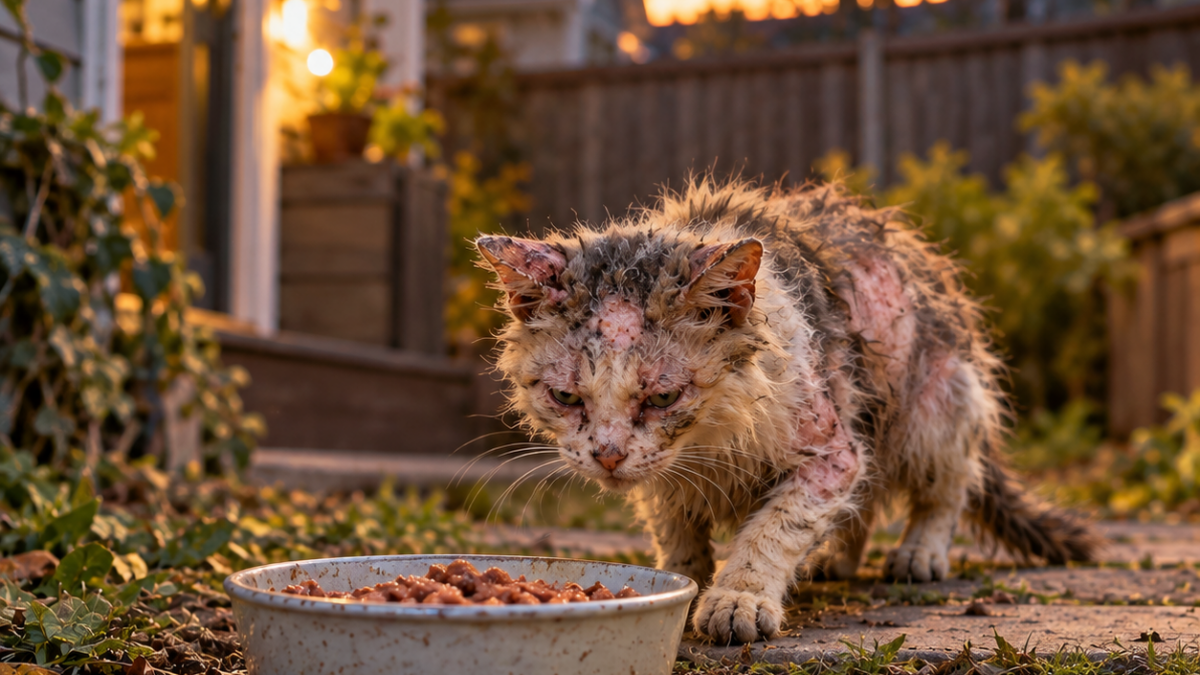
A Stray Cat Was So Weak He Had to Crawl to His Food—Months Later, I Deleted His Adoption Post Because He Was Already Home.
The message came late at night, when the house was quiet enough for grief to start sounding like furniture settling in the dark.
A stranger said there was a cat outside his property who could barely crawl, and something in the photo he sent made me grab my keys before I even understood why I was crying.
I thought I was driving out to save a stray animal who might not survive the night, but I had no idea that the broken little cat waiting beside an empty bowl was about to become the family I didn’t know I was still missing.
The message arrived at 10:43 on a Thursday evening.
I remember the exact time because I had been standing in my kitchen, barefoot, wearing an old sweatshirt with a bleach stain on one sleeve, staring at a cup of tea I had reheated twice and still hadn’t touched.
The house was too quiet.
That was the thing people never warned you about after loss.
They told you grief came in waves. They told you mornings were hard. They told you birthdays would hurt, holidays would ambush you, and ordinary objects could turn into weapons if they held the wrong memory.
Nobody told you how loud a quiet house could become.
The refrigerator hummed.
The clock ticked.
The floor creaked in the hallway even when no one was walking there.
The empty corner by the window still looked like it was waiting for my old cat, Milo, to curl into the square of sunlight that used to fall across the rug every afternoon.
Milo had been gone for seven months.
Seven months should have been enough time for my brain to stop looking for him.
It wasn’t.
I still woke some mornings expecting to feel the weight of him against my legs. I still caught myself buying the brand of treats he liked before remembering there was no one at home to demand them. I still avoided washing the little blanket he used to sleep on, because it had one faint patch of orange fur near the edge and I wasn’t ready to erase that last ridiculous proof that he had been real.
I fostered animals before Milo died.
Cats mostly.
Sometimes kittens.
Once, a three-legged senior dog named Murphy who hated everyone except the mailman and somehow convinced me that being bitten twice was a reasonable price for his love.
I was good at temporary love.
That’s what fostering is supposed to be.
You open your door.
You give safety.
You give medicine.
You give warmth.
You give them enough of yourself to help them survive, then you hand them to someone else and tell yourself that goodbye is part of the work.
I believed that once.
After Milo died, I stopped taking calls.
At first, I told the rescue coordinator I needed a few weeks.
Then a month.
Then maybe after summer.
Then I stopped answering when numbers from the rescue group showed up on my phone.
I wasn’t proud of it.
But grief had made me selfish in a way I did not know how to explain without sounding cruel.
I could not take another sick animal into my house and wonder every morning if I would find them gone.
I could not put medicine into another fragile mouth.
I could not whisper, “You’re safe now,” and risk being wrong.
So when my phone buzzed that night, I expected to ignore it.
Then I saw the preview.
There’s a cat here, and I’m afraid he might not have much time left.
The message came from a man named Michael Rivera.
I knew the name only vaguely. He lived on the edge of town, near the old orchard roads where houses sat farther apart and stray animals sometimes appeared out of fields like they had been dropped from another life.
Michael had volunteered twice at adoption events. Quiet man. Early forties. Wore baseball caps pulled low. Always helped carry crates but never stayed long enough for small talk.
I opened the message.
He had sent a photo.
At first, I didn’t understand what I was looking at.
PART2:
The cat was crouched beside a metal bowl on a cracked patch of concrete near what looked like a shed. His body was so thin it seemed folded wrong. His back rose sharply beneath damaged skin. Large patches of fur were gone. His ears were crusted and swollen along the edges. His eyes were nearly sealed with inflammation, red and wet and painful even through the blur of the picture.
He looked less like a cat than the memory of one.
I pressed my hand over my mouth.
Another message came through.
I found him near the back fence this afternoon. Put food out. He dragged himself to it. He’s not walking right. I got him into a carrier, but I don’t know what to do.
Then another.
I’m sorry to message so late. I just didn’t think he’d make it until morning if nobody knew.
I stared at the photo until my eyes burned.
The cat’s head was lowered toward the bowl, but what broke me was not how sick he looked.
It was the space around him.
That terrible, empty space.
No blanket.
No warm hand.
No one sitting close enough for him to lean against.
Just concrete, darkness, and a bowl that had already been emptied.
I called Michael.
He answered on the first ring.
“I’m sorry,” he said immediately. “I didn’t know who else to call.”
“Is he breathing okay?”
“I think so. He’s quiet. Too quiet.”
“Is he inside?”
“In my mudroom. In the carrier. I put towels in there.”
“Good.”
“I tried to give water. He wouldn’t drink much.”
“That’s okay. Don’t force it.”
“He looks awful.”
“I saw.”
There was a pause.
PART3:
Then he said, softer, “He didn’t run from me.”
That hurt more than it should have.
“Most sick cats don’t have the energy,” I said.
“No, I mean… he looked scared. Really scared. But he didn’t even try. He just sort of… gave up.”
I closed my eyes.
In the silence, I could hear the old version of myself returning.
The one who knew how to move during emergencies.
The one who could make lists while her heart was breaking.
“Can you keep him warm tonight?”
“Yes.”
“Quiet room?”
“Yes.”
“No kids? No dogs?”
“No. Just me.”
“Text me your address. I’ll come in the morning and take him to the clinic.”
“You don’t have to—”
“Yes,” I said. “I do.”
After we hung up, I stood in the kitchen with the phone in my hand and felt the old fear rise.
What if he dies before morning?
What if he dies in my car?
What if I bring him home and cannot save him?
What if I let myself care and lose him anyway?
The questions came fast, selfish, human.
Then I looked back at the photo.
A starving cat beside an empty bowl.
Waiting.
As if he had learned that food could disappear at any moment and the only way to survive was to stay close to where kindness might show up again.
I whispered to my empty kitchen, “Okay.”
Then I set an alarm for 5:30.
I barely slept.
Every time I drifted off, I saw the cat’s swollen eyes.
I saw his paws dragging across concrete.
I saw him sitting beside the bowl after the food was gone, too exhausted to search, too hungry to leave.
By 5:12, I gave up and got out of bed.
Outside, the world was still that blue-gray color that belongs to early mornings before people have made noise of them. I packed towels, a soft carrier liner, gloves, a bottle of water, and an old fleece blanket. I called the emergency veterinary clinic as soon as they opened and warned them I was bringing in a severely neglected stray.
The receptionist asked, “Name?”
I opened my mouth.
Nothing came out.
I didn’t know his name.
The cat in the photo was only suffering.
Only hunger.
Only survival.
Not a name yet.
“I don’t know,” I said.
“That’s okay,” she answered gently. “We’ll put him under Stray for now.”
I hated that.
Stray.
As if that was what he was.
As if all his fear and pain and stubborn little breathing could be reduced to the fact that no human had claimed him.
“I’ll call back,” I said.
Michael lived thirty minutes away, past the edge of the suburbs where lawns gave way to fields and old barns leaned behind chain-link fences. His house sat at the end of a gravel drive, small and neat, with a porch light still glowing in the morning fog.
He opened the door before I knocked.
“You came,” he said.
“Of course I came.”
He looked exhausted.
There were dark crescents under his eyes.
The mudroom smelled faintly of wet towels, canned cat food, and fear.
The carrier sat on the floor beside a washing machine. A towel covered half of it to keep the cat calm. I crouched slowly, not wanting to startle him, and lifted one corner.
Two inflamed eyes blinked through the shadows.
He did not hiss.
Did not growl.
Did not strike.
He curled smaller, as if apologizing for taking up space.
“Oh, sweetheart,” I whispered.
His body trembled.
Michael stood behind me, helpless.
“He ate a little more around midnight,” he said. “Then he just sat there. I checked on him every hour.”
“You did good.”
“I don’t know.”
“You got him safe for the night. That matters.”
He swallowed.
“I thought he was dead when I first saw him.”
I looked up.
Michael leaned against the doorframe, eyes fixed on the carrier.
“He was by the fence. I thought it was trash at first. A rag or something. Then it moved. I put food out because I figured if he could still eat, maybe…” He stopped.
“Maybe he had a chance,” I finished.
“Yeah.”
I reached toward the carrier door.
“Hey, little one,” I murmured. “We’re going to help you now.”
The cat lowered his head.
It was not trust.
Not yet.
It was surrender.
There is a difference.
Trust says, I believe you won’t hurt me.
Surrender says, I can’t stop you if you do.
I lifted the carrier carefully. He weighed almost nothing.
That was the first thing I noticed.
How little life could weigh when it had been forced to spend too long surviving.
Michael followed me to the car.
“Will you tell me what happens?”
“Yes.”
“If he needs money for the vet—”
“I’ll figure it out.”
“I can help.”
I turned back.
He looked embarrassed, like offering help after making a phone call was somehow too little.
“Michael,” I said, “you stopped.”
He frowned.
“What?”
“You saw him. You stopped. You fed him. You brought him inside. You called someone. That is not little.”
His eyes reddened.
“I almost didn’t.”
“But you did.”
He nodded once.
I placed the carrier on the passenger seat and buckled it in with the seatbelt.
As I pulled out of the driveway, the cat made a sound.
Not a meow.
Barely even a breath.
A small, broken rasp.
“I know,” I said softly. “I know, baby. We’re going.”
Halfway to the clinic, I decided he could not stay Stray.
The carrier was quiet beside me.
The world outside the windshield blurred with morning traffic and pale light.
I tried names in my head.
Oliver.
Theo.
Henry.
Nothing fit.
Then Jasper came.
I cannot explain why.
Maybe because it sounded warm.
Maybe because it sounded like something that could belong to a cat who had survived long enough to be found.
Maybe because names are sometimes less chosen than recognized.
“Jasper,” I said aloud.
The cat did not move.
Still, the car felt different after that.
“Okay, Jasper,” I whispered. “Stay with me.”
At the clinic, the vet tech who met us at the door took one look inside the carrier and said, “Oh, honey.”
Not to me.
To him.
That mattered.
People who work with wounded animals learn to speak directly to the part of them that still exists beneath the damage.
They took us into an exam room immediately.
Dr. Elaine Avery came in five minutes later.
She was in her fifties, with silver-streaked hair pulled into a bun and reading glasses hanging from a cord around her neck. She had been Milo’s vet, which was why I had avoided the clinic for seven months.
When she saw me, her face softened.
“I didn’t know you were coming in.”
“I didn’t either.”
She looked at the carrier.
“Who do we have?”
“Jasper.”
The name came out before I could second-guess it.
Dr. Avery nodded as if he had always been Jasper.
“All right,” she said. “Let’s meet him.”
When she opened the carrier, I expected panic.
A hiss.
A swipe.
A desperate attempt to flee.
Instead, Jasper slowly moved into the farthest corner, curled into himself, and lowered his head.
Defeated.
That was the only word.
Not aggressive.
Not wild.
Defeated.
I sat beside the exam table and reached out one hand.
“It’s okay,” I whispered. “You’re safe here. Nobody is going to hurt you.”
I had no idea whether he understood me.
I needed him to hear it anyway.
The exam was slow.
Gentle.
Painfully careful.
Every new finding felt like another chapter in a story no animal should have lived through.
Severe malnutrition.
Dehydration.
Skin infection.
Ear crusting.
Inflamed eyes.
Possible mites.
Old wounds.
Muscle wasting.
Sores where he had scratched himself raw.
No microchip.
No collar.
No sign that anyone had been looking for him.
Dr. Avery spoke in a calm voice, but I knew her well enough to see sadness behind the professionalism.
“He’s been struggling for a while,” she said.
“Weeks?”
“At least.”
“Months?”
“Possibly.”
I looked at Jasper.
He lay still on the towel, breathing fast, eyes narrowed against the light.
“How old is he?”
“Hard to know in this condition. Adult. Maybe four. Maybe six. He could look older because he’s so depleted.”
“Can he recover?”
Dr. Avery did not answer immediately.
That was the first time fear truly entered the room.
“We’re going to try,” she said finally. “He needs fluids, medication, nutritional support, skin treatment, eye medication, parasite control, and rest. He may need bloodwork once he’s stable enough. We’ll take it one step at a time.”
One step at a time.
That became the whole story.
Then, while Dr. Avery gently stroked the top of his head with two fingers, Jasper purred.
It was so quiet I thought I imagined it.
A tiny, uneven vibration.
Barely there.
Dr. Avery froze.
I looked at her.
She looked at me.
Jasper kept purring.
Sick.
Exhausted.
Terrified.
Touched by a stranger.
And somehow, inside that broken little body, there was still enough hope left to purr.
I turned away because I could not stop the tears.
Dr. Avery kept her hand on his head.
“Well,” she said softly, “there you are.”
I cried harder.
Because that was exactly what it felt like.
There you are.
Not the wounds.
Not the hunger.
Not the crusted ears or swollen eyes.
Him.
Somewhere under all that suffering, Jasper was still there.
And now we had to convince him the world could be more than pain.
The first bill was ugly.
I paid it without thinking too much, because thinking too much can turn compassion into math and I did not have room for that.
They kept Jasper for the day for fluids and initial treatment.
I went home with an empty carrier.
That was almost worse than bringing him in.
The passenger seat looked too clean.
Too quiet.
I stopped at a pet supply store and bought things I had not let myself buy since Milo died.
Soft blankets.
Shallow bowls.
A heated bed.
Litter with no strong scent.
A scratching pad.
A small stuffed mouse I told myself was unnecessary and bought anyway.
At home, I stood outside the spare bathroom for several minutes before opening the door.
The room had once been Milo’s recovery room after dental surgery.
His old towel still sat folded in the linen closet.
For seven months, I had not touched it.
Now I took it down.
Held it against my chest.
It smelled like laundry detergent, not him.
That hurt.
Then I placed it on the floor for Jasper.
Not because I was replacing Milo.
Because love is not a bowl that empties when given again.
I had forgotten that.
By evening, the room was ready.
Soft bed in the corner.
Blankets.
Food and water within easy reach.
A low-sided litter box.
Dim nightlight.
Quiet.
When I picked Jasper up, the tech carried him out wrapped in a towel like something precious.
“He ate a few bites,” she said.
“That’s good?”
“That’s very good.”
Dr. Avery gave me medications, instructions, warnings, and the kind of look veterinarians give when they want you to hope but not float away on it.
“Call if he stops eating. Call if his breathing changes. Call if he becomes unresponsive. Call if you’re worried.”
“I’m already worried.”
“I know.”
She placed a hand on my shoulder.
“You can do this.”
I nodded.
But in the car, with Jasper beside me, I whispered, “I’m not sure I can.”
From inside the carrier came the faintest sound.
Not quite a meow.
Not quite a complaint.
Enough.
“Okay,” I said. “We’ll both try.”
The first night was hard.
Not dramatic.
Hard in the exhausting, ordinary way caregiving is hard.
Medication every few hours.
Tiny meals.
Warm compresses.
Eye drops.
Skin treatment.
Laundry.
More laundry.
Checking to make sure he was breathing.
Sitting on the bathroom floor until my back ached because every time I tried to leave, he lifted his head slightly as if the room became less certain without me in it.
At first, even walking across the bathroom seemed to take everything Jasper had.
He moved like his bones were made of apology.
One paw.
Pause.
Another paw.
Pause.
Lower head.
Breathe.
He ate like someone might take the food away.
Fast.
Desperate.
No chewing if he could avoid it.
He swallowed until I worried he would make himself sick.
“Slow down,” I whispered. “There’s more. I promise there’s more.”
But promises take time to become believable.
Especially to a body that has survived without them.
The second night, I fell asleep sitting against the bathtub with my knees pulled to my chest.
I woke at 3:17 a.m. with a stiff neck, one sock half off, and Jasper staring at me from his bed.
His eyes were still swollen.
His face still looked painful.
But he was watching me.
Not hiding.
Watching.
“Hi,” I whispered.
He blinked.
I cried.
Apparently, that was going to be my new hobby.
Crying in the bathroom at small cat movements.
Over the next few days, the world became very small.
Bathroom.
Clinic.
Medication schedule.
Food.
Laundry.
Work emails answered in fragments.
Calls from rescue volunteers I had avoided for months.
Texts from Michael.
How is he today?
I sent pictures when I could.
At first, Jasper looked terrible in every one.
But Michael always answered as though each photo was a miracle.
He’s sitting up!
He looked at the camera!
His blanket looks soft!
That last one made me smile.
Michael asked if he could visit once Jasper was stronger.
I said yes.
Then regretted it briefly because some wounded part of me wanted Jasper’s recovery to belong only to us.
That embarrassed me.
He would not be alive without Michael.
Love begins with whoever stops.
I reminded myself of that often.
One afternoon, on the sixth day, I brought Jasper a small meal and prepared myself for the usual panic eating.
He sniffed the bowl.
Took a few bites.
Paused.
Took two more.
Then turned away and lay down.
Food remained in the bowl.
I froze.
At first, fear hit.
Was he sick?
Nauseous?
Declining?
Then I looked at him.
He was calm.
Tired, but calm.
Not desperate.
Not frantic.
Just finished.
There was still food in his bowl, and he believed he could leave it there.
I sat down hard on the bathroom floor.
“Oh, Jasper,” I whispered.
He had no idea what he had just done.
No idea that leaving a spoonful of wet food behind could feel like a door opening.
But to me, it was enormous.
Maybe he was beginning to understand another meal would come.
Maybe he was starting to believe nobody was going to take everything away.
Maybe hunger was no longer the ruler of his body.
I took a picture of the bowl and sent it to Michael.
He replied:
Is that good?
I wrote:
That is everything.
A few days later, I opened the bathroom door one morning and found Jasper sitting upright on his blanket.
His eyes were open.
Not completely healed.
Not clear.
But open.
He looked at me.
Really looked.
For the first time, I could see their color.
A tired green-gold, cloudy at the edges, but alive.
“Good morning, beautiful,” I whispered.
He blinked slowly.
I sat down and cried again.
Not because everything was fixed.
It wasn’t.
His skin still needed treatment.
His fur was patchy.
His body was still too thin.
His ears still looked painful.
But for the first time, I could see a little more of the cat hiding beneath all that damage.
And I could not stop thinking about how close he had come to being missed.
If Michael had not looked twice.
If the weather had been colder.
If Jasper had crawled under a shed instead of toward the bowl.
If the message had come to someone who thought, I can’t deal with this.
If I had ignored my phone.
I pressed my palm against the tile floor, grounding myself.
Jasper watched me like I was the strange one.
Which was fair.
Over the next weeks, healing arrived slowly enough to test every impatient part of me.
His skin improved by inches.
The crusts softened.
The irritated patches began to shrink.
A fine fuzz appeared where bare skin had been.
His steps grew steadier.
He used the litter box without needing help.
He started grooming one paw, then got tired and stopped as if embarrassed.
I told him he was doing great.
He looked unconvinced.
Personality came in pieces.
First, stubbornness.
Eye drops turned him into a tiny, sickly warrior. He weighed almost nothing and looked like an old sock, but the moment the medicine bottle appeared, he developed the strength of an animal three times his size.
“Jasper,” I said one evening, trying to hold him gently between my knees, “this is for your own good.”
He tucked his chin.
“No.”
He could not say no.
His entire body said it.
I got one drop in.
He glared.
I laughed for the first time in what felt like months.
Not a polite laugh.
Not a sad laugh.
A real one.
Jasper blinked at me with offended dignity.
“Oh,” I said. “So you’re in there.”
He turned his back on me.
Five minutes later, he ate dinner like nothing had happened.
Then curiosity arrived.
He began investigating the bathroom.
Slowly at first.
The corner behind the toilet.
The cabinet.
The bathmat.
My shoelaces.
The laundry basket, which he treated as a mountain placed before him by fate.
The day he climbed into it, got stuck, and yelled at me for assistance, I texted Michael:
He has discovered drama.
Michael replied:
I knew he had it in him.
Affection came last.
Or maybe trust did.
For weeks, Jasper tolerated touch more than he sought it.
He allowed me to stroke his head.
He leaned slightly into the brush when his skin healed enough for gentle grooming.
He accepted warmth, food, medicine, and presence.
But he did not climb into my lap.
I told myself that was fine.
It was fine.
It was.
It had to be.
Love cannot demand repayment from the wounded.
Still, some part of me wanted him to choose me.
That was the shameful truth.
I wanted him to look at me and know I was safe.
I wanted the work to mean something to him.
I wanted proof.
Then one evening, I sat on the bathroom floor with my laptop open, trying to answer work emails while Jasper finished dinner. Rain tapped the window. The house smelled faintly of clean laundry and medicated shampoo.
Jasper walked toward me.
Not to the food bowl.
Not to the litter box.
To me.
He placed one paw on my thigh.
Then another.
He paused there, uncertain.
I held my breath.
He climbed into my lap with the caution of someone stepping onto a frozen lake.
Then he curled into himself, pressed his fragile body against my sweatshirt, and began to purr.
I did not move.
I barely breathed.
His purr was stronger now.
Still soft, but steady.
I lowered one hand and rested it near him, not on him.
He pushed his head into my palm.
That was the moment I broke differently.
The tears came quiet.
No sobbing.
No drama.
Just a steady, helpless overflow of something I had been holding back for too long.
After Milo died, I thought grief had made a closed room inside me.
Jasper did not burst it open.
He did something gentler.
He found a crack.
He curled up there.
And the room began to let light in.
When Jasper was strong enough, I let him explore beyond the bathroom.
The hallway came first.
He stepped out like an explorer discovering a new continent.
Sniffed the baseboard.
Paused at a dust bunny.
Looked offended.
Continued.
The living room overwhelmed him at first.
Too open.
Too many shadows.
Too many places danger could hide.
He retreated to the bathroom after three minutes.
The next day, he made it to the rug.
The day after that, the couch.
The couch changed everything.
Jasper discovered softness at a level he had apparently never imagined.
He climbed onto one cushion, sank slightly, froze, then looked at me as if I had been hiding royal accommodations from him.
“That’s a couch,” I said.
He lowered himself carefully.
Five minutes later, he was asleep.
Within a week, he had claimed the left cushion.
Within two, he complained if I sat there.
Not loudly at first.
A small chirp.
Then a stare.
Then one paw on my leg, pushing.
“I lived here first,” I told him.
He did not care.
After the couch came the bed.
That was not planned.
I told myself Jasper would sleep in the bathroom until he was fully healthy.
Then in a cat bed.
Then maybe eventually on the bed if he wanted.
The first night he made it to my bedroom, he stood in the doorway for almost a minute.
I was reading, glasses low on my nose, pretending not to watch.
He walked around the bed once.
Then vanished under it.
“Jasper?”
Silence.
I leaned over.
Two glowing eyes stared from the darkness.
“You okay?”
No answer.
I turned off the light.
At 2:04 a.m., I woke because something very light landed near my feet.
I stayed still.
Jasper walked slowly up the side of the mattress, every step careful.
He reached my hip.
Paused.
Walked to my chest.
Paused again.
Then curled in the space beside my ribs.
I stared at the ceiling in the dark.
His body was warm.
His purr vibrated faintly through the blanket.
I thought of Milo then.
Not as a wound.
As a memory.
For the first time in seven months, thinking of him did not feel like falling.
It felt like being visited.
“I’m not replacing you,” I whispered into the dark.
Jasper lifted his head.
Blinked.
Then put it back down.
Maybe he understood.
Maybe he didn’t.
Maybe that sentence was never for him.
After that, Jasper slept wherever he wanted.
Which was everywhere.
The couch.
My bed.
The laundry basket.
A folded towel I had placed on the counter for exactly four seconds.
The windowsill.
The office chair.
The heating vent.
One memorable afternoon, inside an empty cardboard box labeled TAX DOCUMENTS, which felt spiritually appropriate.
He became opinionated about breakfast.
At first, hunger made him grateful for everything.
Then safety made him selective.
The first time he refused a flavor he had previously eaten, I stared at him.
“You cannot be serious.”
He sniffed the bowl.
Looked at me.
Walked away.
I sent Michael a message:
He has become rude.
Michael replied:
That’s recovery.
He was right.
Jasper gained weight.
Not quickly.
Carefully.
His fur grew back in uneven patches, then fuller, then soft enough that I caught myself petting him whenever he passed. His eyes cleared. His ears healed, though one remained slightly ragged at the edge, a tiny permanent record of whatever life had done to him before us.
Before us.
I started thinking that without meaning to.
Us.
The veterinarian visits became less frightening.
Dr. Avery smiled more.
The techs celebrated every pound gained like a graduation.
At one appointment, Jasper explored the exam room instead of hiding.
He sniffed the cabinet.
Inspected the trash can.
Tried to climb into Dr. Avery’s open bag.
“Well,” she said, lifting him gently away from her stethoscope, “someone feels entitled to the world now.”
“He’s been practicing at home.”
Jasper purred through the exam.
Dr. Avery listened to his heart.
Then looked at me.
“You’ve done a beautiful job with him.”
I looked at Jasper instead of her.
“He did the hard part.”
“He survived,” she said. “You helped him live.”
That sentence stayed with me.
Surviving and living are not the same.
Jasper had taught me that.
One evening, Michael came to visit.
I had cleaned the house as if a government official were inspecting my worthiness, which was ridiculous because Michael had already seen Jasper at his worst.
He arrived holding a small paper bag.
“I brought treats,” he said.
“Bribery is welcome.”
Jasper was on the couch, watching the door with narrowed eyes.
Michael stepped inside slowly.
“Hey, buddy,” he said, voice breaking slightly. “You look… wow.”
Jasper sniffed the air.
Michael crouched several feet away and placed one treat on the floor.
“I don’t know if you remember me.”
Jasper stared.
Took one cautious step.
Then another.
He reached the treat, sniffed it, ate it, and looked at Michael.
Michael laughed once, but his eyes filled.
“He’s beautiful.”
“He knows.”
Jasper took another treat.
Then, to my surprise, he walked to Michael and brushed lightly against his knee.
Michael froze.
I put a hand over my mouth.
Jasper did it again.
A small thank-you.
Or maybe he just wanted the bag.
It did not matter.
Michael cried openly then.
“I thought he was going to die on my mudroom floor,” he said.
I sat across from him.
“I thought so too.”
Jasper climbed back onto the couch and began washing one paw, apparently bored by our emotions.
Michael wiped his face.
“I almost didn’t message you.”
“I know.”
“I kept thinking, it’s late, people are busy, maybe he’s too far gone.”
I looked at Jasper.
“If you hadn’t, he wouldn’t be here.”
Michael nodded.
Neither of us spoke for a while.
Some truths are too large for immediate conversation.
After Michael left, I found Jasper asleep on the couch, one paw tucked under his chin.
I sat on the floor beside him and looked through the earliest photos.
The ones Michael had sent.
Painfully thin body.
Damaged skin.
Swollen eyes.
Exhausted expression.
I hated looking at them.
I needed to.
Because the cat in those pictures looked as though the world had forgotten him.
The cat sleeping in front of me looked peaceful.
Warm.
Safe.
He slept so deeply that when I shifted slightly, he barely moved.
For the first time, Jasper seemed able to rest without expecting pain to follow.
That was when I understood how much had changed.
Not just his body.
His relationship to tomorrow.
At the beginning, I had made myself a promise.
I would help Jasper recover.
I would get him healthy.
And once he was ready, I would find him a loving family.
That was the plan.
It was reasonable.
Responsible.
The kind of thing experienced foster people tell themselves because otherwise every rescue becomes an adoption and soon your home contains forty-seven animals and one chair for humans.
I repeated it often.
He is temporary.
He is healing here.
He will have a forever home.
I said it to Dr. Avery.
To Michael.
To my friend Emma, who had known me long enough to hear the lie before I did.
One Sunday afternoon, Emma came over with coffee and found Jasper stretched across my lap like melted butter.
She looked at him.
Then at me.
“You’re keeping him.”
“No, I’m fostering him.”
“Sure.”
“I am.”
“Absolutely.”
I narrowed my eyes.
“You are using the voice.”
“What voice?”
“The voice people use when they think I’m delusional.”
“I would never.”
Jasper rolled onto his back, exposing a spotted belly he allowed almost no one to touch.
Emma pointed.
“That cat has filed paperwork.”
“He has not.”
“He owns you.”
“He is recovering.”
“He is recovering on your chest.”
I looked down.
Jasper opened one eye.
Closed it.
Emma sipped her coffee.
“Write the adoption post.”
“I will.”
“When?”
“When he’s ready.”
She smiled gently.
“You mean when you are.”
I changed the subject.
That night, after Emma left, I opened my laptop.
The rescue group had an adoption template.
I had written dozens before.
Meet Daisy, a playful kitten with a big personality.
Meet Bruno, a gentle senior who loves naps and sunny windows.
Meet Clover, a sweet tabby looking for a patient home.
My fingers hovered over the keyboard.
Meet Jasper…
I stopped.
Jasper was sleeping beside me on the couch.
His body curled against my thigh.
One paw twitched in a dream.
I tried again.
Jasper is looking for his forever home…
I stared at the sentence.
Something inside me resisted so hard it felt physical.
I deleted it.
Tried again.
After surviving life on the streets, Jasper is ready for…
Delete.
Jasper needs…
Delete.
Jasper deserves…
Delete.
The blank screen glowed.
I looked at him.
He had come into my life starving, sick, and frightened. I had told myself I was giving him safety. But somewhere between medications, small meals, clean blankets, veterinary appointments, and all those quiet nights on the bathroom floor, something had happened that did not fit into a foster plan.
Jasper was not simply in my home.
He had changed the shape of it.
His bowl sat beside the kitchen doorway.
His blanket occupied the couch.
His medicine chart was still taped to the bathroom cabinet even though most of the medication was finished.
His toys were under the table.
His fur was on my sweatshirt.
His routines had become my routines.
Breakfast.
Window time.
Afternoon nap.
Evening couch theft.
Bedtime purring.
He was stitched into the day.
The adoption post blurred.
I closed the laptop.
Jasper opened his eyes.
“What?” I whispered.
He stretched one paw and placed it on my leg.
That was all.
No dramatic sign.
No magical moment.
Just one paw.
One quiet claim.
I started crying.
“I’m not looking for your forever home,” I said. “You already found it.”
Jasper yawned.
Deeply unimpressed.
That was how Jasper became mine.
Or how I admitted I had become his.
The adoption coordinator cried when I told her.
Not because she was surprised.
She said, “We all knew.”
Apparently everyone knew.
Michael sent back fifteen exclamation points and then called because texting was not enough.
“He stays?”
“He stays.”
“With you?”
“Yes.”
“Good,” he said, voice thick. “That’s where he belongs.”
I thought belonging would feel simple after that.
It didn’t.
It felt joyful.
And terrifying.
Because love, once claimed, becomes vulnerable.
For weeks after deciding to keep him, I became anxious over every sneeze, every skipped bite, every long nap.
I had lost Milo after years of love.
Now I had chosen to love Jasper knowing very well that bodies are fragile and forever is never as long as we mean it to be.
One night, I woke to Jasper sleeping beside me and felt panic rise from nowhere.
What if I lose him too?
He was breathing softly.
Safe.
Warm.
Mine.
The fear still came.
I got out of bed and went to the kitchen, where the moonlight lay pale across the floor.
I stood there gripping the counter, ashamed of my own heart.
Then I heard the soft thump of paws.
Jasper appeared in the doorway.
Sleepy.
Annoyed.
He walked to me, chirped once, and bumped his head against my ankle.
As if to say, Why are we standing in the kitchen when the bed exists?
I laughed through tears.
“You’re right,” I whispered. “Sorry.”
We went back to bed.
That became another lesson.
Love does not become safe just because you are afraid of losing it.
It becomes worth the fear.
Months passed.
Jasper became, objectively, spoiled.
There is no softer way to say it.
He complained when breakfast was late.
He stole my favorite spot on the couch.
He followed me from room to room with the intense supervision of a tiny landlord.
He developed an unreasonable attachment to a blue fleece blanket and glared at anyone who moved it.
He sat on my paperwork during tax season.
He knocked pens off my desk while maintaining eye contact.
He discovered sunbeams with religious devotion.
He learned that if he stood beside the treat cabinet and made a tragic sound, I would appear.
Emma said I had created a monster.
I said, “He survived the streets. Let him have dramatic snack opinions.”
Jasper agreed.
Loudly.
His fur grew back soft and thick, a smoky gray-brown with lighter patches around his chest. His face filled out. His eyes became bright. The ragged edge of one ear gave him a permanently roguish look, like he had lived a wild past and would not be discussing it with reporters.
Sometimes new visitors did not believe the old photos were him.
“That’s Jasper?” they would ask, looking from my phone to the healthy cat sprawled across the couch.
“Yes.”
“No way.”
Jasper would blink slowly, bored by their disbelief.
I understood.
It was hard to believe too.
Not because scars vanish.
They don’t.
But because healing can become so complete in ordinary moments that you almost forget how miraculous ordinary is.
A cat sleeping without fear.
A bowl with food left in it.
Eyes open.
Fur growing back.
A purr that does not sound like a question anymore.
One year after Michael’s message, I drove back to his house.
This time, Jasper came with me in a carrier lined with his blue blanket.
He was healthier, heavier, and furious about the car.
“This is symbolic,” I told him.
He yowled.
“Your criticism is noted.”
Michael met us outside.
The same mudroom door.
The same driveway.
Different season.
Different life.
When I opened the carrier, Jasper did not rush out, because Jasper was sensible enough to understand that carriers usually led to medical betrayal.
Michael crouched.
“Hey, buddy.”
Jasper stared.
Then sniffed.
Then, after a long moment, stepped out.
He walked slowly across the mudroom floor.
Past the washing machine.
Past the corner where his carrier had sat that first night.
He sniffed the baseboard.
Then sat down and looked at us.
Michael’s eyes filled.
“I keep thinking about how he looked here.”
“I know.”
“He was so tired.”
“I know.”
Jasper turned, walked back to me, and leaned against my leg.
Not from fear.
From choice.
Michael wiped his face.
“You saved him.”
I shook my head.
“We did.”
He looked like he wanted to argue.
I didn’t let him.
“You stopped. That was the first rescue.”
He nodded.
Jasper, uninterested in emotional closure, tried to climb into the treat bag Michael had brought.
“That,” I said, “is who he is now.”
Michael laughed.
So did I.
And for once, the memory of that first photo did not feel only like pain.
It felt like proof.
Proof that one terrible night was not the whole story.
Proof that a life can bend toward safety because one person notices.
Because one message gets sent.
Because one door opens.
Because one bowl appears.
Because one frightened animal is not left alone on concrete.
Jasper is older now than he was when I found him, though I still don’t know his exact age.
The vet calls him “middle-aged with senior tendencies,” which I think is rude but accurate.
He sleeps across my bed like he pays the mortgage.
He complains when breakfast is late by more than thirty seconds.
He steals the warm laundry.
He greets Michael whenever he visits with the casual affection of a celebrity acknowledging an early investor.
He allows Emma to pet him exactly four times before walking away.
He still hates eye drops, even though he has not needed them in ages.
He still leaves food in his bowl sometimes.
Every time, I notice.
Every time, some part of me remembers the starving cat beside Michael’s shed who ate like the world might never feed him again.
And every time, I am grateful for the food left behind.
People sometimes ask me how I saved him.
I never know how to answer.
Because there was no single heroic moment.
No miracle cure.
No dramatic scene where everything changed at once.
There was a message.
A man who stopped.
A bowl of food.
A carrier.
A veterinarian.
A bathroom with soft blankets.
Medicine.
Small meals.
Warm hands.
Patience.
A cat who kept breathing.
A hundred tiny choices, repeated long after the first wave of emotion faded.
That is what rescue usually is.
Not glory.
Repetition.
Not one grand act of love.
A schedule.
A towel.
A pill hidden in food.
A clean blanket.
Another chance.
Another meal.
Another morning.
Jasper did not need the whole world to become kind.
He needed one corner of it to stop being cruel.
He needed one person to notice.
Then another.
Then a safe room.
Then time.
And slowly, those small things became a life.
I used to think rescue meant pulling an animal back from the edge.
I still think that, partly.
But Jasper taught me rescue is also what happens afterward.
After the crisis.
After the vet visit.
After the first photo that breaks your heart.
Rescue is teaching a starving body that food will come again.
Teaching a frightened animal that hands can be gentle.
Teaching a defeated creature that sleep does not have to be guarded.
Teaching yourself that loving again is not betrayal.
That was the part I did not expect.
I thought I was saving Jasper.
I thought I was giving him one more chance.
I thought I was opening my home for a cat who needed somewhere to heal.
But somewhere along the way, Jasper began healing the quietest rooms inside me.
He did not erase Milo.
He did not replace him.
He did not fill the same space.
He created a new one.
That is how love works when it is allowed to.
It does not ask old love to leave.
It pulls up another chair.
Some evenings, Jasper sleeps beside me while I look through old photos.
I still have the first one Michael sent.
I do not look at it often.
But I keep it.
Not because I want to remember his suffering.
Because I never want to forget how close the world came to missing him.
In the photo, he is thin, broken-looking, eyes swollen, body folded near an empty bowl.
In the room beside me, he is warm, soft, demanding, alive.
Sometimes I hold the phone near him and whisper, “Look how far you came.”
He never looks.
He does not need proof.
He is proof.
Then he stretches, presses one paw into my side, and settles deeper into the blanket as if he has never known anything but comfort.
That is the ending people like best.
The happy one.
The before-and-after.
The transformation.
The cat who survived.
The cat who became king of the house.
The cat who found his forever home.
I love that ending too.
But the truth is, Jasper’s story did not end when he became healthy.
It continues every morning he wakes up expecting breakfast.
Every time he leaves food in his bowl.
Every time he sleeps through a thunderstorm.
Every time he climbs into my lap without asking permission from fear.
Every time I come home and he is waiting near the door with sleepy eyes and an annoyed little chirp, as if to say, You’re late, but I’ll forgive you if there are snacks.
That is not just survival.
That is trust.
That is life returning to itself.
The night Michael messaged me, I thought I was going to help a stray cat who might not survive until morning.
I thought I was giving him a chance.
I never imagined that months later, I would be sharing my bed with a cat who hogged the blanket, judged my work calls, and acted as if he had always belonged there.
I never imagined that the animal I carried into my house to save would become the reason the house stopped feeling empty.
But that is what happened.
One message.
One bowl.
One name.
Jasper.
Sometimes, the life you rescue does not simply become safe.
Sometimes it becomes home.
And sometimes, the animal you bring in because they need you ends up becoming the family you never knew you were missing.