A Stray Cat Learned to Ride the City Bus for Breakfast—Every Morning, She Takes the Same Seat, Travels Six Stops, and Gets Off at the Fish Market.
PART3:
Luis finished his route, told himself it was a strange little incident, and forgot about it by lunch.
The next morning, she was back.
Same stop.
Same bench.
Same posture.
6:48.
Briar Court.
Luis pulled up and saw her sitting there like she had a monthly pass hidden under one paw.
“No,” he said before he even opened the doors.
The doors opened.
She got on.
“Absolutely not.”
She walked past him.
“Ma’am.”
Fourth row.
Window seat.
The woman in blue scrubs, already seated near the back, smiled sleepily.
“She’s punctual.”
Luis looked at the cat in the mirror.
“You are not making this a thing.”
The cat looked out the window.
It became a thing.
For the first week, Luis tried to remove her every morning.
Not harshly.
He liked animals.
He had grown up with dogs, tolerated his sister’s dramatic Persian cat for fourteen years, and once stopped his bus for seven minutes because a turtle had decided to cross Midtown Avenue at the worst possible time.
But a city bus was a city bus.
There were rules.
Probably.
Somewhere.
He was sure of it.
Animals were supposed to be in carriers unless they were service animals. Strays definitely were not supposed to commute unsupervised to seafood establishments.
Every morning, he opened the doors at Briar Court.
Every morning, the cat boarded.
Every morning, she went to the fourth-row window seat.
Every morning, Luis tried some new strategy.
He blocked the aisle with one leg.
She went under.
He placed a folded newspaper on the seat.
She sat on it.
He kept the doors closed for an extra moment.
She waited.
He opened only the front door halfway.
She slipped through.
He asked a passenger to gently pick her up.
The passenger said, “She looks like she knows what she’s doing.”
By the fifth day, Luis stopped trying to understand and started narrating.
“Good morning, Miss Transit.”
“Fourth row available.”
“No eating on the bus unless you bring enough for everyone.”
“Remember, fish market is six stops, not seven. Don’t oversleep.”
The passengers loved her before Luis admitted he did.
Regular riders began recognizing her.
A woman named Carla Simmons, who boarded at Briar Court and worked at the county records office, started saving the window seat.
Not officially.
Just by placing her bag on the aisle seat and lifting it when the cat boarded.
“She likes the window,” Carla said when Luis raised an eyebrow.
“She is a cat.”
“Exactly. She has preferences.”
The man in the gray suit turned out to be named Malcolm Reed. He boarded two stops after the cat and worked in insurance downtown. He began saying “Good morning” to her every day.
At first, ironically.
Then sincerely.
“Good morning, Rider,” he would say, because by then the bus had given her a name.
Rider.
It started as a joke.
It stuck because it was true.
No one knew what her real name was.
No collar.
No tag.
No microchip, as they would later discover.
But every weekday morning, she rode.
So Rider she became.
The woman in blue scrubs, whose name was Denise Patel, once tried to pet her after a long night shift.
Rider leaned away politely.
Denise nodded.
“Fair. I also don’t like being touched before breakfast.”
After two weeks, the bus stopped treating Rider like an event.
She simply became part of the route.
People made room.
People smiled when she boarded.
People checked the fourth row before sitting.
Tourists did not notice her until they did, and then whispered, took photos, and asked if this was normal.
Regular passengers answered, “Yes.”
Because by then it was.
Luis tried once to report it.
He picked up the radio after Rider got off at the fish market and said, “Dispatch, Route 12 has a recurring animal passenger.”
There was a pause.
“What kind of animal?”
“Cat.”
Another pause.
“Is the cat aggressive?”
“No.”
“Is it interfering with operation?”
“No.”
“Is it… with someone?”
“No.”
“Luis, are you telling me a cat is riding your bus alone?”
“Yes.”
A longer pause.
Then dispatch said, “Does it know where it’s going?”
Luis looked toward the fish market alley.
“Apparently.”
“Then keep moving. We’re behind on three routes.”
That was the end of the first official report.
At the fish market, nobody knew about the bus.
That was the part Luis learned later.
The owner of the market was a man named Armand Giordano, sixty-one, thick forearms, white apron, voice like gravel, heart softer than he wanted anyone to know. His family had run Giordano Fish & Seafood for thirty-two years, opening before sunrise every weekday because restaurants wanted first pick and old customers wanted fresh haddock before work.
Armand had noticed the black-and-white cat months earlier.
She first appeared behind the market near the service door, sitting beside a stack of empty crates at 7:15 a.m.
Not begging loudly.
Not darting around.
Just sitting.
Watching.
Armand stepped outside with a tub of fish heads and trimmings.
The cat looked at him.
He looked at the cat.
“You working?”
She blinked.
“No resume?”
She blinked again.
“Fine.”
He tossed her a piece of fish skin.
She sniffed, ate, and stayed.
The next morning, she returned at 7:15.
Then the next.
Then the next.
Armand began setting aside pieces from morning prep—fish heads, skin, scraps too small for customers but perfect for a cat who had solved the city’s transportation system.
He called her Seven-Fifteen.
“Because that’s when she clocks in,” he told his nephew Marco.
Marco said, “You know you’re feeding a stray.”
Armand said, “You know you’re stating the obvious.”
“Now she’ll keep coming.”
“That’s the point of breakfast.”
Armand assumed she lived nearby.
Maybe in the alley behind the bakery.
Maybe under the loading dock.
Maybe with someone in the apartments above the pharmacy.
He had no idea that every morning she arrived by public transportation.
Then one Thursday, Luis pulled the bus to the fish market stop and saw Armand outside hosing down the back step.
Rider walked to the front doors.
Luis opened them.
Rider stepped down, crossed the sidewalk, and trotted straight toward Armand.
Armand lifted one hand.
“Seven-Fifteen!”
Luis leaned out the bus window.
“You know this cat?”
Armand looked up.
“You know this cat?”
“She rides my bus.”
“She what?”
“She gets on at Briar Court. Six stops. Every morning.”
Armand stared at Rider, who was already sitting by the service door waiting for breakfast.
“You take the bus?”
Rider licked one paw.
Armand looked back at Luis.
“You’re telling me this cat commutes?”
Luis said, “That is exactly what I’m telling you.”
Armand laughed so hard he had to lean against the wall.
By lunchtime, half the market knew.
By evening, half the neighborhood knew.
By Friday, someone had posted a photo online.
BLACK-AND-WHITE CAT TAKES ROUTE 12 TO FISH MARKET EVERY MORNING
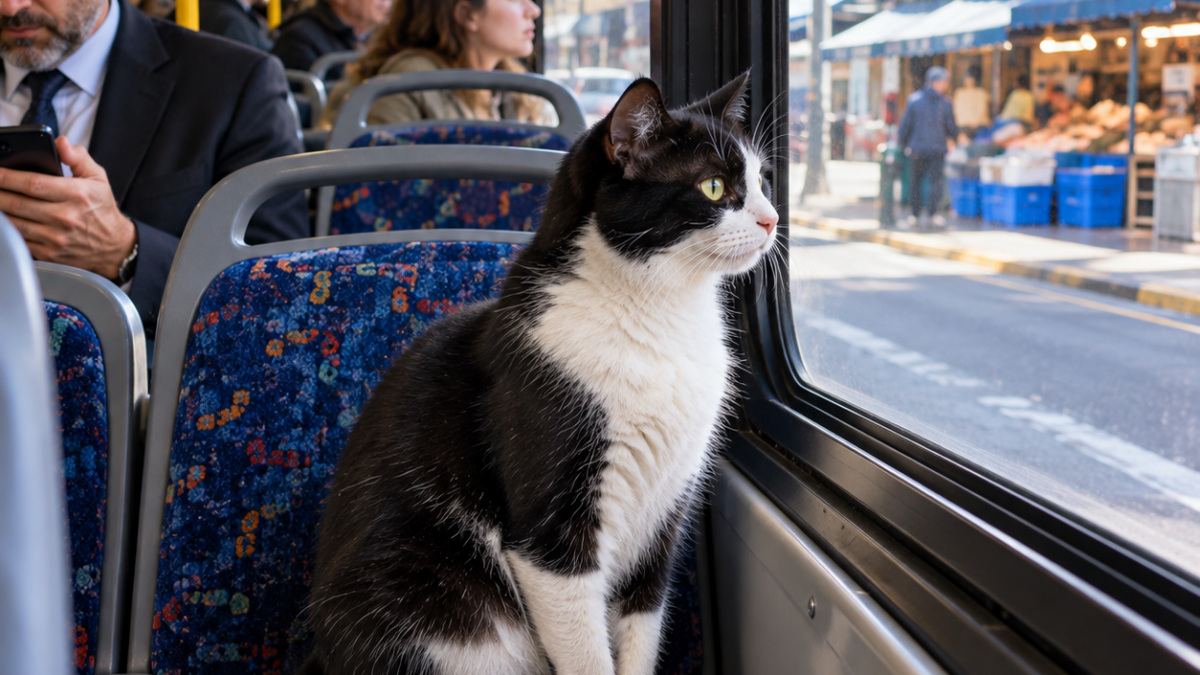
The photo showed Rider in the fourth-row window seat, paws on the cushion, looking out at traffic while Malcolm in the gray suit sat across the aisle, scrolling on his phone, utterly indifferent.
It was perfect because nothing about it looked staged.
No one was reacting.
No one was posing.
No one was pointing.
A cat was commuting.
A man was checking email.
The bus was being a bus.
That ordinary quality made the photo travel farther than anyone expected.
People began commenting.
“She knows the economy better than me.”
“Public transit should be for everyone.”
“Does she have a monthly pass?”
“Fourth row, window seat, do not disturb.”
“Someone get this girl a tiny briefcase.”
Luis’s daughter sent him the post with fourteen laughing emojis.
DAD IS THIS YOUR BUS???
Luis replied:
Unfortunately yes.
Then:
Do not tell your mother.
His wife already knew.
She had known since day three because Luis came home talking about “that stubborn cat” with the same tone he had used years earlier when saying he definitely did not want to keep the stray dog their daughters found behind a laundromat.
That dog slept on his side of the bed for twelve years.
After the photo spread, transit management noticed.
That was when paperwork entered the story.
Luis was called into the supervisor’s office.
His supervisor, Marlene Watts, had worked for the city transit authority for twenty-four years and possessed the weary calm of a person who had solved every possible passenger dispute except, apparently, a fare-evading stray cat with a seafood routine.
She held up the printed photo.
“Luis.”
He sat down.
“Yes.”
“Is this on your route?”
“Yes.”
“Is that the cat?”
“Yes.”
“The cat that rides six stops to the fish market?”
“Yes.”
“How long has this been happening?”
“Depends how you define happening.”
“Luis.”
“Three months.”
Marlene stared at him.
“You have allowed an unaccompanied cat to ride your bus for three months?”
“I tried to remove her.”
“For three months?”
“For two weeks.”
“And then?”
“She won.”
Marlene closed her eyes.
Luis added, “She’s very disciplined.”
“That is not a transit category.”
“She sits quietly.”
“Also not a transit category.”
“She knows her stop.”
Marlene rubbed her forehead.
“Luis, there are policies.”
“I figured.”
“Animals must be contained unless they are service animals.”
“She provides morale.”
“That is also not a transit category.”
“She improves ridership satisfaction.”
Marlene looked at him.
He stopped.
“Sorry.”
Marlene sighed.
“I’m riding tomorrow.”
And she did.
At 6:42 the next morning, Supervisor Marlene Watts boarded Route 12 with a clipboard, a transit badge, and the expression of a woman prepared to restore order to an absurd situation.
Luis said nothing.
Regular passengers noticed immediately.
Carla whispered, “Is she here about Rider?”
Malcolm whispered back, “Act normal.”
Denise in scrubs muttered, “We are adults surveilling a cat commute.”
At 6:48, Luis pulled to the Briar Court stop.
Rider was there.
Same bench.
Same upright posture.
Same black patch over one eye.
Marlene leaned forward.
The doors opened.
Rider entered.
She did not hurry.
Did not hesitate.
Did not beg.
She walked past the fare box, down the aisle, to the fourth row.
Carla lifted her bag from the window seat.
Rider jumped up, turned once, and sat.
Marlene watched the entire thing.
The bus pulled away.
Stop one.
Rider watched traffic.
Stop two.
Malcolm boarded.
He saw Marlene, adjusted his tie, and said quietly, “Good morning, Rider.”
Marlene wrote something on her clipboard.
Stop three.
Denise nearly fell asleep, woke up, saw Rider, and smiled.
Stop four.
Rider stood.
Stop five.
She stretched once.
Stop six.
She walked to the front door and waited.
Luis opened the doors.
Rider stepped down and headed toward the fish market alley.
Armand stood outside with a small metal bowl.
“Morning, Seven-Fifteen,” he called.
Rider trotted toward him.
Marlene watched through the windshield.
The bus remained quiet.
Finally, Luis said, “So.”
Marlene looked at the empty doorway.
Then at the passengers, who were all pretending not to wait for her verdict.
Then at the clipboard.
Then back toward the fish market.
“I am not writing a policy for this,” she said.
The bus erupted.
Not loudly.
Bus laughter is contained laughter. People have places to be. But everyone smiled, and Malcolm actually clapped twice before remembering he was an insurance analyst with a reputation to maintain.
Marlene pointed at Luis.
“If she causes a disturbance, call dispatch.”
“She won’t.”
“If someone complains, call dispatch.”
“They won’t.”
“If she brings friends, absolutely call dispatch.”
Luis nodded solemnly.
“Understood.”
That should have been the end of it.
Of course, it wasn’t.
Once people knew Rider was officially unofficial, the story grew.
A local reporter came.
Then a morning radio host.
Then someone made a cartoon of her holding a tiny bus pass.
Children drew pictures.
A coffee shop near the third stop named a muffin after her: The Rider, black-and-white chocolate swirl.
A transit employee put a small sign in the break room that said:
ROUTE 12: NOW WITH CAT
Marlene removed it.
Then quietly put it back.
But Rider herself did not change.
That was the part people loved most.
She did not know she was famous.
She did not care.
No matter how many phones lifted when she boarded, no matter how many people whispered, no matter how many passengers hoped she would sit near them, Rider kept her schedule.
Same stop.
Same seat.
Six stops.
Fish market.
Breakfast.
The city found wonder in her because she had no interest in being wonderful.
She simply understood something useful.
A large vehicle stopped at the same place every morning.
Its doors opened.
It moved through the city.
It stopped near fish.
So she used it.
People called it intelligence.
Instinct.
Routine.
Accident.
Maybe all of those.
Maybe none.
What mattered was that she had learned.
A stray, untrained, ownerless cat had studied the city better than many people who lived in it. She knew timing. Direction. Landmarks. Doors. People. Patterns. She knew which bus to board, where to sit, when to stand, where to exit, and who behind the fish market would feed her.
No one had taught her.
No one had rewarded her with treats during training.
No one had clipped a leash to her collar and guided her through the process.
She figured out the system because hunger makes creatures observant, and survival is the oldest teacher in the world.
But survival did not explain the fourth-row window seat.
That was personality.
Rider liked looking out.
Every morning, while the bus rolled through the waking city, she sat beside the glass and watched.
Apartment balconies.
Streetlights switching off.
A man unlocking the bakery.
A child with a backpack running late.
Delivery trucks.
Pigeons.
Steam rising from vents.
Bikes chained to poles.
Trash bags.
Flower buckets outside the market.
Reflections of passengers in the window.
The city, moving.
Maybe Rider understood none of it the way humans did.
Maybe she understood more.
Carla once said, “She looks like she’s thinking.”
Denise replied, “She looks like she’s judging.”
Malcolm said, “Both can be true.”
As weeks passed, people began measuring their mornings by Rider.
If she was at the bench, the bus was on time.
If she was already on the fourth-row seat, the day felt normal.
If she was not there, everyone noticed.
The first morning she missed, the bus grew tense.
Luis slowed at Briar Court.
Empty bench.
He opened the doors anyway.
No Rider.
Carla looked out the window.
“Maybe she’s late.”
Luis waited ten seconds longer than usual.
Transit schedules do not officially allow waiting for cats.
Luis waited anyway.
Nothing.
He closed the doors and drove.
At stop two, Malcolm boarded and looked toward the fourth row.
“Where is she?”
Luis said, “Didn’t show.”
No one liked that.
At the fish market, Armand came outside before the bus even stopped.
Luis opened the doors.
“She didn’t board.”
Armand’s face changed.
“What do you mean?”
“She wasn’t at the stop.”
Armand looked toward the alley, then down the block.
“She’s never late.”
The sentence sounded ridiculous until everyone realized it was true.
That day, Armand searched behind the market.
Carla posted in the neighborhood group.
Luis checked the Briar Court stop on his return route.
Marlene called animal control, pretending it was a “routine welfare inquiry.”
By late afternoon, a teenager from the apartment complex near Briar Court posted that she had seen a black-and-white cat sleeping under a parked car.
Rider returned the next morning.
She walked to the bench at 6:47.
Luis opened the doors at 6:48.
The entire front half of the bus exhaled.
“You scared us,” Carla said.
Rider walked past her and jumped onto the fourth-row window seat.
Malcolm boarded two stops later.
“Good morning, Rider,” he said, with more feeling than usual.
Rider ignored him.
At the fish market, Armand gave her extra fish skin and called her “ungrateful little commuter” while wiping his eyes with the back of his wrist.
After that, people began discussing whether she needed a home.
This was not as simple as outsiders thought.
Rider was friendly enough to tolerate humans but not friendly enough to belong easily to them. She avoided hands. She did not like being picked up. She seemed healthy, alert, and capable. She had her territory near Briar Court, her route, her breakfast, her rhythm.
But she had no shelter anyone knew of.
No medical care.
No protection from winter.
No guarantee that every driver, every passenger, every day would be kind.
The debate grew quietly among the regulars.
Carla wanted to adopt her.
Her husband was allergic.
Denise said the hospital had a therapy cat program, then admitted Rider would likely terrorize the administrator.
Malcolm said he lived in a high-rise and worked ten-hour days, which felt unfair to a cat accustomed to commuting.
Armand offered the market.
“She can live here,” he said.
Luis looked at the alley full of delivery trucks, wet pavement, fish crates, and sharp back doors.
“She already comes here for breakfast. Doesn’t mean she should sleep here.”
Armand grumbled because he knew Luis was right.
Finally, Marlene contacted Second Chance Paws, a local rescue group, and asked for advice.
Not removal.
Advice.
A volunteer named Tessa came one morning to observe.
She boarded Route 12 at Briar Court, sitting two rows behind Rider with a carrier discreetly folded at her feet. She watched the cat’s behavior closely.
Confident boarding.
Predictable seat.
No distress during motion.
Alert at correct stop.
Avoidant but not fearful.
Food-motivated at destination.
Established routine.
At the fish market, Tessa followed at a distance and watched Rider eat from Armand’s bowl.
“Could be socialized,” Tessa said.
Armand crossed his arms.
“She is socialized. She takes the bus better than most people.”
“I mean to a home.”
Luis asked, “Should we trap her?”
Tessa looked at Rider, who was washing one paw after breakfast.
“Not unless there’s a plan. A bad rescue can still be a disruption. She’s surviving well, but winter changes things. She needs a vet check, spay if she isn’t, vaccines, and some kind of safe shelter. If someone patient can foster her near her territory, that might work.”
“Near Briar Court?” Carla asked.
Everyone looked at her.
Carla lifted both hands.
“My husband is allergic. But my sister lives in Briar Court. She has a screened patio.”
That was how Rider almost became an indoor cat.
Almost.
Carla’s sister, June, agreed to foster.
Tessa trapped Rider humanely near the Briar Court stop one Friday after breakfast, when she returned to the apartment complex. Rider was not pleased. She shouted in the carrier with the outrage of a commuter kidnapped between errands.
At the vet, they learned she was about three years old.
Female.
Already spayed.
No microchip.
No major health issues.
Old scar on one ear.
Slightly underweight but stable.
Flea-treated.
Vaccinated.
Declared, by the vet, “a very opinionated little lady.”
June took her in.
For three days, Rider lived on the screened patio, then inside a spare room. She ate. Used the litter box. Slept on a folded blanket near the window. Allowed June to sit nearby. Did not allow touching.
On Monday morning at 6:42, Rider escaped.
Not dramatically.
Professionally.
June opened the patio door a fraction too long while carrying coffee.
Rider slipped past her, crossed the parking lot, and trotted toward the bus stop.
Luis pulled up at 6:48.
There she was.
Same bench.
Same posture.
He opened the doors.
Rider boarded.
“Of course,” Luis said.
The passengers cheered.
Carla called her sister immediately.
“She’s on the bus.”
June, breathless from searching, said, “What do you mean she’s on the bus?”
“I mean she has a schedule.”
Rider completed her route, ate breakfast at the fish market, and later allowed herself to be re-collected near Briar Court with far less drama than expected.
Tessa updated the plan.
“She may not want full indoor life yet,” she said. “But we can support her.”
So they did.
June installed a heated outdoor shelter on her patio, with a small cat door that allowed Rider to come and go. Tessa arranged follow-up care. Carla bought a breakaway collar with a small tag.
RIDER
I AM CARED FOR
PLEASE DO NOT REMOVE
ROUTE 12 REGULAR
Marlene objected to the last line.
Then approved it emotionally, if not officially.
Rider accepted the shelter.
Accepted food near Briar Court.
Accepted the collar after three failed attempts and one minor human injury.
But she did not give up the bus.
Every weekday morning, she still went to the stop.
She still boarded at 6:48.
She still sat fourth row, window seat.
She still rode six stops.
She still got off at the fish market.
The difference was that now, after breakfast, she often returned to Briar Court by foot, following alleys and side streets over the next hour, ending up at June’s patio for a long nap in her heated shelter.
The city adapted around her.
That is what cities do at their best.
Not by writing grand rules.
By making room for a small, strange, harmless thing that somehow makes everyone gentler.
Luis kept driving.
Carla kept saving the seat.
Malcolm kept saying good morning.
Denise kept pretending she did not care.
Armand kept feeding Seven-Fifteen.
Marlene kept insisting there was no official policy.
And Rider kept riding.
Months passed.
The story faded from the internet, as stories do.
New things replaced her.
Angry things.
Funny things.
Terrible things.
People online moved on.
But Route 12 did not.
On that bus, Rider was not viral.
She was local.
She was Tuesday.
She was part of the morning.
She was the small black-and-white passenger who reminded people to look up from their phones at least once before work.
One rainy morning in November, Luis pulled up to Briar Court and saw three children waiting with their mother. They were new riders, bundled in yellow raincoats, carrying backpacks almost as big as their bodies.
Rider sat at the far end of the bench.
The smallest child stared.
“Mom,” he whispered loudly, “there’s a cat.”
“I see.”
“Is it waiting for the bus?”
The mother smiled uncertainly.
Luis opened the doors.
Rider boarded first.
The children’s eyes went wide as she passed the fare box, walked down the aisle, and jumped into the fourth-row window seat.
The smallest child turned to Luis.
“Does she have to pay?”
Luis considered.
Then said, “She pays by making everyone happy.”
The child nodded seriously.
“That’s good money.”
Luis laughed all the way to the next stop.
Winter came.
Not brutal, but cold enough that everyone worried.
June’s shelter kept Rider warm at night.
Armand warmed her fish scraps slightly, though he denied doing anything so sentimental.
Carla knitted a small blanket for the fourth-row seat.
Marlene said, “Absolutely not.”
The blanket appeared anyway.
No one knew who placed it there.
It was dark blue and folded neatly in the corner of Rider’s seat.
Rider used it once, on a particularly cold morning, tucking her paws beneath herself and watching fog gather on the window.
Malcolm took a photo.
Not to post.
Just to keep.
“It’s nice,” he told Luis, “having proof that the world can be absurd in a kind way.”
Luis nodded.
The city needed that.
Most people did.
Because mornings are hard.
Work is hard.
Loneliness is hard.
Bills.
Appointments.
Bad news.
Traffic.
Exhaustion.
People boarded Route 12 carrying invisible weights.
Then they saw Rider.
A cat who had no idea she was extraordinary.
A cat who simply knew the bus led to fish.
And somehow, for six stops, the day became lighter.
One morning, an elderly man boarded at stop three with a cane and no patience for nonsense. He saw Rider in the fourth-row seat and frowned.
“Why is there a cat on the bus?”
Before Luis could answer, Denise said from the back, “She commutes.”
“To where?”
“Breakfast.”
The man stared.
Rider stared back.
Finally, he grunted and sat down.
The next morning, he brought a small packet of salmon from home.
Luis said, “No feeding on the bus.”
The man grumbled, “Rules everywhere.”
Rider looked out the window.
She had standards.
By spring, Rider’s collar had been replaced twice, her photo hung quietly in the transit break room, and a tiny illustration of a black-and-white cat had appeared on the whiteboard beside Route 12 scheduling notes.
Marlene pretended not to know who drew it.
Everyone knew it was her.
On the anniversary of Rider’s first ride, Luis stopped at Briar Court at 6:48 and found the bench empty.
His heart dropped.
Then he saw her.
Rider was under the bench, sheltering from rain.
He opened the doors.
She emerged, shook one paw with disgust, and boarded.
Carla had placed a small paper crown on the window seat.
Rider ignored it.
Malcolm said, “Happy commute anniversary.”
Denise said, “That’s not a real thing.”
Luis said, “It is now.”
At the fish market, Armand had prepared a small plate of chopped fish.
No candle.
He said candles near fish were stupid.
But he did place the plate on an overturned crate and say, “For one year of punctual service.”
Rider ate without ceremony.
Which was exactly right.
A reporter later asked Luis why the story mattered to people.
He thought about giving a funny answer.
Because cats improve public transportation.
Because fish is a strong motivator.
Because no one wants to be the villain who kicks a cat off a bus.
But then he thought about the passengers.
Carla saving the seat.
Malcolm saying good morning.
Denise smiling after night shifts.
Marlene riding the route and choosing mercy over policy.
Armand learning that his 7:15 visitor arrived by bus.
June building a shelter.
The children in yellow raincoats.
The old man with contraband salmon.
All the small ways people had become better because one stray cat had trusted the bus doors to open.
So Luis answered honestly.
“Most of the time, the city teaches people to ignore each other. Keep moving. Don’t look. Don’t ask. Don’t get involved unless it’s your problem.”
He looked toward the fourth-row window seat, where Rider was sitting, bored by human reflection.
“But this little cat got on the bus and everybody noticed. Then everybody made room. Maybe people liked remembering they could still do that.”
The reporter asked, “Make room?”
Luis nodded.
“For something small. Something harmless. Something that didn’t belong by the rules, but belonged anyway.”
Rider yawned.
That evening, the quote spread.
But Rider did not know that either.
She spent the night in June’s heated shelter, washed one paw, ignored the expensive toy Carla bought her, and slept with her nose tucked under her tail.
The next morning, she woke before sunrise.
Stretched.
Ate a little from the bowl near the patio.
Walked through the cat door.
Crossed the apartment courtyard.
Slipped under the hedge near the sidewalk.
Reached the Briar Court bus stop at 6:45.
She jumped onto the bench.
The city was just beginning to move.
A delivery truck rattled past.
A jogger glanced over and smiled.
A woman carrying coffee checked her watch.
The sky lightened behind the apartment roofs.
At 6:48, Route 12 turned the corner.
Luis saw her and shook his head like he always did.
The bus sighed to a stop.
The doors opened.
Rider stepped aboard.
Fourth row.
Window seat.
Six stops.
Breakfast.
She did not know people called her clever.
She did not know strangers had shared her photo.
She did not know a supervisor had decided not to write a policy because some things are better handled with a little common sense and a little kindness.
She did not know she had become the best part of several people’s mornings.
She knew only what mattered.
The bus came.
The seat waited.
The city moved.
And somewhere six stops away, behind a fish market that opened early, there would be breakfast.
So she rode.