A Shelter Took the Senior Cats Nobody Wanted on a Field Trip to the Aquarium—Then the Photos Started Spreading and Everything Changed.
PART3:
He called an emergency board meeting on a Thursday evening. Rain hammered the roof over the conference room so hard we had to raise our voices. The fluorescent lights flickered above us. I sat at the end of the table with wet hair, a folder of medical records, and a bad feeling crawling up my spine.
Grant sat at the other end like a judge.
“We have to be realistic,” he said.
That was how cruel people often began.
Realistic.
Practical.
Responsible.
Difficult choices.
He slid a packet across the table. I did not touch it right away.
“What is this?” I asked.
“A sustainability proposal.”
My assistant manager, Tessa, who had worked at the shelter since she was nineteen and cried every time a bonded pair got adopted together, leaned forward. “Why does it list Room Three as a closure area?”
Grant smiled gently at her, the way adults smile at children they have decided are naive.
“Because Room Three is the problem.”
The words fell into the room.
I looked down at the packet.
Charts. Numbers. Columns. Intake dates. Medical costs. Adoption probability. Average length of stay.
Our fourteen senior cats had been reduced to red marks and negative percentages.
At the bottom of page six, under Recommended Action, I saw the phrase “humane outcome review.”
My stomach turned cold.
“No,” I said.
Grant steepled his fingers. “Lila.”
“No.”
“We cannot operate on feelings.”
“They are not feelings. They are living animals.”
“And we have a duty to the shelter as a whole.”
“Don’t dress this up.”
His eyes hardened for half a second. It was quick, but I saw it. The mask slipped, and behind it was annoyance. Not guilt. Not conflict. Annoyance.
Board members shifted in their chairs. Some looked at me with sympathy. Others looked at their packets. Nobody wanted to be the first to say the ugly thing out loud.
So Grant said it.
“We are not discussing mass euthanasia,” he said, voice calm. “We are discussing quality of life, resource allocation, and making space for animals with a realistic chance.”
Tessa made a sound like someone had pressed a hand to her throat.
I opened my folder and spread photographs across the table. Clementine asleep on a volunteer’s lap. Duke rubbing his cheek against a brush. Mabel sitting in a child’s stroller during our summer reading program. Gus wearing a tiny knitted sweater after his surgery.
“Look at them,” I said.
Grant did not.
“Lila,” he said, “you’re too emotionally attached.”
“Yes,” I said. “That is literally why I’m qualified to do this job.”
A few people looked away to hide smiles.
Grant’s face flushed.
He adjourned the meeting without a vote, but not before announcing that the proposal would be reconsidered after the weekend fundraiser. He wanted “fresh adoption numbers” by Monday.
That meant we had four days.
Four days to find homes for cats people had ignored for months.
Four days to prove they were worth keeping alive.
Four days before Grant Holloway put on his compassionate voice and convinced frightened board members that killing them was kindness.
That night, I slept on the shelter office couch.
Not intentionally. I meant to finish paperwork, make calls, and go home. But sometime after midnight, I found myself sitting on the floor of Room Three with Mabel in my lap and Baxter pressed against my hip. Rain tapped the windows. The cats moved around me in soft little patterns.
Duke snored.
Juniper knocked a toy mouse under the cabinet and yelled at it.
Clementine climbed onto the donation box, stared at me, and chirped.
“I’m trying,” I told them.
My voice broke on the second word.
Mabel placed one paw against my chest.
That was when Tessa appeared in the doorway in sweatpants and a hoodie, holding two gas station coffees.
“I knew you’d still be here,” she said.
I wiped my face. “I’m fine.”
“You look like a woman one coffee away from committing a felony.”
“That also might be fine.”
She sat beside me and handed me a cup. For a while, we said nothing.
Tessa was twenty-seven, with wild curls, a sleeve of flower tattoos, and the stubborn optimism of someone who had seen too much suffering and chosen kindness anyway. She had started as a volunteer after her father died, then never really left. Animals trusted her instantly. People did too, which was both gift and burden.
“He can’t do this,” she said finally.
“He can, if the board lets him.”
“We need something big.”
“I know.”
“No, I mean big big. Not another sad post. Not another ‘please adopt seniors’ graphic with paw prints around it. People scroll past sadness when they don’t know what to do with it.”
I looked at her.
She was staring through the glass at Pearl, who was sitting upright in her bed, watching nothing and everything with her deaf-cat intensity.
“People don’t know them,” Tessa said. “They just know the story they think senior cats tell.”
“Old,” I said.
“Sick. Sad. Expensive. Temporary.”
“Don’t forget doomed.”
“Exactly.” Tessa turned to me. “So we give them a different story.”
“Tessa, I have called every foster, every rescue partner, every adopter over fifty miles—”
“No.” Her eyes sharpened. “Not a plea. An adventure.”
I waited.
She took a breath, almost embarrassed. “The aquarium.”
I blinked.
She rushed on. “Before you say no, just listen. My cousin works at Cedar Bay Aquarium. They’re closed Monday mornings for maintenance. They do therapy visits sometimes, educational stuff. We take a few of the seniors in carriers or strollers. Safe, controlled, no contact with marine animals, obviously. We photograph them watching fish, otters, dolphins, whatever. Not sad kennel photos. Not begging. Just them being curious and alive.”
I stared at her.
Outside, thunder rolled low over the bay.
“It’s ridiculous,” I said.
“Maybe.”
“It’s a liability nightmare.”
“Probably.”
“Grant would call it a circus.”
“He already thinks we’re clowns.”
I looked through the glass.
Clementine had climbed out of the box and was now batting gently at a paper tag hanging from the shelf. Mabel was still in my lap. Baxter had rolled onto his back, one white paw in the air like he was voting for something.
An adventure.
A different story.
I imagined Clementine’s face lit blue by aquarium glass. Pearl watching silver fish flash past. Gus seeing something bigger than the four walls he had come to know too well.
My chest tightened.
Not because I thought it would work.
Because I realized how badly they deserved it even if it did not.
The next morning, Tessa called her cousin.
By noon, we had a maybe.
By four, we had a yes.
The aquarium director, Jonah Reed, wanted to speak with me directly. His voice over the phone was warm but careful.
“I understand the emotional goal,” he said. “But I have to protect our animals, your animals, and our staff.”
“Absolutely.”
“No free roaming.”
“Of course.”
“No stress exposure.”
“We’ll choose cats who tolerate carriers and new environments.”
“No public visitors.”
“Closed hours only.”
“No flash photography near tanks.”
“Agreed.”
He paused. “And this is really for senior cats?”
“Yes.”
Another pause.
“My mother adopted a thirteen-year-old cat after my father died,” he said quietly. “That cat got her out of bed every morning for three years.”
I closed my eyes.
“Then let’s give yours a good morning,” he said.
We scheduled it for Monday at 8 a.m.
That gave us the weekend.
Saturday’s fundraiser was supposed to be our big adoption push. Grant had arranged it at the community center and named it “Fresh Starts Fest,” which sounded hopeful until we saw the promotional materials.
Every poster showed kittens.
Not one senior cat.
Not one adult dog.
Not even our shelter logo without Grant’s name beneath it.
The community center smelled like popcorn, coffee, and floor wax. Volunteers set up tables with raffle baskets and handmade dog bandanas. Children carried balloons. A local radio host plugged in speakers near the stage. On the surface, it looked like a cheerful charity event.
Underneath, I felt the blade.
Grant arrived with a camera crew from a regional lifestyle show. He wore a pale blue blazer and carried a kitten he had not asked permission to pick up.
“Lila,” he called, smiling too broadly. “There she is. Our fearless shelter girl.”
Shelter girl.
I was forty-one years old.
I had a master’s degree in nonprofit management, twelve years of animal welfare experience, and bite scars on both hands from choosing not to let go of terrified animals when they needed me.
Shelter girl.
“Grant,” I said.
His eyes moved to the cat stroller beside me. Clementine sat inside wearing a small purple harness, looking unimpressed by democracy, charity, and men in blazers.
His smile thinned.
“What’s that?”
“Clementine.”
“I know the cat. Why is she here?”
“To meet people.”
“This event is meant to move adoptable animals.”
“She is adoptable.”
“Lila.”
A cameraman drifted closer.
Grant lowered his voice, but not enough. Men like him rarely understood how far cruelty traveled in a crowded room.
“This is exactly what I’m talking about,” he said. “You’re leading with emotional liabilities.”
Tessa, standing behind me with Pearl’s stroller, went still.
I felt heat climb my neck. “These cats are part of our shelter.”
“They are draining resources from animals people actually want.”
The cameraman adjusted his focus.
Grant noticed and changed his face instantly.
He laughed, placing a hand on my shoulder like we were sharing a joke. “Of course, every animal deserves compassion. But we also have to make hard choices. Not everyone understands that leadership means thinking beyond one room full of endings.”
There it was.
Room full of endings.
He said it smoothly, almost sadly, as if the phrase had come from a place of wisdom.
But Clementine chose that exact moment to stand in her stroller, put both paws on the edge, and let out one of her rusty chirps.
A little girl nearby turned.
“Mommy, that cat talked.”
Her mother smiled despite herself. “She did.”
The girl approached slowly. “Can I pet her?”
I knelt. “Clementine likes gentle hands.”
Grant’s smile flickered.
The girl stroked Clementine’s head with two careful fingers. Clementine leaned into her touch like she had been waiting all morning for someone small and kind.
“She’s soft,” the girl whispered.
“She’s ten,” Grant said lightly. “A very senior lady.”
The girl looked up at him. “My grandma is old and I still love her.”
A few people laughed.
Not cruelly. Honestly.
Grant’s jaw tightened.
The mother filled out an interest card for Clementine but admitted their apartment had a strict pet deposit they could not afford until the following month. I told her we could talk options. Grant overheard and later pulled me aside near the storage hallway.
“No waived fees,” he said.
“We waive fees all the time for the right home.”
“Not for that cat.”
“Why?”
“Because adoption revenue matters.”
“Her fee is seventy-five dollars.”
“It’s the principle.”
“The principle is that she needs a home.”
“The principle,” he said, stepping closer, “is that you are not in charge of this organization’s future.”
For the first time all day, his smile disappeared completely.
“You think you’re the heart of this place,” he said. “But hearts are replaceable when they stop pumping money.”
I stared at him.
There are moments when anger is so clean it feels like ice.
“Are you threatening my job?” I asked.
“I’m explaining reality.”
“No,” I said. “You’re revealing yourself.”
His eyes narrowed.
Then someone opened the hallway door, and he transformed again. Bright smile. Soft laugh. Charity face.
By the end of the event, twelve kittens had applications.
Two puppies had deposits.
One young orange cat was adopted by a college student who said he wanted “a cat with vibes.”
Not one senior went home.
That night, Grant emailed the board.
Subject: Immediate Action Needed.
Tessa forwarded it to me with no message. She did not need to add one.
I read it at my kitchen table while my own cat, a nineteen-year-old gray named Walter, slept beside my laptop.
Grant had attached photos from the event. Kittens in arms. Children laughing. Himself at the podium.
Then the numbers.
High public interest in young animals.
No measurable adoption traction for senior cat population.
Ongoing costs unsustainable.
Recommended vote Monday evening.
Monday evening.
After the aquarium.
I sat in the dark a long time.
Walter woke, stretched one stiff leg at a time, and climbed into my lap with the determination of an old cat who had never once questioned his right to be loved.
I buried my face in his fur.
“I know,” I whispered. “I know.”
At 6:15 Monday morning, the shelter parking lot filled with cars.
Not adopter cars. Volunteer cars.
People came carrying carriers, blankets, harnesses, towels, treats, paperwork, backup towels, cleaning spray, and the nervous energy of a mission nobody wanted to admit might be a goodbye.
Dawn was just beginning to pale behind the buildings. The rain had cleared overnight, leaving the pavement shiny and the air washed clean. Tessa stood by the van with a clipboard, her curls tied up in a red scarf.
“We are calm,” she announced to twelve volunteers, two staff members, and fourteen cats who disagreed with the entire concept of transportation. “We are organized. We are not crying before 8 a.m.”
“I’m already crying,” said Martin, a retired postal worker who volunteered three mornings a week and pretended he did not have favorites, though everyone knew Duke was his favorite.
“Then cry quietly,” Tessa said.
We had chosen carefully. Every cat had been assessed for stress. We had soft carriers, covered strollers, calming blankets, and a quiet room at the aquarium ready if anyone needed a break. Our veterinarian, Dr. Albright, had come in early to check everyone.
Grant had not approved the trip.
I had not asked him.
The aquarium had permission forms. We had insurance. The shelter policies allowed off-site enrichment and promotional events with management approval.
I was management.
For at least a few more hours.
Clementine rode with me in the front passenger seat, secured in her carrier, watching the road with bright suspicion. Tessa drove the van behind us. The others followed.
Cedar Bay Aquarium sat at the edge of the harbor, all glass curves and blue banners snapping in the morning wind. I had visited once as a child on a school field trip. I remembered touching a stingray with two fingers and thinking it felt like wet velvet. I remembered my mother buying me a plastic dolphin keychain. I remembered standing in front of the big ocean tank, feeling small in the best way.
That morning, I arrived feeling small in the worst way.
Jonah Reed met us at the staff entrance. He was in his fifties, tall, with a trimmed gray beard and kind eyes that missed nothing. Beside him stood a young aquarist named Naomi, who looked at the caravan of cat carriers and pressed a hand to her heart.
“Oh,” she said. “Oh, they’re beautiful.”
I almost cried then.
Not because it was dramatic.
Because she said it so simply.
Beautiful.
No qualifiers.
No apology.
No old.
Just beautiful.
We unloaded slowly. The aquarium was closed to the public, lit in soft morning blue. Pumps hummed behind walls. Somewhere water splashed steadily. The air smelled faintly of salt and clean stone.
At first, the cats were cautious. That was expected. They peered from carriers, ears moving. Pearl sat upright like a queen arriving in a foreign country. Baxter pressed his nose to the mesh. Gus stayed tucked in his blanket until Martin whispered to him.
“It’s okay, buddy. We’re all out of our depth.”
The first stop was the kelp forest tank.
Green light rippled across the floor. Long strands of kelp swayed like underwater trees. Silver fish moved in sudden synchronized flashes.
Clementine saw them and froze.
Her ears lifted.
Her pupils widened.
Then she placed one paw against the carrier mesh.
I opened the top carefully and lifted her into my arms, her harness clipped securely. She did not struggle. She stared.
A fish glided past the glass.
Clementine chirped.
Naomi made a sound somewhere between a laugh and a sob.
Tessa lifted her camera.
Click.
That first photo would become the one everyone remembered.
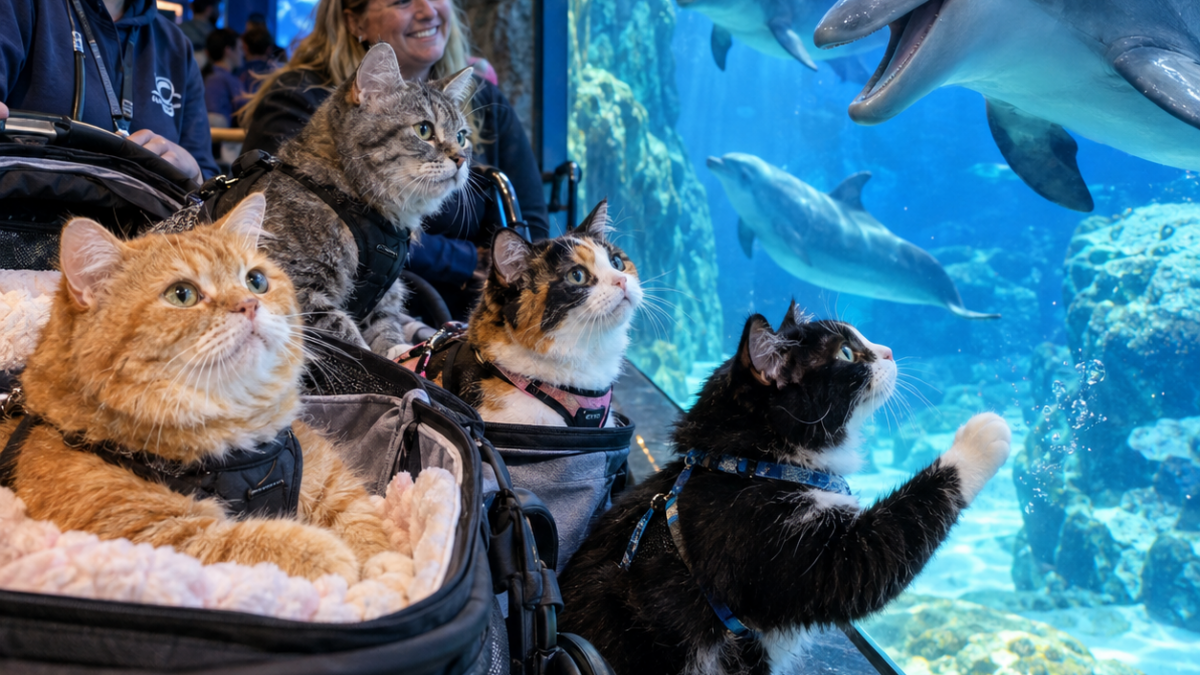
Clementine, orange fur glowing in blue-green aquarium light, one crooked ear forward, one paw reaching toward a silver fish on the other side of the glass. Her face was not sad. Not tired. Not tragic.
Wonder.
Pure wonder.
The kind people forget animals can feel when they have only seen them behind bars.
We moved slowly from exhibit to exhibit.
At the jellyfish gallery, Baxter sat in his stroller and watched translucent bells pulse through dark water. Their soft glow reflected in his black-and-white fur until he looked like he was floating among stars.
At the otter habitat, Juniper lost her entire mind.
She stood on all three good legs and one determined half-bend, tail lashing, while two otters swam directly up to the glass. One pressed its paws against the other side. Juniper pressed her paw back.
The otter tilted its head.
Juniper tilted hers.
Everyone in the room stopped breathing.
Click.
Click.
Click.
“Tell me that’s not a conversation,” Tessa whispered.
“That is absolutely a conversation,” Jonah said.
Pearl could not hear the splashing at the ray pool, but she could feel vibrations. She sat with her paws tucked under her chest, watching shadows move through the water, calm as a little white statue.
Duke fell asleep in front of the sea turtle tank.
Ruthie hissed at a moray eel, then seemed satisfied when it retreated into a rock crevice.
Simon drooled on Jonah’s shoe because Jonah made the mistake of rubbing his cheek exactly right.
And Mabel.
Mabel was quiet.
She had always been quiet, even by senior cat standards. Gentle, watchful, affectionate in a careful way. She liked laps but did not demand them. She liked being brushed but flinched if you moved too quickly near her left side. Her surrender form said she had been found in an empty apartment after an eviction. No owner listed. No records.
She had come in thin, dehydrated, and silent.
It took three weeks before she purred.
At the aquarium, she sat in a stroller lined with a yellow blanket, her small tabby face turned toward the massive dolphin viewing window.
The dolphins moved like thoughts through blue water.
One passed close.
Mabel stood.
Another dolphin circled back.
Mabel put both paws on the glass.
The dolphin slowed.
I know how that sounds. I know people make too much meaning out of animal moments because our hearts are hungry for signs. I know dolphins are curious. I know cats are predators. I know glass makes safe fascination possible.
But I also know what I saw.
That dolphin came back to her.
Again and again.
Mabel watched with such stillness that even Grant Holloway would have had to shut up.
Tessa lowered her camera for a moment.
“Lila,” she whispered.
“I see it.”
The dolphin turned sideways, one dark eye visible.
Mabel leaned forward until her nose nearly touched the glass.
For several seconds, the old cat and the dolphin simply looked at each other.
No adoption profile could have captured that.
No intake form.
No cost analysis.
No red mark on a spreadsheet.
Click.
After two hours, the cats were tired. Good tired. The kind that comes from seeing something new and surviving it. We settled them in the quiet education room with water, blankets, and portable litter boxes while Tessa and our volunteer photographer, Amy, reviewed images.
Amy was normally cheerful to the point of exhaustion, but now she sat at a plastic table with tears running down her face.
“I can’t edit these,” she said.
My heart dropped. “Why?”
“Because they’re already perfect.”
She turned the camera screen toward me.
Clementine reaching.
Juniper with the otter.
Baxter under jellyfish light.
Pearl watching rays.
Duke sleeping under a sea turtle.
Mabel and the dolphin.
My throat tightened until I could not speak.
Jonah stood behind us, arms crossed, expression unreadable.
Then he said, “Post them.”
I looked at him.
“Today,” he said. “Use the aquarium account too. We’ll share.”
I hesitated. “The board meeting is tonight.”
“Then post them before lunch.”
Tessa’s eyes met mine.
A different story.
We drove back to the shelter under a brightening sky. The cats slept almost the entire way. Clementine snored softly in her carrier, one paw tucked under her chin. Gus did not tremble. Pearl looked deeply satisfied, as if she had inspected the sea and found it acceptable.
At 11:42 a.m., we posted the album.
The caption was simple because anything else felt too small.
“Today, our senior cats visited Cedar Bay Aquarium. They have spent months waiting for homes, but this morning they reminded us they are not done discovering the world. They are curious, funny, brave, strange, loving, and full of life. They are not endings. They are stories still being written.”
Tessa added each cat’s name, age, personality, and adoption link.
Then we waited.
For twenty minutes, nothing unusual happened.
A few likes.
A volunteer shared it.
Jonah shared it from the aquarium page.
Naomi commented, “Juniper and the otter are best friends now and no one can convince me otherwise.”
I smiled for the first time all day.
Then my phone buzzed.
Once.
Then again.
Then again.
By 12:30, the Clementine photo had two thousand shares.
By 1:15, a local news anchor reposted Mabel and the dolphin with the words, “I was not emotionally prepared for this.”
By 2:00, our website crashed.
By 2:30, Tessa was standing in the lobby holding the phone away from her ear because three lines were ringing at once and she had forgotten which one she had answered.
By 3:00, people were driving to the shelter without appointments.
Not for kittens.
For Room Three.
“I saw the cat with the otter,” a man said breathlessly, holding his phone like it was proof of destiny. “Is she still here?”
“Juniper has special needs,” I warned automatically.
“So do I,” he said, lifting his pant leg slightly to show a prosthetic. “We’ll figure it out.”
A grandmother came for Baxter because the jellyfish photo reminded her of her late husband, who had loved planetariums.
A young nurse applied for Pearl because she worked nights and wanted a calm deaf cat who would not mind a quiet apartment.
A retired couple asked about Duke after seeing him asleep under the sea turtle. “He looks like us after church,” the husband said, and his wife elbowed him, laughing through tears.
The mother and little girl from the fundraiser returned for Clementine with a money order for the pet deposit. The girl had drawn a picture of Clementine at the aquarium and written, “Old cats still like surprises.”
I taped it to the lobby wall.
For three hours, the shelter felt like a miracle with bad parking.
Then Grant arrived.
He came through the front door at 4:17 p.m., face flushed, phone in hand, tie crooked. Behind him came Patricia Vale, another board member, and a man I recognized as his campaign consultant.
Grant had recently begun hinting at a run for city council. His slogan, according to a banner mistakenly delivered to the shelter one afternoon, was “Compassion. Accountability. Results.”
He looked around the lobby at the crowd.
His eyes landed on the drawing on the wall.
Then on the adoption applications stacked near my elbow.
Then on me.
“What did you do?” he asked.
The lobby quieted.
Not fully. There were still phones ringing, printers humming, cats meowing in the back. But the human part of the room shifted toward him.
I kept my voice even. “We took the senior cats on an approved enrichment visit to Cedar Bay Aquarium.”
“Approved by whom?”
“Me.”
His laugh was sharp. “You?”
“Yes.”
“You used shelter resources for a stunt?”
A woman holding a carrier looked up. “It was a beautiful post.”
Grant ignored her.
“You had no right,” he said.
I felt Tessa move closer behind me.
“I had every right under shelter policy,” I said. “And it generated more adoption interest for our senior cats in one afternoon than we’ve had in a year.”
“This is not interest,” he snapped. “This is hysteria.”
A man near the desk frowned. “I’m adopting a cat, not joining a cult.”
A few people laughed.
Grant’s face darkened.
“You think this is funny?” he said to the room. “Do any of you understand the costs associated with geriatric animals? Do you understand what happens when the novelty wears off? These animals come back. They always come back.”
The laughter died.
An older woman waiting to meet Mabel stood slowly. She wore a navy raincoat and held a cane with a carved wooden handle.
“My husband came back from Vietnam with nightmares,” she said. “My daughter came back from rehab twice. My son came back after his divorce. Things that come back are not always failures, Mr. Holloway. Sometimes they are just still trying to live.”
Silence.
Grant opened his mouth, but no sound came out.
I would have loved that woman forever even if I never saw her again.
Grant turned back to me, lowering his voice. “My office. Now.”
“No.”
His eyebrows lifted. He was not used to that word in public.
“No?”
“The board meeting is at six,” I said. “Until then, I’m processing adoption applications.”
“You are suspended pending review.”
Tessa gasped.
My hands went cold.
Grant raised his voice, making sure the room heard. “Effective immediately, Lila Parker is relieved of management duties due to unauthorized use of shelter resources and potential endangerment of animals during an unsanctioned off-site publicity stunt.”
The words hit like slaps.
Unauthorized.
Endangerment.
Stunt.
People stared.
Someone whispered.
My face burned, but I did not look down.
That mattered. I knew it mattered even as my chest tightened. Cruel people often count on public humiliation to make decent people shrink. They want your tears because tears look like weakness to anyone already inclined to believe them.
So I stood straight.
“The cats were supervised by staff, volunteers, a veterinarian-approved plan, and aquarium personnel,” I said. “Every safety protocol was followed. Documentation is available.”
“You can present your excuses to the board.”
“They’re not excuses.”
His smile returned, thin and mean. “Then call them your final report.”
He walked past me into the office that had been mine for five years.
The lobby remained frozen.
Then Clementine chirped from inside her stroller.
The little girl, her future little girl, whispered, “She’s mad too.”
People laughed softly, and just like that, the room breathed again.
I went outside before anyone could see my hands shaking.
Behind the shelter, near the dumpsters, there was a narrow strip of grass where volunteers sometimes cried. Every shelter had a place like that, even if nobody named it. Ours was between the recycling bins and the broken chain-link gate, beside a patch of stubborn weeds that flowered yellow every spring.
I stood there in the cold air and pressed my palms against my eyes.
Tessa followed.
“He can’t suspend you,” she said.
“He just did.”
“He’s not the whole board.”
“He thinks he is.”
“He’s scared.”
That made me lower my hands.
She was right.
Grant Holloway had not looked angry when he arrived.
He had looked scared.
Not of me. Not of the cats.
Of the attention.
My phone buzzed again. I almost ignored it, assuming it was another adoption inquiry, but the screen showed a number I did not recognize.
I answered because habit is stronger than despair.
“Harbor Hope, this is Lila.”
A woman’s voice said, “Is this the person who posted the aquarium cats?”
“Yes.”
“My name is Elaine Mercer. I’m an attorney. I represent the estate of Beatrice Whitcomb.”
The name landed somewhere in the back of my memory.
“I’m sorry,” I said. “Can you repeat that?”
“Beatrice Whitcomb. She passed last year. I believe one of the cats in your aquarium photos may have belonged to her.”
I leaned back against the brick wall.
“Which cat?”
“The tabby watching the dolphin.”
“Mabel?”
The woman inhaled.
“Her name was not Mabel,” she said quietly. “Her name was Marigold.”
I looked through the small back window into Room Three, where Mabel’s empty kennel door stood open because she was currently in the meet-and-greet room with the woman in the navy raincoat.
“Are you sure?” I asked.
“No,” Elaine said. “But Mrs. Whitcomb’s cat disappeared after her emergency hospitalization. The family claimed they could not find her. I have been looking for records because Mrs. Whitcomb’s will included a trust provision for the cat’s care.”
My body went very still.
“A trust provision?”
“Yes.”
“For the cat.”
“For Marigold, and after Marigold’s natural death, remaining funds were to be donated to Harbor Hope Animal Shelter.”
The world seemed to tilt.
I heard cars passing on the street. A dog barking in the kennels. Tessa saying my name, far away.
“How much?” I asked.
Elaine was quiet for a moment.
“After taxes and estate expenses,” she said, “approximately four hundred and eighty thousand dollars.”
I closed my eyes.
Four hundred and eighty thousand dollars.
Enough to repair the roof.
Enough to fund senior medical care for years.
Enough to make Grant’s sustainability proposal unnecessary.
Enough to make Room Three safe.
“Why didn’t we know?” I whispered.
“That,” Elaine said, “is why I’m calling.”
The board meeting began at six.
By then, the internet had done what the internet does when it finds something pure enough to defend and cruel enough to fight.
The aquarium photos were everywhere.
Local news picked them up first. Then regional pages. Then national animal accounts. By 5:30, “senior cats aquarium” was trending in places far beyond Cedar Bay. Our shelter inbox was unusable. Adoption inquiries came from three states. A famous actress commented with crying emojis. A marine biologist wrote a thread explaining dolphin curiosity and ended it with, “Also, adopt old cats.”
But virality is not justice.
Virality is lightning.
Justice is what you build after the flash.
Grant understood that better than anyone. By the time we entered the conference room, he had already prepared his version.
Board members sat around the table, tense and pale under fluorescent lights. Some had clearly seen the posts. Others avoided my eyes. Patricia Vale clutched her pearls as if the cats might leap through the walls and steal them.
Grant sat at the head of the table with a printed statement.
I was allowed to attend “for explanation,” not as manager. He made that clear.
Tessa came with me anyway. So did Dr. Albright. So did Jonah Reed from the aquarium, who walked in wearing a suit and carrying a folder thick enough to make Grant’s smile falter.
“This is a closed board session,” Grant said.
Jonah nodded. “Then close it after I speak.”
“This is highly irregular.”
“So is calling a safe, documented enrichment visit animal endangerment on local television.”
Grant’s eyes flicked to me.
“You went to the media?” he asked.
“I processed adoption applications,” I said.
“The media called us,” Tessa added. “Because your statement was insane.”
“Tessa,” I murmured.
“What? It was.”
Board member Samuel Ortiz, a retired principal and one of the few people on the board who actually visited the shelter without cameras, cleared his throat.
“Let’s proceed,” he said. “I think we all want clarity.”
Grant began with a performance.
He spoke of responsibility. Oversight. Governance. Risk exposure. He described the aquarium trip as “emotionally manipulative content creation” and said my judgment had been compromised by attachment to “unplaceable animals.”
He did not say “room full of endings” again.
He was too smart for that.
Then he presented his recommendation: immediate termination of my employment, suspension of Tessa, formal apology to donors, and a renewed vote on humane outcome reviews for long-stay senior cats.
Humane outcome reviews.
I stared at the table until the wood grain blurred.
Then Samuel turned to me.
“Lila.”
I stood.
My knees felt hollow, but my voice did not shake.
“The aquarium visit followed written off-site enrichment policy. Every cat was medically cleared. Every animal was contained, supervised, transported safely, and monitored throughout. Cedar Bay Aquarium approved the visit and provided staff support. We have documentation.”
I passed out copies.
“The result was not hysteria. It was measurable adoption interest. As of 5:45 p.m., we have received one hundred and seventy-three inquiries for fourteen senior cats. Seven have approved applications pending home checks. Three have backup applications. We also received thirty-two foster offers and over forty thousand dollars in online donations in six hours.”
Patricia Vale blinked. “Forty thousand?”
“Forty-two now,” Tessa said, checking her phone.
Grant leaned back. “Viral donations are not a business model.”
“No,” I said. “But neither is killing animals because your posters don’t work.”
His face hardened.
A couple of board members shifted.
Dr. Albright spoke next. She was small, blunt, and feared by every animal control officer in the county because she had no patience for bureaucratic cruelty.
“These cats are not suffering,” she said. “Some have age-related conditions. Arthritis. Dental disease. Mild kidney values. All manageable. I will not allow my medical recommendations to be misused as cover for convenience euthanasia.”
Grant smiled tightly. “No one suggested convenience euthanasia.”
“I’m a veterinarian,” she said. “I know what people call it when they don’t want to say it.”
Jonah presented the aquarium’s report. Calm. Detailed. Devastating.
No incidents. No stress behaviors beyond normal transport adjustment. No exposure risks. No policy violations.
Then he added, “Cedar Bay Aquarium would be proud to partner with Harbor Hope again under Ms. Parker’s leadership.”
Under Ms. Parker’s leadership.
Grant tapped his pen.
“Very touching,” he said. “But none of this changes the underlying financial reality.”
That was when my phone buzzed with an email from Elaine Mercer.
I had been waiting for it.
I printed nothing. There was no time. So I asked Samuel if I could read a statement into the record.
Grant sighed. “From whom?”
“An attorney representing the estate of Beatrice Whitcomb.”
His pen stopped moving.
It was small.
Almost nothing.
But I saw it.
I had seen enough frightened animals to recognize fear when it entered the body before the face could hide it.
“Why is that relevant?” he asked.
“I think you know.”
The room changed.
I opened the email.
“Mrs. Beatrice Whitcomb,” I read, “was a Cedar Bay resident and longtime supporter of Harbor Hope Animal Shelter. Prior to her death, she executed a will providing funds for the lifetime care of her cat, Marigold, and directing remaining funds to Harbor Hope Animal Shelter upon the cat’s natural passing. Estate counsel was informed by family representatives that Marigold could not be located following Mrs. Whitcomb’s hospitalization.”
Patricia frowned. “What does that have to do with us?”
I looked at Grant.
“The cat we know as Mabel may be Marigold.”
He laughed once.
Too quickly.
“That is absurd.”
“Maybe,” I said. “The attorney is coming tomorrow to scan for a microchip and compare veterinary records.”
Dr. Albright sat up. “Mabel has a microchip?”
“She came in with one,” I said. “But the registration led to a disconnected number and an old address. We filed the standard found-animal notice.”
Grant looked at the wall.
Not at me.
Not at anyone.
At the wall.
I continued, “Elaine Mercer also indicated she attempted to contact Harbor Hope twice last year regarding a missing senior tabby connected to the Whitcomb estate.”
Samuel’s eyes narrowed. “I don’t recall that.”
“Neither do I,” I said. “Those messages never reached staff.”
Grant stood. “This is becoming defamatory.”
Nobody moved.
He gathered his papers. “I will not sit here while a disgruntled employee implies—”
“Sit down, Grant,” Samuel said.
It was the voice of a former principal.
Grant sat.
Samuel turned to me. “Do you have proof those messages came to the shelter?”
“Not yet,” I said. “But Ms. Mercer said she has call logs and emails. She also said the family representative she spoke to after Mrs. Whitcomb’s death was a man named Grant Holloway.”
The silence was immediate and complete.
Patricia’s mouth opened.
Grant’s face lost color.
I felt Tessa’s hand grip the back of my chair.
Samuel looked slowly toward Grant.
“Is that true?”
Grant adjusted his cuff.
“It’s possible,” he said. “Our families move in the same circles. Beatrice was a donor to many causes.”
“That is not an answer.”
“I may have assisted informally with estate confusion.”
“Did you know her will named this shelter?”
“I don’t remember the specifics.”
“Did you know her cat was missing?”
Grant’s voice sharpened. “An elderly woman’s cat ran off during a medical emergency. That is unfortunate but hardly—”
“Mabel did not run off,” I said.
Everyone looked at me.
I had not meant to interrupt, but the words came out hard.
“She was found locked inside an apartment closet,” I said. “The landlord brought her in after an eviction cleanout. She was dehydrated, underweight, and terrified. Someone left her there.”
Grant’s eyes met mine.
For one second, the mask fell again.
And in that second, I knew.
Not legally.
Not provably.
But deeply.
He knew exactly who she was.
The board did not vote that night on euthanasia.
They did not vote to terminate me either.
Samuel moved to table all action pending investigation into the Whitcomb matter, shelter communications, and Grant’s conflict of interest disclosures. The motion passed 5-2.
Grant left without speaking to anyone.
But on his way out, he paused beside me.
“This is a mistake,” he said softly.
I looked at him. “I agree. You made a lot of them.”
His smile was gone.
“You have no idea how ugly this can get.”
I thought of Mabel in the dolphin light.
“I work in animal rescue,” I said. “I know ugly.”
The next seventy-two hours nearly broke us.
Not because of the cats.
Because of people.
Attention brought kindness first. Donations. Adoption applications. Volunteers dropping off blankets and food. Children bringing drawings. People sending messages about old cats they had loved and lost.
Then came anger.
Some of it righteous.
Some of it reckless.
People wanted a villain, and Grant had volunteered for the role with astonishing confidence. Clips of his lobby confrontation spread after someone posted phone footage. The phrase “room full of endings” became a hashtag. His campaign page filled with comments. His dealerships got one-star reviews from people who had never bought a car in Cedar Bay and possibly never would.
I did not encourage that.
I did not have to.
Grant issued a statement saying his words had been “taken out of context by individuals resistant to fiscal accountability.”
That made things worse.
Meanwhile, Elaine Mercer arrived with a leather briefcase, silver hair pinned at the nape of her neck, and the focused calm of a woman who had spent thirty years making liars regret paperwork.
Mabel sat on the exam table between us.
She looked smaller than ever.
Dr. Albright scanned her.
The microchip number appeared.
Elaine’s lips pressed together as she compared it to the record in her folder.
Then she covered her mouth.
“Marigold,” she whispered.
Mabel blinked.
The name did something.
Not dramatically. She did not leap up. She did not meow like a movie cat recognizing destiny.
But her ears shifted.
Her body softened.
Elaine said it again, voice trembling.
“Marigold.”
Mabel stepped forward and pressed her forehead against the attorney’s sleeve.
Elaine began to cry.
I had seen many kinds of grief in shelter work. The loud kind. The numb kind. The guilty kind. The kind that came disguised as anger because anger was easier to carry into public.
Elaine’s grief was quiet and old.
“She loved this cat,” she said. “Beatrice used to bring pictures to our appointments. She said Marigold was the only creature in the house who told her the truth.”
“What happened?” I asked.
Elaine looked down at the file.
“Beatrice fell in her kitchen. She was taken to the hospital. Her nephew handled the house initially.”
“Grant?”
“Yes. Not by blood. His mother and Beatrice were cousins. Close enough that he presented himself as family when convenient.” Her mouth tightened. “The will named a professional executor, but there were several days before my office received notice. By then, the cat was missing, valuables had been removed for ‘safekeeping,’ and Grant was insisting Mrs. Whitcomb had verbally promised certain donations would be redirected.”
“To him?”
“To a foundation he controlled.”
My stomach turned.
“Could he do that?”
“No. But he could create confusion. Delay. Pressure. Especially while everyone was grieving and Beatrice’s closest friends were elderly themselves.”
Elaine stroked Mabel’s head with two careful fingers.
“When I asked about Marigold, Grant said the cat had escaped through a loose screen. He appeared very concerned.”
“Appeared,” Dr. Albright repeated.
Elaine nodded. “I have learned to be suspicious of men who perform concern too smoothly.”
The investigation widened from there.
Samuel hired an independent accountant. The board temporarily suspended Grant’s authority. Patricia Vale resigned “for family reasons” after reporters asked why she had voted twice against reviewing conflict disclosures.
Tessa and I were interviewed for hours.
We turned over emails, invoices, intake logs, donation records, board minutes, phone records, and every scrap of paper we could find. Volunteers searched storage cabinets. Martin found three boxes of old files behind broken folding chairs in the supply room. Amy discovered that several donor acknowledgment letters had never been mailed. Dr. Albright produced medical records proving Grant had repeatedly questioned care for animals tied to restricted donations.
At first, I thought the Whitcomb trust would be the whole scandal.
It was not.
It was the door.
Behind it was a hallway full of rot.
Grant had been pressuring families of deceased donors to redirect pledged shelter gifts to his “community impact foundation,” which then sponsored events featuring his name. He had buried communications about restricted donations for senior animal care because they undermined his argument that old animals were financially unsustainable. He had pushed for flashy kitten adoption campaigns funded by grants originally intended for long-stay animals.
And the cruelest part, to me, was not the money.
It was the paperwork.
He had changed words.
Not alone, maybe. Not always directly. But through pressure, “recommendations,” and administrative access he should never have had, words had shifted in our system.
“Senior foster candidate” became “low placement probability.”
“Manageable arthritis” became “quality-of-life concern.”
“Long stay” became “resource burden.”
“Owner deceased” became “abandoned.”
Words matter.
Words decide whether people lean closer or turn away.
Words decide whether an animal becomes a story or a statistic.
Mabel’s intake had been altered three months after she arrived.
The original note from the landlord said: “Found in bedroom closet. Tenant deceased? Possible owner hospitalized. Cat wearing faded yellow collar with flower tag, no tag recovered.”
The version in our active system said: “Found abandoned in vacated unit. No owner info.”
Yellow collar.
Flower tag.
Marigold.
I stared at those records until the letters blurred.
Tessa sat beside me in the office, silent for once.
Finally she said, “He erased her.”
I shook my head.
“He tried.”
Mabel was adopted three days later by Elaine Mercer.
It was not the outcome I expected, but the moment Elaine asked, I knew it was right.
“She has money for sanctuary care,” Elaine said. “Beatrice made sure of that. But she needs a person. I live alone. I work too much. I’m stubborn. I believe we may suit each other.”
Mabel, sitting on the desk, placed both paws on Elaine’s closed file folder and refused to move.
That settled it.
The adoption ceremony was supposed to be private.
It did not stay that way.
By then, reporters had camped politely across the street. The aquarium photos had become a national story, not because they were cute, though they were, but because people had learned what almost happened after the cuteness.
Senior cats marked unadoptable.
Shelter director suspended.
Viral photos reveal missing trust cat.
Local donor under investigation.
It sounded unbelievable if you had not lived it.
If you had lived it, it sounded like Tuesday in nonprofit work.
Elaine signed the adoption papers with a fountain pen. When I handed her Mabel’s carrier, she looked at me over the top of her glasses.
“Beatrice used to say that dignity is what remains when power leaves the room,” she said. “I think she would have liked you.”
I had managed not to cry through television interviews, board meetings, and Grant Holloway threatening my career.
That broke me.
After Elaine left with Mabel, I went to Room Three.
It was emptier now.
Clementine had gone home with the little girl and her mother. They sent a photo that evening of Clementine sleeping on a pink pillow beneath the child’s drawing taped to the wall.
Juniper went home with the man with the prosthetic leg, whose name was Aaron. He posted a video of her sitting on his lap while he adjusted the straps, both of them looking equally unimpressed by pity.
Pearl went to the night-shift nurse and immediately claimed the bathroom sink.
Duke went with the retired couple, who bought him orthopedic beds for three rooms because, as the husband said, “A man needs options.”
Baxter went to the grandmother who missed her husband. She renamed him Galileo because of the jellyfish stars.
Ruthie went to a librarian.
Simon went to Jonah Reed.
That surprised us all except Simon, who had chosen Jonah at the aquarium by drooling on him with commitment.
Gus took longer.
He was shy, and attention frightened him. Viral fame did not change the fact that he needed patience. But two weeks after the aquarium trip, Martin came into my office holding an adoption application.
“I think,” he said gruffly, “my mail route has been missing a cat.”
I pretended to review the application carefully.
“Do you have experience with senior cats?”
He glared.
“Do you understand Gus may need time?”
He looked through the window at Gus, who was asleep inside a fleece tunnel Martin had donated.
“I’ve got time,” he said.
His voice cracked on the last word.
I approved him immediately.
For the first time in more than a year, Room Three was empty.
Not permanently. Shelters are never empty for long. Need always finds the door. But that day, the room sat quiet and sunlit, with clean blankets folded on shelves and no old cats waiting behind glass.
I stood in the doorway and felt something inside me loosen.
Tessa came up beside me.
“We did it,” she whispered.
I wanted to say yes.
Instead, I said, “They did it.”
Because they had.
Clementine had reached for a fish.
Juniper had argued with an otter.
Mabel had looked at a dolphin and pulled a buried truth into the light.
The board reinstated me unanimously two weeks later.
Grant had already resigned by then.
His resignation letter was exactly what you would expect: polished, wounded, self-pitying, and completely free of accountability. He cited “a hostile environment fueled by misinformation” and said he would continue serving Cedar Bay through other channels.
Those channels narrowed quickly.
The state attorney general opened an inquiry into charitable fund diversion. The IRS began reviewing his foundation. Families of donors came forward. Former employees from his dealerships contacted reporters. A pattern emerged, as patterns do when powerful people finally lose control of the room.
Grant had not only misused compassion.
He had monetized it.
He understood that people would give money to help vulnerable creatures, grieving widows, veterans, children, disaster victims, anyone whose pain could be photographed well. He built himself into the frame, then quietly redirected the light.
But here was the thing about light.
Once it moves, it reveals more than the photographer intended.
The final board hearing was held in the city council chamber because too many people wanted to attend. It was not a trial, not legally, but it felt like one. Reporters filled the back row. Volunteers sat shoulder to shoulder in shelter T-shirts. Adopters came holding framed photos of the cats the internet had come to love.
Clementine’s little girl sat in the front row with a plush orange cat in her lap.
Elaine Mercer sat beside her, Mabel’s yellow flower tag on a chain around her neck. The actual tag had been found in Grant’s mother’s storage unit inside a box of items removed from Beatrice Whitcomb’s house.
That was the detail that made people gasp when it came out.
Not the money.
The tag.
A tiny yellow enamel flower with the name Marigold scratched on the back.
Proof that someone had known exactly who that cat was and chose silence.
Grant did not attend.
His attorney did.
That told us enough.
The board voted to adopt sweeping reforms. Restricted donation oversight. Independent audits. Whistleblower protections. No board member could access or alter animal records without staff approval. Long-stay animals would receive dedicated promotion funds. Euthanasia decisions would require documented medical or severe behavioral necessity confirmed by veterinary staff, never financial convenience.
Then Samuel stood and announced the creation of the Beatrice Whitcomb Senior Pet Fund, seeded by the recovered trust money and hundreds of thousands in new donations from people moved by the aquarium story.
Its mission was simple.
Old animals would not be hidden.
Not at Harbor Hope.
Not again.
When he said that, the room stood.
Applause hit like rain on a roof.
I stayed seated for a moment, overwhelmed by the sound.
Tessa pulled me up.
“You’re allowed to stand for this,” she said.
“I know.”
“Then stand.”
So I did.
Not because I had won.
Because they had been seen.
Months later, when the scandal had moved from front pages to archives and the internet had found new things to love and hate, I visited the aquarium alone.
It was a Tuesday morning in early spring. The lobby smelled like popcorn and saltwater. Children clustered around touch tanks. Parents read signs aloud. A toddler screamed with joy at a stingray.
I stood in front of the dolphin viewing window, the same place Mabel had placed her paws against the glass.
For a while, nothing happened.
Then one dolphin passed.
Then another.
I thought about Beatrice Whitcomb, an old woman making sure her cat would be cared for after she was gone.
I thought about Mabel in a closet, waiting for a door to open.
I thought about Grant Holloway, who saw a living creature as an inconvenience standing between him and money.
I thought about Room Three.
All those faces behind glass.
Not endings.
Never endings.
Jonah found me there.
“I wondered if you’d come back,” he said.
“I needed to see it without holding a cat.”
“Not as fun.”
“No,” I said. “Less drool.”
He laughed.
We stood together watching blue water move.
“How’s Simon?” I asked.
“Rude. Perfect. He sleeps on my clean laundry and yells at shrimp.”
“That sounds right.”
Jonah smiled. “We’re planning another shelter morning next month.”
I looked at him.
“Dogs this time?” he said. “Maybe the calm ones. Or rabbits. We’ll be careful.”
My throat tightened. “You’re serious?”
“Lila, half our staff has adopted animals because of you.”
“Because of the cats.”
“Fine. Because of the cats.” He glanced at me. “But you opened the door.”
I looked back at the water.
Maybe that was all rescue ever was.
Opening doors.
Kennel doors. Car doors. Office doors. Boardroom doors. Closet doors where someone had left a frightened cat and hoped her story would die in the dark.
Sometimes the door opened and nobody came.
Sometimes it opened and someone walked past.
Sometimes it opened and a ten-year-old orange cat reached for a fish, and the world finally understood she was still full of wonder.
The shelter changed after that.
Not magically. Magic is too easy a word for work that still required mopping floors, giving pills, answering midnight calls, and holding animals through pain no viral post could fix.
But something shifted.
People began asking for seniors by name.
Not always to adopt. Sometimes just to meet them. Sometimes to bring blankets. Sometimes to sit quietly with a cat whose owner had died and say, “Tell me about them,” as if the cat might answer.
We started “Second Story Saturdays,” where long-stay and senior animals went on safe little adventures with staff and volunteers. The fire station. The library. A flower shop before opening. A retirement home where Pearl, now a local celebrity, visited residents who could not hear well either.
Every time we posted the photos, we told the truth.
Not every animal would go viral.
Not every story would have a dramatic reveal.
Not every old cat had a hidden trust fund, a stolen tag, or a dolphin moment.
Most simply had ordinary needs.
A warm lap.
A sunny window.
Medication in a pill pocket.
Someone who did not flinch from the fact that love might come with goodbye sooner than expected.
But after the aquarium, more people understood that shorter love was not lesser love.
Sometimes it was deeper because everyone knew time was precious.
One evening, nearly a year after the trip, I received a letter with no return address.
Inside was a photograph.
Clementine sat in a doll stroller wearing a crooked paper crown. Beside her, the little girl from the fundraiser grinned with two missing front teeth. On the back, in careful handwriting, it said:
“She is not old. She is my best friend.”
I pinned it to the wall in Room Three.
Below it, I taped photos of the others.
Juniper asleep beside Aaron’s prosthetic leg.
Duke watching television between the retired couple.
Baxter under a homemade mobile of paper stars.
Pearl in the sink.
Gus on Martin’s mailbag.
Simon sitting on Jonah’s folded aquarium uniform like he owned marine science.
Mabel, now Marigold again, lying across Elaine Mercer’s legal documents with the authority of a senior partner.
The wall filled slowly.
Not with endings.
With evidence.
That was what I told a new volunteer named Sophie when she started crying on her first day after an old black cat named Leonard was surrendered by a family who said they “just couldn’t deal with him anymore.”
Sophie stood in Room Three holding Leonard’s intake form, tears dripping onto the paper.
“I hate people,” she whispered.
“You’ll feel that a lot,” I said gently.
“How do you keep doing this?”
I looked at Leonard. He was thirteen, skinny, confused, with a white patch on his chest shaped vaguely like a lightning bolt. He sat in the back of his kennel facing the wall because his whole world had collapsed that morning and he did not yet know we were not the enemy.
Then I looked at the wall of photos.
“We don’t do it because people are always good,” I said. “We do it because animals are always worth it.”
Sophie wiped her face.
“Will he find someone?”
I opened Leonard’s kennel and placed a soft blanket inside. He did not turn around, but one ear moved toward my voice.
“I don’t know,” I said. “But we’re going to tell his story properly.”
That weekend, Leonard went to the aquarium.
He ignored the fish.
He ignored the otters.
He ignored the jellyfish.
Then, in the gift shop before opening, he climbed into a basket of plush sea turtles and fell asleep with his head on a stuffed turtle’s shell.
The photo did not go nationally viral.
It did not expose corruption.
It did not change state policy.
But it reached one woman three towns over whose husband had died the previous winter and who had been sleeping on only one side of the bed ever since.
She adopted Leonard on Wednesday.
Three weeks later, she sent a note.
“He sleeps on my husband’s pillow. At first that hurt. Now it helps.”
I read it twice, then taped it to the wall.
People think rescue stories end at adoption.
They don’t.
Adoption is only where the waiting ends.
The loving begins there, and love is not clean or simple. Senior animals still get sick. They still have accidents on rugs. They still wake people at 4 a.m. They still require patience, money, humor, and the courage to care for someone whose past you cannot change and whose future you cannot control.
But that is true of all love.
We just pretend it isn’t.
A year after the first aquarium trip, Cedar Bay held a public dedication for the new senior cat suite funded by the Whitcomb trust.
We painted the walls pale blue, not because of the aquarium exactly, though everyone knew it was because of the aquarium. We installed climbing shelves with ramps for arthritic cats, heated beds, wide windows, hiding cubbies, and a mural painted by local high school students.
The mural showed cats sitting before a huge ocean tank.
Silver fish.
Green kelp.
One orange cat reaching with a crooked ear.
One tabby touching noses with a dolphin through glass.
At the entrance, a brass plaque read:
THE ROOM FULL OF STORIES
In honor of Beatrice Whitcomb and all senior animals still waiting to be seen.
I did not know about the last line until the unveiling.
Tessa had kept it secret.
When the cloth came down, I covered my mouth.
Grant’s phrase had been taken from him, broken open, and remade into something true.
Not endings.
Stories.
The dedication drew a crowd larger than any fundraiser we had ever held. Not because of scandal this time. Because people wanted to stand in a place that proved cruelty had not had the final word.
Elaine came with Marigold in a soft carrier. We did not make her pose. She was older now, slower, her tabby face thinner, but when Elaine opened the carrier in the quiet staff room, Marigold stepped out, looked around, and placed one paw on my shoe.
“Hello, Mabel,” I whispered before I could stop myself.
Elaine smiled. “She answers to both now.”
“I’m sorry.”
“Don’t be. She had two lives. She can have two names.”
Clementine came too, carried by her girl, who was taller now and wearing a shirt that said SENIOR CATS RULE. Clementine wore no crown that day, but she did wear the expression of someone who expected tribute and had been disappointed by the catering.
Juniper could not attend because Aaron said she had “retired from public life after biting a local reporter’s shoelace.” Pearl stayed home. Duke had passed peacefully in his sleep three months earlier between the retired couple who loved him. They came anyway, carrying his photo.
That is the part people forget about happy endings.
They still contain grief.
The retired woman pressed Duke’s framed picture into my hands and said, “We only had him eight months.”
I started to say I was sorry.
She stopped me.
“No,” she said. “Don’t make it sadder than it is. We got eight months of that ridiculous old man bossing us around. I would take eight months again.”
Her husband nodded, eyes wet. “He ruined my recliner.”
“He improved your recliner,” she said.
He laughed and cried at the same time.
I hugged them both.
During the dedication, Samuel spoke. Tessa spoke. Jonah spoke. Elaine spoke about Beatrice, describing a woman who wore red lipstick to garden, cheated at cards, and believed animals were honest judges of character.
Then, unexpectedly, she asked me to say something.
I hate speeches.
I especially hate surprise speeches.
But I looked at the room, at the volunteers, adopters, staff, board members, children, reporters, old cats in new beds, and the mural glowing behind them.
I walked to the front.
For a second, I saw Grant in my memory, standing in our lobby with his polished shoes and cold smile.
A room full of endings.
Then I saw Clementine reaching for a fish.
“I used to think our job was to convince people to save animals,” I said. “I don’t think that anymore. I think our job is to tell the truth clearly enough that people can recognize love when it is standing right in front of them.”
The room went quiet.
“Senior animals are not brave because they are old. They are brave because they keep offering themselves after loss. They come to us after someone dies, or leaves, or fails them, and somehow they still learn our footsteps. They still lift their heads when the door opens. They still make room for hope.”
I looked at the cats watching from their beds, unimpressed by human ceremony.
“They do not need us to make them special. They already are. They need us to stop hiding them behind fear.”
My voice thickened.
“Sometimes all it takes is a different setting. A blue wall of water. A photograph. A child who says her grandma is old and she still loves her. A person willing to look again.”
I found Elaine in the crowd.
“And sometimes, when someone tries to erase a life, the truth waits quietly in the dark until the right door opens.”
No one spoke for a moment.
Then the applause came.
Not loud at first.
Soft.
Like rain beginning.
After the dedication, I slipped away to Room Three, now transformed beyond anything I had imagined during those nights on the floor. Sunlight poured through the windows. A new senior cat named Harriet slept in a heated bed. Leonard, visiting with his adopter for the ceremony, had somehow found the plush sea turtle someone donated and was using it as a pillow.
I sat on the floor.
Old habit.
Tessa found me there, because she always did.
“You okay?” she asked.
“Yes.”
“You’re hiding.”
“Also yes.”
She sat beside me.
For a while, we watched Harriet dream.
Then Tessa said, “Do you ever think about what would’ve happened if we hadn’t gone?”
I did.
Of course I did.
I thought about it more than I admitted.
Clementine still in a box.
Mabel still erased.
Grant still smiling on banners.
Room Three emptied in the worst possible way.
“I try not to,” I said.
“But you do.”
“Yes.”
She leaned her head against the wall. “Me too.”
Harriet twitched in her sleep, chasing something only she could see.
Finally Tessa whispered, “I’m glad we were ridiculous.”
I smiled.
“Me too.”
Because that was what people called compassion when it made them uncomfortable.
Ridiculous.
Too emotional.
Unrealistic.
Sentimental.
Naive.
But every good thing I had ever seen in rescue began with someone refusing to accept the practical cruelty of the world.
Someone bottle-feeding a kitten every two hours.
Someone adopting a blind dog.
Someone paying for dental surgery on a cat with no followers, no dramatic story, no guarantee.
Someone saying yes when no would be easier to defend.
Someone taking old shelter cats to an aquarium because maybe wonder could do what pity had failed to do.
That night, after everyone left, I locked the shelter alone.
The new senior suite glowed softly behind the glass. Harriet slept. Leonard had gone home. The mural shimmered in the low light, fish forever swimming, cats forever watching.
I paused at the donation box near the front door.
It was new, sturdy, with a clear panel and a lock Grant would never touch.
For a moment, I saw Clementine curled inside the old cardboard box on that dark morning, making herself small.
I wished I could tell her what happened after.
Then my phone buzzed.
A photo from Clementine’s family.
She was asleep on the little girl’s homework, one paw resting on a sentence written in pencil.
I zoomed in.
The assignment seemed to be about heroes.
The sentence under Clementine’s paw read:
“A hero is someone who helps you remember you still matter.”
I stood alone in the shelter lobby and cried.
Not because I was sad.
Because sometimes justice does not arrive like thunder.
Sometimes it arrives as an old cat sleeping on a child’s homework.
Sometimes it arrives as a recovered name.
Sometimes it arrives as a room once marked for endings becoming a room full of stories.
And sometimes, if the world is lucky, it arrives with a crooked-eared orange cat reaching toward a fish, reminding everyone that wonder does not belong only to the young, that love does not expire, and that every living creature deserves to be seen before someone dares to decide they are not worth saving.