A Shelter Cat Clung to the Red Leash His Family Left Behind for Four Days—Until One Hidden Email Exposed Their Cruel Lie
PART3:
Normally, Eli would have smiled at that.
He didn’t.
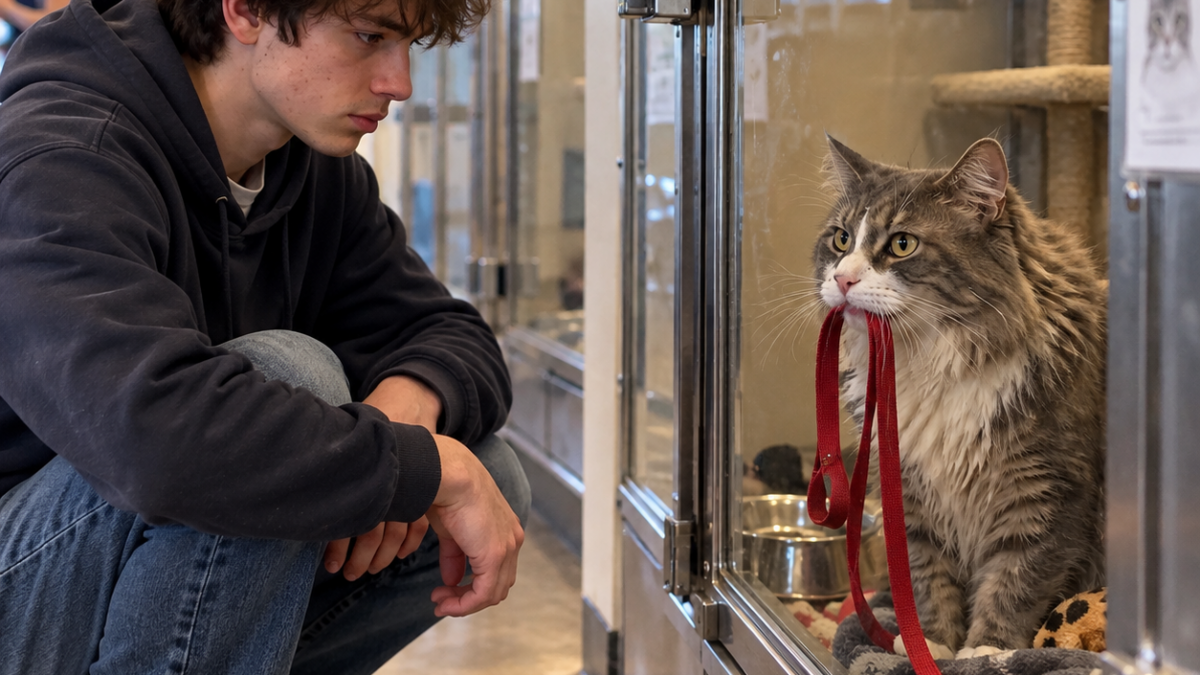
Instead, he asked, “Why’s he holding that leash?”
Martha’s expression changed.
She looked through the glass.
Then she sighed.
“That’s a sad story.”
I glanced at my brother.
“Maybe we should—”
“No,” Eli interrupted.
It was the first time he had spoken with any urgency all morning.
“I want to know.”
Martha folded her hands.
“Aqua’s three years old. His family surrendered him four days ago.”
“Why?” Eli asked.
“They moved into an apartment with strict pet rules. Apparently, the building wouldn’t allow animals over a certain size.”
I looked at Aqua.
He was large, yes.
Perhaps part Maine Coon.
But he was still a cat.
Martha seemed to read my thoughts.
“They told us he was too big.”
Too big.
Two words.
That was the reason.
Not aggressive.
Not sick.
Not destructive.
Not dangerous.
Just too big.
Martha continued.
“His old family trained him to walk on that red leash. They used to take him around their neighborhood in the evenings. He loved it. Every day around six, he’d sit near their front door and wait for someone to pick it up.”
Aqua shifted slightly behind the glass.
The leash tightened between his teeth.
“When they brought him here,” Martha said, “they put the leash inside his carrier. I think he believed they were going somewhere together.”
I felt something uncomfortable move through my chest.
“What happened when they left?” I asked.
Martha looked at Aqua.
“He watched the door.”
She paused.
“And he hasn’t really stopped.”
Eli stared at the cat.
“He’s been waiting four days?”
“Yes.”
“Does he eat?”
“A little. Mostly after closing, when the building is quiet.”
“Does he sleep?”
“Not much.”
Eli swallowed.
Then he asked a question so softly I almost missed it.
“Does he know?”
Martha looked confused.
“Know what, sweetheart?”
Eli’s eyes remained fixed on Aqua.
“That they’re not coming back.”
Nobody answered immediately.
Behind us, a kitten was batting a toy mouse against its kennel door. Somewhere down the hall, a dog barked twice. A telephone rang at the reception desk.
Ordinary shelter noises.
But suddenly the building felt painfully quiet.
Martha pressed her lips together.
“I don’t know,” she admitted.
Eli nodded slowly.
“I don’t think he does.”
I looked at my brother.
His shoulders were tight.
His jaw trembled once before he clenched it.
And suddenly I understood.
He wasn’t only looking at Aqua.
He was looking at himself.
For months, Eli had been waiting for someone who kept promising to show up.
He knew what it felt like to hear footsteps and hope they belonged to the person you missed.
He knew what it felt like to stare at a door long after everybody else had stopped expecting it to open.
And now, in a shelter full of barking dogs and playful kittens, he had found another living creature doing exactly the same thing.
Martha told us the staff had tried to remove the leash to wash it.
Aqua had panicked.
“He threw himself against the kennel door,” she said. “Not attacking anybody. Just desperate. He grabbed the leash and wouldn’t let go.”
Since then, they had left it with him.
He ate beside it.
Slept beside it.
Dragged it to the front of the kennel every time he heard the entrance open.
I looked at the red strip of fabric.
It was worn near the handle, with a small frayed section close to the metal clip.
To anyone else, it was a leash.
To Aqua, it was the last piece of home.
“Can I sit with him?” Eli asked.
Martha looked at him carefully.
“Of course.”
She led us to a small visitation room near the back of the building.
There was a beige rug, a chair with cracked vinyl arms, a window overlooking the parking lot, and an old scratching post wrapped in rope.
Martha brought Aqua inside.
The cat immediately carried his leash into a corner.
He sat behind it.
His yellow eyes moved from me to Eli and back again.
I stayed near the wall.
Eli lowered himself onto the rug.
He didn’t call the cat.
Didn’t whistle.
Didn’t make those clicking noises people use when they want animals to come closer.
He simply sat with one hand resting open on the floor.
Five minutes passed.
Nothing happened.
Aqua watched him.
Eli watched Aqua.
Then my brother whispered, “I get it.”
My heart tightened.
Aqua blinked slowly.
Eli stared at the leash.
“I waited too.”
The words nearly knocked the air out of me.
He had never said that.
Not after our father carried his suitcases downstairs.
Not after the missed school concert.
Not after the canceled fishing trip.
Not after all those evenings when Eli left a chair empty at dinner because Dad had said he might stop by.
“I kept thinking maybe he was just busy,” Eli continued.
His voice was barely audible.
“Maybe he forgot. Maybe something happened. Maybe if I waited long enough, he’d call.”
Aqua lowered his head.
One giant paw settled over the leash.
Eli swallowed hard.
“Everybody kept telling me it wasn’t my fault.”
He laughed once, without humor.
“But nobody could tell me why he didn’t come.”
I turned toward the window.
Not because I wasn’t listening.
Because I was trying not to cry in front of him.
For six months, I had begged Eli to tell me what was wrong.
A giant abandoned cat had managed to hear it without asking a single question.
Eli rubbed his palms against his jeans.
“You don’t have to like me,” he told Aqua.
The cat’s ears moved.
“You don’t have to come over here.”
Another pause.
Then Eli said, “But I’m not going anywhere for a while.”
Aqua stared at him.
One minute passed.
Then another.
Finally, the cat stood.
He was even bigger on his feet, with thick fur around his neck and a heavy tail that swept the carpet like a feather duster.
He picked up the red leash.
Took one step.
Then another.
Then a third.
He stopped in front of Eli and lowered his head.
The leash slipped from his mouth.
It landed beside my brother’s open hand.
Not in it.
Beside it.
As though Aqua could not quite offer trust yet, but was exhausted from carrying his grief alone.
Eli looked up at me.
His eyes were full of tears.
“We can’t leave him here.”
I had a dozen practical reasons to say no.
Our apartment was small.
Money was tight.
My car needed new tires.
The electricity bill was overdue.
Eli was still in school, and I already worked more hours than I wanted.
Aqua would need food, veterinary care, litter, vaccinations, grooming.
And he was enormous.
But he was sitting beside my brother, who had barely spoken in weeks, and for the first time since our family broke apart, Eli was looking at something with hope instead of disappointment.
So I asked Martha how adoption worked.
She smiled.
And I said yes.
The paperwork took twenty minutes.
Getting Aqua into the car took considerably longer.
At the shelter’s front entrance, he stopped.
His body stiffened.
His eyes fixed on the parking lot.
I could almost see what he was remembering.
The last car ride.
The strange building.
The people who rubbed his head once and disappeared.
Eli crouched beside him.
He held the leash loosely without pulling.
“Hey, buddy,” he whispered. “We’re not going to do that.”
Aqua did not move.
Eli waited.
“You don’t have to forget them today.”
Aqua looked at him.
“Just let us take you home.”
For a moment, nothing happened.
Then Aqua took one step toward my brother.
Only one.
But Eli smiled.
A real smile.
The first one I had seen in longer than I wanted to admit.
And sometimes one step is enough to change the direction of an entire life.
The first night in our apartment was not magical.
Aqua hid beneath the kitchen table.
He refused dinner.
He startled when the refrigerator compressor turned on.
At nine o’clock, when a neighbor walked past our door, he emerged from hiding so quickly he knocked over his water bowl.
He ran to the entrance.
Sat beneath the doorknob.
And stared.
Eli sat beside him for almost an hour.
I made sandwiches.
Neither of them seemed interested.
“Maybe he’s unhappy,” I said quietly.
Eli shook his head.
“He’s scared.”
“You think so?”
My brother looked at the cat.
“People always act like you can tell someone they’re safe and they’ll believe it.”
He paused.
“Sometimes you have to prove it for a while.”
I didn’t know what to say.
So I sat on the other side of Aqua and waited with them.
At midnight, Eli finally went to bed.
Aqua remained near the front door with the red leash tucked beneath his chest.
I lay awake wondering whether adopting him had been a mistake.
Perhaps his old family was all he wanted.
Perhaps we’d brought home a creature whose heart belonged somewhere else.
Perhaps I had mistaken grief for a problem love could solve quickly.
Then, just after six the next morning, I walked into the hallway and stopped.
The red leash was no longer beside the front door.
It was lying in front of Eli’s bedroom.
Aqua was curled beside it.
His enormous body nearly blocked the doorway.
He was asleep.
Not staring at the entrance.
Not listening for footsteps in the hall.
Sleeping.
I stood there holding my coffee and cried so quietly he never woke up.
The following weeks changed our apartment in ways I hadn’t expected.
Aqua learned the sound of my alarm clock.
He began waiting beside the coffee maker every morning, convinced that anything involving the kitchen should eventually benefit him.
He discovered the windowsill above the living room radiator and spent afternoons watching birds with a seriousness usually reserved for courtroom testimony.
He followed Eli from room to room.
Not desperately.
Not constantly.
Just close enough to know where he was.
When Eli sat at his desk, Aqua slept across his feet.
When Eli did homework on the floor, Aqua lay directly on the textbook.
When Eli took a shower, Aqua stationed himself outside the bathroom door like an irritated security guard.
And when Eli played guitar for the first time in months, Aqua appeared in the doorway.
My brother was sitting on his bed, picking slowly through a song he’d once known by heart.
Aqua listened for approximately thirty seconds.
Then he marched into the room and sat on the guitar case.
Eli stopped playing.
“Seriously?”
Aqua blinked.
“You’re blocking my stuff.”
The cat began grooming one enormous paw.
Eli laughed.
It was small.
Unexpected.
Beautiful.
I was passing the bedroom with a basket of laundry when I heard it.
I stopped so abruptly a sock fell onto the floor.
Eli laughed again.
“Fine,” he told the cat. “You can be my manager.”
I leaned against the hallway wall and smiled through tears.
I had spent half a year trying to bring joy back into that room.
Aqua had done it by sitting on a guitar case.
We established routines.
Breakfast at seven.
A short walk before dinner.
A small treat afterward.
Brushing every other evening, though Aqua insisted the brush was a personal enemy and occasionally attacked it with both front paws.
The red leash hung on a hook beside our front door.
At first, Aqua watched it anxiously.
Every time Eli reached for it, the cat hurried over, afraid it might disappear.
Then something changed.
He began associating the leash with coming back.
We took him into the courtyard beneath the maple tree. He sniffed bushes, inspected flower beds, stared suspiciously at squirrels, and once attempted to climb a fence before discovering his body was substantially heavier than his ambition.
Eli held the leash.
I walked beside them.
And every evening, no matter how far Aqua wandered, we returned through the same door.
Nobody handed him away.
Nobody disappeared.
Nobody left him waiting.
One evening, after a particularly long walk, Eli sat on the front steps while Aqua investigated a crack in the concrete.
“Do you think he remembers them?” he asked.
“Probably.”
“Do you think he misses them?”
I hesitated.
“Yes.”
Eli nodded.
For a moment I thought he would become quiet again.
Instead, he said, “That’s okay.”
I looked at him.
“What’s okay?”
“He can miss them.”
Aqua lifted his head.
Eli scratched behind the cat’s ear.
“Missing somebody doesn’t mean you don’t like where you are now.”
I sat beside him.
“No,” I said. “It doesn’t.”
He looked toward the parking lot.
“I still miss Dad.”
The words were steady.
No anger.
No apology.
Just truth.
“I know.”
“But I like living here.”
My throat tightened.
“I’m glad.”
He smiled faintly.
“You make terrible spaghetti, though.”
I bumped his shoulder.
“Then perhaps His Majesty would like to cook tomorrow.”
Aqua sneezed.
Eli laughed.
And for one ordinary moment, sitting on concrete steps with a giant cat between us, I felt the world settle.
I thought we were finally becoming a family again.
Then, three months after we adopted Aqua, my phone buzzed during dinner.
A message from Martha at Cedar Ridge Rescue.
At first, I smiled.
She checked on us occasionally and loved receiving photographs of Aqua sprawled across furniture like a furry landlord.
I dried my hands and opened the message.
The smile disappeared.
Hi, Nora. I’m sorry to contact you with something unexpected, but Aqua’s former family reached out after seeing his adoption update online. They’ve told us their housing situation has changed and they’re now permitted to keep him. They’re hoping you might consider returning him.
I read it twice.
Then a third time.
Below those sentences was another.
They have a ten-year-old son who has apparently been devastated since the surrender.
My stomach turned.
A child.
Of course there was a child.
I closed my eyes.
Across the table, Eli was tapping his pencil against a mug while Aqua lay across his feet.
It was such an ordinary scene.
Homework.
Half-eaten dinner.
A cat who had finally stopped watching the front door.
I wanted to freeze the room exactly as it was.
Eli looked up.
“What happened?”
“Nothing.”
He studied my face.
“Nora.”
I turned my phone over.
“It’s complicated.”
His expression changed.
He looked down at Aqua.
Then back at me.
“Is it about him?”
I said nothing.
Eli pushed his chair back.
“What happened?”
I could have hidden it.
I could have deleted the message and answered the shelter privately.
I could have decided I knew what was best for my brother and kept another painful truth away from him.
But that was exactly what adults had been doing to him for months.
Making decisions.
Managing information.
Offering reassurance without honesty.
So I told him.
Aqua’s old family had seen him online.
Their apartment rules had changed.
They wanted him back.
There was a little boy involved.
Eli stared at me.
Then he looked at the cat sleeping on his shoes.
“No.”
One word.
Flat.
Final.
I nodded.
“That’s what I thought too.”
But Eli wasn’t finished.
“They left him.”
“I know.”
“They gave him away.”
“I know.”
“He waited four days.”
“I know, Eli.”
His face tightened.
“Then they don’t get to come back because they changed their minds.”
Aqua stood, stretched his enormous body, and walked toward the door.
For one terrible second, both of us froze.
Then he sat beneath the red leash.
And looked back at Eli.
Not toward the hallway.
Not toward the outside world.
At my brother.
Eli’s face crumpled.
He knelt beside Aqua and wrapped one arm loosely around the cat’s shoulders.
“You’re not going anywhere,” he whispered.
Aqua pressed his head into Eli’s chest.
I looked away.
Because in that moment, I understood the real danger.
The people asking for Aqua were not simply threatening to take our cat.
They were threatening the first promise my brother had learned to believe again.
And I had no idea how far they were willing to go.
I called Martha the next morning.
She sounded tired before I finished saying hello.
“Nora, I’m so sorry.”
“Can they legally take him?”
“No,” she said immediately. “The surrender was voluntary, the paperwork was signed, and your adoption is final.”
I let out a breath.
“Then why are we even having this conversation?”
“Because they asked us to pass along the request.”
“Is that all?”
Martha hesitated.
That silence told me more than the words.
“What aren’t you saying?”
She sighed.
“They’ve been calling.”
“How often?”
“Several times.”
My fingers tightened around the phone.
“And?”
“The father is particularly upset.”
“About the cat?”
Another pause.
“He says his family was misled about the apartment restrictions.”
I frowned.
“Misled by whom?”
“According to him, the leasing office changed the rules shortly after they moved.”
“That’s not the same as being misled.”
“I know.”
I leaned against the kitchen counter.
Outside, a garbage truck rumbled past.
Aqua lifted his head from the rug, then settled again.
“What does he want?”
Martha’s voice became careful.
“He wants us to convince you that returning Aqua is the compassionate thing to do.”
I nearly laughed.
Compassion.
That word was starting to sound dangerous.
“What did you tell him?”
“That we can’t make that decision for you, and that Aqua is safe and settled.”
“Good.”
“But his son has been asking for him every day.”
I closed my eyes.
There it was again.
The child.
A little boy who had not signed the surrender form.
A little boy who might have stood at the door just as Eli had.
A little boy whose heartbreak was real, even if his parents had caused it.
“What is his name?” I asked.
“Ben.”
I repeated it quietly.
Ben.
I hated how much that changed things.
An anonymous child was easy to imagine as part of somebody else’s problem.
A child with a name became a person.
Martha continued.
“His mother says Ben didn’t understand the decision when they surrendered Aqua. He still thinks they gave him away temporarily.”
My heart sank.
Temporarily.
Another word adults use when they cannot bear to explain something permanent.
I thought of Eli staring at his phone after Dad missed another call.
Of Aqua sitting behind glass with his leash in his mouth.
Of promises people made because the truth was too uncomfortable.
“I need to speak with Eli,” I said.
“Of course.”
“And Martha?”
“Yes?”
“Please don’t give them our address or phone number.”
“I wouldn’t.”
“Not even if they ask nicely.”
Her voice sharpened.
“Nora, I promise.”
I thanked her and hung up.
For several minutes I stood in the kitchen, watching Aqua sleep.
Then Eli came out of his room.
He had heard enough to know the call was about him.
Not just about Aqua.
About both of them.
“Can they make us give him back?”
“No.”
He exhaled.
“Good.”
“But they want to meet.”
Eli stopped.
“Meet who?”
“You and me. Maybe Aqua.”
His face closed.
“No.”
“I haven’t agreed to anything.”
“Then don’t.”
He walked to the refrigerator, opened it, and stared inside without taking anything.
I recognized the movement.
It was what he did when he was trying not to cry.
After a long silence, he said, “What if Dad called tomorrow?”
I frowned.
“What?”
“What if he called and said he wanted me to move in with him?”
“Eli—”
“No, seriously.”
He closed the refrigerator.
“What if he said he had more time now? What if he said things were different and he was ready to be a better dad?”
I looked at him.
He folded his arms.
“Would everybody tell me I had to go because he’s my father?”
“Of course not.”
“Would they say I was selfish if I wanted to stay here?”
“No.”
He looked toward Aqua.
“Then why should Aqua have to go back?”
I had no answer.
Not because he was wrong.
Because he had found the truth so quickly.
People sometimes believe the person who loved you first has the greatest claim on you.
But being first is not the same as being safe.
And remembering someone is not the same as wanting to return.
I stepped closer.
“You’re right,” I said.
Eli lowered his eyes.
“I just don’t want him to think we’re leaving him too.”
I put my arm around his shoulders.
“We won’t.”
He leaned against me for a moment.
Then he pulled away and walked toward Aqua.
I watched him kneel beside the sleeping cat.
And I made a decision.
Whatever happened next, I would not let another adult’s regret become my brother’s responsibility.
Unfortunately, the people who had surrendered Aqua had a very different plan.
Two days later, someone posted Aqua’s adoption photograph on a local Facebook pet page.
It was a picture Martha had taken a few weeks earlier.
Aqua stood proudly in the courtyard, wearing his black harness and red leash, while Eli crouched beside him. My brother was smiling with his whole face, one hand resting on Aqua’s broad shoulders.
The afternoon sunlight made Aqua’s fur look silver.
His yellow eyes were half closed.
He looked ridiculous and magnificent.
The caption was simple.
A big rescue boy enjoying his second chance with a family who loves him.
People loved it.
At first.
There were little heart emojis, comments about his enormous paws, jokes about Maine Coons being disguised lions, and strangers saying how happy they were to see an adult shelter cat adopted.
Then a man named Grant Mercer commented.
Interesting how everyone celebrates the people who took him while the little boy who raised him is still crying himself to sleep.
I stared at the screen.
Below that came another comment.
His family had no choice because of unfair apartment restrictions. Those rules have now changed, but the adopters refuse to return a child’s beloved pet.
More people joined in.
Some supported us.
Others didn’t.
Then someone wrote the sentence that made my hands go cold.
The right thing would be to give that little boy his cat back.
The right thing.
As though nobody had done anything right in the months between Aqua’s surrender and that photograph.
As though feeding him, comforting him, paying his medical bills, teaching him to trust a front door again, and making room for him in a home that could barely fit us was somehow selfish.
I opened Grant’s public profile.
There was a family photograph.
A tall man in his forties with close-cropped dark hair, expensive sunglasses, and a confident smile stood beside a blond woman and a little boy with messy brown hair.
The boy held Aqua.
Not the anxious, underfed cat we had met at the rescue.
A younger Aqua with a fluffy tail and bright eyes, sitting in the child’s arms.
The caption beneath the old photograph read:
Best friends since day one.
I stared at Ben’s face.
He was smiling so hard his eyes had almost disappeared.
Whatever his father was doing now, the little boy in that photograph had loved Aqua.
I put my phone down.
Then I picked it up again.
Because more comments were appearing.
Grant was answering strangers.
He wrote that they had been forced into an impossible situation.
That the shelter had rushed the adoption.
That his son had never agreed to surrender his best friend.
That he was willing to compensate us for expenses.
Then he wrote something that made my pulse pound.
Some adults care more about their own happiness than about what they are doing to a ten-year-old child.
I sat there in our dark kitchen, my phone lighting my hands.
I wanted to type.
I wanted to tell everyone about Aqua gripping the leash. About four days spent staring at a hallway. About Eli sleeping on the floor beside him the first night because he couldn’t stand the thought of the cat waking alone.
I wanted to ask Grant where all that concern had been when he signed the paperwork.
Instead, I took screenshots.
Every comment.
Every accusation.
Every mention of us.
Then I called Martha.
“Please tell me you saw what’s happening.”
She sighed.
“I’ve been dealing with it all afternoon.”
“Is he allowed to do this?”
“He’s allowed to tell his story. He’s not allowed to harass you.”
“He’s telling people we took his son’s cat.”
“I know.”
“And the shelter rushed the adoption.”
“I know that too.”
I heard another voice in the background.
Martha covered the receiver briefly.
Then she returned.
“Our director is preparing a statement confirming the adoption was properly completed.”
“Will that stop him?”
“I hope so.”
I closed my eyes.
Hope had become an unreliable currency in our family.
“I’m worried about Eli,” I admitted.
“Has he seen the comments?”
“Not yet.”
“Try to keep him away from them.”
I looked toward his bedroom.
His guitar was playing softly.
“I’ll try.”
Of course he saw them.
By Sunday afternoon, half the students in his school seemed to know about the giant cat from the rescue.
Someone had recognized Eli from the adoption photograph.
Someone else had tagged a classmate.
And then a few teenagers, being teenagers, decided it was funny to turn somebody else’s pain into entertainment.
On Monday, Eli came home with his hood pulled over his head.
He walked past me without speaking.
Aqua followed him down the hall.
I gave him twenty minutes before knocking.
“Eli?”
Nothing.
“Can I come in?”
A pause.
“Yeah.”
He sat on the floor beside his bed, holding his phone.
Aqua was stretched across his knees.
I took one look at Eli’s face and sat down.
“What happened?”
He handed me the phone.
It showed a screenshot from a local discussion group.
Grant had reposted the shelter photograph.
He had circled Eli in red.
Above it, he wrote:
Imagine knowing a ten-year-old boy is devastated and still refusing to return the animal he grew up with.
Below that was a comment from someone at Eli’s school.
Pretty sure this is Eli from Westbrook High.
My blood turned cold.
There were more comments.
Imagine stealing a little kid’s cat.
Some people have no shame.
Hope karma finds him.
One person had written:
Just because you adopted him doesn’t make you his real family.
I looked at Eli.
He stared at the carpet.
“People think we stole him.”
“No, they don’t know the truth.”
“They don’t care about the truth.”
I couldn’t argue.
His voice shook.
“Somebody taped a picture of Aqua to my locker.”
I felt my stomach drop.
“What?”
“It said ‘RETURN STOLEN PROPERTY’ underneath.”
I closed my eyes.
For a moment I imagined marching into that school and demanding names.
Then Eli said, “Don’t make a scene.”
I looked at him.
“Eli—”
“Please.”
His eyes were full of something worse than embarrassment.
Defeat.
“I already feel stupid.”
“Why would you feel stupid?”
“Because I thought doing something good meant people would understand.”
He stroked Aqua’s head.
“I thought we helped him.”
“We did help him.”
“Then why does it feel like we’re the bad guys?”
There are moments when being the older sibling feels like standing between a child and an ocean.
You cannot stop the waves.
You can only keep telling him where the ground is.
I reached for his hand.
“Look at me.”
He didn’t.
“Eli.”
Finally, he looked up.
“You did not steal Aqua. You did not lie to anyone. You did not sign him away and then change your mind. You took a frightened cat home and gave him everything you had.”
His eyes filled.
“Then why are they doing this?”
“Because it’s easier to make us the villains than to admit somebody made a decision that hurt their child.”
Aqua lifted his head.
Eli wiped his cheek quickly.
“Maybe we should just give him back.”
The words struck me harder than I expected.
“What?”
My brother looked ashamed.
“Maybe if we give him back, everyone will stop.”
I stared at him.
The boy who had sat on a shelter floor and whispered I waited too was now considering losing the one creature who helped him breathe again, just to escape public humiliation.
Something in me went very still.
“No.”
He blinked.
“But—”
“No, Eli.”
I kept my voice calm.
“We are not making a permanent decision because strangers were cruel on the internet.”
He looked down.
“And we are definitely not teaching Aqua that the loudest person gets to decide where he belongs.”
Aqua stretched, stood, and placed both enormous paws on Eli’s chest.
My brother fell backward onto the rug.
For a second, he looked startled.
Then Aqua lowered his head and rubbed his cheek against Eli’s chin.
A tiny laugh escaped him.
“Buddy,” Eli whispered, “you’re crushing me.”
I smiled.
“Apparently he’s voted.”
That evening, I emailed the school counselor, Mrs. Callahan, and included screenshots of the posts and locker incident.
I also contacted the shelter director, a woman named Judith Price, asking her to preserve Aqua’s surrender and adoption records.
I was not looking for a fight.
I was building a record.
There is a difference.
My father used to say I was too cautious.
Too organized.
Too much of a worrier.
But when the people you love are being threatened by someone who controls the story, documents can become a form of protection.
The next morning, Mrs. Callahan called.
She was kind and practical.
The school would address the locker incident, make sure Eli had somewhere safe to go if the harassment continued, and remind the students involved that an online dispute did not excuse bullying.
She also asked whether Eli was receiving counseling.
I hesitated.
“We’ve talked about it.”
“Nora,” she said gently, “he’s carrying more than a seventeen-year-old should have to carry.”
I looked through my office window at the parking lot outside.
“I know.”
“Loving him doesn’t mean you have to carry it all yourself either.”
That sentence stayed with me.
For months, I had treated my brother’s heartbreak like a job only I could perform.
If he was sad, I worked harder.
If he was quiet, I filled the silence.
If Dad disappointed him, I tried to make the next day extraordinary.
I bought his favorite cereal when money was tight.
I learned enough about guitars to ask questions without sounding completely ridiculous.
I pretended I wasn’t exhausted.
But I couldn’t fix the reason he had stopped trusting people.
Only the people who broke that trust could choose to behave differently.
And Eli needed more than my determination to hold everything together.
That evening, I asked if he would talk to Mrs. Callahan.
He stared at Aqua for a long time.
Then he nodded.
“Maybe.”
It wasn’t yes.
But it wasn’t no.
And in our apartment, maybe had become a word worth respecting.
Three days later, Eli surprised me.
He came into the kitchen while I was making coffee and asked, “Can we meet Ben?”
I nearly dropped the mug.
“What?”
“The little boy.”
I stared at him.
“Eli, after everything his father has done—”
“Not his dad. Ben.”
I set the mug down.
“Why?”
Eli looked uncomfortable.
“Because maybe he didn’t know.”
“Know what?”
“That Aqua wasn’t coming back.”
I didn’t answer.
He continued.
“I keep thinking about when Dad moved out. Everybody kept saying it was between him and Mom. But I was still there.”
His eyes shone.
“I was still in the house.”
Those words stopped me.
Because I had spent so much time protecting Eli that I had forgotten how well he understood being powerless.
He looked toward the leash hanging by the door.
“Maybe Ben needs to see Aqua is okay.”
“And what if Aqua gets upset?”
“We stop.”
“What if Ben asks us to give him back?”
“We say no.”
“What if his father comes?”
“Then we leave.”
He had thought about this.
Really thought about it.
Not impulsively.
Not because strangers had shamed him.
Because he saw another child hurting and wanted to understand the truth.
I leaned against the counter.
“You’re seventeen.”
He frowned.
“Last time I checked.”
“You shouldn’t have to be more thoughtful than the adults involved.”
He gave a tired smile.
“Somebody has to.”
That nearly broke my heart.
I contacted Martha.
We agreed to a supervised meeting at the rescue.
Neutral ground.
Twenty minutes.
Only Ben and his mother.
No father.
No cameras.
No discussion of taking Aqua back.
I insisted on putting those conditions in writing.
Martha agreed without hesitation.
Then I called Eli into the kitchen.
“It’s arranged.”
He went pale.
“When?”
“Wednesday afternoon.”
He nodded.
Aqua, sitting beneath the leash, looked up at both of us.
I wished I could explain what was coming.
That the people he once loved were about to become real again.
That memory could hurt even after a home became safe.
But all I could do was kneel beside him and touch his thick fur.
“Whatever happens,” I whispered, “you’re coming home with us.”
Wednesday arrived beneath a sky full of low gray clouds.
Eli wore the same navy hoodie he had worn the day we adopted Aqua.
I noticed.
I didn’t mention it.
He helped me settle Aqua into his travel carrier, with the red leash folded neatly beside him.
Aqua hated the carrier but tolerated it with the offended dignity of a retired judge being forced onto public transportation.
When we reached Cedar Ridge Rescue, he became unusually still.
The smell.
The parking lot.
The automatic doors.
I could not know what he remembered.
But I saw his ears flatten.
Eli crouched beside the carrier.
“Hey, buddy.”
Aqua stared at the entrance.
“We’re not leaving you.”
The cat did not move.
Eli placed one hand against the carrier wall.
“I’m going in with you.”
Aqua looked toward his voice.
“And I’m coming out with you.”
That seemed to settle something.
Not completely.
But enough.
Martha met us near the reception desk.
Her expression was gentle and worried.
“They’re waiting in the visitation room.”
“Just the mother and son?” I asked.
She nodded.
“Just them.”
We walked down the hallway.
The familiar smell of disinfectant and cat food brought back memories of our first visit. I remembered Eli walking beside me without speaking. I remembered Aqua behind glass, holding the leash as though the world had narrowed to one unanswered promise.
Now the leash was attached to his harness.
Eli held it.
And we were all walking together.
Through the little window in the visitation room door, I saw them.
A woman sat in the chair, her hands clasped tightly in her lap.
She was probably thirty-eight, with shoulder-length blond hair, a tired face, and a blue sweater that looked as though she had dressed carefully before deciding none of it mattered.
On the rug beside her sat a little boy.
Thin wrists.
Messy brown hair.
Red eyes.
He held a folded blue blanket against his chest.
He looked younger than ten.
Martha opened the door.
The boy stood so quickly the blanket slipped from his hands.
“Aqua.”
One word.
Barely a whisper.
But it seemed to fill the room.
Aqua froze.
Eli froze too.
The little boy took one step forward.
Then stopped when his mother touched his shoulder.
“Easy, Ben,” she whispered.
Aqua stared at him.
His ears tilted forward.
His tail lowered.
Then he made a sound I had never heard before.
Not quite a meow.
Not quite a cry.
A small, startled chirp.
Ben covered his mouth.
“Oh, buddy.”
I felt the air leave my chest.
Aqua knew him.
Of course he did.
Love doesn’t disappear because paperwork changes.
Eli’s face went pale.
I wanted to grab Aqua and run.
Not because I hated Ben.
Because I didn’t.
That was the worst part.
He looked like a child who had lost something adults told him he couldn’t keep.
I knew that look.
I had seen it across our kitchen table for six months.
The woman stood.
“I’m Claire,” she said. “Ben’s mother.”
I shook her hand.
“Nora.”
She looked at Eli.
“And you must be Eli.”
He nodded.
“Thank you for coming,” she said.
Her voice trembled.
I had prepared myself to dislike her.
I had built entire speeches in my head.
But she looked ordinary.
Exhausted.
Guilty.
That made everything harder.
Villains are easy when they arrive wearing their cruelty openly.
Ordinary people who have made painful choices are much harder to hate without feeling the edges of your own humanity.
Ben knelt slowly.
“Hi, Aqua.”
The cat stood halfway between him and Eli.
The red leash stretched gently from Eli’s hand to Aqua’s harness.
Ben held his hands against his knees.
He did not reach.
He did not grab.
He simply waited.
Aqua sniffed the air.
Then walked toward him.
Ben made a small, broken sound.
Aqua touched his nose to the boy’s sleeve.
Then sniffed the blue blanket.
Then rubbed his cheek once against Ben’s knee.
Ben began to cry.
Not loudly.
Not dramatically.
The helpless, trembling crying of a child who has been holding grief longer than his body knows how to carry.
“I told them,” he whispered.
Claire closed her eyes.
“I told them you’d wait.”
Nobody spoke.
Because sometimes being right feels terrible.
Ben lowered his face.
“I kept your blanket.”
Aqua sniffed it again.
“You remember?”
The cat pushed his nose into the folds.
Ben pressed his lips together, trying to stop crying.
“I thought they were just taking you somewhere until we moved.”
I looked at Claire.
She stared at the floor.
“I thought we’d come back for you,” Ben whispered.
Eli’s fingers tightened around the leash.
The boy looked up at him.
“Do you walk him?”
Eli nodded.
“Every day?”
“Most days.”
“Does he still stop at every bush?”
Eli blinked.
Then a small smile appeared.
“Every single one.”
Ben smiled too.
“He likes the ones near mailboxes.”
“Yeah,” Eli said. “I noticed.”
“And he hates getting his feet wet.”
“Even when the grass is barely damp.”
Ben gave a tiny laugh.
For the first time, the room felt like something other than a battlefield.
Two boys were talking about a cat.
Not ownership.
Not paperwork.
Not blame.
Just a cat who sniffed bushes, hated wet grass, and apparently believed every mailbox contained important information.
“He used to sleep on my pillow,” Ben said.
Eli looked down.
“He sleeps on my feet.”
“That sounds like him.”
Aqua moved closer to Ben.
The boy held himself still.
When the cat nudged his hand, Ben stroked his cheek.
One gentle touch.
Then another.
For a moment, I saw what Aqua’s life had been before Cedar Ridge.
A little boy kneeling on the floor.
A giant cat leaning into his hand.
A family bond that had been real, regardless of how badly the adults had handled it.
Then Ben asked, “Can I hug him?”
Martha answered before I could.
“Let Aqua decide.”
Ben nodded.
He opened his arms slightly without reaching.
Aqua sniffed his sleeve.
Then climbed halfway into his lap.
Ben bent over the cat.
His face disappeared into gray-and-white fur.
He cried silently.
Aqua stayed for perhaps thirty seconds.
Then he stood.
Stepped away.
And walked back to Eli.
Not fast.
Not frightened.
Simply returning to the person holding his leash.
He pressed his whole body against Eli’s leg.
My brother released a breath that sounded as if he’d been underwater.
Ben watched.
His face crumpled again.
But then he nodded.
“He picked you.”
The words nearly broke me.
Eli knelt beside Aqua.
“He can still miss you.”
Ben wiped his face.
“I know.”
“He did,” Eli continued.
Ben looked at him.
“He waited at the rescue. He held his leash the whole time.”
Claire covered her mouth.
Ben nodded.
“I put it in his carrier.”
Eli looked at him.
“The red one?”
“Yeah.”
“Why?”
Ben swallowed.
“Because that’s what we used when we went outside. I thought if he had it, he’d know we were coming back to get him.”
I felt tears slip down my face.
The leash.
The last promise.
Not a toy.
Not a random piece of fabric.
A child’s attempt to tell his best friend that their story wasn’t over.
Ben continued.
“Dad said we couldn’t bring him because he was too big.”
Claire’s shoulders tightened.
Eli looked confused.
“Too big for what?”
“Our apartment.”
Eli looked down at Aqua.
Then back at Ben.
“He’s not too big for ours.”
Ben nodded.
“I know.”
His lower lip trembled.
“I told Dad that.”
The room became quiet.
Claire finally spoke.
“We were under a lot of pressure during the move.”
I looked at her.
She held my gaze.
“Our old lease ended sooner than expected. Grant was changing jobs. We had two weeks to find somewhere, and we were told the new building had restrictions.”
“Were told?” I asked.
Claire hesitated.
“My husband handled the lease.”
Something about the way she said that stayed with me.
Not we read the lease.
Not the manager told us.
My husband handled the lease.
She continued.
“I convinced myself that surrendering Aqua was the responsible choice.”
Her eyes moved toward Ben.
“I was wrong about how it would affect him.”
Ben shook his head.
“I told you.”
Claire looked shattered.
“I know, honey.”
“I told you he would wait.”
“I know.”
He looked at the floor.
“Dad said cats don’t remember stuff like that.”
My entire body went cold.
Eli scratched Aqua’s shoulders.
“Well,” he said quietly, “I think your dad was wrong.”
Ben nodded.
“Me too.”
The visit lasted twenty-three minutes.
I know because I watched the clock.
At the end, Claire asked whether Ben might be allowed to see Aqua again someday.
I looked at Eli.
Aqua was sitting beside his knee.
Ben stood near the blue blanket, his hands tightly clenched.
Eli answered before I could.
“Maybe not right away.”
Claire nodded.
“Of course.”
“But maybe,” he continued, “we could send pictures.”
Ben looked up.
“Really?”
Eli nodded.
“And maybe sometime we could walk him together.”
I nearly objected.
Eli knew it.
He wisely avoided looking at me.
“No promises,” I said.
Everyone turned toward me.
“I mean it. Aqua isn’t going to be passed back and forth like a borrowed bicycle. He needs stability.”
Claire nodded.
“Absolutely.”
“And Eli needs stability too.”
I hadn’t planned to say that.
The words came out anyway.
The room became quiet.
Claire looked at my brother.
Really looked at him.
Then something in her expression softened.
“I’m sorry,” she said.
Not to me.
To Eli.
He swallowed.
“Thank you.”
As we prepared to leave, Ben picked up the blue blanket.
“Can he keep this?”
I looked at Aqua.
Then at Eli.
My brother nodded.
“Yeah.”
Ben folded it carefully and placed it inside the carrier.
Then he leaned close to Aqua.
“Bye, buddy.”
Aqua bumped his forehead gently against Ben’s hand.
The boy smiled through tears.
“You be good.”
Aqua made a low grumbling noise.
Eli smiled.
“He’s not very good at that.”
Ben laughed.
This time, the laugh stayed for more than a second.
When we walked out, Aqua remained close to Eli’s leg.
He did not look back at the hallway.
He did not pull toward the visitation room.
He went to the car.
And he came home.
That night, he dragged the blue blanket into Eli’s bedroom.
He sniffed it for almost twenty minutes.
Then he retrieved the red leash from the floor, pulled it onto the blanket, and lay down beside both.
Eli stood in the doorway.
“Do you think he’s confused?”
I thought about lying.
Then I remembered how much damage adults had already done with comforting lies.
“Yes,” I said.
Eli looked at me.
“But confused doesn’t mean broken.”
He nodded slowly.
“Do you think he misses Ben?”
“Probably.”
“Even though he’s happy here?”
“Yes.”
Eli sat beside Aqua.
The cat rolled onto his side and stretched one paw across the blue fabric.
My brother watched him for a long time.
Then he said something I would remember forever.
“I don’t want anyone to tell me I have to forget Dad to love Mom.”
I felt my eyes burn.
“Or to love you,” he added.
I sat beside him.
“You don’t.”
He looked at Aqua.
“Then maybe he doesn’t have to forget Ben.”
“No,” I whispered. “He doesn’t.”
For a little while, I thought the worst was over.
Claire sent a short thank-you message through the shelter.
Ben drew Aqua wearing a crown.
Eli taped the picture above his desk.
The online comments slowed down.
Martha called to say the rescue director had spoken with Grant and reminded him that our adoption was final.
It seemed as though reason had finally found its way into the situation.
Then Grant Mercer discovered his son had accepted that Aqua was staying with us.
And what happened next showed me that some people do not want justice.
They want control.
The first warning came on a Friday evening.
I was making dinner when an unfamiliar number appeared on my phone.
I almost ignored it.
Something made me answer.
“Hello?”
A man’s voice came through.
“Is this Nora?”
“Yes. Who’s calling?”
“Grant Mercer.”
I stopped stirring the pasta.
“How did you get this number?”
“That’s not important.”
“It is to me.”
He ignored the question.
“I understand you met my wife and son.”
“Yes.”
“And I understand you’ve decided to keep our cat.”
I stared at the wall.
“Mr. Mercer, Aqua was legally surrendered and adopted.”
“Let’s not hide behind paperwork.”
I felt my patience tighten.
“Paperwork matters when you’re accusing people of taking something that was voluntarily given up.”
He laughed.
“Look, I’m trying to be reasonable.”
That is usually the sentence people use immediately before becoming unreasonable.
“I’ve offered to reimburse your expenses.”
“This isn’t about money.”
“Everybody says that until they hear a number.”
I turned off the stove.
“Excuse me?”
“Five hundred dollars.”
I was silent.
“That’s more than you paid to adopt him, isn’t it?”
I thought of Aqua’s food, his veterinary appointments, his medications when he developed an ear infection, the scratching posts, the toys, the time Eli spent sitting beside him when he was afraid.
Then I thought of the nights the cat slept against my brother’s feet.
As though all of it had a price tag.
“Mr. Mercer—”
“A thousand.”
I closed my eyes.
“You’re not listening.”
“I’m offering a fair deal.”
“He is not for sale.”
The man’s voice hardened.
“He belongs to my son.”
“He lives with us now.”
“For the moment.”
Something cold moved through me.
“What does that mean?”
“It means I haven’t exhausted my options.”
I heard a television in the background.
Then a door closed.
Grant continued.
“You seem like a nice woman, Nora. I’d hate for people to think you’re exploiting a child’s tragedy.”
I felt my heartbeat in my ears.
“Are you threatening me?”
“I’m advising you to do the decent thing.”
I looked toward Eli’s bedroom.
Aqua was sleeping beside him.
“Don’t call this number again,” I said.
Then I hung up.
My hands were shaking.
I called Martha immediately.
She sounded horrified.
“We didn’t give him your number.”
“I believe you.”
“I’ll speak to Judith.”
“Please document it.”
“I will.”
Then I called my mother.
I hadn’t done that in weeks.
Not because we were fighting.
Because I had grown so used to being the responsible adult that I kept forgetting I was also someone’s daughter.
Mom answered on the third ring.
“Sweetheart?”
I tried to sound normal.
“Hey.”
“What’s wrong?”
And just like that, I cried.
Not graceful tears.
Not a few quiet drops.
The exhausted crying of a woman who had worked all day, paid bills all week, and spent months protecting a teenage boy from disappointments she could not control.
Mom listened.
Then she said, “I’m coming over.”
“You worked twelve hours.”
“I don’t care.”
“Mom—”
“Nora. You’ve been taking care of everybody. Let me take care of you for one night.”
She arrived with grocery bags, a rotisserie chicken, a carton of ice cream, and the determined expression of a woman who had spent twenty-five years surviving problems nobody else wanted to face.
She hugged Eli.
She kissed Aqua on the head.
Then she sat at the kitchen table with me and read the screenshots.
Her face grew harder with every one.
Finally, she looked up.
“This man is trying to frighten you.”
“Yes.”
“Then stop speaking with him privately.”
I nodded.
“Put everything in writing. Keep records. Let the shelter and an attorney handle the harassment if he continues.”
I looked at her.
“I don’t have money for a lawyer.”
“Then we’ll find someone who can advise you without charging a fortune.”
I wanted to argue.
She held up one hand.
“And don’t tell me you don’t want to bother me.”
My mouth closed.
Mom softened.
“You’re allowed to need help.”
I looked down at my hands.
For six months, I had been everyone’s steady person.
Eli’s steady person.
Mom’s steady person.
The person who made sure dinner happened and bills got paid and nobody completely fell apart.
I had forgotten that strength could include leaning on someone else.
The following Monday, Judith Price sent Grant a formal written notice.
Our adoption was final.
The rescue would not participate in efforts to reclaim Aqua.
All further communications needed to go through the shelter.
He was instructed not to contact us directly.
The letter was firm.
Professional.
Measured.
Grant ignored it.
Two days later, a new post appeared online.
This one included a cropped photograph of Eli holding Aqua’s leash.
Grant’s caption read:
How would you feel if strangers kept your child’s best friend and refused to return him, even after learning the truth?
Below it, he added:
Some people choose publicity over compassion.
The implication was obvious.
He was accusing us of using Aqua for attention.
The man who had shared my brother’s photograph with strangers was now accusing my brother of wanting publicity.
I took another screenshot.
Then I noticed something.
Grant had attached an image of what appeared to be a notice from his apartment management company.
The top read:
COMMUNITY PET GUIDELINES.
The bottom was cut off.
Only one highlighted line remained visible.
Animals exceeding the permitted weight limit are prohibited without prior written approval.
I stared at it.
Then I enlarged the image.
There was a number beside the highlighted sentence.
Section 4.2.
Something about it bothered me.
Not because I understood lease agreements particularly well.
Because Grant had carefully cropped the page.
He wanted everyone to see that sentence.
But nothing above it.
Nothing below it.
And I had spent enough years working with dental insurance companies to know that people often highlight exactly the words that support their argument while hiding the words that change its meaning.
I showed the image to Mom.
She studied it.
“Prior written approval,” she read aloud.
“Yes.”
“Doesn’t that mean approval was possible?”
“That’s what I thought.”
She looked at me.
“Did they ever ask for it?”
I didn’t know.
But suddenly I wanted to.
The next morning, I called Martha.
“Do you still have the surrender paperwork?”
“Yes.”
“Would you be able to confirm what reason they gave for surrendering Aqua?”
“It’s listed as a housing restriction.”
“Did they provide proof?”
Martha paused.
“I don’t remember.”
“Could you check?”
“I can ask Judith.”
“Thank you.”
I looked again at the cropped policy.
Without prior written approval.
Those four words would not leave my mind.
Because if the family’s story was true, Aqua had been surrendered because the building refused to accept him.
But the document Grant himself had posted seemed to suggest there was another possibility.
An exception.
A request.
An approval.
Something that might have allowed a little boy to keep his beloved cat.
And I began wondering whether Grant Mercer had ever told his family the whole truth.
I did not know it then, but the answer was sitting in an email he had buried before he drove Aqua to the rescue.
An email that would eventually destroy the story he had spent months telling the entire town.
The next few days were miserable.
I slept badly.
I checked my phone too often.
I kept expecting Grant to appear outside our apartment or approach Eli at school.
Every time I heard a car door slam in the parking lot, I looked through the curtains.
It embarrassed me how quickly one determined stranger could make an ordinary home feel exposed.
Aqua noticed.
He began following me more closely, his thick tail brushing my ankles whenever I crossed the kitchen.
One evening, while I sat at the table reviewing screenshots, he jumped onto the chair beside me.
It was not graceful.
Aqua rarely did anything gracefully.
He landed with a heavy thump, placed one enormous paw on my paperwork, and looked directly into my face.
“You’re not helping,” I told him.
He blinked.
Then he sat on the papers.
I laughed despite myself.
For a moment, I understood what Eli had found in him.
Aqua could not fix our problems.
He did not know about social media, custody agreements, apartment policies, or adults who made promises they had no intention of keeping.
He only knew that someone he loved was upset.
And he had decided to be there.
Sometimes presence is the only answer that doesn’t make things worse.
On Thursday afternoon, Martha called with an update.
“I checked the surrender paperwork.”
I sat up.
“And?”
“The reason recorded was housing restrictions. Grant signed the form.”
“What about Claire?”
“Both signatures are there.”
I felt a small surge of disappointment.
“So she knew?”
“She knew they were surrendering him,” Martha said. “That doesn’t tell us what she knew about the apartment.”
I looked at the photograph of the cropped lease on my computer screen.
“Was there any documentation from the landlord?”
“No.”
“Nothing?”
“Just their explanation.”
I leaned back.
Martha continued.
“Nora, I know you’re upset, but please don’t try to investigate their private affairs yourself.”
“I’m not trying to invade anyone’s privacy.”
“I know. I’m only worried this is becoming something bigger than it needs to be.”
I looked toward Eli’s bedroom.
He was sitting on the floor with Aqua, struggling through a guitar chord.
“It’s already bigger than it needed to be,” I said quietly.
Martha sighed.
“I suppose you’re right.”
She told me the rescue had hired a local attorney to advise them about Grant’s posts.
They had also contacted the moderators of the community page.
Several of the more aggressive comments had been removed.
Grant’s posts remained.
Then Martha mentioned something that made my stomach tighten.
“By the way, we’re having our fall adoption fundraiser on Saturday.”
I knew about it.
Eli had volunteered to help after Martha asked whether he would demonstrate leash training for people considering adopting adult cats.
He was nervous, but excited.
It would be his first public volunteer event since our parents separated.
For days, he had been practicing how to explain Aqua’s harness without sounding awkward.
“Is Grant planning to come?” I asked.
“We haven’t invited him.”
“That wasn’t my question.”
Martha went quiet.
“It’s a public event,” she admitted.
I closed my eyes.
I knew what I wanted to do.
Cancel.
Keep Eli home.
Protect him from another scene.
But then I thought about the school concert he’d stopped attending because he was embarrassed about our father.
The friends he’d stopped seeing.
The guitar he’d stopped playing.
If I pulled him out of the fundraiser because of Grant, I would be teaching him the same terrible lesson the online comments were teaching him.
That somebody else’s cruelty could decide how small his life had to become.
So I spoke with Judith.
We agreed that Aqua would remain with us during the event, away from the general animal enclosures. A staff member would accompany Eli, and if Grant appeared or caused trouble, we would leave immediately.
Judith assured me volunteers would be briefed.
Then I told Eli everything.
He listened quietly.
Finally, he said, “I still want to go.”
“Are you sure?”
He looked at Aqua.
“Yeah.”
“Why?”
My brother shrugged.
“Because I promised Martha I’d help.”
It was such a simple answer.
I nearly cried.
A promise.
One he intended to keep.
Saturday morning arrived bright and cold.
The fundraiser was held inside the town recreation center, a low brick building beside the public library. Folding tables lined the walls. Volunteers sold homemade cookies, donated pet supplies, and raffle tickets. Families moved between adoption booths while children pressed their faces against portable kennels.
There were colorful balloons near the entrance and a large banner welcoming visitors to Cedar Ridge’s annual adoption event.
It should have been a happy day.
Eli wore clean jeans and his navy hoodie.
He had brushed Aqua until the cat looked like a magnificent cloud with paws.
I packed water, treats, the carrier, and a spare harness.
The red leash hung from Eli’s hand.
“You ready?” I asked.
He nodded.
“Sort of.”
“That’s good enough.”
Aqua gave a loud, impatient meow.
Eli smiled.
“He’s ready.”
For the first hour, everything went well.
Aqua behaved like a minor celebrity.
Children stared at his size. Adults asked whether he was really a cat. One elderly woman insisted he looked exactly like the lion her late husband had once seen on safari.
Aqua accepted compliments with the bored dignity of a creature who had always known he was exceptional.
Eli explained how to introduce a harness gradually.
He showed a little girl how to let a cat sniff her hand before touching him.
He even laughed when Aqua sprawled directly across the demonstration mat and refused to move.
I stood nearby watching my brother speak to strangers without flinching.
For the first time in months, he seemed comfortable being seen.
Then I heard a man’s voice near the entrance.
“Well, there he is.”
I turned.
Grant Mercer stood beside a row of folding tables, holding his phone upright.
Recording.
He wore a dark jacket, polished boots, and the confident expression of someone who believed being loud meant being right.
Behind him stood Claire.
And Ben.
Claire looked horrified.
Ben looked confused.
Grant walked straight toward Eli.
“There’s my son’s cat.”
I moved before he reached them.
“Mr. Mercer.”
He barely glanced at me.
“You must be Nora.”
“Put the phone away.”
He smiled.
“Why? Nothing to hide, right?”
My pulse began pounding.
“Please stop recording my brother.”
Grant raised the phone higher.
“Everybody should see this.”
People nearby turned.
Eli stood very still.
Aqua looked toward the voices, ears flattening.
Grant spoke loudly enough for several rows of visitors to hear.
“This is the kid who refuses to give my ten-year-old son his cat back.”
A woman gasped.
Someone whispered.
I felt heat rush into my face.
“That’s not what happened,” I said.
Grant ignored me.
He pointed his phone toward Eli.
“Tell them, son. Tell them how you feel knowing you’ve kept a little boy’s best friend.”
Eli’s face drained of color.
He held the leash with both hands.
“Please don’t film me.”
Grant laughed.
“Then maybe you shouldn’t do things you’re ashamed of.”
Something inside me snapped.
I stepped between them.
“He asked you to stop.”
Grant leaned around me.
“Look at him. He knows.”
I heard a chair scrape.
Martha hurried toward us.
Judith followed.
Claire grabbed Grant’s sleeve.
“Grant, stop.”
He pulled away.
“I’m showing people the truth.”
“No,” Claire said sharply. “You’re embarrassing everyone.”
He pointed toward Aqua.
“That’s our family pet.”
Ben stood behind his mother, clutching a blue drawing folder.
His face was pale.
Grant turned to him.
“Tell them, Ben. Tell them you want your cat back.”
The little boy looked at Eli.
Then Aqua.
Then the red leash.
His lips trembled.
“Dad…”
“Tell them.”
Ben looked frightened.
I hated Grant in that moment.
Not because he wanted Aqua back.
Because he was using his own child’s heartbreak like a weapon.
Eli slowly knelt beside Aqua.
The cat pressed against his leg, clearly distressed by the noise.
My brother placed a steady hand on his back.
“It’s okay,” he whispered.
Grant took another step forward.
“Don’t pretend you’re the victim here.”
Eli looked up.
His eyes were wet.
But his voice, when it came, was steady.
“I’m not pretending.”
The room quieted.
Eli stood slowly.
“You gave him away.”
Grant scoffed.
“We had no choice.”
“You signed the papers.”
“You don’t understand what adults have to do.”
Eli swallowed.
“Maybe not.”
He looked toward Ben.
“But I know he waited for you.”
Grant opened his mouth.
Eli continued.
“He waited four days at the rescue holding that leash because he thought you were coming back.”
Someone behind us whispered, “Oh my God.”
Aqua made a low, unhappy sound.
Eli looked down at him.
Then back at Grant.
“When we took him home, he slept by the front door because he didn’t know if we’d leave him too.”
Grant shifted his weight.
Eli’s voice trembled.
“It took weeks before he stopped waiting.”
For the first time, Grant seemed unsure what to say.
Then his expression hardened.
“He’s an animal.”
My brother went still.
I saw something change in his face.
Not anger.
Clarity.
“He’s an animal who trusted you.”
The words were quiet.
But they carried.
Grant laughed bitterly.
“You’ve got a lot to learn about the real world, kid.”
Eli nodded once.
“Maybe.”
Then he bent down and picked up Aqua’s carrier.
“But I already know you don’t get to scare somebody into loving you.”
For a second, nobody moved.
Then Judith stepped forward.
“Mr. Mercer, this event is over for you.”
Grant stared at her.
“What?”
“Put your phone away and leave.”
“This is a public building.”
“And you’re harassing a minor during a rescue event. I’ve already asked security to come over.”
He looked around.
People were watching.
Some had their own phones out.
His jaw tightened.
“This is unbelievable.”
Claire stepped beside Ben.
“Grant. We’re leaving.”
He looked at his wife.
Then at Eli.
Then at me.
“This isn’t finished.”
I met his eyes.
“Yes,” I said. “It is.”
He left with security watching him.
Claire followed slowly, one hand resting on Ben’s shoulder.
But before they reached the exit, Ben turned.
He looked directly at Eli.
“I’m sorry,” he whispered.
Eli shook his head.
“You didn’t do anything.”
Ben’s face crumpled.
Then Claire guided him outside.
The whole confrontation lasted less than five minutes.
It felt like an hour.
Afterward, I found Eli sitting in a storage room behind the gymnasium.
Aqua’s carrier sat beside him.
My brother had both elbows on his knees and his face in his hands.
I sat down on the floor.
For a while, neither of us spoke.
Then he whispered, “Everybody saw.”
“I know.”
“I couldn’t make him stop.”
“You didn’t have to.”
He looked at me.
“You stood up for Aqua,” I said. “You kept him safe. And you didn’t become cruel just because someone was cruel to you.”
His eyes filled.
“I was scared.”
“I know.”
He wiped his face.
“I thought he was going to take him.”
I put my arm around his shoulders.
“He wasn’t.”
Aqua pushed his nose through the carrier door and gave an irritated meow.
Eli laughed weakly.
“Yeah, buddy. I know.”
I reached for the carrier.
“Ready to go home?”
He looked at me.
Then at Aqua.
“Yeah.”
We left through a side entrance.
I did not look back at the crowd.
I did not know how many people had recorded us.
I did not know how the internet would twist what had happened.
I only knew my brother had been humiliated in front of strangers by a grown man who believed his own regret entitled him to hurt someone else.
And this time, I would not let the truth disappear beneath the noise.
The video spread before we reached home.
Several clips appeared online.
One showed Grant shouting.
Another showed Eli standing beside Aqua.
A third had been edited to begin with my brother saying, “You gave him away,” making him sound confrontational without showing what had happened beforehand.
The comments exploded.
Some people apologized for judging us.
Others doubled down.
Some argued that Grant was simply a desperate father.
Some said Eli was brave.
Some said we should have stayed away from the fundraiser.
I read enough to understand what was happening.
Then I stopped.
I saved the original recordings from people willing to share them.
I wrote down the names of witnesses.
I emailed Judith.
And for the first time in this entire ordeal, I contacted an attorney.
His name was Thomas Reed.
He was in his late fifties, worked out of a modest office above a pharmacy, and had represented my employer in a small contract dispute years earlier.
When I explained the situation, he listened without interrupting.
Then he asked one question.
“Do you have the signed surrender and adoption documentation?”
“The rescue does.”
“Good.”
He made notes.
“Have you threatened this man?”
“No.”
“Contacted his employer?”
“No.”
“Published his personal information?”
“No.”
“Then keep doing exactly what you’re doing. Preserve evidence, communicate through appropriate channels, and do not engage in online arguments.”
I exhaled.
“Can he sue us?”
“Anyone can file a lawsuit. That doesn’t mean it has merit.”
He leaned back.
“From what you’ve told me, the adoption was completed lawfully. The more immediate concern is the repeated targeting of your brother.”
I looked down.
“He’s seventeen.”
“I understand.”
Thomas glanced at the screenshots.
“Let me review these and the adoption documents. If the facts check out, we can send a formal notice demanding that the harassment stop and that false statements be corrected.”
For the first time in weeks, I felt the slightest easing in my chest.
Not because a lawyer could fix everything.
Because someone who knew how the system worked was finally standing beside us.
Then, three days after the fundraiser, Claire called Martha.
She wanted to speak with me.
Privately.
I almost refused.
After Grant’s behavior, I wanted nothing to do with the Mercer family.
But Martha’s voice sounded different.
“Nora, I think you should hear her.”
“Why?”
“She says there’s something you need to know about the apartment.”
My pulse quickened.
“The lease?”
“Yes.”
I closed my eyes.
That cropped photograph flashed through my mind.
Without prior written approval.
I agreed to meet Claire at the rescue the following afternoon.
No Grant.
No children.
Just us, Martha, and Judith.
When I arrived, Claire was already sitting in the little conference room.
She looked as though she had not slept.
There were shadows beneath her eyes and no makeup on her face. Her hands trembled around a paper cup of coffee.
On the table lay a folder.
A thick one.
She stood when I entered.
“Thank you for coming.”
I sat across from her.
“What happened?”
Claire looked down.
Then she pushed the folder toward me.
“I found the lease.”
I opened it.
Inside was the full apartment pet policy.
Not the cropped photograph Grant had posted.
The entire document.
I scanned the sections.
There was indeed a weight restriction.
But the heading above it read:
DOG WEIGHT AND BREED RESTRICTIONS.
I stared.
Dogs.
Not cats.
Claire’s voice broke.
“The limit never applied to Aqua.”
I looked up.
“What?”
She swallowed.
“Cats were allowed with management approval and a refundable pet deposit.”
I felt my heartbeat in my throat.
“How much?”
“Two hundred and fifty dollars.”
I said nothing.
Claire pressed her hands together.
“I called the leasing office after Saturday. I asked them to send me every email we had exchanged about pets when we applied.”
She slid another sheet toward me.
It was a printed email.
Dated five days before Aqua had been surrendered.
The sender was the apartment manager.
The subject line read:
Pet Application Approval — Aqua Mercer
I stared at the words.
Claire continued.
“Grant told me the request had been denied.”
I began reading.
The message confirmed that Aqua, a domestic longhair cat weighing approximately eighteen pounds, had been approved to live in the apartment.
The only remaining requirement was the standard refundable pet deposit.
There was no prohibition.
No exception still pending.
No rule waiting to change.
Approval had already been granted.
Five days before Aqua arrived at the rescue.
I looked at Claire.
“He knew?”
She nodded.
Tears spilled down her cheeks.
“He received the email. It was sent to our shared account, but he handled all the housing messages.”
“Did he tell you?”
“No.”
She wiped her face.
“He told me the manager wouldn’t allow Aqua because of his size. He showed me the paragraph about weight limits, just like he showed everyone online.”
I stared at the paper.
Then at the date.
Five days.
Five whole days when Aqua could have stayed with his family.
Five days when Ben could have continued walking him around the neighborhood.
Five days when somebody could have paid a deposit instead of signing away a living creature.
“What happened to the email?” I asked.
Claire looked ashamed.
“I found it in the archived folder. It had been marked as read that morning.”
I closed my eyes.
The room felt suddenly too small.
Claire continued.
“I called the manager. She confirmed Grant had spoken with her by phone. She told him Aqua was approved, and she explained the deposit.”
Martha made a quiet sound beside me.
Judith’s expression hardened.
“Why would he surrender the cat anyway?” she asked.
Claire covered her face.
For a long moment, she could not answer.
Then she whispered, “Because he didn’t want to pay.”
Silence filled the room.
Outside, a dog barked.
Somewhere in the building, a metal kennel door closed.
Claire lowered her hands.
“He said we’d already spent too much money moving. He said Aqua shed everywhere and scratched furniture. He said we couldn’t keep building our lives around an animal.”
Her voice shook.
“He called him a luxury we couldn’t afford.”
I thought about the two hundred and fifty dollars.
I knew that was real money.
I had lived through months when two hundred and fifty dollars meant the difference between replacing tires and hoping they lasted another paycheck.
But the family had not been told the truth.
No one had been allowed to make an informed choice.
Not Claire.
Not Ben.
Certainly not Aqua.
“Did you have the money?” I asked quietly.
Claire stared at the table.
“Yes.”
My chest tightened.
“We had the money.”
She began crying again.
“Grant bought a new television the week after we moved. I didn’t even think about it then. I was trying to unpack the house and get Ben settled, and I believed the apartment rule was real.”
I looked at the approval email.
Aqua had not been too big.
He had not been rejected by the building.
He had not been a victim of an unavoidable housing restriction.
He had been sacrificed to one man’s preference.
And then that man had spent months presenting himself as a grieving father forced into an impossible choice.
I pushed the paper back toward Claire.
“Does Ben know?”
She shook her head.
“Not yet.”
I thought of the little boy in the visitation room.
The blue blanket.
The way he had whispered that he put the red leash in the carrier because he believed his family was coming back.
My eyes burned.
Claire took a shaky breath.
“I asked Grant about the email last night.”
I looked up.
“What did he say?”
“He said he was trying to protect our finances.”
I said nothing.
“He said Ben would get over the cat.”
Martha looked away.
Claire’s voice became harder.
“And when I told him he had lied to me, he said I should be grateful he made the difficult decision so I didn’t have to.”
For the first time, there was anger beneath her tears.
Not defensiveness.
Not embarrassment.
Anger.
“He didn’t just lie about Aqua,” she whispered. “He made my son believe the world had taken something from him when it was his own father who gave it away.”
I sat back.
That was the heart of it.
Grant had created the loss.
Then he had used the loss to make himself look noble.
When his son continued grieving, Grant blamed the shelter.
When Aqua found a new home, he blamed us.
When Eli refused to surrender the cat, Grant called him selfish.
At every step, someone else had been made responsible for the consequences of his choice.
Claire reached for a tissue.
“I signed the surrender papers,” she said.
I looked at her.
“I know.”
“I didn’t question him enough.”
I waited.
“I should have asked to see the entire policy. I should have called the leasing office myself. I should have listened when Ben begged us to wait.”
She wiped her face.
“I can’t blame all of this on Grant.”
That mattered.
More than the tears.
More than the folder.
For the first time, someone from Aqua’s former family was speaking about responsibility without turning it into an excuse.
“I was his person too,” Claire said. “I should have protected him.”
I thought of Aqua behind the glass.
The red leash in his teeth.
Four days waiting.
And I finally said what had been sitting in my chest for months.
“Yes,” I whispered. “You should have.”
Claire nodded.
She did not ask me to forgive her.
She did not ask for comfort.
She simply sat there and accepted the truth.
Judith asked whether Claire would authorize the rescue and our attorney to review and use the documents to correct the public record.
Claire nodded.
“Yes.”
Then she looked at me.
“I want to make a statement myself.”
I hesitated.
“Why?”
“Because my husband used our son’s heartbreak to hurt your brother.”
Her lips trembled.
“And somebody needs to tell the truth where people can hear it.”
The following week, the story changed.
Not because strangers suddenly became kinder.
Because evidence finally caught up with the loudest person in the room.
Claire posted a public statement on the same community page where Grant had repeatedly accused us.
It was not long.
It did not contain dramatic accusations or insults.
She identified herself as Aqua’s former owner.
She confirmed that she and Grant had voluntarily surrendered him.
She stated that the adoption was final and lawful.
She acknowledged that they had initially believed their apartment prohibited a cat of Aqua’s size.
Then she explained that the apartment had, in fact, approved Aqua before the surrender.
She included the relevant portion of the policy and the dated approval email, with private information removed.
Finally, she wrote:
The family who adopted Aqua did not steal him from our son; they gave him a loving home after we failed to keep ours.
I read that sentence three times.
Then I looked at Eli.
He was sitting on the living room floor while Aqua sprawled across his lap.
“Do you want to see something?” I asked.
He looked up.
“What?”
I handed him my phone.
He read Claire’s statement slowly.
Then he looked at the email.
His eyes widened.
“He was allowed?”
I nodded.
“The whole time?”
“Yes.”
Eli stared at the screen.
I watched his face change.
Confusion.
Anger.
Disbelief.
Then sadness.
Not for himself.
For Ben.
“He lied to his kid,” Eli whispered.
“Yes.”
Eli looked down at Aqua.
The cat was asleep, blissfully unaware that an entire town had been arguing about his right to exist somewhere.
My brother stroked his head.
“All he had to do was pay the deposit?”
“That’s what the documents show.”
Eli was quiet for a long time.
Then he whispered, “I would’ve helped.”
My throat tightened.
“What?”
“If they really didn’t have the money. I would’ve worked extra hours. I could’ve helped them.”
I stared at him.
He was seventeen.
He worked weekends at a grocery store.
He had forty-three dollars in his checking account and wore sneakers with holes beginning to form near the toes.
Yet his first instinct was to imagine how he could have prevented the pain.
I sat beside him.
“You couldn’t have known, Eli.”
“I know.”
“And it wasn’t your responsibility.”
He looked at me.
“I know that too.”
But his eyes filled anyway.
Because understanding something does not always stop it from hurting.
Claire’s statement spread quickly.
People who had accused us began deleting comments.
A few sent apologies.
One woman who had called Eli selfish wrote that she had judged too quickly.
A man who had shared Grant’s photograph of Eli removed it and apologized publicly.
Not everyone did.
Some disappeared.
Some claimed they had only been asking questions.
Some insisted there must be another side.
There are people who would rather move the goalposts forever than admit they helped hurt an innocent person.
I had learned not to expect every stranger to become accountable.
But the truth was there.
Visible.
Dated.
Documented.
And that mattered.
Grant responded once.
He posted that his wife had betrayed the family and that private financial decisions should not have been made public.
He did not deny receiving the approval email.
He did not deny surrendering Aqua.
He did not deny making the posts about Eli.
Then his account went quiet.
Our attorney sent the formal notice.
It demanded that Grant cease contacting us directly and stop publishing false accusations about my brother.
The shelter’s attorney sent a separate notice regarding his accusations about the adoption process and his conduct at the fundraiser.
Judith informed him that he was no longer permitted to attend rescue events.
The moderators of the community page removed the posts that singled out Eli.
Grant eventually signed a written agreement through counsel that he would not contact or approach us and would not make further false public claims about the adoption.
There was no dramatic courtroom victory.
No judge striking a gavel.
No handcuffs.
No crowd cheering while the villain was led away.
Real consequences are often quieter than that.
But they were real.
He had lost control of the story.
He had been forced to stop harassing a teenager.
The documents contradicted his claims.
And the community finally knew why Aqua had ended up behind that glass door.
Claire also told me she and Ben had moved temporarily into her sister’s house.
She and Grant were beginning counseling separately and discussing whether their marriage could continue.
I did not ask for details.
That was their family to sort through.
But I thought about Ben.
He had lost his cat.
Then learned his father had lied about why.
And now his home was changing again.
I knew better than most people how much a child could hurt when adults decided the truth was optional.
One evening, Eli came into the kitchen holding his phone.
“Can I write to Ben?”
I looked up.
“What do you want to say?”
He shrugged.
“I don’t know.”
“Then maybe figure that out first.”
He sat across from me.
Aqua jumped onto the empty chair between us.
For ten minutes, Eli typed and deleted messages.
Finally, he handed me the phone.
He had written:
Hey, Ben. I heard things have been really hard. I just wanted you to know Aqua is okay. He still carries his red leash around when he wants a walk. And he still likes your blue blanket. None of what happened was your fault.
I stared at the message.
Then at my brother.
“You can send it through Martha,” I said softly.
He nodded.
A week later, Ben replied.
The message was short.
Thank you for taking care of him. I’m glad he doesn’t have to wait anymore.
Eli read it twice.
Then he sat on the floor beside Aqua and cried.
Not loudly.
Not dramatically.
He simply buried his face in the cat’s thick fur.
Aqua tolerated the attention for approximately forty seconds before turning around and presenting Eli with his rear end.
My brother laughed through his tears.
“Thanks, buddy.”
The house began to settle again.
Not overnight.
Not perfectly.
But gradually.
Eli returned to school without the knot of dread he’d carried for weeks.
Mrs. Callahan continued meeting with him.
He started spending time with two friends from his music class.
He began practicing guitar regularly again.
Some evenings, I stood outside his bedroom and listened.
Not because I wanted to spy.
Because music had returned to our home.
Aqua hated one particular song.
Every time Eli played it, the cat marched over and sat directly on the small amplifier.
Eli called him his toughest critic.
Aqua seemed proud of the title.
Our mother began visiting on Sunday afternoons.
She brought groceries, complained about the state of our refrigerator, and pretended she wasn’t secretly buying Aqua more toys than any animal needed.
Sometimes she cried when she thought nobody was watching.
The divorce still hurt.
The bills were still difficult.
Dad was still inconsistent.
Healing had not made our family suddenly easy.
But the apartment no longer felt like a place where everyone was holding their breath.
It felt lived in.
Warm.
Messy.
Full of noises that belonged to us.
And one night, something happened that showed me just how far Eli had come.
Dad called.
Not texted.
Called.
Eli was sitting at the kitchen table with his homework open.
His phone lit up.
He stared at the screen.
Aqua, who had been sleeping nearby, lifted his head.
I stayed quiet.
The phone rang.
Once.
Twice.
Three times.
Eli let it go to voicemail.
Then he stared at the screen.
I could see his hands trembling.
“Do you want to talk about it?” I asked.
He shook his head.
Then the message arrived.
Hey, buddy. Been thinking about you. I know I’ve messed up. Maybe we can start fresh?
Start fresh.
Two words that can sound hopeful to the person saying them and exhausting to the person who has heard them before.
Eli read the text.
Then put the phone down.
For a moment, I wanted to tell him exactly what to do.
Don’t answer.
Make Dad wait.
Make him understand what it feels like.
Protect yourself.
But then I thought of Aqua.
Of Ben.
Of the room at the rescue.
Of two boys learning that loving someone did not require surrendering every boundary.
So I asked, “What do you want?”
Eli looked at me.
“I don’t know.”
“That’s okay.”
“He says he wants to start over.”
“What do you think?”
Eli rubbed his face.
“I don’t want to start over.”
I waited.
“I want him to remember what happened.”
My eyes burned.
“That makes sense.”
“He keeps acting like if we have one good day, the bad ones won’t count.”
I nodded.
“And I don’t want to hate him.”
“You don’t have to.”
“But I don’t want to sit around waiting for him anymore.”
Aqua walked toward the door, reached up with both front paws, and pulled the red leash from its hook.
It fell to the floor.
Eli stared at it.
Then he laughed softly.
“Of course.”
The cat picked up the handle and carried it toward him.
My brother took the leash.
For a long moment, he held it across his knees.
Then he picked up the phone and typed:
I miss you, Dad, but I need you to stop making promises you don’t keep. If you want to spend time with me, start small. Pick a day you can actually show up.
He showed me before sending it.
I nodded.
“That’s fair.”
His finger hovered over the screen.
Then he pressed send.
Almost immediately, his phone buzzed.
Dad replied:
You’re right. I’m sorry.
Eli read it.
He didn’t smile.
He didn’t cry.
He simply placed the phone down and began fastening Aqua’s harness.
“Come on, buddy.”
I looked at him.
“Where are you going?”
“Walk.”
“It’s getting dark.”
He shrugged.
“Aqua doesn’t care.”
I stood.
“I’ll come.”
He smiled faintly.
“You don’t have to.”
“I know.”
And we went anyway.
The following month, we agreed to let Ben join one supervised walk.
Not at our apartment.
Not at his.
At the small fenced courtyard behind Cedar Ridge Rescue.
Martha would be nearby.
Claire would accompany Ben.
There would be no mention of returning Aqua.
No discussion of ownership.
No pressure.
Just one ordinary afternoon.
I was nervous for days.
Eli pretended not to be.
Aqua, naturally, gave no indication that he understood his social calendar had become more complicated than mine.
He only cared that the red leash came off the hook.
Ben arrived carrying a paper bag.
He looked healthier than the last time I had seen him.
Still quiet.
Still serious.
But less frightened.
His mother stayed near a bench, giving him space.
That mattered.
She did not rush toward Aqua.
Did not cry loudly.
Did not behave as though time with the cat belonged to her.
She simply watched her son.
Ben pulled something from the paper bag.
It was a small stuffed fish made of blue fabric.
The stitching was crooked.
One fin was much larger than the other.
“I made it,” he said.
Eli took the toy and examined it with great seriousness.
“He’s going to destroy this.”
Ben smiled.
“I know.”
Aqua sniffed the fish.
Then ignored it completely and began chewing a fallen leaf.
Both boys laughed.
That was the first time I heard them laugh together.
The sound did something strange to my heart.
It did not fix everything.
It did not erase the past.
But it opened a window.
They walked Aqua around the courtyard slowly.
Eli held the leash first.
Then, after a while, he handed the loop to Ben.
My body tensed automatically.
I wanted to object.
The words rose in my throat.
Then I looked at Aqua.
He was not panicking.
He was not searching for the parking lot.
He was walking between the two boys with his tail lifted high, sniffing the grass as though the most important problem in the world was determining whether a squirrel had passed through recently.
The red leash stretched from Ben’s hand to Aqua’s harness.
For months, that leash had symbolized a promise somebody failed to keep.
Now it was being used for something different.
A walk.
A simple, ordinary walk.
No grand declarations.
No ownership dispute.
No demands.
Just a little boy spending time with the cat he loved, and a teenager secure enough to let him.
Near the end, Ben stopped beside the maple tree.
He knelt.
Aqua approached him.
The boy stroked his face.
Then he whispered something into the cat’s fur.
I didn’t hear it.
I didn’t need to.
Aqua pressed his forehead against Ben’s chin.
Then returned to Eli.
This time, Ben smiled.
Sad.
But real.
He handed back the leash before anyone asked.
That small gesture mattered more than a speech.
On the drive home, Eli stared out the window.
“That was okay,” he said.
“It was.”
“I thought it would feel like sharing him.”
“And?”
He looked down at Aqua, who was asleep across the back seat with one paw resting on the red leash.
“It felt more like letting him keep his memories.”
I glanced at him.
He continued.
“I don’t want somebody telling me I have to forget Dad to love Mom. Or to love you.”
My eyes burned.
“So maybe Aqua doesn’t have to forget Ben.”
“No,” I said. “He doesn’t.”
“But he still lives with us.”
“Yes.”
Eli nodded.
“Good.”
That became our answer.
It took work.
Boundaries.
Trust.
Adults admitting mistakes without making children pay the entire bill.
But slowly, it became possible for Aqua to have a stable home without pretending his previous life had never existed.
Ben began receiving one photograph every month.
Not perfect photographs.
Real ones.
Aqua sleeping upside down with one fang showing.
Aqua sitting inside a laundry basket like he had been asked to review the household budget.
Aqua standing on his red leash in the courtyard, staring at a squirrel with the confidence of an animal who had never once successfully caught anything.
Ben sent drawings in return.
Aqua wearing a crown.
Aqua flying through space.
Aqua dressed as a superhero called Captain Leash.
Eli taped that one above his desk.
He claimed it was because the drawing was funny.
But I noticed he looked at it on difficult days.
Winter arrived slowly.
The courtyard grass turned dull.
The maple tree lost its leaves.
Aqua grew even fluffier, which seemed physically impossible, and began demanding walks with the confidence of a retired landlord.
Eli started looking forward to school again.
He applied for a part-time job helping at Cedar Ridge on weekends.
Martha teased him that Aqua had turned him into a volunteer recruiter.
He grinned.
“Somebody has to improve his public image.”
Aqua responded by knocking a cup of pens off the reception desk.
The shelter staff adored him.
And then, two days before Christmas, a small package arrived for us at Cedar Ridge.
Martha called to say Ben had left something.
Eli and I picked it up after work.
Inside was a handmade Christmas ornament.
Gray-and-white felt.
Yellow button eyes.
A tiny red thread for a leash.
One ear was bigger than the other.
The stitching was uneven.
It was perfect.
There was a note.
Dear Eli,
Thank you for letting me know Aqua is happy.
I still miss him, but I don’t worry about him being lonely anymore.
Mom says loving somebody means wanting them to be safe, even when you can’t keep them with you.
I think Aqua found the right door.
Please tell him Merry Christmas.
Your friend, Ben.
Eli read it twice.
Then he carried the ornament into the living room.
Our Christmas tree was a small artificial one we had bought from a discount store years earlier.
It leaned slightly to one side.
Half the lights no longer worked.
Most of the ornaments were mismatched.
Eli hung Ben’s felt Aqua near the top.
The real Aqua immediately attempted to knock it down.
We moved it higher.
He tried again.
Eli laughed so hard he fell onto the couch.
And for a moment, I saw him.
Not the hurt version.
Not the waiting version.
Just my brother.
Seventeen.
Messy hair.
Too tall for the room.
Laughing because an enormous gray-and-white cat was losing a battle with a felt version of himself.
I turned away before he saw my face.
Some happiness is so fragile at first that it makes you cry.
On Christmas morning, Dad came by.
I had not expected him to.
Neither had Eli, though he pretended not to care.
Dad stood in the doorway holding a wrapped gift.
He looked older than I remembered.
His hair had more gray.
His eyes were tired.
And the uncertain smile on his face belonged to a man who was beginning to realize that later had become a place his children no longer lived.
Aqua stood beside Eli.
The red leash hung above him.
Dad looked down.
“This must be Aqua.”
Eli nodded.
“He’s big.”
My entire body tensed.
Eli’s face changed.
Dad noticed.
He looked confused.
Then he cleared his throat.
“I mean… he’s impressive.”
Aqua stared at him with complete indifference.
Eli relaxed slightly.
“Yeah,” he said. “He is.”
Dad stayed for forty minutes.
He did not make a grand speech.
He did not pretend a Christmas gift could repair months of broken promises.
He did not demand that Eli forgive him because he had finally shown up on a holiday.
He sat at our kitchen table.
Asked about school.
Listened.
Actually listened.
When Eli told him about the shelter fundraiser, Dad looked ashamed.
“I should’ve been there,” he said.
Eli looked down.
“Yeah.”
Dad nodded.
“I know.”
Nobody rushed to comfort him.
That mattered.
Sometimes adults need to sit with the consequences of their absences without asking their children to make them feel better.
Before leaving, Dad looked at the red leash.
“You walk him every day?”
“Pretty much.”
Dad hesitated.
“Maybe sometime I could come along.”
The room went quiet.
I watched Eli carefully.
Aqua chose that moment to scratch his ear with his back foot and nearly fall over.
Eli smiled.
“Maybe.”
Dad nodded.
“Maybe is good.”
After the door closed, Eli stood in the hallway for a long time.
Then Aqua picked up the leash and dropped it at his feet.
My brother looked at me.
“He has terrible timing.”
I smiled.
“No.”
I knelt beside the cat.
“I think his timing is perfect.”
We walked Aqua that afternoon.
The air was sharp and cold.
The courtyard was almost empty.
Eli wore gloves with holes in the fingers.
Aqua strutted along the path like he owned every inch of frozen grass.
Halfway around the courtyard, Eli stopped.
“I used to think if somebody left, the only way to be okay was to make them not matter.”
I stayed quiet.
He looked down at Aqua.
“But he still remembers Ben.”
“Yes.”
“And Ben still loves him.”
“Yes.”
“And he’s happy with us.”
I nodded.
Eli swallowed.
“Maybe all those things can be true.”
“They can.”
He stared toward the parking lot.
“I think I can miss Dad without waiting for him all the time.”
My throat tightened.
“Yes.”
“And I can be happy here without feeling guilty.”
“Absolutely.”
Aqua began investigating a patch of dead grass with intense concentration.
Eli smiled.
“He makes everything seem complicated and simple at the same time.”
I laughed.
“He’s talented.”
My brother bent down and scratched behind Aqua’s ear.
“Do you think he forgave his old family?”
I thought about the rescue.
The glass door.
The red leash.
The waiting.
The way Aqua had walked to Ben and then returned to Eli.
“I don’t know,” I said.
Eli looked at me.
“I don’t think animals forgive the way people talk about it. I think they remember what hurt. And they remember who stayed afterward.”
He considered that.
Then nodded.
“That makes sense.”
We finished the walk.
When we returned upstairs, Aqua did not go to the front door.
He did not go to Eli’s bedroom door either.
He dragged the red leash into the living room, dropped it in the middle of the rug, and flopped down beside it.
Right in the center of our apartment.
Like the door was not the point anymore.
Like home had stopped being a place where he waited to be chosen.
It was simply where he lived.
Months later, the arguments online disappeared beneath newer stories.
New outrage.
New accusations.
New strangers making decisions about lives they would never have to live.
But the real story continued quietly.
Aqua still walked on his red leash.
Ben still received a photograph every month.
Claire continued working with the rescue on responsible pet surrender education, quietly and without asking anyone to praise her.
Grant’s absence remained part of Ben’s family life, something the adults were helping him understand rather than asking him to ignore. His decisions had consequences that could not be solved by reclaiming a cat.
Dad joined two walks with Eli.
Only two.
But he showed up both times he said he would.
That mattered.
Not because it fixed everything.
Because consistency is not built from grand promises.
It is built from small promises kept.
Our mother still worked too many hours.
I still worried about bills.
The apartment was still too small for most of the furniture I wanted.
Aqua was still too big for every chair he insisted on occupying.
But the empty spaces were different.
They were no longer holes.
They were places we had begun filling with ordinary habits.
Morning coffee.
Guitar music.
Sunday dinners.
Walks.
Monthly photographs.
Two bowls beside the kitchen wall.
One red leash beside the door.
And a giant gray-and-white cat who treated every human in the apartment like a mildly incompetent employee.
One evening, almost a year after we first brought Aqua home, I woke around two in the morning.
I heard a soft dragging sound in the hallway.
For one frightened moment, I thought something was wrong.
I opened my bedroom door.
Aqua stood there with his red leash in his mouth.
He looked up at me.
Then walked away.
I followed him.
He carried the leash past the front door without even glancing at it.
Past the kitchen.
Past the living room.
Straight to Eli’s bedroom.
The door was open.
My brother lay asleep, one arm hanging off the bed.
Aqua dropped the leash beside him.
Then he climbed onto the mattress with all the grace of a dropped suitcase and settled against Eli’s legs.
My brother stirred.
Half asleep, he reached down and touched Aqua’s back.
“Hey, buddy.”
Aqua began to purr.
I stood in the hallway watching them.
And suddenly I remembered the first day.
The glass kennel.
The fluorescent lights.
The yellow eyes fixed on the hallway.
The red leash clenched between his teeth.
A giant cat who believed somebody was late picking him up.
I thought about the family who left him.
The father who lied.
The mother who failed him and later found the courage to admit it.
The little boy who loved him enough to stop asking for him back.
My brother, who recognized his own heartbreak in an animal no one else could comfort.
And the strange, imperfect home they had helped build together.
I used to think love was proven by holding on.
Then I thought it was proven by letting go.
Now I think it is harder than both.
Love is knowing when to hold steady.
When to open a door.
When to say no.
When to say maybe.
When to protect the fragile trust someone has placed in your hands.
And when to understand that having loved someone first does not give you the right to hurt them again.
Aqua lost his first home because somebody decided he was too big.
Too big for an apartment.
Too big for a rule.
Too big for a hard season.
Too big for a sacrifice one adult did not want to make.
But he was never too big.
Not for Ben’s memory.
Not for Eli’s heart.
Not for our little apartment with uneven floors, scratched furniture, a crooked Christmas tree, and a red leash hanging by the door.
He was exactly the right size.
Big enough to help two brokenhearted boys understand each other.
Big enough to make adults confront what they had done.
Big enough to teach our family that being chosen once means very little unless somebody keeps choosing you.
And Eli?
He is still healing.
Not in a straight line.
People don’t heal that way.
Some days he answers Dad’s calls.
Some days he doesn’t.
Some days he talks about the divorce like something that happened years ago.
Some days one canceled plan can make him quiet through dinner.
But when that happens, Aqua notices.
He jumps onto Eli’s bed.
Steps on homework.
Headbutts phones.
Bites the corner of the blanket.
Knocks guitar picks onto the floor.
And keeps demanding attention until Eli laughs, or at least tells him to stop being ridiculous.
Most nights, that is enough.
Not to fix everything.
Just to bring my brother back into the room.
That is what staying does.
It does not erase who left.
It reminds you that leaving was not the only thing that happened.
Someone stayed too.
Aqua stayed.
Eli stayed.
I stayed.
And every morning, when I walk past our front door, I still see that red leash hanging there.
Not as proof of abandonment anymore.
Not as a reminder of the people who failed him.
But as proof that even broken promises can lead to something beautiful when someone finally chooses to keep one.
Because home is not the place that claims to love you the loudest.
It is not always the first place you remember.
It is not the place that demands you come back simply because you once belonged there.
Home is the place where you can fall asleep without listening for footsteps.
Where a closed door does not mean someone has disappeared.
Where your past is allowed to exist without controlling your future.
Where you don’t have to earn the right to stay by becoming smaller, easier, quieter, or less inconvenient.
And where, after everything you have survived, somebody looks at you exactly as you are and says:
“You’re not too much.”
“There’s room for you.”
“And tomorrow, when you wake up, we’ll still be here.”
That was all Aqua had needed from the beginning.
Not another family promising to return.
Just one family that finally did.
One walk at a time.
One ordinary evening at a time.
One promise kept at a time