A SEAL’s K9 Wouldn’t Let Anyone Near Him for Six Months—Then an Old Farmer Spoke One Forgotten Command, and the Dog Finally Broke Down.
PART2:
Trainers, veterinarians, handlers who had known Liam, men Phalanx had once tolerated, even people who had deployed with him—every single one had been met with the same bared teeth and the same promise of savage retribution.
The old man watched him.
No flinch.
No step backward.
No sympathetic clucking.
No foolish attempt to make eye contact in the way civilians did when they wanted dogs to “know they were friendly.”
He simply watched.
His stillness stood in stark contrast to the animal’s frantic energy.
“I’m aware,” the old man said.
Elena glanced at him.
“You’re aware?”
“Liam was my grandson.”
The words were plain.
No tremor.
No performance.
No demand for sympathy.
Just a fact placed between them like a stone.
Elena’s professional mask softened for a fraction of a second.
“Mr. Brandt, I’m sorry. We spoke on the phone. I’m Dr. Reed.”
“I know who you are.”
The old man’s gaze never left the dog.
“You’re the one who thinks you can fix him with charts and pills.”
The comment was delivered without malice.
That somehow made it worse.
A simple statement of fact.
It landed like a stone dropped into a still bucket.
Elena’s spine stiffened again.
“Mr. Brandt, with all due respect, Phalanx is suffering from a severe trauma response. He is locked in a grief and aggression loop. We have attempted desensitization, counter-conditioning, controlled exposure, handler substitution, environmental changes, diet support, and pharmacological intervention. Nothing has broken through his state of hyperarousal.”
Beside her, Petty Officer Davis shifted his weight.
Davis was twenty-seven, lean, sharp-eyed, and too young to look as tired as he did. He was the only one currently feeding Phalanx, a process that involved a long pole, precise timing, and a quick retreat before the dog decided the pole itself was an enemy. Davis respected Dr. Reed. He had seen her sit alone after failed sessions, her head in both hands, when she thought the handlers had gone home.
But he had also seen the bond between a handler and his dog.
The kind of bond that made a Malinois sleep with one ear against a man’s cot and wake before the man did.
The kind that made a dog learn the rhythm of a human heartbeat better than most people ever learned the names of their neighbors.
Davis knew, down in the part of him that worked with dogs before paperwork, that whatever lived inside Phalanx was not something a textbook could simply reach in and remove.
He watched the old man.
There was something about him.
The way he stood.
Not slumped with age.
Balanced.
Feet shoulder-width apart.
Weight distributed evenly.
Hands loose.
Shoulders relaxed.
His eyes were not merely looking at the dog. They were scanning the entire perimeter: gate latch, fence height, concrete corners, shadows, wind direction, sun angle, the position of every person standing nearby.
It was unconscious.
Systematic.
A silent assessment Davis had only seen in one kind of person.
“He’s not aroused, ma’am,” Jacob Brandt said.
Elena looked at him sharply.
“What?”
“He’s guarding.”
Phalanx turned at the far end of the enclosure, growl deepening as he passed their section of fence.
Jacob kept watching.
“He thinks his boy is still in the fight, and he’s holding the line until he gets back. His war ain’t over. You’re trying to tell him it is. He’s not going to listen to you.”
Elena pinched the bridge of her nose.
This was exactly what she had feared.
A grieving relative.
A well-meaning old man full of folk wisdom, raw emotion, and a refusal to accept that Phalanx was no longer safe. A family member who had come too late, carrying guilt and stories, thinking love alone could undo neurological damage, trauma response, and six months of violent behavior.
“Mr. Brandt,” she said carefully, “I understand your emotional connection, but this is a highly trained and currently highly dangerous animal. My primary responsibility is the safety of the personnel here. I can allow you to see him. I can allow you to speak to him from a safe distance. But that is all.”
“I didn’t come all the way from Montana to talk through a fence.”
His tone did not change.
“Open the gate.”
Davis inhaled sharply.
Elena looked at Jacob as if he had just asked her to hand him a live grenade.
“Absolutely not.”
Phalanx turned again inside the enclosure, body low, teeth flashing briefly as he passed.
“That is out of the question,” Elena said. “You have no idea what he is capable of. He put a master-at-arms in the infirmary for three days for getting too close.”
Jacob finally turned his pale eyes from the dog to the doctor.
They were clear.
Steady.
And held a depth that seemed entirely at odds with his simple appearance.
There was no pleading in them.
No anger.
Just a quiet, unshakable certainty.
“You’ve had him for six months, Doctor.”
Elena did not answer.
“Your way isn’t working.”
Her jaw tightened.
“He has about a week left before some captain in an office signs a piece of paper and all of you have to live with putting down a hero because you were scared of him.”
The words stripped away all clinical detachment.
Davis looked down.
Elena felt the statement hit somewhere beneath her ribs because it was brutal, unfair in its simplicity, and not entirely wrong.
The final report was already on her desk.
Unfinished.
Unsigned.
Waiting.
She had not said the word euthanasia to Jacob on the phone.
She had barely said it to herself.
But the Navy did not have facilities for permanently unstable assets, no matter how heroic their past. Phalanx could not be adopted. Could not be retired to a civilian family. Could not remain indefinitely in a reinforced enclosure eating through a pole while growling at shadows and attacking anyone who misjudged distance.
The clock was ticking.
Everyone knew it.
No one wanted to say it aloud.
Jacob Brandt had just said it.
Elena looked from the desperate animal to the strangely composed old man. Something in his bearing—an air of absolute competence he wore as comfortably as his flannel—made her hesitate.
It was illogical.
It went against every protocol.
But her protocols had failed.
Every chart, every observation, every staged intervention, every medication adjustment, every carefully planned approach had left Phalanx exactly where he had started.
Behind steel.
Pacing.
Guarding.
Dying by inches while still alive.
“Davis,” Elena said.
Her voice was barely above a whisper.
The young handler looked at her.
“Open the gate. But stay right here. If he makes one move—”
“Yes, ma’am.”
Davis’s hand hovered near the tranquilizer pistol on his belt. He looked at Jacob, a silent question in his eyes.
The old man gave the smallest nod in return.
It was not gratitude.
It was an acknowledgment.
I have this.
Davis unlocked the heavy padlock.
His heart pounded hard enough that he felt it in his throat.
The gate swung inward with a metallic groan.
Phalanx stopped pacing.
The growl deepened.
Then intensified.
It vibrated through the concrete.
His head lowered. His ears flattened. The black lips peeled back from pristine white teeth.
He was no longer only a grieving dog.
He was a weapon system acquiring a target.
Jacob Brandt did not hesitate.
He took one slow, deliberate step into the enclosure.
Then another.
He did not hold out a hand.
Did not make soothing noises.
Did not say, “Good boy.”
Did not crouch too soon.
Did not approach with the eager pity of civilians who thought tenderness was measured by how quickly one invaded another creature’s space.
His hands remained loose at his sides.
His movements were fluid, economical, betraying a surprising lack of age-related stiffness.
He stopped about fifteen feet from the dog.
Just outside what Davis had learned to call the red zone.
Then he stood there.
A silent, unmoving island in the dog’s sea of rage.
The sound that ripped from Phalanx’s throat was terrifying.
A declaration of war.
He bunched his powerful haunches, preparing to launch himself across the concrete.
Elena’s hand flew to her mouth.
Her mind screamed at her own foolishness.
Davis’s fingers tightened on the grip of the tranq pistol.
Jacob did not flinch.
He did not brace for impact.
He did not even seem to be breathing.
He simply watched the dog’s eyes.
Not the teeth.
Not the hackles.
Not the shoulders.
The eyes.
He saw fury.
But underneath it, he saw the abyss of confusion and pain.
He saw the real casualty.
“Easy, son,” Jacob said.
His voice was no louder than a murmur, yet it carried with odd authority.
“Just easy now.”
Phalanx launched.
Not a full charge.
A blustering, explosive lunge that brought him within five feet of Jacob.
He barked once.
A concussive sound that echoed off the kennel walls and sprayed saliva.
The sheer violence of it should have sent any sane person scrambling back through the gate.
Jacob remained perfectly still.
His breathing was slow and even.
A quiet rhythm in the face of the storm.
Davis, watching with a handler’s trained eye, saw it then.
The old man was not just standing there.
His body was subtly bladed.
His weight was on the balls of his feet.
His hands were loose but ready.
It was not the posture of a farmer.
It was the ready stance of a fighter.
He was not afraid.
He was assessing.
Waiting.
Letting the dog expend the first wave of aggression on something that did not move.
He was letting Phalanx show him the rage, the fear, the bluff.
Dr. Elena Reed saw an old man about to be mauled.
Petty Officer Davis saw a professional at work.
For a full minute, the standoff held.
Phalanx raged.
Jacob weathered it.
The fury in the animal’s barks began to change. It became less certain, tinged with a note of frantic confusion.
This man was not cowering.
He was not shouting.
He was not a threat.
He was not prey.
He was something outside Phalanx’s recent experience.
“All right,” Jacob said, voice still low.
“That’s enough of that.”
He took one deliberate step forward.
Phalanx renewed his barking, but it was a fraction less committed.
“You’re done scaring the folks in the white coats. I’m not them.”
He kept his eyes on the dog.
“I know you’re waiting for him.”
Phalanx’s growl vibrated in his chest.
“I know you miss him.”
Jacob’s voice changed.
Barely.
But enough.
“I miss him too. He was my boy long before he was yours.”
The enclosure seemed to shrink around them.
Elena’s eyes stung unexpectedly.
Davis forgot to breathe.
Jacob stopped again, now only a few feet away, close enough to feel the heat coming off the dog’s body.
Then he lowered himself to one knee.
The movement was impossibly smooth. A single controlled motion that spoke of ligaments and muscles conditioned by something far more demanding than baling hay.
He settled onto the concrete, putting himself below the dog’s eye level.
A gesture of submission.
And simultaneously, an act of supreme confidence.
“He’s not coming back, Phalanx,” Jacob said.
For the first time since arriving, his voice thickened.
“He’s gone home. And he’s waiting on us now. But our job ain’t done.”
Phalanx’s barking faltered.
A low, uncertain growl replaced it.
He trembled.
Not from cold.
Not from fear exactly.
From the terrible collision of rage and recognition.
Jacob did not reach for him.
“Dr. Reed,” he called without taking his eyes off the dog. “I need something of Liam’s. Something he wore.”
Elena blinked.
“What?”
“His vest, if you have it.”
She stood frozen.
Davis snapped his head toward her.
“Ma’am. The vest.”
“Right.”
Elena turned and hurried toward the evidence locker where Liam Olsen’s last kit had been stored. The locker had been logged, cataloged, sealed, opened only for inventory and investigation-related documentation. It held things that should have belonged to a living man. Gloves. Patches. Utility knife. A helmet camera casing. The dusty, sweat-stained plate carrier.
She returned carrying it with both hands.
The vest still smelled faintly of what had once been impossible to separate from Liam: cordite, desert sand, sweat, machine oil, sun-baked fabric, and something uniquely him.
She passed it through the fence to Davis, who approached carefully and laid it on the ground near the gate before retreating.
Jacob did not look at it.
He kept his focus on Phalanx.
“His last watch is over, boy,” he said. “He stood his post. Now you got to stand yours.”
Slowly, Jacob reached out a hand.
Not toward the dog.
Toward the vest.
He hooked a finger in the MOLLE webbing and dragged it closer.
The scent hit Phalanx like a physical blow.
The dog whined.
A high, piercing sound of pure anguish.
It was the first sound he had made in six months that was not a growl or a bark.
He took one hesitant step back.
Away from the smell.
Away from the memory.
Away from what his body seemed to understand before his mind could.
The aggression was gone.
In its place was something raw and visible.
Pain.
Jacob laid one hand flat on the dusty armor.
“He told me about you,” he said.
His voice had become a low thrum.
“Said you were the best he’d ever seen. Said you could find a needle in a sandstorm. Said you had the heart of a lion and the attention span of a thief when jerky was nearby.”
Davis swallowed hard.
Elena looked down.
Jacob stroked the worn fabric.
“He said you were family.”
Phalanx had stopped trembling.
He stood rigid, eyes fixed on the old man’s hand on the vest.
Listening.
Then Jacob did something that made Davis’s blood run cold.
He spoke a single word.
Short.
Guttural.
A burst of sound from a language Davis did not recognize, but with the unmistakable cadence of a command.
“Stashy.”
The reaction was instantaneous.
Phalanx flinched as if struck.
His body, held for six months by an invisible wire of tension, went slack in a single moment.
His head cocked.
His ears swiveled forward.
He stared at Jacob.
Not with aggression.
With bewilderment.
Complete, total bewilderment.
It was a word he knew.
A word he had not heard in six months.
A word that did not belong in this sterile concrete box and certainly not in the mouth of an old weathered farmer from Montana.
It was a deep-field training command.
One used not for tricks, not obedience school, not civilian handling, but in operational context to signal a shift from high alert into quiet, watchful readiness.
At ease, soldier.
Jacob said it again.
Softer this time.
Almost a whisper.
“Stashy.”
A long, shuddering whimper escaped the dog.
It was a sound of release.
Of a dam of grief finally breaking.
Phalanx took one hesitant step forward.
Then another.
He moved slowly, cautiously, as if approaching a ghost.
He stopped just in front of Jacob’s knee, nose working.
The scent of the old man reached him.
Old cotton.
Hay.
Machine oil.
Leather.
Cold wind.
And beneath all of it, faint but familiar.
Gunpowder.
Phalanx nudged Jacob’s outstretched hand with his nose.
A question.
Jacob did not move.
Phalanx nudged him again, harder this time.
A plea.
Slowly, Jacob lifted his hand from the vest and brought it to the dog’s head.
He did not pat.
Did not scratch behind the ears like a man greeting a pet.
His callused fingers moved with practiced expertise, checking the ears, feeling beneath the jaw, running down the powerful neck and shoulders, pressing along muscle groups, searching for heat, swelling, injury.
It was not civilian affection.
It was the diagnostic touch of a master handler checking his partner after a mission.
Phalanx leaned into the touch.
His massive body sagged with relief.
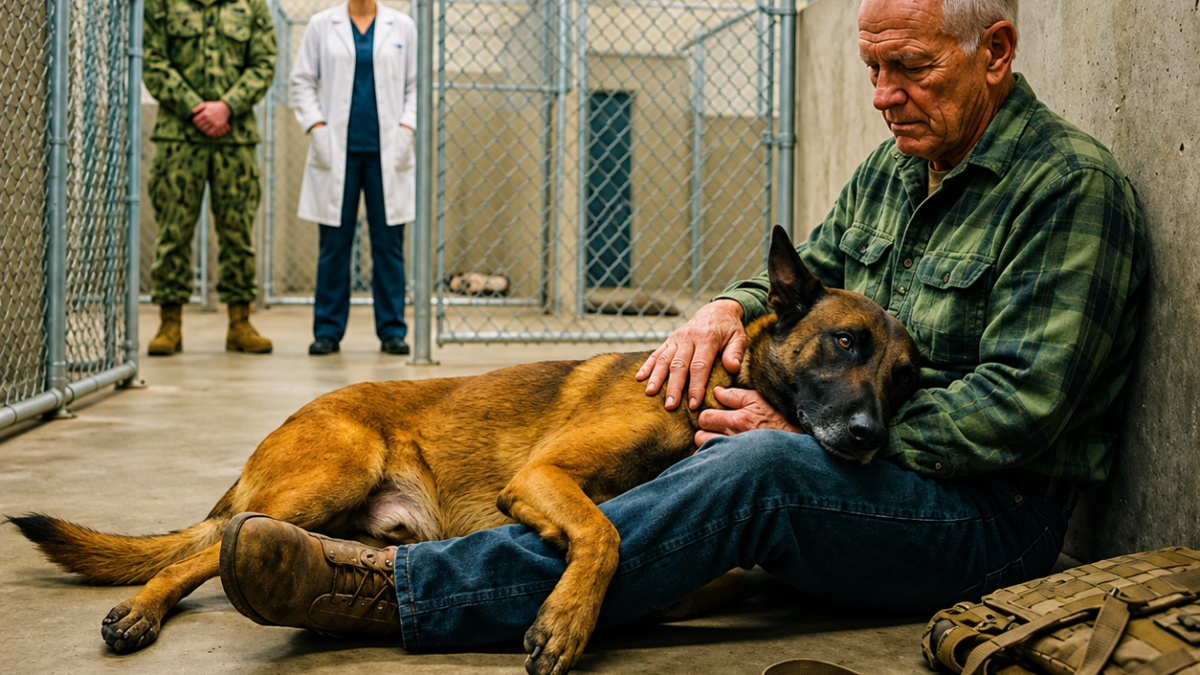
He let out another long, mournful cry and collapsed onto the concrete, laying his head on Jacob’s knee.
His eyes closed.
And for the first time in one hundred eighty-two days, the warrior dog was at peace.
Outside the fence, nobody moved.
The compound seemed to hold its breath.
Jacob’s hand continued its steady, methodical assessment. Along the flank, half hidden in thick fur, his fingers found a small matted knot. He worked at it gently, blunt fingernails teasing apart the tangle until he freed a tiny dried burr, the kind that grew wild in the high deserts of Afghanistan.
It had been there for six months.
A small, constant irritant all the veterinarians and all their modern equipment had missed.
A tiny piece of the battlefield Phalanx had carried home with him.
Jacob plucked it free and flicked it away.
Elena leaned against the chain-link fence.
Her scientific certainty had not vanished, but something in it had shattered and rearranged itself into humility.
Her charts.
Her data.
Her methodology.
None of it was meaningless.
She knew that.
But it had not been enough.
Not because science had failed.
Because she had mistaken data for understanding.
“How?” she whispered.
The word barely formed.
“How did you do that?”
“What was that word?” Davis asked.
Jacob looked up, pale eyes meeting theirs over the now docile dog.
“Just something Liam mentioned in one of his letters,” he said.
The lie was smooth.
Easy.
“A calming word they used.”
Davis knew better.
That was not a calming word.
It was a command.
And the way the old man moved, the way he had handled himself, the way he had just field-checked the dog, the economy of motion, the breath control under extreme stress—it all screamed of deep training that did not come from ranch fences and cattle barns.
“Sir,” Davis said.
His voice carried a new, profound respect.
“With all due respect, that’s not something you pick up from a letter.”
Jacob’s gaze shifted to him.
Davis continued carefully.
“The way you kneeled. Your stance. Your breathing. The way you assessed him. Where did you serve?”
Elena looked from Davis to Jacob.
Phalanx lifted his head slightly, then settled again, as if he had already chosen whose answers mattered.
Jacob Brandt’s tired eyes held a flicker of something.
Pride, maybe.
Or shared understanding.
He slowly got to his feet.
Phalanx rose with him, sticking to his leg like a shadow.
“A long time ago,” Jacob said simply.
He offered no more.
“In a place that doesn’t exist anymore.”
He rubbed Phalanx’s head once, firm and brief.
“He’ll be all right now. He just needed someone who spoke his language.”
Then he turned and walked toward the gate.
Phalanx trotted calmly at his heel.
Elena and Davis stood in stunned silence, watching the old man and the redeemed dog walk away as though this were the most normal thing in the world.
But the mystery of what had just happened was deeper and more compelling than the problem it had solved.
Later that afternoon, Petty Officer Davis stood at parade rest in front of Captain Wallace’s desk.
He had requested the meeting because a nagging certainty would not leave him alone.
He had witnessed something far more significant than a grieving grandfather calming a dog.
Captain Wallace did not look up from the report in his hand.
“At ease, Petty Officer.”
Davis shifted stance.
Wallace was the base commander, a man in his late fifties with iron-gray hair, a calm voice, and the permanently unreadable expression of someone who had signed too many orders to react quickly to anything. He had already received Dr. Reed’s preliminary memo, which Davis suspected had been written with the caution of a person who no longer trusted her own first interpretation of events.
Wallace set the report down.
“Dr. Reed’s memo just came across my desk. It says the Olsen K9 is no longer an immediate threat and that the handler’s grandfather was instrumental. She recommends transfer into his custody pending review.”
He looked at Davis.
“That is a vague sentence, Petty Officer. Fill in the blanks. What the hell happened out there?”
Davis recounted the events precisely.
He did not embellish.
Did not dramatize.
Did not leave out details.
He described Jacob Brandt’s unnatural calm, the perfect tactical stance, the controlled movements, the way he weathered Phalanx’s lunge without a single sign of panic. He described the diagnostic touch. The burr. The vest. The dog’s collapse.
Then he told Wallace about the word.
“Stashy,” Davis repeated. “I checked with someone in language support. It’s regional. Means rest or be at ease, roughly. But not standard. Not something you’d get from a basic phrase sheet.”
Wallace’s pen stopped moving.
Davis continued.
“It’s the kind of word you’d know if you spent time on the ground in very specific regions. Kandahar. Helmand maybe. Older usage. Decades back, possibly. Sir, he said Liam told him in a letter, but with respect, that wasn’t letter knowledge.”
Captain Wallace leaned back in his chair.
For a long moment, he said nothing.
Then he asked, “Brandt, you said?”
“Yes, sir. Jacob Brandt from Montana.”
Wallace was silent.
His gaze fixed on a point on the far wall, as if accessing a file stored deep in memory.
“Petty Officer,” he said finally, “what do you know about the history of Naval Special Warfare K9 work?”
“The basics, sir. Formalized in stages. Expanded significantly after 9/11.”
“Before that.”
Davis hesitated.
“Sir?”
“Before the official budgets. Before state-of-the-art kennels. Before the designations and program codes.”
Wallace turned toward his computer.
“It started with a handful of men in Vietnam. MACV-SOG. They were writing the book as they went. Taking hunting dogs, scout dogs, dogs no manual had properly accounted for, and turning them into trackers, early warning systems, partners in terrain where a man could vanish ten feet away and never be seen again.”
He typed in a series of commands.
“Unorthodox. Highly classified. Most records destroyed, buried, misfiled, or sealed so deep they might as well be underwater.”
A heavily redacted file appeared on the screen.
Wallace turned the monitor toward Davis.
At the top:
BRANDT, JACOB T.
CPO, USN, RETIRED.
Beneath it, long black bars covered operational names, dates, and locations stretching from the late 1960s to the early 1980s.
One line near the bottom remained unredacted.
A citation.
Navy Cross.
Awarded in secret.
Davis read the summary.
For extraordinary heroism while serving as lead scout and K9 handler during a clandestine cross-border operation, Chief Petty Officer Brandt and his K9 Major single-handedly held off a numerically superior enemy force, enabling the extraction of his reconnaissance team.
Davis’s breath caught.
He looked at the screen.
Then at Wallace.
“Jacob Brandt is not a farmer who happens to be a SEAL’s grandfather,” Wallace said.
His voice carried quiet reverence.
“He is one of the originals. A plank owner. One of the men who invented the work you do today.”
Davis stared.
“He wrote the first chapter of the playbook on unconventional warfare with a dog at his side. When he retired, he requested his file be sealed. He wanted to disappear. Went to Montana. Bought land. Became a farmer. As far as the world was concerned, Chief Petty Officer Brandt ceased to exist.”
The pieces clicked into place in Davis’s mind with the force of a chambered round.
The calm.
The stance.
The old command.
The hands that knew exactly how to assess a warrior dog.
Jacob had not simply been calming an animal.
He had been a founding father of their tribe speaking to one of his own in a language older than the compound, older than the program as Davis knew it, older than the official words for what they did.
Wallace leaned back.
“His grandson Liam was one of the few reasons anyone in command even knew Brandt was still alive. Liam was his legacy.”
The captain’s voice softened.
“And when his grandson fell, the old wolf came down from the mountain.”
The next morning, Elena Reed found Jacob Brandt in a small grassy training field on the far side of the base.
Phalanx was with him.
The change in the dog was staggering.
He was not merely calm.
He looked whole.
Not healed entirely. Elena knew enough not to mistake a single day for recovery. But something essential had shifted. He moved beside Jacob with relaxed attention, body loose but ready, eyes bright without frenzy. No pacing. No growling. No frantic scanning for enemies only he could see.
He looked like a working dog again.
Not a caged monster.
Jacob held a simple rope toy in one hand.
For the first time in half a year, Phalanx looked like he might actually want to play.
Elena stopped a respectful distance away.
“Mr. Brandt.”
He turned.
“Doctor.”
“I wanted to apologize.”
The words felt clumsy.
Inadequate.
“I was arrogant. I came at him with science, and I missed the soldier. I saw a case. A dangerous asset. A behavioral problem.”
She looked at Phalanx.
“You saw him.”
Jacob tossed the rope toy a short distance.
Phalanx bounded after it, movements fluid and joyful, and brought it back, dropping it at Jacob’s feet.
The simple act felt like a miracle.
Jacob picked up the rope.
“You weren’t wrong, Doctor.”
Elena looked at him.
“The science matters,” he said. “Medicine matters. Data matters. But you can’t forget what they are down deep.”
He glanced at Phalanx.
“Pack animals. Working animals. Warriors, in the only way dogs can be warriors. They understand loyalty, hierarchy, duty, and loss in ways we mostly forgot how to respect.”
He rubbed Phalanx’s head.
“Liam was his alpha. His partner. His entire world. When Liam was gone, Phalanx was a soldier left on the battlefield without a commander and without orders. All he knew to do was guard his last known position.”
Elena swallowed.
“The enclosure.”
“The fight,” Jacob corrected. “His fight. You all thought he was attacking you. Maybe sometimes he was. But mostly he was keeping everybody back until his boy came home.”
“And the word?” Elena asked.
“Stashy.”
“It wasn’t just a word.”
Jacob smiled.
A rare thing.
It crinkled the corners of his eyes and made him look briefly like someone Liam might have known not as legend, but as grandfather.
“No,” he said. “It was a key. A command from his world. From someone who understood his world.”
He looked down at Phalanx.
“It told him the battle was over. Gave him a new order. Stand down.”
His voice lowered.
“It gave him permission to grieve.”
Elena looked at the dog, now sitting with one shoulder touching Jacob’s leg.
“And now?”
“Now he has a new pack.”
The words were simple.
But they landed heavily.
Elena felt humility wash through her.
Not humiliation.
Humility.
The clean kind.
The kind that makes room for learning.
“The Navy has approved his transfer to your custody,” she said. “Pending final paperwork, but Captain Wallace supports it.”
“I know.”
“Of course you do.”
One corner of Jacob’s mouth moved.
“But his work isn’t done,” he said. “And neither is mine.”
He looked at her directly, pale eyes piercing.
“This is going to happen again, Doctor. We’re going to keep sending brave young men and women into harm’s way, and we’re going to send these dogs with them. Sometimes both come home. Sometimes neither does.”
Phalanx leaned against his leg.
“And sometimes only the dog comes home.”
Elena said nothing.
“You need a program that understands the warrior, not just the animal. You need to treat the bond. That’s the thing that gets injured.”
It was not a suggestion.
It was a directive.
In that moment, Elena was not looking at a farmer.
She was looking at a chief.
A leader of immense and unquestionable authority.
“Teach me,” she said.
The words came from somewhere deeper than professional curiosity.
“Help me build it. Help me understand.”
Jacob Brandt studied her for a long time.
He saw pride, but not the kind that blocks learning.
He saw fatigue.
Guilt.
And beneath it, willingness.
He gave a slow nod.
“All right, Doctor.”
His voice was the same quiet anchor it had been in the kennel.
“Get a notebook. Class is in session.”
He turned to Phalanx, who looked up at him with absolute trust.
“First lesson,” Jacob said. “It’s not about the training.”
Elena listened.
“It’s about the trust. Everything, and I mean everything, starts from there.”
He started walking.
Phalanx trotted happily at his side, a living testament to a bond that science could observe but not fully measure, and that death had failed to break.
Elena Reed, student once more, fell into step beside the old ghost and his warrior dog.
Ready to learn the language she had never known existed.
The quiet war for one dog’s soul was over.
But a new and more hopeful mission was just beginning.
Over the next two weeks, Jacob Brandt became the most unlikely instructor Naval Base Coronado had ever hosted.
He refused conference rooms.
Refused PowerPoint.
Refused any meeting where people sat too far from dogs.
Instead, he taught in training fields, kennel corridors, medical bays, and once, to Elena’s annoyance, beside a maintenance shed because he said the echo of the metal door reminded him of a dog transport trailer and therefore “made a point better than a slide deck.”
People began attending quietly at first.
Davis came every day.
So did Elena.
Then two more handlers.
Then a veterinarian.
Then Captain Wallace stood at the back of one session with his arms folded, pretending he had only stopped by for five minutes and staying nearly an hour.
Jacob never lectured the way professors lectured.
He told stories.
Not heroic ones.
Not the kind that made him look brave.
Small ones.
A scout dog in Vietnam who refused to cross a patch of jungle and saved eight men from walking into an ambush.
A handler who mistook exhaustion for disobedience until his dog collapsed with fever.
A dog named Major who once carried a strip of torn uniform in his mouth for three days after they lost a man Jacob never named.
A young operator who learned too late that a dog’s hesitation was often intelligence trying to slow down human impatience.
“Most men,” Jacob said one morning, standing beside Phalanx while four handlers watched, “want obedience because obedience makes them feel in control.”
He looked at Davis.
“Control is useful. But trust is better.”
Davis nodded slowly.
“A dog that trusts you will tell you the truth. A dog that only obeys may do exactly what you command, even when the command is wrong.”
Elena wrote that down.
Jacob glanced at her notebook.
“Don’t just write it. Watch it.”
She lowered the pen.
Phalanx sat in the grass beside Jacob, alert but calm.
“Ask him for something,” Jacob told Davis.
Davis hesitated.
“Me?”
“You feed him, don’t you?”
“With a pole.”
“Then introduce yourself without the pole.”
Davis approached carefully.
Phalanx watched him.
Not with the old murderous intensity, but with a soldier’s evaluation.
Davis stopped six feet away.
“Phalanx,” he said.
The dog’s ears moved.
Davis looked to Jacob.
Jacob said nothing.
Davis lowered himself slowly into a crouch.
Phalanx looked at Jacob.
Jacob gave no command.
No correction.
No reassurance.
He let the dog choose.
After a long moment, Phalanx stood.
Davis froze.
The Malinois walked toward him.
Stopped.
Sniffed the air.
Then nudged the young handler’s knee with his nose.
Davis’s face changed.
He reached out slowly, hand low.
Phalanx accepted the touch.
It lasted less than five seconds.
But Davis looked like he had been handed a medal he did not deserve.
Jacob nodded.
“That’s a start.”
Elena looked down at her notebook again.
Trust starts where force ends.
She did not know if Jacob had said that or if she had written it for herself.
Either way, it remained.
Phalanx’s transfer became official at the end of the month.
The ceremony was not public.
Jacob would have hated that.
There was paperwork, signatures, veterinary clearance, transport arrangements, and a quiet gathering near the training field. No speech was planned, but Captain Wallace gave one anyway because military men could not resist making moments official when paperwork alone felt insufficient.
He did not mention Jacob’s sealed file.
He did not call him a hero.
He simply said, “Some debts are too old and too sacred to be measured by policy.”
Jacob looked irritated.
Davis smiled.
Phalanx stood at Jacob’s side, wearing no tactical gear, only a simple collar.
When the final form was signed, Elena felt an unexpected ache.
She had spent six months fighting for this dog.
Then one old man had done what she could not.
But that was not the whole truth, she reminded herself.
Six months of keeping Phalanx alive had made this moment possible.
Failure, she realized, was sometimes not the opposite of rescue.
Sometimes it was the bridge to the person who finally knew the missing word.
Jacob loaded Phalanx into the back of a dust-covered pickup truck that looked wildly out of place on base.
The dog hesitated only once.
He looked back toward the kennels.
Toward the concrete run.
Toward the place where his grief had been mistaken for madness.
Then he looked at Jacob.
Jacob rested one hand on his head.
“Forward,” he said.
Not the old command.
A new one.
Phalanx climbed in.
A month later, a package arrived on Dr. Elena Reed’s desk.
No return label beyond a Montana postmark.
Inside was a photograph.
Phalanx standing in a wide field beneath a sky so large it made the Navy compound in Elena’s memory feel like a box. His coat shone in cold sunlight. Snow dusted the distant mountains. Jacob stood beside him in the same worn flannel, one hand resting on the dog’s shoulder.
On the back, in rough block letters, Jacob had written:
He sleeps through the night now. Still checks the perimeter. Good instincts. We’re both learning how to be old soldiers.
Beneath that, in a smaller line:
Keep building the program. There will be more.
Elena pinned the photograph above her desk.
She did build it.
Not quickly.
Not perfectly.
But with a seriousness that surprised people who thought she might treat the incident with Phalanx as an anomaly.
She called it the Warrior Bond Reintegration Protocol at first, until Jacob read the draft and told her by phone that it sounded like “something invented by people who never got mud on their boots.”
They argued for six minutes.
The final name became simpler.
The Handler-K9 Transition Program.
It included medical care, behavioral assessment, scent and object preservation, controlled grieving protocols, handler-loss transition support, family integration planning, and, most importantly, education for every human involved.
Do not erase the handler too quickly.
Do not remove every object because the humans cannot look at it.
Do not mistake guarding for aggression without asking what the dog believes he is guarding.
Do not ask the dog to “move on” before giving him a new place to stand.
Treat the bond.
That was the core.
Jacob’s line.
Elena made it the center.
Davis became one of the program’s strongest advocates.
He had seen the difference between control and understanding on the concrete floor of that enclosure. He had watched a dog marked for death collapse into peace because one person spoke his language. That kind of thing either changed a man or made him spend the rest of his life pretending not to have seen it.
Davis chose change.
He wrote Phalanx’s case summary himself, careful to protect sensitive details but honest where it mattered.
Subject displayed prolonged hypervigilance and defensive aggression after handler death. Previous interventions focused primarily on reducing symptoms. Breakthrough occurred after grief framework was reframed around duty, bond preservation, and command transition.
Elena crossed out “breakthrough.”
Too dramatic.
Then put it back.
Some moments deserved the word.
Six months after Phalanx left Coronado, Jacob returned.
He did not announce himself.
He simply appeared one morning at the edge of the training field, Phalanx at his heel, both of them dusted from a long drive and looking like they had stepped out of another century.
The dog looked older.
Healthier.
Scarred, yes.
Carrying memory, yes.
But alive in a way that made Davis stop mid-sentence and simply stare.
Phalanx saw him.
His tail moved once.
Then he walked over and placed his head against Davis’s chest.
Davis closed his eyes.
“Hey, warrior.”
Phalanx leaned harder.
Jacob pretended not to notice the young handler wiping his face.
Elena came out of the clinic building and stopped when she saw them.
For one second, she looked like the same woman from that first day: lab coat, controlled posture, professional distance.
Then she smiled.
“Mr. Brandt.”
“Doctor.”
“You look well.”
“I look old.”
“You looked old before.”
Davis coughed into his fist.
Jacob’s mouth twitched.
Phalanx trotted to Elena and sniffed her hand.
She did not reach too fast.
She had learned.
The dog accepted her touch.
That, too, felt like a miracle.
Jacob spent three days reviewing the program.
He approved of some things.
Disliked more.
Rejected anything that sounded too neat.
“Grief ain’t linear,” he said during one session.
A young psychologist nodded eagerly.
“Right, there are stages—”
Jacob turned slowly.
The room got very quiet.
“Don’t put a working dog in your little grief staircase,” he said. “He’ll jump off it and bite you on the way down.”
Elena pressed her lips together to keep from smiling.
Jacob continued.
“Some days he’ll eat. Some days he’ll guard the door for a man who isn’t coming. Some days he’ll play. Some days a smell will put him back in the fight. Your job isn’t to drag him forward every hour like you’re hauling feed sacks. Your job is to give him enough safety that forward becomes possible.”
The young psychologist wrote very fast.
On the last evening, Jacob visited Liam’s memorial plaque near the canine compound.
It was small.
Simple.
Petty Officer First Class Liam Olsen.
A few lines.
A date.
A symbol of SEAL Team Three.
Elena saw him there but did not approach.
Phalanx sat beside him.
For a long time, neither moved.
Then Jacob reached into his pocket and pulled out something small.
A patch.
Worn.
Faded.
Liam’s.
He placed it beneath the edge of the plaque.
Phalanx lowered his head and sniffed it.
Then pressed his nose once to the stone.
Jacob’s shoulders shifted.
Not much.
Just enough.
The next morning, he and Phalanx left before sunrise.
Davis found a note taped to the training room door.
Three words.
Keep listening.
Years later, the story of Phalanx and Jacob Brandt became something people at Coronado told carefully.
Not because it was secret.
Because it was sacred.
New handlers heard versions of it.
Veterinarians heard it.
Psychologists heard it.
Young men who believed confidence meant having answers heard it more than once.
There was a dog, they were told, who would let no one near for six months.
There was an old farmer who walked into the enclosure and did not flinch.
There was one word.
One vest.
One grief finally named correctly.
But the people who told the story best always included the part outsiders forgot.
They included Dr. Elena Reed, who had the humility to let the gate open after her own methods failed.
They included Petty Officer Davis, whose hand stayed near the tranquilizer gun but whose eyes recognized a professional at work.
They included Liam Olsen, whose love for his dog survived in letters, training, scent, and loyalty.
They included Jacob Brandt, the old ghost who had disappeared into Montana after writing a chapter of history in places that officially barely existed.
And always, they included Phalanx.
Not as a beast saved from death.
Not as a symbol.
As a warrior who had been misunderstood.
A dog who had not gone mad.
A dog who had been standing watch.
In the spring of his second year in Montana, Phalanx began sleeping on the porch at sunset.
Jacob’s farm sat beneath a wide sky where the wind moved through grass like water. The land was not gentle, but it was honest. Fence lines. Hay fields. Weathered barns. A narrow creek. Mountains far enough away to look like memory.
Phalanx patrolled it all.
Not obsessively anymore.
Not like he was guarding a battlefield.
Like he belonged to a place worth watching.
Jacob grew older.
That was inevitable.
His hands stiffened in cold weather. His knees complained. Some mornings, he took longer to rise than he wanted Phalanx to notice. The dog noticed anyway.
Working dogs always do.
One evening, Jacob sat on the porch with Liam’s old vest folded beside him. The sun had gone low, painting the fields in gold and rust. Phalanx lay near his boots, head raised, ears tracking birds, wind, distant cattle, the world.
Jacob rested one hand on the dog’s shoulder.
“You did good, son.”
Phalanx looked at him.
Jacob’s voice roughened.
“He’d be proud of you.”
The dog lowered his head onto Jacob’s boot.
For a while, neither moved.
There are bonds death cannot command to stop.
They change shape.
They become duty.
Memory.
A dog sleeping through the night.
An old man teaching again.
A doctor learning humility.
A program built because one life was spared.
A field in Montana where a SEAL’s K9 finally stopped guarding a war that had already ended.
When Phalanx died years later, it was not behind a fence.
It was not on concrete.
It was not with a growl in his throat and strangers afraid to approach.
He died old.
Gray around the muzzle.
Scarred.
Loved.
His head rested in Jacob Brandt’s lap beneath the wide Montana sky.
Jacob’s hand moved through his fur with that same old diagnostic tenderness, checking nothing now, only remembering.
“Stashy,” Jacob whispered one last time.
At ease.
Rest.
Phalanx exhaled.
And obeyed.
The next month, a package arrived at Naval Base Coronado.
Inside was the rope toy Phalanx had carried in the training field the day Elena first saw him play again. There was also a handwritten letter from Jacob, shorter than anyone wanted and exactly as long as he needed.
Doctor Reed,
He stood his post until the end.
So should you.
—Brandt
Elena placed the rope toy in a glass case near the entrance of the Handler-K9 Transition Program.
Beneath it, she mounted a small brass plaque.
PHALANX
MWD K9, SEAL TEAM THREE
LOVED BY PETTY OFFICER FIRST CLASS LIAM OLSEN
BROUGHT HOME BY CHIEF PETTY OFFICER JACOB T. BRANDT
HE TAUGHT US TO TREAT THE BOND.
Handlers who passed it often touched the case.
Some knew the full story.
Some only knew pieces.
But every person who entered that wing learned the lesson.
A working dog is not a machine.
Not a weapon to be stored when damaged.
Not a symbol to be praised only when obedient.
He is a living partner, built from training, instinct, loyalty, memory, trust, and love fierce enough to look like violence when the world takes away the person he was sworn to protect.
Phalanx had not needed more fences.
He had needed someone who understood what he was still guarding.
Someone who could kneel before the rage, place a hand on the last scent of the man he loved, and give him the order nobody else knew how to give.
Stand down.
The battle is over.
You are not alone.
And somewhere in Montana, beneath wind and grass and sky, an old farmer’s porch remained empty for a while after Jacob Brandt was gone too.
But the story did not end there.
It lived in every handler who learned to ask a better question.
Not, “How do we control him?”
But, “What bond has been broken?”
Not, “Why is he dangerous?”
But, “What does he think he is still protecting?”
Not, “How do we make him forget?”
But, “How do we help him carry what he remembers?”
That was Jacob Brandt’s final lesson.
And Phalanx, the dog no one could touch, became the reason generations of warrior dogs after him were finally understood not only as assets, not only as partners, but as souls who could grieve, wait, guard, break, heal, and choose to come home.
All because an old man stepped through a gate everyone else feared to open.
All because he saw past the teeth.
All because he spoke one forgotten word.
And the warrior dog who had been holding the line for six months finally knew he was allowed to live.