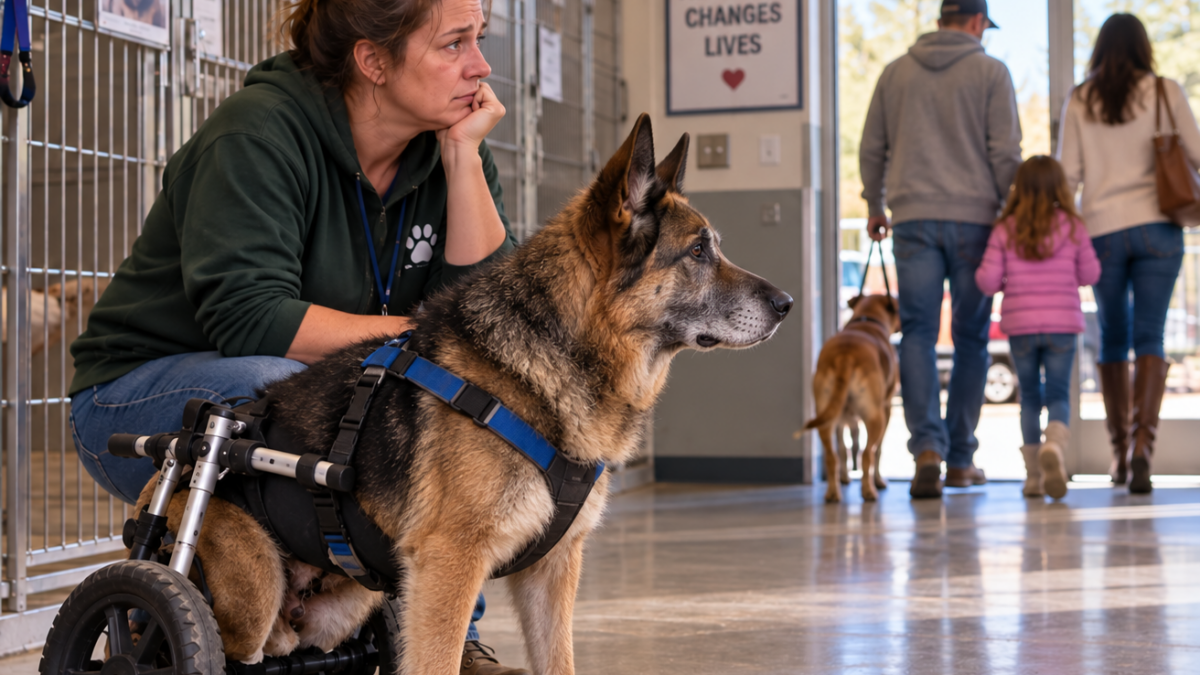
The paralyzed German Shepherd watched two families walk away, his useless back legs resting in a wheelchair nobody wanted to take home.
PART3:
“And how much clearance would you recommend for a ramp?”
I stared at her.
“At least thirty inches. Thirty-two would be safer.”
She nodded thoughtfully.
“Thirty-two it is.”
Bishop nudged the measuring tape with his nose.
June smiled and slowly retracted it.
Then she looked up at me.
“What happens if he tips over on the ramp when I’m home alone?”
I started explaining safety harnesses, side rails, and proper ramp slopes.
But June was already reaching into her coat pocket.
She unfolded a small piece of graph paper covered in handwritten measurements.
And when she placed it on the floor between us, I noticed something that made my throat tighten.
She had not come to the shelter wondering whether she could make room for Bishop.
She had arrived with measurements of a home she was already preparing to change.
For several seconds, I could not speak.
I just stared at the little piece of graph paper lying on the visitation-room floor.
There was nothing remarkable about it at first glance.
A rough rectangle represented a house. Smaller rectangles marked the kitchen, bathroom, bedroom, and living room. There were numbers written in pencil beside doorways. A small square marked the back porch.
Across the bottom, June had written two words.
Possible ramp.
I looked from the drawing to her face.
“Did you make this for Bishop?”
She seemed surprised by the question.
“Well, yes.”
“You haven’t even met him before today.”
“I know.”
“Then how did you know what measurements you’d need?”
June glanced at Bishop, who was busy investigating the cuff of her work jeans.
“I didn’t,” she replied. “That’s why I came with a tape measure.”
It was such a practical answer that I almost laughed.
But something about her calmness caught me off guard.
Most visitors who expressed interest in Bishop spoke about what they hoped might happen.
They hoped his paralysis would improve.
They hoped his care would not be difficult.
They hoped he would somehow fit into the homes they already had.
June was not talking about hope.
She was talking about measurements.
She pointed toward the back of her little floor plan.
“My back door has a thirty-four-inch opening. The threshold is only about an inch and a half high. I can take that out.”
Then she tapped another part of the drawing.
“The hallway is thirty-eight inches wide. That should be enough for him to turn, shouldn’t it?”
“Probably,” I said. “But we’ll want to see him maneuver through a similar space first.”
She nodded.
“Fair enough.”
She pointed to the front entrance.
“Three steps. That’s the tricky part. I’ve got room for a ramp, but I don’t want it too steep.”
I explained that we would need to consider the total rise, the available landing space, the ramp surface, and whether she could safely guide Bishop up and down it.
June listened without interrupting.
Then she took out a pencil.
Bishop lowered his head onto her knee.
She paused.
Not because he had interrupted her measurements.
Because he had chosen to touch her.
Her hand settled gently behind his left ear.
“Hello there, handsome,” she murmured.
Bishop closed his eyes.
For the first time that morning, he was not looking toward the door.
He was resting against someone who had not talked about leaving.
I wish I could tell you that I knew right then she would become his person.
I did not.
I had seen too many promising adoptions fall apart after the first conversation.
Good intentions were not enough.
Not for a dog like Bishop.
Love could convince someone to take him home.
But love alone could not prevent a urinary tract infection, protect his hind legs from friction injuries, or lift him safely into a wheelchair every morning.
Bishop needed consistency.
He needed someone willing to learn procedures that would make many people uncomfortable.
He needed a home that was physically accessible.
Most of all, he needed someone who would not resent him for requiring help.
So I asked June the question I dreaded asking whenever I felt myself beginning to hope.
“Have you ever cared for a paralyzed animal?”
She shook her head.
“No.”
My heart sank a little.
Then she added, “But I’ve taken care of broken things all my life.”
I smiled politely.
June saw my expression.
“I don’t mean the dog,” she said immediately. “I mean the equipment. I’m good with tools. I know how to build something safe, and I know when I need a professional.”
She looked down at Bishop.
“He’s not the thing that needs fixing.”
That sentence stayed with me.
Because Bishop had spent months surrounded by people who wanted to repair the one part of him that might never change.
June was the first visitor who seemed to understand that his paralysis was not a personal failure.
It was simply part of how he moved through the world.
And the world, she believed, could sometimes be made easier to move through.
I asked June to tell me about her home.
She lived in a modest bungalow on a quiet residential street about twenty minutes from the shelter.
The house had belonged to her parents before she bought it from their estate.
It had one bedroom, a small kitchen, a living room with hardwood flooring, and an enclosed backyard.
There were no children.
No other pets.
No steep basement staircase Bishop would need to navigate.
June had retired from the Portland transportation system three years earlier after spending most of her adult life maintaining city buses.
Her job had involved hydraulic lifts, wheelchair restraints, electrical systems, and mechanical repairs that had to work correctly every single time.
“On a bus,” she told me, “you don’t get to say the wheelchair lift is too much trouble today. If somebody needs it, it needs to work.”
I nodded.
“That’s useful experience.”
“It taught me not to guess about weight limits.”
She examined Bishop’s wheelchair again.
“Who maintains this?”
“Our veterinary team checks it regularly. The manufacturer handles certain replacement parts. We can explain the fitting schedule and refer you to people who specialize in mobility equipment.”
She nodded.
“Good. I don’t want to start modifying something I don’t understand.”
That answer impressed me more than confidence would have.
June knew what she knew.
More importantly, she knew what she did not.
I asked how she planned to manage Bishop’s daily care.
She looked at me.
“I was hoping you’d show me.”
“Of course. But it’s more involved than most people expect.”
“I figured.”
I explained that Bishop needed assistance emptying his bladder several times throughout the day, according to his veterinary care plan.
His skin had to be checked for redness, pressure, dampness, or injury.
His protective equipment had to fit correctly.
His hind legs needed to be positioned safely.
He could not remain in his wheelchair indefinitely.
And because his sensation was impaired, he might not react normally if something hurt him.
June listened carefully.
Then she asked whether I could write everything down.
I told her we already had a detailed care sheet.
“Good,” she said. “I’d rather read the instructions ten times than pretend I understood something the first time.”
Bishop pushed forward in his chair.
One red wheel bumped against her boot.
June moved her foot aside.
He continued until his chest rested against her knee.
She scratched beneath his collar.
“You’ve got a lot of people discussing your business, haven’t you?”
His tail gave a small movement.
It was not a grand gesture.
He could not wag with the loose, whole-body enthusiasm of a physically typical dog.
But his ears relaxed, and his face softened.
I watched June scratch his chest.
Then I asked something that was not on our application.
“Why Bishop?”
She looked up.
“What do you mean?”
“We have younger dogs. Smaller dogs. Dogs who don’t require medical care. You’ve seen his picture and read his description. What made you schedule an appointment?”
Her hand stopped moving.
For the first time since she had arrived, June seemed uncertain.
Not about Bishop.
About how much of herself she wanted to reveal.
Finally, she looked toward the window.
Rain slid down the glass in crooked lines.
“I had a dog once,” she said.
I waited.
“His name was Walter.”
She smiled faintly.
“Big black Labrador mix. Terrible manners. Could open the refrigerator if I didn’t keep a child lock on it.”
Bishop lifted his nose.
June resumed stroking his neck.
“Walter lived with me for thirteen years.”
“What happened to him?”
“Age, mostly. His hips went. Then his kidneys. Eventually there were more bad days than good ones.”
“I’m sorry.”
“Thank you.”
She swallowed.
“I lost him two years ago.”
There was a pause.
Then she said, “When he got older, he couldn’t manage the back steps anymore. So I built him a ramp.”
I glanced down at her sketch.
She noticed.
“That old ramp’s gone now. The wood started rotting, and I took it out last spring.”
She rubbed Bishop’s chest.
“But I still know where the supports went.”
Something changed in her voice.
It became quieter.
“I remember how happy Walter was the first time he walked outside without me lifting him. You should’ve seen him. He stood in the yard like he’d conquered the whole neighborhood.”
I smiled.
June looked at Bishop.
“I saw his picture Wednesday night. And I kept thinking about how many people might look at those wheels and see everything he couldn’t do.”
She moved her palm slowly over his shoulder.
“I wondered what he could do if somebody made the house work for him.”
I did not answer immediately.
Because I was beginning to understand.
June was not trying to replace Walter.
She was remembering what it had meant to help an aging dog keep the little freedoms he still loved.
But Bishop was different.
Walter had gradually lost mobility after years in a familiar home.
Bishop would be arriving as a stranger.
He would need to learn June’s voice, her routines, her doorways, and her expectations.
June would need to learn him.
That mattered.
So I asked whether she understood the difference.
She did not seem offended.
“I think so,” she said. “But I’d like you to tell me what I’m missing.”
And for the next forty minutes, that was exactly what I did.
We began with Bishop’s wheelchair.
I showed June how the padded support sling sat beneath his pelvis and how the adjustable frame allowed his weight to be distributed properly.
I explained how his rear paws rested in protective stirrups to keep them from dragging against the ground.
She examined the buckle positions.
Then she examined Bishop.
“Does he like getting into it?”
“Most days. He knows it means he gets to go somewhere.”
“Most days?”
“He has tired days, just like anyone else.”
She nodded.
“What do you do then?”
“We let him rest.”
“Good.”
She said the word as though it settled something important.
I demonstrated how Bishop’s front legs propelled the chair.
He rolled across the visitation room, turned around a plastic water bowl, and stopped when a rubber wheel caught the edge of a floor mat.
He tried to push forward.
The chair resisted.
I stepped toward him, but June raised one hand.
“May I see what he does?”
I stopped.
Bishop backed up awkwardly, adjusted his angle, and tried again.
This time the wheel cleared the mat.
June grinned.
“Well, look at you.”
He rolled directly toward her.
She laughed.
It was a deep, unselfconscious laugh, the kind you do not often hear in an animal shelter.
Bishop responded by shoving his nose into her hand.
“You figured it out,” she told him.
I thought about the first family.
Their teenage son had wanted to know whether Bishop would ever run.
June was celebrating the fact that he had worked out how to get around a floor mat.
The difference was not about how much either person cared.
It was about what each of them considered a victory.
I showed her how to remove Bishop from the wheelchair.
She watched my hands carefully.
Then she practiced with me supervising, learning where to support his weight without pulling on his injured back or allowing his hindquarters to drop.
She was strong.
Years of mechanical work had left her with solid shoulders and hands that moved with practiced precision.
But strength alone was not enough.
Bishop weighed nearly sixty pounds.
He was cooperative, but he could shift unexpectedly.
He could become frightened.
He could struggle.
One careless lift could hurt both of them.
June understood.
“Would a lifting harness help?” she asked.
“Yes. We can show you the style he uses and how it needs to fit.”
She wrote that down.
I took her through his indoor movement routine.
Without the wheelchair, Bishop moved by pulling himself forward with his front legs.
We used a protective drag bag on appropriate indoor surfaces to reduce friction against his skin.
June watched him travel from his blanket to his water dish.
Then she looked at the doorway.
“Does he ever get frustrated?”
“Of course.”
“What does he do?”
“Sometimes he barks at the obstacle. Sometimes he tries to solve it. If he’s tired, he’ll stop and wait for help.”
She considered that.
“So I need to know which is which.”
“Exactly.”
She looked back at Bishop.
“Well, buddy, I’m sure you’ll tell me.”
That was the first moment I saw something beyond her mechanical competence.
She was not planning to treat Bishop like a complicated piece of equipment.
She was planning to learn his language.
The medical-care discussion was harder.
I warned June that the next demonstration might be uncomfortable.
She pulled a small notebook from her raincoat.
“All right.”
I brought her into our designated care area, where a veterinary technician named Elena joined us.
Elena had been caring for Bishop for nearly four months.
She knew his eating habits, his skin sensitivities, his preferred sleeping position, and the quiet grumbling sound he made when somebody interrupted his afternoon nap.
More importantly, she knew his medical needs.
She explained the specific bladder-expression schedule established by Bishop’s veterinarian.
Then she demonstrated the technique under the shelter’s clinical protocol.
I watched June’s face.
Many potential adopters became visibly uneasy at this point.
Some looked away.
Some became apologetic.
A few grew embarrassed, as though the procedure itself made the dog less lovable.
June simply watched.
When Elena finished, June said, “Could you show me again?”
Elena repeated the explanation.
June asked about warning signs for urinary infections.
She asked how to monitor urine changes.
She asked what to do if Bishop resisted.
And she asked when a failed attempt meant calling the veterinarian rather than repeatedly trying at home.
Elena answered each question carefully.
Then June asked whether she could practice, with supervision.
That was where the real test began.
June did not get everything right immediately.
She struggled to position her hands the way Elena had demonstrated.
Bishop shifted.
June stopped.
“Sorry, big guy.”
She looked at Elena.
“Can you show me where I’m going wrong?”
Elena adjusted her hand placement and explained the pressure and positioning specific to Bishop.
They tried again.
June remained patient.
But after several minutes, I noticed her expression changing.
Her brow tightened.
Her jaw set.
For the first time, she looked worried.
“That’s harder than I thought,” she admitted.
I appreciated the honesty.
“It is.”
She wiped her hands.
“What happens if I can’t learn it?”
I did not soften my answer.
“Then Bishop can’t safely go home with you until we find a reliable care arrangement. This is essential, not optional.”
June lowered her eyes.
For a long moment, she said nothing.
I prepared myself for another goodbye.
Then she reached into her pocket for her notebook.
“How many practice sessions can I schedule?”
I stared at her.
“What?”
“How many times can I come back before you’d feel comfortable evaluating whether I can do it safely?”
Elena looked at me.
Then she smiled.
“As many as we can reasonably arrange.”
June nodded.
“Good. Because I’m not going to pretend I know something I don’t.”
She looked toward Bishop, who was watching us from his blanket.
“And I’m not taking him home until I can do right by him.”
I had heard countless declarations of love in that room.
But I had rarely heard anything that sounded more like commitment.
June stayed nearly three hours that Saturday.
She practiced handling Bishop’s wheelchair.
She walked him through the visitation room and the covered outdoor exercise area.
She learned how to check his skin.
She asked about his food, his medications, his veterinary records, and the approximate cost of long-term care.
She requested copies of the equipment information.
She also asked whether the shelter could arrange a follow-up appointment with his neurologist or rehabilitation team.
By the time she stood to leave, the rain had stopped.
Bishop was lying across her boots.
She looked down.
“Well, that makes getting up interesting.”
I laughed.
“He does that when he likes someone.”
She bent over and scratched his ear.
“Is that right?”
He pressed his forehead against her palm.
She stayed still for a moment.
Then she said, “I have to go build something.”
My chest tightened.
“June—”
She looked up.
“I know. I haven’t been approved. I haven’t even finished my training.”
“Right.”
“I’m not assuming anything.”
She clipped her tape measure back onto her belt.
“But if there’s a chance this boy comes home with me, I want the house ready before he does.”
I nodded.
She crouched beside Bishop one last time.
“I’ll be back,” she told him.
I wish people understood what those words can mean inside a shelter.
Animals hear promises every day.
People say they will return.
They say they will call.
They say they need to discuss things at home.
Sometimes they mean it.
Sometimes they do not.
Bishop did not know the difference.
He only knew that the woman who had sat on the floor with him was getting up.
He followed her toward the doorway.
His red wheels made their familiar soft clicking sound across the floor.
June stopped.
For one second, I thought she might turn around and take him home right then.
Instead, she knelt.
She placed one hand on either side of his face.
“I can’t take you yet, sweetheart.”
Bishop leaned forward.
“But I’m working on it.”
She kissed the dark fur between his eyes.
Then she stood and walked out.
Bishop remained by the door.
I watched his ears.
They were pointed forward.
He waited through the sound of her footsteps.
He waited through the opening of the outer door.
He waited until the latch clicked shut.
Then he looked up at me.
I crouched beside him.
“She said she’s coming back,” I whispered.
He rested his chin against my knee.
And I hoped with everything I had that this time the words would be true.
On Monday morning, June called at 8:07.
I remember the exact time because I had barely removed my coat.
“Good morning,” she said. “It’s June Walsh. I’m calling about Bishop.”
I smiled.
“Good morning, June.”
“I’ve got a few questions.”
“Of course.”
“First, would you recommend a solid deck surface or textured composite for the ramp?”
I leaned back in my chair.
“Let me connect you with our rehabilitation specialist for the traction requirements.”
“Perfect.”
“Anything else?”
“I measured the available space. I can fit a gentler slope with a turn and a landing.”
“That’s good.”
“I’ll need side protection, too. I don’t want one wheel slipping off.”
I opened Bishop’s file.
“June, have you already started building it?”
There was a pause.
“Not the ramp itself. I’m still checking the design.”
Something in her voice made me smile.
“What have you done?”
“Well, I took up the loose hallway rug. And I moved the shoe rack.”
“The shoe rack?”
“It narrows the hallway by six inches.”
She sounded almost annoyed that she had tolerated such an inconvenience for years.
I laughed.
Then she said, “And I bought a bigger water bowl.”
I went quiet.
For some reason, the water bowl got to me.
Not the ramp.
Not the measurements.
Not even the hours she had spent learning about Bishop’s medical condition.
The water bowl.
It was such an ordinary object.
A simple stainless-steel dish that most people would purchase without thinking.
But June had bought it for a dog she did not own.
A dog who might never be approved for her home.
A dog who had already watched too many people leave.
I looked through the window toward the kennel corridor.
Bishop was lying on his blanket, chewing one corner of a rubber toy.
“That’s thoughtful,” I said.
June cleared her throat.
“Well, he’ll need somewhere to drink.”
Over the following week, June returned to the shelter four times.
Every visit began with Bishop hearing her voice.
On Tuesday, I was walking him through the main corridor when June stepped through the door.
“Morning, handsome.”
Bishop froze.
His head lifted.
Then his front paws began moving so quickly that I had to shorten the leash to keep him from rolling into a stack of donated food bags.
His wheels rattled.
His ears stood high.
And he made a strange, breathy sound I had never heard from him before.
June laughed.
“Well, hello to you, too.”
Bishop pressed his chest against her legs.
She bent to greet him.
Then she looked at me.
“Does he do that with everybody?”
“No,” I answered.
And that was the truth.
Bishop liked people.
He enjoyed attention.
But he had begun to recognize June.
Not just as another visitor.
As someone familiar.
Someone predictable.
Someone who came back.
That mattered more than most people realized.
The training was not always easy.
On Wednesday, June struggled through a bladder-care session.
Bishop was restless.
He wanted to leave the care room and investigate the sounds coming from the kennel corridor.
June became tense.
He became more restless.
Elena gently asked her to stop.
June stepped away.
“I don’t want to make him afraid of me,” she whispered.
Elena reassured her that the goal was a calm, consistent process and that a caregiver needed to recognize when to reset, ask for help, or contact the veterinary team.
June nodded.
Then she asked if they could begin again after Bishop had rested.
They did.
The second attempt went better.
Not perfectly.
But better.
When the session ended, June sat on the floor with Bishop’s head in her lap.
She did not look triumphant.
She looked exhausted.
“That was rough,” she said.
“It was a difficult day,” I agreed.
She ran her fingers along Bishop’s ear.
“I keep thinking about what happens if I’m tired. Or sick. Or something goes wrong.”
“Those are important things to think about.”
She looked at me.
“Do you think I can do this?”
I could have offered her easy reassurance.
I could have said yes, of course, because she was kind and determined and clearly loved him already.
But Bishop deserved more than encouragement.
So I told her the truth.
“I think you’re taking the responsibility seriously. And I think you’re learning. But we need to make sure you have reliable backup care before we can say this is a safe long-term arrangement.”
June nodded slowly.
“That’s fair.”
Then she stood.
“Guess I’d better work on that, too.”
Friday afternoon, she returned with a name and phone number.
“Tom Alvarez,” she said, handing me a piece of paper. “He lives two houses down. We’ve been neighbors for seventeen years.”
“Will he be helping with Bishop?”
“He offered to learn.”
I looked at her.
“Learn what?”
“Whatever the veterinary team says a backup caregiver needs to know.”
She explained that Tom was sixty-four, recently retired from a local utility company, and had cared for his own senior dog through several years of mobility problems.
He could not replace a veterinarian.
He did not pretend he could.
But he was willing to attend training, understand Bishop’s daily routine, and help if June became ill or had an emergency.
June had also identified an accessible veterinary clinic closer to her home and found a professional pet-care provider who was willing to discuss specialized care after appropriate training.
“I don’t want his whole life depending on whether I wake up feeling good,” she said.
That sentence almost made me cry.
Because it revealed something I had been struggling to explain for years.
Responsible adoption is not simply a promise to love an animal while life goes according to plan.
It is preparation for the days when it does not.
June understood that.
And each time