A Nurse Walked Into a Retired K9 Auction Looking for One Dog—Then She Called Out “Rex,” and All 30 Working Dogs Froze at Once.
PART2:
One had belonged to her younger brother.
Nobody at Blue River asked about it anymore.
They had learned Delaney was kind with other people’s questions and ruthless with her own privacy.
She walked into room 212.
Mr. Alvarez glared at his blanket.
“You did this.”
“What?”
“Another blanket.”
“You said you were cold.”
“That was twenty minutes ago.”
“Medical science has advanced.”
“I’m sweating.”
“You’ll survive.”
He pointed accusingly.
“You nurses enjoy power too much.”
“Yes.”
That made him laugh.
Delaney removed one blanket.
“Better?”
“Maybe.”
“High praise.”
PART3:
She checked his oxygen saturation.
Good.
Pain controlled.
Incision clean.
His eyes moved toward the therapy hallway.
Another bark.
This one sharper.
Two quick notes.
Mr. Alvarez smiled.
“Which one?”
“Nova.”
“You’re making it up.”
“Belgian Malinois. Female. Retired Air Force.”
“How do you know?”
“She barks like she’s offended.”
He considered.
“That sounds military.”
Delaney smiled.
Retired working dogs were part of Blue River’s veteran rehabilitation program.
Some visited.
A few stayed temporarily during handler recovery.
The hospital had discovered something physicians already knew and administrators preferred to see quantified before believing:
Veterans sometimes spoke more honestly to dogs than therapists.
A man who would not discuss nightmares might sit on the floor for forty minutes brushing an old Shepherd.
A woman who refused physical therapy might walk twenty extra steps because her retired Labrador waited at the far end of the hallway.
Dogs did not ask:
How are you processing your transition?
They asked:
Are you getting up?
Are we going outside?
Do you have food?
Can I lie here?
For some patients, that was enough.
Delaney understood that better than most.
She had grown up around working dogs.
Not because her parents trained them.
Because Micah did.
Micah Brooks.
Three years younger.
Loud.
Funny.
Impossible.
The kind of boy who brought stray animals into the house and announced afterward rather than asking permission.
At twelve, a turtle.
At fourteen, a three-legged beagle.
At seventeen, a baby raccoon he claimed was “temporarily confused.”
Their mother nearly killed him.
Micah joined the Navy at nineteen.
Delaney chose nursing.
Different roads.
Same instinct.
Find something hurt.
Try to help.
Micah became a K9 rehabilitation technician working with military dogs returning from deployments.
Not glamorous.
No movies.
A lot of torn ligaments.
Dental injuries.
Blast trauma.
Behavioral rehabilitation.
Handlers trying to understand why a dog who once entered buildings without hesitation now froze near metal doors.
Micah loved every minute.
Then eighteen months earlier, a military transport vehicle carrying personnel and working dogs crashed overseas.
Official report:
Mechanical failure.
Fire.
Five personnel dead.
Three dogs dead.
Among the names:
Petty Officer First Class Micah Brooks.
Military Working Dog R-417.
Call name Rex.
Delaney received the folded flag.
The condolence letters.
The commander’s phone call.
Micah’s personal effects.
She received everything except a body she was permitted to see.
Condition of remains, they said.
She stopped asking after the third explanation.
That bothered her later.
At the time grief made questions feel like betrayal.
The government said Micah was dead.
Micah was dead.
Rex was dead.
End of sentence.
Except Delaney never fully believed the period at the end.
She blamed grief.
So did everyone.
That morning, she was helping Owen Tate outside a therapy room when the first crack appeared.
Owen was fifty-three.
Former Army K9 handler.
Broad man who now walked with one carbon-fiber prosthetic below the knee.
He stood outside room 118.
Frozen.
Inside, a German Shepherd barked.
Owen’s hands started shaking.
Delaney saw breathing change.
Short.
Shallow.
His eyes unfocused.
“Hey.”
No response.
“Owen.”
He blinked.
“Look at me.”
“I thought I was ready.”
“You don’t have to go in.”
“I should.”
“Why?”
He looked embarrassed.
“Because it’s a dog.”
“That’s not an answer.”
Another bark came from inside.
Owen flinched.
Delaney stepped beside him, not in front.
No touching.
Not yet.
“You know where you are?”
“Blue River.”
“Good.”
“What floor?”
“First.”
“What day?”
He frowned.
“Tuesday.”
“Unfortunately.”
His breathing slowed slightly.
“Feel your heel.”
“What?”
“Right foot.”
He pressed into floor.
“Good. Again.”
Two minutes later his hands stopped shaking.
Owen looked through glass door.
The Shepherd inside was not his dog.
Of course.
His dog was Juno.
Belgian Malinois.
Three years earlier, Owen had been told Juno died in a kennel fire at a rehabilitation contractor in Tennessee.
He still blamed himself for not adopting her immediately after medical retirement.
“They said she’d be transferred to me after evaluation.”
His voice cracked.
“I waited.”
Delaney said nothing.
“I signed everything.”
“I know.”
“They called two weeks later.”
He stared at floor.
“Fire.”
Delaney knew story.
Everyone did.
“I dream about her.”
“I know.”
Owen looked toward Delaney.
“You ever dream about Rex?”
That stopped her.
Nobody at work mentioned Rex.
Owen knew because they had spoken once after midnight during a difficult shift.
“Yes.”
“What does he do?”
Delaney almost smiled.
“Steals Micah’s sandwich.”
Owen laughed.
“Good dog.”
“Terrible dog.”
Footsteps approached.
Administrative assistant hurried down hall.
“Nurse Brooks?”
“Yes?”
“This was left for you.”
Plain brown envelope.
No stamp.
No return address.
Only:
DELANEY.
Block letters.
“Who brought it?”
“No idea.”
“Patient?”
“Front desk says it was there when day shift came in.”
Delaney looked at envelope.
Something cold moved beneath her ribs.
She placed it in scrub pocket.
“Thanks.”
“Open it.”
“No.”
The assistant looked offended.
“Why?”
“Because I’m working.”
Owen said:
“I support opening mysterious packages immediately.”
“You also tried to leave rehab through the loading dock.”
“Unrelated.”
Delaney smiled.
But her fingers touched the envelope all morning.
She opened it after shift.
Locker room nearly empty.
6:13 p.m.
She sat on wooden bench.
Pulled envelope free.
Inside:
One folded sheet.
One printed manifest.
The paper looked boring.
Shipping codes.
Animal IDs.
Auction numbers.
Medical condition abbreviations.
Destination.
Thirty retired working dogs.
Scheduled transfer to Red Cedar Working Dog Placement Event.
Lexington area.
Kentucky.
Delaney read down list.
She did not know why someone had sent it.
Then line twenty-seven.
Partially blacked out.
Original ID:
K9 R-417.
Transfer name:
REX.
Her hand stopped.
No.
She pulled paper closer.
R-417.
She knew that number.
Not approximately.
Exactly.
Micah had made her memorize it as a joke.
“If I ever get arrested overseas, you identify Rex first.”
“Why?”
“He’s more valuable.”
“Comforting.”
She had a photocopy.
Inside her locker.
Old emergency contact sheet Micah mailed before deployment.
She ripped open backpack.
Notebook.
Plastic sleeve.
There.
MILITARY WORKING DOG R-417.
REX.
Handler/rehab contact:
PO1 MICAH BROOKS.
Delaney stared between pages.
Same number.
Same dog.
Impossible.
She called number listed for Red Cedar event.
Recorded message.
“Thank you for contacting Heritage K9 Transition Services. Our retirement placement event begins at seven p.m. Registration closes at six forty-five.”
She looked at clock.
6:19.
Lexington outskirts.
Forty-five minutes.
Impossible if traffic.
She changed nothing except shoes.
Still blue scrubs.
Grabbed keys.
Drove.
She told nobody.
That was mistake number one.
Later, she would admit it.
At the time, thought of committee, permission, police, command chains made something inside her rebel.
If this was fake, she would embarrass herself.
If it wasn’t—
She didn’t know.
She drove.
Red Cedar Auction Barn looked respectable.
That bothered her first.
Large restored barn.
Fresh flags.
Parking rows.
Veterans.
Families.
Dogs.
Banner:
HONORING OUR RETIRED WORKING DOGS — FINDING HEROES THEIR FOREVER HOMES
Delaney parked.
For almost a minute, she stayed in truck.
Micah’s old tag pressed under scrub shirt.
“Don’t be stupid.”
Micah’s voice existed clearly in memory.
She answered aloud:
“You first.”
Then went inside.
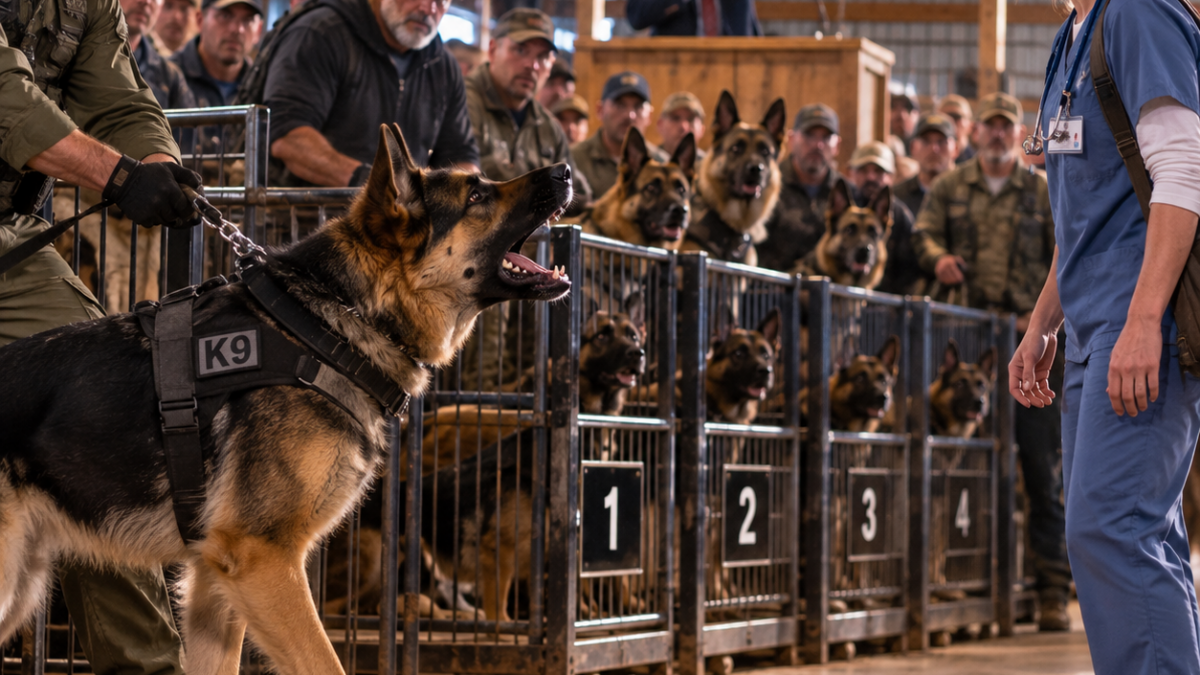
Thirty pens.
Exactly thirty.
German Shepherds.
Belgian Malinois.
Dutch Shepherds.
Two Labs.
A spaniel detection dog.
Each with laminated card.
Name.
Age.
Service history.
Medical status.
Auction donation recommendation.
Placement requirements.
People clapped as auctioneer welcomed crowd.
“This is not simply an adoption event.”
Delaney disliked him immediately.
“These are American heroes.”
More applause.
“They served.”
Applause.
“They sacrificed.”
More.
“Tonight, we honor them with retirement homes worthy of their service.”
Delaney did not clap.
She watched dogs.
Something wrong.
Not one dramatic thing.
Many small things.
A Malinois flinched when handler touched shoulder though card said:
NO BEHAVIORAL CONCERNS.
One German Shepherd ignored name “Bear” three times.
A Labrador listed age twelve moved like six.
Another dog listed “excellent health” had ribs visible.
One had ear tattoo while card said civilian-contractor dog with no permanent military marking.
Nurse brain.
Details.
She moved closer.
A tall man in civilian clothes stood beside her.
Late forties.
Close cropped gray hair.
Weathered.
Posture military.
“Thinking of adopting?”
“Looking for one.”
“They’re all good dogs.”
“I’m looking for Rex.”
His expression changed.
“No Rex today.”
“There should be.”
He looked at her scrubs.
“You came from work.”
“Yes.”
“I’m Senior Chief Everett Sloan.”
“Navy?”
“Retired.”
“Security?”
“Contract oversight consultant.”
“Delaney Brooks.”
Recognition flickered.
“Brooks?”
She saw it.
“You knew Micah.”
Everett’s face tightened.
“Yes.”
“How?”
“He audited rehab programs for my office.”
“You were at his memorial?”
“No.”
“Why?”
“I was overseas.”
She pulled manifest.
“I got this today.”
Everett read.
His forehead creased.
“Where’d you get it?”
“Envelope at hospital.”
“This isn’t today’s public roster.”
“I noticed.”
He read again.
“R-417.”
“You know it?”
“I know designation format.”
“Rex died with my brother.”
Everett looked toward dogs.
“Officially.”
That one word made Delaney’s heart pound.
Before she could ask, applause began.
A man stepped onto platform.
Mid-fifties.
Expensive navy jacket.
Silver hair.
Calm smile.
Gideon Rusk.
Founder and president Heritage K9 Transition Services.
He looked like a man donors trusted.
That meant nothing.
“Friends, veterans, families—welcome.”
Warm voice.
“We’re privileged tonight to place thirty retired heroes.”
Delaney watched his hands.
No nervousness.
When he spoke about sacrifice, he paused exactly long enough.
Practiced.
She waited until he asked for opening questions.
Raised hand.
“Yes, ma’am?”
“I’m looking for military working dog R-417.”
Silence.
Rusk smiled.
“I’m afraid I don’t recognize that designation.”
“Call name Rex.”
“Not on tonight’s roster.”
“He’s on this manifest.”
She unfolded paper.
Murmurs.
Everett stepped forward.
“Gideon, I’ve never seen that version.”
Rusk looked at him.
Something flashed.
Annoyance.
“You don’t need to.”
Wrong answer.
Everett heard it too.
Delaney said:
“My brother died eighteen months ago in a transport accident.”
Rusk’s smile returned.
“I’m sorry for your loss.”
“His dog Rex was listed dead with him.”
“That is tragic.”
“This says Rex came through your system.”
“Ma’am, people fabricate documents.”
“Then let me scan microchips.”
No smile now.
“This is private property.”
“You’re auctioning retired government working dogs.”
“We are facilitating placements.”
“Then verification should be easy.”
Rusk looked toward security.
Two men.
“Escort Ms. Brooks outside.”
Whispers spread.
Hospital nurse.
Dead brother.
Missing dog.
People love information.
Delaney did not move.
Everett stepped between security and her.
“Hold.”
Gideon’s eyes hardened.
“Senior Chief, this isn’t your concern.”
“It became my concern when you told me there was no alternate manifest.”
“You’re a consultant.”
“Exactly.”
“I hired you.”
“No.”
Everett’s voice went colder.
“The program hired me to ensure these dogs are handled appropriately.”
Rusk’s jaw tightened.
Delaney turned away from them.
Looked at thirty dogs.
An idea came from nowhere.
Or from memory.
Micah videos.
Almost every video ended with Rex.
Big Shepherd charging camera.
Micah laughing.
“Come on, Rex!”
Sometimes other dogs nearby reacted too.
Not to Rex as name.
To Micah’s voice.
To command cadence.
To the sound associated with group training.
Delaney did not understand that yet.
She just called:
“Rex!”
Loud.
Clear.
Thirty dogs froze.
All thirty.
Every head lifted.
Ears forward.
Not one bark.
The barn went silent.
Auctioneer lowered microphone.
Someone whispered:
“What the hell?”
Everett looked from dog to dog.
Delaney’s skin prickled.
Then from beneath rear platform:
Bark.
Bark.
Pause.
One softer bark.
Delaney stopped breathing.
No.
She knew it.
Hundreds of Micah videos.
Rex always barked twice when impatient.
Then softer when Micah laughed.
Again.
Bark.
Bark.
Pause.
Whine.
“Rex.”
Her voice broke.
Scratching came from beneath wood.
Metal.
Rusk laughed too quickly.
“Farm dog.”
Delaney turned.
“No.”
“You cannot identify a dog by barking.”
“I can identify that dog.”
Security men stopped moving.
Audience no longer looked at Delaney as interruption.
They looked at Rusk.
Then someone in third row stood.
Owen Tate.
Delaney stared.
“Owen?”
He looked embarrassed.
“I was coming to adopt.”
“You drove from Blue River?”
“I didn’t want anyone to know.”
Then he looked past her.
Toward a Malinois in pen twelve.
Face drained.
“No.”
He walked closer.
Harness said:
SIERRA.
Age eight.
Former patrol K9.
Owen’s hands trembled.
“Juno?”
Dog’s head snapped.
Not froze.
Snapped.
Eyes locked.
Owen whispered:
“Juno.”
The Malinois pulled once.
Handler tightened leash.
“Sir, her name is Sierra.”
“No.”
Owen started crying.
“That is my dog.”
“Sir—”
“Right shoulder.”
Everyone watched.
“She has crescent scar beneath right shoulder blade.”
Handler hesitated.
Everett said:
“Check.”
Rusk shouted:
“No one touches these animals outside protocol.”
Everett turned.
“Check.”
The handler looked between men.
Then lifted fur.
Pale crescent scar.
Owen folded.
Not physically.
Emotionally.
He reached toward pen.
“Juno.”
Dog whined.
Then dragged handler forward.
Owen dropped to knees.
Juno pressed body against fence.
He shoved fingers through.
She licked.
Whined.
Scratched.
Owen sobbed.
Three years.
A dog he had mourned.
Alive.
Barn changed.
Veterans pulled out phones.
Photographs.
Service records.
One man walked toward Labrador.
Another toward Dutch Shepherd.
Names began circulating.
Not catalog names.
Real names.
“Shadow?”
A Shepherd turned.
“Brisk?”
Malinois lifted head.
“Harper?”
A Lab stood.
Rusk’s face lost color.
“This event is terminated.”
Everett said:
“No one leaves.”
“You don’t have authority.”
“Maybe not.”
He removed phone.
“But state veterinary enforcement does.”
Rusk moved toward him.
“You are making a serious mistake.”
Everett smiled without warmth.
“Then you should be eager to prove it.”
It took fifty-three minutes for Dr. Nessa Ward to arrive.
State veterinary forensic specialist.
Small woman.
Red hair.
Glasses.
No patience.
Two investigators with her.
Local sheriff deputy too.
Rusk immediately relaxed at sight of badge.
That lasted thirty seconds.
Nessa started with pen twelve.
Juno.
Microchip scanner beeped.
Number appeared.
She entered federal working-dog registry.
Screen loaded.
Her eyebrows lifted.
“Status deceased.”
Owen closed eyes.
Nessa rescanned.
Same.
“Cause?”
Everett asked.
“Facility fire three years ago.”
Owen whispered:
“That’s what they told me.”
Nessa moved next.
German Shepherd labeled Bear.
Chip registered to Labrador named Mako.
Next.
No chip.
Scar where chip likely removed.
Next.
Chip implanted eight months ago.
Paper says retired five years.
Nessa stopped.
Looked at Rusk.
“How long has Heritage operated?”
“Seven years.”
“Who handles veterinary documentation?”
“Our contracted veterinarians.”
“Names.”
“My counsel—”
“Names.”
Rusk folded arms.
“I’d like an attorney present.”
Nessa nodded.
“Good idea.”
Then:
“Until identity verification complete, no animal moves.”
Applause almost started.
Everett raised hand.
“Don’t.”
He understood.
This was evidence now.
Not victory.
Nessa scanned all thirty visible dogs.
Nineteen discrepancies.
Six officially dead.
Four IDs linked other agencies.
Three histories impossible.
Two chips surgically removed.
Several ages inconsistent.
Medical records did not match visible injuries.
The barn erupted.
Rusk’s attorney arrived.
So did state police.
Delaney stayed near rear platform.
Rex kept scratching.
Everett joined.
Stacked feed bags concealed steel door.
Padlock.
“What’s down there?”
Rusk said:
“Storage.”
“For what?”
“Equipment.”
Bark.
Bark.
Pause.
Delaney stared.
“Open it.”
Rusk ignored her.
Everett:
“Key.”
“Don’t have one.”
Young employee near wall suddenly raised hand.
Everyone turned.
He looked twenty.
Terrified.
“I do.”
Rusk’s head snapped.
“Tyler.”
The employee backed up.
“You said never open it.”
“Shut up.”
State investigator stepped between.
“Give me the key.”
Tyler did.
Padlock clicked.
Door opened.
Concrete stairs descending.
Smell rose.
Kennel.
Urine.
Disinfectant.
Fear.
Delaney went cold.
Investigators descended first.
Correct.
Then Nessa.
Everett.
Delaney was told to wait.
She did not argue.
For twelve seconds.
Then a state investigator called:
“Ms. Brooks?”
She went.
Basement larger than barn footprint suggested.
Rows of enclosures.
Not thirty.
Seventeen more.
Old dogs.
Injured dogs.
Thin dogs.
Some sleeping.
Some stood.
One Labrador barely lifted head.
A Dutch Shepherd limped.
One Malinois had cloudy eyes.
Records on kennel doors were minimal.
Numbers.
Not names.
At final enclosure, large German Shepherd stood.
Black and tan.
Thinner than videos.
Gray starting muzzle.
Left ear bent slightly.
Scar over muzzle.
Delaney knew him before he moved.
“Rex.”
He stared.
No bark.
She crouched.
Kept distance.
Tears started.
“Hey, buddy.”
His head tilted.
Micah’s videos.
Micah’s voice.
One phrase.
Always when deployment rotation ended.
Always as joke.
“Home is still waiting.”
Delaney whispered it.
Rex took one step.
Then another.
Reached bars.
Pressed nose through.
Delaney touched him.
His eyes closed.
She broke.
Not loud.
Forehead against metal.
Eighteen months of grief splitting differently.
“You’re alive.”
Rex licked fingers.
Everett looked at metal plate.
Paint scratched.
Number removed.
He rubbed.
Under chipped surface:
R-417.
He whispered:
“They lied.”
Delaney looked toward collar.
Old leather.
Something attached beneath.
Small weatherproof capsule.
Nessa noticed too.
“Don’t touch.”
Evidence gloves.
She unscrewed.
Inside:
Micro SD card.
Everyone stared.
Delaney covered mouth.
Micah had always hidden backups.
Cloud.
USB.
External drive.
Once mailed hard drive inside coffee tin because he did not trust military postal handling.
Nessa placed storage card in evidence sleeve.
Everett said:
“What did Micah tell you before deployment?”
“Nothing about this.”
“Any packages?”
Delaney froze.
“Yes.”
“What?”
“Digital recorder.”
“Where?”
“At home.”
Then remembered.
Backpack.
She carried Micah’s old items sometimes after bad days.
Recorder.
Flash drive.
She opened bag.
Small recorder.
Everett stared.
“You had that?”
“I never listened past first file.”
“Why?”
“Because hearing his voice made me sick.”
She turned it on.
Folders.
Dates.
One file unlabeled.
She pressed.
Static.
Then Micah.
“Hey D.”
Delaney’s knees almost gave.
Rex looked up.
Micah’s voice continued.
“If you’re listening to this, something probably happened.”
Everett became still.
“They’re not stealing dogs.”
Pause.
“They’re stealing identities.”
Nessa leaned closer.
“An injured dog disappears. A healthier dog gets its paperwork. Contractor keeps billing rehab. Another dog gets marked dead. Some get sold privately. Government thinks one animal exists while two or three invoices use same identity.”
Micah coughed.
“I found medical records copied between dogs. Same X-rays. Same surgical notes with names changed.”
Delaney whispered:
“Oh God.”
“Rex has final list.”
Everyone looked at collar.
Recording continued.
“I don’t trust email anymore.”
Micah’s voice lowered.
“Someone accessed my report before command received it.”
Everett shut eyes.
“I’m sending copies separately.”
Then laughter.
Faint.
Rex barking in background.
Micah:
“Yeah, yeah. Drama queen.”
Delaney cried.
Recording:
“If I can’t finish, find Rex.”
Click.
No one spoke.
Delaney turned to Everett.
“He died three days later.”
Everett looked sick.
“The crash.”
“You think—”
“I don’t know.”
Important.
They didn’t know.
Not yet.
Nessa said:
“Don’t speculate.”
Exactly.
Delaney nodded.
Truth mattered more than satisfying suspicion.
The investigation widened immediately.
Federal contracting officers arrived that night.
Military veterinary representatives.
State police.
Fraud investigators.
The auction disappeared.
Evidence markers replaced bidding paddles.
Every dog photographed.
Scanned.
Examined.
No animal released until identity verified.
Rusk tried leaving at 10:37.
Leather briefcase.
Rear loading dock.
Everett saw him.
“Going somewhere?”
Rusk forced smile.
“My attorney advised me to leave.”
State investigator stepped closer.
“Your attorney is inside.”
Rusk stopped.
Everett held stack documents from office.
“Transport contracts.”
Rusk’s face changed.
“Those are confidential.”
“Good.”
Investigator took them.
Rusk ran.
Three steps.
That was all.
A trooper stopped him.
Briefcase opened on gravel.
Papers scattered.
Delaney watched from barn door.
Rusk shouted:
“You don’t understand federal contracting!”
Delaney answered:
“I understand dead dogs don’t send invoices.”
That silenced him.
He was arrested initially for evidence tampering and obstruction.
More charges later.
Fraud.
False government claims.
Animal cruelty related to neglect.
Identity falsification.
Conspiracy.
Illegal resale of government property.
The full scheme took months to understand.
It was more complicated than Micah’s first recording.
Heritage received government funds to rehabilitate and place retired military and law-enforcement working dogs.
Each dog represented a stream of reimbursable expenses.
Transport.
Veterinary care.
Behavioral assessment.
Boarding.
Medication.
Training.
Placement.
A dog with chronic injuries could generate tens of thousands in legitimate expenses.
Rusk’s organization learned how to turn one dog into several financial ghosts.
Dog A arrived injured.
Records showed treatment for months.
Actual treatment minimal.
Dog declared medically euthanized or deceased.
No proper independent verification.
Its identity number reused on invoices while actual dog hidden or sold.
Another dog given modified paperwork.
Private buyers paid “donations” far above permitted placement fees.
Some high-value trained animals went to private security firms.
Others disappeared into breeding programs.
Older or injured dogs, too recognizable or expensive, were hidden beneath facilities until paperwork could be adjusted.
Microchips swapped.
Removed.
Reimplanted.
Medical histories copied.
A dead dog’s number became currency.
And the people least likely to question it were grieving handlers who had already been told their partners were gone.
That was the cruelty Delaney could barely tolerate.
Not just money.
Grief was part of system.
Tell handler dog died.
Send official letter.
Maybe urn with generic cremains impossible to independently verify.
Close file.
Most people trust death notices.
Because what else can you do?
Owen spent three years blaming himself for waiting too long to adopt Juno.
Juno had been alive less than four hundred miles away.
Brisk’s former handler had paid for a memorial plaque.
Shadow’s handler had scattered an empty urn over Montana.
Apollo’s family thought he died after kidney failure.
Apollo was alive in basement with untreated dental disease.
Every reunion broke something.
Dogs responded differently.
Some remembered instantly.
Some hesitated.
Some had been renamed so often that voices confused them.
One Malinois heard former handler say:
“Scout.”
He crouched.
Then crawled across floor.
Another simply pressed forehead into veteran’s chest.
A Labrador named Harper ignored everyone until an older woman sang the cadence she used during training.
Then tail moved.
Delaney watched all of it.
Thirty visible dogs.
Seventeen hidden.
Forty-seven lives.
Not inventory.
Lives.
Nessa told her:
“Some won’t be who people think.”
Delaney knew.
Mistaken hope could hurt.
So forensic identification became careful.
Microchips.
Old veterinary dental charts.
Scars.
Tattoos.
DNA when records available.
Training responses used only supporting evidence.
Photographs.
Handler testimony.
No one simply took dog home because it reacted to name.
Delaney appreciated that.
Truth again.
Even good emotions needed verification.
Rex’s identity was easiest.
R-417 plate.
Dental records.
Microchip had been removed, but radiographs matched old mandibular repair.
Scar pattern.
DNA sample from military archive.
Confirmed.
Rex.
Alive.
Then question Delaney had avoided:
Why?
Why had he been hidden rather than resold?
Micah’s storage card answered.
Not immediately.
The card had encrypted folders.
Federal analysts copied before opening.
One labeled:
R417 FINAL.
Inside:
Photographs of invoices.
Lists.
Names.
Dates.
Audio.
Inspection reports.
And one video.
IF REX IS FOUND
Investigators asked Delaney whether she wanted to watch alone.
“No.”
She wanted Everett.
Owen.
Nessa.
Rex.
They gathered in Blue River conference room two days after auction.
Video began.
Micah appeared.
Alive.
Tired.
Beard longer.
Rex beside him.
“Hey D.”
Delaney grabbed edge table.
“If you’re seeing this, Rex found you.”
He laughed.
Rex barked.
Micah scratched ears.
“I figured he’d outsmart everybody.”
Then expression changed.
“They’re changing names.”
He held notebook.
“Not just dogs. Invoices. death certifications. transport reports. inspection documents.”
He looked at camera.
“I reported it through channels.”
Everett leaned forward.
Micah:
“My first report disappeared.”
Everett cursed quietly.
“Second triggered audit, but Heritage got warning before inspectors arrived.”
Nessa wrote.
“Someone inside contracting office is feeding them.”
Delaney’s chest tightened.
“This doesn’t mean command-wide corruption.”
Micah always careful.
“One person may be enough.”
He continued.
“I copied everything I could.”
Then:
“If something happens to me, don’t waste your life chasing revenge.”
Delaney closed eyes.
Micah knew her.
“Chase the truth.”
Tears.
“Rex carries final cross-reference because they stopped searching dogs.”
Micah smiled slightly.
“Everybody searches people.”
Rex looked at him.
“You always come home, buddy.”
Micah’s expression softened.
“Take care of D if you get there first.”
Video ended.
Delaney stared at blank screen.
Then Rex moved.
Placed head on her knee.
She lost it.
Not graceful.
She buried face in his neck and cried until shirt damp.
Owen looked away.
Everett did not.
He had his own tears.
Afterward Delaney asked:
“Was Micah’s accident an accident?”
Federal investigator answered:
“We don’t know.”
For months, no answer.
Crash report reopened.
Vehicle brake failure originally blamed mechanical wear.
Forensic reexamination found maintenance logs altered.
But proving intentional sabotage was difficult.
One technician admitted being paid to falsify inspection times.
Not to damage vehicle.
Another contractor had accessed schedule.
Suspicious.
Not proof.
Eventually investigators concluded there was insufficient evidence to charge anyone with Micah’s death.
Delaney hated that.
For weeks she felt case incomplete.
Then Micah’s words returned:
Don’t waste your life chasing revenge.
Chase truth.
Truth sometimes says:
We cannot prove this part.
She had to learn to live with that.
Rusk was convicted.
So were two Heritage executives.
A contract administrator pleaded guilty to accepting bribes and leaking inspection schedules.
Three veterinarians lost licenses; one was criminally charged for falsifying euthanasia records.
Several lower-level employees cooperated.
Tyler—the young worker who handed over basement key—was not charged.
He testified.
He had worked three weeks.
Knew basement existed.
Did not understand scheme.
People online called him coward for waiting.
Delaney defended him.
“He opened the door.”
Someone asked:
“Why didn’t he sooner?”
She answered:
“Because scared people don’t become brave on your preferred schedule.”
She knew.
Rex came home with her.
Not instantly.
Government process.
Medical clearance.
Ownership transfer.
Evidence status.
Weeks.
Delaney visited daily.
Rex initially paced when she left.
First night at her house, he stood by front door for two hours.
Waiting.
For Micah.
Delaney sat on floor beside him.
“He’s not coming.”
Rex stared at door.
“I know.”
She cried.
“I’m sorry.”
He lay down.
Head toward door.
For several nights.
Then one night he slept beside Delaney’s bed.
Not replacement.
Never.
Adaptation.
Owen got Juno after verification and medical clearance.
Their reunion at home was quiet.
He sent Delaney video.
Juno walked into living room.
Sniffed old toy box Owen had never thrown out.
Pulled faded rubber ball.
Owen sat on floor and sobbed.
Delaney watched video once.
Could not again for weeks.
Blue River changed after auction.
Handlers came asking questions.
“My dog was declared dead through Heritage.”
“Can you check?”
Not all were alive.
That was hard.
Some really had died.
Some records were legitimate.
Hope became dangerous if treated carelessly.
Delaney helped create review process.
No promises.
No false miracles.
Records requests.
Microchip audits.
Independent veterinary confirmation.
Families learned truth.
Sometimes truth reunited.
Sometimes it confirmed grief.
Both mattered.
Eight months later, Red Cedar Auction Barn reopened.
Not as auction.
That felt important.
Fresh paint.
New fencing.
Outdoor runs.
Veterinary room.
Retirement suites.
No bidding paddles.
No sale stage.
Sign above entrance:
MICAH BROOKS WORKING DOG RECOVERY SANCTUARY
Delaney argued against name.
Lost unanimously.
Everett became operations director.
Nessa chaired forensic identification advisory board.
Owen volunteered twice weekly with Juno.
Blue River partnered for veteran-handler reunification.
Delaney ran medical coordination part-time while continuing hospital shifts.
Rex followed everywhere.
His limp remained.
Muzzle grayer.
Left ear still bent.
But coat improved.
Weight returned.
Eyes bright.
At opening ceremony, Delaney refused speech.
Then Everett handed microphone anyway.
“I hate you.”
“Noted.”
Audience laughed.
Veterans.
Handlers.
Families.
Veterinarians.
Children.
Recovered dogs resting beneath trees.
A boy stood front row.
“Miss Brooks?”
“Yes?”
“My grandpa says all the dogs froze when you called Rex.”
Delaney smiled.
“They did.”
“Why?”
Good question.
She looked at dogs.
Thirty from auction.
Some with original handlers.
Some with carefully screened families.
Some permanent sanctuary residents due medical needs.
“Because they had been trained around each other.”
Everett added:
“And many had heard the name before.”
The boy frowned.
“But they had new names.”
“Yes.”
“Can dogs forget?”
Delaney looked toward Rex.
“Sometimes they learn new things because they have to.”
“That’s not forgetting.”
No.
It wasn’t.
She crouched.
“They can be called different names. Moved somewhere new. Separated from people they love.”
The boy looked serious.
“But something remains.”
“What?”
Delaney thought of Micah.
Owen.
Juno.
The basement.
“Recognition.”
Everett said quietly:
“Sometimes all it takes is somebody saying the right name.”
That line spread online.
Delaney hated that too.
People made videos.
Headlines.
NURSE CALLS ONE NAME—30 MILITARY DOGS FREEZE
Too simple.
She started correcting journalists.
“They didn’t freeze because I’m magical.”
“They weren’t all responding specifically to Rex.”
“The important part is records fraud.”
“Please mention handlers.”
“Please mention verification.”
Nobody likes nuance as much as miracles.
So Delaney learned to tell full story herself.
She spoke at veterans hospitals.
Veterinary conferences.
Government contracting reviews.
She began with:
“My brother died investigating paperwork.”
People expected dog story.
She gave them invoice story.
“Fraud hides where people stop asking questions because forms look official.”
She showed altered records.
“Grief makes families easy to silence because nobody wants to challenge a death certificate.”
She taught nurses and social workers something else.
“If a patient says the paperwork feels wrong, don’t automatically treat that as denial.”
Sometimes it is denial.
Sometimes paperwork is wrong.
Listen first.
Verify.
Rex aged.
Delaney hated that.
She had already lost him once on paper.
Every gray hair felt unfair.
At ten, arthritis worsened.
At eleven, kidney values changed.
Medication.
Diet.
Slow walks.
He still rode to sanctuary.
At entrance, recovered dogs reacted.
Some barked.
Some stood.
Rex carried authority without effort.
Everett called him “union boss.”
Delaney called him “old criminal.”
Rex ignored both.
One afternoon Owen found Delaney sitting beside pond.
Rex asleep at feet.
“You okay?”
“No.”
“Kidneys?”
She nodded.
Veterinarian had told her months, maybe a year.
Owen sat.
“I got three extra years with Juno.”
Delaney looked over.
“Extra?”
“After thinking she was dead.”
He smiled sadly.
“I stopped calling them extra.”
“What then?”
“Ours.”
That mattered.
Delaney looked at Rex.
She had treated every day with him as borrowed.
Maybe that was another form of not living it.
“I’m scared to lose him.”
Owen nodded.
“Good.”
She frowned.
“Good?”
“Means you let yourself have him.”
Delaney hated wise veterans.
Rex died fourteen months later.
Not dramatic.
Sanctuary.
Sunny morning.
He had stopped eating.
Could barely stand.
Delaney carried him into grass.
Same way she had once carried wounded dogs in hospital hallways.
Everett came.
Owen.
Nessa.
Juno had died months earlier.
They did not make ceremony.
Rex lay with head in Delaney’s lap.
She wore Micah’s tag.
“I promised I’d take care of you.”
Rex breathed slowly.
“I think I did okay.”
Tail moved once.
“You could’ve made this easier.”
Everett laughed softly through tears.
Rex looked toward sky.
Then Delaney.
She whispered Micah’s phrase:
“Home is still waiting.”
One final breath.
Then still.
Delaney bent over him.
For years she had believed grief meant love had nowhere to go.
Rex taught her something else.
Sometimes grief is where love goes when body cannot carry it anymore.
The sanctuary buried his ashes beneath oak beside walking trail.
No heroic statue.
Small stone:
R-417 REX
MILITARY WORKING DOG
PARTNER. WITNESS. HOME.
Delaney placed Micah’s copied ID number beneath glass in main building.
Next to waterproof capsule.
Not evidence anymore.
History.
Years passed.
Sanctuary expanded.
Fraud reforms followed case.
Working-dog retirement contracts required stronger identity checks.
Independent microchip verification.
Photo documentation.
Handler notification.
Medical record auditing.
Not perfect.
Systems never are.
But harder to erase dogs.
Harder to recycle identity.
Harder to tell a veteran:
Your partner died.
Without proof.
Delaney remained nurse.
That mattered.
People expected her to quit hospital and become full-time activist.
She didn’t.
She loved nursing.
Blue River was home too.
She worked three shifts weekly.
Sanctuary two days.
No balance.
She complained constantly.
Patients loved her.
One morning she heard bark down rehab hall.
Stopped.
Volunteer asked:
“Which one?”
Delaney listened.
Young Malinois.
Two sharp.
Pause.
She smiled.
“That’s Echo.”
“You sure?”
“Absolutely.”
Dog barked again.
The volunteer laughed.
“You still know all of them.”
“Most.”
She walked hall.
Passed framed photograph.
Micah with Rex.
Micah smiling.
Rex looking at camera.
Beneath:
DON’T CHASE REVENGE. CHASE THE TRUTH.
Delaney touched frame sometimes.
Not every day.
She no longer needed ritual every day.
One afternoon young nurse named Priya asked:
“Can I ask you something personal?”
“Dangerous opening.”
“Why didn’t you listen to your brother’s recorder when he mailed it?”
Delaney considered.
No shame now.
“Because I was grieving.”
“But if you had—”
“I know.”
She cut gently.
Priya stopped.
Delaney continued:
“For years I punished myself with that sentence.”
If I had listened.
If I had asked.
If I had challenged report.
If I had opened file.
Maybe Rex would have been found sooner.
Maybe dogs would have suffered less.
Maybe Micah’s evidence would have surfaced.
Maybe.
That word destroys people.
“I didn’t know what was on it.”
Priya nodded.
“Micah knew I might not listen.”
“How?”
“He made backups.”
Delaney smiled.
“He understood me.”
Then:
“You can’t judge past yourself using information present self learned later.”
Priya wrote that down.
“Don’t.”
“Too late.”
Delaney groaned.
The sanctuary’s tenth reunion event became largest.
Not because spectacle.
Because dogs had become families.
Former handlers arrived with grandchildren.
Recovered dogs—those still living—moved slowly.
Some in carts.
One Lab slept entire ceremony.
Perfect.
Owen walked with cane now.
His granddaughter wore Juno’s old service patch on backpack.
Everett fully gray.
Nessa still terrifying contractors.
Delaney forty-one.
Micah would have been thirty-eight.
That thought no longer crushed every breath.
At event, one reporter asked:
“Do you believe Micah died because of what he uncovered?”
Delaney paused.
Years earlier she would have wanted yes.
Clean villain.
Murder.
Purpose.
Now:
“We don’t know.”
Reporter looked disappointed.
“Investigators found falsified maintenance records.”
“Yes.”
“Isn’t that suspicious?”
“Yes.”
“So—”
“Suspicion is not proof.”
She looked directly at camera.
“My brother died chasing truth.”
“I’m not honoring him by inventing the part we couldn’t prove.”
Everett heard.
Later:
“That was him.”
“What?”
“He would’ve said that.”
Delaney smiled.
“Micah invented facts constantly.”
“Only when talking about fishing.”
“Or dating.”
“Especially dating.”
They laughed.
That was another sign healing had moved.
Micah could be funny again.
Not only dead.
He became brother.
Boy who hid raccoon.
Man who loved dogs.
Terrible cook.
Loud laugh.
Investigator.
Son.
Friend.
Not just victim.
Rex too.
Not just evidence.
He stole sandwiches.
Hated baths.
Loved tennis balls.
Snored.
Once destroyed Delaney’s couch cushion.
That couch cushion became more precious in memory than courtroom exhibits.
Because justice restores names.
Love restores personality.
The public remembered:
R-417.
Missing military dog.
Key evidence.
Delaney remembered:
Rex refused wet grass unless Micah walked first.
Both true.
One evening after shift, Delaney drove to sanctuary alone.
Sunset.
Dogs settled.
She walked to Rex’s oak.
Sat.
Not anniversary.
No reason.
She carried one thing.
Original brown envelope.
The one that started everything.
Investigators had returned it after case.
No fingerprints useful.
No source ever publicly identified.
Delaney eventually learned privately that a former Heritage bookkeeper sent it.
Woman named Carol Mendoza.
She had discovered altered invoices.
Afraid.
She knew Delaney from Micah files.
Left envelope at hospital because she was too frightened to approach.
Carol later testified.
Delaney had asked:
“Why me?”
Carol answered:
“Because your brother wrote one instruction beside Rex’s file.”
What?
If I disappear, tell Delaney. She doesn’t quit.
Delaney had laughed and cried.
At oak, she unfolded manifest.
Line.
R-417.
REX.
One piece paper.
Almost ignored.
She looked toward sanctuary.
Dogs sleeping.
Handlers talking.
Staff closing clinic.
Lives changed because someone slipped paper onto hospital desk.
Because Delaney opened it.
Because she drove alone.
Which she now admitted was stupid.
Because Everett listened.
Because Owen recognized Juno.
Because Tyler handed over key.
Because Nessa scanned chips.
Because investigators followed money.
Because veterans testified.
Because Micah documented.
No one hero.
Chains again.
People love one dramatic moment.
Thirty dogs freezing.
Rex barking beneath floor.
Delaney calling his name.
Good image.
But justice took years of boring work.
Subpoenas.
Spreadsheets.
DNA.
Vet files.
Contracts.
Court.
Appeals.
Dog rehabilitation.
Families learning pets they mourned were alive.
Other families learning theirs really were gone.
Healing.
No headlines for most.
Delaney placed manifest back envelope.
“Micah.”
Wind.
“You were right about one thing.”
Nothing.
“I don’t quit.”
She smiled.
“Annoying thing to leave me.”
A bark echoed from barn.
Then another.
Different voices.
She could identify several.
Maybe all.
Some skills never leave.
She stood.
Walked toward dogs.
There is a version of this story people tell where Delaney Brooks walked into an auction alone, called one name, and thirty military dogs recognized the truth.
It sounds beautiful.
It is not exactly what happened.
The dogs did not expose fraud magically.
People did.
Dogs reacted.
Humans finally paid attention.
That distinction matters.
The animals had been communicating all along.
Ignoring false names.
Flinching at wrong handlers.
Showing scars missing from paperwork.
Recognizing old voices.
Their bodies held records too.
Nobody had asked correctly.
Delaney did.
Not because she was special.
Because one line did not match.
R-417.
Same number.
Wrong reality.
That was Micah’s real legacy.
Not suspicion.
Verification.
Paper says dog dead.
Dog is standing here.
Therefore paper is wrong.
Follow contradiction.
One question.
Then another.
Then another.
Sometimes courage is not running toward gunfire.
Sometimes it is embarrassing yourself by asking:
Can we scan the chip?
Sometimes loyalty is not believing official answer because you want comforting conspiracy.
Sometimes loyalty is accepting official answer only after evidence survives scrutiny.
Sometimes honoring dead means refusing both blind faith and convenient fantasy.
Delaney learned all of that because she wanted one dog.
Rex.
She found forty-seven.
She went looking for piece of her brother.
Found his unfinished work.
She walked into barn believing grief had played cruel trick.
Walked out knowing grief had been manipulated for profit.
But that was not final transformation.
Years later, when recovered dogs slept safely beneath trees and veterans no longer wondered whether their partners vanished into paperwork, Delaney finally understood something Micah probably knew when he hid memory card on Rex.
Names matter.
Not because labels define us.
Because names connect stories to bodies.
Change name.
Change chip.
Change paper.
You can make a dog disappear administratively.
But scars remain.
Habits remain.
Recognition remains.
Love remains.
Owen did not love “K9 asset 43-118.”
He loved Juno.
Micah did not risk career for “R-417.”
He loved Rex.
Delaney did not mourn “PO1 Brooks.”
She mourned Micah.
Systems need numbers.
People need names.
Fraud stole both.
Sanctuary restored both.
That was why Delaney refused auction language afterward.
No inventory.
No units.
No lots.
No “surplus animals.”
Dogs.
Names.
Histories.
Partners.
When one arrived without verified identity, temporary designation was not number.
They called him Unknown until proven.
Not renamed casually.
Respect for missing story.
That policy irritated administrators.
Delaney never cared.
One new employee asked:
“Does a dog really know if we call him wrong name?”
Delaney answered:
“Maybe.”
“Then why matter?”
“Because we know.”
That was enough.
On anniversary of Micah’s death, Delaney no longer sat alone.
Sometimes Owen.
Everett.
Sometimes no one.
Sometimes she worked.
One year she brought school group through sanctuary.
Boy asked:
“Was your brother a hero?”
Delaney paused.
Children waited.
“No.”
Teachers startled.
She smiled.
“He was my brother.”
“What does that mean?”
“It means he was brave sometimes and stupid sometimes.”
Kids laughed.
“He helped animals.”
“Yes.”
“He found bad guys?”
“Sort of.”
“Then hero.”
Delaney crouched.
“If you want.”
Then:
“But don’t make heroes so perfect that real people think they can’t do brave things.”
The teacher looked moved.
Delaney continued:
“My brother got scared.”
“He made mistakes.”
“He missed birthdays.”
“He forgot to call Mom.”
“He hid evidence in dog collar because he watched too many spy movies.”
Laughter.
“But when something looked wrong, he kept asking.”
She pointed at sanctuary.
“That is something any of you can do.”
One girl asked:
“Even if grown-ups say stop?”
Delaney thought of Rusk.
“Especially then sometimes.”
Then quickly:
“But tell another trusted grown-up too.”
She had learned from driving alone.
Years later, old Blue River volunteer who first joked about recognizing barks passed away.
His family asked sanctuary if memorial donations could go toward medical care.
Delaney cried when letter came.
Everything connected.
Tiny threads.
Volunteer.
Envelope.
Dog.
Hospital.
Brother.
Veterans.
No one knows while living which small actions matter later.
Maybe that’s why paperwork fraud is so cruel.
It counts on people assuming one detail cannot matter.
Wrong digit.
Wrong age.
Wrong scar.
Wrong bark.
One detail can open basement.
At sanctuary entrance, beneath Micah’s photograph and Rex’s capsule, they eventually added a second plaque.
Delaney hated plaques.
Still approved this one.
It read:
THEY WERE NEVER INVENTORY.
THEY HAD NAMES.
THEY HAD PEOPLE WAITING FOR THEM.
No mention of Delaney.
She insisted.
Everett argued.
Lost.
For once.
On quiet mornings, Delaney sometimes arrived before staff.
Walked pens.
Listened.
Bark.
Whine.
Scratch.
Tail thump.
Each different.
She still knew most voices.
One morning a newly recovered Shepherd barked twice.
Pause.
Then one softer bark.
Delaney froze.
Not Rex.
She knew that.
Still, chest tightened.
Young staff member asked:
“You okay?”
Delaney smiled.
“Yes.”
Real yes.
“Thought I heard someone I knew.”
She walked on.
That was grief after enough time.
Not wound reopening every time.
More like hearing familiar song from another room.
You stop.
Remember.
Then continue.
Delaney had entered Red Cedar Auction Barn alone in blue scrubs because she believed her dead brother’s dog might be alive.
She thought finding Rex would answer one question.
Instead it gave her hundreds.
Who changed records?
Who profited?
Who looked away?
Who knew?
Which dogs were alive?
Which identities belonged where?
What happened to Micah?
Some answers came.
Some never did.
That used to feel unbearable.
Now she understood truth is not guaranteed to feel complete.
It is simply what evidence allows.
Rex had been alive.
Juno had been alive.
The dogs’ identities had been stolen.
Contracts were fraudulent.
Micah knew.
He documented.
He died before finishing.
Cause of crash remained uncertain.
All true.
Enough.
Not everything needs final twist.
Sometimes justice is accepting the line where knowing stops.
The rest belongs to grief, faith, or unanswered questions.
On twenty-year anniversary of sanctuary, Delaney stood before new generation of veterans and veterinary students.
Hair streaked gray now.
Still nurse.
Still blue scrubs because she had come straight from hospital.
Someone joked:
“You never change.”
She answered:
“My knees disagree.”
Behind her hung giant photograph.
Micah and Rex.
Young.
Laughing.
Alive.
Audience included grandchildren of handlers reunited at original auction.
One old veteran held framed photo of Juno.
Everett used cane.
Nessa retired but still corrected everyone.
Delaney looked around.
Then said:
“People remember thirty dogs freezing when I called Rex.”
Heads nodded.
“That’s not the part I want you to remember.”
Silence.
“Remember that records looked official.”
She held old manifest.
“Remember respected people endorsed the event.”
“Remember banner said honor.”
“Remember everyone clapped.”
She looked toward recovered dog descendants? No breeding; rather current rescue dogs.
“And remember one mismatch was enough to ask another question.”
She folded manifest.
“Institutions fail when everyone assumes verification is somebody else’s job.”
Then softer:
“Families fail too sometimes.”
“We hear something that hurts and stop listening.”
“I did.”
Her hand touched Micah’s tag.
“I had my brother’s recorder for months.”
Silence.
“I wasn’t ready.”
“No one should shame you for not being ready.”
“But when you are ready—”
She looked at people.
“Ask.”
That was her legacy.
Not miracle nurse.
Not woman thirty dogs obeyed.
Question.
Verify.
Name.
Remember.
One forgotten name spoken aloud.
Rex.
Thirty heads turning.
One bark beneath floor.
A basement door opening.
Veteran whispering:
“That dog is mine.”
A chip scanner beeping.
A dead record becoming living body.
One frightened employee offering key.
One brother’s voice from recorder:
Don’t chase revenge.
Chase the truth.
And a nurse who finally did.
Delaney looked once toward Micah’s photograph before leaving sanctuary that evening.
“You were right.”
She smiled.
“Rex outsmarted everybody.”
Then she turned off lobby lights.
Outside, dogs barked in evening.
Different voices.
Different names.
Known.
Recorded correctly.
Loved.
No one hidden beneath floor.
No one sold under stolen identity.
No one forced to disappear because paperwork said so.
And for Delaney Brooks, that became the part of the story that mattered most.
She had walked into that auction searching for one dog her brother loved.
She walked out carrying proof that dozens of lives had been erased on paper.
But years later, standing in a sanctuary filled with veterans reunited with partners they had mourned, she finally understood what Micah had meant.
Names could be stolen.
Records could be altered.
History could be buried.
But truth had a stubborn way of surviving inside scars, memories, voices, and the living beings someone forgot to ask.
Sometimes it waited in a locked basement.
Sometimes inside a weatherproof capsule.
Sometimes in the mind of a grieving veteran who remembered one crescent-shaped scar.
Sometimes in a nurse who could recognize a dog by his bark.
And sometimes justice began with nothing more dramatic than one woman standing alone in a crowded room, refusing to believe the paperwork over what she could see with her own eyes.
“Rex.”
Thirty dogs had gone still.
Years later, Delaney finally understood why that moment continued to matter.
It was not because thirty dogs obeyed her.
It was because for the first time in years, someone had called one of them by the name the truth remembered.