A Navy SEAL Waited at a Train Station With Roses for the Woman Who Broke His Heart—Then He and His K9 Saw a Terrified Stranger Fighting for a Bag No One Else Understood.
A Navy SEAL Waited at a Train Station With Roses for the Woman Who Broke His Heart—Then He and His K9 Saw a Terrified Stranger Fighting for a Bag No One Else Understood.
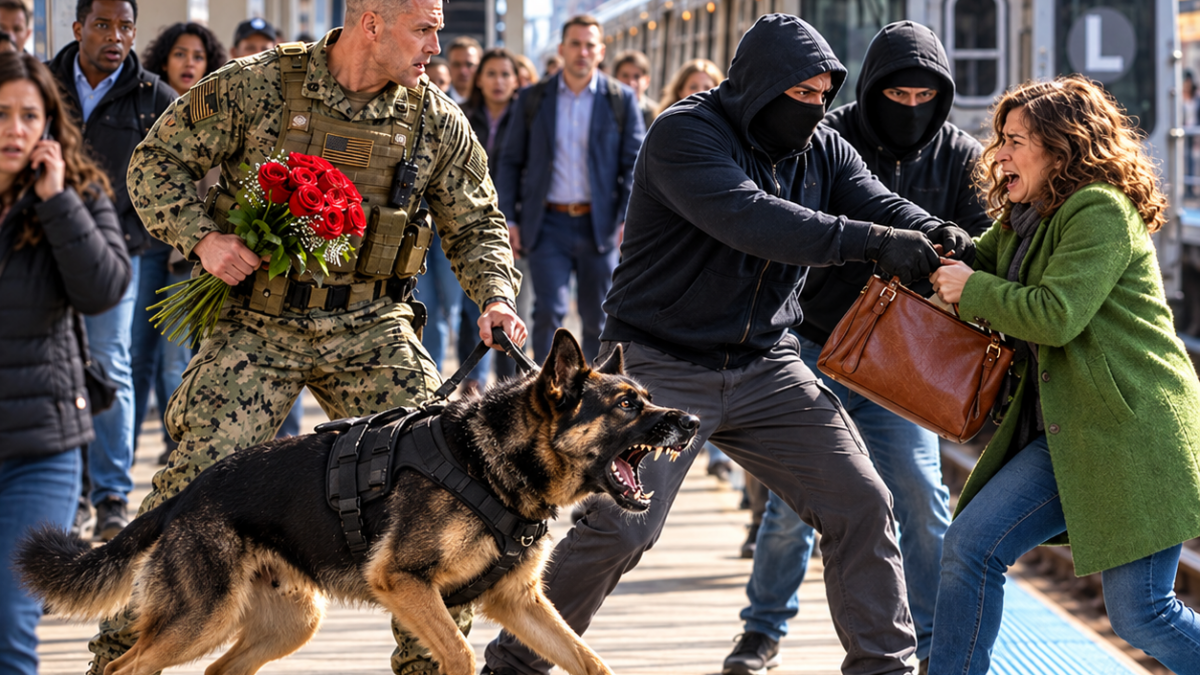
Xavier Cole had crossed the country with roses to surprise the woman he loved, only to receive a breakup text minutes before her train arrived—but before he could even throw the flowers away, three men attacked a young teacher named Clara for a leather bag she refused to surrender.
The attackers thought they were stealing paperwork from an exhausted neighborhood teacher; they had no idea the quiet stranger beside her was a Navy SEAL on leave, or that his German Shepherd had already chosen which person on that platform needed protecting.
By sunrise, the papers inside Clara’s bag would connect a street gang to forged deeds, shell companies, corrupt property deals, and families being pushed from homes they had owned for decades—and Xavier would discover that the date who never came was not the most important person he had been waiting for that night.
I was holding twelve red roses when my girlfriend ended our relationship by text.
There are dignified ways to receive bad news.
Standing alone beneath fluorescent lights on a Chicago train platform while three hundred commuters pretend not to notice you staring at your phone is not one of them.
My name is Xavier Cole.
I was thirty-five that fall.
Lieutenant Commander, United States Navy.
SEAL.
Ten years operational.
Three deployments I discussed rarely.
One reconstructed shoulder.
One knee that predicted rain more accurately than local meteorologists.
And one German Shepherd named Max who understood human disappointment with far more patience than I did.
Max sat beside me at the elevated station on the South Side, black-and-tan coat shining under cold afternoon light.
His ears moved constantly.
Train.
Footsteps.
Rolling suitcase.
Child screaming.
Pigeon landing nearby.
Nothing escaped him.
I looked down at my phone again.
Maybe reading the message a sixth time would change the words.
It did not.
Xavier, I’m sorry. I can’t keep doing this. Every time you deploy, I wonder whether you’re coming home. Every time you’re home, half of you is somewhere else. I thought seeing you would make this easier, but I don’t think I can meet you today. I think we need to end this. Please don’t come to my apartment.
PART2:
Her name was Julia.
We had been together almost two years.
Mostly airports.
Video calls.
Missed holidays.
Rescheduled dinners.
Promises about “next leave.”
I had imagined this trip differently.
She would come off the train.
See the flowers.
Maybe cry.
I had reservations at a small Italian restaurant because six months earlier she mentioned liking handmade pasta.
SEALs remember useful details.
Sometimes we remember useless ones even better.
Instead, I had roses and instructions not to come to her apartment.
Max looked up.
I sighed.
“Don’t.”
His tail moved once.
“You knew?”
He nudged my hand.
“Traitor.”
I crouched.
Scratched behind his ears.
He leaned against me.
PART3:
Max was technically retired.
He had served six years as a military working dog, including three attached to teams I deployed alongside.
An explosive injury damaged his hearing slightly in one ear and left a white scar along his chest.
When his service ended, I went through every form necessary to adopt him.
Friends joked the paperwork was harder than BUD/S.
They were only partly joking.
He knew commands.
Hand signals.
Search patterns.
Crowds.
Threats.
More importantly, he knew me.
He knew when my breathing changed.
When I stopped sleeping.
When silence meant tired and when silence meant bad.
I stood.
Looked at the roses.
There was a trash can ten feet away.
I walked toward it.
Stopped.
Throwing roses away felt melodramatic.
So I placed them on a bench instead.
A teenage girl nearby looked at them.
“You want those?”
I asked.
She stared.
“For real?”
“Yeah.”
She picked them up.
“Thanks.”
“Make somebody’s day better.”
She smiled.
“Sorry if somebody ruined yours.”
Teenagers are terrifying.
I almost laughed.
Then a train came screaming into the station.
Wind pushed along the platform.
People gathered near doors.
Max rose beside me.
I had no plans anymore.
Hotel.
Maybe steak.
Maybe fly home early.
Maybe finally admit Julia had been right.
Half of me was always somewhere else.
Then I noticed the woman with the green coat.
At first there was nothing extraordinary about her.
Late twenties.
Brown hair pulled into a loose knot.
Canvas shoes.
Green wool coat.
Leather messenger bag across her body.
She looked tired.
Teacher tired.
The kind where your shoulders sag because twelve people asked you questions every minute for eight hours.
She clutched the messenger bag with one hand.
Not casually.
Protectively.
As people moved toward the train, three men separated from the crowd.
Young.
Early twenties.
Dark hoodies.
Same crown-shaped emblem on two backs.
One positioned near her left.
Another behind.
Third moved ahead.
That formation caught my attention.
Max saw something too.
His ears went forward.
The woman noticed the first man only when he grabbed her bag.
Hard.
She stumbled backward.
“Let go.”
He yanked again.
She wrapped both hands around the strap.
“No!”
The second man shoved another commuter away.
“Mind your business.”
People backed off.
Phones came out.
Of course.
The tall attacker pulled harder.
The leather strap dug against the woman’s coat.
“Give me the bag, Clara.”
That mattered.
Not random robbery.
He knew her name.
She kicked his shin.
He cursed.
Raised his fist.
I moved.
“Hey.”
Everyone looked.
Tall man turned.
“What?”
“Let go.”
He laughed.
“I said mind your—”
Max barked.
One sharp command bark.
The man’s attention shifted.
I stepped closer.
Hands visible.
“I don’t want trouble.”
“Then keep walking.”
The woman looked at me.
Fear.
Not helplessness.
She was calculating.
“Clara,” I said, because he’d used her name. “Do you know them?”
“No.”
The tall man jerked the bag.
“She owes us something.”
“No, I don’t.”
“What’s in the bag?” I asked.
“None of your business,” he snapped.
“I asked her.”
Clara said:
“Documents.”
Tall man’s face tightened.
There it was.
The second attacker moved toward me.
“Soldier boy, walk.”
Maybe haircut.
Maybe posture.
Maybe Max.
I did not ask.
“I’m leaving as soon as she says she wants to go with you.”
Clara answered immediately.
“I don’t.”
“Good.”
The third man pulled a knife.
That changed the legal and practical problem.
I held one hand low toward Max.
Stay.
He obeyed.
Tall attacker shouted:
“Grab the bag!”
The knife man came forward.
I moved inside his reach.
Not cinematic.
Fast.
Control wrist.
Turn.
Use momentum.
The knife hit concrete.
He swore.
I forced him down.
The tall man released Clara and lunged toward me.
Max moved between them.
Growl.
No bite.
Tall man stopped.
Good choice.
Third attacker ran.
Not toward us.
Toward the stairs.
Gone.
The man I held struggled.
I tightened control.
“Stop.”
He tried once more.
“Stop.”
He did.
I released enough pressure to avoid injury while keeping him down.
The tall man took two steps backward.
Clara still clutched the bag.
Max stood between them.
Chicago transit staff arrived.
Then two CPD officers.
Real life after violence is mostly statements.
Names.
Questions.
Witnesses.
Body camera angles.
Where was the knife?
Who touched what?
Did anyone strike first?
The two attackers were detained.
The third disappeared.
An officer found the knife.
Another spoke to Clara.
I gave my military ID after explaining why Max was with me.
The older officer looked at my ID.
Then me.
“SEAL?”
“On leave.”
He looked toward the detained men.
“Hell of a vacation.”
“You have no idea.”
Clara sat on a bench.
Hands shaking.
Max walked over.
Stopped three feet away.
Looked at me.
I nodded.
He approached slowly.
Clara reached toward him.
He placed his head beneath her hand.
Her whole posture loosened.
“What’s his name?”
“Max.”
“He’s beautiful.”
“He knows.”
Max’s tail thumped.
She smiled.
First time.
Then she looked at me.
“I’m Clara Reyes.”
“Xavier.”
“I heard.”
“Right.”
Her eyes went to the bench where the roses had been.
Only stems from one broken flower remained.
“You were waiting for someone?”
“I was.”
“She coming?”
“No.”
Clara’s face softened.
“I’m sorry.”
“You were just attacked.”
“Still allowed to notice things.”
That was the first clue Clara noticed more than most people.
The officer returned.
“We’re going to need you downtown later for a full statement, Ms. Reyes.”
“Can I go now?”
“Yes, but someone should escort you.”
Clara looked at the arrested men.
“They knew my name.”
“I heard.”
“They weren’t trying to rob me.”
The officer nodded.
“Tell me why.”
Clara rested the bag on her lap.
Opened it slightly.
Inside were thick manila folders.
Flash drives.
Photocopies.
Maps.
Bank records.
The officer frowned.
“What is all that?”
“Evidence.”
“Of what?”
Clara looked around before answering.
“A property scheme.”
The officer’s face remained blank.
“What kind?”
She exhaled.
“I work at the Jefferson Community Learning Center.”
I knew the name vaguely.
After-school programs.
Adult education.
Food distribution.
“Our neighborhood has been getting bought piece by piece for eighteen months.”
“Developers?”
“That’s what everyone thought.”
She opened one folder.
Property records.
“Families started receiving tax notices for properties they never sold. Elderly owners discovered liens they didn’t recognize. Small businesses got code violations, then purchase offers days later.”
The officer glanced.
“And these men?”
“Iron Kings.”
He looked toward the hoodies.
Gang.
“So gang pressure tied to development?”
“More than pressure.”
She showed another paper.
“Shell companies.”
The officer slowed.
“Where’d you get these?”
“Public records. Some leaked.”
“By who?”
“Someone inside a title company.”
The officer looked uncomfortable.
“You have copies?”
“Three sets.”
“Good.”
“Not good.”
Clara closed the bag.
“One set disappeared from our office yesterday.”
My attention sharpened.
“Who knew you had the others?”
“Three people.”
“Names?”
She looked at me.
“Why are you asking?”
“Because those men knew your exact train.”
That landed.
The officer nodded too.
“Mr. Cole’s right.”
Clara’s face changed.
“I was supposed to meet Councilman Avery’s policy director.”
“Today?”
“Yes.”
“At city hall?”
“Yes.”
“Did he know your route?”
“No.”
“Anyone at your community center?”
“My director.”
“Who?”
“Marianne Lopez.”
“Trust her?”
“With my life.”
“Anyone else?”
Clara hesitated.
“A lawyer helping us.”
“Name?”
“Daniel Whitaker.”
The officer wrote it.
Then another officer called him away.
Clara looked at me.
“What do you think?”
“I think you should not go home alone.”
“Police said—”
“Police said escort.”
“You volunteering?”
I looked at Max.
He was sitting beside her like he had already decided.
“Apparently.”
She smiled.
“I can pay for your train.”
“I’m devastated you assume I can’t afford transit.”
“That wasn’t—”
“Joke.”
“Oh.”
“Bad one.”
“Very.”
We left the station forty minutes later.
The city had changed color.
Late afternoon going gray.
Cold wind moving between brick buildings.
Clara walked close.
Max on her outside, between her and the street.
Not trained command.
Habit.
“Where’s your place?” I asked.
“Twenty minutes.”
“We’re not going there.”
She stopped.
“What?”
“Those men knew you were at the station.”
“So?”
“If they tracked you, your apartment is first stop.”
“I need clothes.”
“Clothes are replaceable.”
“My laptop.”
“Replaceable.”
“My cat.”
That stopped me.
“You have a cat.”
“Don’t sound offended.”
“Max has opinions.”
“He can deal.”
“We’ll figure out the cat.”
She looked amused despite fear.
“How?”
“No idea.”
We started walking.
I checked reflections.
Traffic.
People lingering.
A black SUV appeared two blocks behind us.
Tinted.
Slow.
Not enough evidence.
Then it turned when we turned.
Still not enough.
We crossed.
It crossed.
Enough.
“Clara.”
“What?”
“Don’t look back.”
Naturally, she started to.
I touched her sleeve.
“Don’t.”
Her breathing changed.
“Are they following us?”
“Possibly.”
“Possibly?”
“Yes.”
“You say that very calmly.”
“Panic doesn’t improve traffic.”
Max looked behind once.
SUV slowed.
I changed route.
Busy grocery store.
Through one entrance.
Across.
Out another.
Crosswalk.
Bus.
We boarded.
SUV continued.
Maybe lost us.
Maybe not.
Clara whispered:
“Do you do this all the time?”
“Ride buses?”
“You know what I mean.”
“Less often in Chicago.”
She almost laughed.
We rode five stops.
Exited near an industrial neighborhood.
I called a former teammate.
Marcus Bell.
He had left the Navy four years earlier after an injury.
Owned an automotive restoration shop outside the city.
Currently in Wisconsin fishing.
“Xavier?”
“Need a favor.”
“Money?”
“No.”
“Body disposal?”
“Marcus.”
“Joke.”
“I need your shop.”
Pause.
“That’s worse.”
I explained enough.
He became serious.
“Back lockbox. Code’s 2746.”
“You should change that after this.”
“I’ve known you fifteen years. If you wanted to rob me, you’d have done it.”
“Thanks.”
“There are cameras.”
“Good.”
“Truck keys in office.”
“Better.”
“Don’t wreck it.”
“No promises.”
Marcus sighed.
“Now I know it’s serious.”
We reached the warehouse after dark.
Brick and corrugated steel.
Classic cars under covers.
Tools.
Office.
Heat, eventually.
I locked doors.
Checked windows.
Camera system.
Clara sat on an old leather couch.
Max immediately jumped up beside her.
“You allow him on furniture?”
“He allows himself.”
Max leaned into her.
Traitor.
I gave Clara water.
Protein bar.
Then:
“Now tell me everything.”
She looked at the bag.
“Everything is a lot.”
“We have time.”
“Do we?”
“Hopefully.”
That was the wrong word.
She caught it.
“Comforting.”
“Working on bedside manner.”
She opened the bag.
For the next hour, Clara explained a neighborhood I had never thought about.
West Haven.
Not an official name.
What residents called six blocks surrounding Jefferson Community Learning Center.
Immigrant families.
Black families.
Polish families who had lived there since the seventies.
Mexican grocery stores.
Auto shops.
Barbers.
Churches.
Apartment buildings.
For years, the neighborhood was ignored.
Then a new redevelopment plan was announced three miles away.
Property values rose.
Developers came.
One company especially.
Northstar Urban Holdings.
Perfect website.
Renderings.
Words like revitalization.
Mixed-use.
Opportunity.
Community investment.
Clara’s voice sharpened.
“They bought seventeen properties in eight months.”
“Legal?”
“Some.”
“Some?”
“Three owners swear they never signed.”
“Forgery?”
“We think.”
“Others?”
“Threats.”
She showed me statements.
A mechanic whose windows were smashed after refusing an offer.
An elderly woman cited for code violations costing more than her pension.
A landlord whose tenants were harassed.
“Connection to Iron Kings?”
She opened another folder.
Bank transfers.
Northstar subcontractor.
Security company.
Payments to a cleaning firm owned by a cousin of an Iron Kings lieutenant.
“Not enough alone.”
“I know.”
“You’ve done this properly.”
She looked surprised.
“You sound disappointed.”
“I’m impressed.”
That made her smile.
Then:
“The strongest piece came yesterday.”
She removed a flash drive.
“What?”
“Title company employee exported internal logs.”
“Shows?”
“Documents uploaded after supposed signings. Same IP addresses. Notaries whose signatures appear on dates they weren’t working.”
“Why not go federal already?”
“We were supposed to meet an assistant U.S. attorney next week.”
“Then why city council today?”
“Because the community center received condemnation notice this morning.”
“What?”
“They claim structural hazards.”
“Is it unsafe?”
“No.”
“Who inspected?”
“Private firm.”
“Tied to Northstar?”
She looked at me.
“We think.”
“And the center owns valuable land.”
“Corner lot.”
There it was.
She whispered:
“If we close, seventy-six kids lose after-school programming immediately.”
Max nudged her hand.
She scratched his ears.
I asked:
“Why carry originals?”
“Because someone broke into the center last night.”
“Did you report it?”
“Yes.”
“Anything taken?”
“Office computer.”
“Files?”
“Some.”
“Camera?”
“Hard drive removed.”
“You had backup?”
She tapped her bag.
“Here.”
I looked at the clock.
Seven forty-two.
“Your council contact?”
She froze.
“What?”
“Did you tell him you were attacked?”
“No.”
“Call.”
She pulled phone.
Three missed calls.
Unknown number.
One from Marianne.
One from Daniel Whitaker.
“Call Marianne first.”
She did.
Voicemail.
Again.
Nothing.
Whitaker next.
He answered.
“Clara? Thank God. Where are you?”
She looked at me.
I shook my head.
“Safe.”
“Where?”
I shook again.
“Not home.”
“Listen, police called me. They said there was an incident.”
“How do they know you’re my lawyer?”
Pause.
“Clara, I represent the center.”
“That doesn’t answer me.”
“Marianne gave them my number.”
Possible.
“What happened?”
“Three Iron Kings tried to take my bag.”
Long silence.
“Did they get it?”
“No.”
“Good.”
Too fast.
I noticed.
So did Clara.
Whitaker continued:
“You need to bring those files to me immediately.”
“Why?”
“I’ll secure them.”
“Where are you?”
“My office.”
I shook my head.
Clara said:
“I’ll call you back.”
“Clara, don’t—”
She ended it.
“You don’t trust him,” she said.
“I don’t know him.”
“He helped us pro bono for six months.”
“Doesn’t make him guilty.”
“Then?”
“He asked if they got the bag before asking if you were hurt.”
Her face changed.
Damn.
“Could be nothing.”
“No.”
“Don’t turn suspicion into certainty.”
“You really are military.”
“Yes.”
Her phone rang.
Unknown.
We stared.
Again.
Then voicemail.
Clara played it.
A man’s voice.
Low.
Calm.
“Ms. Reyes. You created unnecessary problems today. Return the documents by midnight. If you don’t, Jefferson Community Learning Center will not be standing in the morning.”
Clara stopped breathing for a second.
Max lifted his head.
Voice continued:
“You have three hours.”
Click.
She stood.
“We have to go.”
“Where?”
“The center.”
“No.”
“They’ll burn it.”
“Maybe.”
“Maybe?”
“Threat could force you into the open.”
“What if it isn’t?”
I stood.
“Then we call police and fire.”
“And tell them what? Someone threatened arson? They send a car. Gang waits.”
She was not wrong.
“Federal contact.”
“Tonight?”
“I can try.”
She paced.
“That building isn’t just walls.”
“I know.”
“No, you don’t.”
Her voice broke.
“My mother taught English there.”
I stopped.
“She came here from Mexico at nineteen.”
Clara looked away.
“She cleaned hotels during the day and taught classes there at night.”
“Still alive?”
“No.”
I understood.
“My father died when I was eleven. That place fed us.”
She pressed both hands against her face.
“Every scholarship I ever got started there. Every adult who told me I wasn’t stupid was there.”
She looked at me.
“And now seventy-six kids walk through those doors because someone kept it open for me.”
The bag was no longer evidence.
The building was no longer property.
Memory.
Debt.
Identity.
I understood those.
My phone buzzed.
Marcus.
CAMERA 3 PICKED UP CAR OUTSIDE TWO MIN AGO. BLACK SUV. LEFT.
I showed Clara.
“They found us.”
“How?”
“Phone.”
She stared at hers.
“Turn it off.”
She did.
Battery non-removable.
I placed it inside a metal toolbox.
Not perfect Faraday cage.
Better than pocket.
Mine too.
Then I used Marcus’s landline.
Called Chicago Police district.
Reported specific arson threat.
They said units would check the center.
Then I called a federal contact from prior joint training.
Not magic.
Not instant FBI rescue.
Voicemail.
I left concise message.
Name.
Military identification.
Attempted robbery.
Possible organized property fraud.
Arson threat.
Requested callback and documentation.
Then Clara pointed toward office wall clock.
Eight thirty-five.
“If they go early…”
I thought.
“We don’t go to confront.”
“What do we do?”
“Recover anything irreplaceable and get out before they arrive.”
“There are more backups.”
“Where?”
“My office safe.”
“Why aren’t they in your bag?”
“Because carrying everything seemed insane.”
“Excellent judgment.”
She glared.
We used Marcus’s old pickup.
Green.
Rusty.
Reliable.
Max in back.
Clara directed.
Chicago at night.
Traffic.
Streetlights.
The city seemed completely unaware that our small problem existed.
That always strikes me.
Your life can be collapsing while somebody beside you waits for pizza delivery.
We parked two blocks from Jefferson Center.
Brick building.
Murals across walls.
Children holding books.
Planets.
Hands of different colors.
A painted tree stretching two stories.
Clara stared.
“My mom painted part of that trunk.”
“Then let’s not let idiots burn it.”
Back entrance.
Keys.
Inside.
Dark.
No alarms.
“That normal?”
“No.”
She froze.
“System should be armed.”
I stopped.
Listened.
Nothing.
Max sniffed.
Low growl.
Someone had been inside.
I whispered:
“Stay behind me.”
“It’s my building.”
“Tonight it’s a building with unknown occupants.”
She hated that.
Followed anyway.
Her office had been searched again.
Drawers open.
Desk shifted.
Safe still closed.
Clara opened it.
Flash drives.
Original deeds.
Notary ledgers.
She placed everything into bag.
Then Max growled toward hallway.
Footsteps.
Multiple.
Lights went out.
Complete dark.
Clara grabbed my arm.
“Power.”
“Yes.”
Gasoline smell came seconds later.
“Move.”
We left office through secondary classroom door.
Voices from lobby.
“Upstairs too!”
“Find the drives!”
Not random vandalism.
They knew.
I guided Clara toward rear exit.
Stopped.
Two shadows visible through glass.
Outside guard.
Damn.
Max remained silent now.
Trained.
I whispered:
“Call 911 from office hardline?”
“Front desk only.”
“Fire alarm?”
“Pull station hallway.”
Good.
I moved.
Clara grabbed my sleeve.
“Don’t leave me.”
“I’m not.”
We stayed together.
That mattered.
I was not turning her into luggage to be stored while I fought her war.
We moved through classrooms.
One attacker entered.
Flashlight.
I waited behind door.
When he passed, I shoved it closed against him.
He fell.
I pinned.
Disarmed handgun.
Secured with his own belt.
No theatrics.
Clara watched.
“Alive?”
“Yes.”
“Good.”
That answer surprised me.
“You care?”
“I want them in court.”
Smart.
We reached fire alarm.
Clara pulled.
Nothing.
Power cut.
Backup system should still work.
It did not.
“Sabotaged.”
“Probably.”
Gasoline smell stronger.
Then glass shattered in lobby.
I heard:
“Light it!”
We had seconds.
I grabbed a red fire extinguisher.
Moved toward lobby.
One man held a lighter.
I discharged the extinguisher directly into them.
White cloud.
Confusion.
Clara yelled:
“Fire!”
Not for them.
For neighbors.
For anyone.
A man fired one shot blindly.
Bullet hit wall.
I tackled him.
Weapon away.
Max barked.
Another attacker turned toward Clara.
Max moved.
He hit the man’s chest.
Pinned.
Did not bite once the man stopped.
“Max, hold.”
He held.
Clara grabbed the dropped lighter.
Stomped it.
One attacker ran.
Another followed.
The gasoline never ignited.
Sirens came.
Fast.
Because our earlier arson call had put patrol nearby.
Fire trucks.
Police.
This time, dozens of witnesses.
Gas cans.
Weapons.
Captured men.
No ambiguity.
Detective Laura Chen arrived.
Thirty years old maybe.
Sharp eyes.
No patience for drama.
She looked at Clara’s bag.
“Is this why?”
“Yes.”
“Then nobody touches it until evidence team arrives.”
Clara tightened her grip.
“I’m not giving it to anyone without a receipt.”
Chen nodded.
“Good.”
Not offended.
Good sign.
“We inventory every item in front of you.”
Clara relaxed one degree.
Then Chen looked at me.
“You military?”
“Yes.”
“Please tell me you didn’t interrogate anyone.”
“No.”
“Search phones?”
“No.”
“Move weapons?”
Only to make safe.”
“Good.”
She looked at Max.
“Dog bite?”
“No.”
One attacker shouted from floor:
“That thing attacked me!”
Chen looked at the man’s shirt.
No blood.
Then Max.
Then me.
“Noted.”
That was the start of the real case.
Not the end.
Police recovered gasoline cans, burner phones, weapons, and one man’s messages showing the arson order.
A phone referenced “Whitaker.”
Clara went pale.
Her lawyer.
Detective Chen did not jump.
“Could be another Whitaker.”
It wasn’t.
Daniel Whitaker was arrested two days later.
He had not created the scheme.
He had been compromised.
Debt.
Gambling.
Then payments.
At first he gave Northstar updates about legal strategy.
Later names.
Meeting schedules.
Clara’s planned city-council visit.
He had told the Iron Kings which train she would take because he had offered to arrange a rideshare from the station.
That betrayal hurt Clara more than the physical attack.
“He sat in my office.”
She said it three times during questioning.
“He ate lunch with us.”
Trust violated by someone familiar cuts differently.
The city-council policy director was clean.
Marianne was clean.
That mattered.
Not everyone had betrayed her.
Detective Chen brought in financial-crimes investigators.
Then federal prosecutors.
The property records were real.
Forged deeds.
Fraudulent notarizations.
Shell companies.
Gang intimidation.
But the story was not as simple as “street gang secretly owns neighborhood.”
Iron Kings were muscle.
Northstar executives were money.
A title-company supervisor altered records.
A private code-enforcement consultant steered inspectors toward resistant owners.
Two low-level city employees accepted bribes.
No grand conspiracy controlling Chicago.
Something more believable.
A group of people discovering that vulnerable neighborhoods are easier to steal from when everyone assumes the residents cannot afford lawyers.
The community center sat in the middle.
Corner parcel.
Future transit redevelopment nearby.
Northstar wanted it.
Clara had become dangerous because she did what most schemes depend on victims not doing.
She kept paperwork.
Copies.
Dates.
Names.
The center remained closed two days while damage was repaired.
Then reopened.
Kids returned.
Murals intact.
One bullet hole near the lobby stayed visible until insurance approved repairs.
Clara wanted it patched immediately.
An older volunteer named Mrs. Brooks said:
“Leave it until the case ends.”
“Why?”
“So nobody forgets what paper can make cowards do.”
Clara laughed.
It stayed.
I was supposed to fly back to California the morning after the arson attempt.
I did not.
Called command.
Explained I was witness in active felony investigation.
Leave extended several days.
My commanding officer said:
“You traveled to Chicago for a date and ended up in a gang-property fraud case.”
“Yes, sir.”
“Of course you did.”
Apparently reputation travels.
Julia texted once.
I saw the news. Are you okay?
I stared at it.
Then answered.
Yes. I hope you are too.
Nothing else.
No dramatic reconciliation.
No anger.
By then I understood she had not betrayed me.
She had reached her limit.
That hurt.
Still true.
Clara and I did not immediately fall in love either.
That would have been ridiculous.
She had been nearly attacked twice.
I had been dumped less than twenty-four hours earlier.
Neither of us needed romance.
We needed sleep.
I spent my final two Chicago days helping move records.
Installing cameras.
Walking Max around the community center because every child became obsessed with him.
A boy named Marcus asked:
“Is he a police dog?”
“Military.”
“Did he kill people?”
“No.”
“Can he?”
“Marcus.”
Clara sounded horrified.
“What? I’m asking.”
Max sneezed.
The kids loved him.
He tolerated fame.
Clara watched from doorway.
“You’re different around them.”
“Around kids?”
“Yeah.”
“How?”
“Less scary.”
“I’m scary?”
“First day, yes.”
“You asked me to walk you home.”
“I was desperate.”
“Good to know.”
She smiled.
Then:
“You were holding flowers.”
I groaned.
“You noticed?”
“Everyone noticed.”
“Fantastic.”
“What happened?”
“Breakup.”
She softened.
“I’m sorry.”
“I survived.”
“Were they for her?”
“Obviously.”
“What kind?”
“Roses.”
“Basic.”
I stared.
“You’re criticizing flowers I wasn’t giving you.”
“Still basic.”
“What would you prefer?”
She thought.
“Sunflowers.”
I filed that away.
Then hated myself for filing it away.
On my last morning, Clara insisted on returning with me to the train station.
Same platform.
Same cold wind.
Different day.
Max between us.
She held coffee.
I had my duffel.
No roses.
Better.
“You heading straight to airport?” she asked.
“Yes.”
“When’s your next leave?”
“Unknown.”
She nodded.
We stood awkwardly.
That was better than instant passion.
Real connections are often awkward because they matter enough to make people careful.
Clara crouched.
Hugged Max.
He leaned into her.
“You’re the best man I’ve met this week.”
“Low bar.”
She smiled.
Then stood.
“Thank you.”
“You already did.”
“For what you did at the station.”
“You would’ve survived.”
“Maybe.”
She looked directly at me.
“But you made sure I didn’t have to find out alone.”
That stayed.
Train approached.
She handed me an envelope.
“What’s this?”
“Open later.”
“Money?”
“No.”
“Good.”
I stepped toward train.
Stopped.
“Clara.”
“Yeah?”
“If the case gets ugly…”
“I have Detective Chen.”
“Good.”
“Marianne.”
“Good.”
“Federal attorney.”
“Better.”
She smiled.
“And your number.”
I had given it to her.
“Use it if you need.”
“Even if I don’t?”
That changed something.
“Yeah.”
She nodded.
“Okay.”
No kiss.
No dramatic promise.
I boarded.
Max sat beside me.
Through window, Clara waved.
Train moved.
I opened envelope.
Inside was a child’s drawing.
Max.
Me.
Clara.
Community center.
Above us in crooked letters:
THANK YOU FOR SAVING OUR PLACE.
Underneath, Clara had written:
You didn’t save it alone. Neither did I. But I’m glad you were there.
I folded it.
Kept it.
Three months later, I returned to Chicago.
Not because fate demanded it.
Because Clara invited me.
The case was moving toward indictments.
The center was holding a fundraiser.
Max had apparently become mandatory.
I brought sunflowers.
Clara opened the door.
Looked at them.
Then at me.
“You remembered.”
“I remember useful intelligence.”
“That is the least romantic sentence anyone has ever said.”
“Still took the flowers.”
She did.
That was our first real date.
After fundraiser.
Pizza.
No gunfire.
No gang.
Max under table.
Perfect.
We talked.
Actually talked.
Her mother.
My family.
Deployment.
Julia.
Clara’s previous engagement that ended because her fiancé moved to Boston and she refused to leave Chicago.
“What was his name?”
“Ethan.”
“You hate him?”
“No.”
“Interesting.”
“He wanted a different life.”
“So did Julia.”
She looked at me.
“Do you hate her?”
“No.”
That surprised me when I said it.
Clara smiled.
“Progress.”
I asked:
“Are you always this judgmental?”
“Teacher.”
“Right.”
The federal investigation took eighteen months.
Northstar’s CEO was indicted.
So were two executives.
Daniel Whitaker pleaded guilty to conspiracy and obstruction.
Several Iron Kings members went to prison for extortion, arson conspiracy, assault, and racketeering-related offenses.
A title-company supervisor cooperated.
Two city employees were convicted of bribery.
Some charges failed.
Some defendants received less than residents wanted.
Civil litigation restored several properties.
Not all.
One elderly owner died before his deed dispute resolved.
That angered Clara for years.
Justice is not retroactive.
Winning a case does not return time stolen by fear.
The community center received legal aid.
Then grants.
Then enough publicity that donors arrived.
Clara hated donors who wanted photographs with children.
She accepted their checks anyway.
“Compromise,” she told me.
“Growth.”
“Don’t get philosophical.”
The attempted arson became one of the strongest prosecution facts because the attackers had been careless.
Messages.
Gasoline.
Witnesses.
Cameras.
One phone contained orders linking the attack to Whitaker’s information leak.
People later called me hero.
That made me uncomfortable.
Max got the better headlines.
As he should.
One local article read:
RETIRED MILITARY DOG HELPS SAVE SOUTH SIDE COMMUNITY CENTER.
I framed it.
Clara framed a different one.
TEACHER’S RECORDS EXPOSE PROPERTY FRAUD NETWORK.
That was closer.
She had done the work before I arrived.
Months of records.
Late nights.
Public filings.
Resident interviews.
I had been present for the dramatic part.
Dramatic is not the same as important.
That distinction changed how I saw service.
Military life trains you to respect missions with clear objectives.
Secure.
Extract.
Observe.
Return.
Community work is different.
No clean finish.
A kid needs tutoring every Tuesday.
An elderly owner needs help reading a notice.
A family needs someone at court.
A leaking roof remains boring even if you stopped arson last month.
Clara lived in that world.
I admired it.
Then envied it.
Purpose without adrenaline.
I had not known that existed.
My active career ended two years later.
Not because of Chicago.
My shoulder deteriorated.
Another surgery.
Medical board.
Retirement became inevitable.
I took it badly.
Clara took it practically.
“You’re moving here.”
I stared at her through video call.
“Am I?”
“Yes.”
“Interesting.”
“You hate San Diego without the teams.”
“I don’t hate—”
“You complain constantly.”
“I have friends.”
“They visit.”
“I have an apartment.”
“Chicago has apartments.”
“I have sunshine.”
“Overrated.”
“Winter here is hostile.”
“Buy a coat.”
Max appeared behind me.
Clara pointed through screen.
“Max agrees.”
“He is sleeping.”
“Consent.”
I laughed.
Six months later, I moved.
Not into Clara’s apartment.
Important.
We had been dating seriously.
Still, both of us understood intensity can impersonate compatibility.
So I rented a place fifteen minutes away.
Max approved because Clara visited with treats.
I began consulting on physical security for nonprofits.
Eventually I took a role helping community centers build safety plans without turning themselves into fortresses.
Lighting.
Entry procedures.
Camera coverage.
Staff training.
Emergency contacts.
Threat assessment.
Nothing glamorous.
Useful.
The first center I worked with was Jefferson.
Clara refused discount.
“Invoice us.”
“You barely have budget.”
“Invoice us.”
“Why?”
“Because your work matters.”
That sentence hit harder than she knew.
I invoiced.
At reduced nonprofit rate.
She noticed.
We argued.
Healthy relationship.
Max aged.
Slower stairs.
White around muzzle.
Kids at Jefferson still loved him.
A little girl named Nia read books to him every Thursday because she was embarrassed reading in front of adults.
Max never corrected pronunciation.
Excellent tutor.
When he turned eleven, arthritis worsened.
Clara bought him an orthopedic bed.
He ignored it and slept on my couch.
At twelve, he developed cancer.
Nothing dramatic.
One scan.
Spleen.
Metastatic.
The vet gave us maybe two months.
I called Clara from parking lot.
Could not speak for thirty seconds.
She understood.
“I’m coming.”
“You don’t have to.”
“Xavier.”
“Yeah.”
“Stop.”
She came.
Max lasted seven weeks.
Good weeks mostly.
Chicken.
Short walks.
Kids visiting.
Sun on balcony.
His final morning he would not eat.
Not even bacon.
I knew.
Clara knew.
The vet came home.
Max lay with his head on my boot.
Clara sat on floor.
Her hand on his chest.
I whispered:
“Good boy.”
The phrase felt insultingly small.
He had been more than good.
He had stayed through every version of me.
Operator.
Injured.
Angry.
Heartbroken.
Lost.
In love.
Retired.
He had been there when Clara came into our lives.
Max took one last breath.
Then stopped.
I did not cry immediately.
Clara did.
I buried my face against his fur after the vet left.
Then everything came.
Clara sat beside me.
No speech.
No “he’s in a better place.”
No attempt to repair.
Just stayed.
Weeks later she gave me a framed photograph.
The train platform.
Someone had taken it during a Jefferson fundraiser a year earlier.
Me.
Clara.
Max between us.
Underneath she had engraved:
HE KNEW BEFORE WE DID.
I laughed through tears.
“That’s manipulative.”
“Yes.”
“Accurate though.”
“Yes.”
We married the following spring.
Small ceremony.
Jefferson courtyard.
Murals behind us.
No military dress uniform.
No dramatic vows.
Clara wore simple ivory dress.
I wore dark suit.
A brass dog tag from Max’s collar stayed in my inside pocket.
At reception, Marianne gave speech.
She said:
“Clara once told me she met Xavier because three idiots tried stealing a bag.”
Clara shouted:
“Technically true.”
Marianne continued:
“I prefer to believe they met because two stubborn people were standing in the same place refusing to walk away from something that mattered.”
That was also true.
Julia sent congratulations after seeing announcement through mutual friend.
I answered:
“Thank you. I hope you’re happy.”
She replied:
“I am.”
And I believed her.
No villain.
Some relationships end because two people fail.
Others because love cannot solve incompatible lives.
Julia had been right.
I was absent even when present.
By the time I met Clara, I had started understanding that.
Clara did not cure me.
Another myth I refuse.
Love does not erase combat stress.
Marriage did not stop nightmares.
Some nights I still woke sweating.
Sometimes crowded stations made my shoulders tighten.
Therapy helped.
Routine helped.
Clara helped by not pretending she was therapy.
She would say:
“Bad night?”
“Yes.”
“Want company?”
Sometimes yes.
Sometimes no.
Both allowed.
That was love.
Choice.
Years later, Jefferson Community Learning Center purchased the vacant building next door.
Expanded.
Computer lab.
Legal clinic twice a month.
Property-rights workshops.
Clara became director.
She hated administration.
Was good at it.
The neighborhood changed anyway.
Some development was positive.
New grocery store.
Safer park.
Transit investment.
Some longtime residents still left because costs rose.
Clara learned another hard truth.
Stopping one corrupt scheme does not freeze a neighborhood in time.
The goal could not be preventing all change.
It had to be giving residents a voice in it.
The center created a community land trust.
Legal partners.
Homeowner education.
Tenant organizing.
Not dramatic.
Far more lasting than stopping three men on a train platform.
I sat through meetings.
Learned vocabulary.
Zoning.
TIF districts.
Lien priority.
Community benefits agreements.
I once whispered to Clara:
“I have done underwater demolitions easier than this.”
She whispered:
“Shut up.”
Marriage.
One winter afternoon, nearly ten years after we met, Clara found the old leather messenger bag in a closet.
Same one.
Scuffed.
Strap repaired.
She carried it into kitchen.
“I should throw this away.”
I looked.
“Why?”
“It’s falling apart.”
“Historic artifact.”
“It’s a bag.”
“Almost got me stabbed.”
“You volunteered.”
“Still.”
She opened it.
Empty except one forgotten paper folded at bottom.
Property map.
Old.
The community center parcel circled red.
Next to it, handwritten note:
THEY THINK NO ONE WILL NOTICE.
Clara stared.
“Who wrote that?”
“Maybe your title-company source?”
“Maybe.”
She sat.
For a while neither spoke.
Then:
“They were almost right.”
“What?”
“No one noticed for months.”
“You did.”
“Eventually.”
I sat across.
“That counts.”
She looked toward window.
Children walking home outside.
“We lost some buildings.”
“Yes.”
“Some families moved.”
“Yes.”
“Mr. Alvarez died before he got his deed fixed.”
“I know.”
She hated imperfect victories.
So did I.
“You saved a lot.”
“So did everyone.”
“Exactly.”
She smiled.
“You’ve finally learned.”
“What?”
“Not everything is a solo mission.”
“Painful lesson.”
She folded the map.
Put it back.
Did not throw bag away.
Our daughter was born the next year.
Yes.
Life surprised us late.
We named her Elena after Clara’s mother.
The first time I held her, every skill I ever had became irrelevant.
Small human.
No instructions.
Clara laughed at me.
“You look terrified.”
“I am.”
“You’ve jumped from planes.”
“Planes obey physics.”
“Mostly.”
Elena wrapped fingers around mine.
I did not breathe for a second.
When she was five, we took her on train.
Same line.
Not intentionally sentimental.
Chicago transport exists.
We stopped at the station where Clara and I met.
Elena ran ahead.
Clara caught her.
“Yellow line.”
“I know.”
“No, you don’t.”
I watched them.
Same platform.
Different life.
A flower vendor had set up near stairs.
I bought sunflowers.
Clara looked suspicious.
“Why?”
“Basic husband behavior.”
“Sunflowers aren’t basic.”
“I remember useful intelligence.”
She kissed my cheek.
Elena groaned.
“Gross.”
Perfect.
Sometimes people still ask us how we met.
Clara says:
“He was waiting for another woman.”
I say:
“She was being robbed.”
Clara:
“Very romantic.”
Me:
“Max introduced us.”
That is probably most accurate.
The original news coverage turned the story into something cleaner.
Navy SEAL Saves Teacher.
Military Dog Stops Gang.
Evidence Brings Down Crime Ring.
All true enough.
Incomplete.
Clara had already spent months saving her neighborhood before I arrived.
Max did not understand forged property deeds.
I did not understand community land trusts.
Detective Chen built the criminal case.
Federal prosecutors followed money.
Residents testified.
Journalists investigated.
Lawyers unwound fraudulent ownership.
Volunteers kept Jefferson open while Clara sat in court.
Everybody held part.
That is how most meaningful things work.
No single hero.
A chain of people refusing to drop what the person before them handed over.
Clara once told a group of students:
“Courage isn’t holding on to the bag while somebody hits you.”
I was standing at back.
She continued:
“That part was probably stupid.”
Kids laughed.
“It was knowing why I had it.”
She held up folders.
“Facts matter.”
Then she pointed toward me.
“And sometimes courage is accepting help from somebody you didn’t plan to trust.”
A student asked:
“Were you scared?”
“Absolutely.”
“Did you know Xavier was a SEAL?”
“No.”
“Would you still have asked him for help if he wasn’t?”
Clara thought.
“Yes.”
I looked at her.
She saw.
Later I asked:
“Really?”
“What?”
“If I wasn’t military?”
“Yes.”
“Why?”
She smiled.
“Max trusted you.”
“Again with the dog.”
“He had better judgment.”
Fair.
My own lesson from that day was different.
I had arrived in Chicago convinced I knew why I was there.
Julia.
Roses.
Dinner.
Reunion.
Then one text destroyed the plan.
For about fifteen minutes, I thought the trip had become pointless.
That’s what people do.
We confuse plans with meaning.
If plan fails, we assume meaning disappeared too.
Sometimes it did.
Sometimes not.
I don’t believe the universe deliberately broke my relationship to put me on that platform.
That sounds cruel to Julia.
She was not a chess piece.
Neither was Clara.
Things happened.
Then we made choices inside them.
Julia chose honesty.
I chose not to leave immediately.
Clara chose not to surrender the bag.
I chose to step forward.
Max chose Clara.
Detective Chen chose to take property fraud seriously instead of dismissing it as “civil.”
Residents chose to testify.
Clara and I chose, slowly, to become more than one violent afternoon.
That is enough.
Life does not need fate to be meaningful.
Sometimes coincidence plus courage is plenty.
The roses I brought for Julia disappeared from the station before the attack ended.
I used to wonder who got them.
Then one year, during a Jefferson fundraiser, a woman approached me.
Mid-thirties.
She stared.
“You’re Xavier Cole?”
“Yes.”
“This is weird.”
Usually a terrible opening.
She showed me a photograph on her phone.
Teenage girl holding twelve red roses.
Same platform.
“That’s my daughter,” she said.
I recognized her vaguely.
The teenager I had handed flowers to.
“She was having the worst day of her freshman year.”
I smiled.
“What happened?”
“Friends excluded her from some party. Teenage apocalypse.”
“Serious.”
“Very.”
The woman continued.
“She came home with flowers from some stranger and said maybe people weren’t all awful.”
I looked at photograph.
Another chain.
A relationship ended.
Flowers changed hands.
Teenager went home slightly less sad.
I stayed on platform.
Clara arrived.
Nobody planned any of it.
“Tell her I’m glad,” I said.
“I will.”
Clara heard later.
She laughed.
“So even the roses found someone.”
“Apparently.”
“You really hate waste.”
“Operational efficiency.”
She kissed me.
“Of course.”
Max’s photograph still hangs inside Jefferson’s front lobby.
Not mine.
His.
Kids voted.
Underneath:
MAX — FRIEND, PROTECTOR, VERY GOOD BOY
That title beats Lieutenant Commander.
Every year on the anniversary of the attempted arson, Jefferson does not hold a memorial.
Clara refused.
Instead they host a records clinic.
Residents bring deeds.
Tax notices.
Leases.
Bills.
Volunteer attorneys review them.
Children get pizza.
Max’s photo watches everyone.
That feels right.
Turn trauma into infrastructure.
Turn memory into something useful.
The old messenger bag eventually became display material inside the center’s small history room.
Clara objected.
The board insisted.
A placard says:
THE BAG THAT CARRIED THE RECORDS USED TO PROTECT JEFFERSON COMMUNITY LEARNING CENTER AND NEIGHBORING PROPERTY OWNERS DURING THE NORTHSTAR FRAUD CASE.
No mention of me.
Perfect.
One day Elena asked:
“Mommy, is that your bag?”
“Yes.”
“Why’s it in a museum?”
“Because adults get sentimental.”
She pointed at photograph nearby.
“Is that Daddy?”
Unfortunately, one newspaper clipping included me.
Clara smiled.
“Your father had more hair.”
“I still have hair.”
Elena studied.
“Not there.”
Cruel child.
Then she saw Max.
“Is that the dog you always talk about?”
“Yes.”
She knew Max only from stories.
That always hurts a little.
Clara crouched.
“He helped Mommy when she was scared.”
Elena touched the glass.
“Did he bite bad guys?”
Clara looked at me.
I answered:
“He knew when not to.”
That was what made Max special.
Power under control.
Maybe that is what made the whole day matter.
I could fight.
Max could attack.
Clara could refuse.
Detective Chen could arrest.
Prosecutors could charge.
But real protection required choosing when not to use power too.
Not chasing the third man alone.
Not turning the warehouse into a vigilante raid.
Not deciding everyone connected to Northstar was guilty before evidence.
Not forcing Clara into safety she did not choose.
Not treating her like a fragile object afterward.
Strength without restraint is only another form of danger.
I learned that overseas.
Max lived it naturally.
Clara taught it differently.
She never wanted me to rescue her forever.
Once, six months into our relationship, I tried to walk her to work every morning because one defendant had been released pending trial.
She stopped me.
“I can walk.”
“Threat level—”
“Xavier.”
“I’m being cautious.”
“You’re being annoying.”
“Same family.”
“No.”
She pointed toward Max.
“He can walk me.”
Traitor again.
We compromised.
Pepper spray.
Check-ins.
Security upgrades.
No permanent escort.
Protection should increase freedom.
Not replace one controller with another.
That lesson became central to my later work with shelters.
Ask people what safety means to them.
Do not assume.
One person wants police.
Another fears them.
One wants cameras.
Another needs privacy.
One wants company.
Another needs a locked door and silence.
Safety is not one thing.
Clara taught me that too.
If you ask me now what I remember most about that first day, it isn’t the fight.
Fights blur.
Body remembers.
Mind compresses.
What I remember clearly is Clara sitting on the platform afterward with both hands wrapped around her bag.
Max placed his head on her lap.
She stopped shaking.
For maybe thirty seconds, neither of us said anything.
The city moved around us.
Trains arrived.
People left.
Announcements echoed.
Somewhere in my pocket was the text ending my relationship.
Somewhere inside Clara’s bag was evidence that would alter dozens of lives.
Neither of us understood what had just started.
Max probably did not either.
He just knew somebody was scared.
So he stayed.
That is the image.
Not the SEAL.
Not the gang.
Not the files.
A dog choosing not to move.
Years later, after Max died, Clara told me:
“That’s what you did too.”
“What?”
“Stayed.”
I shook my head.
“I left on a train.”
“You came back.”
Different thing.
Maybe.
Maybe staying is not always remaining physically beside someone.
Sometimes it is returning.
Answering.
Showing up again after the emergency stops being interesting.
Anybody can feel heroic during adrenaline.
Can you still care three months later when the work is forms, hearings, trauma, bills, and bad moods?
Can you still stay when nobody applauds?
That is harder.
Clara and I learned.
Marriage is mostly that.
Community too.
Service too.
The train station where we met has been renovated.
New signs.
New cameras.
Different benches.
The trash can I almost threw the roses into is gone.
Every time we pass, Clara says:
“There’s where you got dumped.”
I say:
“There’s where you were almost robbed.”
She says:
“My story is better.”
She’s right.
On our tenth anniversary, she told me to meet her there.
I complained.
She insisted.
I arrived.
No dog now.
That part felt wrong.
Clara stood near the yellow line holding sunflowers.
“What’s this?”
“You waited for a date here once.”
“Went badly.”
“I thought we could try again.”
She handed me flowers.
Then kissed me.
Not movie kiss.
Ten-years-married kiss.
Comfortable.
Knowing.
Train came.
We boarded.
No chase.
No gang.
No evidence.
We rode downtown.
Had dinner.
Came home.
Elena complained that babysitter let her stay up too late.
Ordinary.
I would not trade it for any mission.
People sometimes say the worst thing that happens to you can lead to the best thing.
I understand why they say it.
I don’t like it.
Julia did not need to hurt for me to meet Clara.
Clara did not need to be attacked for our marriage to have value.
Residents did not need to lose homes so Jefferson could become stronger.
Pain does not need retroactive justification.
What matters is what we build after it.
I was hurt.
Clara was threatened.
A neighborhood was targeted.
Max got older.
People died.
Some property was never recovered.
None of that became “good.”
But afterward?
We built.
Cases.
Programs.
Trust.
Marriage.
A child.
A safer building.
A legal clinic.
A community land trust.
Stories about a dog.
A wall full of children’s drawings.
That is enough.
Sometimes when Elena asks how Clara and I met, I simplify.
“Your mom needed help.”
Clara interrupts.
“Your dad was sad.”
I object.
“I was processing.”
“You were holding roses.”
“Evidence of strategic optimism.”
Elena groans.
Then:
“And Max?”
We both answer:
“Max knew what to do.”
Always.
The world changed for me on that platform twice in less than ten minutes.
First, a message told me the future I expected was gone.
Then a stranger refused to release a leather bag.
One felt like an ending.
The other looked like trouble.
Neither was exactly what I thought.
That is life.
The person you expect never arrives.
The person you never expected stands ten feet away, surrounded by three men, still holding on.
And sometimes the most important decision you make is not chasing destiny.
It is simply noticing that someone needs help and stepping closer.
Not because you know who she will become.
Not because a dog likes her.
Not because the universe owes you a better ending.
Because in that moment, it is the right thing to do.
Everything after that has to earn itself.
Ours did.