A Navy SEAL Begged a Beverly Hills Vet to Save His Bleeding German Shepherd—Only a Poor Assistant Helped, and Days Later the Entire Gala Learned Who They Had Turned Away.
PART2:
When Mrs. Kensington finally left with Duke tucked inside a leather carrier that cost more than Harper’s monthly rent, Sterling held an umbrella over her silk scarf all the way to her car.
The second the glass door closed behind the client, his smile vanished.
“Harper.”
She straightened.
“Yes, Dr. Sterling?”
He pointed toward the display shelves near the waiting area. “Look at the bottom row.”
Harper glanced over.
Imported shampoos.
Organic dental chews.
Luxury calming sprays.
Everything appeared fully stocked.
“They look full, Doctor.”
“I didn’t ask whether they were full.” His voice sharpened. “The labels are not facing precisely forward.”
“I’ll fix them.”
“Do you understand what precision means?”
She lowered her eyes.
“Yes, Doctor.”
“Do you? Because sometimes I wonder if this environment is simply too refined for someone with your background.”
The insult was wrapped neatly, like everything Sterling did.
Not shouted.
Not vulgar.
Just sharp enough to remind her where he believed she stood.
Harper nodded because rent was due in five days.
“I’ll take care of it.”
He glanced toward the hallway. “And examination room two needs to be spotless before you leave. No streaks. No odor. No evidence that an animal was ever inside. Clients expect a sanctuary, not a shelter.”
“Yes, Doctor.”
He walked away without another word.
Harper stood alone in the lavender-scented lobby, swallowing the answer she could not afford to give.
She rearranged the bottles one by one until every label faced exactly forward.
Then she cleaned exam room two.
Then room three.
Then the recovery kennels.
Outside, the rain grew harder.
By closing time, the storm had become something fierce.
Wind slapped sheets of water against the clinic’s glass walls. Thunder rolled over the city. The streetlights blurred into golden smears through the downpour.
The receptionist had gone home.
The junior technician had left early.
Only Harper and Dr. Sterling remained.
He was in his office packing his briefcase for a dinner event, and Harper was wiping the lobby doors one last time, even though the glass would be wet again as soon as anyone opened them.
She was reaching for the lock when a heavy hand slammed against the glass.
Harper jumped back with a gasp.
Through the rain-streaked door, she saw a figure standing outside.
Large.
Dark.
Motionless.
Then the door was shoved open.
Wind exploded into the lobby, carrying rain across the marble floor.
A man stepped inside.
He looked like the storm had dragged him out of another world and dropped him into the clinic.
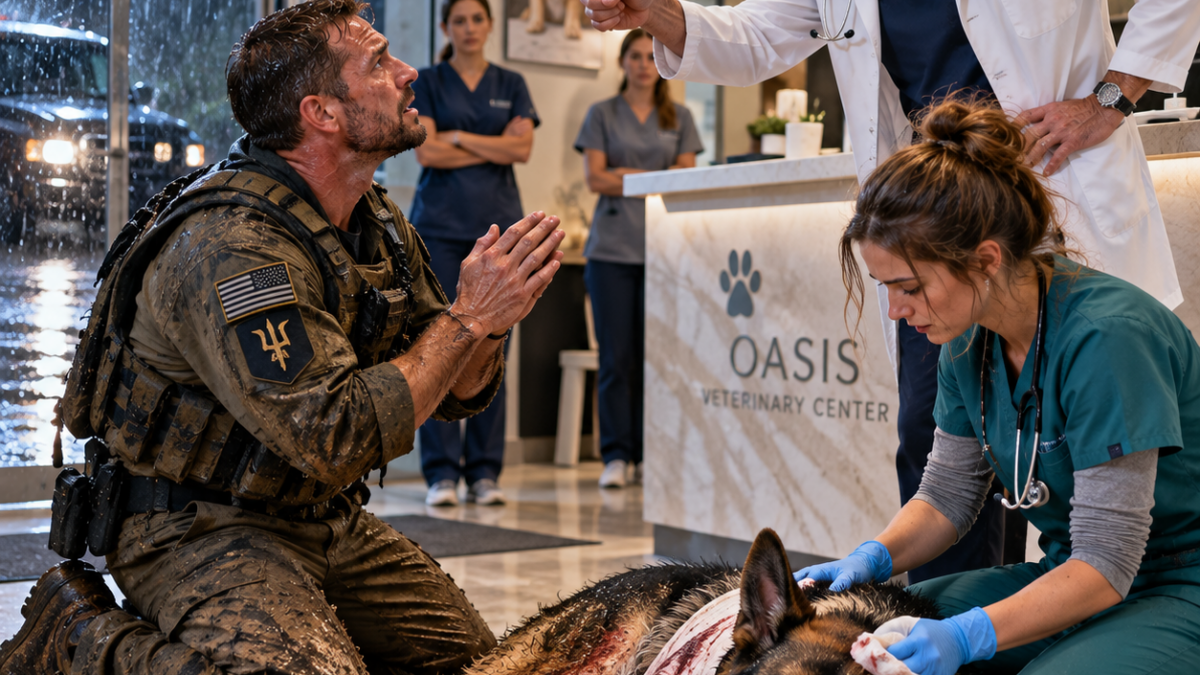
He was tall, broad-shouldered, and soaked through. Dark hair clung to his forehead. Mud streaked his tactical jacket and cargo pants. His boots left thick prints across the white floor.
In his arms, he carried a German Shepherd.
Harper’s breath caught.
The dog was older, with a graying muzzle and scarred ears. His fur was soaked, matted with rain and blood. A deep gash split the upper part of his hind leg, and dark red drops fell steadily from the wound to the marble below.
Harper saw the danger instantly.
Heavy bleeding.
Possible arterial involvement.
Shock risk.
The man’s arms were locked under the dog’s body, steady despite the weight. His face was hard, pale beneath the rain, but not panicked. His breathing was controlled. His eyes found Harper’s and held there.
“I need a doctor,” he said.
His voice was deep and rough, but calm.
Too calm for what he was carrying.
“He’s losing blood.”
Harper moved before fear could stop her.
“Room one,” she said, pointing down the hall. “Put him on the table. I’ll get the trauma kit.”
The man nodded once.
Not grateful.
Not questioning.
Just obeying the fastest path to help.
He carried the German Shepherd down the hall while Harper ran behind the desk and grabbed towels, gauze, pressure bandages, antiseptic, clamps, sutures, and the red emergency kit.
She was about to follow when Dr. Sterling’s office door opened.
He stepped out wearing a cashmere overcoat, briefcase in hand.
Then he saw the mud.
The blood.
The wet footprints across his marble.
His face changed.
Not with concern.
With disgust.
“Harper,” he said softly.
That was worse than shouting.
“What is the meaning of this?”
“Emergency,” she said quickly. “A man came in with a German Shepherd. Severe laceration. Heavy bleeding. He needs immediate care.”
Sterling looked down the hallway as if she had said someone had spilled sewage into his operating suite.
“We are closed.”
“He won’t make it to another clinic in time.”
Sterling walked carefully around the muddy footprints, protecting his shoes. He reached the doorway of exam room one and stopped.
The man had placed the dog on the stainless steel table. One large hand pressed a soaked cloth against the wound. The German Shepherd lay on his side, breathing hard but still, eyes locked on the man’s face.
That stillness struck Harper again.
Most injured animals fought.
They whined.
They twisted.
They snapped out of fear.
This dog did none of that.
He endured.
The man looked up.
“Are you the veterinarian?”
Sterling’s gaze traveled over him.
Muddy jacket.
Worn boots.
No visible luxury watch.
No designer anything.
Then Sterling looked at the dog.
Old.
Scarred.
Bleeding on his table.
“I am the owner and chief of medicine at this facility,” Sterling said coldly. “And this facility is closed.”
“My dog needs stitches, antibiotics, and fluids,” the man replied. “I’ll pay whatever it costs.”
Sterling gave a short laugh.
“I doubt that.”
The man’s jaw tightened.
Harper stepped into the room with the trauma kit. “Doctor, the bleeding is serious. If we don’t clamp and close it soon—”
Sterling turned on her. “I did not ask for your assessment.”
The German Shepherd exhaled roughly.
The man leaned closer to the dog. “Stay with me, Titan.”
Titan.
Harper remembered the name because of the way he said it.
Not like a pet name.
Like a partner’s name.
Sterling crossed his arms. “An after-hours emergency procedure at Oasis requires a fifteen-thousand-dollar deposit before treatment begins.”
Harper stared at him.
“Doctor—”
“Quiet.”
The man did not flinch. “I don’t have fifteen thousand dollars in cash on me.”
“Of course you don’t.”
“I can transfer funds.”
“Verified funds before treatment. That is policy.”
Harper knew that was not policy.
Not written policy.
Sterling had treated wealthy clients before payment plenty of times. He had opened the clinic at midnight for a celebrity’s French bulldog with indigestion. He had once sent a junior doctor to a mansion because a billionaire’s cat had sneezed twice.
The policy was not about money.
It was about appearance.
The man in the muddy jacket did not look like the kind of client Sterling wanted photographed inside Oasis.
“He’s not asking for charity,” Harper said, forcing herself to speak. “The dog is bleeding out.”
Sterling’s eyes narrowed.
“Harper, you seem confused about your role here.”
“I’m not confused.”
The words surprised even her.
Sterling stared.
Harper swallowed, but continued. “We have the supplies. I can assist. It won’t take long.”
Sterling smiled then.
A thin, cruel smile.
“You can assist by removing them from my building.”
The man’s face remained still, but something in the room shifted.
Harper felt it like pressure before a lightning strike.
“He is not a stray,” the man said.
Sterling looked down at Titan. “He looks like one.”
The words landed in the room like filth.
Titan’s eyes remained fixed on the man.
The man leaned down, pressing his forehead briefly against the dog’s head.
Harper saw his hand.
Calloused.
Steady.
Blood running across his knuckles.
Sterling glanced toward the door. “I am not wasting my sterile equipment, my medication, or my staff on a filthy old mutt dragged in from the street.”
“He is my partner,” the man said.
“Then you should have taken better care of him.”
Harper actually felt herself sway.
She had heard Sterling be rude.
Condescending.
Cruel in subtle ways.
But this was something else.
This was a dying animal on a table and a man begging for help without ever using the word.
“Doctor, please,” she whispered. “We can’t send him back into that storm.”
Sterling stepped closer to her.
His voice dropped.
“You will escort this man and his animal out the back door. Then you will scrub this room until there is no trace they were ever here. If they are not gone in two minutes, you are fired.”
Harper’s mouth went dry.
Sterling leaned closer.
“And if you ever want another job in this field, you will think very carefully before embarrassing me again.”
He turned and walked out.
Moments later, the front door opened and closed.
Through the rain-streaked windows, red taillights disappeared into the storm.
The clinic fell silent except for Titan’s labored breathing.
The man said nothing.
He did not plead.
He did not ask Harper to risk her job.
He gathered the dog carefully, lifting him back into his arms as if pain could be softened by reverence.
Harper watched him take one step toward the hallway.
Then another.
Every debt notice, every student loan bill, every fear she had about survival rose inside her.
Then she looked at Titan.
The dog’s eyes were open.
Trusting.
Waiting.
Harper had spent years telling herself that one day, when she had money, power, and security, she would be brave.
That night, she realized bravery almost never waits for convenience.
“Stop,” she said.
The man turned.
Harper’s voice shook, but only for the first word.
“Don’t go through the front.”
His eyes sharpened.
“There’s a rear delivery door in the alley,” she said. “Drive around back. Two minutes.”
He stared at her.
“Are you sure?”
“No,” she said honestly. “Go.”
He nodded and disappeared into the rain.
Harper ran.
She grabbed her personal medical kit from her locker. She took antibiotics she had purchased herself for emergency foster work. She unlocked the old storage room near the rear delivery area, the one Dr. Sterling never checked because nothing inside was expensive enough to interest him.
The room had a steel prep table, a sink, harsh fluorescent lights, shelves of cleaning supplies, and enough space to work if she did not think too hard about what would happen if she was caught.
A quiet knock sounded at the metal door.
Harper opened it.
The man stood in the alley, shielding Titan with his own body.
“Inside,” she said.
He laid the dog on the prep table.
Under the lights, the wound looked worse. Deep tissue. Torn muscle. A damaged vessel. Dirt in the edges from whatever had caused it.
“What happened?” Harper asked, already gloving up.
“Broken glass and rebar near a collapsed training structure,” he said. “He pulled me clear before it came down.”
She looked up.
He said nothing more.
“I can’t fully anesthetize him here,” she said. “I can numb the area, but pressure and stitching will still hurt. You need to hold him perfectly still.”
“He won’t move.”
There was no arrogance in the statement.
Only certainty.
The man bent close to Titan’s ear and murmured something too low for Harper to hear.
Titan’s body relaxed.
Harper cleaned the wound.
The dog’s body told a story no glossy clinic brochure could understand.
Old scars along the ribs.
A healed puncture near the shoulder.
Thick marks around the chest where harnesses had rubbed for years.
A small burn scar near the side.
This was not a pampered pet.
This was a survivor.
When Harper clamped the bleeding vessel, Titan made a low sound deep in his throat but did not move.
The man kept one hand on his chest and the other near his head.
“Eyes on me,” he whispered. “That’s it. Good boy. Hold.”
Harper stitched.
Her fingers moved quickly, precisely, better than fear should have allowed. She closed the muscle. Irrigated again. Sutured the outer layer. Wrapped the leg in sterile gauze and compression. Administered antibiotics. Checked gum color. Checked pulse. Checked breathing.
Forty minutes later, the bleeding had stopped.
Harper stepped back.
Her scrubs were streaked with blood.
Her hands cramped.
Her whole body trembled.
“He’s stable,” she said softly. “He needs rest. Keep the bandage dry. Watch for swelling, fever, discharge, refusal to eat. But he’s going to live.”
The man closed his eyes.
For the first time, his face changed.
Not much.
Just enough for Harper to see the terror he had been holding back.
He pressed his forehead to Titan’s head.
“Did you hear that, old man?” he whispered. “You’re not done.”
Titan’s tail gave one weak thump against the metal table.
The man looked at Harper.
His eyes were gray, steady, and suddenly full of emotion so controlled it almost hurt to see.
“What’s your name?”
“Harper.”
“Last name?”
She hesitated.
“Lane.”
He pulled a small waterproof notebook from his jacket. “Write your number down.”
“You don’t have to pay me.”
“That’s not what I asked.”
“I mean it. Just take care of him.”
“I will.” He slid the notebook across the table. “And I repay debts.”
Harper almost laughed.
“Unless you can repay student loans, rent, and professional blacklisting, I’m not sure you can help.”
His expression did not change.
“Write it down.”
Something in his voice made argument feel unnecessary.
Harper wrote her name and number.
He tore the page carefully and placed it inside an inner pocket of his jacket.
Then he lifted Titan as gently as if the eighty-pound dog were made of glass.
At the back door, he paused.
“Harper.”
She looked up.
“Thank you.”
Two words.
No flourish.
No drama.
But they carried the weight of an oath.
Then he stepped into the storm and disappeared.
Harper locked the door behind him.
For several seconds, she stood in the storage room surrounded by bloody towels, used sutures, and the faint sound of rain against metal.
Then she started cleaning.
By morning, no one would know.
That was what she told herself.
She was wrong.
Over the next four days, Oasis transformed into a shrine to Dr. Arthur Sterling’s ego.
The annual Oasis Foundation Gala was the most important event on his calendar. Officially, it raised money for animal welfare. Unofficially, it reminded Beverly Hills that Sterling was not merely a veterinarian, but a humanitarian visionary with excellent lighting.
White tents went up in the private parking circle.
Crystal chandeliers were hung in the lobby.
Thousands of imported orchids arrived in refrigerated trucks.
A string quartet rehearsed near the reception desk.
A champagne tower was assembled in front of a wall covered with the Oasis Foundation logo.
Sterling spent the week barking orders at caterers, decorators, florists, lighting technicians, and terrified assistants.
“Not there,” he snapped at one man carrying a floral arrangement. “Three inches left. Do you want the mayor photographed beside empty wall space?”
Harper kept her head down.
Sterling had not discovered what she had done.
Or perhaps he suspected and was waiting.
Either way, he punished her without naming the crime.
No front desk.
No client interaction.
No gala duties.
She was assigned to kennels, laundry, trash, and surgical tray sanitation. On the night of the gala, she was told to remain in the back hallways and “avoid disrupting the aesthetic environment.”
Harper nodded.
She preferred the animals anyway.
Every evening, her cracked phone buzzed.
Unknown number.
First message:
Titan is resting. Bandage dry. Ate half a bowl.
Harper had stared at the message for a long time before saving the contact.
Callum.
She typed back wound-care instructions.
The next night:
Swelling down. He hates the cone. I also hate the cone. We are negotiating.
Harper smiled so hard her cheeks hurt.
The third night:
Tried to walk too much. I stopped him. He is offended. Thank you again.
Those messages became the one clean thing inside a week of hypocrisy.
While Sterling rehearsed his speech about compassion, Harper knew an injured dog was alive because she had chosen not to obey cruelty.
The night of the gala arrived.
By eight o’clock, Oasis no longer looked like a clinic.
It looked like wealth had decided to host a dream about kindness.
Valets parked Bentleys, Ferraris, Rolls-Royces, armored SUVs, and cars Harper could not name without looking them up. Women in silk gowns moved beneath chandeliers. Men in tuxedos spoke over champagne about tax-deductible generosity. Cameras flashed. Reporters smiled. The mayor arrived. A famous actress posed with a rescue Chihuahua she had borrowed for photographs.
Harper stood behind the swinging kitchen door holding a trash bag.
She peeked through the small window and watched Sterling step onto the stage.
He wore a black tuxedo and the expression of a man who believed applause was a form of oxygen.
“Ladies and gentlemen,” he began, voice smooth through the microphone, “tonight we gather not merely as donors, but as guardians of the vulnerable.”
Warm applause filled the room.
Harper’s stomach twisted.
“At Oasis, we believe every life matters. Every frightened creature deserves dignity. Every suffering animal deserves compassion.”
The applause grew louder.
Harper looked away.
Four nights earlier, he had ordered a bleeding dog into the rain because saving him would have inconvenienced the marble.
She shifted the trash bag in her hands and prepared to take it outside.
Then the floor vibrated.
At first, she thought it was thunder.
But thunder did not approach in measured formation.
The string quartet faltered.
Champagne rippled in crystal flutes.
Through the front glass, red and blue lights swept across the lobby walls.
Engines.
Heavy ones.
Not sports cars.
Not valet traffic.
Military vehicles.
The room turned toward the entrance as four matte-black SUVs with government plates pulled into the valet circle. They did not park politely. They angled themselves with tactical precision, blocking the exit lanes, dwarfing the Ferraris and Bentleys like wolves among show ponies.
Uniformed personnel stepped out.
The hired security guards near the front doors straightened, then instinctively stepped aside.
The rear door of the second SUV opened.
An older man emerged in a white Navy dress uniform.
His silver hair was cut short. His posture was flawless. His chest carried rows of ribbons and medals that made every diamond in the room look decorative and weak.
He walked through the glass doors.
The lobby fell silent.
Not quiet.
Silent.
The admiral crossed the marble floor without looking left or right.
The wealthy guests parted for him.
Sterling stood behind the podium, his smile frozen.
The admiral stopped ten feet from the stage.
He clasped his hands behind his back.
“Good evening,” he said.
He did not need the microphone.
His voice carried like command across water.
“My name is Admiral Thomas Vance of the United States Navy. I apologize for interrupting your celebration, but I am not here for champagne, photographs, or speeches.”
A murmur moved through the room.
Sterling tried to recover.
“Admiral Vance,” he said, stepping forward with sudden eagerness. “What an extraordinary honor. Oasis is always proud to support—”
The admiral lifted one hand.
Sterling stopped.
“I am here,” Admiral Vance continued, “because this facility was the site of an act of extraordinary courage. I intend to honor the person responsible.”
Sterling’s expression changed.
A greedy light entered his eyes.
Harper saw it even from the shadows.
He thought the moment was for him.
He thought the Navy had come to praise Oasis.
The admiral turned toward the entrance.
“Commander,” he called. “Bring him in.”
The glass doors opened again.
Callum stepped inside.
But he was not the muddy stranger from the storm.
He wore his full Navy dress uniform, dark, immaculate, perfectly pressed. Gold stripes marked his sleeves. Medals rested over his heart. Above them, unmistakable even across the room, was the golden trident of a Navy SEAL.
He walked with quiet authority.
Beside him, moving with a slight but dignified limp, was Titan.
The German Shepherd’s coat was clean now, dark and brushed. His muzzle was gray, his ears scarred, his eyes alert. A crisp bandage wrapped his injured leg. He did not cower from the cameras, chandeliers, or crowd. He sat at Callum’s side with the composure of a soldier at inspection.
Harper’s knees nearly gave out.
Sterling gripped the podium.
He recognized them.
The entire room watched the blood drain from his face.
Admiral Vance spoke again.
“Ladies and gentlemen, this is Commander Callum Hayes, active-duty Navy SEAL team leader. Beside him is Titan, a retired military working dog and explosive ordnance detection specialist.”
A wave of whispers spread.
“During their last deployment,” the admiral continued, “Titan detected a buried improvised explosive device that had evaded mechanical sensors. By doing so, he saved Commander Hayes and fourteen American service members.”
The room erupted.
Applause rose, sudden and thunderous.
The mayor stood.
The actress covered her mouth.
Cameras flashed in white bursts.
Sterling stepped from behind the podium, forcing a broad smile onto his face with the desperation of a man trying to board a departing ship.
“What an honor,” he said loudly, clapping. “Commander Hayes, Titan, truly, what an honor. When this hero came to Oasis in his hour of need, we were humbled to provide the world-class care our clinic is known for.”
Harper felt the air leave her lungs.
No.
Sterling continued, extending his hand toward Callum.
“Our entire team is proud to have contributed to this brave dog’s recovery.”
Callum looked at the outstretched hand.
He did not take it.
The applause faded.
Sterling’s smile twitched.
“I am not going to shake your hand, Doctor,” Callum said.
His voice was quiet.
The room heard every word.
Sterling’s hand hung in the air.
Callum stepped past him and approached the microphone. Titan moved with him, sitting perfectly at his side.
Callum looked out at the crowd.
Four nights ago, he had stood in that same building covered in rain, mud, and blood.
Now every person who had ignored people like Harper their entire lives was watching him breathe.
“Four nights ago,” he said, “I carried my partner into this clinic.”
The room remained still.
“He was bleeding heavily from a severe leg wound. I asked for a doctor. I was willing to pay whatever the procedure cost.”
His eyes shifted to Sterling.
“Dr. Arthur Sterling refused to treat him.”
A sharp gasp moved through the crowd.
Sterling shook his head. “That is not—”
Callum did not raise his voice.
“He demanded a fifteen-thousand-dollar deposit before he would touch the wound.”
The mayor lowered his glass.
“When I could not produce that amount of money on the spot, he called Titan a dirty street mutt.”
A woman near the front whispered, “Oh my God.”
“He ordered his assistant to throw us back into the storm through the rear door so we would not track more mud through his lobby.”
Sterling’s face had turned gray.
“That is a gross misrepresentation of clinic policy,” he stammered.
Callum turned toward him.
“No,” he said. “It is the truth.”
Sterling tried to speak again.
Callum’s gaze stopped him.
“I have heard men lie under interrogation with more courage than you’re showing right now.”
The room went dead silent.
Then Callum looked back to the crowd.
“Titan is alive today. But not because of this man. Not because of this gala. Not because of the foundation whose name is printed behind me.”
He paused.
“He is alive because one person in this building remembered what medicine is for.”
Harper’s grip tightened around the trash bag.
Callum’s eyes found the swinging kitchen door.
“Miss Harper Lane,” he said. “Please come forward.”
Every head turned.
Harper froze.
She stood half-hidden in the service doorway wearing faded scrubs, old sneakers, and a name tag scratched at the corner. Her hands were still holding a black trash bag.
For one terrible second, she wished the floor would open.
Then Titan barked.
One sharp, joyful sound.
His tail thumped against the marble.
That broke something inside her.
Harper set down the trash bag.
Then she stepped into the light.
The room watched her walk down the aisle between tables of silk, diamonds, tuxedos, champagne, and people who had never had to calculate whether courage would cost rent.
Her sneakers made no sound on the marble.
Callum stepped down from the stage and met her halfway.
He did not offer her a theatrical handshake.
He bowed his head slightly.
Respectfully.
As if she had rank.
“This woman,” Callum said, turning toward the room, “risked her job, her license, and her future to save my partner.”
Harper’s eyes filled.
“When Dr. Sterling ordered us out, she brought us through the back alley. She treated Titan in a storage room with her own supplies. She asked for nothing. No money. No recognition. No guarantee that doing the right thing would not destroy her life.”
He looked directly at Sterling.
“That is compassion.”
Then back to Harper.
“That is courage.”
No one spoke.
The silence felt enormous.
Admiral Vance stepped forward.
“Miss Lane,” he said gently, “on behalf of the United States Navy, thank you.”
Harper could barely breathe.
“I just did what anyone should have done.”
The admiral’s face softened.
“Yes,” he said. “That is why it matters.”
Then the room changed.
Not slowly.
All at once.
The mayor stood first.
“Arthur,” he said, voice shaking with anger, “you are a disgrace to this city.”
Sterling opened his mouth.
The mayor continued. “Do not call my office again. Do not use my name in another foundation brochure. Ever.”
A famous actress pushed back her chair and stood.
“I want my donation canceled immediately,” she said to the assistant beside her.
Across the room, a tech investor was already on his phone.
Another donor stood.
Then another.
The cameras, which had been pointed toward Callum and Titan, swung toward Sterling.
The man who had built his life around appearances now had nowhere to hide from them.
Sterling backed toward the podium.
“This is absurd,” he said weakly. “You people don’t understand medical operations. There are protocols. Liability concerns. Sanitation standards—”
“Sanitation?” someone snapped. “The dog was dying.”
“He was old,” Sterling said, panic making him cruel again. “There are practical decisions in medicine. Emotional people don’t understand—”
Titan growled.
It was low.
Not loud.
Enough.
Sterling stopped talking.
A man in the front row stood. He was older, heavyset, in a perfectly tailored tuxedo. Harper recognized him from magazines, a real estate developer worth more money than most hospitals.
“I wrote a seven-figure pledge to the Oasis Foundation tonight,” he said.
Sterling looked toward him with sudden hope.
“I’m canceling it.”
The hope vanished.
The man turned to Harper.
“Miss Lane, do you want to run a clinic?”
Harper blinked.
“What?”
“A real one,” he said. “A clinic that treats emergencies. Rescues. Working dogs. Animals whose owners don’t arrive in silk.”
“I—”
“I’ll fund the building.”
Another woman stood. “I’ll fund equipment.”
A man near the mayor said, “I’ll cover the first year of operating costs.”
Someone else called, “I’ll donate land.”
The room erupted.
Not in polite applause.
In movement.
Phones came out.
Assistants were summoned.
Checks were redirected.
Journalists began shouting questions.
The Oasis Foundation Gala, carefully designed to make Dr. Arthur Sterling look like the savior of animals, became the night his donors abandoned him for the assistant he had tried to keep hidden near the trash.
Harper stood in the middle of it, stunned.
Callum placed a steady hand on her shoulder.
“I told you,” he said quietly, “I honor my debts.”
She looked up at him through tears.
“I didn’t do it for this.”
“I know.”
Titan limped forward and pressed his head against her hip.
Harper dropped to her knees on the marble floor and wrapped her arms around his neck.
She did not care who watched.
Titan sighed and leaned into her.
The cameras flashed.
Somewhere behind them, Sterling was shouting about contracts and defamation and misunderstanding.
Nobody listened.
That was the strange thing about a public mask once it cracked.
People could not unsee what was underneath.
Within a week, the footage was everywhere.
The clip of Callum refusing Sterling’s handshake.
The admiral thanking Harper.
Titan limping across the marble with his bandaged leg.
Sterling’s pale face behind the podium.
The headline changed depending on the outlet.
Elite Vet Refused Service Dog in Storm.
Poor Assistant Saves Military Hero K9.
Beverly Hills Gala Turns Into Public Reckoning.
The California Veterinary Medical Board opened an investigation.
Former employees came forward.
So did former clients.
Stories emerged about inflated procedures, unnecessary luxury add-ons, charity funds redirected toward clinic renovations, low-income pet owners humiliated, rescue animals refused, and staff punished for helping when help was not profitable.
Oasis did not collapse overnight.
Places like that rarely do.
They crack first.
Then leak.
Then rot becomes visible.
But Sterling’s empire never recovered.
The mayor severed ties.
Donors withdrew.
Journalists dug into the foundation.
Former staff testified.
The clinic that once smelled of lavender and money began to smell like fear.
Harper resigned before Sterling could fire her.
Her resignation letter was one sentence.
I choose medicine.
She printed it, signed it, and left it on the reception desk.
Then she walked out the front door for the first time without lowering her eyes.
Three months later, a modest building on the edge of East Los Angeles opened with a blue sign over the door.
Harper Lane Animal Care & Rescue.
No marble.
No chandeliers.
No imported orchids.
The floors were durable vinyl because animals slipped less on them. The lobby had mismatched chairs because donors gave what they had. The exam rooms were clean, practical, and bright. The back wall displayed photographs of animals treated there, not wealthy donors.
On opening morning, Harper stood outside holding a paper cup of coffee with both hands, staring at the sign like she expected someone to take it down.
Callum stood beside her in civilian clothes.
Titan sat between them wearing a vest that read RETIRED MWD.
“You’re staring,” Callum said.
“I’m making sure it’s real.”
“It’s real.”
“It doesn’t feel real.”
“That part takes longer.”
She looked at him.
“You sound like you know.”
He looked down at Titan.
“I do.”
The first patient arrived at 7:12 a.m.
A delivery driver with a limping terrier.
He apologized three times before stepping inside because he was afraid he could not afford much.
Harper opened the door herself.
“What’s his name?”
“Rufus.”
“Then let’s help Rufus.”
The man’s eyes filled with relief before treatment had even begun.
That was when Harper understood.
The clinic was not a reward.
It was a responsibility.
A beautiful one.
The days were long.
Longer than Oasis.
Harder too.
There were emergencies at midnight. Scared owners. Strays hit by cars. Senior dogs with cancer. Cats found under dumpsters. Foster puppies with parvo. Military working dogs needing specialized rehab. Police K9s. Search-and-rescue dogs. Dogs with scars Harper recognized before anyone told her their stories.
She learned to ask for help.
To accept donations.
To hire people who loved the work more than the image of it.
She hired the technician Sterling once fired for giving free antibiotics to a shelter cat.
She hired a receptionist who spoke three languages and had a gift for calming panicked families.
She hired a young vet fresh from school who cried after his first euthanasia and came back the next morning anyway.
Callum visited often.
At first, he brought Titan for wound checks.
Then physical therapy.
Then no reason at all.
He fixed a broken lock on the back door.
Installed shelves in the supply room.
Built a ramp for older dogs near the entrance.
He never made speeches about it.
He simply showed up, did the work, and left before anyone could thank him too much.
Titan became the clinic’s unofficial supervisor.
He lay near the reception desk on a thick mat Harper bought with her first official paycheck from her own clinic. Nervous dogs calmed when they saw him. Children asked if they could pet him. Veterans stopped in the doorway when they recognized the look in his eyes.
One afternoon, a former Marine brought in a trembling shepherd mix who refused to let anyone near his injured paw.
Harper tried soft words.
Treats.
Time.
Nothing worked.
Titan stood slowly, limped across the room, and lay down beside the younger dog.
The shepherd mix stopped shaking.
Harper looked at Callum.
Callum shrugged.
“Senior enlisted,” he said. “They handle discipline.”
Titan rested his gray muzzle on his paws with great dignity.
The shepherd mix allowed treatment.
A year after the gala, Harper received an envelope from the state board.
Her hands shook as she opened it.
Callum happened to be in the lobby repairing a cabinet hinge.
Titan lifted his head.
Harper read the letter twice.
Then a third time.
“What?” Callum asked.
“Sterling lost his license.”
The lobby went quiet.
The receptionist looked up.
The young vet stopped in the hallway.
Harper lowered the page.
“For misconduct. Negligence. Financial fraud connected to the foundation. Retaliation against staff.”
Callum nodded once.
“Good.”
Harper expected to feel triumphant.
She did not.
She felt sad.
Not for Sterling.
For every animal he had turned away.
For every assistant he had bullied into silence.
For every client made to feel small because they arrived without money.
For every moment when medicine had become theater.
Titan rose and came to her.
He pressed his head against her leg the same way he had at the gala.
Harper scratched behind his ear.
“You know,” she whispered, “you changed my whole life.”
Callum’s voice came quietly from behind her.
“He has a habit of doing that.”
Harper looked at him.
“So do you.”
He glanced away first.
For a Navy SEAL, he was terrible at receiving gratitude.
Months passed.
The clinic grew.
Not in the polished, predatory way Oasis had grown.
It grew because people trusted it.
A woman paid twenty dollars toward a bill and came back later with homemade tamales for the staff.
A retired firefighter donated oxygen masks for pets.
A wealthy donor funded a surgical suite but asked that no plaque be placed anywhere.
Harper put up one anyway.
It read:
For the animals who arrive without appointments, without money, and without time.
That was the only plaque in the building.
One rainy night, almost exactly two years after Titan stumbled into Oasis bleeding, Harper was locking up when headlights swept across the front windows.
For one heartbeat, memory pulled her back.
Storm.
Glass doors.
Blood on marble.
A man carrying a dog like the whole world depended on not dropping him.
Then the door opened.
Callum stepped inside.
Rain shone on his jacket.
Titan was with him, older now, slower, but still upright and proud.
Harper smiled.
“We’re closed.”
Callum looked around the clinic.
A tired mother sat in the corner with a sleeping child and a bandaged kitten in a carrier, waiting for a rideshare. A tech was mopping. Somewhere in the back, a recovering dog barked once in its sleep.
“Looks open to me.”
“That’s because you have poor boundaries.”
“I’ve been told.”
Titan walked to Harper and leaned into her knees.
She knelt carefully because his joints hurt more these days.
“Hi, old man.”
His tail moved once.
Callum watched them.
There was softness in his face now that had not existed that first night.
Not weakness.
Peace.
“What brings you here?” Harper asked.
Callum reached into his jacket pocket and pulled out a folded photograph.
He handed it to her.
It showed Titan years earlier overseas, younger and muscled, standing beside Callum in full gear. Behind them were fourteen soldiers, dusty and grinning, some with arms thrown over one another’s shoulders.
“This was taken the day after he found the IED,” Callum said.
Harper studied it.
Titan looked fierce, bright-eyed, unstoppable.
“You kept this?”
“I have a lot of pictures. But that one belongs here.”
“Callum—”
He nodded toward the wall of patient photographs.
“He saved them. You saved him. Seems like a full circle.”
Harper’s throat tightened.
She found a frame the next morning.
The photo went up in the front lobby where everyone could see it.
Beneath it, Harper placed a small card.
Titan
Retired Military Working Dog
Saved fourteen soldiers overseas.
Saved one clinic from forgetting what compassion means.
People stopped to read it every day.
Some smiled.
Some cried.
Some asked questions.
Harper told the story carefully.
Not as a fairy tale.
Not as revenge.
As a reminder.
A white coat did not make a healer.
A uniform did not make a hero.
Money did not make a person generous.
Titles did not make someone worthy of trust.
Choices did.
Sterling had chosen status.
Harper had chosen the dog.
Callum had chosen gratitude over pride.
Titan had chosen to keep trusting humans after humans had failed him.
That was the miracle.
Not the military convoy.
Not the gala.
Not the donations.
The miracle was that a wounded animal, lying in pain on a cold table, still believed someone might help.
Years later, when Harper trained new assistants, she told them about triage, blood pressure, wound care, dosage calculations, owner communication, and documentation.
Then she told them the most important thing.
“If an animal comes through that door in pain, our first question is not whether it fits the brand. Our first question is what it needs.”
One assistant asked, “What if the owner can’t pay?”
Harper looked toward the framed photograph of Titan.
“Then we start with the animal and figure the rest out after.”
That became the rule.
Not a marketing slogan.
A rule.
The kind written into the bones of a place.
Titan lived three more good years.
Good years, not easy ones.
His leg stiffened. His muzzle whitened. He stopped climbing stairs. He began sleeping more, often in a patch of sunlight near Harper’s office when Callum brought him by.
The whole clinic adjusted around him without discussion.
A rug appeared where he liked to lie.
Then a water bowl.
Then a thicker bed.
Then a sign near the front desk that read:
Please do not step over the retired hero. He outranks you.
Titan seemed pleased with this.
On his last day, rain fell over the city.
Softly this time.
Not violent.
Not cold.
Callum carried him into Harper’s clinic wrapped in a gray blanket.
No blood.
No panic.
Just age.
The kind no medicine can defeat forever.
Harper met them at the door.
She knew before Callum spoke.
Titan’s eyes were tired, but calm. His head rested against Callum’s chest, just like it had that first night at Oasis. Harper placed one hand on his muzzle and felt the old dog breathe.
“Hey, old man,” she whispered.
His tail moved once beneath the blanket.
Callum’s voice was steady because he had trained it to be.
“He waited until morning.”
Harper nodded.
“Of course he did.”
They took him into the quiet room at the back of the clinic, the one with soft blankets, dim lights, and no metal tables unless necessary.
Callum sat on the floor.
Harper sat beside him.
Titan lay with his head across Callum’s lap and one paw touching Harper’s knee.
There were no speeches.
Heroes do not always need speeches.
Sometimes they need hands they trust.
Callum bent close to Titan’s ear.
“You did good,” he whispered. “You can stand down.”
Harper’s vision blurred.
Titan exhaled.
Long.
Peaceful.
Final.
Callum did not move for a long time.
Neither did Harper.
Outside, rain tapped softly against the window.
Later, they buried Titan beneath a jacaranda tree behind the clinic. The staff came. Veterans came. Police K9 handlers came. Families whose animals Harper had treated came with flowers, drawings, biscuits, notes, and small American flags.
Admiral Vance attended in civilian clothes.
He stood beside Callum while Harper placed the framed photo near the tree.
No marble.
No chandeliers.
No wealthy audience.
Just real people who understood that a life does not need glamour to matter.
Callum placed Titan’s old vest over the grave for a moment before taking it back.
Harper touched the patch gently.
Retired MWD.
Hero.
Partner.
Family.
Months later, the clinic felt strange without him.
His bed remained near reception.
At first, Harper planned to move it.
She never did.
A nervous rescue dog curled up on it one afternoon and fell asleep for the first time since arriving.
After that, it stayed.
Titan’s bed became the place frightened animals learned the room was safe.
That seemed right.
One evening, Harper was closing when Callum arrived with a cardboard box.
“What’s this?” she asked.
“Trouble.”
Inside were three abandoned German Shepherd puppies from a military working dog rescue network.
All ears.
All paws.
All chaos.
Harper stared at him.
“No.”
Callum looked innocent.
“You haven’t heard the pitch.”
“I already know the pitch.”
“They need temporary foster placement.”
“No.”
“Very temporary.”
“You are lying in military.”
One puppy barked.
Another chewed the side of the box.
The third fell asleep on its sibling’s head.
Harper sighed.
Callum smiled.
It was small, but real.
“Titan would approve.”
“That is emotional blackmail.”
“Yes.”
She took the box.
“One week.”
“Of course.”
The puppies stayed for three months.
One was adopted by a retired Marine.
One by a firefighter.
One, a black-and-tan female with a white blaze on her chest, stayed with Harper because she made the mistake of naming her.
Hope.
Callum did not say “I told you so.”
He did not have to.
Years after the storm, people still told the story of the gala.
They liked the dramatic parts.
The military convoy.
The admiral in dress whites.
The ruined doctor.
The poor assistant becoming the founder of a rescue clinic.
They liked the reversal because people love watching arrogance fall in public.
Harper understood that.
Sometimes she loved that part too.
But when she told the story, she always started somewhere quieter.
Not with the gala.
Not with the cameras.
Not with the applause.
She started with the storage room.
A steel table.
A single fluorescent bulb.
A wounded dog holding still because he trusted his partner.
A man with blood on his hands who did not yell because saving the dog mattered more than defending his pride.
A young assistant choosing the thing she could live with over the job she was afraid to lose.
That was where everything changed.
Not in the light.
In the back.
Where nobody was watching.
One night, Harper stayed late after surgery. Hope slept in Titan’s old bed. Rain streaked the windows. The clinic was quiet except for the hum of refrigerators and the soft breathing of recovering animals.
Callum stood beside the framed photo in the lobby.
He had been silent for a while.
Harper came up beside him.
“You okay?”
He nodded.
Then shook his head.
Then smiled faintly.
“Depends when you ask.”
She understood.
Grief was like that.
So was healing.
He looked at Titan’s photo.
“I used to think he saved my life overseas.”
“He did.”
“He saved it again here.”
Harper waited.
Callum looked around the clinic.
At the adoption board.
At the donation jar.
At the wall of patient photos.
At Hope sleeping where Titan once slept.
“He brought me here.”
Harper’s throat tightened.
“Yes,” she said. “He did.”
Rain softened against the glass.
Callum turned toward her.
“I never thanked you enough.”
“You thanked me with an entire clinic.”
“That was strategy.”
“Of course.”
He smiled.
Then his expression grew serious.
“No. I mean for that night. Before you knew who I was. Before the uniform. Before any of it.”
Harper looked toward the back hallway, remembering the storage room.
“You were just a man with a dying dog.”
“Yes.”
“And he was just a dog who needed help.”
Callum nodded slowly.
“That’s why it mattered.”
In the years that followed, Harper Lane Animal Care & Rescue became known across the city.
Not because it was glamorous.
Because it answered.
At midnight.
At dawn.
During storms.
For veterans.
For single mothers.
For old dogs.
For injured strays.
For people who walked in ashamed because they could not afford enough.
A sign hung near the reception desk.
It was handwritten by Harper, framed crookedly by Callum, and never replaced.
Compassion first. Paperwork second.
Visitors sometimes laughed.
Staff did not.
They knew it was the foundation.
On the fifth anniversary of the clinic, the mayor came to speak. Reporters arrived. Donors gathered. Staff wore clean scrubs. Hope sat at Harper’s side, alert and proud, with Titan’s old tag attached to her collar.
Harper stood at a small podium outside under the jacaranda tree.
She was no longer the invisible assistant in the shadows.
She was a clinic founder, a licensed veterinary technician, a director, a mentor, and the person desperate owners asked for by name.
But when she looked at the crowd, she still felt like the young woman in faded scrubs holding a trash bag outside a glittering room.
She touched the edge of her notes.
Then she folded them.
“I had a speech,” she said.
People laughed softly.
“But the truth is simpler.”
She looked toward Titan’s marker beneath the tree.
“This clinic exists because one night, somebody powerful said no, and someone scared said yes.”
Silence settled over the crowd.
“I was scared. I needed my job. I had bills. I had loans. I had every practical reason to obey a cruel order.”
Her voice shook slightly, but did not break.
“Then I looked at an animal in pain and realized that if I walked away, I would keep my job and lose myself.”
Callum stood near the back.
His eyes did not leave her.
Harper continued.
“So that is what we do here. We help people keep the best part of themselves. We help animals survive long enough for love to do the rest.”
Hope leaned against her leg.
Harper smiled down at her.
“And sometimes, if we are very lucky, the animal we save saves us back.”
The applause came slowly at first.
Then stronger.
Callum clapped with both hands.
Admiral Vance wiped one eye and pretended he had not.
Behind them, the clinic doors remained open.
Inside, phones rang.
A dog barked.
A kitten knocked over a pen.
Life continued.
Work continued.
That was the real legacy.
Not Sterling’s downfall.
Not the viral video.
Not the headlines.
A door that stayed open.
A table ready.
A hand steady enough to help.
That night, after everyone left, Harper stood beneath the jacaranda tree with Callum beside her and Hope lying at their feet.
The city lights glowed beyond the fence.
The air smelled faintly of rain though the sky was clear.
Harper looked at Titan’s marker.
It was simple.
Titan
Military Working Dog
Partner. Protector. Friend.
He held the line.
Callum crouched and brushed a fallen purple flower from the stone.
For a long time, neither of them spoke.
Then Harper said, “He would have liked the puppies.”
“He would have pretended not to.”
“He would have loved them.”
“Yes,” Callum said. “He would have.”
Hope lifted her head, as if hearing her name in the silence between words.
Callum stood.
Harper looked at the clinic behind them.
The windows were warm.
The floors were scuffed.
The shelves were practical.
The air smelled faintly of antiseptic, wet dog, coffee, and life.
Nothing like Oasis.
Everything better.
She thought about Sterling’s marble floor, his lavender air, his charity speeches, his obsession with perfection.
Then she thought about a storage room, a wounded German Shepherd, and the moment she chose to open the back door.
Some choices look small because the world is not watching yet.
But the world is not what gives a choice its weight.
Character does.
And on the night Dr. Arthur Sterling looked at Titan and saw a stain, Harper looked at him and saw a life.
That had made all the difference.
Callum opened the clinic door for her.
Hope trotted inside first.
Harper paused under the sign.
Harper Lane Animal Care & Rescue.
She still read it sometimes like she needed proof.
Then she stepped inside.
Another phone began ringing at the front desk.
A night emergency.
A dog hit by a car.
Owner ten minutes away.
Harper moved immediately.
Gloves.
Towels.
Trauma kit.
Hope stood alert beside the desk.
Callum looked at Harper.
“Need help?”
She gave him a small smile.
“Always.”
He rolled up his sleeves.
Outside, the city kept shining for people who could afford to pretend pain happened somewhere else.
Inside, Harper prepared the table.
The door would open soon.
Someone would come in scared.
Someone would be bleeding.
Someone would need the kind of help that did not wait for perfect circumstances.
And this time, no one would send them back into the rain.