A Navy SEAL and His K9 Were Eating Alone in a Desert Diner—Then a Bruised Girl Ran Inside Begging for Help, and the Men Who Came Looking for Her Were the Last People He Expected.
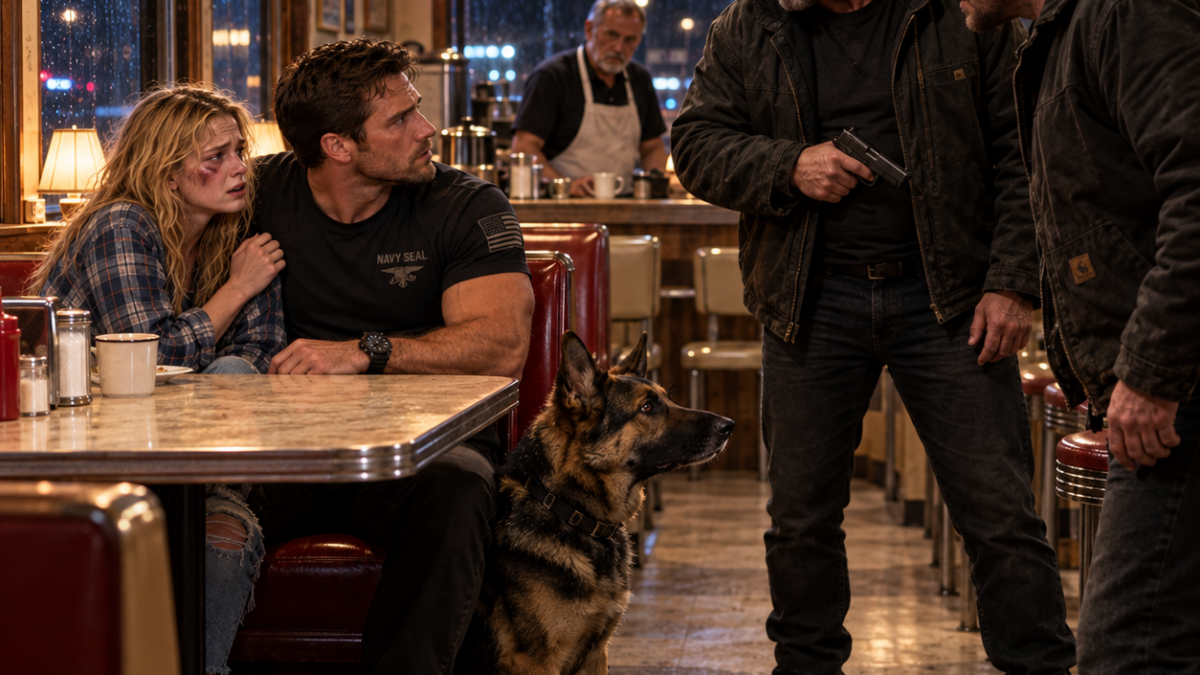
PART3:
Plain hamburger patty for him.
Earl looked offended.
“For the dog?”
“Yes.”
“Seven dollars.”
“He has expensive taste.”
Duke thumped his tail.
The diner was too quiet.
No music.
Refrigerator humming.
Wind rubbing sand against the windows.
Earl polishing the same coffee cup for several minutes.
I noticed details because I could not stop noticing details.
Two exits.
Front entrance.
Kitchen rear.
Three ceiling cameras.
One broken.
One above register.
One covering booths.
A framed photograph behind the counter showed Earl shaking hands with a sheriff wearing a silver badge.
SHERIFF HARLAN MILLER, COMMUNITY BUSINESS AWARD.
I barely registered it.
Then Duke lifted his head.
His ears turned toward the door.
Three seconds later, it slammed open.
A young woman stumbled inside.
Early twenties.
Blond hair tangled.
Blue flannel shirt ripped at one shoulder.
Jeans torn at both knees.
No jacket.
One shoe missing.
Blood on her palms.
Bruising along her cheekbone.
A darker bruise wrapped partway around her right wrist.
She looked behind herself before she looked into the room.
That told me everything about what direction danger was coming from.
Earl stopped wiping the glass.
He did not say:
Are you hurt?
Need an ambulance?
What happened?
He reached beneath the counter.
Pulled up a landline.
Started dialing.
That mattered.
The girl saw him doing it.
Her face went white.
Then she saw me.
More importantly, she saw Duke.
She moved fast.
Straight toward our booth.
Duke stood.
Not aggressive.
Alert.
The girl stopped three feet away.
“Please.”
Her voice barely worked.
I slid outward, giving her the inside seat.
“Sit.”
She did.
Pressed herself into the corner.
Duke sniffed the air.
Then slowly pushed his nose toward her hand.
She jerked back.
Duke stopped immediately.
He was good about that.
He waited.
After two seconds, she placed her fingers against his head.
They trembled.
“My name’s Brent.”
She said nothing.
“This is Duke.”
Duke leaned into her hand.
“What’s your name?”
“Sarah.”
“Sarah, are you injured badly?”
“I don’t know.”
“You hit your head?”
“I don’t think so.”
“Are you bleeding anywhere besides your hands?”
She shook her head.
“Anyone chasing you?”
She looked toward the counter.
Earl had finished his call.
Now he was watching.
Sarah whispered:
“They’re coming.”
“Who?”
Her eyes filled.
“Please don’t let them take me back.”
That sentence removed several possibilities.
I kept my voice quiet.
“Back where?”
She swallowed.
“There’s a place.”
“What place?”
“Outside town.”
“House?”
“Camp.”
Her breathing increased.
I stopped questions.
“Slow down.”
“I can’t.”
“Yes, you can.”
“No.”
“Look at Duke.”
She did.
“Watch him breathe.”
Duke was panting softly.
“Match that.”
She tried.
It helped a little.
“Good.”
I looked at Earl.
He pretended to clean the counter.
“Who did you call?”
He stared at me.
“Sheriff.”
Sarah grabbed my arm so hard her fingernails dug through my shirt.
“No.”
Earl noticed.
“So police are a problem.”
Sarah whispered:
“They’re with them.”
Earl’s expression changed.
Just slightly.
I stood.
“Earl.”
He did not answer.
“Who exactly did you call?”
“The sheriff.”
“Why?”
“Girl runs in bleeding, I call police.”
“That’s not what you did.”
He put the cup down.
“What did I do?”
“You recognized her.”
Silence.
“You were waiting for her.”
Earl’s eyes hardened.
“Sit down, soldier.”
That confirmed more than he probably intended.
I moved one hand toward my pocket.
Phone.
No service.
One bar appeared.
Then disappeared.
Of course.
Sarah whispered:
“They block signals around here.”
“Who?”
Before she answered, headlights filled the diner window.
One black pickup.
No light bar.
No markings.
Sarah folded inward.
“Oh God.”
I looked outside.
Two men stepped from the truck.
Large.
Dark clothing.
One bald.
One with beard and a scar across his face.
Neither looked like law enforcement.
Bald man had something heavy beneath his coat.
Scar-face did not bother hiding the knife at his belt.
Earl backed away from the counter.
Not scared of them.
Making room.
That mattered too.
I looked at Sarah.
“You know them?”
She nodded.
“They drove the transport.”
“Transport for what?”
Her mouth opened.
The front door did too.
Cold desert air entered first.
Then the men.
The bald one looked at Earl.
“Where?”
Earl nodded toward us.
No hesitation.
The man’s eyes found Sarah.
Then me.
Then Duke.
He smiled.
“There you are.”
Sarah pressed into the wall.
The scarred man walked closer.
“Come on, little bird.”
Duke gave one low growl.
The man stopped.
I said:
“She doesn’t want to go.”
Bald man looked at me.
“Not your business.”
“Maybe.”
“She belongs with us.”
“No person belongs with anybody.”
He smiled.
“Cute.”
Scar-face moved closer.
I looked at his hands.
No firearm visible.
Bald man had one.
I could see the outline now.
I kept both hands on the table.
“Sarah.”
She looked at me.
“Did they take you against your will?”
“Yes.”
“Did they hold you somewhere?”
“Yes.”
“Did you escape?”
“Yes.”
Bald man said:
“She’s confused.”
Sarah shouted:
“No!”
First loud word from her.
She pointed.
“They took me!”
Earl flinched.
Scar-face said:
“Shut up.”
Duke rose completely.
Every hair along his back lifted.
I rested one hand on his neck.
“Easy.”
Bald man looked at me.
“You military?”
“Used to matter.”
“Then you know when you’re outnumbered.”
I glanced around.
“Two.”
He laughed.
“Three.”
Earl moved.
Shotgun came from beneath the counter.
There it was.
I looked at the muzzle.
Then at Earl.
“Bad decision.”
His hands shook.
“Sarah goes with them.”
“Why?”
“You don’t understand.”
“Explain.”
“Can’t.”
“Won’t?”
His eyes flicked toward the windows.
Fear.
Not of me.
Of whoever might arrive if this took too long.
That interested me.
Scar-face pulled his knife.
“Enough.”
Sarah whispered:
“Brent.”
“I know.”
The next several seconds happened quickly.
Not because I wanted them to.
Because the men made a decision for all of us.
Scar-face reached toward Sarah.
Duke moved before I gave a command.
Not an attack.
A warning lunge.
Teeth.
Bark.
The man recoiled.
His knife hand came up.
I knocked it aside.
Bald man reached inside his jacket.
I drove the table into him.
Heavy diner table.
Bolted?
No.
Lucky.
It struck his thighs.
His balance went.
I caught his wrist before the pistol cleared.
We struggled.
The gun hit the floor.
Duke barked once.
Earl swung the shotgun toward us.
I shouted:
“DOWN!”
Sarah dropped.
A shot exploded.
Ceiling tile disappeared.
Duke launched behind the counter.
Not onto Earl’s throat.
Onto his weapon arm.
The shotgun hit the floor.
Earl screamed.
Duke pinned him by the sleeve.
Scar-face came at me again.
I blocked.
He hit the edge of the booth.
Bald man tried to recover the pistol.
I kicked it under another table.
There is nothing graceful about real violence.
Movies lie.
Real fights are furniture, elbows, breathing, mistakes, slipping shoes, people trying not to die.
The scarred man fell.
Got up.
Fell again.
The bald one took a hard hit and stayed down.
I stopped when he stopped resisting.
That matters.
The fight lasted maybe twenty seconds.
Felt like five minutes.
I stood breathing hard.
Duke still had Earl pinned.
“Duke.”
He released instantly.
Returned to me.
Earl curled one arm against his chest.
No bite.
Bruising maybe.
Good dog.
Sarah stared.
I picked up the pistol.
Cleared it.
Set magazine and weapon apart.
Then the shotgun.
Unloaded.
Separated shells.
The knife went onto the counter.
“Earl.”
He looked at me.
“You call anyone else?”
No answer.
I stepped closer.
“Sheriff already coming?”
His face gave me the truth.
Sarah saw too.
“We have to go.”
I agreed.
I hated that.
Leaving a scene with injured men and unsecured authorities coming was not normally what I would do.
But normally the sheriff was not allegedly protecting kidnappers.
Normally the diner owner had not assisted armed men.
Normally a bruised survivor was not terrified of law enforcement.
I took my keys.
Backpack.
Phone.
Duke.
Sarah.
At the door, Earl said:
“You’re making this worse.”
I stopped.
“For who?”
He said nothing.
Outside, wind cut hard.
My SUV sat near the edge of the lot.
Old Toyota Land Cruiser.
Green.
More dents than paint.
I opened rear passenger door.
“Sarah, back seat.”
She climbed in.
“Stay low.”
Duke got into the cargo area behind her instead of the passenger seat.
His choice.
He pressed close to Sarah.
Smart dog.
I started the engine.
Headlights appeared down the highway.
Red.
Blue.
Three cruisers.
Far too fast.
Sarah lifted her head.
“Police.”
Then relief.
For maybe half a second.
She forgot.
Then remembered.
“No.”
I watched their speed.
Diner was miles from the nearest town.
Earl’s call had been what?
Five minutes?
Seven?
Three cruisers already almost here.
Sarah whispered:
“They were waiting.”
Exactly.
I pulled onto the highway in the opposite direction.
The cruisers accelerated.
No radio contact.
No command to stop through speaker yet.
Just pursuit.
I dialed 911.
One bar.
Call connected.
“911, what’s your emergency?”
“This is Brent Walker. Former active-duty Navy special operations. I’m traveling on Highway 95 north of Dry Wells, Nevada. I have a young woman alleging abduction and human trafficking. She claims local sheriff’s personnel are involved.”
The dispatcher paused.
“What county?”
I gave it.
Another pause.
Longer.
“Sir, local deputies are currently trying to stop your vehicle.”
“I know.”
“You need to pull over.”
“Transfer me to Nevada State Police.”
“Sir—”
“State Police.”
“You cannot request—”
“Then document this call. Young woman named Sarah Keller. Bruised. Injured. Two armed civilians attempted to remove her from Joe’s Diner. Diner owner drew a shotgun. Three county units arrived less than ten minutes after the owner called.”
Sarah suddenly leaned forward.
“Tell them Sheriff Miller.”
I repeated.
Dispatcher became quiet.
“Did you say Sheriff Harlan Miller?”
“Yes.”
Another long pause.
Then:
“Stay on the line.”
Finally.
The cruisers drew closer.
One activated siren.
Another moved left like he intended to come alongside.
I kept speed steady.
Not reckless.
Not racing.
I did not need another charge added to whatever story local officials were already building.
Dispatcher returned.
“Mr. Walker, Nevada State Police communications is joining.”
New voice.
“Walker?”
“Yes.”
“Trooper Communications Supervisor Elaine Cho. I need your location.”
I gave mile marker.
“Are county units behind you?”
“Three.”
“Any shots fired?”
“Not by me.”
“What does that mean?”
“Diner owner fired a shotgun inside the diner.”
“Anyone hit?”
“No.”
“Any weapons in your vehicle?”
“My legally owned handgun locked in rear safe. Not accessible. I took a pistol from an attacker but left it at the diner after clearing it.”
Sarah grabbed my shoulder.
“They’re getting closer.”
One cruiser came alongside.
Passenger deputy motioned aggressively.
Pull over.
I looked at him.
Then Sarah.
She ducked.
He saw that.
His expression changed.
Then he pointed ahead.
A roadblock?
No.
The county cruiser accelerated.
Pulled in front.
Brake lights.
I slowed.
Dispatcher said:
“Brent, do not escalate.”
“Trying not to.”
“We have state units moving toward you.”
“How far?”
“Twenty-three minutes.”
Might as well have said tomorrow.
County cruiser ahead slowed more.
Second came beside us.
Third remained behind.
Box.
Classic.
I had no interest in turning a highway into a chase.
I turned onto a dirt access road I had noticed earlier that afternoon.
Not tactical genius.
Just memory.
The county cruisers followed.
The Land Cruiser handled dirt better.
Their sedans did not.
But they kept coming.
Sarah whispered:
“Where are we going?”
“Away from traffic.”
“That’s worse.”
Maybe.
She was right.
I corrected.
“Toward a place where they can’t box us.”
“What if they shoot?”
I looked at her in mirror.
“They won’t.”
“You don’t know.”
No.
I didn’t.
That was the worst part.
The dirt road climbed toward low rocky hills.
Then the right front tire hit something.
Hard.
Steering pulled.
I controlled it.
Stopped behind a ridge.
Tire was finished.
“Of course.”
Sarah gave a strangled laugh.
“What?”
“You sound annoyed.”
“I am.”
“We’re being chased by corrupt deputies.”
“Yes.”
“And you’re mad at a tire.”
“Tire should know better.”
For the first time, she almost smiled.
Duke climbed out.
He sniffed wind.
I opened cargo hatch.
Pulled backpack.
Water.
Medical kit.
Cold-weather layer.
Flashlight.
Small emergency beacon.
Most important, satellite communicator.
Battery half charged.
I had forgotten it was there.
I could have kissed my own paranoia.
The device took time to find signal.
I sent one emergency message to a federal contact I knew from joint operations years before.
Not “send helicopters.”
Real life does not work like that.
Message:
BRENT WALKER. EMERGENCY. POSSIBLE HUMAN TRAFFICKING + CORRUPT LOCAL LE. SARAH KELLER SURVIVOR. DRY WELLS NV. CONTACT NV STATE POLICE SUPERVISOR ELAINE CHO. NEED FEDERAL NOTIFICATION.
Then location coordinates.
Sent.
We moved.
Not far.
Just away from the vehicle before county deputies reached it.
Rocky ground.
Cold.
Sarah was barefoot on one foot.
I gave her spare socks.
Then my jacket.
She resisted.
“You’ll freeze.”
“I’ve been cold before.”
Duke stayed against her.
We found a shallow rock overhang.
Not cave.
Enough.
I cleaned Sarah’s hands.
Cuts.
Bruises.
One burn mark near wrist.
I did not ask yet.
Trauma is not an interrogation opportunity.
She watched my hands.
“You really military?”
“Yes.”
“What kind?”
“Navy.”
“SEAL?”
I looked at her.
“How’d you guess?”
“You don’t act normal.”
“Fair.”
Duke sneezed.
She stroked his ears.
“He military too?”
“Retired.”
“He seems better adjusted.”
“By far.”
That smile came again.
Small.
Then vanished.
Voices in the distance.
County deputies reaching SUV.
Dogs barked.
Sarah froze.
Not Duke.
Other dogs.
Tracking.
Her face changed completely.
“No.”
I touched her arm.
“Sarah.”
“They use dogs.”
“I know.”
“No, you don’t.”
Her eyes filled.
“They used them on Jessie.”
“Who’s Jessie?”
“A girl who ran before me.”
“What happened?”
Sarah shook her head.
“Please.”
“Okay.”
I stopped.
She looked ashamed.
“Don’t.”
“What?”
“You don’t owe me details.”
Nobody had told her that in a long time.
I could see it.
We waited until barking moved closer.
Duke stood.
His tail lowered.
Body stiff.
I clipped his leash.
“Stay with me.”
Sarah whispered:
“What do we do?”
“Keep moving toward rock.”
“Can dogs follow?”
“Yes.”
I did not lie.
“Then—”
“But rock and wind make it harder.”
We moved.
Slow.
Sarah limped.
I eventually carried her for stretches.
Duke followed.
Behind us, flashlights swept.
I kept the satellite communicator on.
One response appeared.
MESSAGE RECEIVED. FED CONTACTING STATE/FED TASK FORCE. DO NOT RE-ENTER COUNTY CUSTODY IF SURVIVOR IDENTIFIES THREAT. PRESERVE EVIDENCE. STATE UNITS EN ROUTE.
Good.
At least the situation existed somewhere outside this county now.
That was everything.
Sarah saw.
“They believe you?”
“They believe enough to ask questions.”
“That’s more than I got.”
We found a deeper rock shelter.
Duke lay beside Sarah.
I gave her water.
Protein bar.
She ate like she had been told food might disappear if she took too long.
That hurt to watch.
I said:
“When were you taken?”
She stared at the wrapper.
“Four months ago.”
My chest tightened.
“From where?”
“Reno.”
“Family?”
“Mom.”
“Know where you are?”
“She thinks I’m dead.”
“Why?”
“They made me record something.”
I stayed quiet.
“They told me if I didn’t say I ran away voluntarily, they’d hurt my mom.”
She looked toward the darkness.
“They sent messages from my phone.”
“How old are you?”
“Twenty-one.”
I had guessed early twenties.
“Others at the camp?”
She nodded.
“How many?”
“I don’t know. Twenty? Thirty? Changes.”
“Women?”
“Mostly.”
“Minors?”
She closed her eyes.
“Yes.”
That shifted everything.
“Sarah, listen to me.”
She looked over.
“The people outside this county know now.”
She laughed bitterly.
“You think that matters?”
“Yes.”
“Sheriff Miller owns this place.”
“He doesn’t own Nevada.”
“He owns the judges.”
“He doesn’t own federal courts.”
“He owns cops.”
“He doesn’t own all of them.”
“How do you know?”
I thought about every institution I had ever trusted and every one I had ever watched fail.
“I don’t.”
She looked away.
I added:
“But corrupt systems work by making you believe nobody outside exists.”
That got her attention.
“Tonight we make outside exist.”
Duke’s head lifted.
Barking closer.
Men.
We heard radios.
I caught pieces.
“Walker armed.”
“Dangerous veteran.”
“Kidnapped female hostage.”
There it was.
Narrative control.
They were not hunting a trafficker.
They were rescuing Sarah from me.
Perfect.
Sarah heard.
“Oh my God.”
“Expected.”
“They’ll shoot you.”
“Maybe.”
“Because of me.”
“No.”
“You could leave me.”
“No.”
“You should.”
“No.”
“Brent!”
I turned.
Her face broke.
“They will kill you.”
“I need you to understand something.”
I kept voice calm.
“They were coming after you before I existed in this story.”
Tears.
“None of this is because of you.”
She looked down.
Duke pushed his head into her lap.
She gripped his fur.
Radio voices moved closer.
Then another sound.
Vehicles from opposite direction.
Sirens.
Different pitch.
State police.
The county team noticed too.
Shouting.
Radios erupted.
I raised no weapon.
Kept hands visible.
Sarah stayed behind rock.
“State Police!” someone called.
I answered:
“Brent Walker! Two civilians and one dog! No weapons in hand!”
Flashlights.
“Stay where you are!”
We did.
Then another voice:
“County deputies, hold position!”
Argument.
Even at distance I could hear Miller.
The sheriff himself.
“That’s my fugitive!”
State trooper answered:
“It’s our scene now.”
“My county.”
“State investigation.”
That sentence changed the night.
We waited.
Five minutes.
Ten.
Then three state troopers reached us.
Weapons low.
Not pointed.
Senior one identified herself.
Lieutenant Mara Vance.
“Brent Walker?”
“Yes.”
“Sarah Keller?”
Sarah did not answer.
Vance lowered herself.
“Sarah, my name is Mara.”
No response.
“I’m with Nevada State Police.”
Sarah whispered:
“Badge doesn’t mean anything.”
Vance paused.
Then removed her badge.
Set it on a rock.
“So don’t trust the badge.”
Sarah looked up.
“Trust what I do next.”
Good answer.
Vance pointed behind her.
“No county officers are approaching.”
Sarah’s eyes filled.
“We have a female medic coming.”
No movement.
“We contacted state victim services and the FBI field office.”
That did it.
Sarah started crying.
Not relief exactly.
Collapse.
Four months of holding herself together ending because somebody outside finally knew her name.
I sat nearby.
Duke stayed with her.
Lieutenant Vance looked at me.
“You hurt?”
“No.”
“Diner?”
“Three men disarmed.”
“Dead?”
“No.”
She looked mildly surprised.
“Sheriff says you assaulted civilians and abducted Sarah.”
Sarah raised her head.
“He’s lying.”
Vance nodded.
“I figured we’d ask you.”
A state medic arrived.
Examined Sarah.
Hypothermia risk.
Dehydration.
Bruising.
Possible fractures in hand.
Signs of prolonged restraint.
They wanted ambulance.
Sarah refused until she knew where it would go.
Vance said:
“State hospital in Henderson. Escort by state units.”
Sarah looked at me.
I nodded.
“You go.”
“You?”
“I’ll give statement.”
“Don’t leave.”
The words were quiet.
I looked at Vance.
She said:
“You can ride in the escort vehicle if medical allows.”
So I did.
Duke rode too.
Harlan Miller arrived before we left.
Sheriff.
Sixties.
Silver hair.
Square shoulders.
Campaign-poster face.
He stepped from black Tahoe wearing tactical vest over uniform.
Gold star.
Calm.
He looked at Sarah.
Then me.
Then state police.
“Lieutenant.”
Vance blocked his path.
“Miller.”
“That woman is a material witness in an active county case.”
Sarah started shaking.
I noticed.
So did Vance.
“What case?”
“Kidnapping.”
“Who’s victim?”
Miller looked at me.
“Potentially her.”
Sarah laughed.
Not humor.
Despair.
“You kept us there.”
Miller’s face remained calm.
“Sarah, you’ve been through trauma.”
“You came every Friday.”
Vance’s eyes shifted.
Miller said:
“You’re confused.”
“You wore that same vest.”
His jaw tightened.
Sarah continued.
“You collected envelopes.”
“Stop.”
Vance’s voice:
“Sheriff.”
He looked at her.
“You need to step back.”
“This is my county.”
“Not this investigation.”
He smiled.
“Based on what?”
A black SUV approached.
No county markings.
Federal plates.
Two FBI agents.
Then another vehicle.
Miller’s face changed.
Barely.
Enough.
Special Agent Lena Ortiz introduced herself.
Violent Crimes Against Children and Human Trafficking Task Force.
Miller said:
“This is ridiculous.”
Ortiz answered:
“Then it should be easy to clear up.”
Beautiful sentence.
The sheriff stepped back.
Not arrested.
Not yet.
Real investigations do not give you dramatic handcuffs before evidence.
They give you jurisdictional arguments and warrants at dawn.
Sarah went to the hospital.
I spent six hours giving statements.
Diner.
Earl.
The attackers.
Highway.
Pursuit.
Everything.
State police recovered my SUV.
County units had searched it without warrant.
That became relevant later.
The diner security system had been wiped.
Also relevant.
But not erased well enough.
A state digital technician recovered partial footage.
Sarah entering.
Earl calling.
Two men arriving.
One man drawing a pistol.
Earl lifting a shotgun.
That footage ended many arguments.
Then the diner owner talked.
Earl had not been a mastermind.
He was terrified.
His nephew owed money to men connected to the camp.
For two years Earl had been instructed to call a number whenever certain women appeared near his diner.
He had done it three times before Sarah.
That sentence made me sick.
Three.
The previous women had been returned.
One later found dead from an alleged overdose.
Another still missing.
Third eventually identified after federal investigation.
Alive.
Earl cried during interrogation.
People online later argued whether he was victim or accomplice.
He was both.
Fear explains choices.
It does not erase consequences.
He pleaded guilty to obstruction and received a reduced sentence for cooperation.
The bald man and scar-faced man at the diner were employees of a private transport company registered to a shell corporation.
That shell corporation paid consulting fees to a company owned by Sheriff Miller’s brother-in-law.
Then things moved fast.
Not movie fast.
Legal fast.
Which means hours of silence followed by sudden warrants.
Sarah gave investigators enough details to locate the camp.
Old mining settlement east of Dry Wells.
Hidden in canyon terrain.
Properties owned through three LLCs.
No magical fortress.
No machine guns on towers.
The truth was uglier because it looked ordinary.
Trailers.
Converted bunkhouses.
A workshop.
Fencing.
Cameras.
Men with firearms.
Vehicles.
Locked sleeping quarters.
Women told they owed debts.
Phones confiscated.
Threats against families.
Some brought across state lines.
Some recruited through fake jobs.
Some sold by people they trusted.
Some minors.
Miller had protected the operation.
Not alone.
Two deputies.
A county records clerk.
A private security contractor.
One assistant district attorney who had repeatedly declined cases tied to associated businesses.
The FBI obtained warrants before sunrise.
State tactical teams and federal agents served them together.
No heroic lone assault.
No one man fighting fifteen guards.
Professionals.
Evidence.
Body cameras.
Medical teams.
Victim advocates.
That matters.
Because the goal was not revenge.
It was getting people out alive and making cases strong enough to survive court.
Twenty-seven women were recovered.
Four were under eighteen.
Another two adult men were found being used for forced labor.
Three armed guards surrendered.
Two ran.
One fired at officers and was wounded.
No hostages were killed.
Miller was arrested at 8:42 that morning.
I know the exact time because Sarah asked.
We were in a hospital room.
Duke asleep beside her bed.
Agent Ortiz entered.
Sarah sat up.
“What happened?”
Ortiz pulled a chair close.
“The site is secure.”
Sarah’s whole face changed.
“All of them?”
“We’re still identifying everybody.”
“The women?”
“Alive.”
Sarah covered her mouth.
“All?”
“Everyone located so far is alive.”
She started crying.
Then:
“Miller?”
“In custody.”
Her body folded.
I caught her shoulder before she slid.
Duke stood.
Pressed against her legs.
Sarah cried into his fur.
Not quietly.
Months of terror leaving the body sounds ugly.
Let it.
I looked away.
Give people dignity when they fall apart.
Ortiz did too.
The next weeks became a machine of statements.
Evidence.
Lawyers.
Medical appointments.
Victim services.
Sarah’s mother arrived from Reno.
Her name was Denise Keller.
Small woman.
School librarian.
She entered Sarah’s hospital room and stopped like she’d hit glass.
Sarah looked older than the daughter she had lost.
Thinner.
Bruised.
Hair cut badly by whoever controlled the camp.
For several seconds neither moved.
Then Denise whispered:
“Baby?”
Sarah stood.
They reached each other.
I left.
That reunion did not belong to me.
Duke tried to stay.
I pulled gently.
“Come on.”
He looked offended.
Outside the room, I sat on a hospital floor.
Not chair.
Floor.
Back against wall.
Duke beside me.
Agent Ortiz approached.
“You all right?”
“Yep.”
“That answer seems popular with military men.”
“It saves time.”
She sat.
“What happens to Sarah now?”
“Whatever she chooses.”
“That simple?”
“No.”
“Thought so.”
Ortiz looked toward the closed door.
“Therapy. Housing support. Criminal case. Maybe testifying.”
“Danger?”
“Some.”
“Miller connected?”
“Very.”
“How far?”
“Far enough we’re not assuming this county was the limit.”
I nodded.
Then:
“Sarah thinks she caused this.”
“Common.”
“Can you fix that?”
Ortiz looked at me.
“No.”
Good answer.
“She has to rebuild what happened in her own head.”
“Who helps?”
“Professionals.”
“Family?”
“If healthy.”
“Duke?”
She smiled.
“Apparently.”
Sarah asked for Duke constantly.
The hospital eventually allowed extended visits after paperwork and enough arguments.
Duke became something of a celebrity on the floor.
He hated it.
He preferred Sarah.
She slept better when his bed was beside hers.
I understood.
After discharge, Sarah entered a secure transitional program.
Denise stayed nearby.
I expected to disappear from the story.
I wanted to.
Not because I did not care.
Because survivors deserve a future that is not permanently attached to the stranger who found them at their worst.
But Sarah called.
First time three days later.
“You left.”
“I had statements.”
“I know.”
“Your mom was there.”
Silence.
Then:
“Duke there?”
I looked at him.
He was sleeping upside down on motel carpet.
“Yes.”
“Can I FaceTime him?”
“You don’t want me?”
“No.”
“Fair.”
So I pointed the camera at Duke.
He opened one eye.
Sarah smiled.
That became routine.
Mostly Duke.
Occasionally me.
Weeks passed.
Investigation widened.
Sheriff Miller’s finances revealed payments disguised through land leases and consulting arrangements.
One deputy pleaded guilty.
Then another.
The assistant district attorney resigned and was later indicted for obstruction.
A regional businessman named Wallace Crane emerged as the organizer behind much of the trafficking network.
Not some tattooed movie villain.
Sixty-two.
Married.
Country club member.
Owned trucking companies.
Served on charity boards.
Photographed with governors.
That mattered.
People prefer evil to look obvious.
Crane looked trustworthy.
The network used legitimate businesses to move people.
Motels.
Transportation companies.
Cleaning crews.
Private properties.
Corrupt officials did not run the entire operation.
They made sure certain complaints went nowhere.
Miller rerouted patrols.
Warned operators when state units entered county.
Discouraged victims.
Threatened witnesses.
Told people Sarah was a runaway addict when reports began circulating.
That detail enraged Denise.
“My daughter never used drugs.”
Agent Ortiz answered:
“It wouldn’t matter if she had.”
That was exactly right.
A victim does not become less kidnapped because her life is messy.
That idea became important later.
Crane’s defense team attacked Sarah.
Drug allegations.
Mental health rumors.
Sexual history.
Anything.
They framed her as unstable.
A runaway.
A liar.
The same pattern.
Make the victim imperfect.
Then ask whether imperfect people deserve belief.
Sarah nearly refused to testify.
I understood.
She called one night.
“I can’t.”
“You don’t have to decide tonight.”
“They’ll make everyone hear everything.”
“Yes.”
“They’ll call me a liar.”
“Probably.”
“You’re terrible at comfort.”
“I know.”
“They’ll say I went voluntarily.”
“Maybe.”
“I hate you.”
“Understandable.”
Silence.
Then:
“What would you do?”
There it was.
Dangerous question.
I could not tell her to testify.
That choice belonged to her.
So:
“I’d decide what lets me live with myself afterward.”
“That doesn’t help.”
“Sorry.”
“What if I testify and lose?”
“You don’t control verdict.”
“What if I don’t?”
“You don’t control that either.”
She cried quietly.
“I just want it gone.”
“I know.”
“It never leaves.”
“No.”
Silence.
Then I said something I had learned the hard way.
“You don’t have to make what happened disappear to build something bigger around it.”
She stopped crying.
“What does that mean?”
“I don’t know yet.”
That made her laugh.
Good.
Sarah testified.
Not because I convinced her.
Her mother didn’t.
Ortiz didn’t.
She decided after meeting two other women recovered from the camp.
One was seventeen.
She asked Sarah if court was scary.
Sarah said yes.
The girl said:
“Then can we be scared together?”
That was it.
Testimony lasted three days.
I attended one.
Never again.
Watching strangers dissect a survivor under rules called cross-examination is difficult even when those rules are necessary.
Sarah held up.
Sometimes barely.
The defense attorney asked why she entered Joe’s Diner instead of continuing to run.
“Because I saw a dog.”
That surprised everyone.
“A dog?”
“Duke.”
“Why did that matter?”
“He looked safe.”
The courtroom laughed softly.
Judge stopped it.
The attorney continued.
“And Mr. Walker?”
Sarah looked at me.
“He looked tired.”
More laughter.
“What made you believe he would help?”
“I didn’t.”
Silence.
“I asked.”
That answer was perfect.
No mythology.
No instant trust.
She took a chance.
Then the lawyer asked:
“Mr. Walker used violence against two men at the diner, correct?”
“Yes.”
“Did that frighten you?”
“Yes.”
I looked down.
Then Sarah added:
“But he stopped when they stopped.”
The courtroom became quiet.
That mattered more to her than I had known.
People who lived around violence learn the difference between force and cruelty.
Crane was convicted.
Miller too.
Federal charges.
Trafficking conspiracy.
Corruption.
Obstruction.
Civil-rights violations.
Sentences long enough that Sarah would be middle-aged before some defendants could even seek release.
Not everyone went to prison.
Some cooperated.
Some charges failed.
One deputy was acquitted of the largest counts but convicted of obstruction.
Earl received less because he testified and helped identify communications.
People hated that.
Justice is messy.
It is not revenge with paperwork.
Sarah asked Agent Ortiz whether reduced sentences meant they “got away with it.”
Ortiz told her:
“No. It means cases involve tradeoffs.”
Sarah hated that answer.
Eventually understood it.
Maybe.
I did not stay in Nevada permanently.
For a while, I considered it.
Not because of Sarah.
Because the case shook something loose.
I had spent years thinking purpose only existed in dangerous places.
Missions.
Targets.
Extraction points.
That night started as another fight.
What mattered most afterward was everything that was not fighting.
Sitting in hospital hallways.
Driving Sarah to an interview because she refused county transport.
Helping Denise replace a broken lock.
Walking Duke beside Sarah when crowded sidewalks made her panic.
Listening without fixing.
That was harder.
The Navy had taught me to solve problems.
Trauma is often not a problem you solve.
It is a reality you accompany someone through.
Duke knew that before I did.
He never asked Sarah what happened.
Never told her to be brave.
Never said she was safe when he could not guarantee it.
He lay down.
Stayed.
Sometimes Sarah woke from nightmares and sat on the floor beside him.
He breathed.
She breathed.
That was enough.
My medical review eventually ended active operational service.
Shoulder never fully recovered.
Hearing worse.
Sleep complicated.
I could have fought the decision.
Did not.
I retired.
That word bothered me.
Thirty-seven and retired sounded like I should own golf clubs.
Instead I moved to northern Nevada.
Not Dry Wells.
Far enough away that Sarah’s life remained hers.
Close enough that Duke could visit.
I started doing security consulting for shelters and victim-services organizations.
Not tactical nonsense.
Doors.
Lighting.
Camera placement.
Safe exits.
Staff procedures.
How not to accidentally trap someone who is already afraid.
Boring things.
Important things.
Sarah laughed when I told her.
“You became a safety nerd.”
“I’ve always been a safety nerd.”
“No, before you were a violent safety nerd.”
“Fair.”
She returned to school.
Community college first.
She wanted nursing.
Changed to social work.
Changed again.
Eventually emergency medicine.
Denise said she was trying to rescue everyone.
Sarah said:
“Maybe.”
Her therapist apparently helped her separate calling from compulsion.
Those words sounded like psychology to me.
Whatever worked.
She did not become a perfect inspirational survivor.
Thank God.
She got angry.
Missed classes.
Had a bad relationship.
Went back to therapy.
Quit a job.
Started another.
Sometimes she ignored my texts for weeks.
Then sent a photograph of Duke’s favorite treats with:
STILL ALIVE. DON’T BE DRAMATIC.
Normal.
Normal became the goal.
Duke aged.
That was harder than expected.
His hip worsened.
Then arthritis.
Walks shortened.
Sarah visited more.
He was eleven when he stopped climbing stairs.
Twelve when he developed cancer.
Hemangiosarcoma.
Fast.
Cruel.
Veterinarian gave months.
Maybe less.
I called Sarah.
She drove three hours overnight.
Sat beside Duke on my living room floor.
He placed his head in her lap the same way he had the first night in the desert.
She whispered:
“You can’t leave.”
I stepped outside.
Not because I could not handle crying.
Because their relationship deserved privacy.
Duke lasted six weeks.
His last day was sunny.
He could not stand without help.
Would not eat.
He looked at me with those amber eyes and I knew.
Military dogs spend their lives waiting for commands.
That morning, he gave one.
Enough.
The vet came to the house.
Sarah was there.
Denise too.
We fed Duke pieces of steak.
He ate two.
Ignored the third.
Sarah lay beside him.
“He saved me.”
I shook my head.
“He helped.”
She looked at me.
“So did you.”
“I was mostly transportation.”
She laughed through tears.
Then:
“Brent.”
“Yeah?”
“Stop making everything smaller because you don’t know what to do with people loving you.”
That was uncomfortably accurate.
Duke died with his head on my leg and Sarah’s hand on his chest.
Quiet.
No drama.
One breath.
Then none.
I had buried teammates.
Friends.
My father.
Nothing prepared me for that dog.
For two months, I still reached for his leash in the mornings.
Sarah eventually brought me a wooden box.
Inside was Duke’s old retirement collar.
Cleaned.
Brass plate polished.
She had engraved another plate beneath it.
HE STAYED.
Two words.
Perfect.
Years passed.
Joe’s Diner closed.
Earl served his sentence.
When released, he contacted Sarah through her attorney.
Wanted to apologize.
She declined.
That was her right.
People sometimes think survivors owe remorseful offenders a conversation because remorse feels morally satisfying.
They don’t.
Sarah later wrote him a letter.
Never sent it.
That was enough for her.
Sheriff Miller died in federal prison from a heart attack.
When Sarah heard, she called me.
“I thought I’d feel something.”
“What do you feel?”
“Hungry.”
“Then eat.”
She laughed.
“You’re terrible.”
“I’ve been consistent.”
Crane remained incarcerated.
Appeals failed.
Several civil suits forced county reforms.
Independent reporting channels.
State review of trafficking complaints.
New policies for conflicts involving sheriff’s personnel.
None of that erased what happened.
But systems changed because people documented where they failed.
Agent Ortiz later told me the biggest breakthrough had not been my emergency message.
It was Sarah’s memory.
Names.
Vehicle descriptions.
Schedules.
Small details.
She had watched.
Survived.
Remembered.
The people at that camp thought fear made her powerless.
Fear had made her observant.
That distinction mattered.
At twenty-nine, Sarah became a physician assistant working in an emergency department.
First time I visited, she wore navy scrubs.
Badge.
Hair tied back.
I stared.
“What?”
“You look official.”
“That’s terrifying.”
“Deeply.”
A nurse walked past.
“Sarah, room four needs you.”
Sarah nodded.
Then looked at me.
“Stay.”
I sat.
Ten minutes.
Twenty.
Forty.
I watched people come in hurt.
Scared.
Angry.
Some intoxicated.
Some bleeding.
Some lying.
Some telling truth nobody initially believed.
Sarah treated all of them the same at first.
Calm.
Questions.
Evidence.
No contempt.
After shift she found me.
“Why are you smiling?”
“I’m not.”
“You are.”
“You used to hate hospitals.”
“I still do.”
“You work in one.”
“I contain multitudes.”
We went for coffee.
Not Joe’s.
A clean chain place with music too loud and no gunfire.
Good.
She asked:
“Do you ever think about that night?”
“Yes.”
“Which part?”
“The diner.”
“I think about the desert.”
“Why?”
“You gave me your jacket.”
“That was basic cold-weather management.”
She rolled her eyes.
“See?”
“What?”
“You still do that.”
“Do what?”
“Turn kindness into procedure.”
I looked down at coffee.
She continued.
“You don’t have to pretend you helped because of training.”
“What if I did?”
“You would’ve helped anyway.”
“How do you know?”
“Because Earl didn’t.”
That silenced me.
Sarah stirred her drink.
“Everybody knew something was wrong.”
“Not everybody.”
“Enough.”
She looked at me.
“You were the one who decided it mattered.”
I thought about Earl.
The sheriff.
The deputies.
The people who had seen pieces and looked away.
Then:
“Maybe.”
She smiled.
“Progress.”
A year later Sarah invited me to speak at a training for emergency-department staff about trafficking indicators.
I refused.
She asked again.
I refused.
Third time she wrote:
DUKE WOULD DO IT.
Manipulative.
Effective.
I went.
I expected to talk about security.
Instead Sarah introduced me as:
“The tired guy who believed me.”
I hated that.
Afterward someone asked what made me believe her.
I answered honestly.
“I didn’t know if every detail was true.”
The room got quiet.
“That’s different from believing she deserved protection while we found out.”
Sarah smiled.
That distinction became the point.
People often think belief means shutting off judgment.
It doesn’t.
You can protect someone without knowing the whole story.
You can ask questions without treating them like a liar.
You can preserve safety while facts are investigated.
That night, Sarah had bruises.
Men followed her.
A diner owner called those men.
She feared law enforcement.
Those were enough facts to slow down and keep her away from immediate danger.
Everything else came later.
That idea spread through our training.
Safety first. Verification follows.
Not blind faith.
Not reflexive suspicion.
Room to breathe.
I wish more people understood how much truth needs room.
I still ride through Nevada sometimes.
Different truck now.
No Duke.
His collar hangs near my front door.
Once, years after Joe’s closed, Sarah and I drove past the old building.
Windows boarded.
Red neon gone.
Parking lot cracked.
She asked me to stop.
We stood outside.
Wind.
Desert.
Same emptiness.
Sarah looked through dusty glass.
“I sat there.”
“Yep.”
“You threw a table.”
“Table moved unexpectedly.”
She laughed.
Then became quiet.
“I thought I was going to die.”
“I know.”
“No.”
She looked at me.
“I mean before I came in.”
Her voice softened.
“I saw the diner and thought, if they give me back, I’m done.”
I did not know that.
She continued:
“I was going to make them kill me before I went back.”
My chest tightened.
“Sarah.”
“I’m okay.”
She touched my arm.
“I’m telling you because that’s how close it was.”
We looked through the glass.
One decision.
Door.
Booth.
Dog.
“I saw Duke first,” she said.
“I remember.”
“He looked at me.”
“He did that.”
“I figured anyone trusted by that dog might be okay.”
“Terrible security standard.”
“Worked.”
She smiled.
Then looked toward the highway.
“Do you know what I remember most?”
“What?”
“You asked my name.”
That surprised me.
“Not what happened.”
“You asked who I was before you asked what they did.”
I had not done that intentionally.
Maybe that made it matter more.
Sarah whispered:
“For four months nobody used my name unless they were ordering me around.”
Wind moved her hair.
“When you said Sarah like it belonged to me…”
She stopped.
I understood.
People who control others often steal identity before freedom.
Number.
Girl.
Asset.
Runaway.
Addict.
Victim.
Witness.
Sarah had become all those words in other people’s records.
Her name was the one thing still hers.
We left.
Did not take photographs.
Some places do not need memorials.
Years after the prosecutions ended, Agent Ortiz retired.
At her dinner, Sarah attended.
So did I.
Ortiz stood with wine and told me:
“You were a pain in the ass.”
“Government trained me.”
“She was worse.”
Sarah smiled.
“Trauma made me assertive.”
Ortiz nearly spit out her drink.
Then she hugged Sarah.
Long.
Later, Ortiz sat beside me.
“You know what I was afraid of that night?”
“What?”
“You.”
“Comforting.”
“Seriously.”
I waited.
“Former SEAL. Armed men. Corrupt sheriff. Survivor you felt responsible for.”
She shook her head.
“I thought you’d decide institutions were too slow and go solve it yourself.”
“Thought about it.”
“I know.”
She looked at me.
“Glad you didn’t.”
“So am I.”
That was another thing the original headlines got wrong.
They called me a hero.
Some said:
NAVY SEAL TAKES DOWN TRAFFICKING RING.
Nonsense.
I did not.
Sarah survived it.
Earl’s mistakes created evidence.
State police created separation from corrupt county units.
Federal investigators built the case.
Twenty-seven survivors gave statements.
Analysts followed money.
Prosecutors spent years in court.
Jurors listened.
Reporters kept attention on reforms.
Therapists did work nobody photographed.
Duke lay beside one frightened woman when she could not sleep.
I happened to be the first person in the chain who said no when someone tried to take her.
That matters.
It is not everything.
I think about that whenever people tell stories about rescue.
We love one hero.
One villain.
One dramatic fight.
Reality is less satisfying.
People are saved by chains of decent choices.
A stranger believes enough.
A dispatcher documents.
A supervisor calls outside jurisdiction.
A trooper questions local authority.
An agent asks for a warrant.
A judge signs one.
A nurse preserves evidence.
A victim advocate stays through the interview.
A mother drives through the night.
A dog lies beside a bed.
One person cannot be all of that.
Shouldn’t be.
The worst systems concentrate power.
The best rescues distribute responsibility.
Sarah once told me the thing she feared most during those four months was not the guards.
It was the sheriff.
“Why?”
“Because guards looked bad.”
She explained.
“Tattoos. Guns. Mean.”
She looked at me.
“Miller looked safe.”
Uniform.
Badge.
Community photograph.
Friendly public speeches.
“When he came,” Sarah said, “I knew nobody was coming after him.”
That is how corruption protects itself.
Not only by fear.
By appearance.
People trust symbols because societies require trust to function.
Most officers deserve the presumption that they came to help.
Most officials are not trafficking women.
That is why Miller was dangerous.
He borrowed the credibility of thousands of people who wore similar badges honestly.
His betrayal belonged to him.
Not every badge.
But blind trust would have delivered Sarah back.
Blind distrust would have made cooperation with state police impossible.
The answer was harder.
Watch behavior.
Check authority.
Create oversight.
Document.
Ask who benefits when nobody asks questions.
Sarah taught me that.
Duke taught something simpler.
Stay.
The older he got, the more I understood that was his whole philosophy.
Stay beside the frightened person.
Stay through silence.
Stay without demanding they calm down for your comfort.
Stay until someone safer takes over.
Then, if needed, go sleep for fourteen hours.
Excellent philosophy.
I keep his collar beside my keys.
Not because I need grief displayed.
Because some mornings I need the instruction.
HE STAYED.
So do I.
Not everywhere.
Not forever.
Just long enough.
Sarah is thirty-two now.
Married.
Her husband’s name is Noah.
Paramedic.
Good man.
Duke would have liked him.
She has a daughter.
Named Grace.
First time I held that baby, I panicked.
“I don’t do babies.”
Sarah handed her over.
“You fought armed traffickers.”
“They had predictable anatomy.”
Sarah laughed.
Grace grabbed my beard.
I looked at her tiny hand.
Something in my chest moved.
Sarah noticed.
“Don’t get weird.”
“I’m not.”
“You’re doing the face.”
“What face?”
“The one where you pretend emotion is a tactical problem.”
Noah laughed from the kitchen.
Traitor.
Grace grew.
She calls me Uncle Brent.
I objected.
Nobody cared.
There is a photograph on Sarah’s mantel.
Her.
Denise.
Noah.
Grace.
Me.
And beside it, Duke’s old retirement photograph.
Sarah keeps another picture privately.
One from the hospital.
She is bruised.
Exhausted.
Duke beside the bed.
I hate it.
She loves it.
“Why keep that?”
“Because I want Grace to know her mother didn’t begin when things got easy.”
I understood.
Survival is not an identity.
But it is part of a life.
You do not have to erase scars to move forward.
One autumn evening, Sarah asked me a question that finally made the whole story settle differently.
We were outside her house.
Grace asleep.
Noah working.
Desert sunset turning everything copper.
Sarah said:
“If I hadn’t come into Joe’s Diner, what do you think would’ve happened to you?”
“Me?”
“Yes.”
I had never considered it.
“I would’ve eaten bad eggs.”
“After.”
“Driven north.”
“Then?”
I shrugged.
“I don’t know.”
“Exactly.”
She looked toward Duke’s old collar hanging from my truck mirror for that trip.
“You always talk like you saved me.”
“I don’t.”
“Everyone else does.”
“Everyone else is wrong.”
She nodded.
“Good.”
Then:
“Because I think we interrupted each other’s endings.”
That sentence stayed.
I had gone into Joe’s because I was drifting.
Not suicidal.
Not dramatic.
Just empty.
I had spent years being useful in extreme circumstances and had no idea what usefulness looked like without a mission.
I thought purpose needed danger.
Sarah taught me something else.
Purpose can look like paperwork.
Driving somebody to therapy.
Installing better lighting behind a shelter.
Answering a phone at two in the morning and not pretending you know what to say.
Sitting beside a dying dog.
Holding a baby badly.
Showing up for birthdays.
Nothing explodes.
Nobody applauds.
Still matters.
Sarah did not give me a reason to fight again.
That is how the early news stories framed it.
I hate that version.
She gave me a reason to learn there were things worth doing besides fighting.
That was bigger.
The last time we passed the old highway where Joe’s Diner used to stand, the building was gone.
Demolished.
A convenience store was being built.
Sarah looked at the empty lot.
“That’s weird.”
“What?”
“I thought it’d always be there.”
“Nothing is.”
She nodded.
Then smiled.
“Good.”
I understood.
Some places do not deserve monuments.
What mattered had already left.
Sarah left.
The others left.
I left.
Even Earl eventually left prison and Nevada.
Miller died behind bars.
Crane grew old behind concrete.
The camp was dismantled.
The land sold.
One of the bunkhouses became evidence for years, then was torn down.
Nothing remains except records.
And people.
People remain.
That is both the damage and the victory.
Sometimes strangers still recognize Sarah from old articles.
She hates it.
Once a patient said:
“Wait. You’re that trafficking survivor.”
Sarah answered:
“Today I’m your PA.”
Perfect.
The past can explain you.
It does not get to introduce you forever.
People occasionally recognize me too.
Usually older veterans.
“You’re the SEAL with the dog.”
I say:
“Dog was more impressive.”
True.
One man once shook my hand and said:
“You took down an entire corrupt town.”
I corrected him.
“No.”
He seemed disappointed.
I told him:
“One scared woman told the truth.”
That is the story.
Everything else followed.
Not because truth automatically wins.
It doesn’t.
Truth gets buried.
Threatened.
Mocked.
Cross-examined.
Misfiled.
Sometimes killed.
Truth needs infrastructure.
Witnesses.
Records.
People willing to protect someone long enough for facts to survive.
That is what Sarah found that night.
Not a superhuman soldier.
A few extra minutes.
A booth.
A dog.
A person willing to say:
She stays here until somebody outside your control hears her story.
Sometimes that is enough to crack something open.
I still dream about Joe’s occasionally.
The dream always changes.
Sometimes the door never opens.
Sometimes I leave five minutes early.
Sometimes Duke does not raise his head.
Sometimes Sarah reaches the booth and I tell her I don’t want trouble.
Those are the worst ones.
Because they feel possible.
I wake.
Sit on edge of bed.
Touch Duke’s collar.
Remember what actually happened.
The door opened.
She came in.
We stayed.
That happened.
You cannot save every person.
I know that more deeply than most.
You will miss signs.
Arrive late.
Trust the wrong person.
Sometimes do everything right and still lose.
That reality should not make us indifferent.
It should make the moments when we can help matter more.
Sarah never needed me to be fearless.
I was afraid plenty.
Afraid of deputies.
Afraid of getting her killed.
Afraid my judgment was wrong.
Afraid the institutions we called would fail.
Courage was not the absence of that.
It was refusing to make her carry my fear too.
Duke understood.
Of course.
He just stayed beside her.
If I could reduce the whole story to one image, it would not be the sheriff in handcuffs.
Not federal vehicles.
Not a courtroom.
Not Sarah testifying.
It would be the first night.
A cracked red booth.
A young woman with bruises trying to disappear into the corner.
A German Shepherd slowly moving his head until his nose touched her shaking hand.
She flinched.
He stopped.
He waited.
Then Sarah reached toward him.
That was the first safe choice she had been allowed to make in four months.
Touch the dog.
Or don’t.
Duke gave her both options.
Maybe that is what safety really is.
Not somebody stronger controlling what happens next.
Choice returning.
Years later, when Sarah spoke to a room full of nurses and officers, she said:
“The first thing Brent did was let me sit where I wanted.”
I had forgotten.
She hadn’t.
“He didn’t grab me.”
She continued.
“He didn’t tell me to calm down.”
True.
“He asked my name.”
Then she looked at me.
“And when men came to take me, he asked me what I wanted before he decided what my rescue was supposed to look like.”
I had not understood any of that at the time.
Sometimes people do one decent thing instinctively, then spend years learning why it mattered.
Sarah taught me afterward.
That is another reason I reject the hero label.
Heroes stand above stories.
I was inside this one.
Learning too.
Joe’s Diner was where Sarah’s nightmare started ending.
It was also where I stopped believing my useful life had ended with active duty.
Neither of us knew that when the door opened.
She only knew she was running.
I only knew Duke had lifted his head.
And maybe that is how most life-changing moments arrive.
No warning.
No music.
No certainty.
Just a door slamming against a wall.
A frightened stranger.
A choice.
Sarah asked:
“Can I sit with you?”
I said:
“Sit.”
Everything that came afterward—the corrupt sheriff, the desert, the investigation, the arrests, the courtroom, the years of rebuilding—began with that small permission.
A seat.
A name.
A dog.
A few minutes of safety.
Sometimes that is all a person needs before they can begin telling the truth.
And sometimes the truth, once somebody finally protects it long enough to be heard, is powerful enough to bring an entire hidden world into the light.