A Homeless Man Gave His Only Blanket to a Mother Cat and Her Six Newborn Kittens—By Morning, He Was Nearly Frozen to Death, but…
PART3:
It went over the sleeping bag on cold nights. Under him when the concrete froze through cardboard. Around his shoulders when he sat awake before dawn, waiting for daylight to make the world slightly less hostile.
On the night of February 8, it was the difference between suffering and danger.
Maybe even between waking and not waking.
Thomas knew that.
He knew the cold.
Not in theory.
In the body.
Cold had stages.
At first, it was pain. Fingers, ears, nose, toes. Sharp. Angry. Personal.
Then came shaking. Violent at first, then deeper, from the muscles. The body burning itself to stay alive.
Then confusion.
Then the dangerous calm.
Thomas had seen men reach that calm.
He had once found a man named Reggie behind the closed laundromat at dawn, sitting against the wall with his hat beside him, looking almost peaceful. Reggie had complained the night before that the shelter was too crowded and he would rather take his chances outside.
He had not gotten another chance.
Thomas had never forgotten the color of his hands.
So on that night, when the city said there was no more room, Thomas built his little survival system carefully.
Cardboard under the sleeping bag to keep the concrete from stealing heat.
Sleeping bag zipped as high as the broken zipper allowed.
Wool blanket folded over the top, tucked beneath his shoulders and feet to trap warm air.
Two shirts.
A hoodie.
Canvas jacket with a broken zipper held shut by a piece of wire.
Two pairs of pants.
Boots with no laces, tied with cord.
Wool hat pulled low.
Hands tucked into sleeves.
Do not sweat.
Do not expose skin.
Do not sleep too deeply.
Do not believe the cold is finished just because the wind quiets.
At 10:15 p.m., Thomas heard crying.
Not human crying.
He knew human crying.
He had heard people sob under bridges, in alleys, beside dumpsters, in shelter lines, in emergency rooms, outside court buildings, outside churches, inside themselves while making no sound at all.
This was different.
Small.
Thin.
High.
Alive.
At first, he thought it was the wind catching on rebar inside the concrete seam. Then it came again, broken and desperate.
A kitten.
The sound hit a place in him older than addiction, older than homelessness, older than the fall from the roof.
Thomas had grown up on a farm outside Cape Girardeau. Not a big farm. Just enough land for chickens, two milk cows, barn cats, a vegetable patch, and a father who believed children should learn work before they learned complaint.
Every spring, barn cats had kittens in haylofts, feed bins, tool sheds, and once inside the cab of an old combine. Thomas remembered the sound clearly. Newborn kittens crying for warmth. A sound so fragile it seemed impossible that anything making it could survive the world.
He sat up slowly.
His joints protested.
Cold slid beneath the blanket the moment he opened it.
The cry came again.
From outside the alcove.
Toward the base of the concrete embankment.
Thomas cursed under his breath, not at the animal, but at the night.
He pulled the blanket around his shoulders, grabbed his small flashlight, and crawled out from the alcove into the wind.
The cold struck like a hand.
It went through the canvas jacket immediately.
He hunched forward and followed the sound.
Ten yards away, near the base of the bridge support where the concrete met frozen dirt, there was a crack in the foundation seam. Not wide. Maybe a few inches across near the top, wider lower down where erosion had eaten away at the soil.
Inside that crack, pressed as deep as she could go, was a tortoiseshell cat.
Small.
Too small.
No more than six pounds, maybe less.
Her fur was mottled black, orange, and brown, but the colors were hard to see in the flashlight beam. Her body trembled so violently that for a moment Thomas thought she was trying to move. Then he realized she was simply freezing.
Beneath her were kittens.
Six of them.
Newborn.
So new that some were still damp from birth.
Their eyes were sealed.
Their ears pressed flat.
Their bodies barely more than breath and skin and instinct.
The mother had curled around them, doing everything a creature could do without hands, without shelter, without help. But she was too small, and there were too many. The kittens on the outer edges were exposed to the air. One was no longer crying, just opening and closing its mouth against the cold.
Thomas stared.
“Damn,” he whispered.
The mother cat watched him with wide eyes.
She did not hiss.
That scared him more than if she had.
A cat with strength defends.
A cat too cold to resist only waits.
Thomas looked back toward his alcove.
The sleeping bag.
The cardboard.
The blanket.
His blanket.
The only thing he owned that truly mattered.
He looked at the kittens again.
He understood the calculation instantly.
It was not complicated.
That was the awful part.
If he left them there, they would die before midnight. Maybe sooner. The mother might live until morning, or she might not. Either way, she would remain pressed against six freezing bodies, unable to save them.
If he used his blanket, they might live.
If he gave it away, he might not.
The wind cut through the bridge gap and pushed against his back.
Thomas remembered Reggie behind the laundromat.
He remembered his own father carrying frozen piglets into the kitchen when Thomas was seven, cursing the sow, the weather, and God while warming them near the stove.
He remembered Diane standing in the kitchen the night before she left, saying, “I can’t keep watching you disappear.”
I can’t keep watching.
Those words had lived in him.
Maybe because they were true.
Maybe because he had watched himself disappear too.
He went back to the alcove.
For a moment, he stood over his bedding.
The wool blanket lay across the sleeping bag, green and plain and precious.
He picked it up.
Cold rushed into the space it had covered.
He carried the blanket to the crack.
The mother cat’s eyes followed him.
“It’s all right,” he said, though nothing was.
He laid the blanket on the frozen ground beside the foundation crack.
His fingers were already stiff.
He worked slowly.
First, he lifted the mother.
She was lighter than she should have been, all ribs and trembling muscle. She did not resist. She barely moved. He placed her on the blanket and curled the edge up behind her.
Then the kittens.
One by one.
He could not see them clearly enough in the darkness, so he counted with his hands.
One.
Two.
Three.
Four.
Five.
Six.
The coldest two were almost limp. He tucked them directly against their mother’s belly. The warmer ones he placed along the outside, still under her curve. The mother shifted weakly, trying to gather them closer.
Thomas folded the blanket around them with the care of a man who knew exactly what a blanket was worth.
He tucked the bottom edge under the mother’s body.
Folded the left side in.
Then the right.
Pulled the top over the kittens without covering the mother’s nose.
Checked for gaps.
Pressed the wool beneath them to block the wind.
He built a pocket.
Not pretty.
Not perfect.
But tight enough to hold heat.
The mother cat stared at him from inside the fold.
“You keep them warm,” he whispered.
Then he returned to his alcove without the blanket.
The sleeping bag looked thinner than before.
The concrete looked colder.
The cardboard looked like an insult.
Thomas climbed in anyway.
He zipped the bag as high as it would go, pulled his hat down over his ears, tucked his hands inside his sleeves, curled on his side, and tried to make himself small.
The cold found him immediately.
Without the wool layer, the sleeping bag could not hold enough heat. The air inside cooled faster than his body could warm it. The concrete beneath the cardboard pulled at him. Wind pressed into the open side of the alcove and slipped through the broken jacket zipper.
He began shaking within minutes.
Hard.
His teeth clicked.
He clenched his jaw to stop them.
The first hour was pain.
Feet first.
Then fingers.
Then thighs.
Then shoulders.
He tried to think of warm things.
Coffee.
Tar on summer roofs.
The engine heat inside his old truck.
Diane’s back against his chest in the first apartment they rented, before pain, before pills, before everything broke.
But the mind has trouble producing warmth the body can believe in.
At some point, he crawled out to check the cats.
The wind nearly knocked him sideways.
He staggered to the crack, crouched, and touched the blanket.
Still there.
Still tucked.
Inside, the mother cat’s body made a small mound. He could hear faint movement. A tiny cry, muffled but stronger than before.
“Good,” he said.
His voice sounded strange.
He went back.
The second hour, the shaking became violent.
He pulled his knees up, wrapped his arms around himself, and tried to breathe into the front of his hoodie. His boots felt wrong. Not just cold. Distant. As if his feet were no longer clearly attached.
He flexed his toes.
Pain answered.
That was good.
Pain meant blood still knew where to go.
By the third hour, his thoughts began slipping.
He imagined his father calling him from the barn.
Tommy, shut that gate.
His father was dead.
He imagined Diane standing at the mouth of the alcove holding a mug of tea.
She was not there.
He imagined the shelter volunteer Maria telling him to keep the blanket dry.
He almost laughed.
Then he realized he was not shaking as hard.
That frightened him.
He forced himself to sit up.
Movement hurt.
Good.
Pain was information.
He slapped his hands against his thighs.
Once.
Twice.
Again.
His fingers did not respond right.
He tucked them under his armpits.
The night deepened.
Cars passed overhead occasionally, tires thudding across expansion joints in the bridge. Each sound faded quickly, swallowed by wind. Somewhere far away, a siren wailed, then disappeared.
Thomas wondered how many others were outside.
Under other bridges.
Behind stores.
In doorways.
In cars with dead batteries.
He wondered who had blankets.
Who didn’t.
Who would be found.
Who wouldn’t.
He tried to pray.
Not because he was religious. He had spent too many years angry at God to call himself that honestly.
But cold strips a man down to old habits.
“Let them make it,” he whispered.
He did not specify whether he meant the cats or the people outside or himself.
Maybe all of them.
Around three in the morning, he checked the blanket again.
The walk to the crack took longer.
He could not feel his toes properly. His balance was bad. He had to brace one hand against the concrete wall and move slowly down the embankment.
The blanket bundle was dusted with frost on the outside.
That scared him until he slipped two fingers beneath one fold and felt warmth.
Real warmth.
Not hot.
But alive.
The mother cat opened her eyes.
The kittens were quiet now.
Quiet could mean death.
Thomas carefully lifted the fold.
A tiny body moved.
Then another.
One kitten opened its mouth and squeaked.
Thomas closed the fold quickly.
“Good,” he whispered.
His lips felt thick.
He went back to the alcove.
He did not remember lying down.
At 6:40 the next morning, Maria Alvarez found him.
Maria worked with a street outreach team that covered the west side of town during weather emergencies. She was forty-nine, practical, kind in a way that did not soften her eyes to danger. She had spent the night driving between known encampments, checking under bridges, passing out hand warmers, arguing with men too proud or too confused to get into vans, and calling ambulances when pride had already lost.
She knew Thomas.
Not well.
But enough.
He was usually alert, even when exhausted. Polite. Guarded. Sometimes sarcastic. Always aware of where his belongings were.
That morning, he was curled inside the sleeping bag without the wool blanket.
That was the first thing she noticed.
Then his color.
Gray.
Not pale.
Gray.
“Thomas?”
He opened his eyes halfway.
His lips moved.
No sound came.
Maria crouched in front of him.
“Thomas, where’s your blanket?”
He blinked slowly.
“Cat,” he whispered.
She leaned closer.
“What?”
“Cat.”
His speech was slurred.
His movements were uncoordinated.
When she touched his cheek, his skin was frighteningly cold.
Maria called 911 before asking anything else.
While she waited, she checked his hands.
His fingers were stiff, the skin waxy at the tips.
His boots were damp with frost.
He tried to sit up.
She stopped him.
“No. Stay still.”
“Blanket,” he mumbled.
“I’ll find it.”
He turned his eyes toward the concrete embankment.
Maria followed his gaze.
At first, she saw only trash.
A crushed can.
Windblown plastic.
A dark bundle against the foundation seam near the frozen dirt.
She almost ignored it.
Almost.
But Thomas made a sound.
Not quite a word.
A plea.
Maria stood and walked to the bundle.
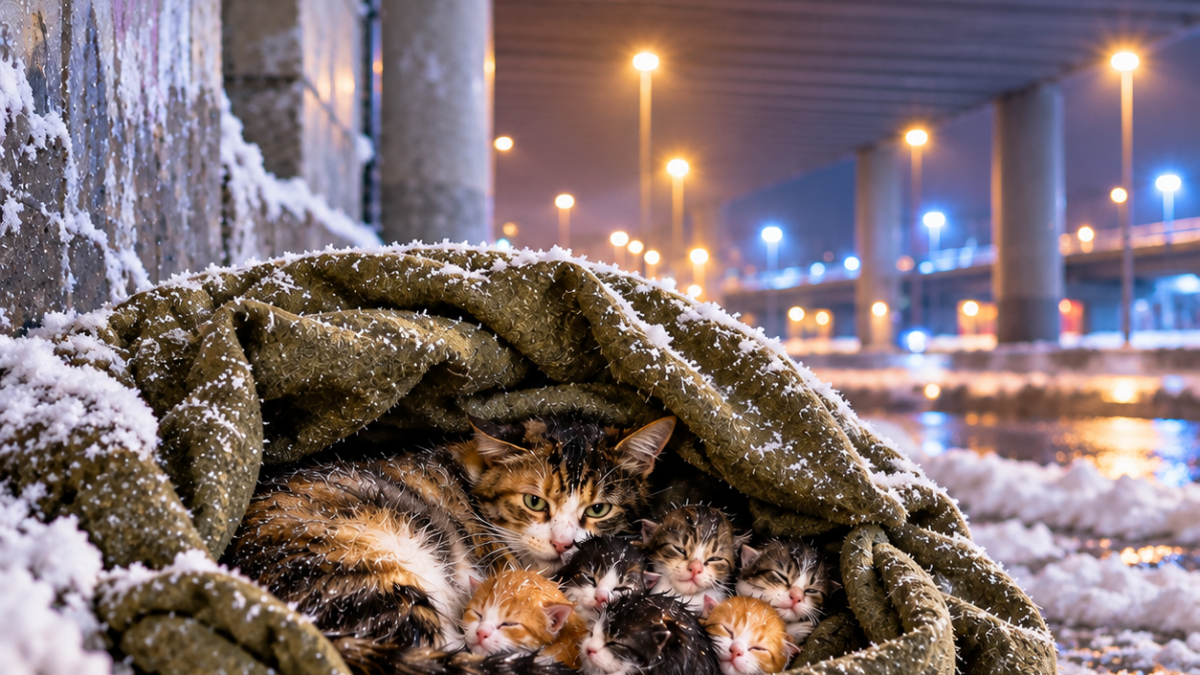
The wool blanket had frost along the outside. Its edges were tucked with surprising precision, folded under and around itself like someone had built a little sealed package against the cold.
She thought it might be belongings.
Maybe clothes.
Maybe trash.
Then the bundle moved.
Maria froze.
She knelt and pulled back one edge.
Inside, warm against the wool, lay a small tortoiseshell cat and six newborn kittens.
All alive.
Maria’s breath caught.
“Oh, Thomas,” she whispered.
The mother cat lifted her head weakly.
Six tiny bodies pressed against her belly. Their fur was dry now. Their breathing visible in little movements. The inside of the blanket felt warm enough that Maria could feel the difference immediately when her hand entered the pocket.
He had made a shelter.
Out of the only warmth he owned.
The ambulance arrived fourteen minutes later.
The paramedics measured Thomas’s core temperature.
Eighty-eight point two degrees Fahrenheit.
Moderate to severe hypothermia.
His body was beginning to shut down.
They loaded him carefully, cutting away parts of his clothing because his fingers and feet could not be handled roughly. He tried to speak when they lifted him.
Maria leaned close.
“They’re alive,” she said.
His eyes moved toward her.
“All seven,” she said.
Only then did he stop fighting to stay awake.
Maria took the blanket bundle in her car.
She placed it on the passenger seat, turned the heat as high as it would go, and drove to the nearest veterinary clinic with one hand steadying the bundle at every turn.
Dr. Elaine Mercer opened early because Maria called from the road.
By the time Maria arrived, the veterinarian and two techs were waiting with warmed towels, syringes, formula, and the kind of urgency reserved for creatures too small to lose body heat slowly.
The mother cat weighed barely five and a half pounds.
Malnourished.
Dehydrated.
Mild respiratory infection.
But alive.
The kittens were less than twelve hours old.
Newborns.
Born during the coldest night of the year in a crack beneath a bridge, in a city that had run out of room for people, never mind animals.
The vet examined them one by one.
All six alive.
Cold-stressed, but stable.
No frostbite.
No injuries.
No lost ears.
No damaged paws.
Nothing missing.
Maria stood beside the exam table with both hands pressed to her mouth.
Dr. Mercer looked at the wool blanket.
“Who wrapped them like this?”
“A man under the bridge.”
“He did this?”
“Yes.”
The vet touched the folds.
Each edge tucked under.
No gaps.
The mother’s body positioned to provide heat.
The smallest kittens placed closest to her belly.
The warmer ones outside.
“Whoever did this knew what he was doing,” Dr. Mercer said.
Maria wiped her eyes.
“He had one blanket.”
The vet looked at her.
“What?”
“That was his blanket.”
No one spoke for a moment.
Outside, morning light hit the clinic windows.
Inside, six kittens rooted blindly against their mother while the blanket that had nearly cost a man his life lay open beneath them.
Thomas spent six days in the hospital.
They treated him for moderate to severe hypothermia, dehydration, early frostbite on eight fingers and both feet, and exposure injuries that would follow him longer than he wanted to admit.
He lost part of two toes on his left foot.
The smallest toes.
The ones farthest from the center of his body.
The ones his body had sacrificed first when it began pulling blood inward to protect the heart and brain.
He did not complain.
That bothered the nurses more than if he had.
The first time Nurse Amelia Grant came to check his vitals, he asked one question.
“Cats?”
She had been warned.
“The mother and all six kittens survived.”
He closed his eyes.
She thought he had fallen asleep.
Then he whispered, “Good. Blanket worked.”
Amelia stood beside his bed for a few seconds longer than necessary.
She had worked emergency medicine for twelve years. She had seen cruelty, stupidity, courage, and strange miracles. But something about that sentence entered her and stayed.
Good.
Blanket worked.
Not I almost died.
Not my toes.
Not why me?
Just relief that the thing he gave away had done what it was supposed to do.
On the third day, she asked him if he needed anything.
“Anything,” she said. “I can call someone. Get you something from the cafeteria. Charge your phone. Whatever.”
Thomas looked toward the window.
Snow had begun falling again.
“I don’t want anything.”
“You sure?”
He nodded.
Then, after a pause, he asked, “The kittens still okay?”
Amelia smiled.
“Yes. All six.”
He nodded once.
Then he looked away fast, but not before she saw his eyes fill.
Maria visited that afternoon.
She brought photos from the clinic.
The tortoiseshell mother nursing six kittens under a heat lamp.
The kittens lined up like little commas.
The wool blanket, washed but still folded nearby.
Thomas held the photos carefully because three of his fingers were bandaged.
“She looks better,” he said.
“She is.”
“Good.”
Maria sat beside the bed.
“You scared me.”
“Sorry.”
“You knew what would happen if you gave that blanket away.”
He looked at her.
For the first time since she had known him, he seemed irritated.
Not at her.
At the question.
“Of course I knew.”
“Then why?”
He was quiet for a long time.
The hospital machines hummed softly.
A cart rattled somewhere in the hall.
Thomas stared at his bandaged fingers.
“I’ve been cold for three years,” he said finally. “I know what cold does. Cold is something you survive or you don’t.”
He swallowed.
“But watching something die when you could have stopped it… that doesn’t leave. That stays.”
Maria said nothing.
He continued.
“I’ve watched things die.”
His voice changed.
Not louder.
Smaller.
“My marriage. My work. My house. Friends. Men out there. Reggie behind the laundromat.”
He looked at the photo of the kittens.
“I had something that could stop it this time.”
He paused.
“So I used it.”
Maria wiped her cheek.
Thomas looked embarrassed by her tears.
Then he added, almost defensively, “Besides, she had six babies and no blanket. I had no babies and one blanket. Math wasn’t hard.”
Maria laughed through tears.
“The math wasn’t hard?”
“No.”
She repeated it later to Amelia.
Then Amelia repeated it to Dr. Mercer.
Then someone said it at the clinic.
Then someone wrote it online.
The math wasn’t hard.
People shared the phrase thousands of times.
Thomas hated that at first.
He did not want to be a story.
Stories made people clean.
They left out smells, fear, shame, bad decisions, missing teeth, addiction, paperwork, and the way being homeless meant strangers sometimes spoke about you while looking at the space beside your face instead of your eyes.
He did not want to be turned into “the homeless hero.”
He was not a symbol.
He was a man who had made many mistakes and one decision he could live with.
But the story moved anyway.
A local reporter came to the hospital.
Thomas refused.
A national morning show called.
He refused.
A church group wanted to raise money.
He said no until Maria told him refusing help was not the same as humility if he still needed a place to sleep.
He frowned at that.
She won.
The hospital social work team found him a spot in a transitional housing program on February 15.
A small apartment.
One room.
A bathroom.
A kitchenette.
A bed.
A chair.
A table.
Heat.
A lock on the door.
The first roof and walls that were his, even temporarily, in three years.
When Thomas stepped inside, he did not speak.
The caseworker, a young man named Jordan, pointed out the donated items.
Sheets.
Towels.
A box of groceries.
A coat.
A pair of boots with actual laces.
A new wool blanket folded at the foot of the bed.
Thomas stared at the blanket.
It was dark blue.
Thicker than the old one.
Clean.
Jordan said, “A donor provided that.”
Thomas walked over and touched it with two fingers.
Then he sat down on the edge of the bed as if standing had become too much work.
Jordan asked, “You all right?”
Thomas nodded, but did not look up.
For the first time in three years, no concrete waited beneath him.
That night, he slept badly.
Not because of the bed.
Because of the warmth.
Warmth can feel suspicious when a body has learned not to trust it.
He woke every hour.
Checked the door.
Checked the window.
Checked the blanket.
At four in the morning, he got up and made coffee though he had nowhere to go.
He stood in the tiny kitchen, holding the mug with bandaged fingers, and cried without sound.
Two weeks later, Maria visited with one of the kittens.
She had adopted two.
She claimed she meant to foster them.
Nobody believed her.
The kitten she brought was five weeks old, black with a white chin and a loud, indignant voice. Maria carried him in a small soft carrier, and the moment she opened it, he began complaining as if the entire car ride had been an act of personal betrayal.
Thomas sat carefully in the chair by the window.
His foot was bandaged.
Three fingers still wrapped.
His face had gained a little color, but he looked thinner than before. Cleaner. Rested in some ways. More fragile in others.
Maria placed the kitten on his lap.
Thomas froze.
The kitten looked up at him.
Then climbed immediately up his coat, planted two tiny paws on his chest, and pressed its face against his neck.
Thomas closed his eyes.
His hands rose slowly around the small body.
“The last time I held one this size,” he whispered, “I couldn’t feel my hands.”
Maria sat across from him.
“And now?”
The kitten purred.
A loud, ridiculous, impossible purr for something so small.
Thomas opened his eyes.
“Now I feel everything.”
Maria cried.
Thomas cried.
The kitten purred like it had work to do.
The old blanket stayed with Maria.
She had asked permission.
Thomas gave it.
“Keep it,” he said.
“You sure?”
“It belongs with them.”
Maria washed it carefully.
After it dried, she noticed something strange. There were six slight depressions in the wool. Not visible at first. But when she ran her hand over the fabric, she could feel them.
Tiny compressed places.
Where the kittens had spent the night.
She folded the blanket and kept it over the back of her couch.
She never used it.
When people asked why, she said, “It already did the most important thing a blanket can do.”
Two of the kittens stayed with Maria.
Two were adopted by Nurse Amelia, who named them Benny and June after pretending for one full day that she was “just helping.”
The mother cat and the remaining two kittens were adopted by the Henson family, who had heard the story through the clinic and asked if they could keep the mother with at least some of her babies.
Their son, Oliver, was ten.
When his mother explained where the cats came from, he listened seriously.
Then he asked, “Did the man get his blanket back?”
His mother did not know what to say.
Later, they brought Thomas a blanket too.
Not new.
Better.
Oliver chose it himself from a farm supply store. Heavy wool. Gray. With black stripes at both ends.
Thomas accepted it awkwardly.
The boy looked at his bandaged foot.
“Did it hurt?” Oliver asked.
His mother began to apologize, but Thomas answered.
“Yes.”
“Was it worth it?”
Thomas looked at the boy.
Children ask the questions adults cover with softer words.
“Yes,” Thomas said.
Oliver nodded, satisfied.
Then he handed Thomas a folded drawing.
It showed a bridge, a man, a blanket, one big cat, and six small circles labeled BABYS because Oliver had misspelled babies and refused correction.
Above them, in large green crayon letters, he had written:
HE SHARED THE WARM.
Thomas kept the drawing on his refrigerator.
Spring came slowly.
Thomas learned the strange routines of being housed again.
Mail.
Appointments.
A refrigerator that hummed at night.
A thermostat.
A key.
The ability to take off his shoes and know they would still be there in the morning.
The transitional program required meetings, addiction counseling, medical follow-ups, and paperwork. So much paperwork. Thomas hated most of it. But he went.
He had relapses in his mind before he had them in his body.
Old cravings came hardest when pain flared in his foot and back. The two missing toe tips changed his balance. Cold made the injured tissues ache. Some nights he sat on the edge of the bed with both hands gripping the blanket and remembered exactly how easy it had once been to swallow something and let the world blur.
He told Maria once, ashamed.
She said, “Wanting relief is not the same as failing.”
He did not answer.
She continued, “You stayed alive through that night. Stay alive through this one.”
That became their phrase.
This one.
Not forever.
Not never again.
This one.
Thomas made it through this one.
Then the next.
Then another.
He began volunteering once a week at the same outreach center that had once given him supplies. At first, he sorted donated clothes in the back because he did not want people recognizing him. Then he helped repair broken shelving. Then he fixed a leak above the storage room. Then he started checking the roof, because once a roofer always sees roof problems before anyone asks.
One evening, Maria found him on a ladder outside the building.
“Thomas.”
He looked down.
“What?”
“You are not medically cleared for ladders.”
“It’s six feet.”
“You fell thirty.”
“Different ladder.”
She stared at him until he climbed down.
Still, the center began calling him when something broke.
A hinge.
A shelf.
A loose railing.
He liked being useful.
Usefulness returned to him before dignity did.
Or maybe it carried dignity back with it.
On the one-year anniversary of the cold night, the outreach center held a small event.
Thomas did not want it.
Maria said it was not for him.
“It’s for everyone still outside,” she told him. “And for everyone who thinks people outside have nothing to give.”
He hated that she was right.
The event was simple.
Coffee.
Soup.
Blankets collected for distribution.
A veterinarian offering free basic checks for pets belonging to people without housing.
A small table with photos of the mother cat and six kittens, now healthy and absurdly spoiled in their different homes.
Thomas stood near the back, uncomfortable in a clean flannel shirt someone had given him.
Oliver, the boy who adopted the mother cat and two kittens, came running in with his family.
He was holding a framed version of his drawing.
HE SHARED THE WARM.
The outreach center hung it near the supply shelves.
Thomas stared at it for a long time.
“Spelled babies wrong,” he muttered.
Oliver grinned.
“I know.”
The mother cat had a name now.
Mabel.
Thomas pretended not to care.
Maria’s two kittens were named Hope and Trouble.
Amelia’s were Benny and June.
Oliver’s family named the remaining two Biscuit and Lantern.
Lantern because, Oliver said, “He was found in the dark.”
Thomas liked that one but did not admit it.
During the event, Maria asked if he would say a few words.
“No.”
“Just one minute.”
“No.”
“For the blankets.”
“No.”
“For the people donating them.”
He looked at her.
She knew exactly where to press.
Thomas walked to the front reluctantly.
The room quieted.
He stood behind the little microphone, hands in his pockets, shoulders tight.
“I’m not good at talking,” he said.
Someone near the front whispered, “That’s okay.”
Thomas looked at the stacks of donated blankets along the wall.
“When you give somebody a blanket, you might think it’s small. It’s not.”
His voice roughened.
“A blanket is a wall when you don’t have one. It’s a door when you don’t have one. It’s the difference between sleeping and waiting for morning.”
The room stayed still.
He swallowed.
“I gave mine away because I knew what cold was. That’s all. And somebody else gave me one later. That matters too.”
He stepped back.
Maria started clapping first.
Then everyone else.
Thomas hated the applause.
But he took three blankets from the donation pile afterward and helped load them into the outreach van.
That was easier.
Years do not heal everything.
That is something people say when they want grief, pain, addiction, poverty, or regret to obey a calendar.
Thomas still had hard days.
He still sometimes woke convinced he was under the bridge.
He still felt phantom cold in the toes he lost.
He still passed people on the street who looked away from homeless men the same way they had once looked away from him.
That angered him more now.
Not because he thought he was better.
Because he knew how thin the wall was.
A roof.
A prescription.
A paycheck.
A fall.
A death.
A divorce.
A bad month.
A blanket.
People liked to pretend the distance between housed and homeless was moral.
Thomas knew it was often paperwork, luck, pain, and whether someone answered the phone before you stopped calling.
He stayed in transitional housing nine months.
Then moved into a small subsidized apartment above a closed barber shop on Third Street. The stairs were hard on his foot. The heating pipes knocked at night. The window stuck in summer. He loved it.
He got a part-time job doing maintenance at the outreach center.
Nothing heavy.
No ladders, according to Maria.
Mostly repairs, inventory, sorting, and keeping the place functional.
He was good at that.
He had always been good at keeping things from falling apart.
One afternoon in late November, Maria brought Hope, one of the kittens she had adopted, to the center for a pet vaccination clinic. Hope was no longer tiny. She was sleek, black, and loud, with the entitled confidence of a cat who had never known how close she came to freezing beneath concrete.
She climbed immediately onto Thomas’s lap in the storage room and pressed her face against his beard.
Maria watched from the doorway.
“She remembers you.”
Thomas scratched behind Hope’s ears.
“No, she doesn’t.”
“She does.”
“She was twelve hours old.”
“Maybe warmth remembers.”
Thomas looked at her.
That was the sort of thing Maria said that made him want to roll his eyes and think about it for three weeks.
Hope purred.
Thomas rested one hand over her back.
“Maybe,” he said.
On the second anniversary, the city expanded its extreme weather shelter plan.
More beds.
More transportation.
A 24-hour cold response team.
Pet-friendly warming spaces in one church basement after the veterinarian and the outreach staff argued that some people would refuse shelter if it meant abandoning their animals.
At the press conference, city officials talked about policy, funding, coordination, emergency preparedness.
Thomas stood in the back near the exit.
No one called him to the microphone.
He had made that a condition of attending.
But one councilwoman mentioned him without using his name.
She said, “Two winters ago, a man with almost nothing reminded this city that survival can depend on whether someone is willing to share warmth.”
Thomas looked at the floor.
Maria nudged him gently.
He whispered, “Don’t.”
She whispered back, “Fine.”
That night, he walked home with his coat zipped up and the gray wool blanket Oliver had given him folded inside his backpack.
He no longer needed to carry a blanket everywhere.
He did anyway.
Habit, maybe.
Or memory.
Near the Jefferson Street overpass, he stopped.
The alcove was still there.
The crack near the foundation had been repaired with concrete filler after city crews inspected the bridge. No cats lived there now. No bedding. No cardboard. No sign of the night that changed everything except in Thomas’s body and in the lives of seven animals who had gone on to become ordinary housecats with food bowls, sun patches, and people who called them ridiculous names.
Traffic moved overhead.
A cold wind slid beneath the bridge.
Thomas stood for a long time.
Then he took the blanket from his backpack.
For a moment, he did not know why.
He unfolded it.
Held it in both hands.
Heavy.
Warm.
Whole.
He thought of the old blanket—the green one with the burn hole—wrapped around a mother cat and six newborns.
He thought of his own body curled in the alcove, losing heat.
He thought of Reggie.
Diane.
The roof.
The pills.
The years gone.
The morning Maria found him.
The kitten pressing against his neck.
The words he had said because they were the only true ones.
She had six babies and no blanket.
I had no babies and one blanket.
The math wasn’t hard.
Thomas folded the blanket again.
He carried it home.
The next morning, he brought three new blankets to the outreach center donation shelf.
Maria saw him.
“Those yours?”
“Bought them.”
“With what money?”
“My money.”
“Thomas.”
“What?”
She smiled.
“Nothing.”
He arranged them carefully.
Not tossed.
Folded.
Ready.
Because somewhere, always, someone was cold.
Maybe a person.
Maybe an animal.
Maybe someone with hands too numb to ask properly.
Maybe someone who still had one thing of value and was deciding whether to keep it.
Thomas could not save everyone.
He knew that.
The world had made sure he knew.
But he also knew that not being able to save everyone was not an excuse to save no one.
That was the lesson people kept trying to make grand.
It was not grand.
It was simple.
Brutally simple.
A thing can be small and still be everything.
A blanket.
A call.
A ride.
A warm room.
A bowl of food.
A hand checking a bundle that might have been trash.
A man under a bridge choosing to be colder so something smaller could live.
The last time Maria asked him about that night, they were sitting outside the outreach center in early spring. The air was cool but not dangerous. Hope, now fat and opinionated, sat in a carrier at Maria’s feet, glaring at birds.
“Do you ever regret it?” Maria asked.
Thomas knew what she meant.
His foot ached every day.
Two toes gone.
Nerve damage in his fingers.
Medical debt reduced but not erased.
Pain that would follow him.
He watched Hope paw at the carrier door.
“No.”
“Never?”
He thought about lying.
Then didn’t.
“I regret needing to choose.”
Maria looked at him.
“That’s different.”
“Yes.”
He leaned back against the bench.
“I regret there wasn’t room that night. For me. For them. For everybody. I regret that the city had to learn something from a cat under a bridge.”
He paused.
“But giving the blanket? No.”
Hope meowed.
Thomas looked down.
“No,” he said again. “That part was easy.”
Maria smiled sadly.
“The math wasn’t hard.”
He shook his head.
“No.”
Sometimes, late in winter, when the wind hits the apartment windows and the pipes knock in the walls, Thomas still wakes with cold in his bones.
On those nights, he gets up.
Makes coffee.
Wraps Oliver’s gray blanket around his shoulders.
Stands by the window above Third Street and watches the city lights blur through frost.
He knows there are people outside.
He knows some will refuse help.
Some will not find it.
Some will be found too late.
That knowledge hurts in a place no doctor can treat.
But then he thinks of Mabel, the tortoiseshell mother cat, sleeping on Oliver’s bed in a house across town.
He thinks of Hope and Trouble tearing through Maria’s apartment at midnight.
Benny and June knocking pens off Nurse Amelia’s desk.
Biscuit hiding socks.
Lantern sitting in windows, watching dark places from the warm side of the glass.
Six kittens born into one of the coldest nights of the year.
Six kittens who lost nothing.
Because someone else lost something for them.
People still ask why he did it.
Not as often now, but sometimes.
Volunteers.
Reporters.
New outreach workers who hear the story.
Donors at blanket drives.
Thomas has stopped trying to make the answer sound better.
He says it plainly.
“She had six babies and no blanket. I had no babies and one blanket.”
Then, if they keep staring, he adds the part that matters more.
“I knew what cold was. They didn’t deserve to learn it on their first night alive.”
That is all.
No speech.
No halo.
No clean ending where pain disappears because a kind thing happened.
His toes did not grow back.
His past did not rewrite itself.
The years outside still counted.
Addiction still left wreckage behind him.
Diane did not come back.
The world did not become fair.
But under one bridge, on one night, the cold did not get everything it came for.
That matters.
It has to.
Because the world is full of things too large to fix all at once, and if a man waits until he can save everything, he may pass by the one small life he could have saved.
Thomas Reed had almost nothing that night.
A sleeping bag.
A piece of cardboard.
A broken jacket.
A wool hat.
A body already weakened by hunger, pain, and years outdoors.
And one blanket.
One thing of real value.
He gave it to a mother cat with six newborns because their need was greater than his fear.
By morning, he was nearly gone.
But they were alive.
All seven.
Wrapped in the careful folds of a blanket that had done exactly what a blanket is meant to do.
Hold warmth.
Protect the fragile.
Stand between life and the dark.
And perhaps that is why the story stayed with people.
Not because it was about cats.
Not because it was about homelessness.
Not because it was about sacrifice in some grand, polished, heroic sense.
But because somewhere deep down, everyone understands what the blanket means.
It is the thing we have.
The thing we fear losing.
The thing that keeps us safe.
The thing we tell ourselves we cannot spare.
And then, one night, we hear something crying in the cold, and we find out who we are by what we do with it.