A Homeless Cat Waited on the Same Doorstep Every Day—Then She Gave Birth to Six Kittens There…
PART3:
She took one step forward.
Then another.
Then she stopped.
A car door slammed somewhere in the parking lot, and the cat bolted beneath the staircase.
Carolyn stayed crouched, her knees protesting.
“That’s okay,” she whispered. “Take your time.”
She left the food and went back inside.
When she checked ten minutes later, the plate was empty.
After that, she fed the cat twice a day.
She told herself she was not getting attached.
That was a lie.
Every morning before work, she opened a can of food and placed it near the shaded wall. Every evening, she refilled the water bowl. The cat began waiting for her, not at Carolyn’s door, but near the stairs, half-hidden behind a croton plant with red and yellow leaves.
Still cautious.
Still unsure.
But waiting.
Carolyn began calling her Mama.
“Good morning, Mama.”
“There you go, Mama.”
“You need to eat, Mama.”
The cat never answered.
She only watched Carolyn with wide green eyes and then looked back toward Apartment 2B.
That was the part Carolyn could not ignore.
No matter how much food she offered, no matter how hot the day became, no matter how many people passed by, the cat always returned to that door.
One afternoon, Carolyn went to the leasing office.
The office smelled like printer ink, carpet cleaner, and the vanilla candle the assistant manager was not supposed to burn but always did anyway. A fake palm sat in the corner. On the wall behind the desk, a framed sign read: PALMETTO GARDENS—WHERE COMFORT FEELS LIKE HOME.
Carolyn found that phrase less comforting every year.
The property manager, Denise Mallory, looked up from her computer.
“Hi, Carolyn. Everything okay?”
“There’s a cat outside Building B.”
Denise’s smile thinned slightly.
“We’ve had a few reports.”
“She keeps sitting outside 2B.”
“Strays do that sometimes.”
“I don’t think she’s a stray.”
Denise leaned back.
“Is this the gray one?”
“Yes.”
“We can call animal control if she’s becoming a nuisance.”
“She’s not a nuisance. She’s pregnant.”
Denise’s expression shifted from annoyance to inconvenience.
“That’s exactly why we need to call.”
Carolyn felt her hand tighten around the strap of her purse.
“I’m asking because I think she belonged to the tenant who moved out.”
Denise glanced at her screen.
“Marissa Lane?”
“Yes. Did she have a cat?”
“We don’t discuss tenant information.”
“I’m not asking for her bank records. I’m asking whether she abandoned an animal.”
Denise’s eyes cooled.
“Carolyn.”
The tone was gentle, but only on the surface. Carolyn had heard that tone before. Doctors used it when they wanted to make a woman feel unreasonable for asking one more question. Bank employees used it when they were about to say no. People in authority used it when they wanted politeness to do the work of a locked door.
“I can’t share details,” Denise said. “But if the cat is on the property, we’ll address it.”
“What does address it mean?”
“It means we’ll follow policy.”
Carolyn had lived long enough to distrust that sentence.
“Please don’t trap her without telling me.”
“If she’s a stray, we can’t have her reproducing around the property.”
“She may be someone’s pet.”
“If she was abandoned, that’s unfortunate.”
Unfortunate.
The word sat between them like a small, dead thing.
Carolyn left the office with nothing except a bad feeling.
That evening, she sat on the bottom step near the cat and placed a plate of food a little closer than usual.
The cat stared at her.
“You had a home, didn’t you?” Carolyn said.
The cat blinked.
“Somebody was supposed to take you.”
A breeze moved through the palm fronds near the parking lot.
The cat lowered her head and ate.
Carolyn watched the rounded curve of her belly.
“You’re not going to be able to keep doing this much longer.”
The cat paused and looked at her.
For one second, Carolyn had the strange sensation that the animal understood every word.
Then the cat turned and looked back at Apartment 2B.
That night, a storm rolled in.
Florida storms did not arrive politely. They came like a door kicked open. Thunder cracked over the complex just after eleven. Rain hammered the sidewalks. Wind pushed water sideways across the stairwell. Carolyn woke to the sound of it hitting her bedroom window and lay in the dark listening.
She thought of the cat.
She tried not to.
She told herself the animal had shelter somewhere. Under the stairs. Beneath a parked car. In the hedges.
Then lightning flashed.
For a split second, the bedroom lit white, and Carolyn saw Daniel’s old rain jacket hanging on the chair in the corner. He had worn it on fishing trips, grocery runs, and one terrible hospital appointment when neither of them had spoken on the drive home because both were trying not to cry.
She got out of bed.
“Don’t be foolish,” she whispered to herself.
But she put on the rain jacket anyway.
Outside, the world was water.
Carolyn opened her apartment door and stepped into the hallway. Rain blew across the breezeway. The concrete was slick beneath her slippers. She moved carefully down the stairs, gripping the railing.
“Mama?” she called.
Thunder answered.
She looked beneath the stairwell.
Nothing.
Behind the bushes.
Nothing.
Near Apartment 2B.
There.
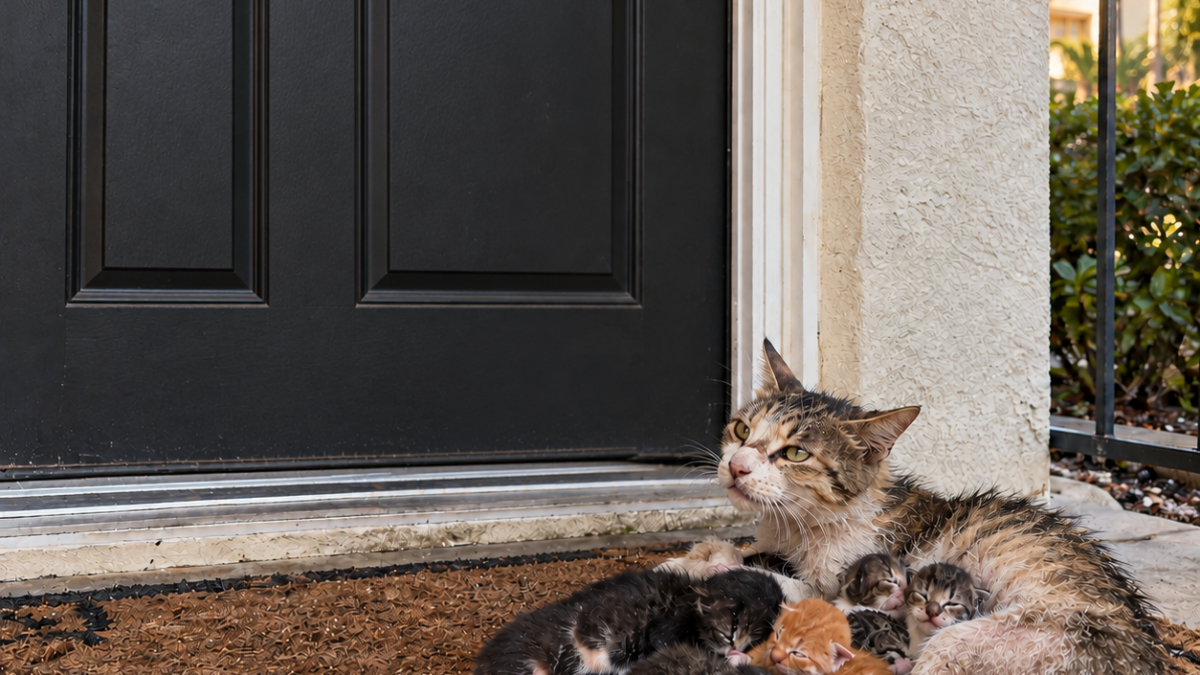
The cat was curled against the bottom of the closed door, soaked so thoroughly her fur clung to her body. Her belly looked enormous now. She had pressed herself into the shallowest patch of shelter the doorway offered, but the rain still reached her.
Carolyn’s heart cracked.
“Oh, honey.”
The cat lifted her head.
For once, she did not run.
Carolyn crouched slowly, rain dripping from the hood of Daniel’s jacket.
“You can’t stay out here.”
The cat’s body trembled.
Carolyn extended one hand.
The cat flinched, then froze.
“I know,” Carolyn whispered. “I know people haven’t been kind.”
Another burst of thunder rolled across the complex.
The cat did not move.
Carolyn touched two fingers gently to the top of her head.
The cat closed her eyes.
It was the smallest surrender Carolyn had ever seen.
She went back upstairs, grabbed a clean towel, a plastic storage bin, and one of Daniel’s old fleece blankets. By the time she returned, the cat was still there, breathing fast.
Carolyn set the bin on its side near the doorway, tucked the blanket inside, and placed the towel over the top to block rain.
The cat watched.
“Please,” Carolyn said. “Just for tonight.”
The cat sniffed the blanket.
Then, slowly, painfully, she stepped inside the bin.
Carolyn exhaled.
She sat beside her in the rain until nearly midnight, one hand resting near the entrance, not touching, only offering.
The next morning, the cat was gone.
But the blanket remained warm.
After that night, something changed.
The cat still returned to 2B, but she came to Carolyn’s door for food. She allowed Carolyn to sit closer. Once, while eating, she leaned lightly against Carolyn’s ankle.
Carolyn stood perfectly still, afraid to ruin it by breathing too loudly.
“You’re breaking my heart,” she whispered.
The cat rubbed her cheek against Carolyn’s shoe.
The name came a few days later.
Carolyn was watering the potted rosemary near her balcony when Mrs. Alvarez stopped at the bottom of the stairs.
“How is your little mother cat?”
Carolyn looked toward the bushes.
“She’s not mine.”
Mrs. Alvarez smiled.
“Of course not.”
Carolyn sighed.
“I’ve been calling her Mama.”
“She needs a real name.”
“I don’t want to name her. Then she’ll be mine.”
“Carolyn, you are feeding her twice a day and checking the weather like she pays rent.”
Carolyn tried not to smile.
Mrs. Alvarez adjusted the grocery bag on her hip.
“She looks like a Rosie to me.”
“Rosie?”
“Yes. Soft, but stubborn.”
Carolyn looked at the cat, who sat beneath the croton plant licking one paw with queenly concentration.
“Rosie,” Carolyn said.
The cat looked up.
Mrs. Alvarez laughed.
“There. She approves.”
So the cat became Rosie.
And once she had a name, it became harder for people to pretend she was no one’s problem.
Tyler from 2D started leaving a bowl of water when Carolyn was at work.
Mrs. Alvarez brought a small bag of kitten food because, she said, “Soon she will need strength.”
Even Mr. Keene, who complained about everything, stopped grumbling when Rosie began napping beneath his hibiscus bush.
“She kills lizards,” he said one afternoon, as if that explained his tolerance.
But Denise from the leasing office still wanted the issue handled.
A notice appeared on the building bulletin board the last week of August.
Residents are reminded not to feed stray animals on the property. Feeding encourages nuisance behavior and creates health and safety concerns. Management will be contacting animal services regarding roaming cats.
Carolyn read the notice twice.
Then she pulled out her phone and called three rescue groups.
The first was full.
The second did not answer.
The third, a small volunteer organization called Suncoast Whisker Rescue, had a voicemail message explaining that kitten season had overwhelmed them and response times might be delayed.
Carolyn left a message anyway.
“My name is Carolyn Pierce,” she said. “There’s a pregnant cat at my apartment complex. I think she was abandoned. I’m feeding her, but management may call animal control. Please call me back.”
No one called that day.
Or the next.
On the third day, a woman named Megan returned the message.
Her voice sounded exhausted.
“How far along is she?”
“I don’t know. Very pregnant.”
“Is she friendly?”
“Scared. But she lets me touch her sometimes.”
“Can you bring her inside?”
Carolyn looked around her apartment.
The beige couch.
The small dining table.
Daniel’s recliner she still had not moved.
The spare bedroom filled with boxes she had promised herself she would sort.
“I’m not sure.”
Megan was quiet.
“I know it’s a lot. But if she gives birth outside, those kittens may not make it. Heat, ants, raccoons, dogs, cars, people. Anything can happen.”
Carolyn closed her eyes.
“What would I need?”
“A quiet room. A box or nesting space. Food. Water. Litter. We can help with supplies when we can, but we’re stretched thin.”
“I have to get permission from the apartment.”
Megan hesitated.
“If they say no?”
Carolyn looked out the window.
Rosie was sitting outside 2B again.
“If they say no,” Carolyn said, “I’ll decide how much trouble I’m willing to be.”
Megan gave a tired laugh.
“That’s how rescue starts more often than people think.”
Carolyn went back to the leasing office.
Denise looked up and immediately seemed wary.
“Carolyn.”
“I found a rescue willing to help.”
“That’s good.”
“They said Rosie needs to come inside before she gives birth.”
“Rosie?”
“The cat.”
Denise sighed.
“Carolyn, we don’t allow unauthorized pets.”
“She was abandoned here.”
“That doesn’t make her your pet.”
“I’m asking for temporary permission to foster her until the rescue can place her.”
“We can’t make exceptions every time someone gets attached.”
Carolyn felt heat rise in her face.
“I’m not getting attached to a lamp at a yard sale. I’m trying to keep newborn animals alive.”
Denise’s mouth tightened.
“There are liability concerns.”
“I’ll sign something.”
“There are cleaning concerns.”
“I’ll pay a deposit.”
“There are policy concerns.”
Carolyn leaned forward.
“Denise, if animal control takes her, what happens?”
Denise looked away.
That was enough answer.
Carolyn lowered her voice.
“She sits outside 2B every day because someone left her. She is pregnant. She is scared. And she is still waiting at the door where she thinks her person might come back. I am asking for a few weeks.”
Denise did not answer.
From the office behind her, the assistant manager, a young man named Luis, looked up from his paperwork.
“My aunt fosters cats,” he said quietly.
Denise turned toward him.
Luis swallowed but continued.
“It’s not that bad if they’re in one room.”
Denise gave him a look.
He looked back down.
Carolyn waited.
Finally, Denise rubbed her forehead.
“Temporary. In writing. You are responsible for all damage. The cat cannot roam. The rescue must be involved. And if there are complaints—”
“I understand.”
Denise pointed at her.
“I am not approving a permanent pet.”
Carolyn smiled for the first time in days.
“Of course not.”
That afternoon, Carolyn transformed the spare bedroom.
She moved boxes into the closet, vacuumed corners, spread old towels beneath the window, and placed Daniel’s fleece blanket inside a low cardboard box. Mrs. Alvarez brought a litter pan. Tyler carried up a bag of food. Luis from the office quietly dropped off a packet of disposable pads and whispered, “Don’t tell Denise I had extras.”
Getting Rosie inside took three hours.
Not because she fought.
Because she could not believe the invitation was real.
Carolyn sat on the floor near her open apartment door with a plate of food just inside.
Rosie stood on the landing.
She sniffed.
Stepped forward.
Stepped back.
Looked toward 2B.
Came forward again.
Cars passed in the parking lot. A child shouted near the pool. Somewhere downstairs, a dog barked.
Rosie flinched.
“It’s okay,” Carolyn said. “Nobody’s going to close you in unless you decide to come.”
Rosie stared at her.
Then, with a slow, exhausted courage that made Carolyn’s throat tighten, the cat crossed the threshold.
Carolyn did not move.
Rosie ate half the food.
Then she explored the living room.
She kept low to the ground, belly heavy, tail tucked. She sniffed the couch, the table legs, Daniel’s recliner. At the recliner, she paused.
Carolyn watched from the floor.
Daniel had loved cats.
They had never owned one because his allergies were terrible, but he still stopped to pet every shop cat, porch cat, and boatyard cat he met. “A cat choosing you is a compliment,” he used to say. “They’re too honest to flatter.”
Rosie sniffed the recliner again.
Then she rubbed her cheek against the corner.
Carolyn covered her mouth.
“Of course you’d pick his chair,” she whispered.
That night, Rosie slept in the spare room with the door open and Carolyn sleeping on the couch nearby. Every few hours, Carolyn woke and listened.
No crying.
No scratching.
Only the soft sound of Rosie moving from the nesting box to the food bowl and back again.
For the first time in weeks, Rosie did not sleep outside a closed door.
For five days, there was peace.
Rosie grew calmer. She ate constantly. She allowed Carolyn to brush burrs from her fur. She even climbed onto the couch one evening and sat beside Carolyn while the television murmured in the background.
Not on Carolyn’s lap.
Not yet.
But close enough that their bodies touched.
Carolyn sat very still.
Rosie purred once.
A low, surprised sound, as if she had forgotten she could.
Then, on the sixth morning, everything changed.
Carolyn woke before dawn to a sound from the spare bedroom.
Not a meow.
Not exactly.
A low, strained cry.
She sat up instantly.
“Rosie?”
Another cry.
Carolyn hurried down the hall.
Rosie was in the nesting box, sides heaving, eyes wide and frightened. The blanket beneath her was damp. Her paws kneaded at the fleece.
Carolyn froze in the doorway.
She had helped neighbors through storms, sat beside Daniel through chemotherapy, managed insurance forms, funeral arrangements, and the dreadful machinery of grief.
But she had never delivered kittens.
“Oh, sweetheart,” she whispered.
Rosie cried again.
Carolyn grabbed her phone and called Megan from Suncoast Whisker Rescue.
It went to voicemail.
Carolyn called again.
This time Megan answered, voice thick with sleep.
“Hello?”
“It’s Carolyn. Rosie’s having the babies.”
“How is she acting?”
“Scared. Crying. She’s in the box.”
“Okay. Breathe. Cats usually know what to do. Stay nearby, but don’t crowd her. Keep the room quiet. Watch for problems. I’m going to talk you through what to expect.”
Carolyn sat on the floor beside the box.
Rosie looked at her with terrified green eyes.
“I’m here,” Carolyn whispered. “I’m right here.”
At 5:17 a.m., the first kitten was born.
Tiny.
Wet.
Almost impossibly small.
Rosie turned immediately, instincts cutting through fear. She cleaned the baby with urgent strokes of her tongue while Carolyn held her breath.
The kitten moved.
A thin squeak filled the room.
Carolyn began to cry.
She did not mean to.
It just happened.
The sound was so small, so determined, so alive.
“Good girl,” Carolyn whispered. “Oh, Rosie, good girl.”
The second kitten came twenty minutes later.
Then the third.
Then the fourth.
Rosie worked with heartbreaking focus, exhausted but gentle, pulling each baby close, cleaning them, nudging them toward warmth.
Carolyn changed towels when Megan told her to.
She warmed a small rice sock in the microwave.
She whispered encouragement.
She cried quietly when the fifth kitten arrived and let out a squeal so fierce it sounded offended by birth itself.
By sunrise, five kittens nursed against Rosie’s belly.
Carolyn thought it was over.
Then Rosie strained again.
The sixth kitten came smaller than the rest.
Still.
For a terrible moment, the room stopped.
Rosie licked frantically.
Carolyn’s heart pounded.
“Megan,” she said into the phone, voice breaking. “This one isn’t moving.”
“Clear the face gently with a towel. Rub firmly but carefully. Keep the head slightly down. Come on, baby.”
Carolyn’s hands shook.
She wrapped the tiny body in a soft towel and rubbed.
“Come on,” she whispered. “Come on, little one. You came this far.”
Nothing.
Rosie cried.
It was not the sound she had made during labor.
This was different.
A pleading sound.
Carolyn rubbed harder, careful but desperate.
“Please.”
The kitten twitched.
Carolyn froze.
Then came the smallest gasp.
Another.
Then a thin, ragged squeak.
Carolyn sobbed once, so loudly Rosie lifted her head.
“He’s here,” Carolyn said. “He’s here, sweetheart.”
She placed the kitten against Rosie’s belly.
Rosie curled around all six babies, trembling with exhaustion.
Megan exhaled through the phone.
“You did it.”
“No,” Carolyn whispered. “She did.”
Outside, the apartment complex woke.
Cars started.
Showers ran.
Somewhere, someone dropped a pan.
The world continued as if nothing miraculous had happened in the spare bedroom of Apartment 1A.
But Carolyn sat on the floor beside a cardboard box and watched a homeless cat become a mother to six tiny lives she had somehow kept safe long enough to bring into warmth.
She named the smallest one Leo because he had fought like a lion for his first breath.
The others came over the next few days.
Flynn, the restless orange-and-white boy who crawled over everyone.
Koda, the chunky gray kitten who always found the warmest spot.
Luna, a pale little girl with a white crescent on her forehead.
Forrest, dark and quiet, always tucked beneath Rosie’s chin.
Delilah, the loudest of them all, who screamed every time she lost her place at the milk bar.
Six kittens.
Leo.
Flynn.
Koda.
Luna.
Forrest.
Delilah.
The names filled Carolyn’s apartment like little bells.
Word spread through Palmetto Gardens.
Mrs. Alvarez came by with soft blankets and stood in the doorway with tears in her eyes.
“My goodness,” she whispered. “Look at them.”
Tyler from 2D brought a shoe box full of bottle nipples he had bought online because he “panicked and didn’t know what kittens needed.”
Even Mr. Keene knocked one afternoon and handed Carolyn a bag of kitten food without making eye contact.
“It was on sale,” he said.
“It’s not on sale anywhere,” Carolyn replied.
He frowned.
“I don’t know what you’re talking about.”
Then he walked away.
For a while, everyone seemed united by the small miracle.
Then Denise found out how many kittens there were.
Six kittens changed the tone of temporary permission.
One mother cat was an exception.
Seven cats were a situation.
Denise appeared at Carolyn’s door three days after the birth with a clipboard and a face full of worry.
“Carolyn, we need to talk.”
Carolyn glanced toward the spare bedroom.
“Not loudly.”
Denise lowered her voice.
“I approved temporary fostering of one pregnant cat.”
“You knew pregnant cats have kittens.”
“I did not approve seven animals in your unit.”
“They’re three days old.”
“I understand that, but—”
“No, Denise. You don’t.”
The firmness in Carolyn’s own voice surprised her.
Denise blinked.
Carolyn stepped into the hallway and pulled the door gently behind her.
“That cat spent weeks sitting outside the door of a tenant who left her behind. She gave birth in a box because I was lucky enough to bring her in before she had to do it on concrete. Those babies are not a policy problem. They are alive.”
Denise looked uncomfortable.
“There are rules.”
“Then write down that they will stay until the rescue can move them safely.”
“It may take weeks.”
“Then they will stay for weeks.”
“Carolyn—”
“I have paid rent on time for eight years. I have never complained about the upstairs boys playing music. I have never reported Mr. Keene for smoking by the stairwell. I have never asked for new carpet even though mine looked tired when I moved in. I am asking you to be human for a few weeks.”
Denise’s face softened, then hardened again, then softened once more.
People like Denise were not cruel by nature.
They were afraid of exceptions because exceptions created responsibility.
“I need documentation from the rescue,” she said finally.
“You’ll have it.”
“And they cannot leave your apartment.”
“They won’t.”
“And you will be responsible—”
“For everything. Yes.”
Denise exhaled.
“Fine.”
Carolyn nodded.
“Thank you.”
Denise turned to leave, then paused.
“Is she okay?”
“Rosie?”
Denise nodded.
Carolyn looked back at the closed door.
“She’s tired. But she’s safe.”
Denise’s expression shifted in a way Carolyn did not understand until later.
Guilt.
“Good,” Denise said quietly.
Over the next weeks, Carolyn’s apartment transformed into a world built around Rosie and her babies.
The spare bedroom smelled faintly of kitten milk, clean laundry, and the disinfectant Carolyn used every morning. Towels moved through the wash constantly. Food bowls multiplied. The litter box became a daily battlefield. Megan from the rescue visited when she could, bringing supplies and teaching Carolyn how to weigh the kittens, check their gums, watch for fading, and make sure Rosie was eating enough.
Rosie was a devoted mother.
She washed every kitten until their tiny fur stood up in damp spikes. She counted them with her nose when Carolyn changed the bedding. If one squeaked too sharply, Rosie was there instantly, eyes wide, body curved protectively around the sound.
But she remained wary of the world outside the room.
If someone knocked, she gathered herself like a soldier.
If footsteps passed too loudly in the hallway, her ears flattened.
If the apartment door opened, she placed her body between the kittens and the sound.
Carolyn understood.
Some betrayals do not leave when the door closes.
They stay in the muscles.
In the flinch.
In the way safety feels temporary even when it is real.
One afternoon, as Carolyn sat on the floor watching Leo wobble across a towel, Megan picked up Rosie’s file.
“We should try to find out who she belonged to.”
Carolyn looked up.
“I think I know.”
“Marissa?”
“You heard?”
Megan nodded.
“Denise mentioned there was a previous tenant.”
“I saw Rosie go in and out of that apartment months ago.”
“Any proof?”
“No.”
Megan sighed.
“If we can prove abandonment, it helps. Not always legally, but it helps with records. And if Marissa had vet information, Rosie might have a microchip.”
“She has one?”
“We’ll scan her when she’s ready to travel. But if she was left behind, there may be more to the story.”
That sentence stayed with Carolyn.
There may be more to the story.
She did not know whether she wanted more.
Sometimes the story you can imagine is painful enough.
But the truth began surfacing without her permission.
It started with Luis from the leasing office.
He knocked on Carolyn’s door one evening after work, holding a sealed envelope.
“I probably shouldn’t be here,” he said.
“That’s a strong opening.”
He looked down the hallway.
“Denise doesn’t know I’m giving you this.”
Carolyn took the envelope.
Inside was a copy of a pet addendum from Marissa Lane’s lease.
Authorized pet: female domestic shorthair, gray/white.
Name: Rosie.
Carolyn stared at the page.
Rosie.
Her name had already been Rosie.
Not Mama.
Not stray.
Not no one.
Rosie.
Carolyn’s eyes burned.
“She had a name,” she whispered.
Luis nodded.
“There’s more.”
He looked ashamed.
“When Marissa moved out, she told the office the cat had run away. Denise put it in the notes. But maintenance found food bowls and a litter box inside the unit after she left.”
Carolyn gripped the paper.
“Did anyone look for her?”
Luis looked away.
“I don’t think so.”
“Did anyone tell the rescue?”
“No.”
“Did anyone check whether she was outside that door every day?”
Luis swallowed.
“I saw her.”
Carolyn’s anger rose so quickly it frightened her.
“Then why didn’t you say something?”
His face reddened.
“I’m twenty-three and I needed the job. Denise said not to get involved. She said strays become everybody’s problem if you start asking questions.”
Carolyn looked at him, ready to say something sharp.
Then she saw his eyes.
He was not cruel.
He was ashamed.
That was different.
He had brought the paper because shame had finally become heavier than fear.
Carolyn folded the addendum carefully.
“Thank you.”
Luis nodded.
“I’m sorry.”
“So am I.”
After he left, Carolyn went into the spare bedroom.
Rosie lay curled around the kittens. Leo slept on his back. Delilah twitched in a dream. Luna’s tiny paw rested against Rosie’s chin.
Carolyn sat beside the box.
“Rosie,” she said softly.
The cat opened her eyes.
“You were always Rosie.”
Rosie blinked slowly.
Carolyn covered her mouth.
“I’m sorry nobody came sooner.”
Rosie stretched one paw toward her.
That broke Carolyn completely.
She cried quietly on the floor while Rosie watched, calm and tired and somehow forgiving in the way animals can be when humans least deserve it.
The next day, Megan scanned Rosie for a microchip.
There was one.
The registered owner was Marissa Lane.
The phone number went straight to voicemail.
The email bounced.
The listed emergency contact answered.
It was Marissa’s sister, Jenna.
At first, Jenna sounded guarded.
“I don’t know where Marissa is.”
Megan explained about Rosie.
There was a silence.
Then Jenna said, “She left the cat?”
Her voice changed on the last word.
Carolyn, listening on speaker with permission, closed her eyes.
“I told her not to,” Jenna said. “I told her she couldn’t just walk away from an animal.”
“What happened?” Megan asked gently.
Jenna exhaled shakily.
“My sister was in a bad situation. Debt, breakup, job loss, all of it. I’m not defending her. I’m really not. But she was falling apart. She called me crying from Georgia and said Rosie got out during the move.”
“She didn’t get out,” Carolyn said, voice quiet.
Another silence.
“I know,” Jenna whispered.
“How?”
“Because Marissa told me later she couldn’t take her. The motel didn’t allow pets. She said someone at the apartment would probably feed her.”
Carolyn felt sick.
Someone.
That was the word people used when they wanted kindness without responsibility.
Someone will help.
Someone will notice.
Someone will fix what I am leaving behind.
Jenna began to cry.
“I’m sorry. I should have done something. I thought maybe she had found a home or… I don’t know what I thought.”
Carolyn looked toward Rosie.
“She came back to that door every day.”
Jenna made a broken sound.
“She loved Marissa. Slept on her pillow. Followed her everywhere.”
“Rosie was pregnant.”
“I didn’t know.”
“She has six kittens now.”
“Oh my God.”
“They’re safe.”
Jenna cried harder.
After the call, Carolyn sat in silence.
She wanted to hate Marissa.
It would have been easy.
Clean.
A woman abandoned a pregnant cat and lied about it.
But the truth had come with human mess attached.
Debt.
Fear.
Desperation.
Weakness.
None of it excused what she did.
But it made the betrayal heavier, not lighter.
Because Rosie had not been left by a cartoon villain.
She had been left by someone who loved her too little at the exact moment love required sacrifice.
That was the kind of cruelty ordinary people committed when they told themselves they had no choice.
A week later, Marissa called.
Carolyn knew it was her before she said her name.
Some voices carry guilt before words arrive.
“Is this Carolyn?”
“Yes.”
“This is Marissa Lane.”
Carolyn stood in the kitchen holding the phone.
Rosie was in the spare room. The kittens were almost three weeks old now, beginning to wiggle with purpose, their eyes opening into cloudy blue confusion.
Marissa inhaled shakily.
“My sister gave me your number. She said you have Rosie.”
“I do.”
“And… kittens?”
“Six.”
A sob escaped through the phone.
“Is she okay?”
Carolyn looked toward the hallway.
“She’s safe.”
“Can I see her?”
The question hit Carolyn like a slap.
“No.”
The answer came out before she could soften it.
Marissa was silent.
Carolyn closed her eyes.
“I’m not trying to be cruel,” she said. “But Rosie waited outside that door for weeks.”
“I know.”
“She sat there in the heat. In storms. Pregnant.”
“I know.”
“No. You don’t get to know from a distance. She waited for you.”
Marissa cried quietly.
“I didn’t have anywhere to go.”
“I’m sorry for that.”
“The motel wouldn’t take pets. I thought if I left food—”
“You left food in an empty apartment.”
“I thought someone would find her.”
“Someone did. Eventually.”
The words hung between them.
Marissa whispered, “I loved her.”
Carolyn’s voice softened, but only slightly.
“Love is not what we feel when things are easy. It is what we do when leaving would be easier.”
Marissa cried harder.
“I can’t take her now. I know that. I just wanted to hear she was alive.”
“She is. So are her babies.”
“Can you tell her I’m sorry?”
Carolyn looked down at the counter.
“No,” she said.
Marissa went silent.
“That apology is for you, not her.”
It was the harshest thing Carolyn had said in years.
But it was true.
Rosie did not need an apology she could not understand from a voice that had already disappeared.
She needed food.
Warmth.
Medicine.
Safety.
A future.
Marissa said, “I deserve that.”
Carolyn did not answer.
After the call ended, she went into the spare bedroom and sat beside Rosie.
“I spoke to her,” Carolyn said.
Rosie was nursing Luna and Forrest. Her eyes lifted to Carolyn’s face.
“She knows you’re safe.”
Rosie blinked.
Carolyn reached out and stroked her head.
“I didn’t tell you she was sorry.”
Rosie purred.
Maybe forgiveness was simpler for animals.
Or maybe Rosie had already turned away from the door in her heart.
The kittens grew.
At four weeks, they became chaos.
Tiny, stumbling, squeaking chaos.
Leo escaped the nesting box first, naturally. He tumbled over the side and landed on a towel with the shocked expression of someone betrayed by gravity. Flynn followed because Flynn followed everything. Koda remained in the box until he was certain the outside world included food. Luna learned to climb onto Carolyn’s slipper and sit there like royalty. Forrest hid beneath the low shelf and watched everyone with solemn eyes. Delilah screamed whenever anyone dared to move without consulting her.
Carolyn’s apartment filled with life.
Not neat life.
Not quiet life.
Real life.
The skitter of tiny paws.
The thump of toys against baseboards.
The sound of Carolyn laughing alone in the kitchen because Flynn had attacked his own reflection in the oven door.
For the first time since Daniel died, the apartment did not feel like a waiting room.
It felt inhabited.
Mrs. Alvarez came by almost daily.
Tyler became emotionally attached to Koda and tried to pretend he had not.
Mr. Keene sat outside one afternoon with Forrest asleep on his lap and told Carolyn, “This one has sense.”
“He’s three inches tall.”
“Still more sense than most people here.”
Denise visited too, though she pretended it was for inspection purposes.
The first time she saw the kittens, Delilah marched across the towel, opened her tiny mouth, and screamed at her shoe.
Denise stared down.
“That one is dramatic.”
“That’s Delilah.”
“She looks like she runs the place.”
“She thinks she does.”
Denise crouched slowly.
Rosie watched from the box, wary but not panicked.
Denise extended one finger.
Delilah sniffed it.
Then bit it with toothless conviction.
Denise smiled despite herself.
Carolyn saw it.
A real smile.
Not property-manager polite.
Human.
“I found out she belonged to Marissa,” Carolyn said.
Denise’s smile faded.
“I know.”
“Luis gave me the pet addendum.”
Denise looked toward the window.
“I figured.”
“You knew about the bowls.”
Denise was quiet.
“Yes.”
“Why didn’t you do anything?”
Denise did not defend herself immediately.
That surprised Carolyn.
Finally, she said, “Because I was tired. Because I had three move-outs, two plumbing leaks, one eviction, and corporate yelling about vacancy rates. Because I told myself the cat had probably run off. Because if I admitted she was abandoned, I had to do something.”
Carolyn looked at her.
“That’s not a good enough reason.”
“No,” Denise said. “It isn’t.”
The room softened.
Denise wiped at one eye quickly, irritated by her own emotion.
“I’m not a monster, Carolyn.”
“I know.”
“I acted like one anyway.”
Carolyn let that sit.
Then Rosie stood, walked out of the box, and approached Denise.
Denise froze.
Rosie sniffed her hand.
Then rubbed her cheek against Denise’s knuckle.
Denise covered her mouth.
“I don’t deserve that,” she whispered.
Carolyn thought of Marissa.
Of Luis.
Of herself, waiting behind a curtain for too many days before stepping fully into Rosie’s life.
“Maybe animals don’t give us what we deserve,” Carolyn said. “Maybe they give us a chance to do better.”
Denise nodded, crying silently now.
A few days later, the bulletin board notice disappeared.
In its place was a new one.
Residents, please contact the leasing office if you see an animal in distress on the property. Palmetto Gardens is partnering with local rescue volunteers to ensure humane response whenever possible.
Carolyn stood in front of that notice for a long time.
It did not erase what had happened.
But it mattered.
Small repairs often do.
At six weeks, the kittens had names, personalities, and devoted fans.
Megan from Suncoast Whisker Rescue arranged vaccinations, foster paperwork, and future adoption profiles. She photographed each kitten in Carolyn’s living room under the best available light.
Leo refused to sit still.
Flynn tried to climb the backdrop.
Koda fell asleep mid-photo.
Luna posed as if born for calendars.
Forrest hid behind a stuffed mouse.
Delilah screamed at the camera.
Rosie watched from Daniel’s recliner.
That had become her place.
Not the spare room.
Not the doorstep.
The recliner.
At first, Carolyn had tried to discourage it because the chair still felt like Daniel’s. Then one evening, she found Rosie curled there with all six kittens piled around her, and instead of pain, Carolyn felt something open.
Not healing exactly.
Healing was not a door that swung wide all at once.
It was more like light finding cracks.
Daniel would have loved them.
He would have pretended not to.
He would have said, “We can’t keep seven cats, Carolyn,” while cutting chicken into tiny pieces and calling Leo “little man.”
The thought made her laugh and cry at the same time.
One evening, during a thunderstorm, Carolyn sat in Daniel’s old chair because Rosie had left it temporarily to eat. The rain struck the windows. The kittens wrestled on the rug.
Rosie returned, jumped onto the arm of the chair, and considered Carolyn with serious eyes.
“This was his chair,” Carolyn said.
Rosie stepped onto her lap.
Carolyn stopped breathing.
Rosie circled once, then settled.
The kittens noticed immediately.
Leo climbed Carolyn’s ankle.
Flynn attacked the blanket.
Koda wedged himself against her hip.
Luna curled near Rosie’s tail.
Forrest tucked under Carolyn’s knee.
Delilah complained until Carolyn lifted her gently onto the pile.
Within minutes, Carolyn sat beneath a mother cat and six sleeping kittens while rain washed the windows and thunder moved farther away.
She placed one hand on Rosie’s back.
The purr vibrated through her palm.
For the first time in eight years, Carolyn did not feel alone in the storm.
The adoption applications began at eight weeks.
Megan screened carefully.
No impulse adopters.
No outdoor-only homes.
No families unwilling to spay, neuter, vaccinate, and commit.
Carolyn told herself she was ready.
She had known from the beginning the kittens could not all stay.
Her apartment was not big enough.
Her lease was not written for a cat kingdom.
Rescue meant letting go.
She repeated that sentence often.
It did not help.
Leo was adopted first by a retired firefighter and his wife who had lost their old orange tabby the previous spring. The man held Leo against his chest and said, “He’s got fight in him.”
Carolyn nodded.
“He needed it.”
When they left, Rosie sniffed the carrier, then looked at Carolyn.
Carolyn cried in the bathroom where no one could see.
Flynn and Koda went together to a young couple with two children who had built a climbing wall in their laundry room because, as the father said, “We believe in tiring them out legally.”
Luna went to Mrs. Alvarez’s niece, who sent a photo within two hours of Luna sitting in a pink bed looking unimpressed by luxury.
Forrest went to Mr. Keene.
That surprised everyone except Carolyn.
He arrived at her door one afternoon wearing a clean shirt and holding a carrier.
“I suppose I could take the sensible one,” he said.
Carolyn smiled.
“You mean Forrest?”
“I am not calling a cat Forrest.”
“What will you call him?”
Mr. Keene frowned.
“Mr. Forrest.”
Carolyn laughed so hard she startled Rosie.
Delilah was the last kitten to leave.
That was fitting.
She had arrived loudly and intended to depart the same way.
A veterinary technician named Abby adopted her after Delilah climbed into her purse and refused to leave.
“She chose you,” Carolyn said.
Abby looked delighted.
Delilah screamed from inside the purse.
“She has opinions,” Carolyn warned.
“I respect a woman with boundaries,” Abby replied.
Then Delilah was gone too.
The apartment became quiet.
Not empty like before.
But quiet.
Rosie searched the rooms that evening.
She checked the spare bedroom.
The couch.
The kitchen.
The bathroom.
Daniel’s recliner.
Carolyn followed at a distance, heart aching.
Rosie did not cry.
She only looked.
When she finished, she jumped onto the recliner and sat with her paws tucked beneath her.
Carolyn sat on the floor beside her.
“They’re safe,” she whispered.
Rosie blinked.
“All six.”
Rosie lowered her head.
Carolyn stroked her gently.
“You did it.”
The next week, Megan came to discuss Rosie’s adoption profile.
“She’s young,” Megan said. “Beautiful. Sweet once she trusts. She’ll find a home.”
Carolyn looked at Rosie, who was asleep on Daniel’s chair with one paw covering her nose.
“Yes,” Carolyn said.
Megan looked at her.
“Carolyn.”
“What?”
“You know where I’m going with this.”
“I’m too old to adopt a young cat.”
“No, you’re not.”
“My lease—”
“Denise already said she’ll approve one pet.”
Carolyn frowned.
“She did?”
Megan smiled.
“She called me.”
Carolyn looked toward the hallway.
“She called you?”
“She said, and I quote, ‘If Carolyn pretends she isn’t keeping that cat, please tell her she is being ridiculous.’”
Carolyn’s eyes filled.
Megan softened.
“You saved Rosie.”
Rosie opened one eye at the sound of her name.
Megan continued.
“But she saved something in you too, didn’t she?”
Carolyn looked down at her hands.
They were older than she remembered. Veins raised. Knuckles stiff. A small scratch from Flynn healing near her thumb.
“I was doing fine,” she said.
“I know.”
“I had my routines.”
“I know.”
“I wasn’t unhappy every minute.”
“I believe you.”
Carolyn looked at Rosie.
“But I was waiting too.”
Megan did not speak.
Carolyn swallowed.
“I think that’s why I noticed her. She looked the way I felt.”
The words broke something open, but gently.
Rosie stood, stretched, jumped down from the chair, and walked to Carolyn. She pressed her forehead against Carolyn’s knee.
Carolyn began to cry.
Megan wiped her own eyes.
“Well,” she said, voice thick, “I’ll mark Rosie as adopted.”
“Don’t you need paperwork?”
“I have paperwork.”
“Of course you do.”
“Rescue runs on paperwork and emotional damage.”
Carolyn laughed through tears.
Rosie became official that Friday.
Denise waived the pet fee.
Mr. Keene brought a small bag of treats “by mistake.”
Mrs. Alvarez bought a red collar with a tiny rose charm.
Tyler made a sign for Carolyn’s apartment door that read:
ROSIE LIVES HERE NOW.
Carolyn taped it inside the door where only she could see it.
The doorstep outside 2B did not stay empty forever.
A new tenant moved in before Christmas, a school counselor named Hannah with two suitcases, a bicycle, and a laugh that carried down the stairs.
Before she moved in, Denise told her the story.
Not all of it.
Enough.
Hannah knocked on Carolyn’s door one evening with a plate of cookies.
“I heard my apartment used to be important to your cat.”
Carolyn smiled sadly.
“It was the door she waited at.”
Hannah looked toward 2B.
“I’ll try to make it a kinder door.”
Carolyn liked her immediately.
On Christmas Eve, Palmetto Gardens held a small gathering in the courtyard. It was mostly cookies, paper cups of punch, and a Bluetooth speaker playing holiday songs too softly to bother Mr. Keene.
Rosie did not attend.
Rosie had standards.
But Carolyn did.
She stood beneath string lights with Mrs. Alvarez, Denise, Luis, Tyler, Mr. Keene, and a dozen neighbors who now knew one another better because one abandoned cat had forced them to become less invisible to each other.
Megan sent photos that night.
Leo under a Christmas tree.
Flynn and Koda asleep in a laundry basket.
Luna wearing a tiny bow she clearly hated.
Forrest—Mr. Forrest—sitting beside Mr. Keene’s television like a judgmental statue.
Delilah inside a gift bag, screaming at tissue paper.
Carolyn showed the pictures to everyone.
People laughed.
Even Denise.
Especially Denise.
Later, after the gathering ended, Carolyn returned to her apartment.
Rosie waited inside the door.
Not at someone else’s door.
Hers.
Carolyn set down her keys.
“Well, hello.”
Rosie chirped softly.
Carolyn scooped her up, something Rosie now allowed for exactly twelve seconds at a time.
“Merry Christmas, Rosie.”
Rosie tolerated the kiss on her head with visible dignity.
That night, Carolyn sat in Daniel’s recliner with Rosie curled on her lap. Outside, the Florida air was cool enough to open the window. Somewhere in the complex, someone laughed. A car door closed. Wind moved through palm fronds.
Carolyn thought about the first morning she had seen Rosie sitting outside 2B.
The stillness.
The waiting.
The faith in a door that had no intention of opening.
For weeks, Rosie had believed the person who left would come back.
She had carried six lives inside her while sitting on concrete, hungry and confused, watching a door that only held the echo of betrayal.
And then, when no one came, she had done what mothers do.
She survived anyway.
She held on.
She brought her babies into the world.
She trusted one more human when she had every reason not to.
That was the miracle Carolyn could not stop thinking about.
Not just that Rosie was rescued.
But that Rosie had still been willing to trust.
People liked stories where rescue sounded simple.
A door opens.
A cat comes inside.
Everyone is saved.
But Carolyn knew the truth was deeper.
Rescue was not one moment.
It was the bowl of water left before you were sure.
The storm you walked into because you could not sleep otherwise.
The phone call to a rescue that might not answer.
The argument with a property manager.
The towel warmed at dawn.
The tiny kitten rubbed back into breath.
The apology you refused to carry for someone else.
The goodbye to each baby when love meant letting them leave.
The choice, finally, to stop calling yourself alone when someone had already chosen your lap.
Rosie shifted in her sleep.
Carolyn rested a hand on her back.
The purr began, low and steady.
For months, Rosie had waited for a door to open.
Eventually, one did.
But it was not the door she had been staring at.
It was the door across the breezeway.
The door of a woman who thought her life had become too quiet to matter.
The door of a home that still held grief, dust, old furniture, and enough love waiting unused in the corners.
The door of someone who knew what abandonment felt like, and because of that, could recognize it even when it came on four paws and sat silently in the Florida heat.
Rosie never went back to waiting outside 2B.
Sometimes she watched the hallway from Carolyn’s window, ears twitching when footsteps passed.
But she no longer stared at closed doors like her life depended on them.
She had food.
Warmth.
A bed.
A name that had been lost and found again.
Her six babies were safe in homes where no one would leave them behind.
And Carolyn, who had once thought she was only rescuing a cat, learned that sometimes the life you save turns around quietly, curls up in your empty chair, and saves you right back.
Outside, Christmas lights reflected faintly on the window glass.
Inside, Rosie slept without fear.
Carolyn leaned her head back against Daniel’s chair and closed her eyes.
For the first time in a long time, the apartment did not feel like the place where her old life had ended.
It felt like the place where a new one had begun.
And just before she drifted to sleep, Rosie stretched one paw across her wrist, as if making sure she was still there.
Carolyn smiled in the dark.
“I’m not going anywhere,” she whispered.
Rosie kept purring.
And this time, no one was waiting at the wrong door.