A Retired Navy SEAL Went to Adopt a Beagle Puppy—Then the Shelter Begged Him to Meet a Malinois Who Hadn’t Eaten in Four Days.
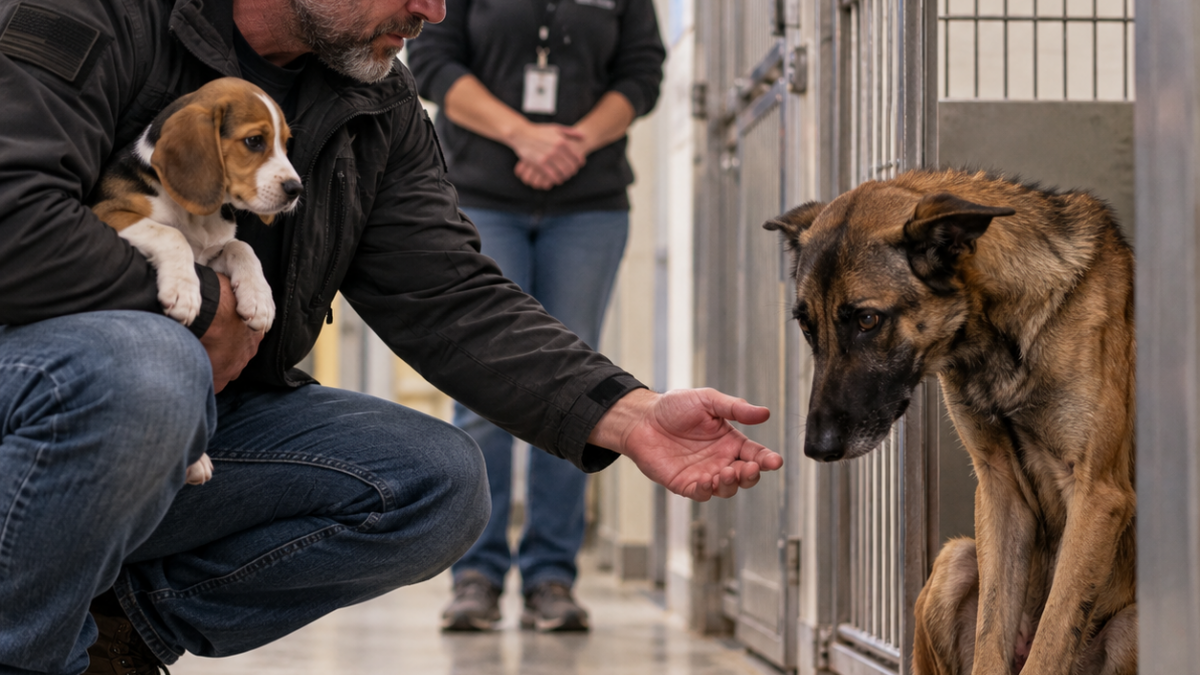
A Retired Navy SEAL Went to Adopt a Beagle Puppy—Then the Shelter Begged Him to Meet a Malinois Who Hadn’t Eaten in Four Days.
I drove forty minutes through a gray Montana morning to adopt a beagle puppy and came home with a dog that looked like every ghost I had spent nine years trying not to name.
The shelter director begged me to meet him because he had not eaten in four days, and every time someone opened his kennel, he looked past them for a man who was never coming back.
I told myself I was only going to foster him for forty-eight hours, but then he carried my dead wife’s gardening glove to the front door and placed it on my boot like he was asking me not to disappear too.
My name is Grant Ives.
I am fifty-three years old.
Former Navy SEAL.
Retired, though retired never felt like the right word.
Retired makes it sound like something ended cleanly.
Like a door closed and another one opened.
For me, it was more like a machine that had been running too hot for too long finally grinding down in pieces.
First my knees.
Then my shoulder.
Then my patience.
Then my ability to pretend I could keep living inside a world where everything was measured by readiness, threat, movement, and the likelihood that a quiet room was only quiet because something in it had not happened yet.
Twenty-two years in the Navy will teach a man how to move through darkness.
It does not teach him how to sit alone at a kitchen table after the mission ends and the people he loved are gone.
I lived on eleven acres outside Bozeman, Montana, in a gray-planked farmhouse my wife Miriam had chosen before we ever walked through the front door.
She had driven out there on a wet Saturday in March, stood at the back fence line with the Bridger Range half-hidden behind clouds, and said, “This is the one.”
I had looked at the house.
Then at her.
“We haven’t even gone inside.”
She shrugged.
“I don’t need to.”
That was Miriam.
Quick hands.
Dark hair.
A laugh that sounded like she had genuinely found something funny instead of offering politeness to keep the room comfortable.
She trusted her instincts.
She trusted land.
She trusted weather.
She trusted dogs before people.
She died eighteen months before the morning I went to Clearwater Animal Haven for a beagle.
Cancer.
The kind of death that gives a person just enough time to say the important things and not nearly enough time to finish saying them.
She died in our bedroom with snow pressed against the windows and her hand in mine.
She told me not to become a ghost before my body did.
I promised her I would try.
Then I failed quietly for a year and a half.
My daughter Abby lived in Denver.
She called more often than I returned the calls.
PART2:
She had Miriam’s directness, which meant she did not decorate hard truths before handing them to me.
“You need a dog, Dad.”
“I had dogs.”
“You had working dogs. You need a living thing in the house.”
“I have deer in the meadow.”
“Dad.”
“I have mice in the barn.”
“Dad.”
“I’m fine.”
“You are absolutely not fine.”
The listing she sent was for an eight-week-old beagle mix.
Big ears.
Spotted paws.
Already named Milo by the shelter, which felt presumptuous but forgivable because he looked like a dog who would forgive anything.
Abby wrote:
Just go look.
I printed the shelter address on the back of an old envelope because I still did things like that, drove into town on a Tuesday morning, and told myself I was not making a life decision.
I was only looking.
That was the lie I brought with me.
The truth was simpler.
I wanted a dog small enough not to remind me of Ajax.
Ajax had been my dog in Kandahar.
Belgian Malinois.
Compact.
Dark-faced.
Fast in a way that seemed less like movement and more like water finding the fastest path downhill.
He could clear a room with me without a sound.
He knew my breathing.
My hand.
My silence.
He knew when I was angry before I did.
He knew when I was afraid and never judged me for it.
PART3:
Nine years before the shelter, Ajax pushed me out of a doorway and took the pressure plate blast meant for me.
I held him for eleven minutes.
Eleven.
A number I will remember longer than my own age.
His chest moved wrong at first.
Then barely.
Then not at all.
I said I was sorry.
I said it again.
I said it after he was past hearing.
I said it in the helicopter.
I said it in my sleep for months.
Then I stopped saying his name out loud because names can become doors, and I had no intention of opening that one again.
So when Abby sent me a beagle, I said yes.
Beagles were safe.
Beagles were ears and appetite and stubborn joy.
A beagle would not look at me with the face of a dog trained to trust a man who had failed to clear a doorway fast enough.
A beagle would not move like Ajax.
Would not remind me of Ajax.
Would not ask anything from the sealed room in my chest where I kept eleven minutes and never went voluntarily.
Clearwater Animal Haven sat on the east side of Bozeman in a low brick building with a gravel lot and a chain-link perimeter that had seen better decades.
The lobby smelled of disinfectant, old blankets, dog breath, cat litter, and that strange mixture all shelters carry.
Hope and resignation in equal measure.
A hand-painted sign above the front desk read:
EVERY DOG HERE HAS A STORY. SOME ARE JUST HARDER TO READ.
I remember looking at that sign and thinking Miriam would have liked it.
Then thinking I had to stop measuring the world by whether Miriam would have liked it.
The woman at the front desk was Fay Caldwell.
Sixty-four.
Silver hair cut bluntly at her jaw.
Small, sturdy build.
Dark eyes that took in a person before that person realized he had been seen.
She had run Clearwater for nineteen years, though I did not know that yet.
I only knew she looked at me the way experienced people look at strangers carrying pain they are trying to pass off as posture.
“Grant Ives?” she asked.
“Yes, ma’am.”
“The beagle is ready.”
I nodded.
Then she set down her pen.
“Before we head back, could I show you one other dog first?”
“No.”
I did not mean for it to come out that fast.
Fay did not flinch.
“Fair.”
I exhaled.
“I came for the beagle.”
“I know.”
“Is there a problem with the puppy?”
“No. He’s healthy. Sweet. Waiting.”
“Then why show me another dog?”
“Because I think you might understand him.”
That sentence irritated me more than it should have.
People say things like that when they want to make you responsible for something you did not ask to carry.
I had learned to recognize emotional ambushes dressed as intuition.
“What kind of dog?”
Fay held my eyes.
“Belgian Malinois.”
“No.”
She nodded once.
Not surprised.
“His name is Ranger.”
“I said no.”
“I heard you.”
“I’m not looking for a working dog.”
“I know.”
“I’m not looking for a project.”
“I know that too.”
“Then why are we still talking?”
“Because he hasn’t eaten in four days.”
The lobby sounds seemed to shift around that sentence.
A phone rang behind the desk.
Somewhere down the hall, a small dog barked twice.
A volunteer laughed in another room.
Fay kept looking at me.
“He came in nine days ago,” she said. “Four years old. Male Belgian Malinois. Belonged to a man named Leonard Price. Leonard was seventy-one. Retired Army. Lived alone off Bridger Canyon Road. His wife passed a few years back. Neighbors said he’d been withdrawing.”
I looked away.
Fay continued anyway.
“Ranger was the reason he got up in the mornings.”
I knew then that I should leave.
I should thank her, say I changed my mind, get in the truck, and drive home through the cold gray morning with the beagle still hypothetical and my sealed room still sealed.
Instead, I stood there.
Fay saw that too.
“Leonard died at home,” she said. “Animal control found Ranger beside the chair. He’d been there almost three days.”
My jaw tightened.
“He let them put a lead on him?”
“Yes.”
“Then he’s not aggressive.”
“He snapped at the air once when a handler reached too fast. Report listed him as potentially aggressive.”
“What do you see?”
She was quiet for a moment.
“A dog waiting for something that isn’t coming back.”
I looked at the sign over the desk again.
Every dog here has a story.
Some are just harder to read.
“Show me,” I said.
Fay led me past the puppy wing.
That was the first cruelty of it.
I could hear the beagles before I saw them.
Little chaotic voices.
Soft bodies throwing themselves against kennel doors.
Tiny claws on metal.
Life at full volume.
The corridor Fay took me down was quieter.
Cooler.
The sound of other dogs faded behind us, not completely, but enough that each step felt more deliberate.
We stopped in front of a door with a narrow observation panel.
Fay did not reach for the handle.
She stood beside it.
“His name is Ranger.”
I looked through the glass.
The Malinois was pressed against the back wall of his kennel.
Knees folded beneath him.
Coat dull from weight loss.
Dust-colored, though I could tell it should have carried richness when healthy.
His ribs showed through a frame that needed thirty more pounds.
A full bowl of food sat untouched in the corner.
Not spilled.
Not investigated.
Ignored.
His amber eyes fixed on the kennel door.
Not wild.
Not frantic.
Patient.
That was worse.
Frantic still thinks something can change.
Ranger looked like a dog who had watched the door open too many times and never reveal the person he needed, so he had stopped expecting and kept watching anyway because there was nothing else left to do.
I felt something uncomfortable move under my ribs.
I disliked it.
The Malinois had Ajax’s shoulders.
Compact.
Functional.
Built for speed, not bulk.
He held his weight low, the way dogs do when uncertainty is not fear exactly, but not safety either.
I had spent nine years teaching myself not to compare every Malinois to Ajax.
I failed in less than five seconds.
“I came for the beagle,” I said.
“I know,” Fay answered.
“He’s not my dog.”
“I know that too.”
“He needs someone with room for this.”
“Yes.”
“And you think that’s me?”
“I think you recognized him before you decided not to.”
That made me turn.
Fay did not apologize.
“He hasn’t responded to anyone’s voice since he arrived,” she said. “Not really. Not enough to break the wall.”
“Maybe he doesn’t want to.”
“Maybe.”
“Maybe he’s done.”
“Maybe.”
“You always this manipulative?”
“Only when a dog is dying in front of me.”
I looked back through the glass.
Ranger had not moved.
I knew grief in a working dog’s body.
Most people think dogs grieve like people do because it comforts us to imagine our emotions reflected cleanly.
They do not.
Dogs grieve with routine.
With absence.
With doorways.
With food they stop eating because the person who made eating feel safe is gone.
With posts they hold long after the mission has ended because nobody has told them they are released in a language they can believe.
Ranger’s joints were locked.
His breathing shallow.
His attention fixed.
His body had chosen a duty.
Watch the door.
Wait.
Refuse the world until the right person returns.
I did not want to understand that.
Understanding is not the same as wanting.
I stepped closer to the glass.
“Easy,” I said.
Low.
Even.
Not a command.
A word.
The word.
The one I had used in places where dogs learned faster than people that my voice meant the immediate threat had passed.
Ranger’s ears moved.
Not his head.
Not his body.
Just one degree of rotation toward the sound.
Barely a second.
Then his eyes returned to the door.
Fay did not speak.
I hated her a little for that.
“Open it,” I said.
She did.
I went in alone.
Ranger did not move.
I did not approach him directly.
People who want to help frightened dogs often make the first mistake by letting the need to comfort become another form of pressure.
I moved at an angle.
Picked up the water bowl.
Set it several feet from him.
Not close enough to trap him.
Not far enough to make reaching it a performance.
Then I sat on the concrete floor with my back partly turned and my hands open on my knees.
I did not stare at him.
I talked.
Not about Leonard.
Not about grief.
Not about anything important.
I talked about the drive in from the meadow.
About the sky.
About the first serious snow probably coming by the weekend.
About the wood stove in the farmhouse.
About how Miriam had insisted we put it in and I had told her the existing heating system was perfectly adequate.
Then the first winter came, and she spent three months reminding me that “perfectly adequate” was the saddest phrase in the English language.
I talked in the rhythm I had used in Kandahar.
Low.
Unhurried.
Words as vessel.
Rhythm as message.
Twelve minutes passed.
Maybe thirteen.
I heard Ranger move.
I did not turn.
Careful pads on concrete.
Pause.
Then the soft, tentative sound of a tongue meeting water.
Three laps.
Four.
Silence.
I pressed my palm flat against the floor and looked at the ceiling.
Something in my chest released by one degree.
Not enough to matter to anyone else.
Enough for me.
When I came out, Fay was still standing in the hallway.
“What are the terms for a short foster?” I asked.
Her expression did not change, but her eyes softened.
“Forty-eight hours if that’s what you can do.”
“That’s what I can do.”
She nodded.
No celebration.
No pressure.
Smart woman.
“Paperwork?”
“Front desk.”
“And the beagle?”
“Milo will be adopted before dinner. He has six applications.”
I stared at her.
“You were never worried about the beagle.”
“No.”
“You lied by omission.”
“Yes.”
“Miriam would’ve liked you.”
Fay tilted her head.
“Who’s Miriam?”
I regretted saying the name before I could stop myself.
“My wife.”
Fay nodded once.
Not asking.
Not pushing.
Another smart thing.
The drive back was quiet in the way Montana highways are quiet in November.
Flat gray sky.
Frost-stiffened grass.
Bare cottonwoods along the roadside.
The kind of cold that makes the world look paused.
Ranger lay folded in the secured crate on the back seat and made no sound.
He did not whine at turns.
Did not paw at the bars.
Did not sleep.
He fixed his amber eyes on the crate wall and kept them there.
Diminished.
Patient.
I checked the rearview mirror every few miles.
“Roads will freeze before dark,” I said.
Not because he needed a weather report.
Because the rhythm worked even there.
“You’ve got heated floors in the kitchen. Miriam had them put in. I thought they were unnecessary every year until it snowed.”
One of Ranger’s ears turned slightly toward the sound.
Barely.
Enough.
The farmhouse looked the way it always did in November.
Gray planks darkened at the corners by rain.
Vegetable garden along the south fence brown and folded under.
Back meadow flat and colorless beneath the sky.
The barn door complaining in the wind because I had been meaning to fix it for three weeks and had instead practiced the fine art of not doing things that required wanting tomorrow to function.
By the front door, a wicker basket held Miriam’s gardening gloves.
The worn leather pair she had used for everything.
Tomatoes.
Roses.
Stacking firewood.
Pulling thistle.
Carrying kindling.
Moving stones I told her were too heavy.
They were shaped by eleven years of her hands.
I had not moved the basket.
I had not moved a great many things.
Her coffee mug still sat on the second shelf.
Her blue rain jacket hung in the mudroom.
Her handwritten notes remained tucked into cookbooks.
Half a packet of zinnia seeds sat in the kitchen drawer.
I had told myself that leaving things where they were was respect.
Some days I knew it was fear.
I set Ranger’s crate just inside the entryway and opened the door.
He did not come out.
He sat in the opening and looked at the unfamiliar room with the stillness of an animal who had learned that new places do not necessarily stay safe.
I sat down on the floor.
Not the couch.
Not my chair.
The floor.
Then I left the front door ajar.
Cold air came in.
Ranger looked at the opening.
I wanted him to see it.
An exit.
Choice.
I had no intention of chasing him if he ran.
No animal starts healing inside a trap.
It took forty minutes for him to step out.
He moved close to the walls.
Head low.
Body narrow.
He chose a position facing the front door.
Sat with his spine straight.
Ears forward.
Watching the entrance with the focused attention of a dog who had appointed himself to a post he had not been given and could not set down.
I put food and water within reach.
He ignored both.
That night, I went upstairs and lay on my back in the dark.
I listened through the floorboards.
Old houses speak in weather.
The pipes ticked.
Wind pressed against the siding.
A branch scraped once against the window.
No dog movement.
At 2:00 a.m., I went downstairs.
Ranger was still at his post.
His head had dropped with exhaustion, but each time his eyes began to close, he forced them open and fixed them on the door.
He did not acknowledge me.
He was managing something that required everything he had, and sleep was not part of the available options.
I understood that from the inside.
I sat against the sofa with my legs stretched out and faced the door beside him.
“Nothing’s getting through there tonight,” I said quietly.
His ears shifted.
“You’ve got the front. I’ve got the floor.”
Neither of us slept right away.
But slowly, over the next hour, Ranger’s locked shoulders began to soften.
His front legs slid forward.
His chest lowered.
His eyes closed for a moment.
Opened.
Closed again.
Eventually, they stayed closed.
He had not approached me.
He had not accepted touch.
But he had allowed himself to sleep while another body held the watch.
For a creature who had been awake at his post for nine days, that was not small.
The second day was mostly quiet.
Ranger ate a few bites when I stepped out of the kitchen.
Drank when I sat with my back turned.
I noted each improvement as data rather than cause for celebration.
Progress collapses quickly when it feels expected.
By midafternoon, he had moved from the front door to a position near the hallway where he could see both the entrance and the kitchen.
He was tracking me with his eyes now.
Not following.
Not trusting.
Not yet.
Just noticing.
The rhythm of my boots on the floor.
The way I set my mug down.
The sequence of ordinary movements that make up the daily grammar of a house.
I came back from the garage around three and found one piece of toast missing from the plate on the counter.
Ranger sat six feet away with the carefully neutral expression of a dog who had already considered and rejected every possible connection between himself and the situation.
I looked at the plate.
Then at him.
He examined the middle distance with great interest.
“Four days without eating,” I said, “and you start with my breakfast.”
His tail touched the floor once.
A single thump.
Involuntary.
Almost startled-looking.
Then he seemed to register what he had done and went very still.
It was the first movement that had nothing to do with fear.
I turned back to the counter before he could see what happened to the edge of my mouth.
The storm came in fast that night.
Mountain storms in November do not always announce themselves politely.
One minute the world is gray and still.
The next, wind is pressing against every window, bending the cottonwoods along the drive, and filling the farmhouse with the low persistent sound of old wood being asked whether it intends to hold.
The power stayed on.
I was adding a log to the stove when a gust hit the back wall hard enough to rattle the glass and blow Miriam’s small clay pot from the shelf above the fireplace.
It fell.
Shattered against the stone hearth.
A sharp ringing crack.
Not especially loud.
But sudden.
Metallic.
Clean.
The wrong sound at the wrong moment does not ask permission before becoming another sound entirely.
I did not hear the pot.
I heard Ajax’s tags.
Metal identification tags striking a harness buckle.
A sound I had heard ten thousand times.
A sound that had become, in the particular compression of grief, the sound that lived in the seconds before the eleven minutes.
The room was not the room.
The fire was not the fire.
I went down on one knee beside the couch without meaning to.
My hand pressed against the floor.
My breath came wrong.
I was in a doorway in Kandahar.
Ajax ahead of me.
A smell of dust and wire insulation and sun-baked concrete.
Not enough time.
Never enough time.
The thing I had told myself for nine years was that I had no choice.
In those moments, the choice felt enormous.
Irreversible.
Entirely mine.
“I’m sorry,” I said.
Not to the room.
Not to Ranger.
To a dog who had been dead for nine years and past hearing it even when I first said it.
“I’m sorry.”
Ranger was shaking.
The sound had done something to him too.
His tail tucked.
Ears flat.
Body coiled with the particular terror of a creature who knows the shape of sudden loss and has just heard something that resembles it.
He was the most frightened animal in the room.
And he crossed the floor anyway.
Two slow steps.
Then he lowered his head against my clenched fist.
Not asking for comfort.
Offering presence.
The instinct of one creature who knows darkness to place itself beside another creature standing inside it.
I opened my fist.
Rested my palm against the side of his neck.
Felt the rabbit-quick heartbeat there.
The tremble of a dog frightened to his bones who had decided staying mattered more than running.
“It’s over,” I said.
My voice came stripped down to something essential.
“You’re here. It’s over.”
I said it until my breathing evened.
Ranger did not pull back.
The shaking in his muscles gradually quieted.
We sat on the farmhouse floor while the storm worked against the windows and the fire returned to its ordinary sound.
I could not have said which of us needed the other more.
In that moment, I suspected the answer did not matter.
Morning came clear and cold.
Three inches of new snow on the meadow.
Ice along the fence lines.
The Bridger Range brilliant white against a hard clean sky.
I woke on the floor with my back against the sofa and Ranger several feet away, lying on his side with his legs loosely extended.
Completely unlike any position he had held since arriving.
The posture of a dog who had decided somewhere during the night that vigilance could afford to wait until morning.
Dr. Ingrid Sorrel arrived at nine.
Fay had arranged it.
Of course she had.
Ingrid was tall, forty-five, deliberate with her hands, patient in the way of someone who has learned frightened animals notice tension before humans admit to feeling it.
She examined Ranger without forcing proximity.
Asked me to cross the room while she watched his eyes.
Checked weight.
Joints.
Hydration.
Gums.
Teeth.
Movement.
Reflexes.
“Underweight,” she said afterward. “But structurally sound.”
“That mean he’s fine?”
“No.”
I almost smiled.
“I appreciate direct.”
“He is physically salvageable. Emotionally exhausted. Fear is one of the harder things to treat.”
“I know.”
“It’s also one of the more responsive things given consistency and someone who doesn’t leave when the work gets difficult.”
I looked toward Ranger.
He was watching the front door again.
Not as intensely as before.
But enough.
“The shelter said a rehabilitation center could take him.”
“Yes.”
“You think that’s better?”
Ingrid studied me.
“I think better depends on what question you’re asking.”
“Don’t do that.”
“Do what?”
“Answer like a therapist.”
“I’m a veterinarian. We do worse.”
I looked out the window.
“If he stays here, I don’t know what I’m doing.”
“That may be true.”
“If he goes to the center, they know what they’re doing.”
“That may also be true.”
“Helpful.”
“Grant, dogs like Ranger do not need perfect people. They need predictable ones. The real question is whether you are prepared to become predictable for him.”
I did not answer.
Because the answer scared me more than the question.
The rehabilitation center called at eleven.
Transport window the next morning.
I spent the afternoon assembling Ranger’s things into the bag the shelter had provided.
Medication schedule.
Feeding notes.
Vet observations.
The blanket he had finally slept on.
I folded it twice.
Unfolded it.
Folded it again.
Stupid.
A blanket did not care how it was folded.
Ranger watched from the hallway.
I put the bag by the front door and stood at the back window looking at the snow-covered meadow for a long time.
You have been explaining this to yourself since five in the morning, I thought.
You know what you are doing.
I had told myself the rehabilitation center was the right choice because it had fenced yards.
Veterinary supervision.
Trained staff.
Protocols.
Experience.
Follow-up.
I had told myself I had done what I could in forty-eight hours.
That was enough.
I had told myself many things with the same disciplined fluency I once used to manage fear in dark corridors.
Still, the farmhouse felt different with Ranger inside it.
Not better.
Not yet.
Different.
Alive in an uneasy way.
The way a house feels when another breathing creature has begun learning its sounds.
The van came up the drive the next morning.
Fay sat in the passenger seat.
A transport specialist named Cord Yates stepped out after her.
Mid-forties.
Careful movements.
The kind of man who had learned that how you approach an animal tells it everything before you have done anything at all.
I opened the front door.
Cold air moved in.
From somewhere in the back of the house, I heard Ranger’s claws on the hardwood.
He appeared in the hallway.
He looked at me.
Then past Fay and Cord.
Toward the transport van at the end of the drive.
Something in his posture changed.
Not panic exactly.
Recognition.
A pattern.
The shape of a morning that ended with being somewhere else.
He turned and walked back into the house.
Fay and Cord waited on the porch.
No one rushed him.
No one called his name.
I stood in the doorway and listened.
Ranger moved through the kitchen.
Stopped.
Then I heard the soft deliberate sound of something being lifted.
Not grabbed.
Not chewed.
Lifted with intention.
He reappeared from the hallway carrying Miriam’s gardening glove.
The right one.
Worn leather.
The glove from the basket by the door.
The glove she had used every season for eleven years, shaped by her grip until no other hand fit it quite right.
I had walked past that basket several hundred times since she died.
Had not moved it.
Could not move it.
Ranger walked to the threshold and stopped.
He looked at me.
Then lowered his head and placed the glove onto my boot.
Carefully.
Deliberately.
The way a dog places something when offering is the only language available.
Then he sat.
He was trembling.
Cold air coming through the open door.
The van visible past my shoulder.
He knew what vans meant.
He knew what leaving looked like.
And he had gone into the house, chosen the one thing he somehow understood carried my grief, and brought it to me.
Not a toy.
Not a leash.
Not food.
Miriam’s glove.
The thing I had not been able to touch.
The thing I had left by the door because moving it would mean admitting the hand it had shaped itself around would never return.
Ranger sat in front of me with fear in his body and the glove at my feet.
Waiting to see what happened next.
I looked down.
The leather was worn smooth across the thumb and forefinger.
Creased exactly where Miriam had gripped shovel handles and pruning shears and mugs of coffee she carried outside because she never believed coffee belonged indoors.
I crouched.
Ranger flinched when my hand moved toward him.
But he did not step back.
“You’re not Ajax,” I said.
The name came out.
Not as an explosion.
Not as a seizure.
Just a name.
A fact allowed finally to exist in open air.
“You don’t have to be him.”
Ranger watched me.
“You don’t owe me that.”
I picked up the glove and held it with both hands.
“But if you’re choosing to stay…”
My voice caught.
I waited until it steadied.
“Then so am I.”
Fay pressed the back of her hand briefly to her mouth and looked at the mountains.
Cord returned to the van and quietly closed the transport door without a sound.
That was the beginning.
Not the ending.
People like to make stories neat.
A broken man meets a broken dog.
They save each other.
Roll credits.
That is not how it worked.
Ranger still flinched at sudden metallic sounds.
He still tracked the door when strangers arrived.
He needed more time than most dogs to decide whether a new person posed any threat.
He ate better, then stopped for half a day when a delivery truck came too close to the porch.
He slept through one night, then spent the next one at the front door.
He accepted touch, then retreated.
He leaned against my leg once in the kitchen, then looked offended by his own need and walked away.
Progress was not a staircase.
It was weather.
Changing.
Returning.
Testing every fence line.
I learned his signals.
Two ear rotations meant curiosity.
Hard stare at the door meant too much pressure.
Low tail but loose jaw meant he was managing.
Tail tucked and breath held meant stop.
Do not push.
Do not praise too loudly.
Do not make hope another job.
I started leaving food in places where he could choose it without feeling watched.
I sat on the floor more often than furniture.
I learned to announce movements.
“Standing.”
“Door.”
“Wood stove.”
“Coffee.”
I had talked less in the years after Miriam died than at any point in my life.
Ranger changed that because silence made him watch harder.
So I narrated ordinary things until the house began to sound inhabited again.
In January, I moved Miriam’s gardening gloves.
Not away.
Not into a drawer.
Onto the kitchen windowsill, where morning light came through and touched the worn leather.
I did not examine why too closely.
Some decisions are better honored than analyzed.
Ranger noticed.
He sniffed them once.
Then walked away.
No ceremony.
Which was the right amount.
By February, he slept at the foot of my bed.
Not on the bed.
Not beside it.
At the foot, angled toward the door.
A compromise between duty and rest.
Some nights I woke to Ajax’s tags.
Not real.
Memory.
A sound in the dark.
A metallic echo.
On those nights, Ranger developed a routine.
He would rise without being called, cross the room, and rest his chin on the mattress near my hand.
He never barked.
Never pawed.
Never demanded.
He simply arrived.
One creature who knew that particular dark, staying until the room came back.
Spring came slowly.
Montana does not surrender winter all at once.
It negotiates.
Snow in the shadows.
Mud in the drive.
Green under dead grass.
The meadow changed first at the edges.
Ranger changed that way too.
By March, he followed me to the barn.
By April, he trotted ahead, then circled back if I disappeared too long behind a stall door.
By May, he moved through the long grass with his nose down and his ears rotating independently, which I had come to understand meant the world currently contained nothing requiring his active defense.
He was still thin, but no longer hollow.
Still cautious, but no longer absent.
A seventy-pound argument against the idea that what has been damaged must remain only damage.
I began going to Clearwater on Wednesday mornings.
At first, I went to repair kennels.
The building needed work.
I was good with tools.
That arrangement felt safe.
A hinge is honest.
A latch either works or does not.
A rotted board does not ask what happened in Kandahar.
After a few weeks, Fay found me replacing a gate latch and said, “There’s a dog I want you to sit with.”
I stared at her.
“You ever stop?”
“No.”
“I’m here for maintenance.”
“That’s maintenance.”
“I fix buildings.”
“Some rooms have dogs in them.”
“You are impossible.”
“Yet effective.”
The dog was a senior Catahoula mix named Pepper.
Gray muzzle.
No interest in anyone.
Watched volunteers walk past with the flat resignation of a creature who had already decided the world had spent its last chance.
I sat outside her kennel for thirty minutes and did nothing.
The following week, I came back.
Then again.
By April, two other veterans had started showing up.
Dennis, former Air Force crew chief, walked with a limp from a landing he did not talk about and eventually left with a border collie named Wes, who had once cleared the adoption room on sight.
Judith, former Army nurse, still working at the VA, began sitting outside Pepper’s kennel.
Pepper ignored her for two weeks.
Then one morning let Judith touch the top of her gray head and leaned into the hand like she had been waiting a long time for someone patient enough to reach that far.
Fay named the group Steady Watch.
My suggestion.
A naval phrase.
Hold course through uncertain conditions without overcorrecting.
The first rule was mine.
The dogs were not therapy.
The veterans were not damaged handlers looking for a function.
They were two populations that had survived hard things and had not yet decided what came next.
Sometimes proximity to another creature who understood that landscape was enough to begin answering the question.
The second rule was Fay’s.
Every placement had to include vet evaluation, behavioral plan, and follow-up.
“Love matters,” she said. “Love without preparation is just another form of pressure.”
She was right.
I hated how often that happened.
Six months after the day I came for a beagle, the meadow outside my farmhouse was green under a wide May sky.
Ranger moved through the grass with his nose down.
The Bridger Range held late snow in the high cuts.
Miriam’s gloves sat on the kitchen windowsill.
Ranger’s food bowl was empty.
His water bowl needed filling because he drank like a normal dog now, not like water might be taken away if he trusted it too openly.
I stood at the sink and watched him through the window.
He lifted his head.
Looked toward the house.
Not because he was waiting for someone dead.
Because he knew where I was.
That was different.
In the evening, he stretched across my boot under the kitchen table, a habit he had developed and showed no sign of reconsidering.
I looked at the gloves in the last of the light.
Thought about Miriam standing at the back fence on a gray March Saturday, looking at mountains she had never lived near before and knowing anyway.
Thought about Ajax.
The eleven minutes.
The nine years I spent believing that everyone who died in my care took with them any door that might have opened to something new.
I still did not know how to close what happened.
I was no longer certain closing was the right word.
Maybe some things do not close.
Maybe they become part of the house.
Not the whole house.
A room.
A foundation beam.
A scar in the wood you stop trying to sand out.
There was a seventy-pound Belgian Malinois sleeping across my foot.
There was a south fence I had mended in April.
There were Wednesday mornings at Clearwater.
Dennis with Wes.
Judith with Pepper.
Fay pretending not to be pleased when an impossible dog became slightly less impossible.
There was a wood stove Miriam had been right about.
There was a glove on the windowsill.
There was Ranger’s steady breathing.
Outside, the meadow held the last of the evening light.
The mountains held theirs a little longer, the way they do in Montana in late spring, as if the day is reluctant to let go of something good.
Inside the farmhouse, in the ordinary quiet of two beings who had each believed what they lost had sealed the door to anything that came after, the door remained open.
It had been open all along.
We had simply been facing the wrong direction.
Sometimes healing does not arrive with certainty.
Sometimes it does not arrive clean.
Sometimes it does not feel like healing while it is happening.
Sometimes it comes across the floor on a storm night, trembling, afraid, choosing to cross the distance anyway.
That is not weakness.
That is the bravest thing a broken heart can do.
And if you had told me on that cold Tuesday morning that I would drive to Clearwater Animal Haven for a beagle and end up with a Malinois who carried my dead wife’s glove like an answer, I would not have believed you.
I would have said I did not need saving.
I would have said I was fine.
I would have said no.
But Ranger did not ask whether I was ready.
He only waited long enough for me to stop leaving.
Then he stayed.
So did I.