A Dying Police K9 Lifted His Head During His Final Goodbye—Then He Saw Someone in the Station Doorway His Handler Never Expected to See Again.
PART3:
The socket wrench still lying on the floor where he had dropped it.
I went back to work because that was what I knew how to do.
I still wore the uniform.
I still answered calls.
I still stood in front of people on the worst days of their lives and tried to be useful.
But emotionally, I was somewhere else.
I stopped returning phone calls.
I stopped going to cookouts.
I stopped laughing at things that used to make me laugh.
When other deputies asked if I was okay, I gave the answer men give when they have no idea how to say, “No, I am not okay, and I don’t know who I am without the person who taught me how to be one.”
I said, “I’m fine.”
That answer became a wall.
At first, people tried to climb it.
Then they got tired.
I do not blame them.
Grief can make a person difficult to love.
I was angry without saying I was angry.
Lonely without admitting I was lonely.
Hurt without allowing anyone close enough to help.
I convinced myself that keeping everything inside made me stronger.
It did not.
It only made me harder to reach.
Then the department introduced me to Max.
He was a young Belgian Malinois with ears too large for his head, paws he had not quite grown into, and eyes so focused they made you feel like he already knew your secrets.
I remember the first day I met him.
He stood beside Officer Michael Reynolds, the K9 trainer who had been working with him since he arrived at the department’s training program. Michael was the kind of trainer dogs trusted immediately and people learned to trust after about five minutes. Calm voice. Patient hands. No wasted movement.
“This is Max,” Michael said.
Max looked at me.
Not past me.
Not around me.
At me.
I crossed my arms.
“He looks like trouble.”
Michael smiled.
“He is. But the useful kind.”
Max took one step forward, sniffed my boot, then sat directly in front of me as if he had already made a decision I had not agreed to yet.
Michael said, “He’s smart. Fast learner. Strong drive. Needs a handler who can keep up.”
I looked at the dog.
The dog looked at me.
I said, “You sure he wants me?”
Michael’s smile faded just a little.
“Sometimes the dog knows before the handler does.”
I did not understand what he meant.
Not then.
At first, I thought the relationship would be simple.
Training.
Commands.
Patrol shifts.
Reports.
Equipment.
A professional partnership.
I had seen K9 teams work before. I respected them. I knew the bond was real, but from the outside, it looked structured. The handler gave commands. The dog followed. Together, they searched, tracked, apprehended, detected, and protected.
That was what I expected.
Work.
What I did not expect was that Max would notice things people missed.
He knew when I was having a bad day before I said a word.
If I sat too long in the cruiser staring through the windshield after a hard call, he would shift in the back cage and press his nose against the barrier until I looked at him.
If I worked late at the station, he would lie beside my desk, but never fully sleep until I stood up.
If I got quiet in that dangerous way people get quiet when the pain inside them becomes too loud, Max would sit close enough that his shoulder touched my leg.
Not asking.
Not demanding.
Just there.
That was what broke me down.
Not sympathy.
Not advice.
Presence.
Max did not ask me to explain myself.
He did not tell me time would heal anything.
He did not say my father was in a better place.
He did not tell me to move on.
He simply refused to let me disappear completely.
Slowly, without me realizing it, Max started breaking through the walls I had built around myself.
The first real crack came on a winter night after a domestic call.
It was one of those ugly calls that never leaves cleanly.
A child crying in a bedroom.
A mother with a split lip saying she was fine.
A man drunk enough to be cruel and sober enough to know exactly where to aim his words.
We handled it.
Arrest made.
Statements taken.
Child safe with an aunt.
Paperwork complete.
The kind of call people outside the job imagine ends when the patrol car leaves.
It does not.
I got back to the station after midnight and sat in the cruiser longer than I needed to.
Snow was falling hard under the parking lot lights.
Max was quiet behind me.
Too quiet.
I looked back.
He was staring at me through the cage, head slightly tilted.
“What?” I muttered.
He whined once.
I got out, opened the rear door, and let him down.
Instead of heading toward the kennel entrance, Max stepped close, pressed his body against my legs, and rested his head against my hip.
I stood there in the snow with my hand on his neck and felt something inside me finally give.
Not all at once.
Not loudly.
But enough.
I started crying.
The kind of crying that embarrasses a man even when nobody is watching.
Max did not move.
He just stayed there, warm and solid against me, while snow collected on his back and melted under my hand.
That was the first time I said my father’s name out loud without sounding angry.
“Dad would’ve liked you,” I whispered.
Max looked up at me.
I laughed through tears.
“Yeah. He would’ve pretended not to, but he would’ve.”
After that, I stopped pretending Max was only a police dog.
He was my partner.
And more than that, he became family.
Every K9 officer knows the bond between handler and dog is different from any other working relationship.
You trust each other completely.
There is no time for doubt in the field.
No time to wonder whether the partner beside you understands.
You rely on training.
You rely on instinct.
You rely on the body moving with yours through dark yards, empty buildings, tree lines, alleys, fields, and unknown rooms where danger may be waiting with both hands hidden.
Max gave everything he had.
During training days, he was always ready before I was.
During patrols, he stayed focused even when the conditions were miserable.
Rain.
Heat.
Ice.
Mud.
Long hours.
Loud scenes.
He never treated the work like it was just work.
For Max, protecting people was what he was born to do.
But what most people never saw was what happened after the calls ended.
They saw the vest.
The commands.
The controlled power.
The dog moving with purpose while everyone else stepped back.
They saw Max when he was working.
They did not see him waiting outside an interview room with his head on his paws while I talked to a terrified teenager.
They did not see him sitting quietly beside a lost elderly man we found wandering near the highway at three in the morning.
They did not see him at the station kitchen, pretending not to beg while every deputy pretended not to feed him.
They did not see him place himself between me and sadness so many times that eventually I forgot what it felt like to be alone with it.
To everyone else, Max was a police K9.
To me, he was the friend who brought me back when I had lost myself.
Years passed.
People at the department began saying the same thing.
“Those two are always together.”
They were right.
Where I went, Max went.
When I walked into the station, he was beside me.
When I prepared for another shift, he watched every move.
When I opened the cruiser door, he jumped in with the same energy whether it was our first shift of the week or the fifth night in a row.
When life felt heavier than I wanted to admit, Max somehow made it easier.
He had habits.
Every morning, he checked the station kitchen.
Not because he was supposed to.
Because Deputy Harris once gave him half a sausage biscuit, and Max never forgot a promising location.
He disliked the copy machine when it jammed, which made him one of us.
He knew which dispatcher kept dog treats in the bottom drawer.
He could hear Michael Reynolds’s truck from half a block away and would be at attention before the man stepped through the door.
He loved tennis balls until they split.
He hated baths with the kind of dignity usually reserved for wrongfully accused men.
He slept with one ear awake.
And when someone needed him, he knew.
There was a rookie named Alex Turner who joined the department in Max’s fifth year with me.
Alex was twenty-three, eager, nervous, and trying so hard not to look scared that he looked scared all the time.
Most of us saw it.
Max acted on it.
One night after a rough call involving a fatal crash, I found Alex sitting behind the station near the back steps, elbows on knees, staring at the gravel.
He did not see me.
Max did.
Before I could say anything, Max walked over, sat beside him, and leaned his shoulder against the young officer’s arm.
Alex looked startled.
Then his face folded.
He put one hand on Max’s back and lowered his head.
I stayed by the door and said nothing.
Some help works better without witnesses.
The next morning, Alex came to my desk.
“Does he always do that?” he asked.
“Do what?”
“Know.”
I looked down at Max.
He was chewing a toy like he had no idea what we were talking about.
“Yeah,” I said. “He knows.”
That was Max.
He showed up before people asked.
He stayed without needing credit.
He made people feel protected, not only because he could chase, track, and fight, but because he carried a kind of steady courage that made human fear less embarrassing.
There were awards.
Commendations.
News photos.
A framed certificate after he helped locate a missing child in a wooded area during a thunderstorm.
A letter from a mother whose son was found alive because Max tracked through mud, creek water, and dense brush for nearly two miles.
A department photo where Max looked noble and I looked like I had slept three hours, because I had.
People liked those things.
They mattered.
But they were not what I remembered most.
I remembered small moments.
Max resting his head on my knee while I wrote reports.
Max standing at attention during a fallen officer ceremony, somehow understanding the weight of the flag.
Max placing one paw on my boot during my father’s birthday, when I thought nobody noticed I had gone quiet.
Max staring at me from the back of the cruiser after every hard call as if to say, “We are still here.”
And we were.
Until the morning he could not stand.
It started quietly.
Most heartbreaking things do.
I arrived at the station before sunrise.
Max was usually awake before I reached the kennel area. I would hear his paws, his collar, the impatient shift of his body as he waited for me to open the door.
That morning, I heard nothing.
I remember stopping in the hallway.
There was coffee brewing somewhere.
A radio crackled near dispatch.
Someone laughed in the briefing room.
Normal sounds.
But the absence of Max’s movement cut through all of it.
I walked faster.
He was lying down in his kennel, awake but still.
His ears lifted when he saw me.
His tail moved once.
Only once.
“Hey, buddy,” I said.
I opened the gate.
He tried to stand.
His front legs moved first.
Then his back legs failed him.
He sank back down.
For a moment, I could not process what I was seeing.
Max had been slowing down for months.
I knew that.
I was not blind.
His muzzle had gone gray.
His jumps into the cruiser had become careful.
He slept harder after long shifts.
The vet had warned me his hips were aging, his joints wearing, his body carrying the cost of a life spent working full force.
But knowing something is coming does not prepare you for the moment it arrives.
“Come on,” I whispered.
Max looked up at me.
Still alert.
Still Max.
But tired in a way I had never seen.
I knelt beside him and placed my hand on his shoulder.
He leaned into it.
That was when I knew.
Not fully.
Not with words.
But somewhere deep in the part of me Max had once rescued, I knew.
The veterinarian confirmed what my heart had already started refusing.
Max’s body was failing.
His years of service, the countless training sessions, the jumps, the runs, the hard landings, the long nights, the work he had done without complaint, all of it had taken its toll.
There are medical words people use when they want to make heartbreak sound manageable.
Degeneration.
Progression.
Quality of life.
Comfort.
Options.
I heard them.
I understood them.
I hated every one.
The vet was kind.
That made it worse somehow.
Cruel people are easier to argue with.
Kind people leave you alone with the truth.
I sat beside Max on the floor of the treatment room and held his paw.
His breathing was steady but tired.
He looked at me the way he had looked at me a thousand times before.
Trusting me.
Waiting for me to know what to do.
That was the hardest part.
All those years, Max had followed me into danger because he trusted my judgment.
Now I had to make the one decision that felt like betrayal even though it was mercy.
The department found out quickly.
Nobody sent a formal announcement at first.
They did not need to.
Word moved through the station the way grief does in places where people pretend they are tough.
Quietly.
Fast.
By late morning, officers began appearing near the K9 room.
Not crowding.
Not intruding.
Just showing up.
Harris came first.
Then Alex.
Then Sergeant Mills, who claimed he did not like dogs but once kept Max entertained with a donut hole during a fourteen-hour snow emergency.
Dispatchers came on breaks.
The chief came and stood in the doorway for a long time without saying anything.
Even officers from neighboring departments arrived when they heard.
People who had seen Max work.
People he had helped protect.
People who knew the difference he made.
The station changed around him.
Radios seemed lower.
Voices softened.
Boots slowed in the hallway.
The same building that had held noise, urgency, frustration, laughter, and stress every day for years seemed to understand that something sacred was happening.
Max had served there.
So the station made room for goodbye.
We moved him to the training room where there was more space and sunlight.
Someone brought his old blanket.
Someone else placed his K9 vest nearby.
His collar rested beside it.
A worn tennis ball sat near his paw.
He noticed that.
Even tired, he noticed.
His eyes moved toward the ball, and his tail gave the smallest thump.
That sound broke three people at once.
I sat beside him with my hand on his chest.
For hours, people came to say goodbye.
Harris knelt and scratched behind his ear.
“You still owe me for all those biscuits,” he whispered.
Max blinked slowly.
Alex Turner cried openly and did not apologize.
The chief placed one hand on Max’s head and said, “You served with honor, partner.”
A dispatcher named Maria brought a small paper bag.
Inside was one piece of bacon.
“Don’t tell anybody,” she said, voice shaking.
Everybody saw.
Nobody told.
Max ate it slowly, gently, like he understood it was a gift.
I tried to find the right words.
How do you say goodbye to someone who helped rebuild your life?
How do you thank a partner who never asked for anything in return?
I thought I had prepared myself for that moment.
But I had not.
Because preparation assumes the heart listens to reason.
Mine did not.
I kept seeing every version of him.
Young Max, all ears and speed.
Working Max, focused and fearless.
Kitchen Max, hopeful near the breakfast table.
Cruiser Max, watching me through the barrier.
Snow-covered Max, standing beside me the night I finally cried for my father.
And now this Max, gray-faced and tired, still trying to comfort me while I was losing him.
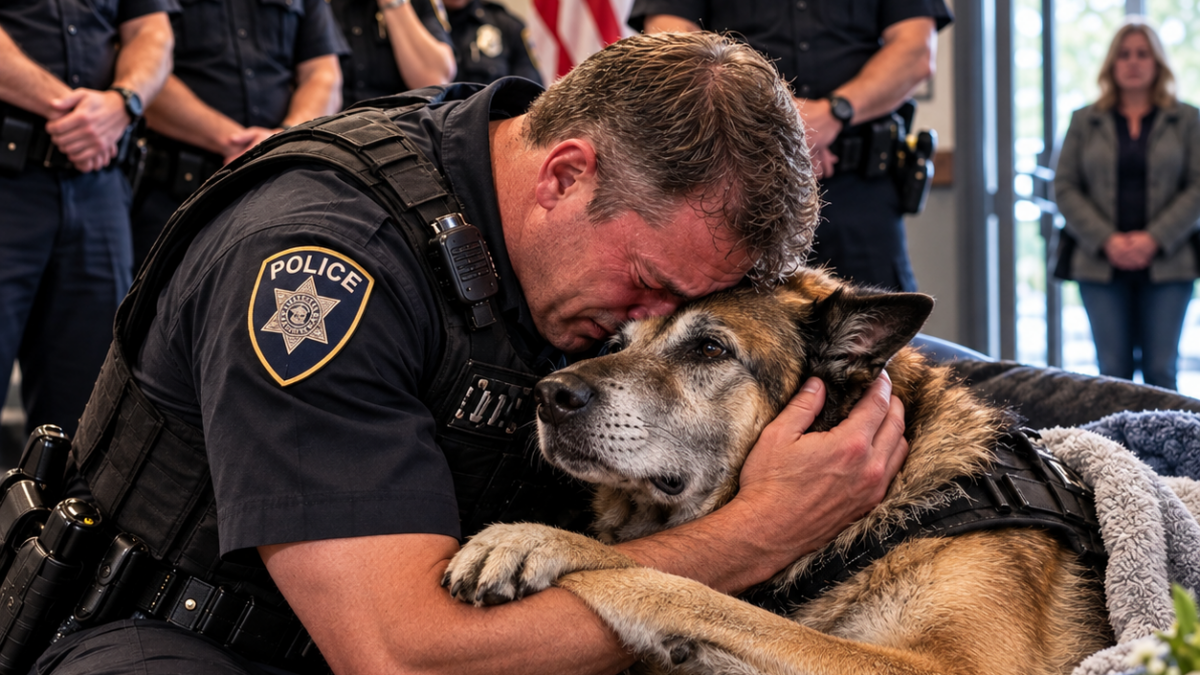
Just before the final goodbye, Max lifted his head.
Everyone became quiet.
He was not looking at me.
He was not looking at the officers around us.
He was staring toward the station entrance.
I turned.
A man stood in the doorway, breathing hard like he had come straight from his truck.
Officer Michael Reynolds.
The first K9 trainer who had worked with Max before Max became my partner.
Most people at the station did not know the whole story.
Michael was the reason Max became the dog he was.
Years earlier, when Max was still young and wild and full of more drive than discipline, Michael had spent countless hours teaching him patience, trust, and control.
He had shaped the dog who later shaped me.
Michael had retired the year before after a back injury ended his field career. He lived nearly four hours away.
Nobody had expected him.
But Max had.
I believe that with everything in me.
Michael walked slowly into the room.
Nobody spoke.
There was no ceremony.
No official speech.
No polished goodbye.
Just a retired trainer, a broken handler, and one incredible dog sharing the last moment of a life that had touched all of us.
Michael knelt beside Max.
His hand trembled when he placed it on Max’s shoulder.
Max looked at him.
Really looked.
His eyes seemed brighter for just a second.
Michael swallowed hard.
“Still watching over everyone, aren’t you?” he whispered.
Max let out a soft breath.
Then he rested his head back down.
Michael bowed his head.
I looked around the room.
At the rookies who had learned from Max.
At the deputies who had trusted him during dangerous calls.
At the dispatchers who kept treats in drawers.
At the chief standing with wet eyes he would later deny.
At Alex, who had become a good officer partly because one dog sat beside him on the worst night of his early career.
That was when I realized Max had never belonged only to me.
I needed him most.
Maybe I loved him deepest.
But Max had been carrying pieces of everyone.
The department held a small memorial service that afternoon.
His K9 vest was placed beside his photo.
His collar was displayed with the same respect given to any officer who had served.
People shared stories.
Some were serious.
Some made everyone smile.
Sergeant Mills admitted publicly that Max had once stolen half his sandwich during a training day and that he had pretended not to notice because “the dog had better judgment than most administrators.”
Maria told the bacon story, even though we all already knew.
Alex spoke about the night behind the station.
Michael spoke about training Max, about how the dog had always been intense but never careless.
“He had power,” Michael said, voice rough. “But more than that, he had heart. You can train a dog to work. You cannot train a dog to care. Max cared.”
When it was my turn, I almost could not stand.
My legs felt wrong.
Like grief had added weight to my bones.
I walked to the front, looked at Max’s photograph, and forgot every sentence I had tried to prepare.
So I told the truth.
“When Max came into my life, I thought I was getting a partner,” I said. “I did not know I was getting a way back.”
I stopped.
The room waited.
“My father died before I met him. I was angry, closed off, and convinced that needing anyone made me weak. Max never argued with me about that. He just stayed close until I learned I was wrong.”
My voice cracked.
I let it.
“Every call I answered with him, every night he sat beside me, every time he looked at me like I was still worth saving, he gave me something I did not know how to ask for.”
I looked at the officers standing in front of me.
“Max protected this community. But he also protected us from believing we had to carry everything alone.”
I could not say more.
I stepped back.
No applause.
Thank God.
Only silence.
The respectful kind.
The kind Max deserved.
After the ceremony, I walked back to my patrol vehicle.
For years, I had opened that door and watched Max jump inside.
That day, the back seat was empty.
And for the first time in a long time, I felt the weight of everything.
Not only losing Max.
Losing my father again somehow.
Losing the routine.
The partnership.
The quiet presence that had stitched itself through my life so completely that I had forgotten where my own edges were.
I sat in the driver’s seat for several minutes.
The station moved around me.
People came and went.
Some looked toward the cruiser and then away.
Nobody bothered me.
Then I noticed something on the back seat.
A small worn-out toy Max had carried since he was young.
It was torn in two places.
One end was flattened from years of chewing.
The fabric had faded to a color no manufacturer would claim.
I did not know how it got there.
Maybe someone from the department placed it.
Maybe it had been sitting in the vehicle unnoticed.
Maybe Max had hidden it there in one of those small mysteries dogs leave behind so grief has something to hold.
I reached back and picked it up.
The second my fingers closed around it, memory hit me so hard I had to lean forward.
Long nights.
Training fields.
Rain.
Snow.
His paws on station tile.
His head against my leg.
The night I cried in the parking lot.
The child he found in the woods.
The rookie he comforted.
The bacon he absolutely knew he was not supposed to eat.
Every difficult call.
Every quiet ride.
Every time I thought I could not keep going and Max proved me wrong by simply being there.
I pressed the toy against my chest and cried in the empty cruiser.
Not like a deputy.
Not like a handler.
Like a man saying goodbye to family.
A few weeks later, I returned to duty.
People asked if I was ready.
I said yes.
That was not exactly true.
But readiness is not always a feeling.
Sometimes it is just the decision to show up while grief rides along.
Walking into the station without hearing Max’s paws on the floor felt wrong.
Opening the cruiser door and seeing the empty space behind the barrier felt wrong.
Driving past the training field felt wrong.
For a while, everything felt like a place where Max had just been.
But something had changed.
I started noticing things he had always noticed.
The new officers who were struggling.
The dispatcher who smiled too quickly after a hard call.
The deputy who sat alone after a child welfare case.
The people who needed someone to listen but did not know how to ask.
Max had taught me that protecting people was not only about responding when something went wrong.
Sometimes it was about being present before anyone had to say help.
One night, I found Alex Turner sitting in the same place behind the station where Max had once sat beside him.
He was older now.
More confident.
But the call had been bad.
I sat down beside him without asking.
For a while, neither of us spoke.
Then he said, “I miss him.”
“Me too.”
“He always knew.”
“Yeah.”
Alex wiped his face with both hands.
“How do you do it? Keep going after losing him?”
I looked out across the dark parking lot.
“I don’t think you keep going after,” I said. “I think you keep going with. Just differently.”
He nodded.
I do not know if that helped.
But he did not sit alone.
That was something.
Years later, a new K9 team joined our department.
A young handler named Officer Ben Miller and a German Shepherd named Ranger.
Ranger was all legs, ears, and mistakes.
He barked at a mop bucket the first week, got tangled in his leash during training, and once tried to carry three toys at the same time with the desperate confidence of youth.
Watching him hurt at first.
Then, unexpectedly, it made me smile.
During one training session, Ben looked over at me.
“What are you smiling at?”
“Your dog thinks he’s smarter than both of us.”
“He might be.”
“Good. Let him.”
Ben laughed.
Then his face grew serious.
“Everyone talks about Max,” he said. “I wish I’d met him.”
I looked toward the training field.
For a moment, I could almost see Max there.
Young again.
Fast.
Focused.
Waiting for my command.
“You know his story,” I said.
“Yeah.”
“Then you met part of him.”
Ben nodded.
I told him something I had learned the hard way.
“The best partners don’t just follow you into difficult situations. They change who you become afterward.”
He looked down at Ranger, who was currently trying to bite water from a hose.
“I hope we get there.”
“You will,” I said. “But don’t rush it. Trust takes time.”
So does healing.
I still keep Max’s collar in a small wooden box at home.
The box sits on a shelf beside a photograph of my father.
That feels right to me.
The two of them never met, but somehow they belong near each other.
My father taught me how to be a man.
Max taught me how to remain human when the man I had become started closing every door.
Sometimes, after a long day, I take the collar out.
The leather is worn.
The metal tag is scratched.
If I close my eyes, I can still feel the weight of him beside me.
People often say police dogs are trained to protect.
That is true.
Max was trained to track, search, apprehend, detect, obey, and serve.
He did all of that.
He did it bravely.
He did it well.
But Max taught me something much bigger.
The greatest protectors are not always the strongest.
They are not always the loudest.
They are not always the ones who charge first into danger.
Sometimes the greatest protectors are the ones who quietly stand beside you when you need them most.
The ones who notice when your smile is false.
The ones who sit close enough to remind you that loneliness is not a life sentence.
The ones who ask nothing except that you keep going.
Max was my K9 partner.
He was my family.
He was the friend who brought me back when I had lost myself.
And even though he is no longer walking beside me, every call I answer, every young officer I sit with, every person I try to protect, and every hard night I survive carries a little piece of him forward.
Because some partners never really leave.
They become part of how you stand.
Part of how you serve.
Part of how you notice pain in others because they once noticed yours.
And sometimes, late at night, when the station grows quiet and the hallway lights shine on the empty space beside my desk, I still find myself looking down.
Not because I expect to see him.
I know better.
But because for eight years, Max rested there.
Watching.
Waiting.
Reminding all of us that courage does not always bark.
Sometimes it simply stays.
And if you are lucky enough to be loved by a partner like that, then even goodbye is not the end.
It is a promise.
To keep walking.
To keep protecting.
To keep becoming the person they believed you were, long before you believed it yourself.