A Deputy Treated a Disabled Veteran Nurse Like a Suspect—Then a Police K9 Broke Formation, Ran Straight to Her, and Left Everyone in the Clinic Asking Who She Really Was.
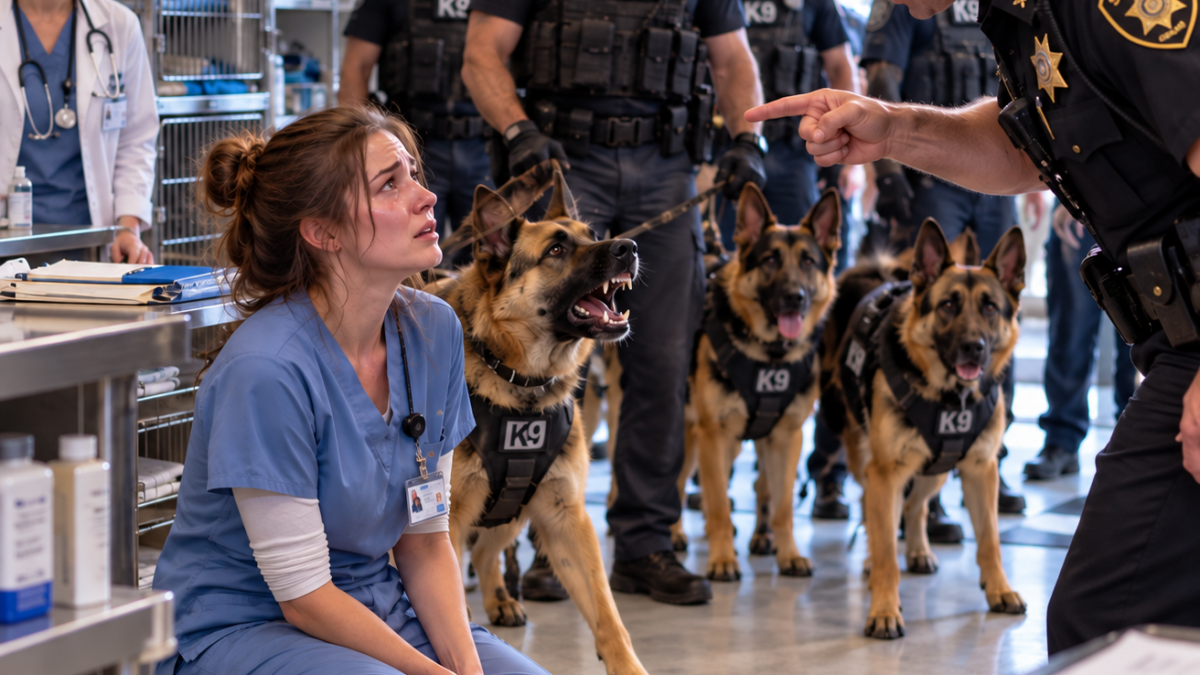
A Deputy Treated a Disabled Veteran Nurse Like a Suspect—Then a Police K9 Broke Formation, Ran Straight to Her, and Left Everyone in the Clinic Asking Who She Really Was.
Deputy Mason Briggs spent an entire morning watching my shaking hands, my carbon-fiber leg brace, and the pain I tried to hide, then quietly decided those things looked more like guilt than disability.
By noon, controlled-medication discrepancies had turned me into the most convenient suspect in a crowded veterinary trauma center, and I was standing beneath the eyes of clients and coworkers who had begun wondering whether the wounded veteran they trusted had been stealing narcotics all along.
Then the sheriff’s K9 unit walked through the doors, one of the most disciplined German Shepherds in the county broke formation, crossed the entire clinic without obeying a single command, and pressed himself against the damaged leg I had sacrificed years earlier while saving him and his handler from an explosion.
My name is Harper Ellis.
For most of my adult life, I have disliked introductions.
People ask ordinary questions and expect ordinary answers.
Where are you from?
What do you do?
How did you hurt your leg?
The first two are easy.
The third never is.
If I say I was injured overseas, people want details.
If I say military service, they thank me.
If I mention the explosion, their expression changes into that mixture of admiration and discomfort people wear when they suddenly realize the person standing in front of them carries a story larger than the conversation they planned to have.
So for years I used the same answer.
“Life happened.”
Usually people smiled awkwardly.
Usually they stopped asking.
That was exactly what I wanted.
At thirty-eight, I worked as the senior veterinary trauma nurse at Blue Ridge Veterinary Trauma Center in western North Carolina.
I had been there two years.
Long enough that anxious pet owners sometimes asked for me by name.
Long enough that Dr. Naomi Foster had stopped arguing every time I volunteered for an extra shift.
Almost.
“You’re here again.”
That was what Naomi said at 5:47 one Tuesday morning when she found me checking a chest tube on a retired service dog named Scout.
I looked at the wall clock.
“I work here.”
“You worked yesterday.”
“Yes.”
“And the day before.”
“Yes.”
“And the nine days before that.”
I checked Scout’s respiratory rate.
“Your pattern recognition is excellent.”
Naomi sighed.
She was forty-two, brilliant, practical, and one of only three people who could tell when my humor meant I was avoiding a subject.
“You’ve worked twelve days straight.”
“Scout needed monitoring.”
“We have night staff.”
“He doesn’t trust night staff.”
Scout, a twelve-year-old Labrador with cloudy eyes and a scar across his muzzle, lifted his head as though supporting my argument.
Naomi pointed at him.
“Do not recruit the patient.”
PART2:
I scratched beneath Scout’s chin.
“He approached me.”
“Harper.”
“I’m fine.”
Naomi looked at my left leg.
I had adjusted the carbon-fiber brace twice in five minutes.
That was enough for her to notice.
“Pain?”
“Four.”
“Your four or everybody else’s four?”
I considered.
“Unfair question.”
“Sit down.”
“I am sitting.”
“You’re kneeling.”
“Technically.”
She gave me the expression doctors use when they know arguing will create more resistance than compliance.
“Breakfast.”
“At seven.”
“Six-thirty.”
“Seven.”
“Six forty-five.”
“Accepted.”
That was Naomi.
Negotiation instead of pity.
One reason I stayed.
PART3:
Blue Ridge was not a normal veterinary clinic.
It handled trauma referrals, emergency surgery, retired working dogs, police K9s, search-and-rescue dogs, and animals too complicated for smaller practices.
That meant mornings rarely remained quiet.
By six-thirty we had a golden retriever struck by a pickup truck, a cat recovering from abdominal surgery, a retired military dog struggling with pneumonia, and a police Malinois with a torn paw pad after jumping a fence during a burglary search.
Phones rang.
Doors opened.
Monitors beeped.
Owners cried.
Technicians moved quickly between rooms.
Controlled chaos.
I liked controlled chaos.
Chaos with tasks is easier than chaos without them.
Pain has a purpose when there is work.
At 7:12 a young couple entered carrying a German Shepherd puppy wrapped in a blanket.
The puppy barked at everything.
Receptionist.
Floor mat.
Door.
Trash can.
Stethoscope.
The owner looked mortified.
“I’m sorry.”
“He’s never like this.”
I watched from several feet away.
Puppy’s ears flattened.
Whites of eyes visible.
Weight shifted backward.
Fear.
Not aggression.
I lowered myself carefully.
My brace locked halfway.
A sharp line of pain traveled up my thigh.
I ignored it.
Sat on the floor.
Did not reach.
Did not call the dog.
Did not make eye contact.
The puppy barked.
Then less.
Then stopped.
Thirty seconds.
A minute.
He sniffed.
Moved forward.
Retreated.
Moved again.
Eventually his nose touched my hand.
I did nothing.
He decided.
Then he leaned his entire body against my knee.
The owner stared.
“What did you do?”
“Nothing.”
“You didn’t even touch him.”
“Exactly.”
I scratched his chest once he asked for contact.
“I let him decide I was safe.”
Naomi stood near the treatment door watching.
She had seen me do it before.
Still watched every time.
Animals rarely care about résumés.
They do not care whether you were promoted.
Decorated.
Divorced.
Injured.
They care whether the body in front of them feels dangerous.
Maybe that was why I understood them.
At 10:06 the front doors opened again.
This time conversation stopped.
Two sheriff’s deputies entered.
The first carried a leather folder.
Tall.
Forties.
County uniform.
Nameplate:
BRIGGS.
The second deputy carried evidence bags and a laptop case.
Naomi approached.
“Can I help you?”
The first man showed identification.
“Deputy Mason Briggs.”
His voice was professional.
Not hostile.
Not yet.
“We’re conducting compliance inspections at several regional veterinary clinics.”
“For what?”
“Controlled medications.”
That got everyone’s attention.
Blue Ridge kept fentanyl, hydromorphone, ketamine, midazolam, buprenorphine, and several other controlled medications under strict inventory procedures.
Naomi’s expression sharpened.
“Is there a problem?”
Briggs glanced around.
“There are unexplained discrepancies across multiple facilities in the county.”
“Missing drugs?”
“Possibly.”
A woman in the waiting area pulled her terrier closer.
Naomi said:
“We’ll cooperate.”
“Who manages your controlled-substance documentation?”
Naomi turned.
“Harper.”
I walked over.
Briggs looked at me.
Not rudely.
Assessing.
His gaze passed over my scrubs.
Hands.
Badge.
Then stopped briefly on the brace extending beneath my left pant leg.
“This is Harper Ellis,” Naomi said. “Senior trauma nurse.”
Briggs nodded.
“You oversee narcotics?”
“The daily physical count and most documentation.”
“Show me.”
The medication room was small.
Bright fluorescent light.
Two locked cabinets.
Automated dispensing terminal.
Paper backup logs.
I entered my code.
Bent to access the lower safe.
The brace caught.
Pain struck.
I paused.
One second.
Maybe two.
Briggs noticed.
“You okay?”
“My brace locked.”
“You hesitated.”
“Yes.”
“Nervous?”
“No.”
He kept watching.
I unlocked the safe.
His gaze remained on my hands.
I removed binders.
My fingers trembled.
Pain tremor.
Chronic nerve irritation caused that sometimes when I stood too long.
Briggs saw it.
I saw him see it.
Something subtle changed.
He opened the log.
“When was your last count?”
“Yesterday at 19:12.”
“You signed alone.”
“Physical count by me. Electronic verification by Dr. Foster.”
He flipped pages.
Stopped.
“These numbers don’t match.”
I moved beside him.
Three entries.
Hydromorphone withdrawal duplicated.
Ketamine line repeated.
Another medication quantity mirrored exactly six minutes later.
“Yes.”
“You knew?”
“We reported it.”
“To whom?”
“Software manufacturer.”
“When?”
“First report five weeks ago.”
“Supplier?”
“Yes.”
“State veterinary board?”
“Yes.”
He looked at me.
“You reported your own narcotics discrepancies?”
“They are not physical inventory discrepancies.”
“What are they?”
“Transaction duplication.”
His expression said convenient before his mouth did.
I pulled another binder.
“Here.”
Briggs stepped between me and the shelf.
“I’ll take that.”
“Those contain patient records.”
“Potential evidence.”
“You need documentation before originals leave.”
His jaw tightened.
Naomi appeared in the doorway.
“She’s right.”
Briggs looked toward her.
“We’ll review on site.”
“Thank you.”
No argument.
Still, tension entered the clinic.
The second deputy began examining dispensing records.
Briggs asked questions.
Lots.
Who had keys?
Who had override authority?
Who accessed cabinets after hours?
Who wasted unused narcotics?
How were witnesses recorded?
Who corrected entries?
My answers were precise.
Precision sometimes sounds defensive to people looking for emotion.
Briggs kept testing.
“You work a lot of overtime.”
“Yes.”
“Frequently alone?”
“Not alone.”
“After administrative staff leave.”
“Sometimes.”
“You have access.”
“Yes.”
“Financial problems?”
I looked at him.
“No.”
“Prescription medication?”
“That question needs context.”
He paused.
“Are you currently prescribed controlled medication?”
I understood.
Pain patient.
Possible dependence.
Convenient motive.
Naomi stiffened.
I answered anyway.
“Occasional prescribed tramadol. Rarely used.”
“Who prescribes it?”
“My physician.”
“Any opioids?”
“Not currently.”
“When did you last receive them?”
“Postoperative.”
“How long ago?”
“Three years.”
“What surgery?”
My leg began to ache harder.
“That is not relevant to inventory access.”
Briggs disagreed.
“If controlled drugs are missing, substance history is relevant.”
“Then request it properly.”
He stared.
For the first time, irritation appeared.
“I’m asking voluntarily.”
“And I’m declining voluntarily.”
The room became quiet.
Not because I had done anything wrong.
Because saying no to a uniform changes a room.
Briggs closed his notebook halfway.
“You seem defensive.”
“I’m protecting medical privacy.”
“You were cooperative ten minutes ago.”
“I am still cooperative.”
“Until I asked about your medication.”
I looked directly at him.
“Deputy, I have answered every inventory question.”
He glanced at my trembling hand.
“You’re shaking.”
“My leg hurts.”
“Your hands are shaking.”
“Nerve pain.”
“You expect me to believe—”
Naomi cut in.
“Yes.”
Her voice hardened.
“She expects you to believe her because she just told you.”
Briggs looked toward her.
“Doctor, I’m conducting an investigation.”
“And I’m explaining a medical fact.”
“I didn’t ask for diagnosis.”
“No. You implied guilt.”
That was when several people outside began listening openly.
I hated that.
Public attention.
Whispers.
The possibility that by lunchtime the story would become:
Nurse investigated for stolen drugs.
Truth rarely travels as fast as suspicion.
The second deputy called:
“Briggs.”
He turned.
“Found more.”
At the terminal, multiple medication withdrawals appeared duplicated.
Same amounts.
Overlapping timestamps.
Several occurred under my login.
Briggs looked at me.
I pointed.
“That is the software issue.”
“Every duplicate is under your authorization.”
“Because I authorize many withdrawals.”
“Convenient.”
Naomi said:
“We have service tickets.”
“We’ll examine them.”
Briggs returned to me.
“Did you ever remove controlled medication without recording it?”
“No.”
“Ever?”
“No.”
“Did you ever take medication home?”
“No.”
“Did you ever alter inventory to cover a shortage?”
“No.”
“Who else knows your password?”
“No one.”
“Then if entries under your credentials are wrong—”
“Software can be wrong.”
“Software doesn’t shake.”
That sentence changed everything.
I became very still.
Naomi’s face hardened.
The technician beside the computer looked down.
Briggs seemed to realize too late that he had said something cruel.
But he did not retract it.
Maybe pride.
Maybe momentum.
I asked:
“What exactly does my brace have to do with your investigation?”
“I didn’t mention the brace.”
“You didn’t need to.”
Silence.
He closed the notebook.
“We’re going to continue reviewing records.”
I nodded.
“Then continue.”
I walked away before pain or anger made me say something I regretted.
In the treatment room, I pretended to organize surgical packs.
My hands trembled more.
Not fear.
Not exactly.
Anger causes adrenaline.
Adrenaline increases tremor.
My leg burned.
I sat.
Then immediately stood when someone entered.
Old habit.
Hide weakness.
Military medicine teaches you to prioritize casualties.
Sometimes you apply the same logic to yourself long after the casualty event ends.
Everyone else first.
Your body later.
Naomi found me fifteen minutes afterward.
“Sit.”
“I am sitting.”
“You stood when I came in.”
“I’m sitting again.”
She closed the door.
“Do you want him out?”
“No.”
“Harper.”
“He has a job.”
“So do I.”
“He thinks drugs are missing.”
“They aren’t.”
“He doesn’t know that yet.”
“He shouldn’t be treating you like—”
“Naomi.”
I looked at her.
“If I ask him to leave after he questioned me, that becomes part of his story.”
She hated that I was right.
“He crossed a line.”
“Yes.”
“You don’t have to tolerate it.”
“I’m not tolerating it.”
“What are you doing?”
“Waiting for facts.”
The phrase sounded familiar even to me.
Wait.
Watch.
Don’t move before you understand the room.
That lesson came from another life.
At 11:14 the clinic doors opened for the third time.
Vehicles had arrived outside.
Two patrol SUVs.
One dark county K9 unit vehicle.
Handlers entered carrying equipment.
Chief Evan Torres came first.
Late forties.
Compact.
Calm face.
Behind him, an officer carried a limping Belgian Malinois named Juno.
Training injury.
Shoulder.
Another handler held a leash attached to a large German Shepherd.
Gray around the muzzle.
Old scar behind left ear.
I did not see him immediately.
I was helping position Juno’s stretcher.
Then the Shepherd stopped.
His handler continued half a step before the leash tightened.
“Atlas.”
My hands froze.
The name hit before I turned.
No.
Too common.
There are many dogs named Atlas.
I looked.
German Shepherd.
Older now.
Heavier through the chest.
Scar.
Right forepaw angled slightly outward.
Everything in the room disappeared.
Kosovo.
Concrete dust.
Blood.
Cold.
A dog shaking beneath a field blanket.
The handler said:
“Atlas. Heel.”
Atlas did not move.
His ears rose.
His eyes locked on me.
Chief Torres noticed.
“What is it?”
Atlas pulled forward.
“Atlas.”
Harder command.
Nothing.
Then he broke formation.
The leash slipped from the handler’s hand.
The dog ran.
Clients gasped.
Briggs stepped forward.
“Watch out!”
Atlas crossed the lobby.
Toward me.
For one instinctive second, several people prepared for impact.
But Atlas slowed three feet away.
Ears lowered.
Tail moved once.
Then he pressed the side of his body gently against my left leg.
Exactly beside the carbon-fiber brace.
He lifted his head.
I touched the old scar behind his ear.
My fingers remembered before my mind did.
“Easy, Atlas.”
His eyes closed.
My throat closed too.
“You’re safe now.”
Atlas whined.
One long broken sound.
Chief Torres stopped dead.
“What did you say?”
I barely heard him.
Atlas pushed his head into both my hands.
“You’re safe.”
Torres looked at his handler.
Then at me.
His face changed.
“Only one person…”
He stopped.
Briggs stared.
“What?”
Torres whispered:
“Only one person ever used those words with him like that.”
I looked up.
He asked:
“Who are you?”
“Harper Ellis.”
His eyes widened.
“No.”
I knew that expression.
Recognition of a story.
Not a person.
He looked toward my brace.
Then Atlas.
“Ellis?”
“Yes.”
“Captain Harper Ellis?”
“Former captain.”
The room became completely still.
Even Naomi stared at me.
She knew I had served.
Not rank.
Not details.
I had made sure of that.
Torres took one step closer.
“Kosovo?”
The word landed like an explosion.
My body responded before thought.
Heart rate up.
Muscles tight.
The fluorescent clinic vanished for half a second.
Cold night.
Field hospital.
Metal tables.
Atlas young.
Daniel Rhodes bleeding.
I forced myself back.
“Yes.”
Chief Torres exhaled.
“My predecessor trained Atlas after repatriation.”
I said nothing.
“He told us about a nurse.”
I looked away.
“The Steady One.”
Naomi turned toward me.
I hated the nickname.
Always had.
It made calm sound like a gift.
Calm was work.
Torres continued.
“He told every handler who worked with Atlas.”
I scratched behind Atlas’s ear.
“That story wasn’t necessary.”
“It was to us.”
Briggs had forgotten his investigation.
He stood several feet away listening.
Torres looked toward him.
“What’s going on?”
Briggs closed his notebook.
“Controlled medication review.”
“Harper is involved?”
“We’re determining that.”
Torres looked at me.
Then at Briggs.
Something in the room shifted.
I said:
“Don’t.”
Torres looked back.
“Don’t what?”
“Don’t decide I’m innocent because a dog remembers me.”
Briggs stared.
I continued:
“Finish the investigation.”
It surprised everyone.
Maybe me too.
But hero worship is only prejudice wearing nicer clothes.
If evidence mattered, it had to matter when it helped and when it hurt.
Torres nodded slowly.
“Fair.”
Atlas remained against my leg.
Naomi asked:
“What happened in Kosovo?”
I almost said:
Nothing relevant.
Instead, I looked at Atlas.
Maybe some stories remain hidden until hiding them starts doing damage.
“I was twenty-six.”
That was how it began.
Not with the explosion.
With a field hospital.
The conflict had officially ended.
Emergencies had not.
Collapsed buildings.
Unexploded ordnance.
Mine injuries.
Displaced families.
Rescue workers.
Military teams.
Animals trained to search rubble.
I had been an Army trauma nurse assigned to a humanitarian medical detachment supporting multinational operations.
The hospital was tents, prefabricated structures, generators, mud, cold, and constant noise.
I was small.
Five-foot-five.
People underestimated me until casualties arrived.
Then height became irrelevant.
Someone called me The Steady One after a mass-casualty night.
I hated it.
“What did you do?” one medic asked after fourteen hours.
“Nothing.”
“You never panic.”
“I panic later.”
He laughed.
I wasn’t joking.
Atlas arrived three months into that rotation.
Eighteen months old.
Young German Shepherd.
Search dog.
His handler was Corporal Daniel Rhodes.
A collapsed residential structure had trapped Daniel beneath concrete.
Atlas refused to leave him.
The dog tore his shoulder on exposed metal.
Paw shredded.
By the time rescue crews got both out, Atlas was terrified.
Not aggressive.
Fearful.
Veterinary team tried approaching.
He growled.
Snapped once.
People wanted sedation.
Reasonable.
But his breathing worried me.
Sedation in a compromised animal can create problems.
So I sat.
Six feet away.
Did nothing.
Atlas growled.
Then stopped.
I remained.
Ten minutes.
Fifteen.
He crawled forward.
Head low.
Finally rested his muzzle on my knee.
I whispered:
“You’re safe now.”
That became the phrase.
Every dressing change.
You’re safe.
Every needle.
You’re safe.
Every time Daniel went into surgery and Atlas searched for him.
You’re safe.
Daniel survived.
Barely.
Three weeks later came the blast.
Humanitarian convoy entered an industrial district.
Secondary explosive detonated.
Mass casualties.
Field hospital flooded.
We worked eighteen hours.
Children.
Soldiers.
Rescue personnel.
Dogs.
Around midnight, Daniel returned injured again.
Atlas beside him.
Then a second explosion struck near the hospital entrance.
Not a direct attack on us, investigators later believed.
Residual munition.
Chain reaction.
It did not matter.
Glass moved like knives.
Metal fragments crossed the tent.
I saw Atlas.
Daniel.
Blast path.
Then I moved.
No thought.
I threw myself over both.
Impact.
White light.
Sound disappeared.
When I woke, I could not feel my left leg.
Daniel lived.
Atlas lived.
Surgeons rebuilt the leg.
Multiple fractures.
Nerve injury.
Muscle damage.
Eleven procedures over two years.
Rehabilitation.
Then medical retirement.
I hated those two words more than I ever admitted.
Medical retirement.
As if the body had submitted paperwork to stop being useful.
I stayed through evacuation because there were patients.
Not because I was brave.
Because leaving while others still needed treatment felt impossible.
Eventually someone forced me onto transport.
Back home, everyone called me lucky.
That word again.
Leg saved.
Life saved.
Career changed.
Marriage engagement ended six months later.
Some friends disappeared.
Others became too helpful.
Every room changed around the brace.
People opened doors I did not ask opened.
Moved chairs.
Spoke slower.
Used words like inspirational.
I started over.
Nursing animals came later.
Animals never looked at the brace and decided what the rest of me meant.
When I finished, nobody spoke for several seconds.
Atlas leaned against me.
Torres said quietly:
“He remembered.”
“Yes.”
“After twelve years.”
“Dogs remember safety differently.”
Briggs looked toward his notebook.
Then me.
His face had changed.
Shame.
But before he could speak, a technician ran from the computer room.
“Naomi.”
Dr. Foster turned.
“What?”
“We found it.”
Every head shifted.
“The duplicate withdrawals.”
The technician held printed diagnostic logs.
“It’s the dispensing system.”
Briggs moved fast.
“How?”
“Network interruption creates a failed confirmation signal.”
He showed the report.
“When the terminal reconnects, it records the same withdrawal again.”
I had explained that.
But now the system had documented itself.
The technician continued:
“Every discrepancy matches a network dropout.”
Briggs compared timestamps.
One by one.
Exact.
Same drug.
Same patient.
Same quantity.
Duplicated electronically.
Physical counts correct.
No missing medication.
Then Naomi brought three maintenance tickets.
My signature.
Dates.
First complaint five weeks earlier.
Second four weeks.
Third nine days earlier.
Each:
URGENT — DUPLICATED CONTROLLED MEDICATION TRANSACTIONS DURING NETWORK INTERRUPTION.
Manufacturer acknowledged.
Technician scheduled.
Delayed.
I had documented everything.
Briggs read the pages.
His shoulders lowered.
He looked at me.
“You told me.”
“Yes.”
“You reported all of it.”
“Yes.”
He looked toward my hands.
Not shaking now because I was sitting.
Pain had eased.
“I thought…”
“You thought my shaking meant guilt.”
He swallowed.
“Yes.”
The whole lobby heard.
I wished they didn’t.
But public suspicion had arrived publicly.
Maybe correction needed to as well.
Briggs closed his notebook.
“I owe you an apology.”
I waited.
“I saw hesitation.”
“My brace locked.”
“I saw shaking.”
“Pain.”
“I saw you refusing medical questions.”
“Privacy.”
He nodded.
“I put those things together into a story before the evidence was finished.”
“Yes.”
No comfort.
He deserved a clean answer.
“I was wrong.”
Naomi folded her arms.
“Yes.”
I nearly smiled.
Briggs continued:
“I treated pain like deception.”
Atlas lifted his head toward him.
Chief Torres said:
“He didn’t.”
Briggs looked at Atlas.
“No.”
Then back at me.
“He remembered the person.”
Torres nodded.
“Dogs don’t remember rank.”
I scratched Atlas.
“They remember patterns.”
“Trust too.”
“Yes.”
Briggs extended his hand.
I looked at it.
Not because I wanted to humiliate him.
Because apologies create choices.
Accepting one does not mean declaring harm erased.
Eventually I shook his hand.
His grip was careful.
“I’m sorry, Nurse Ellis.”
“Thank you.”
He started to step away.
“Deputy.”
He stopped.
“One thing.”
“Anything.”
“Next time someone seems nervous…”
He waited.
“Ask yourself whether you’re looking at guilt or pain.”
He nodded.
“I will.”
“No.”
I shook my head.
“Don’t promise me.”
His expression changed.
“Build something that makes you remember when I’m not there.”
That became the part neither of us expected.
Because Briggs did not leave the clinic, feel embarrassed for two days, then return to doing everything exactly the same.
He stayed.
After the other deputy finished documentation, Briggs sat in his cruiser for almost forty minutes.
Later he told me he replayed the morning.
Every question.
Every assumption.
The moment he noticed the brace.
The moment my hand shook.
The instant his mind began building a suspect before evidence had finished building a case.
He had been a deputy eighteen years.
Hundreds of interviews.
Traffic stops.
Domestic calls.
Search warrants.
Mental-health crises.
Veteran encounters.
He had always believed he was good at reading people.
Now he understood how dangerous that confidence could become.
Two days later he returned.
No folder.
No warrant.
Coffee.
He stood near reception.
Naomi looked suspicious.
“What happened?”
“I need to talk to Harper.”
“You already did.”
“Naomi.”
I was behind her.
“It’s okay.”
She moved aside reluctantly.
Briggs held two coffees.
“I didn’t know what you drink.”
“I don’t drink coffee.”
He stared at both cups.
“That would’ve been useful before purchase.”
“Tea.”
“I’ll remember.”
He handed one to Naomi.
She accepted because waste offended her more than pride.
Briggs said:
“I’ve been thinking.”
“That can be dangerous.”
He smiled faintly.
“Probably.”
Then serious.
“I owe you more than an apology.”
“You don’t.”
“I think I do.”
“What?”
“A change.”
He had spoken to Sheriff Randall Price.
Their department required annual de-escalation training.
Use-of-force updates.
Bias modules.
Nothing specifically covered invisible disability.
Chronic pain.
Mobility impairment.
Trauma responses.
Veteran-related nervous-system behaviors.
They had general ADA training.
Mostly compliance.
Parking.
Wheelchairs.
Interpreters.
Not behavior.
Briggs said:
“I want to build something.”
“With me?”
“If you’ll help.”
My immediate answer was no.
I had no desire to become the disabled veteran displayed before deputies as a lesson.
No inspirational slideshow.
No applause.
No:
Look what this brave woman overcame.
Briggs seemed to understand.
“I don’t want you to tell your war story.”
“Good.”
“I want you to tell us where I went wrong.”
That was different.
I said:
“Pain can look like evasiveness.”
He nodded.
“Trauma can look like aggression.”
He wrote it down.
“Autism can look like noncompliance.”
Another note.
“Hearing impairment can look like ignoring commands.”
“Medication side effects can look like intoxication.”
He looked up.
“Keep going.”
“Parkinsonian tremor.”
“Diabetic confusion.”
“PTSD hypervigilance.”
“Prosthetic discomfort.”
“Brain injury.”
“Panic.”
“Grief.”
“People avoiding eye contact because of culture, fear, neurodivergence, or shame.”
Briggs stopped writing.
“You’ve thought about this.”
“I’ve been a nurse a long time.”
Over the next month, we built a pilot.
Not alone.
That mattered.
We included disability advocates.
A veteran therapist.
An autistic self-advocate.
A deaf community representative.
A pain specialist.
A former patrol officer with a traumatic brain injury.
Chief Torres joined.
So did Naomi.
I insisted on one rule.
“No training about us without us.”
Briggs agreed.
The first session began badly.
Forty deputies.
Some interested.
Some visibly not.
One crossed his arms from the first minute.
Another checked his watch.
I expected resistance.
Police officers are trained to detect threats quickly.
Speed matters.
The problem is what happens when speed becomes certainty.
I stood at the front.
Brace visible.
No uniform.
No medals.
No Atlas at first.
I wrote two words on the board.
BEHAVIOR ≠ CAUSE
Then asked:
“What does nervous look like?”
Answers came.
Sweating.
Shaking.
Avoiding eye contact.
Fidgeting.
Short answers.
Breathing hard.
“Now tell me what guilty looks like.”
Silence.
Then someone said:
“The same.”
“Exactly.”
That changed the room.
I did not accuse them.
I used cases.
A diabetic driver appearing intoxicated.
An autistic teenager unable to answer open-ended questions.
A combat veteran positioning himself where he could see exits.
A woman with cerebral palsy whose movement might resemble impairment from substances.
A person in severe chronic pain becoming irritable during questioning.
We talked about safety.
Officer safety too.
Trauma-informed does not mean naive.
Disability awareness does not mean ignoring threats.
It means separating observation from interpretation.
Observation:
His hand is shaking.
Interpretation:
He is hiding something.
Those are not the same sentence.
One is evidence.
One is a story.
Briggs stood in the back.
At the end, he told them what he had done to me.
Not a softened version.
He said:
“I saw a disabled woman in pain and decided I was seeing a suspect reveal herself.”
No one moved.
“I did it while believing I was being objective.”
That mattered more than anything I said.
Because accountability from inside a profession carries weight outsiders cannot manufacture.
Then Chief Torres brought Atlas in.
The room changed.
Old dog.
Slow now.
Still proud.
Torres explained his history.
Not my heroism.
Atlas’s behavior.
How working dogs store associations.
How trust conditioning works.
How the same dog can react differently to postures, tones, breathing, and familiar emotional patterns.
Briggs joked:
“My best instructor has four legs.”
People laughed.
Atlas walked toward me.
Leaned against the brace.
Again.
The room became quiet.
Not dramatic.
Just recognition.
Three months later the sheriff’s department adopted the course for all deputies.
Six months later a neighboring county asked for it.
Then another.
I resisted becoming a traveling speaker.
Mostly succeeded.
Briggs became the person who carried the program.
That was as it should be.
Change lasts longer when the institution owns it.
Meanwhile, Blue Ridge changed too.
The software manufacturer finally admitted a defect.
Not just our clinic.
Several veterinary practices using the same version had duplicate controlled-drug transaction logs during unstable network connections.
No medication theft.
No diversion ring.
The state board issued guidance.
The company pushed a software patch.
Nothing glamorous.
The entire investigation that had nearly stained my reputation ended because someone finally examined boring technical logs carefully.
Truth is often boring.
That is one reason suspicion wins so quickly.
Suspicion has drama.
Truth frequently has spreadsheets.
I returned to work.
At first clients treated me differently.
Some had witnessed the investigation.
Then the reunion.
A few suddenly wanted selfies.
I refused.
One older man called me a hero loudly in the waiting room.
I said:
“Please don’t.”
He looked hurt.
I explained.
“I’m your dog’s nurse today.”
That was what I wanted.
Not Captain Ellis.
Not The Steady One.
Harper.
Nurse.
Person.
Atlas began visiting Blue Ridge regularly because his joints were aging.
Every appointment, he looked for me.
If I wasn’t working, Torres said he searched treatment rooms.
I pretended this did not affect me.
Everyone knew better.
Then one afternoon Atlas arrived with a man I had not seen in twelve years.
Tall.
Walking stick.
Gray hair.
Left shoulder lower than right.
He entered slowly.
Atlas began barking before the door opened fully.
I looked up.
The man smiled.
“Hello, Harper.”
My body forgot how to move.
“Daniel.”
Corporal Daniel Rhodes.
Atlas’s first handler.
The man underneath me when the blast destroyed my leg.
Alive because many people had worked very hard to keep him that way.
I crossed the lobby.
Stopped.
Didn’t know whether to hug.
He solved it.
Opened his arms.
I stepped in.
For several seconds, neither of us spoke.
Then Atlas shoved between us.
Daniel laughed.
“Still jealous.”
I knelt as much as my brace allowed.
“You disappeared.”
Daniel looked at me.
“I disappeared?”
“You left the service.”
“So did you.”
“You changed your number.”
“So did you.”
We both laughed.
Then not.
Daniel had spent years recovering too.
Lung damage.
Shoulder reconstruction.
Traumatic brain injury.
Nightmares.
Divorce.
Eventually remarriage.
He became a high-school history teacher.
I found that strangely perfect.
“How did you find me?”
“Atlas.”
“What?”
“Torres called after the clinic incident.”
I looked at the chief.
He raised both hands.
“I had permission to contact the former handler.”
Daniel leaned on the walking stick.
“I’ve been trying to find you for years.”
“Why?”
He stared as if the answer should be obvious.
“To say thank you.”
I hated that.
Not him.
The debt.
“No.”
His expression changed.
“No?”
“You don’t owe me.”
“You threw yourself over me.”
“And Atlas.”
“Exactly.”
“I was doing my job.”
Daniel laughed once.
“The Steady One.”
“Don’t.”
He stopped.
Then softened.
“Harper.”
“Yes?”
“You saved my life.”
I looked at the floor.
“You survived because surgeons, medics, evacuation crews, and a dog refused to quit.”
“And you.”
“Yes.”
I finally allowed that word.
“And me.”
Daniel nodded.
“Thank you.”
This time I accepted it.
“You’re welcome.”
That was harder than it sounds.
People think veterans struggle only with what happened.
Sometimes we struggle with what others say it meant.
Hero.
Sacrifice.
Courage.
Those words can become cages too.
Accepting gratitude without letting it define me took years.
Daniel became part of my life again.
Not constantly.
Enough.
He visited the clinic.
Spoke at training sessions once or twice.
Mostly we talked about ordinary things.
His students.
Naomi’s terrible taste in music.
My refusal to retire from overtime.
Atlas’s arthritis.
The dog was eleven when he started slowing noticeably.
Twelve when stairs became difficult.
Thirteen when Torres stopped using him in demonstrations.
Retired completely.
He lived with Torres by then.
Chief in title.
Full-time servant in reality.
At Blue Ridge, we began planning something new.
The idea came from an argument.
A veteran client named Luis brought in a retired bomb dog.
Luis used a prosthetic leg.
The dog had hip dysplasia.
Both struggled across the parking lot.
Our existing rehabilitation room was narrow.
Too clinical.
Luis joked:
“Neither of us wants to exercise under fluorescent lights.”
Naomi said:
“Then we need a garden.”
I thought she was joking.
She was not.
Fundraising began.
Accessible pathways.
Low-incline ramps.
Shaded benches.
Hydrotherapy access.
Quiet zones.
Exercise stations for service dogs.
Space where veterans, first responders, disabled handlers, and retired working animals could rehabilitate together.
The sheriff’s department donated.
So did community members.
Several veterinary suppliers.
A veterans foundation.
Briggs ran a charity 10K despite hating running.
I walked the last quarter mile with him.
He slowed deliberately.
I noticed.
“Do not do that.”
“Do what?”
“Walk slower because of me.”
“I’m tired.”
“You are lying.”
He laughed.
“Okay.”
We finished at my pace anyway.
Not because I needed pity.
Because two people can share pace without assigning value to speed.
Six months later, the garden opened.
They wanted me to cut the ribbon.
I refused.
Naomi threatened me.
Still refused.
Instead I invited Olivia Chen.
Twenty-two.
Nursing student.
Leg brace after a car crash.
She had been volunteering at Blue Ridge while deciding whether she could physically manage nursing school.
She worried constantly that hospitals would see the brace before competence.
Sound familiar.
Olivia stared at the scissors.
“I shouldn’t be up there.”
“Why?”
“It’s your garden.”
“No.”
“Everyone says it exists because of you.”
“Everyone exaggerates.”
She looked terrified.
“I don’t belong.”
I smiled.
“I used to think belonging required permission too.”
We cut the ribbon together.
Applause.
I tolerated it.
Mostly because Atlas stood beside me.
Old now.
Gray muzzle nearly white.
He leaned against my brace one more time.
I rested my hand on his head.
“We’re both still standing.”
Torres smiled.
“Barely.”
Atlas looked offended.
Daniel laughed.
Briggs approached later.
Uniform.
No notebook.
“I wanted to thank you.”
“For what?”
“You could’ve made sure I was disciplined.”
I looked at him.
“I did not control your discipline.”
“No.”
He had received a formal counseling memo after the clinic incident.
Not because he investigated.
Because supervisors found aspects of his questioning unnecessarily biased toward disability-related behavior after reviewing body-camera footage.
No suspension.
No career destruction.
Appropriate.
Briggs continued:
“You could’ve asked for more.”
“Would that have helped?”
“Maybe you.”
I thought.
“Punishment can matter.”
He nodded.
“But?”
“Education matters too.”
He looked around.
Deputies talking with veterans.
Children petting retired K9s.
Nurses.
Handlers.
Olivia laughing beside Naomi.
“You gave us education.”
“No.”
I shook my head.
“You chose to learn.”
Important distinction.
People cannot be forced into understanding by humiliation.
Accountability, yes.
Shame sometimes gets attention.
But lasting change usually needs participation.
That does not mean victims owe education to people who hurt them.
I did not owe Briggs anything.
I chose.
That choice mattered because it was mine.
A year after the garden opened, Atlas developed degenerative myelopathy.
Torres knew before he brought him.
I knew the moment I watched Atlas walk.
Rear legs uncertain.
Paws dragging slightly.
No pain initially.
Progressive.
No cure.
We managed him.
Harness.
Physical therapy.
Hydrotherapy.
Medication for secondary discomfort.
Ramps.
Time.
Atlas remained himself.
That is something disease cannot always steal immediately.
He still knew Torres’s refrigerator.
Still hated nail trims.
Still looked for me.
Still leaned against my brace whenever he could.
Then one morning he could not stand.
Torres called before sunrise.
“Harper.”
His voice told me.
I drove to the clinic.
Naomi was already there.
Daniel came.
Atlas lay on a thick blanket in the rehabilitation garden.
Outside.
His favorite place.
Torres sat beside him.
Red eyes.
No uniform.
Daniel lowered himself carefully on the other side.
I sat near Atlas’s head.
He looked toward me.
Still there.
Still him.
I touched the scar behind his ear.
The one from Kosovo.
“Easy.”
His tail moved once.
“You’re safe now.”
Torres broke.
Quietly.
Daniel did too.
I had said those words to Atlas when he was eighteen months old and afraid of every hand approaching his wound.
Years later, he had crossed a clinic to say something similar back to me without language.
I see you.
I remember you.
You are not what they think.
Now the phrase returned one final time.
Atlas died peacefully beneath trees.
Three people around him.
No war.
No sirens.
No fear.
Afterward I sat in the garden long after everyone left.
My leg hurt.
I did not adjust the brace.
For once I let it hurt.
Some pain deserves acknowledgment.
The sheriff’s department retired Atlas’s working identification number.
Blue Ridge created a small fund in his name for retired K9 medical care.
I insisted there be no statue.
Torres ignored me partially.
A simple bronze paw print appeared near one path.
Beneath it:
ATLAS
HE REMEMBERED TRUST.
I accepted that.
Months later, I visited the sheriff’s academy for another training.
A young deputy asked me:
“Do you think Atlas knew you saved him?”
I thought.
“No.”
The deputy seemed surprised.
“He recognized you.”
“Yes.”
“But—”
“Dogs don’t organize life into debts the way people do.”
I looked at the class.
“He remembered how he felt around me.”
Safe.
That was different.
Then I told them the part I cared about most.
“When Briggs investigated me, the mistake wasn’t that he suspected the wrong person.”
Briggs sat in the back.
I continued:
“Police are allowed to suspect.”
“Investigators are supposed to question.”
“The mistake was deciding what my behavior meant before checking what else could explain it.”
I wrote again:
BEHAVIOR ≠ CAUSE.
A recruit raised his hand.
“How do we avoid assumptions completely?”
“You don’t.”
That surprised them.
“Human brains make assumptions.”
I looked around.
“Your job is to notice when an assumption has quietly promoted itself into a fact.”
Briggs smiled faintly.
He had said almost the same thing in later sessions.
That was when I knew the training belonged to them now.
Not me.
Years passed.
My brace changed.
Newer model.
Lighter.
Better articulation.
Still carbon fiber.
Pain remained.
Some days three.
Some days seven.
Weather mattered.
Fatigue mattered.
Stress.
Standing still remained harder than walking.
I reduced overtime.
Naomi took full credit.
“You’re finally listening.”
“I’m aging.”
“I’ll take either.”
Blue Ridge grew.
The rehabilitation garden expanded.
Olivia graduated nursing school.
She became an orthopedic nurse.
Then sent me a photograph from her first shift.
Leg brace visible beneath navy scrubs.
Caption:
DIDN’T HIDE IT.
I stared at that message longer than I expected.
My injury had never made me ashamed exactly.
But I had spent years minimizing it.
Not wanting help.
Not wanting questions.
Not wanting it to become the first fact in every room.
Olivia reminded me there was another possibility.
Visibility without surrendering identity.
I began answering differently when clients asked.
“What happened to your leg?”
Instead of:
Life happened.
Sometimes I said:
“I was injured while serving overseas.”
If they asked more and I didn’t want to answer:
“That’s all I want to say.”
Most people respected that.
Boundaries do not require mystery.
Only confidence.
Briggs eventually became sergeant.
Then training lieutenant.
He never forgot the clinic.
Not because I kept reminding him.
Because he used the story himself.
Every new class heard:
“I once thought I was reading guilt when I was actually watching someone endure pain.”
He did not name me unless I was present and had consented.
That detail mattered.
He also taught recruits something he learned from Atlas.
Trust is observable.
Not mystical.
Tone.
Distance.
Posture.
Choice.
Time.
He would tell them:
“If the first thing you do is force compliance from someone who is already terrified, don’t be surprised when fear gets worse.”
Safety still first.
Commands sometimes necessary.
But not every situation requires maximum volume.
Once, years after we met, Briggs brought his own dog to Blue Ridge.
Not K9.
Rescue beagle.
Overweight.
Named Pickles.
I stared at him.
“You named a dog Pickles?”
“My daughter did.”
“Good.”
“What would you have named him?”
“Something dignified.”
Pickles immediately urinated on Briggs’s shoe.
I said:
“Never mind.”
We became friends.
Not close in the dramatic sense.
No weekly dinners.
No sentimental texts.
But respectful.
The kind of friendship built after conflict where neither person pretends the beginning was pleasant.
That mattered.
Forgiveness does not require amnesia.
Trust does not require denying harm.
One autumn, a reporter contacted me about doing a feature.
DISABLED VETERAN NURSE WHO TRANSFORMED POLICE TRAINING.
I declined.
She persisted politely.
“Why?”
“Because that title isn’t accurate.”
“You helped create the program.”
“Yes.”
“You inspired reform.”
“No.”
“What would you call it?”
I thought.
“A deputy made a mistake.”
“He admitted it.”
“Other people contributed expertise.”
“The department adopted changes.”
“A dog recognized someone he knew.”
She laughed softly.
“That’s less dramatic.”
“Truth often is.”
She asked:
“Then what is the story?”
I looked through the clinic window.
A frightened rescue dog was refusing to leave a carrier.
Olivia had come to visit.
She sat several feet away.
Not reaching.
Waiting.
The dog eventually moved toward her.
I smiled.
“The story is that assumptions are fast.”
“And?”
“Understanding takes longer.”
“That’s it?”
“That’s enough.”
She wrote the article anyway.
Much better headline:
WHEN PAIN LOOKS LIKE GUILT: WHAT ONE K9 REUNION TAUGHT A COUNTY ABOUT ASSUMPTIONS.
I approved.
At fifty, I finally reduced myself to part-time.
Naomi called it victory.
I called it strategic redeployment.
My leg had developed post-traumatic arthritis.
Long shifts became harder.
For several months, I felt something old returning.
The fear from medical retirement.
If I could not stand twelve hours, was I still useful?
Ridiculous question.
Still powerful.
Identity attaches itself to productivity quietly.
Then one afternoon a veterinary nursing student shadowed me.
Twenty.
Nervous.
Kept apologizing.
Dropped a syringe cap.
Apologized.
Forgot a chart.
Apologized.
Could not calm a frightened shepherd.
Apologized.
I told her:
“Sit down.”
She looked terrified.
“Am I in trouble?”
“No.”
We sat outside.
“What’s wrong?”
She cried.
First-generation college student.
Working nights.
Mother ill.
Failing pharmacology.
Certain she did not belong.
I listened.
Then helped her make a plan.
Tutoring.
Shift reduction.
Faculty meeting.
She passed.
Graduated later.
That day I went home and realized something.
I had spent years measuring usefulness by how many hours my damaged leg could hold me upright.
Wrong measurement.
Sometimes helping someone stand means sitting beside them.
Atlas had known that before I did.
He never cared how I walked.
Only whether I was safe.
When I eventually retired from Blue Ridge, the clinic held a dinner.
I explicitly requested:
No surprise ceremony.
No slideshow.
No military music.
Naomi violated two of the three.
There was a slideshow.
No military music.
I forgave her.
Pictures.
Early clinic days.
Puppies.
Surgical teams.
Rehabilitation garden.
Atlas.
One photograph stopped me.
The day he returned.
I stood in blue scrubs.
Brace visible.
Atlas pressed against my leg.
Briggs in the background.
Expression stunned.
Torres frozen.
Clients watching.
A single image containing before and after without anyone knowing it yet.
Before:
Assumption.
After:
Question.
That was the real transition.
Not suspicion to hero worship.
That would only replace one simplistic story with another.
From:
I know what I am seeing.
To:
Maybe I should ask.
That is progress.
At the end of the dinner, Briggs gave me a box.
Inside was his original investigation notebook.
I stared.
“You can’t give me official evidence.”
“It’s a photocopy.”
“Good.”
He opened to one page.
His handwriting from that morning.
Ellis visibly nervous.
Hands trembling.
Avoidant re medication history.
Possible access opportunity.
Then beneath it, added later:
PAIN.
CONTEXT MISSED.
ASK BEFORE INTERPRETING.
I looked at him.
“You kept this?”
“For every training class.”
He handed me the copy.
“Now you keep it.”
I did.
Not as proof he had been wrong.
As proof someone can write a second sentence after the first one fails.
That is rarer than people think.
Today I am fifty-four.
I no longer work regular clinical shifts.
I consult.
Teach occasionally.
Volunteer in the rehabilitation garden twice a month.
My brace remains.
So does the pain.
Neither is a tragedy.
They are facts.
Some mornings I wake and the leg refuses cooperation.
I change plans.
Some days I walk miles.
Bodies are inconsistent.
Human worth should not be.
Olivia now supervises orthopedic nursing at a regional hospital.
Briggs runs statewide training workshops.
Torres retired.
Pickles lost six pounds and remains morally questionable around unattended food.
Daniel still teaches history.
Naomi still sends me messages saying:
YOU ARE NOT ALLOWED TO PICK UP SHIFTS.
I respond:
YOU ARE NOT MY COMMANDING OFFICER.
She responds:
WORSE. I KNOW YOUR MEDICAL HISTORY.
Some relationships improve with age.
Atlas is gone.
Still, every time a frightened Shepherd enters the clinic garden and I sit nearby without reaching, I remember him.
Eighteen months old.
Bleeding.
Terrified.
Then twelve years later.
Gray muzzle.
Running across a clinic toward the one person he associated with safety.
People say he saved my reputation.
I understand why.
But that gives him too much responsibility and everyone else too little.
The technical logs cleared me.
Naomi defended facts.
The software investigation found the cause.
Briggs admitted error.
Torres supplied context.
Atlas supplied memory.
All of it mattered.
One dog did not magically prove innocence.
He interrupted a story.
That was enough.
Briggs had built a narrative about me.
Shaking.
Access.
Privacy.
Pain.
He thought the pieces meant guilt.
Atlas entered the room and made everyone ask:
What else might those pieces mean?
Questions saved me more than recognition.
That is why, when people ask what lesson I took from that morning, I do not tell them:
Never judge a disabled person.
Too simple.
People judge constantly.
I tell them:
Slow down when your interpretation starts feeling certain.
There is a difference between what you saw and what you decided it meant.
A shaking hand is a shaking hand.
Maybe guilt.
Maybe fear.
Maybe pain.
Maybe low blood sugar.
Maybe Parkinson’s.
Maybe medication.
Maybe trauma.
You do not know yet.
A person looking away is looking away.
Maybe deception.
Maybe autism.
Maybe culture.
Maybe shame.
Maybe respect.
You do not know yet.
Someone refusing a question is refusing a question.
Maybe hiding evidence.
Maybe protecting privacy.
Maybe confusion.
Maybe past abuse.
You do not know yet.
Investigation begins where assumption should end.
That is what Briggs learned.
That is what I learned too.
Because I had assumptions about him.
Cop.
Arrogant.
Able-bodied.
Certain.
I almost decided those things were his permanent shape.
They were not.
He changed.
Not because I forgave him beautifully.
Because he accepted discomfort without running from it.
That deserves recognition too.
The final time I visited the garden on Atlas’s adoption anniversary, Torres joined me.
Older now.
Gray.
We sat on the bench near the bronze paw print.
He asked:
“Do you ever wish you had kept Atlas?”
“No.”
He looked surprised.
“He had you.”
Torres smiled.
“Fair.”
“And Daniel.”
“True.”
“He didn’t need to belong to me to matter.”
We sat quietly.
Then Torres said:
“He remembered you before I did.”
“What?”
“I had read your name in the file.”
He laughed softly.
“When you first walked into the clinic, it meant nothing.”
“But Atlas knew.”
I looked at the bronze print.
“Dogs don’t read files.”
“No.”
“Lucky.”
Torres laughed.
Then I said:
“They also don’t read reputations.”
That was why they had always been easier for me.
Animals meet what is in front of them.
Humans meet what they have already decided.
Our work is learning the difference.
I stood.
The brace clicked.
Torres heard.
“You okay?”
I smiled.
“My leg hurts.”
Nothing more.
No suspicion.
No embarrassment.
No heroic interpretation.
He nodded.
“Bench?”
“Good idea.”
We sat again.
Simple.
Maybe that is the ending I prefer.
Not applause.
Not ribbon cutting.
Not a police department transformed overnight.
Just two older people adjusting because one body hurts.
No shame.
No story attached.
Only information.
Years ago, Deputy Mason Briggs saw my brace lock and decided the pause meant nervousness.
He saw my hand tremble and decided the tremor meant deception.
He saw my boundaries and decided privacy meant guilt.
Then Atlas came through a door and remembered something Briggs had not yet learned.
Pain and trust can exist in the same body.
Strength and disability can exist in the same body.
Fear and honesty can exist in the same body.
A person can shake and still tell the truth.
A person can need a brace and still carry others.
A person can be wounded without becoming weak.
And sometimes the future changes not because someone never makes a terrible assumption—
but because, after the truth arrives, they have the courage to rewrite what they thought they knew.
Atlas did not know any of that as philosophy.
He knew one thing.
Twelve years earlier, when he was young, injured, and afraid, I sat on a cold hospital floor and waited until he chose to come closer.
I never forced him.
Never punished the growl.
Never mistook terror for aggression.
When he finally placed his head on my knee, I whispered:
“You’re safe now.”
He remembered.
Years later, when I was the one standing in a room full of people who had started looking at me differently, Atlas crossed that room and leaned against the leg everyone else had been watching with suspicion.
He could not speak.
He did not need to.
His whole body said the thing I had once said to him.
I know you.
I remember you.
You are safe with me.
And sometimes one living creature remembering who you were before the world started making assumptions is enough to make everyone else look again.