A Corrupt Sheriff Hunted a Starving German Shepherd for Eight Months—Then a Navy SEAL Discovered the Dog Was Guarding the Truth About His Best Friend’s Murder.
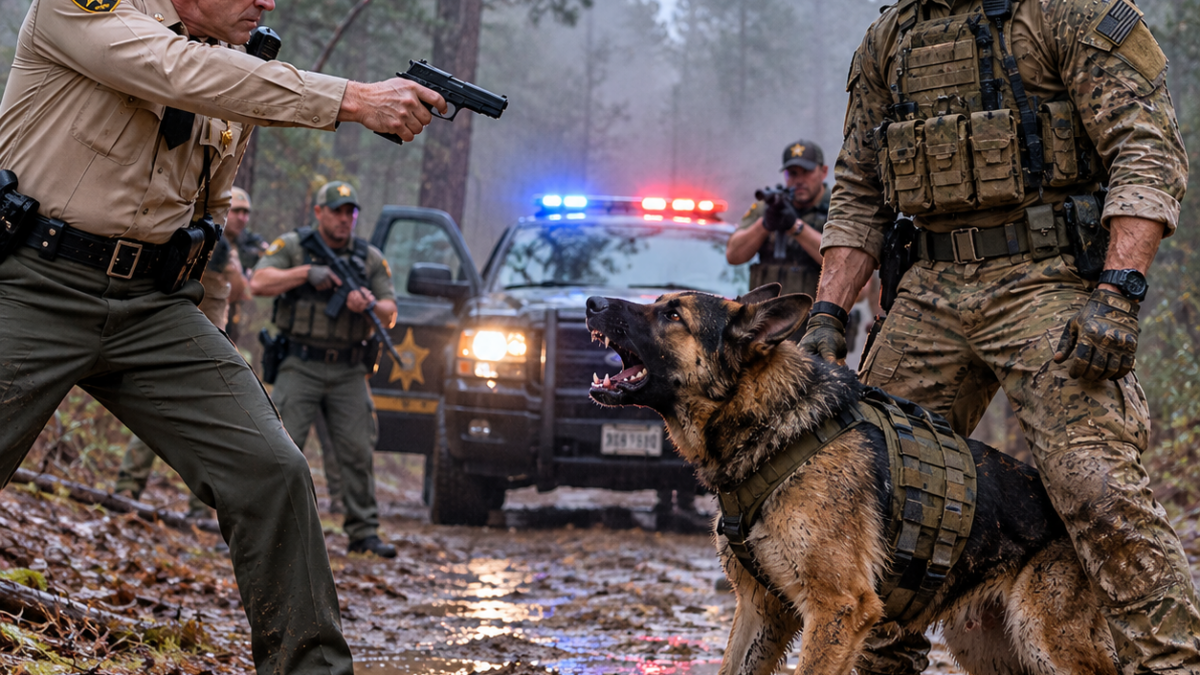
PART3:
He crouched and aimed the beam through the gap beneath the porch.
Two amber eyes flashed back at him.
A dog was tucked into the darkest corner under the floorboards.
German Shepherd.
Male.
Or what was left of one.
The animal’s ribs showed beneath matted black-and-tan fur. Mud clung to his legs and chest. One ear was torn at the tip. Scars cut across his snout and front legs in pale, jagged lines. He trembled so hard Liam could see the boards above him shake.
Then the dog bared his teeth.
It was an ugly, ragged snarl, but Liam heard what lived underneath it.
Not hate.
Fear.
Exhaustion.
The last defense of something that had been betrayed too many times.
“Easy,” Liam said softly. “I’m not going to hurt you.”
The dog growled harder.
Liam did not move closer.
He had worked with military dogs before. He knew the kind of respect a good handler gave a terrified animal.
You did not force trust.
You earned enough of it to survive the next minute.
He went back inside, filled a bowl with warm water, found a strip of jerky, and returned to the porch. Slowly, he knelt in the freezing mud and slid both toward the dog.
The Shepherd did not even glance at the food.
His eyes stayed locked on Liam.
“Smart,” Liam murmured. “Food can be bait.”
Rain soaked through his jacket. Mud seeped around his boots. The dog shook under the porch, too weak to run, too proud to surrender.
Liam studied him.
The posture.
The focus.
The scars.
The way the dog watched hands instead of faces.
“You’re not wild,” Liam whispered. “You’ve been trained.”
The dog’s lip twitched over his teeth.
Liam lowered his gaze, not in submission, but in respect. Then he slowly unzipped his heavy jacket and shrugged it off.
The rain hit his shoulders through the thin olive shirt beneath.
On the left side of that shirt, faded from washing but unmistakable, was the gold trident of the United States Navy SEALs.
The dog froze.
The growl died mid-breath.
His scarred head tilted.
Those amber eyes shifted from Liam’s face to the patch and stayed there.
For a moment, the storm seemed to hold its breath.
Then the dog crawled forward.
Not walked.
Crawled.
He dragged himself through mud and wet leaves with a sound so pitiful Liam felt it behind his ribs. He ignored the water. Ignored the food. He came straight to Liam and stopped inches from his knees.
Liam held still.
The Shepherd leaned forward and sniffed the patch.
Once.
Twice.
Then he pressed his cold, wet nose into Liam’s palm.
The dog let out a sound that was not a whine exactly.
It was smaller than that.
Older.
A sound from the bottom of a grave.
Liam’s hand closed gently around the side of the dog’s neck.
“Yeah,” he said, voice rough. “You know this, don’t you?”
The dog leaned into him.
Then, as if the last thread holding him upright had finally snapped, the Shepherd collapsed against Liam’s leg and went limp in the mud.
Liam caught him before his head hit the ground.
“Okay, brother,” he whispered. “I’ve got you.”
He lifted the dog carefully.
The animal weighed far less than he should have.
Under the fur and scars, he was all bones and stubborn life.
Liam carried him inside, kicked the door shut against the storm, and laid him near the fire on an old wool blanket.
The dog did not wake.
He only sighed once, long and broken, as if some part of him had been waiting months to stop fighting.
Liam sat beside him until dawn.
By morning, the rain had weakened into mist.
The Shepherd woke with a start, teeth flashing, body stiff.
Liam was already on the floor several feet away with another bowl of warm broth between them.
“Easy,” he said. “You’re inside. Fire’s warm. Food’s free. Nobody’s asking you for anything.”
The dog stared at him.
Then at the bowl.
Then at him again.
Finally, hunger overpowered fear.
He crawled forward and drank.
Liam looked away while he ate.
A starving animal deserved dignity too.
Over the next few days, the cabin became a quiet hospital.
Warm broth.
Roasted chicken.
Small meals so the dog’s stomach would not rebel.
Clean water.
A towel by the door.
A blanket near the fire.
Liam named him Bruno because the dog needed something solid and square and hard to break.
At first, Bruno flinched at every log that popped in the fireplace.
A spoon falling in the sink sent him scrambling under the table.
Thunder made him shake until Liam sat on the floor beside him and spoke in a low voice, not touching him unless Bruno leaned first.
“You and me both,” Liam said one night while rain struck the roof. “I don’t like sudden noises either.”
Bruno stared from under the table.
Liam raised one hand and made a casual hold signal without thinking.
Bruno froze.
Not in fear.
In obedience.
His ears came forward. His spine straightened. His eyes locked on Liam’s hand.
Liam stared back.
Then he gave a release gesture.
Bruno moved.
A slow chill traveled through Liam.
“Well,” he said softly, “that answers one question.”
The dog was not just trained.
He was military trained.
Not police basic obedience.
Not weekend protection work.
The real thing.
Hand signals.
Impulse control.
Silent movement.
Waiting for release.
A dog like that did not appear in the woods by accident.
By the end of the first week, Bruno had gained enough strength to follow Liam from room to room like a shadow. He slept with his head across Liam’s boots, as if determined that the man could not leave without waking him.
Liam pretended not to care.
Then he started leaving one boot near Bruno before bed.
By the second week, supplies ran low.
Mostly because Liam had been feeding a half-starved working dog like he was trying to repair him through meat alone.
So they went into town.
Bruno rode upright in the passenger seat of the Jeep, watching the trees through the windshield with a discipline that would have embarrassed most junior sailors.
“You know,” Liam said, glancing at him, “if anyone asks, you’re emotionally supportive and terrible at chess.”
Bruno did not blink.
“Right. Too classified.”
Pine Ridge looked smaller in daylight.
A general store.
A diner.
A post office.
A hardware shop.
A bar with a crooked neon sign.
And the sheriff’s office.
Liam parked outside the general store. The locals watched him with that practiced mountain-town stillness that said everybody had already been told an outsider was here.
Bruno jumped down and stood close at Liam’s left leg.
Inside, the store smelled of coffee, old wood, flour, and wet wool. Behind the counter stood a woman in her late sixties with silver hair pinned into a messy bun and a flour-dusted apron tied at her waist.
She looked Liam over once.
Then Bruno.
“Well,” she said. “You two look like the beginning of either a bad idea or a good story.”
Liam smiled despite himself.
“Depends who’s telling it.”
“Name’s Martha.”
“Liam.”
“And this poor gentleman?”
“Bruno.”
Martha’s eyes softened.
“Somebody did him wrong.”
Liam looked down at the dog.
“Looks that way.”
She came around the counter slowly and offered the back of her hand. Bruno sniffed, then gave her one cautious lick.
Martha’s eyebrows lifted.
“Smart boy.”
“Smarter than me,” Liam said. “I rented a cabin in a storm.”
“That old place up on Miller Ridge?”
“Yeah.”
Martha’s expression changed so quickly most men would have missed it.
Liam did not.
“What?” he asked.
“Nothing.”
“Martha.”
She looked toward the front window, then lowered her voice.
“People go up there wanting quiet. Sometimes they get too much of it.”
Before Liam could ask what that meant, the bell above the door chimed.
A large man in a pressed tan uniform stepped inside.
The room tightened.
That was the only word for it.
The two old men near the coffee station went silent.
A teenage stock boy suddenly found great interest in a shelf of canned beans.
Martha’s mouth closed.
The sheriff was in his late forties, broad in the shoulders, with a square jaw, mirrored sunglasses, and a silver star pinned over his heart. He carried himself like the building belonged to him because nobody had challenged the idea in years.
“Morning,” he said.
Not to the room.
To Liam.
“Morning,” Liam replied.
The sheriff’s smile widened without warming.
“You must be the military boy up at the cabin.”
Liam kept his face blank.
“Liam Mercer.”
“Sheriff Calvin Miller.”
Miller extended a hand.
Liam shook it.
The sheriff’s grip was firm and performative.
“Don’t get many SEALs out here,” Miller said.
Liam’s eyes narrowed by the smallest degree.
He had not said SEAL.
“Small town,” Miller continued. “Folks notice things.”
Bruno, who had been standing calmly at Liam’s leg, changed.
The dog’s entire body went rigid.
His ears flattened.
His lips peeled back.
A growl rolled out of him so deep the old floorboards seemed to vibrate.
Miller looked down.
For one fraction of a second, the sheriff’s smile disappeared.
Not because he was afraid of a snarling dog.
Because he recognized him.
Liam saw it.
Then Miller’s expression sealed shut again.
“Looks like your mutt has manners issues.”
Bruno lunged.
Liam caught the leash with both hands and planted his boots.
“Bruno. Heel.”
The dog did not obey.
He strained toward Miller with a focused, lethal rage Liam had never seen from him before. This was not panic. This was not confusion. Bruno knew exactly who he hated.
The sheriff rested one hand casually near his holster.
“You’ll want to control that animal,” Miller said. “Accidents happen in these woods.”
Martha went pale.
Liam’s voice stayed quiet.
“They do.”
Miller lifted his sunglasses just enough for Liam to see his eyes.
Cold.
Flat.
Calculating.
Then he smiled again.
“Enjoy your stay.”
He left.
The bell chimed behind him.
It took nearly two minutes for Liam to calm Bruno enough to leave the store.
Outside, mist gathered along the wooden sidewalk. Miller’s white patrol SUV rolled away slowly, taillights glowing red through the fog.
Liam crouched beside Bruno and placed one hand against the dog’s chest.
The Shepherd was shaking with rage.
Not fear.
Memory.
“You know him,” Liam whispered.
Bruno stared down the road where the sheriff had gone.
The quiet retreat was over.
Back at the cabin, Liam walked the perimeter.
Not casually.
Professionally.
He moved through wet ferns, pine needles, and low brush, reading the ground the way some people read newspapers.
Fresh boot prints sat just beyond the tree line.
Large.
Deep.
Tactical sole pattern.
A watcher had stood there with a clear view of the cabin’s front door.
Liam photographed the tracks, measured them against his own boot, then followed them until they disappeared into rock.
The forest felt different now.
Not empty.
Occupied.
He returned to the cabin, locked the doors, and laid his sidearm on the table while Bruno watched from beside the fireplace.
“Somebody’s nervous,” Liam said.
Bruno’s ears twitched.
“Yeah. Me too.”
That night, Bruno did not sleep.
He paced from the back door to the table, claws clicking softly against the floor. Every few minutes, he pressed his nose to the crack beneath the door and whined.
Liam tried ignoring it.
Then he tried feeding him.
Then he tried giving a firm command.
Nothing worked.
The second night was worse.
The third night, Liam woke at 2:15 a.m. to Bruno tugging the leg of his sweatpants.
Not chewing.
Not playing.
Pulling.
Liam sat up instantly.
The cabin was dark except for red embers in the fireplace. Bruno stood beside the bed, eyes bright, body tense, tail low.
“What is it?”
Bruno pulled again.
Toward the back door.
Liam looked at him for a long moment.
Then nodded.
“All right. Show me.”
He dressed in silence.
Dark pants.
Boots.
Jacket.
Pistol.
Flashlight.
Knife.
Not because he expected trouble.
Because trouble had already introduced itself.
He opened the back door.
Cold air rushed in.
Fog covered the ground so thickly it looked like the forest had flooded.
Bruno stepped outside and immediately lowered his nose to the earth.
Then he moved.
Not wandering.
Tracking.
Liam followed.
They climbed into the trees, leaving the cabin light behind. The forest closed around them in black columns of pine. Wet branches brushed Liam’s shoulders. Roots slid underfoot. Somewhere far away, water moved over stone.
Bruno did not hesitate once.
Every twenty yards, he looked back to make sure Liam was still there.
They hiked nearly thirty minutes before the trees opened into a small clearing.
At the center lay an enormous fallen pine. Its roots clawed into the air like the ribs of something dead and prehistoric.
Bruno went straight to the root ball.
He began digging.
Frantically.
Dirt flew backward. Wet leaves scattered. His scarred paws struck roots and stone, but he did not stop.
Then he froze.
He lifted his head toward the invisible sky and howled.
The sound hit Liam harder than a gunshot.
It was not a warning.
It was grief.
Pure, old, unbearable grief.
Liam knelt beside him.
“What did you find, boy?”
Bruno looked at him.
Then at the hole.
Liam began digging with both hands.
Two feet down, his knuckles scraped metal.
He cleared mud from the object and pulled free a small military ammunition box, old, green, rusted at the edges, but sealed tight.
Bruno sat immediately in front of it.
Not excited.
Not proud.
Respectful.
As if guarding a coffin.
Liam set the box on the wet ground.
His heartbeat had slowed into the cold rhythm he knew from operations.
Sheriff Miller.
The boot prints.
Bruno’s scars.
The dog’s reaction in town.
And now this.
Liam rested a hand on the lid.
Whatever was inside had been buried by someone who knew they might not survive long enough to retrieve it.
He carried the box back to the cabin under one arm.
Bruno stayed glued to his side.
Inside, Liam locked the doors, drew the curtains, and set the box on the dining table.
It took work to open.
The hinges resisted. The metal complained. When the seal finally gave, trapped air escaped with a stale smell of damp metal, old electronics, and something darker beneath it.
Inside lay a shattered satellite communicator.
Liam recognized the type immediately.
Special operations.
Encrypted.
Field use.
The casing had been cracked. The screen was broken. Wires had been ripped loose. Whoever destroyed it had not wanted a signal leaving the mountain.
But Liam barely saw the radio after his flashlight hit what lay beside it.
Dog tags.
Silver chain.
Blood dried black along the edges.
Liam reached in slowly.
His hands, steady in firefights and storms and helicopter turbulence, trembled when he lifted them.
He rubbed mud and dried blood away with his thumb.
The letters appeared.
VANCE, ARTHUR J.
The cabin disappeared.
For a moment Liam was back under a brutal sun half a world away, hearing Arthur Vance laugh through a sandstorm while telling a terrible joke over comms.
Arthur.
Arty.
Best friend.
Brother.
Spotter.
The man who once dragged Liam behind a burned-out wall with a bullet crease in his own neck and then complained that Liam owed him better cigars.
Arthur Vance had been a mountain of a man with a terrible sense of timing, a worse sense of humor, and the kind of loyalty men write songs about after they die.
Two years earlier, a helicopter hard landing shattered Arthur’s femur and ended his career.
He took the medical retirement with the worst smile Liam had ever seen and said he was moving to Pine Ridge to learn how to fish badly and sleep without mortars.
Eight months ago, Liam received the official notice.
Arthur Vance had died in a hiking accident.
Sheriff Calvin Miller signed the report.
Arthur, the report said, had slipped from a ridge during a solo hike and fallen into a ravine.
Liam had stood at the memorial with other men who knew better but had no proof.
Arthur did not slip off trails.
Arthur did not hike without telling someone his route.
Arthur did not leave gear behind.
But suspicion without evidence is only a wound.
Now the wound sat on Liam’s table in the form of blood-stained dog tags.
Bruno stepped closer.
Liam looked down at him.
The Shepherd sat perfectly still, eyes fixed on the tags.
A memory clicked into place.
Arthur had adopted his military working dog after retirement.
An explosives detection and tracking dog aging out of service.
A German Shepherd.
Scarred around the muzzle from an overseas blast.
Loyal to one handler.
Liam’s breath caught.
“It’s you,” he whispered.
Bruno’s ears lifted.
“You’re Bruno.”
The dog’s chest shuddered.
“You’re Arty’s boy.”
At the sound of Arthur’s name, Bruno broke.
He pushed his head into Liam’s lap and let out a low, broken whine that seemed to come from eight months of hunger, cold, fear, and waiting.
Liam bent over him, one hand on the dog’s neck, the other gripping Arthur’s tags.
“You stayed,” he said. “God, Bruno. You stayed with him as long as you could.”
The dog leaned harder against him.
Liam understood then.
Bruno had not been a stray.
He had not wandered.
He had escaped.
He had carried or guarded what Arthur buried. He had survived winter, hunger, predators, and men hunting him because the last command his handler gave him must have been simple.
Protect it.
Find help.
Wait.
And he had.
Liam put Arthur’s tags around his own neck.
The cold metal touched his chest.
Something inside him settled.
Not healed.
Not close.
But aligned.
By sunrise, Liam had stopped thinking like a grieving friend.
He was thinking like an operator.
He spent the morning pretending to be boring.
Coffee on the porch.
Slow walk with Bruno.
A deliberately clumsy trip to the lake with a fishing pole he had no intention of using.
From the outside, he looked like a tired veteran trying to enjoy a mountain vacation with a rescued dog.
From inside his mirrored sunglasses, he mapped everything.
Two watchers along the north tree line.
One near the old logging cut.
A radio flash from a ridge.
No discipline.
No patience.
Miller’s men were not soldiers.
They were hired muscle with weapons and overconfidence.
At one point Liam tangled his fishing line so badly he almost respected the performance.
Bruno sat beside him, wearing the blankly innocent expression of a dog who had definitely not noticed the man behind the cedar tree.
“You see him?” Liam whispered.
Bruno yawned.
“Good. Keep looking stupid.”
The dog scratched his ear and looked magnificently useless.
Liam smiled for the first time all morning.
Arthur would have loved him.
That afternoon, back inside the cabin, Liam worked on the broken communicator.
He was not an engineer, but he knew enough field recovery to attempt the basics. The device was damaged badly, but the memory module had survived. With a rugged laptop, salvaged cables, and more patience than confidence, he pulled fragments of data from the ruined machine.
Most of it was corrupted.
Coordinates.
Partial images.
A map overlay.
Then one audio file.
Liam stared at it.
Bruno stood beside him.
The dog’s body had gone still.
Liam pressed play.
Static filled the cabin.
Then breathing.
Running.
Branches breaking.
And a voice Liam had not heard in eight months cracked through the speakers.
“This is Chief Petty Officer Arthur Vance, transmitting blind.”
Bruno jerked upright.
His ears snapped forward.
He looked toward the door, then the windows, then the laptop, searching for the man who had raised him, trained him, loved him.
Liam grabbed his collar gently.
“No. Bruno. It’s a recording.”
The dog trembled.
Arthur’s voice continued, ragged and urgent.
“If you’re hearing this, Liam, I didn’t make it off the mountain. Listen carefully. Sheriff Miller is dirty. Not small-town dirty. Bought-and-paid-for dirty. The northern logging roads are being used to move weapons past federal checkpoints. C4, rifles, ordnance, the kind of inventory that doesn’t belong anywhere near civilians.”
A crash sounded in the recording.
Distant shouting.
Arthur breathed harder.
“They know I found the bunker. I hid the drive. Bruno knows. He’ll find help if he gets out. Take care of him for me, brother. He’s a good boy. Tell him I—”
A gunshot cracked through the speakers.
Bruno lunged toward the laptop with a sound Liam never forgot.
A howl.
A bark.
A plea.
The recording dissolved into chaos.
Men shouting.
A dog snarling with murderous fury.
Arthur’s voice gone.
Then silence.
Liam closed the laptop.
The room seemed colder.
Bruno stood with his nose inches from the screen, shaking.
Liam pulled him close.
“He said you were a good boy.”
Bruno’s head turned slowly toward him.
“He was right.”
Outside, somewhere in the trees, a branch snapped.
Liam did not move for several seconds.
Then he turned off the lamp.
The cabin fell into shadow.
Down in Pine Ridge, Sheriff Miller received the call that changed everything.
“He found the box,” Deputy Collins said over the radio. His voice shook. “The SEAL and the dog. They dug it up.”
Miller sat alone in his office, one hand around the receiver, the other tightening around the edge of his desk.
For years, he had built his little kingdom in the mountains.
He told locals he kept them safe.
In truth, he had turned Pine Ridge into a funnel.
Old logging roads. Hidden storage. Deputies who looked the other way. Outside contractors paid in cash. Weapons moving through the trees under fog and storm while the town slept.
Arthur Vance had seen too much.
Miller had handled that.
Or thought he had.
The dog had been the mistake.
He had told his men to find the animal after Arthur died.
They never did.
For eight months, that German Shepherd had lived in the forest like a ghost with teeth.
Now the ghost had found a SEAL.
Miller stood and opened the gun cabinet behind his desk.
“Bring Roark,” he said. “And the others.”
Collins swallowed audibly.
“Sheriff—”
“No reports. No lights. No sirens. We go up under fog and finish what should’ve been finished eight months ago.”
“What about the dog?”
Miller’s eyes went flat.
“The dog dies first.”
At the cabin, Liam did not wait for the attack to begin before accepting that it had already started.
He secured the evidence.
Copied the data.
Sent a burst transmission through the emergency channel on his military watch and hoped the ridge did not swallow it.
Then he prepared.
Not theatrically.
Not like a man looking for war.
Like a man who understood war had already kicked in the door of his life and found him sitting at the table.
He moved furniture.
Darkened windows.
Checked exits.
Set alarms.
Established routes.
Nothing he built was meant to impress anyone.
Everything had one purpose.
Buy seconds.
Seconds were life.
Seconds were distance.
Seconds were the difference between being hunted and choosing the ground.
Bruno watched every movement.
He did not shake now.
Something in the dog had changed after hearing Arthur’s voice.
The haunted animal was still there, but beneath him the soldier had returned.
Liam knelt in front of him.
“This is it,” he said softly. “They took Arty from you. They tried to bury the truth with him. Tonight, we stop running.”
Bruno’s lip lifted in a low, controlled growl.
Liam touched Arthur’s tags beneath his shirt.
“For him.”
The generator died at midnight.
The lights cut out.
Darkness filled the cabin.
Fog pressed against the windows, pale and thick.
Liam stood in the deepest shadow near the back wall, shotgun held low, breathing slow.
Beside him, Bruno crouched silently, ears moving.
The dog heard them first.
One at the front.
Two left.
One rear.
One farther out.
Five.
Liam did not need to see them.
He felt the pattern.
The porch creaked under a careful boot.
A hand tested the front door.
From outside came the faint murmur of a man who believed darkness belonged to him.
Then the door burst inward.
The first man entered fast, expecting a sleeping target.
Instead, the cabin punished the breach.
A blinding flash, a thunderous concussive blast, and the attacker crashed backward through smoke and broken wood. The sound rolled through the trees and shattered the quiet of Pine Ridge like a warning bell.
Liam moved before the echo faded.
Not forward.
Out.
He and Bruno slipped through the rear window into wet darkness, vanishing into the woods as Miller’s men shouted and fired at shadows inside an empty room.
The forest became Liam’s ally.
He knew their problem immediately.
They had planned a murder.
They had not planned a fight.
One mercenary swept his weapon through the fog, breathing too loudly. Liam circled behind him, struck once, and the man dropped into wet ferns without firing again.
A young deputy panicked near the woodpile.
Bruno took him from the side like a black-and-tan thunderbolt, knocking him flat and pinning him with one paw on his chest and teeth inches from his throat.
The deputy froze.
“Don’t move,” Liam said from the fog.
The boy’s eyes filled with tears.
“I didn’t shoot him,” he whispered. “I didn’t shoot Vance. I swear.”
Liam zip-tied his wrists.
“Then start living like someone who wants to testify.”
The deputy nodded so hard his teeth clicked.
Bruno stepped away only when Liam touched two fingers to his collar.
“Good boy.”
The words were soft.
The dog’s eyes flicked to him.
In that second, Liam felt Arthur there so strongly it nearly broke him.
Arthur had trained Bruno not only to attack, but to choose.
To control.
To hold without killing when killing was not required.
That was Arthur.
Deadly when necessary.
Decent when possible.
The fight moved uphill.
Miller retreated toward the fallen pine, the same clearing where Bruno had dug up the box. Maybe he chose it for cover. Maybe guilt dragged him back there. Maybe men like Miller always returned to the place they thought they had won.
Liam tracked him through mud and broken brush.
Bruno flanked wide without a command.
Fog thinned as they reached the clearing.
Miller stood behind the exposed roots of the fallen pine, revolver in hand, face twisted with rage.
“You think you’re bringing justice?” Miller shouted. “Your friend thought the same thing.”
Liam stayed behind a tree.
Miller laughed, but it cracked at the edges.
“Vance should’ve left it alone. He could’ve walked away.”
“He never did like cowards,” Liam said.
The sheriff fired toward his voice.
Bark exploded from the tree near Liam’s shoulder.
Miller shouted, “He died in the dirt, Mercer. He died calling for that dog.”
Liam’s hand tightened around the stock of his weapon.
The words hit exactly where Miller intended.
For one dangerous second, grief pulled him forward.
Then he heard Bruno move above them.
A whisper of claws on rock.
Miller saw Liam’s shadow and raised the gun.
“Got you.”
Bruno came from the ridge like vengeance given form.
He struck Miller high, knocking him backward into the mud. The sheriff’s gun went off wildly, the shot cracking through fog and pine. Bruno yelped but did not let go. His jaws locked on Miller’s forearm, not to kill, but to keep the weapon down.
Liam crossed the clearing in a sprint.
He reached Miller before the sheriff could recover.
One strike ended it.
Miller collapsed, groaning, gun gone, arm pinned beneath Bruno’s weight.
Liam dropped to his knees beside the dog.
“Bruno. Let go.”
The dog released.
Blood darkened the fur near his shoulder.
Liam’s stomach clenched.
“No, no, no. Let me see.”
The wound was a graze.
Ugly.
Painful.
Not fatal.
Bruno panted, then gave one weak tail thump and licked mud from Liam’s jaw.
Liam laughed once, breathless and broken.
“You insane, beautiful bastard.”
He pulled the dog against him and pressed his forehead into Bruno’s wet fur.
Behind them, Miller groaned in the mud beneath the fallen pine where Arthur’s truth had waited eight months to rise.
The first helicopter arrived at dawn.
Then came sirens.
Federal vehicles climbed the mountain road with lights flashing blue and red through the thinning fog. FBI agents moved through the clearing. Military police secured the cabin. Evidence teams marked the weapons cache coordinates pulled from Arthur’s damaged communicator.
By midmorning, Pine Ridge no longer belonged to Sheriff Miller.
He sat cuffed beside an armored vehicle, face bruised, uniform torn, silver star removed from his chest and sealed in an evidence bag.
His deputies looked smaller without him.
The mercenaries looked less invisible when federal agents read them their rights.
Liam sat on the lowered tailgate of an ambulance with a blanket around his shoulders and mud drying on his boots.
Bruno sat beside him.
A medic had cleaned and bandaged his shoulder. The dog tolerated the treatment with noble irritation, watching the clearing as if still responsible for everyone’s security.
“You can relax,” Liam told him.
Bruno ignored him.
“Right. Stupid suggestion.”
A tall officer approached through the mud.
Captain Reynolds, military police.
Gray at the temples. Calm eyes. Uniform somehow still straight despite the mountain.
He stopped in front of Liam and saluted.
Liam returned it with a wince.
“Master Chief Mercer,” Reynolds said, “the area is secure. The bunker is exactly where the recovered coordinates said it would be. Weapons, explosives, ledgers, communications equipment. Enough evidence to bury Miller and everyone connected to him.”
Liam looked at Bruno.
“He found it.”
Reynolds followed his gaze.
The captain’s expression softened.
“So I hear.”
He crouched in the mud and offered the back of his hand.
Bruno studied him with all the seriousness of a security clearance investigation.
Then he gave one polite lick.
Reynolds smiled.
“I read the preliminary file on Arthur Vance.”
Liam’s throat tightened.
“The local report called it a hiking accident,” Reynolds said.
“It wasn’t.”
“No.”
Liam reached beneath his shirt and pulled out Arthur’s dog tags. He held them for a long moment before placing them in Reynolds’s palm.
“Arthur uncovered a domestic weapons pipeline and tried to report it. He died doing his duty.”
Reynolds closed his fingers carefully around the tags.
“I’ll make sure the record says that.”
Liam nodded.
“He deserves Arlington.”
“He’ll have it,” Reynolds said. “Full honors.”
Bruno leaned against Liam’s leg.
Liam rested a hand on the dog’s head.
“And him?”
Reynolds looked down at the scarred German Shepherd.
“Technically, if he was Vance’s adopted dog, there will be paperwork.”
Liam looked at him.
Reynolds almost smiled.
“I am very good at paperwork.”
“For once,” Liam said, “I love paperwork.”
The captain stood.
“The Navy takes care of its own.”
After he walked away, the clearing grew quiet around Liam and Bruno.
Not silent.
There were agents, radios, helicopter rotors winding down, evidence markers, shouted instructions.
But underneath all of it, the mountain felt different.
The fog had lifted.
Sunlight poured through the pines and touched the fallen tree, the disturbed dirt, the place where Bruno had waited with the truth.
Liam looked at the dog beside him.
Eight months alone.
Eight months starving.
Eight months hunted.
And still he had not abandoned his last mission.
Bruno suddenly stood.
“Easy,” Liam said. “Shoulder.”
The dog ignored him and limped toward Liam’s discarded tactical vest near the ambulance. He nosed through the fabric until he found a small embroidered SEAL trident patch torn loose during the night.
He picked it up gently.
Then he carried it back.
Liam held out his hand.
Bruno placed the patch in his palm and looked up.
No command.
No trick.
No accident.
A transfer.
A trust.
Arthur had been his handler.
His partner.
His home.
Now Bruno was choosing again.
Liam closed his fingers around the patch.
His eyes burned.
“All right,” he whispered. “I hear you.”
Bruno stepped closer.
Liam wrapped both arms around the dog’s neck, careful of the bandage.
“You’re coming home with me.”
Bruno sighed.
A long, exhausted, peaceful sound.
“Your watch is over,” Liam said. “You can rest now.”
The dog leaned his full weight against him.
For the first time since Liam had found him under the porch, Bruno closed his eyes in daylight.
Arthur Vance was buried at Arlington three weeks later.
The sky was pale gray that morning.
Rows of white stones stood in perfect formation over green grass. Sailors in dress uniform carried the flag with the kind of care men reserve for things that are both cloth and country.
Liam stood in the front row.
Bruno sat at his left side.
He wore a clean working-dog vest with one patch on it.
A gold trident.
Arthur’s mother wept when Captain Reynolds folded the flag and placed it in her hands. His father stood silent and stiff, one hand over his mouth, eyes fixed on the casket as if refusing to believe wood and brass could contain a son.
When the rifle salute cracked across the cemetery, Bruno flinched.
Liam’s hand dropped immediately to his neck.
The dog steadied.
At the sound of taps, Bruno lifted his head and released one low, mournful howl.
Nobody moved to stop him.
The sound carried across the rows of stones, over men and women who understood grief, over families who had learned the cost of service in folded flags and empty chairs.
Arthur’s mother turned.
Bruno walked to her slowly.
He sat in front of her and lowered his head into her lap.
She broke then.
Not politely.
Not quietly.
She wrapped both arms around the scarred dog and sobbed into his fur.
“He loved you,” she whispered. “He loved you so much.”
Bruno stayed perfectly still.
A soldier receiving final orders.
Later, at the edge of the cemetery, Arthur’s father shook Liam’s hand with both of his.
“Thank you for bringing him home,” the older man said.
Liam looked down at Bruno.
“We both did.”
The man knelt, stiffly, and touched Bruno’s head.
“You stayed with him.”
Bruno’s amber eyes softened.
“You good boy,” Arthur’s father whispered.
Bruno pressed his nose into the man’s palm.
After the funeral, Liam did not return to Pine Ridge.
Federal teams remained there for months. Sheriff Miller’s empire unraveled exactly the way rotten things do when sunlight reaches the center. Deputies flipped. Contractors talked. Ledgers led to names. Names led to arrests.
Pine Ridge learned what it had tolerated.
Some people claimed they had known Miller was wrong for years.
Others claimed they had suspected nothing.
Martha sent Liam one letter.
Just three sentences.
The mountain feels lighter.
The general store still smells like coffee.
Tell Bruno he has steak waiting if he ever comes back.
Liam read it aloud.
Bruno thumped his tail once.
They went home to Virginia, where Liam filled out more adoption paperwork than he had ever completed for some missions.
Bruno adjusted slowly.
He slept at the foot of Liam’s bed at first, body always facing the door. Then beside the bed. Then, one cold night after thunder rolled over the coast, he climbed onto the mattress and pressed against Liam’s side like a furnace with paws.
Liam did not push him off.
Some nights, Liam woke from dreams with his heart racing.
Some nights, Bruno woke from dreams with his legs kicking and a growl trapped in his throat.
On those nights, whoever woke first helped the other return.
A hand on fur.
A head against a boot.
A whispered name.
“You’re here.”
“I’ve got you.”
“Stand down.”
Little by little, the house became less of a shelter and more of a home.
Liam kept Arthur’s photograph on the mantel.
Not the official one.
A field photo from years earlier.
Arthur laughing with dust on his face, one arm thrown around Liam’s shoulders, the other hand resting on a younger Bruno’s head.
Beneath it sat the trident patch Bruno had carried to Liam in the clearing.
Sometimes, when the morning light struck it just right, Liam thought about the first night in Pine Ridge.
Rain.
Mud.
A starving dog under a porch.
A patch recognized in the dark.
He had gone there to hide from ghosts.
Instead, one of them sent him a dog.
Months later, Liam returned to active duty in a limited capacity.
Training command.
Evaluation work.
Mentoring younger operators who thought toughness meant never admitting pain.
Bruno came with him often.
Officially, he was retired.
Unofficially, he became a legend before lunchtime.
Men who had jumped out of planes, breached doors, and survived places nobody could pronounce lowered their voices when the scarred German Shepherd walked past.
Someone left steak in his bowl.
Someone else bought him a custom bed.
Bruno ignored the bed and slept on Liam’s boots.
The younger sailors asked about the scars.
Liam never told the whole story unless they had earned it.
But sometimes, after training, when the sun lowered and the air smelled of salt and gun oil, he would sit outside the barracks with Bruno beside him and say enough.
“Loyalty isn’t loud,” he told them once. “It doesn’t always look heroic when it starts. Sometimes it looks like surviving one more night because the mission isn’t finished. Sometimes it looks like guarding a box in the woods for eight months. Sometimes it looks like telling the truth when everyone with power wants it buried.”
The sailors listened.
Bruno slept with one ear open.
One evening, a young handler asked Liam whether dogs remembered grief.
Liam looked down at Bruno, whose muzzle had gone a little whiter around the scars.
“Yes,” he said.
The handler swallowed.
“Do they heal?”
Liam thought about Pine Ridge.
About Arthur’s dog tags.
About Bruno pressing his nose into a dead man’s mother’s hand.
About his own nightmares becoming less sharp with a dog breathing beside him.
“They don’t forget,” Liam said. “But they learn where to put it.”
The handler nodded.
Liam scratched behind Bruno’s ear.
“So do we.”
Years passed.
Not many.
Enough.
Enough for Bruno’s limp to worsen in cold weather.
Enough for Liam’s beard to gather a few strands of gray.
Enough for Pine Ridge to become a name in federal case summaries and classified briefings and the occasional whispered barracks story about the K9 who dug up a murder.
But for Liam, it was never legend.
It was mud under his fingernails.
The weight of a rusted box.
The sound of Arthur’s voice breaking through static.
The warmth of a starving dog finally trusting his hand.
One winter morning, snow fell quietly outside Liam’s small house near the coast. Bruno lay by the fireplace, older now, but still alert when Liam entered the room.
Liam carried two mugs.
Coffee for him.
Warm broth for Bruno.
“Don’t judge me,” Liam said. “You’re retired. Retired dogs get broth in mugs.”
Bruno lifted his head with great dignity.
Liam set the broth down.
The dog drank half, then rested his head again.
On the mantel, Arthur’s photograph watched them both.
Liam stood there for a while.
“I did what you asked,” he said quietly.
Bruno’s ears moved.
“I took care of him.”
The fire popped softly.
Outside, snow covered the yard in clean white silence.
Liam looked at the old dog by the hearth.
No longer starving.
No longer hunted.
No longer waiting under a porch for a symbol from a life he had lost.
Home.
That word still surprised Liam sometimes.
For years, home had been a place he visited between deployments.
A place to store gear.
A place where silence could turn dangerous.
Now home had nails clicking across hardwood floors.
A battered leash by the door.
A dented food bowl.
A German Shepherd who snored like an idling truck.
That night, Liam woke from a dream.
Not the usual kind.
No gunfire.
No shouting.
No blood.
He dreamed of Pine Ridge as it should have been.
Arthur standing in the clearing beside the fallen pine, younger, whole, grinning that terrible grin.
Bruno beside him, strong and unscarred.
Arthur raised two fingers in a lazy salute.
Then turned and walked into the trees.
Bruno did not follow him.
In the dream, the dog looked back at Liam and stayed.
When Liam opened his eyes, the room was dark except for firelight.
Bruno was beside the bed, awake, watching him.
“You saw him too?” Liam whispered.
Bruno placed his head on the mattress.
Liam rested a hand between his ears.
For a long time, neither moved.
Some bonds end with burial.
Others change shape and keep walking beside you.
Arthur Vance had died in a forest because he refused to let evil pass quietly through his mountain.
Bruno had survived because loyalty gave him a reason stronger than hunger.
Liam had found them both because grief, like a good working dog, sometimes leads you exactly where you are needed.
People later called it justice.
They were not wrong.
Miller went to prison.
The weapons ring was dismantled.
Arthur’s name was restored.
Bruno was honored.
But justice was not the whole story.
The whole story was a freezing night under a porch.
A starving animal recognizing a patch through rain.
A man who thought he wanted solitude discovering he had been sent a mission.
A dog who had lost one brother and waited long enough to find another.
And a promise kept in mud, blood, firelight, and dawn.
Years after Pine Ridge, when people asked Liam why he adopted Bruno, he usually gave the simple answer.
“He chose me.”
That was true.
But it was not complete.
The fuller truth was harder to explain.
Bruno had not just chosen Liam.
He had carried Arthur’s final trust across eight months of wilderness and placed it at Liam’s feet.
He had brought him evidence.
Grief.
Danger.
Purpose.
Family.
He had led Liam into the darkest part of the forest and shown him that truth can be buried, but loyalty keeps digging.
And on the mornings when the world felt too heavy, when old memories pressed against Liam’s ribs and the house seemed too quiet, Bruno would appear with that same scarred face, that same amber gaze, and that same stubborn expectation.
Get up.
Keep going.
Mission not finished.
So Liam did.
He got up.
He fed the dog.
He stepped into the day.
And every time he clipped the leash to Bruno’s collar, every time the old Shepherd leaned against his leg, every time the trident patch on the mantel caught the morning light, Liam remembered what Arthur had tried to say before the gunshot cut him off.
Tell him I love—
He had not finished the sentence.
He had not needed to.
Bruno knew.
Liam knew.
And somewhere beyond the reach of fog, guns, corrupt sheriffs, and buried secrets, Arthur Vance knew too.
The watch was over.
The loyal dog had come home.
And the truth, at last, was no longer alone in the woods.