A Cat Survived 45 Days Trapped Inside a Shipping Container Crossing the Pacific—When Dockworkers Finally Opened the Doors, She Walked Into the Sun and Simply Closed Her Eyes.
PART3:
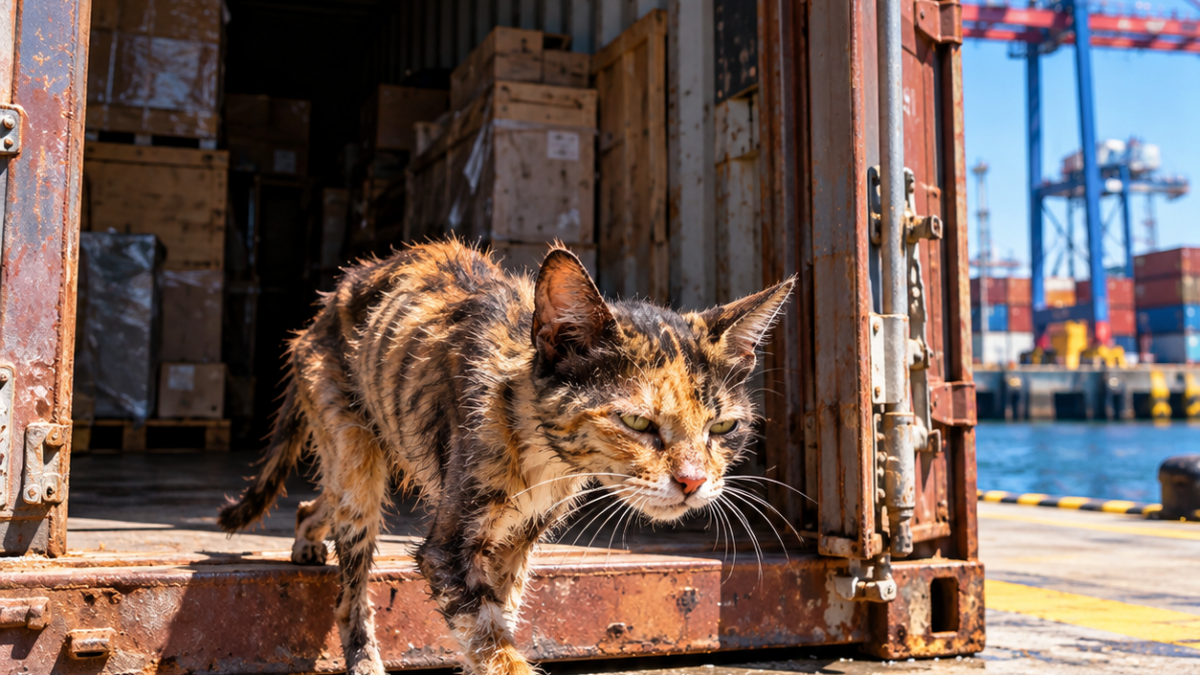
Then she stepped down onto the loading yard.
Her paws touched concrete.
She took three more steps.
Then she sat.
Just sat.
The entire dock seemed to keep moving around her, but the small circle near Bay 17 went still.
Marco lowered his flashlight.
Darnell whispered, “Is that a cat?”
Marco said, “Looks like one.”
“How?”
Nobody answered.
The cat’s eyes stayed closed.
Her body swayed once.
Then steadied.
Marco took one step toward her.
She did not move away.
That was what frightened him more than anything.
A healthy cat in a strange port yard would have run. Hidden. Fought. Scratched. Vanished under machinery before anyone could blink.
This one had no energy left for panic.
Or maybe, after forty-five days inside the dark, sunlight itself was stronger than fear.
Marco had brought lunch that day.
A tuna sandwich, chips, and a dented can of tuna he sometimes mixed with hot sauce because his wife said his eating habits were a crime against groceries.
He remembered the tuna.
“Don’t crowd her,” he told the others.
He walked to his bag, opened it, pulled out the can, and popped the lid.
The sound made the cat open her eyes.
They were pale green.
Cloudy from dehydration and light sensitivity, but alive.
Marco set the tuna on the concrete and pushed it gently toward her.
The smell reached her before the can did.
Her head lowered.
For one second, she stared at the food as if she did not trust that the world could offer something so simple.
Then she ate.
Not neatly.
Not slowly.
She devoured it.
The sound was soft and desperate, tongue and teeth scraping metal, the can rattling against the concrete because she kept pushing it with her nose.
No one joked then.
No one filmed at first.
They just watched a starving animal eat like every bite had to be claimed before darkness took it back.
After the tuna was gone, she licked the empty can until Marco had to gently pull it away so she would not cut her tongue.
That was when he saw her paws.
The pads were raw.
Not just scratched.
Raw.
As if she had spent days pacing across ridged metal flooring, circling, searching, hunting, waiting, scratching at walls no one could hear through steel and ocean.
Darnell crouched a few feet away.
“Poor little thing.”
The cat looked at him.
Not startled.
Not trusting.
Just aware.
Marco stood.
“Call port veterinary.”
Someone ran.
Someone else brought water.
The cat sniffed the bowl and began drinking too fast.
Marco stopped her after a few seconds.
“Easy,” he said, though she did not know the word.
He waited.
Let her drink again.
Stopped her.
Waited.
Again.
He had seen what happened when starving animals got too much too fast. His sister worked at a shelter. He had heard enough stories to know kindness could kill if it rushed.
The cat hated him for taking the water away.
That, Marco thought, was a good sign.
Anger meant something in her still expected to live.
The port veterinarian arrived fifteen minutes later.
Dr. Elaine Porter was used to strange calls.
Ports gather the world’s accidents.
Birds trapped in warehouses.
Dogs found near cargo lots.
Snakes discovered in shipments.
Exhausted gulls tangled in fishing line.
But the radio message—live cat found inside sealed ocean container—made her drive faster than usual.
When she reached Bay 17, the cat was still sitting in the sun.
Not in the shade.
Not under the container.
In the sun.
Her eyes were half closed again, as if the light hurt but she wanted it anyway.
Dr. Porter knelt slowly.
The cat watched her.
“Hi, sweetheart,” she said softly.
The cat did not move.
Dr. Porter extended one hand.
The cat sniffed weakly.
Then looked away toward the open container.
That look stayed with the veterinarian.
It was not longing.
It was memory.
Dr. Porter examined her as gently as she could without moving her too much.
Severe dehydration.
Extreme weight loss.
Body condition dangerously low.
Sensitivity to light after prolonged darkness.
Paw pad abrasions.
Likely gastrointestinal stress.
No obvious fractures.
No fresh bite wounds.
No collar.
No microchip visible without scanning.
No strength left for resistance.
When Dr. Porter lifted her, the cat weighed almost nothing.
“She’s lost at least half her body weight,” the veterinarian said.
Marco looked at the open container.
“How is she alive?”
Dr. Porter did not answer immediately.
She looked inside.
“Let’s find out.”
The interior of the container told the story in pieces.
At first, it looked like ordinary cargo.
Wrapped furniture.
Stacked cartons.
Household goods.
Then the workers saw what they had missed.
Scratch marks on cardboard.
Clawed plastic wrap.
Droppings.
Tufts of tortoiseshell fur caught on splinters.
A corner where the cat had likely slept, tucked between the back of a dresser and two boxes of bedding.
And rats.
Dead rats.
At least five.
Some partly eaten.
Some not.
Darnell backed out and whispered, “Damn.”
Marco removed his hard hat and held it in both hands.
For forty-five days, the cat had not simply waited.
She had hunted.
In total darkness.
Inside a moving metal box.
With almost no water.
She had become, in that sealed space, what all cats carry somewhere under soft fur and sleepy eyes.
A predator.
A survivor.
A creature built by hunger to make decisions quickly and by instinct to keep breathing even when the world becomes impossible.
The rats had probably entered before loading, hidden among packing materials or near the cargo. Rodents are not rare in global shipping. They find warmth, darkness, cardboard, grain residue, and cracks in systems humans assume are clean because the paperwork says so.
The cat may have followed them in.
That was one theory.
A stray tortoiseshell prowling a loading warehouse in China.
A rat slipping into an open container.
The cat chasing.
The doors closing.
The seal snapping shut.
Darkness.
Or perhaps she had been sleeping inside when the doors closed.
Perhaps someone had seen her too late.
Perhaps no one saw her at all.
No one would ever know.
But once the container was sealed, the world narrowed to steel walls.
The floor beneath her paws.
Boxes.
Rats.
Temperature swings.
The rocking of trucks.
The lift of cranes.
The deep shudder of a ship leaving port.
The endless dark.
The first day, she may have cried.
The second, scratched.
The third, searched for a way out until her paws hurt.
But containers do not care about claws.
Steel does not answer.
Across the Pacific, there would have been heat during the day and cold at night. Moisture forming on metal walls when temperatures shifted. Tiny beads of condensation gathering along seams, corners, panels.
Not enough.
Never enough.
But enough to lick.
Enough to keep organs from failing completely.
Enough to turn each morning and each night into a search for droplets.
The veterinarian explained it later.
“Shipping containers sweat,” Dr. Porter said. “Temperature changes cause moisture to condense on interior metal surfaces. It would not have been much. But if she learned where it formed, if she conserved energy, if the rats provided some moisture through prey tissue, she could have survived longer than we would normally expect.”
Could have.
That was the language of medicine.
Careful.
Measured.
Unwilling to call a miracle what the body might explain.
But when Dr. Porter looked at the cat curled in a towel under the clinic light later that day, she felt the clinical language fail.
Forty-five days.
No bowl.
No window.
No human help.
No sun.
The cat had survived on rats and water gathered from metal walls.
That was more than physiology.
That was will.
At the port clinic, they gave her fluids slowly.
Warmth.
Pain relief.
Small controlled portions of food.
Eye protection from bright light.
Soft bedding.
A darkened kennel.
The cat did not sleep immediately.
Exhaustion should have taken her.
Instead, she remained upright for as long as her body allowed, watching the clinic door.
Every time someone opened it, her eyes went toward the light beyond.
Dr. Porter noticed.
“She wants to know where the exits are,” she told the technician.
The technician, a young woman named Lila, looked at the little tortoiseshell with tears in her eyes.
“After what she’s been through, I don’t blame her.”
They scanned her for a microchip.
Nothing.
No collar.
No identifying mark except the tortoiseshell pattern that made her look like smoke, rust, and autumn leaves mixed together.
For paperwork, they needed a temporary name.
Lila suggested Pacific.
Marco, who had stayed longer than he needed to, shook his head.
“That’s too big,” he said.
Dr. Porter looked at him.
“What would you call her?”
He looked through the observation window at the cat lying in the dim kennel, eyes half open.
“Sunny,” he said.
Lila smiled.
“Because she sat in the sun?”
Marco nodded.
“First thing she wanted.”
So on the intake form, beneath species, sex, condition, and origin unknown, Dr. Porter wrote:
SUNNY.
The name spread through the port by the end of the shift.
Sunny, the container cat.
Sunny, the Pacific cat.
Sunny, the cat who crossed an ocean in the dark and came out looking for light.
By that evening, everyone in Bay 17 knew.
By the next morning, half the port did.
The photo Marco took—after making sure she had water, after calling the veterinarian, after feeding her tuna—began circulating in private messages before anyone thought about news.
It showed her sitting on the concrete, tiny and thin beneath the enormous open doors of the container. Behind her, the interior was black. Around her, the sun was almost too bright. Her eyes were narrowed. Her body looked fragile. But she was upright.
Alive.
That was the power of the image.
Not beauty.
Not cuteness.
Survival.
A little cat sitting between darkness and daylight, looking like she had just stepped out of a story no one would have believed if the container seal had not been there to prove it.
When port management heard, the tone changed.
There were procedures.
Quarantine rules.
Customs questions.
Agricultural concerns.
Animal import regulations.
A cat arriving from overseas, even accidentally, could not simply be handed to a dockworker and taken home. She needed examination, observation, vaccination review, disease screening, parasite treatment, and quarantine.
Marco understood.
He did not like it.
But he understood.
He returned to the clinic the next day with another can of tuna.
Dr. Porter stopped him at the door.
“She can’t have a full can yet.”
“I figured.”
“Then why bring it?”
He shrugged.
“Seemed rude to come empty-handed.”
Lila took the can and wrote his name on it.
Sunny was in quarantine housing by then, in a quiet controlled room with dimmed lights. She had a soft bed, water, food, a litter box, and a towel draped over part of the kennel so she could hide.
She did hide.
At first.
But when Marco entered the room and spoke softly, she looked out.
Maybe she knew his smell.
Maybe she recognized the man who gave her the first food in the sun.
Maybe she simply noticed he moved slowly.
He crouched by the kennel.
“Hey, sailor,” he said.
Sunny blinked.
Marco smiled.
“My wife says I can’t bring you home.”
Sunny stared.
“She also said if no one claims you, she wants to meet you. So I think negotiations are open.”
Dr. Porter, standing behind him, said, “She has weeks of quarantine first.”
“I know.”
“You may not be the only person who wants her.”
Marco kept his eyes on the cat.
“I know that too.”
He went back every day he worked.
Sometimes just for five minutes.
Sometimes longer.
He brought no more food after Dr. Porter scolded him, but he brought old cotton T-shirts he had worn, so Sunny would know one consistent human smell.
The first week was the hardest.
Sunny’s body did not trust food yet.
Her stomach struggled.
Her hydration had to be monitored.
Her eyes watered in bright light.
Her paws needed treatment because the pads were tender and damaged. She walked carefully, placing each paw as if the floor might punish her.
At night, she cried once.
A sound so small Lila almost missed it.
Then she stopped.
After that, she did not cry again.
Some animals come out of trauma loud.
Some come out quiet.
Sunny came out watchful.
She slept with her face toward the kennel door.
She ate only when the room was calm.
She flinched at the metallic clang of carts in the hallway.
She disliked closed doors.
She loved sunlight but could not tolerate too much at once. Dr. Porter began placing her kennel near a window for short periods in the morning, filtered by blinds, so she could feel warmth without pain.
The first time sunlight touched her bedding, Sunny rose from her crouch and stepped into it.
Slowly.
One paw.
Then another.
Then she lowered herself into the golden rectangle and closed her eyes.
Lila had to leave the room.
Dr. Porter found her in the hallway wiping her face.
“First rescue?” Dr. Porter asked gently.
“No,” Lila said.
“First impossible one?”
Lila laughed through tears.
“Maybe.”
The story became public after a local reporter called the port.
Management issued a brief statement.
A cat had been found alive in a shipping container from overseas.
She was receiving veterinary care.
She was under quarantine.
Her condition was improving.
No, she was not currently available for adoption.
No, the port could not disclose all cargo details.
Yes, they were investigating origin.
The internet did what the internet does.
It loved her.
Then argued about her.
Then loved her again.
People wanted updates.
People wanted to adopt her.
People wanted to know if she had a passport.
People made jokes about her being an illegal stowaway, a tiny pirate, the queen of the Pacific, the world’s toughest mouser.
Someone drew her wearing a captain’s hat.
Someone else started calling her “Containerella.”
Marco hated that one.
But beneath the jokes was awe.
Because everyone understood one thing.
A container is not a place for life.
It is built for cargo.
It is designed to keep the outside out and the inside in.
No windows.
No mercy.
No soft edges.
No schedule for opening once the seal closes.
That little cat had entered a box on one side of the world and come out on another after six and a half weeks of darkness.
She had crossed the largest ocean on earth with no map, no help, no name anyone knew, no one waiting for her.
And still, when the doors opened, she walked toward the light.
The port tried to trace her origin.
They contacted the shipping company.
The freight forwarder.
The loading facility overseas.
The importer.
The warehouse.
No one reported a missing cat.
No one knew.
The container had been loaded in China, but whether she had lived near the warehouse, the port, a surrounding alley, or somewhere along the cargo chain was impossible to determine.
She was likely a stray.
That word hurt Lila.
Stray.
As if it meant no one had belonged to her.
But maybe that was true.
Maybe Sunny had survived long before the container.
Maybe she had already known hunger, rats, shadows, hiding places, and the importance of never trusting too quickly.
Maybe that was why she lived.
A pampered house cat might not have.
That thought made people uncomfortable, but Dr. Porter said it gently.
“Her hardship may have trained her for hardship. That doesn’t make it fair. It just means survival often begins before the disaster people notice.”
Sunny gained weight slowly.
At first, ounces.
Then more.
Her coat began to clean itself as she regained strength. Tortoiseshell colors emerged from the grime: black patches, copper streaks, a cream mark above one eye like a small flame. Her eyes cleared. The light sensitivity improved.
Her paws healed.
The first time she stretched fully, Lila applauded.
Sunny looked offended.
Dr. Porter said, “Don’t embarrass her.”
On day twelve, Sunny played.
Not much.
Just one paw reaching from under the towel to tap a soft toy mouse.
But Lila saw it.
She froze.
Sunny tapped again.
Then caught the toy in both front paws and bit it with sudden, intense purpose.
A hunter still.
A survivor still.
But something else too.
A cat.
Just a cat.
Not a symbol.
Not a headline.
Not a miracle demanded to keep proving itself.
A little tortoiseshell with healing paws and a sharp opinion about toy mice.
Marco visited that afternoon.
Lila told him, “She played today.”
He grinned like someone had promoted him.
“Yeah?”
“With a mouse.”
“Of course she did. Professional pride.”
He crouched by the kennel.
Sunny came forward.
Not all the way.
But forward.
That was new.
Marco put two fingers near the mesh.
She sniffed.
Then, very carefully, rubbed one cheek against them.
Marco stopped breathing.
Lila saw.
Dr. Porter saw.
Sunny pulled away immediately, as if regretting vulnerability.
Marco stood and turned toward the wall.
Lila pretended not to notice him wiping his eyes.
The quarantine period stretched on.
People forgot a little, as people do.
The news cycle moved.
But the port did not forget.
Bay 17 workers asked for updates every morning.
Darnell brought a blanket.
A crane operator sent a tiny stuffed ship.
A customs officer who claimed not to like cats donated money for medical care and told everyone not to make a big deal about it.
Marco’s wife, Teresa, finally came to see Sunny through the quarantine room window.
She stood with arms crossed, studying the cat.
Marco waited nervously.
“Well?” he asked.
Teresa did not look at him.
“She’s smaller than I thought.”
“She was half-dead when they found her.”
“I know that.”
Sunny was sitting in her patch of filtered sunlight, tail wrapped around her paws, looking annoyed by existence in general.
Teresa’s expression softened.
“She looks like my grandmother.”
Marco blinked.
“What?”
“My grandmother. Tiny. Suspicious. Impossible to kill.”
Marco laughed so hard Dr. Porter shushed him from the hallway.
Teresa looked at him.
“If she needs a home after quarantine, we can apply.”
Marco tried to speak.
Teresa lifted a finger.
“Apply. Not assume. And you are cleaning the litter box.”
“Yes.”
“I mean it.”
“Yes.”
Sunny stared at both of them through the glass.
If she had an opinion, she kept it.
On day twenty-three, Dr. Porter took another weight.
Sunny had gained nearly two pounds.
Still thin.
No longer skeletal.
Her bloodwork improved.
Her hydration was stable.
Parasite treatment had worked.
No signs of infectious disease.
Her eyes tolerated daylight better.
Her paws had healed enough for normal walking.
She remained wary of loud metallic sounds, sudden darkness, and closed spaces.
That last part mattered.
When placed in a standard cat carrier for cleaning, she panicked.
Not ordinary dislike.
Panic.
Body slamming.
Claws scraping.
Mouth open in silent terror.
Dr. Porter immediately opened it.
Sunny shot out and hid behind the kennel bed, trembling.
No one tried again that day.
After that, they used a larger soft-sided enclosure with light coming through the mesh. They moved slowly. They never forced her into small dark spaces.
Trauma has memory even when survival moves forward.
Sunny’s body remembered the box.
At night, the staff began leaving a small low light on.
Just enough.
Not bright.
Not darkness.
She slept better.
A month after she arrived, the port held a small press update.
Not a circus.
Dr. Porter insisted.
No cameras in Sunny’s face.
No crowd.
No handling for publicity.
A few photos through glass.
A short statement.
“She is recovering,” Dr. Porter said. “She is eating well, gaining weight, and adjusting to light and human contact. She remains under required quarantine and observation. What she survived was extraordinary, but our focus now is not the drama of her survival. It is her comfort, health, and future.”
A reporter asked, “Do you think she knew where she was when she came out?”
Dr. Porter smiled sadly.
“No. I think she knew she was out.”
Another asked, “What kept her alive?”
The veterinarian paused.
“Instinct. Resourcefulness. Prey inside the container. Condensation. Luck. And a will to keep going that I’m not sure medicine can measure.”
That answer traveled far.
Marco watched from the back, arms crossed.
He liked Dr. Porter.
She spoke about Sunny like a patient, not a prop.
After the update, the adoption requests became overwhelming.
Hundreds.
Then thousands.
Families from California.
New York.
Texas.
Canada.
A retired sailor.
A children’s librarian.
A woman who ran a cat sanctuary.
A man who had survived being trapped in a mine and said he understood darkness.
Some requests were beautiful.
Some were strange.
Some wanted her because she was famous.
Those were discarded immediately.
Dr. Porter, Lila, and the port animal liaison created a careful list.
Sunny needed a quiet home.
No small children crowding her.
No frequent travel.
No dark crates unless carefully trained over time.
Patient people.
Windows.
Sunlight.
A secure indoor environment.
Someone willing to let her be more than a story.
Marco and Teresa applied.
Their application was simple.
They lived in a small house thirty minutes from the port.
No children at home.
One older cat who mostly slept.
A sunroom.
A screened patio.
Experience with shy animals because Teresa had taken in frightened rescues before.
Marco wrote one line in the section asking why they wanted to adopt.
I was there when she came out. I don’t think that means she belongs to me. I think it means I owe her a safe place if she chooses us.
Dr. Porter read that line twice.
Then she showed Lila.
Lila nodded.
“That’s the one.”
But they still had to wait.
Sunny completed quarantine after several more weeks.
On the final day, Marco arrived with a carrier that looked nothing like the dark trap Sunny feared. It was large, soft-sided, with mesh on all four sides and a blanket inside that had been sitting in her kennel for a week so it smelled familiar.
Teresa came too.
They did not rush.
They sat in the room quietly.
Sunny watched them from her sun patch.
Marco placed the carrier on the floor and opened every flap.
No pushing.
No lifting.
No closing.
Inside was a small piece of tuna.
Sunny sniffed.
Walked around it.
Looked at Marco.
Looked at Teresa.
Then stepped inside.
Just her front paws at first.
Then all the way.
She ate the tuna.
Turned around.
Sat down.
Marco did not move.
Teresa whispered, “Smart girl.”
Dr. Porter waited until Sunny settled before gently closing the mesh flap.
Sunny tensed.
But she could see out.
Light entered.
Marco’s hand rested against the outside of the carrier.
She sniffed the mesh.
No panic came.
Not this time.
The drive home was quiet.
Marco avoided every pothole.
Teresa sat in the back seat beside the carrier, talking softly. Not because Sunny understood the words. Because the tone mattered. Because a living thing that had crossed an ocean alone deserved not to be surrounded by silence if comfort was available.
At the house, they opened the carrier in the sunroom.
Sunny stayed inside for eleven minutes.
Then she stepped out.
The sunroom had windows on three sides.
Plants.
A low couch.
A cat tree.
A shallow water fountain.
A soft bed placed where sunlight pooled on the floor.
Sunny walked straight to the light.
She stood in it.
Lifted her face.
Closed her eyes.
Marco stood in the doorway, unable to move.
Teresa put one hand over her mouth.
The little cat folded herself down into the sun patch and slept.
Not lightly.
Not with one eye open.
Slept.
For the first time since anyone had known her, she slept like the world was not about to close.
Recovery was not instant.
Famous survival stories often end too early.
They stop when the animal is adopted, as if love erases what happened before.
Love helps.
It does not erase.
For weeks, Sunny startled whenever a cabinet door slammed.
She refused to enter closets.
She panicked during the first thunderstorm and wedged herself behind the washing machine until Marco and Teresa turned on every light in the house and waited on the floor nearby.
She hoarded food at first, dragging pieces behind the couch.
She drank from condensation on windows even though clean water sat beside her bowl.
That broke Teresa’s heart.
One morning, Teresa found Sunny licking droplets from the inside of the sunroom glass after a foggy night.
The water fountain was full.
The bowl was full.
Still, Sunny licked the glass.
Teresa did not stop her.
She simply sat nearby and cried quietly.
Marco found her there.
“She has water,” Teresa whispered.
“I know.”
“She doesn’t know she always will.”
Marco sat beside his wife.
Sunny continued licking the glass.
After a while, Marco said, “Then we keep showing her.”
So they did.
Every day.
Fresh water.
Food on schedule.
Sun patches.
Open doors inside the house.
No forced carriers.
No darkness without a night-light.
No sudden grabs.
Slow hands.
Soft voices.
Patience.
The older cat, a gray male named Professor, ignored Sunny for three days. Then he sat near her sun patch, not too close, and fell asleep.
Sunny watched him with deep suspicion.
Professor did not care.
That was his gift.
By the second week, she slept near him.
By the fourth, she stole his bed.
By the sixth, he accepted defeat with dignity.
Marco went back to work, and Bay 17 never looked the same to him.
Every sealed container carried a question now.
Not fear exactly.
Awareness.
He began tapping on doors before cutting seals.
Not because he expected an answer.
Because he remembered that sometimes life was on the other side of metal and had no way to announce itself.
Other workers began doing it too.
A habit.
A superstition.
A respect.
Tap.
Pause.
Listen.
Then open.
One day, Darnell saw Marco tap a container and said, “You know if there’s another cat in there, she can’t tap back.”
Marco shrugged.
“Maybe not.”
He tapped anyway.
The story did not leave him.
How could it?
He had been there for the moment between dark and light.
He had watched a creature no heavier than a bag of groceries step out of a sealed ocean crossing with the calm of something that had already fought the worst battle alone.
A few months after adoption, Dr. Porter visited Sunny at Marco and Teresa’s home.
Sunny had gained healthy weight by then. Her coat shone. The tortoiseshell colors were rich now, copper and black and cream like spilled autumn. Her paws had healed, though the pads remained slightly rough. Her eyes were clear.
She approached Dr. Porter slowly.
Sniffed her shoe.
Then retreated to the window.
Dr. Porter smiled.
“She looks good.”
Teresa nodded.
“She still sleeps in the sun every morning.”
“I’m glad.”
“She won’t go into closets.”
“I wouldn’t ask her to.”
“She licks the window sometimes.”
Dr. Porter’s face softened.
“That may fade.”
“And if it doesn’t?”
“Then you’ll know she remembers surviving.”
Teresa looked toward Sunny.
“I hate that she has to remember.”
Dr. Porter said, “Remembering is part of why she’s here.”
Sunny turned in the sun, rolled onto one side, and stretched.
For a few seconds, she looked like any loved cat in any warm house.
That, Dr. Porter thought, was the real miracle.
Not that she had survived the container.
That she could still receive peace afterward.
The port held one small event six months after her discovery.
Not for publicity, exactly.
For the workers.
Management installed a plaque near Bay 17, not large, not flashy.
It read:
IN THIS BAY, A TORTOISESHELL CAT WAS FOUND ALIVE AFTER 45 DAYS IN A SEALED SHIPPING CONTAINER CROSSING THE PACIFIC.
MAY WE ALWAYS OPEN THE DOOR CAREFULLY.
Marco pretended the plaque was unnecessary.
Then he took a picture of it.
Darnell caught him.
“Sending it to Teresa?”
“No.”
“Liar.”
“Yes.”
On the anniversary of Sunny’s arrival, Marco and Teresa brought her a small cat-safe tuna treat and opened the sunroom windows so she could smell morning air through the screens.
They did not throw a party.
They did not dress her in a sailor costume despite many online requests.
They did not force her into photos.
Teresa placed the treat in her bowl.
Marco sat on the floor.
Sunny ate slowly now.
She no longer devoured food as if each meal might be the last.
Sometimes she even left a little and came back later.
The first time that happened, Teresa had whispered, “She trusts breakfast will still exist.”
That morning, after the treat, Sunny climbed into the wide window ledge and watched sunlight spread across the room.
Marco said, “Forty-five days.”
Teresa sat beside him.
“Don’t.”
“I’m just thinking.”
“I know. That’s why I said don’t.”
He smiled faintly.
Sunny closed her eyes.
The sun lit her whiskers.
Marco lowered his voice.
“I keep thinking about the moment before we opened the doors. She was in there. Right there. Alive. And none of us knew.”
Teresa took his hand.
“That’s the part that gets me,” he continued. “How much life is hidden right next to us because we don’t know to look.”
Teresa leaned against him.
“You looked.”
“Only because the manifest told me to open the box.”
“But you looked after.”
That was true.
He had looked after.
Maybe that was all anyone could do.
Open the door.
Notice what stepped out.
Respond with kindness before the world turned it into a story.
Sunny became older, as cats do.
Her face filled out.
Her coat grew soft.
She developed a habit of sleeping on Marco’s work jacket whenever he left it on a chair, as if the smell of the port that once meant terror had been rewritten into something that meant he would come back.
She never liked being picked up for long.
She never tolerated small enclosed spaces.
But she loved windows.
Sunlit floors.
Warm laundry.
The screened patio.
Professor’s bed.
Marco’s boots.
Teresa’s lap, but only on Tuesdays, Thursdays, and any day Teresa had given up trying.
People still wrote to ask about her.
Children sent drawings.
A school class mailed a paper chain with forty-five links, one for each day.
Teresa hung it in the hallway for a while, then packed it carefully in a box labeled SUNNY’S PEOPLE, because that was what the strangers became.
Not fans.
People.
People who heard about a starving cat sitting in sunlight and felt something inside them answer.
A child wrote:
Dear Sunny,
I am scared of the dark too.
I am glad you found the sun.
Teresa framed that one.
Years later, when people asked Marco what the cat taught him, he did not say resilience first.
That was what people expected.
Resilience.
Survival.
Strength.
All true.
But not enough.
He said, “She taught me that sometimes the first thing a rescued creature wants is not celebration. It’s warmth. Quiet. A minute to sit in the sun before anyone asks it to be inspiring.”
That line made Dr. Porter cry when she heard it.
Because she knew how often people demanded meaning from survivors before giving them rest.
Sunny had given the world a story.
But what she wanted, that first day, was simple.
Sun on her face.
Food.
Water.
A body no longer trapped in steel darkness.
After that, everything else came slowly.
Trust.
Weight.
Healing.
A home.
Love.
One summer evening, long after the headlines had faded, Marco came home late from the port.
The day had been brutal.
Heat rising from concrete.
A delayed vessel.
Two damaged containers.
A supervisor angry about schedules no human could control.
By the time he opened his front door, he felt hollowed out.
Sunny was waiting in the hallway.
Not because she ran to greet him like a dog.
She would never be that undignified.
She sat ten feet from the door, tail wrapped around her paws, green eyes fixed on him.
Marco smiled.
“Hey, sailor.”
Sunny blinked slowly.
Professor snored from the couch.
Teresa called from the kitchen, “Wash your hands before you touch anything.”
Marco said, “Nice to see you too.”
He set down his bag.
Sunny walked toward him.
Then past him.
Straight to his work boots.
She sniffed them, rubbed her cheek once against the leather, and turned toward the sunroom.
Marco followed.
The late sunlight was still pooled on the floor.
Sunny stepped into it.
Looked back.
Marco sat down beside the patch of light.
Sunny settled close enough that her tail touched his knee.
That was all.
No drama.
No miracle.
No ocean.
Just a man and a cat sitting in evening sun.
Sometimes that is the ending survival asks for.
Not applause.
Not a headline.
Not the world shouting about how strong you were when you had no choice.
Just warmth.
Stillness.
A safe room.
A door that opens.
And someone nearby who understands that after forty-five days in darkness, the light itself is enough.
Sunny lived the rest of her life as if sunlight were a promise she intended to collect daily.
Morning sun on the ledge.
Afternoon sun in the patio.
Evening sun across the rug.
She followed it through the house, not frantically, but faithfully, as if mapping every bright place proved the dark had not followed her all the way home.
And maybe that was the lesson hidden inside the metal box.
Not that survival is beautiful.
Survival is often ugly.
Hungry.
Desperate.
Raw-pawed.
Thirsty enough to lick walls.
Lonely enough to forget the world has voices.
The beautiful part comes after.
When the door opens.
When the body steps forward anyway.
When someone sees.
When someone feeds gently.
When the creature that should have died in the dark finds a place where light returns every morning without having to be hunted.
That is what happened to the tortoiseshell cat from the container.
She entered a sealed box on one side of the world.
She crossed an ocean no small animal was meant to cross.
She survived on rats, condensation, instinct, and a will no manifest could record.
Then one day, in Los Angeles, dockworkers broke a seal, opened two heavy doors, and sunlight poured into the darkness that had held her for forty-five days.
She walked out.
She sat down.
She closed her eyes.
And for ten quiet minutes, before the food, before the veterinarian, before the quarantine, before the name Sunny, before the headlines and adoption applications and letters from children afraid of the dark, she did the one thing she had stayed alive long enough to do.
She let the sun touch her face.