A Broken Stray CAT Dragged Himself Into Our Clinic at Closing Time, and After Ten Weeks Nobody Wanted Him—Then Patch Did Something That Made Me Wonder If He Had Come There for a Reason.
PART3:
She understood there are moments when arguments only make compassion feel embarrassing.
She brought me vending-machine coffee instead.
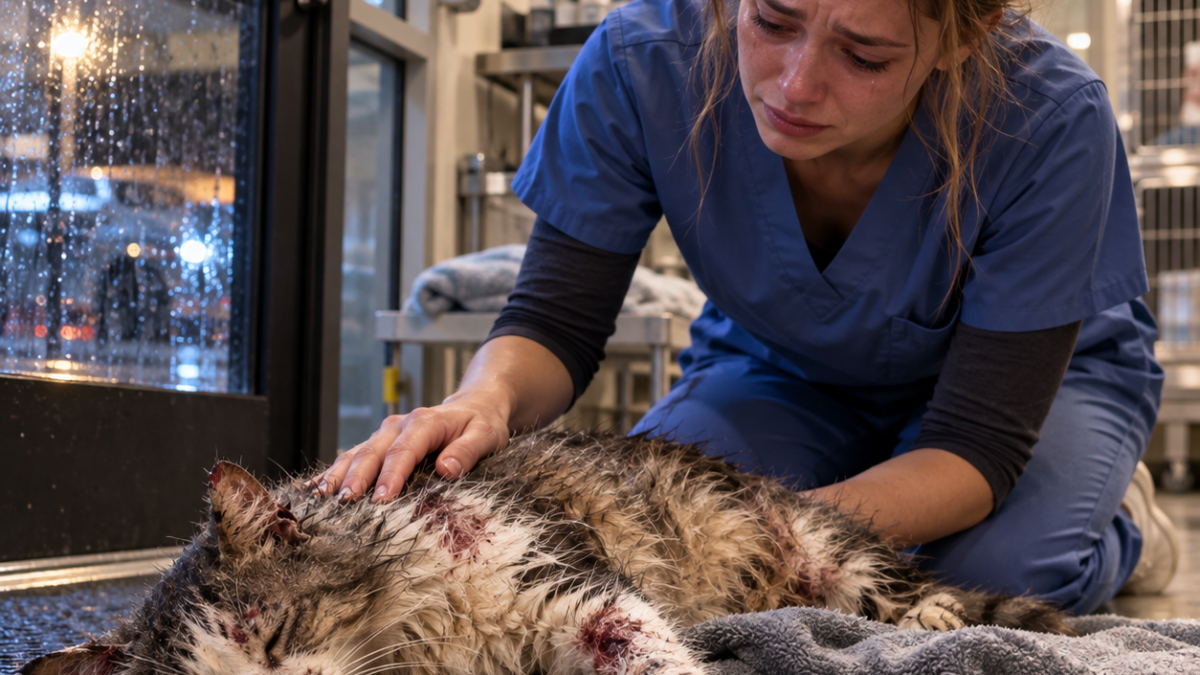
Patch survived the night.
That is how he got his name.
Not because he had patches of color.
He didn’t.
He was mostly gray with dirty white along his chest.
I called him Patch because he looked as if life had ripped him apart and somebody had tried to repair him using whatever pieces were still available.
The name was supposed to be temporary.
Most names at a clinic are.
You write something on the chart because you cannot keep calling an animal “male stray.”
Patch stayed.
His abscess drained.
The swelling came down.
The bite wounds closed.
His paw improved enough that he could use it, though never normally.
He walked with a limp for the rest of his life.
His torn ear folded forward.
The scar across his nose became permanent.
One eye always looked slightly softer than the other.
Not cloudy.
Just different.
As if whatever he had seen before reaching us had settled behind it.
We neutered him once he was strong enough.
Vaccinated him.
Treated parasites.
Tested for disease.
Fed him until his sides stopped looking hollow.
And when he was medically cleared, I did what clinic employees always do with an animal nobody technically owns.
I took pictures.
Good ones.
I chose the angle that made the scar less obvious.
Put him on a clean fleece blanket.
Waited until sunlight hit his face.
Then I wrote a cheerful adoption post.
Meet Patch!
Approximately four to five years old.
Gentle. Quiet. Litter trained.
Loves warm blankets, calm rooms, and slow introductions.
He survived a rough start and deserves a safe forever home.
I did not write:
His face is not symmetrical.
He limps.
He may always limp.
His ear looks damaged.
He startles when doors slam.
He sleeps as though he is still listening for danger.
He needs somebody who does not require broken things to pretend they were never broken.
People called.
At first.
“How old is he?”
“Do you know his breed?”
“Good with kids?”
“Good with dogs?”
“Why does he walk like that?”
“Is the face permanent?”
That question came more than once.
Is the face permanent?
As though we could repaint him.
As though a scar were a temporary inconvenience we had forgotten to mention.
One family visited.
Their little boy loved Patch.
The mother did too.
The father crouched beside him, scratched his cheek, then asked me privately whether Patch might develop “more problems later” because of whatever had happened.
“Any animal can develop problems later.”
He nodded.
“I understand.”
They adopted a kitten from the shelter two days later.
Another woman said she needed time to think.
She posted photographs of a perfect white kitten on Instagram that weekend.
A college student loved Patch but his landlord did not allow pets.
An older couple considered him until their daughter convinced them his limp meant “future expenses.”
Nobody was evil.
That almost made it worse.
They were choosing.
And when people have choices, scars become easy reasons to keep looking.
Three weeks became six.
Six became ten.
I stopped checking adoption messages every hour.
I told myself I was being professional.
I wasn’t.
Patch had begun sleeping on folded towels behind reception.
He learned the sound of the treat drawer.
He learned Dr. Ruiz left pieces of plain chicken in the break-room refrigerator.
He learned that our receptionist, Molly, would surrender part of her turkey sandwich if he stared at her long enough.
He learned exactly which technicians tolerated him on their laps and which ones needed both hands to type.
He started appearing in the front window every morning as soon as we opened.
Clients began asking whether he was ours.
We gave different answers depending on our mood.
“Technically available.”
“Clinic foster.”
“Temporary resident.”
“Freeloader.”
“Assistant manager.”
Then something happened on a Tuesday afternoon that changed his life.
A woman named Hannah Pierce brought in a little gray cat called Misty.
The moment Misty’s carrier entered the lobby, the cat panicked.
Not nervous.
Panic.
She threw herself against the plastic door.
Claws scraping.
Pupils enormous.
Breathing through her mouth.
Hannah was near tears.
“She does this every time.”
I crouched beside the carrier.
“Has she had her gabapentin?”
“At seven.”
“Okay.”
Misty slammed herself backward again.
I moved the carrier into our quiet exam room.
Covered part of it with a towel.
Turned down the lights.
Waited.
Nothing worked.
Every time I moved toward the latch, Misty became frantic.
Hannah stood near the wall wringing her hands.
“Maybe we should just leave.”
“We can give her time.”
“She hates me after this.”
“She doesn’t hate you.”
“She hides for two days every time.”
I was about to call Dr. Ruiz when Patch appeared in the doorway.
I almost pushed him away.
The last thing we needed was another cat.
But Patch didn’t approach Misty.
He sat.
Five feet from the carrier.
Bad paw tucked under his chest.
Torn ear forward.
He looked at Misty.
Then slow-blinked.
Once.
Misty stopped moving.
Not completely relaxed.
Not magically transformed.
She simply froze long enough to notice him.
Patch lowered himself onto the floor.
He looked away.
Misty moved closer to the side of the carrier facing him.
Her breathing slowed.
Hannah whispered, “What is happening?”
“I have absolutely no idea.”
Patch remained there.
We opened the carrier fifteen minutes later.
Misty hissed.
Patch did not move.
She stepped onto the towel.
Dr. Ruiz examined her.
We completed almost everything we needed to do without restraint.
Before Hannah left, she crouched beside Patch.
“Are you some kind of therapy cat?”
Patch yawned.
“I don’t think he’s anything official,” I said.
Hannah smiled.
“He’s official to Misty.”
The next week it happened again.
Then again.
A large tabby named Moose came in shaking so badly the metal door of his carrier rattled.
Patch sat eight feet away.
Moose settled.
A young rescue cat tried to bite me during a nail trim.
Patch climbed onto a nearby chair.
The cat stopped lunging long enough for us to finish.
A feral-leaning calico named Sugar hid beneath a towel in the back of her carrier.
Patch lay outside.
After ten minutes, Sugar pushed her nose through the opening in the towel.
No one trained him.
No one encouraged him.
Some cats he ignored entirely.
Some he walked away from after a minute.
Others drew him across the clinic from three rooms away.
He seemed especially interested in the quiet ones.
The ones so frightened they had stopped fighting.
Maybe he knew that state.
Dr. Ruiz refused to romanticize it.
“He’s probably responding to body language, scent, vocalization, stress pheromones.”
“That’s less poetic.”
“Medicine usually is.”
“But you admit he’s doing something.”
She looked at Patch through the exam-room window.
“I admit the room changes when he’s there.”
That became the closest thing we had to an official explanation.
Soon clients noticed.
“Can Patch come in?”
“My cat liked him last time.”
“Where’s the crooked-ear boy?”
An older man named Mr. Shaw began bringing him little containers of cooked chicken every second Friday.
A teenage girl drew Patch with his bent ear and scar.
Above him she wrote:
HE LOOKS LIKE HE FOUGHT LIFE AND WON.
I taped it inside the supply cabinet.
I looked at it on difficult days.
There were many difficult days.
Veterinary medicine does not look like puppy kisses once you work inside it.
It looks like phones ringing while somebody cries in room three.
It looks like a technician eating lunch at four thirty.
It looks like explaining that the treatment most likely to save an animal costs money a family does not have.
It looks like being called heartless because you cannot perform surgery for free.
It looks like euthanasia consent forms.
It looks like an empty carrier leaving with someone who arrived holding a living animal.
It looks like scratches on your forearms and grief you are expected to wipe away before the next appointment.
I was thirty-four.
Single.
Living alone in a one-bedroom apartment seven minutes from the clinic.
My parents lived three states away.
Most of my friends had married, moved, or grown tired of my unpredictable work schedule.
I ate dinner standing over the sink more often than I admitted.
Some nights my only conversations after work were with a grocery-store cashier and whichever foster animal had followed me home.
I was tired.
Not spectacularly.
Quietly.
The dangerous kind.
The kind where you keep showing up, so nobody thinks to ask whether showing up has started costing you too much.
Patch began sitting beneath my chair during paperwork.
Some evenings, when the clinic emptied, I would talk to him.
Not meaningful conversations.
“You know, you could contribute financially.”
Blink.
“Rent is expensive.”
Blink.
“You have no marketable skills.”
He would look toward an exam room where a frightened cat had just stopped screaming because he was nearby.
“Fine. One marketable skill.”
I laughed more after Patch arrived.
Not enough to fix me.
Enough to notice.
That was why I took it personally when management called him a liability.
The problem started with a woman named Victoria Lang.
Everyone in town knew the Lang name.
Her husband’s family owned several commercial properties, two car dealerships, and enough land around Cedar Grove that people referred to entire intersections by their surname.
Victoria was always polite to us.
That needs to be said.
Cruel people do not always arrive behaving cruelly.
Sometimes they arrive in expensive raincoats and say please.
She brought in a white Persian named Angel.
Angel’s carrier probably cost more than my monthly grocery bill.
The moment Victoria noticed Patch in the front window, she stopped.
“What is that cat doing out?”
I smiled.
“That’s Patch. He lives here.”
“Lives here?”
“He’s our clinic cat.”
Technically, that had never been written down.
But by then, what else was he?
Victoria looked him over.
Torn ear.
Scar.
Bad paw.
“Is he contagious?”
“No.”
“Has he been tested?”
“Yes.”
“For everything?”
“For the standard diseases we would worry about, yes. He’s fully vaccinated.”
Patch jumped down from the window.
Angel saw him.
A low growl came from inside the carrier.
Patch stopped ten feet away.
Victoria tightened her grip on the handle.
“Could you put him somewhere?”
“Absolutely.”
I picked Patch up.
He did not resist.
I put him in the staff office.
Angel continued growling.
By the time we entered the exam room, she was panting and swatting through the carrier door.
Dr. Ruiz noted that she had arrived highly stressed.
We completed the exam with difficulty.
Patch never entered the room.
The appointment ended.
I thought that was it.
By that afternoon, Victoria had posted a review.
One star.
She called the clinic unsanitary.
Said a “mutilated stray cat” was permitted to roam medical areas.
Said her purebred cat had been traumatized.
Then came the sentence everyone at work remembered.
When clients pay premium veterinary prices, they should not have to look at something that appears diseased and damaged in the lobby.
Molly read it aloud.
Then slowly lowered her phone.
Nobody spoke.
Dr. Ruiz said, “Did she actually write ‘look at something’?”
Molly nodded.
Patch sat on the copier.
Licking his chest.
Completely unaware that somebody had just reduced his entire life to poor lobby aesthetics.
The review got attention.
People defended us.
Others agreed with Victoria.
Some asked whether having a resident cat violated sanitation standards.
Some said they would not want an unfamiliar animal near their pet.
Those concerns were not unreasonable.
That became important later.
But the internet is not built for reasonable concern.
It is built for escalation.
By Sunday, comments had become ugly.
“Why would a professional clinic keep an injured alley cat loose?”
“Looks disgusting.”
“I wouldn’t let my pet anywhere near that.”
“He’s probably traumatizing patients.”
“He belongs in a shelter.”
Then photographs appeared.
Old photographs.
Patch calming Misty.
Patch outside Moose’s carrier.
Patch curled on the fish-print blanket a client had given him.
Those posts spread too.
People started calling him the Fear Whisperer.
I hated that name.
It made him sound like a circus act.
But people loved him.
For three days, Cedar Grove’s social pages gained more followers than they had in the previous year.
The company that owned our clinic noticed.
That was something I did not understand yet.
Cedar Grove had once been privately owned by Dr. Ruiz and another veterinarian, Dr. Warren Bell.
Two years earlier, they sold a controlling interest to a regional veterinary group called PetCore Health.
PetCore promised administrative support.
Better purchasing power.
Centralized billing.
Marketing.
Human resources.
All the things exhausted veterinarians did not want to spend their lives doing.
Mostly, the arrangement worked.
Until it didn’t.
Monday morning, our practice manager Denise called me into her office.
She looked miserable.
That should have warned me.
“Sit.”
“I hate when people say that.”
“Leah.”
I sat.
She folded her hands.
“We got a call from regional.”
“About Patch.”
“Yes.”
I laughed once.
“You’re kidding.”
“I wish.”
Denise had worked at Cedar Grove for nineteen years.
She was not corporate.
She just happened to be standing between corporate and us.
“What’s the problem?”
“The review created a formal complaint.”
“He never went near Angel.”
“I know.”
“The medical chart literally says she was stressed before being moved to an exam room.”
“I know.”
“Patch wasn’t even visible after that.”
“I know.”
“Then what are we doing?”
Denise rubbed her forehead.
“Regional compliance says an unassigned animal cannot move freely through client or treatment areas.”
“Unassigned?”
“Don’t start.”
“He has a name.”
“Leah.”
“That’s not how this works?”
She looked at me.
Apparently my sarcasm had become predictable.
She sighed.
“They want him removed from the clinic while they review policy.”
My stomach dropped.
“Removed where?”
“Home. Foster. Shelter.”
“Shelter?”
“I am not saying shelter.”
“You said shelter.”
“I am listing possibilities.”
“He spent ten weeks waiting for somebody to want him.”
“I know.”
“And now you’re sending him back because one woman thinks scars are ugly?”
Denise’s face changed.
“This isn’t only her.”
“Isn’t it?”
“We have legitimate questions about sanitation, client consent, liability.”
“Then solve those.”
“They’re trying.”
“No. They’re removing him.”
“Temporarily.”
I laughed.
“Broken things live on ‘temporarily.’”
She looked exhausted.
“I don’t know what you want me to say.”
“That he stays.”
“I can’t.”
There it was.
Not cruelty.
Powerlessness.
Some injustices are performed by people who feel terrible while doing them.
They still hurt.
I stood.
“I’ll take him.”
Denise’s shoulders lowered.
Relief.
That hurt almost as much as the decision.
She was glad the problem had somewhere to go.
By four o’clock, I was packing Patch’s things.
Fish blanket.
Food.
Medication.
His ceramic dish.
The ugly stuffed mouse he never played with but always slept beside.
Molly cried.
Dr. Ruiz swore under her breath.
One technician said, “Maybe this will blow over.”
Nobody believed her.
Patch watched me.
He knew something was changing.
Animals know packing.
They know carriers.
They know when humans stop moving normally.
I put him inside his carrier.
He did not fight.
That was worse.
His entire body seemed to say:
Of course.
Another place.
Another door.
Another person deciding.
The rain started as I carried him outside.
Same kind of rain as the night he arrived.
Thin.
Cold.
Unfairly familiar.
I buckled his carrier into the passenger seat.
“You’re coming with me.”
Patch blinked.
“You’re not going to a shelter.”
Nothing.
“You’re not being abandoned.”
He turned around inside the carrier.
“That sounded more convincing in my head.”
At my apartment, I opened the carrier.
Patch stepped out.
Sniffed the kitchen.
Limped into the living room.
Jumped onto my thrift-store couch.
Turned twice.
Lay down.
Then looked at me as if I were the visitor.
I stood in the middle of the room.
And cried.
I had spent months believing Patch needed us.
The clinic.
Me.
Now he was the calmest thing in my apartment while I stood there falling apart because somebody had removed him from a place where he had made himself useful enough to belong.
That thought made me angrier.
Useful enough.
Why should that matter?
Wasn’t he worth something the first night?
Wet.
Bleeding.
Collapsed on a mat?
Why did everybody suddenly fight for him only after he started making frightened patients easier?
The question bothered me.
Because I recognized it.
At work, everybody called me dependable.
Which meant I worked late.
Covered shifts.
Skipped breaks.
Answered texts on days off.
I had become valuable by being easy to use.
Patch had become valuable by calming frightened animals.
Neither of us was being asked whether being needed and being cared for were the same thing.
The clinic changed immediately without him.
Not in some mystical way.
In measurable, annoying, stressful ways.
A Bengal named Theo panicked during an exam and needed rescheduling.
A terrified elderly Siamese bit Molly hard enough to require antibiotics.
Two cats who had previously tolerated basic procedures with Patch nearby needed additional medication.
Owners asked for him.
“Where’s Patch?”
“Can he sit with Luna?”
“He helped last time.”
The staff hated answering.
“He’s taking a break.”
“He’s staying with Leah.”
“Policy review.”
Every answer sounded worse than the last.
Three days after Patch left, Dr. Ruiz came into the pharmacy area carrying a clipboard.
“This is ridiculous.”
“What happened?”
“Penny won’t come out of her carrier.”
Penny was twelve.
A regular.
Patch had sat beside her twice before.
Her owner was in tears.
I looked toward Denise’s office.
She was standing in the doorway.
Listening.
Nobody said anything.
Because admitting Patch mattered felt like accusing whoever removed him.
At home, Patch adjusted humiliatingly fast.
Night one, foot of my bed.
Night two, against my hip.
By night four, he discovered the exact loose floorboard outside the bathroom.
By day five, he screamed for breakfast if I was three minutes late.
He knocked a glass of water off my nightstand.
Threw up on the only bathmat I liked.
Covered every black sweater I owned with gray hair.
That saved me.
I needed him to remain a cat.
Not a symbol.
Not a martyr.
Not a magical wounded creature sent to teach humanity.
He was obnoxious.
Funny.
Food-motivated.
Occasionally rude.
He also knew when I was falling apart.
One night, I came home after a fourteen-hour shift.
I stood over the sink eating saltines because preparing actual food felt impossible.
The clinic had been chaotic.
Three emergencies.
One euthanasia.
Two clients yelling about prices.
A dog that came in too late for us to save.
I had smiled through almost all of it.
Then in my kitchen, holding a cracker, I started crying.
No reason.
Every reason.
My hands shook.
My breathing got tight.
I sat on the floor because standing felt unnecessary.
Patch woke from the couch.
Limped into the kitchen.
He did not climb into my lap.
Did not headbutt me.
Did not perform.
He sat on my foot.
Bad paw tucked beneath him.
Warm.
Solid.
Present.
After a few minutes, my breathing slowed.
I looked down.
“Are you doing your clinic thing on me?”
Patch stared toward the refrigerator.
“Rude.”
He stayed anyway.
The next week, an older man named Raymond Clark came into Cedar Grove carrying a nineteen-year-old orange cat wrapped in a faded blue towel.
The cat’s name was Buddy.
Kidney failure.
Severe dehydration.
Barely responsive.
Raymond was maybe seventy.
His jacket was too light for the weather.
He held Buddy against his chest with both arms.
“I’m sorry,” he kept whispering.
Not to us.
To Buddy.
“I’m sorry.”
I put them in room two.
Raymond sat.
He stroked Buddy’s head.
Then looked around.
“Where’s that beat-up little cat?”
I froze.
“What?”
“The gray one. Crooked ear.”
“Patch?”
“Yeah.”
Raymond nodded.
“My neighbor showed me a video. Said he sits with nervous cats.”
“He’s staying with me right now.”
Raymond’s mouth changed.
Just slightly.
The smallest disappointment.
“Oh.”
Then he looked down at Buddy.
“That’s all right.”
But it was not all right.
Not because Patch could save Buddy.
He couldn’t.
The veterinarian examined him.
We discussed options.
Raymond made the decision people call kind because we do not have a better word for choosing heartbreak over suffering.
Before the euthanasia, Raymond asked for a few minutes alone.
I dimmed the lights.
Closed the door most of the way.
Later I walked past.
His voice came through the crack.
“You did good, buddy.”
Pause.
“Your mama’s going to be mad if I make you hurt just because I don’t want to be by myself.”
I stopped walking.
“Tell her I kept my promise.”
My eyes filled.
“And when my turn comes…”
His voice broke.
“I hope somebody sits with me too.”
I walked into the supply closet and cried against shelves of syringes.
All I could think was:
Patch should be here.
Not as medicine.
Not as therapy.
Not as some Instagram-ready grief mascot.
Just because Patch knew how to sit beside fear without asking fear to become attractive first.
After Buddy died, Raymond signed the paperwork at reception.
His hand trembled.
Then he looked toward Patch’s empty spot by the front window.
“Funny world.”
I asked, “What?”
He gave a tired smile.
“We spend our whole lives avoiding anything scarred.”
His eyes filled.
“Then one day that’s the only face that looks honest.”
That night I told Patch what happened.
He cleaned his shoulder through most of the story.
At the end, he put one paw on my leg.
I laughed through tears.
“Terrible listener.”
Two days later, Denise called me into her office.
There were printouts everywhere.
Emails.
Comments.
Complaint reports.
Client messages.
One demanded we never allow “the damaged clinic mascot” back inside.
Another said Cedar Grove had lost her business by removing Patch after one complaint.
One wrote:
Please don’t let one person’s discomfort erase something gentle that clearly helps animals. There is enough cold in the world already.
I looked away.
Denise said, “We’re seeing a difference.”
I crossed my arms.
“We told you.”
“Don’t.”
“You did.”
“Leah.”
She looked exhausted.
“Our doctors are reporting more fear-related difficulties.”
“Because Patch isn’t there.”
“We cannot claim that.”
“Fine. Because Mercury is in retrograde.”
“I’m trying to help.”
I softened.
“Okay.”
She pointed at a spreadsheet.
“We compared appointments involving high-fear feline patients before and after Patch was removed.”
I stared.
“You made a spreadsheet?”
“Dr. Ruiz did.”
“Of course she did.”
There was no dramatic scientific proof.
No miracle numbers.
But patterns were obvious.
More interrupted exams.
More discussions of rescheduling.
More medication needed before return visits.
More staff injuries.
More owner complaints about stress.
Denise said, “Regional is willing to discuss bringing him back under formal guidelines.”
My chest tightened.
“What guidelines?”
“Restricted access. Clean designated rest area. Client consent before he enters exam rooms. No food-prep areas. Updated veterinary records. Monitoring.”
I sat back.
“All of that sounds reasonable.”
“I know.”
“So why didn’t we do it before throwing him out?”
Denise stared at the table.
I knew that look.
“What?”
“There’s something else.”
My stomach sank.
“What?”
She turned her monitor toward me.
A PetCore marketing page was open.
At the top was a photograph.
Patch.
Sitting beside Misty’s carrier.
The picture had been cropped beautifully.
His scar visible.
Torn ear visible.
Below it:
COMPASSION LIVES HERE.
I stared.
“What is that?”
“Regional marketing drafted a community campaign after his video started getting shared.”
I looked at Denise.
“When?”
She did not answer.
“Denise.”
“Before they ordered him removed.”
For a second, I genuinely could not understand the sentence.
“What?”
She clicked another file.
A presentation.
PetCore Health Regional Engagement Strategy.
Slide nine.
Patch’s face.
Beside it:
Authentic rescue stories drive trust and emotional engagement.
Another slide:
Potential localized campaign: from broken stray to comfort companion.
I felt sick.
“They were going to use him?”
Denise nodded.
“Marketing liked the engagement.”
“The same company that said he couldn’t stay.”
“Yes.”
I laughed.
Not because anything was funny.
“Wow.”
“Leah—”
“No, that’s perfect.”
I stood.
“They didn’t want the scarred cat in the lobby.”
“I know.”
“But they wanted his scarred face in an ad.”
“I know.”
“Because online his damage was inspiring, but in person it might make rich people uncomfortable.”
Denise closed her eyes.
“I know.”
I walked out before anger made me say something that would get me fired.
Dr. Ruiz found me in the parking lot.
“You saw it.”
I nodded.
“Did you know?”
“Not until this morning.”
I leaned against my car.
“This is disgusting.”
“Yes.”
“Can they do that?”
“Technically, the original photograph was taken in the clinic.”
“That is not what I asked.”
She knew.
“It is morally disgusting.”
“Better.”
She crossed her arms.
“I sent a formal objection to PetCore medical leadership.”
“Why medical leadership?”
“Because regional marketing is trying to frame Patch as a clinical behavioral tool in one slide and as a marketing story in another.”
I stared.
“They’re calling him therapy?”
“Comfort companion.”
“He’s not trained.”
“Exactly.”
That mattered.
Not because Patch did not help.
Because exaggerating what he did could become dangerous.
Compassion did not excuse pretending.
For the first time, the argument became bigger than whether Patch returned.
It became about who was allowed to tell his story.
I went home furious.
Opened my laptop.
Stared at a photograph of Patch sleeping inside his fish-print blanket.
I started writing.
Deleted it.
Started again.
I wrote about finding him in the rain.
About the weeks nobody adopted him.
About people asking whether his face would always look that way.
About the terrified cats.
About removing him after one complaint.
I did not name Victoria.
Did not name PetCore.
Did not reveal private patient information.
I wrote something else instead.
Something that had been sitting inside me for months.
A lot of us do not actually love the broken.
I stared at the sentence.
Then continued.
We love what the broken can do for us.
I wrote that Patch had been lovable before he comforted anybody.
Before videos.
Before comments.
Before people called him special.
He was lovable when he was bleeding on our front mat and had nothing to offer except need.
I wrote that usefulness is a dangerous requirement for dignity.
For animals.
For people.
For elderly bodies.
Disabled bodies.
Burned-out employees.
Anybody who starts hearing that subtle question:
What are you still contributing?
I wrote that Patch did not owe us inspiration in exchange for rescue.
Then I posted it.
I expected maybe fifty people to read it.
By Sunday morning, there were thousands.
People fought.
Of course.
Some loved the post.
Some called it manipulative.
Some said every business has practical limits.
They were right.
Some said clinics cannot allow animals to roam without structure.
Also right.
Some said people have every right to prefer healthy young pets.
They do.
Some said I was shaming adopters.
I wasn’t trying to.
Then a veterinary nurse from Michigan wrote:
Compassion without structure becomes chaos. Structure without compassion becomes cruelty. Good care needs both.
I printed that one.
Another person wrote:
This isn’t about cats and everybody knows it.
That one stayed in my chest.
Then somebody shared the PetCore marketing slide.
I had not.
I still do not know who did.
Maybe an employee.
Maybe somebody in regional.
The screenshot showed Patch beneath the words COMPASSION LIVES HERE.
The timestamp on the file was two days before his removal.
The internet noticed.
People are exceptionally skilled at outrage when hypocrisy is easy to understand.
The story changed overnight.
Company Uses Scarred Rescue Cat in Marketing, Removes Him From Clinic After Complaint
Local pages picked it up.
Then a local reporter called.
I declined.
PetCore issued a statement.
It was corporate language.
“We remain committed to patient safety, client comfort, and compassionate care while reviewing policies around resident animals.”
Nobody liked it.
Especially because people had learned something else.
Victoria’s original complaint claimed Patch had caused Angel’s panic.
The medical chart from that day—shared internally during review, not publicly—documented that Angel was already growling and distressed upon arrival and continued after Patch was removed.
Our security camera showed Patch sitting near the window until I carried him to the staff office.
He never approached the carrier.
Dr. Ruiz refused to allow PetCore to publicly blame him.
She sent a written statement to medical leadership saying the record did not support the claim that Patch caused Angel’s distress.
That became the second crack.
The third came from Raymond.
I don’t know how he heard about the controversy.
Probably Facebook.
Everything eventually reaches Facebook if enough retired people are awake.
He wrote PetCore a letter.
Not angry.
That made it more powerful.
He told them about Buddy.
About coming to Cedar Grove expecting the hardest goodbye of his life.
About asking for Patch.
About the empty window.
At the end he wrote:
I understand rules. I spent forty-one years working around rules. But sometimes people use rules to avoid deciding what kind of human being they want to be. I hope your company finds a way to have both rules and heart.
Dr. Ruiz read it aloud in the break room.
Molly cried.
Denise left the room.
I found her later in her office.
She was wiping her eyes.
“I hate this job sometimes.”
“You’ve said that before.”
“No. I hate being the person standing between people and decisions I didn’t make.”
I sat.
“You’re allowed to tell them no.”
She laughed bitterly.
“That’s easy when it’s not your mortgage.”
I looked at her.
She immediately regretted the words.
“I’m sorry.”
“No. You’re right.”
Patch was not the only creature surviving on usefulness.
Denise had two kids in college.
A mortgage.
A mother with dementia.
She had spent decades becoming indispensable.
Now she was being told to execute decisions she hated because her paycheck depended on remaining useful too.
The story kept reflecting itself.
That Monday, PetCore sent their regional director.
His name was Calvin Ross.
Late forties.
Tailored blue suit.
Expensive watch.
He did not look evil.
He looked tired.
That almost annoyed me.
I wanted an easy villain.
He gave us a meeting.
Dr. Ruiz.
Dr. Bell.
Denise.
Two technicians.
Me.
PetCore compliance joined remotely.
Calvin started with the word “miscommunication.”
Dr. Ruiz interrupted.
“No.”
He stopped.
She folded her hands.
“It was not miscommunication.”
Calvin looked at her.
“A cat was removed from the clinic for alleged safety and image concerns while your marketing department prepared material using his story to improve public engagement.”
Nobody moved.
Dr. Ruiz continued.
“That is contradiction.”
Calvin looked at me.
“I understand why staff are upset.”
I said, “Do you?”
“Yes.”
“Then explain why Patch was acceptable in an advertisement but not near the window where the photograph was taken.”
Silence.
Calvin rubbed his thumb along the edge of his folder.
“That campaign should never have advanced during a compliance review.”
“That’s not an answer.”
“No.”
He took a breath.
“The regional decision became influenced by brand concerns.”
There it was.
Brand.
“The complaint described a maimed stray in a premium-care environment.”
My jaw tightened.
“And somebody decided that was bad branding.”
Calvin did not deny it.
“Somebody made an error.”
“Who?”
He hesitated.
“Ultimately, I approved the removal.”
The room became quiet.
At least he said it.
Then Denise asked, “Did you approve the marketing campaign?”
Another pause.
“Yes.”
Molly muttered, “Wow.”
Calvin nodded.
“I deserve that.”
For the first time, I looked at him differently.
Still angry.
But listening.
He continued.
“We wanted the emotional value of the story without confronting the operational messiness of making room for the actual animal.”
Nobody spoke.
That was the most honest corporate sentence I had ever heard.
I said, “You wanted his scars as long as they were pixels.”
Calvin looked at me.
“Yes.”
That answer disarmed me more than an excuse would have.
Compliance reviewed the situation.
The marketing campaign was canceled.
PetCore agreed it had used Patch’s image without a clear internal process for the resident-animal dispute.
Calvin received a formal disciplinary review.
Months later, we learned he had been removed from regional marketing oversight and transferred back into operations.
Not fired.
Life is not always a movie.
But authority narrowed.
The woman who approved the campaign after the complaint was no longer responsible for community marketing.
More importantly, Cedar Grove received permission to develop an actual resident-cat policy.
With veterinarians.
Technicians.
Infection control.
Client consent.
No fantasy.
No pretending Patch was licensed therapy.
He was not.
He became what he actually was.
A resident clinic cat who could be present, under controlled conditions, when clinicians and owners believed his presence might help.
He received regular health screening.
He had a designated clean room.
He stayed out of food areas, surgical areas, isolation rooms, and anywhere infection risk made his presence inappropriate.
He did not wander into appointments uninvited.
Owners could opt out without explanation.
If another cat became more stressed by seeing him, Patch left.
No argument.
No moral judgment.
Because not every frightened animal wanted another cat nearby.
Compassion means noticing the animal in front of you, not forcing one touching story onto everyone.
The policy was boring.
Six pages.
I loved every line.
Boring structure was what allowed kindness to survive.
The day before Patch was supposed to return, I sat on my apartment floor beside him.
“You’ve become paperwork.”
He licked one paw.
“Six pages.”
Nothing.
“You’re exhausting.”
Blink.
“I guess we’re going back tomorrow.”
His ear moved.
I don’t know whether he understood.
Probably not.
But the next morning when I pulled out the carrier, Patch disappeared beneath the bed.
I lay on the carpet.
“Seriously?”
Two green eyes stared back.
“You walked into traffic and fist-fought something with teeth, but the carrier is where you draw the line?”
No response.
Twenty minutes later, we arrived at Cedar Grove.
I carried him through the back entrance.
The staff had tried not to make a scene.
They failed.
Molly cried.
A technician named Serena clapped once, then pretended she had not.
Dr. Ruiz crouched.
“Well.”
Patch stepped out.
Sniffed the floor.
Looked around.
Then limped straight toward reception.
He jumped onto his old fish-print blanket.
Turned twice.
Lay down.
Like he had been gone for a long weekend.
No understanding of policy wars.
No awareness of viral posts.
No concern about branding.
He was home.
His first appointment back involved a skinny brown tabby called Eddie.
Eddie had been trapped behind an apartment building.
His foster, a young woman named Kara, looked exhausted.
Eyes swollen.
Hands shaking.
“I found him the week my husband moved out.”
I looked at her.
She laughed nervously.
“Sorry. That’s probably not relevant.”
“It can be relevant if you need it to be.”
Her mouth trembled.
“I don’t know if I’m saving him or he’s saving me.”
Then she started crying.
Not loudly.
The kind of crying that happens when the body finally encounters a room where it feels allowed.
Inside the carrier, Eddie slammed himself backward.
Patch was sitting near the window.
He stood.
Limped to within six feet.
Sat.
The consent note was already on Eddie’s chart.
Kara looked at him.
“Is that Patch?”
“Yes.”
“The famous ugly cat?”
I felt my shoulders tighten.
She saw it.
“No. I’m sorry.”
She wiped her face.
“I mean it nicely.”
Patch blinked.
“He looks like he’s been through things and stopped pretending he hasn’t.”
Then Eddie stopped throwing himself backward.
Not relaxed.
Not cured.
Just watching.
Patch lowered himself.
Eddie’s breathing slowed.
Kara covered her mouth.
Nobody said anything.
We completed the exam.
At the end, Kara sat beside the carrier.
Patch nearby.
Eddie still scared.
Still alive.
Still learning.
And I understood what bothered me about the word healing.
People make healing sound like the disappearance of evidence.
Scar fades.
Fear stops.
Memory softens.
You become shiny again.
Patch had healed with the evidence still visible.
That mattered.
His ear remained torn.
His paw remained bad.
His nose remained scarred.
He was not restored to some imaginary original condition.
He simply became safe enough to live as the creature who survived.
Maybe that was why frightened animals trusted him.
Maybe not.
I am a veterinary technician, not a poet or behavioral researcher.
I cannot prove what cats think when they look at one another.
But I know what rooms feel like.
Some rooms tighten.
Some loosen.
Patch loosened rooms.
He did it for cats.
He did it for people too.
The public controversy eventually faded.
It always does.
The internet found something else to hate.
Some people remained angry that Patch was allowed back.
Others thought he should be turned into a formal therapy program.
We refused both extremes.
He was not removed to satisfy discomfort.
He was not turned into a performing product to satisfy admiration.
He was allowed to be a cat.
That became the victory.
Not fame.
Not likes.
Not PetCore suddenly becoming virtuous.
Space.
A warm bed behind reception.
A clean bowl.
Medical care.
Boundaries.
The freedom to walk away from an appointment if he wanted.
The right to exist without constantly proving his value.
Raymond came back six weeks later.
No carrier.
I recognized him immediately.
“Mr. Clark?”
He smiled.
“Raymond.”
He held a small paper bag.
“I brought something.”
Patch sat near the scale.
Raymond froze.
There he is, his face said.
He approached slowly.
Patch watched.
Raymond crouched.
“You’re uglier than the pictures.”
I laughed.
“Careful.”
“It’s a compliment.”
From the bag, he pulled out a blue fleece blanket.
On one corner someone had embroidered two words.
FOR PATCH
Raymond swallowed.
“My wife used to sew.”
His voice changed.
“Not this. Neighbor did it.”
He placed the blanket down.
Patch sniffed.
Stepped onto it.
Sat.
Raymond started crying.
He wiped his face quickly.
“I keep thinking about Buddy.”
“I know.”
“House is terrible without him.”
I waited.
“People keep telling me to get another cat.”
“That can be hard to hear.”
“Yeah.”
He looked at Patch.
“I don’t want another Buddy.”
“No one could give you one.”
Raymond nodded.
“That helps.”
He sat on one of our chairs.
Patch eventually walked over.
Not because he was summoned.
Because Patch did things on his own schedule.
He sat near Raymond’s shoe.
Raymond looked down.
“That enough?”
“For Patch?”
I smiled.
“That’s basically an embrace.”
Raymond stayed twenty minutes.
No appointment.
No problem to solve.
Sometimes we let people do that now.
Not constantly.
We’re still a clinic.
Phones still ring.
Bills still exist.
But we learned something from the week Patch disappeared.
Efficiency is not the only kind of care.
Another change came quietly.
A woman named Carol called.
She had seen Patch’s story.
She wanted to surrender a twelve-year-old black cat after her mother died.
“I don’t want him,” she said.
Then immediately, “That sounded awful.”
“You’re allowed to be honest.”
“I have dogs. He hates dogs. I work sixty hours a week.”
She started crying.
“My mother made me promise.”
I asked what she promised.
“That I wouldn’t let him die in a shelter.”
We worked with a rescue.
The cat, Benny, eventually went to a retired teacher named Gloria.
Gloria was sixty-nine.
She chose Benny because he hid behind the litter box during their meeting.
“Everybody keeps showing me friendly ones,” she said.
I asked why she wanted him.
She shrugged.
“He looks like he’s had enough sales pitches.”
Patch’s influence spread that way.
Not because people suddenly adopted every damaged animal.
They didn’t.
The shelter remained full.
Kittens remained easier to place.
Old cats remained overlooked.
But sometimes one person looked twice.
That matters.
The teenage girl who had drawn Patch came back with her father.
They had saved money.
She carried a jar full of coins and folded bills.
“For the senior cats.”
Her father looked embarrassed.
“She emptied birthday money.”
The girl corrected him.
“Not all.”
Months later, they adopted a nine-year-old cat named Pepper.
Cloudy eye.
Bent tail.
I asked why Pepper.
The girl looked confused by the question.
“Because nobody else picked him.”
Then she added, “He looks honest.”
I had to walk away for a minute.
Children sometimes say things adults spend years making complicated.
Patch became older.
Of course.
Time touched him like it touches everything.
His limp worsened slightly.
Dr. Ruiz started him on joint support and later medication.
He developed mild kidney disease.
Nothing dramatic.
Just another piece of age.
By then, I officially adopted him.
The paperwork listed me as owner.
I hated the word.
Patch did not belong to me any more than I belonged to him.
But ownership mattered for medical decisions and responsibility.
So I signed.
The first night he was officially mine, he threw up on my blanket.
“I appreciate the ceremony.”
Patch went back to sleep.
I also changed.
I stopped covering every open shift.
Not all at once.
I learned to say no badly before I learned to say it well.
The first time Denise asked whether I could stay late on my day off and I declined, I spent three hours feeling guilty.
Patch slept on my chest.
“You’re no help.”
Purr.
I started eating at my table instead of over the sink.
Sometimes.
I called my mother more often.
I reconnected with a friend named Sarah I had ignored for almost a year because friendship required energy I convinced myself I did not have.
She came over one Friday.
Patch sat beside her.
She scratched his head.
“So this is your emotionally significant garbage cat.”
“Respect him.”
“I do.”
Patch drooled on her jeans.
“Deeply.”
I laughed until my stomach hurt.
It shocked me how long it had been since that happened.
One winter night, almost two years after Patch arrived in the rain, I was closing the clinic.
Lobby lights dim.
Floor freshly mopped.
Same kind of weather outside.
Cold rain tapping against the glass.
Patch sat on his blanket behind reception.
I heard something strike the door.
My body froze.
Not again.
Then the sound came again.
Scratch.
I walked closer.
Outside stood a woman.
Not a cat.
She held a carrier under her coat.
I unlocked the door.
“We’re closed.”
“I know.”
She was crying.
“I didn’t know where else to go.”
Inside the carrier was a kitten.
Brown.
Thin.
Maybe five months old.
Not dying.
But frightened.
“I found her behind the grocery store.”
The woman wiped her face.
“I can’t keep her.”
I looked at Patch.
He had gotten up.
He stood ten feet away.
Watching.
I let the woman inside.
We checked the kitten.
No major injuries.
Dehydrated.
Fleas.
Hungry.
Nothing we could not handle.
The woman kept apologizing.
“I know you’re closed.”
“It’s okay.”
“I saw the story about him.”
She looked toward Patch.
“I thought maybe this was a place that wouldn’t tell me I was stupid for caring about a stray.”
That sentence stayed with me.
Maybe that was what Patch had really changed.
Not our numbers.
Not our fear scores.
Not marketing.
He had told people what kind of room we wanted to be.
A room where caring was not embarrassing.
The kitten eventually went to rescue.
Adopted within two weeks.
Young.
Cute.
Easy story.
Patch watched her carrier leave.
Then returned to bed.
No jealousy.
No lesson.
He was a cat.
I kept reminding myself.
That matters because people love turning survivors into teachers.
We demand wisdom from suffering.
As though pain owes us a useful product.
Patch did not survive for us.
He survived because his body kept breathing.
Everything we learned afterward belonged to us.
Not him.
The most important thing I eventually understood was that Patch never became worthy.
Not after Misty.
Not after the viral video.
Not after Raymond’s letter.
Not after PetCore apologized.
Not after Cedar Grove created a policy.
Worthiness was there on night one.
Wet fur.
Blood.
Bad paw.
No home.
Nothing to offer.
That was the test.
Could we care before we knew what he might become?
People love second-chance stories because they know the ending.
You see the wounded animal after the transformation.
Healthy.
Loved.
Useful.
Beautiful in some unconventional way.
You feel safe giving compassion because the story already proved the investment was good.
Real rescue is different.
You open the door without knowing.
Maybe the animal never trusts you.
Maybe the medical bills are high.
Maybe behavior remains hard.
Maybe you give months and get no cinematic gratitude.
Maybe the ending is bad.
Dignity cannot depend on whether the ending rewards us.
That became the argument I had with myself every time somebody called Patch inspirational.
He was inspiring.
Fine.
But he did not need to be.
He should have been fed if he never calmed one cat.
Treated if he never sat near one carrier.
Loved if he spent ten years hiding beneath a bed.
He did not owe anyone a return.
That was what made the marketing campaign so ugly to me.
They almost turned his survival into a transaction.
Look what this damaged creature can produce.
Engagement.
Trust.
Warm brand feelings.
Then when his physical presence became complicated, the creature disappeared while the story remained useful.
I see that everywhere now.
Employees praised for resilience while being overworked.
Parents praised for sacrifice until they ask for help.
Disabled people celebrated for “overcoming” things when they should never have been denied access in the first place.
Old animals called sweet as long as they remain continent and inexpensive.
Brokenness is welcomed once it becomes inspirational enough for comfortable people.
Patch taught me to distrust applause.
Not reject it.
Distrust it.
Ask what happens when the applause stops.
One morning, a new client came in with a carrier.
She glanced at Patch.
Wrinkled her nose.
“What happened to him?”
“Life.”
She laughed nervously.
“No, really.”
“We don’t know all of it.”
“He looks rough.”
“He does.”
“Does he live here?”
“Yes.”
She seemed uncertain.
I knew that look.
Months earlier, it would have angered me.
Now I said, “If you’d rather he not be near your cat, that’s completely fine.”
Her face relaxed.
“Oh.”
“No problem at all.”
“Thank you.”
We put Patch in the staff room.
Her cat had an easy exam.
At checkout, the woman looked toward the back.
“I hope I didn’t offend you.”
“You didn’t.”
“I just didn’t know how my cat would react.”
“That’s exactly what you’re supposed to think about.”
She smiled.
Then she asked, “Can I see him before I go?”
Patch was brought out.
The woman crouched.
He sniffed her hand.
She touched his torn ear carefully.
“He’s actually pretty cute.”
I smiled.
“He has representation. Be careful.”
She laughed.
That interaction mattered as much as the public apology.
Because compassion does not mean demanding everyone perform affection.
It means making room for fear too.
Even human fear.
Structure and heart.
Both.
Calvin Ross returned once.
Months after the meeting.
No suit.
Just slacks and a jacket.
He asked about Patch.
I pointed.
Patch was sleeping in a sunbeam.
Calvin stood at a distance.
“He looks good.”
“He is.”
“I wanted to apologize to you directly.”
“You already apologized in the meeting.”
“That was work.”
I looked at him.
He swallowed.
“This is me.”
I waited.
“I saw the complaint and thought about risk.”
“Okay.”
“I saw the marketing numbers and thought about opportunity.”
“Okay.”
He looked at Patch.
“I don’t think I once thought about the actual cat.”
That landed.
He continued.
“I don’t like knowing that about myself.”
I nodded.
“You should probably keep not liking it.”
He laughed once.
“Fair.”
I did not forgive him in some dramatic scene.
There was nothing to forgive on Patch’s behalf that Patch could not understand.
But I respected that he came back without needing redemption from me.
People can change without becoming the hero of the story they harmed.
That is enough.
Patch is seven now.
Probably.
Maybe eight.
His age has always been an estimate.
He still limps.
His torn ear still folds.
The white scar on his nose has faded but never disappeared.
He has more gray in the fur around his mouth, which seems unfair for a gray cat.
He still sleeps behind reception.
Still clocks in at the window.
Still gets chicken from Mr. Shaw, who is now eighty-two and pretends not to adore him.
Still appears when certain frightened cats arrive.
Not every time.
Not every cat.
Patch has boundaries.
He also spends more nights at my apartment now than at the clinic.
He is mine.
And theirs.
Mostly his own.
The fish-print blanket has been washed so many times the fish look haunted.
Raymond’s blue blanket stays underneath it.
The stuffed mouse lost its remaining ear.
I tried sewing it.
Patch rejected my craftsmanship.
The teenage drawing remains inside the supply cabinet.
HE LOOKS LIKE HE FOUGHT LIFE AND WON.
I no longer think that is quite right.
Winning suggests the fight ends.
Patch did not defeat life.
He stayed in it.
That is different.
He stayed scarred.
Stayed limping.
Stayed complicated.
Stayed himself.
And somehow that became enough.
A few weeks ago, a family brought in an elderly tortoiseshell named Ruby.
She was terrified.
Seventeen years old.
Kidney disease.
Never liked vets.
Her owner was a man in his twenties.
His grandmother had died and left him Ruby.
“I promised I’d keep her.”
He looked embarrassed.
“I wasn’t really a cat person.”
Ruby growled from beneath the towel covering her carrier.
He smiled sadly.
“I guess I am now.”
Patch wandered near.
The young man looked at him.
“Is that the cat?”
I smiled.
“Depends what you’ve heard.”
“The messed-up one.”
“Careful.”
He laughed.
“Sorry.”
Patch sat.
Ruby stopped growling long enough to listen.
Her owner watched.
Then he said, “He doesn’t look messed up.”
I looked at Patch.
Bent ear.
Scar.
Bad leg.
“What’s he look like?”
The young man thought.
“Tired.”
Then after a moment:
“But comfortable.”
I felt something catch in my throat.
That was it.
Not healed.
Not beautiful.
Not heroic.
Comfortable.
Patch had spent who knows how long outside in pain before dragging himself to our door.
Nobody came looking.
Nobody claimed him.
He had every reason to remain a creature waiting for the next bad thing.
Instead he eventually became comfortable enough to sleep with his stomach exposed beneath a front desk while phones rang above him.
Maybe there is no greater victory for a frightened animal.
Maybe for people too.
The clinic is still imperfect.
PetCore is still a corporation.
Clients still complain.
Bills still hurt.
Staff still get tired.
Nobody became saintly because of one scarred cat.
Denise still has to make decisions I hate.
Dr. Ruiz still tells me my emotional arguments are not medical evidence.
Molly still steals my pens.
I still occasionally eat dinner over the sink.
Change rarely arrives complete.
But there is more room now.
That is real.
One afternoon, the little girl who adopted Pepper returned.
She was older.
Maybe thirteen.
Pepper’s cloudy eye had worsened, but he looked fat and content.
She put his carrier beside Patch.
Patch sniffed.
Pepper sniffed back.
The girl watched them.
“Do they remember being unwanted?”
I did not answer immediately.
“I don’t know.”
She considered that.
“Maybe they remember being picked.”
I smiled.
“Maybe.”
She crouched.
“Do you think Patch knows he’s famous?”
“No.”
“Good.”
I laughed.
“Why good?”
“Because famous things always start acting weird.”
I looked at Patch.
“Trust me. He’s weird already.”
She scratched beneath his chin.
Then said something only a child could say without making it sound sentimental.
“He was already good when he was ugly, right?”
I swallowed.
“Yeah.”
“He didn’t have to help cats first?”
“No.”
She nodded.
“Okay.”
Then she went into the exam room with Pepper.
I sat behind reception for a while after that.
Patch jumped onto the chair beside me.
Put his bad paw against my thigh.
I thought about that first night again.
Rain.
Glass door.
Scraping sound.
The body collapsing on the mat.
If Patch had died that night, his life would still have mattered.
That was the entire point.
Nobody would have made videos.
No one would have brought him blankets.
No corporate campaign would have tried to borrow his story.
No frightened cats would have calmed beside him.
He would have been one unnamed stray who reached a warm building and died.
Still worthy.
Still a life.
Maybe that is the hardest thing for people to accept.
Value that cannot be measured.
A creature who never becomes useful.
A person who cannot work anymore.
A body that needs more than it gives.
A grief that produces no lesson.
A scar that remains ugly.
We want return.
We want meaning.
We want suffering transformed into something that makes us feel safer.
But some lives do not become lessons.
They simply need kindness.
That should be enough.
Patch happened to become visible.
That is not the same thing as becoming valuable.
He was valuable outside the glass.
He was valuable on the mat.
He was valuable while unconscious.
He was valuable before he belonged anywhere.
The rest of us were simply late to notice.
Tonight I am writing this at my kitchen table.
Yes, the same kitchen where I used to eat standing over the sink.
Patch is asleep beside my chair.
One paw twitching.
Probably chasing something in his dream that he would fail to catch in real life.
Tomorrow morning we’ll drive to Cedar Grove.
He will complain from the carrier.
Then he will walk through the back door.
Limp to reception.
Inspect the window.
Take his place on the fish blanket.
Some frightened animal may need him.
Maybe none will.
I hope none will.
Because the best day for Patch should not depend on somebody else being afraid.
He is allowed to have days where he helps no one.
Days where he sleeps.
Eats.
Sheds.
Knocks something over.
Contributes absolutely nothing.
I think that is the part I love most now.
After everything people demanded he symbolize, Patch finally gets to be ordinary.
And ordinary is a beautiful thing when you once nearly died alone in the rain.
Sometimes a new client still points at him.
“What happened to that cat?”
I give different answers.
“Bad luck.”
“Old injuries.”
“Long story.”
But when someone asks why we keep him, I have stopped giving speeches.
I say:
“He lives here.”
Usually that is enough.
If they ask why he sometimes sits beside frightened cats, I tell them:
“He seems to help.”
Not cures.
Not treats.
Not fixes.
Helps.
And if somebody asks why a professional clinic would make room for an imperfect animal with scars, a limp, and no certificate proving he deserves six square feet of sunlight by the window, I know the answer now.
Because he needed room before he ever gave us anything back.
Because compassion that only appears after usefulness is not compassion.
It is a transaction.
Because the scarred should not have to become inspiring before we stop looking away.
Because the tired should not have to keep performing strength just to earn rest.
Because the frightened do not always need someone to fix them.
Sometimes they need somebody who recognizes fear and sits down nearby.
Patch never asked to become the heart of Cedar Grove.
He never asked to become an argument.
Never asked to expose a company.
Never asked to teach us about dignity.
He only scratched on a glass door one wet Thursday night because there was light inside.
I opened it.
That was my part.
Everything after that came from letting him stay.
And maybe that is the thing I carry with me most.
Somewhere tonight there is another animal outside a door.
Maybe not literally.
Maybe it is a person.
A tired nurse.
A widower.
A disabled veteran.
A teenager whose face does not fit everybody’s idea of easy.
A burned-out employee who still smiles because usefulness has become the only language they think anyone respects.
A senior dog.
An old cat.
Something scarred.
Something inconvenient.
Something that cannot promise a return on the love it needs.
The world will ask what it can do.
How much it will cost.
Whether it is attractive.
Whether it is productive.
Whether keeping it makes sense.
Those questions have places.
Practicality matters.
Money matters.
Safety matters.
Planning matters.
But there should be one question before all the others.
Is there still a life there?
If the answer is yes, then dignity has already arrived.
It does not need to prove anything else.
Patch never became worthy when the first frightened cat stopped shaking beside him.
He only became visible.
And every morning when he limps through that clinic like a tiny gray landlord with one bad paw and absolutely no respect for authority, I remember how close we came to confusing those two things.
Visible.
Valuable.
They are not the same.
They never were.
The broken ones were always worth making room for.
The rest of us were just late to open the door.